
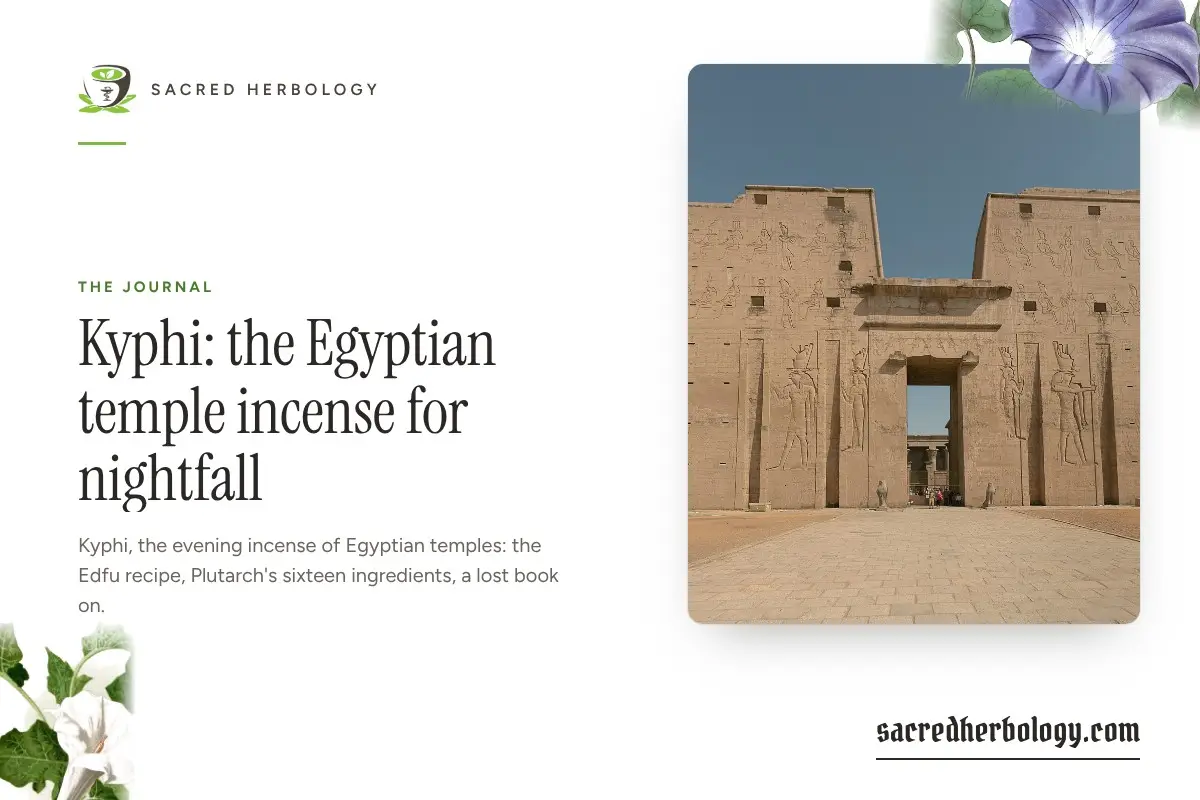
Picture the end of a day at the temple of Horus at Edfu, a little over two thousand years ago. The sun is going down behind the western hills. The light in the courtyard has turned the colour of honey, the great stone pylon throws a shadow across the forecourt, and inside the dim halls a priest lifts a bronze censer shaped like a human arm. In the cupped hand at its end a few coals glow. He drops onto them a handful of small, dark, sticky pellets, and a smoke rises that smells of resin and raisins, of wine and honey, of something green and something like warm bread.
That smoke had a name. The Greeks wrote it kyphi. The Egyptians called it kapet. It was the evening incense of the Egyptian temples, burned as the sun began its journey through the night, and it was famous enough across the ancient world that Greek philosophers wrote about it, Greek and Roman physicians copied out its recipe, and a priest of Mendes is said to have written a whole book on how to make it.
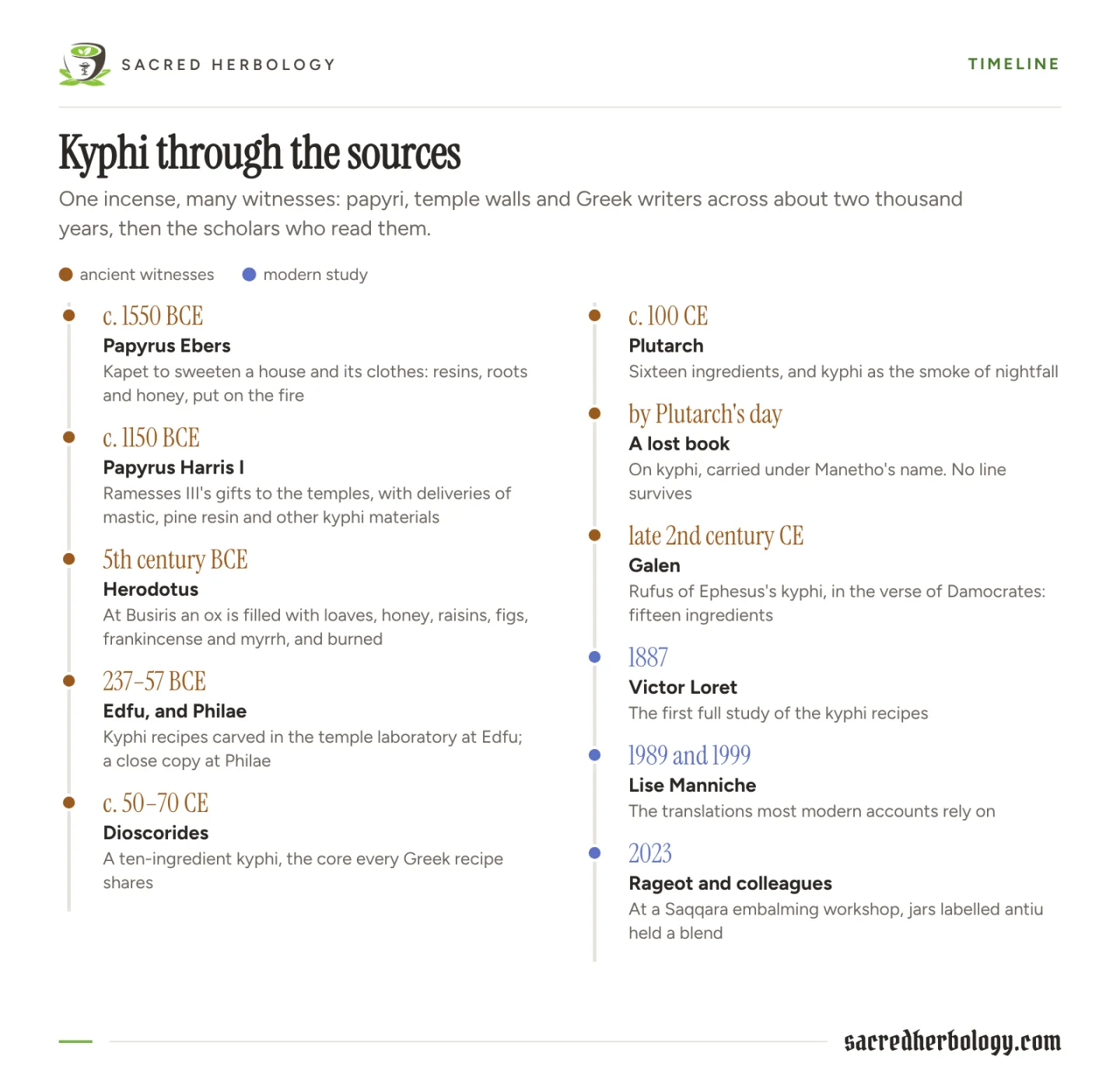
Kyphi is one of the few ancient incenses whose recipe we actually have, and we have it several times over, in sources stretching across about two thousand years: a medical papyrus from the New Kingdom, a king’s list of temple gifts, recipes carved into the walls of two Ptolemaic temples, and a run of Greek writers from Plutarch to Galen. None of them agree exactly. That is the first thing to know about kyphi, and the most useful. There was never one kyphi. There was a family of evening incenses built around the same core of resin, fruit, wine and honey, made a little differently by every temple and every writer who touched it.
This piece follows that family from the temple walls to the modern shop shelf. It looks at what the word meant, what the priests thought the smoke did, what went into it, which ingredients nobody can now identify, how a lost book became a legend, how kyphi slipped into the physicians’ books and the magicians’ papyri, and what you are buying when you buy a cone or a jar labelled “kyphi” today. I’ll finish with how to burn it well and how to keep your lungs and your household safe while you do.
A word for smoke
Start with the name, because it tells you how the Egyptians thought about the thing.
Kyphi is a Greek spelling, and the Romans took it over as cyphi. Behind it lies an Egyptian word that Egyptologists write as kapet (kꜣp.t), built on a verb meaning to burn incense, to fumigate, to cense. E. A. Wallis Budge put it in his hieroglyphic dictionary of 1920, and the link between kyphi and kapet was already being drawn in the nineteenth century. In its plainest sense kapet means a fumigation: something you burn so that its smoke fills and changes a space.
You will often read that kyphi is named in the Pyramid Texts, the funerary spells carved inside the royal pyramids of the late Old Kingdom, around 2350 to 2180 BCE. I have not been able to tie that to a particular utterance, and the passages usually quoted use general words for incense and fumigation. So treat it as a claim that comes up often in popular books, and keep an open mind about it. What is certain is that the word kapet belongs to an old and wide vocabulary of burning, and that by the New Kingdom it had settled on a particular kind of compound incense.
The ordinary Egyptian word for incense was a different one, senetjer. It is built on netjer, the word for a god, and it is often explained as “that which makes divine”. Whether or not an Egyptian priest heard that meaning every time he said the word, the idea runs through all the temple texts. Incense purified the space, made it fit for a god, and was itself a gift the god enjoyed. The gods were thought to have a scent of their own. In the temple reliefs a god breathes in the smoke the king offers, and in the hymns the god’s presence is announced by a sweet smell.
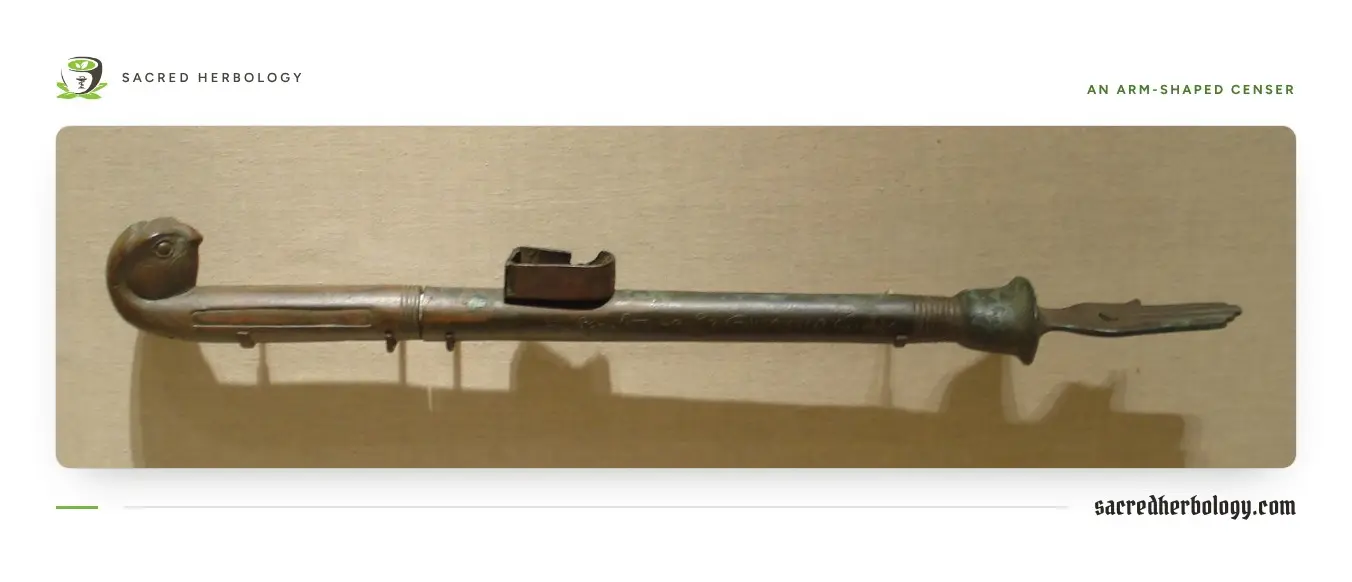
The tool that carried kapet into the sanctuary is one of the loveliest objects of Egyptian ritual. Reliefs from many periods show the king or a priest holding an arm-shaped censer: a long handle carved as a forearm, ending in an open hand that holds a small cup of coals. Often a little box for the pellets sits halfway along the arm, and the officiant takes the pellets out one at a time and drops them into the burning cup. If you keep one scene from this whole story, keep that one: a man in a white kilt holding out a bronze arm, a few pellets falling from his fingers into a cupped bronze hand, and a thin line of smoke rising towards the face of a god.

Three smokes for the sun’s day
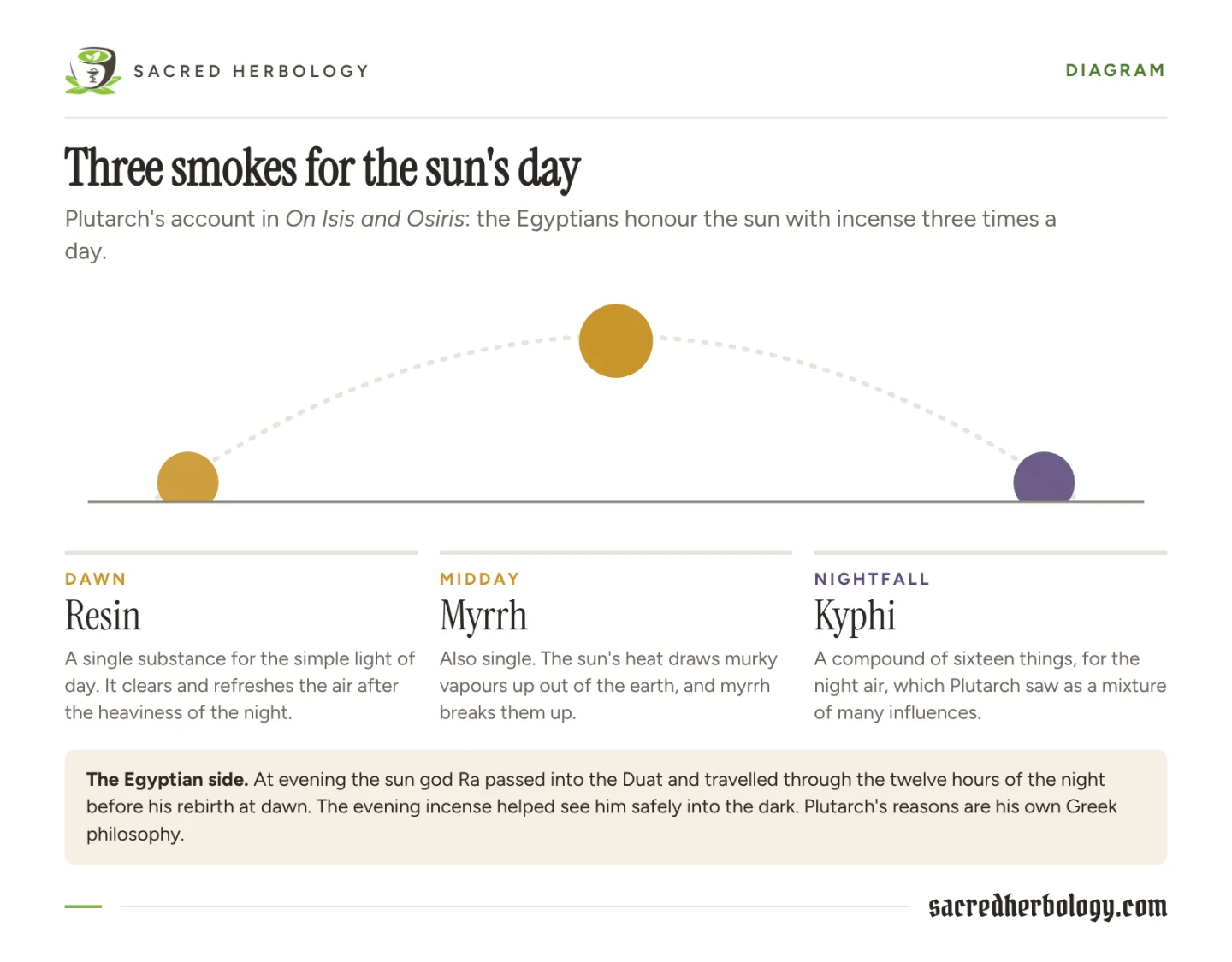
The best-known statement of what kyphi was for comes from a Greek writer who loved Egypt but was never an Egyptian priest. Plutarch of Chaeronea, a priest of Apollo at Delphi, wrote his essay On Isis and Osiris late in the first century or early in the second. Near its end he describes how the Egyptians honour the sun with incense three times a day. At dawn they burn resin, to clear and refresh the air after the heaviness of the night. At midday they burn myrrh, because the sun’s heat draws murky vapours up out of the earth and myrrh breaks them up. And at nightfall they burn kyphi.
The first two smokes have their own stories, and I have told the myrrh one already in this Journal. Here I want to stay with the third, because Plutarch’s reason for it is interesting. He says that the light of day is simple and single, so it suits single substances, resin and myrrh, which he thinks are born of the sun. The night is different. The night air, as he sees it, is a mixture of many influences, so the evening offering should be a compound made of many things with many qualities. Kyphi, with its sixteen ingredients, is the incense of a complicated hour.
That reasoning is Greek philosophy, and Plutarch gives it his own colour. The Egyptian background makes sunset matter for another reason. In Egyptian religious thought the sun god Ra sailed across the sky by day in one boat and, at evening, passed into the Duat, the underworld, where he travelled through the twelve hours of the night in another boat, beset by dangers, before being reborn at dawn. The great royal books of the underworld in the tombs of the Valley of the Kings, the Amduat and the Book of Gates, map that night journey hour by hour. Every evening was a small crisis in the order of the world. The temples marked it. The evening incense was part of how the priests saw the sun safely into the dark.
So the temple day has three markers on it: a sunrise with a resin tear, a high sun with a lump of myrrh, and a setting sun with a small dark pellet. The Egyptians and Plutarch would have given you different reasons for that third smoke. They agreed about when it was burned.
Plutarch also says what he thinks kyphi does to people. Its aromatic substances, he writes, lull the body into sleep, ease the cares of the day without the help of wine, and brighten and polish the part of the mind that dreams, “like a mirror”. He compares it to the music of the lyre that the Pythagoreans played before they slept. That is a beautiful passage, and it is the origin of most of what is said about kyphi and dreams in modern books. It is a report of what a Greek philosopher believed about an Egyptian incense. It gives us his view, and it gives us a hint of how the priests talked about their own smoke. It does not tell us that kyphi does anything to anyone’s sleep.
The oldest recipe: a house and its clothes
The oldest surviving recipe for something called kyphi has nothing to do with a temple.
The Papyrus Ebers is a long medical scroll written in hieratic, the cursive script of Egyptian scribes, around 1550 BCE, early in the New Kingdom. It is about twenty metres long and carries several hundred recipes and remedies. It takes its name from the German Egyptologist and novelist Georg Ebers, who bought it in Luxor in the winter of 1872 to 1873, and it is now in the university library at Leipzig. The Norwegian physician Bendix Ebbell published an English translation in 1937, and later scholars have revised many of his readings. On the scroll itself the text runs in neat lines of brown-black hieratic, right to left, with the openings of each recipe picked out in red ink.
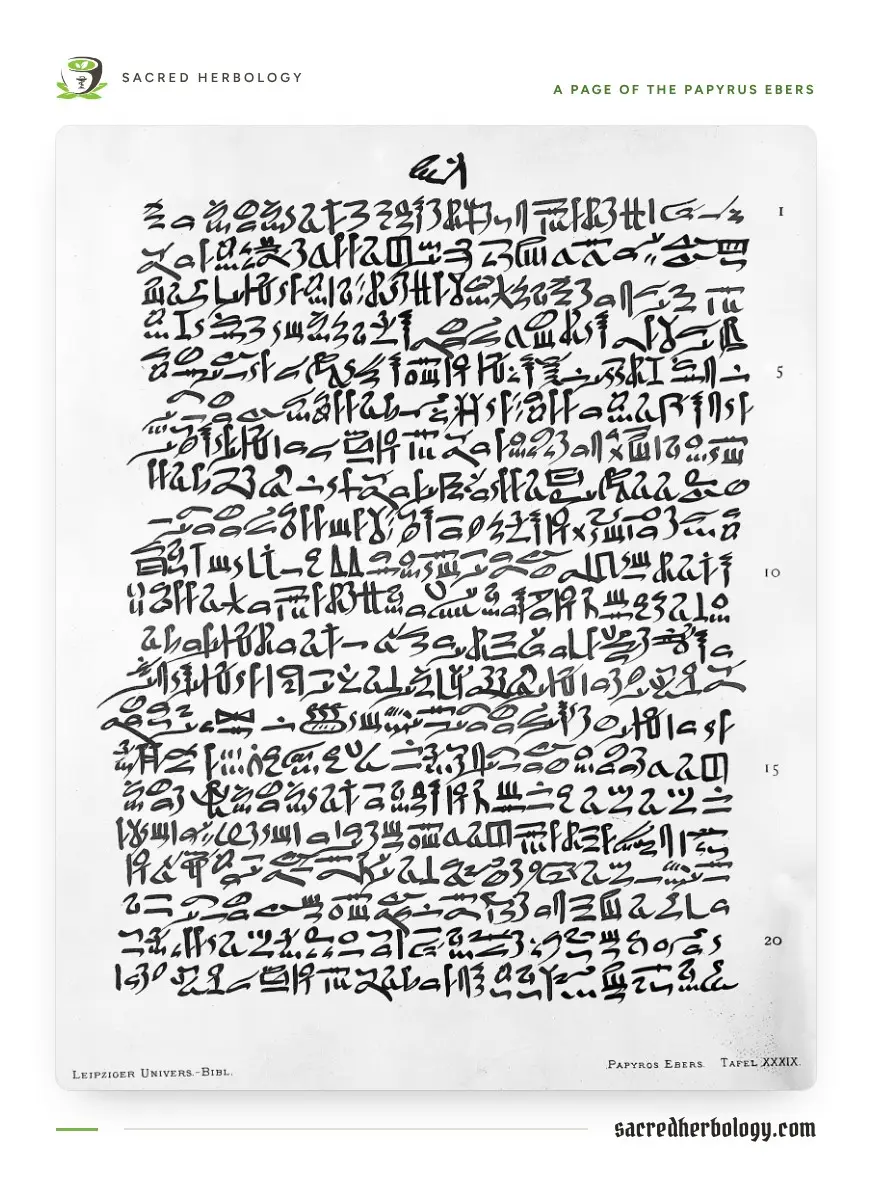

Among its recipes are directions for kapet to make the smell of a house or of clothes pleasant. The ingredients, as Ebbell and later translators read them, include dry myrrh, frankincense, pine kernels or pine resin, cyperus, mastic, an aromatic reed, cinnamon and others, ground together and bound with honey. The mixture is put on the fire. A second, related entry describes forming the mass into pellets, and adds that women used them to sweeten their breath. Scholars disagree on several of the plant names, and the translations differ from each other in places.
What I like about the Ebers recipe is how domestic it is. Long before kyphi was the incense of the gods at nightfall in a Ptolemaic temple, the same word covered a household perfume, something to burn in a room to make it smell sweet and to hang the scent in your linen. Some of the earliest kyphi was the smell of a well-kept house.
There is no raisin in the Ebers recipe, and no wine. Those came later, or at least we only see them later. The core of resins, aromatic roots and honey was there from the start.
The king’s storehouse
The next witness is one of the most impressive documents to survive from ancient Egypt.
Papyrus Harris I, in the British Museum, is about forty-one metres long, the longest Egyptian papyrus known. It was drawn up at the start of the reign of Ramesses IV, around 1150 BCE, and records the gifts his father Ramesses III had made to the temples of Egypt during his thirty-one-year reign: land, cattle, workers, ships, grain, gold, linen, oil, wine and great quantities of incense and aromatics, temple by temple, with Thebes, Heliopolis and Memphis taking the lion’s share. It was bought in 1855 by Anthony Charles Harris, a merchant and collector in Alexandria, and James Henry Breasted put it into English in the fourth volume of his Ancient Records of Egypt in 1906. The modern French edition by Pierre Grandet appeared in 1994.
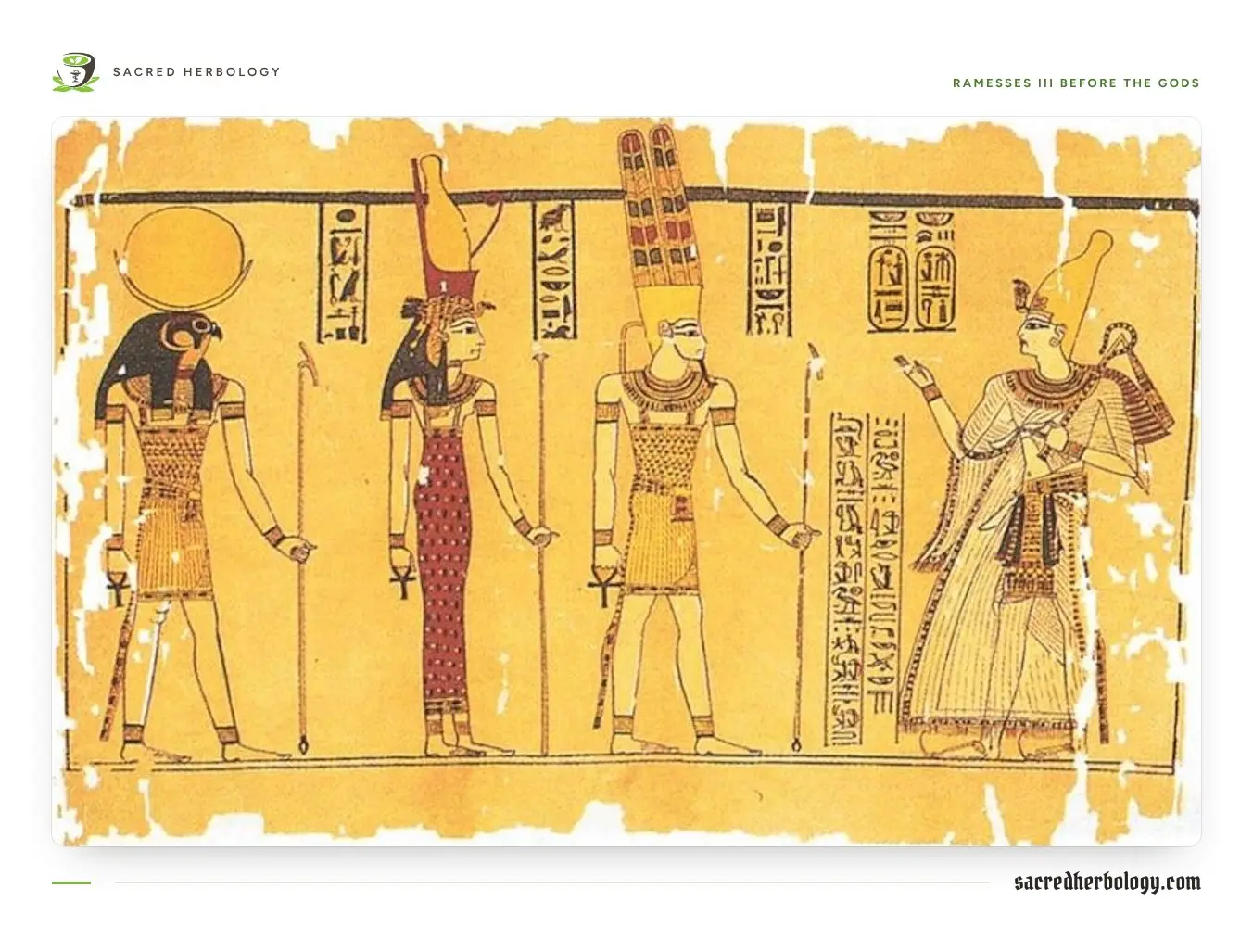

Harris I does not give a kyphi recipe. What it does give, among the endless lists, are deliveries to the temples of the aromatic materials that later appear in the Edfu kyphi recipes: mastic, pine resin, an aromatic grass, mint, an aromatic reed and cinnamon among them. Lise Manniche, the Danish Egyptologist who has written most fully on Egyptian fragrance, reads these as the raw materials for temple kyphi, with the raisins, wine and honey supplied locally. That is an inference, and a sensible one. It tells us that by the twelfth century BCE kyphi, or something very close to it, was being made in the temples on a scale large enough to need deliveries from the royal stores.
Picture it as a long strip of papyrus unrolled, with the temples named along it and the bundles of resin, jars of honey and baskets of fruit going to each.
The perfume room at Edfu
The fullest kyphi recipes are carved in stone.
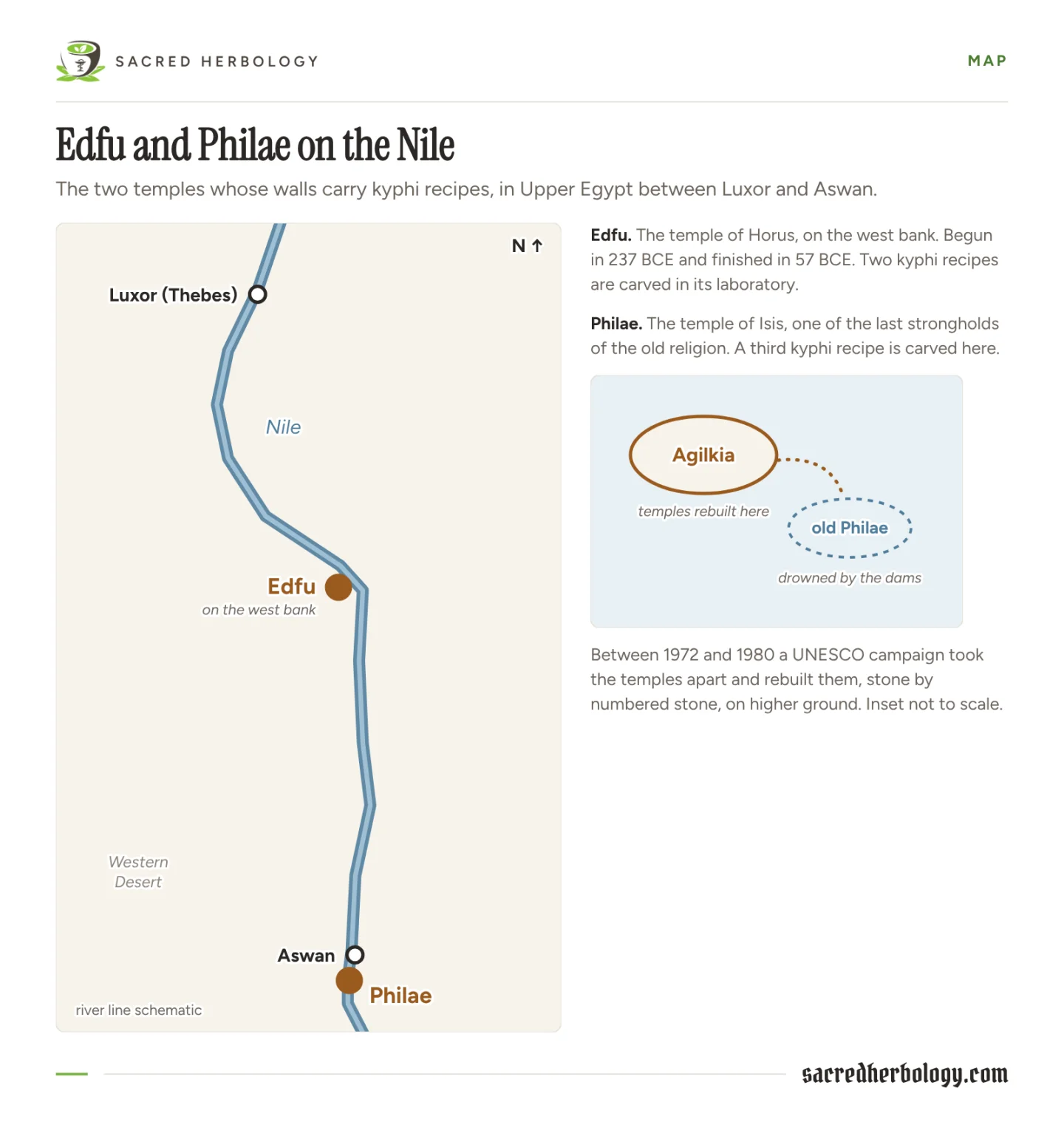
The temple of Horus at Edfu, on the west bank of the Nile in Upper Egypt between Luxor and Aswan, is the best-preserved large temple in Egypt. It was begun in 237 BCE under Ptolemy III and finished in 57 BCE, so it belongs to the time when Egypt was ruled by the Greek-speaking Ptolemies, the dynasty that ended with Cleopatra VII. The Ptolemies built in the old Egyptian style and kept the old rites going, and the priests of their temples carved an enormous body of religious and ritual text on the walls, much of it recording knowledge that had been handed down for many centuries.
Off the hypostyle hall at Edfu there is a small room that Egyptologists call the laboratory. Its walls are covered with recipes for the temple’s perfumes, unguents and incenses, the substances the priests needed to anoint the god’s image and fill the halls with scent. Two of those recipes are for kyphi. A third kyphi recipe, very close to them, is carved in the temple of Isis at Philae, near Aswan.
Philae deserves a word on its own. It was one of the last strongholds of the old religion. The last known hieroglyphic inscription in Egypt was carved there in 394 CE, and the temple of Isis was finally closed under the emperor Justinian in the 530s. When the Aswan dams were built in the twentieth century the island was drowned for much of each year, and between 1972 and 1980 an international rescue campaign led by UNESCO took the temples apart and rebuilt them, stone by numbered stone, on the higher island of Agilkia nearby. The kyphi recipe of Philae survived that journey with the rest. On the map, the Nile runs from Luxor south to Aswan, with Edfu on its west bank and Philae’s two islands, the drowned one and the new one.
The French Egyptologist Victor Loret was the first to work through the kyphi recipes seriously, in a long article in the Journal asiatique in 1887 called “Le kyphi, parfum sacré des anciens Égyptiens”. He compared the temple texts with the Greek recipes and tried to identify each ingredient. A century later Lise Manniche returned to them in An Ancient Egyptian Herbal (1989) and Sacred Luxuries (1999), and her translations are the ones most modern accounts rely on, often without saying so.
As they are usually read, the Edfu and Philae recipes share one set of ingredients and differ in the quantities. The list runs to about sixteen items:
- raisins, wine and honey, the sweet, sticky base;
- frankincense and myrrh, the two great imported resins;
- mastic and pine resin, the Mediterranean resins;
- an aromatic reed, often translated as sweet flag;
- aspalathus, a fragrant thorny wood;
- an aromatic grass, usually translated as camel grass;
- mint;
- cinnamon;
- cyperus, the aromatic tuber of a sedge;
- juniper berries;
- pine kernels;
- and an ingredient called peqer (also written peker), which nobody has securely identified.
The method, as Manniche and others read the inscriptions, is long and fussy. The dry aromatics are ground in a mortar in batches. The ground material is moistened with wine and left to stand. Raisins are soaked in wine and added. The mass is reduced over heat. Honey and frankincense are heated together separately and reduced, the two preparations are combined, myrrh is ground in last, and the finished paste is shaped into small pellets. The work takes days, and the inscriptions treat it with the care of any temple rite. The details vary between the translations, and I give them here only as a picture of what the priests did. The quantities and timings on the walls are the temple’s business, and this piece is not a recipe card.
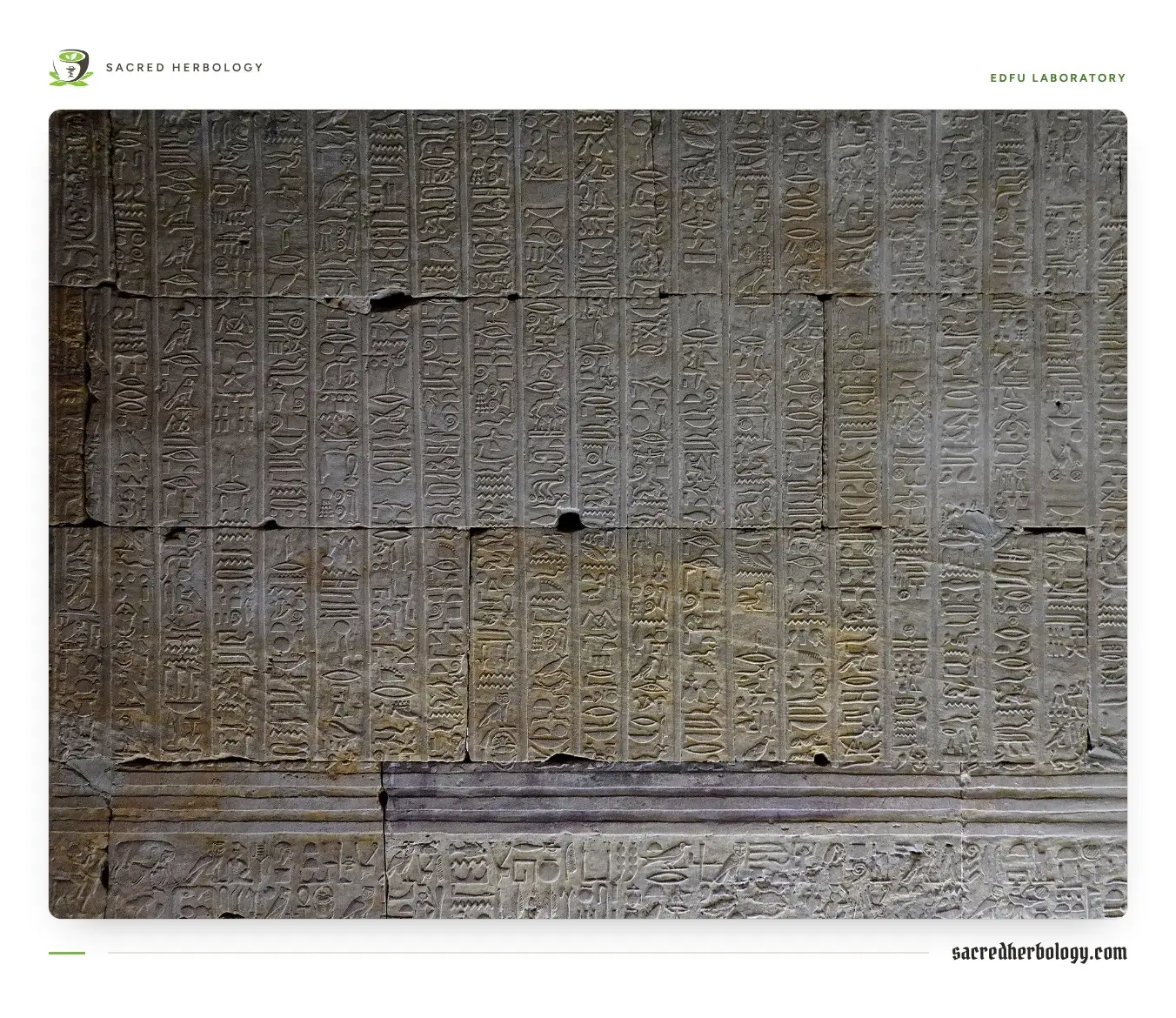

What the Edfu texts make clear is that kyphi was a crafted, aged, sticky preparation, closer in its making to a fruit paste than to a pinch of dried herbs. That matters for how it behaves on a coal. A kyphi pellet does not flare. It softens, bubbles, chars at the edges and gives off a heavy, sweet, rounded smoke in which the resins sit on a bed of caramel and fruit.
Sixteen things
Plutarch’s list is the one most people know, and it is worth reading carefully because it differs from the temple walls.
In the Loeb translation by F. C. Babbitt, Plutarch gives the sixteen ingredients as honey, wine, raisins, cyperus, resin, myrrh, aspalathus, seseli, mastic, bitumen, rush, sorrel, both kinds of juniper berry (the larger and the smaller), cardamom and sweet flag. He adds that these are mixed not at random but while sacred writings are read aloud to the perfumers as they work.
Set that beside the Edfu list and a few things stand out.
- The core is the same: honey, wine, raisins, resins, myrrh, aromatic roots and grasses, juniper.
- Frankincense is missing from Plutarch’s list, which fits his own scheme, since resin and myrrh have their own hours earlier in the day.
- Mint, cinnamon and the unknown peqer do not appear.
- Bitumen, the black mineral pitch the Greeks associated with the Dead Sea, is in. So are seseli, an umbellifer of the carrot family that the ancients knew under several names, and sorrel (the Greek word, lapathon, covers the docks and sorrels of the genus Rumex), which is a strange thing to find in an incense.
Set the ingredient lists side by side, with the ten of Dioscorides from the physicians’ books beside them, and you can see in one glance what the texts agree on and how much room each tradition left itself.
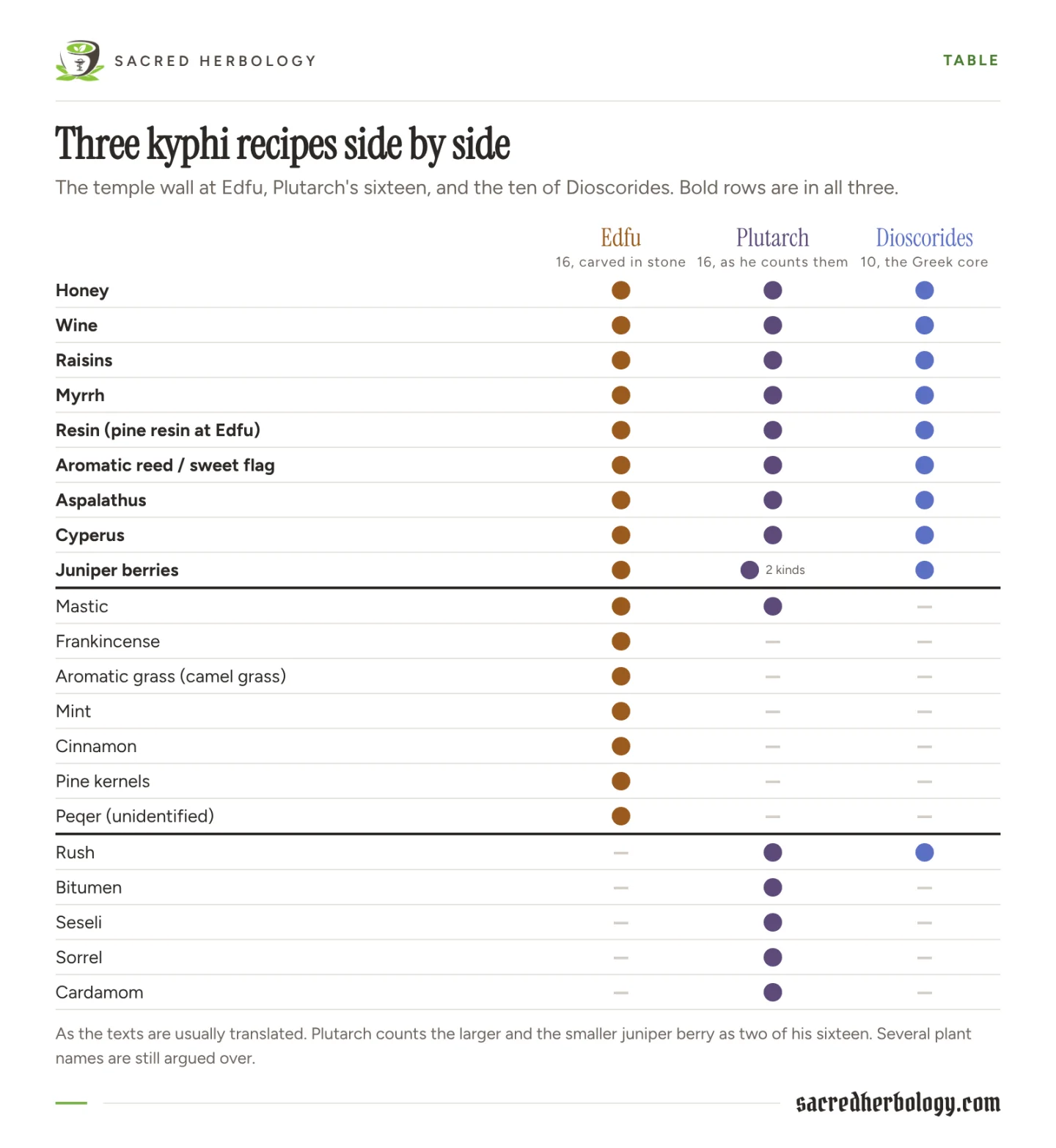
Plutarch then does something very Greek. He stops to admire the number. Sixteen, he points out, is a square of a square, four times four, and it is the only number that, as a square, has a perimeter equal to its area: a four-by-four square has sixteen units of area and sixteen units round its edge. He admits this has little to do with his subject and moves on. It tells you how kyphi looked to a learned Greek in the age of the Pythagorean revival. The sixteen ingredients were a fact about Egyptian practice. The meaning of sixteen was his own.
The reading of sacred writings during the mixing is worth stopping on too. It fits everything we know of Egyptian temple practice. The making of sacred substances was itself a rite, done in a sacred room by people in a state of purity, with words spoken over the work. At Edfu the recipe for kyphi sits in the same room as the recipes for the god’s ointments, in a temple whose walls are covered with words. A substance made that way carried the words with it. That is the Egyptian view, reported on its own terms.
Where did Plutarch get his list? He names no source here, but he names Manetho elsewhere in the essay, and Greek writers credited a priest called Manetho with a whole book on kyphi. That brings us to the lost book.
Manetho of Mendes and the lost book
Manetho is a famous name in Egyptology. A priest of Sebennytos in the Nile Delta, writing in Greek in the early third century BCE under the first Ptolemies, he composed a history of Egypt, the Aegyptiaca, that gave us the system of thirty royal dynasties still used today. The history itself is lost and survives only in quotations by later writers, mostly Josephus and the Christian chronographers. W. G. Waddell gathered those fragments for the Loeb Classical Library in 1940.
Several other books were attributed to Manetho in antiquity, and one of them was on kyphi. The Suda, the great Byzantine encyclopedia compiled in the tenth century, has two entries that matter here. One describes a Manetho of Mendes in Egypt, a chief priest, who wrote on the preparation of kyphi. The other, under kyphi itself, says that Manetho the Egyptian prepared it and sends the reader back to his entry. Waddell lists the work as On the Making of Kyphi and prints the Suda notice as one of his fragments. That English title is a modern rendering of the Suda’s description. No line of the book survives.
Whether the Manetho of Mendes who wrote on kyphi was the same man as the Manetho of Sebennytos who wrote the history is uncertain. The Suda itself seems to distinguish two. Several of the minor works carried under Manetho’s name are not mentioned until the first century CE, two or three hundred years after the historian, and some scholars suspect that a famous priestly name was borrowed to give authority to later writings. That is a common pattern in the ancient world, and you will meet it again and again in the esoteric literature, where books are hung on great names to make them weightier. The honest position is this: a book on kyphi under Manetho’s name existed by Plutarch’s time or soon after, it is lost, and we do not know who wrote it.
Mendes is a nice detail all the same. It was a city of the eastern Delta, sacred to a ram god, and in the Greek and Roman world it was famous for a perfume, the Mendesian, a rich oil scented with myrrh, cassia and resin. Between 2018 and 2019 the Egyptologist Dora Goldsmith and the historian of ancient science Sean Coughlin, working with Robert Littman and Jay Silverstein, the excavators of nearby Tell Timai, ancient Thmuis, reconstructed a version of the Mendesian perfume from the Greek recipes. It was shown at the National Geographic Museum in Washington in 2019 and written up in the journal Near Eastern Archaeology in 2021 under the title “Eau de Cleopatra”. The team were careful to call their result a possible version. That project dealt with a perfume oil. It came from the same corner of Egypt and the same habit of mind, and it shows how far a careful reconstruction can go and where it has to stop.
The names nobody can pin down
If you have been keeping count of the ingredients you could not quite picture, you are in good company. Every serious attempt to remake kyphi runs into the same wall. The Egyptian and Greek plant names do not map neatly onto modern species, and some do not map at all.
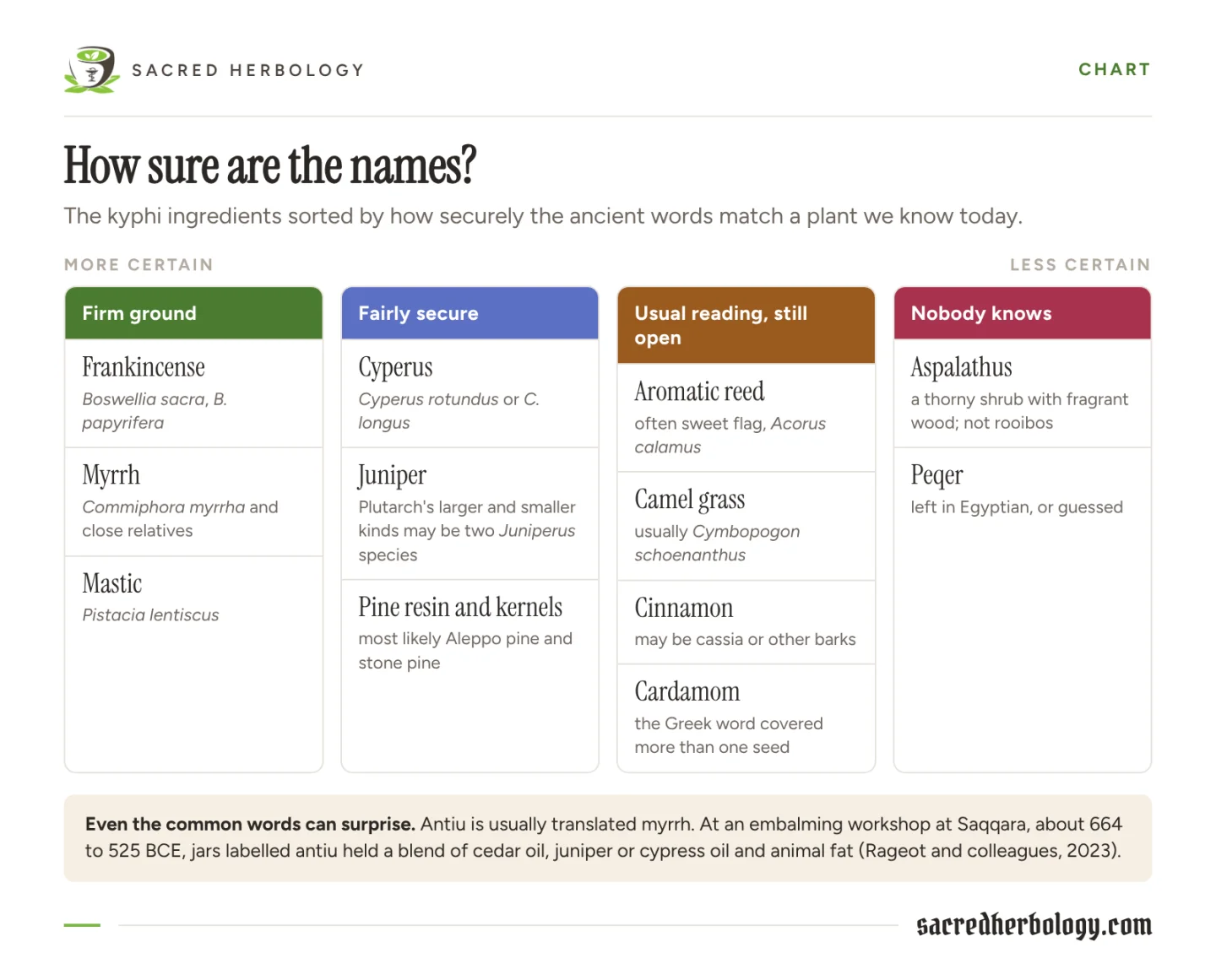
A few examples make the point.
- Aspalathus appears in Dioscorides, Plutarch and the temple recipes. The Greeks describe a thorny shrub with fragrant wood. It has been identified with various spiny members of the pea family, with a thorny bindweed, and with others. Nobody knows. The modern rooibos plant of South Africa is called Aspalathus linearis, but that is a name borrowed by eighteenth-century botanists, and it has nothing to do with the ancient one.
- Peqer, at Edfu, is simply unknown. Translators leave it in Egyptian or guess.
- The aromatic reed is usually translated sweet flag, Acorus calamus, a marsh plant whose fragrant part is the rhizome. It is native to Asia, and whether the Egyptians had it by trade is itself an open question. The Egyptian and Greek words for fragrant reeds and grasses were used loosely, and several plants have been proposed. The same is true of the camel grass, usually identified as Cymbopogon schoenanthus, a lemongrass relative of North Africa and the Middle East.
- Cyperus is fairly secure as the aromatic tuber of a sedge, a member of the family Cyperaceae, most often Cyperus rotundus or Cyperus longus.
- Juniper berries in Plutarch come in two kinds, larger and smaller, which may mean two species of Juniperus native to the eastern Mediterranean. Strictly, a juniper “berry” is a small cone whose scales have turned soft and fleshy.
- The resins are the firm ground. Frankincense is the gum resin of Boswellia trees, a mixture of resin, water-soluble gum and essential oil that seeps from cuts in the bark, chiefly Boswellia sacra of southern Arabia and Somalia and Boswellia papyrifera of Ethiopia, Eritrea and Sudan. Myrrh comes from Commiphora myrrha and its close relatives. Both belong to the torchwood family, Burseraceae. Mastic is the resin of Pistacia lentiscus, a shrub of the cashew family that grows right round the Mediterranean, and the pine resin and pine kernels most likely came from the Aleppo pine, Pinus halepensis, and the stone pine, Pinus pinea.
- Plutarch’s cardamom may or may not be the cardamom in your kitchen. The Greek word was used for more than one aromatic seed.
- Even the commonest words can surprise. The Egyptian word antiu is usually translated myrrh, and sometimes frankincense. In 2023 a team led by Maxime Rageot and Philipp Stockhammer published chemical analyses in Nature of residues from an embalming workshop at Saqqara, dated to about 664 to 525 BCE. Vessels labelled antiu held a mixture of cedar oil, juniper or cypress oil and animal fat. In that workshop, at least, the word named a blend.
That last finding is a useful warning for anyone reading a kyphi recipe. When an Egyptian text names an ingredient, it may name a plant, a part of a plant, a grade, a blend, or a trade name that covered several things. The modern translation is a best guess, made by careful people, and sometimes the guess is wrong.
So when someone sells you an “authentic Edfu kyphi”, the most it can honestly be is one modern maker’s reading of a set of ancient names, with substitutions where the original is lost. That can still be a lovely thing to burn. Buy it knowing what it is.
Kyphi in the physicians’ books
Kyphi did not stay in the temples. From the first century CE it turns up in the Greek medical writers, who treated it as a compound with uses in medicine as well as in worship.
Pedanius Dioscorides, a Greek physician from Anazarbus in Cilicia who probably served with the Roman army, wrote his De materia medica around 50 to 70 CE. It became the standard book on medicinal substances for the next fifteen hundred years. In his first book, among the aromatic preparations, he describes kyphi as an incense welcome to the gods, which the priests in Egypt use lavishly. His recipe has ten ingredients: raisins, wine, honey, myrrh, resin, juniper berries, an aromatic reed, a fragrant rush, aspalathus and cyperus. Those ten are the core that every Greek recipe shares.
A generation or two later, Rufus of Ephesus, one of the most respected physicians of the Roman empire, devised his own kyphi. His recipe survives because a physician called Servilius Damocrates, who had the odd habit of writing his recipes in iambic verse so they could be memorised, turned it into a poem. And that poem survives because Galen of Pergamon, the most influential doctor of antiquity, copied it out in the second book of his treatise On Antidotes, written in the late second century. Galen’s kyphi has fifteen ingredients, adding cassia, cinnamon, saffron, bdellium and spikenard to the familiar core, and he notes that cardamom can stand in for cinnamon. So a single kyphi recipe reaches us through three doctors, one inside another: Rufus inside Damocrates inside Galen. Picture three nested frames, like a set of Russian dolls, with a pellet at the centre.
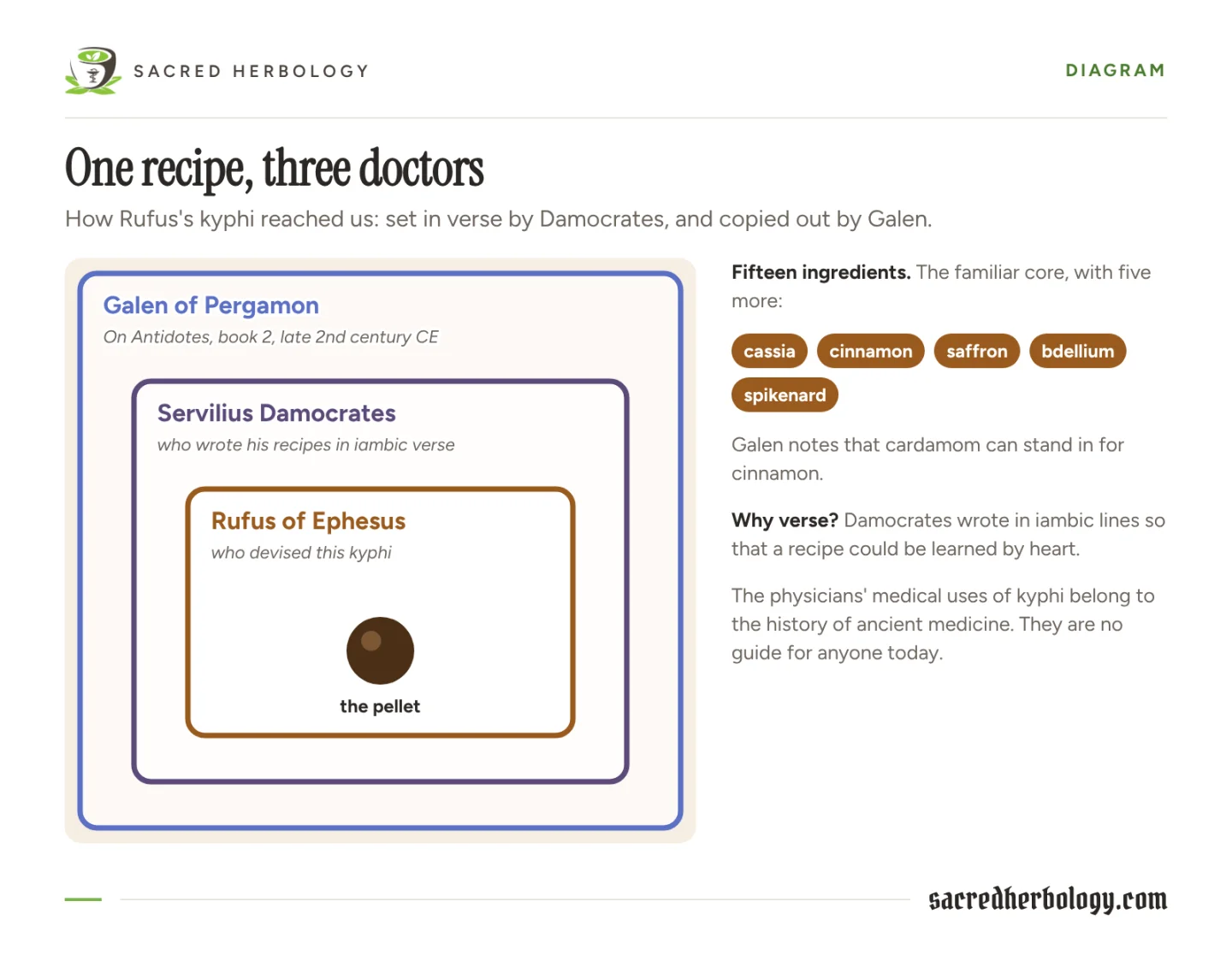
The physicians had their own reasons for valuing kyphi, and Plutarch says the Egyptians used it as a potion and a salve as well as a smoke. Those medical uses belong to the history of ancient medicine, and they are well recorded in the editions listed at the end. I am not going to repeat them here. A Greek physician’s opinion of what kyphi did inside the body is evidence of what he believed, and it is no guide for anyone today. The kyphi on this page is something to smell.
The Greek medical tradition carried kyphi on through Byzantium. You will read that Paul of Aegina, a seventh-century physician of Alexandria, recorded a “lunar” kyphi of twenty-eight ingredients and a “solar” kyphi of thirty-six. I have seen that repeated in many places, but I have not been able to check it against an edition of Paul’s text, so I pass it on as a report and not as a fact.
Kyphi among the magicians
This next part is ESOTERIC material, and I am labelling it that way on purpose. It comes from the learned magic of Roman Egypt, written down by educated practitioners, and it belongs with the grimoires, not with village custom.
The Greek Magical Papyri are a body of handbooks of ritual magic from Roman and late antique Egypt, written mostly in Greek with some Demotic and Coptic, dating from roughly the second century BCE to the fifth century CE. Many of them came out of a single find near Thebes in the early nineteenth century. The standard English translation, edited by Hans Dieter Betz, appeared in 1986.
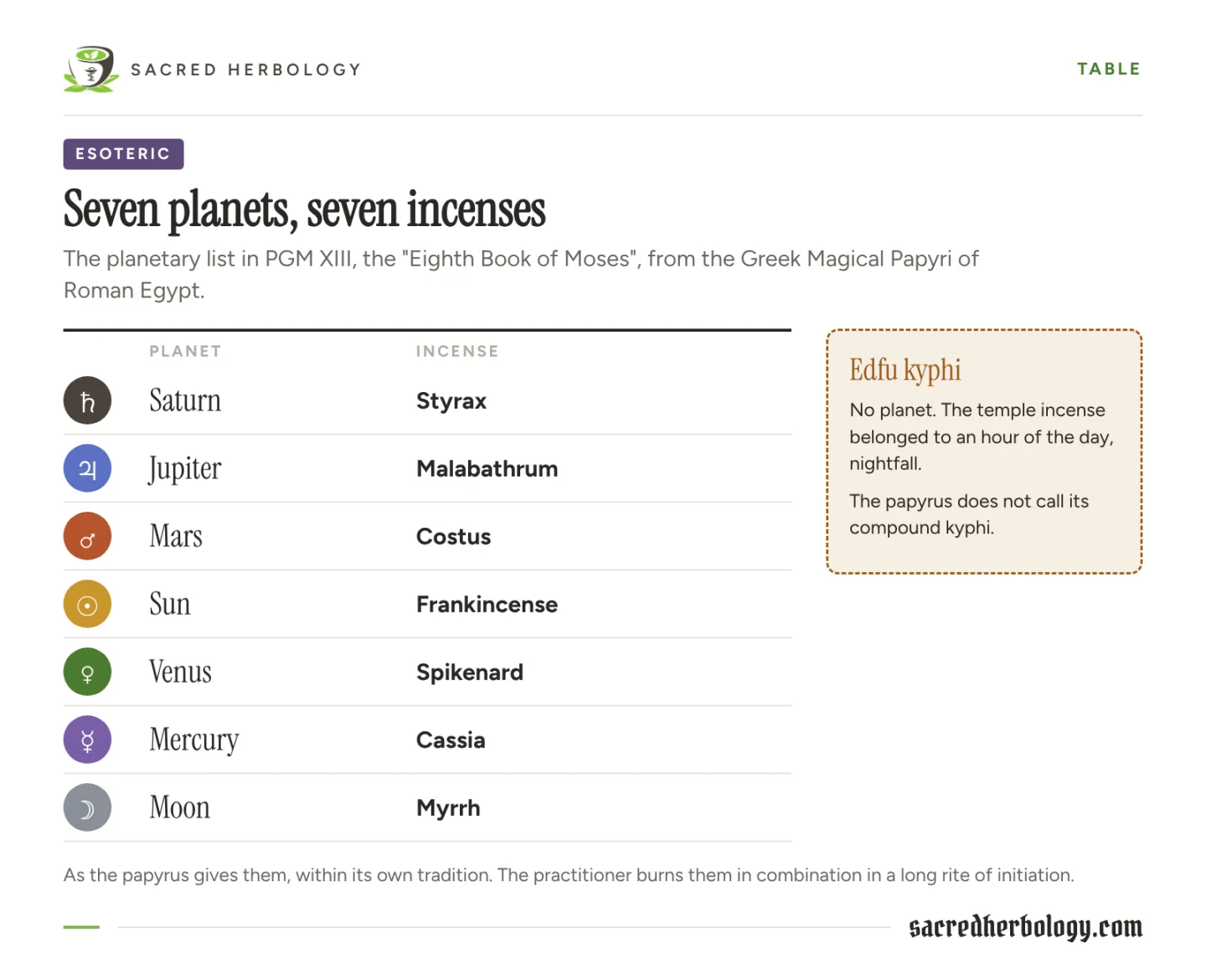
One of the most elaborate texts in the collection, PGM XIII, presents itself as the “Eighth Book of Moses”. It is full of incense. Among its instructions is a list of the seven planets with an incense for each: styrax for Saturn, malabathrum for Jupiter, costus for Mars, frankincense for the Sun, spikenard for Venus, cassia for Mercury and myrrh for the Moon. The practitioner burns them in combination as part of a long rite of initiation.
The text does not call this compound kyphi, and I won’t either. What it shows is the same habit of mind that produced the temple incense: the belief, within the tradition, that a compound smoke of many aromatics, made with words spoken over it, could reach powers that a single resin could not. The magicians of Roman Egypt were in many cases trained in temple scribal traditions, and the Egyptologist Robert Ritner argued that much of this magic grew out of priestly practice. The planetary incense of the Eighth Book of Moses sits somewhere between the evening kyphi of Edfu and the planetary fumes of the Renaissance magicians. Set out as a table of correspondences, the seven planets sit in one column and their incenses in the other, and the Edfu kyphi has no row at all, because it belonged to no planet.
That is how these traditions saw the world. It is no part of my job to tell you whether the planets answer to styrax and cassia. My job is to tell you accurately what the papyri say, and that is what they say.
The ox stuffed with sweet things
Before we leave the ancient world, there is one more scene worth seeing, because it shows that the smell of kyphi was part of a whole Egyptian palette of sacred scent.
Herodotus, the Greek historian who travelled in Egypt in the middle of the fifth century BCE, describes a festival of Isis at Busiris in the Delta. After the sacrificial ox is killed and prepared, he says, the Egyptians fill its body with pure loaves, honey, raisins, figs, frankincense, myrrh and other aromatics, pour oil over it and burn it. Set beside the kyphi recipes, that list is striking: the same honey, the same raisins, the same frankincense and myrrh. The sweet fruit-and-resin smell of kyphi was the smell of an Egyptian offering in general, the smell of the gods being fed.
It also tells you why kyphi has fruit and wine in it at all. Those ingredients bind the paste, and they also burn with the smell of a feast. To an Egyptian nose, a temple at nightfall smelled like a banquet set for someone who could not be seen.
Kyphi today
Kyphi never quite disappeared from European memory. Loret’s 1887 study brought it back into scholarship, the occult revivals of the late nineteenth and twentieth centuries took a deep interest in everything Egyptian, and modern incense makers, pagan and ceremonial groups and people drawn to the reconstruction of Egyptian religion have all made and burned their own versions. Today you can buy kyphi as loose pellets, as cones, as sticks, as a perfume oil and even as a scented candle.
A few things are worth knowing when you meet it on a shelf.
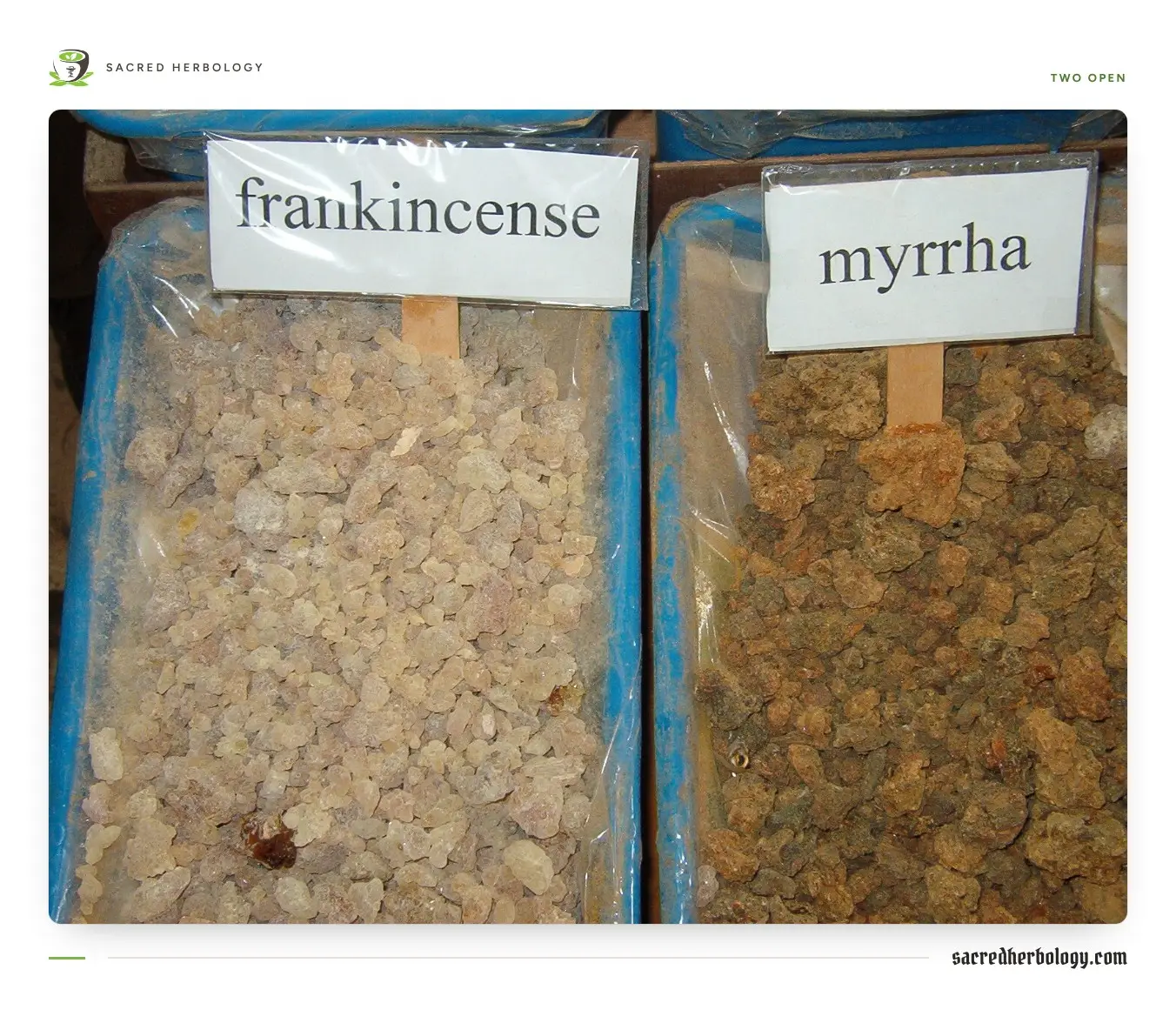

- Every modern kyphi is a reconstruction or an interpretation. The good makers say which ancient source they follow, Edfu, Plutarch, Dioscorides or Galen, and what they substituted for the ingredients nobody can identify.
- Many commercial kyphis include things no ancient recipe names. Sandalwood, benzoin, rose and vanilla are common additions, made for the modern nose. That is fine, as long as the label is honest.
- Some modern kyphi blends and articles add blue lotus, cannabis or other mind-altering plants, and claim that the Egyptian priests used kyphi to induce visions or trance. No ancient kyphi recipe names any of them. That is a modern invention of recent decades, and it is often attached to Plutarch’s line about bright dreams, which says something much gentler. I have written about the blue lotus elsewhere in this Journal, and I won’t go over that ground again.
- Kyphi made in the old way is sticky, dark and smells of fruit and resin even before it is lit. Bone-dry, crumbly “kyphi” that smells mostly of one essential oil is something else.
- The resins in a blend are only as good as the resins the maker bought. Frankincense is traded in grades, sorted by colour, size and cleanness, with the pale, large, clean tears at the top and dark siftings and dust at the bottom, and a bag sold simply as “frankincense” may hold more than one species without saying so. Myrrh is often mixed with cheaper resins from other Commiphora trees, such as opopanax and bdellium. Cheap incense of every kind is sometimes stretched with pine rosin or perfumed with synthetic fragrance oils. You cannot test for any of this at home. A good supplier will tell you the species and where it was harvested, and the best can show you a laboratory analysis of the batch.
- Several of the ancient ingredients are now under real pressure in the wild. Frankincense from the Horn of Africa is in decline, and you should ask where the frankincense and myrrh in any blend came from.
People also ask whether you can eat kyphi, because the old recipes are full of honey, wine and raisins, and the Ebers papyrus mentions women chewing it for their breath. The answer is no. A modern kyphi is an incense. It may contain resins, oils or other materials that were never meant to be swallowed, and makers often add ingredients you would not want in your mouth. Keep it in the censer and out of reach of children and pets, who may well be drawn by the sweet smell. Raisins and grapes are poisonous to dogs, so a dropped pellet is worth picking up. If a child swallows some, call the Poisons Information Centre on 13 11 26; if a pet does, ring your vet.
The kyphi plants in a tropical garden
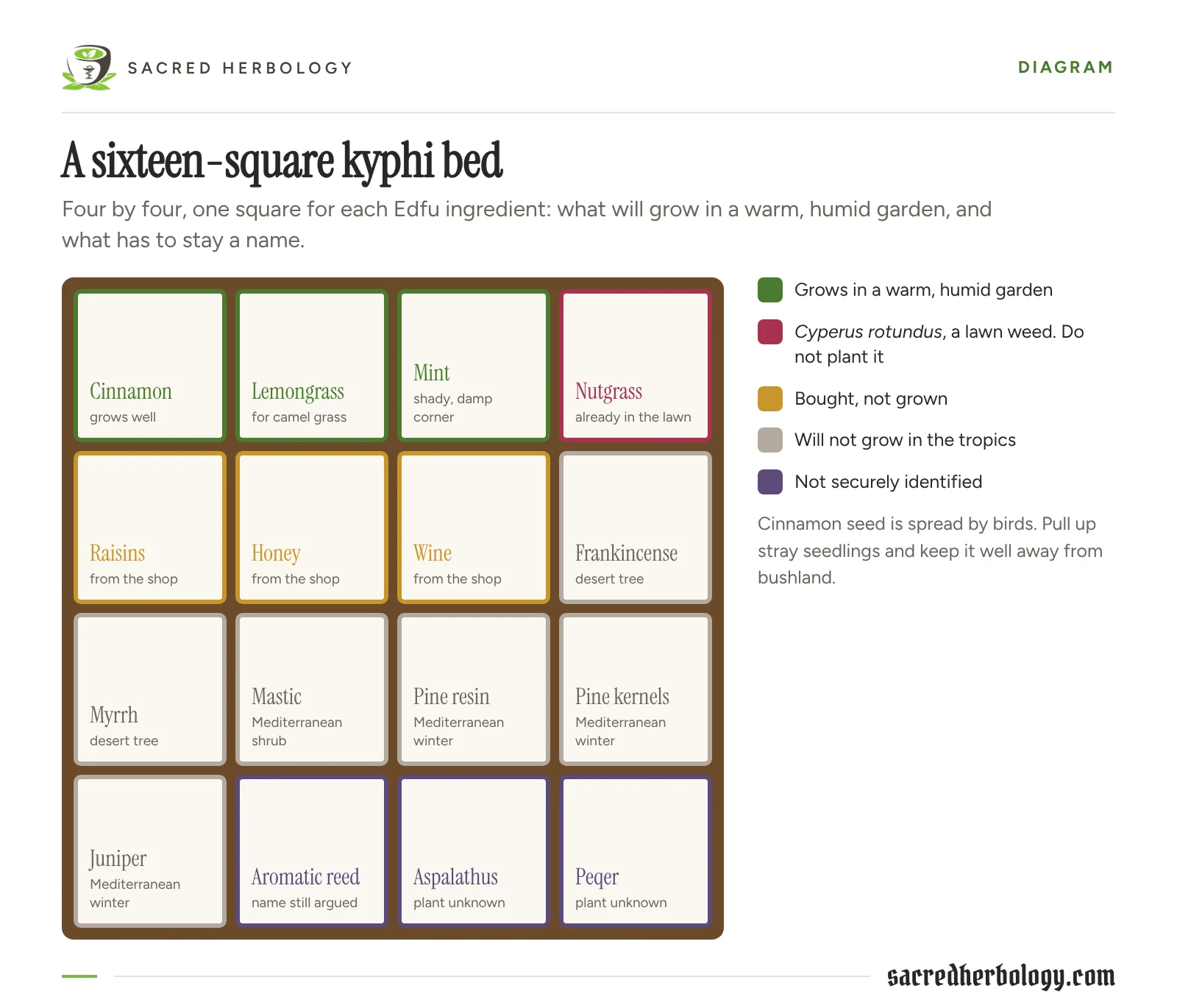
You cannot grow a whole kyphi in one garden. Frankincense and myrrh are desert trees, juniper and Aleppo pine want a Mediterranean winter, and mastic comes from a Mediterranean shrub, the best of it from the Greek island of Chios. But a surprising number of the kyphi family will grow in a warm, humid garden, and growing them is the best way I know to learn what the ancient words smelled like.
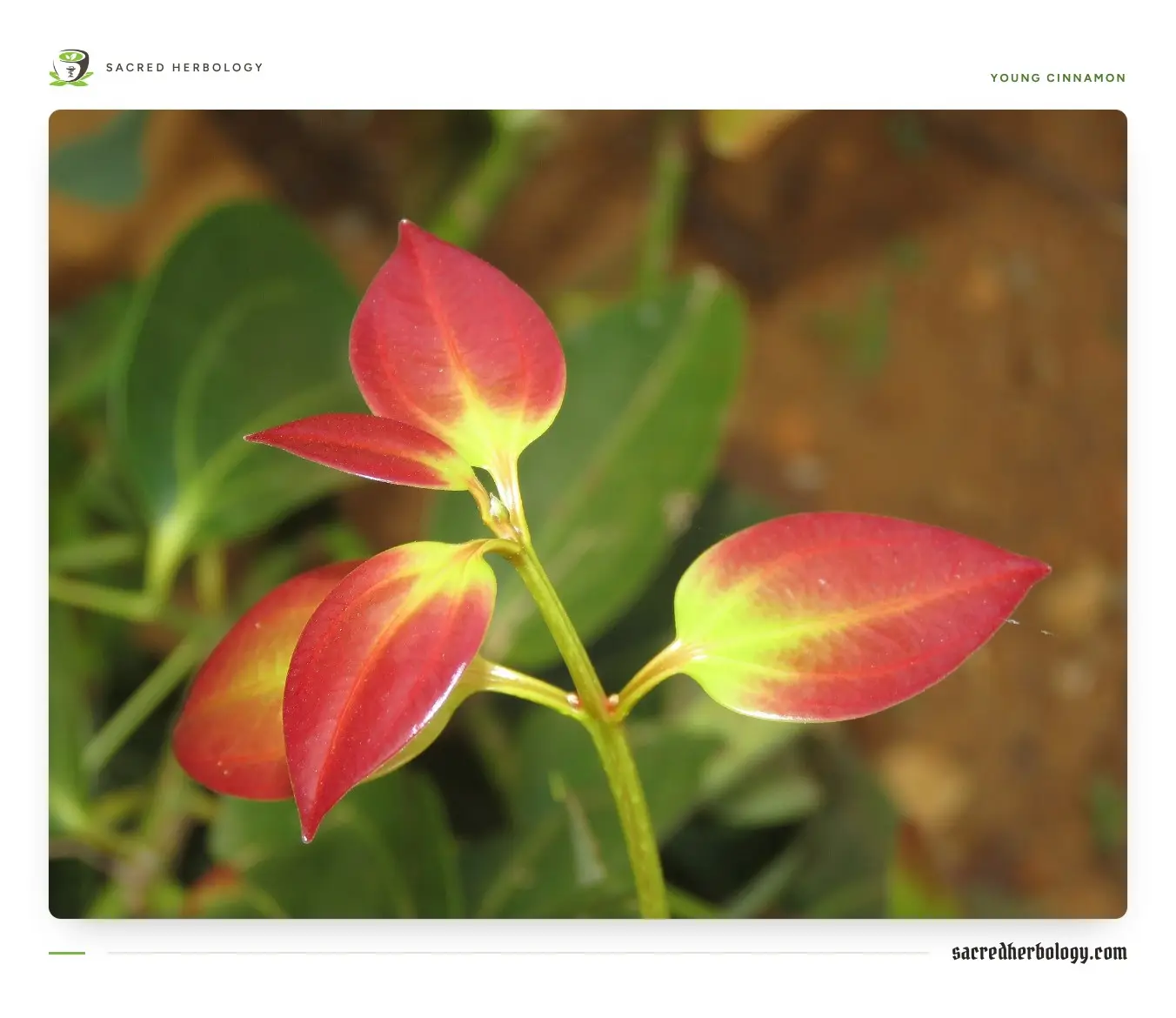

- Cinnamon, Cinnamomum verum, the Sri Lankan tree whose inner bark is the spice, grows well in a hot, humid garden. Its young leaves are flushed red, and a scraped twig gives you the smell straight away. Birds carry its seed, and it has run wild in the forests of the Seychelles, so pull up stray seedlings and keep it well away from bushland. Bear in mind too that the “cinnamon” of the Egyptian and Greek texts may not be this plant. Cassia, Cinnamomum cassia, and other barks were traded under similar names.
- Lemongrass, Cymbopogon citratus, is a close relative of camel grass, in the same genus, and thrives in our heat and rain. Crush a leaf and you have a fair idea of the “aromatic grass” of the temple lists.
- Nutgrass, Cyperus rotundus, needs no help from anyone. It is one of the worst lawn weeds in Queensland. Dig up one of its little tubers, scrape it and smell it, and you will understand why it went into kyphi. It is earthy and faintly woody. Please do not plant it on purpose. If you have a lawn, you almost certainly have it already.
- Mints of several kinds, Mentha species, grow happily in a shady, damp corner, though they sulk in the hottest months.
- Grapes struggle in the humid tropics, but a dish of raisins from the shop will tell you more about kyphi than any amount of reading. Warm a few in your hand and smell them. That deep, sweet, brown note is the base the resins sat on.
A small kyphi bed could be a square of four by four, sixteen squares, with the plants we can grow in some and the names of the ones we can’t grow chalked into the others. Plutarch would have liked that.
Burning it well
Kyphi burns differently from a single resin, and it is worth getting the hang of it.
- Use a proper charcoal disc in a heat-proof bowl half filled with sand or ash. Light the disc and wait until it is glowing grey all over before you add anything.
- Add one small pellet at a time. Kyphi is sticky and sugary, and too much at once will smother the coal and burn to an acrid smoke. Let each pellet soften and finish before you add the next.
- Hold the disc with tongs while you light it, stand the bowl on a heat-proof mat, and never leave a lit coal unattended. The bowl and sand get hot enough to burn a hand and scorch a table.
- Keep a small spoon or pair of tongs handy to scrape off the charred residue, which builds up quickly with fruit-based incense.
- Open a window. Incense smoke is still smoke, full of fine particles, and it can set off an asthma attack. If you have asthma or any other chest or lung condition, or you are pregnant, keep well back from it or skip it. Keep it away from babies, small children and pet birds, whose lungs are easily hurt by smoke.
- The charcoal disc gives off carbon monoxide as it burns, which you can’t see or smell. Never burn it in a closed room, a tent or a car. If anyone feels headachy, dizzy or sick, get them into fresh air. In an emergency call 000, or the Poisons Information Centre on 13 11 26.
- Never put bitumen, tar or any petroleum product on a coal, whatever Plutarch’s list says. Burning bitumen gives off harsh, irritant fumes, whether it is the natural asphalt of the ancient world or a modern product.
- Store pellets and charcoal out of reach of children and pets.
The smoke at sunset
Every evening, for many centuries, someone in an Egyptian temple dropped a few dark pellets into a bronze hand as the light went out of the sky. They believed the god was there to smell it, and that the sun was going into a dangerous dark from which it would return in the morning. Greek visitors watched them and wrote it down. Greek doctors borrowed the recipe. Magicians wrote compound incenses of their own for the planets. Scholars of the nineteenth century tried to read the temple walls, and scholars of our own century have tested the residues in ancient jars and found that even the simple words were not as simple as they looked.
What reaches us is a family of recipes, a handful of names we can’t identify, and a smell we can come close to. You do not need to share the priests’ beliefs to enjoy that smell, or to understand why it mattered to them. Light a coal at sundown, drop on a pellet, and watch the smoke go up. For a few minutes your room will smell much as an Egyptian temple did as the day closed.
Where this comes from
- Plutarch, De Iside et Osiride 52 and 79-80, in Moralia vol. V, trans. F. C. Babbitt (Loeb Classical Library, 1936); and ed. and trans. J. Gwyn Griffiths (University of Wales Press, 1970).
- Herodotus, The Histories 2.40, trans. A. D. Godley (Loeb Classical Library, 1920).
- Dioscorides, De materia medica, book 1, trans. Lily Y. Beck (Olms-Weidmann, 2005).
- Galen, De antidotis 2.2, in C. G. Kühn, ed., Claudii Galeni opera omnia, vol. 14 (Leipzig, 1827).
- Manetho, ed. and trans. W. G. Waddell (Loeb Classical Library, 1940).
- The Suda, entries “Manethos” and “kyphi”, in the Suda On Line translation project (Stoa Consortium).
- B. Ebbell, The Papyrus Ebers: The Greatest Egyptian Medical Document (Levin & Munksgaard, Copenhagen, 1937).
- James Henry Breasted, Ancient Records of Egypt, vol. 4: The Twentieth to the Twenty-Sixth Dynasties (University of Chicago Press, 1906), Papyrus Harris I.
- Pierre Grandet, Le Papyrus Harris I (Institut français d’archéologie orientale, Cairo, 1994).
- Victor Loret, “Le kyphi, parfum sacré des anciens Égyptiens”, Journal asiatique 8th series, 10 (1887): 76-132.
- E. A. Wallis Budge, An Egyptian Hieroglyphic Dictionary (John Murray, London, 1920).
- Lise Manniche, An Ancient Egyptian Herbal (British Museum Publications, 1989).
- Lise Manniche, Sacred Luxuries: Fragrance, Aromatherapy and Cosmetics in Ancient Egypt (Cornell University Press, 1999).
- Hans Dieter Betz, ed., The Greek Magical Papyri in Translation (University of Chicago Press, 1986), PGM XIII.
- Robert K. Ritner, The Mechanics of Ancient Egyptian Magical Practice (Oriental Institute, Chicago, 1993).
- M. Rageot et al., “Biomolecular analyses enable new insights into ancient Egyptian embalming”, Nature 614 (2023): 287-293.
- R. J. Littman, J. E. Silverstein, D. Goldsmith, S. Coughlin and H. Mashaly, “Eau de Cleopatra: Mendesian perfume and Tell Timai”, Near Eastern Archaeology 84, no. 3 (2021).