
Open a jar of galbanum and you will know straight away that you are in unusual company. It does not smell like the other resins on the incense shelf. Frankincense is bright and lemony, myrrh is bitter and warm, benzoin is all vanilla and sweetness. Galbanum smells green. It smells like a snapped stem, like crushed green capsicum, like the sap that runs out of a celery stalk when you break it, with something resinous and slightly musky underneath that hangs about on your fingers for the rest of the day. Some people love it on first meeting. Plenty of people pull a face.
That face is part of the story. Galbanum is one of the four named ingredients in the holy incense of the book of Exodus, burned morning and evening in the Tabernacle and later in the Temple in Jerusalem. The other three were the sweet ones. Galbanum was the odd one out, and the rabbis of the Talmud noticed. They built a whole teaching on the fact that a bad-smelling resin had been put into the holiest perfume on earth, and that teaching is still read aloud in synagogues today.
So this piece follows a lump of green, sticky gum from the mountain slopes of northern Iran to the altar in Jerusalem, and then on through Greek philosophers, Roman farmers, the rabbis, a Renaissance magician, the tables of an English occultist, and the perfume houses of Paris in the twentieth century. At the end I’ll come back to what you are buying when you buy galbanum in Australia, how to burn it, and what grows in its family if you want to keep a relative of it in the garden.
A word on the beliefs first, as always. Much of this piece is about what people believed incense did: that it carried prayer upward, that it guarded a priest from death, that it drew down the influence of a star. I’ll report those beliefs as fairly as I can, on their own terms, and I won’t tell you they are true. The Temple incense belongs to a living religion, and I’ll describe it from its own published texts. Where the material comes from the learned magical books and the correspondence tables of the occult orders, I’ll label it esoteric, because that is its proper category. Where it comes from farmyards and households, I’ll call it folk custom. The two have different histories.
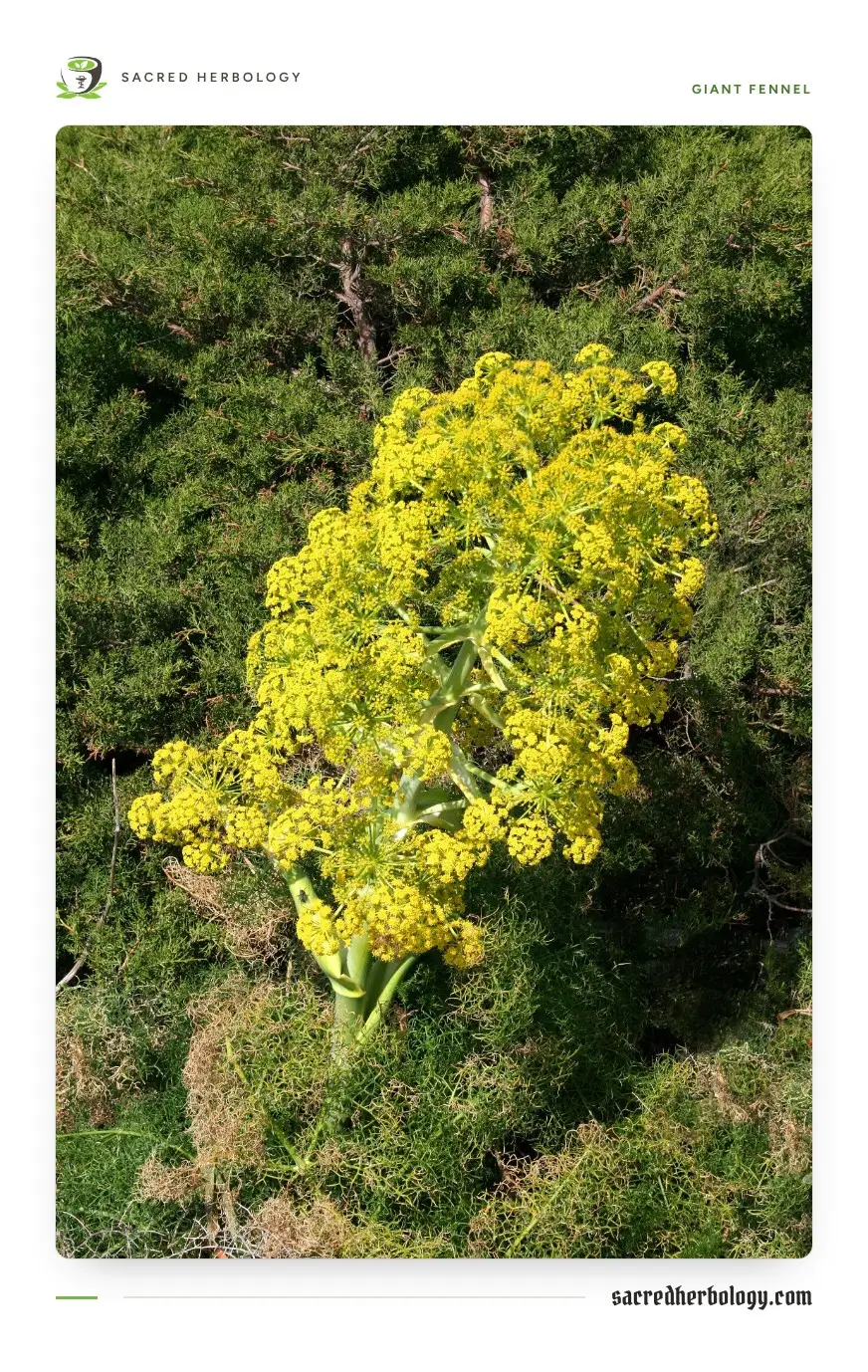
A giant fennel from the Iranian mountains
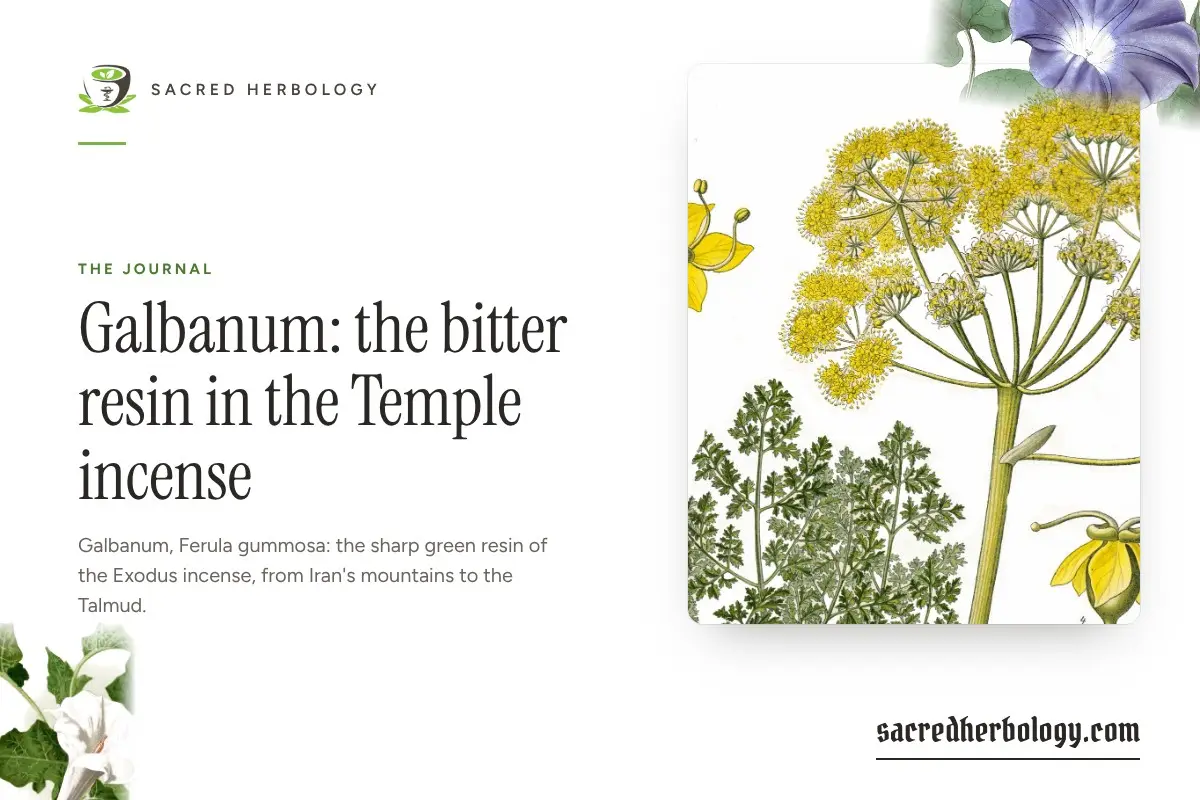
Galbanum is a gum resin, which means it is a mixture of gum (the part that dissolves in water), resin (the part that dissolves in alcohol and burns) and volatile oil, which carries the smell. Galbanum is unusually rich in oil for a gum resin, which is part of why it smells so loud. It comes from plants in the genus Ferula, in the carrot and parsley family, the Apiaceae (Umbelliferae in older books). The main source is Ferula gummosa, which you will also find in older books as Ferula galbaniflua. A close relative, Ferula rubricaulis, is often named alongside it, though many botanists now fold it into F. gummosa as the same species.
If you have grown fennel, dill or coriander and let them flower, you already know the shape of the plant. Ferula species are the giants of that family. They make a big rosette of finely cut, feathery leaves at ground level, and after some years of building up a thick, fleshy root, they send up a tall, stout flowering stem topped with umbrella-shaped heads of small yellow flowers. Many of them flower once and die, having spent everything they stored in the root on that one season of flowers and seed. The whole plant is full of milky, resinous sap that runs out wherever it is cut.
Ferula gummosa grows on dry, stony mountain slopes in Iran, from the Alborz range south of the Caspian Sea down through the Zagros, with populations reaching into Turkmenistan and Afghanistan. These are places with cold winters, hot dry summers and very little rain outside the cool season. The plant has adapted to that rhythm: it grows in the wet months and sits out the dry heat underground. Iran remains the main source of galbanum for the world market.
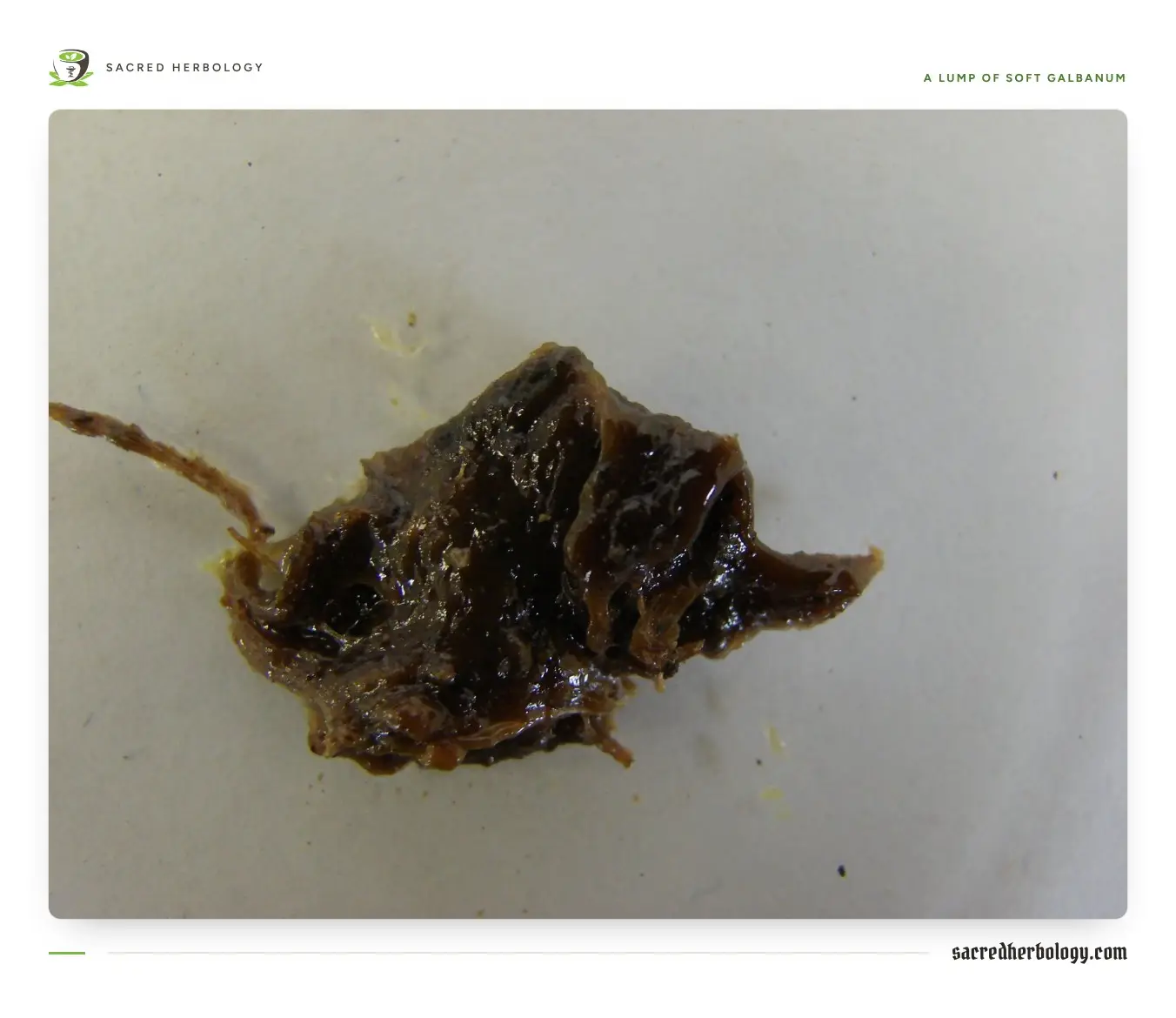
The gum is gathered much as asafoetida is gathered from its cousin. The collectors clear the soil from around the top of the root and cut into the lower stem or the crown of the root. The sap that oozes from the wound thickens and darkens in the air, and they come back to scrape it off. Some of it hardens into separate tears; more of it runs together into soft, sticky masses with bits of plant and grit caught in it. The trade has long recognised two sorts: a soft galbanum, sticky and almost syrupy in warm weather, and a hard galbanum in drier, firmer lumps and tears. The colour runs from pale yellowish green through honey-brown to a darker olive.

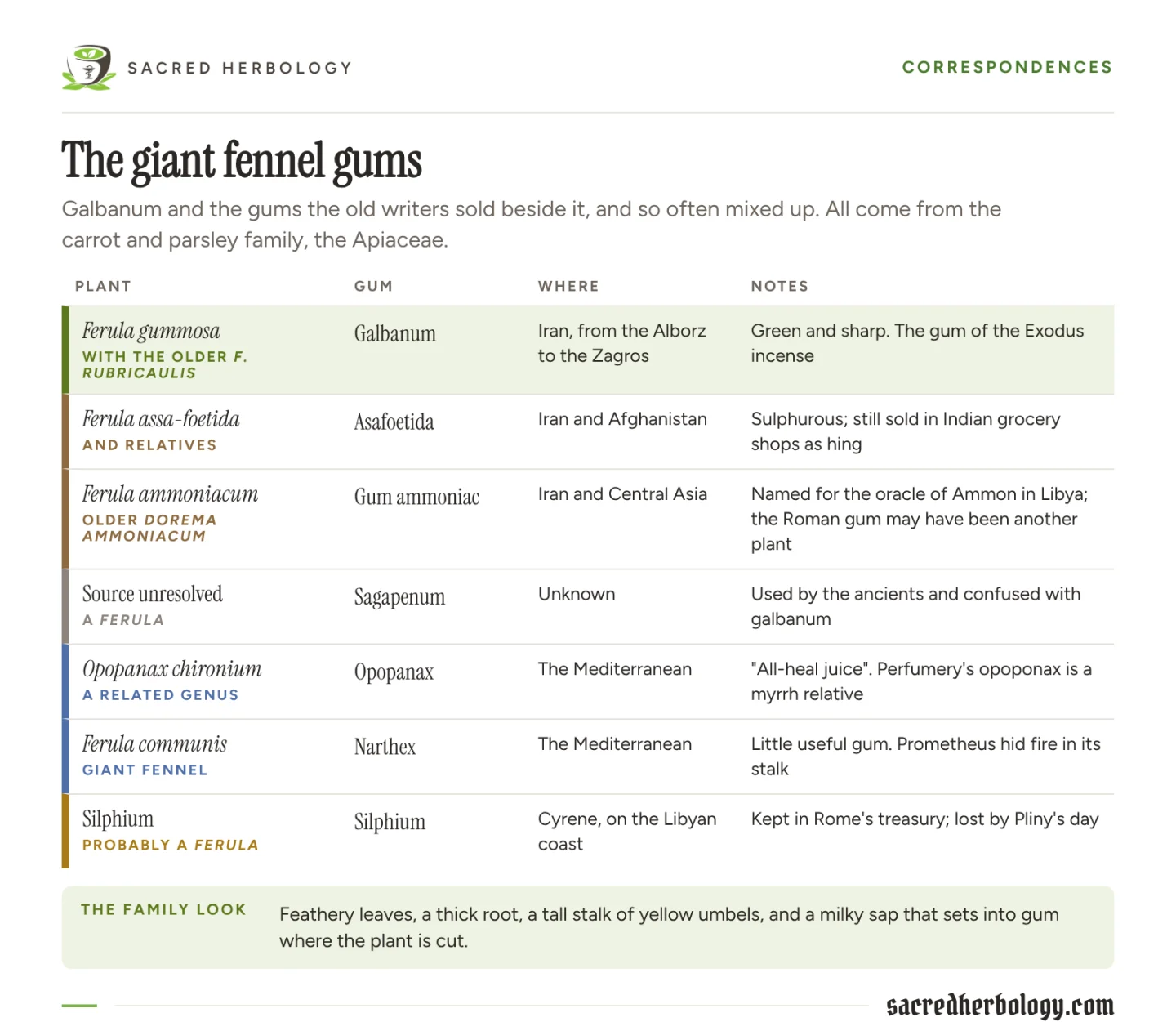
The family it belongs to is a strange one, and worth setting out, because the old writers knew several of these gums and mixed them up all the time:
- Ferula gummosa, with what older books call F. rubricaulis: galbanum, green and sharp.
- Ferula assa-foetida and relatives: asafoetida, the sulphurous gum still sold in Indian grocery shops as hing.
- Dorema ammoniacum, now usually moved into Ferula itself as Ferula ammoniacum: gum ammoniac, named for the region around the oracle of Ammon in the Libyan desert, though the gum the Romans knew may have come from a different plant.
- Sagapenum, another Ferula gum the ancients used and confused with galbanum. Which species gave it is still argued over.
- Opopanax chironium and its relatives: opopanax, “all-heal juice”, a gum resin from a related genus of the same family. The sweet “opoponax” of modern perfumery is a different resin altogether, from a myrrh relative.
- Ferula communis: the giant fennel of the Mediterranean, the Greek narthex, which gives little useful gum but has a long history of its own.
- Silphium: the lost plant of Cyrene, on the coast of modern Libya, whose gum the Greeks and Romans prized so highly that it was kept in the state treasury at Rome. Pliny says that in his day only one stalk had been found in living memory, and it was sent to the emperor Nero. Most scholars think silphium was a Ferula or something close to it.
Most of them were sold side by side in the same ancient markets, which goes a long way to explaining the muddle.
Milk, fat and a borrowed word
The Hebrew name in Exodus is chelbenah. Most scholars take it from the Semitic root that gives chalav, milk, or chelev, fat, and either sense suits a plant that bleeds a white, milky sap which sets into a fatty, sticky mass. The Greek chalbanē is a borrowing from the Semitic name, and Latin took it over as galbanum. Every European word for the stuff, French galbanum, German Galbanum, English galbanum, goes back through Latin and Greek to that Hebrew word for milk or fat.
The Persians, whose mountains grew it, had their own names. In Persian it has long been bārzad, and Arabic medical writers of the Islamic centuries used qinna among other names. A merchant in a medieval Baghdad market and a priest in Jerusalem a thousand years earlier would have known the same lump of gum by entirely different words, and that is how you get the confusion between galbanum, sagapenum and the rest in the old books. Names travelled along trade routes in one direction while the gum travelled in another.
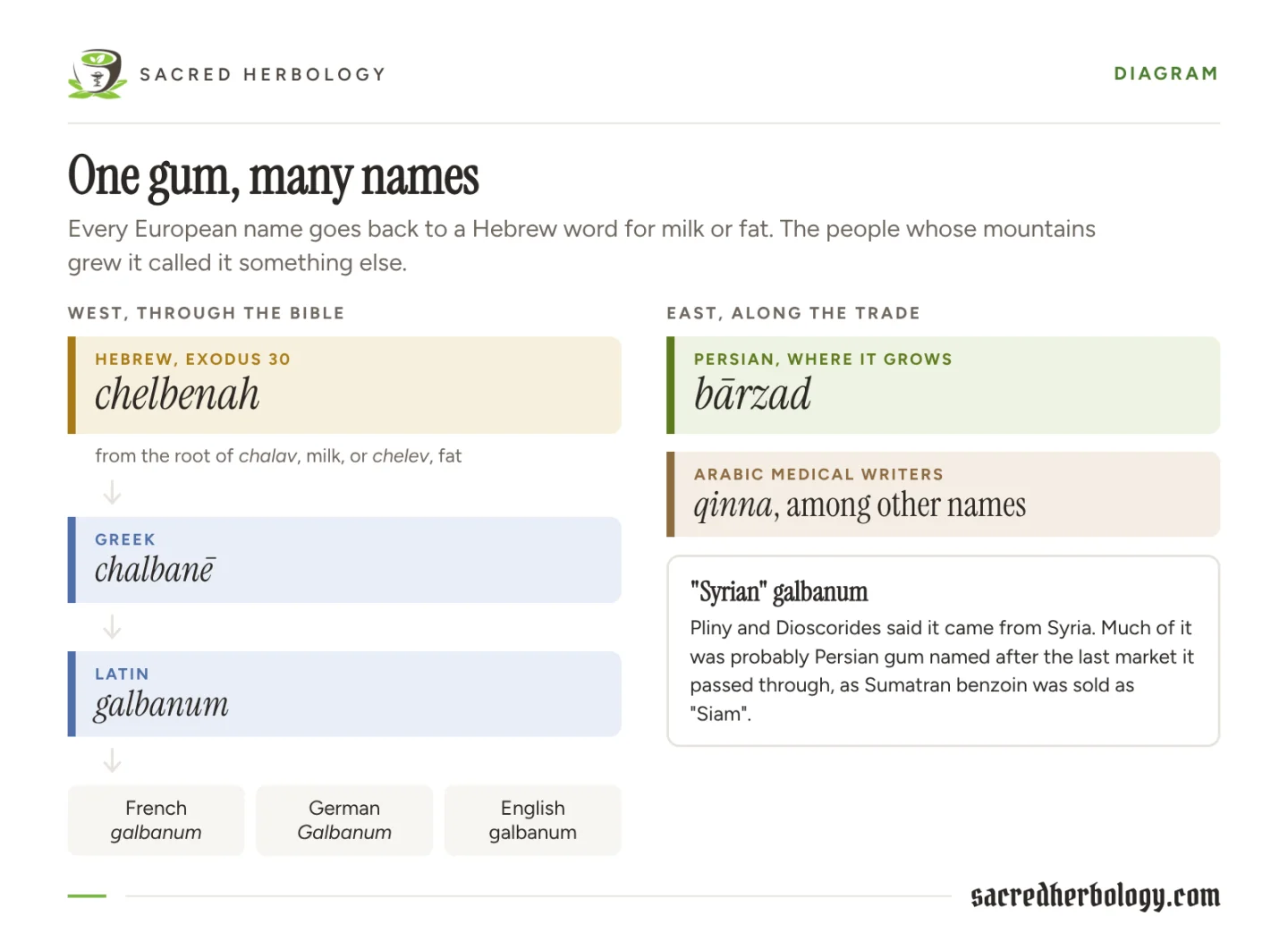
There is one scholarly wrinkle worth mentioning. Pliny and Dioscorides, the two great Roman-era authorities on plant products, both say galbanum came from Syria. The plant does not grow wild there today in any quantity, and several modern scholars think the Syrian galbanum of the classical writers was largely Persian gum that reached the Mediterranean through Syrian ports and was named for the place where the Romans bought it. That happens again and again in the history of resins. The Romans called it Syrian for the same reason Europeans later called Sumatran benzoin “Siam benzoin” or a Somali resin “Arabian”: they named it after the last market it passed through.
Four spices in equal weight
Here is the passage that made galbanum famous. In Exodus 30, after the instructions for the anointing oil, Moses is told how to make the incense for the golden altar that stands before the curtain of the Holy of Holies. In the plain modern English of most translations, he is to take sweet spices, stacte, onycha and galbanum, sweet spices with pure frankincense, each of equal weight, and make of them an incense, blended as by the perfumer, seasoned with salt, pure and holy. Some of it is to be beaten very small and put before the testimony in the tent of meeting, where God says he will meet with Moses. It is to be most holy. Whoever makes anything like it to smell it for pleasure is to be cut off from his people.
That is the whole recipe the Bible gives: four named ingredients in equal shares, salt, and the word “spices” (sammim) used twice, which later readers would take to hide more ingredients. Three of the four are hard to pin down even now. Stacte means “drops” and has been taken as the finest myrrh, as storax, or as the balsam of Gilead. Onycha means “fingernail” or “claw” and is usually explained as the horny lid of a sea snail, the operculum, though some argue for a plant resin. Frankincense is clear enough. Galbanum is the one ingredient on the list whose identity almost nobody disputes. The Greek and Latin translators recognised it at once, and the trade name has never changed.
The altar itself is described in the same chapter: a small square altar of acacia wood, a cubit each way and two cubits high, with horns at its four corners, overlaid with pure gold and rimmed with a gold moulding. It was to stand in front of the curtain, opposite the ark. Aaron was to burn incense on it every morning when he trimmed the lamps, and every evening when he lit them, “a perpetual incense before the Lord throughout your generations”. Nothing else was to go on that altar: no strange incense, no burnt offering, no grain offering, no drink offering.
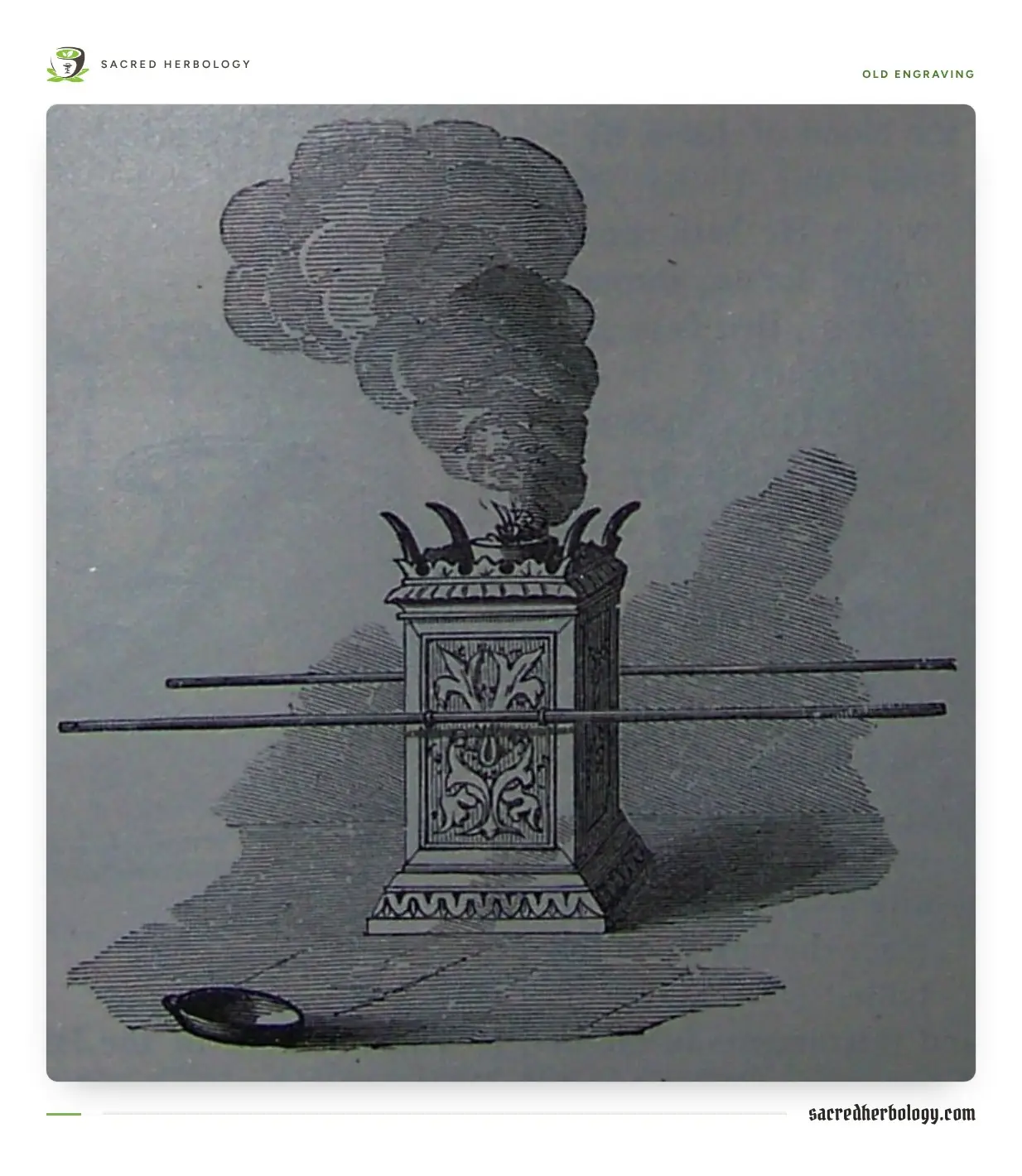

The rules were strict, and the stories that follow show them being enforced. In Leviticus 10, Aaron’s sons Nadab and Abihu offer “strange fire” before the Lord and are consumed by fire. In Numbers 16, two hundred and fifty men who side with Korah in his rebellion against Moses bring censers of incense to the tent of meeting and die in the same way; their bronze censers are beaten into plates to cover the altar as a warning. In 2 Chronicles 26, King Uzziah walks into the Temple to burn incense himself, against the protests of the priests, and is struck with a skin disease on his forehead as he stands beside the altar.
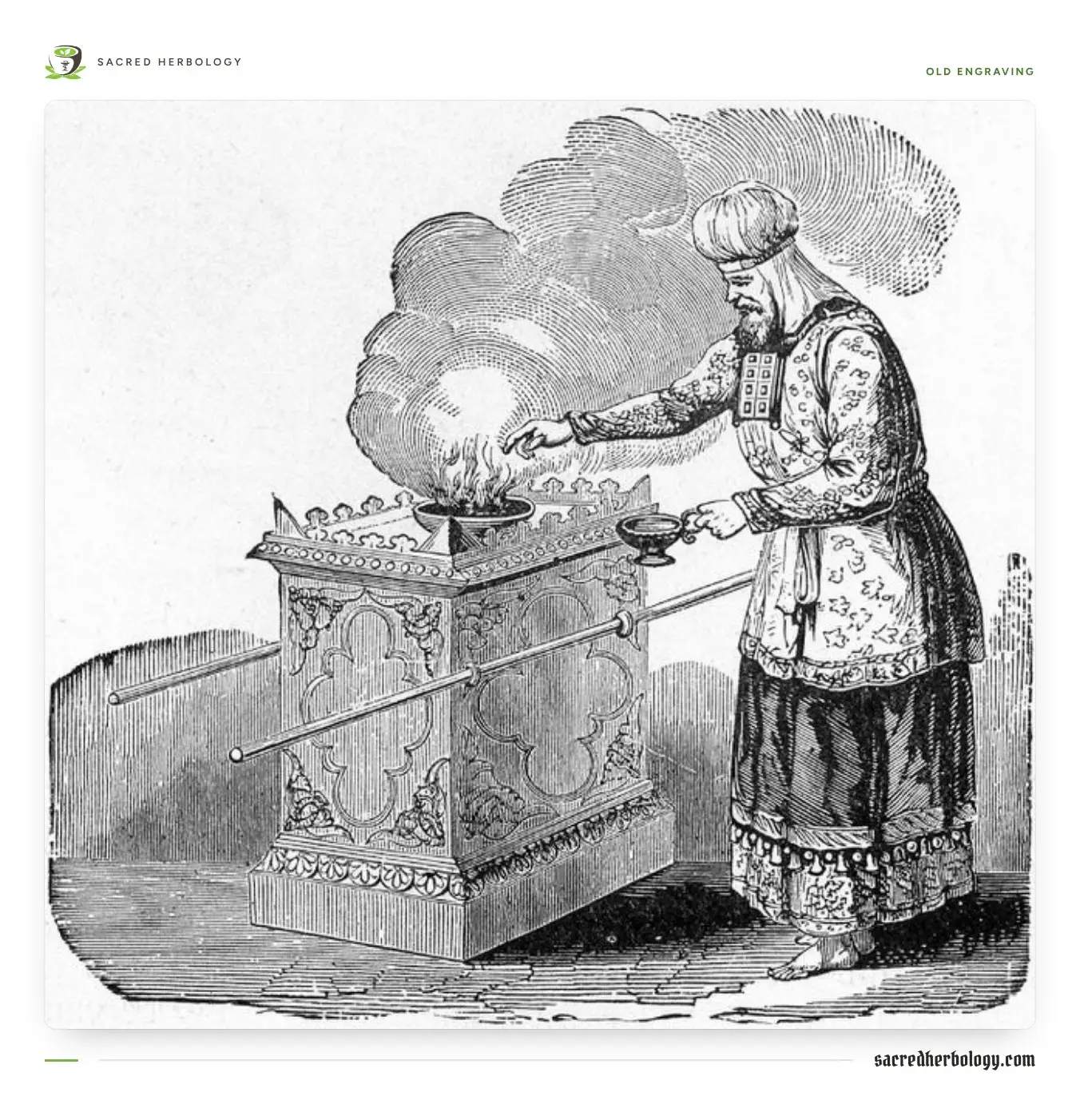
The greatest moment for the incense came once a year, on the Day of Atonement. Leviticus 16 has the high priest take a censer full of burning coals from the altar and two handfuls of the beaten incense, carry them inside the curtain, and put the incense on the fire so that the cloud of it covers the mercy seat over the ark, “that he die not”. In the text, the smoke is a screen between the man and the presence of God. Galbanum was in that cloud.
Christianity inherited the image. Psalm 141 asks that a prayer be set forth as incense. In the book of Revelation, the elders before the throne hold golden bowls full of incense, “which are the prayers of saints”, and an angel at the golden altar offers incense with the prayers of all the saints, and the smoke rises before God. The thurible in an Orthodox or Catholic church burns no galbanum, as a rule, but its theology comes down from that altar in Exodus.
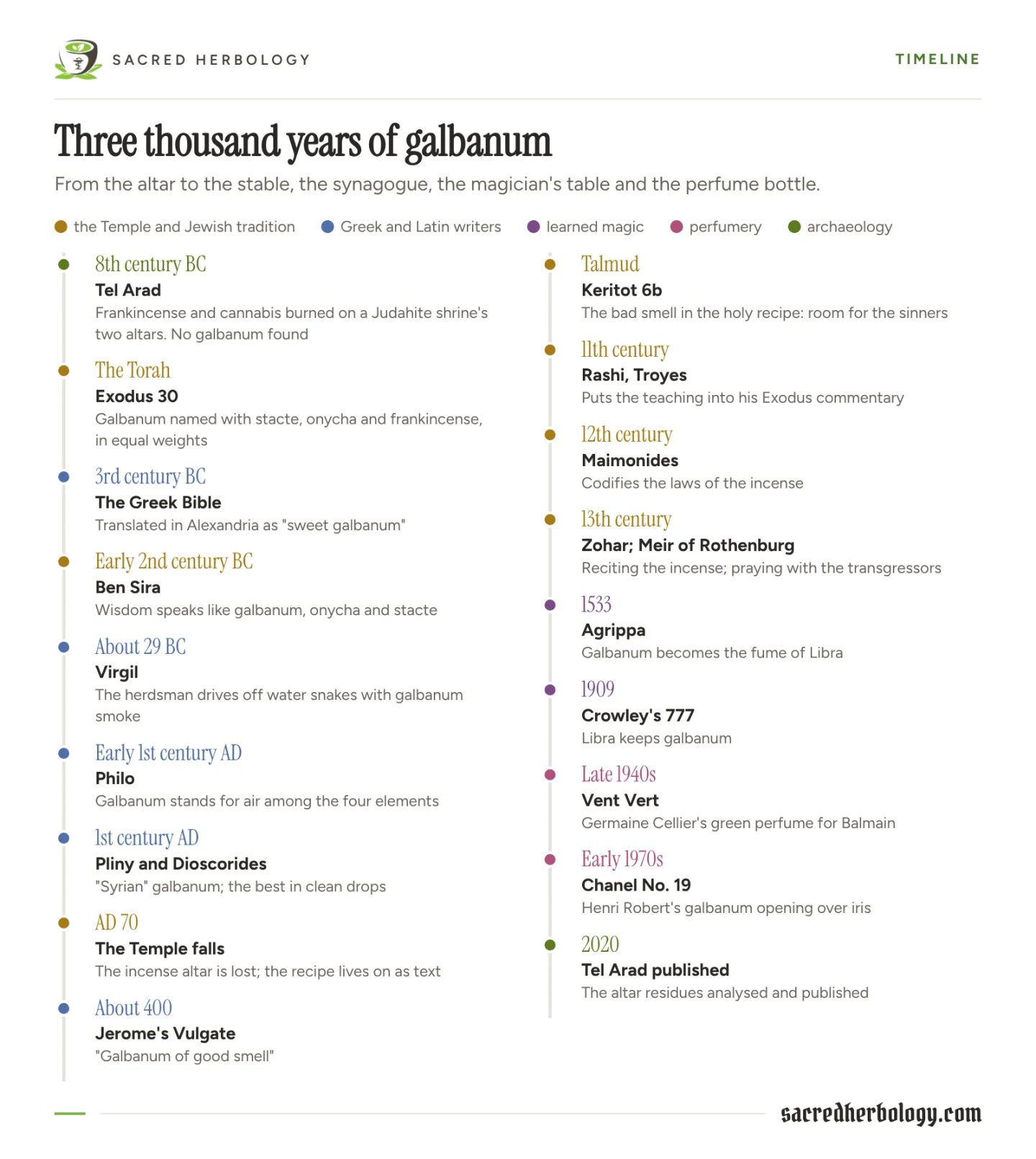
What did the Temple incense actually smell like? Nobody knows, and the archaeology has so far been little help on galbanum in particular. When residues on two limestone altars from the Judahite shrine at Tel Arad, in the Negev, were analysed and published in 2020, the larger altar carried frankincense mixed with animal fat, and the smaller carried cannabis mixed with animal dung, the fat and dung probably added to control how the material heated and burned. That shrine is a provincial one from the eighth century BC, centuries before the rabbinic recipes, and its findings tell us nothing directly about Jerusalem. They do tell us that incense in that world could be a stranger and more varied thing than the clean list in Exodus suggests. No ancient altar has yet given us a confirmed trace of galbanum.
Galbanum among the Greeks and the philosophers
When Jewish scholars in Alexandria translated the Torah into Greek, in the third century BC, they rendered the Exodus ingredient as chalbanē hēdusmou, “galbanum of sweet spice” or “sweet galbanum”. When Jerome made his Latin Vulgate at the end of the fourth century AD, he wrote galbanen boni odoris, “galbanum of good smell”. Both translators seem to have felt the word needed a little help. It was a holy ingredient, and galbanum by itself was not famous for smelling good.
The wisdom book of Ben Sira, written in Hebrew in Jerusalem early in the second century BC and preserved in Greek by the author’s grandson, has Wisdom herself speak in the language of the Temple perfumes. In chapter 24 she says that like cassia and camel’s thorn she gave forth the scent of spices, and like choice myrrh she spread a pleasant odour, like galbanum, onycha and stacte, like the smoke of frankincense in the tabernacle. It is the Exodus list turned into poetry, and galbanum takes its place there without apology.
Philo of Alexandria, the Jewish philosopher who wrote in Greek in the first half of the first century AD, read the scriptures as an allegory of the cosmos, in the manner of the Platonists. In his treatise Who Is the Heir of Divine Things? he takes the four incense ingredients of Exodus and gives each one an element. Stacte, which flows in drops, is water. Onycha, dry and hard, is earth. Galbanum is air. Frankincense, clear and bright, is fire. The equal weights of the four spices stand for the balance of the four elements in the world, and the whole incense becomes a picture of creation offering thanks to its maker. He says the same thing more briefly in his life of Moses.
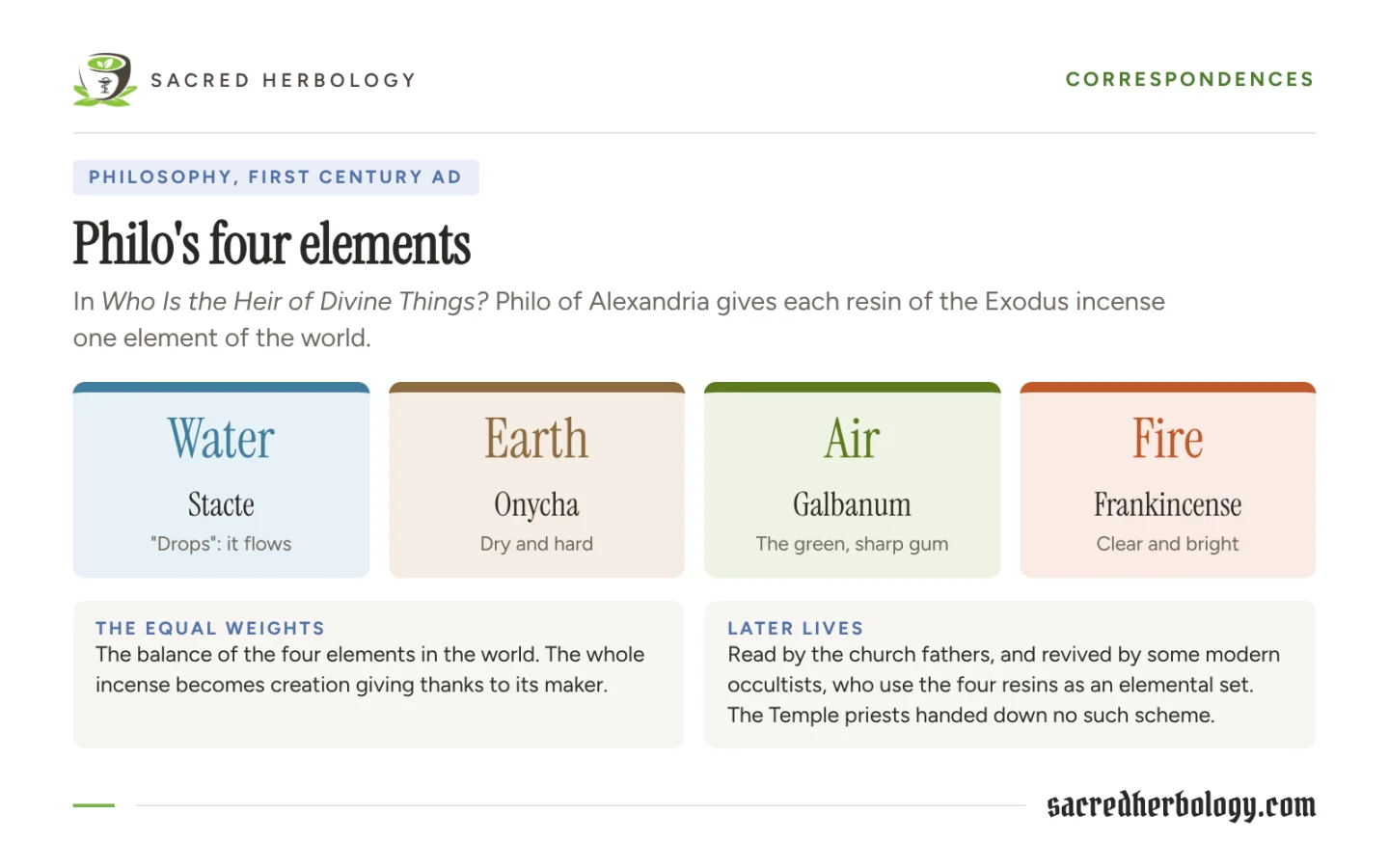
This is philosophy, a Greek reading laid over a Hebrew text, and it was hugely influential among the church fathers who read Philo. It is also the first place I know of where galbanum is given a place in a scheme of correspondences, the kind of table that the Renaissance magicians would later fill out for every substance on earth. Set out as a table, four resins against four elements, it shows how early that way of thinking began.
Josephus, the Jewish historian who had been a priest in the Temple before its destruction in AD 70, describes the incense in his Jewish War. He says it was made of thirteen sweet spices taken from the sea, the uninhabited desert and the inhabited land, to show that all things are of God and for God. His count of thirteen differs from the eleven of the rabbis, and he gives no names. Still, he was writing as a man who had seen the altar.
Pliny’s galbanum and Virgil’s snakes
Pliny the Elder, in book twelve of his Natural History, gives galbanum a short entry among the aromatics. Syria, he says, produces it on Mount Amanus, from a fennel-giant of the same name, and the best is the kind called stagonitis, from the Greek word for a drop, the gum that forms in clean tears. He warns that it is adulterated with bean meal and with sagapenum, and he tells his reader how to test it: pure galbanum, set alight, drives away serpents with its smoke. Dioscorides, writing his great guide to medicines at about the same time, gives it as the juice of a narthex growing in Syria and lists much the same marks of quality: pure, fat, free of wood and grit, with a sharp smell.
Pliny comes back to galbanum in book twenty-four, where he lists the remedies drawn from it, and the serpents come up again. The smoke of burning galbanum puts them to flight, he says, and the very touch of galbanum mixed with oil of spondylium is enough to kill one. Most of the rest of that chapter is ancient medicine, plasters and draughts that I won’t repeat here. It is a record of what Roman physicians did, and nobody should take it as a guide today.
The snakes belong to the farmyard as much as the pharmacy. In the third book of the Georgics, his long poem on farming, written around 29 BC, Virgil tells the herdsman to learn to burn sweet cedar in his stalls and to drive off the noxious water snakes with the heavy smoke of galbanum. It is a line of practical advice in a poem about cattle and sheep, and it shows galbanum doing a very ordinary job in the Italian countryside: smoking out vermin. That is folk practice, the custom of herdsmen, and Virgil records it the way a modern gardening writer might record a tip about keeping possums off the roses.
So the same resin that stood in the holy incense of Jerusalem was, a few hundred kilometres away in Italy, a smoke for clearing snakes out of a cowshed. Neither use cancels the other. The Mediterranean world knew galbanum as a strong-smelling, useful, slightly fierce substance. Whether its smoke ever bothered a snake is another matter; the ancient writers believed it did, and I am reporting their belief.
The gum reached both places by the same long road: from the Iranian mountains to the markets of Syria, and from there overland to Jerusalem and by sea to Rome.

Eleven spices and the house of Avtinas
The rabbis of the Mishnah and Talmud, working in the land of Israel and in Babylonia in the centuries after the Temple fell, preserved a far fuller account of the incense than Exodus gives. The key passage is a teaching (a baraita, a tradition from the time of the Mishnah that was not included in it) found in the Babylonian Talmud in tractate Keritot and in the Jerusalem Talmud in tractate Yoma. It is known by its opening words in Aramaic and Hebrew, pittum ha-ketoret, “the compounding of the incense”.
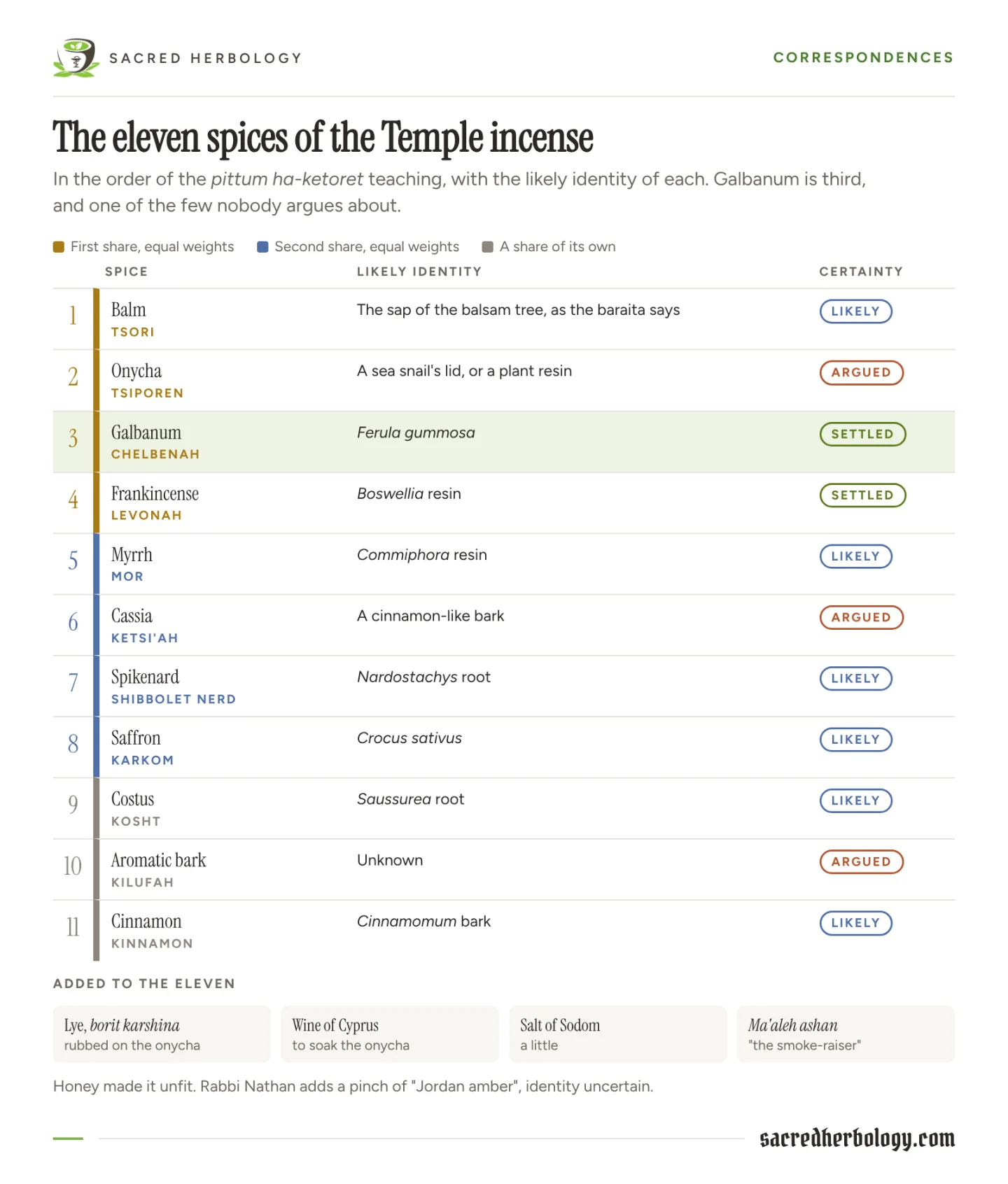
It lists eleven spices. The first four take the largest share, in equal weights, as Exodus requires: balm (tsori), onycha (tsiporen), galbanum (chelbenah) and frankincense (levonah). Then come myrrh, cassia, spikenard and saffron, in a smaller equal share; then costus; then an aromatic bark; then cinnamon. To these were added a lye called borit karshina, used to rub the onycha and make it fine; wine from Cyprus, to soak the onycha and sharpen its smell; a little salt of Sodom; and a tiny amount of a herb called ma’aleh ashan, “the smoke-raiser”, which made the smoke rise straight up in a column. Rabbi Nathan adds a pinch of “Jordan amber”, whose identity is uncertain. The teaching is fierce about the rules: if honey was added the incense was unfit, and if any one of the spices was left out, the man who made it was liable to death.
The baraita explains some of its own terms. Balm, it says, is the sap that drips from the balsam trees. Wine from Cyprus was preferred, though an old white wine could serve, and anyone who suggested soaking the onycha in urine, which was said to work as well, was told that one does not bring urine into the Temple. It is a very human passage, the record of people who took the recipe seriously enough to argue about every detail.
Who actually made the incense? The Mishnah, in tractate Yoma, names a priestly family, the house of Avtinas, who held the secret of its making and would not teach it. The sages counted this among the things remembered to their discredit. The Talmud’s discussion adds the family’s side of the story. When the sages brought in perfumers from Alexandria in Egypt to replace them, the Alexandrians could make an incense just as fragrant, but its smoke would not rise straight; it spread out sideways. So the sages had to ask the house of Avtinas back, and the family doubled its fee. The family explained that they kept the secret because they knew the Temple would one day be destroyed, and they did not want anyone to use the knowledge for an idol. To keep themselves above suspicion, the Talmud adds, no bride in that family ever went out wearing perfume, and when they married a woman from another family they made it a condition that she would not perfume herself, so that no one could say they had taken the Temple incense for their own use.
The rabbis also remembered how far the smell carried. The Mishnah in tractate Tamid says that in Jericho, more than twenty kilometres from Jerusalem and a long way below it, people could smell the compounding of the incense. The Talmud adds that the goats in Jericho sneezed from it, that the women of Jerusalem had no need to perfume themselves, and that a bride there needed no perfume either, because the whole city smelled of the Temple. These are stories told to honour a vanished building, and I would not lean on them for a measurement, but they are a vivid picture of a city wrapped in sacred smoke.
Try to match the eleven to modern plants and substances and several are still argued over. Galbanum is not.
The bad smell in the good recipe
Now to the teaching that made galbanum famous among Jewish readers. In tractate Keritot, right after the list of spices, the Talmud records a saying of Rav Hana bar Bizna in the name of Rabbi Shimon Hasida: any fast that does not include some of the sinners of Israel is no fast. Why? Because galbanum has a foul smell, and yet Scripture counted it among the spices of the incense. Abaye then finds a verse in the prophet Amos to support the idea that the community is bound together as one bundle.
The logic is simple and generous. The holy incense was made of good smells and one bad one, and without the bad one it was unfit, invalid, liable to death in its maker. So a community that gathers to pray and fast is incomplete without the people it might prefer to leave out. Their presence belongs in the mixture, and the mixture is holy because they are in it.
Rashi, the great commentator who worked in Troyes in northern France in the eleventh century, put the same lesson into his commentary on Exodus. At the word chelbenah he explains that it is a spice with a bad smell, which Scripture counted among the spices of the incense to teach us that we should not think it a small thing to include the sinners of Israel with us in our fasts and our prayers, so that they are counted with us. Because Rashi’s commentary was printed alongside the Hebrew text of the Torah in Jewish homes and schools for centuries, generation after generation of children met galbanum first as the smelly spice that teaches you to make room for people.
The teaching lives on in the liturgy of the Day of Atonement. Before the prayer called Kol Nidrei, which opens the evening service, many congregations recite a short formula, usually attributed to Rabbi Meir of Rothenburg in thirteenth-century Germany, declaring that with the consent of God and of the congregation “we permit ourselves to pray with the transgressors”. Commentators have long tied that formula back to galbanum. The Day of Atonement was the one day the high priest carried the incense into the Holy of Holies, and the bitter resin was in his censer.

I find this one of the loveliest things in the whole history of incense, because it takes the plain experience of a smell, the moment when someone opens the galbanum jar and pulls a face, and turns it into an ethic. You do not need to share the faith to see the sense of it.
Saying the incense when there is no Temple
When the Romans destroyed the Temple in AD 70, the altar of incense went with it. Jewish law holds that the ketoret could be offered only in the Temple, so it has not been burned since. What survived is the text. The pittum ha-ketoret passage, with its eleven spices and galbanum third among them, is recited in synagogue prayer to this day. In the Sephardic and Mizrahi rites it is said daily, and in many Ashkenazi communities it comes at the close of the additional service on the Sabbath and festivals, and in some daily as well. Reading the recipe aloud takes the place of making it.
The Zohar, the great work of Kabbalah that appeared in Castile in the late thirteenth century, praises the reciting of the incense passage in the highest terms. In its pages, saying the words with full attention is credited with protecting the one who says them and with turning away harm. That is the Zohar’s teaching, in its own religious terms, and it explains why the passage is so beloved in Kabbalistic circles and why some people recite it from small printed cards or parchments. I report it as a belief of the tradition. Kabbalah is a mystical tradition within Judaism, and in this case it belongs to synagogue liturgy and devotion, quite apart from the learned magic of the grimoires.
Maimonides, the philosopher and legal authority of twelfth-century Egypt, set out the laws of the incense in his code, the Mishneh Torah, in the section on the vessels of the Temple. He gives the eleven spices, the additives, and the rule that the incense was compounded once a year. In his philosophical work The Guide for the Perplexed he offered a practical reason for the incense: the many animals slaughtered in the Temple would have left the place smelling of a butcher’s yard, and the incense made it fragrant. Other commentators, Nachmanides among them, disagreed sharply and gave the incense a far more mystical role. The argument between the practical and the mystical reading has never been settled, and galbanum sits in the middle of it.
Modern Jewish groups who work towards a rebuilt Temple have studied the eleven spices closely and have prepared sample sets for teaching, but the incense itself, by Jewish law, waits on the altar. For everyone else, galbanum’s place in the incense is a matter of words, read in a voice, in a room full of people.
Galbanum in the learned magic
Here we move into the esoteric, the learned magic of Renaissance Europe and its modern heirs, and I’ll label it as that.
The Renaissance magicians inherited the habit of correspondences from many sources at once: Philo and the Platonists, the Arabic astral magic of the Picatrix, the medieval lapidaries and herbals. Every planet and every sign of the zodiac had its own plants, stones, metals, colours and perfumes, and a magician who wanted the influence of a star burned its fume. Heinrich Cornelius Agrippa’s Three Books of Occult Philosophy (1533) gives a fume for each of the twelve signs, and galbanum is the fume of Libra, the sign of the scales. The choice has a neat logic to it, given that galbanum was one of four ingredients weighed out in equal measure in the holy incense, though Agrippa does not explain his reasons.
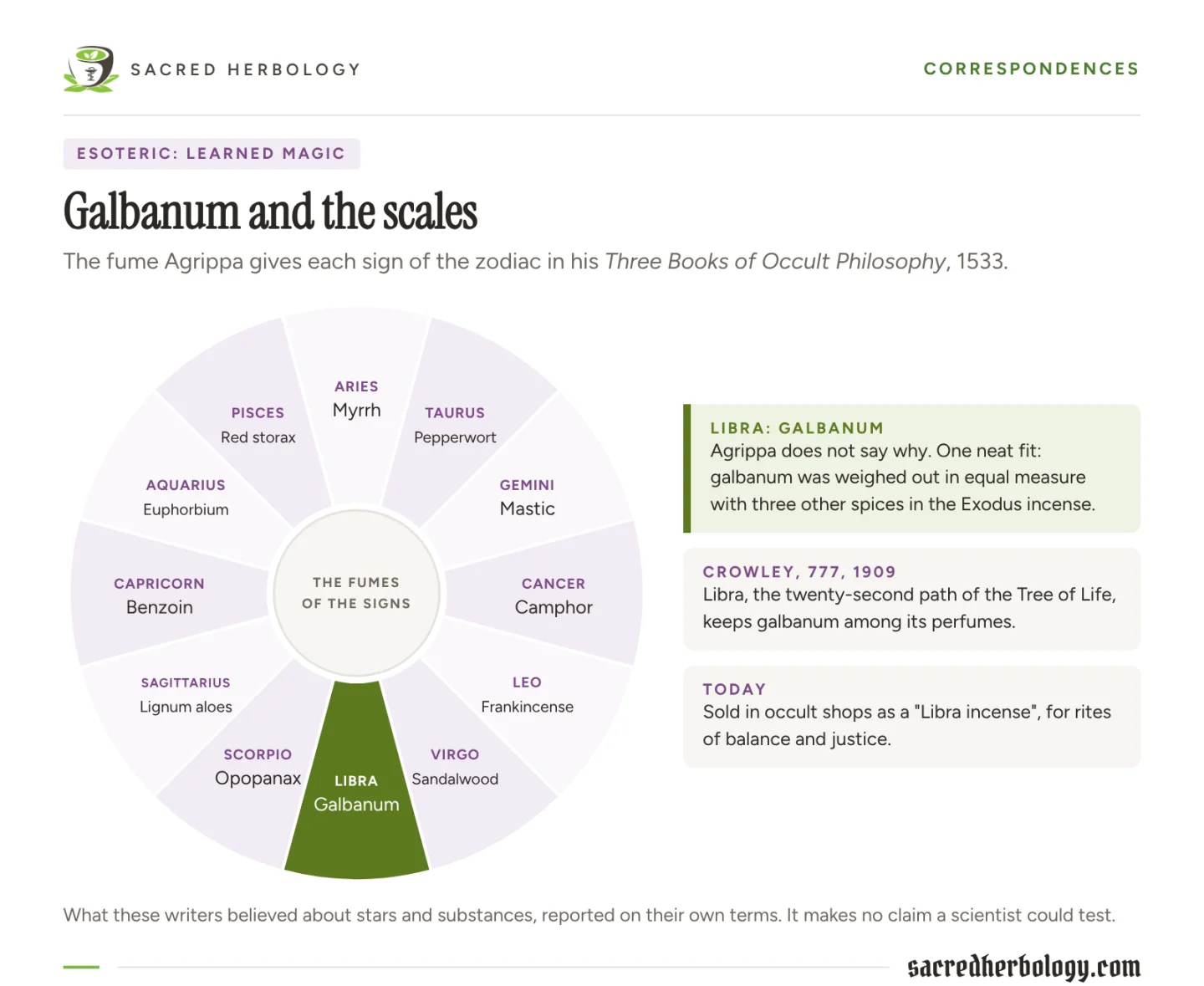
Aleister Crowley carried the habit into the twentieth century. In 777, his book of correspondence tables first published in 1909, built on the material he had learned in the Hermetic Order of the Golden Dawn, there is a column of perfumes set against the thirty-two paths of the Kabbalistic Tree of Life. Libra, on the twenty-second path, gets galbanum. The pairing has passed from Agrippa through Crowley into the incense lists of modern ceremonial magicians and witches, and you will still find galbanum sold in occult shops as a “Libra incense” or for rituals of balance and justice.
That is the esoteric tradition speaking. It tells you how Agrippa and Crowley believed the world was arranged, a web of sympathies between stars and substances. It makes no claim a scientist could test, and I’d be misleading you if I pretended otherwise. It is also a learned, bookish tradition, one writer copying and correcting the last, and quite separate from Virgil’s herdsman smoking out his stall.
There is one more thread worth noting. Philo’s four-element reading of the Exodus incense, galbanum as air, has had a quiet life among modern occultists too, who sometimes use the four Exodus resins as a set for the four elements. Where you see that, it is a modern esoteric revival of a first-century philosopher. The Temple priests handed down no such scheme.
The green note
Galbanum’s second great career began in the perfume houses of twentieth-century France, and it is the reason most people alive today have smelled it, whether or not they knew.
Perfumers work galbanum in several forms. Steam distillation gives an essential oil, thin and very sharp, with a pine-like, green top note. Solvent extraction gives a resinoid and an absolute, darker and thicker, more balsamic and woody, which hold the scent for longer in a finished perfume. Chemists who have studied the oil find it rich in the ordinary terpenes of resins, alpha- and beta-pinene, delta-3-carene, limonene and ocimene. The famous green smell comes from much smaller amounts of a few very powerful compounds: a family of undecatrienes, and a pyrazine of the kind that gives green capsicum its smell, which the human nose can pick up at vanishingly small concentrations. That is why so little galbanum oil goes such a long way in a blend.
In the late 1940s, just after the war, the perfumer Germaine Cellier made Vent Vert (“green wind”) for the house of Pierre Balmain, and she used galbanum in an amount that astonished her colleagues. It is usually counted as the first great green perfume, the one that founded the green family. In the early 1970s Chanel released No. 19, composed by Henri Robert, built on a sharp galbanum opening over iris and woods, and it became the classic galbanum perfume for a generation. Galbanum was already in older perfumes such as Guerlain’s Vol de Nuit of 1933, and it carried on into Cartier’s Must and many of the green chypres of the 1970s and after.
Laid out in order, the story runs from the altar and the stable to the dressing table, and it shows something about the smell. The same note the Talmud called foul, the Vulgate felt the need to call “of good odour”, and Virgil used to drive off snakes became, in the hands of a skilled perfumer, the height of fresh, crisp, modern elegance. Quantity and company change everything. A small amount of galbanum in a blend lifts it; a great lump of it alone is a lot to take.
What you are buying in Australia
Galbanum is uncommon in Australian incense shops. It is still easy enough to find. Specialist resin sellers and some esoteric shops stock it, and perfumery suppliers sell the oil. Here is what to look for.
- Resin. Good galbanum resin is a sticky, yellowish-green to brown mass, sometimes with harder tears in it, and it smells sharply green the moment you open the bag. In warm weather, and especially in a tropical summer, soft galbanum can turn almost runny. Store it in a sealed glass jar in a cool spot. Expect bits of plant and some grit; it is a wild-gathered gum.
- Hard tears. Drier, firmer tears are easier to handle and to break up for burning. They are often dearer.
- Oil. Galbanum essential oil is a perfumery material, very strong, and a little goes a very long way. Pine and turpentine fractions are the classic adulterants, as the trade literature has long warned, and they are hard to catch because genuine galbanum oil is itself mostly pinene. What gets thinned out is the green note, which lives in those few trace compounds. A “galbanum” oil that smells mostly of pine cleaner, with little of the sharp green bite, has probably been cut. Some oils sold cheaply under the name are blended “galbanum bases” built partly from synthetic green materials; a good supplier will say which you are buying and can show a lab analysis of the batch.
- An old test. The pharmacopoeias of the nineteenth and early twentieth centuries told galbanum from gum ammoniac with a simple chemical test: boiled with acid and then made alkaline, a galbanum extract shows a blue glow, strongest under ultraviolet light, from a compound called umbelliferone that its resin releases, while gum ammoniac gives no glow. Asafoetida glows too, so the test sorted the gums into families and could not settle a sample on its own.
- Names. Some sellers still label it Ferula galbaniflua. That is the old name for the same plant, Ferula gummosa.
As for the law, galbanum resin and oil are ordinary aromatic materials and are not scheduled substances in Australia. Live Ferula plants and seed are a different question, because anything that grows comes under Australia’s biosecurity rules. Before ordering seed or plants from overseas, check the import conditions on the federal agriculture department’s BICON database. Buying from a local seller who already holds stock in Australia avoids the question.
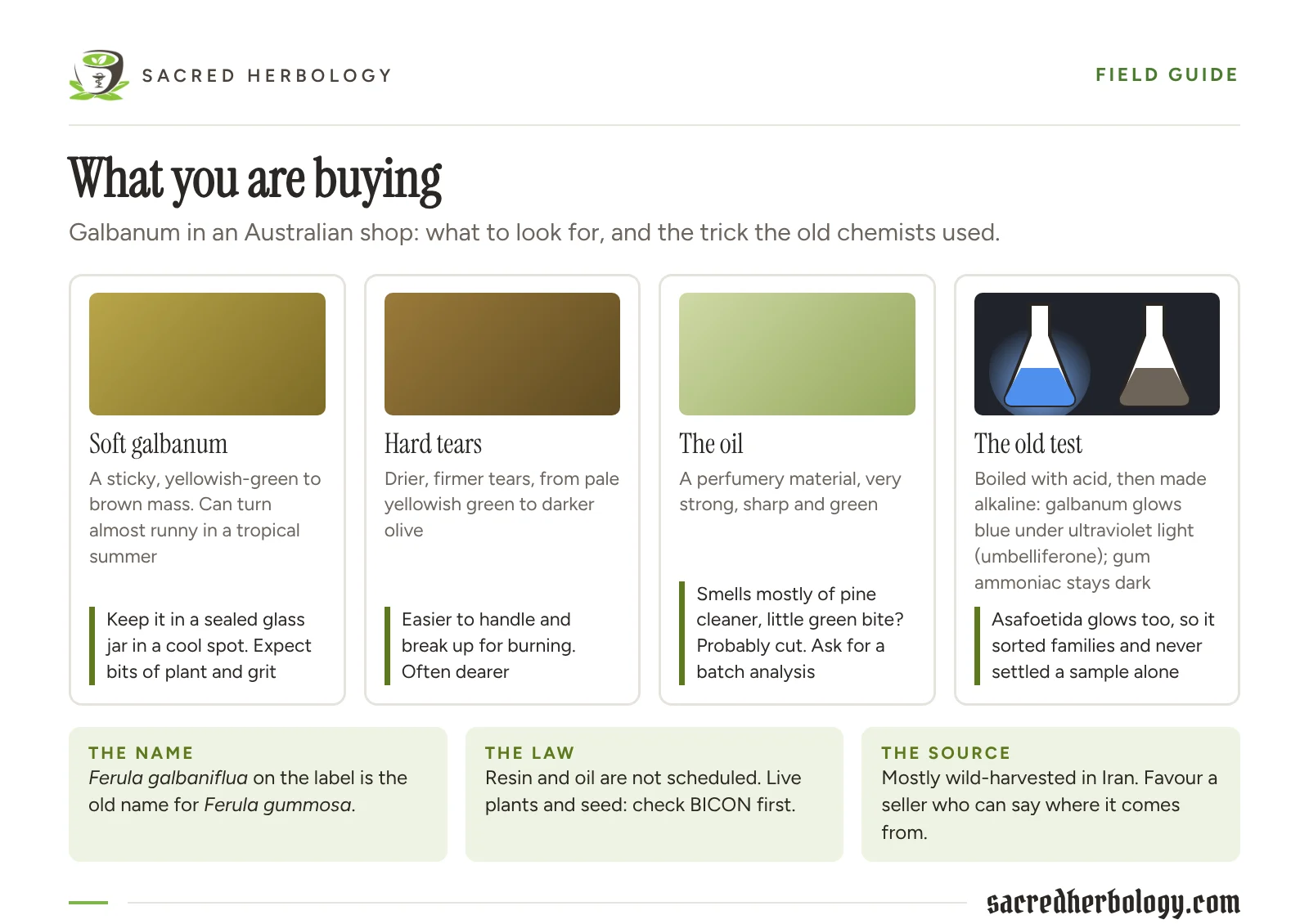
Most of the world’s galbanum comes from wild plants on Iranian mountainsides, and wild-harvested resins are always worth asking about. Many Ferula species die after their roots are cut for gum if the cuts are too deep or too frequent, and overharvesting has been raised as a concern for several of them in Iran. Ask your seller where the resin comes from, and favour one who can tell you.
Its relatives in the garden
I’ll be honest: Ferula gummosa does not belong in a tropical garden. It wants a cold winter, a dry, scorching summer and stony, sharply drained ground, and a tropical wet season would rot its root in a month. If you garden in a cool, dry part of southern Australia, with winter rain and summer drought, you might have a chance with one of the Mediterranean Ferula species from a specialist grower, but even there they are slow and fussy.
Its family is a different matter. The Apiaceae give the tropical garden plenty of plants that carry a hint of that green, resinous, celery-and-seed smell, the smell that runs right through the family. Coriander does well in the dry season. Dill and fennel can be grown through the cooler months. Culantro, Eryngium foetidum, the long-leaved herb of South-East Asian and Caribbean cooking, loves the wet and shade. Gotu kola, Centella asiatica, sometimes put in its own family now, spreads happily through damp ground. Break a stem of any of them, sniff, and you will catch a faint echo of the family galbanum belongs to.
Giant fennel, Ferula communis, the narthex of the Greeks, deserves a note of its own, because it is the most storied plant in the genus. Hesiod tells how Prometheus stole fire from the gods and carried it down to people hidden in the hollow stalk of a narthex, where it smouldered unseen in the pith. The thyrsus carried by the followers of Dionysus was a narthex stalk topped with a pine cone. Ferula was the plant’s own Latin name, and because Roman schoolmasters beat their pupils with rods cut from its light, hollow stalks, the word came to mean a schoolmaster’s cane. The genus takes its name from the plant. It is also a plant to handle with care in a paddock: livestock that graze some forms of giant fennel can be badly poisoned, which is one reason it is not a plant to grow anywhere animals forage.

Burning it well
Galbanum on its own is not the easiest resin to burn. It is sticky, it can spit and bubble on a coal, and its smoke is sharp and green with a heavy edge underneath. Many people find it at its best in small amounts in a blend, which is exactly how the Exodus recipe used it, one part in four. Here is how people generally work with it as a ceremonial smoke.
- Use a proper charcoal disc in a heat-proof bowl half filled with sand or ash. Light the disc, wait until it glows grey all over, then add a small piece of resin. With galbanum especially, more is rarely better.
- Soft galbanum is easier to handle if you chill it first; it firms up in the fridge, sealed in its jar and kept apart from food, and can then be broken into small pieces. Keep it in its own jar, because its smell gets into everything.
- Blending it with frankincense, as the old recipe did, softens the sharpness. A tiny amount added to a frankincense and myrrh blend gives the smoke a green, outdoor lift.
- Open a window. Resin smoke is still smoke, full of fine particles, and it can set off an asthma attack. If you have asthma or any other chest or lung condition, keep well back from it or skip it. Keep it away from babies, small children and pet birds, whose lungs are easily hurt by smoke. If you are pregnant, keep your exposure to any smoke low and burn it somewhere well aired, or leave it for another time.
- The charcoal disc gives off carbon monoxide as it burns, which you can’t see or smell. Never burn it in a closed room, a tent or a car. If anyone gets a headache, feels dizzy or sick, or turns drowsy while incense is burning, get them into fresh air, and call 000 if they are unwell.
- Galbanum resin and oil are for burning and for perfume. They are not food. If anyone, child or adult, swallows resin or oil, call the Poisons Information Centre on 13 11 26, or 000 in an emergency.
- Essential oils of all kinds, galbanum included, can irritate or sensitise skin. Keep the neat oil off your skin and well away from eyes. If it gets on skin, wash it off with soap and water; if it gets in an eye, rinse with plenty of cool running water. Store resin and oil where children and pets cannot reach them, and do not diffuse or burn strong oils around cats, which handle many of their compounds poorly.
The bitter one in the cloud
There is something I like about galbanum that goes beyond its history. Every other resin in this Journal has been praised for its sweetness, its brightness, its warmth. Galbanum is the one that people have been apologising for, and finding a place for, for three thousand years. The Greek and Latin translators of the Bible softened it with an adjective. Virgil gave it a job in the stable. The rabbis put their finger on its smell and drew from it a rule about who gets to stand in the congregation. Agrippa and Crowley handed it the scales. A woman in a Paris laboratory in the 1940s poured in far more of it than anyone thought sensible and made a perfume that people still talk about.
When you put a small piece on a coal, beside a tear or two of frankincense, you are burning something very close to what was named in that verse of Exodus, from the same sort of plant, gathered on the same sort of mountain, sold along the same sort of road. You may believe the smoke goes somewhere or you may not. Either way, the green note in it is the same one the priests knew, the one that made the whole blend complete. Nobody was meant to leave it out.
Where this comes from
- Exodus 30:1-10 and 30:34-38; Leviticus 10:1-2 and 16:12-13; Numbers 16; 2 Chronicles 26:16-21; Psalm 141:2; Revelation 5:8 and 8:3-4.
- Ben Sira (Ecclesiasticus) 24:15, in the New Revised Standard Version (1989).
- Philo, Who Is the Heir of Divine Things? 196-200, in The Works of Philo, trans. C. D. Yonge (London, 1854-1855; Hendrickson reprint, 1993).
- Josephus, The Jewish War 5.218, trans. H. St J. Thackeray (Loeb Classical Library, 1928).
- Virgil, Georgics 3.414-415, in Eclogues, Georgics, Aeneid I-VI, trans. H. R. Fairclough, rev. G. P. Goold (Loeb Classical Library, 1999).
- Pliny the Elder, The Natural History, books 12 and 24, trans. John Bostock and H. T. Riley (Bohn, London, 1855-1857).
- Dioscorides, De materia medica, trans. Lily Y. Beck (Olms-Weidmann, 2005).
- Babylonian Talmud, Keritot 6a-6b, Yoma 38a and 39b; Mishnah Yoma 3:11 and Tamid 3:8; in the Koren Talmud Bavli, Noé edition, with commentary by Adin Even-Israel Steinsaltz (Koren, 2012-2019).
- Rashi, commentary on Exodus 30:34, in Pentateuch with Rashi’s Commentary, trans. M. Rosenbaum and A. M. Silbermann (London, 1929-1934).
- Moses Maimonides, Mishneh Torah, Laws of the Temple Vessels, ch. 2; The Guide of the Perplexed III.45, trans. Shlomo Pines (University of Chicago Press, 1963).
- H. C. Agrippa, De occulta philosophia libri tres (Cologne, 1533); Three Books of Occult Philosophy, ed. Donald Tyson (Llewellyn, 1993).
- Aleister Crowley, 777 (London, 1909); reprinted in 777 and Other Qabalistic Writings, ed. Israel Regardie (Weiser, 1973).
- E. Arie, B. Rosen and D. Namdar, “Cannabis and frankincense at the Judahite shrine of Arad”, Tel Aviv 47 (2020): 5-28.