
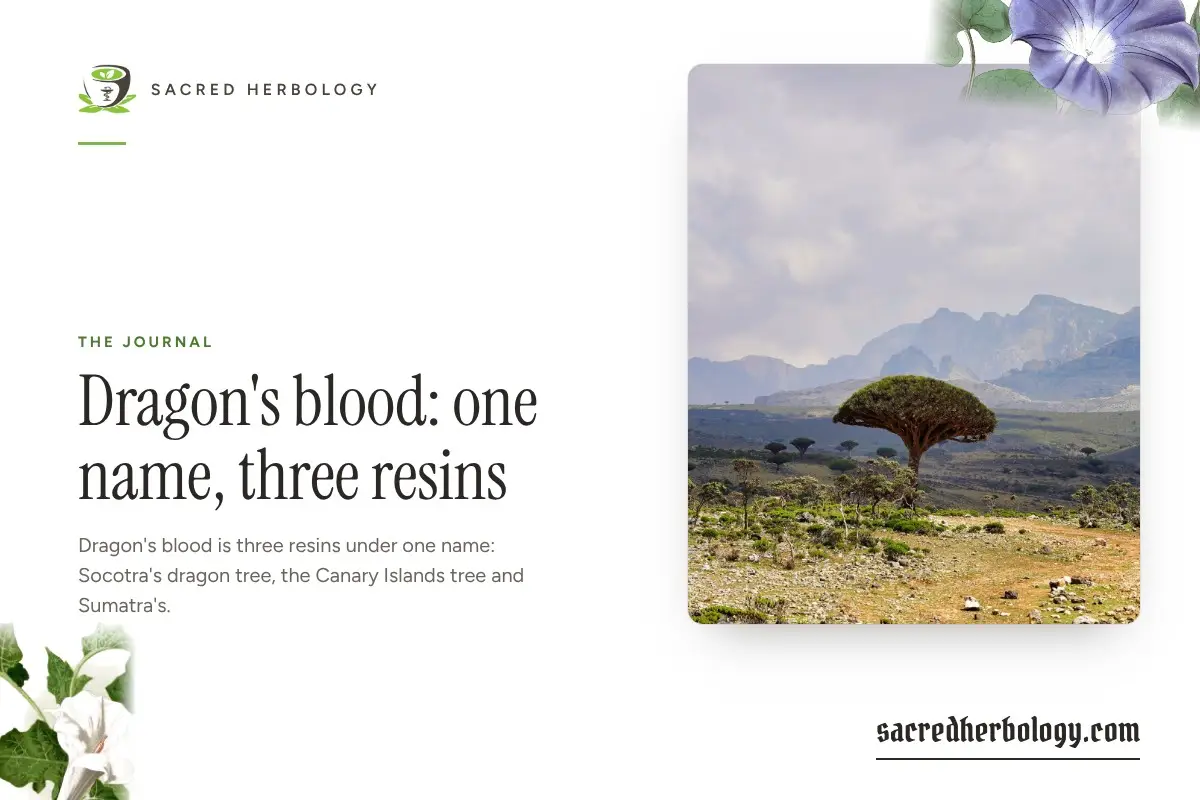
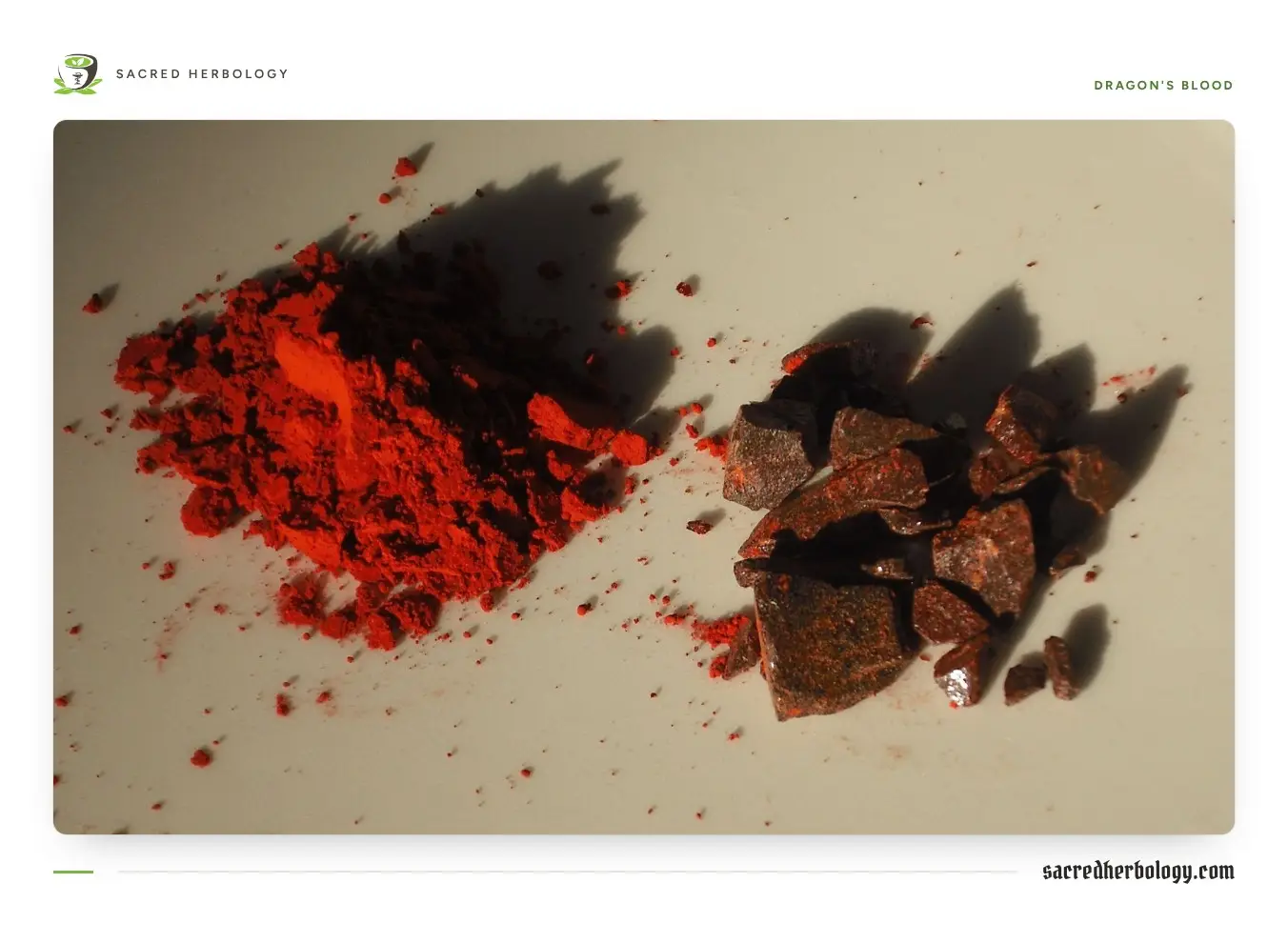
Buy a bag of dragon’s blood today and you might get one of half a dozen things. It might be a handful of dark red, glassy lumps that break with a sharp edge and show deep crimson when you hold them up to the light. It might be a brick-red stick wrapped in a palm leaf, dusty on the outside, that leaves your fingers stained. It might be a fine powder the colour of brick dust. If it’s an incense stick from a big supplier, it might hold no resin at all, only a sweet, warm perfume made in a factory that has never seen a dragon tree. All of them are sold as dragon’s blood, and none of them is lying about the name. It has belonged to all of them for centuries.
What the name has always meant is a red resin from a plant. Which plant has changed with the centuries, the trade routes and the empires that ran them. The Romans got theirs from an island at the mouth of the Red Sea. Medieval and Renaissance Europe got a good share from the Atlantic islands off Africa. The Dutch and the British, from the seventeenth century on, got most of theirs from a climbing palm in the forests of Sumatra and Borneo. China found its own tree in Yunnan in the twentieth century. And South America has a red tree sap of its own that Spanish speakers call by the same name.
So when the old books say dragon’s blood, you need to ask which one. This piece goes through the three main resins one by one, with the outliers after them. On the way it passes through Pliny’s battle between the dragon and the elephant, a Greek sailor’s handbook from the first century, a Venetian trader on a Portuguese island, a painter in Florence who told his students to leave the stuff alone, the zinc plates of the newspaper engravers, Aleister Crowley’s tables of correspondences and the curio shops of American hoodoo. At the end I’ll come back to what you are holding when you buy some in Australia, and how to burn it.
A word on the beliefs. A lot of this piece is about what people thought dragon’s blood was, and what they thought it did, in magic, in medicine and in religion. I’ll report those beliefs as fairly as I can, and I won’t tell you they are true. Where the material comes from learned magical books and the tables of the occult societies, I’ll call it esoteric, because that is its proper category. Where it comes from village and family practice, I’ll call it folk custom. The two have different histories, and they should not be mixed up.
Three trees and a palm
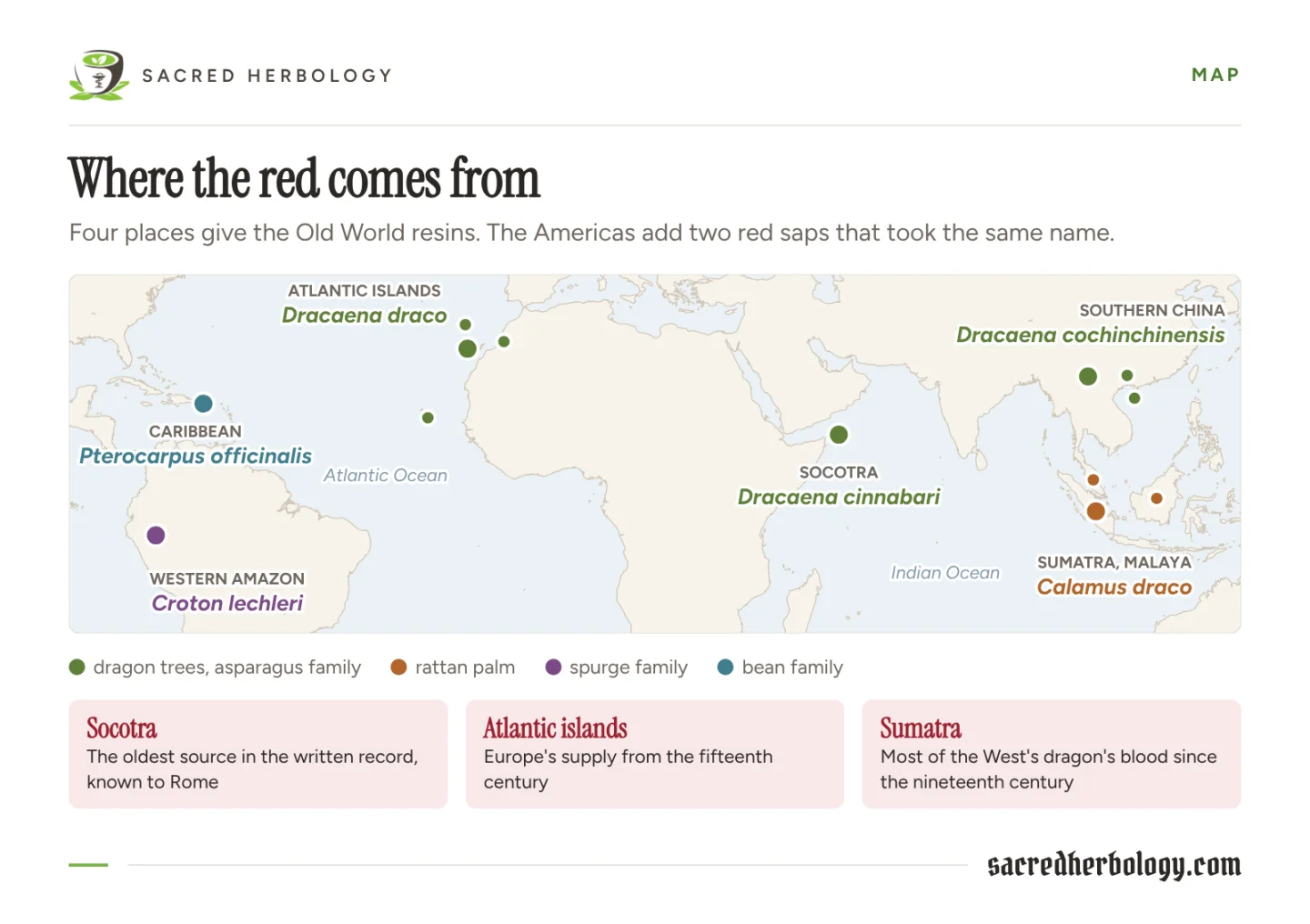
Start with the plants, because once you have them straight the rest of the story makes sense. On a map they sit in four places: the Atlantic islands off north-west Africa, the island of Socotra off the Horn, the rainforests of Sumatra and Borneo, and the hills of southern China.
The first two sources are trees in the genus Dracaena. That genus belongs to the asparagus family and includes the dracaenas sold as pot plants in every Australian nursery. The big ones are strange to look at. A young dragon tree grows as a single trunk with a tuft of stiff, sword-shaped leaves at the top. After some years it flowers, and only then does it branch, splitting at the tip into two or more arms. Each arm grows on for years, flowers, and branches again. After centuries of this, the tree has a crown like an upturned umbrella or a giant head of broccoli, held up on a thick, bare trunk. When the bark is cut or cracked, the tree bleeds a resin that dries dark red.
- Dracaena cinnabari, the dragon’s blood tree of Socotra, an island in the Arabian Sea that belongs to Yemen. It grows nowhere else on earth. This is the oldest source in the written record.
- Dracaena draco, the dragon tree of the Canary Islands, Madeira, Cape Verde and the south-west of Morocco. Europe knew its resin from the fifteenth century.
- Dracaena cochinchinensis and a few close relatives in southern China and mainland South-East Asia, the source of the Chinese resin called xuejie, “blood exhaustion” in a stiff word-for-word reading, more usefully “dried blood”.
The third main source is a different kind of plant altogether. Daemonorops draco, which many botanists now put in the rattan genus Calamus as Calamus draco, is a climbing palm of the forests of Sumatra and the Malay Peninsula, with close relatives in Borneo that give the same kind of resin. Rattans are the palms that give the world its cane furniture. They scramble up through the forest canopy on long whippy stems armed with hooks and spines. The red resin of this one forms on the outside of its fruit, between the overlapping scales that cover each one like the skin of a pine cone. The trade name for it in Indonesian and Malay is jernang.
So the title of this piece is a slight cheat. There are three resins that carry most of the history: Socotra’s, the Atlantic islands’, and the rattan’s. China’s is a fourth that matters a great deal in Asia. Then there are the New World saps that share the name: Croton lechleri, the sangre de grado of the western Amazon, and Pterocarpus officinalis, a swamp tree of the Caribbean whose wood bleeds red. Taken together, that makes one name across four plant families (asparagus, palm, spurge and bean) and four continents, held together by nothing but colour.
The dragon and the elephant
The name is older than any of the trade, and it starts in a story.
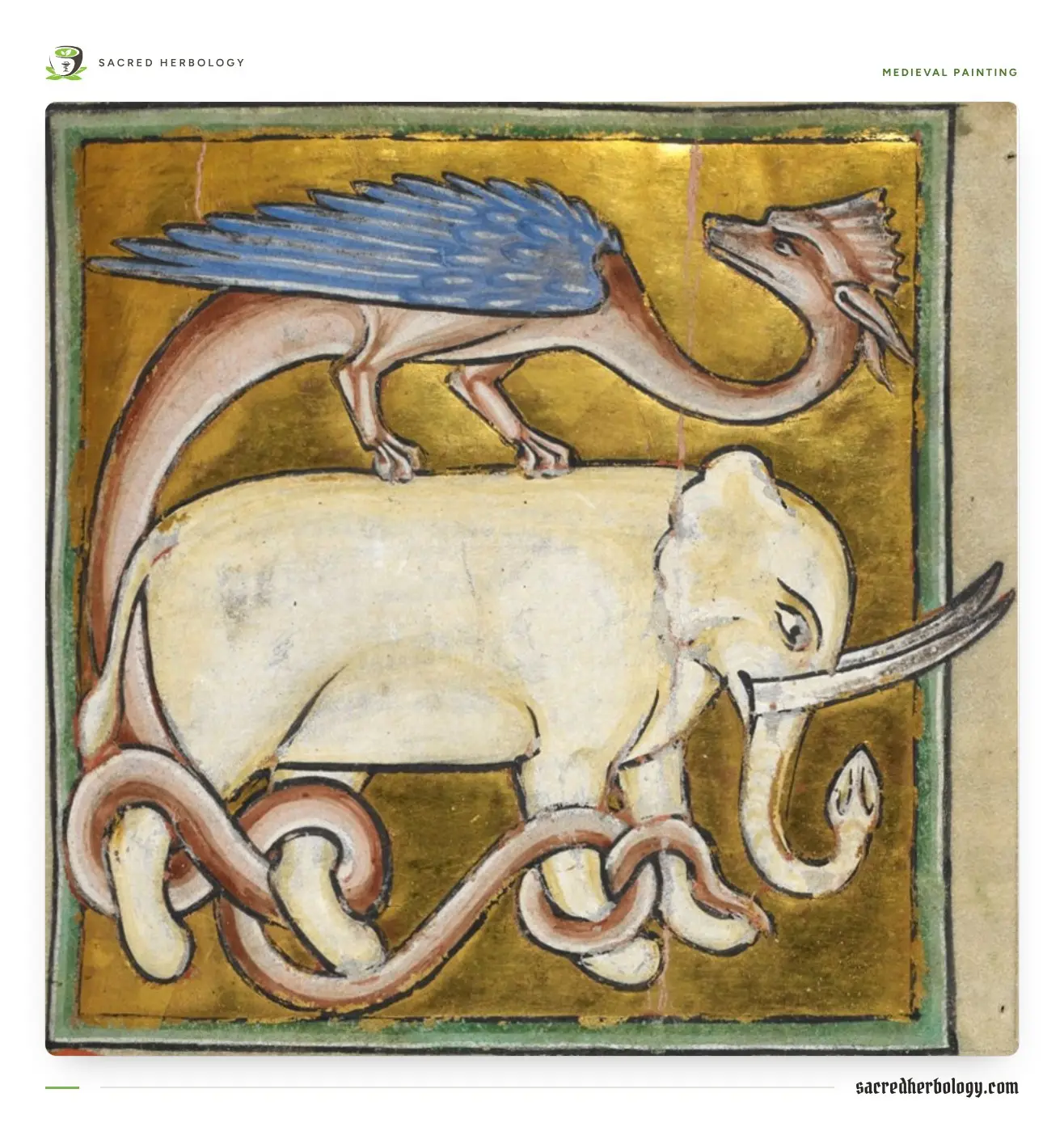
Pliny the Elder, the Roman admiral who died in the eruption of Vesuvius in 79, wrote the Natural History, a vast encyclopedia of everything a Roman gentleman might want to know about the world. In book eight, where he deals with land animals, he tells of the endless war between the elephant and the dragon in India. The dragon, by which Pliny means an enormous serpent, lusts for the elephant’s blood, which it believes to be cool. It hides in the trees by a path, or lies in wait in a river where the elephants come to drink, and it coils around the elephant and bites behind the ear, where the beast cannot reach it with its trunk. It drinks the elephant dry. The elephant, dying, falls, and its great weight crushes the dragon beneath it. The two die together.
Then, in book thirty-three, where he deals with metals and the pigments that come from the earth, Pliny comes back to it. He is talking about the red pigments, and he is cross. The Greeks, he says, call the red mineral minium by the name cinnabaris, and that causes a dangerous mistake, because cinnabaris properly means something else. In the old English translation of John Bostock and Henry Riley, published in 1855, the word properly belongs to “the thick matter which issues from the dragon when crushed beneath the weight of the dying elephant, mixed with the blood of either animal”. This, Pliny says, is the only colour that paints blood truly. Physicians use the real thing in their remedies, he goes on, but because minium has the same name, they give that instead, and so give a poison.
Pliny is mixing up two very different red things, and complaining that other people mix them up. The mineral we call cinnabar today is mercury sulphide, the ore of mercury, mined in Spain in Pliny’s day and ground into the bright red pigment vermilion. It is toxic, and Pliny was right to worry about it going into anyone’s medicine. The other “cinnabar” was a red resin brought from the far end of the known world, and nobody in Rome knew it came from a tree. A dragon-and-elephant story explained it. It is the sort of tale a merchant might tell a buyer in a port, and it lasted. A medieval bestiary painter could draw the scene with confidence: the serpent wrapped round the elephant’s leg, the elephant toppling, red pouring out of both. Pictures of that fight turn up again and again in the illuminated bestiaries.

The names stayed tangled for over a thousand years. In Latin the resin became sanguis draconis, dragon’s blood, and in medieval apothecary shops it sat in a jar under that label. The word cinnabar went over to the mercury mineral. Some old texts still use one for the other, which is worth knowing if you read early recipes for pigments or medicines: a red called cinnabar might be the resin, and a red called dragon’s blood might in some texts be the mineral. Context is the only guide.
Socotra and the blood of the two brothers
The resin Pliny’s Romans used came, almost certainly, from Socotra.
Socotra lies in the Arabian Sea, about 240 kilometres east of the tip of the Horn of Africa and some 380 kilometres south of the Arabian coast. It is long and narrow, with a granite massif in the middle, the Haggeher mountains, rising to about 1,500 metres. Because it has been cut off from the mainland for millions of years, a large part of its plant life grows nowhere else: the bottle-shaped cucumber tree, frankincense trees of its own, and the dragon’s blood tree, Dracaena cinnabari, which is the plant every photograph of the island seems to show. On the limestone plateaus, around Diksam and in the Firmihin forest (also spelled Firmhin), the trees stand in open groves, each with its dense umbrella crown, looking like a picture from a children’s book about another planet. A Firmihin grove, with the crowns lined up against the sky, is one of the great plant sights of the world.
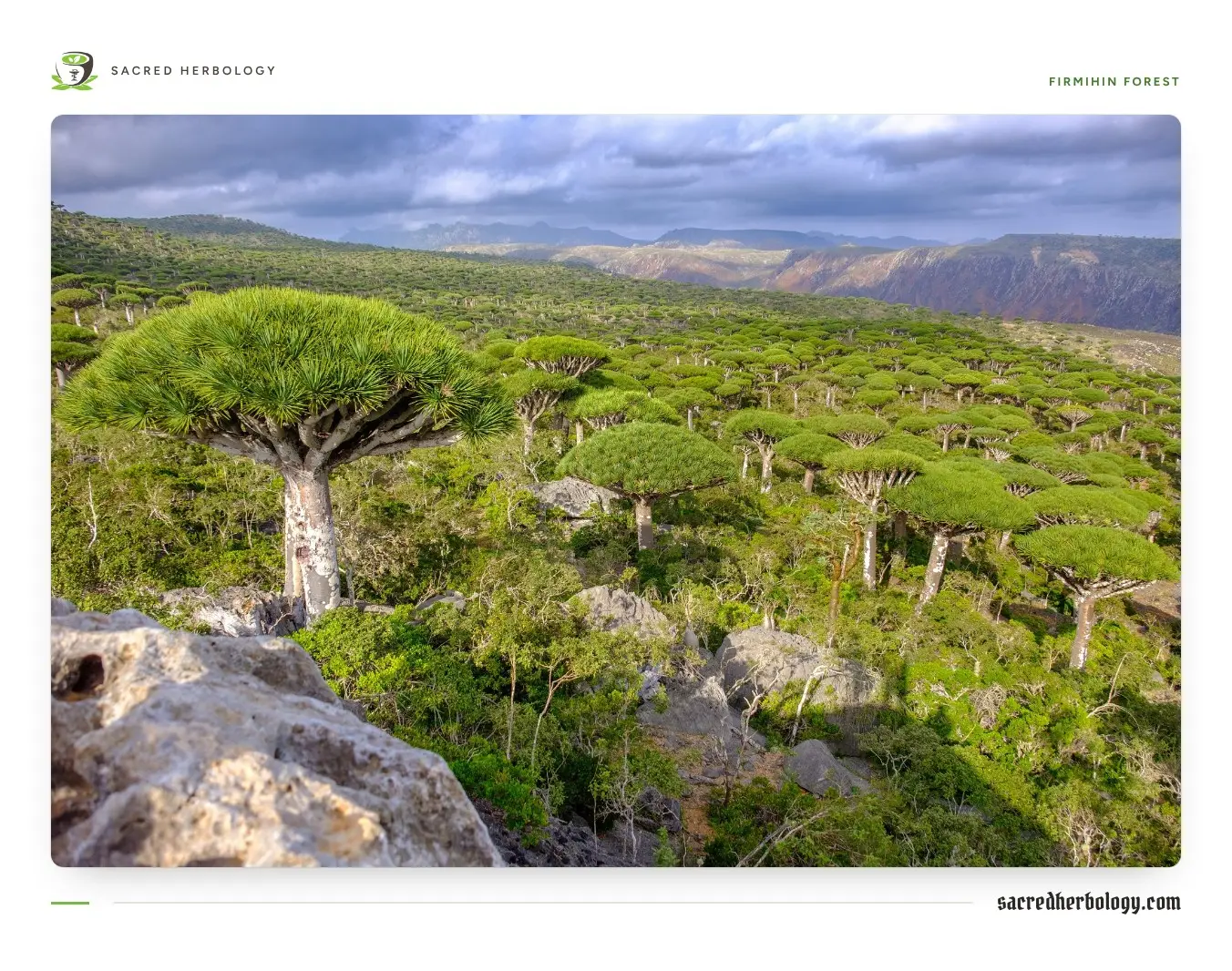

The tree got its scientific name from the Scottish botanist Isaac Bayley Balfour, who visited Socotra in 1880 and described it in 1882, and the name he chose, cinnabari, echoes the old Greek and Latin word for the resin. But the trade is far older.
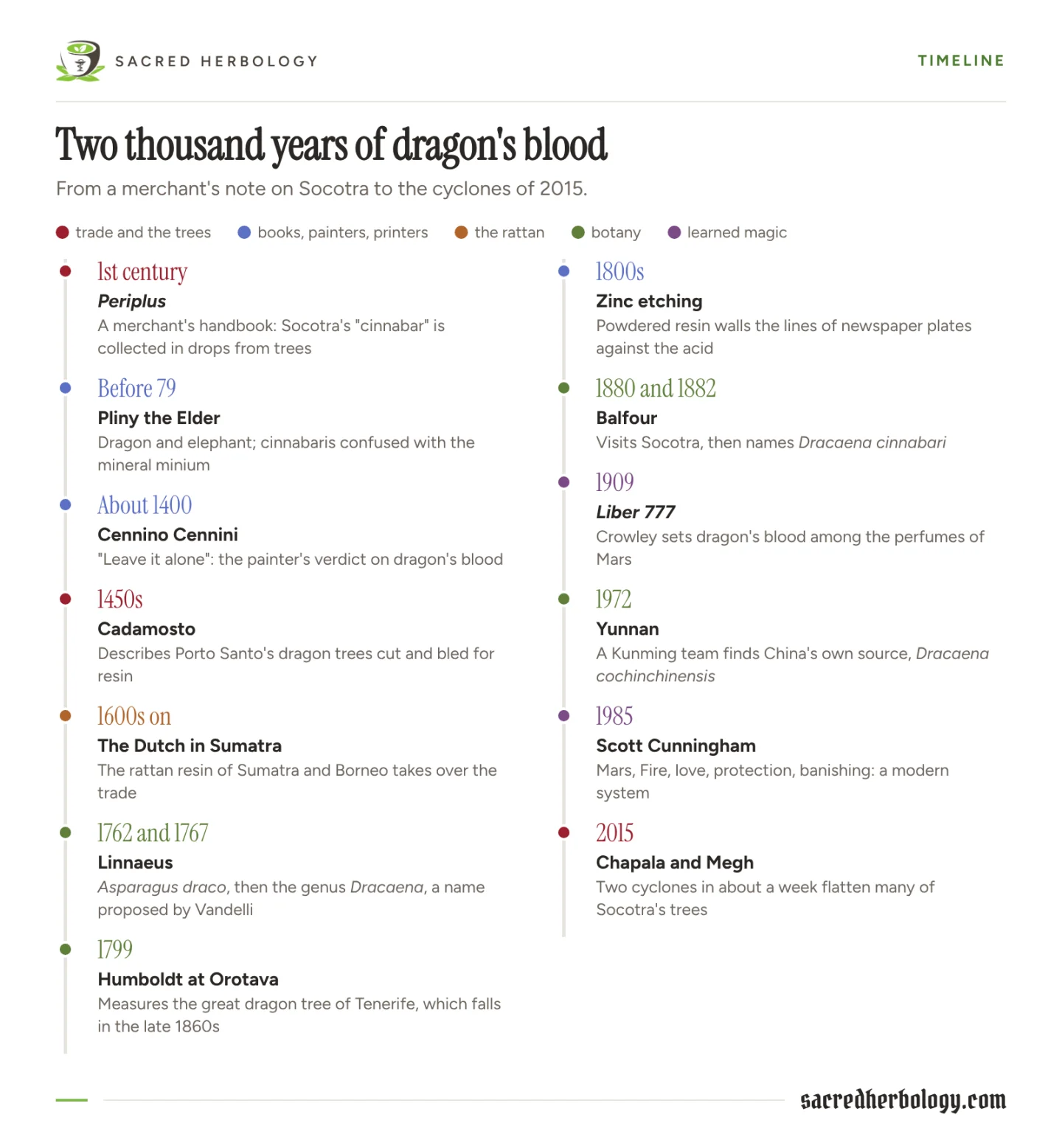
The oldest clear mention comes from a Greek-language handbook for merchants called the Periplus of the Erythraean Sea. It was written in the first century, probably by an Egyptian Greek who had made the voyages himself, and it describes the ports, goods and dangers of the sea routes from the Red Sea down the African coast and across to India. Its thirtieth section reaches an island called Dioscorida, which is Socotra. The writer says it is large but desert, with rivers, crocodiles, many snakes and great lizards. Its few inhabitants live on the north coast and are a mixture of Arabs, Indians and Greeks who have gone there to trade. The island exports tortoiseshell. And, in Wilfred Schoff’s translation of 1912, “there is also produced in this island cinnabar, that called Indian, which is collected in drops from the trees”. The Romans called it Indian because it came in on the India trade. The Periplus writer, unlike Pliny, knew it came from trees.
Socotra’s resin has been gathered by the island’s own people for as long as anyone has records. They work it from cracks and wounds in the bark, where it oozes out and hardens into dark red lumps and drops. The people of Socotra speak their own language, Soqotri, one of the Modern South Arabian languages, older in its roots than the Arabic that surrounds it, and they have long had their own names and grades for the resin. In Arabic the resin is called dam al-akhawain, “the blood of the two brothers”. The story behind that name is told in several ways. In the commonest, two brothers fought and one killed the other, and the tree grew from the blood that was spilled. Some tellings make the brothers Cain and Abel, the first murder of the Bible and the Qur’an. That is the island’s story, and I pass it on as the island tells it.
The people of Socotra have put the resin to their own uses, and travellers and writers over the centuries have recorded them: as a dye and a glaze, as a cosmetic, as a remedy in household medicine, and as a varnish for pottery. I’m reporting those as uses people recorded, the way I’d report any other piece of history. They tell you what the resin meant to the people who lived among the trees, and they are no guide for anyone today.
The trees themselves are in trouble. The International Union for Conservation of Nature lists Dracaena cinnabari as Vulnerable. Most of the trees standing on Socotra are old, many of them centuries old, and very few young ones are coming up to take their place. The island has a great many goats, about four for every person according to one recent count, and goats eat seedlings. A dragon tree sapling grows painfully slowly, a couple of centimetres in several years, and researchers working on the island have estimated it can take a century for a young tree to grow beyond a goat’s reach. The climate is drying. The umbrella crown is thought to help the tree catch moisture from passing fog and cloud and drip it into the soil, and the trees are less able to do that when the mist comes less often. Then in late 2015 two cyclones, Chapala and Megh, struck the island within about a week of each other and flattened a great many trees. In 2022 the Czech forest ecologist Petr Maděra, who has spent years working on the island with Soqotri colleagues, told the journalist Jess Craig: “The long-term future of this species is not hopeful.” Nurseries on the island are growing saplings behind fences, and the people of Socotra are working to keep their trees.
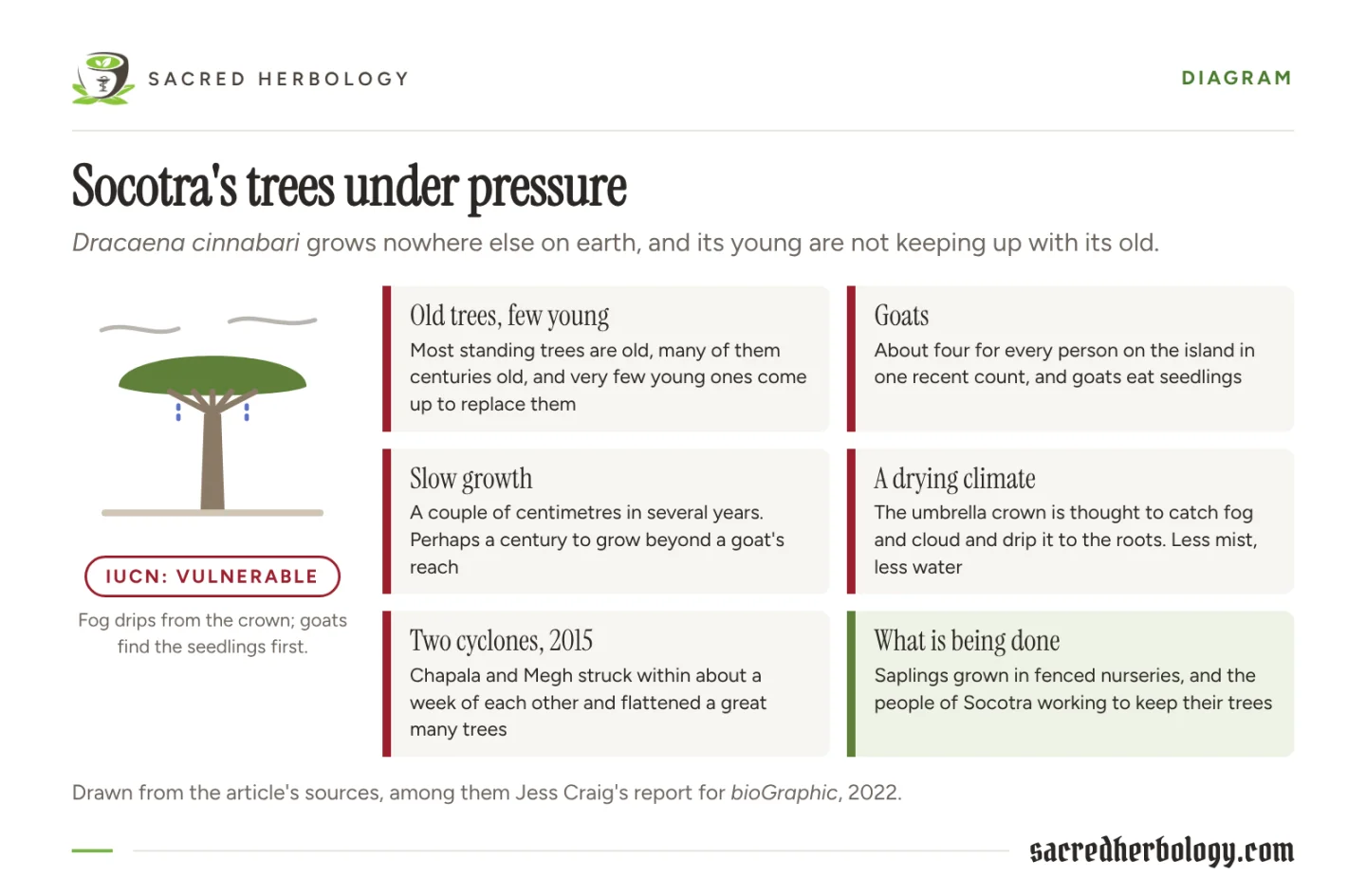
What that means for the buyer is simple. Socotran dragon’s blood is the original, and it is scarce. Very little of it reaches the outside world, and very little of what is sold as Socotran has a clear chain of custody. If someone offers you a large quantity cheaply, ask questions.
The dragon trees of the Atlantic
The second chapter of the story opens in the fifteenth century, as Portuguese and Castilian ships began to work their way down the Atlantic coast of Africa.
The Canary Islands, Madeira and Porto Santo, and later Cape Verde, all had their own dragon tree, Dracaena draco. It is a close relative of the Socotran tree, with the same branching habit, though its crown is usually looser and more irregular, less like a perfect umbrella. It was there on the islands when the Europeans arrived, and they very quickly found that it bled red.

The Venetian merchant Alvise Cadamosto sailed for Prince Henry of Portugal in the 1450s and wrote an account of his voyages along the West African coast. On the way he stopped at Porto Santo, the little island next to Madeira, and he described its dragon trees and their resin. The trees, he wrote, were cut in the bark, and the next year a gum was gathered from the cuts, boiled in vessels and strained, and it became what people called dragon’s blood. He also noticed the fruit, which he likened to a yellow cherry. Porto Santo’s settlers took so much from their trees that the wild dragon tree has long since vanished from that island. On Madeira it is now rare in the wild.
The Canaries were a bigger source. Their resin went into the medieval and Renaissance trade in drugs and pigments, sold alongside and often mixed with whatever Socotran resin still came in through the East. In Europe nobody much cared to tell the two apart. They were dragon’s blood, the same red in the same jar. Botanical study came later. Linnaeus, the Swedish naturalist, first named the Canary tree in 1762 as Asparagus draco, and five years later moved it into a new genus, Dracaena, a name proposed by the Italian botanist Domenico Vandelli, from the Greek for a female dragon. The genus that now holds nearly two hundred species, including the pot plant on your windowsill, is named for the resin.
The Canary dragon tree also carries stories of its own. The Guanches, the people who lived on the Canaries before the Castilian conquest of the late fifteenth century, are said in the later Spanish and travellers’ accounts to have honoured particular dragon trees. Those accounts were written by outsiders, often a long time after the conquest, and how far they reflect what the Guanches themselves believed is a question the historians of the islands still argue over. I mention them as reports, nothing more.
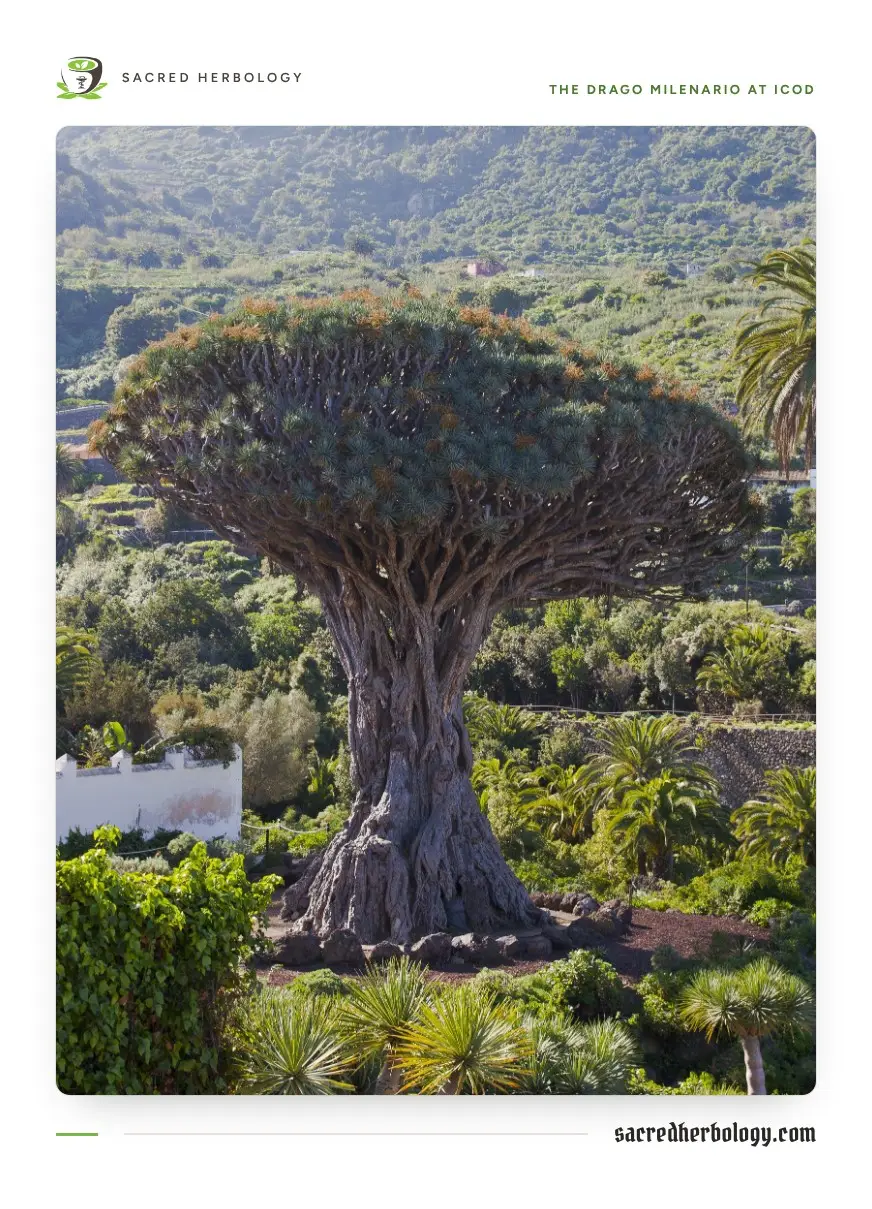
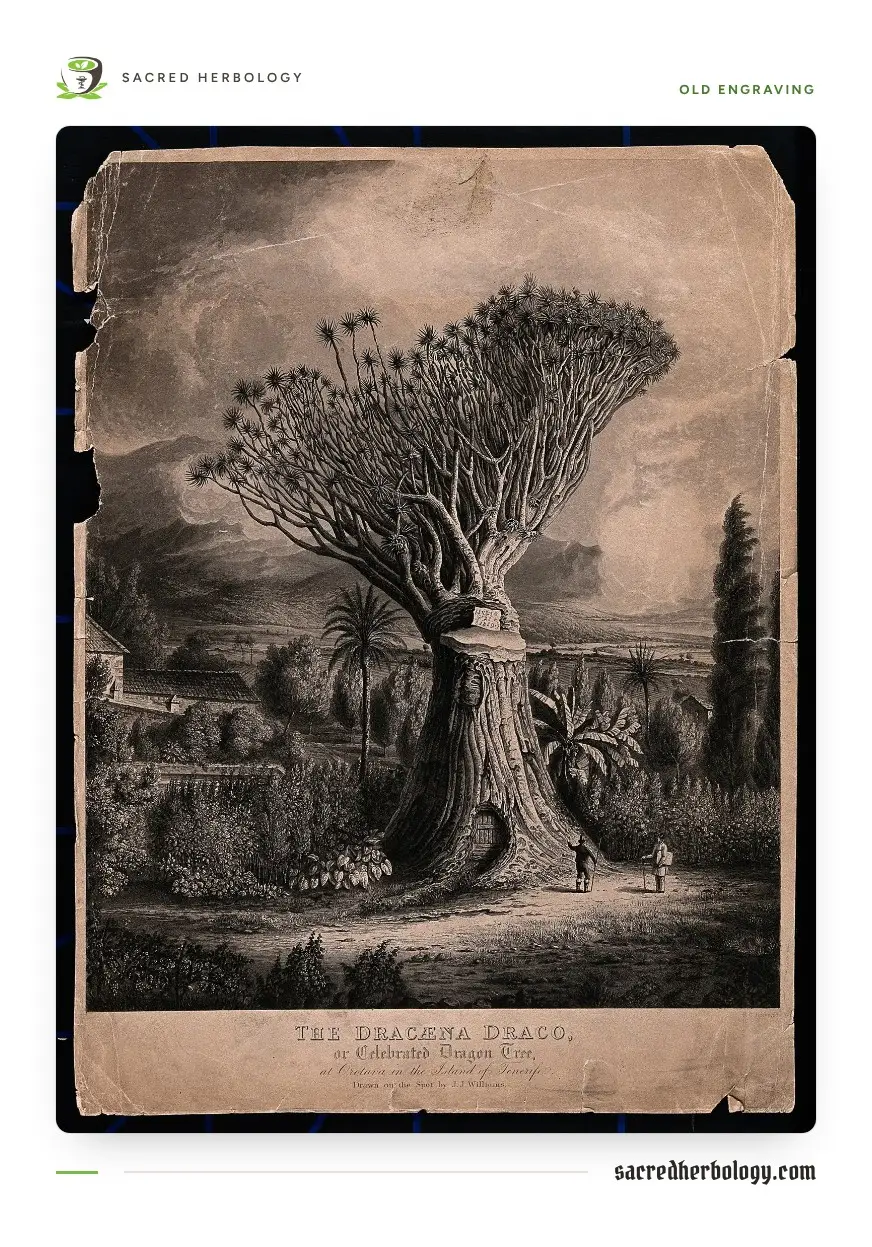
One tree became famous across Europe. At La Orotava, on the north coast of Tenerife, there grew an enormous dragon tree in a garden that the Prussian naturalist Alexander von Humboldt visited in June 1799, on his way to South America. He measured it and wrote about it in the account of his travels, and his description made it one of the best-known trees in the world. People who saw it in the nineteenth century talked of ages of several thousand years. Storms broke it over the following decades, and in the late 1860s one brought the whole tree down. The great survivor today is the Drago Milenario, “the thousand-year dragon tree”, at Icod de los Vinos on Tenerife, which is a national monument and the island’s emblem. Its age is guesswork. A dragon tree doesn’t lay down wood the way an oak does, and counting its years is hard. Estimates for the Icod tree have ranged from a few hundred years to several thousand, and the honest answer is that nobody knows. Engravings of the Orotava tree, with tiny human figures at its foot for scale, were made and copied through the nineteenth century, and they show the size of the thing better than any measurement can.

The rattan of Sumatra
From the seventeenth century the Atlantic trees were giving less and less, and the East was giving more. The Dutch East India Company, and later the British in Malaya, found that the forests of Sumatra and Borneo had their own dragon’s blood, in larger quantities and more reliably than any island could supply. By the nineteenth century, most of the dragon’s blood in European and American shops came from there. Much of it still does.
This resin comes from a palm. Calamus draco, long called Daemonorops draco, is a rattan, a climbing palm with long, slender, spiny stems that haul themselves up through the trees by hooks on the leaf tips. It grows in lowland forest in Sumatra and the Malay Peninsula, and several related species, in Borneo as well as Sumatra, give a similar resin and go into the same trade. Its fruits hang in clusters, each one about the size of a cherry or a small marble, covered in shiny, overlapping scales. As the fruit ripens, a red resin forms on and between those scales. Harvesters cut the clusters down, and the resin is separated from the fruit, traditionally by beating or pounding the fruit, sometimes after drying, and sifting what comes off. The red powder is then either sold as it is, or softened with heat and pressed into sticks or cakes, which were often wrapped in palm leaf for shipping. That is where the old trade names come from: “reed” dragon’s blood, “stick” dragon’s blood, “lump” and “tear”.
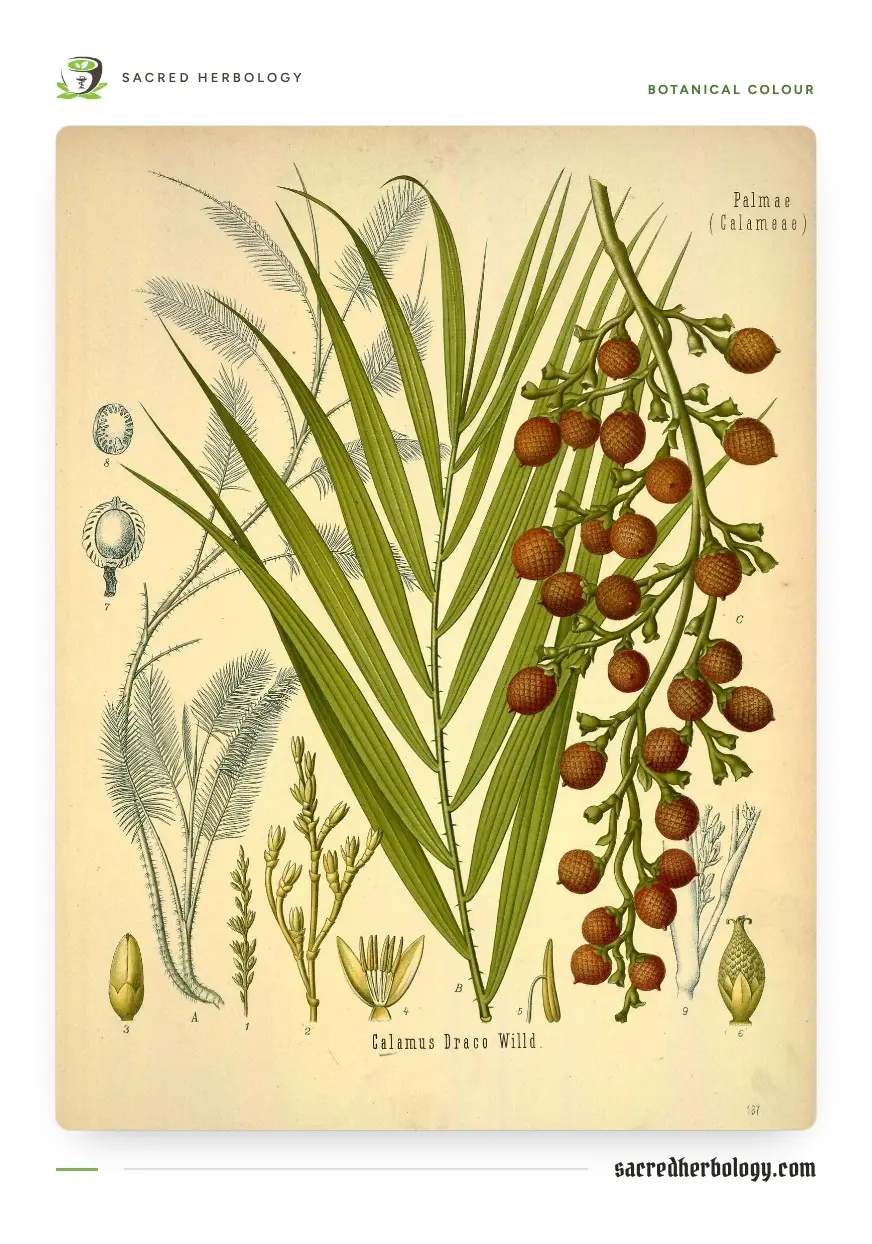

In Indonesia the resin is called jernang, and it is a forest product of real importance in the provinces of Jambi and Aceh in Sumatra. Among the forest peoples who gather it are the Orang Rimba of Jambi, known in Indonesian as the Suku Anak Dalam, for whom it has long been one of the forest goods traded out to the market towns. Indonesian researchers have written about how the Orang Rimba look after the rattan clumps in the forest and protect the trees the rattans climb on. As the wild forest has shrunk, gatherers have also begun to plant the rattan in gardens and plantations. The resin goes out to China, Hong Kong and Singapore, mostly for the Chinese medicine trade, and some of it reaches the incense market in the West. Indonesia has a national standard for grading it, by colour, purity and melting point, among other things.
So the dragon’s blood most people in the West have bought, burned or used in a spell in the last two hundred years has come off the fruit of a palm in a Sumatran forest. When the old herbals call it a gum from a tree, they are thinking of Socotra and the Canaries. The modern shop label is usually describing a rattan.
China’s own dragon tree
China imported dragon’s blood for many centuries, first by sea from the Indian Ocean and later from South-East Asia. It was a valued ingredient in Chinese medicine under the name xuejie, and Chinese craftsmen also used red resins in varnish and lacquer work. A large share of what came in, in later centuries, was the rattan resin from the Indonesian islands.
In the 1970s Chinese botanists working in Yunnan, in the south-west of the country, identified a local tree, Dracaena cochinchinensis, as a source of a red resin that the Chinese medicine authorities accepted as equal to the imported kind. The usual account credits a team at the Kunming Institute of Botany, led by the botanist Cai Xitao, with the find in 1972. That gave China a domestic source for the first time, and the wild trees in Yunnan and Guangxi were soon under heavy pressure. A related species, Dracaena cambodiana, from Hainan and Indochina, is another source. These dragon trees are smaller than the Socotran giant, but they belong to the same group and they bleed red in the same way when wounded.
For our purposes, this matters in one way. Much of the world’s dragon’s blood now passes through Chinese markets, whether it began in a Sumatran forest or on a Yunnan hillside, and it can come back out again under a single trade name. If you are buying, the country on the box tells you where it was packed. It may not tell you where it grew.
The New World bloods
When the Spanish reached the Americas, they met other trees with red sap and gave them the same name.
The best known is Croton lechleri, a fast-growing tree of the spurge family that grows in the western Amazon, in Peru, Ecuador and Colombia. Cut its bark and a thick, dark red latex runs out like blood from a wound, which is a striking thing to see. Spanish speakers call it sangre de grado or sangre de drago, dragon’s blood. It has a long history of use among the Indigenous peoples of the upper Amazon and in the folk practice of the region, and it is a traded forest product in Peru today. It is a latex, wet and runny when fresh, and it shares little with the Old World resins beyond the colour. Its chemistry is its own, built largely on tannin-like compounds called proanthocyanidins and an alkaloid named taspine.
The Caribbean has Pterocarpus officinalis, a swamp tree of the bean family that grows in coastal wetlands, and whose wounded bark and roots bleed red. It too has been called dragon’s blood. Older reference books also list a red resin from Pterocarpus draco as a commercial source. That is Linnaeus’s name for a Caribbean tree that botanists now treat as the same species as Pterocarpus officinalis, so the two entries in the old books are one tree.
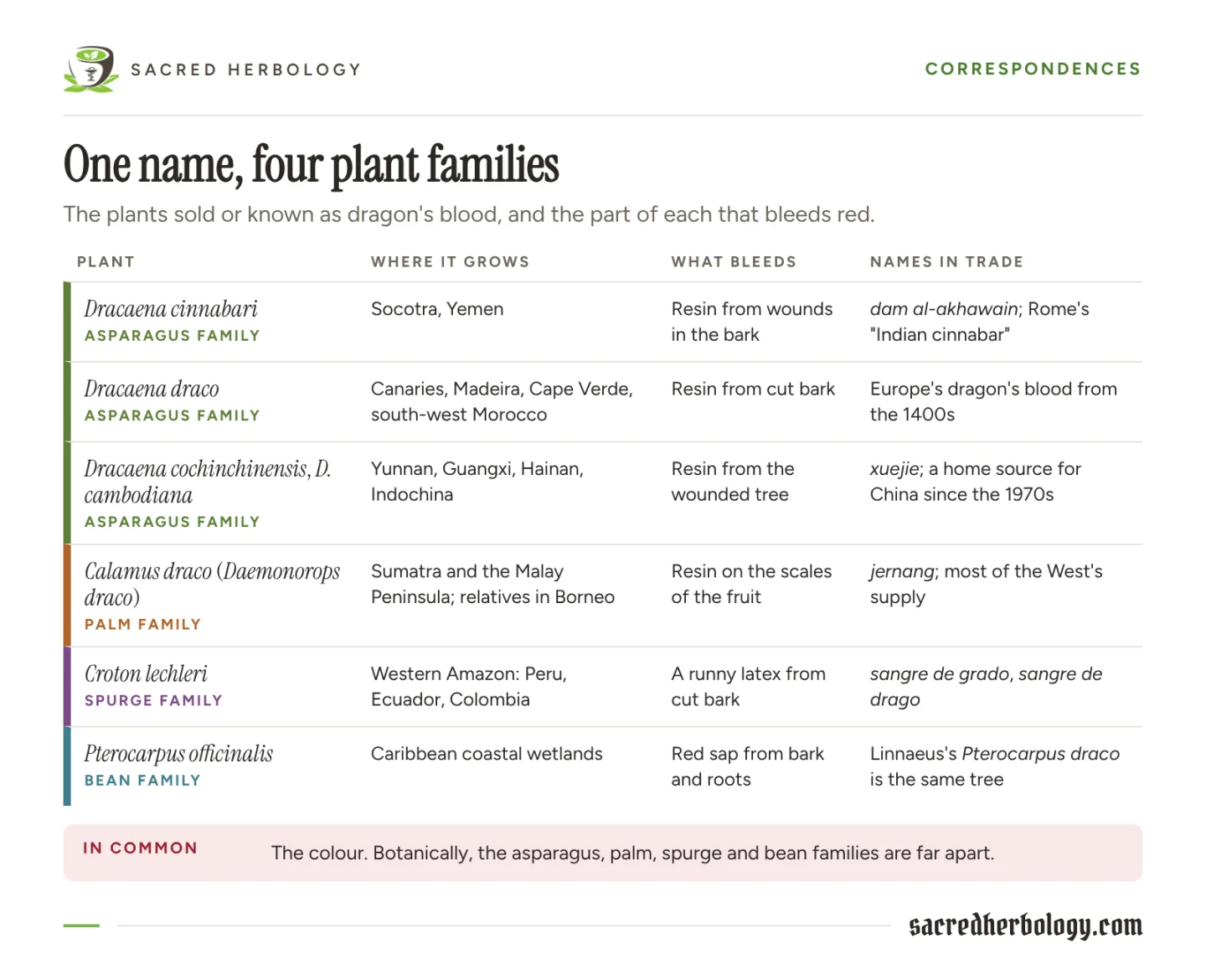
None of these will turn up as a lump of red resin on the charcoal. I mention them because the name will catch you out if you read older herbals, modern herbal marketing or travel writing from the Amazon. When someone says dragon’s blood, the first question is always which one.
A red for painters, fiddle-makers and engravers
For most of its European history, dragon’s blood was a colour.
Medieval illuminators used it for red inks and glazes on parchment, and painters used it as a translucent red over gold and silver leaf, which gave a warm, glowing effect. The trouble was that it faded and could darken, and it didn’t behave like the mineral reds. Cennino Cennini, a Tuscan painter who wrote a handbook for apprentices around 1400, Il Libro dell’Arte, gives it one short chapter. In Daniel V. Thompson’s translation of 1933, it reads in full: “A color known as dragonsblood is red. This color is used occasionally on parchment, for illuminating. But leave it alone, and do not have too much respect for it; for it is not of a constitution to do you much credit.” That is chapter forty-three, and it may be the most dismissive thing ever written about this resin.
It kept its place anyway. Because it dissolves in alcohol, and to a lesser degree in oils and turpentine, and gives a clear, warm red, it went into varnishes, especially for wood. Violin makers in Italy and elsewhere used it to tint their varnish, and some still do. It is often said that the great Cremonese makers, Stradivari among them, used it in theirs. That claim turns up in almost every popular account of violin varnish, and it is hard to pin down. The varnish recipes of the old makers were not written down for us, and analyses of their instruments are still argued over. If someone tells you the secret of the Stradivarius is dragon’s blood, treat it as a story that is often told, not a fact anyone has proven.
Then came an odd, practical use in the nineteenth century, when newspapers and books began to print pictures from etched zinc plates. The engraver transferred the picture to the metal and then etched away the background with acid, leaving the lines standing. To stop the acid eating sideways under the fine lines, he dusted the plate with powdered dragon’s blood and brushed it against the sides of the lines, often from four directions in turn, then warmed the plate so the resin melted and stuck. It made a red wall that the acid couldn’t get through. A 1917 article in the art magazine The Studio describes etchers using the same trick. For a long time, the red dust of a Sumatran palm helped put pictures into newspapers all over the world.
In the magical books
Now to magic, and here I’ll be careful about categories. The material in this section comes from the learned magical tradition and the modern occult societies, and it is esoteric material. It is what these traditions held. It is not my claim, and it is not the Journal’s.
The older European grimoires, the handbooks of ritual magic copied in manuscript and later printed, use plenty of colours and inks, and red inks are among them. Dragon’s blood was an easy red to get from any apothecary, and it dissolves well, so it is a natural candidate for a magical red ink. But be careful when you meet claims online that a particular grimoire calls for dragon’s blood ink. Many of them trace back to modern books, and not to the old manuscripts. I have not found a clear instance in the major Solomonic texts that I can point you to with confidence, and I’m not going to invent one.
Be careful too with alchemy. The alchemists wrote in a code of their own, where the dragon, the serpent, the lion and the blood stood for stages of the Work and for substances in the flask. In an alchemical text, “the blood of the dragon” might mean a red stage of the process, or a red mercury compound, or the resin, and the alchemists took care not to tell outsiders which. When you read an alchemical recipe that names dragon’s blood, read the whole passage before you decide what it means.
The clearest esoteric use comes much later, with the Hermetic Order of the Golden Dawn and its successors at the end of the nineteenth century. They organised the whole of their magical system around the Tree of Life of the Kabbalah, and they built tables of correspondences: lists of which colours, stones, plants, animals, gods and perfumes go with which part of the Tree and which planet. Aleister Crowley, who came out of the Golden Dawn, published his version of these tables in 1909 as Liber 777, and an expanded edition came out after his death. In the column of perfumes, dragon’s blood is set against the path of Mars, along with pepper and “all hot pungent odours”. The logic is a logic of sympathy, the same one Agrippa used three centuries before: Mars is red, hot, fierce and martial, dragon’s blood is red, blood is the stuff of war, so they belong together. The same row of the tables gives Mars its metal, iron, its colour, scarlet, its stone, the ruby, and its plants, absinthe and rue.
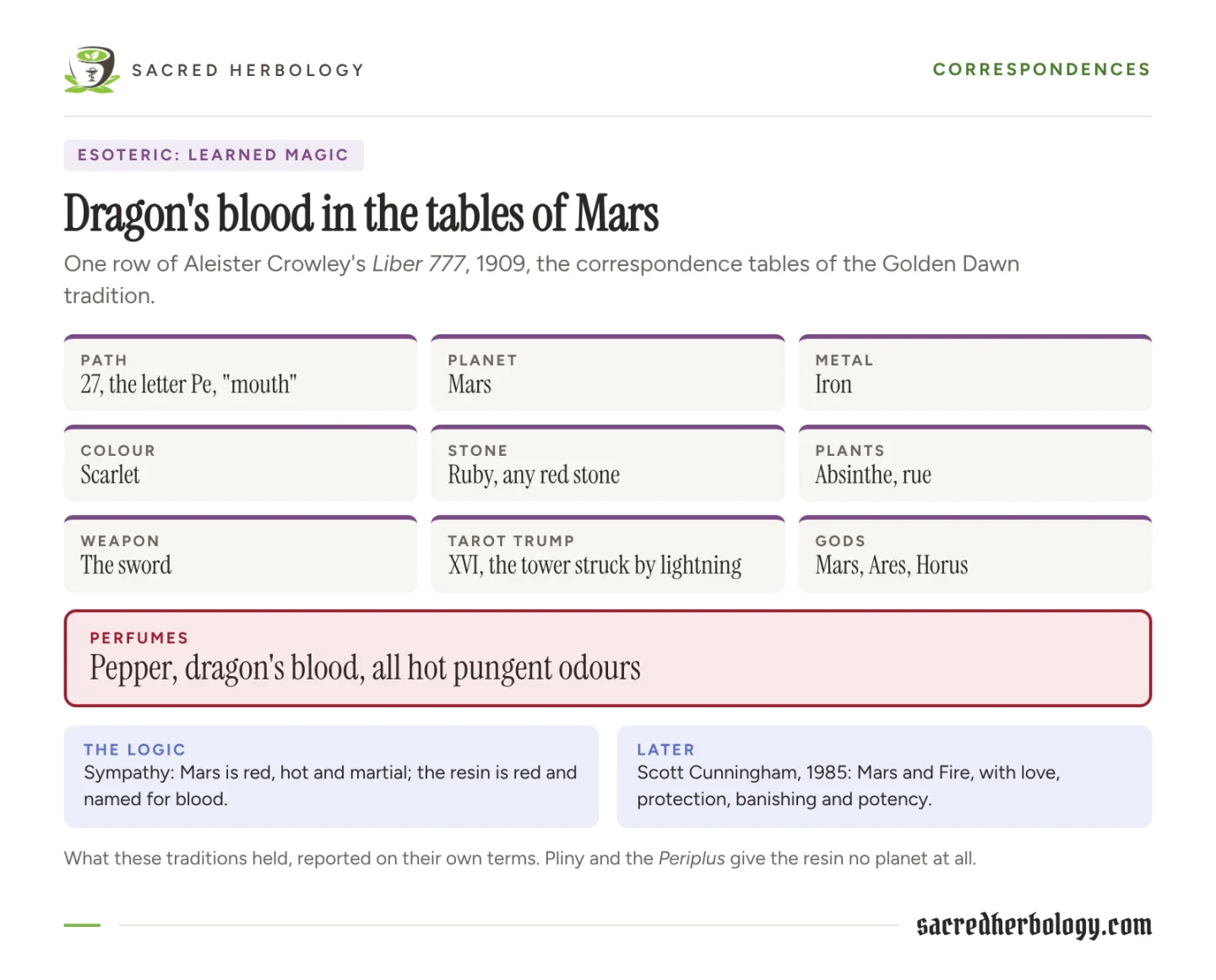
From those tables, dragon’s blood passed into the books of modern Western magic and Wicca in the twentieth century. Scott Cunningham’s Encyclopedia of Magical Herbs, first published in 1985 and still in print, gives it Mars and Fire, and powers of love, protection, banishing and potency, and recommends adding it to other incenses to make them stronger. That is a modern system, written in the 1980s, and it is a good example of a correspondence that looks ancient and is in fact quite recent. If someone tells you dragon’s blood has been the magician’s resin of Mars since antiquity, you can tell them the attribution is in print from Crowley’s day, and that the oldest writers on the resin, Pliny and the Periplus writer, said nothing about planets at all.
In the hoodoo shop
Dragon’s blood also has a strong place in hoodoo, the African American tradition of folk magic, also called conjure or rootwork, that grew up in the American South. That is a living folk tradition, and I’ll describe it from what its own practitioners have published.
By the early twentieth century, the drugstores and mail-order curio houses that supplied hoodoo practitioners stocked dragon’s blood in lumps, powder, sticks, ink and, later, oil. catherine yronwode, a well-known author and supplier in the tradition, writes in her shop’s published herb notes that the resin is burned on charcoal to clean a house and drive off evil, especially when moving into a new home, sometimes mixed with camphor. A small chunk is carried in a mojo bag, a little cloth packet of roots and curios, for luck and protection. Dragon’s blood ink is used to write out petitions and wishes. She describes a love working where a woman writes a lover’s name on brown paper with dragon’s blood ink, crosses it with her own name, folds the resin powder into the paper and burns it on charcoal with incense while she prays. In the hoodoo shops it stands for power, luck, protection and love.
Note the vocabulary. This is folk custom in the plain sense: practical working magic handed on by ordinary people and the shops that served them. Some of it has blended with the esoteric correspondences from the occult books, because the curio shops sold both, and anyone writing about it should keep the two lines of descent apart.
Some of the “dragon’s blood” sold in this trade, and in the wider incense trade, is pure resin. A great deal of it is not. Dragon’s blood incense sticks and cones from India, and dragon’s blood oils, are mostly made with a fragrance blend: something sweet, warm, ambery and slightly spicy, which has become “the dragon’s blood smell” for a whole generation. The real resin smells much fainter than that.

What it smells like on the coal
That fainter smell is worth knowing, because it is the best test you have.
Put a lump of real dragon’s blood on a hot coal and it will soften, bubble, darken and send up a thin smoke. The scent is mild: a little sweet, a little like warm resin or old wood, with what some people call a hint of vanilla or benzoin, and a dry, smoky edge as it burns down. It doesn’t fill the room the way frankincense does. Most people who burn it today put it in a blend, where it adds body and colour. Few burn it alone.
The main chemistry behind the red colour is a family of plant pigments called flavonoids. In the rattan resin, the best-known of them are the red compounds named dracorhodin and dracorubin, both names built on the Latin draco, dragon. The Chinese pharmacopoeia sets a minimum dracorhodin content for the rattan resin as one of its tests of quality. The Dracaena resins have their own set of related compounds, mostly chalcones and homoisoflavonoids, among them the loureirins of the Chinese tree resin. Those markers are what a laboratory reads, which is why the different sources can be told apart there, and why conservators studying old manuscripts and paintings can sometimes say which dragon’s blood an illuminator used. Naming a compound tells you what is in the resin. On its own it tells you nothing about what the resin does in the body.
The trade has always had its fakes. Old pharmacy books warned of dragon’s blood padded out with cheaper resins, earth and bits of crushed fruit scale, and the druggist’s quick check was that good resin dissolves almost completely in alcohol to a deep red and leaves very little ash when burned. Today the commonest problem is the one already mentioned: dye and perfume sold under the old name.
So, if you hold some in your hand, here is a simple way to think about what you’ve got. Treat it as a set of hints. Looks alone can’t prove the source, and only a laboratory can settle it.
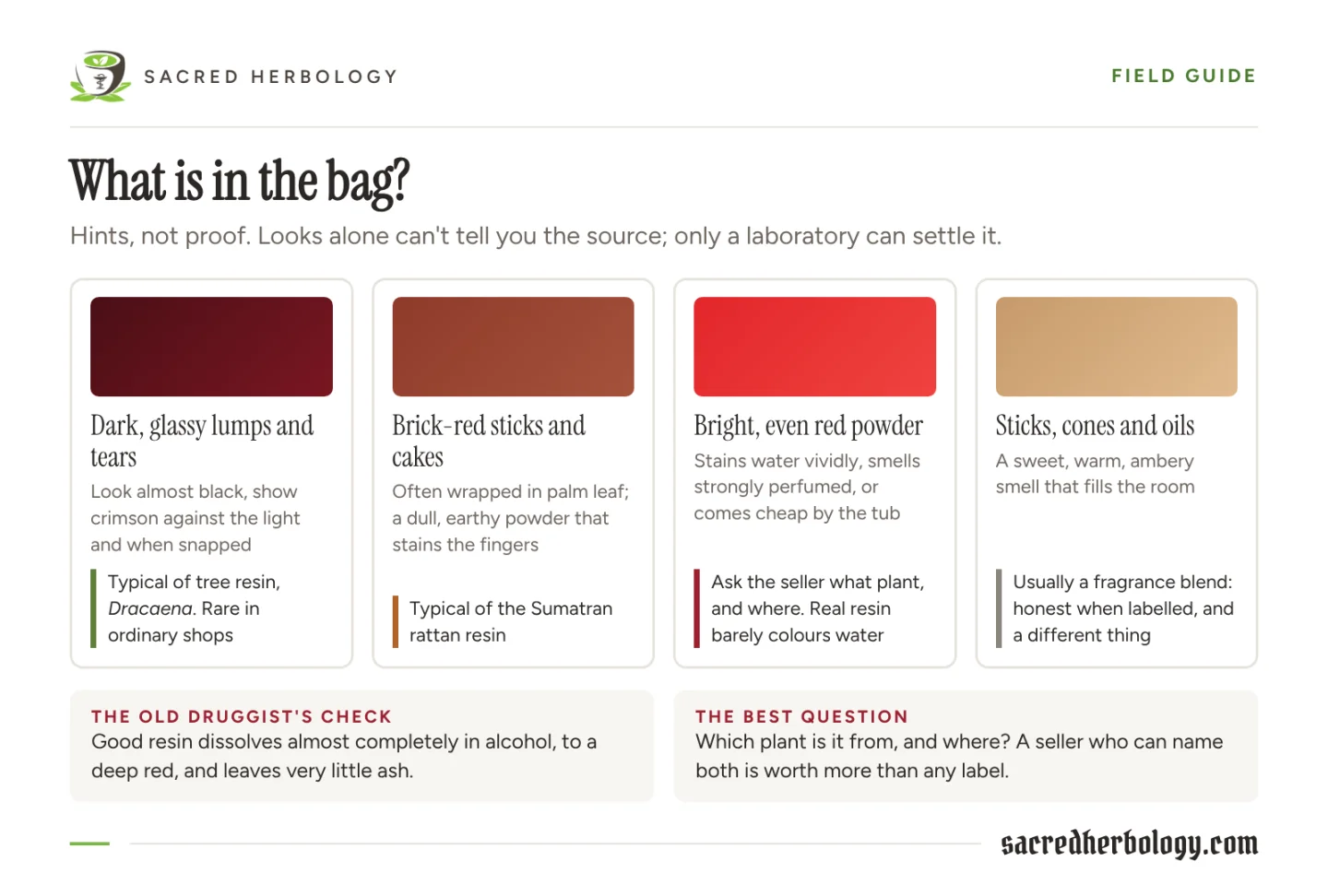
- Dark red, glassy lumps or tears that look almost black until held to the light, and show crimson when you snap them, are typical of tree resin, from Dracaena. Very little of this reaches ordinary shops.
- Brick-red sticks wrapped in palm leaf, or cakes and powder with a dull, earthy red colour that stains the fingers, are typical of the Sumatran rattan resin.
- Bright, uniform red powder that leaves a vivid red stain in water (real dragon’s blood barely colours water at all; it needs alcohol to dissolve), smells strongly perfumed, or comes in a big tub for a small price, deserves a question or two. Ask the seller what plant it is from, and where. A seller who can name the species and the region is worth more to you than any label.
- Sticks, cones, oils and “dragon’s blood” perfumes are usually fragrance blends. They are honest products when labelled as such, and they are a different thing from the resin.
Burning it safely, and buying it in Australia
Dragon’s blood is burned the way any resin is. The house line on that is the same as for frankincense or copal, and it is worth repeating.
- Use a proper charcoal disc in a heat-proof bowl half filled with sand or ash. Light the disc, wait until it glows grey all over, then add a small piece of resin. Dragon’s blood melts readily and can spit, so keep it small and keep your face and fingers back from it. Melted resin sticks to skin and burns. Never leave a lit disc on its own, and let it cool right through before you tip out the sand.
- Open a window. Resin smoke is still smoke, full of fine particles, and it can set off an asthma attack. If you have asthma or any other chest or lung condition, or you are pregnant, keep well out of the smoke or skip it. Keep it away from babies, small children and pets, and above all from pet birds, whose lungs are easily hurt by smoke.
- The charcoal disc gives off carbon monoxide as it burns, which you can’t see or smell. Never burn it in a closed room, a tent or a car. If anyone gets a headache or feels dizzy or sick while it burns, put the disc out, get them into fresh air, and ring 000 if they don’t come right quickly.
- Dragon’s blood stains. It will mark fabric, stone benchtops and pale timber, and alcohol spreads it further. Burn it on a tray.
- Don’t swallow it, keep powder away from food, children and pets, and wash your hands after handling it. Some of the bright powders on the market are dyed, and you can’t know what with. If anyone swallows something they shouldn’t, ring the Poisons Information Centre on 13 11 26, or 000 in an emergency.
If you want to go further than incense with any of the dragon’s blood plants, for health or anything to do with the body, consult a degree-qualified herbalist with competencies and adequate training in pharmacognosy. The long history of the resin in the old medicine of China and Europe is part of its story. It is not a guide for anyone at home.
In Australia, dried plant resins brought in from overseas pass through biosecurity, and the conditions for any particular product are set out by the federal Department of Agriculture, Fisheries and Forestry in its import conditions database. Reputable suppliers deal with that for you. Under the Australian Consumer Law, a seller has to describe what they sell accurately. A fragrance blend sold as “dragon’s blood” should say it is a fragrance, and a resin sold as Socotran should be Socotran. That is the standard we hold ourselves to on our own shelves, and it is the standard to expect from anyone.
The trees are worth thinking about too. Socotra’s dragon tree is Vulnerable, and the Canary dragon tree is listed as Endangered in the wild. Most of the commercial resin now comes from the rattan, and the rattan itself does best where its forest is left standing and the people who gather it are paid fairly. Ask where your resin comes from, and who gathered it.
An Australian dragon tree
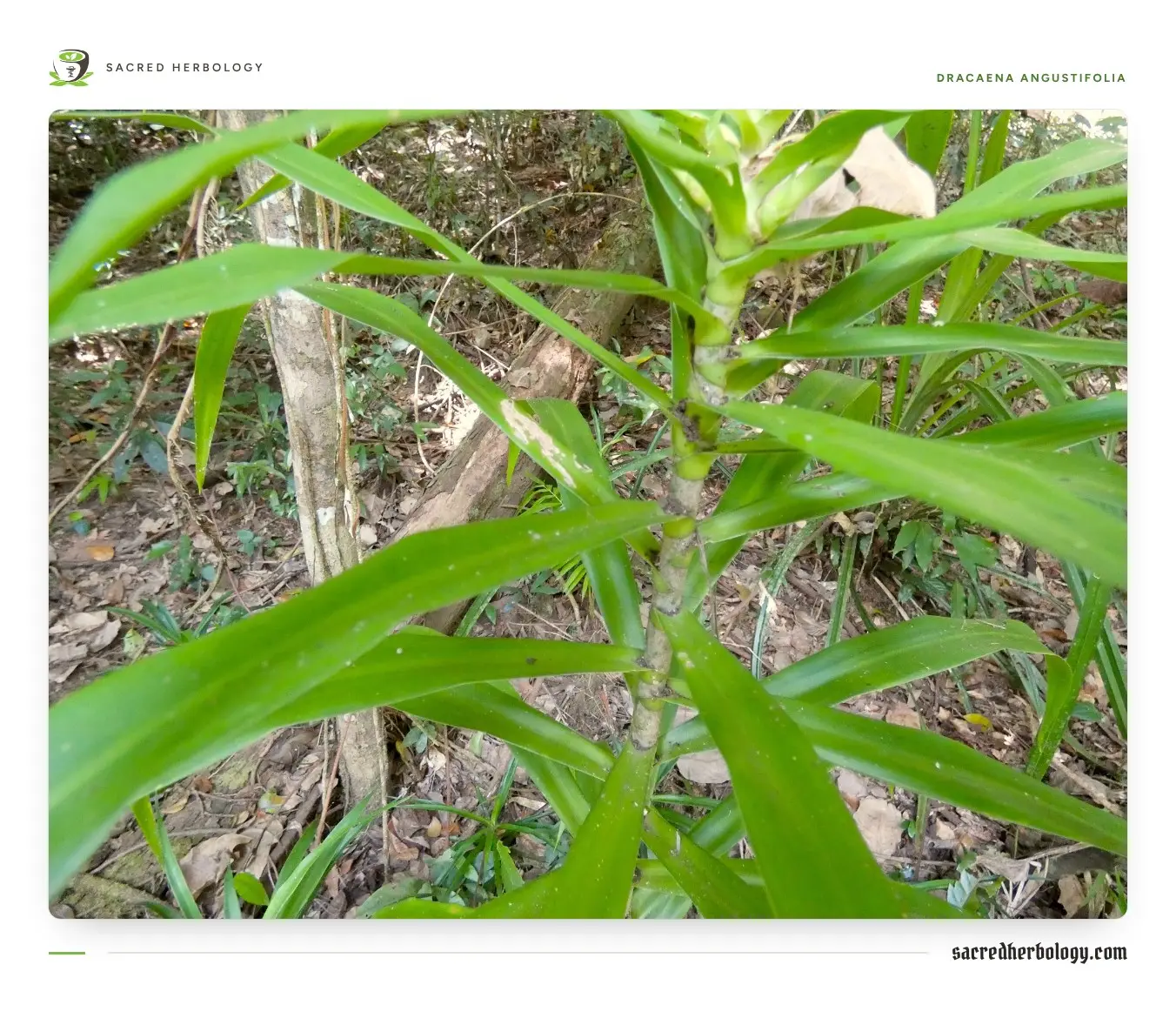
There is a quiet Australian footnote to all this. We have a dracaena of our own. Dracaena angustifolia, called the native dracaena or pleomele, grows wild in lowland and monsoon rainforest in Cape York, along the Queensland coast and in the Top End of the Northern Territory, as well as across tropical Asia. Older Australian books list it as Pleomele angustifolia, a genus name botanists have since folded back into Dracaena. It is a slender shrub or small tree, a few metres tall, with long strap leaves, and it looks nothing like the Socotran umbrella. It is not a commercial source of dragon’s blood, and I’d be wary of anyone who sells it as one. It is a pleasant reminder that the genus reaches all the way into Australia. The rattan has its relatives here too. The lawyer canes of the Queensland rainforests, the hooked climbers that bushwalkers call wait-a-while, are species of Calamus, cousins of the Sumatran dragon’s blood palm. None of them is a source of the resin.

The true dragon tree, Dracaena draco, is grown in gardens around Australia too. It likes a dry, sunny spot and good drainage, and it takes a very long time to make any size, which is why mature specimens in old Australian gardens are prized. In the wet north it needs protection from waterlogging, and it grows best in a raised, sandy bed or a large pot, where it will sit for decades as a living link to Humboldt’s tree at Orotava.
The blood of two brothers
Two thousand years ago a Greek merchant sailing to India wrote down that an island at the mouth of the Red Sea made a red stuff that dripped from trees. A Roman admiral, writing at about the same time, believed it came from a dragon crushed by a dying elephant. A Florentine painter told his apprentices it would do them no credit. Newspaper engravers dusted it onto zinc. Crowley set it under Mars. A woman in a Southern town folded it into a paper with her lover’s name and set it on the coal. A forest family in Jambi cut the fruit clusters down from a climbing palm and pounded the red dust off them for the market. It is one name, and it has covered three plants and more besides.
The one thing every version shares is that colour, the deep, wet red that made people think of blood the first time they saw it. Whatever you believe about the resin, the trees on Socotra are old, slow and running short of years, and the rattan forests of Sumatra are shrinking. If you burn it, burn it knowing which one you have and where it grew.
Where this comes from
- Pliny the Elder, The Natural History, trans. John Bostock and H. T. Riley (Taylor and Francis, London, 1855), book 8 (the dragon and the elephant) and book 33, chapter 38, “Cinnabaris”.
- The Periplus of the Erythraean Sea: Travel and Trade in the Indian Ocean by a Merchant of the First Century, trans. Wilfred H. Schoff (Longmans, Green, New York, 1912), section 30.
- Lionel Casson, The Periplus Maris Erythraei: Text with Introduction, Translation, and Commentary (Princeton University Press, 1989).
- Cennino d’Andrea Cennini, The Craftsman’s Handbook (Il Libro dell’Arte), trans. Daniel V. Thompson Jr. (Yale University Press, 1933; Dover, 1954), chapter 43.
- G. R. Crone (ed. and trans.), The Voyages of Cadamosto and Other Documents on Western Africa in the Second Half of the Fifteenth Century (Hakluyt Society, London, 1937).
- Alexander von Humboldt and Aimé Bonpland, Personal Narrative of Travels to the Equinoctial Regions of the New Continent, trans. Helen Maria Williams (Longman, London, 1814-1829), vol. 1.
- Aleister Crowley, 777 and Other Qabalistic Writings, ed. Israel Regardie (Samuel Weiser, 1973); Liber 777 first published 1909.
- Scott Cunningham, Cunningham’s Encyclopedia of Magical Herbs (Llewellyn, 1985).
- catherine yronwode, “Dragon’s Blood: spiritual supplies in the hoodoo and conjure tradition”, Lucky Mojo Curio Co. herb notes (Forestville, California), online.
- Jess Craig, “Saving the Dragon’s Blood”, bioGraphic, 12 October 2022.
- The Studio: An Illustrated Magazine of Fine and Applied Art, vol. 70 (1917), on the etcher’s use of powdered dragon’s blood.
- Queensland Government, WildNet species profile, Dracaena angustifolia.