
Somewhere this morning, in Tehran or Mashhad, in Kabul or Almaty, in a flat in Los Angeles or a brick house in western Sydney, a woman is tipping a pinch of small brown seeds onto something hot. It might be a lump of glowing charcoal in a little brass dish. It might be a dry frying pan on the stove. The seeds sit there for a second, then they start to crack and jump like corn in a pot, and a thick grey-white smoke climbs off them with a sharp, scorched smell. She waves it around the room with a tea towel, or she lifts the dish and circles it above the head of a child who is about to sit an exam, a son who is about to drive across the country, a daughter on her wedding day. Under her breath she says a few words her own mother said.
The seeds are esfand. You will see the word spelled esphand, espand, isfand and sepand, and in English the plant is Syrian rue, African rue, wild rue or harmal. The botanist’s name is Peganum harmala. The smoke is meant to drive off the evil eye, the harm that rides on an envious look or a compliment given with too much feeling behind it. In Iran it is one of the most familiar household acts there is. Most Iranian kitchens keep a jar of the seeds somewhere, and most Iranians can tell you what the smoke smells like, usually while pulling a face.
This piece follows that smoke as far back as anyone has traced it and as far out as it has travelled. It starts with the plant, which is a desert weed with a long string of names. It goes to a pair of clay burners in an Iron Age house in north-west Arabia, where chemists found the plant’s alkaloids in the soot about 2,700 years after the fire went out. It looks at what the Greek and Persian physicians wrote, at the scholarly argument over whether this plant was the sacred haoma of ancient Iran, and at the customs of birth, marriage and protection that grew up around the seed. Then it goes east, to the boys who carried smoking cans through the markets of Kabul, the bundles of dried twigs on the bazaar tables of Kazakhstan and Kyrgyzstan, and a president who told his country to fumigate itself against a virus. I’ll finish with what the chemistry shows, how the smoke sits in an Australian house, and where the plant stands under the law here.
One thing first. Everything below about the evil eye, about angels living in the seeds, about the smoke cleaning a house of harm, is what the people who burn esfand believe and have believed. I’m reporting it as faithfully as I can. I’m not asking you to believe it, and I’m not telling you it is false. The household custom is village and family custom, folk practice in the plain sense: the knowledge of ordinary people, passed by hand and mouth. Where the plant turns up in a learned magical book, I’ll say so and label it esoteric, because that is a different kind of record with a different history.
The rue that isn’t
Start with the plant itself, because it is easy to get wrong.
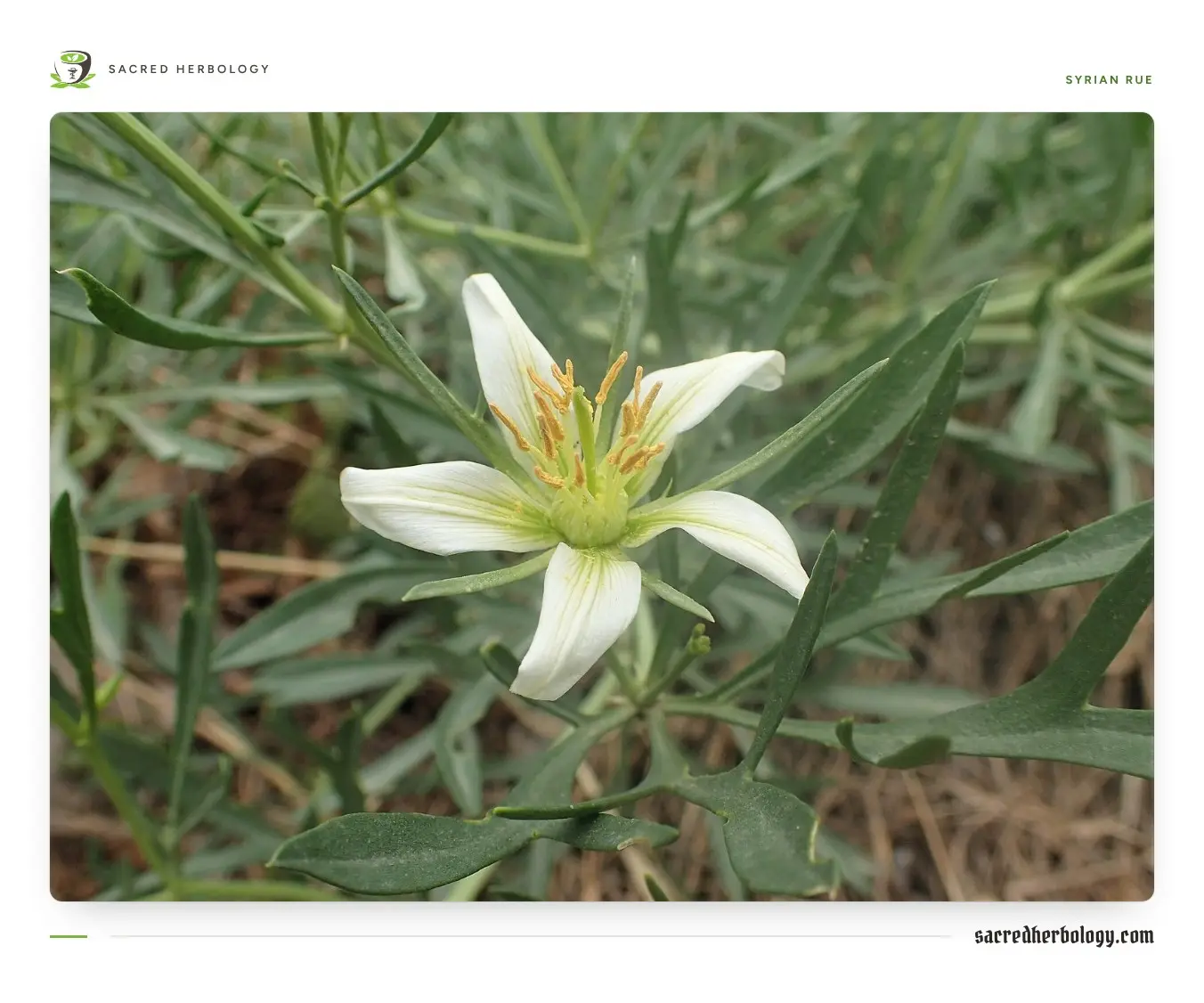

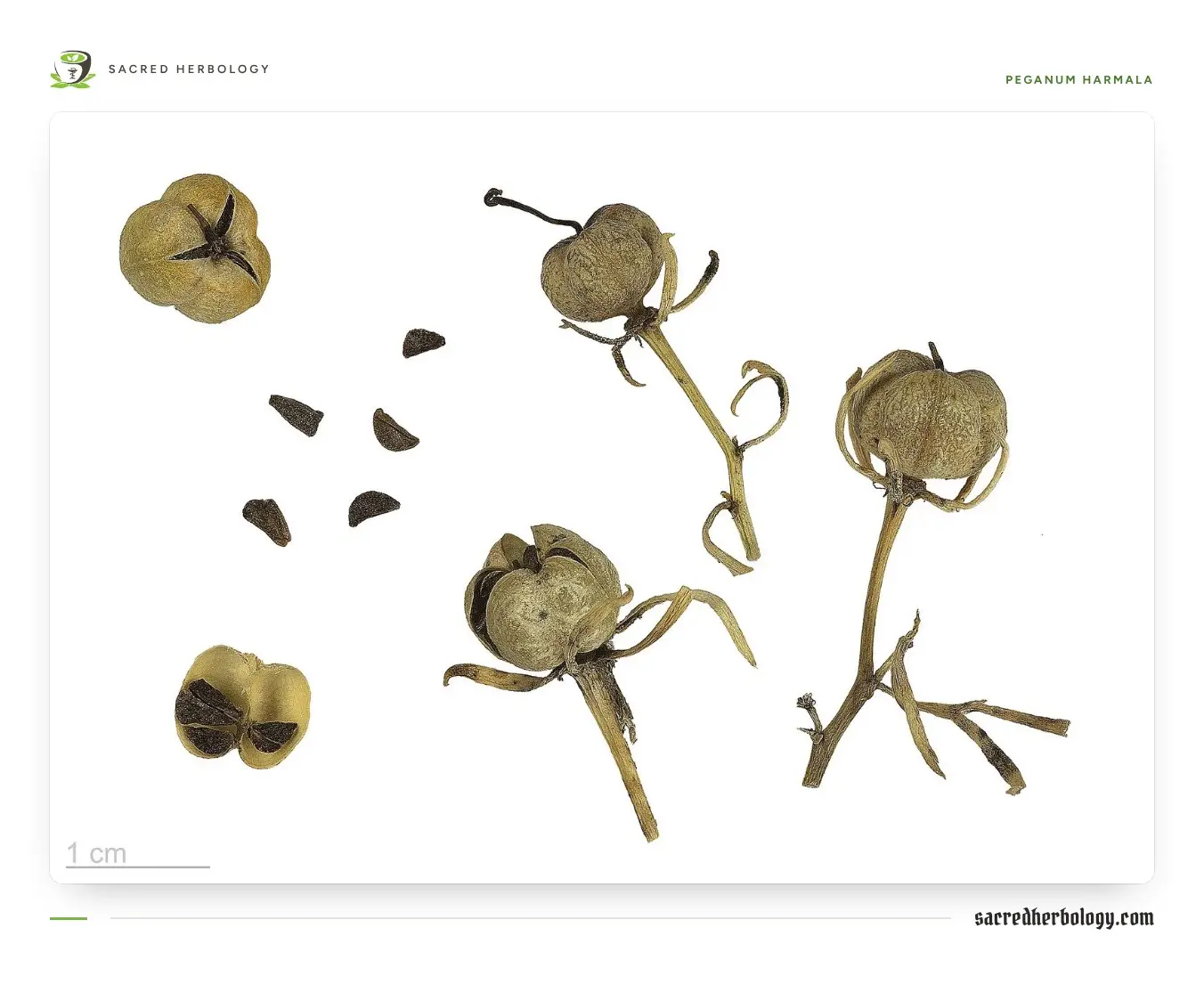
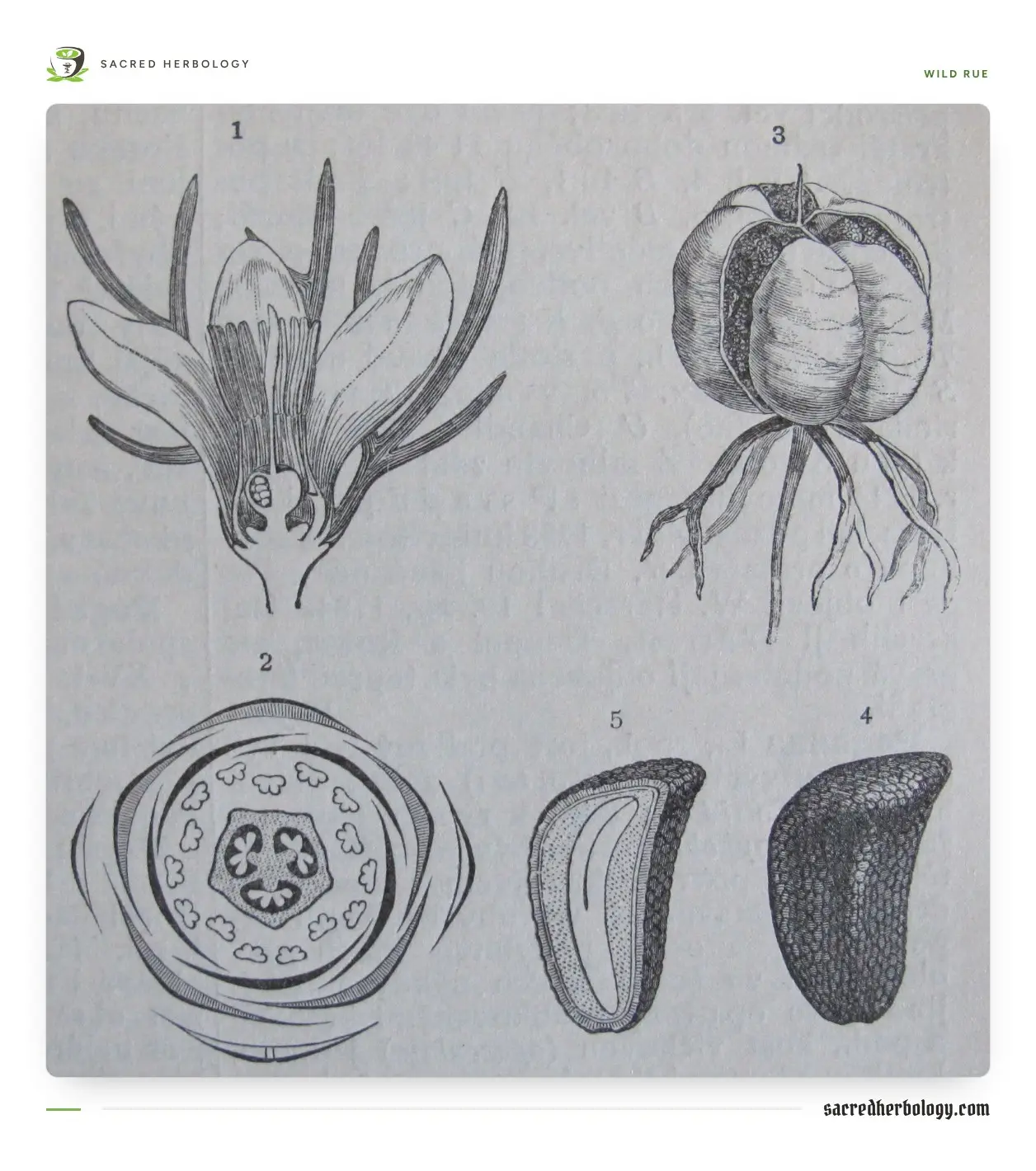
Peganum harmala is a low, bushy perennial, usually knee-high or a little more, that comes up each year from a deep, woody root. The stems branch thickly from the base, so a mature plant makes a rounded clump. The leaves are cut into narrow, almost thread-like segments, bright green and fleshy, and when you bruise them they give off a rank, bitter smell that grazing animals have learned to leave alone. The flowers are small and five-petalled, white to pale creamy yellow, with a cluster of stamens in the middle. After them come the fruits, which are the part everybody knows: round capsules about the size of a pea, divided inside into three chambers and packed with dozens of tiny, angular, dark brown seeds. When the capsule dries it splits, and the seeds spill out.
The photographs here show both stages: a flower open among the feathery leaves, and dry capsules split open with their seeds spilled out beside them.

The plant belongs to dry country. It grows wild from North Africa and the dry corners of southern Europe through Arabia, Turkey and the Levant, across Iran, Afghanistan and Pakistan to the edge of north-western India, up into the Central Asian steppe, and on into north-western China and Mongolia. It likes poor, disturbed, salty or overgrazed ground: the edges of tracks, old village sites, the margins of fields, places where livestock have eaten everything else. Because the animals avoid it, it tends to spread wherever grazing is heavy. It is a weed in the old, honest sense, a plant that thrives where people have been.
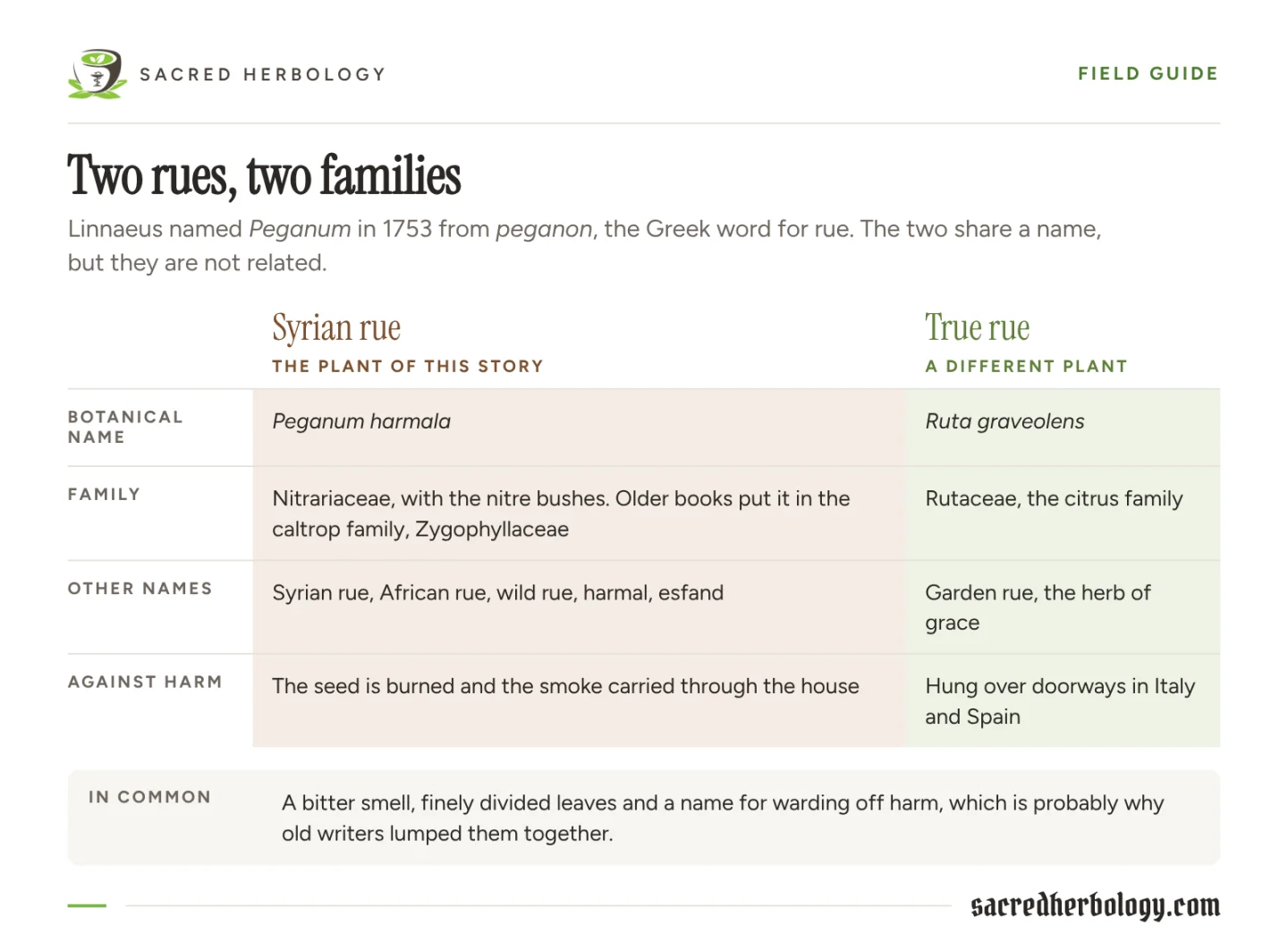
The name is a muddle with a history. Linnaeus called it Peganum harmala in 1753, taking peganum from the Greek word for rue, peganon, and harmala from the name the plant carried in the east. English speakers followed the Greek and called it wild rue or Syrian rue. True rue, Ruta graveolens, the herb of grace that hangs over doorways in Italy and Spain, is a different plant in a different family, the citrus family, Rutaceae. The two share a bitter smell, finely divided leaves and a reputation for warding off harm, which is probably why the old writers lumped them together. Botanists once put Peganum in the caltrop family, the Zygophyllaceae, and you will still see that in older books. Most botanists now place it in a small family, the Nitrariaceae, alongside the nitre bushes, Nitraria, which also love salty desert ground. It has nothing to do with Syria in particular. The name is a European label for a plant that came, as far as Europe was concerned, from somewhere east.
It has also travelled. In the United States it escaped into the south-west, where it is a declared noxious weed in several states and goes by African rue. That is overseas and only a footnote here. In Australia it has naturalised mainly in South Australia, with scattered records in Victoria and New South Wales, and it is a declared weed in South Australia. Western Australia lists it as a declared pest, though not as present in the state. I’ll come back to the Australian position at the end, because the law here is stricter than most people expect.
Many names, one smoke
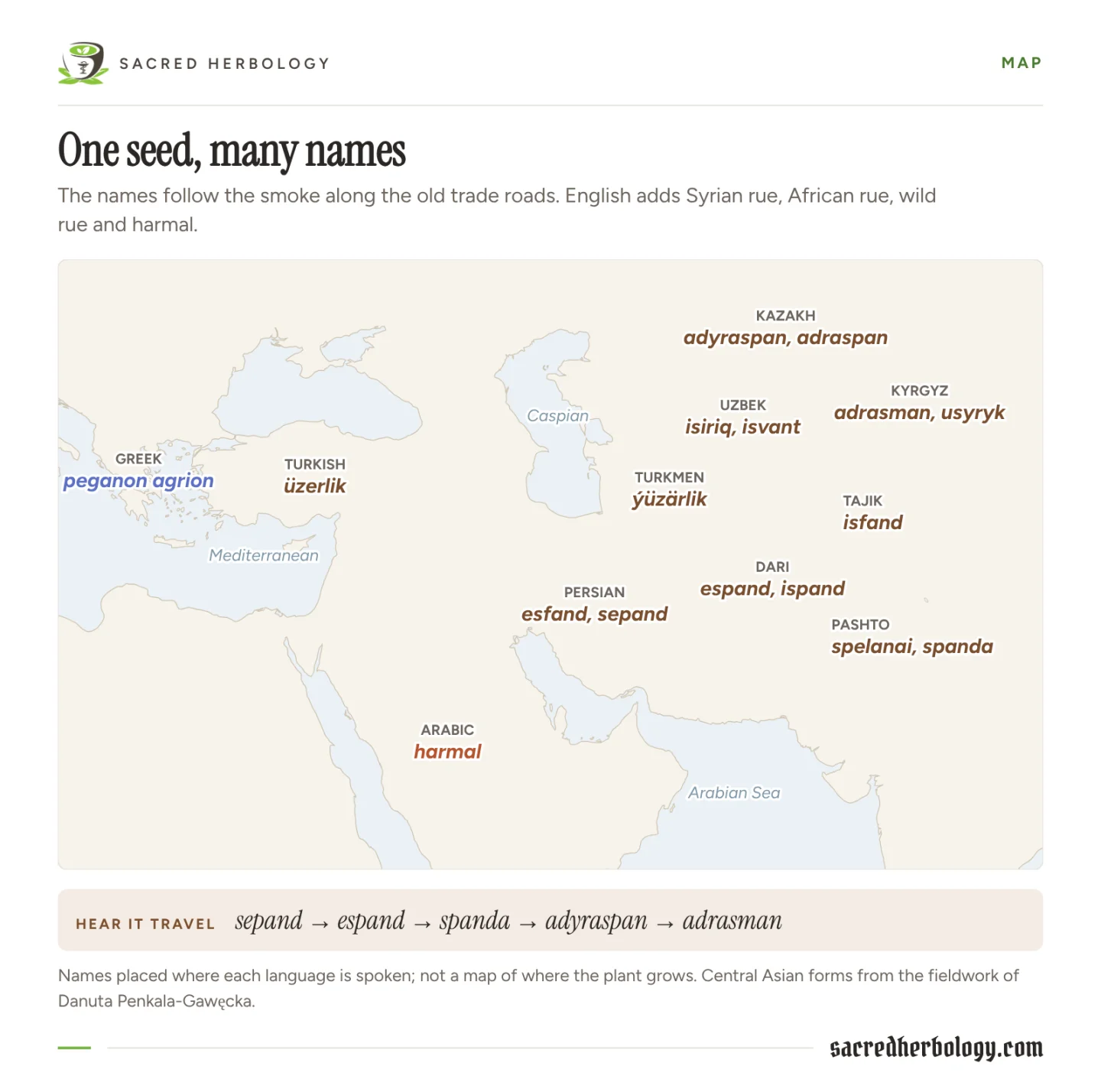
Few plants carry as many names across as many languages, and the names tell you where the smoke has gone. Here they are, language by language, and the map below sets them on the ground:
- Persian: esfand, espand, sepand, aspand, sepanj. Tajik: isfand.
- Dari (Afghanistan): espand, ispand. Pashto: spelanai, spanda.
- Arabic: harmal.
- Kazakh: adyraspan, adraspan.
- Kyrgyz: adrasman, abdyrashman, and in the south-west usyryk.
- Uzbek: isiriq, isvant.
- Turkmen: ýüzärlik. Turkish: üzerlik.
- Greek: peganon agrion, wild rue, and in later Greek writers persaia botane, the Persian herb.
- English: Syrian rue, African rue, wild rue, harmal.
The Central Asian forms come from the fieldwork of the Polish anthropologist Danuta Penkala-Gawęcka, who has written the best survey I know of the plant in that region. Look at the Kazakh and Kyrgyz words and you can hear the Persian sepand hiding inside them, worn down by centuries of other tongues. Adyraspan, adrasman, spanda, espand: the same word travelling up the trade roads with the seed.
Where does the Persian word come from? The Encyclopaedia Iranica, in its entry on esfand by the folklorist Mahmoud Omidsalar, traces it to an old Iranian form reconstructed as svanta. Many scholars connect that root with the Avestan word spenta, which means something like holy, bountiful, full of increase. It is the same spenta that appears in the Amesha Spentas, the Bounteous Immortals of Zoroastrian theology. If that connection holds, the plant’s everyday name once meant something close to “the holy one”. That is a big claim to hang on a few sounds, and linguists argue over the details, but it is the reason the plant has a place in one of the more interesting arguments in the history of Iranian religion. I’ll come to it shortly.
The Arabic harmal is old too. It had already reached Greek by the time the copyists of Dioscorides wrote it into his book, as you’ll see below. So the two great name families, sepand in the Iranian world and harmal in the Semitic one, met in the Near East long before any European botanist wrote either of them down.
The oldest smoke: a house at Qurayyah
For most of the twentieth century, the history of burning esfand started with books. In 2025 it gained an archaeological chapter, and a vivid one.
Qurayyah is an oasis in the far north-west of Saudi Arabia. In the Bronze and Iron Ages it was a substantial settlement, something close to a small town, known to archaeologists for its painted pottery. The site has produced a good number of censers and burners, and one of them, from a grave of the very end of the Early Bronze Age, dates to roughly 2135 to 1952 BCE. People at Qurayyah were burning things in small clay vessels for a very long time.
A joint Saudi and Austrian excavation, with laboratory work in Germany and France, took samples from three fired-clay burners of the Middle Iron Age, the first half of the first millennium BCE. Barbara Huber, Marta Luciani and their colleagues published the results in Communications Biology in May 2025. They drilled tiny amounts of powder from the residues soaked into the clay and ran them through high-performance liquid chromatography with tandem mass spectrometry, a technique that picks out specific molecules by their weight and the way they break apart.
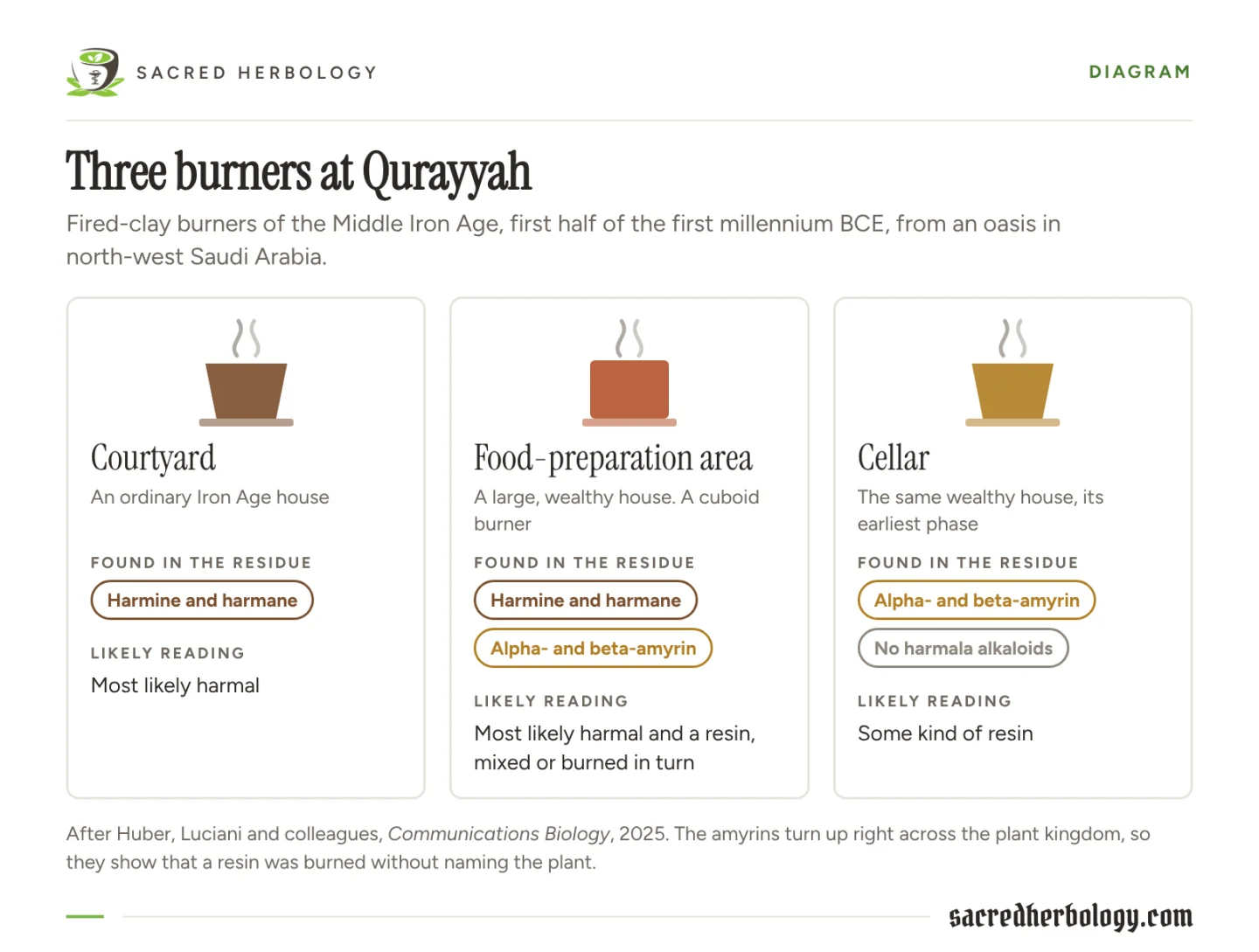
Here are the three burners. Where they were found matters as much as what was in them, and the diagram below sets them side by side:
- One stood in the courtyard of an ordinary Iron Age house.
- One, a cuboid burner, came from the food-preparation area of a large, wealthy house.
- One came from the cellar of the same wealthy house, from its earliest phase.
In the courtyard burner and the kitchen burner, the team found harmine and harmane, two members of a family of alkaloids called beta-carbolines. They confirmed both against pure reference compounds. They then went through the other plants that contain those molecules and ruled them out one by one. The maypop passionflower, Passiflora incarnata, and the ayahuasca vine, Banisteriopsis caapi, are American plants, unknown in Iron Age Arabia. Cultivated tobacco is American too. Coffee contains harmane, but coffee did not reach Arabia until the fifteenth century CE. That left Peganum harmala, which grows wild in Saudi Arabia today. The authors concluded that it was the most likely source, and they described the find as the oldest radiocarbon-dated material evidence anywhere for the burning of harmal.
The cellar burner told a different story. It held no harmala alkaloids at all. Instead it carried alpha- and beta-amyrin, triterpenes found right across the plant kingdom and plentiful in the resins of the frankincense and myrrh family, the Burseraceae. The authors were clear that these compounds can’t name a species, so the safe reading is that some kind of resin went on the coals. The kitchen burner had both. The team could not tell whether someone had mixed harmal with a resin or simply burned one and then the other in the same vessel. Either way, the household had what looks like a resin incense and a seed smoke, and used both.
The authors were careful about what it all meant, and I’ll be careful too. They pointed out that these burners came from houses. At other oases in the region, at Tayma and at Mada’in Salih, burners from graves have produced resins but no harmal. So at Qurayyah the seed smoke looks like a household thing, part of daily life, at home. They noted that harmal smoke smells pungent, so the people of Qurayyah probably did not burn it for fragrance. They raised the possibility that it was burned to keep insects down and the air clean in a hot oasis, or as part of the region’s medicine. They left a mind-altering purpose open. They noted that the alkaloids only bring on visions in large amounts, that taking that much by mouth can poison a person, and that breathing smoke is a different road into the body from eating the seed. Their own summary puts the weight on medicine and hygiene. They also mentioned the modern Iranian custom of burning the seeds to ward off evil, as a parallel.
Those are reasonable readings of good evidence, and they stay readings. No one at Qurayyah left a note. What the chemistry does show is that people in Arabia were putting this plant on hot coals inside their homes more than two and a half thousand years ago. A grandmother in a Tehran kitchen is doing much the same thing in much the same kind of room.
There is one older trace, and the Qurayyah team mention it: seeds of Peganum harmala found at Maadi, a Predynastic settlement near modern Cairo. Those seeds tell us the plant was there. They don’t tell us what anyone did with it.
Dioscorides and the Persian herb
The written record starts with the Greeks.
Pedanius Dioscorides, an army doctor from Cilicia in what is now southern Turkey, wrote his De materia medica in the first century CE. It became the most copied book on medicinal plants in the Western and Islamic worlds for fifteen hundred years. In his third book, after the garden rue, he gives a separate entry to peganon agrion, wild rue, and that entry is generally read as Peganum harmala. The text, and the lists of foreign names that later scribes attached to it, record that the plant was called harmala, and that in Cappadocia and among the Galatians of Asia Minor people called it moly. The synonym lists were added by later hands, so they tell you what scribes believed the plant was called, which is still worth knowing.

That word moly carries a charge. In the Odyssey, Hermes gives Odysseus a herb called moly, black at the root and white in the flower, to protect him from the witch Circe’s drugs. Ever since, people have tried to say which real plant Homer meant, and wild rue is one of the candidates, along with a long list of others. It is a guessing game, and nobody has won it. All the Cappadocian name tells us is that in at least one corner of the Greek-speaking world, people thought this protective weed deserved the name of Homer’s protective herb.
The finest early picture of the plant is in New York. The Morgan Library in New York holds a Greek herbal made in Constantinople in the middle of the tenth century, catalogued as MS M.652, an alphabetical version of Dioscorides with painted plants throughout. One of its paintings is labelled peganon agrion, wild rue. A Byzantine painter set down this weed with the same care he gave the roses and the lilies.
The physicians who wrote in Arabic and Persian took up Dioscorides and added their own experience. The Iranica entry gathers what they said. They knew a white kind and a stronger black kind. They classed the plant as hot, in the four-humour system that the Arabic and Persian physicians inherited from the Greeks, and prescribed it for a range of complaints that the system called cold. The great polymath al-Biruni, writing in the first half of the eleventh century, gave it an entry in his book of drugs, the Kitab al-Saydana. I won’t list the medical uses here. They belong to a learned tradition of drug therapy that is part of the plant’s history, and they are no guide to anything you or I should do with it.
The Persian physicians and the Persian poets knew the smoke as well. According to Iranica, burning the seeds against the evil eye is widely attested in early Persian literature, and its sources include the court poet Farrokhi of Sistan, who died in the late 1030s. So by the time of the first great flowering of Persian poetry, the household act was already old and familiar enough for a court poet to use it.
Haoma, and an argument about the holy
Now to the argument.
The oldest scriptures of Iran and India both describe a sacred plant that was pressed, mixed and drunk in ritual. The Rigveda calls it soma. The Avesta, the scripture of the Zoroastrians, calls it haoma. The words are the same word in two sister languages, and the rite clearly goes back to a time before the ancestors of the Indians and Iranians went their separate ways. Both traditions praise the plant as a god, a giver of strength and insight, a drink of the immortals. Neither one says, in terms a botanist could use, what the plant was.
That silence has drawn a long line of candidates. In 1968 R. Gordon Wasson argued in Soma: Divine Mushroom of Immortality that soma was the fly agaric mushroom, Amanita muscaria. Others have put forward cannabis, the opium poppy, various mushrooms and ephedra. Ephedra has the strongest living claim, because it is what Zoroastrian priests actually use. In the Yasna ritual of the Parsis of India and the Zoroastrians of Iran today, the priest pounds twigs of a plant called hom, and that plant is ephedra.
In 1989 David Flattery and Martin Schwartz, at the University of California, put forward Peganum harmala. Their book, Haoma and Harmaline, argued that the Iranian haoma was this plant, and they followed what they saw as its legacy through Iranian religion, language and Middle Eastern folk custom. Part of their case rested on the name. If sepand goes back to the word for holy, then the everyday name of this weed may preserve its old sacred standing. Part rested on the plant’s chemistry, which can affect the mind, and part on its long and stubborn place in Iranian household ritual. In their reading, the burning of esfand against evil is a faint domestic echo of a much older and grander sacrament.
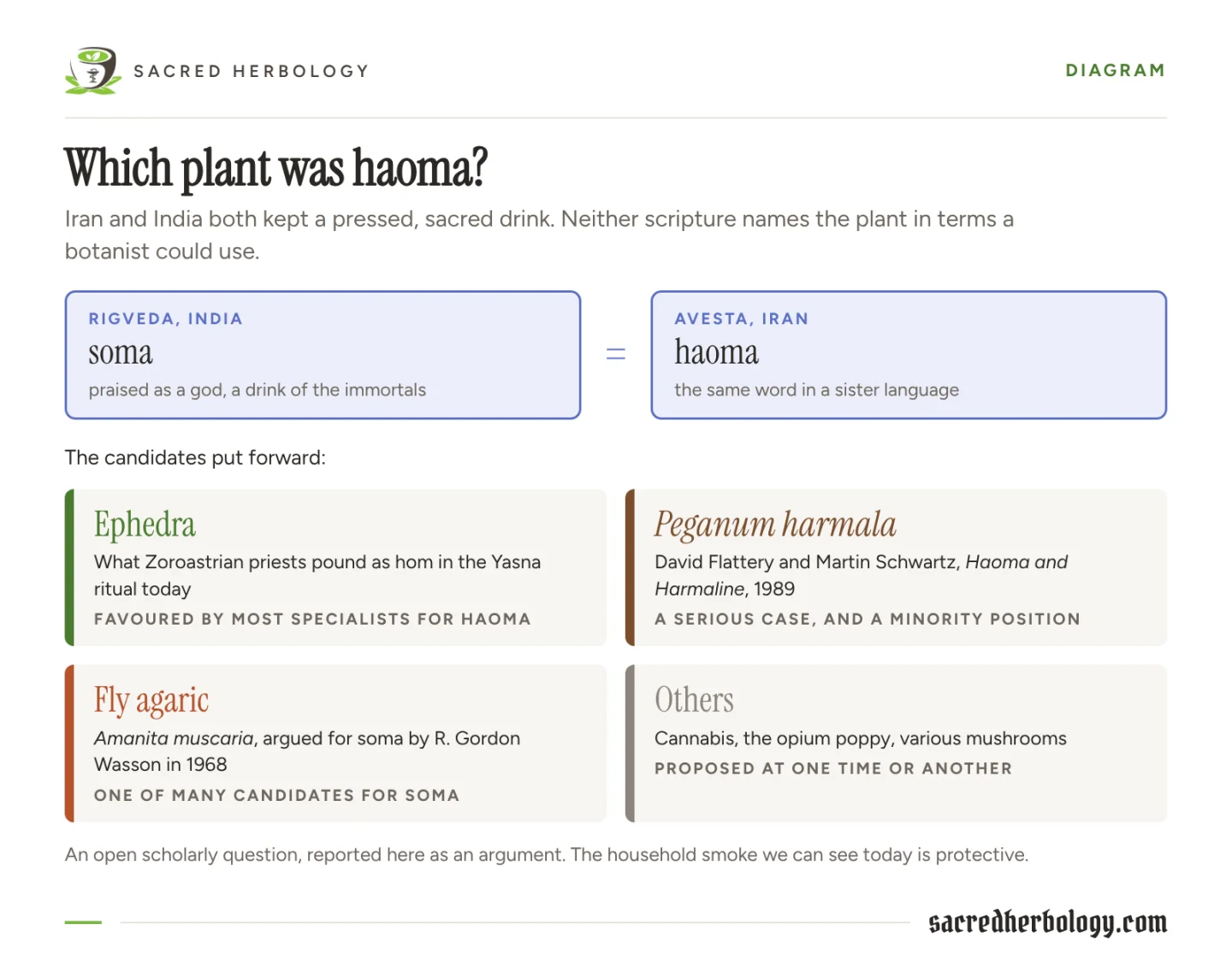
Where this stands: it is a serious scholarly argument by two respected Iranists, published by a university press, and it is a minority position. Most specialists in the field still favour ephedra for haoma, and the question of soma in India is even more crowded. The Iranica entry on esfand says that the plant’s association with haoma may have shaped its protective use, and leaves it there. That seems right to me. The argument is worth knowing, because it makes you look at a grandmother’s jar of seeds in a new light. It is still an argument.
There is a temptation, when you read this kind of thing, to jump from “this plant may once have been sacred” to “this plant is sacred”, or from “this plant contains alkaloids that act on the brain” to “the ancients used it to see visions”. Neither jump follows. The household custom we can see is protective. It is about keeping harm away from people you love. That is enough to explain why it has lasted.
The eye that harms
To understand the smoke you have to understand what it is for.
The belief in the evil eye runs from the Atlantic coast of Morocco to the Indian subcontinent, around the Mediterranean and deep into Central Asia. The core idea is simple. A look can do harm. Envy, admiration, even plain over-enthusiastic praise can carry a force that lands on the person or thing admired. A beautiful baby, a new car, a good harvest, a bride, a boy who has just won a prize: all of them are exposed. The harm can show up as illness, bad luck, a broken possession, a sudden reversal. In Persian the evil eye is cheshm-e bad, the bad eye, or cheshm-zakhm, a wound or blow from the eye. In Afghanistan Penkala-Gawęcka recorded nazar-e bad, the bad look.
Because the harm comes through admiration, the moments of most danger are the moments of most joy and change: birth, a child’s first steps into the world, a wedding, a new house, a journey, an exam, a recovery from illness. Those are the moments when esfand comes out of the jar.
Iranica collects a set of customs from Iranian sources that show how deep the seed goes into the life cycle. This is household custom, and I give it as reported:
- Esfand was burned at the risky moments, at a circumcision or beside a woman in childbed, and the burning was accompanied by a spoken formula.
- When a family believed a child had been swapped or harmed by unseen beings, a changeling in the old European sense, burning esfand was a required part of the ceremony to set things right.
- In Khorasan, on the third day after a birth, forty pebbles, forty balls of sheep dung, forty chickpeas and forty esfand seeds were dipped forty times in a special bowl inscribed with prayers, called the bowl of forty keys, and the water was poured over a cloth held above the new mother’s head.
- When a new baby was first shown to visitors, each guest gave a thread pulled from their own clothes, and the threads were burned with the seeds while a formula was said. Anyone who had brought harm in on their eyes gave a little of themselves to the fire.
That last one is my favourite: a ring of women around a cradle, each holding out a loose thread, and a small brazier in the middle.
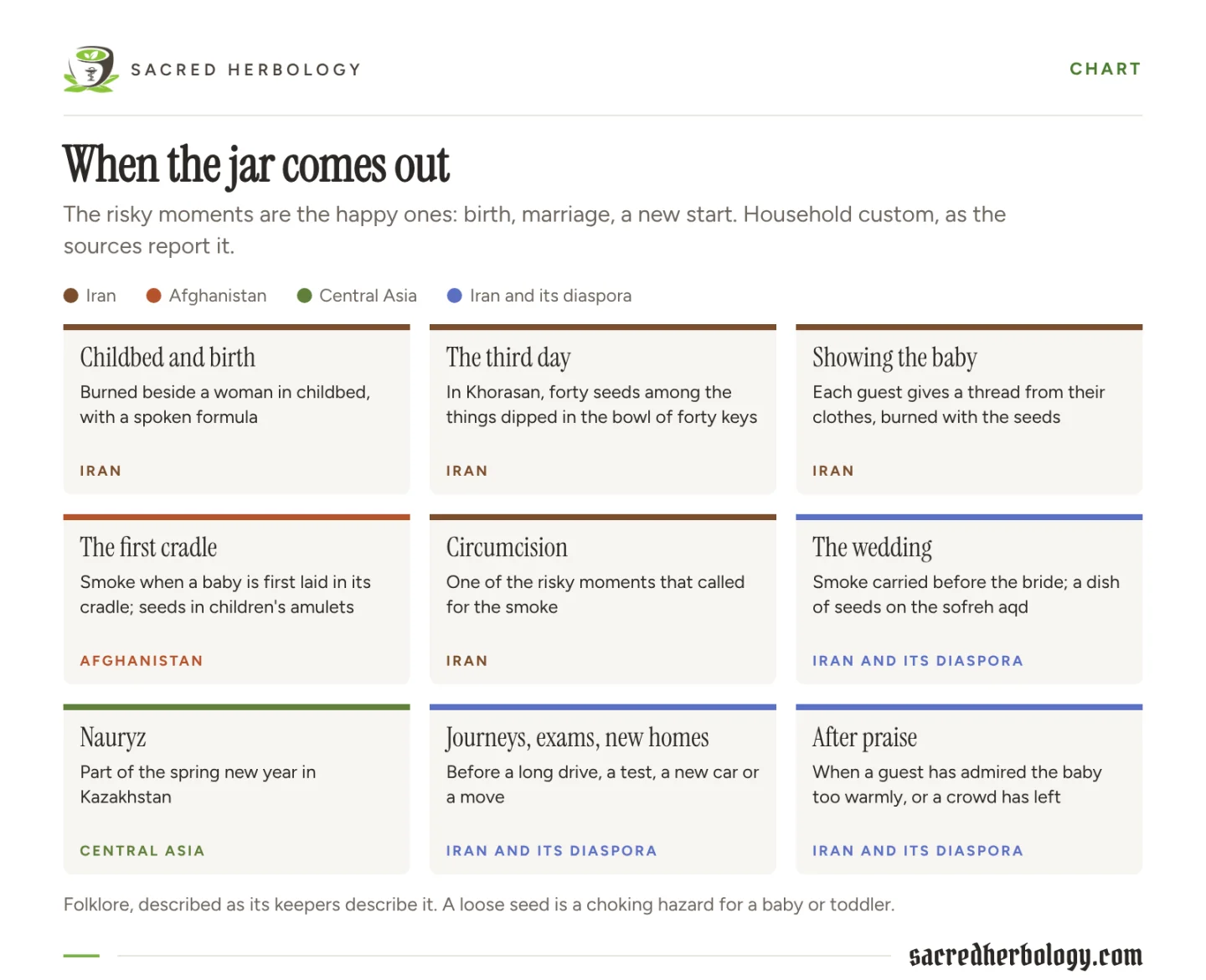
The same entry records a layer of Islamic-era lore around the plant. In this telling, every leaf and every seed of esfand holds an angel, and the devil keeps seventy houses away from a home where the plant is kept. These sayings come from the devotional literature of Iranian Islam. They are beliefs about the plant. I pass them on because they explain why a family that is careful about its religion has no difficulty keeping a jar of seeds for the smoke.
Not everyone has been comfortable with that. Penkala-Gawęcka notes that in parts of Central Asia today, stricter currents of Islam criticise fumigation and amulets as un-Islamic, alongside pilgrimages to the shrines of saints. The custom keeps going regardless, the way household customs usually do.
Smoke in the house
What does the burning look like in an Iranian home? Here I’ll describe it the way the people who do it describe it. This is a description of a custom, and I’m not asking you to do it.
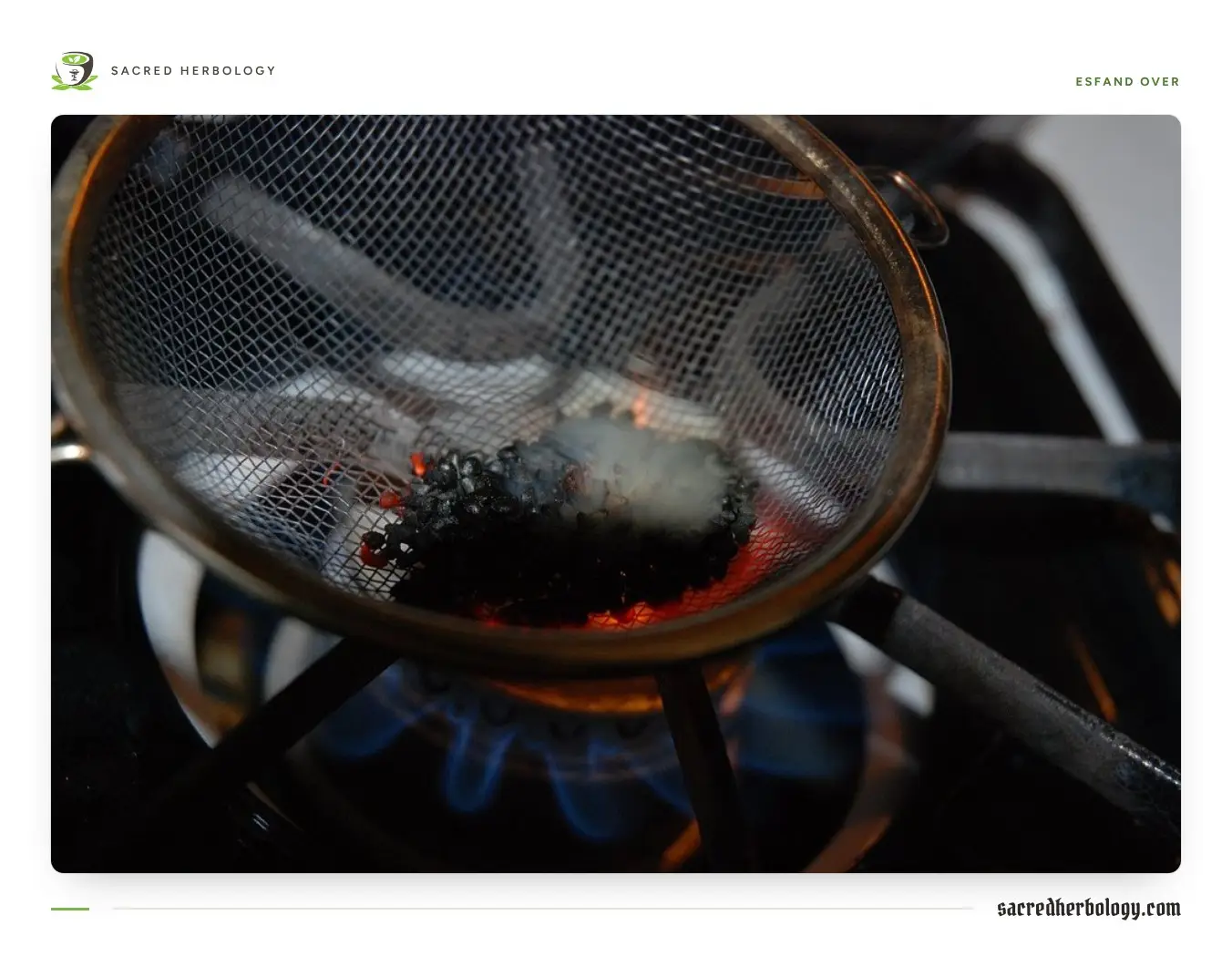
The classic tool is a small metal dish or brazier, often brass or tin-plated copper, sometimes with a pierced lid, sometimes on a little stand. A lump of charcoal goes in, or a few coals from the samovar. The seeds go on top. They don’t burn quietly like a resin. They snap and spit and jump, and the smoke comes off them fast and thick. Then the dish is lifted and moved: in circles above the head of the person being protected, along the corners of a room, in front of a door. Some families do it over a gas flame in a pan, with a tea towel to push the smoke through the house.
A lovely record of this is in an online archive at the University of Southern California, where students collect customs from their own families. In 2021 an Iranian-American student described what her grandmother did. She would wake up, she said, and the house would smell like burnt popcorn, and for years she thought her grandmother had left something in the toaster oven. It turned out to be deliberate. Her grandmother put esfand in a pan on the stove, toasted it until it smoked, and waved the smoke through the house with a towel to clear away bad luck. She did it when she was nervous, when the family was about to do something important and she didn’t want it to go wrong. When her granddaughter was away at university, she did it for her from a distance. And at the start of the pandemic, the student noticed, her grandmother did it more than ever.
The same student remembered an older wedding custom: someone walking in front of the bride, burning esfand, so that she passed through the smoke on her way to be married. The Persian wedding spread, the sofreh aqd, still often carries a dish of esfand seeds among its mirror, candles, bread, sweets and spices, set there to keep the evil eye away from the couple.
Other occasions people mention: before a long journey, when a guest has praised the baby a little too warmly, after a crowd of visitors has left, when someone has had a run of bad luck, when the family buys a new car or moves into a new house. The words spoken over the smoke vary from family to family and region to region, and Iranica notes only that a formula goes with the burning. I’ve chosen not to print a rhyme here, because I couldn’t find a published version I trust enough to give you word for word, and I’d rather leave a gap than invent a charm.
Picture the grandmother at the stove, the pan in one hand, a tea towel in the other, the smoke curling past a kitchen window.

Kabul’s smoke boys
The custom also has a street life.
In December 2001, a few weeks after the fall of the Taliban government, the journalist Charles Recknagel of Radio Free Europe/Radio Liberty walked the markets of Kabul and wrote about the boys who made their living from the smoke. There were thousands of them, he reported, aged roughly eight to fifteen, many from families that had lost a father to the wars. Each carried a small can of glowing charcoal hung from a long wire handle, a homemade censer. They bought the seed by the half-kilo at a spice stall. They went from cart to cart and shop to shop, and for a small coin they dropped a few seeds on the embers and swung the smoke over the goods or through the shop, to turn away the evil eye and any curse a rival or an unhappy customer might have laid.
One boy, Fais Ahmad, thirteen years old, told the reporter he visited fifty or sixty shops a day. Some paid. Some sent him away. A spice seller in the market said he sold two or three kilograms of seed to the boys every day. A shopkeeper said he had no superstition of his own. He let them in five times a day anyway, because they needed the money. In the report the seed is called “wild rye”, a slip of one letter that has probably sent a few readers looking for the wrong plant.
Later reporters kept coming back to the boys and their swinging cans over the next twenty years. The scene is easy to see: a boy in a market lane, a tin can on a wire swinging in a circle, and a ribbon of smoke wrapping round a fruit cart.
The steppe and the bazaar
Go north from Afghanistan and the seed becomes a twig.
Penkala-Gawęcka did fieldwork in central and northern Afghanistan in 1976, and she saw the smoke used on houses, on the people in them and on market stalls, to drive off jinn and the evil eye. She was told that the new mother and her baby needed it most, during the birth and the weeks after, and at the small ceremonies of a child’s early life, such as the first time a baby was laid in its cradle. Esfand seeds went into protective amulets for children and girls. Some women advised tucking seeds into the cradle of a baby who cried a lot at night, because the crying was taken as a sign that something unseen was bothering it. A Tajik man summed it up for her: the smoke of espand is good and clean, and it drives away everything unclean.
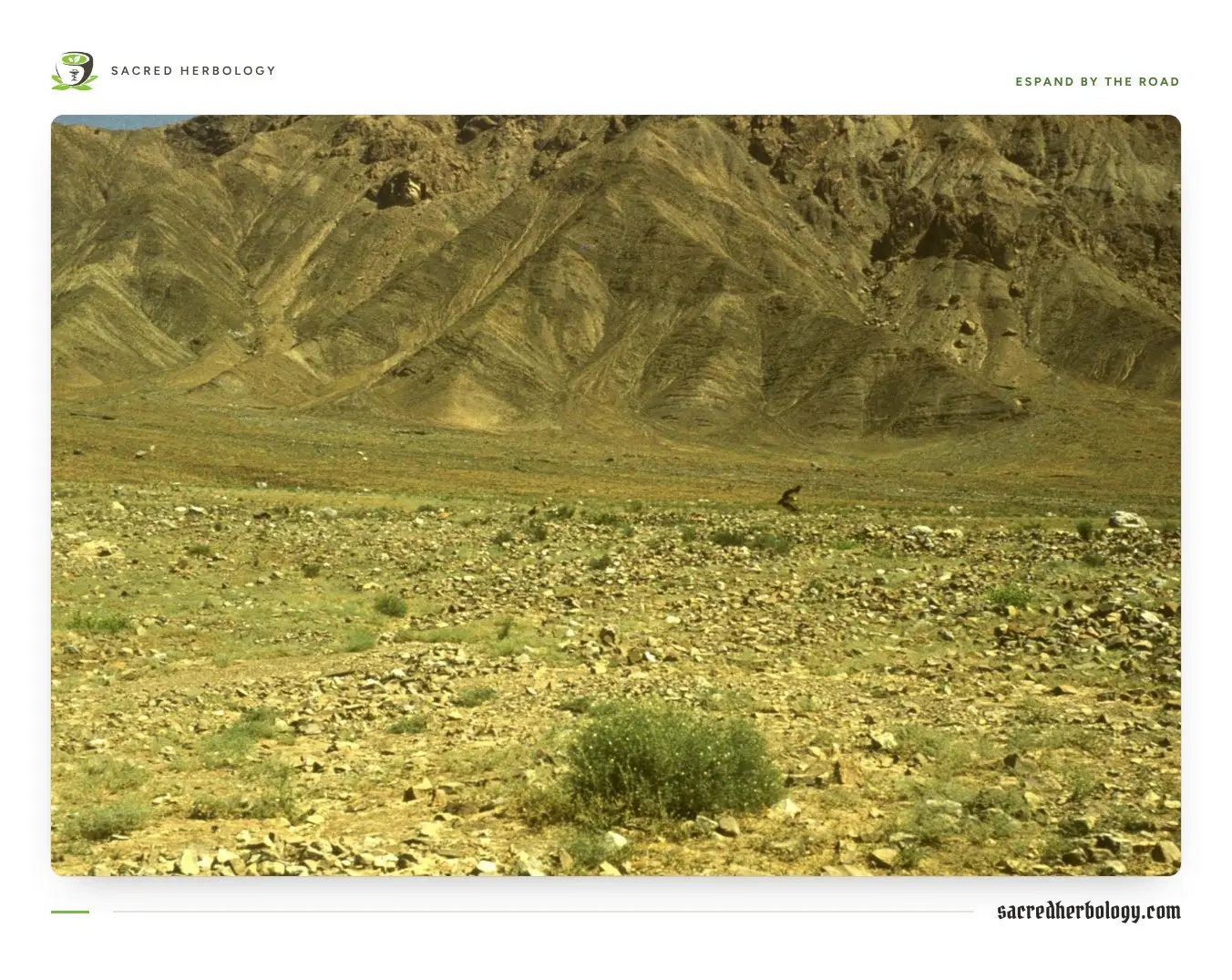

In Kazakhstan, where she lived from 1995 to 2000, the plant is adyraspan, and people mostly burn the dried twigs and leaves, sold in bundles at every bazaar and at the new clinics of traditional medicine that opened after the Soviet Union fell. She photographed a bundle for sale in Almaty in 1996, laid out beside religious books and Muslim prayer beads, and a stallholder smoking the market stalls in 1997. The smoke is swept over a sick person, a child, a flat, an office, a car, and travellers about to set off. Healers use it on their clients, saying set formulas as they go. It is part of Nauryz, the spring new year.
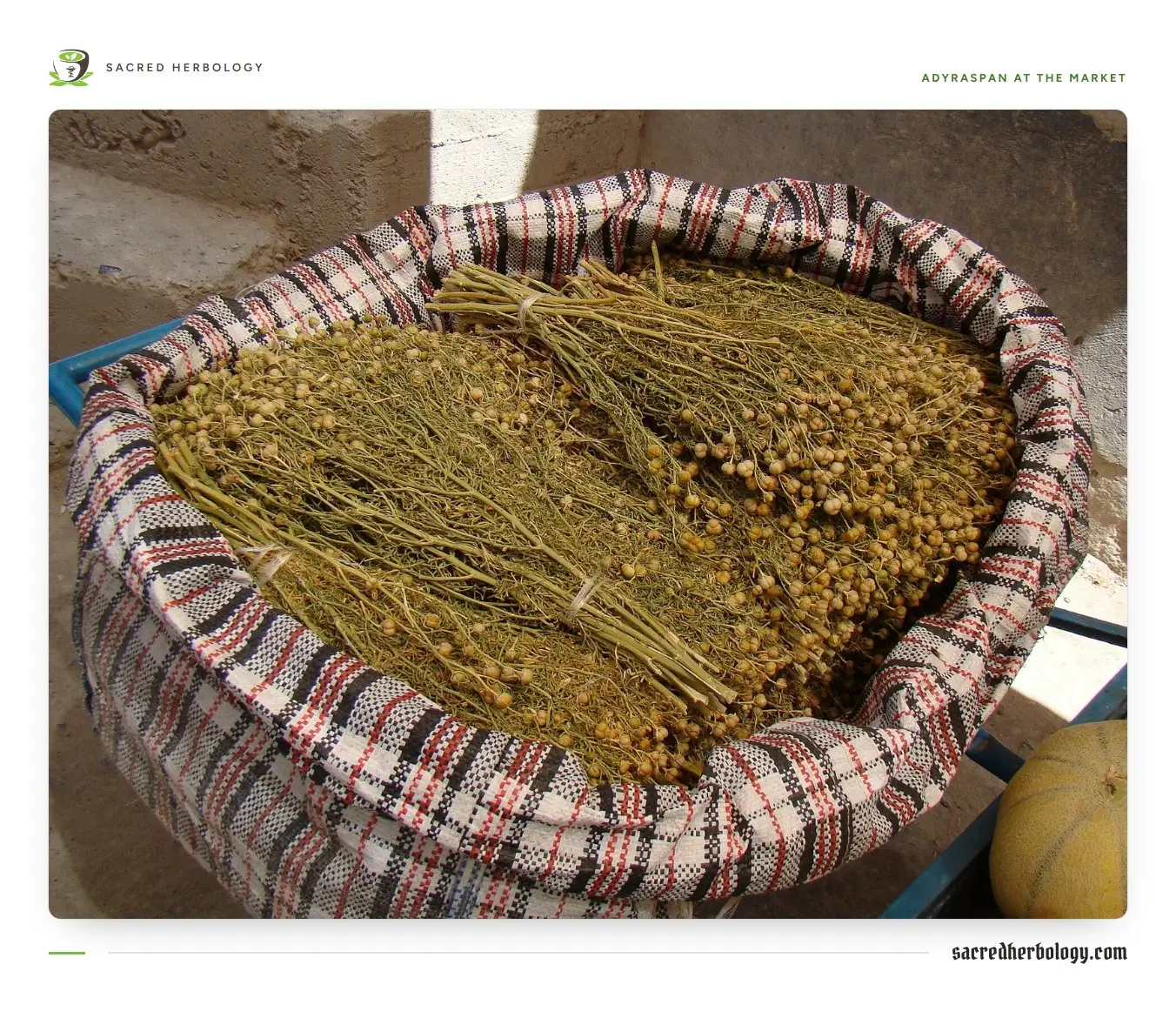

In Kyrgyzstan, the plant is adrasman. In Bishkek she found it sold beside bundles of juniper, archa, which people in the north burn for the same purpose more often than they burn harmal. Russian fieldwork in northern Kyrgyzstan has recorded the two burned together, sometimes with a little savory added. A study of herbal healers in the south-west of the country, along the Tajik border, found that the smoke once carried a sacred meaning there, and that people are now a little embarrassed to talk about it with outsiders. In Khorezm, in western Uzbekistan, the anthropologist Krisztina Kehl-Bodrogi found the plant, there called isvant, burned to protect new mothers and babies, and sewn into children’s amulets. People could gather it on the steppe or buy it at the bazaar, but they especially liked to bring it home from a pilgrimage to a saint’s shrine, believing it picked up extra power there.
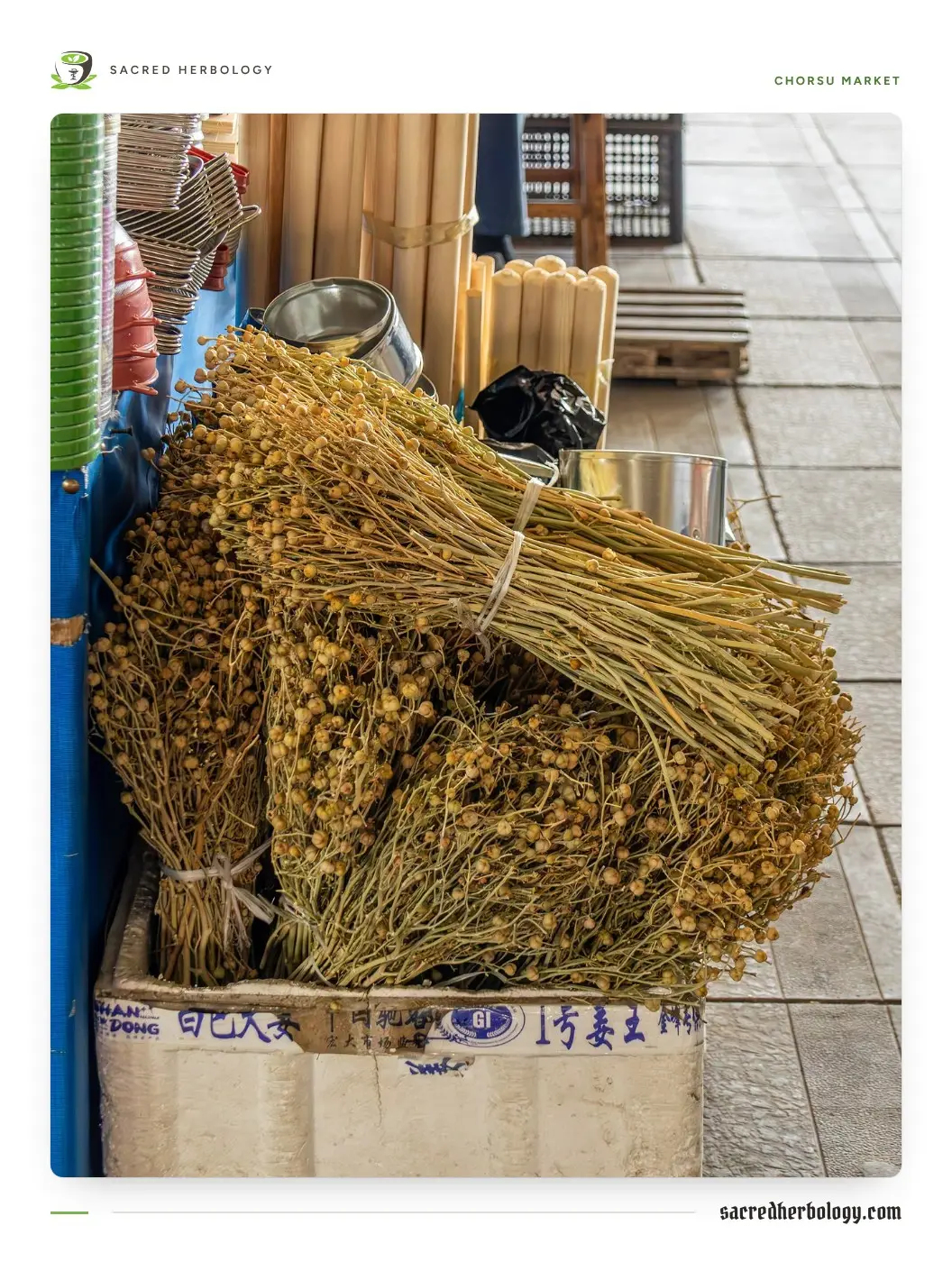
In the bazaars the plant is sold dried and whole, twigs, leaves and seed capsules together, bundled or heaped in sacks, as in the photographs here from Kentau in southern Kazakhstan and the Chorsu market in Tashkent.

A plague year
In the spring of 2020 all of this became news.
As COVID-19 spread, Penkala-Gawęcka collected reports from Kazakh media of a rush on adraspan. Prices for the dried plant went up in city bazaars. People smoked their flats and lit bonfires of it. In Shymkent, in the south, a local journalist described women boarding buses at each stop and, for a small fee, smoking the passengers. She noted, with some edge, that it was a good deal cheaper than the state’s health services.
Next door in Turkmenistan the custom reached the top. In March 2020 President Gurbanguly Berdimuhamedow told parliament that citizens should fumigate with ýüzärlik, the local name for the plant, to keep viruses out, citing the ancestors who burned it at weddings, when moving house and in seasons of infectious disease. At the signing of a cooperation agreement between Turkmenistan and the United Nations in Ashgabat on 14 March 2020, the hall was smoked with it. Fumigating offices, schools, universities and shops became official practice.
The response from public health was blunt. Kazakhstan’s fact-checkers listed burning adraspan against the coronavirus among the false claims circulating in the country, and pointed out that the plant contains substances on Kazakhstan’s list of controlled drugs. Penkala-Gawęcka’s own reading is an anthropologist’s: in a time of fear, with weak health systems and governments that would not admit how bad the crisis was, people reached for something old, cheap, familiar and in their own hands. The USC student’s grandmother in California was doing the same thing at the same time, on a smaller stage.
I think this is one of the most telling episodes in the whole history of the plant. It shows how a protective household smoke can be pulled into a public emergency and asked to do a job it was never shaped for. There is no evidence that the smoke stopped a virus. It did give frightened people something to do with their hands.
In the old books
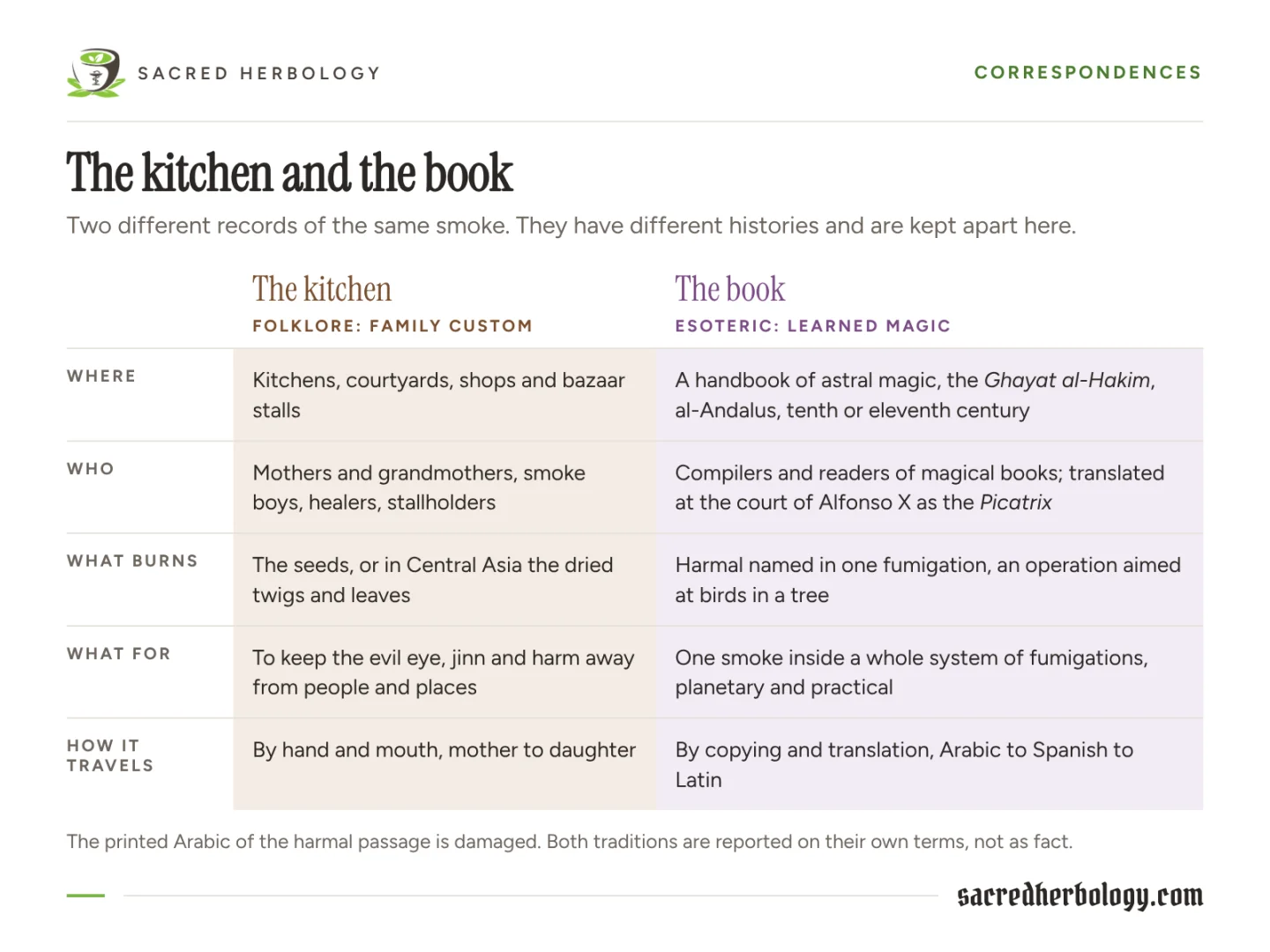
The plant also appears in learned magic, and here the label changes. This section is ESOTERIC material, from a book of astral magic, and it belongs to a different stream from the kitchen and the bazaar.
The Ghayat al-Hakim, the Goal of the Sage, is an Arabic handbook of astral magic, put together in al-Andalus in the tenth or eleventh century and falsely attributed to the Andalusian astronomer al-Majriti. Translated into Spanish and then Latin at the court of Alfonso X of Castile in the thirteenth century, it became the Picatrix, one of the most influential magical books of medieval and Renaissance Europe. It is thick with suffumigations: compound smokes for each planet, smokes to draw spirits, smokes to drive off pests.
In the Latin, harmal is hard to see. The plant names there often come down to “rue” or “forest rue”, and modern readers can’t always tell whether the Arabic behind it meant the garden herb or the wild one. In the Arabic text, though, the word harmal does appear by name, in a fumigation in which the juice of fresh harmal is worked into a preparation, dried and burned. As far as the printed Arabic can be read, the operation is aimed at birds in a tree, and it carries a practical warning not to do it on a windy day, because the wind scatters the smoke. Afterwards the tree is smoked again with sweet materials, frankincense among them, to take away the foul smell left behind. The printed text of that passage is damaged, and I’d want it read against the manuscripts before anyone built much on it. What it does show is that the compilers of a magical handbook knew harmal by its Arabic name, knew its smoke was strong and unpleasant, and fitted it into the same logic of fumigation that runs through the whole book.
There is a smaller, stranger use in the Persian record that sits between craft and wonder. Iranica reports that pounded seeds were left to soak in water and the juice used as an invisible ink, which appeared when the paper was warmed over a flame. It is the kind of trick the medieval Persian books of marvels loved: a sheet of blank paper held over a candle, and the writing rising out of it in brown.
What the chemists found
The seeds have been on the chemist’s bench since the first half of the nineteenth century. The German chemist Göbel isolated an alkaloid from them and named it harmaline. Sources give his date as 1837 or 1841. In 1847 Julius Fritzsche, working in St Petersburg, isolated and named harmine. Both belong to the beta-carbolines, the same family that turned up in the Qurayyah burners. The seeds and roots are the richest parts of the plant, the seeds most of all, and the alkaloid content varies widely from one batch of wild seed to the next.
These compounds have one lovely property. In solution they fluoresce: under ultraviolet light they glow a vivid blue-green. Harmaline’s salts are bright yellow in the jar and glow under the lamp. Picture a glass vial lit from below, giving off its own cold light.
Harmine and harmaline are reversible inhibitors of an enzyme called monoamine oxidase A, or MAO-A, which the body uses to break down several of the brain’s chemical messengers, serotonin among them, along with tyramine from food and a number of medicines. That is why pharmacologists take them seriously, and it is one of the reasons the seed is dangerous to swallow. Researchers have also studied harmine in laboratory and animal work for a range of other effects. None of that tells you anything about the smoke from a dish in a kitchen. I know of no good study that measures how much of these alkaloids reaches a person standing in a room where esfand is burning. The Qurayyah authors left that question open. They pointed out that the alkaloids act on the mind only in large amounts and that smoke reaches the body by a different road from food, and they stopped there. What the smoke in a kitchen actually delivers is still an open question.
Safety, and the law in Australia
Here is where I put the old beliefs down and talk plainly about your lungs, your household and the law in Australia.
On the smoke itself:
- Esfand smoke is thick, pungent and full of fine particles. Open a window. If you have asthma or any other chest or lung condition, keep well away from it. Keep it away from babies, small children and pet birds, whose lungs are easily hurt by smoke.
- If you are pregnant, stay away from it entirely, smoke included. The plant has a long history in the old medical books as a drug that acts on the womb.
- A charcoal block gives off carbon monoxide, which you can’t see or smell. Never burn charcoal in a closed room, a tent or a car. If anyone gets a headache, feels dizzy or sick, or turns drowsy or confused in a smoky room, get them into fresh air and call 000.
- Seeds that pop can throw sparks and hot fragments. Use a deep, heat-proof dish on a heat-proof surface, and keep it away from curtains and tea towels.
On the seed:
- The seed is poisonous if swallowed. Poisonings from eating it are reported in the medical literature, and they can be serious: vomiting, trembling, agitation, hallucinations, trouble walking, and in bad cases a slowed heartbeat and falling blood pressure. Because the alkaloids also block an enzyme that breaks down serotonin and a number of medicines, the seed is especially dangerous to anyone taking antidepressants or other prescription drugs. If you take an antidepressant, keep out of the smoke as well. No one has measured how much reaches you, so there is no reason to take the chance.
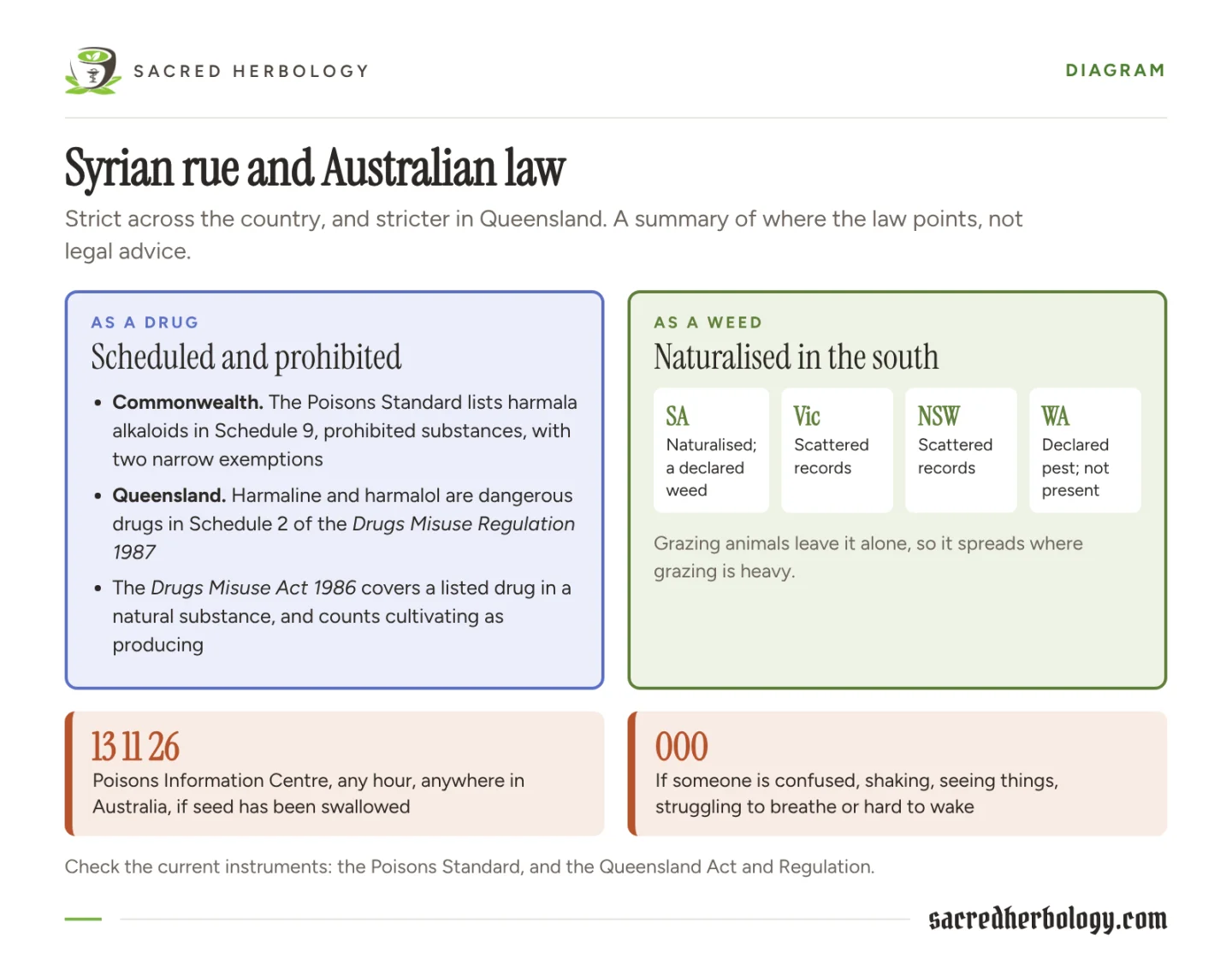
- If anyone has swallowed the seeds, call the Poisons Information Centre on 13 11 26, any hour, anywhere in Australia, even if they seem well. If they are confused, shaking, seeing things, struggling to breathe or hard to wake, call 000.
- Keep the seed and the plant away from children and from animals. Livestock poisoning from grazing the plant is well recorded overseas. The old custom of tucking seeds into a cradle or sewing them into a child’s amulet is one to leave in the history books: a baby or toddler can choke on a loose seed or swallow it. Wash your hands after handling the seed.
On the law, the picture in Australia is strict, and in Queensland stricter still. I’m a historian and this is not legal advice, so please read it as a summary of where the law points, and check the current instruments yourself. The Commonwealth Poisons Standard lists harmala alkaloids in Schedule 9, the schedule for prohibited substances, with two narrow exemptions. In Queensland, harmaline and harmalol are listed as dangerous drugs in Schedule 2 of the Drugs Misuse Regulation 1987. The Drugs Misuse Act 1986 treats a listed drug contained in a natural substance as a dangerous drug, and it counts cultivating as a form of producing. Whether a jar of seed held for a household smoke falls inside those words is a question for a lawyer. On the plain reading of the law, though, possessing, growing or supplying this plant in Queensland without authority could be a serious offence. On top of that, the plant is a declared weed in South Australia and a declared pest in Western Australia.
We do keep esfand seed in the apothecary. It’s sold as nursery seed for the garden and as a smoke for the coals, and never for anyone to eat or drink. We stock it because people need access to their religious sacraments, and in a Persian, Afghan or Turkish household a dish of seed carried smoking past the doorway is one of the oldest of them.
If your family keeps the custom, keep it the way the old households did: a few seeds on a coal, a window open, and the jar up high where children and animals can’t reach it. The seed is for the soil and the coals, never the mouth.
The smoke that stays
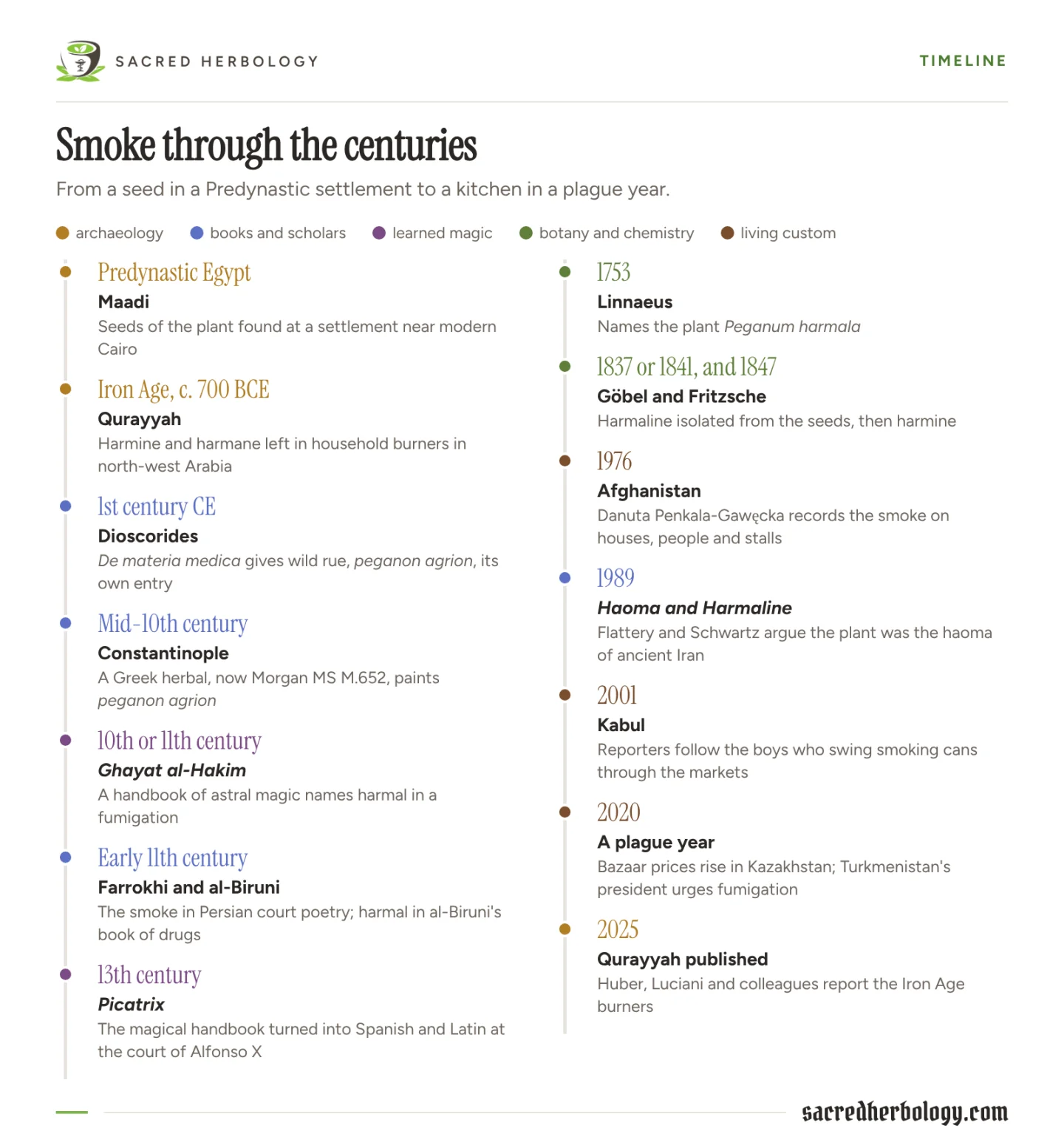
I keep coming back to the two pictures at either end of this story. One is a clay burner in the courtyard of a house at Qurayyah, sometime around 700 BCE, with a brown stain of harmine soaked into its walls. The other is a grandmother in California in the spring of 2020, waving a tea towel through a kitchen full of smoke that smells like burnt popcorn, because she is frightened for her family and this is what her mother did.
Between them run Dioscorides and his Cappadocian moly, the Persian poets and physicians, an argument about the holy plant of ancient Iran, a ring of women burning threads beside a cradle, a boy with a tin can in a Kabul lane, a bundle of twigs on a bazaar table in Almaty, and a president telling a nation to smoke its offices. None of it proves that the smoke does what its keepers say it does. All of it shows how long people have wanted something small, cheap and close at hand that lets them do something when the people they love are exposed to harm.
That is the oldest job any smoke has had. Esfand has done it longer than most.
Where this comes from
- Mahmoud Omidsalar, “Esfand”, Encyclopaedia Iranica, vol. VIII, fasc. 6 (1998), pp. 583-584.
- B. Huber, M. Luciani, A. M. Abualhassan, D. Giddings Vassão, R. Fernandes and T. Devièse, “Metabolic profiling reveals first evidence of fumigating drug plant Peganum harmala in Iron Age Arabia”, Communications Biology 8 (2025): 720.
- Danuta Penkala-Gawęcka, “Syrian rue (Peganum harmala L.) in Central Asian traditions and its popularity in the time of the COVID-19 pandemic: perspective of medical anthropology” (in Polish), Medycyna Nowożytna 29, no. 1 (2023): 135-164.
- David Stophlet Flattery and Martin Schwartz, Haoma and Harmaline (short title), University of California Publications, Near Eastern Studies 21 (University of California Press, 1989).
- R. Gordon Wasson, Soma: Divine Mushroom of Immortality (1968).
- Dioscorides, De materia medica, book 3, trans. Lily Y. Beck (Olms-Weidmann, 2005).
- De materia medica, Greek herbal, Constantinople, mid-tenth century, The Morgan Library & Museum, New York, MS M.652.
- Abu Rayhan al-Biruni, Kitab al-Saydana, ed. M. Said and R. E. Elahie (Karachi, 1973).
- Pseudo-Majriti, Ghayat al-Hakim, ed. Hellmut Ritter as Das Ziel des Weisen (Teubner, Leipzig and Berlin, 1933); Latin Picatrix trans. Dan Attrell and David Porreca (Penn State University Press, 2019).
- Charles Recknagel, “Afghanistan: Casting Out Evil Spirits Can Be A Full-Time Job”, Radio Free Europe/Radio Liberty, 14 December 2001.
- “Burning Esphand”, student-collected entry in the University of Southern California’s online archive of family customs (collected 2021).
- Weeds Australia, “African rue” weed profile, Centre for Invasive Species Solutions.
- Therapeutic Goods (Poisons Standard) Instrument, current edition, Schedule 9, “Harmala alkaloids”.
- Drugs Misuse Act 1986 (Qld) and Drugs Misuse Regulation 1987 (Qld), Schedule 2.