
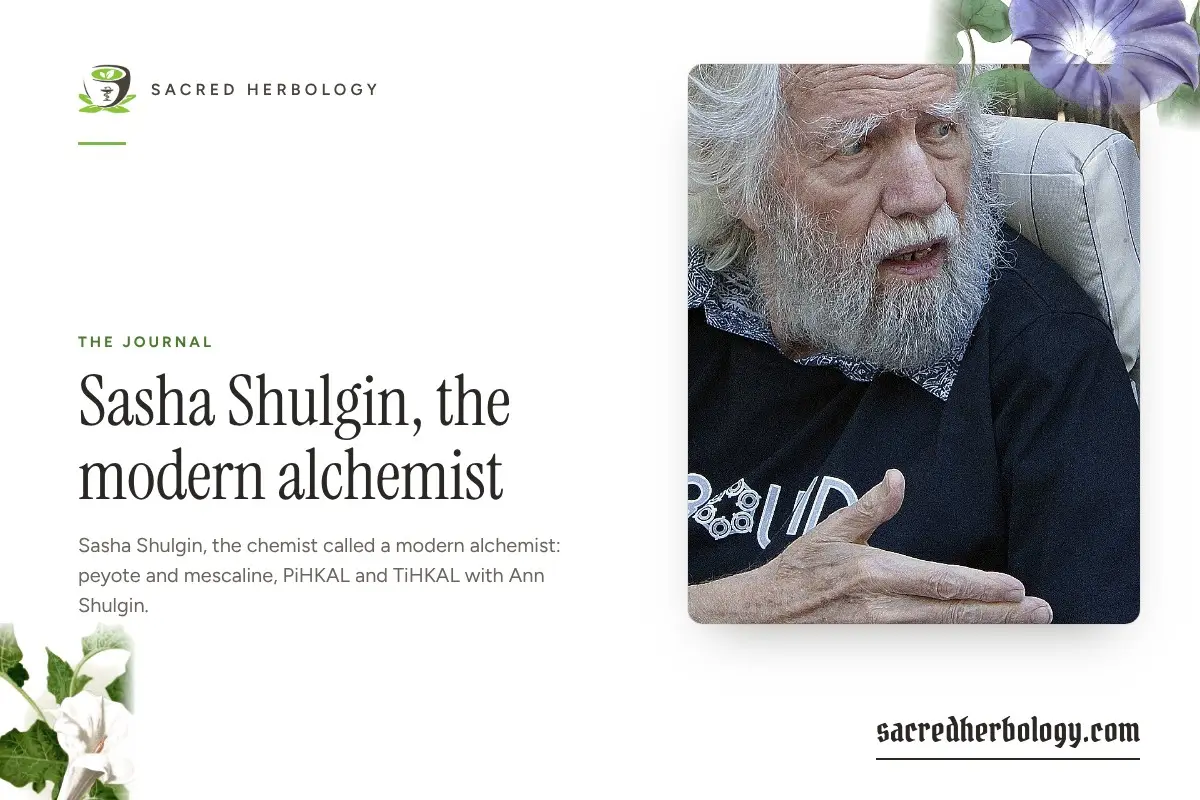
On a dry hillside in Lafayette, east of Oakland in California, there used to be a small building that looked like a garden shed that had lost an argument with a laboratory. Inside, the benches were crowded with glassware, flasks and condensers, jars of reagents with hand-written labels, and decades of notebooks. Spider webs hung in the corners and nobody seemed to mind. The light came in green through the oak trees. Out of the window you could see Mount Diablo. An elderly man with a white beard, a loud laugh and a habit of wearing sandals worked there for more than forty years, and what he made in that shed changed how a great many people thought about their own minds.
His name was Alexander Theodore Shulgin. His friends called him Sasha, a Russian short form of Alexander that came down from his father’s side of the family. He died in 2014, at home on that hillside, and the obituaries reached for all kinds of words to describe him. The godfather of ecstasy. A psychedelic pioneer. A white wizard. One word kept turning up in the profiles and the tributes, in the documentaries and on the posters: alchemist.
This piece is the first of a short series in this Journal about people who get called modern alchemists. I want to start with Shulgin because his story has everything that makes the old alchemical books worth reading: a workshop that doubled as a place of contemplation, a life spent testing transformations on the worker’s own body, a pair of strange books that are half memoir and half manual, a love story, a quarrel with the authorities, and at the root of it all a plant. That plant is the small, spineless cactus called peyote.
I’ll tell you up front what this piece won’t do. It won’t tell you how to make anything, how much of anything to take, or how to take it. Shulgin’s books do contain that kind of material, and people have argued about it for thirty years. None of it belongs here, and Australian law takes a very dim view of it. This piece gives you the history and the meaning: how a chemist ended up being read like an adept, and what the word alchemist does and doesn’t tell us about him.
The word alchemist, and who used it
Start with the word, because it carries a lot of baggage.
Alchemy, in the European tradition that runs from late antique Alexandria through the Arabic writers to the Latin West and on into the seventeenth century, was two things at once. It was a practical craft of furnaces, stills, metals and salts, the ancestor of the chemistry lab. It was also a contemplative discipline, a spiritual path in which the transformation of matter in the flask was read as a mirror of the transformation of the worker’s soul. The alchemists called the whole undertaking the Great Work, the opus magnum, and they described it in stages named after colours: the blackening, the whitening, the yellowing and the reddening. In this Journal alchemy is filed as ESOTERIC. It is learned magic and learned philosophy, written down by literate people in books, and I report what its writers held without telling you that any of it is true of the world.
The image that sums up the spiritual side of alchemy best is a single engraving. In 1595 a German physician and Paracelsian named Heinrich Khunrath printed a book with the grand title Amphitheatrum Sapientiae Aeternae, the Amphitheatre of Eternal Wisdom. The enlarged edition published at Hanau in 1609 carries a famous plate usually called the Laboratory and the Oratory. It shows a large, pillared room cut into two halves. On the right are the furnaces, the bellows, the flasks and the shelves of the working laboratory. On the left is a tent-like chapel with an altar, where a man kneels in prayer before an open book. Lettered into the architecture is the old pairing that runs through the whole tradition: you work, and you pray, and the two belong in the same room.
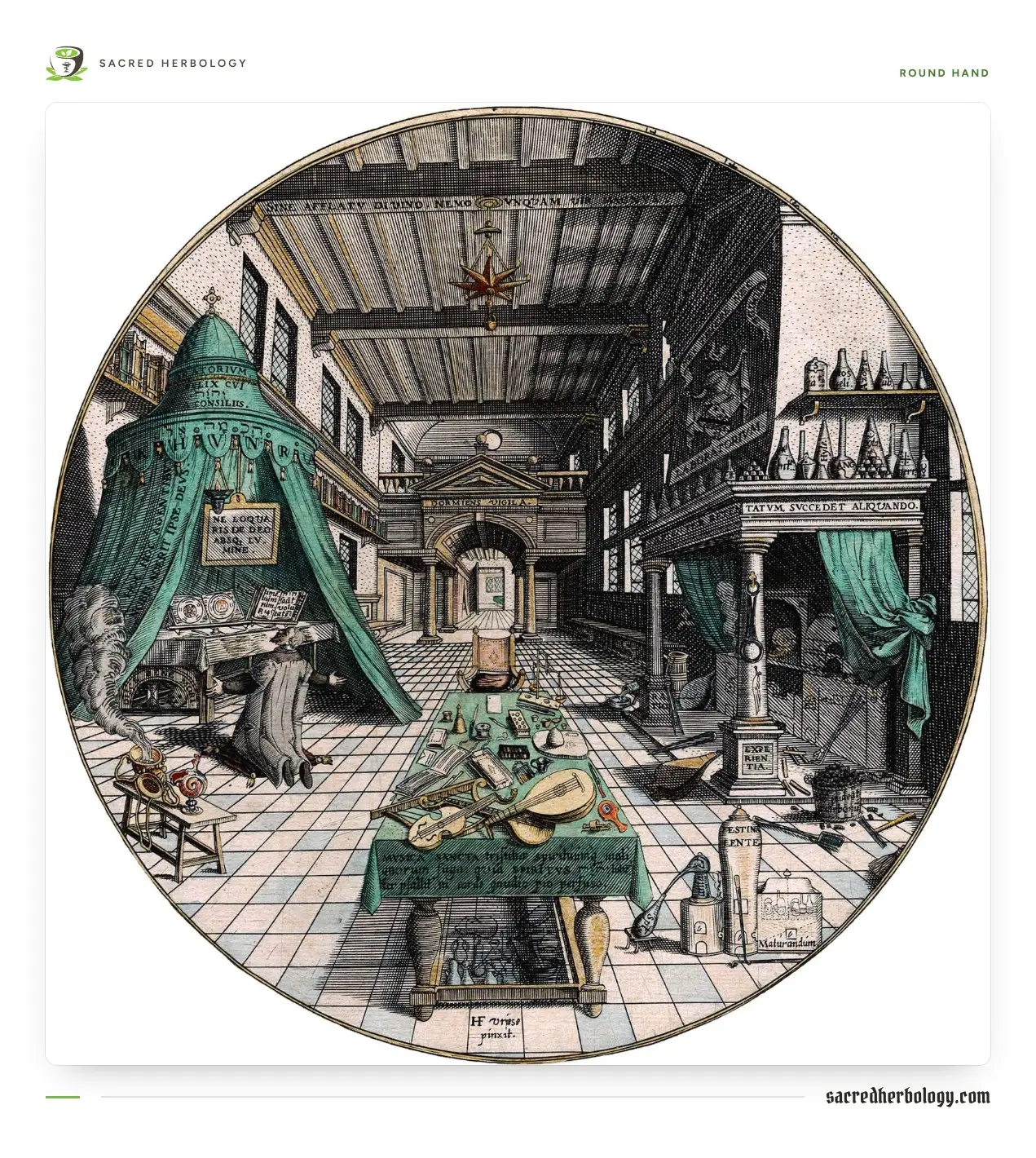

Hold that engraving next to a photograph of Shulgin’s cluttered shed under the oaks, and you can see why people reached for the comparison.
Here I have to be straight with you about a point the comparison usually skips. Shulgin called himself a chemist, a pharmacologist, a researcher. I have looked through the published record of his own words, the two books he wrote with his wife, his lectures and the interviews he gave, and I have not found him calling himself an alchemist in so many words. The label was given to him by others: by journalists, by admirers, by the people who wrote his obituaries in 2014, and now by me. I think it fits, for reasons this piece will lay out, but it is a reading of his life and I won’t put it in his mouth.
What he did say, again and again, was that the chemicals he made were tools for exploring the inside of the human mind, and that the mind held a great store that most people never looked at. That belief, and the way he went about testing it, is what makes him look like an alchemist to anyone who has spent time with the old books.
A boy from Berkeley
Shulgin was born on 17 June 1925 in Berkeley, California. Both his parents, Theodore Stevens Shulgin and Henrietta Aten Shulgin, were public school teachers in Alameda County. He was a clever, bookish child who played the viola, and at about sixteen he won a scholarship to Harvard to study organic chemistry.
He didn’t finish there. In his second year the war was on, and he left to join the United States Navy. The story he told about his time in the navy is one of the small turning points of his life, and it is worth telling because it shows the cast of his mind.
In 1944, serving on the destroyer USS Pope, he developed a bad infection in his thumb and needed surgery. Before the operation a nurse brought him a glass of orange juice. He noticed crystals at the bottom of the glass and decided they must be a sedative put there to calm him before the knife. He drank the juice and passed out cold. Later he learned that the crystals were plain undissolved sugar. Nothing in the glass could have knocked him out. His own expectation had done it.
He drew a lesson from that glass of orange juice that stayed with him for the rest of his life. The mind can produce, from its own resources, effects that we would normally credit to a drug. A chemical and a belief can do strikingly similar things. Any serious explorer of the mind would have to take both into account. That lesson sits underneath his whole later method: if the mind has that much power of its own, then the person best placed to observe what a substance does is the person in whose mind it is happening.
After the war he went back to chemistry at the University of California, Berkeley, and took his doctorate in biochemistry in the mid-1950s with a thesis on the synthesis of isotopically labelled amino acids. He then did postdoctoral work in psychiatry and pharmacology at the University of California, San Francisco. By the end of the 1950s he was a trained, conventional, extremely capable organic chemist, married to his first wife Nina, with a young son, Theodore. Nothing in his career so far had anything to do with visionary experience. That was about to change, and the plant that changed it had a much longer history than he did.
The cactus at the root
Peyote, Lophophora williamsii, is a small, slow-growing cactus of the Chihuahuan Desert, a member of the cactus family, Cactaceae. It grows in the lower Rio Grande valley of southern Texas and across a wide stretch of northern and north-central Mexico. It has no spines. What you see above the ground is a blue-green, button-shaped crown, often no bigger than the palm of your hand, divided into soft ribs and dotted with tufts of pale wool. It can take many years to reach flowering size. Much of the plant lives below ground, as a long carrot-like taproot. The part that was traditionally gathered is the crown, cut off at ground level and dried into the hard discs the old writers called mescal buttons.
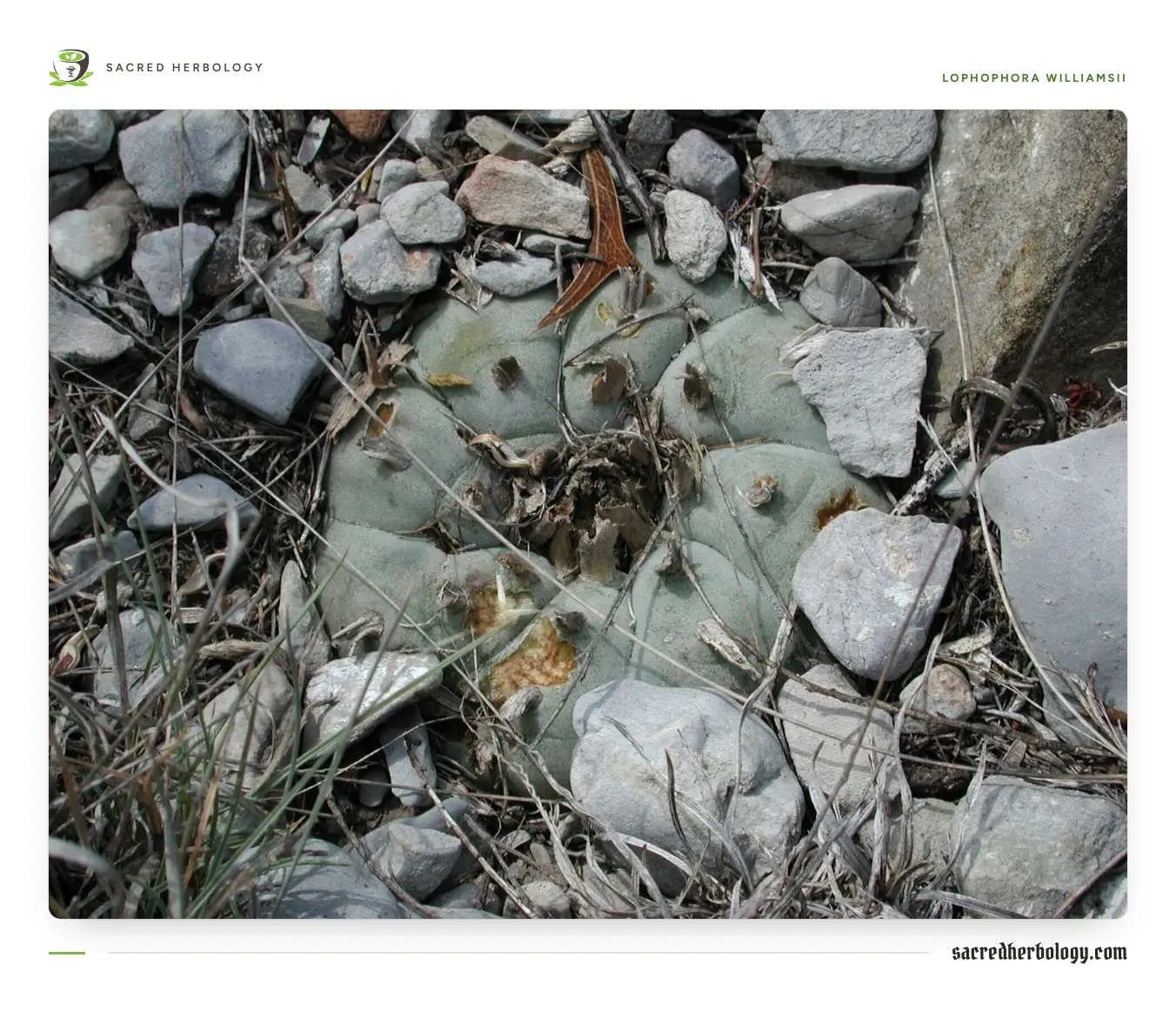

Picture a cluster of those blue-green buttons, half buried in limestone gravel, with a single pale pink flower opening from the woolly centre of one of them.
Peyote has been used ceremonially in what is now Mexico for a very long time. Spanish writers of the sixteenth century, among them the Franciscan Bernardino de Sahagún, recorded its use among the peoples of northern Mexico, and the church authorities of New Spain condemned it in the following century. It is still central to the religious life of several living Indigenous peoples. Among the Wixárika, often called the Huichol, of the Sierra Madre Occidental, the peyote pilgrimage to the desert of Wirikuta in San Luis Potosí is one of the great acts of their religious year, described in the published record by the anthropologist Barbara Myerhoff in Peyote Hunt (1974). North of the border, peyote spread among many Native American peoples in the late nineteenth century, and the Native American Church, incorporated in Oklahoma in 1918, made the peyote meeting the centre of a pan-tribal religion that is still practised today. Weston La Barre’s The Peyote Cult (1938) and Omer Stewart’s Peyote Religion (1987) are the standard histories. I’ll go no further into the ceremonies than those published accounts, and I’d ask you to treat them with the same respect. These are living religions, and the plant is their sacrament.
There is a conservation story here too, and it matters to anyone who loves plants. Peyote grows slowly, its wild range in Texas is small, and harvesting for ceremony, for collectors and for the illicit market has thinned the wild stands badly. It is now assessed as Vulnerable on the IUCN Red List. Native American Church members in the United States have spoken publicly about how hard it has become to find mature plants for their own sacrament.
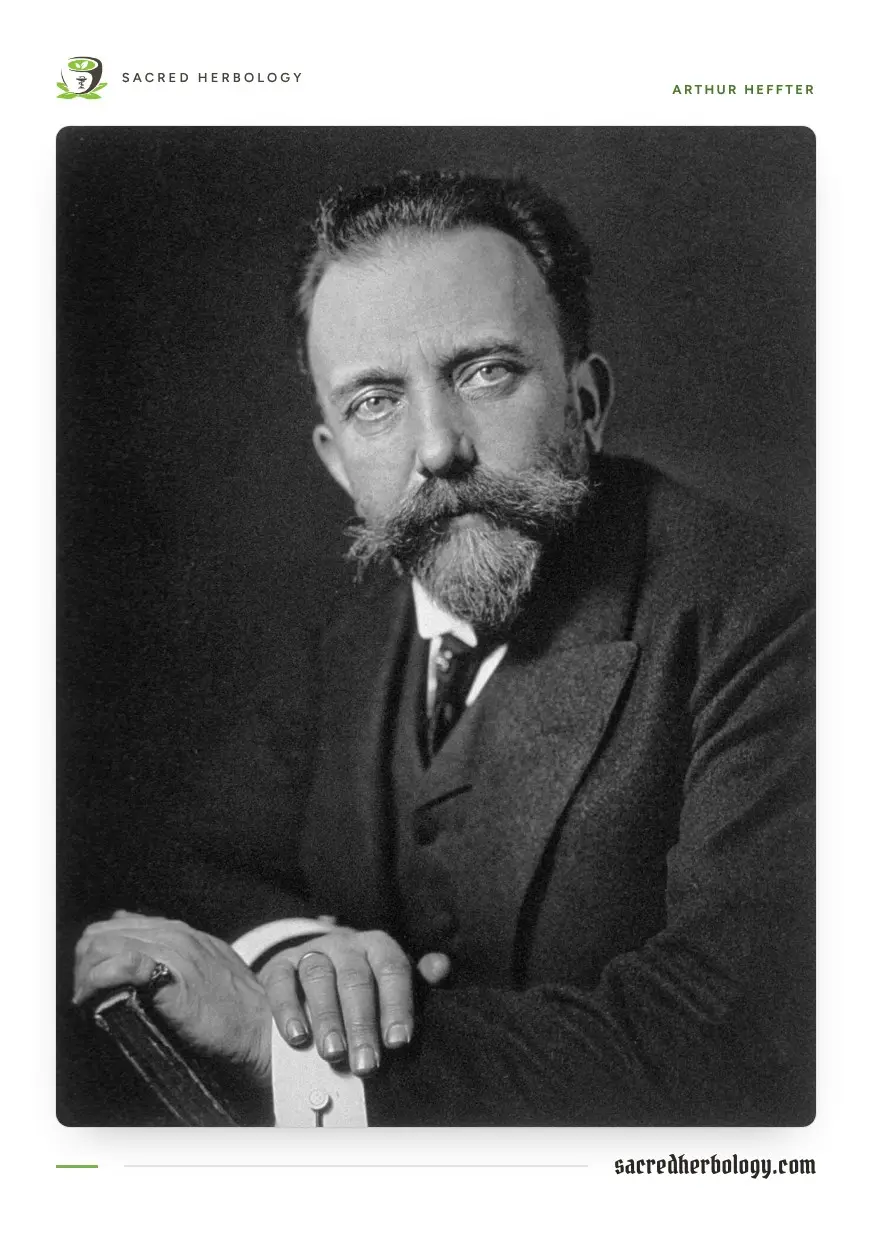
The European and American scientific story begins in the 1880s. The German pharmacologist Louis Lewin obtained dried peyote buttons on a journey through the United States, and the plant he studied was named Anhalonium lewinii in his honour in 1888. Botanists now treat Lewin’s plant as the same species as Lophophora williamsii, and the old name survives only as a synonym, though you will meet it all through the early literature. Then came one of the moments in this story that I’d put on any timeline of modern alchemy. In 1897 another German chemist and pharmacologist, Arthur Heffter, set out to find which of the several alkaloids in peyote was responsible for its visionary effects. Animal tests told him little. So he did what the old alchemists did with their preparations: he tried each fraction on himself. The one that produced the visions he named mescaline. It is usually counted as the first time a single visionary compound had been isolated from a plant and pinned down as the active one, and it was done by a scientist using his own mind as the instrument.

Mescaline was synthesised in the laboratory by the Austrian chemist Ernst Späth in 1919, so it no longer had to come from the cactus at all. Through the following decades it passed through the hands of physicians, psychologists and writers. The English sexologist Havelock Ellis wrote about his peyote experience in 1898 in an essay called “Mescal: A New Artificial Paradise”. That title points to a muddle of names worth clearing up. The mescal buttons of the old writers are dried peyote crowns. They have nothing to do with mescal the spirit, which is distilled from agave, and nothing to do with the so-called mescal bean, the bright red seed of a Texas shrub now called Dermatophyllum secundiflorum (long known as Sophora secundiflora), which is a different and poisonous plant. Its seeds carry cytisine and related alkaloids, chemically nothing like mescaline. Three plants, one word, and the table below sorts them out. The psychologist Heinrich Klüver published a careful study of mescaline visions in 1928, and catalogued the recurring geometric forms people saw, the lattices, spirals, tunnels and cobwebs he later called form constants. And in 1954 Aldous Huxley published The Doors of Perception, his account of a mescaline afternoon in Los Angeles, borrowing his title from William Blake. Huxley’s little book was read by a great many people, and one of them was a young chemist in California.
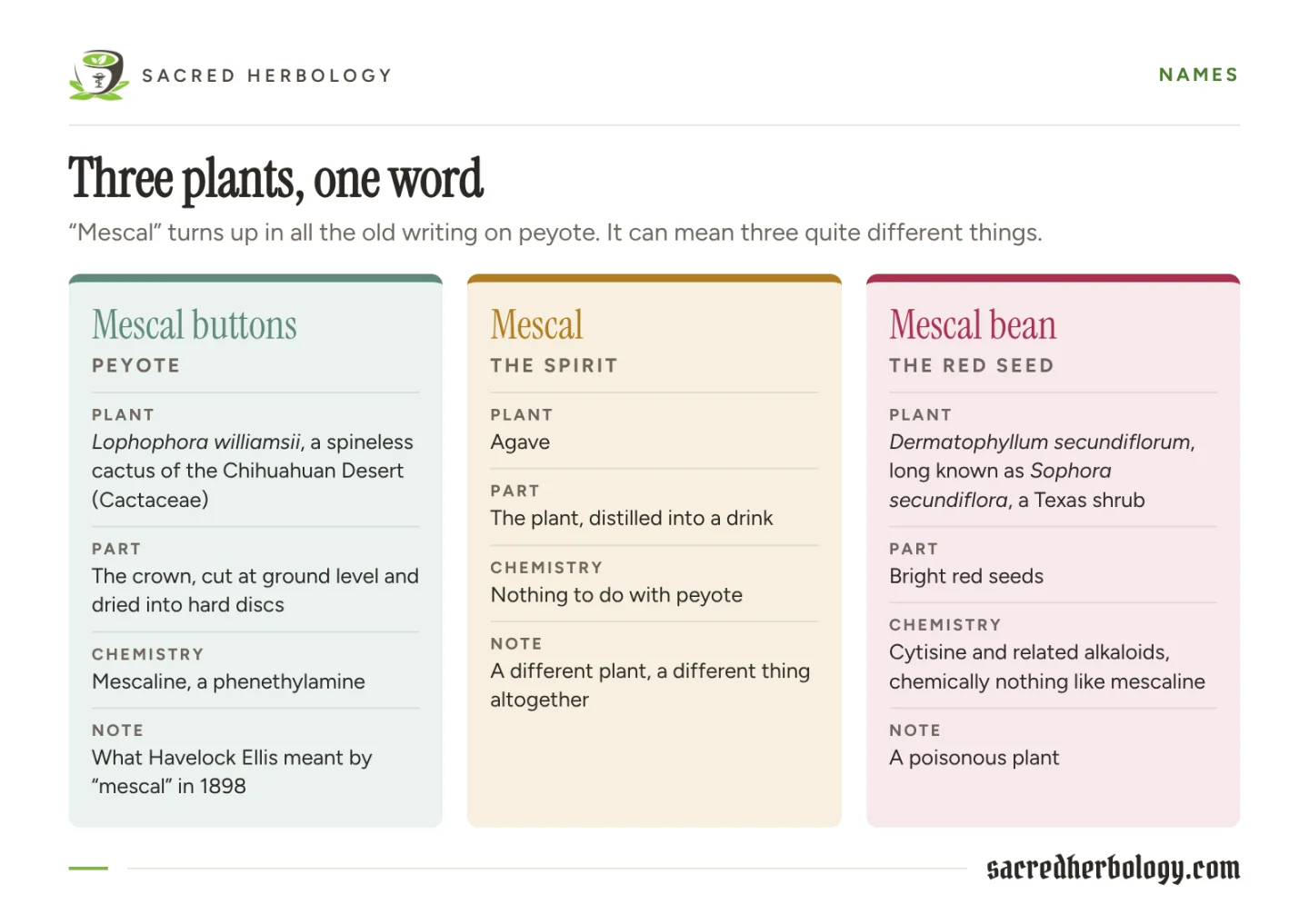
Set out in order, the story so far runs like this:
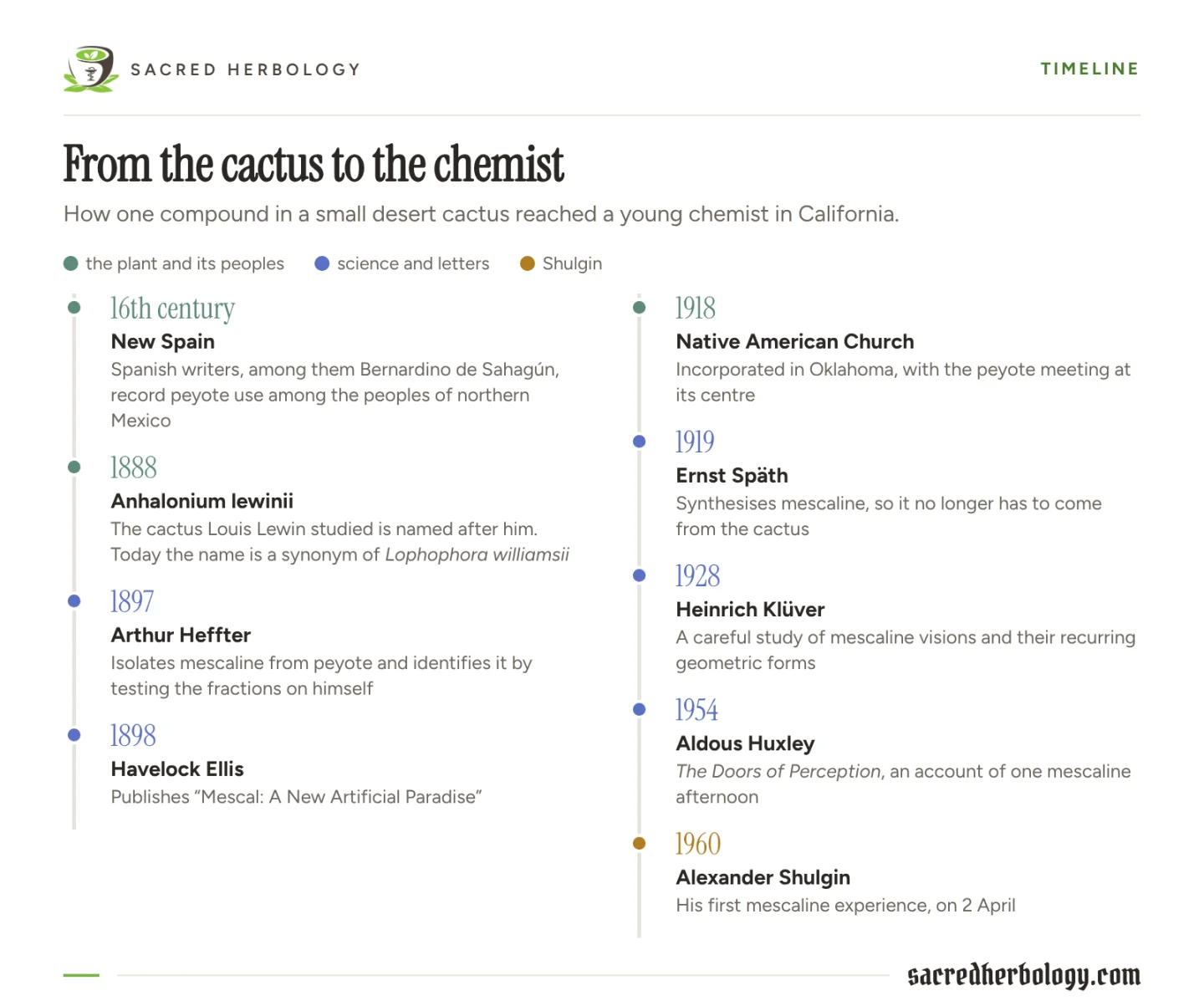
- Sixteenth century: Spanish writers in New Spain record peyote use among the peoples of northern Mexico.
- 1888: the cactus Lewin studied is named Anhalonium lewinii (today a synonym of Lophophora williamsii).
- 1897: Arthur Heffter isolates mescaline and identifies it by testing on himself.
- 1898: Havelock Ellis publishes “Mescal: A New Artificial Paradise”.
- 1918: the Native American Church is incorporated in Oklahoma.
- 1919: Ernst Späth synthesises mescaline.
- 1928: Heinrich Klüver’s study of mescaline visions.
- 1954: Aldous Huxley, The Doors of Perception.
- 1960: Alexander Shulgin’s first mescaline experience.
April 1960
On 2 April 1960 Shulgin took mescaline for the first time. A psychologist friend, Terry Major, offered it to him and sat with him through the day. He was thirty-four.
He wrote about that day many years later, and the passage is one of the most quoted things he ever wrote. What struck him was where the experience came from. The colours, the sense of meaning and the memories that surfaced all seemed to him to come from within, from his own memory and his own psyche, with the chemical acting as a key. In his words, he understood that “our entire universe is contained in the mind and the spirit”, and that we may choose not to find access to it, or even deny that it is there, but that it is there inside us, and that there are chemicals that can open the way to it. Elsewhere he put it more simply: he learned that there was a great deal inside him. He said the day confirmed the whole direction of his life.
I want to slow down here, because this is where the alchemical reading really starts.
Take the alchemists of the sixteenth and seventeenth centuries at their word, and the treasure they were looking for was hidden inside ordinary matter. Gold was latent in lead. The philosophers’ stone was said to be found in something so common that people trod on it in the street. The work was a matter of drawing out what was already there. The contemplative alchemists turned that inward. The real gold, they said, was in the soul of the worker, and the work in the flask was a way of drawing it out.
Shulgin’s account of his first mescaline day has the same shape. The universe was already in him. The chemical did not add anything. It drew out what was there. You do not have to accept either the alchemists’ metaphysics or Shulgin’s to see the family likeness. It is the same story about hidden riches and the means of drawing them out, told once in the language of the furnace and once in the language of pharmacology.
From that day on, Shulgin’s working life had one question at its centre. If one molecule from a cactus could do this, what would its relatives do? What happens to the experience when you move one atom, or add a small group of atoms to one corner of the molecule? Mescaline belongs to a family of compounds called phenethylamines. He would spend the next thirty years building and testing that family, one relative at a time.
The company man who bought his freedom
For the first half of the 1960s Shulgin worked for the Dow Chemical Company as a research chemist. It was there he had a commercial success that bought him an unusual degree of freedom. He developed an insecticide called mexacarbate, sold as Zectran, which was widely described at the time as the first biodegradable pesticide. It made Dow a good deal of money, and in return the company let him work more or less on whatever interested him.
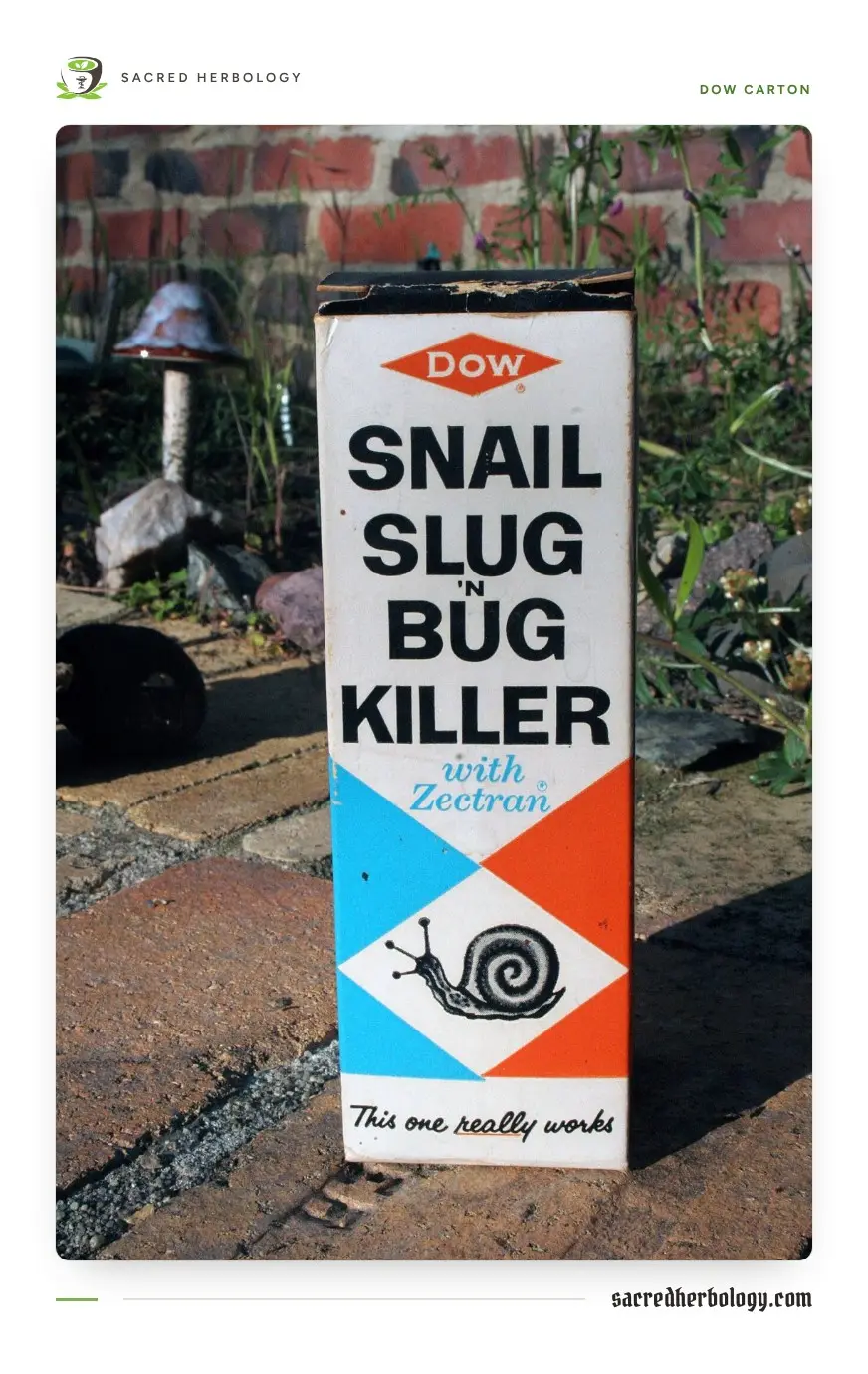

What interested him was mescaline’s family. He began publishing papers on new psychoactive compounds in the early 1960s, and one compound he made at Dow, in 1963, would later escape into the wider world in a way he never intended. It is usually called DOM. In 1967 it turned up on the streets of the Haight-Ashbury in San Francisco under the name STP, handed out free at a gathering in Golden Gate Park in tablets that were far stronger than anyone using them understood, and a wave of people ended up frightened and in hospital. How the compound got from the laboratory to the street has never been fully explained, but Shulgin had no part in the street tablets. But the episode gave him an early and uncomfortable view of what happens when a discovery leaves the laboratory.
Dow, perhaps unsurprisingly, grew less comfortable having its name on papers about mind-altering drugs, and asked him to stop using it in his publications. In December 1966 he left the company. He would never again work as a salaried chemist for a corporation.
The Farm
He went home. His family had land on a hillside in Lafayette, and that property, which everyone called the Farm, became the centre of his world for the rest of his life. He built his laboratory in an outbuilding there, the shed I described at the start. He earned his living as a consultant, taught at the University of California campuses at Berkeley and San Francisco and at San Francisco State University, and worked on his own research in the hours between.
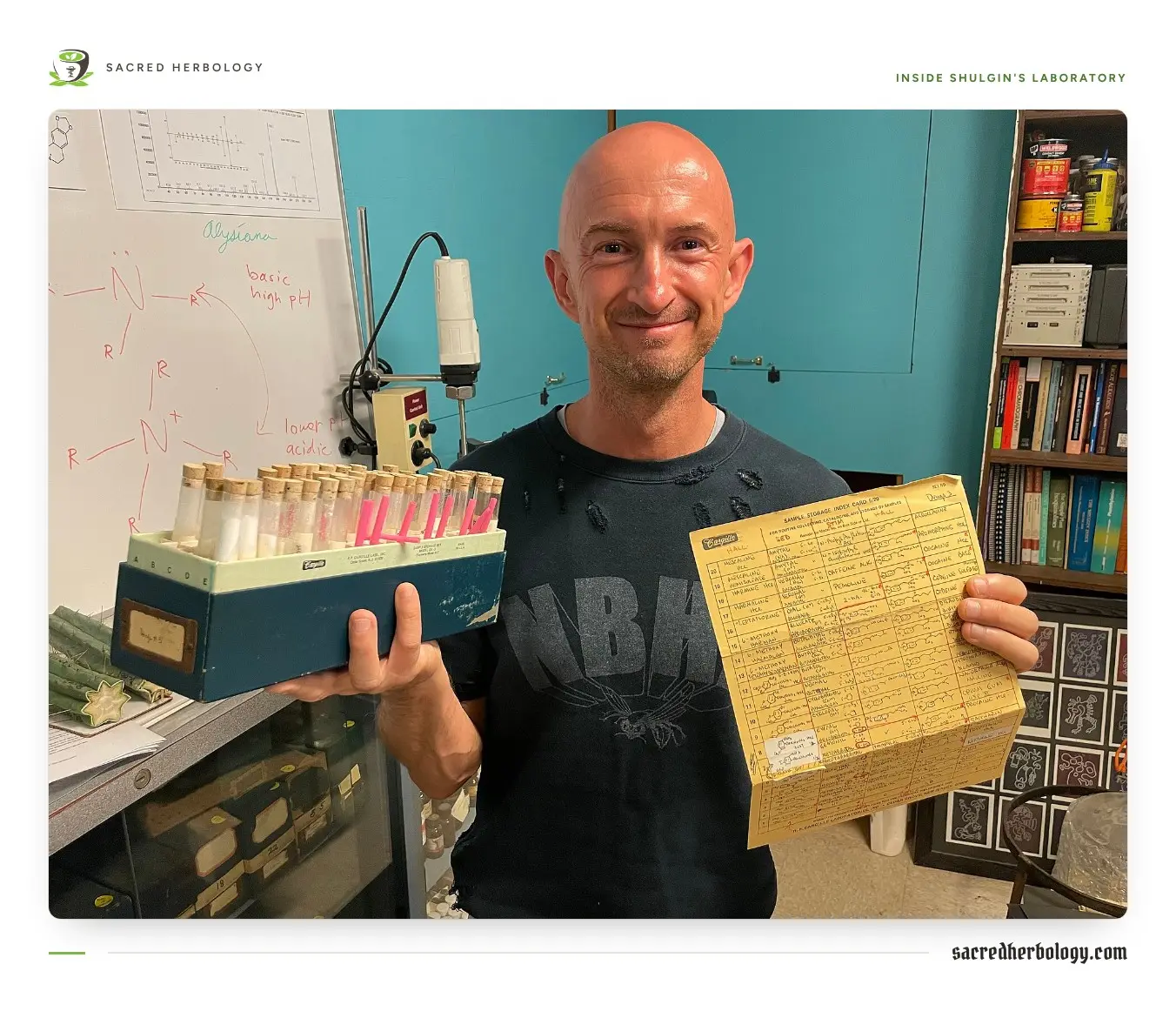

Here is a part of the story that surprises people. Shulgin did all this openly and legally, with the knowledge of the American drug authorities. He held a licence from the federal Drug Enforcement Administration to run an analytical laboratory that could make and hold controlled substances. He built a working friendship with Bob Sager, head of the agency’s Western Laboratories. He gave pharmacology seminars for agents, supplied the agency with reference samples, served as an expert witness in drug cases, and in 1988 published a thick reference book on the American federal drug laws. For years the man later called the godfather of ecstasy was one of the people the drug police called when they needed to know what something was.
This is all American history, of course, under American law. Nothing about his licence or his arrangement with the agency has any bearing on what is permitted in Australia.
The working method he settled into at the Farm is the heart of the alchemical comparison, so I’ll describe it carefully, without any of the chemistry.
He would design a new compound on paper, usually a small change to a known one. He would make a small quantity of it in the shed. Then, after the toxicology he thought prudent, he would test it on himself, cautiously, over many separate sessions, writing detailed notes each time. Only if a compound proved interesting, and tolerable, did he share it with others.
Those others were a small research group of friends that took shape from the 1960s onwards. Its members included the chemist Peyton Jacob, the engineer and psychedelic researcher Myron Stolaroff and his wife Jean, and others whose names appear, often disguised, in his books. They would meet at the Farm, take a new compound together, and compare notes. Many of them were scientists. All of them were volunteers who knew exactly what they were doing and accepted the risk.
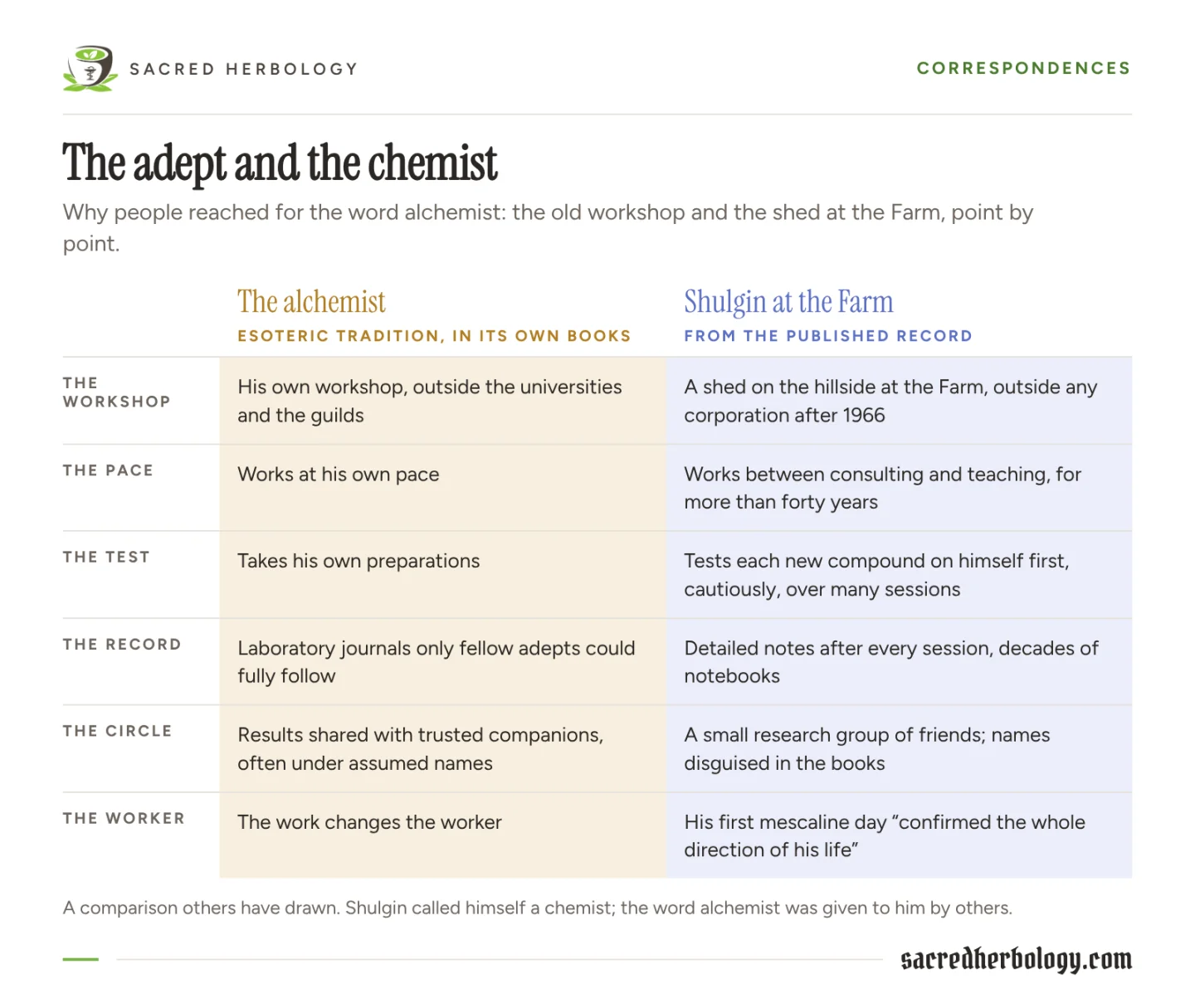
Put that next to the old books and the resemblance is plain. The alchemist worked in his own workshop, at his own pace, outside the universities and the guilds. He took his own preparations. He kept laboratory journals full of observations that only he and a few fellow adepts could fully follow. He shared his results in a small circle of trusted companions, often under assumed names. And the alchemists themselves insisted that the work changed the worker. Shulgin’s research group would have recognised every item on that list.
Plus four: a ladder for inner states
One of the most original things Shulgin produced at the Farm was a vocabulary. Anyone who has read alchemical texts knows how much of the tradition is a struggle to describe inner states that ordinary language has no words for. The alchemists borrowed the colours of matter in the flask, the black crow, the white swan, the peacock’s tail, the red king, to name stages of an inner process.
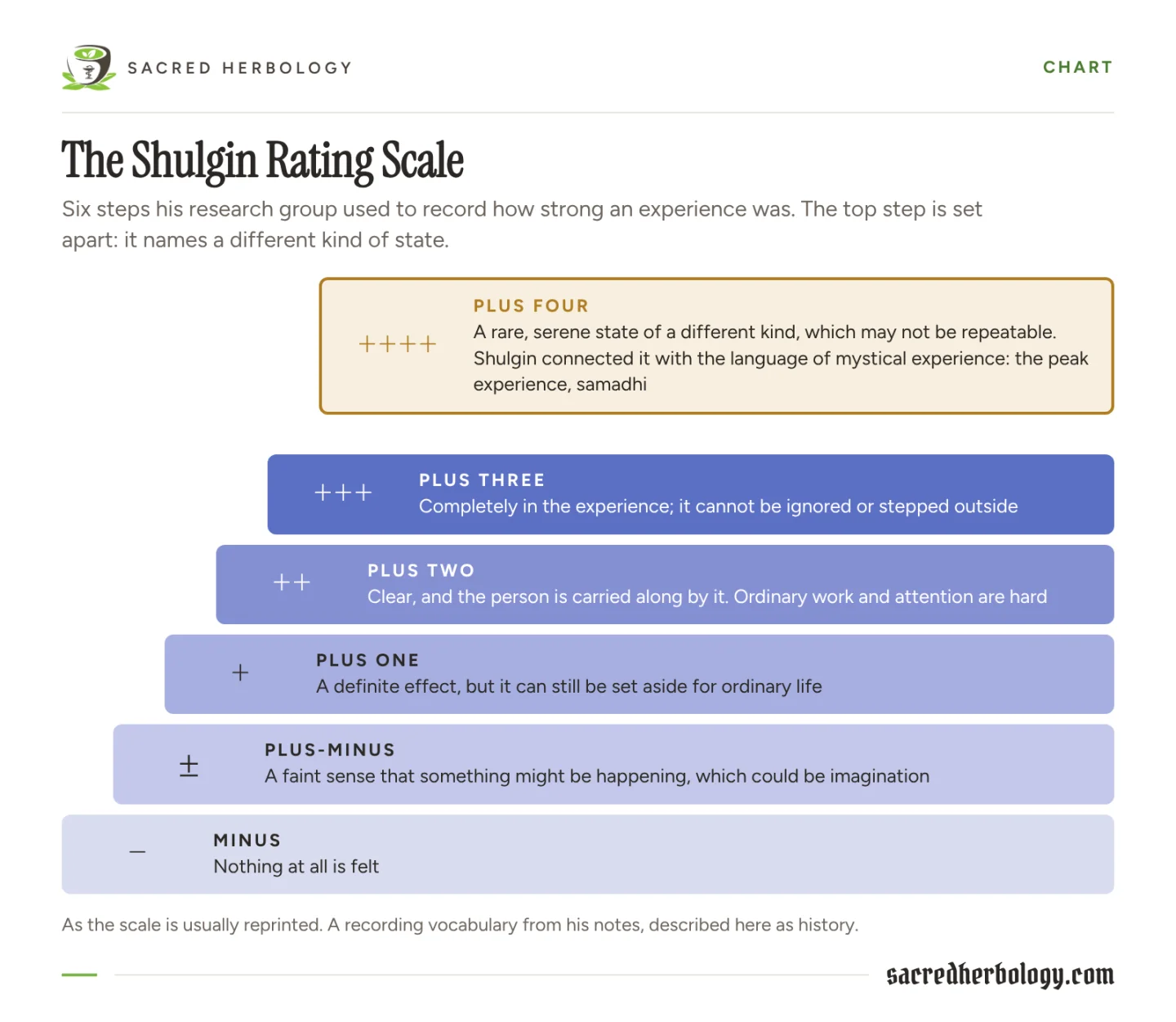
Shulgin had the same problem as a scientist, and he solved it with a simple scale that his research group used to record the strength of an experience. It has been reprinted and discussed so often that it is now usually called the Shulgin Rating Scale. It has six steps, written with plus and minus signs:
- Minus: nothing at all is felt.
- Plus-minus: a faint sense that something might be happening, which could be imagination.
- Plus one: a definite effect, but the person can still choose to set it aside and go on with ordinary life.
- Plus two: the effect is clear, and the person is carried along by it. Ordinary work and attention are hard.
- Plus three: the person is completely in the experience, and cannot ignore it or step outside it.
- Plus four: a different kind of thing altogether, a rare, serene state that may not be repeatable, which he connected with the language of religious and mystical experience, the peak experience of the psychologists and the samadhi of the yogis.
That last step is where the scale stops being a laboratory measure and starts to look like a map of the soul. The first five steps measure how strong an effect is. The plus four describes a state that he said could not be summoned again simply by repeating the compound. The chemist built a scale and at the top of it left a door marked with the names the mystics used.
Drawn out, the scale looks like a ladder: six steps rising up the page, the plus signs climbing, and the top step set apart from the others by a gap.
Ann
In 1977 Nina Shulgin died of a stroke. The following year, 1978, Sasha met the woman who would become his partner in everything that followed.
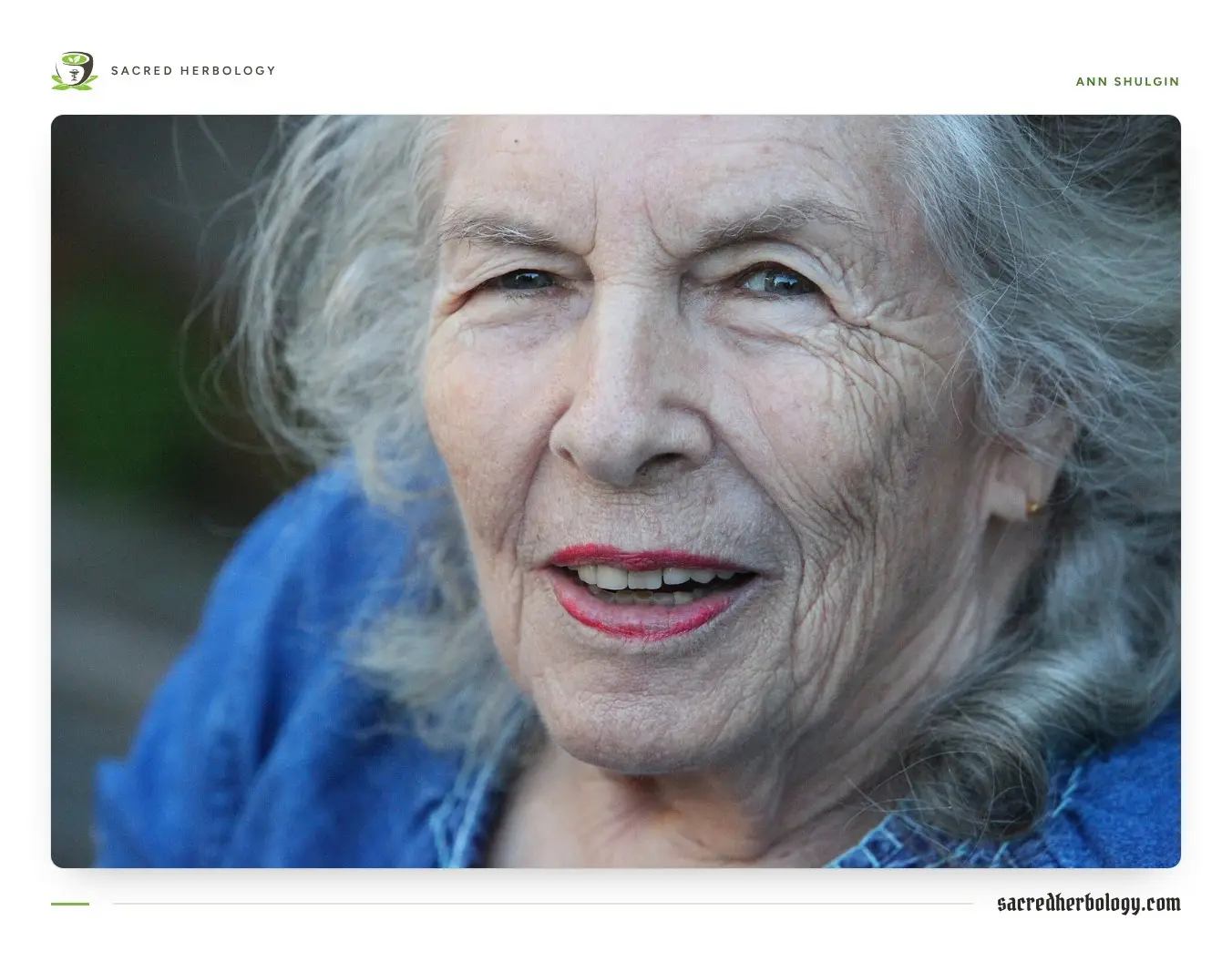
She was born Laura Ann Gotlieb on 22 March 1931 in Wellington, New Zealand, the daughter of an American consular official, and she grew up partly in Opicina, above Trieste in Italy, where her father served as consul. She came to San Francisco as a young woman, worked as a medical transcriber, married twice and raised four children. In the 1950s, long before she met Sasha, she had taken peyote herself, and she called it “one extraordinary blessed day”.
They married on 4 July 1981 in the garden at the Farm. Her name became Ann Shulgin, and for the next three decades she was co-researcher, co-author, editor, organiser, host of the research group and keeper of the household. She also worked as a lay therapist, drawing on the psychology of Carl Gustav Jung, and while the substances were still legal she used some of Sasha’s compounds in her therapeutic work with clients. She outlived him by eight years and died at the Farm on 9 July 2022, aged ninety-one.

Ann’s Jungian training ties this story back to alchemy in a very direct way, and it is a tie I can document. Jung spent the second half of his career reading alchemical texts. In Psychology and Alchemy (1944) and the later Mysterium Coniunctionis, he argued that the images in the old alchemical books, the marriage of the king and queen, the death in the black stage, the rebirth in the white, were projections of a psychological process he called individuation, the long work of becoming a whole person. You do not have to agree with Jung to see the point. It was Jung, more than anyone, who taught the twentieth century to read alchemy as a map of the inner life. And it was a Jungian therapist who sat beside Shulgin in the Farm for thirty years and wrote his books with him.
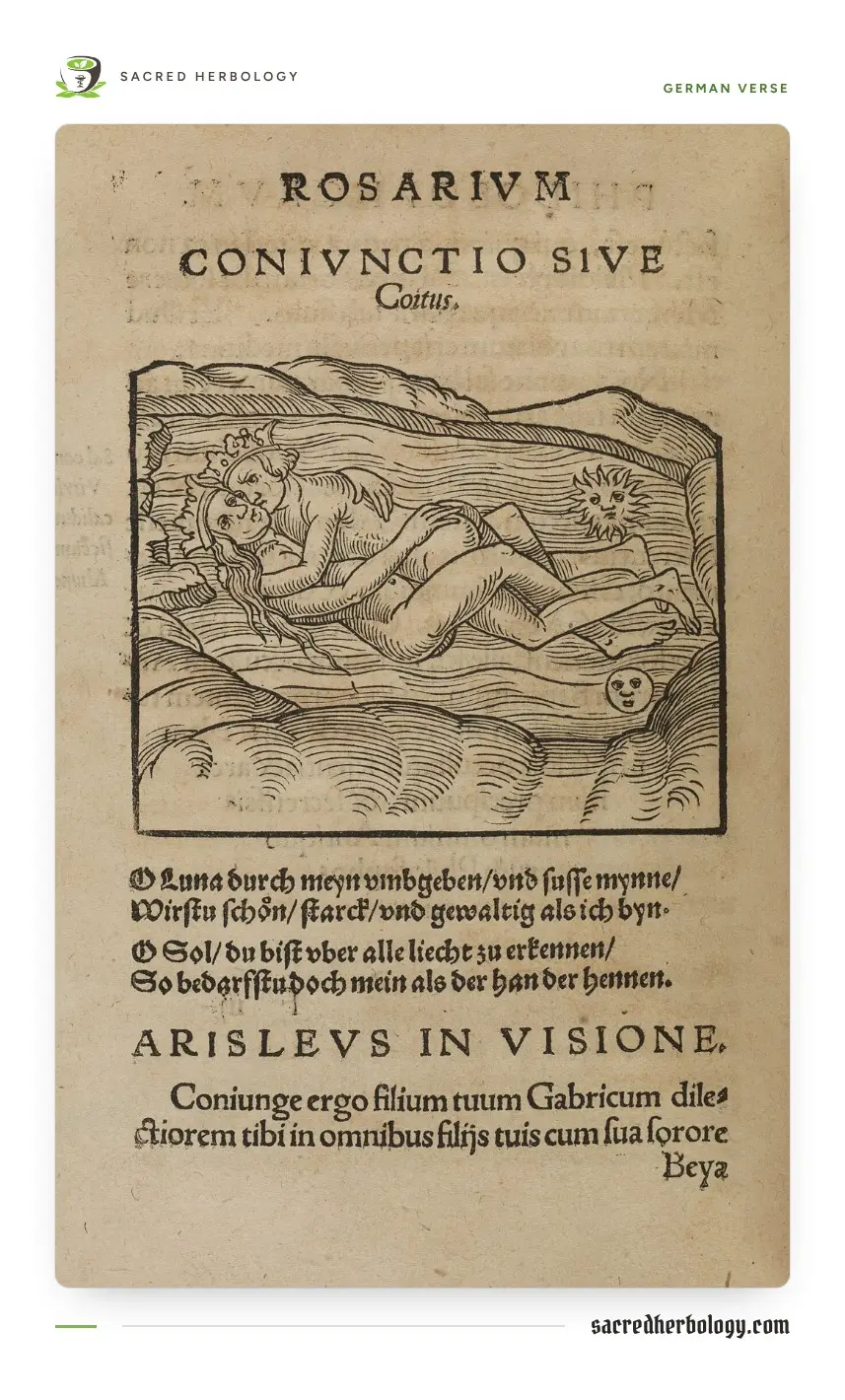
There is one more alchemical image Ann’s arrival brings into the story. The great symbol at the climax of the opus in many alchemical books is the chemical wedding, the coniunctio, the union of the king and queen, sun and moon, sulphur and mercury, from which the stone is born. The Rosicrucian text of 1616 that took this up was even called The Chemical Wedding of Christian Rosenkreutz. I’d be pushing my luck to say Sasha and Ann thought of their marriage in those terms. But their first book was subtitled A Chemical Love Story, and the love story was half of it.

Adam
The compound that made Shulgin famous was one he did not invent.
In 1912 the German pharmaceutical firm Merck made a compound now known to everyone by its initials, MDMA, as a step on the way to something else, and patented the process. For decades nobody paid it much attention. In 1976 a student in the medicinal chemistry group Shulgin advised at San Francisco State University told him about it. Shulgin made a fresh batch by his own route and tested it on himself in the usual careful way. What he found was unlike the visionary compounds he had been making. In his notes it did not produce visions. It seemed instead to make people unusually open and warm, able to talk about difficult things without fear.
He and his colleague David Nichols described its effects in humans in a scientific paper published in 1978, in a volume of conference papers called The Psychopharmacology of Hallucinogens. And around this time he did something that would change its history. He gave some to an old friend, Leo Zeff.
Zeff was a psychologist in Oakland, then in his mid-sixties and on the point of retirement, who had worked quietly with psychedelic substances in therapy for years. He tried the new compound and was so impressed that he gave up retiring. He began introducing it, carefully and privately, to other therapists across the United States and beyond, many hundreds of them according to those who knew him, training them in how he worked. He gave it a name of his own. He called it Adam, because he felt it returned people to a state of innocence before the fall. Zeff appears under a disguise in Shulgin’s books, and after his death in 1988 his friend Myron Stolaroff wrote a book about his work, published in 1997 as The Secret Chief, keeping his identity hidden until a later edition named him.
For roughly eight years, in the late 1970s and early 1980s, MDMA moved through a quiet network of therapists in the United States, legally, without any clinical trial or any regulator’s approval. Then it escaped into the dance clubs of Texas and elsewhere under the name ecstasy, and the quiet years ended.
1985
The scheduling of MDMA in the United States is a piece of American law and history. None of it governs Australia, but it shaped the story everywhere, so here is the outline.
In 1985, alarmed at its growing recreational use, the Drug Enforcement Administration used its new emergency powers to place MDMA in Schedule I, the most restrictive class under American federal law, from 1 July 1985. It was the first time the agency had used those powers. A group of therapists and researchers who had worked with the compound asked for a hearing. In May 1986 the agency’s own administrative law judge, Francis Young, found in their favour and recommended Schedule III, a class that would have let doctors prescribe it. The head of the agency, John Lawn, overruled his own judge and placed it in Schedule I permanently later that year. After a court challenge by the psychiatrist Lester Grinspoon, the listing was briefly set aside and then restored in 1988.
Shulgin had not been the one who carried it to the clubs, and he had no say in the scheduling. But he had been the bridge between a forgotten compound in a German patent and the therapists who learned to use it, and from 1985 onwards his name was tied to it in every newspaper.
Here is that story in order, from the patent to the present:

- 1912: Merck makes MDMA and patents the process.
- 1976: Shulgin is told of it by a student and makes it fresh.
- 1978: Shulgin and Nichols publish its effects in humans.
- Late 1970s: Leo Zeff begins teaching other therapists to work with it.
- 1985: emergency scheduling in the United States, from 1 July.
- 1986: Judge Young recommends Schedule III; the agency’s head overrules him.
- 1988: Schedule I listing restored after the court challenge.
- 1991: PiHKAL is published.
- 2023: Australia’s regulator allows authorised psychiatrists to prescribe it for one condition, from 1 July.
Two books for the Work
By the late 1980s the Shulgins had a problem. Shulgin had been making and testing compounds for nearly thirty years and had notebooks full of results that no scientific journal would publish. Many were too strange for the journals, and some of the substances had by then been made illegal. Ann and Sasha decided to publish it all themselves, set up their own small press, Transform Press, in Berkeley, and in 1991 brought out a book of nearly a thousand pages.
They called it PiHKAL: A Chemical Love Story. The title is an abbreviation of “Phenethylamines I Have Known And Loved”. Six years later, in 1997, came the sequel, TiHKAL: The Continuation, “Tryptamines I Have Known And Loved”, about the family of compounds that includes psilocybin from the mushrooms (which are fungi, not plants) and DMT from many plants.
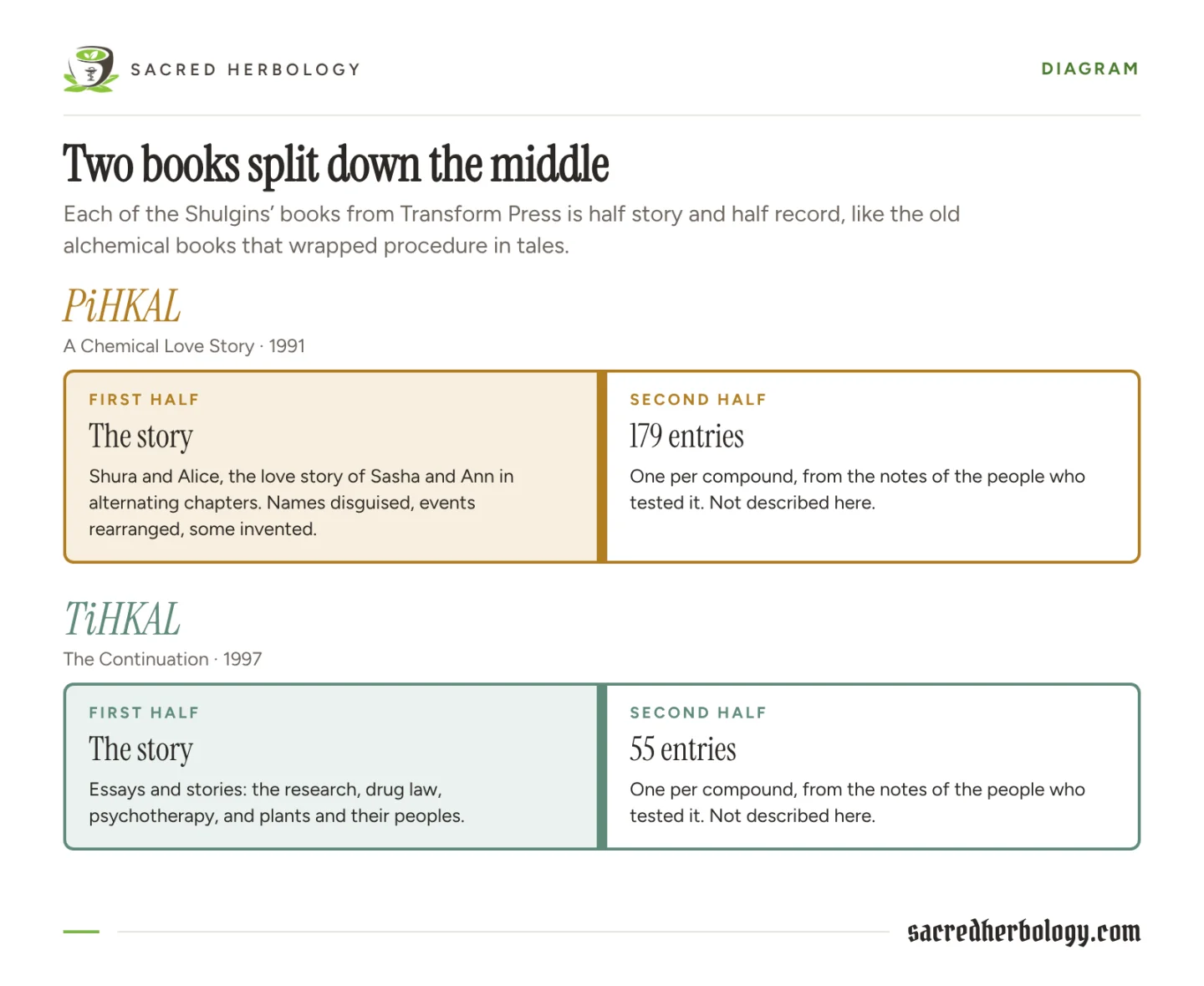
Both books are split down the middle, and the split is the most alchemical thing about them.
The first half of each book is a story. In PiHKAL it is the love story of Sasha and Ann, told in alternating chapters by two characters called Shura and Alice. Shura is another Russian short form of Alexander. The names of friends and colleagues are disguised, events are rearranged and some are invented, and it reads as a novel built on real lives. It covers Shura’s childhood and his first mescaline day, Alice’s earlier marriages, their meeting, their early uncertain years, and the long collaboration of the research group. In TiHKAL the first half is a looser gathering of essays and stories: about the research, about drug law, about psychotherapy, and about plants and their peoples.
The second half of each book is something else entirely: a long sequence of entries, one per compound, each giving the chemistry, the amounts tried, the time course, and extracts from the notes of the people who tested it. PiHKAL has 179 of these entries. TiHKAL has 55. This is the part of the books that made them notorious, and it is the part I am not going to describe in any further detail.
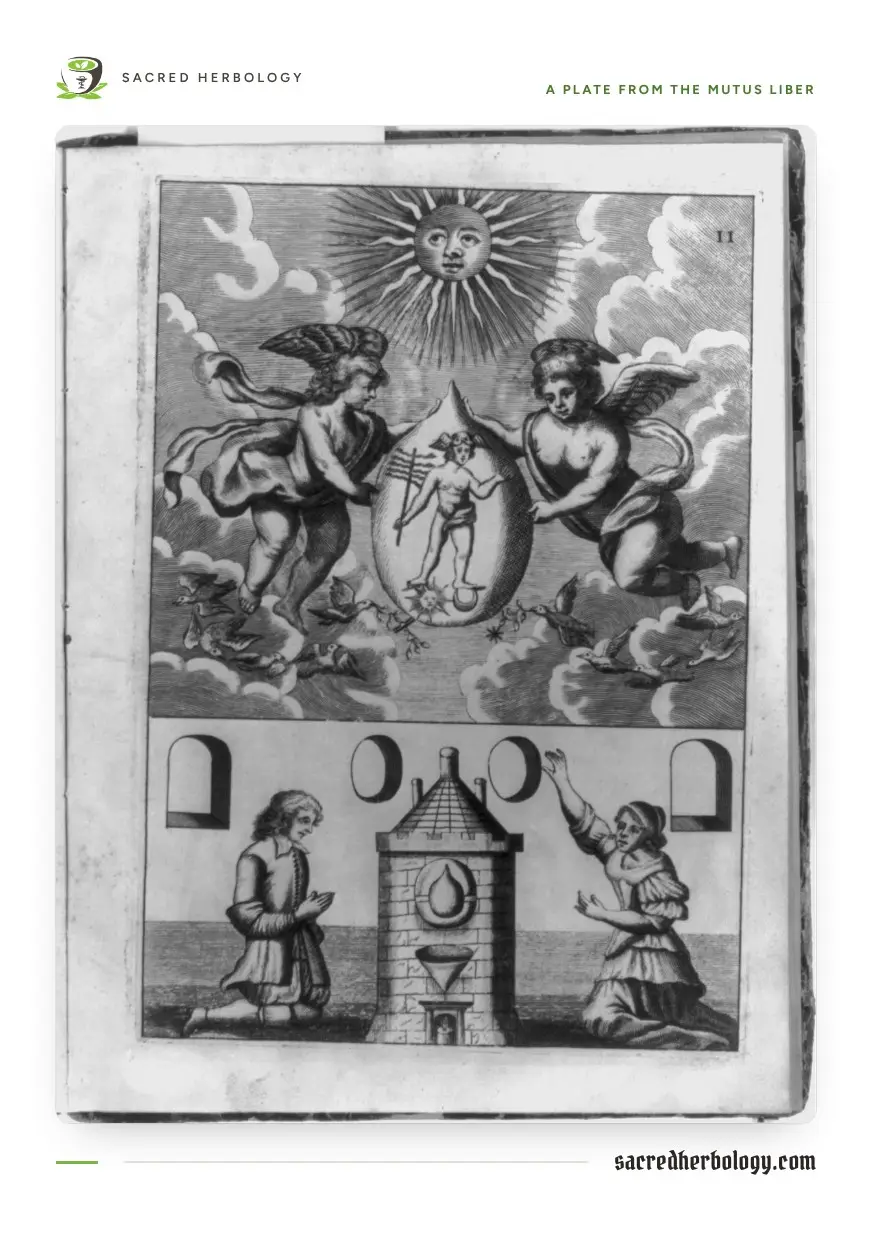
Now pick up almost any of the classic alchemical books and you will find the same marriage of story and procedure. The alchemical writers wrapped their procedures in tales, allegories and dreams. The Splendor Solis, the sixteenth-century alchemical manuscript with its glorious painted plates, sets the stages of the work among kings, queens, flasks and landscapes. In 1677 a book was printed at La Rochelle called the Mutus Liber, the Silent Book, which told the entire work in fifteen engraved plates and almost no words, and shows a couple, a man and a woman, working at the furnace side by side through plate after plate. A woman and a man at the furnace, a story and a manual in one volume: that is very nearly a description of PiHKAL.

The alchemists also had their own way of writing for two audiences at once. Their books were famously obscure. They hid their procedures under code names, the green lion, the grey wolf, the menstruum, so that the uninitiated would not understand and the initiated would. Shulgin went the other way. He wrote his procedures out plainly, deliberately, because he believed that this knowledge should not be lost and that adults had a right to know it.
The authorities saw it differently. In 1994, a couple of years after PiHKAL came out, agents raided the Farm laboratory. They found that he had kept anonymous samples people had sent him for analysis, which his licence did not allow. He was fined twenty-five thousand dollars and gave up the licence. An agency spokesman told a reporter later that the books were “pretty much cookbooks on how to make illegal drugs”. That is the American side of the story. In Queensland, as in some other states, possessing or publishing instructions for making a dangerous drug is itself an offence, and I have no wish to help anyone test that.
Underground
What happened to the books after 1991 is a kind of history of their own.
They were sold openly through the post and in bookshops, and then they went everywhere. Photocopies passed from hand to hand. The chemistry halves were soon circulating in the early online world of the 1990s, on bulletin boards and websites, and Erowid, a long-running online library about psychoactive plants and chemicals, has hosted them for many years. People who would never have found their way into a university pharmacology department read about phenethylamines in their bedrooms.
Most of the people who read them never made anything. They read the first half, the love story, and found in it an account of something they recognised: a man and a woman who treated the mind as a country to be explored, and who wrote about what they found with care and humour. Many of the people who later led the revival of psychedelic research, as scientists, therapists, writers and organisers, have said that they first came to the subject through those two books.
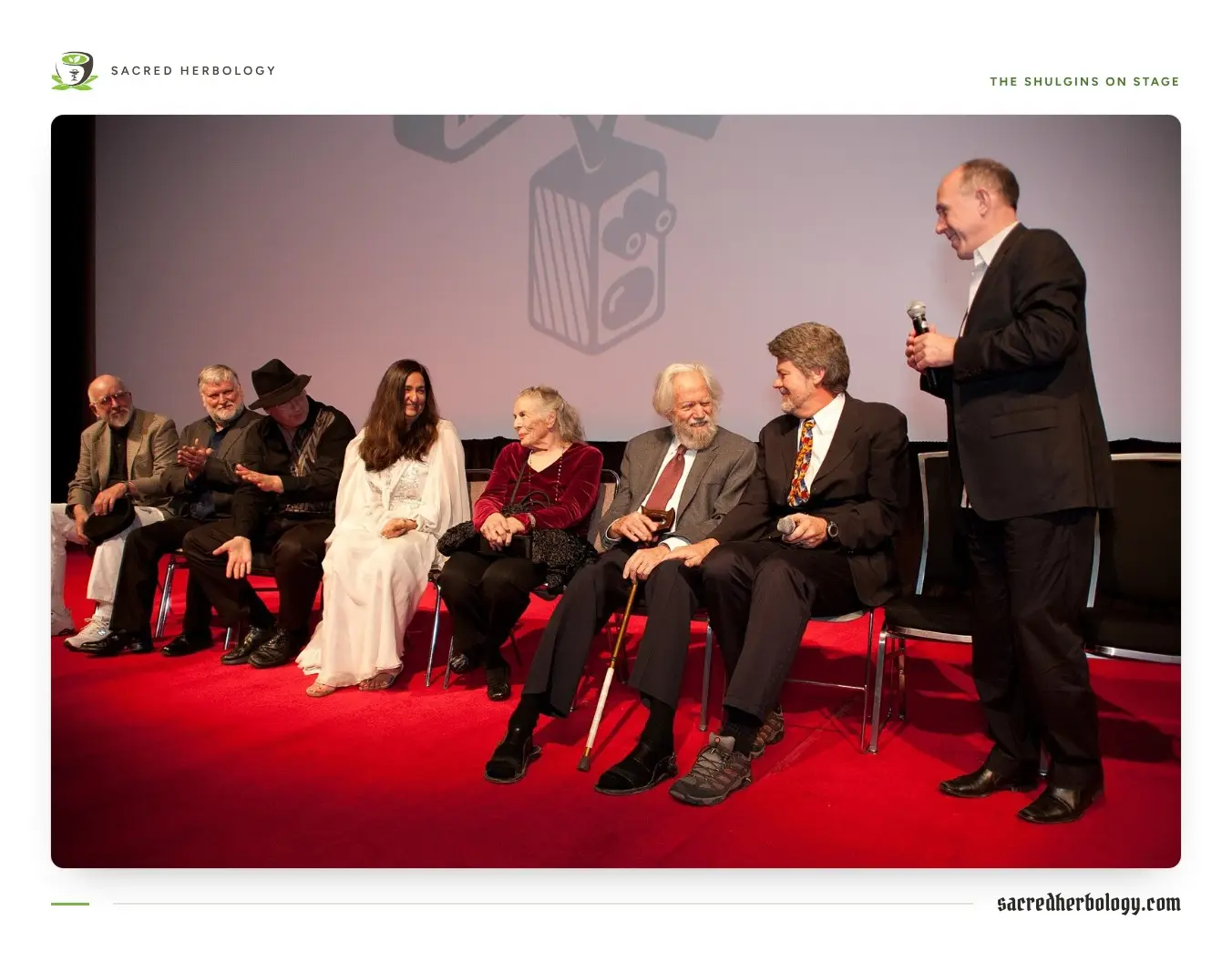
That generation of readers is the closest thing to a school of disciples the books produced, and the comparison with the old alchemical networks is again hard to resist. Alchemical learning in Europe travelled in manuscript copies and rare printed books, passed between practitioners who wrote to each other under pseudonyms and visited each other’s workshops. The Shulgins’ world travelled in photocopies, early websites and conference halls. In the last years of his life Shulgin was a kind of travelling sage at psychedelic conferences across North America and Europe, where long queues of young people waited to shake his hand and have their copies signed.
It would be easy to make this sound sweeter than it was. Some of the compounds the books described were made by people who had none of the Shulgins’ care. Some reached the illicit market, under new and sometimes misleading names, in pills of unknown strength. People were harmed. Shulgin knew this, and he never accepted that the answer was to stop publishing. Reasonable people still disagree about whether he was right. I’ll leave that disagreement where it belongs, with you.
His work went on into his old age. The Simple Plant Isoquinolines, written with Ann’s daughter Wendy Perry and published by Transform Press in 2002, catalogues a family of alkaloids found in plants, among them the isoquinolines that sit alongside mescaline in peyote and other cacti. Mescaline itself is a phenethylamine, a different family, so the book is about its companions in the plant. The Shulgin Index, a vast reference work on the psychedelic phenethylamines written with Tania Manning and Paul Daley, came out in 2011. He had a heart valve replaced in 2008 and a stroke in 2010, and in his last years his memory failed. He died at the Farm on 2 June 2014, aged eighty-eight. Ann and the family kept the work going, and the first volume of his collected lectures, The Nature of Drugs, was published in 2021, with a second volume following in 2023.

Back to the clinic
Shulgin always thought of his compounds as tools. He had seen Leo Zeff and Ann work with them in therapy, and he hoped they would one day return to the clinic under proper study. He did not live to see it, but the story did turn that way.
In 1986, the year after the American scheduling, a young man named Rick Doblin founded the Multidisciplinary Association for Psychedelic Studies to fund clinical research into MDMA-assisted psychotherapy. Over the following decades that organisation and its offshoots ran trials in several countries. In the United States the medicines regulator declined to approve an application for MDMA-assisted therapy for post-traumatic stress disorder in August 2024 and asked for more study. That is another overseas decision with no direct force here.
In Australia the regulator moved first. On 3 February 2023 the Therapeutic Goods Administration announced that from 1 July 2023 two substances would be moved, for specific uses, out of Schedule 9 of the Poisons Standard, the schedule for prohibited substances, and into Schedule 8, the schedule for controlled medicines. MDMA could be prescribed for post-traumatic stress disorder, and psilocybin for depression that has not responded to other treatment, but only by psychiatrists who had been approved under the Authorised Prescriber scheme, with the approval of a human research ethics committee, in a supervised clinical setting. For every other purpose both remain Schedule 9 prohibited substances. No MDMA product is registered on the Australian Register of Therapeutic Goods, and the states and territories each adopt and administer the change under their own laws.
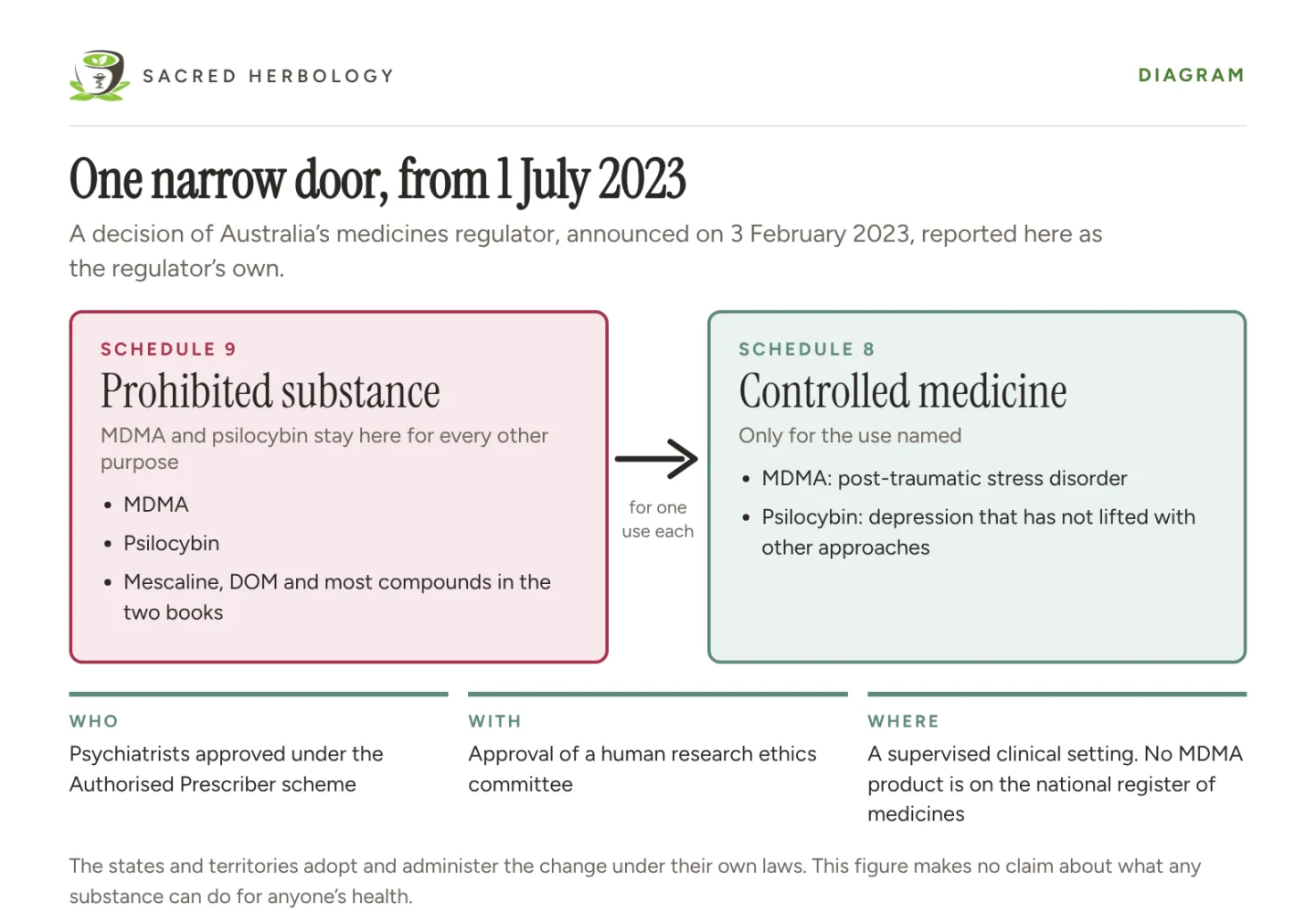
I want to be careful here. Those are the regulator’s decisions, made for the regulator’s reasons, and I report them as such. This Journal makes no claim about what any of these substances can do for anyone’s health, and I’d ask you not to read one into this piece. What I will say as a historian is that the change closes a circle that Shulgin’s life drew. A compound he carried from a forgotten German patent to a retired Oakland psychologist, which was then banned and spent nearly forty years outside the law, came back in 2023 through the most tightly controlled door Australian medicine has.
What the alchemist reading gives you
So, was he an alchemist?
If you mean someone who believed he could turn lead into gold, or who thought the planets ruled his chemistry, then no. Shulgin was a twentieth-century scientist through and through. He trusted measurement, published his chemistry, and wanted his results to be checked by anyone who cared to check them.
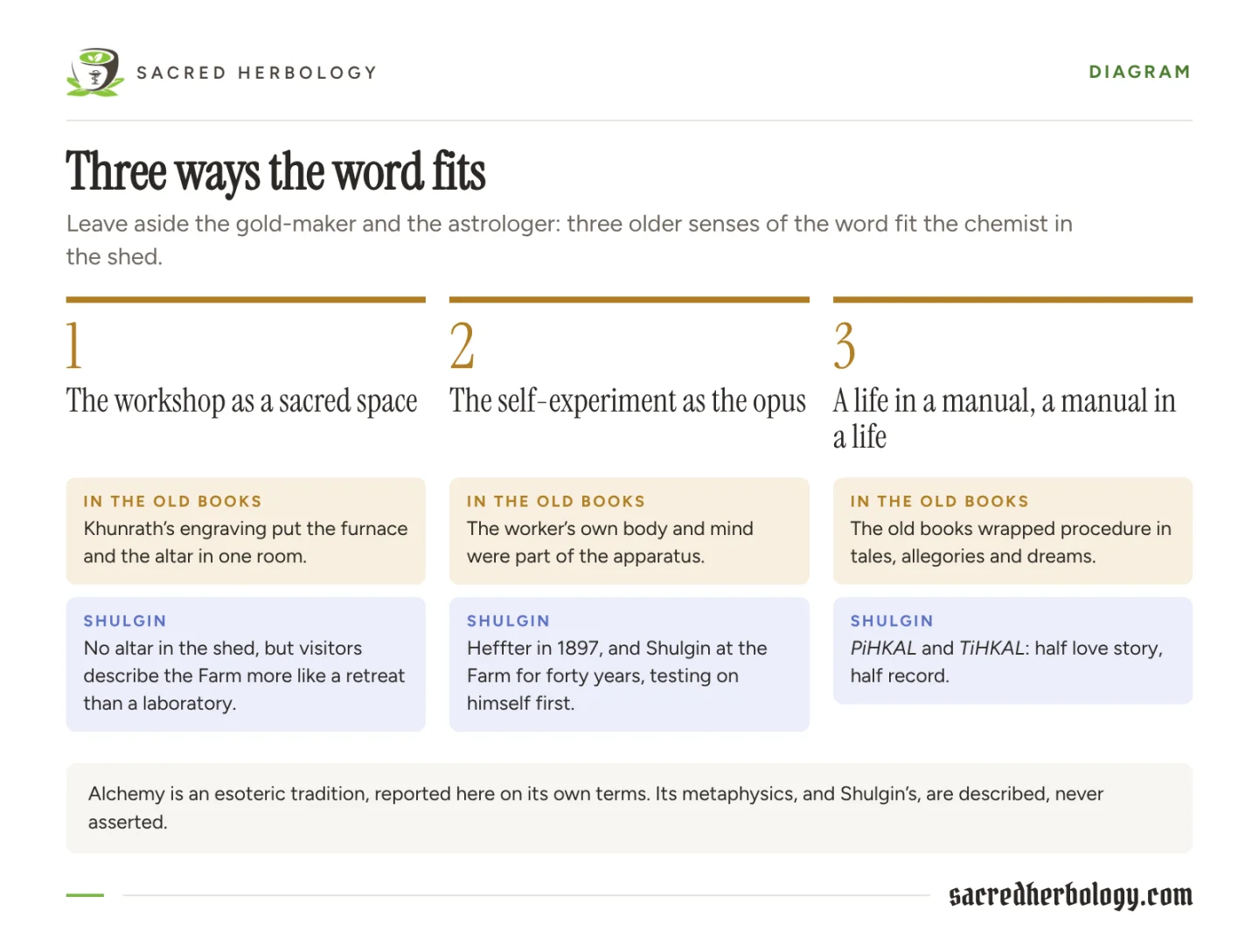
But there are other ways to read the word, and I think three of them fit him well.
The first is the workshop as a sacred space. Khunrath’s engraving put the furnace and the altar in one room. Shulgin’s shed had no altar in it, but he treated what happened there with something very close to reverence, and the people who visited the Farm describe it in terms that sound more like a retreat than a laboratory.
The second is the self-experiment as the opus. For the alchemists the work was never only in the flask. The worker had to be changed by the work, and the worker’s own body and mind were part of the apparatus. Arthur Heffter in 1897, testing peyote fractions on himself, and Shulgin at the Farm for forty years, testing his compounds on himself first and others only later, belong to that line. The modern scientific world mostly abandoned self-experiment for good reasons of safety and objectivity, and nothing in this piece is a recommendation to revive it. But it is the single most alchemical habit of his whole career.
The third is the book that hides a life in a manual and a manual in a life. PiHKAL and TiHKAL are odd, unclassifiable books, and the tradition they most resemble is the one this Journal files under The Old Books.
There is one more thing the alchemist reading gives you, and it is the most useful. The alchemists were famously ambiguous figures in their own time. They were admired and suspected, protected by some princes and imprisoned by others. Their work was thought powerful and dangerous in equal measure, and whether it was a gift or a menace depended on who was telling the story. Sasha Shulgin lived exactly that kind of double life: honoured as a pioneer by one group of people, called a cook of illegal drugs by another, consulted by the very agency that later fined him. If you want to understand why his name still starts arguments, the old books are a good place to begin.
None of this means you have to adopt either his metaphysics or the alchemists’. His belief that the universe was contained in the mind and spirit was his own, held sincerely and stated beautifully, and you are free to think it true or false. The alchemists’ belief that the soul could be refined like gold was theirs. This Journal reports both and asserts neither.
Safety and the law in Australia
A few plain facts, since this subject touches the body and the law.
- Mescaline, MDMA, DOM and the great majority of the compounds described in PiHKAL and TiHKAL are prohibited substances in Australia, listed in Schedule 9 of the Poisons Standard or caught by state drug laws, including in Queensland. The narrow 2023 change for MDMA applies only to authorised psychiatrists treating patients in a supervised clinical setting.
- Many of the compounds in the books have never been studied for safety in any formal way, and illicit pills and powders often contain something other than what they are sold as, at an unknown strength. Some of these substances also interact dangerously with common prescription medicines, including some antidepressants. Substitution is a known problem in the Australian illicit market: pills sold as ecstasy have been found to contain PMA, PMMA and synthetic cathinones, and blotters sold as LSD have been found to carry NBOMe compounds, and deaths here have been linked to substitutions of this kind.
- Wild peyote is a slow-growing, vulnerable species and the sacrament of living Indigenous religions. In Australia the plant itself is restricted under state and territory drug laws, which differ from place to place, and it is not a weed or biosecurity concern here, unlike its distant relatives the prickly pears. If you love it, love it in the books and in the botanical gardens.
- If someone is unwell after taking any drug, overheated, confused, having a fit, hard to wake or struggling to breathe, call 000. For advice at any hour, anywhere in Australia, call the Poisons Information Centre on 13 11 26.
Where this comes from
- Alexander Shulgin and Ann Shulgin, PiHKAL: A Chemical Love Story (Transform Press, Berkeley, 1991).
- Alexander Shulgin and Ann Shulgin, TiHKAL: The Continuation (Transform Press, Berkeley, 1997).
- Alexander Shulgin and Wendy Perry, The Simple Plant Isoquinolines (Transform Press, 2002).
- Alexander Shulgin, Tania Manning and Paul F. Daley, The Shulgin Index, Volume One: Psychedelic Phenethylamines and Related Compounds (Transform Press, 2011).
- Alexander Shulgin, The Nature of Drugs, Volume One (Transform Press, 2021).
- Alexander T. Shulgin and David E. Nichols, “Characterization of three new psychotomimetics”, in R. C. Stillman and R. E. Willette (eds), The Psychopharmacology of Hallucinogens (Pergamon Press, 1978).
- Myron J. Stolaroff, The Secret Chief (Multidisciplinary Association for Psychedelic Studies, 1997; revised as The Secret Chief Revealed, 2004).
- Drake Bennett, “Dr. Ecstasy”, The New York Times Magazine, 30 January 2005.
- Heinrich Khunrath, Amphitheatrum Sapientiae Aeternae (Hamburg, 1595; enlarged edition Hanau, 1609).
- Mutus Liber (La Rochelle, 1677).
- C. G. Jung, Psychology and Alchemy (1944; English translation by R. F. C. Hull, Collected Works vol. 12, Routledge and Kegan Paul, 1953).
- Weston La Barre, The Peyote Cult (Yale University Press, 1938).
- Omer C. Stewart, Peyote Religion: A History (University of Oklahoma Press, 1987).
- Barbara G. Myerhoff, Peyote Hunt: The Sacred Journey of the Huichol Indians (Cornell University Press, 1974).
- Edward F. Anderson, Peyote: The Divine Cactus (University of Arizona Press, 1980; second edition 1996).
- Heinrich Klüver, Mescal: The “Divine” Plant and Its Psychological Effects (Kegan Paul, 1928).
- Aldous Huxley, The Doors of Perception (Chatto and Windus, 1954).
- Therapeutic Goods Administration, announcement on MDMA and psilocybin, 3 February 2023; Poisons Standard, Schedules 8 and 9.