
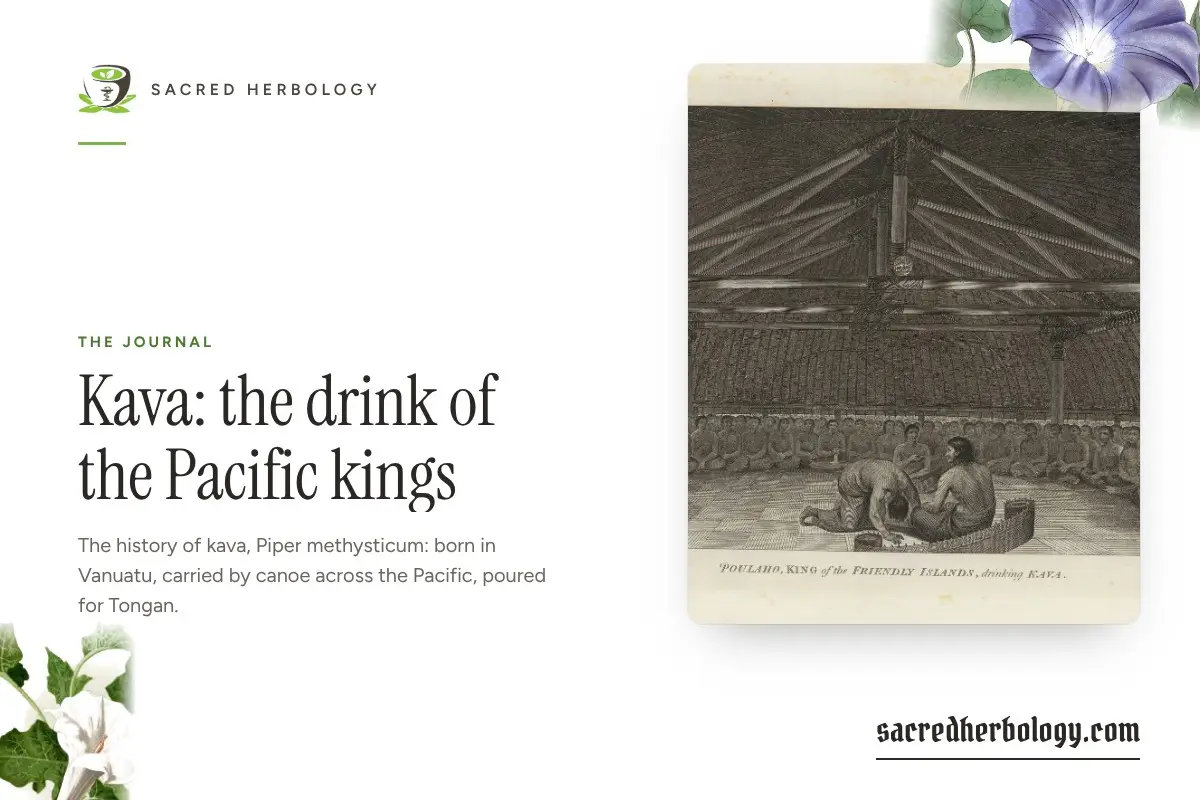
In June 1777 James Cook stepped ashore on Tongatapu, the main island of Tonga, for the third and longest of his visits to the group. Almost at once he was seated in a great circle of men. At the far end, opposite the highest chief, someone was working a root into water in a broad wooden bowl. Cups of folded leaf went round in a strict order while a voice called out each name. When Cook’s turn came he passed the cup to Mai, the young man from Ra’iatea who was travelling home with him. Mai drank it. Cook, who had already seen how the root was prepared on his earlier visit, did not.
That small scene holds most of what this piece is about. A drink belonged to chiefs and kings. The order of service was a map of who mattered. Europeans watched closely, wrote it all down, named the plant, and were often slightly squeamish about it. And the whole thing was already ancient by the time the first ship’s boat touched the beach.
Kava is the drink of a great many Pacific peoples, and each of them has its own name for it, its own stories and its own ways of serving it. What follows draws on published sources only: the islanders’ own written histories where they exist, the explorers’ journals, and the scholars who have worked with Pacific communities. I have named the peoples as I go. Some kava practice is restricted to the people it belongs to, and none of that is here.
A pepper with no seeds
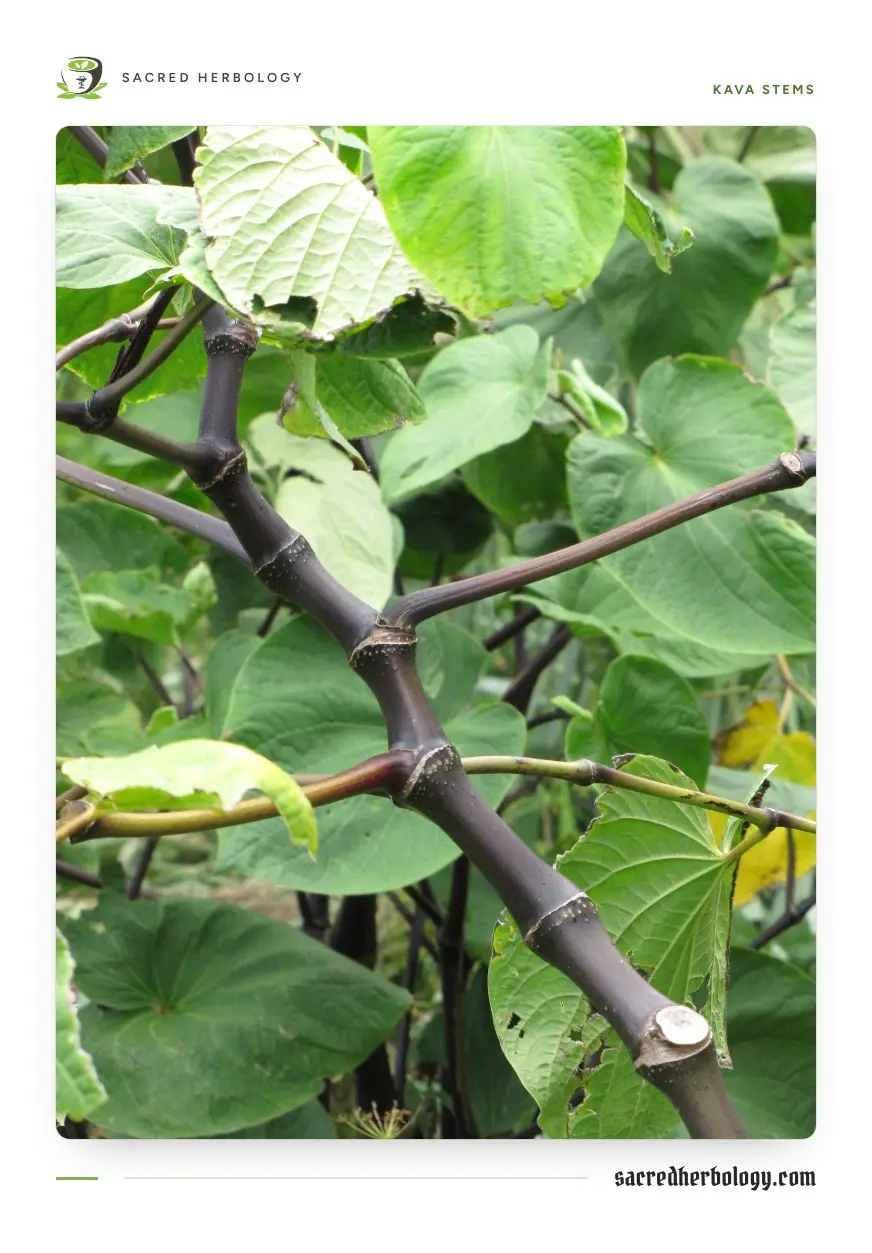
The plant is Piper methysticum, a shrub in the pepper family, Piperaceae, a cousin of the black pepper vine and of the betel leaf, Piper betle. (The betel nut chewed with that leaf is a different plant again, the seed of the areca palm.) It grows two or three metres tall, with big heart-shaped leaves and green or purple-mottled stems that swell at every joint like a bamboo cane. Underneath is the part people want: a heavy, knotted rootstock with a mass of lateral roots running off it. Dug up after a few years, a mature stump can weigh many kilograms and comes out of the ground looking like a tangle of grey rope around a lump of wood. Islanders sort the two parts and value them differently: in Fiji the thin lateral roots are waka and the heavy stump is lewena, and waka is the better-regarded grade. Leaves and stems are not the drinking part.

The odd thing about kava is that it cannot reproduce itself. Its flowers set no viable seed. Every kava plant on earth was grown from a piece of stem that a person cut and planted. When you look at a kava garden in Vanuatu or Fiji, you are looking at clones, each one the end of a chain of human hands that goes back for thousands of years. An old plant can hang on for years in an abandoned garden, but if people stopped planting it, kava would slowly disappear.
That fact is the key to its history. A plant that cannot spread on its own leaves a very clean record of where people took it. Wherever kava grows in the Pacific, someone carried it there in a canoe, kept the cuttings alive across open ocean, and planted them on arrival.
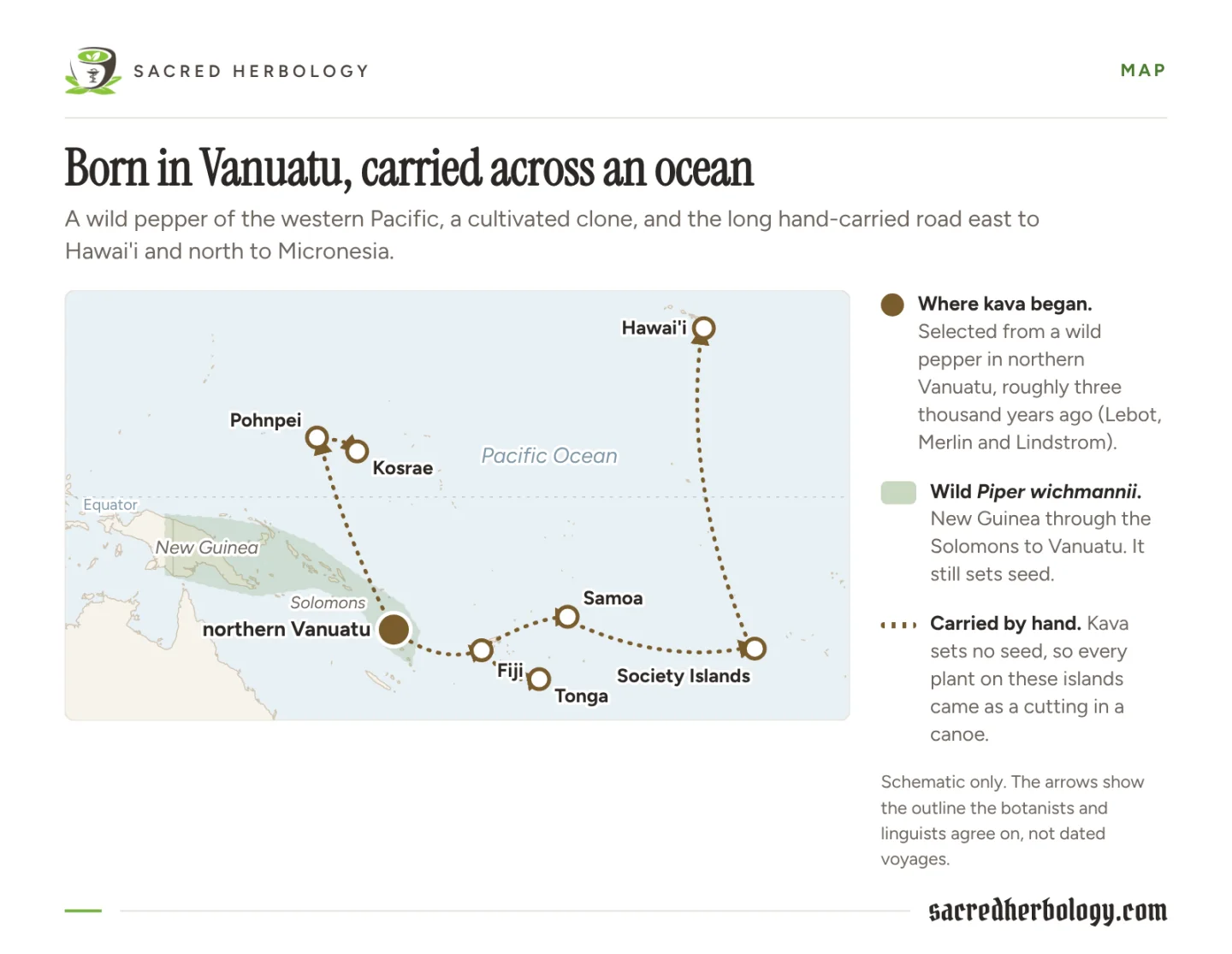
The botanists’ current view, set out most fully by Vincent Lebot, Mark Merlin and Lamont Lindstrom in their book Kava: The Pacific Drug (1992), is that kava was domesticated from a wild relative, Piper wichmannii, which grows from New Guinea down through the Solomons to Vanuatu. Some botanists, Lebot among them, treat this wild plant as a variety of kava itself and write it Piper methysticum var. wichmannii; you will meet both names. Wild wichmannii does set seed. At some point, people in northern Vanuatu began selecting plants of it for their roots, propagating the best ones from cuttings, and over a long time the cultivated line became sterile and distinct. That cultivated line is kava. Lebot and his colleagues put the beginnings of the process roughly three thousand years ago, in the islands of northern Vanuatu, where to this day you find far more named kava varieties than anywhere else in the Pacific.
The map below sets that out: a dot on the northern islands of Vanuatu, a shaded band where wild wichmannii grows, and the routes running east from Vanuatu to Fiji, Tonga, Samoa, the Society Islands and Hawai’i, and north into Micronesia to Pohnpei and Kosrae.
The word, and the voyages
Linguists have their own way into the story. The word kava, or something close to it, is spread right across Polynesia: kava in Tonga, ‘ava in Samoa and Tahiti, ‘awa in Hawai’i. In Fiji the everyday word is yaqona, though kava is understood there as well. On Pohnpei the drink is sakau, and on Kosrae it was seka.
In 2002 the linguist John Lynch published a paper in Oceanic Linguistics called “Potent roots and the origin of kava”. He pointed out that if kava was domesticated in northern Vanuatu, after the first Austronesian-speaking settlers had already spread through the region, then their shared ancestral language, Proto-Oceanic, could not have had a word for it. What it did have, he argued, was an older word for a root with strong or ritual properties, probably a wild ginger, perhaps also the wild pepper and certain fish-poison plants. When kava came along, the old word for “potent root” was attached to the new plant, and that word travelled east with it.
This is a linguist’s reconstruction, and like all such work it is an argument from patterns in many languages. It fits neatly with the botanists’ picture, though, and the two together give a sensible outline: kava is born in Vanuatu, carried to Fiji, then on into western Polynesia, where Tonga and Samoa make it the centre of their political life, and from there it goes with the voyagers to the eastern Pacific.
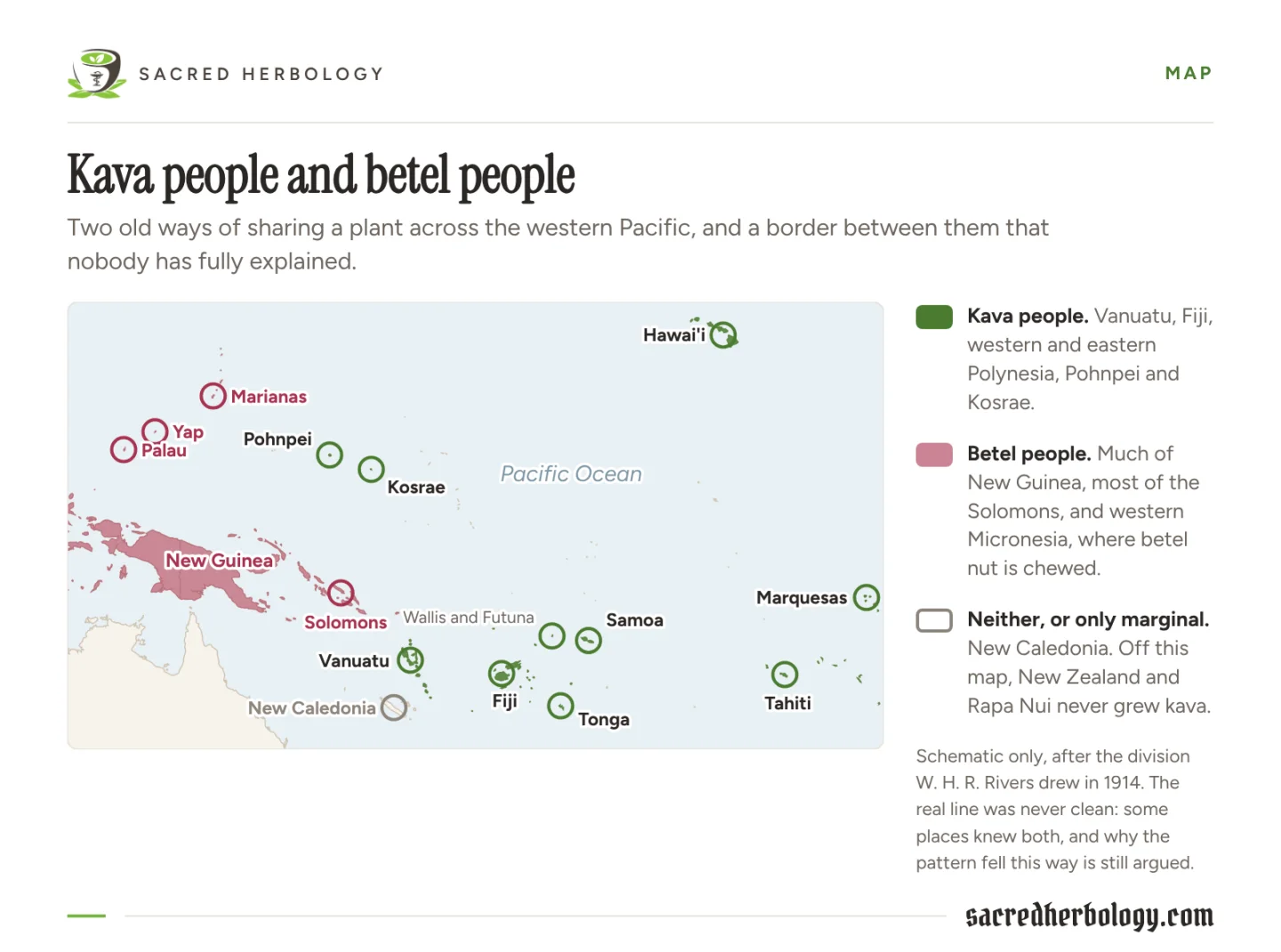
The gaps on the map are as interesting as the arrows. Kava never became established in New Zealand, where the climate is far too cold for it. It was not grown on Rapa Nui. In New Caledonia and across most of the Solomon Islands it is absent or only marginal, and across large parts of New Guinea people chew betel nut instead. In 1914 the Cambridge anthropologist W. H. R. Rivers, in The History of Melanesian Society, divided the region into “kava people” and “betel people” and tried to explain the pattern as layers of migration. Ron Brunton returned to the puzzle in The Abandoned Narcotic (1989), working from his fieldwork on Tanna in southern Vanuatu, and argued that some communities had once drunk kava and then given it up, for reasons tied to the rise and fall of their religious cults. Neither man settled the question. It remains one of the open problems of Pacific history, and the second map, with the kava islands in one colour and the betel islands in another, makes the puzzle plain at a glance.
The Forsters give it a Latin name
Europeans first described kava on Cook’s voyages. On the second voyage, aboard the Resolution between 1772 and 1775, the ship carried two German naturalists, Johann Reinhold Forster and his teenage son Georg. They saw kava in the Society Islands and in Tonga, collected specimens, and wrote about the plant at length.
It was Georg who published the scientific name. In 1786 he brought out a small Latin treatise on the edible plants of the South Sea islands, De plantis esculentis insularum oceani australis, printed in Berlin. There he named the plant Piper methysticum. The specific name is Greek, from methystikos, “intoxicating”, from the same root as methy, wine. So the formal name of the Pacific’s great ceremonial drink is a German naturalist’s Greek word for “makes you drunk”, attached to a plant he met in the Society Islands and Tonga, and it says more about what struck the visitors than about what the drink meant to the people who served it.
Johann Reinhold published his own account in English in 1778, Observations Made During a Voyage Round the World, which covers the islanders’ customs, kava among them. Georg wrote a lively popular narrative, A Voyage Round the World (1777). Both men noticed the same thing that would trouble Cook on the next voyage: the method of preparation.
Chewing the root
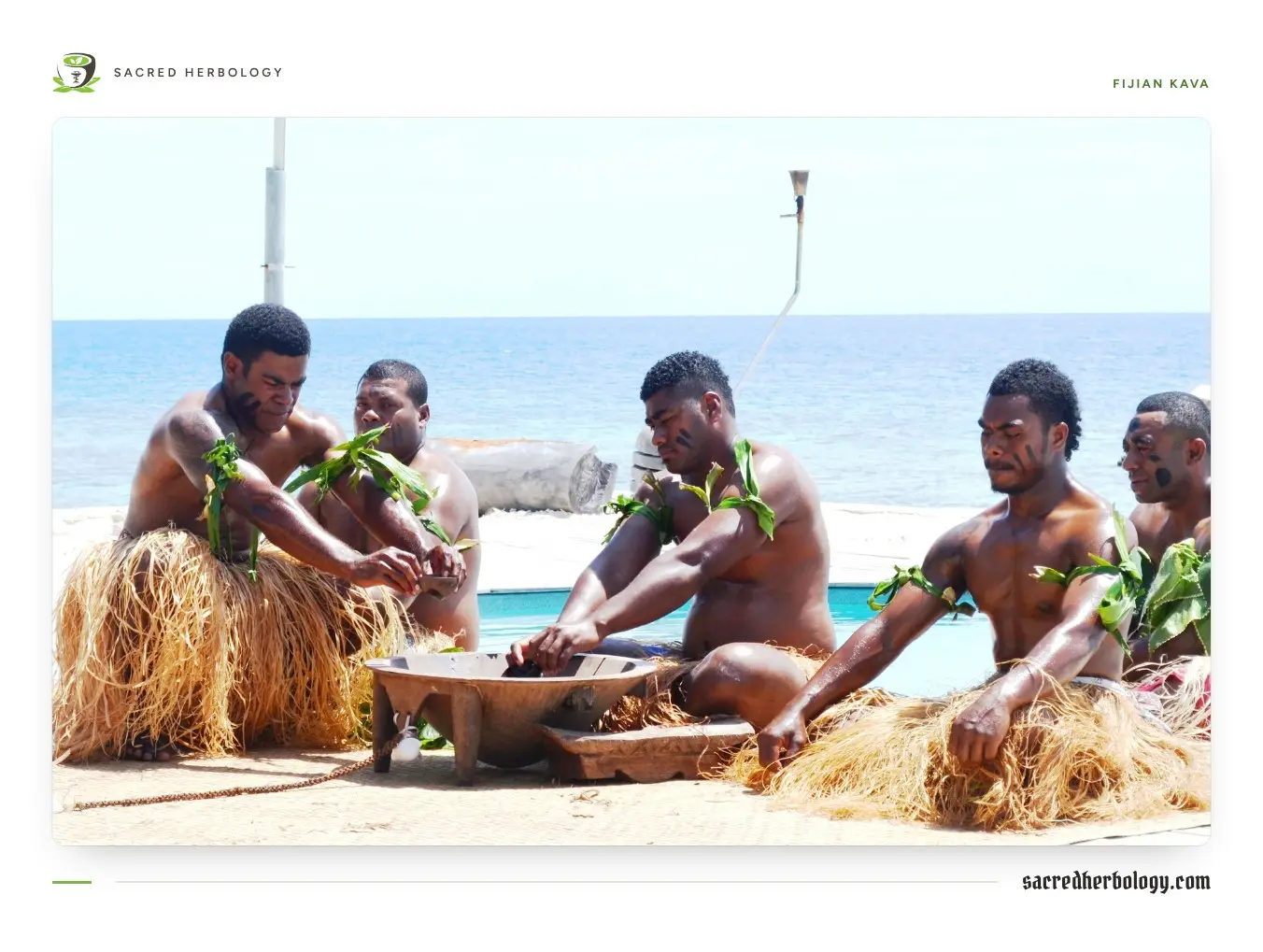
Before the nineteenth century, across most of Polynesia, kava root was prepared by chewing. Young people with clean, sound teeth, often young unmarried women and sometimes boys or young men, chewed pieces of the fresh or dried root and spat the pulp into the bowl. Water was then added and the mass worked by hand, and the fibres were gathered out with a strainer of plant fibre. Every European journal of the period mentions it, usually with a wrinkled nose.
Cook was more tolerant than many of his officers and accepted kava on his earlier visits, but on Tongatapu in 1777, as J. C. Beaglehole tells it in his biography of Cook, he had seen enough of the chewing and handed the cup to Mai. John Webber, the artist on that voyage, drew Paulaho, the Tu’i Tonga, at his kava on the same visit, and the engraving at the head of this piece comes from his drawing: the long circle of Tongan nobles under the great roof, and the bowl at the far end.
The chewing method lasted into the nineteenth century and then gave way, under pressure from missionaries and colonial health officers, to pounding the root between stones or grating it, and later to grinding it. In parts of Vanuatu chewing survived much longer. Lamont Lindstrom, who has worked on Tanna for decades, describes young men and boys there preparing the root for the evening drinking. Today almost all kava in Fiji, Tonga and Samoa begins as pounded or ground dried root.
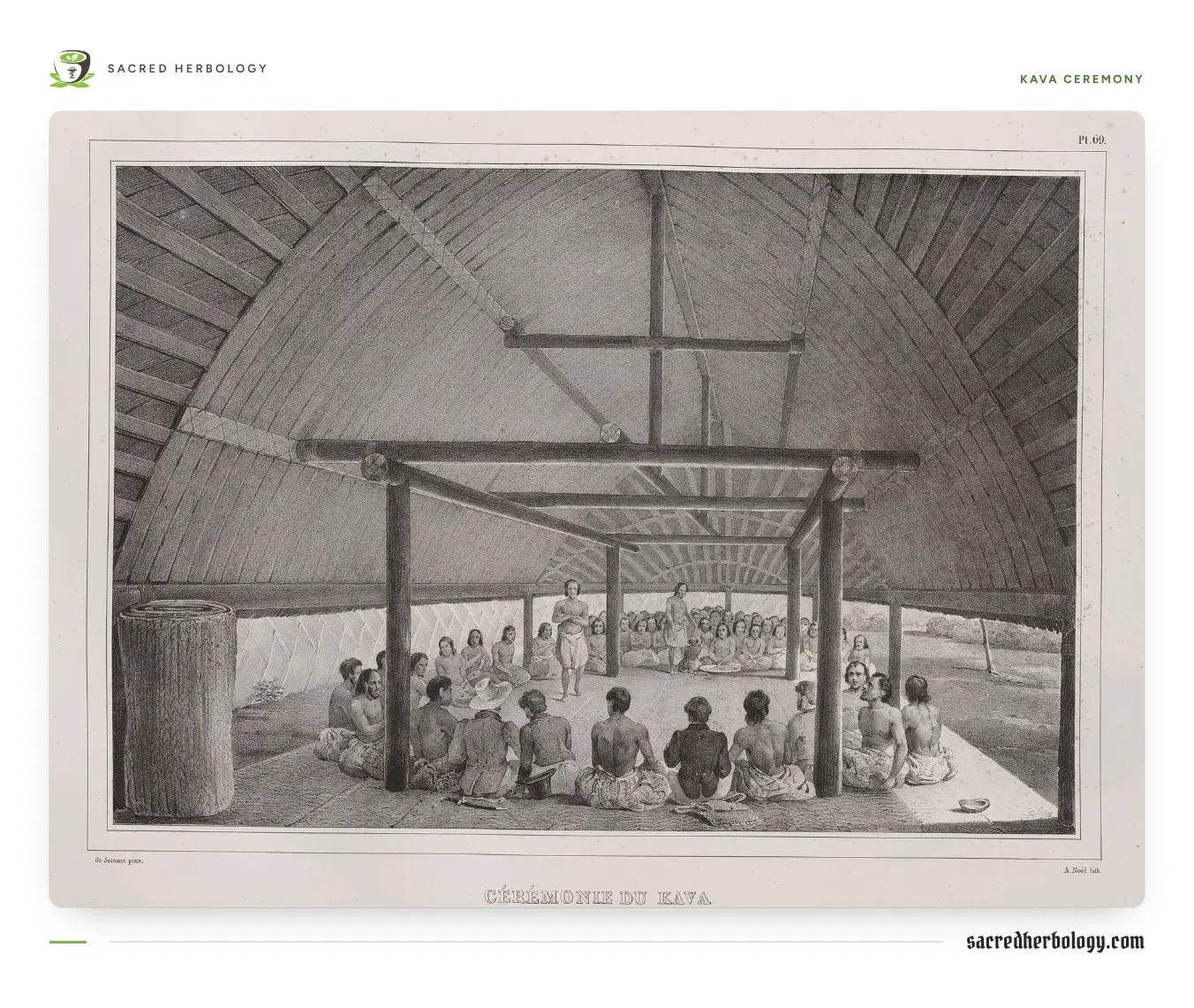

I am describing what people did, as the historical record shows it. None of this is a guide to making anything.
A girl’s grave on ‘Eueiki
Every kava island has its stories of where the plant came from. The best known in Tonga is the story of Kava’onau, and it is worth telling carefully, because Tongans themselves have told it in several versions and treat it with respect.
On the small island of ‘Eueiki there lived an old couple, Fevanga and Fefafa, and their only daughter, Kava’onau, who suffered from leprosy. A time of famine came. One day a great chief landed on the island. In most tellings he is the Tu’i Tonga, the sacred king of Tonga, and many scholars identify him as the tenth holder of that title, Momo. The old couple had nothing to offer him. There was a single kape plant, the giant taro (Alocasia macrorrhizos), and he had leaned against it, so it was forbidden to them. In their shame they killed their daughter, baked her in the earth oven, and offered her as food.
The chief understood what had been done and would not eat. He told them to bury the girl. From her grave two plants grew: kava from her head and sugarcane from her feet. A rat came and chewed the kava and staggered about; then it chewed the sugarcane and recovered. The couple saw this, and the plants were taken to the court, where a chief named Lō’au laid down the rules of the ceremony that would be held in the Tu’i Tonga’s presence ever after.
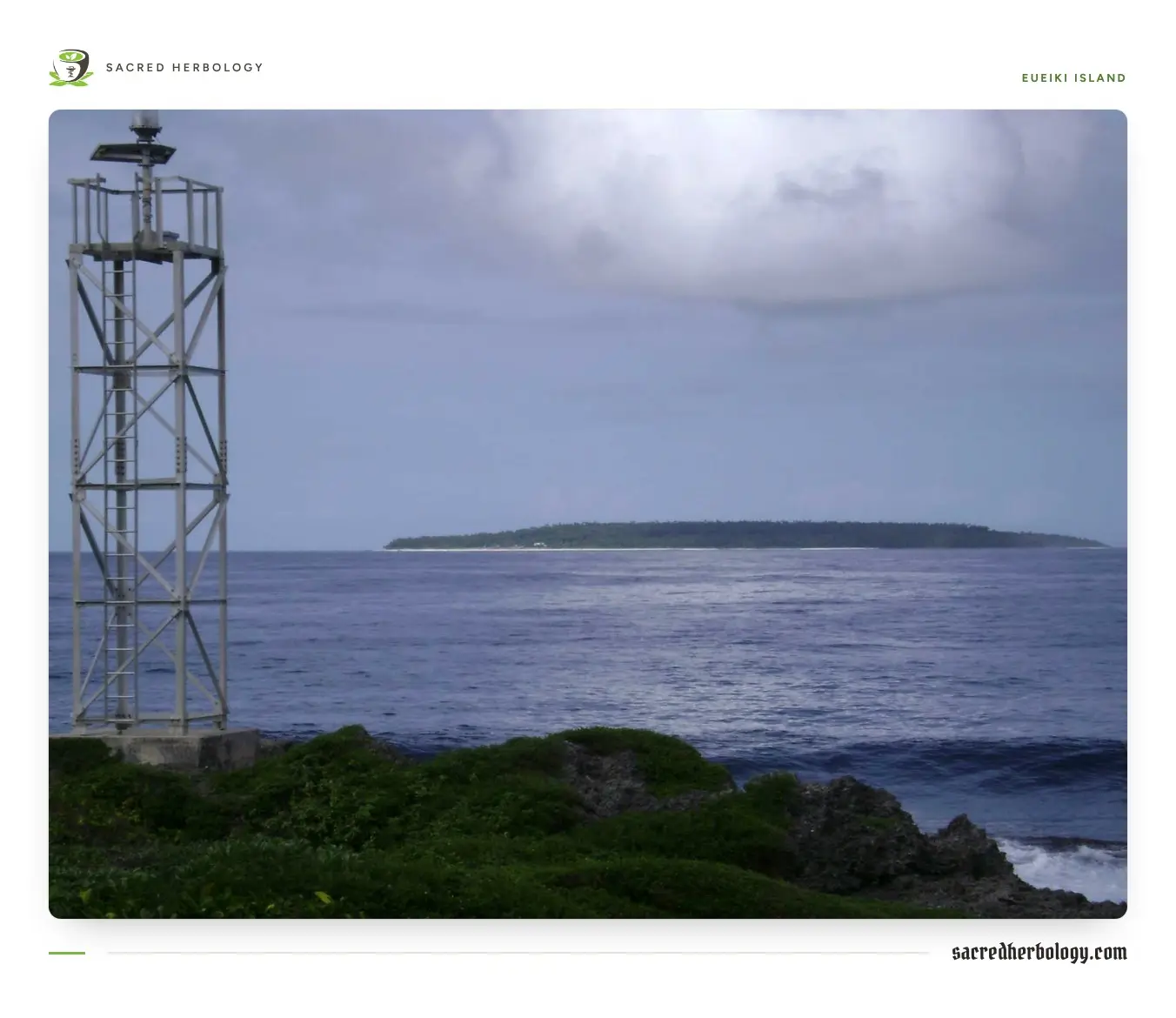

That is why, in the formal Tongan kava, a piece of food is served with the drink, and in the older practice it was sugarcane. The bitter and the sweet go together, as they grew together from Kava’onau’s grave.
Scholars have read the story from several directions. In 1991 the anthropologist Aletta Biersack published “Kava’onau and the Tongan chiefs” in the Journal of the Polynesian Society, reading it as a statement of Tongan political order, of the sacred chief and the people who feed him. In 2020, Arcia Tecun, Robert Reeves and Marlena Wolfgramm took it up again in the same journal, in “The past before us: a brief history of Tongan kava”, alongside a kava chant and the history of the Tongan kava clubs. Edward Winslow Gifford collected Tongan versions in the 1920s, published in Tongan Myths and Tales (1924) and Tongan Society (1929). The story belongs to Tongans, and I have kept to the outline that is already in print.
There is a second Tongan story in which kava stands at the very foundation of the kingship. ‘Aho’eitu, the first Tu’i Tonga, was the son of a Tongan woman and the sky god Tangaloa ‘Eitumātupu’a. When he went up to visit his father, his jealous half-brothers in the sky killed him and ate him. Tangaloa made them vomit his remains into a kava bowl, and from it ‘Aho’eitu was brought back to life and sent down to rule Tonga. The brothers who had wronged him were given roles in his service. Kava, in this telling, is part of how kingship itself comes into being.
These are sacred narratives of the Tongan people. I give them as stories that Tongans tell, and make no claim on their behalf about what happened.
The royal kava of Tonga
Tonga’s highest ceremony is the taumafa kava, the royal kava, held when a new monarch is installed and at a few other great occasions. Accounts of it go back to the first European visitors and run through to the installations of King George Tupou V in 2008 and King Tupou VI in 2015.
The ceremony takes place in a great oval called the ‘alofi. At its head, the ‘olovaha, sits the king. On either side of him sit his senior matāpule, the ceremonial attendants and spokesmen who direct the proceedings and speak on his behalf. Along the two long sides of the oval sit the nobles and chiefs, each in a place fixed by title and lineage. At the far end, facing the king, sits the person who mixes the kava with the great bowl in front of him. Behind the bowl, outside the circle proper, sit the tou’a, the people who work the kava and serve the cups, along with others who attend.
The kava is mixed in public. The root is brought in, the speakers call out each stage, the mixer works the root in water, and when it is ready the cups are filled and carried, one by one, to the person named. Food, often whole baked pigs and baskets of yams, has been presented and counted before the drinking begins. The calling of names is the heart of it. When the herald calls a title, everyone hears who is being honoured and in what order. Over the centuries the seating and the order of the cups have been the place where Tongan rank was set out for all to see, and on occasion where it was contested.
Seen from above, as in the plan below, it is the oval of the ‘alofi, the king at the head, the matāpule beside him, the nobles along the sides, the bowl and mixer at the foot, and the tou’a behind. It is one of the clearest pictures you could make of a society arranging itself.
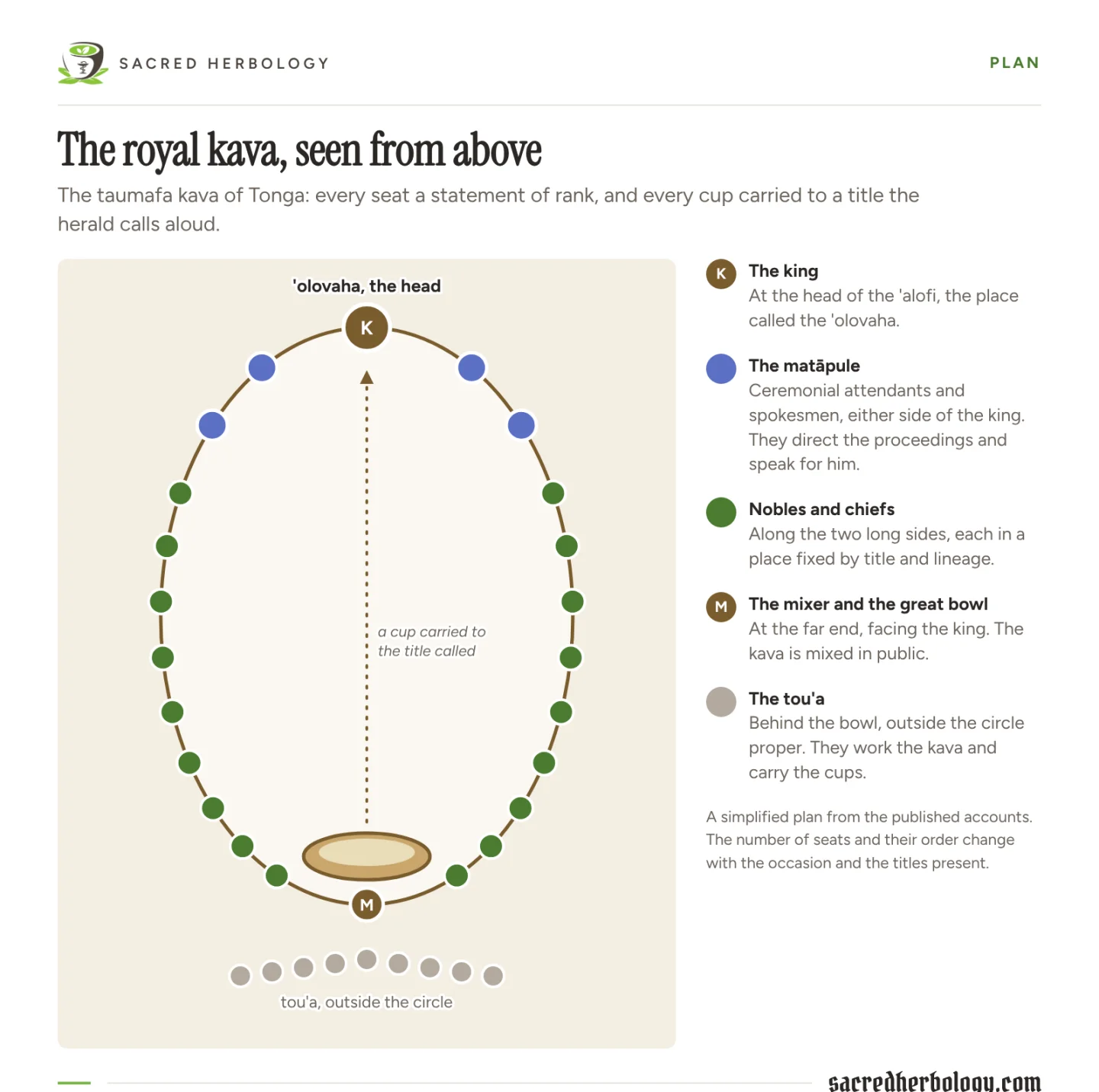
Kava also marked the line between the old sacred kingship of the Tu’i Tonga and the later royal line of the Tu’i Kanokupolu, from which the present monarchy descends. Tongan historians have written about how the two lines held their ceremonies differently, including which way the king faced. The ceremony was a living thing, adjusted as power shifted.
William Mariner’s Tonga
The richest early European account of Tongan kava came from an English teenager who had no intention of going there. In 1806 the privateer Port-au-Prince was taken at Lifuka in the Ha’apai group, and most of her crew were killed. A fifteen-year-old named William Mariner was spared and taken under the protection of the chief Finau ‘Ulukālala. He lived in Tonga for four years, learned the language well and took part in court life, kava circles included.
When Mariner got home, the physician John Martin worked with him to produce An Account of the Natives of the Tonga Islands, published in London in 1817. It describes the kava circle again and again, at war councils, after funerals, at ordinary evenings with the chief. Mariner notes how the root was presented, how it was prepared, who sat where and how cups were called, and he records the speeches and arguments that went on as people drank. For historians of Tonga the book remains a major source, read with care since it passed through Martin’s hand, and for anyone interested in kava it is the first long view of the drink in daily political use, through the eyes of someone who lived inside the circle.
Samoa: the bowl on many legs
In Samoa the drink is ‘ava, and the ‘ava ceremony opens the formal meetings of matai, the chiefs who hold family titles, as well as welcomes for visitors, the conferring of titles and many other occasions.
The bowl is the tānoa, carved from a single block of hardwood with a shallow round basin standing on many short legs. Older Samoan bowls can have a dozen or more legs, and they are among the loveliest objects in the whole subject. The drink is worked in the bowl with a fau, a strainer made from the inner bark fibres of Hibiscus tiliaceus, the beach hibiscus (some botanists now call it Talipariti tiliaceum), which gathers up the solid matter and is wrung out with a deft flick.
At the bowl sits the taupou, traditionally a young woman of high rank who holds a ceremonial office for her village, or in some settings a young man of similar standing, who prepares and serves the drink. A tulafale, an orator chief, calls the cups. He announces each recipient in turn, and the fa’alupega, the formal set of honorifics belonging to the village and its titles, decides the order. Each person, on receiving the cup, may pour a little on the ground or flick a few drops before drinking, with a short formal speech. Samoan scholars have written about this libation as an offering to the dead and to the old powers of the land, carried on in Christian Samoa as a mark of respect.
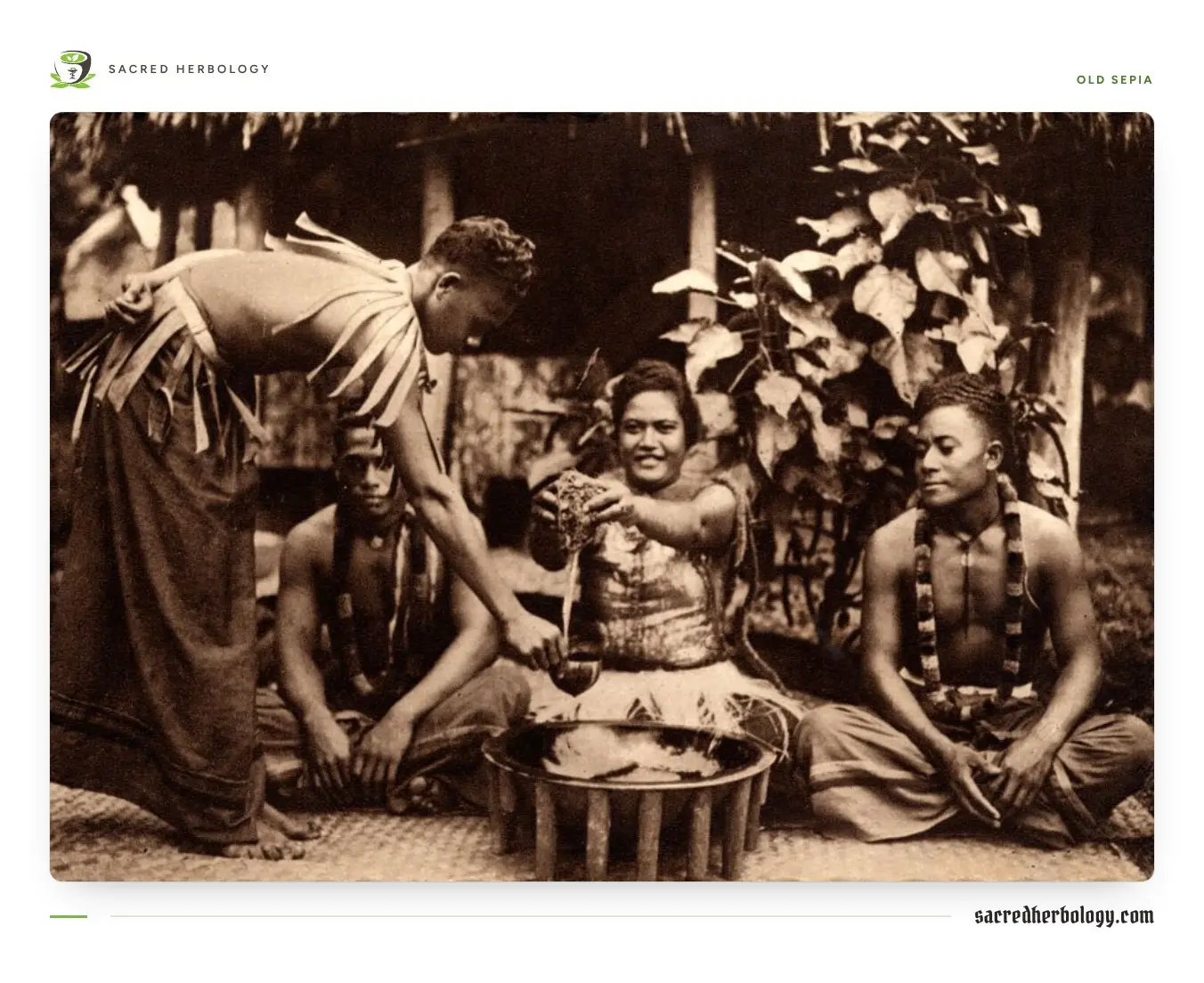

The ‘ava ceremony comes in many forms, from the full ‘ava ceremony of a chiefly council to the ‘ava served at a church dedication or a parliamentary opening. Samoan communities in Auckland, Sydney, Brisbane and Los Angeles hold it too, at weddings, funerals and title bestowals. The tānoa travels with them.
Fiji: yaqona and the sevusevu
Many Australians meet kava first in Fiji, and almost always through the sevusevu. A visitor arriving at a Fijian village, whether a tourist or a returning relative, brings a bundle of dried yaqona roots. These are presented to the chief or the chief’s representative, and a spokesman, often the mata ni vanua (literally the “eye of the land”, the herald), accepts them with a formal speech asking for the visitor’s welcome and wellbeing. Once the offering has been accepted, the visitor is under the village’s care. The roots will later be prepared and drunk.
The Fijian bowl is the tanoa, wide and shallow, on four or more legs, and often fitted with a cord of coconut fibre decorated with cowrie shells running out from one side. In chiefly ceremonies the cord is laid to point towards the chief, and nobody steps over it. Set beside a Samoan tānoa, the Fijian bowl is plainly the same family of object, made by different hands.
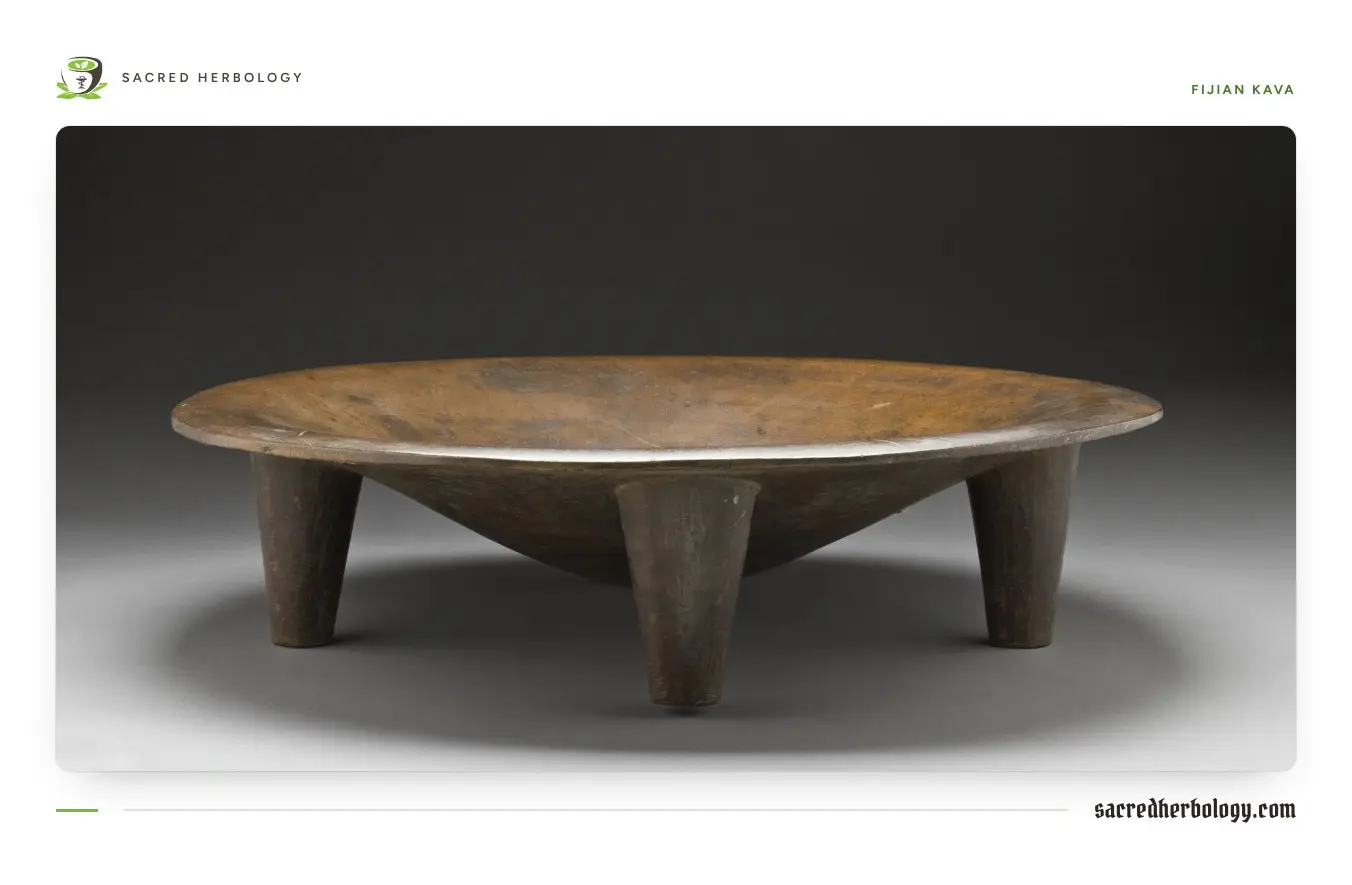

The drinking itself has a rhythm that visitors remember. You clap once with cupped hands, take the bilo, a half coconut shell, and drink. Those around you clap, people say “maca” (pronounced roughly “matha”), meaning it is empty, and the shell goes back to the server. The talk afterwards, which can go on late into the night, is called talanoa, and much of village business is done there.
Beyond the everyday sevusevu sits the yaqona vakaturaga, the chiefly kava ceremony, held at the installation of high chiefs and to welcome dignitaries. It is formal and largely silent, with the cups carried by men in ceremonial dress and the order of service fixed in advance. Installations of the great chiefly titles of Fiji, such as the Tui Nayau of Lau, include it alongside the presentation of tabua, polished whale’s teeth, the most valued of Fijian ceremonial gifts.
In the Lau Islands of eastern Fiji, closest to Tonga, the kava ceremony shows the mark of centuries of contact between the two peoples: shared titles, intermarried chiefly families and borrowed customs. A. M. Hocart’s Lau Islands, Fiji, published by the Bishop Museum in 1929, records the kava ritual there in detail and is still read. Later anthropologists have argued that the standard sevusevu visitors meet today has itself been shaped by the colonial period, which is a reminder that tradition is always alive and always changing.
Pohnpei: the stone and the rhythm
North of the equator, in Micronesia, kava reached the high islands of Pohnpei and Kosrae. On Pohnpei the drink is sakau, and it is still at the centre of every formal occasion: title ceremonies, funerals, weddings, apologies and welcomes.
The preparation is done publicly in the nahs, an open-sided feast house, on a flat basalt stone called the peitehl. Several men sit around the stone and pound the root with smaller hand-stones, striking in a shared rhythm that carries a long way on a still evening. The pounded mass is wrapped in strips of hibiscus bark, wetted, and wrung out by hand into a coconut shell. The first cups go in a set sequence, the first to the highest titleholder present, and the order is again a reading of rank.
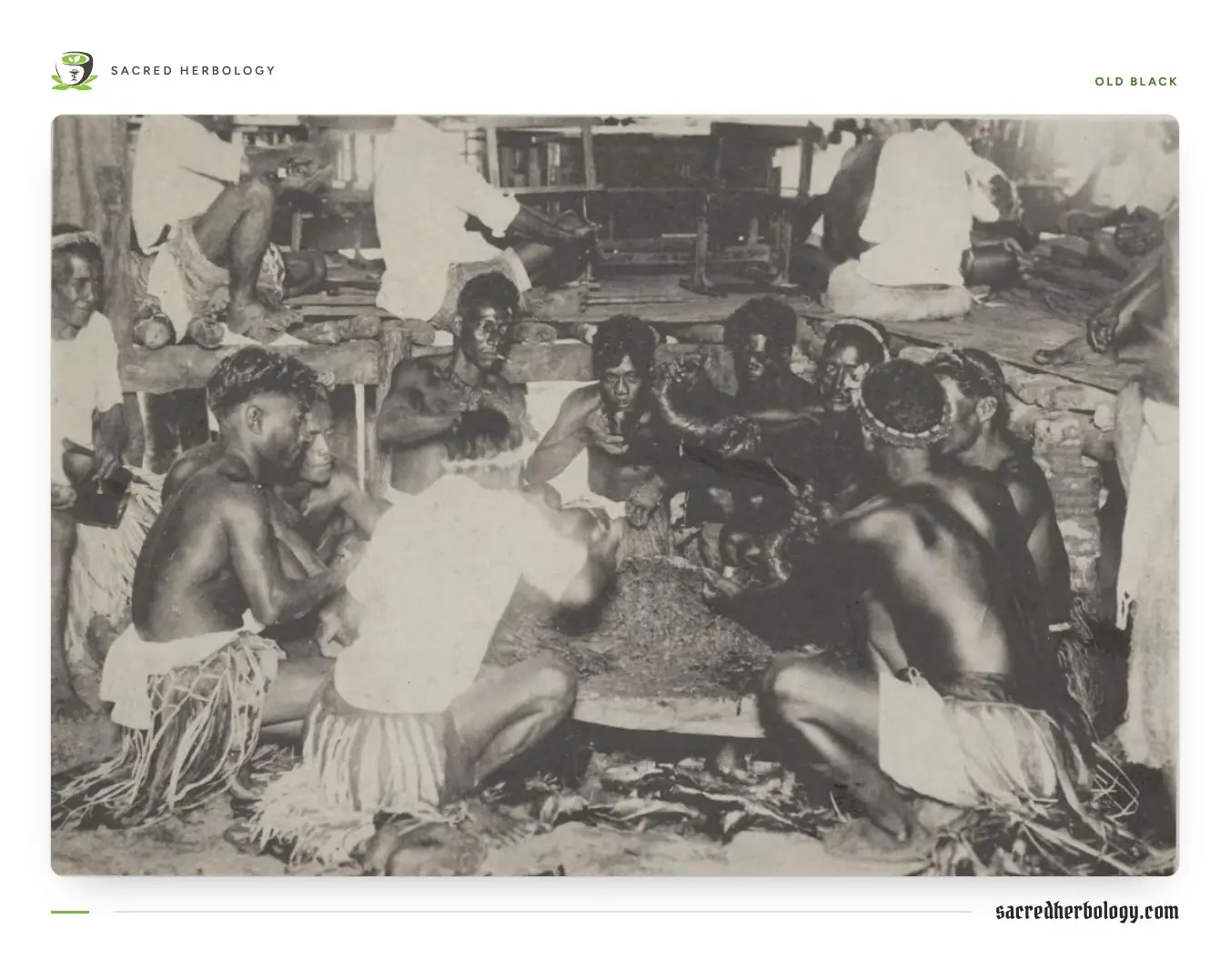

Pohnpeian oral history connects sakau with the Saudeleur, the rulers who governed the island from the great stone city of Nan Madol before the present system of paramount chiefs, the Nahnmwarki. Under the Saudeleur, by these accounts, the sakau ceremony and the tribute that went with it were part of how the rulers displayed their control. The ruins of Nan Madol, basalt columns stacked like logs on artificial islets off the east coast of Pohnpei, still stand.
Hawai’i and the eastern Pacific
Kava went all the way to the far edges of Polynesia. In Hawai’i it is ‘awa, and Hawaiians grew many named varieties. Margaret Titcomb, a librarian at the Bishop Museum in Honolulu, gathered what was known in a long study, “Kava in Hawaii”, published in the Journal of the Polynesian Society in 1948. She drew on the accounts of early visitors and residents and on Hawaiian chants and stories.
In the Hawaiian world, by those sources, ‘awa was offered to the gods, drunk by chiefs, used by priests in ritual and by healers in their work, and shared among ordinary people as well. It appears in prayers, in offerings of food and drink, and in many chants. The rise of Christian missions in the nineteenth century, together with the collapse of the old religious system after 1819, pushed it to the margins. In Tahiti, too, kava drinking faded through the nineteenth century under missionary pressure, to the point that it largely disappeared from daily life there.
In Hawai’i there has been a strong revival since the 1970s and 1980s, as part of a wider renewal of Hawaiian language and culture. Old Hawaiian varieties have been collected and replanted, and ‘awa is once again served at Hawaiian ceremonies. It is a good example of how a plant that depends entirely on human hands can come back from the edge as long as someone keeps the cuttings alive.
Vanuatu: the nakamal at dusk
Back in Vanuatu, where the story began, kava has a different texture. There is less of the royal court about it and more of the evening gathering. Villages have a nakamal, a clearing under a great banyan or a men’s house where men gather at dusk to drink, often in silence at first, and then to talk quietly as the light goes. Lamont Lindstrom’s work on Tanna, published over many years and gathered in his book Tanna Times: Islanders in the World (2020), describes kava there as the drink that marks the end of the working day and the passage into evening, tied up with exchange, politics and the custom ways of the island, which Ni-Vanuatu call kastom.
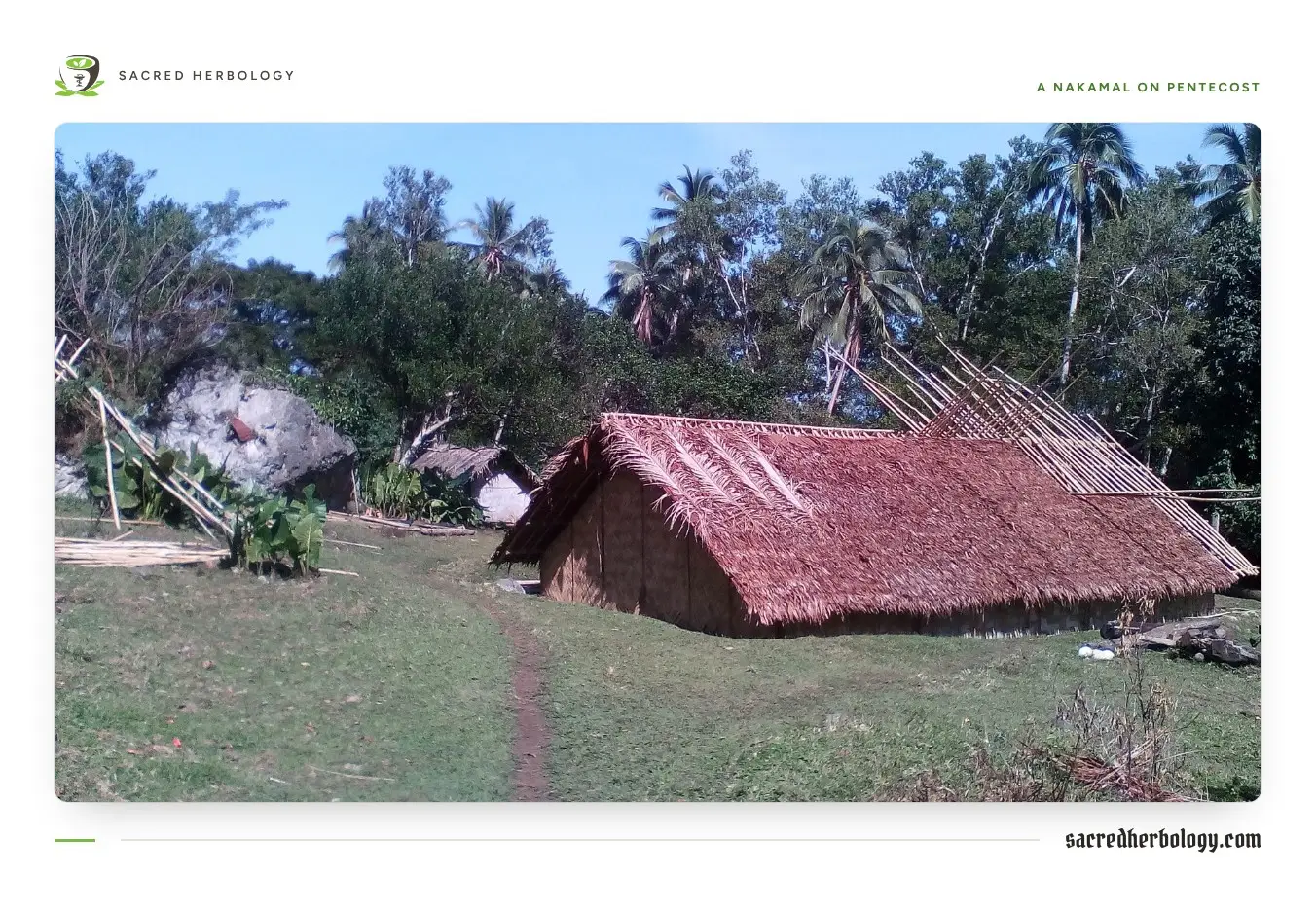

On Tanna and in many other places in Vanuatu, women have traditionally been kept away from the nakamal while men drink. That is changing in the towns, and kava bars in Port Vila and Luganville, which have spread since the 1980s, serve women too. The custom rules remain strong in many villages.
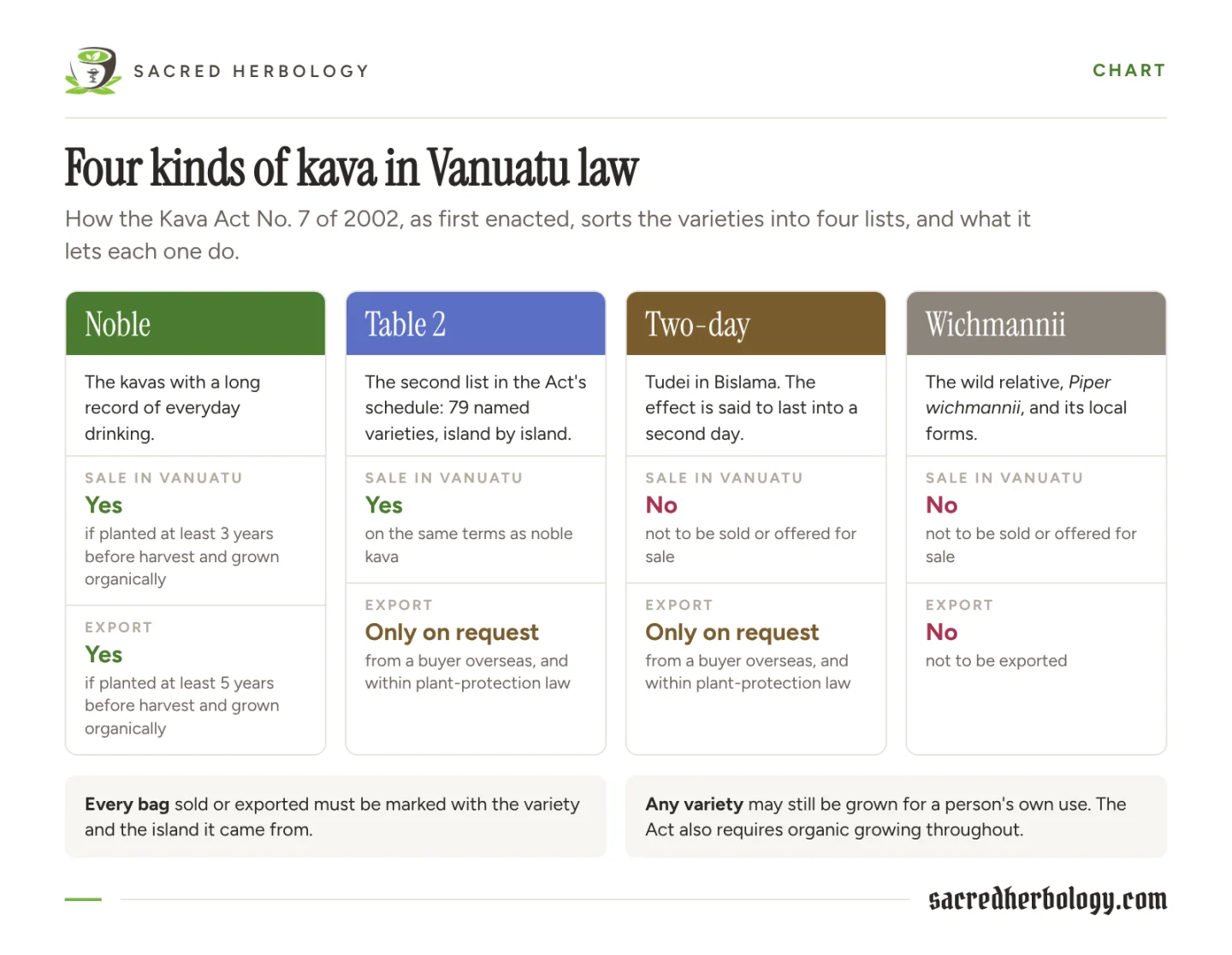
Vanuatu is also where kava became a national symbol and a national industry. After independence in 1980 it was promoted as a mark of Ni-Vanuatu identity, and it became one of the country’s most important exports. The Kava Act No. 7 of 2002 sorted varieties into groups. Noble kavas are the ones with a long record of everyday drinking. “Two-day” kavas, tudei in Bislama, are so called because their effect is said to last into a second day. The Act permits only noble varieties for ordinary export, with a narrow exception for medicinal and two-day kava ordered by a buyer overseas, and every bag must be marked with the variety and the island it came from. Behind that law is the same hand-carried plant: because every kava is a clone, a variety keeps its character from cutting to cutting, and growers can know exactly what they are planting.
The chart below sets the four groups in the Act side by side, noble, the Act’s second list (which it calls medicinal), two-day and wild, with what the law allows for each.
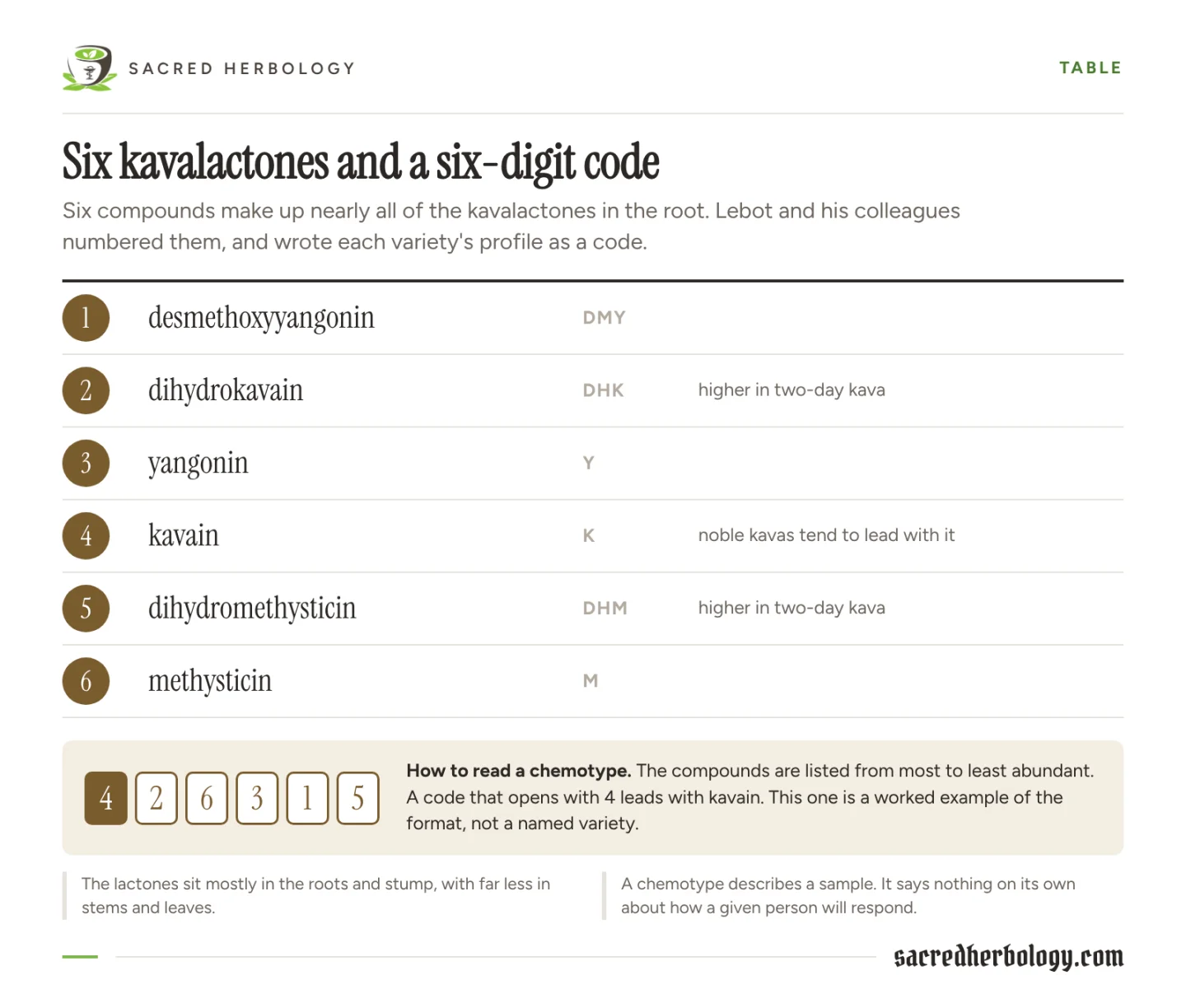
The chemists have their own account of why those groups differ. The substances in the root that drinkers notice belong to a family of compounds called kavalactones. Six of them make up nearly all of the total: kavain, dihydrokavain, methysticin, dihydromethysticin, yangonin and desmethoxyyangonin. Every variety carries the six in its own proportions, and since every plant is a clone, the proportions stay fixed from cutting to cutting. Lebot and his colleagues gave each compound a number from one to six and wrote a variety’s profile as a six-digit code, the most abundant compound first. They call that profile a chemotype. Noble kavas tend to lead with kavain, while two-day kavas run higher in dihydrokavain and dihydromethysticin, and Lebot links that difference to the heavier, longer effect drinkers report. The lactones sit mostly in the roots and stump, with far less in the stems and leaves. Two-day kava also carries more of a group of yellow compounds called flavokavains, which have been investigated as one possible factor in the liver reports described below. Nothing has settled that question.
This is where the drink meets the market. Dried two-day root looks much like dried noble root, and stump, peelings and basal stem look much like the better grades once they are chipped or powdered. Mixing cheaper material into a bag of noble kava has been a recognised problem in the export trade, and it is the reason Vanuatu’s law and the Australian food standard both name noble varieties. Laboratories now test kava for its chemical profile to tell the groups apart. A chemotype or a test result tells you what a sample contains. It says nothing on its own about how a given person will respond to the drink.
What it is like, as the sources describe it
Every European visitor tried to describe the effect, and the descriptions are fairly consistent. Drinkers report that the mouth and tongue go numb, that a quiet and sociable calm comes on, and that the mind stays clear. In larger amounts people become drowsy and heavy-limbed. The early German pharmacologists were fascinated by it. Louis Lewin, the Berlin pharmacologist who wrote a monograph on kava in 1886, gave it a place in his famous survey of mind-altering plants, Phantastica (1924), where he contrasted the quiet of the kava drinker with the noise of the alcohol drinker.
The Pacific sources put the matter in social terms. Kava is the drink you share when people need to agree, or apologise, or welcome, or mourn. The quiet is part of the point. A Fijian village meeting held over yaqona has a different tone from a pub, and people who have sat in both will tell you so.
Safety, and the European withdrawal
Kava has real effects on the body, and its history includes a serious safety episode. In the 1990s concentrated kava extracts, made with acetone or alcohol and sold in tablet and capsule form, became big sellers in Germany and elsewhere in Europe. Around 2000 and 2001 reports of liver injury began to appear, some of them severe. In 2002 Germany’s medicines regulator withdrew kava products from sale, and several other countries followed. The causes were debated for years, and in 2014 a German administrative court set the withdrawal aside. Possible factors raised in the literature include the use of the wrong plant parts, such as stem peelings and leaves, which some exporters had sold to European manufacturers, the use of non-noble varieties, the extraction methods, and the individual susceptibility of some people. Water preparations of noble root, the way the Pacific has always drunk it, have a much better record, though not a spotless one.
Heavy, daily drinking over months is also associated with a dry, scaly skin condition known as kava dermopathy, which usually clears when drinking stops. Kava should not be mixed with alcohol or with medicines that cause drowsiness, it should not come before driving or operating machinery, and it is not for pregnancy, breastfeeding, children or anyone with liver disease. If you take prescribed medicines and are thinking about kava, consult a degree-qualified herbalist with competencies and adequate training in pharmacognosy. If anyone becomes unwell after drinking it, call 000 or the Poisons Information Centre on 13 11 26.
Those are the plain facts of the record. They sit beside three thousand years of shared bowls, and both belong in an honest history.
Kava comes to Australia
Australia has its own kava story, and it is more tangled than most people realise. Three strands run through it: Pacific Islander communities, Aboriginal communities in Arnhem Land, and Commonwealth import law. The timeline below runs from the first Pacific families to the present.
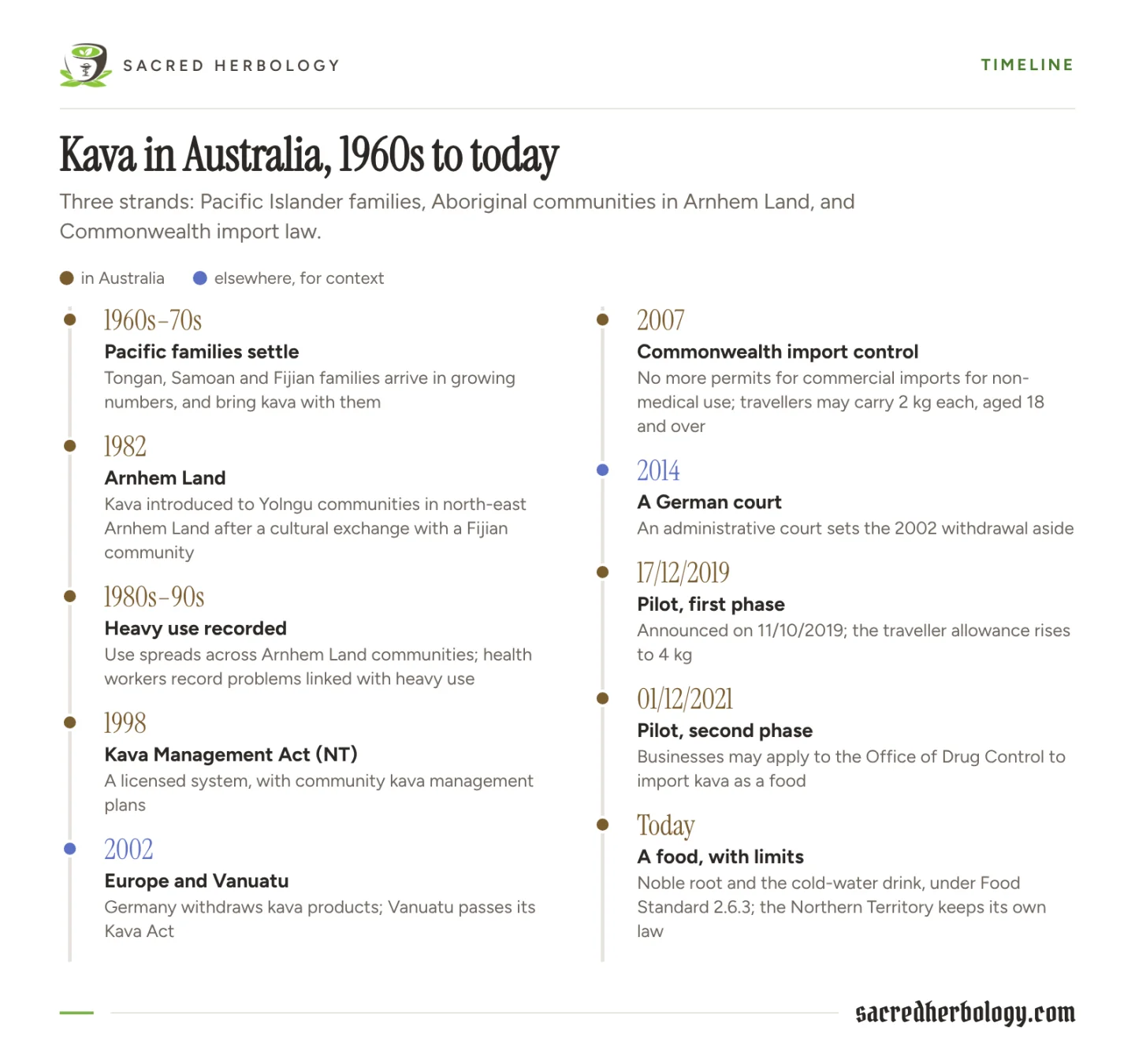
The first strand is the Pacific diaspora. Tongan, Samoan and Fijian families have lived in Australia in growing numbers since the 1960s and 1970s, concentrated in Sydney, Brisbane, Melbourne and their suburbs, and more recently across regional Australia through seasonal work schemes. They brought kava with them. Kava circles meet in church halls and backyards, and Tongan kalapu, kava clubs, hold their regular gatherings of music and talk here as they do in Nuku’alofa and Auckland. For many families kava is how a wedding, a funeral or a visit from the islands is marked properly, and they kept it going through years when it was hard to get.
The second strand begins in 1982. In that year kava was introduced to Yolngu communities in north-east Arnhem Land, in the Northern Territory, following a cultural exchange with a Fijian community. Its supporters hoped it could offer a quieter alternative to alcohol. Through the 1980s and 1990s its use spread across a number of Arnhem Land communities, often in quantities far beyond anything usual in the Pacific, and supplied through a profitable trade. Health workers and researchers recorded weight loss, skin changes and other problems linked with heavy use, and the Northern Territory moved to control it.
The Kava Management Act 1998 (NT) made it an offence to possess more than a small quantity of kava outside a licensed system, and set up a scheme under which communities could develop kava management plans with licensed retailers. The Act remains in force, and the Territory still has its own rules separate from the rest of the country.
The third strand is Commonwealth import control. In 2007, against a background of concern about kava in Aboriginal communities, the Commonwealth stopped issuing permits for commercial imports of kava for non-medical use. From then on, kava could come into Australia only in travellers’ luggage, with a limit of two kilograms per person aged 18 and over. That limit shaped Pacific community life in Australia for more than a decade. Every visitor coming back from Suva or Nuku’alofa brought kava, and much of it was shared out among relatives and church groups.
Pacific governments and Pacific Australians pressed for a change for years. On 11 October 2019 the Prime Minister announced a pilot program, and from 17 December 2019 the personal allowance for incoming passengers rose to four kilograms. The second phase of the pilot started on 1 December 2021. Under it, businesses can apply to the Office of Drug Control for permission to import kava commercially, as a food, under new provisions in the Customs (Prohibited Imports) Regulations 1956. The permitted products are defined in Standard 2.6.3 of the Australia New Zealand Food Standards Code: dried or raw root of a noble variety, and the drink made from it with cold water. The traveller allowance and the commercial pathway both stop at the Northern Territory border, where the Territory’s own law applies.
So kava in Australia today is a food, legally imported from Fiji, Vanuatu, Tonga and Samoa, subject to the food code and import permits, with the Northern Territory’s separate controls still in place. Medicines containing kava are regulated separately again, under therapeutic goods law. Live plants and cuttings are another matter from dried root: bringing them into Australia falls under federal biosecurity import conditions. Because kava sets no seed, it does not escape into the bush the way so many tropical garden plants have, and it is not a declared weed anywhere in Australia. It is one plant, and Australian law handles it under three or four different regimes depending on what it is sold as and where.
How to behave at the bowl
If you are ever invited to a kava circle, in the islands or in an Australian suburb, the published guides and the people who run them agree on a handful of courtesies.
- Wait to be served, and let the person who invited you show you where to sit.
- Dress modestly. In Fiji and Samoa that usually means covering your shoulders and knees, and wearing a sulu or lavalava if one is offered.
- Sit cross-legged, never with your feet pointing at the bowl or the chief, and never step over the bowl or its cord.
- When the cup comes to you, follow what those before you did: the clap, the words, the drinking.
- Ask before taking photographs. Some ceremonies are not for cameras at all.
- Bring a sevusevu if you are visiting a Fijian village. Your host will tell you what is suitable.
These are courtesies, and the best teachers are Pacific people themselves. Many community groups are generous with visitors who turn up with respect and a willingness to listen.
Why the kings drank it
Go back to that circle on Tongatapu in 1777. The drink in the leaf cups was the root of a plant that had been carried by hand across a third of the Pacific, from the islands of northern Vanuatu where people first chose it, through Fiji to Tonga, and on to Samoa, Tahiti and Hawai’i. Every plant of it was a cutting of a cutting. Every cup was called by name and carried to a seat that showed who that person was.
That is why kava became the drink of chiefs and kings. It was the drink in which rank was declared, welcome was given, agreements were sealed and the dead were honoured. The Tongan story says it grew from the grave of a girl given up to feed a king, and that the bitter root and the sweet cane came up together. Tongans still serve them together. The kings who sat at the head of the circle drank first, and everyone in the circle saw them do it.
The bowl has travelled again since then, to Auckland, Los Angeles and Brisbane, and to a church hall near you. The plant still cannot plant itself. Someone always has to carry it.

Where this comes from
- Vincent Lebot, Mark Merlin and Lamont Lindstrom, Kava: The Pacific Drug (Yale University Press, 1992); reissued as Kava: The Pacific Elixir (Healing Arts Press, 1997).
- Georg Forster, De plantis esculentis insularum oceani australis (Berlin, 1786).
- Georg Forster, A Voyage Round the World (London, 1777).
- Johann Reinhold Forster, Observations Made During a Voyage Round the World (London, 1778).
- J. C. Beaglehole, The Life of Captain James Cook (Hakluyt Society and A. & C. Black, 1974).
- John Martin, An Account of the Natives of the Tonga Islands, from the communications of William Mariner (London, 1817).
- Edward Winslow Gifford, Tongan Myths and Tales (Bernice P. Bishop Museum Bulletin 8, 1924) and Tongan Society (Bulletin 61, 1929).
- Aletta Biersack, “Kava’onau and the Tongan chiefs”, Journal of the Polynesian Society 100 (1991).
- Arcia Tecun, Robert Reeves and Marlena Wolfgramm, “The past before us: a brief history of Tongan kava”, Journal of the Polynesian Society 129 (2), 2020.
- A. M. Hocart, Lau Islands, Fiji (Bernice P. Bishop Museum Bulletin 62, 1929).
- Margaret Titcomb, “Kava in Hawaii”, Journal of the Polynesian Society 57 (2), 1948.
- John Lynch, “Potent roots and the origin of kava”, Oceanic Linguistics 41 (2), 2002.
- W. H. R. Rivers, The History of Melanesian Society (Cambridge University Press, 1914).
- Ron Brunton, The Abandoned Narcotic: Kava and Cultural Instability in Melanesia (Cambridge University Press, 1989).
- Lamont Lindstrom, Tanna Times: Islanders in the World (University of Hawai’i Press, 2020).
- Louis Lewin, Phantastica (Berlin, 1924; English translation 1931).
- Republic of Vanuatu, Kava Act No. 7 of 2002.
- Northern Territory, Kava Management Act 1998.
- Commonwealth of Australia, Customs (Prohibited Imports) Amendment (Commercial Importation of Kava as Food) Regulations 2021; Australia New Zealand Food Standards Code, Standard 2.6.3.