
Every few months someone sends me the same story. It usually arrives as a screenshot from a beer website or a list of “weird facts”, and it goes like this. Before the Germans brewed with hops, they brewed with henbane, a poisonous plant that made beer wild and visionary. The Czech city of Pilsen took its name from the henbane fields around it, so the world’s favourite pale lager is secretly named after a witch’s herb. Then in 1516 the Bavarian dukes passed the famous beer purity law to stamp the henbane out, and that is why German beer contains only barley, hops and water to this day.
It is a wonderful story. It has a poison, a pagan past, a stern law and a twist at the end that lets you say something surprising at the pub. Parts of it are true. Henbane did go into beer in parts of Europe, and people were warned against it. The rest of it falls apart the moment you look at a date, and the oldest part of the Pilsen claim is barely thirty years old.
So this piece does two jobs. It takes the Pilsner story apart, carefully, and shows you where each piece came from. Then it puts the real henbane back together: a plant found in a Roman bone jar, in the grave of a Viking-age seeress, in a bishop’s list of village sins, in the planetary tables of the magicians, in a travelling tooth-drawer’s bag of tricks and, in the end, in a London murder trial. It is a better story than the one on the beer coaster, and every part of it can be checked.
This is a Poison Path piece, so the house rule comes first and it stays in force all the way down. Grow it, don’t eat it.
Meet the plant
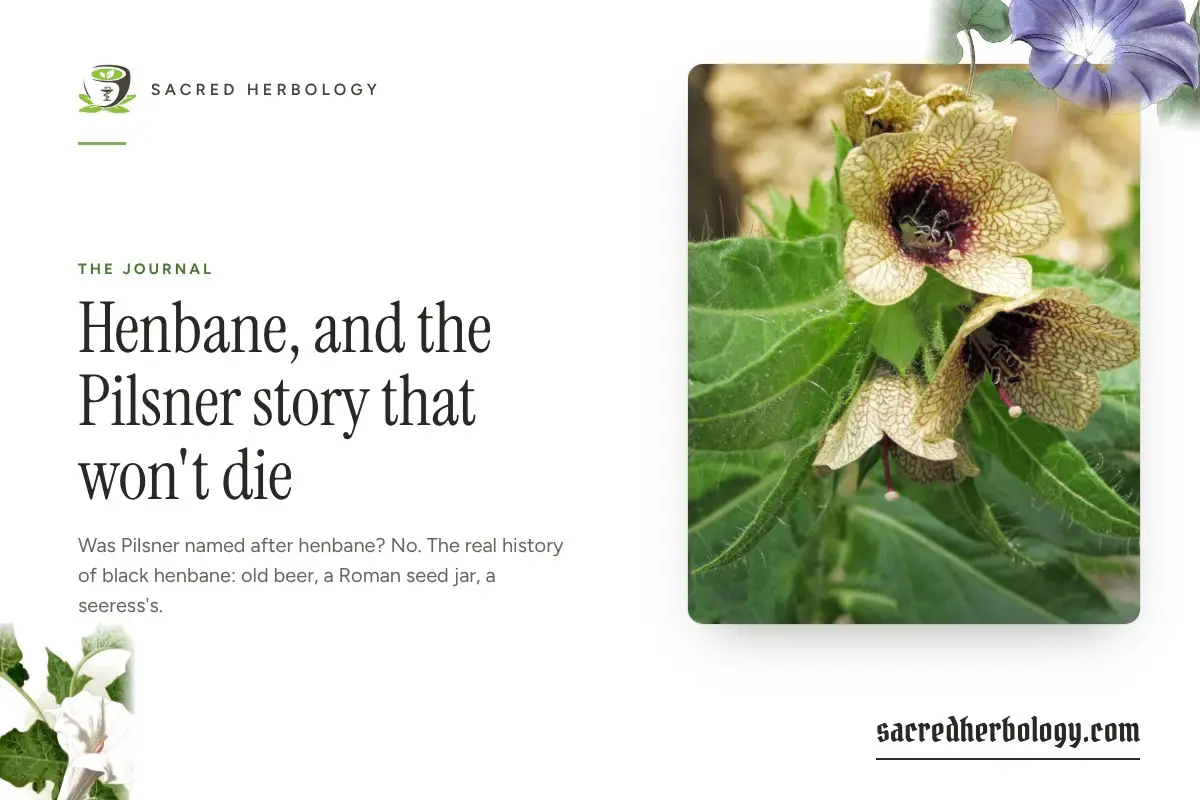
Henbane is Hyoscyamus niger, black henbane, a member of the nightshade family, the Solanaceae. Its cousins are the ones you would expect from a Poison Path piece, deadly nightshade, mandrake and datura, and the ones you might not, tomato, potato, chilli and tobacco. Henbane is native across Europe, North Africa and temperate Asia as far east as the Himalaya and China, and it has followed people around the temperate world as a weed of farmyards, rubbish heaps and disturbed ground.
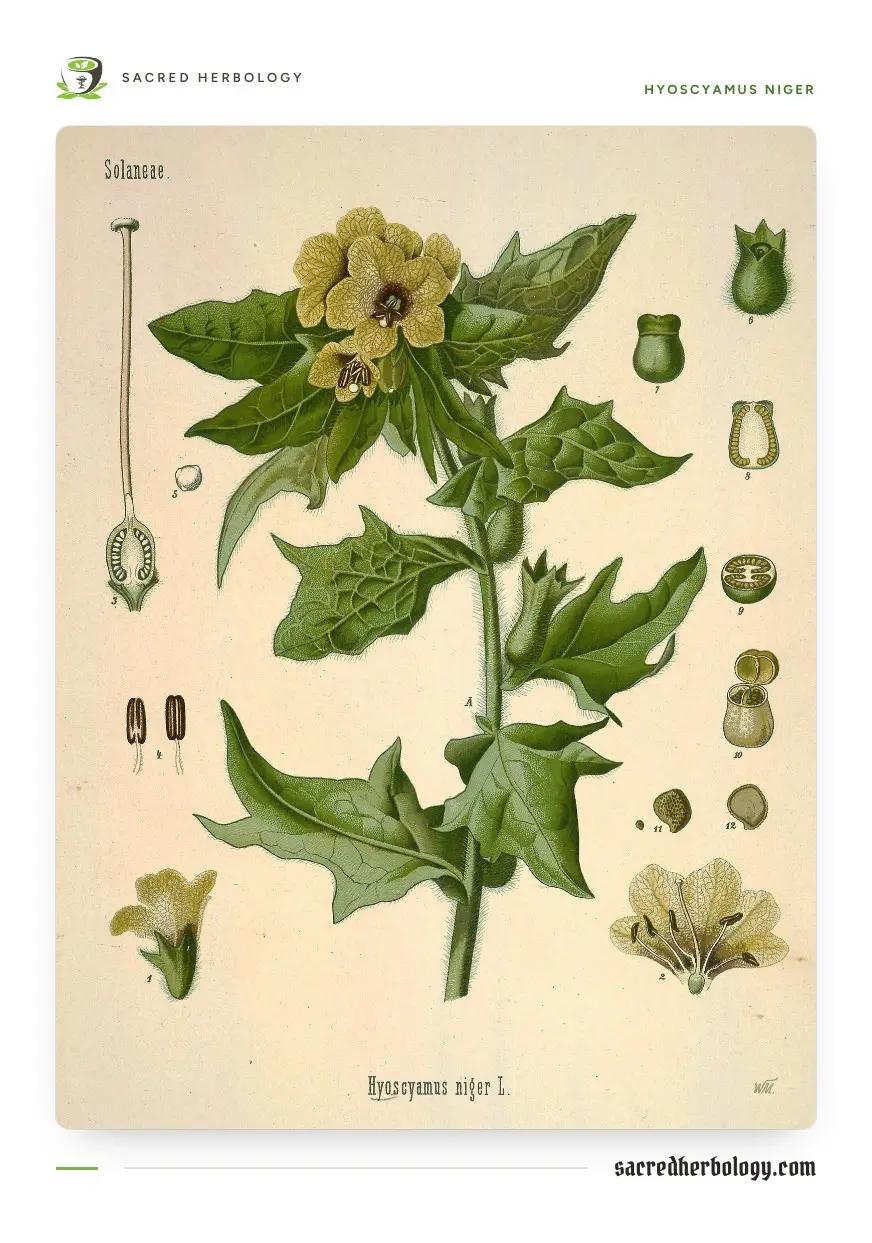
You smell it before you see it. The whole plant is covered in soft, sticky hairs, and when you brush past it gives off a heavy, rank smell that old writers compared to something rotting. The leaves are large, greyish-green and coarsely toothed, the lower ones on short stalks and the upper ones clasping the stem. Some plants flower in their first year and some take two, sending up a stout leafy stalk in their second summer.
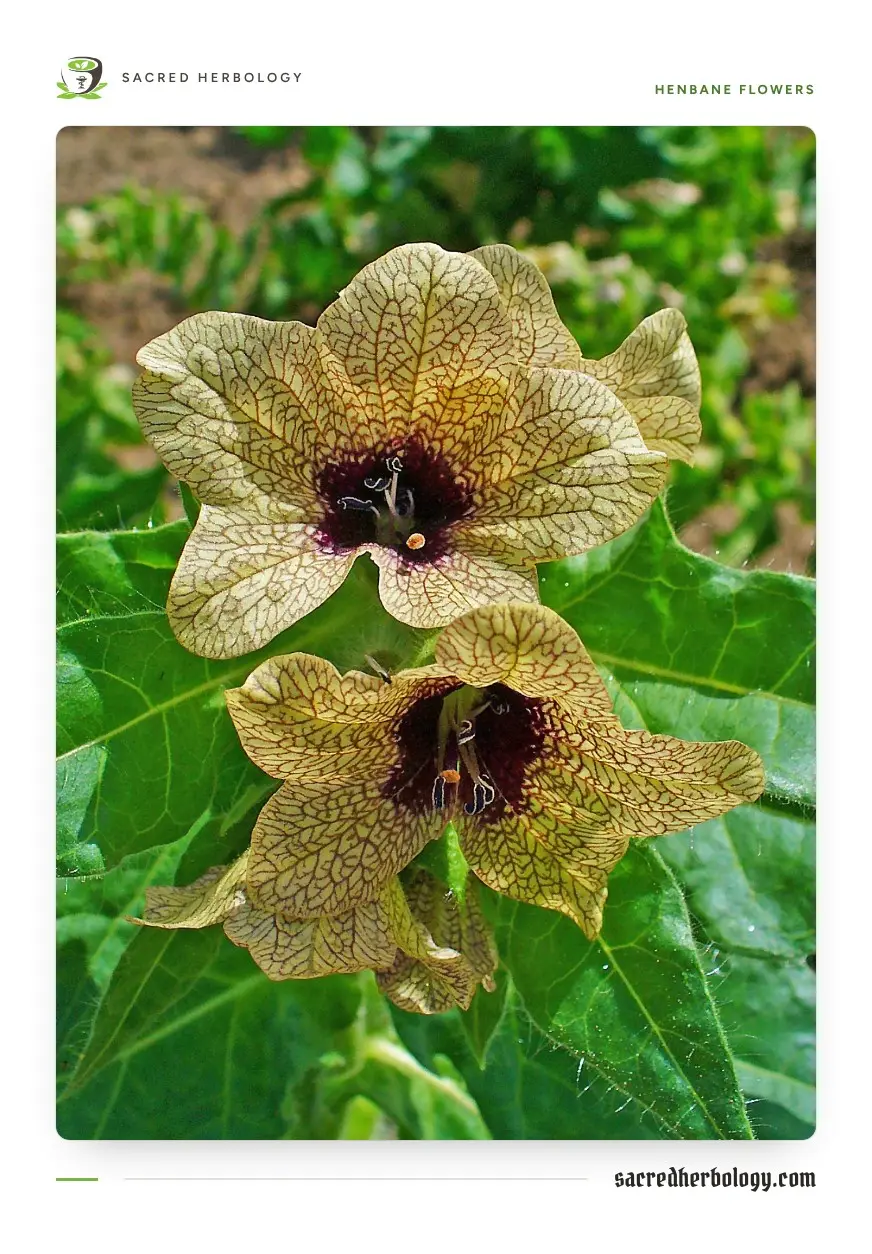
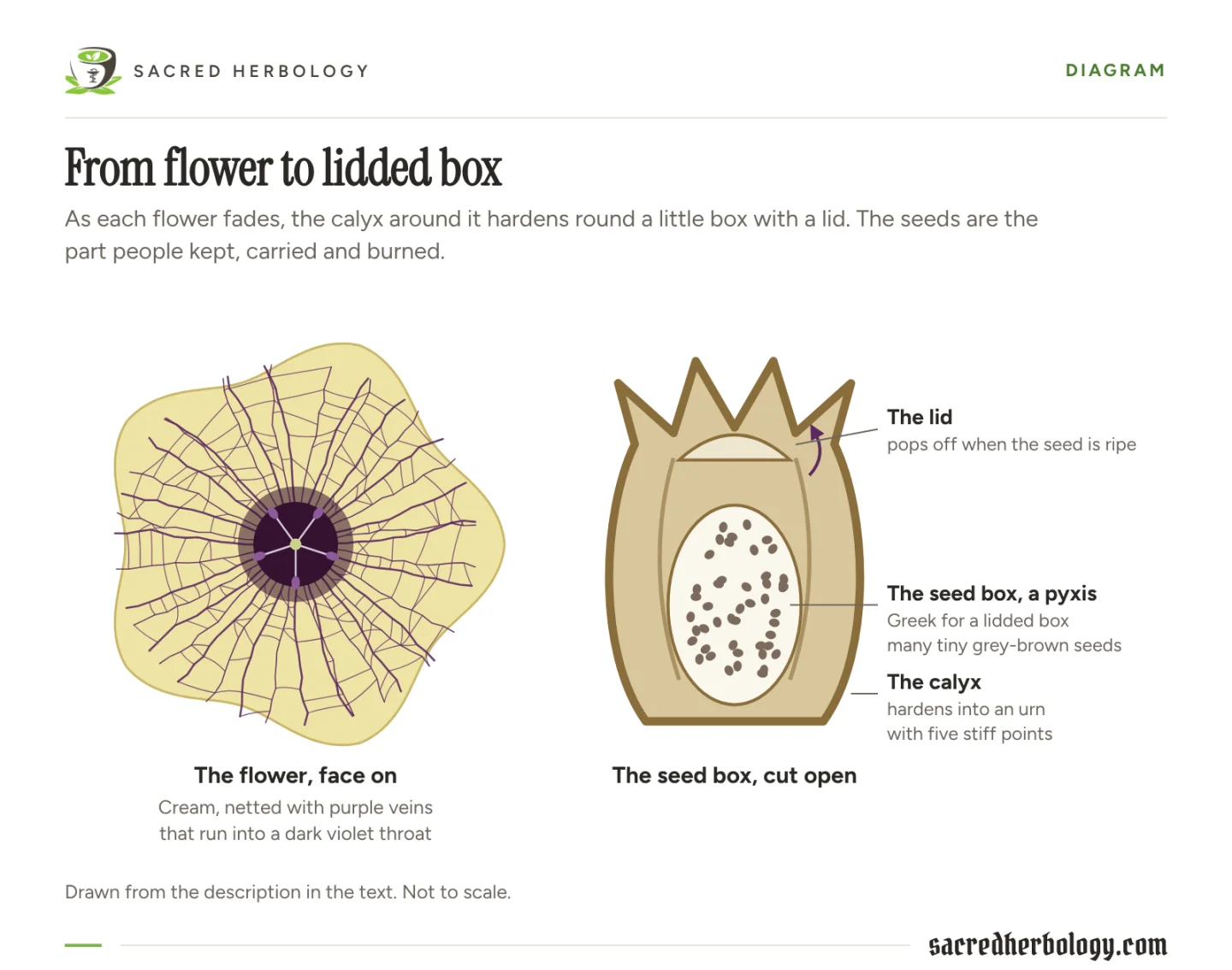
The flowers are the reason anyone grows it on purpose. Each one is a shallow funnel about the width of a large coin, a dull creamy yellow, and the whole face is netted with fine veins of deep purple that run together into a dark violet throat. Nothing else in the garden looks quite like it. Some people find it sinister and some find it one of the most beautiful flowers in the family. I am in the second camp. Look at one face on and you can follow that net of purple veins vein by vein.

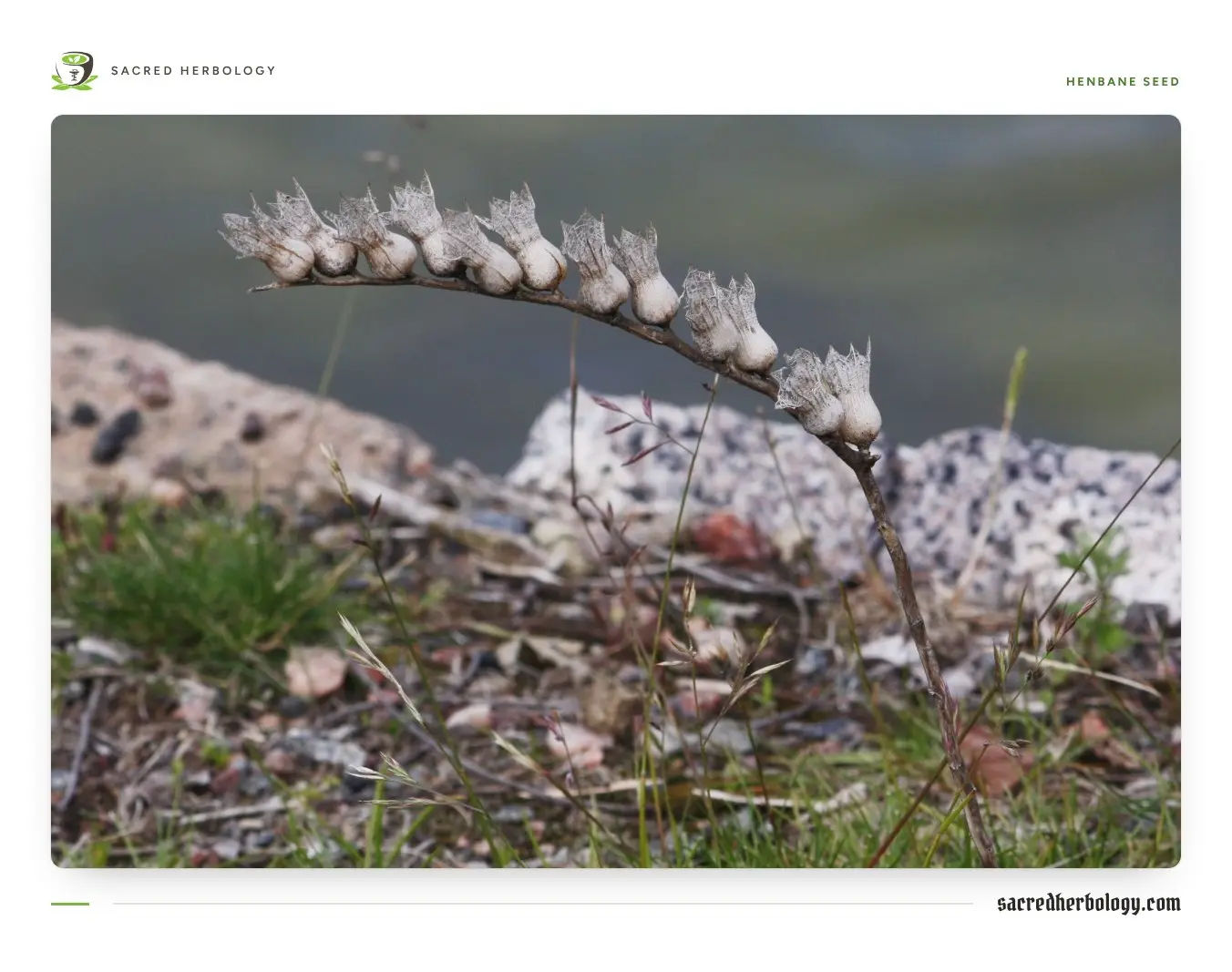
The seed capsule is the other thing worth a close look. As each flower fades, the calyx around it hardens into a little urn with five stiff points. Inside sits a capsule with a round lid that pops off when the seed is ripe, a structure botanists call a pyxis, after the Greek word for a lidded box. Each box holds a great many tiny grey-brown seeds, pitted on the surface. The ripe stalk, studded with rows of these urns all down one side, looks like a shelf of little lidded jars. That shape matters later in the story, because the seeds are the part people kept, carried and burned.
There are relatives. White henbane, Hyoscyamus albus, has paler flowers and grows around the Mediterranean. Egyptian henbane, Hyoscyamus muticus, grows in the deserts of North Africa and western Asia. The old Greek and Latin writers knew several kinds and ranked them, as we will see.
In Australia black henbane has been recorded as naturalised in South Australia, New South Wales and Victoria, though the Australian Plant Census notes that it is known only from early collections and may since have been eradicated. White henbane has been recorded as naturalised in Victoria and Tasmania, with the same note about early collections, and the two have sometimes been confused in the herbarium records. It is a plant of cool, dry summers and does poorly in the humid tropics, where it sulks, and most readers will know it from books and seed catalogues.
What is in it
Henbane carries the same family of chemicals as belladonna and datura, the tropane alkaloids, chiefly hyoscyamine and scopolamine. Scopolamine has a second name, hyoscine, and that name comes straight from this plant. The German chemist Albert Ladenburg isolated hyoscine in 1880, and the name Hyoscyamus is now built into the vocabulary of every pharmacy.
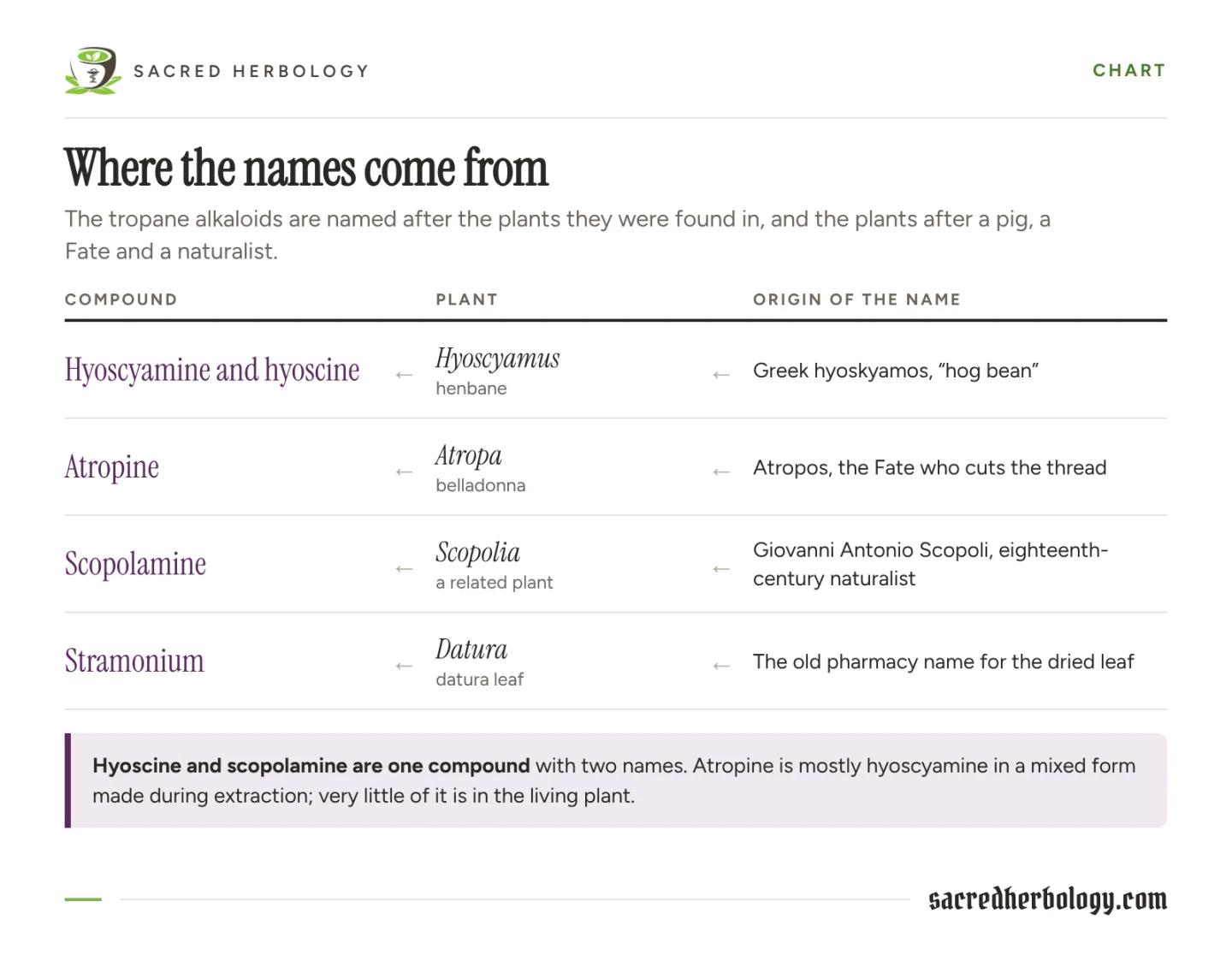
Here is where the names come from:
- Hyoscyamine and hyoscine: from Hyoscyamus, henbane, the Greek “hog bean”.
- Atropine: from Atropa, belladonna, named for Atropos, the Fate who cuts the thread.
- Scopolamine: from Scopolia, a related plant named after the eighteenth-century naturalist Giovanni Antonio Scopoli.
- Stramonium: the old pharmacy name for datura leaf.
These compounds block the receptors for acetylcholine, one of the body’s main chemical messengers, and they do it in the brain and through the rest of the body at once. Hyoscine crosses into the brain more readily than hyoscyamine, which is part of why henbane was known for sleep and confusion as much as for a dry mouth. Atropine, the name most people know, is hyoscyamine in a mixed form that tends to form during extraction, so most of it is made at the chemist’s bench and very little of it is in the living plant. The purified forms are potent prescription medicines. The plant’s own content wanders up and down with the season, the soil, the part of the plant and the individual specimen, and nobody can tell by looking. That single fact sits under everything else in this article. Every old story about henbane, sacred, magical, medical or criminal, is also a story about a dose nobody could measure.
In Australia, Hyoscyamus niger is listed by name in the Poisons Standard. Outside a couple of narrow exceptions for very weak preparations, it sits in Schedule 4, prescription only, alongside its purified alkaloids. That is the law for any product made from the plant. It is one reason we talk about it in the Journal and not on a shop shelf.
The Pilsner story, piece by piece
Let me set the popular version out as three claims, because they come from different places and fail for different reasons.
- Claim one: the city of Pilsen, and so Pilsner beer, is named after henbane.
- Claim two: Pilsner was once a henbane beer.
- Claim three: the Bavarian purity law of 1516 was passed to ban henbane from beer.
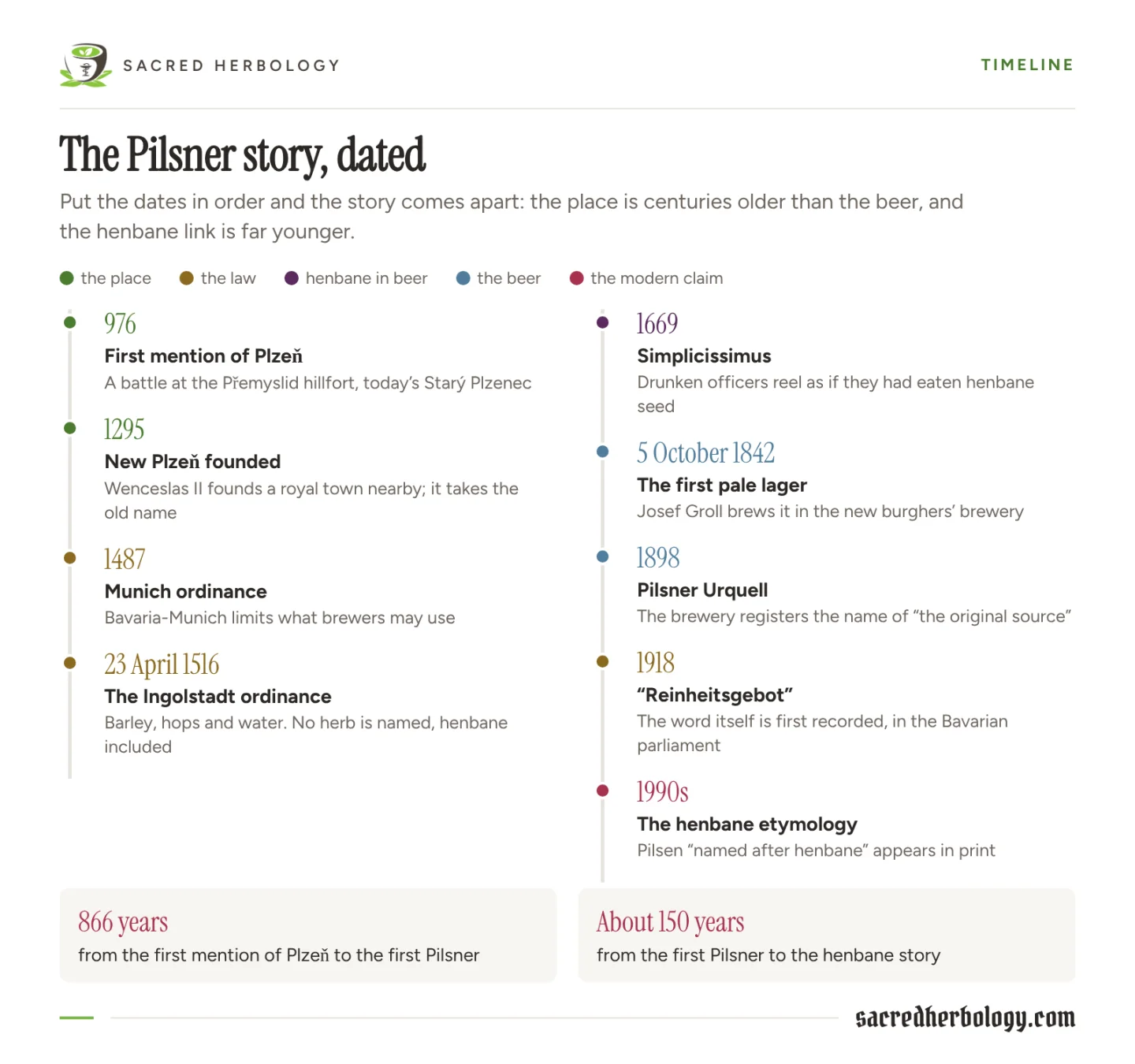
A timeline helps:
- 976: the first written mention of Plzeň, at a Přemyslid hillfort, today’s Starý Plzenec.
- 1295: King Wenceslas II founds a new town nearby, New Plzeň, which carries the old name.
- 1487: a beer ordinance in the duchy of Bavaria-Munich limits brewing ingredients.
- 23 April 1516: the Bavarian ordinance issued at Ingolstadt, later called the Reinheitsgebot.
- 1669: Grimmelshausen’s novel Simplicissimus compares reeling drinkers to people who have eaten henbane seed.
- 5 October 1842: the first batch of pale lager is brewed in Plzeň.
- 1898: the Plzeň brewery registers the name Pilsner Urquell.
- 1990s: the claim that Pilsen was named after henbane appears in print.
Look at the two ends of that list. The name of the place is older than the beer by more than eight and a half centuries, and the story linking them is younger than the beer by a century and a half.
Claim one: the name of Pilsen
Plzeň is the Czech name, and it is the original. Pilsen is the German form of it, the name used by German speakers in Bohemia and by most of the outside world. The henbane story only works in German. In German the plant is Bilsenkraut, from Middle High German bilse, and “Bilsen” and “Pilsen” look like close relatives on paper. The suggestion is that the city was named for the plant that grew there, or was grown there, for brewing.
The trouble is that the name came first in Czech, and the Czech for henbane has nothing to do with it. Czech calls the plant blín. You cannot get from blín to Plzeň. The German Pilsen was made out of Plzeň by German speakers, centuries after the place was named, and it cannot be used to explain where Plzeň came from.
What does the name mean, then? Nobody is sure. The standard reference on Bohemian place names is Antonín Profous’s Místní jména v Čechách, published in Prague from 1947, and the Plzeň entry sits in the volume of 1951. The suggestions in the Czech literature run along two lines: a name built on a personal name, “the place of a man called something like Plz”, or a name describing the ground, a damp or slippery place. Czech reference works today say plainly that the origin is uncertain. None of the serious proposals involves henbane.
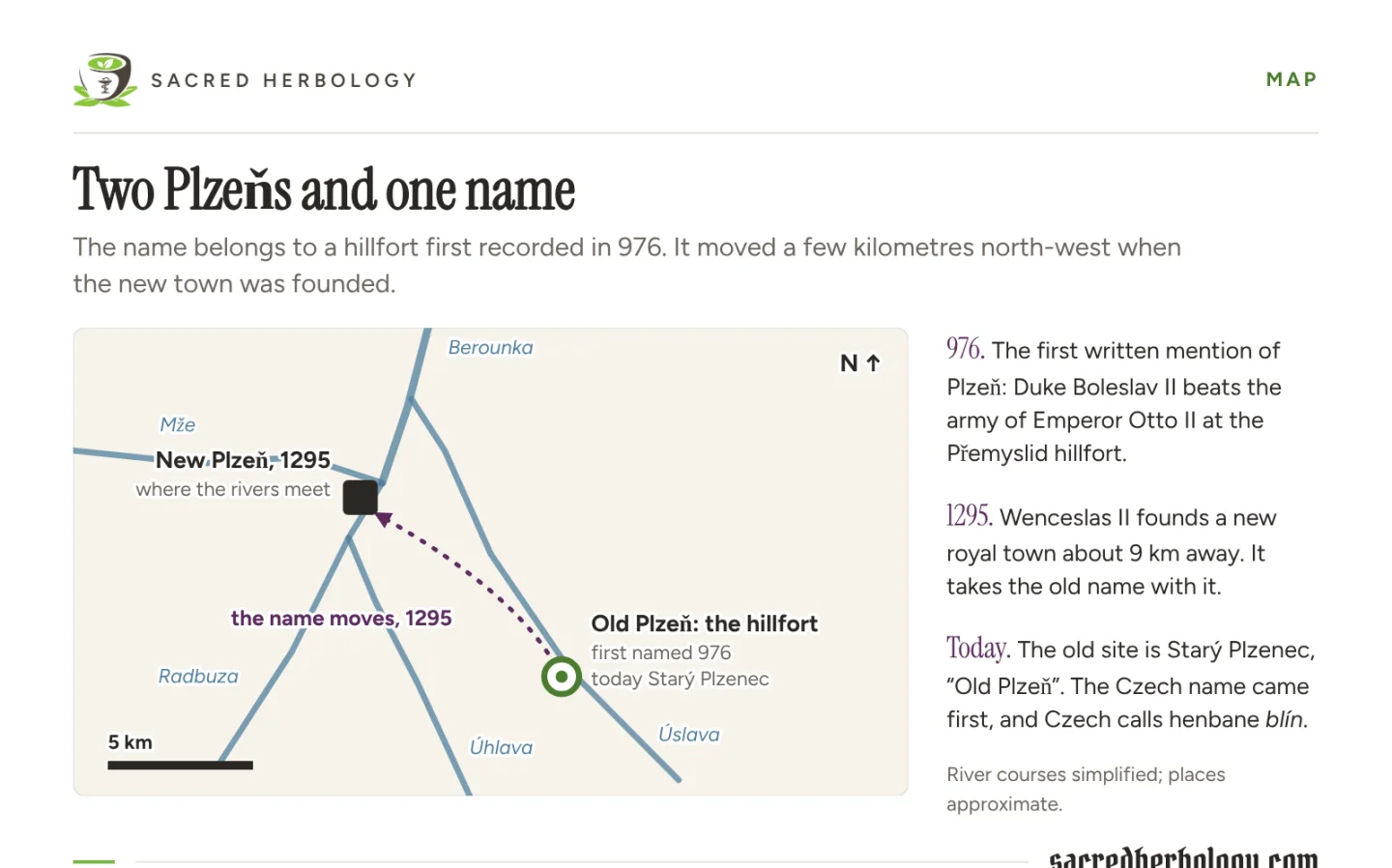
The place itself was named long before anyone brewed lager there. The first mention of Plzeň, in 976, is of a battle at the Přemyslid hillfort, where Duke Boleslav II beat the army of the Emperor Otto II. In 1295 Wenceslas II founded a new royal town a few kilometres away, and the new town took the old name with it, which is why the old hillfort site is now called Starý Plzenec, “Old Plzeň”. On a map the two points sit close together, the hillfort to the south-east and the new town where the rivers meet.
Where did the henbane etymology come from? The trail leads to the German ethnobotanist Christian Rätsch, whose books on psychoactive plants and on old beers, Urbock in 1996 and the big Enzyklopädie der psychoaktiven Pflanzen in 1998, did a great deal to popularise the idea of a lost henbane beer. Rätsch listed place names such as Bilsensee and Bilsengarten in Germany and put Pilsen among them, as places where, he suggested, henbane had once been planted for brewing. The German encyclopaedia articles on the plant now carry his suggestion and immediately note that the etymology is disputed, citing Profous. From Rätsch’s books the idea moved into English, onto beer blogs and craft-brewing forums, and from there into the lists of strange facts that keep sending it back to me.
So, claim one. The name Plzeň is first recorded in 976, it is Czech, its origin is uncertain, and the henbane link is a German-language suggestion of the 1990s that rests on a sound-alike in the wrong language. I will happily call it a modern invention, with the date.
Claim two: Pilsner as a henbane beer
This one is easier, because the beer is so well documented. By the 1830s the citizens of Plzeň who held brewing rights were unhappy with the quality of their town’s beer, and the story goes that in 1838 they tipped barrels of it out in front of the town hall in protest. They founded a new burghers’ brewery and hired a Bavarian brewer, Josef Groll, who brought the Bavarian method of bottom fermentation in cold cellars. On 5 October 1842 he brewed the first batch of a pale, clear, bottom-fermented lager from pale malt, soft local water and the hops of the Žatec district, Saaz in German. It was first served in November 1842. It was a hit, the style spread across Europe within a few decades, and by 1898 the brewery was protecting its original by registering the name Pilsner Urquell, “the original source”.
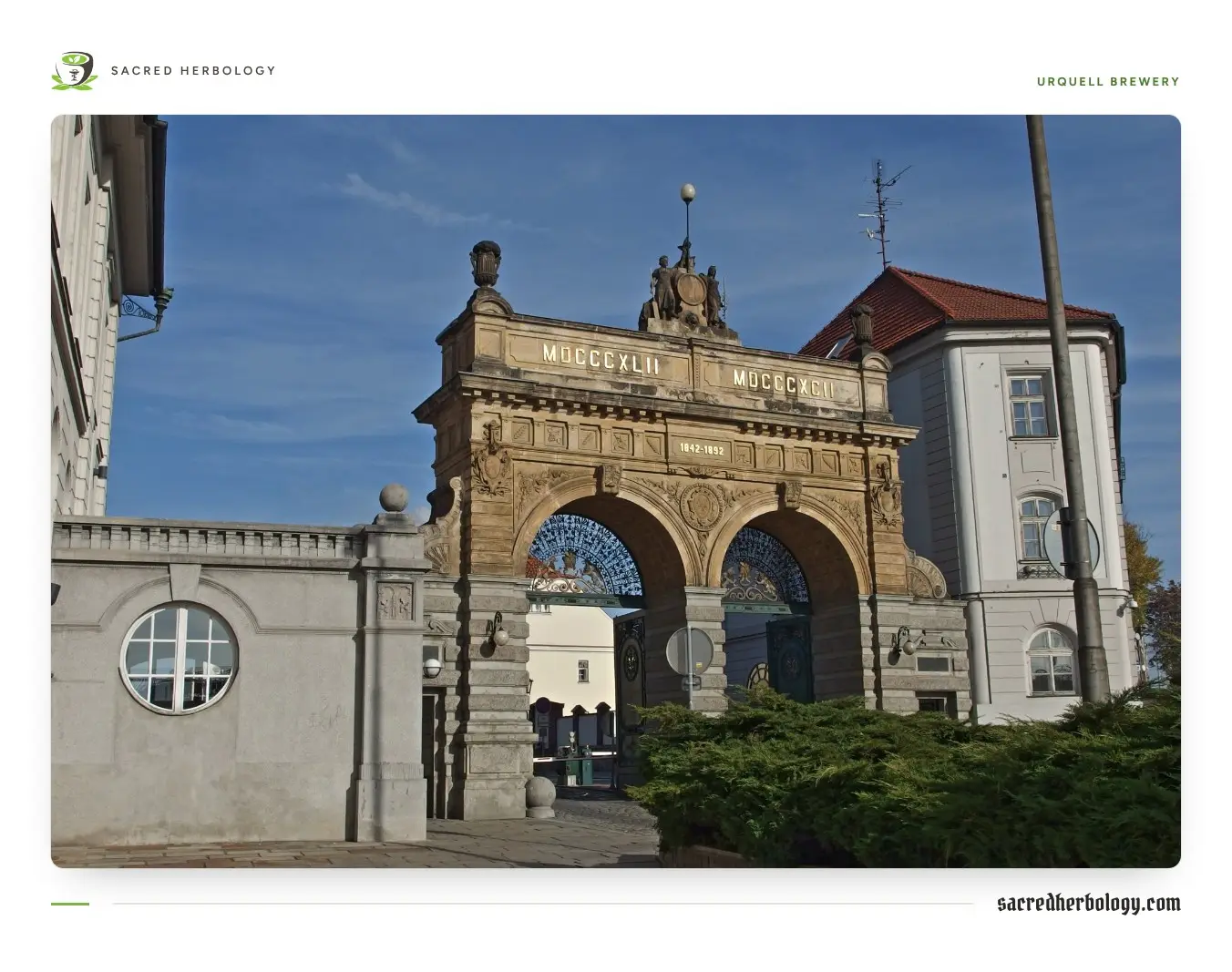

None of that history involves henbane, and the people who made the beer were famous precisely for their hops. A pale lager of the 1840s, made in a modern brewery under contract to a town council, sits about as distant from a medieval herb beer as anything brewed in the nineteenth century. Claim two is simply the first claim pressed into a beer glass.
Claim three: the purity law
The Bavarian ordinance was issued at Ingolstadt on 23 April 1516 in the names of the brothers Duke Wilhelm IV and Duke Ludwig X. It is a short text, and most of it is about money. It sets the maximum price of a measure of beer for the winter half of the year and the summer half, with different limits for March beer and other beer, and it allows innkeepers who bought beer by the barrel a small mark-up when they resold it. Then comes the sentence everyone remembers. From now on, in all Bavarian towns, markets and the countryside, no beer is to be brewed from anything other than barley, hops and water. Brewers who broke the rule would have their barrels confiscated.
The ordinance does not mention henbane, or any other herb. It names three ingredients and stops. It does not even name yeast, which brewers obviously used but did not yet understand. The 1487 Munich ordinance that came before it has the same shape.
Historians give several reasons for the rule. The one most of them put first is grain. Wheat and rye were bread grains, and keeping brewers to barley protected the bread supply and the bakers’ prices. Price control runs all through the text. Fraud and adulterated beer were also real worries in every brewing town in Europe, and brewers who cut corners with cheaper bittering agents or preservatives were a standing complaint. Some writers add a religious or protectionist motive, the suppression of older herb mixtures such as gruit, the brewers’ herb blend, with bog myrtle and yarrow in it, that hops were replacing, along with any plants thought to carry pagan associations. That last suggestion again leans heavily on Rätsch, and it is a modern reading of a law that says nothing about it.
One more small fact undoes a lot of what is written online. The word Reinheitsgebot, “purity command”, is itself a twentieth-century word, first recorded in a Bavarian parliamentary debate in 1918. The people of 1516 called their law nothing of the kind.
So, claim three. A rule limiting ingredients would certainly have excluded henbane, along with every other herb, spice and grain except barley and hops. To say the law was passed to ban henbane, you would need someone at the time to say so, and nobody did.
What is true: henbane in the beer
Here the story gets interesting again, because the core idea, that henbane was put in beer, has real evidence behind it. It just has nothing to do with Pilsen.
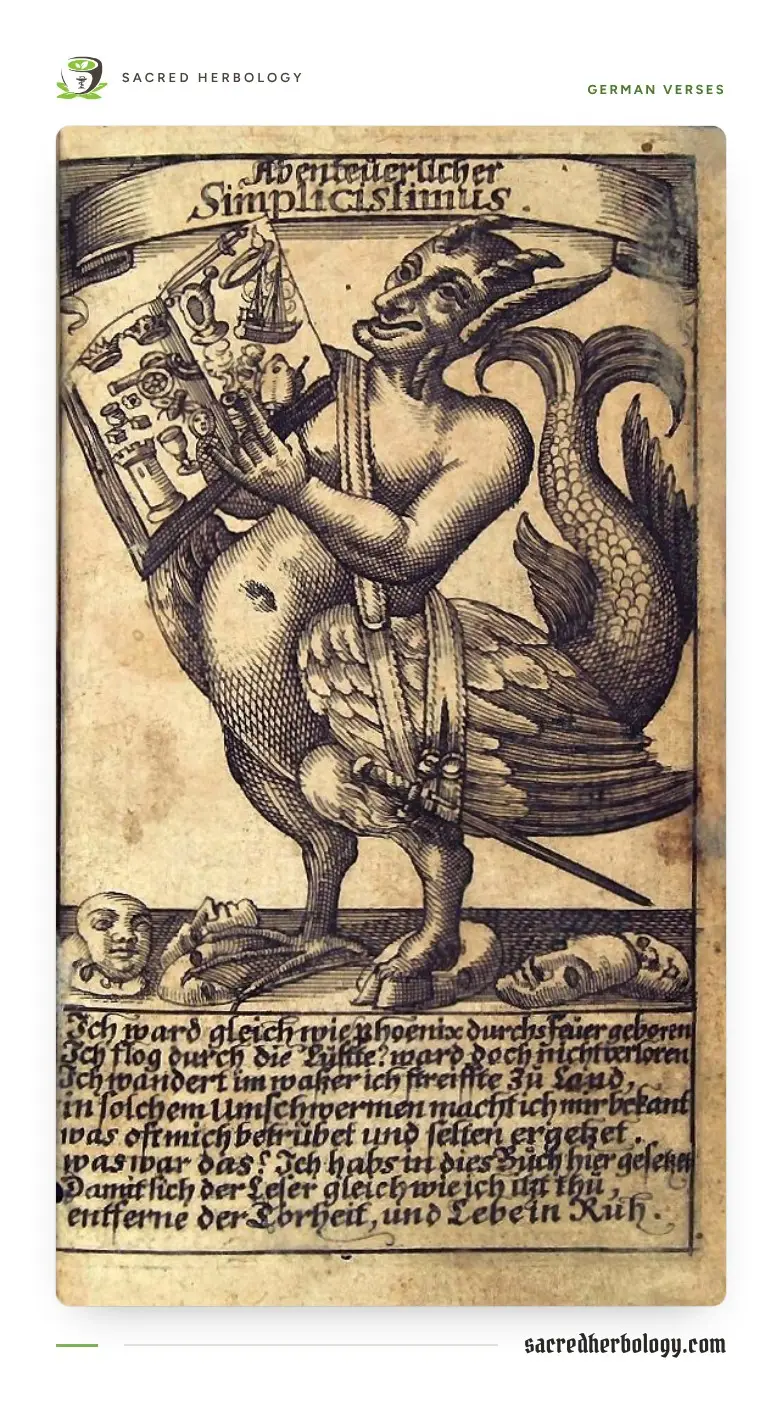
The clearest witness is a novel. Hans Jakob Christoffel von Grimmelshausen’s Der abenteuerliche Simplicissimus, the great German novel of the Thirty Years’ War, came out in 1668, with the edition usually cited dated 1669. In a drinking scene in the first book, the young hero watches a company of drunken officers at table and says they staggered about as if they had eaten henbane seed. A simile is only useful if the reader recognises it, and Grimmelshausen’s readers clearly knew what henbane seed did to a drinker.

Behind the simile sit the German herbals of the sixteenth century. Historians of toxicology reading those books note warnings against beer mixed with henbane seed to make it more intoxicating. It is the kind of thing a herbalist mentions because he has seen it, and because people were being poisoned by it. Henbane in this sense was an adulterant, a cheap way to make weak beer hit harder. That is a long way from a sacred brew, and it is exactly the sort of thing beer ordinances were written to stop, even when they never named it.
You will also read of particular town ordinances before 1516 that banned henbane from beer by name. I have not been able to find one of those in a dated text I could check, so I leave them out. If one surfaces in a published edition I will gladly add it.
What about the older, ritual beers? The Germanic peoples, the Celts and the Norse all brewed, and herbs certainly went into ale long before hops won out. Whether henbane was one of them in any regular way is a question archaeology has not yet answered, and the most famous early case turned out to be a mistake, which brings us to the digs.
The archaeology: a jar, a grave and a false alarm
Three finds are worth knowing, one for each kind of evidence.
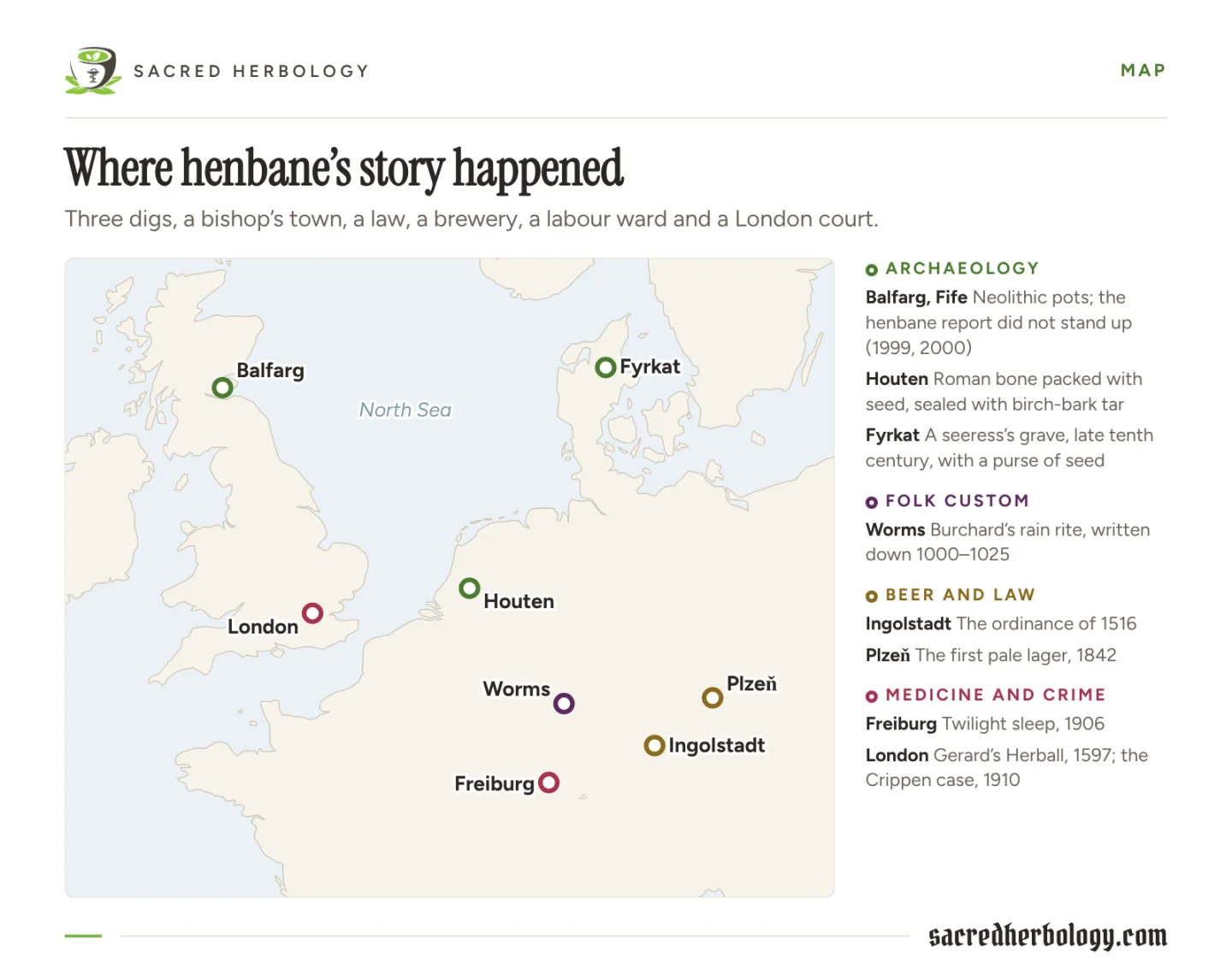
The first is the false alarm. In the early 1990s excavators at Balfarg, a Neolithic henge complex in Fife in Scotland, reported black henbane in the residue on sherds of Grooved Ware pottery, and the finding was quickly taken up as evidence of a Stone Age drug used in ceremonies at the henge. It was exciting, and the press loved it. In 1999 a team led by D. J. Long went back to the material and published a re-examination in the Journal of Archaeological Science. They found no good evidence that henbane had been in the pots. Henbane is a weed of disturbed ground and would have grown on the site itself, and pollen and seed could easily have reached the sherds from the soil. They followed it with a second paper in Antiquity in 2000 warning archaeologists and journalists against jumping to ritual conclusions. You will still find the Balfarg henbane in books. The researchers who checked it say it does not stand up.
The second find is the one that does stand up. At Houten-Castellum in the Netherlands, in a Roman-period farming settlement of the later first century, excavators found a hollowed-out sheep or goat thighbone, sealed at one end with a plug of birch-bark tar and packed with hundreds of black henbane seeds. Maaike Groot, Martijn van Haasteren and Laura Kooistra published it in Antiquity in 2024. Henbane grows wild around settlements, so loose seeds on a site prove nothing about intent. A carefully stoppered bone full of them is a different matter. Someone gathered those seeds and kept them. The authors point to Pliny’s long list of medical uses for the plant as the most likely context and are honest that the exact use is unknown. Picture it: a small, dark, polished tube with its tar stopper still in place.
The third is a grave. At Fyrkat in northern Jutland, one of the great Danish ring fortresses of Harald Bluetooth’s reign, excavators in the 1950s uncovered the burial of a woman from the last quarter of the tenth century. She was buried richly, in fine clothes, laid in the body of a carriage, with silver toe rings unlike any others found in Scandinavia, two bronze bowls, an iron staff with bronze fittings, a tiny silver amulet shaped like a chair, a box at her feet holding owl pellets and the small bones of birds and animals, and a little purse holding henbane seeds. Many archaeologists, including the National Museum of Denmark, interpret her as a völva, a seeress of the kind described in the Old Norse sagas, who carried a staff and sat on a high seat to see what was coming. The henbane in her pouch has naturally invited the suggestion that she burned it in her rites. That is a reasonable guess and it is still a guess. The sagas that describe seeresses never mention henbane, and they were written down centuries later.
Put the three together and you have a fair picture of what archaeology can say. Henbane grew around people for thousands of years. By the Roman period at least, some people were collecting and storing its seed with care. By the Viking age, at least one woman of rank and unusual standing carried it on her body into the grave. What they did with it, beyond that, the finds do not say.
The Greeks and the Romans
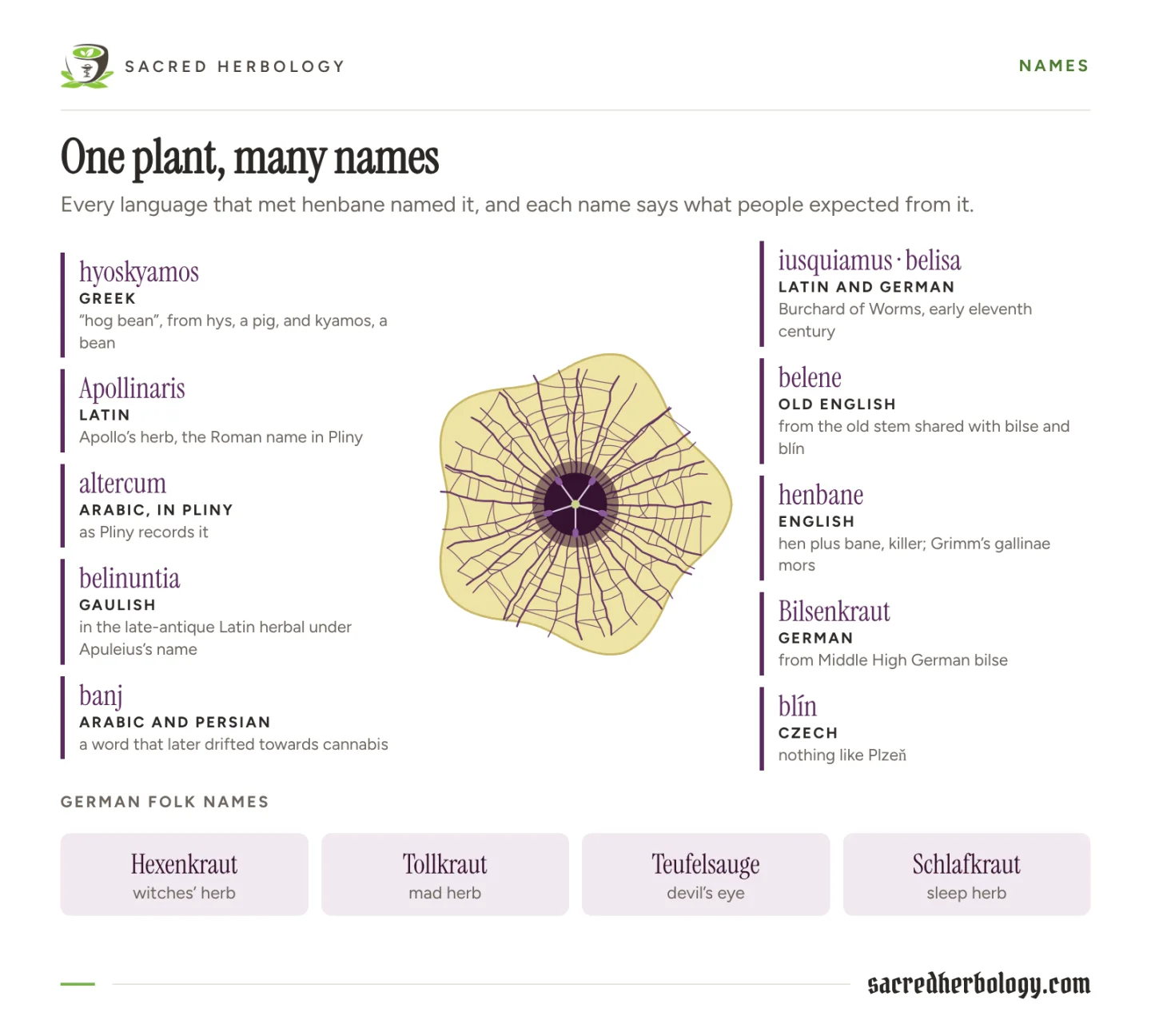
The Greek name is hyoskyamos, usually read as “hog bean”, from hys, a pig, and kyamos, a bean. Why a pig? The ancient explanations vary, and none of them is certain. The name stuck, and it is the one the botanists took for the genus.
Dioscorides, the Greek army doctor of the first century whose Materia medica shaped European pharmacy for fifteen hundred years, describes three kinds. One has dark flowers and hard, blackish seed. One has yellowish flowers and yellowish seed. The third is white and soft, with white seed. He ranks them firmly. The white one is the most useful, the yellow next, and the black, usually taken to be our Hyoscyamus niger, is the worst of the three and should be thrown out of all use, because it brings on madness and a deep, stupefying sleep. It is a striking judgement from a man who used plenty of dangerous plants. The great illustrated copy of Dioscorides in Vienna, made around 512 for the princess Anicia Juliana, paints the plants it describes, and henbane has been drawn in herbals ever since, down to the coloured plates of the nineteenth century.

Pliny the Elder, writing in Rome at about the same time, gives henbane a short chapter in book 25 of his Natural History. He says the discovery of the plant was credited to Hercules, that the Romans called it Apollinaris, and that the Arabs called it altercum. He also lists several kinds, and of them all he says they bring madness and giddiness of the head. Then comes one of my favourite lines in all of Pliny. Henbane, he says, has the nature of wine, and that is why it attacks the mind and the head. Pliny’s Romans were people who knew what too much wine did, and they reached for wine to explain this plant. The man who wrote that line would not have been at all surprised to hear that later people put henbane in their beer.
The name Apollinaris, Apollo’s herb, has had a long afterlife. The Latin herbal that circulated under the name of Apuleius in late antiquity gives a list of foreign names for each plant, and for henbane it records a Gaulish one, belinuntia. Since the nineteenth century scholars have connected that word to Belenus, a Gaulish god whom the Romans identified with Apollo. Jacob Grimm noted the link in his Deutsche Mythologie. More recently the linguist Peter Schrijver has connected the old Celtic stem for henbane to the name of the goddess Belisama. These are serious proposals by serious scholars, and they are still proposals. What we can say safely is that a Roman name tied henbane to Apollo and a Gaulish name may have tied it to the Gaulish Apollo. From there, some modern writers have built a whole Celtic henbane cult. The evidence for that is a word in a plant list.
Something similar happened at Delphi. You may read that the Pythia, Apollo’s priestess, breathed henbane smoke to prophesy, since henbane was Apollo’s herb. No ancient source says so. The ancient writers speak of vapours rising from the ground, of laurel, and of the god himself. The henbane at Delphi is a modern guess built on the name Apollinaris, and it should be read that way.
Banj: an Arabic word with two plants in it
In the medieval Arabic and Persian medical books, henbane went by the name banj. The great Arabic pharmacologists described it, its kinds and its dangers, following and extending Dioscorides. Over time the word banj, and the related Persian bang, drifted. In some times and places it came to mean cannabis preparations, and in Indian languages bhang has long meant cannabis. Franz Rosenthal’s study of hashish in medieval Muslim society walks through the confusion carefully, because it matters a great deal when a text says someone was drugged with banj. Sometimes it was henbane. Sometimes it was cannabis. Sometimes the writer did not know or care. It is a good example of why the plant name in an old text should never be taken at face value. The thing in the cup can change while the word stays the same.
The English name, and the German ones
Henbane is an English compound, hen plus bane, bane meaning killer, as in wolfsbane and fleabane. Old English already had a word for the plant, belene, from the same old stem that gives German Bilsen and Czech blín, and the name henbane appears in the Middle English herbals. The idea behind it, that the plant poisons poultry, is old and widespread. Grimm glossed the English name with a Latin one, gallinae mors, “the death of a hen”.
The German folk names are a small poem in themselves: Hexenkraut, witches’ herb; Tollkraut, mad herb; Teufelsauge, devil’s eye; Schlafkraut, sleep herb. Each of those names tells you what people expected from the plant.
The rain rite in Burchard’s penitential
Now we come to the one passage in the medieval record where henbane appears in a village custom, described in some detail. It is folk custom in the proper sense: a practice of ordinary people, recorded by a churchman who disapproved of it.
Burchard was bishop of Worms on the Rhine from 1000 until his death in 1025. He compiled a great collection of church law in twenty books, the Decretum, and the nineteenth book, usually called the Corrector, is a handbook for priests hearing confession. It is laid out as questions to put to the penitent, with the penance for each sin, and because Burchard wanted his priests to know what their people actually did, the questions describe customs in surprising detail. Historians of medieval religion treasure it for exactly that reason.
One question concerns what some women do when they need rain. In Burchard’s description, they gather a group of girls and choose one small girl as their leader. They strip her naked and take her outside the village to a place where they can find henbane, which the Latin text calls iusquiamus and adds that in German it is called belisa. They make her pull the plant up by the root with the little finger of her right hand, and tie it to the little toe of her right foot. Then the other girls, carrying twigs, lead her to the nearest river and sprinkle her with the water, hoping by this to bring rain. They lead her back to the village walking backwards, the way crabs walk. The bishop asks the penitent whether she has done this or taken part, and sets a penance.
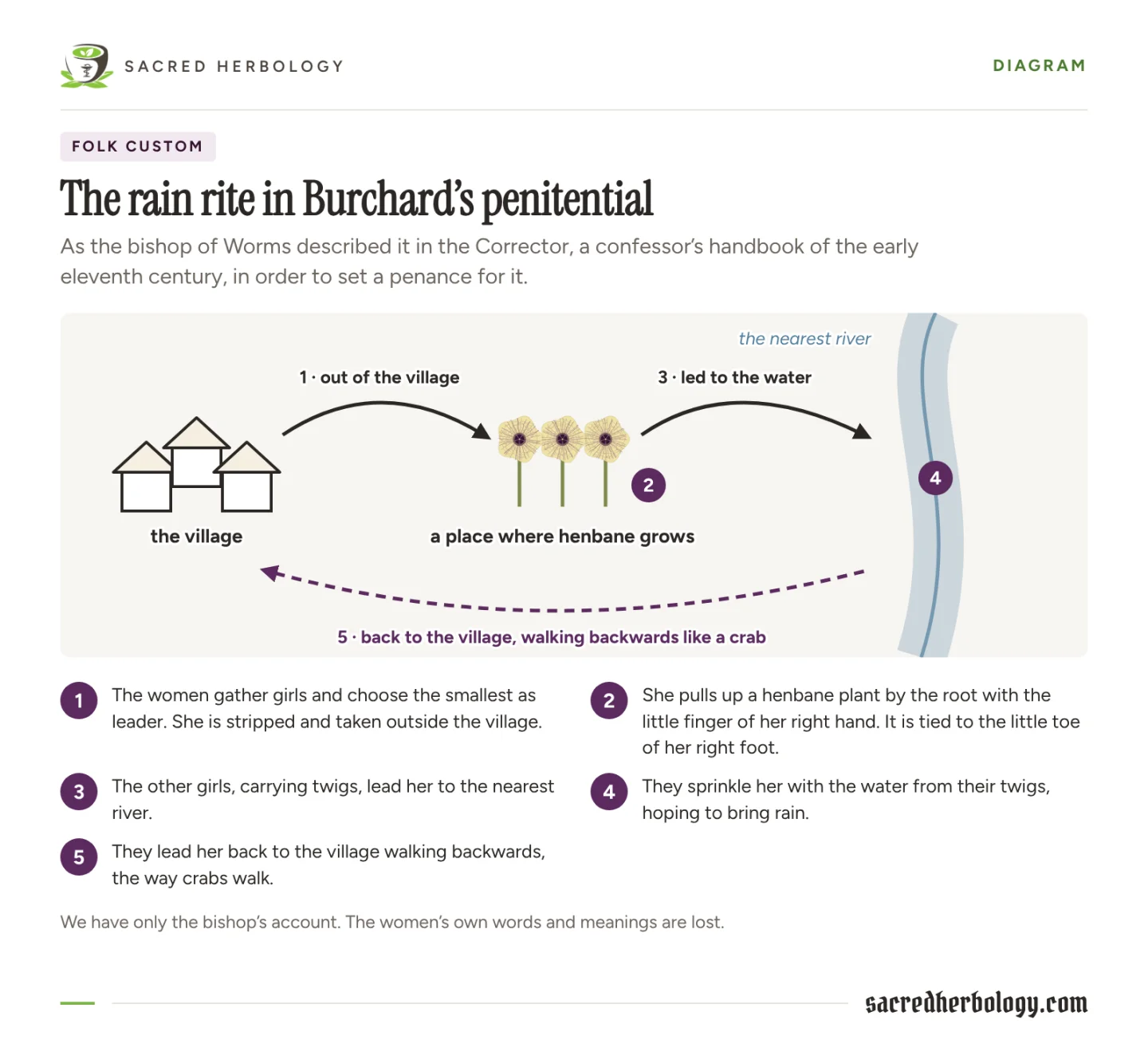
It is one of the most vivid pictures of an early medieval rural custom we have: the girls at the riverbank, the small one in the middle with the plant tied to her foot, the twigs flicking water.
Jacob Grimm read the passage in the 1830s and set it beside living customs from south-eastern Europe. In Serbia, he noted, a girl called the dodola went from house to house in time of drought, naked but entirely covered in grass, herbs and flowers, dancing while the women of each house poured water over her and her companions sang for rain. He collected a similar custom from Greece. Grimm thought the differences between them were too great for one to have been borrowed from another, and that they pointed to a shared and very old way of asking for rain.
Two cautions keep this honest. First, everything we know of the Rhineland rite comes from a bishop who was writing it down to stamp it out. We do not have the women’s own words or their understanding of what they were doing. Second, there is a small scholarly argument about the plant itself. Burchard’s Latin says henbane plainly, and Grimm read it that way. One or two modern commentators have wondered whether the German belisa might have meant something else, since plant names wander. The Latin text is clear, and I follow it. Why henbane, of all plants, for rain? Burchard does not say, and anyone who tells you confidently is guessing.
The magicians’ henbane: Saturn or Jupiter?
Now we cross a line, from village custom into learned magic. The material in this section belongs to the esoteric tradition: the astrological and magical books written by educated men, read by educated men, and quite distinct from what happened in villages.
The planetary system of correspondences gives every plant a ruling planet, and henbane caused a small argument. The Picatrix, the Latin translation of an Arabic handbook of astral magic, names both black and white henbane in a number of its preparations, many of them meant to stupefy or put a person to sleep. A plant with that reputation, cold, dark and heavy in the old language of qualities, sat most naturally with Saturn, the slow, cold, melancholy planet.
Heinrich Cornelius Agrippa, whose Three Books of Occult Philosophy were printed in full in 1533, keeps henbane seed in his fume for Saturn, alongside black poppy seed, mandrake root, lodestone and myrrh. He also uses henbane in the fumes he says make spirits gather and strange shapes appear. And yet in his chapter on the things under Jupiter, among his sweet and wholesome plants, there sits henbane too. Jupiter is the kindly planet, the planet of abundance and good temper, and henbane fits him very badly.
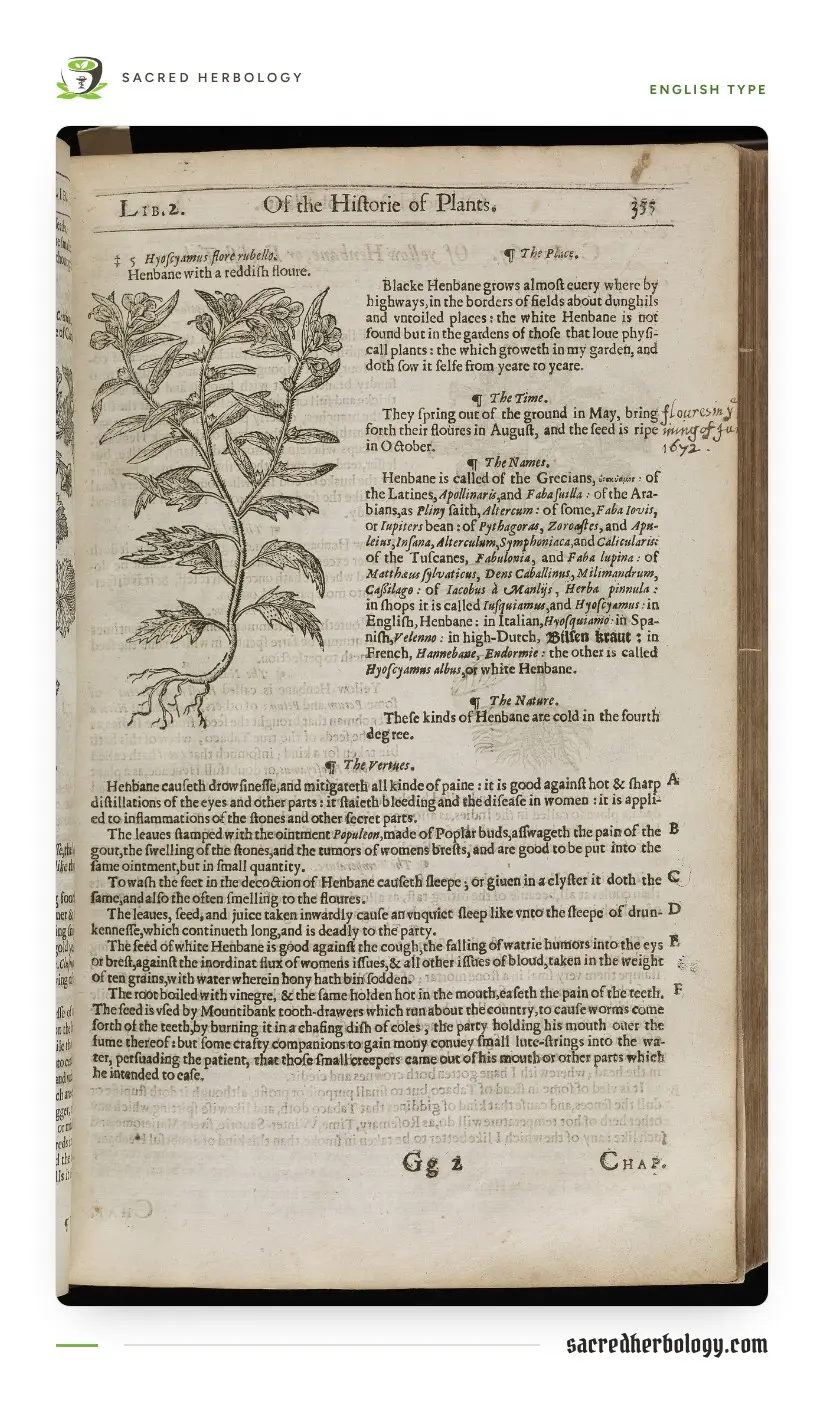
Nicholas Culpeper noticed. In his English Physitian of 1652 he opens his henbane entry by wondering how astrologers could ever have made this an herb of Jupiter, names the French writer Antoine Mizauld as one of them, and puts it firmly under Saturn. He also notes where it grows, by waysides and under hedges and walls, the neglected corners where a Saturnian plant looks at home. It is a lovely moment, one astrologer telling off another across a century.
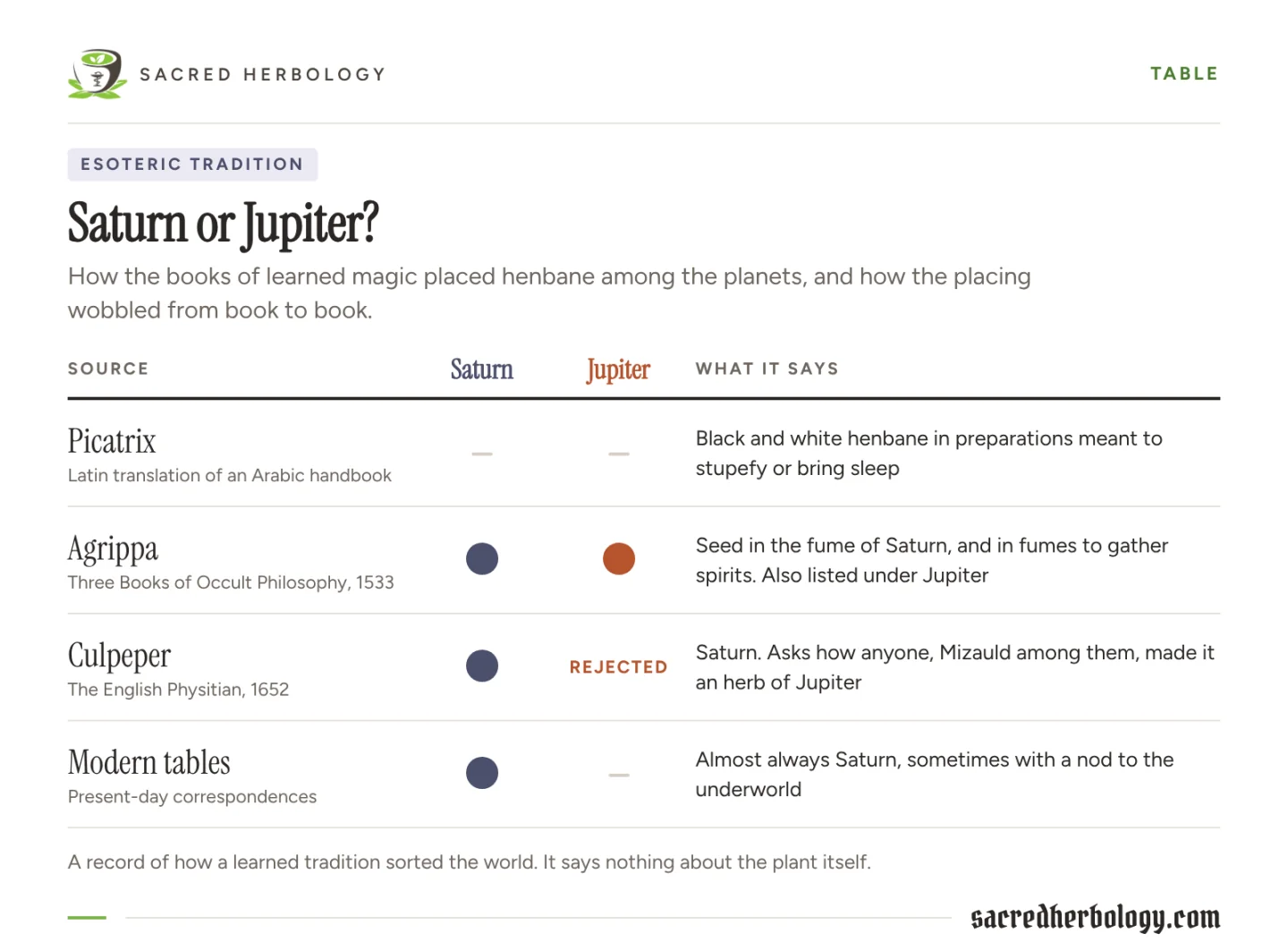
Set side by side, the sources look like this:
- Picatrix: black and white henbane in sleep-bringing and stupefying preparations.
- Agrippa, 1533: henbane seed in the fume of Saturn; henbane also listed under Jupiter.
- Culpeper, 1652: Saturn, and a complaint about anyone who said Jupiter.
- Modern correspondence tables: almost always Saturn, sometimes with a nod to the underworld.
None of this tells you anything about the plant itself. It tells you how a learned tradition sorted the world, and how its sorting could wobble from book to book. If you work with correspondences, bear in mind that your tables carry these old arguments inside them.
I should also say a word about the witches’ flying ointment, since henbane is named in several of the sixteenth-century descriptions of it, alongside hemlock, nightshade and mandrake. I went through that whole record in the Belladonna piece, and I will not repeat it here except to say that the flying-ointment literature is also learned writing, by physicians and demonologists describing what they believed others did. Henbane’s place in it is real, and it is a place in books.
Shakespeare’s hebenon
Every English reader of henbane history meets Hamlet sooner or later. The ghost of Hamlet’s father tells how his brother crept up on him as he slept in the orchard and poured into his ear the juice of “cursed hebenon”, or “hebona” in the earlier printing, in a vial. The poison curdles his blood and covers his body in a crust of sores.
For two centuries editors have argued about what hebenon is. Henbane has strong support, partly because of the sound and partly because Pliny and later herbals mention henbane seed oil dropped into the ear, which affects the mind. Yew has its supporters too, because the German for yew is Eibe and older forms of the word are close to hebenon. Ebony has been suggested, and hemlock. The effects the ghost describes match none of them well. Shakespeare was writing a play and choosing a word that sounded deadly. The honest answer is that he does not tell us, and the argument is part of the fun.
The tooth-drawer’s trick
Henbane’s most widespread folk use in Europe was against toothache, and it rested on an old belief that toothache was caused by a worm boring into the tooth. That belief is very old indeed. It turns up in ancient Mesopotamian texts and lasted in Europe into the eighteenth century.
Henbane seed was the standard weapon. In the folk and street-medicine tradition, the seeds were burned and the sufferer held their mouth over the smoke, after which, it was said, the little worms dropped out. John Gerard, in his Herball of 1597, describes the travelling tooth-drawers who went about the country curing toothache this way. He was a London barber-surgeon himself, and he did not trust them. Some of the craftier ones, he says, slipped short pieces of lute string into the water to show the patient, and passed them off as the worms that had come out of the tooth.

There was a second, more innocent trick at work. When henbane seed is heated, the tiny embryos curl out of the seed coat, and a little pile of them looks very much like a heap of minute white worms. Plenty of honest people who tried the cure would have seen worms with their own eyes. In the eighteenth century a German naturalist and clergyman, Jacob Christian Schäffer, made a point of showing that the “tooth worms” produced by the henbane smoke were nothing but parts of the seed.
You can picture the scene: the tooth-drawer at his table at a country fair, the patient leaning over a smoking dish, and a small bowl of water with something wriggling in it.
It is also a warning. Henbane smoke is poisonous, the alkaloids reach the body that way too, and people were poisoned by this cure. I describe it here as history, and nothing in this section is a method.
From poison to pharmacy
By the nineteenth century the chemists had pulled the alkaloids out of the nightshades. Hyoscyamine came from henbane in the 1830s, and Ladenburg isolated hyoscine in 1880. Once a substance could be weighed, it could be prescribed, and the purified alkaloids passed into regulated medicine, where they have stayed ever since, measured and scheduled.
The dried leaf stayed in the pharmacopoeias for a long time too, and it brought a quality problem with it. Because the alkaloid content of henbane varies so much, the official leaf came to be sold on chemical assay, and the trade had to watch for substitution with related species. Egyptian henbane, Hyoscyamus muticus, is much richer in alkaloids than the black, and it was imported as a raw material for extracting them. A sack of the one could not safely stand in for a sack of the other, and only the laboratory could tell them apart once they were dried and cut. It is the same lesson as the beer, in a later century: with this plant, what is on the label and what is in the bag are separate questions.
One episode from the early twentieth century had a long reach. In 1906 two doctors at Freiburg in Germany, Carl Gauss and Bernhard Krönig, promoted a combination of morphine and scopolamine for women in labour, which became known as Dämmerschlaf, “twilight sleep”. Women given it often had no memory of the birth afterwards. For a decade it was fashionable and fought over, particularly in the United States, where women campaigned to be allowed it, before its dangers to mothers and babies and the distress it could cause brought it into disfavour. The history of twilight sleep is a large subject of its own, and it belongs to the history of medicine and of women’s rights. I mention it because the long line from the hog bean of Dioscorides runs straight through it.
The murder at Hilldrop Crescent
Henbane’s most famous modern appearance is in a criminal court. In early 1910 Cora Crippen, a music-hall singer who performed as Belle Elmore, disappeared from her home at 39 Hilldrop Crescent in north London. Her husband, Hawley Harvey Crippen, an American seller of patent medicines, told friends she had gone to America and died there. When police grew suspicious, Crippen fled with his lover, Ethel Le Neve, who was disguised as a boy, aboard the liner Montrose bound for Canada. The ship’s captain recognised them and sent a message by the new wireless telegraph. A Scotland Yard inspector took a faster ship, overtook them, and arrested Crippen in the St Lawrence River. Human remains had been found under the cellar floor at Hilldrop Crescent, and the toxicologist William Willcox found hyoscine in them. Crippen had bought hyoscine from a London chemist weeks before Cora vanished. He was convicted and hanged at Pentonville in November 1910.
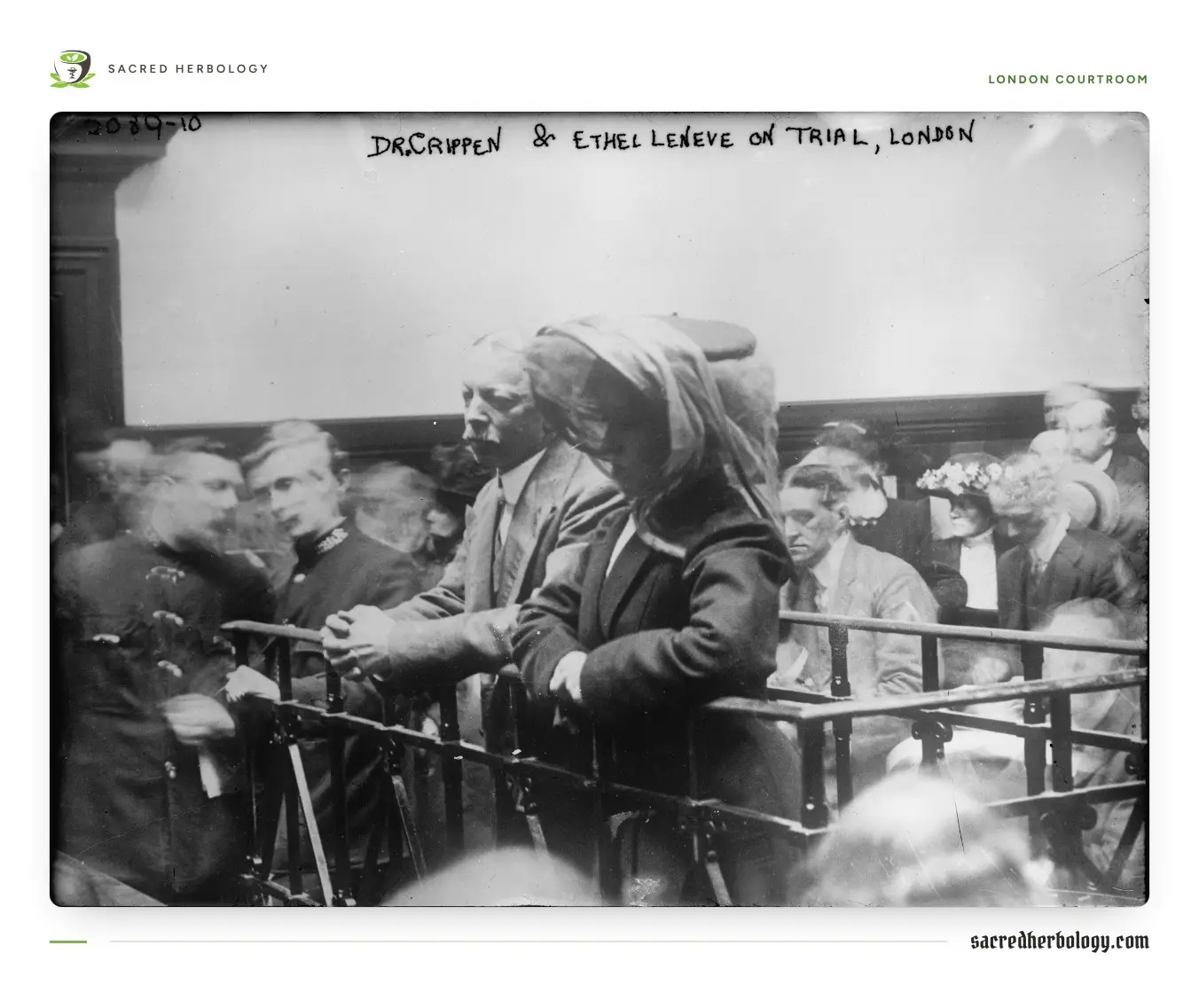

Even here the story has a modern twist. In 2007 a team of American researchers reported DNA tests suggesting that the remains under the cellar might not have been Cora’s at all. Their work has been argued over ever since and the matter is unresolved. Crippen’s guilt in the eyes of the law, and the hyoscine, stand in the record. Who lay under the floor is now an open question again.
I find it striking that the same chemical runs through Pliny’s line about wine, the tooth-drawer’s smoke, a Freiburg labour ward and a London cellar. That is henbane’s whole history in a sentence: one dangerous substance, read in different ways by every age that met it.
Henbane on the poison path today
Some modern practitioners of witchcraft and of what is now called the poison path work with henbane as a plant ally, usually by growing it, studying it and keeping it company in the garden. Some of them speak of it as a Saturnian or underworld plant, in line with the old correspondences. That is a living practice of the late twentieth and twenty-first centuries, and it is entitled to its own meanings. It draws on the books I have named here, Pliny, Agrippa, Culpeper, the flying-ointment writers and, very often, Rätsch. Anyone who claims an unbroken line from a medieval henbane rite to a modern one is claiming more than the record holds.

There is also a small modern revival of “henbane beer” among home brewers, often presented as a recreation of the pre-1516 German brew. Some of those recreations draw directly on the Pilsner story, which is how I keep meeting it. Whatever else is said about them, the historical case for a common, named, traditional henbane beer is thin, and the case for an adulterant that poisoned people is fairly good. There are no recipes in this piece and there will not be any.
Safety in the garden
Henbane is a handsome thing to grow if you live somewhere cool and dry enough, and it has a long story to tell. It is also a genuinely poisonous plant. Every part of it carries the alkaloids, the seed and root especially, and the amount in any given plant cannot be known without a laboratory. Over the centuries people have been poisoned by eating the roots in mistake for parsnip or chicory, by eating the seed, by drinking adulterated beer, and by breathing the smoke.
Henbane poisoning looks like poisoning by its cousins belladonna and datura: a dry mouth and burning thirst, hot, dry, flushed skin, a racing heart, very wide pupils and blurred vision, restlessness, confusion and seeing things, difficulty passing urine, and in serious cases a dangerously high temperature, fits and coma. It can kill. People who are poisoned often do not know it.
If you grow it:
- Keep it where children and pets cannot reach it, and cut the seed stalks before the capsules ripen if small visitors come to the garden.
- Wear gloves when you handle it, wash your hands afterwards, and keep sap and seed away from your eyes. A single widened pupil after gardening is a sign that sap or seed dust has reached the eye. Rinse the eye with plenty of water, and tell anyone who examines you about the plant, because the sign can be mistaken for something more serious.
- Never eat, smoke, burn, brew or rub any part of it on the skin.
- If you are pregnant or breastfeeding, leave the handling, pruning and seed-collecting to someone else.
- Label it clearly in the garden and in any seed packet, so nobody mistakes the root or the seed for something else.
- If someone has swallowed any part of the plant, or breathed its smoke, call the Poisons Information Centre on 13 11 26, any hour, anywhere in Australia, even if they seem fine. Do not try to make them vomit.
- If they are hot, confused, seeing things, have a racing heart, have a fit, are hard to wake or are struggling to breathe, call 000. Take a piece of the plant, the seed or a photo of it to the hospital.
If you have questions about the plant and the body, consult a degree-qualified herbalist with competencies and adequate training in pharmacognosy.
The story that won’t die
So why does the Pilsner story keep coming round? I think it survives because it flatters everyone who tells it. It turns an ordinary glass of lager into a secret, a dry law into a cover-up, and the teller into the person who knows. And it is built on a true thing, that henbane went into beer, which makes the false parts easier to swallow.
The real record is better. A sealed Roman bone packed with seed. A woman laid in a carriage body at Fyrkat with a pouch on her belt. A little girl at a Rhineland river with a plant tied to her toe. Pliny saying that henbane has the nature of wine. Culpeper scolding the astrologers. A tooth-drawer slipping lute strings into a bowl of water. A wireless message from a ship in the Atlantic. All of it real, all of it checkable, and none of it needing a city to be named after a weed.
Plant it, if you live where it will grow. Watch those purple-veined flowers open and the little lidded urns fill up along the stalk, and think of everyone who has looked at the same plant and seen something different in it. Grow it, don’t eat it.
Where this comes from
- Pedanius Dioscorides, De materia medica, trans. Lily Y. Beck (Olms-Weidmann, 2005).
- Pliny the Elder, Natural History, book 25, trans. W. H. S. Jones, Loeb Classical Library vol. 7 (Harvard University Press, 1956).
- Burchard of Worms, Decretum, book 19 (the Corrector), in J.-P. Migne, ed., Patrologia Latina vol. 140 (Paris, 1853).
- Jacob Grimm, Deutsche Mythologie (Göttingen, 1835; fourth edition 1875–78); in English as Teutonic Mythology, trans. James Steven Stallybrass (London, 1882–88).
- Heinrich Cornelius Agrippa, Three Books of Occult Philosophy, ed. Donald Tyson (Llewellyn, 1993).
- Picatrix: A Medieval Treatise on Astral Magic, trans. Dan Attrell and David Porreca (Pennsylvania State University Press, 2019).
- John Gerard, The Herball or Generall Historie of Plantes (London, 1597).
- Nicholas Culpeper, The English Physitian (London, 1652).
- Hans Jakob Christoffel von Grimmelshausen, Der abenteuerliche Simplicissimus Teutsch (first printed 1668, dated 1669).
- Antonín Profous, Místní jména v Čechách, vol. 3 (Prague, 1951).
- Franz Rosenthal, The Herb: Hashish versus Medieval Muslim Society (Brill, 1971).
- Christian Rätsch, Urbock: Bier jenseits von Hopfen und Malz (AT Verlag, 1996).
- Christian Rätsch, Enzyklopädie der psychoaktiven Pflanzen (AT Verlag, 1998).
- D. J. Long, P. Milburn, M. J. Bunting, R. Tipping and T. G. Holden, “Black henbane (Hyoscyamus niger L.) in the Scottish Neolithic: a re-evaluation of palynological findings from Grooved Ware pottery at Balfarg Riding School and Henge, Fife”, Journal of Archaeological Science 26 (1999).
- D. J. Long and colleagues, “The use of henbane (Hyoscyamus niger L.) as a hallucinogen at Neolithic ‘ritual’ sites: a re-evaluation”, Antiquity 74 (2000).
- Maaike Groot, Martijn van Haasteren and Laura I. Kooistra, “Evidence of the intentional use of black henbane (Hyoscyamus niger) in the Roman Netherlands”, Antiquity (2024).
- Else Roesdahl, Fyrkat: en jysk vikingeborg, vol. 2 (Copenhagen, 1977).
- Commonwealth of Australia, Poisons Standard (Standard for the Uniform Scheduling of Medicines and Poisons), current edition, entries for Hyoscyamus niger, hyoscine and hyoscyamine.