
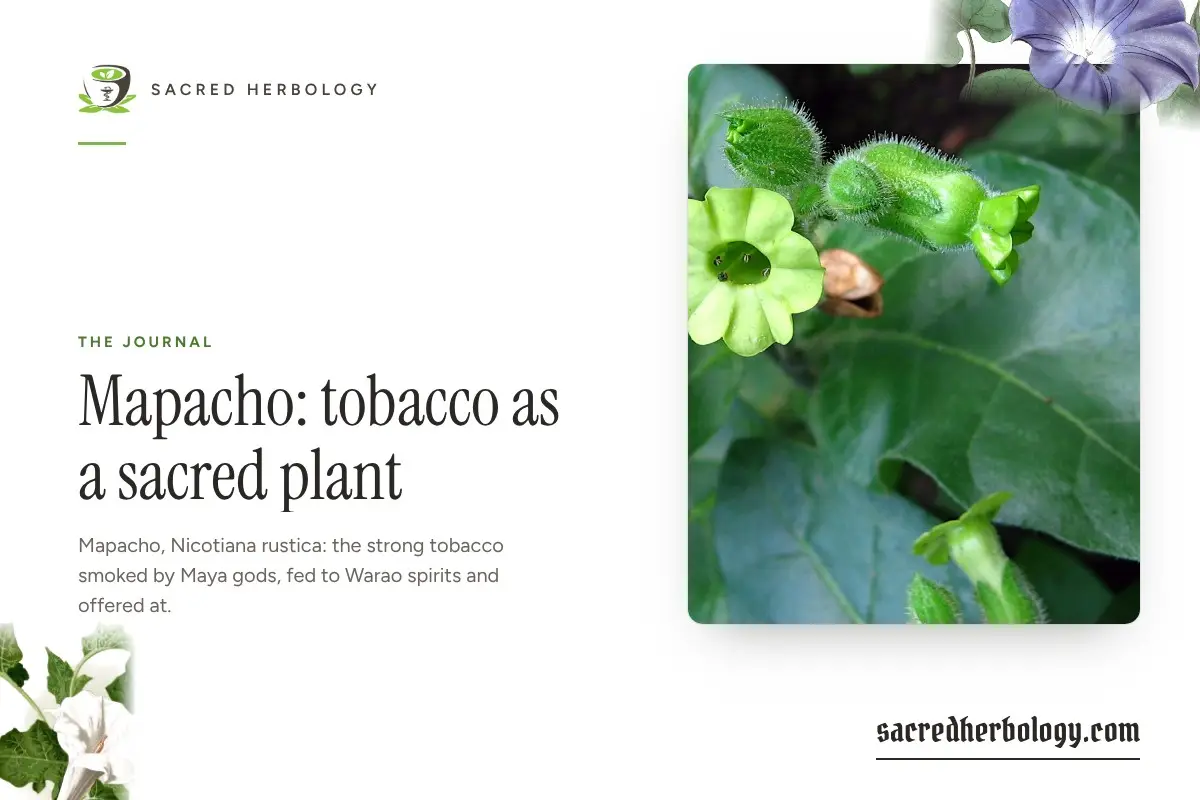
Mapacho is a short, stocky plant. It stands about knee to waist high, with a thick, sticky stem and broad, rounded leaves on short stalks, rather like the leaves of a big lettuce that has decided to become a shrub. The flowers are small greenish-yellow tubes, flared at the mouth, sitting in clusters at the top of the plant. Nobody would grow it for its looks. Its relative, the tall pink-flowered tobacco of the cigarette trade, is the handsomer plant by a long way.
Its botanical name is Nicotiana rustica, and it is a tobacco. In the Peruvian Amazon its leaf, rolled into dark, rough cigarettes, is called mapacho, and that is the name it now travels under around the world. In older English it was “English tobacco”, because it was the kind that grew easily in English gardens in the seventeenth century. In Russia it was makhorka, the coarse tobacco of soldiers and peasants. In eastern North America it was the tobacco people grew and offered long before any European arrived, and in much of the Americas it was something offered, given and fed to spirits, as well as something smoked.
This piece is about that older life of tobacco, as a plant given to gods and spirits, used by shamans and sent up into the sky in smoke. It runs from Maya cigar-smoking gods and a Mexican priest’s catalogue of incantations, through the shamans of the Orinoco Delta and the healers of the Peruvian Amazon, to an English scientist on the coast of North Carolina in 1585, a French explorer at a waterfall, a tobacco-hating king, and the native tobaccos of the Australian desert. It ends with the law, which in Australia has some firm things to say about this plant.
Every piece in this category carries the same house rule, and this one carries it too. Grow it, don’t eat it. With mapacho, as you will see at the end, Australian law trims even the first half of that rule.
Two tobaccos and a big family
Tobacco belongs to the nightshade family, the Solanaceae, with tomato, potato, chilli, henbane, mandrake, belladonna and datura. The genus is Nicotiana. Its species come from two great homes, the Americas and Australia, which now count roughly equal numbers, with a few more on islands of the South Pacific and one in south-western Africa. Two species dominate the human history of the genus, and the second of them is the subject here.
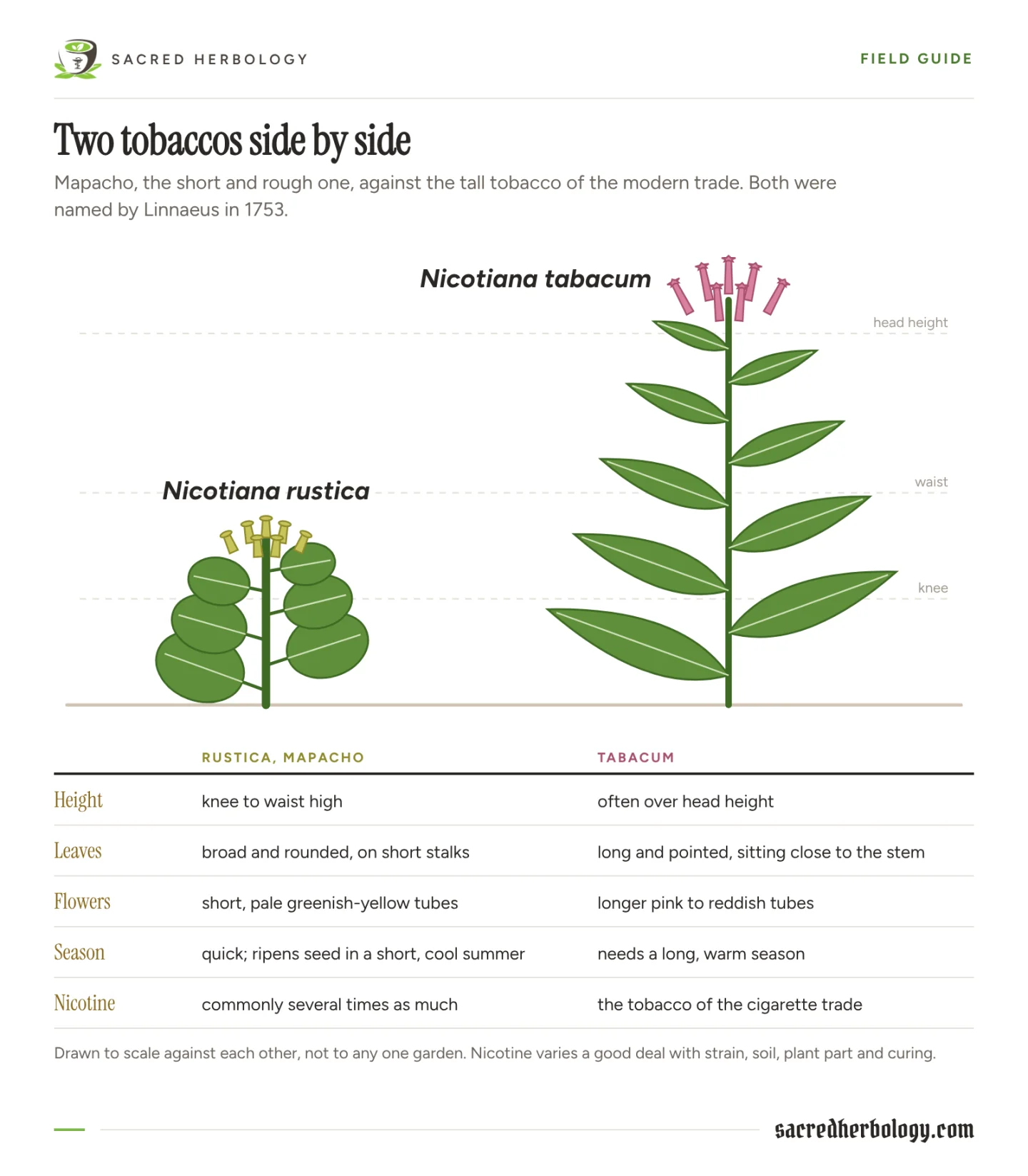
Nicotiana tabacum is the tobacco of the modern trade. It is a tall plant, often over head height, with long pointed leaves that sit close to the stem and clusters of pink to reddish tubular flowers. It is the tobacco of Virginia, Cuba, Turkey and every cigarette factory on earth.
Nicotiana rustica is shorter, tougher and earlier. Its leaves are rounder and stalked, its flowers are pale greenish-yellow and much shorter, and it ripens seed quickly. Nicholas Culpeper, the London herbalist, described it in 1652 under the name English Tobacco as rising “with a round thick stalk, about two feet high”, with flowers “of a greenish yellow colour”, and noted that it was “more familiar in our country than any of the other sorts; early giving ripe seed, which the others seldom do”. That is still a fair description.
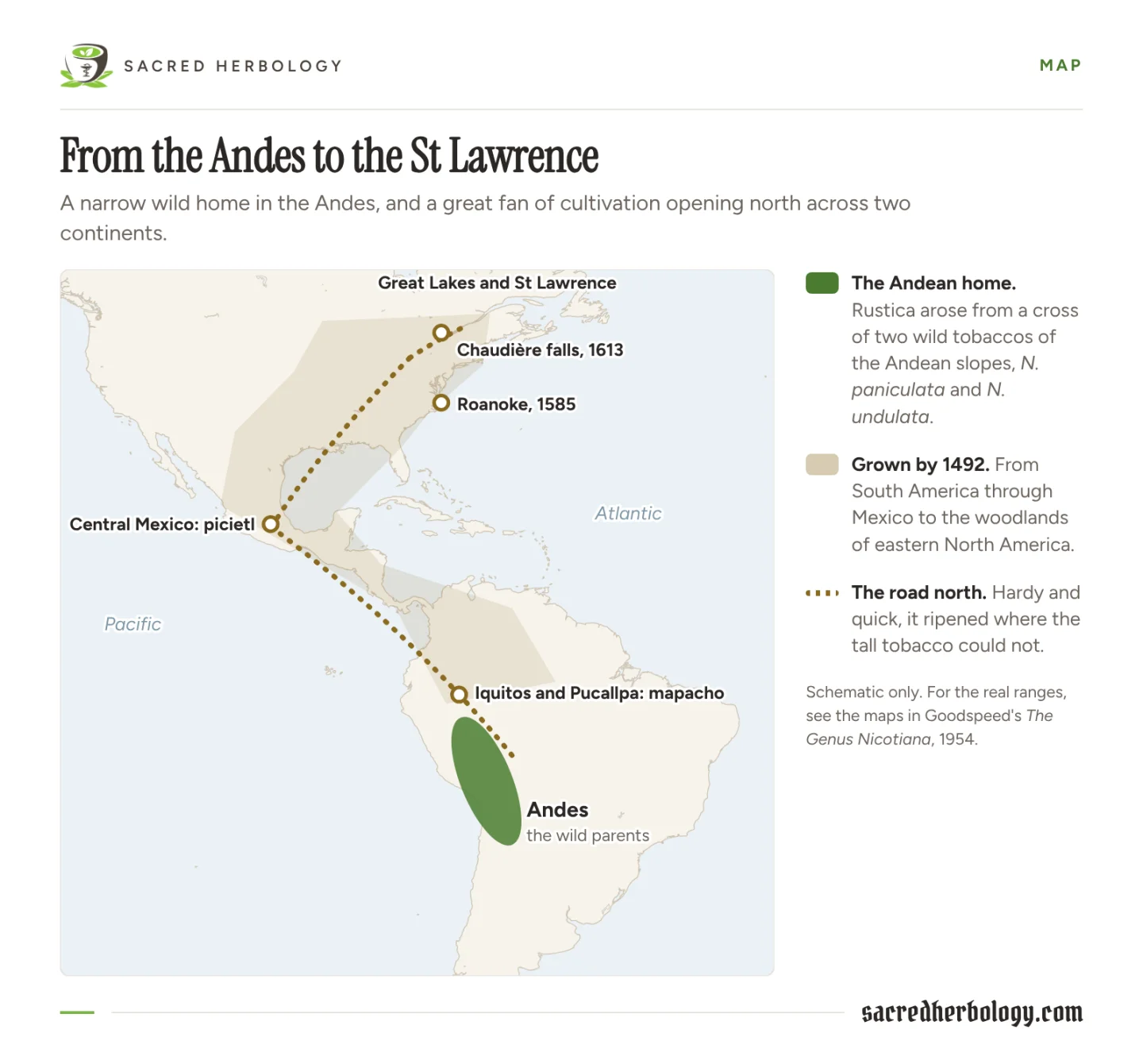
Both species are natural hybrids. Plant geneticists have shown that N. rustica arose long ago from a cross between two wild South American tobaccos, N. paniculata and N. undulata, both of the Andean slopes, followed by a doubling of the chromosomes that made the new plant fertile and stable. N. tabacum arose the same way from a different pair of wild parents. Neither is known as a truly wild plant today. Both have travelled with people for so long that their wild beginnings sit somewhere in the deep past of the Andes and the lands around them.
From there N. rustica spread a very long way. By the time Europeans arrived it was grown from South America through Mexico and up into the woodlands of eastern North America, as far as the Great Lakes and the St Lawrence. It is hardy, quick and forgiving of a short season, which suited it to the north, where the taller tabacum would not ripen. The great American botanist Thomas Harper Goodspeed, whose 1954 monograph The Genus Nicotiana is still the starting point for anyone working on the genus, drew the maps of these ranges: a narrow wild home in the Andes, and a great fan of cultivation opening north across two continents.
Linnaeus gave both species their scientific names in his Species Plantarum of 1753. The genus name honours Jean Nicot, a French diplomat we will meet later, and the species name rustica means “of the countryside”, which is a polite way of calling it rough.
The difference that matters most is in the chemistry. Tobacco’s main alkaloid is nicotine, isolated in 1828 by two students at Heidelberg, Wilhelm Posselt and Karl Reimann, and named after the same Jean Nicot. Rustica leaf commonly carries several times the nicotine of ordinary cigarette tobacco, though the figure varies a good deal with the strain, the soil, the part of the plant and the curing. That one fact explains a great deal of its history. It is why the Jamestown settlers found the local leaf harsh, why, on Wilbert’s reading, Amazonian shamans valued it, and why it was later grown for insecticide. It is also the reason for the rule at the top of this page.
A plant with many names
Before we go to the ceremonies, it helps to sort out the words, because the names of tobacco carry their own history.
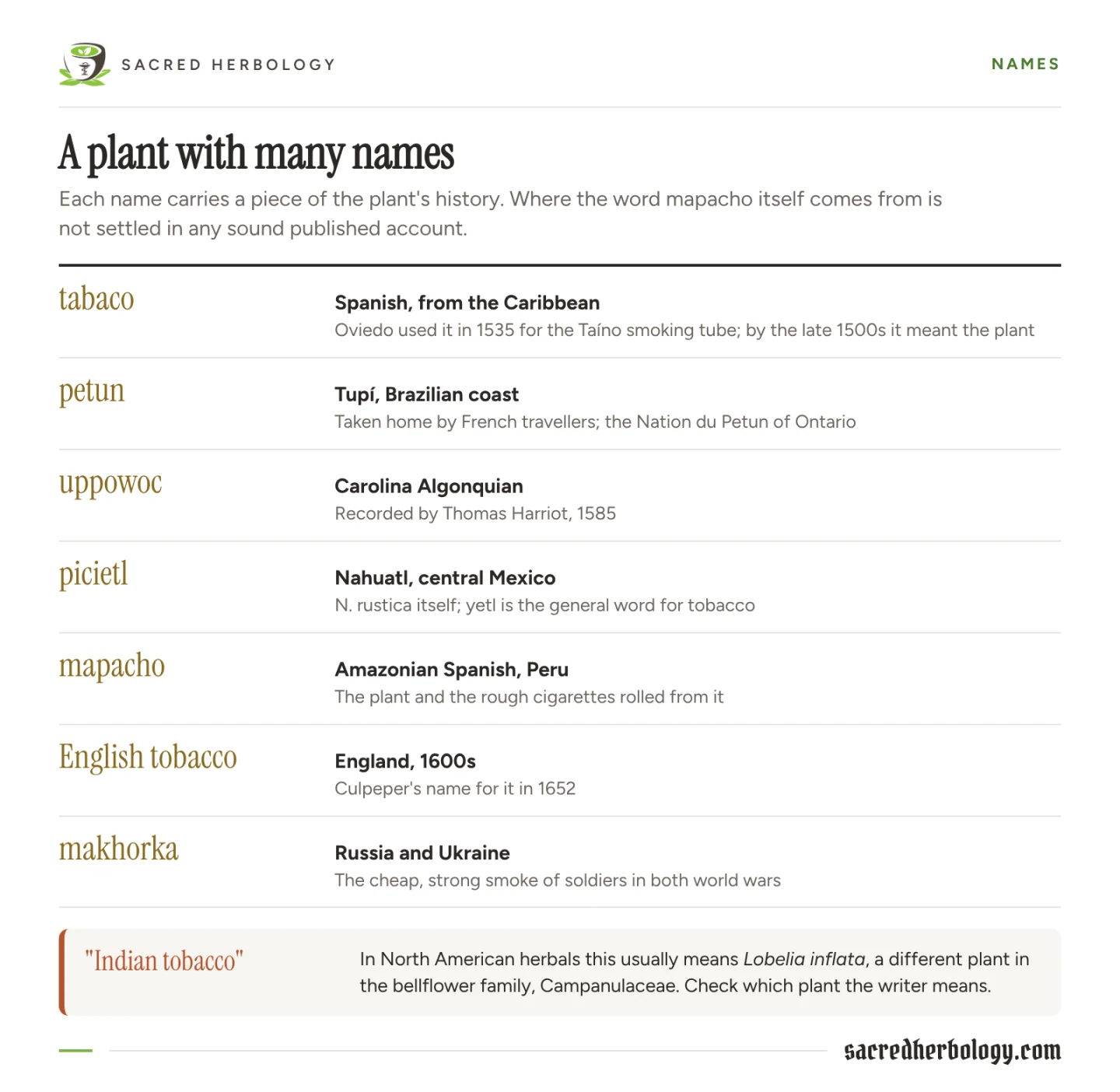
- Tabaco is a word the Spanish picked up in the Caribbean. The chronicler Gonzalo Fernández de Oviedo, writing in 1535, used it for the forked tube that the Taíno of Hispaniola put to their nostrils to take in smoke, and he drew the tube. Later writers argued over whether the word first meant the tube, the rolled leaf or the plant, and it is still argued. By the late sixteenth century it meant the plant across Europe.
- Petun is the word of the Tupí-speaking peoples of the Brazilian coast. French travellers brought it home, and for a long time French speakers called tobacco petun. The French also called an Iroquoian-speaking people south of Georgian Bay, in what is now Ontario, the Nation du Petun, the Tobacco Nation, for the tobacco they grew and traded.
- Uppowoc is the word Thomas Harriot recorded among the Carolina Algonquian peoples in 1585.
- Picietl is the Nahuatl name for N. rustica in central Mexico. Yetl is the more general Nahuatl word for tobacco.
- Mapacho is the Amazonian Spanish name in Peru, for the plant and for the rough cigarettes rolled from it. I have not found a sound published account of where the word comes from, so I will not guess.
There is one more name to be careful with. In North American herbal books, “Indian tobacco” usually means Lobelia inflata, a different plant in a different family, the bellflower family, Campanulaceae. When you read “Indian tobacco” in an old American herbal, check which plant the writer means before you go any further.
The smoking gods of the Maya
The oldest pictures of tobacco in use come from the Maya. They are the best place to start, because they show tobacco in the hands of gods.
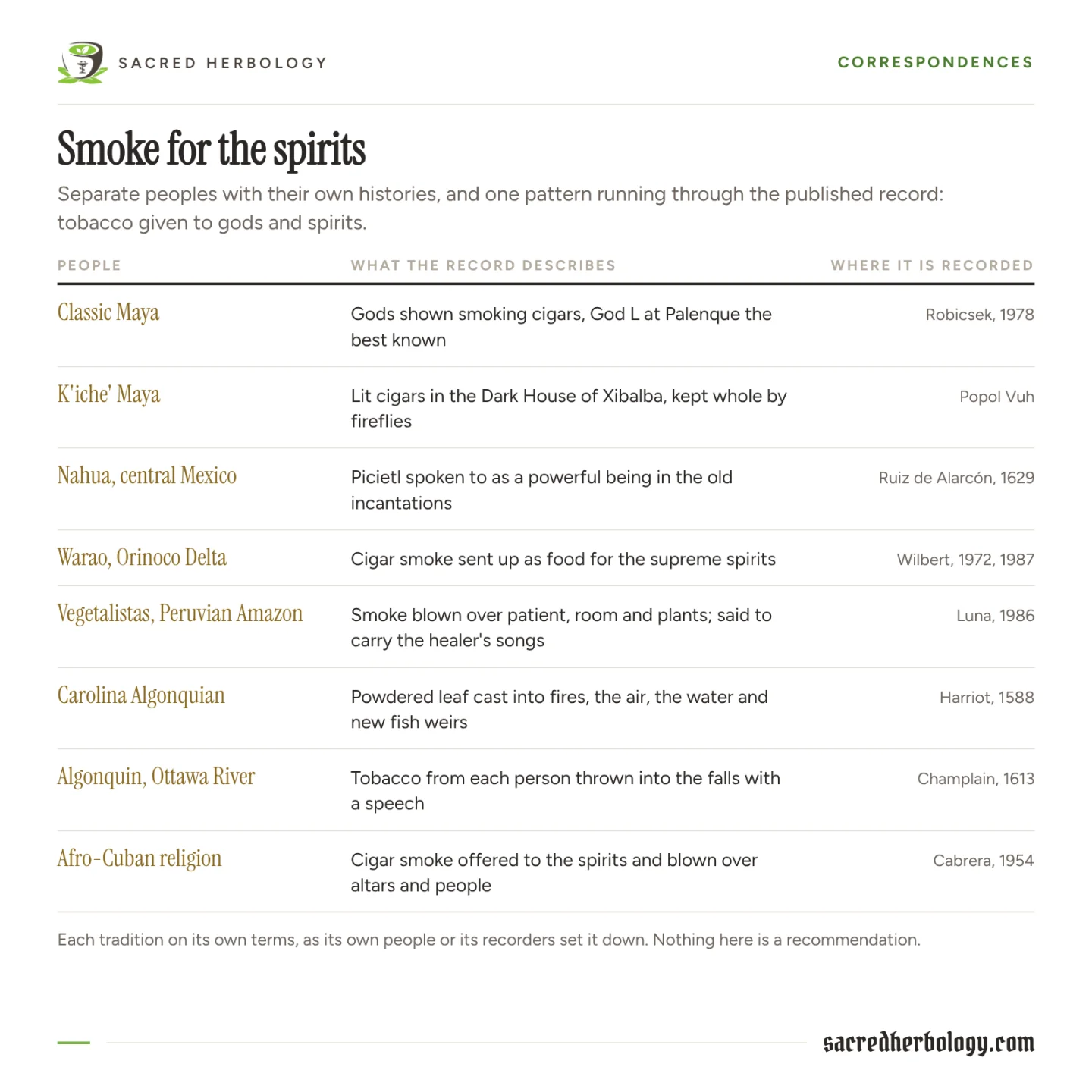
In 1978 the Hungarian-born American surgeon and Maya scholar Francis Robicsek published The Smoking Gods, a collection of tobacco imagery from Maya art: carved stone, painted pots and the few surviving books. His title came from what he found. Maya gods smoke. The best known is the old deity scholars call God L, a lord of the underworld and of merchants, often shown with a broad hat topped by an owl. On a carved panel at the Temple of the Cross at Palenque, in Chiapas, God L stands in profile, wrapped in a jaguar-skin cloak, smoking a fat cigar. It is one of the most reproduced images in Maya art.
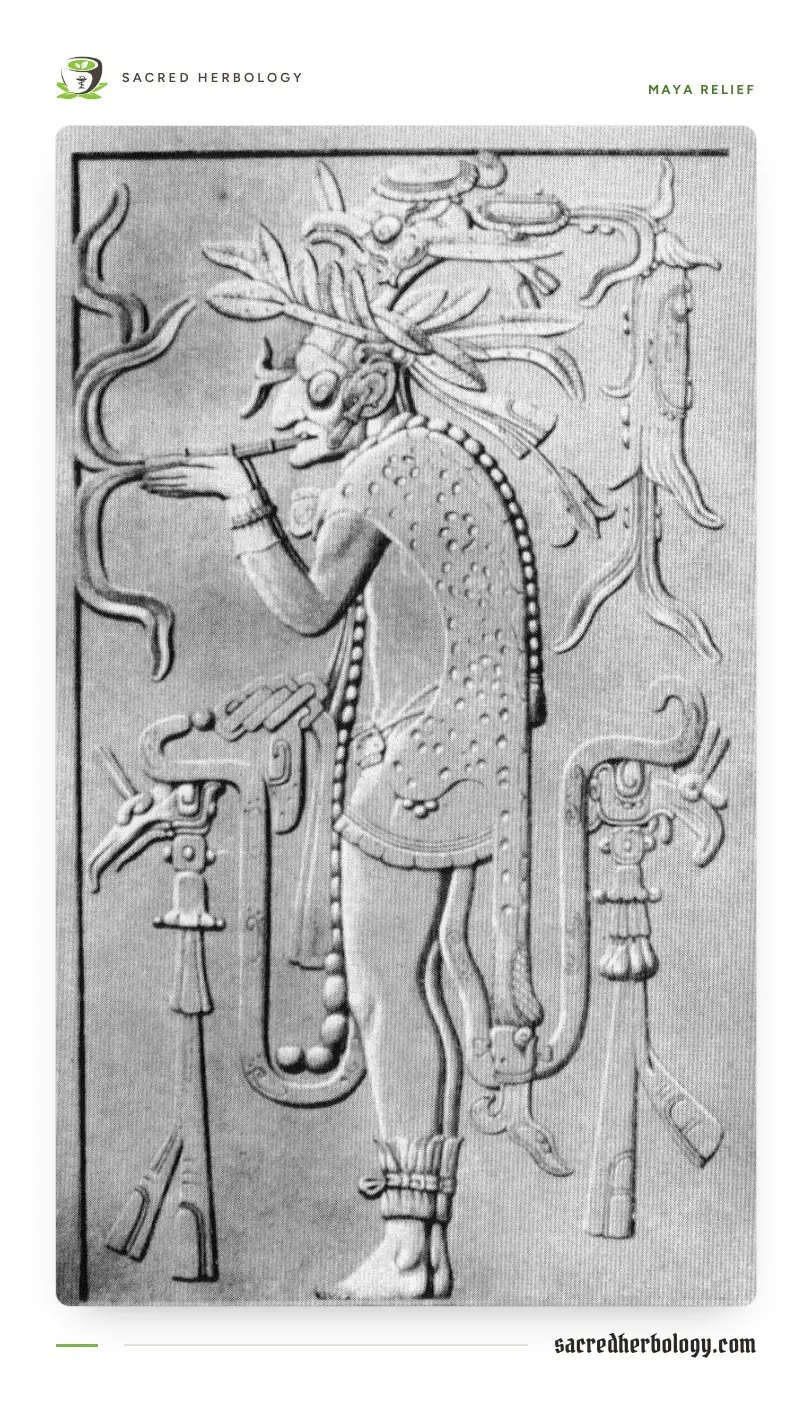

The Maya painted books, the codices, show more smoking deities, and the painted cylinder vases of the Classic period show lords, gods and strange beings with cigars and tubes. Robicsek argued that tobacco smoke in these images is tied to the underworld, to rain and to the shaman’s journey. You can read his evidence and make up your own mind. What the images show without argument is that for the Classic Maya, smoking was something the gods did.
Then there is the Popol Vuh, the great book of the K’iche’ Maya of highland Guatemala. It was written down in K’iche’ using the Latin alphabet in the sixteenth century, and the copy that survives was made by the Dominican friar Francisco Ximénez around 1701. Dennis Tedlock’s English translation of 1985 is the one most readers know.
In it, the hero twins Hunahpu and Xbalanque go down to Xibalba, the underworld, to face its lords. The lords set them a run of trials, one in each of the houses of Xibalba. On the first night they are put in the Dark House and each is given a lit torch and a lit cigar, with orders to return both whole in the morning. Their father and uncle had failed this test and paid with their lives. The twins are cleverer. They put red macaw tail feathers on the torch, which the guards take for flame, and they put fireflies on the tips of the cigars, so that the cigars seem to glow all night without burning down. In the morning they hand back torch and cigars, unburnt, and the lords of Xibalba are dismayed.
It is a wonderful scene to draw, two young men in the dark of the underworld with fireflies on the ends of their cigars. It also tells us that the people who told this story knew tobacco as a thing that belonged in the house of the lords of death, and as something to be outwitted there.
Picietl in Mexico
In central Mexico, the Nahuatl-speaking peoples knew two tobaccos. Picietl was N. rustica, and the Spanish friars who recorded Nahuatl life wrote a good deal about it.
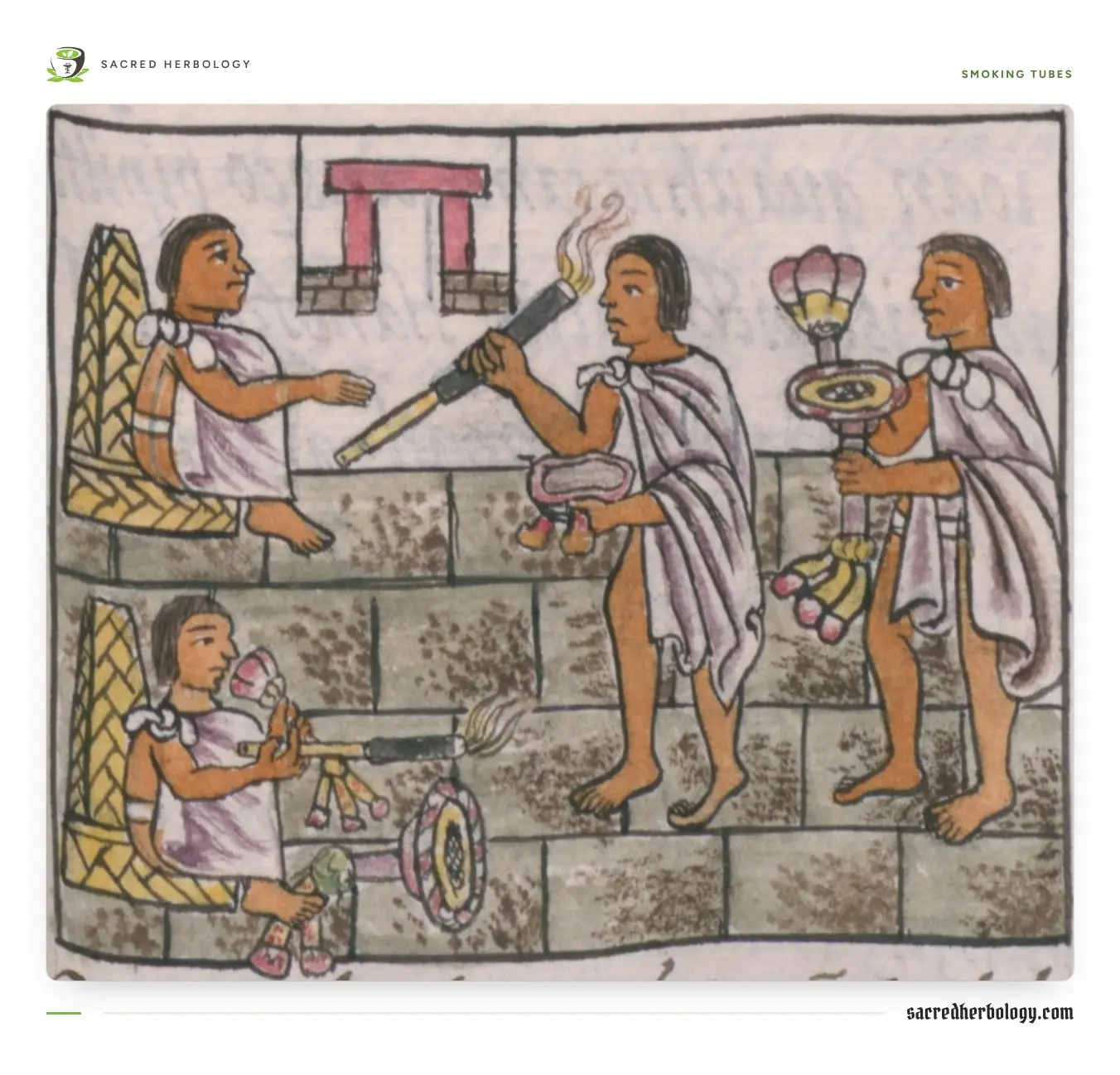
The richest source is the Franciscan friar Bernardino de Sahagún, who with Nahua scholars and elders compiled the great encyclopedia of Aztec life now called the Florentine Codex, finished around 1577. It is in Nahuatl with a Spanish summary, and the standard English translation, by Arthur J. O. Anderson and Charles E. Dibble, came out in twelve books between 1950 and 1982. Tobacco turns up in several of them. Picietl appears among the plants of the natural history book. Smoking tubes, reeds packed with tobacco and fragrant herbs, are handed to guests with flowers at the great feasts of the merchants, and Sahagún’s artists drew people holding them. Priests carried tobacco in gourds as part of their regalia.

The strangest source is later. Hernando Ruiz de Alarcón was a parish priest in the hot country south of Mexico City, and in 1629 he finished a Treatise on the Heathen Superstitions, a handbook meant to help priests root out the old religion. To do that, he collected the incantations that his Nahua parishioners still used for healing, travel, hunting, love and much else, and he wrote them down in Nahuatl with Spanish glosses. The English edition by J. Richard Andrews and Ross Hassig, published in 1984, gives both languages side by side.
Picietl runs all through those incantations. It is spoken to as a powerful being in its own right, called on to help the speaker, and given ritual names that have to do with how the leaf was prepared, beaten and crushed many times over. In the incantations it is a helper and an ally to be addressed, the way you might address a spirit. Ruiz de Alarcón wrote it all down so that it could be stamped out, and in doing so he kept it. That irony runs through a lot of the colonial record, and tobacco is one of its clearest examples.
The Nahua material is folk practice in the plain sense, the working speech of village healers, recorded by a hostile witness. It is not a grimoire and should not be read as one.
Feeding the spirits: tobacco in South America
If one book belongs at the centre of this subject, it is Johannes Wilbert’s Tobacco and Shamanism in South America, published by Yale University Press in 1987. Wilbert was a German-born anthropologist who spent decades with the Warao of the Orinoco Delta in Venezuela, and in this book he gathered everything he could find on tobacco across the whole continent. His conclusion was that tobacco, more than any of the better-known visionary plants, was the great shamanic plant of South America. It was used by more peoples, over a wider area and in more ways than any other.
He catalogued those ways in a long and sobering list. People smoked tobacco in cigars and pipes, took it as snuff, chewed it, licked it as a thick paste, drank it as a juice, and in some places took it in still other ways. I give that list to show how widely it was used. None of it is for trying. Most of these practices belonged to shamans, men and women trained over years, often after long periods of fasting and seclusion, and the amounts they took could knock an untrained person flat.
Wilbert’s own fieldwork was with the Warao, and he first set out his Warao material in an essay in Peter Furst’s collection Flesh of the Gods in 1972. As he records it, the Warao world is a disc of earth surrounded by water, with the supreme spirits living at the cardinal points and the zenith. These spirits hunger for tobacco smoke, which is their food. The Warao shaman smokes long cigars, the leaf rolled in a wrapper from the manicole palm, and the smoke he sends up feeds the spirits and keeps the bond between the people and the powers of the world. Wilbert also records the Warao account of a house of tobacco smoke in the eastern sky, made by a creator spirit, which shamans reach in their trances. All of this is Warao teaching as Wilbert recorded it. It is a whole account of the world, with tobacco smoke as the thing that holds people and spirits together.
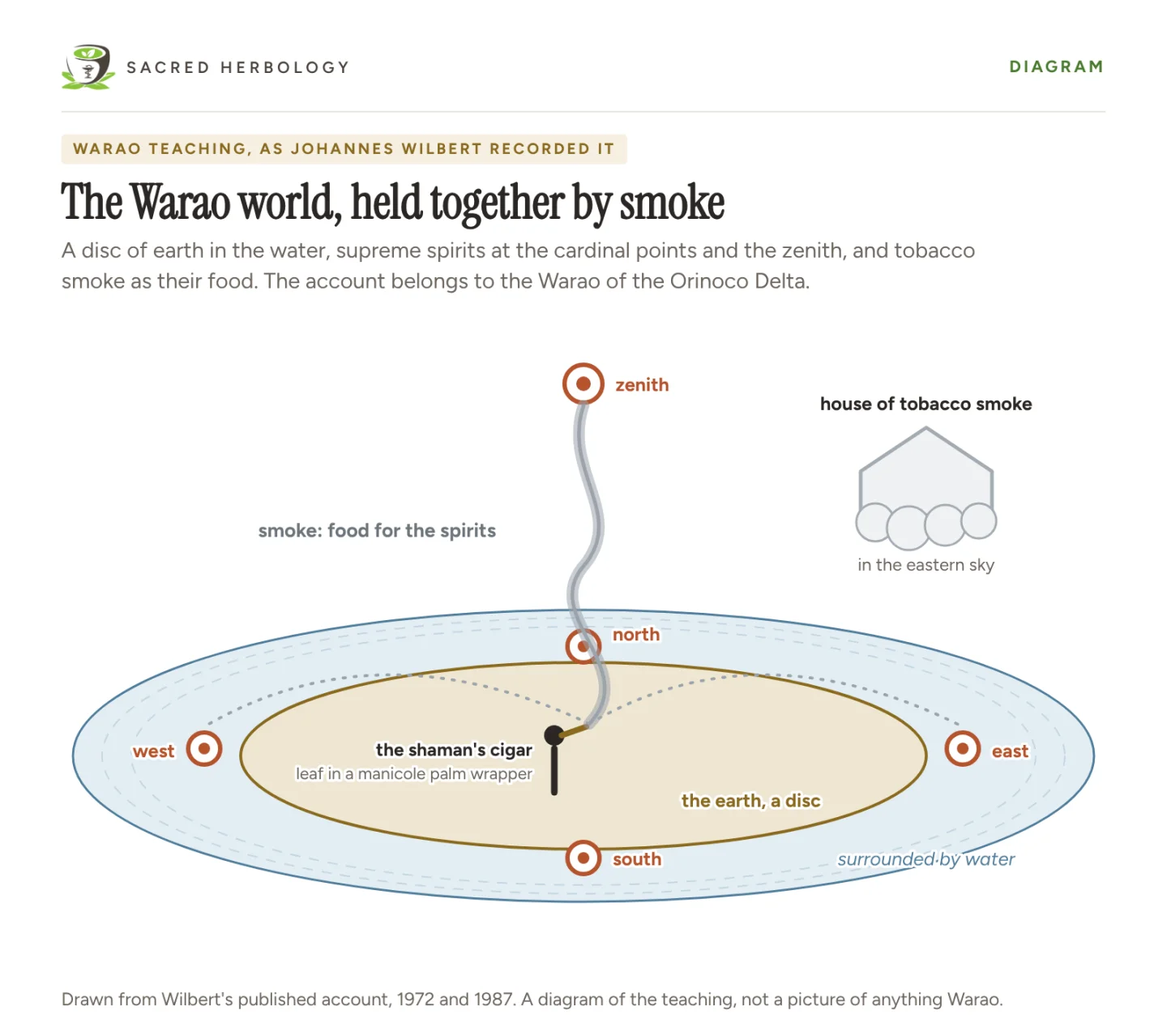
Smoke as food for spirits turns up again and again across the continent, and it is the thread that joins the South American material to the North American offerings we will come to. The details differ from people to people, and Wilbert is careful to keep them separate.
In the north-west Amazon, in Colombia and the neighbouring parts of Peru and Brazil, several peoples, among them the Uitoto, make a thick black tobacco paste called ambil, which men lick from a small container, often in the evening gatherings where they also take powdered coca leaf and talk late into the night. The paste and the talk go together, and the words spoken in those gatherings carry weight. In western Brazil, snuffs made from tobacco and plant ashes, now sold around the world under the Portuguese word rapé, belong to Panoan-speaking peoples of Acre such as the Yawanawá and the Huni Kuin, among others. They are blown into the nose through a V-shaped pipe for oneself or a straight pipe by another person, and those pipes have become familiar objects in the modern trade.
Mapacho in the Peruvian Amazon
The word mapacho, and most of what the modern world knows about the plant, comes from the Peruvian Amazon, around river towns such as Iquitos and Pucallpa.
There, mestizo healers who work with plants are called vegetalistas or curanderos. They are people of mixed Indigenous and Spanish descent whose practice draws on several Amazonian traditions and on Catholic prayer. The Colombian anthropologist Luis Eduardo Luna studied them closely, and his book Vegetalismo: Shamanism among the Mestizo Population of the Peruvian Amazon, published in Stockholm in 1986, is the classic account.
In Luna’s account, mapacho is everywhere in the work. The healer smokes it and blows the smoke, an act called soplar, over the patient, over objects, over the room and over the other plant preparations used in the session, to protect and to purify. Tobacco is one of the plants the vegetalistas call plant teachers, plants believed to teach the healer directly if the healer keeps a strict diet and lives apart for a time while working with them. Each plant is thought to have a spirit, a mother or a doctor, and the healer learns songs, called icaros, from those spirits. Tobacco smoke is said to carry the songs and to please the spirits.
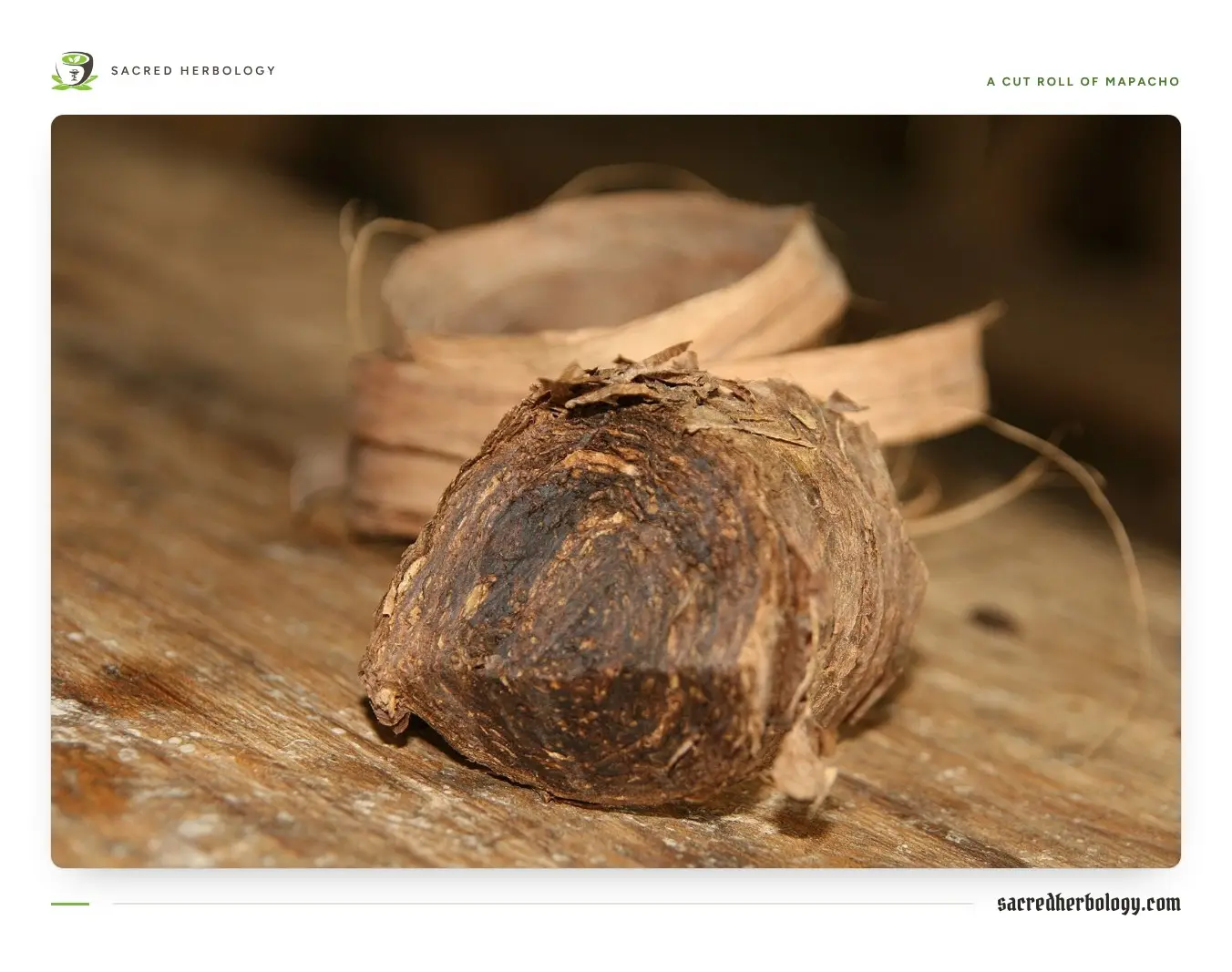

This is the source of the phrase you will hear in modern ceremonial circles, that tobacco is “the father of the plants” or the master plant that opens the way for the others. Healers in the Peruvian Amazon do say things of that kind, and Luna recorded them. It is their teaching, and I give it to you as theirs. It is not a fact about the plant, and it is not a recommendation.
One more thing about the setting. Mapacho cigarettes are a cheap, everyday smoke in those river towns as well as a healer’s tool. The same rough cigarette is lit at the market stall and in the ceremony. That ordinariness is worth keeping in mind when the plant arrives in other countries wrapped in the word sacred.
Into the fire and the water: eastern North America
Now go north, to the woodlands of eastern North America, where N. rustica was the tobacco of the farming peoples. The archaeologist Joseph Winter, whose edited volume Tobacco Use by Native North Americans: Sacred Smoke and Silent Killer came out in 2000, gathers the evidence that it was grown widely across the east for many centuries before Europeans arrived. That book’s subtitle holds both halves of the story in five words.
The first detailed English account of it is also one of the best. In 1585 Sir Walter Raleigh sent an expedition to Roanoke Island, off what is now North Carolina. With it went Thomas Harriot, a young mathematician and astronomer, and John White, an artist. Harriot’s A Briefe and True Report of the New Found Land of Virginia was printed in London in 1588, and in 1590 the Frankfurt engraver Theodor de Bry reprinted it with engravings after White’s watercolours. Those engravings, with their villages, fields and fish weirs, are among the most famous pictures of sixteenth-century America.
Harriot writes about the local tobacco, which the Carolina Algonquian peoples called uppowoc. Modernising his spelling, he says it is “of so precious estimation amongst them, that they think their gods are marvellously delighted therewith”. He goes on to describe what they did with it. They made hallowed fires and cast the powdered leaf into them as a sacrifice. Caught in a storm on the water, they threw it into the air and into the water to pacify their gods. When a new fish weir was set up, they cast tobacco into it and into the air. After an escape from danger, they threw it into the air again. All of this, he says, was done with stamping, dancing, clapping and raising of hands, looking up to the heavens and speaking words he could not follow.
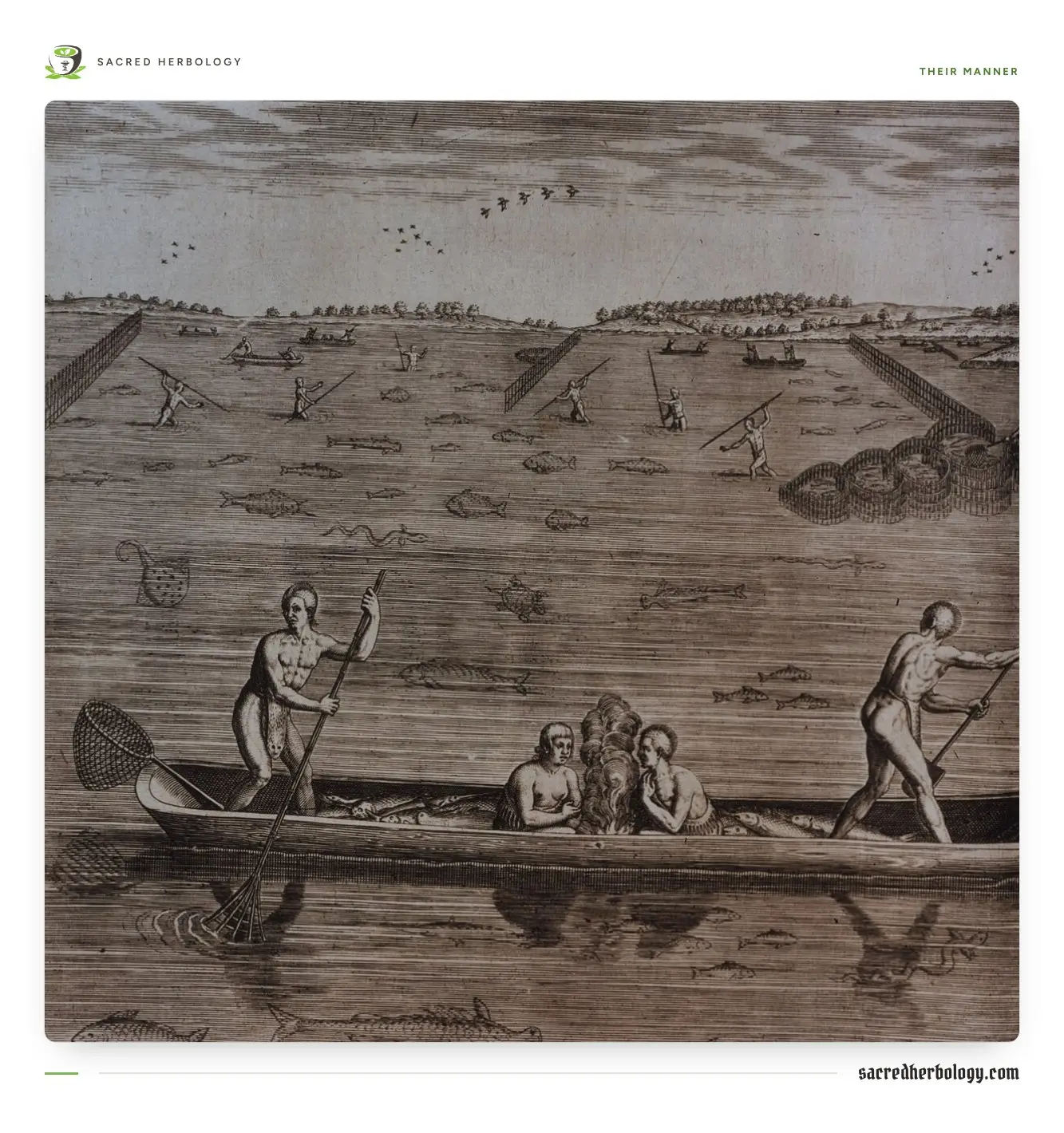

Harriot then adds, quite cheerfully, that he and his companions took up smoking it themselves “after their manner” while they were there. In that one passage you can see tobacco change hands. To the people who grew it, it was an offering. To the Englishmen, it became a smoke.
A few decades later, on the other side of the continent’s north-east, the French explorer Samuel de Champlain saw something very like it. In his account of his 1613 journey up the Ottawa River, he describes the Algonquin people he travelled with stopping at the great falls the French called the Chaudière, the cauldron, near the site of modern Ottawa. They gathered tobacco from each person into a dish, and after a speech, one of them threw it into the boiling water of the falls as an offering, asking for protection from their enemies. The scene is one of the most vivid in Champlain, and it pairs naturally with Harriot’s fish weir, two peoples a thousand kilometres apart, giving tobacco to the water.
Out on the Plains, the pipe stands at the centre of Lakota religious life. The Sacred Pipe, the account given by the Oglala Lakota holy man Black Elk to Joseph Epes Brown and published in 1953, tells how White Buffalo Calf Woman brought the pipe to the Lakota and describes the seven rites connected with it. The smoking mixtures used in Plains pipes often included other plants, such as bark of red willow and leaves of bearberry, and the word kinnikinnick, from an Algonquian language and meaning roughly “mixture”, came to be used for them. I mention the pipe because it is part of any honest story of sacred tobacco and because Black Elk chose to have this account published. Much about the pipe belongs to the people who keep it and is not for outsiders, and I keep to the published record.
Across many First Nations and Native American communities today, tobacco is still given as an offering and as a gift when asking an elder for help or teaching, and it is set down on the earth or the water with a prayer. Many of those communities draw a firm line between this traditional, ceremonial tobacco and commercial cigarettes, and many of their health programmes carry the slogan “keep tobacco sacred”. That line between the offering and the habit runs through this whole story.
Europe meets the leaf
The European side of the story begins on the first voyage of Christopher Columbus. His log of that voyage survives only in a summary made by Bartolomé de las Casas, translated by Oliver Dunn and James E. Kelley in 1989. On 15 October 1492, a man in a canoe near the Bahamas carried some dried leaves, which Columbus notes were highly prized. On 6 November, two men sent inland in Cuba, Luis de Torres and Rodrigo de Jerez, came back and reported that they had met people carrying a smouldering firebrand of herbs whose smoke they drew in. That firebrand is the first European description of someone smoking.

The Spanish physician Nicolás Monardes of Seville never crossed the Atlantic, but he wrote about the new plants that came into the port, and the second part of his book on the medicines of the Indies, published in 1571, has a long chapter on tobacco. The Englishman John Frampton translated it in 1577 under the cheerful title Joyfull Newes out of the Newe Founde Worlde. Most of the chapter is a list of the cures Monardes believed tobacco could perform, which I will not repeat. But he also describes the priests of the Indies taking tobacco smoke before giving answers to questions put to them, falling down as if dead, and on waking telling what they had seen. It is a secondhand account, and a European one, of tobacco as a means of consulting the spirits.
The French came at it through Brazil. The Franciscan friar André Thevet, back from a short-lived French colony in Rio de Janeiro bay, described petun and the Tupinamba use of it in his Singularitez de la France antarctique, published in Paris in 1557. A few years later, around 1560, Jean Nicot, the French ambassador in Lisbon, sent tobacco seed or powder to Catherine de’ Medici, the queen mother of France. For a while it was called the queen’s herb. Nicot’s name ended up on the genus and on the alkaloid, and Thevet spent years complaining that he had brought it first.
The tobacco that first grew well in northern European gardens was rustica, which ripens in a short, cool summer. That is why Culpeper could call it English Tobacco in 1652 and say it was the commonest kind in England. In the 1620s and after, farmers around Winchcombe in Gloucestershire grew tobacco as a cash crop, and the government, which wanted English smokers buying taxed Virginia leaf, sent soldiers to pull up the fields more than once. The historian Joan Thirsk wrote the history of that little war.
Culpeper’s entry matters for another reason. He was an astrological herbalist, and every plant in his book is assigned to a planet. Of English Tobacco he says simply, “It is a martial plant”, a plant of Mars. That attribution belongs to the esoteric tradition of planetary herbs, the learned astrology of plants. Tobacco was too new for the medieval and Renaissance authorities on planetary plants, who never knew it, so Culpeper’s placing is his own seventeenth-century fitting of an American plant into an old European scheme. The hot, fiery, biting nature of the leaf made Mars the obvious choice in his system. It is a nice example of how a plant from another world was given a place in this one. As for the cures Culpeper lists for tobacco, they are his, and I will not pass them on.
A king against the smoke
In Virginia, the English settlers at Jamestown found the Powhatan peoples growing rustica. William Strachey, secretary of the colony, described it in his Historie of Travell into Virginia Britania, written around 1612 and printed by the Hakluyt Society in 1849, as “poore and weake, and of a byting tast”. The settlers did not like it, and neither did the London market, which already favoured the sweeter Spanish leaf from the Caribbean.
The man who changed that was John Rolfe, now better remembered as the husband of Pocahontas. Around 1611 or 1612 he obtained seed of the Spanish tobacco, N. tabacum, apparently from Trinidad or the Orinoco region, and grew it at Jamestown. His first shipments reached London in 1614. Within a generation Virginia was a tobacco colony, and the plant that the Powhatan offered to their gods had been replaced in their own country by a foreign species grown for sale. If you want a single image for that change, it is a field of tall pink-flowered tabacum where the short yellow-flowered rustica used to be.
Not everyone in England welcomed the new habit. In 1604 King James I published, without his name on it at first, A Counterblaste to Tobacco. He objected to it on every ground he could think of, including that it came from the Indians and that the English were aping their customs. His closing words are still quoted: smoking is “a custome lothsome to the eye, hatefull to the Nose, harmefull to the braine, dangerous to the Lungs, and in the blacke stinking fume thereof, neerest resembling the horrible Stigian smoke of the pit that is bottomelesse”. He then taxed it heavily, and the Crown was soon living off the revenue. Every government since has found itself in the same position.
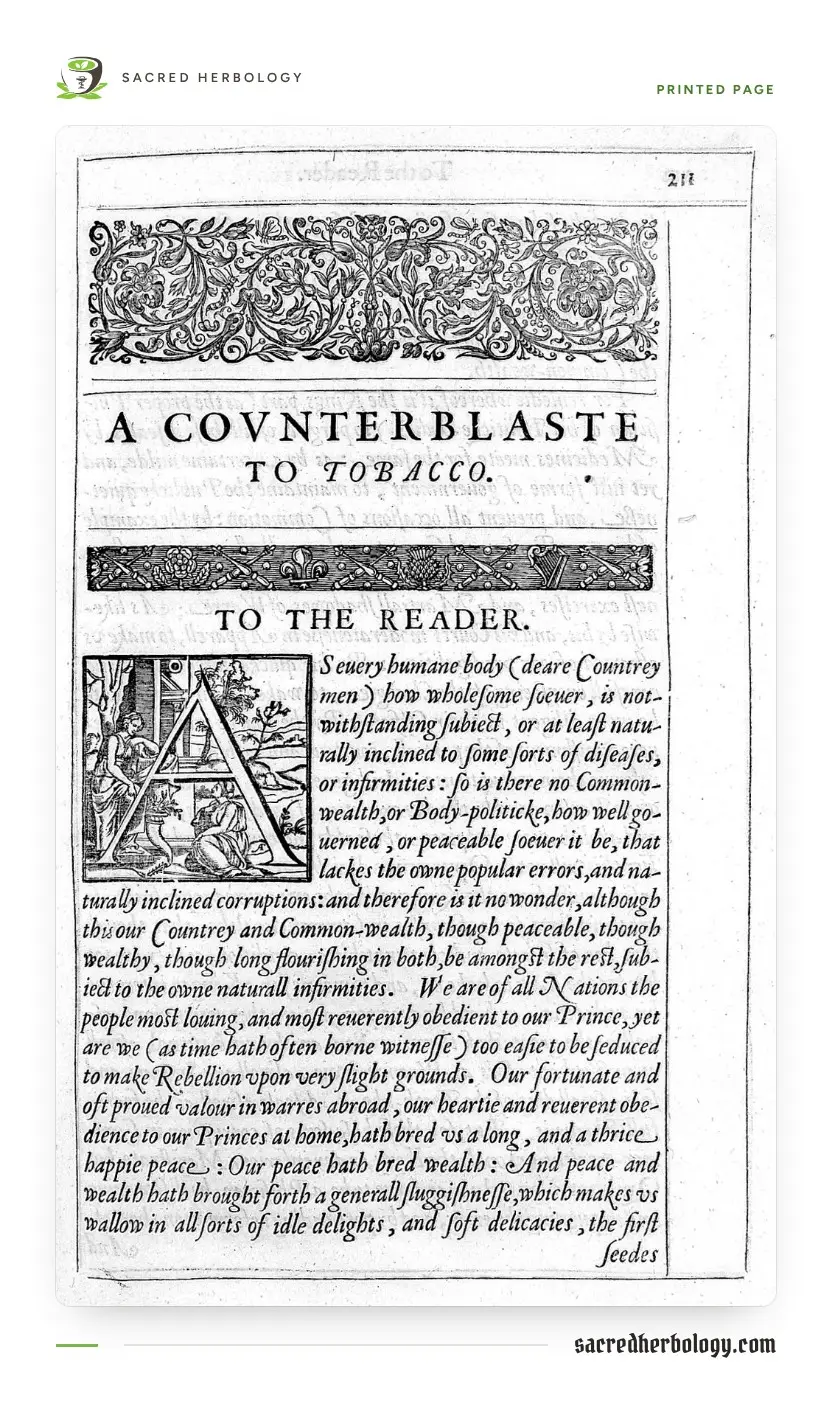

Rustica kept its place in poorer and colder country. In Russia and Ukraine it became makhorka, the cheap, strong smoking tobacco rolled in newspaper by soldiers in both world wars. It was grown in parts of Turkey, Hungary and India. And because of its high nicotine content it was grown in the late nineteenth and twentieth centuries as a source of nicotine for garden insecticides, which tells you something plain about the strength of the leaf.
Tobacco in Australia before 1788
Australia has its own long tobacco story, and it is one of the least known.
Australia is one of the great centres of the genus. All the native Australian tobaccos belong to a single section of Nicotiana called Suaveolentes, which has been the subject of a burst of botanical work. In 2023 Mark Chase, Maarten Christenhusz and their colleagues described nine new species in the journal Australian Systematic Botany, bringing the number of named Australian species to fifty-one, with more still awaiting description. Most of them are plants of the arid and semi-arid inland, and many have pale, night-scented flowers. One of them, Nicotiana benthamiana, has become one of the most used laboratory plants in the world, a desert tobacco from northern Australia now grown in plant science labs on every continent.
Aboriginal peoples of the desert used several native tobaccos. The botanist Peter Latz, who grew up at Hermannsburg in Central Australia and worked for decades with Aboriginal people of the region, records in Bushfires and Bushtucker (1995) the native tobaccos the Anangu and their neighbours call mingkulpa, among them Nicotiana gossei and related species. The leaves were chewed as a quid mixed with plant ash. They were gathered, dried and traded, and the best stands were known and visited.
Then there is pituri. Pituri is the name of a tobacco-like chewing preparation made from the leaves of Duboisia hopwoodii, which belongs to the same nightshade family and carries nicotine and related alkaloids. It is not a Nicotiana. The best pituri was said to come from the Mulligan River country in far south-west Queensland, and it was traded over very long distances along Aboriginal exchange routes that crossed much of eastern and central Australia. The archaeologist Pamela Watson’s This Precious Foliage, published by the University of Sydney in 1983, is the study of it, and her title tells you how it was valued.
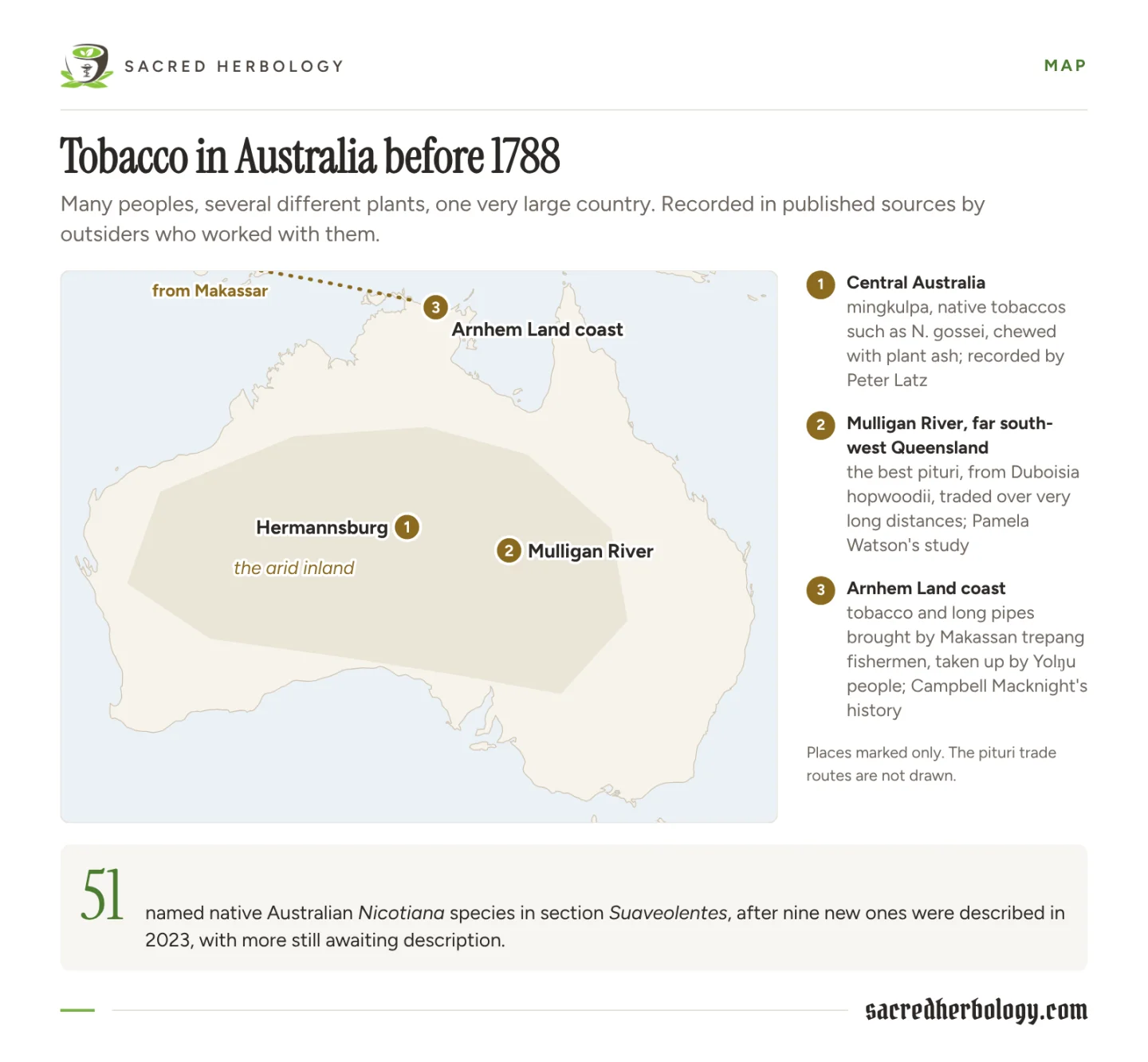
In the north, tobacco of the American kind arrived before the British. For a long period before and after 1788, trepang fishermen from Makassar in Sulawesi sailed each year to the Arnhem Land coast, and they brought tobacco and long pipes. Yolŋu people took up both, and the long Makassan-style pipe became part of Yolŋu life and art. Campbell Macknight told the story of those voyages in The Voyage to Marege’ in 1976.
None of this is a single Australian tradition, and I do not want to make it sound like one. It is many peoples using several different plants over a very large country, recorded in published sources by outsiders who worked with them. The detail belongs to those peoples.
Mapacho now
In the last thirty years mapacho has gone global. It travels with the Amazonian ceremonial circuit and the retreat trade, and it is sold online as ceremonial tobacco, often with a story attached about its purity and its spirit. Rapé has gone the same way. Some of what is sold is made by and benefits the peoples whose practice it comes from, and some is made by whoever saw a market.
None of it can be checked by eye, either. Once tobacco leaf is cured, cut and rolled, nobody can tell rustica from ordinary tabacum by looking at it, and how much nicotine it holds can only be found by laboratory testing. A label that says mapacho, pure or ceremonial is the seller’s word and nothing you can see for yourself. Rapé is harder again, because it is a ground mixture of tobacco, ash and often other plants, and the buyer has no way of knowing what went into it or how strong it is.
Two things are worth saying plainly about the modern scene.
The first is about tradition. When an Amazonian healer smokes mapacho in a session, that act sits inside a whole way of life: the years of training, the diet, the songs, the relationships with the plant spirits as the healer understands them. When the same cigarette is sold in a city shop as sacred, only the leaf travels. Whether a practitioner outside those traditions finds meaning in the plant is their own business, and this piece makes no claim about it either way. But the leaf on its own does not carry the training with it.
The second is about the leaf. You will read that mapacho is safe or safer because it is pure, organic or free of the additives in commercial cigarettes. Nicotine is nicotine, whichever species and however it was grown, and rustica carries a lot of it. Smoke is smoke. The long list of harms from tobacco smoke comes mainly from burning the leaf and breathing the products, and growing it without additives does not remove them. That is the “silent killer” half of Joseph Winter’s subtitle, and it applies to the ceremonial leaf as much as to the cigarette.
Tobacco is also present in the religions of the African diaspora in the Americas. In Cuba, the ethnographer Lydia Cabrera’s El Monte, published in Havana in 1954, records cigar smoke and tobacco throughout Afro-Cuban religious life, offered to the spirits and blown over altars and people, and similar uses are recorded in Brazil and Haiti. These are separate traditions with their own histories, and they show again the same pattern found from the Orinoco to Roanoke: tobacco smoke given to the spirits.
Safety and the law
Nicotine is a strong poison, and rustica has a great deal of it. Two kinds of harm come up in the garden and the home.
The first is green tobacco sickness. People who handle wet tobacco leaves, especially harvesters working in the morning dew or after rain, absorb nicotine through the skin. It is well described among tobacco farm workers around the world, and it brings on nausea, vomiting, dizziness, headache and weakness. The leaf does not have to be eaten or smoked to do harm. Anyone who feels unwell after handling wet leaf should wash the skin well with soap and water, change out of damp clothes and call the Poisons Information Centre on 13 11 26.
The second is swallowing. Children who eat tobacco leaf, cigarettes or butts can be poisoned, and so can pets. Vape liquid is the most dangerous of all for a small child, because the nicotine in it is concentrated and goes in quickly, whether swallowed or spilt on the skin. Nicotine poisoning can cause vomiting, sweating, pallor, drooling, a racing and then slowing heart, shaking, weakness, fits and trouble breathing.
- If anyone, adult or child, has swallowed tobacco leaf or any nicotine product, call the Poisons Information Centre on 13 11 26, any hour, anywhere in Australia, even if they seem well. Do not try to make them vomit.
- If they are drowsy, having a fit, struggling to breathe or collapsing, call 000.
- If a dog, cat or other animal has chewed leaf, butts or vape liquid, call your vet or an after-hours animal emergency clinic straight away. The Poisons Information Centre line is for people.
Pregnancy needs its own word. Nicotine crosses the placenta and passes into breast milk, so pregnancy and breastfeeding are times to stay away from the leaf, the wet plant and the smoke altogether, ceremonial or otherwise.
Then there is the law, and in Australia it is firm.
Under the Excise Act 1901, it is an offence to produce tobacco seed, tobacco plant or tobacco leaf without a producer licence from the Australian Taxation Office. The Act does not say which species count, but the ATO’s published interpretative decision on the question, ATO ID 2009/118, treats as tobacco plants the species whose leaves are generally used for smoking, chewing or snuff, and it names Nicotiana tabacum, N. rustica and N. sylvestris. The ATO also says that the licence requirement applies even if you only intend to grow for personal use, and that no one is currently licensed to grow tobacco in Australia, for sale or for personal use. Australia’s last legal tobacco growers stopped in 2006.
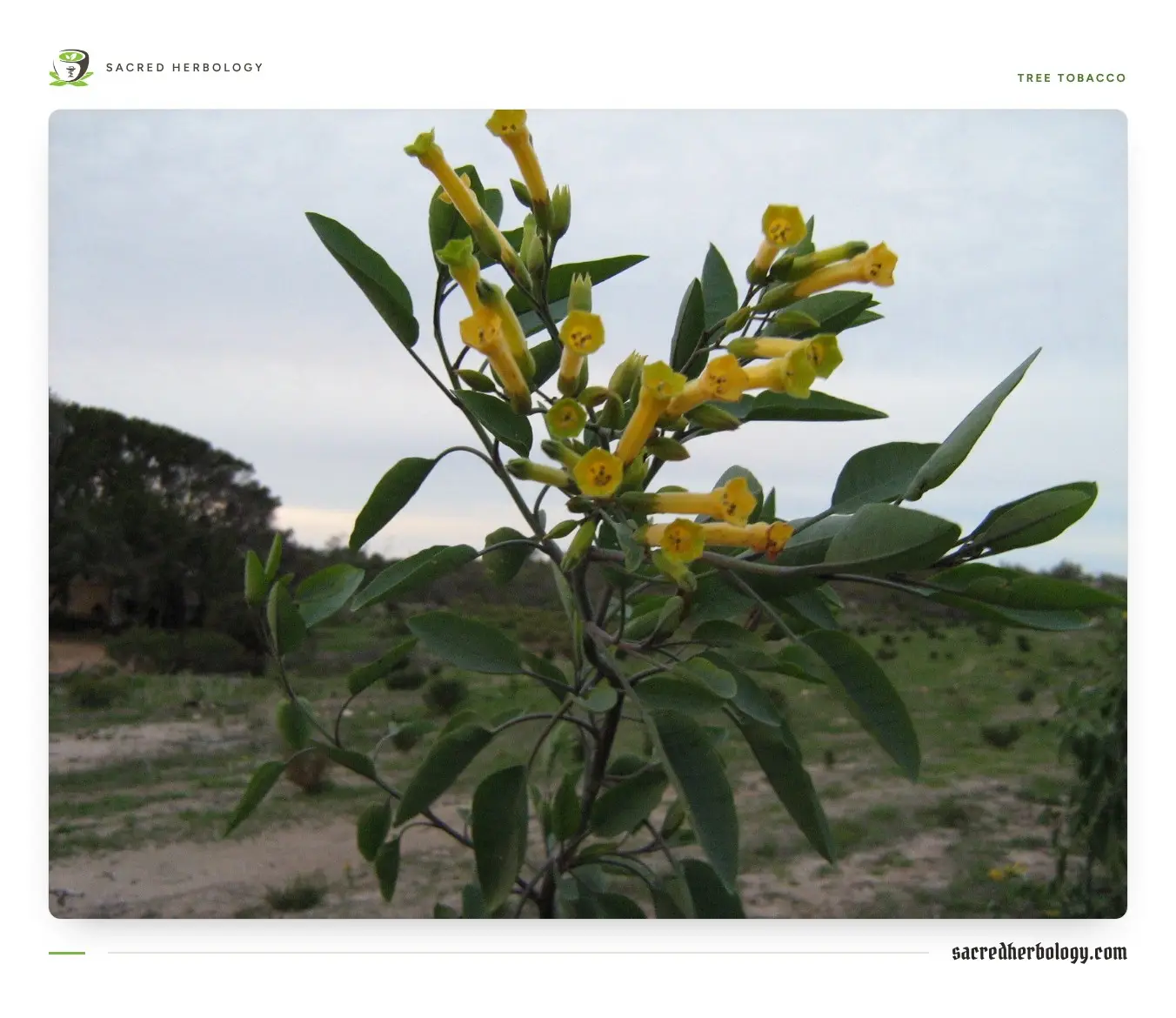
So mapacho cannot lawfully be grown in an Australian garden. The scented garden nicotianas sold in nurseries for their flowers, such as N. alata, are not named in that ruling. The ruling also says other species would count if their leaves came to be generally used for smoking, chewing or snuff. If you are unsure about a particular plant, ask the ATO before you sow it. The native species growing wild in the inland are another matter, and they are not ours to pick or trade. Not every wild tobacco out there is native, either. The tall, blue-grey tree tobacco, N. glauca, with its yellow tubular flowers, is a South American plant that has run wild along creeks, roadsides and old mine sites across much of dry Australia, and it is treated as a weed.
Selling the leaf is just as tightly controlled. Tobacco products sold in Australia carry excise, must meet the plain packaging and health warning rules under Commonwealth law, and in Queensland retailers now need a licence to sell them. Imports are taxed and limited. That is why you will not find mapacho, rapé or any tobacco in our shop, and why there is no product link on this page.
So the house rule bends for this one plant. Grow it, don’t eat it, is the rule for the Poison Path. For mapacho in Australia, read about it, look at the old engravings and the Maya panels, and leave the growing to the places where the law allows it.
If you want to understand what a plant like this does in the body, and how it sits with anything else you take, consult a degree-qualified herbalist with competencies and adequate training in pharmacognosy.
What remains is a plant with a very long story. It came out of the Andes, travelled north with the farmers of two continents, sat in the hands of the Maya gods, fed the spirits of the Warao, went into the Ottawa River at the Chaudière and onto the fish weirs at Roanoke, gave its name to a French diplomat’s genus and a king’s tirade, and grew in English cottage gardens under the sign of Mars. It is small, rough and yellow-flowered, and the peoples who grew it first gave it to their gods before they gave it to themselves.

Where this comes from
- Gonzalo Fernández de Oviedo, La historia general de las Indias (Seville, 1535).
- André Thevet, Les singularitez de la France antarctique (Paris, 1557).
- Nicolás Monardes, Joyfull Newes out of the Newe Founde Worlde, trans. John Frampton (London, 1577).
- Thomas Harriot, A Briefe and True Report of the New Found Land of Virginia (London, 1588); illustrated edition with engravings by Theodor de Bry after John White (Frankfurt, 1590).
- James I, A Counterblaste to Tobacco (London, 1604).
- Samuel de Champlain, Les voyages (Paris, 1613); in English in The Works of Samuel de Champlain, ed. H. P. Biggar (Champlain Society, 1922-1936).
- Nicholas Culpeper, The English Physitian (London, 1652), later printed as The Complete Herbal.
- Carl Linnaeus, Species Plantarum (Stockholm, 1753).
- William Strachey, The Historie of Travaile into Virginia Britannia, ed. R. H. Major (Hakluyt Society, 1849).
- Bernardino de Sahagún, Florentine Codex: General History of the Things of New Spain, trans. Arthur J. O. Anderson and Charles E. Dibble, 12 books (School of American Research and University of Utah, 1950-1982).
- Joseph Epes Brown, ed., The Sacred Pipe: Black Elk’s Account of the Seven Rites of the Oglala Sioux (University of Oklahoma Press, 1953).
- Lydia Cabrera, El Monte (Havana, 1954).
- Thomas Harper Goodspeed, The Genus Nicotiana (Chronica Botanica, 1954).
- Johannes Wilbert, “Tobacco and shamanistic ecstasy among the Warao Indians of Venezuela”, in Peter T. Furst, ed., Flesh of the Gods: The Ritual Use of Hallucinogens (Praeger, 1972).
- Joan Thirsk, “New crops and their diffusion: tobacco-growing in seventeenth-century England”, in C. W. Chalklin and M. A. Havinden, eds, Rural Change and Urban Growth 1500-1800 (Longman, 1974).
- C. C. Macknight, The Voyage to Marege’: Macassan Trepangers in Northern Australia (Melbourne University Press, 1976).
- Francis Robicsek, The Smoking Gods: Tobacco in Maya Art, History, and Religion (University of Oklahoma Press, 1978).
- Pamela Watson, This Precious Foliage: A Study of the Aboriginal Psycho-active Drug Pituri, Oceania Monograph 26 (University of Sydney, 1983).
- Hernando Ruiz de Alarcón, Treatise on the Heathen Superstitions That Today Live Among the Indians Native to This New Spain, 1629, trans. and ed. J. Richard Andrews and Ross Hassig (University of Oklahoma Press, 1984).
- Dennis Tedlock, trans., Popol Vuh (Simon and Schuster, 1985; revised edition 1996).
- Luis Eduardo Luna, Vegetalismo: Shamanism among the Mestizo Population of the Peruvian Amazon (Almqvist and Wiksell, Stockholm, 1986).
- Johannes Wilbert, Tobacco and Shamanism in South America (Yale University Press, 1987).
- Oliver Dunn and James E. Kelley, trans., The Diario of Christopher Columbus’s First Voyage to America, 1492-1493 (University of Oklahoma Press, 1989).
- Peter Latz, Bushfires and Bushtucker: Aboriginal Plant Use in Central Australia (IAD Press, 1995).
- Joseph C. Winter, ed., Tobacco Use by Native North Americans: Sacred Smoke and Silent Killer (University of Oklahoma Press, 2000).
- Australian Taxation Office, ATO ID 2009/118, on which Nicotiana species are tobacco plants under the Excise Act 1901.
- Mark W. Chase, Maarten J. M. Christenhusz and colleagues, “Nine new species of Australian Nicotiana (Solanaceae)”, Australian Systematic Botany 36 (2023).