
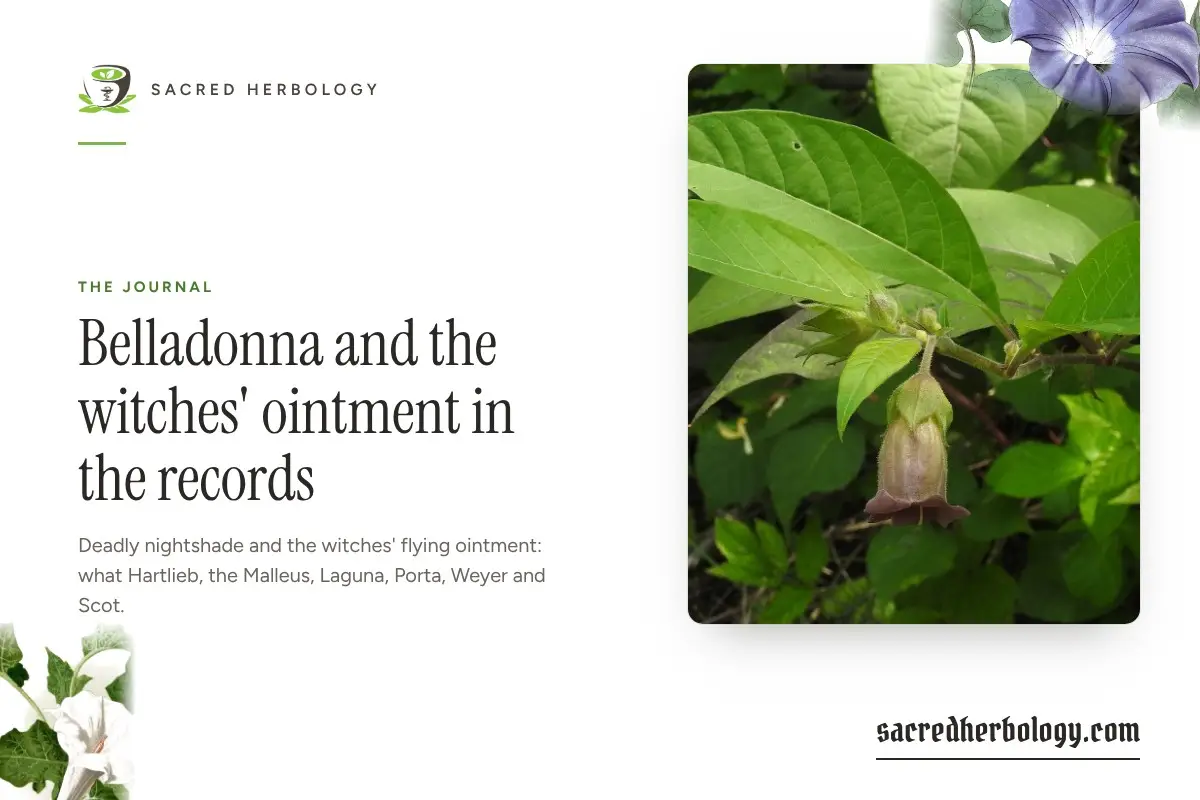
Belladonna is a handsome plant, which is part of the trouble. It grows as a leafy bush to about shoulder height, with dull purple-brown bells hanging from the leaf joints in summer. Each bell is followed by a glossy black berry sitting in a green star of sepals, about the size of a cherry, and the berries taste faintly sweet. Every part of it is poisonous, root, leaf, flower and berry, and the berries are what children find.
Its English names say it straight: deadly nightshade, and in older English, dwale. Its scientific name is Atropa belladonna, given by Linnaeus in his Species Plantarum of 1753. Atropa comes from Atropos, the eldest of the three Fates in Greek myth, the one who cuts the thread of a life. Belladonna is Italian for “beautiful lady”, and the usual story is that Italian women once put the juice in their eyes to widen the pupils. The story is old and widely repeated, and the effect on the pupil is real, but I have not found it in a dated early source, so I give it to you as the traditional explanation and nothing firmer.
This piece is about one corner of belladonna’s history, the witches’ flying ointment. You will find it in nearly every modern book on witchcraft and on poisonous plants. What the old records actually say is narrower, stranger and more interesting than the popular version, and it is worth reading them in order.
So pour yourself something harmless and settle in. The story runs from a tenth-century church ruling, through a Dominican friar watching a woman asleep in a kneading trough, to a Spanish doctor and an executioner’s wife, a Neapolitan collector of secrets, two brave sceptics, an Egyptologist with a theory, and a German folklorist who rubbed a salve on himself to see what would happen. Belladonna turns up late in that line, and less often than you would think.
The house rule for this whole category comes first. Grow it, don’t eat it.
The plant and its family
Belladonna belongs to the nightshade family, the Solanaceae, with tomato, potato, chilli, tobacco, henbane, mandrake and datura. It is native to Europe, North Africa and western Asia, and it likes cool woodland edges, old quarries and lime-rich soils. It is not recorded as naturalised anywhere in Australia, and in the humid tropics it is a poor doer. Most Australian readers will meet it in books.
The name causes a mix-up in Australia. People often call black nightshade, Solanum nigrum, “deadly nightshade”. That is a different plant, a common garden and roadside weed with small white star-shaped flowers and clusters of pea-sized berries that ripen from green to dull black. Belladonna has single drooping purple-brown bells and single shiny black berries, each the size of a small cherry, sitting in a five-pointed green star. If you are unsure which plant you have, treat it as poisonous and have it identified.
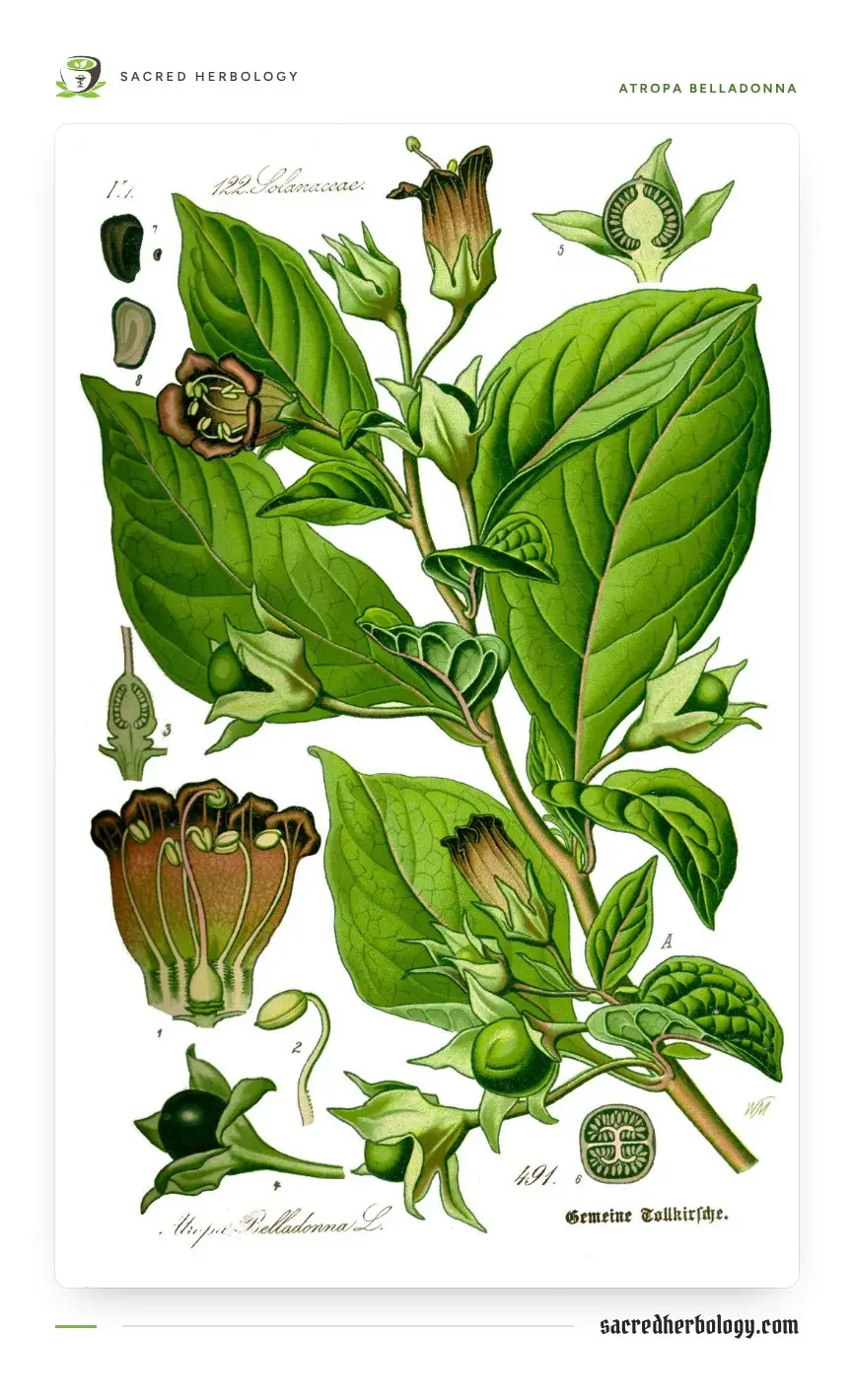

The plant’s power comes from a group of tropane alkaloids, chiefly hyoscyamine, with smaller amounts of scopolamine (hyoscine). Atropine is a mixed form of hyoscyamine that forms readily as the plant is dried and extracted, so the two names often travel together. The German pharmacist Heinrich Mein isolated atropine in 1831, and Philipp Geiger and Otto Hesse published on it independently in 1833. Medicine has used the purified compound ever since, in precisely measured and standardised form. The leaf and berry come with no such measure. Their alkaloid content varies from plant to plant and season to season.
A few years before Mein, the young chemist Friedlieb Ferdinand Runge showed the effect on the pupil to Goethe in Weimar in 1819, using a cat as his subject. Goethe was impressed enough to hand him a box of coffee beans and suggest he look at those next, and Runge went on to isolate caffeine. It is one of the nicer stories in the history of chemistry, and it shows how well known the pupil effect was by then. Whatever the truth of the Italian ladies, every apothecary in Europe knew what belladonna did to an eye.
The other names carry their own warnings. In German the plant is Tollkirsche, the mad cherry, and the name tells you both what it looks like and what it does. The English word dwale is older and slipperier. In medieval English it named a sleeping drink, a mixture used to put a person into a heavy sleep, and Chaucer uses it in the Reeve’s Tale for the kind of sleep that needs no help. Over time the word slid from the drink to the plant, and by the sixteenth century dwale meant deadly nightshade. The medieval drink was a mixture of several things, and the surviving recipes for it do not depend on belladonna, so do not read Chaucer’s dwale as the plant.
The English herbalist John Gerard, in his Herball of 1597, files it among the nightshades under the old name dwale, and he did not like it. He tells of three boys at Wisbech in the fens who ate the berries, two of whom died, and he urges his readers to banish the plant from their gardens and from anywhere children go. Four centuries later that advice is still the best part of his chapter.
Flight before the ointment
Before there was a flying ointment there was a flight, and the Church did not believe in it.
Around the year 906 the abbot Regino of Prüm compiled a handbook for bishops visiting their parishes. In it is a short text that later writers called the Canon Episcopi. It describes certain wicked women who believe and say that they ride at night on beasts with Diana, the pagan goddess, and a great crowd of women, crossing great distances in the silence of the night. The canon’s ruling is blunt. These women are deceived. The devil works on their minds while they sleep, and they take for real what happens in a dream. Anyone who believes such flights happen in the body is, in the canon’s words, an unbeliever and worse than a pagan.
That text went into Gratian’s great collection of church law around 1140, and for three centuries it was the official line. Night flight was an illusion. Remember that, because the sixteenth-century sceptics will come back to it with a jar of ointment in their hands.
The change came in the 1420s and 1430s, in the western Alps, in the valleys of Savoy, the Valais and the lands around Lake Geneva. Trials there began to describe something new: a secret sect of witches who gave themselves to the devil, met at night, ate children and travelled to their meetings through the air. An anonymous tract from Savoy of the 1430s, the Errores Gazariorum, already has the devil giving his followers a stick and an ointment to fly on. The ointment has arrived in the story, and it arrives as the devil’s gift.
The Dominican Johannes Nider, writing his Formicarius in the mid-1430s, gathered a good deal of this material, much of it from a secular judge, Peter of Bern, who had tried witches in the Simme valley. Nider also tells an older kind of story. A friar met a village woman who insisted she flew by night with Diana. He asked to watch. She climbed into a large bowl, the kind used for kneading dough, rubbed herself with an ointment and spoke some words, and fell into so deep and restless a sleep that the bowl tipped and she struck her head on the floor. When she woke she still swore she had flown. The friar showed her she had never left the room.
Nider is telling the story to support the old canon: the flight is a dream sent by the devil. Note what it contains, though. An ointment, a sleep, a vivid dream of flight, and a learned man watching. Every element of the later sceptical case is there a hundred and twenty years before Laguna, without a single plant named.
By 1451 a manuscript copy of Martin Le Franc’s long poem Le Champion des Dames carried a small picture in its margin of two women flying, one on a broom and one on a stick, labelled as Waldensians, the old word for heretics that had become a word for witches. In 1459 and 1460 the town of Arras in northern France tore itself apart in a witch panic, the Vauderie, in which the accused confessed under torture to anointing a stick and flying to their meetings. The Parlement of Paris declared the condemnations unjust in 1491, far too late for those who had burned.
The demonologists: fat, not herbs
The flying ointment enters the written record in the fifteenth century, in the years when learned churchmen were building the idea of the witch as a member of a sect that met at night and flew to its gatherings.
The early writers were vague about what went into it. In 1456 the Bavarian court physician Johannes Hartlieb wrote his Book of All Forbidden Arts for his prince, a survey of the magical arts written to warn against them. In it he names an ointment, the unguentum pharelis, that men and women use to travel by night. It is among the earliest named flying ointments in any European source. He says it is made from seven herbs, each gathered on the day that belongs to it, which ties the ointment to the planets and the days of the week, the habits of learned astrological magic. Hartlieb is warning a prince, though, and he gives no usable recipe.
The Malleus Maleficarum, the notorious witch-hunting handbook printed in 1486 or 1487 under the names of the Dominicans Heinrich Kramer and Jacob Sprenger, has the ointment too. Its authors say the witches make it, at the devil’s instruction, from the limbs of children, especially children killed before baptism, and that they smear it on a chair or a stick and are carried through the air. There are no plants in that account at all. The ointment is a sign of the pact with the devil and of murder, and the flight is the devil’s work.
Kramer had a problem with the old canon, which said the flight was a dream, and he solved it by arguing that witches could fly both ways: sometimes in the body, carried by the devil, and sometimes in imagination. The theology was clumsy, and it left the door open for anyone who wanted to say that all of it was imagination.
A few years later, in 1489, the lawyer Ulrich Molitor wrote a short dialogue on witches for Archduke Sigismund of Austria, De laniis et phitonicis mulieribus. Its printed editions carry some of the earliest printed pictures of witches, including three women riding together through the air on a forked stick, their heads turned into the heads of animals. Molitor’s own view was a halfway house. He thought the flights and transformations were illusions worked by the devil on the mind, and he still thought the women deserved death for having given themselves to him.
That matters for belladonna. In the first layer of the record, the one written by men who believed the witch was real and dangerous, the ointment is a demonic thing made of human fat. The plants come in later, and they come in with a different kind of writer.
The natural magicians: a sleeping ointment
In the middle of the sixteenth century a few physicians and natural philosophers began to read the witch stories differently. If the women anointed themselves, fell asleep and woke up describing flights and feasts, perhaps the ointment was a drug and the flight was a dream. This is a sceptical reading, and it is still a learned one. These men were writing within the esoteric tradition of natural magic, the study of the hidden properties of things, and their witches are figures in an argument among scholars.
The Milanese physician and mathematician Girolamo Cardano got there first in print. In his De subtilitate (Nuremberg, 1550), a vast book on the hidden workings of nature, he describes the witches’ ointment as a mixture of fat and plant juices and treats the visions that follow as the work of the mixture on the mind. Cardano’s list is close to the first of the two recipes Porta would print eight years later, and the two men’s versions have been copied side by side ever since.
The physician Andrés Laguna, who had practised at Metz in the early 1540s, told the best-known story in his Spanish translation of and commentary on Dioscorides, printed at Antwerp in 1555. A jar of green ointment was found in the house of a couple accused of witchcraft. Laguna judged it to be made from cold, sleep-bringing herbs, which he names as hemlock, nightshade, henbane and mandrake. He then rubbed some of it on the wife of the city’s executioner, who could not sleep. She slept for thirty-six hours, he says, and woke complaining that he had pulled her from the arms of a young lover. Laguna’s conclusion was that the witches’ adventures happened in their heads, under the influence of the drug.
Laguna was a man of some standing. Born in Segovia and trained in Paris, he travelled widely and served for a time as a physician in papal Rome. His Dioscorides was a handsome, practical book in the language of ordinary Spanish readers, it was dedicated to the future Philip II, and it went through edition after edition. The anecdote he slipped into it, a little shocking and a little funny, became the founding story of the drug explanation of witchcraft. He compared the green ointment in the jar to populeon, a common apothecary’s salve made with poplar buds, which tells you that to a working physician it looked like something from his own shelves.
Notice the word he uses, solano. In sixteenth-century herbals “solanum” was a loose label that covered several nightshades, and a “sleeping solanum” could mean belladonna or something else. Laguna may well have had deadly nightshade in mind, but the text does not settle it.
Three years later, in 1558, the Neapolitan Giambattista della Porta printed his Magia naturalis, a book of natural wonders and secrets. In a chapter on sleep-bringing preparations he gives two ointments said to be used by the lamiae, the witches. The first keeps the old demonological fat of children and adds herbs: eleoselinum, a kind of wild celery or parsley, aconite, poplar leaves and soot. The second lists sium (water parsnip), acorus, cinquefoil, the blood of a bat, solanum somniferum and oil. That “sleeping solanum” is the line belladonna’s reputation hangs on. Many modern writers read it as deadly nightshade, and that is a fair reading. Others point to winter cherry, Withania somnifera, which most scholars take to be the “sleep-bringing” nightshade of Dioscorides. Porta does not describe the plant, so the identification stays a reading.
Porta was in his early twenties when the first edition appeared, a gentleman of Naples with a passion for secrets, codes, lenses and curious experiments, and the book sold across Europe. He also tells the reader that he had seen an old woman anoint herself, fall into a deep sleep, and on waking describe journeys over seas and mountains, which he took as proof that the flights were dreams. It is a story with the same shape as Nider’s, told for the opposite purpose.
Porta paid for the chapter. The French jurist Jean Bodin, in his De la démonomanie des sorciers of 1580, attacked him for explaining witchcraft away as a matter of drugs and dreams, and Porta’s work came under the scrutiny of the Inquisition in the years that followed. When the much enlarged twenty-book edition of Magia naturalis appeared in 1589, the witches’ ointments were gone from it. That has a curious effect on English readers. The English translation, Natural Magick, printed in London in 1658, was made from the later edition, so anyone who goes looking for the flying ointment in it comes away empty-handed.
Weyer and Scot carry it on
Porta’s recipes travelled quickly because they were useful in an argument. The physician Johann Weyer, in De praestigiis daemonum (Basel, 1563), argued that many accused witches were deluded, melancholy women who deserved treatment and pity, and did not deserve the fire, and he reproduced the ointment recipes as part of that case. In England Reginald Scot did the same in The Discoverie of Witchcraft (1584), giving Porta’s two ointments in English, sleeping solanum and all, in a book written to show that most witchcraft accusations were nonsense.
Weyer, born in Brabant, was court physician to Duke William of Jülich-Cleves-Berg, whose lands, under his influence, saw few witch trials. His book did not deny the devil. Weyer believed in demons as firmly as anyone in his century. What he denied was that old women could make pacts with them and do the harm they were charged with, and he put the confessions down to illness, to the devil’s tricks on weak minds, and to the questioning itself. Bodin was so angry that he wrote a refutation of Weyer and bound it into the Démonomanie, to answer him point by point.
Reginald Scot was a Kent gentleman with an interest in hop-growing, and his Discoverie is a long, sharp, often funny book that takes apart the whole machinery of the witch trials. He copied Porta’s ointments and left the plant names in their Latin forms, so the English reader of 1584 met solanum somniferum without a translation. In 1597 James VI of Scotland, later James I of England, published his Daemonologie and named Scot as one of the writers he was answering. A story, told long after, has James ordering copies of Scot’s book burned when he came to the English throne. It is a good story, and it may be true, but no order of the kind has been found.
So the sixteenth-century belladonna-ointment idea comes to us through men who were trying to save accused women by calling the flight a drugged sleep. That is a humane motive, and it also means the plant lists are the authors’ theory of what could produce such dreams. None of these books is a recipe taken down from a practising witch.
Even within the learned tradition the plant lists differ. Francis Bacon, in his Sylva Sylvarum (1627), reports that the witches’ ointment is said to be made of the fat of children dug from their graves, with the juices of smallage, wolfsbane and cinquefoil, mixed with fine wheat flour. No nightshade appears in his version.
Belladonna in the trial records
The court records add little. Most witch trial confessions were extracted under questioning that shaped the answers, and when ointments come up, the accused rarely name plants. Where an ointment was seized and examined, as in Laguna’s story, the identification was made by a learned man looking at it. I know of no trial record in which an accused woman names belladonna as an ingredient, and I would be cautious of any modern book that says otherwise without giving the trial, the archive and the date.
It helps to picture how a confession was made. The judges came to the room with a list of questions drawn from books like the Malleus. Did you make a pact? How did you travel to the meeting? What did you rub on yourself? An accused person, often after torture or long confinement, gave answers that matched the questions, and the clerk wrote them down in the judges’ language. When an ointment appears in such a confession, it usually appears the way the books describe it, made by the devil or from a murdered child. Folk healers did use plants, and some village women certainly knew which plants made you sleep and which made you sick. That knowledge was folklore, passed by mouth, and it rarely reached the record in the form of a named nightshade.
The broomstick has a similar history. The image of the witch greasing a staff and riding it goes back to the medieval sources: the Malleus has the chair or stick, and Holinshed’s Chronicles (1587) say of the Irish noblewoman Alice Kyteler, accused in 1324, that a pipe of ointment was found in her closet with which she greased a staff and rode upon it. That detail comes from the chronicle, written more than two and a half centuries after the case. The modern idea that the staff was a way of applying a drug ointment to the body is a twentieth-century interpretation. The anthropologist Michael Harner set it out in 1973, and it has been repeated widely since. You may find it persuasive. It is still an interpretation, made more than four centuries after the fact.

The Kyteler case itself is worth a moment. Alice was a wealthy woman of Kilkenny, married four times, and the children of her earlier husbands had reason to resent her. The prosecution was driven by the bishop of Ossory, Richard de Ledrede, and a contemporary narrative of the proceedings survives. Alice escaped, it seems to England. Her maid, Petronilla de Meath, did not. She was flogged until she confessed, and she was burned at Kilkenny later that year. When you read the greased staff in Holinshed, read it with Petronilla in mind. The detail that delights modern writers was part of the story told about the women who paid for it.
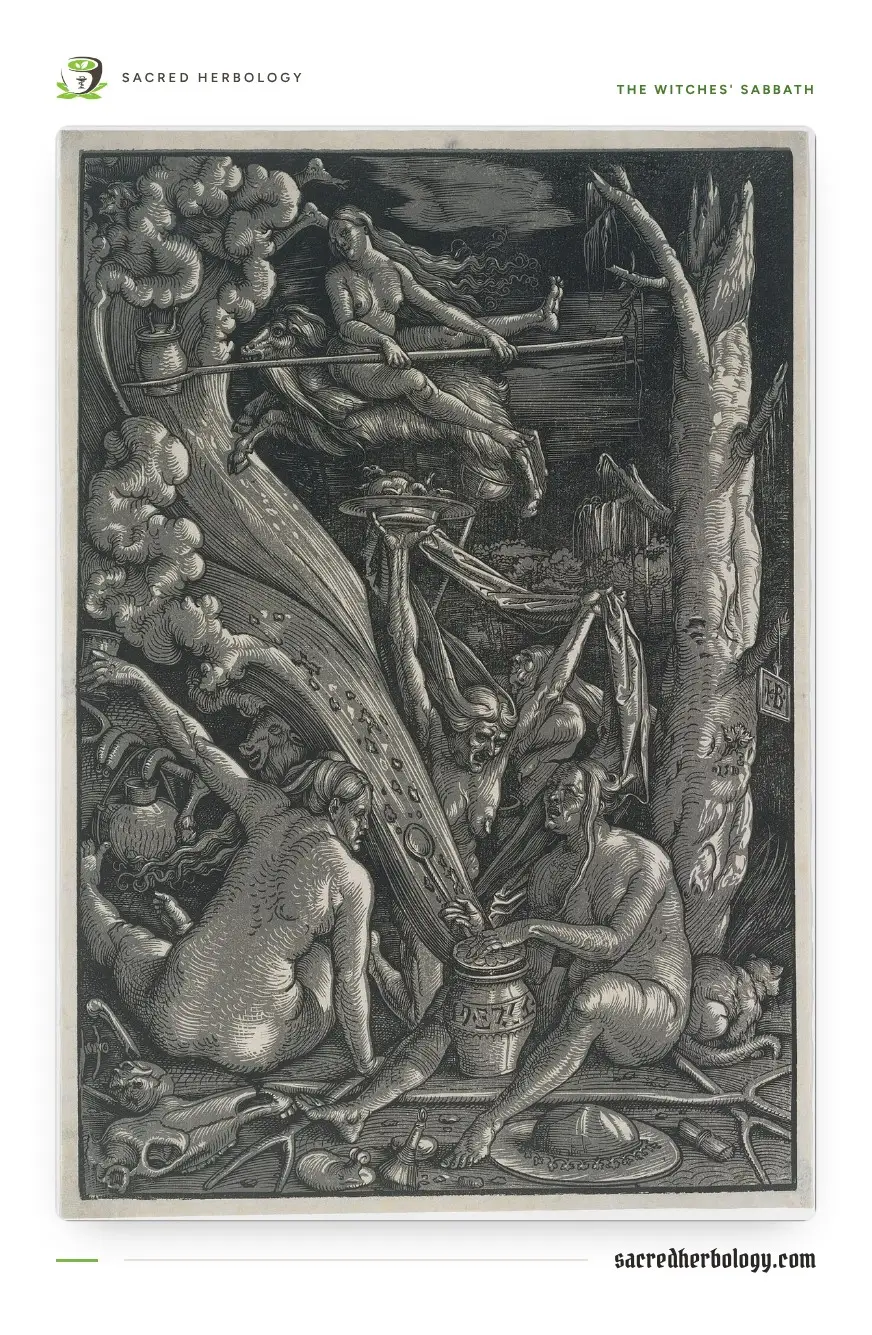
The pictures followed the books. Hans Baldung Grien’s woodcut of 1510 has the jar, the stick and the night ride. Nearly three centuries later Goya etched an old witch and a young one sharing a broom in plate 68 of his Caprichos (1799), with the mocking title Linda maestra!, “pretty teacher”. By Goya’s day the flying witch was satire. The ointment stayed in the pictures as a prop.
The twentieth century takes it up
The modern belladonna story was built in the twentieth century, by a handful of named writers.
In 1921 the Egyptologist Margaret Murray published The Witch-Cult in Western Europe, arguing that the witches were the survivors of an organised pagan religion. Her thesis has been rejected by historians, but the book carried an appendix by the pharmacologist A. J. Clark, “Flying Ointments”, which looked at the old recipes and judged which plants in them might have had real effects. Clark’s appendix put the pharmacology of the nightshades into the witchcraft literature, and it reached a wide audience through Murray’s book.
Clark was careful. He read the recipes as a pharmacologist would, picked out aconite and belladonna among the ingredients as the ones that could act on the body, and suggested how a sleeping person under their effects might feel a rush or a fall that could be remembered as flight. He did not claim to know that any witch had ever used them. The care tends to drop away when his appendix is quoted.
Murray’s book went on to have an influence far beyond the history shelves. When Gerald Gardner published Witchcraft Today in 1954, presenting what he said was a surviving witch religion in England, Murray wrote the introduction. Gardner’s witchcraft became the root of modern Wicca, and Murray’s picture of the old witches as a hidden pagan faith became part of its founding story. Historians took longer to dismantle her than they should have. Norman Cohn’s Europe’s Inner Demons (1975) showed how she had cut her quotations from the trial records to fit, leaving out the impossible parts, and since then no serious historian has defended the witch-cult thesis. Ronald Hutton’s The Triumph of the Moon (1999) tells the whole story of how modern witchcraft drew on Murray and how it has lived with her fall.
In the late 1950s the German folklorist Will-Erich Peuckert went a step further. He made up an ointment of belladonna, henbane and datura from an old printed formula and tried it on himself and a colleague. He reported a deep sleep and dreams of flying, wild rides and falls, and published the results around 1960. Harner’s chapter of 1973, “The Role of Hallucinogenic Plants in European Witchcraft”, drew Clark, Peuckert and the Renaissance writers together, and from there the story passed into the popular books on witchcraft and into the modern revival.
Look closely at Peuckert’s experiment and its weak point shows. He used datura, which most botanists think reached Europe only after Columbus, so his mixture was probably one no medieval witch could have made. He knew what he expected to dream, and he dreamed it. That does not make his report false. It makes it a report on a twentieth-century man with a twentieth-century head full of witch stories, and it is quoted by many people who have never read it.
The Italian historian Carlo Ginzburg took the question somewhere else. In Storia notturna (1989), published in English as Ecstasies, he traced the night flight and the gathering of souls back through older European folk beliefs about journeys in spirit, and he treated the ointments as one possible part of a much older pattern of trance. Many historians disagree with his larger argument. It is still the most serious attempt to ask what the people themselves believed, as distinct from what their judges wrote.
That is the line of descent: demonologists who had no plants, natural magicians who added sleeping herbs to explain the dreams, sceptics who repeated the recipes to save lives, and twentieth-century scholars who tested and spread the idea. Belladonna’s place in it is real, but it rests mostly on one ambiguous Latin phrase, solanum somniferum, and on modern readings of it.
Modern misreadings
With the history laid out, some of the things you will read online and in popular books can be tested against it.
“Belladonna was the main ingredient of the witches’ ointment.” No recipe from the period names belladonna as such. The plant behind solano and solanum somniferum may have been belladonna, and it may not. Hemlock, aconite, henbane and mandrake appear more often and more clearly.
“The ointments were recorded from witches themselves.” They were recorded by physicians, philosophers and judges. The recipes are learned guesses and learned fears, and the confessions were shaped by the questions.
“Nine million women were burned.” The figure goes back to an estimate made in the late eighteenth century by multiplying up the records of a few places, and it was taken up and spread in the twentieth. Most historians now put the number executed across Europe at something like forty to sixty thousand over three centuries, and something like a fifth to a quarter of them were men. That is horror enough without inflation.
“The witches were the village midwives and herbalists, burned for their plant knowledge.” This idea was popularised in the 1970s, especially by Barbara Ehrenreich and Deirdre English in Witches, Midwives and Nurses (1973). The historian David Harley tested it against the records in 1990 and found that midwives were rarely accused and often helped the courts, and the idea has not held up. Some accused women were healers, and their healing could be part of the charge. They were not the typical witch.
“Shakespeare’s witches used belladonna.” The cauldron in Macbeth has root of hemlock digged in the dark and a long list of animal parts, and no nightshade. Banquo’s line about having “eaten on the insane root that takes the reason prisoner” has been read as belladonna, henbane or hemlock, and Shakespeare does not say which.
“The devil himself tends belladonna.” This one is folklore, and charming folklore. Maud Grieve’s A Modern Herbal (1931) repeats a story that the devil trims and tends the plant all year and can only be drawn away on Walpurgis Night, when he is busy preparing for the witches’ gathering. She gives no source for it, and I have not found one older than the nineteenth-century books she drew on. Enjoy it as a garden tale.
“Ointments of this kind give a pleasant flight.” The record says otherwise. The symptoms of belladonna poisoning, described at the foot of this piece, are delirium, confusion and a racing heart, and people who recover often remember little or nothing. Peuckert’s dreams were his own. The physicians of the sixteenth century, who had seen poisonings, wrote of sleep and madness, and none of them wrote of pleasure.
Living traditions today
Some modern witches and practitioners of what is now called the poison path make or describe flying ointments today, and some include belladonna. That is a living practice of the twentieth and twenty-first centuries. It draws on the old books, but no unbroken line of practice connects a modern ointment to a medieval witch, and anyone claiming to hold the original recipe is claiming more than the record supports. You will find no method in this piece. Belladonna alkaloids can pass through the skin, and a salve made from the plant can poison the person who uses it.
The modern practice has its own history, and it is younger than it looks. Much of it grew from the books named above, Murray, Clark, Peuckert and Harner, read by people building a new religion out of an old story. That is a perfectly honest thing to do, and many practitioners say so openly. The trouble comes only when the new is passed off as old. Any meaning a practitioner finds in the plant belongs to the practitioner’s own tradition, and this piece makes no claim about it either way.
Safety in the garden
The berries are the main risk, especially to children, because they look like something good to eat and taste mildly sweet. Belladonna poisoning causes a dry mouth, flushed hot skin, a racing heart, very wide pupils and blurred vision, confusion and seeing things, and in serious cases fits, a dangerously high temperature and coma. It can kill.
If you grow it:
- Plant it where children and pets cannot reach it, and take the berries off before they ripen if anyone small visits the garden.
- Wear gloves when you handle it, wash your hands afterwards, and keep sap away from your eyes.
- If sap or juice gets in an eye, rinse it with plenty of clean water and call the Poisons Information Centre on 13 11 26. A widened pupil and blurred vision on that side are a sign of exposure.
- Never eat, smoke, brew or rub any part of it on the skin.
- If someone has swallowed any part of the plant, call the Poisons Information Centre on 13 11 26, any hour, anywhere in Australia, even if they seem well. Do not try to make them vomit.
- If they are hot, confused, seeing things, have a racing heart, have a fit, are hard to wake or are struggling to breathe, call 000. Take a piece of the plant or a photo of it to the hospital.
Grow it for its bells and its black berries, and for the long argument it has been dragged into. Grow it, don’t eat it.
Where this comes from
- Johannes Hartlieb, Das Buch aller verbotenen Künste, ed. Falk Eisermann and Eckhard Graf (Eugen Diederichs, 1989); original written 1456.
- Heinrich Kramer and Jacob Sprenger, The Hammer of Witches, trans. Christopher S. Mackay (Cambridge University Press, 2009).
- Alan Charles Kors and Edward Peters, eds, Witchcraft in Europe, 400-1700: A Documentary History, second edition (University of Pennsylvania Press, 2001), for the Canon Episcopi and other early texts in English.
- Girolamo Cardano, De subtilitate (Nuremberg, 1550).
- Andrés Laguna, Pedacio Dioscorides Anazarbeo, acerca de la materia medicinal, y de los venenos mortiferos (Antwerp, 1555).
- Giambattista della Porta, Magia naturalis (Naples, 1558); English translation, Natural Magick (London, 1658).
- Johann Weyer, De praestigiis daemonum (Basel, 1563).
- Jean Bodin, De la démonomanie des sorciers (Paris, 1580).
- Reginald Scot, The Discoverie of Witchcraft (London, 1584).
- Raphael Holinshed, The Chronicles of England, Scotland and Ireland, second edition (London, 1587).
- John Gerard, The Herball or Generall Historie of Plantes (London, 1597).
- Francis Bacon, Sylva Sylvarum (London, 1627).
- Carl Linnaeus, Species Plantarum (Stockholm, 1753).
- Thomas Wright, ed., A Contemporary Narrative of the Proceedings against Dame Alice Kyteler (Camden Society, 1843).
- Margaret Murray, The Witch-Cult in Western Europe (Oxford, 1921), with A. J. Clark’s appendix on flying ointments.
- Maud Grieve, A Modern Herbal (London, 1931).
- Gerald Gardner, Witchcraft Today (London, 1954), with an introduction by Margaret Murray.
- Michael J. Harner, ed., Hallucinogens and Shamanism (Oxford University Press, 1973).
- Barbara Ehrenreich and Deirdre English, Witches, Midwives and Nurses (Feminist Press, 1973).
- Norman Cohn, Europe’s Inner Demons (London, 1975).
- Carlo Ginzburg, Storia notturna (Turin, 1989); in English as Ecstasies.
- David Harley, “Historians as demonologists: the myth of the midwife-witch”, Social History of Medicine 3 (1990).
- Ronald Hutton, The Triumph of the Moon (Oxford University Press, 1999).