
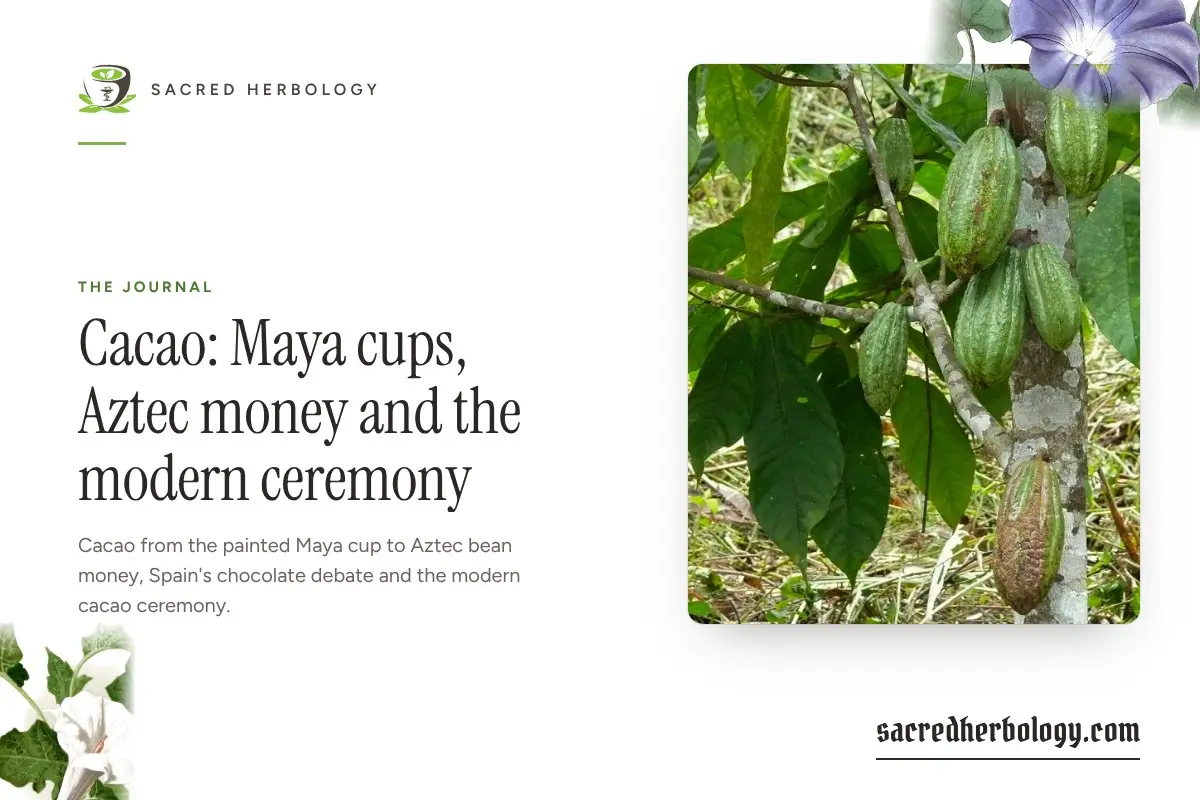
Break open a ripe cacao pod and the first surprise is the smell. Inside is no chocolate at all. You find thirty or forty pale, slippery seeds packed in a white pulp that smells of lychee and lemon and tastes sweet and sharp. The bitterness, the dark colour and everything we call chocolate only arrive later, after the seeds have been fermented, dried and roasted. People in the Americas worked all of that out thousands of years ago, and then built a whole world of meaning around the result.
This piece follows cacao through three lives. The first is the Maya cup, where the drink belonged to lords and gods. The second is the Mexica market, where the beans were small change. The third is the cacao ceremony you may have been invited to, which is much younger than most people think.
Between those three lives sits a long middle stretch that the ceremony leaflets tend to skip. Spanish friars argued about cacao in Madrid. Londoners drank it in coffee houses. Enslaved people grew it in Venezuela and on islands off the coast of Africa, and a Quaker chocolate maker ended up in an English courtroom over where his beans came from. All of that belongs to the story too, so we will take it in on the way.
The tree
Cacao is Theobroma cacao, a small understorey tree of the American tropics, in the mallow family, Malvaceae (older books put it in a separate family, Sterculiaceae). It likes shade, deep moist soil, steady warmth and no frost. Its flowers are tiny and grow straight out of the trunk and the older branches, and they are pollinated mostly by minute biting midges. The pods hang off the trunk like lanterns, green, yellow, red or purple depending on the variety. The part people use is the seed, the cacao bean, along with the pulp around it. The tree has close relatives in the same genus. Pataxte (Theobroma bicolor) was grown and drunk in Mesoamerica too, usually as the lesser bean, and cupuaçu (Theobroma grandiflorum) is grown in Brazil for its pulp.
Carl Linnaeus gave it the genus name Theobroma in his Species Plantarum of 1753. It is Greek for “food of the gods”. He kept the old Mesoamerican name, cacao, as the species. So the plant’s formal name is a European compliment stuck on the front of a word the Maya and the Mexica had been using for centuries.
The journey from pod to chocolate is worth knowing, because every culture in this story depended on it. Once the pods are cut, the beans and their pulp are heaped up or packed into boxes and left for several days. Yeasts and bacteria go to work on the sugary pulp, the heap warms up, and the liquid drains away. Inside the bean the seed dies, and the chemistry that gives chocolate its flavour begins. Then the beans are spread out to dry in the sun. Only after that are they roasted, shelled and ground. An unfermented bean, dried straight from the pod, tastes flat and astringent, and no amount of later skill can put the missing flavour back. Whoever first worked this out, somewhere in the deep past, made one of the great food discoveries of the world.
Growers today sort cacao into three broad groups, though geneticists have since found the real picture is far more tangled. Criollo is the old cacao of Mesoamerica, delicate in flavour and delicate in health. Forastero, from the Amazon basin, is hardier and gives most of the world’s crop. Trinitario is a cross between the two, which arose on Trinidad in the eighteenth century after the island’s criollo trees were badly hit by disease and growers replanted with Amazon stock. When a ceremony seller tells you their cacao is a rare heirloom criollo, these are the groups they mean.
For a long time the story was that cacao was first domesticated in Mexico and Central America. That changed in 2018. A team led by Sonia Zarrillo reported cacao starch grains, theobromine residues and ancient cacao DNA in pottery from Santa Ana-La Florida, a site of the Mayo-Chinchipe culture in the upper Amazon of southeast Ecuador. The oldest of it is around 5,300 years old. Cacao’s wild home is the upper Amazon, and people there were using it about 1,500 years before the earliest evidence from Mesoamerica.
How it travelled north is still an open question. Somewhere along the way, over many centuries, the tree was carried through Colombia and Central America into the lowlands of southern Mexico, and it was there that cacao became the drink and the symbol we recognise. The Amazon peoples who first used it seem mostly to have enjoyed the pulp. The roasted, ground seed drink is a Mesoamerican invention.
Some of the oldest chemical traces in Mesoamerica come from Puerto Escondido in Honduras, in pots dated before 1000 BC. The archaeologists who analysed them, John Henderson and his colleagues, suggested that the first cacao drinks there may have been made from that sweet pulp, fermented into something closer to a beer. Only later, they argued, did the bitter roasted seed take centre stage. Other teams have found cacao in pots from the Pacific coast of Chiapas, among the Mokaya villages of the second millennium BC, and in the Olmec heartland on the Gulf coast. By the time the Maya cities rose, cacao had already been part of Mesoamerican life for well over a thousand years.
Kakaw and chocolate
The word cacao itself has a history. The Classic Maya wrote it kakaw, and the Mexica spoke of cacahuatl. Linguists have long argued about who had the word first. In the 1970s Lyle Campbell and Terrence Kaufman proposed that it came from the Mixe-Zoquean languages of the Gulf coast and the Isthmus of Tehuantepec, the family many scholars connect with the Olmec. If that is right, the Maya and the Mexica both borrowed the name from the people who were drinking cacao before them. Karen Dakin and Søren Wichmann later argued for a Uto-Aztecan origin instead. The question remains open, and you should be wary of anyone who tells you it is.
Chocolate is a puzzle of its own. The word does not appear in the earliest Spanish sources, which call the drink cacao or cacahuatl. “Chocolate” turns up later in the sixteenth century, and its origin is disputed. One old suggestion joins a Maya word for hot to the Nahuatl atl, water. Michael and Sophie Coe thought it might have been coined in colonial Mexico, partly to avoid a Spanish word that sounded rude when joined to cacao. Dakin and Wichmann pointed instead to a Nahuatl word for the wooden beater used to froth the drink. Each idea has its supporters. What everyone agrees on is that the word we now use for a sweet bar began as the name of a drink.
The Maya cup
The Classic Maya, whose great cities flourished from around AD 250 to 900, have left us the most beautiful evidence for cacao drinking anywhere: tall painted cylinder vases, made to hold it.
Many of these vases carry a band of glyphs around the rim. Epigraphers call it the Primary Standard Sequence, and once it could be read it turned out to be a kind of label. It says what the vessel is, what it held, and who owned it. A common phrase is yuk’ib, “his drinking cup”, followed by the word kakaw, often with a word describing the kind of cacao. A painted pot buried in a tomb could tell you, in its own voice, that it was a nobleman’s cup for cacao.
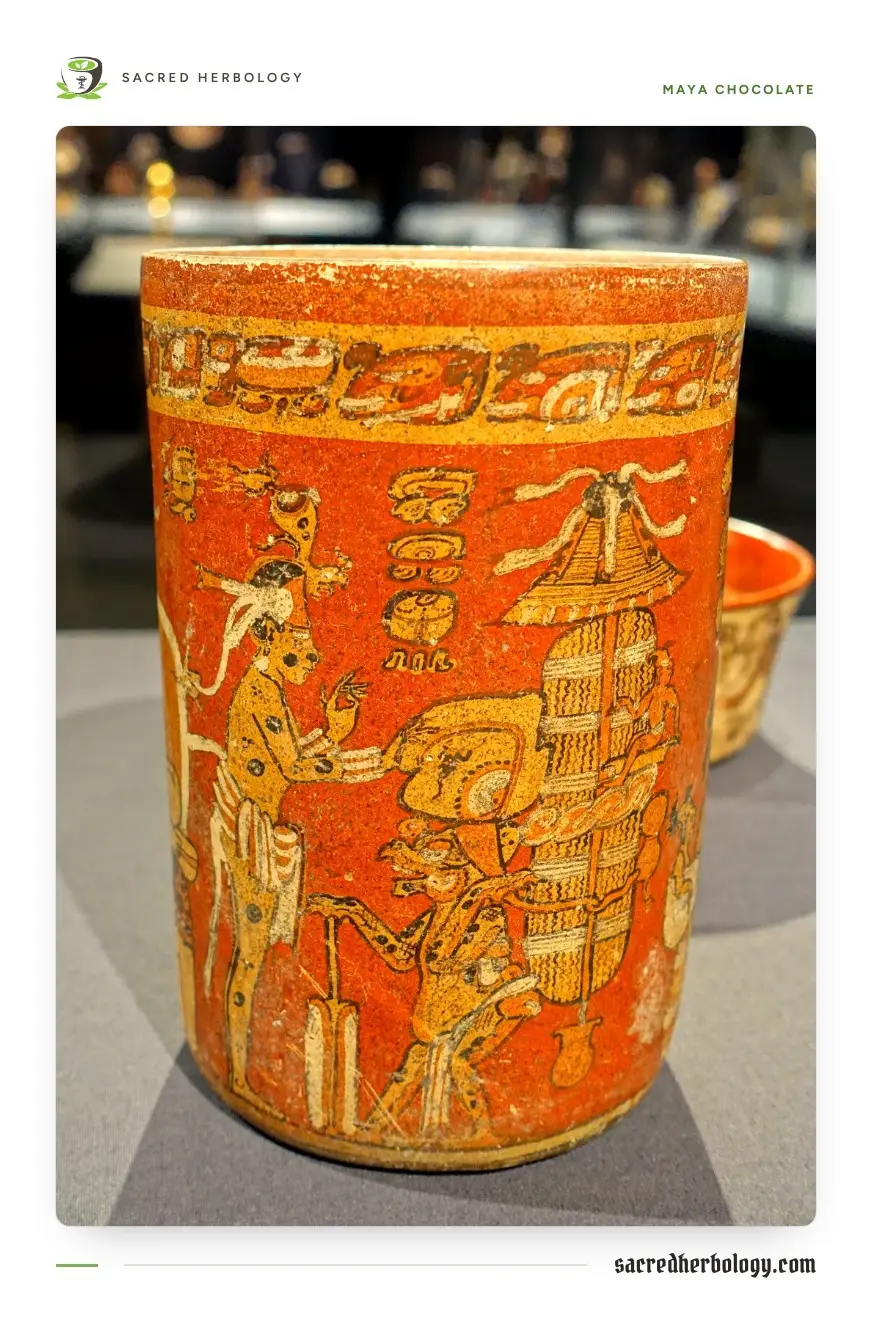

The proof that the labels meant what they said came from Río Azul in northern Guatemala. In an Early Classic tomb there, archaeologists found a lidded vessel with a screw-like locking lid, and on it the glyphs for ka-ka-wa. David Stuart published the reading in 1988. Two years later, W. Jeffrey Hurst and his colleagues analysed the dark residue inside and found theobromine and caffeine. Together these are the marker archaeologists use to identify cacao residue in Mesoamerican pottery. The pot said cacao, and the pot held cacao.
It is a lovely moment in the history of scholarship. For decades the glyph band had been treated as decoration or as a kind of chant. Michael Coe had argued in the 1970s that it was a set formula repeated across hundreds of pots, and once the syllables started to be read, the formula turned out to be about the vessel itself. Archaeology and epigraphy, two fields that do not always talk to each other, met over a single cup.
The Maya prized the foam. On the Princeton Vase, a Late Classic cup now in the Princeton University Art Museum, a woman stands pouring a drink from one vessel into another held well below it, raising a head of froth. Later Spanish writers describe exactly the same thing, the drink poured from a height or beaten until the foam stood up. For the Maya the foam seems to have been the best part.
Cacao also turns up in the Maya books. The surviving codices show gods holding pods and offering bowls of beans, and cacao was part of marriage negotiations, feasts and offerings to the dead. It moved between people the way wine moves at a wedding: a sign that something serious was being agreed.
Cacao was tied in with the Maize God, the great figure of death and rebirth in Classic Maya religion. Simon Martin, in an essay in Cameron McNeil’s collection Chocolate in Mesoamerica, traced how Maya artists showed the god’s body sprouting cacao pods, or turned him into a cacao tree himself. Maize was the staple and cacao was the luxury, and in Maya thinking the two grew from the same sacred source. The Popol Vuh, the great book of the K’iche’ Maya written down in the sixteenth century, keeps the same idea. When the gods find the maize from which they will make the first true people, it lies in a mountain of plenty alongside pataxte and cacao and the other good foods of the land.
That is myth, and it is told here as the K’iche’ told it. What it shows us is how close to the centre of the world the Maya placed this tree. It was food, it was wealth, and it was something the gods themselves had laid down at the making of humankind.
A word of caution about the evidence. Most of what we know of Classic Maya cacao comes from elite tombs, because that is where the painted vessels were buried and where they survived. The picture is tilted towards kings and nobles by the simple accident of what lasted. Ordinary farming families in the cacao-growing lowlands may well have known the drink better than the tombs suggest. Archaeologists are still working on how far down the social ladder cacao reached.
When the Spanish arrived in Yucatán, the Maya there were still using cacao in ritual and trade. Diego de Landa, the Franciscan friar and later bishop who burned Maya books in 1562 and then wrote a long account of Maya life, records that cacao served as money in the markets. He also describes a feast held in the month Muan by the owners of cacao groves, in honour of gods that included Ek Chuah, the patron of merchants. Landa is a difficult witness. He was the man who destroyed much of what he describes. Even so, his account preserves things that would otherwise be lost.
Money that grows on trees
The Mexica, the people we usually call the Aztecs, lived in the highlands of central Mexico, where cacao will not grow. Every bean they used had to be carried up from the hot lowlands of the Gulf coast and the Pacific, or paid to them as tribute. The tribute lists in the Codex Mendoza, made in the 1540s, record cacao coming in from Xoconochco, the Soconusco coast in what is now Chiapas.
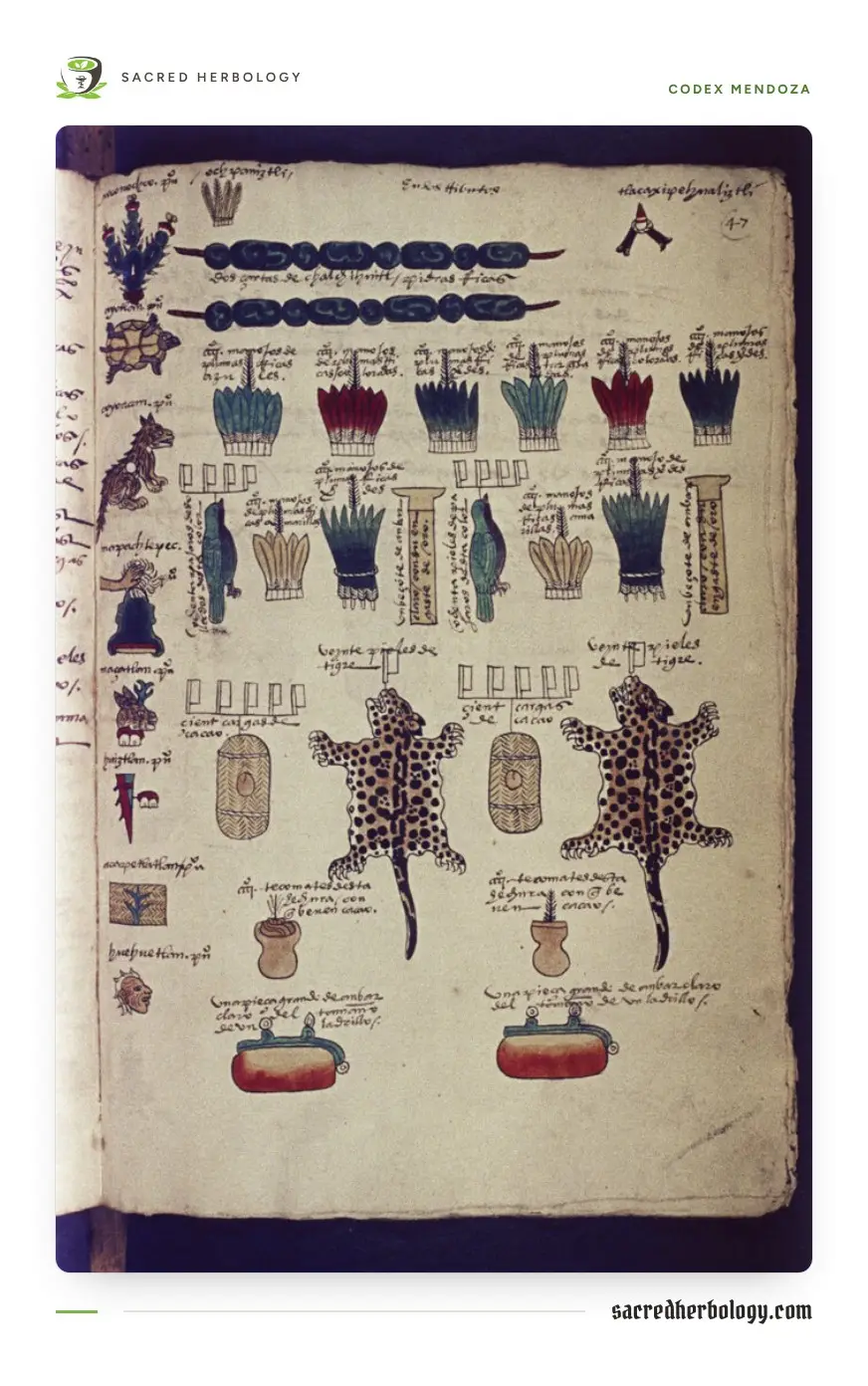

The Codex Mendoza has a story of its own. It was painted by Indigenous artists in Mexico City and annotated in Spanish, and it is usually linked to the first viceroy, Antonio de Mendoza, who seems to have wanted a record of the Mexica world for the emperor Charles V. On its way to Spain the ship carrying it was taken by French privateers. The manuscript passed to the French royal cosmographer André Thevet, who wrote his name in it, then to the English collector of voyages Richard Hakluyt, then to Samuel Purchas, who printed woodcuts of its pages, and finally to the lawyer John Selden. Selden’s books came to the Bodleian Library in Oxford, and that is where it is today. The page shown here, with its jaguar skins and feathers and loads of cacao, is a tribute list that went round half of Europe before it settled.
Because it was scarce, portable, countable and hard to fake well, cacao became money. Big purchases were made with cotton cloaks, the quachtli, but for everyday buying in the market, beans did the job. A price list drawn up in Nahuatl at Tlaxcala in 1545 gives a glimpse of what a bean would get you. A good turkey hen was worth 100 cacao beans. A turkey egg cost three. A fully ripe avocado was worth one. A tamale was one bean.
Merchants counted beans in big round numbers built on the Mesoamerican base of twenty. The units given by the Coes are 400 beans to a zontli, twenty of those, or 8,000 beans, to a xiquipilli, and three xiquipilli, 24,000 beans, to a load, the amount a porter carried on his back up from the coast. Tribute and great trading deals were reckoned in loads. Small change at the market was reckoned bean by bean.
Long before the Spanish reached the Mexica, Europeans had already seen how much cacao was valued. On his fourth voyage, in 1502, Christopher Columbus met a great Maya trading canoe off the island of Guanaja, in the Bay Islands of Honduras. His son Ferdinand, who was on board as a boy, later described the canoe’s cargo, which included cotton cloth, copper and the “almonds” that the people used as money. When some of these fell, he wrote, the traders stooped to pick them up as if an eye had fallen. The Spanish had no idea what they were looking at. Those almonds were cacao beans.
Where there is money there are forgers. Bernardino de Sahagún’s Florentine Codex, compiled with Nahua scholars in the mid-sixteenth century, describes the bad cacao seller. He toasts poor, shrivelled or unripe beans in hot ashes so they pass for good ones. He fills empty husks with amaranth dough, wax or avocado pits so they look whole. He mixes poorer beans in with the good to cheat his customers. The same work describes the good seller, whose beans are big, full and honestly counted. The Mexica market had judges who sat to settle disputes, and a counterfeit bean was a cheat like any other.
Sahagún’s book deserves a moment. He was a Franciscan who came to New Spain in 1529, learned Nahuatl well, and spent decades working with Nahua elders and with young Nahua scholars trained at the college of Santa Cruz in Tlatelolco. Together they produced an enormous account of Nahua life, written in Nahuatl with a Spanish version alongside and illustrated by Nahua artists. The finished manuscript ended up in Florence, in the Laurentian Library, which is why it is called the Florentine Codex. The description of the cacao sellers comes from the book on the people of the city and their trades, and it is one of the liveliest things in it.
The Italian humanist Peter Martyr, writing about the New World for the Pope in the 1520s, was charmed by the whole idea. “O blessed money,” he wrote, which gives people a delightful drink and saves its owners from “infernal avarice”, because it cannot be piled up or hoarded for long. He had a point. Beans go mouldy. You cannot sit on a mountain of them for decades the way you can with gold.
Cacao money did not vanish with the conquest. Spanish colonists accepted cacao beans as small change in New Spain long after the fall of the Mexica, because there were not enough small coins to go round. Into the colonial period and later, in parts of Mexico and Central America, a few beans could still buy a little something at the market.
A drink for lords and warriors
Among the Mexica, drinking cacao was a privilege. Sahagún’s informants describe it as a drink for rulers, nobles, seasoned warriors and the long-distance merchants called pochteca. Ordinary people might see it at a feast, but they did not drink it as a matter of course. Michael and Sophie Coe, in their history of chocolate, point out how often the Nahua spoke of cacao alongside the heart and blood, the most precious things a body holds.
The drink was flavoured in ways we would barely recognise. The sources name chilli, the red seed paste called achiote, vanilla (tlilxochitl, “black flower”), honey, and the dried petals of flowers such as teonacaztli, “sacred ear”. It was served cool or at room temperature, frothy, often bitter or hot with spice.
Making it was skilled work, and in the Nahua world it was women’s work. The Florentine Codex describes the woman who sells fine cacao drinks. She grinds the beans on the metate, the sloping grinding stone, mixes the paste with water, and pours and aerates it until the foam rises, and the good seller’s drink is smooth and properly frothed. The bad seller, the codex says, waters it down or bulks it out with maize flour. Spanish women in the colonies later learned the craft from the Indigenous women who worked in their kitchens, and the wooden whisk, the molinillo, spun between the palms, became the tool of Spanish chocolate making.
The heart-and-blood link had a darker side in Mexica religion. Diego Durán, a Dominican friar who grew up in Mexico and wrote about Mexica rites in the 1570s, describes a man chosen to impersonate the god Quetzalcoatl and die at the god’s festival. If he seemed to lose heart as the day came near, Durán says, the priests gave him a gourd of cacao mixed with water that had washed the blood from the sacrificial knives, so that he would forget his fear and go to the stone willingly. Durán was writing about a world that had already been destroyed, from what older people told him, and some details may have grown in the telling. It is a sobering picture all the same, and a reminder that cacao’s sacred life in Mesoamerica was not all gentle.
Bernal Díaz del Castillo, a soldier who marched with Cortés, left the most famous picture of it. At Moctezuma’s table, he says, servants brought the ruler cacao in cups of fine gold, and after the meal some fifty great jars of it, well frothed, went out to the household. People told him Moctezuma took it before visiting his women. That is a soldier repeating palace gossip forty years later, and it should be read as gossip. It has done a great deal of work in the marketing of chocolate ever since.
Díaz was an old man in Guatemala when he wrote his book, in part to correct an official history he thought gave too much credit to Cortés and too little to men like himself. He is vivid, opinionated and often trustworthy, and he is also remembering a palace he saw for a few months half a lifetime earlier. Those fifty jars were for the household. Somewhere in the retelling they became fifty cups drunk by Moctezuma himself, a figure you will still find repeated on chocolate wrappers.
Crossing to Europe
You will often read that Cortés brought chocolate to Spain in 1528. No document from the time says so. The first record Michael and Sophie Coe could find is from 1544, when Dominican friars brought a delegation of Q’eqchi’ Maya nobles from Guatemala to the court of the future Philip II. Among their gifts were quetzal feathers, chillies, maize, liquidambar resin, and vessels of beaten chocolate.
Not every European liked it. Girolamo Benzoni, a Milanese traveller who spent years in the Spanish colonies, published his History of the New World in 1565 and wrote that the drink seemed more fit for pigs than for people. He admitted that in the end, with no wine to be had, he drank it like everyone else. The Jesuit José de Acosta, in his Natural and Moral History of the Indies of 1590, called it loathsome to anyone unused to it, with a froth that was unpleasant to taste. He also noted that the Spaniards in the Indies, men and women alike, were mad for it.
Spain took to it slowly, then completely. Spanish drinkers added cane sugar, cinnamon and aniseed, and served it hot. It became so much a part of devotional life that it raised a question for the Church: did a cup of chocolate break the fast? Antonio de León Pinelo wrote a whole book on the problem, Question moral si el chocolate quebranta el ayuno eclesiástico, printed in Madrid in 1636. The answer most churchmen settled on was that a drink does not break a fast, so chocolate was allowed, as long as it stayed a drink.
The argument went on in Rome. In 1664 Cardinal Francesco Maria Brancaccio published a short Latin work on the chocolate drink, and he gave the debate the phrase it is remembered by: liquidum non frangit jejunium, a liquid does not break the fast. Chocolate thickened with so much maize or bread that it became a food was another matter. Chocolate as a drink stayed on the right side of the line.
In Chiapas the question turned into open warfare, if we believe Thomas Gage. Gage was an English Dominican who worked in Mexico and Guatemala in the 1620s and 1630s, later turned Protestant, and in 1648 published The English-American, an account of his travels. He tells of the ladies of Chiapa who had their maids bring cups of chocolate into the cathedral during mass, because they said their stomachs were too weak to last without it. The bishop forbade it on pain of excommunication. The ladies stopped coming to the cathedral, and not long after, Gage says, the bishop fell ill and died, and people whispered that a cup of chocolate had been poisoned. Gage loved a good story, and was writing for English readers who enjoyed hearing the worst of Spanish Catholics. It is best treated as the gossip of the town, told by a man with an axe to grind.
Doctors and learned men in Spain wrote about cacao in the language of the four humours. Was it hot or cold, moist or dry? Did the spices balance the coldness of the bean? Antonio Colmenero de Ledesma published a treatise on the nature and quality of chocolate in Madrid in 1631, and an English translation by James Wadsworth appeared in 1640 as A Curious Treatise of the Nature and Quality of Chocolate. These were serious arguments in their own day. They belong to the history of ideas, and nobody now reads them as advice.
From Spain it went to Italy, France and England, into the chocolate houses of the seventeenth century, and eventually into the solid bar of the nineteenth. By then almost all of its Mesoamerican meaning had been stripped away. It had become a sweet.
Chocolate houses and the bar
London met chocolate in 1657, when a Frenchman advertised a house in Bishopsgate where it could be bought ready to drink. Samuel Pepys records drinking “jocolatte” at a coffee house in 1664 and finding it very good. White’s, the gentleman’s club in St James’s, began life in 1693 as a chocolate house run by an Italian, Francesco Bianco, who called himself Francis White. Chocolate houses, like coffee houses, became places for gossip, politics and gambling, and in London they had a reputation for being a little faster than their coffee neighbours.
In France, chocolate was a drink of the court and the salons. Madame de Sévigné, whose letters to her daughter are one of the treasures of seventeenth-century French writing, swung back and forth about it in 1671, recommending it in one letter and warning against it in the next. She passed on a scandalous story that a noblewoman who drank too much chocolate while pregnant had given birth to a baby as dark as the devil. That too is gossip, and it tells us more about Parisian society than about cacao.
The great change came in the nineteenth century. In 1828 the Amsterdam chocolate maker Casparus van Houten patented a press, often credited to his son Coenraad, that squeezed much of the fat, the cocoa butter, out of the ground beans, leaving a cake that could be powdered. Treated with alkali, the powder mixed more easily with water and had a milder taste. That is the origin of “Dutch process” cocoa. With cocoa butter now available on its own, it could be added back to ground cacao and sugar, and in 1847 the Bristol firm of J. S. Fry and Sons sold a moulded chocolate bar for eating. In Switzerland, Daniel Peter worked with his neighbour Henri Nestlé’s milk products to make milk chocolate in the 1870s, and in 1879 Rodolphe Lindt invented the conche, a machine that stirs the warm chocolate for hours until it melts on the tongue.
Chemistry caught up with the bean too. In 1841 the Russian chemist Alexander Voskresensky isolated the main stimulant in cacao and called it theobromine, after the genus name. People sometimes assume there is bromine in it. There is none. The name simply borrows Linnaeus’s “food of the gods”.
By the end of the century chocolate was a cheap pleasure for working people, sold in tins and bars, and the cup of the Maya lords had become a children’s treat.
Who grew it
All of this was built on labour, and a great deal of it was unfree. As the Spanish taste for chocolate grew, cacao plantations spread in Venezuela, Ecuador and the Caribbean, and many of them were worked by enslaved Africans. Caracas cacao, grown in the valleys of the Venezuelan coast, was the most prized in Europe for much of the colonial period, and the wealth it brought the planter families of Caracas rested on slavery.
The Portuguese carried cacao from Brazil to the islands of São Tomé and Príncipe in the Gulf of Guinea in the early nineteenth century. By the 1900s the islands were among the world’s great cocoa producers, worked by labourers brought from Angola under contracts that were slavery in all but name. In 1906 the journalist Henry Nevinson published A Modern Slavery, describing what he had seen. William Cadbury, of the Quaker chocolate family, investigated, and in 1909 the firm stopped buying São Tomé cocoa. That same year Cadbury Brothers took the London Standard newspaper to court for libel, after it had accused them in 1908 of profiting from slave-grown cocoa. They won, and the jury awarded them a farthing in damages. Lowell Satre’s book Chocolate on Trial tells the whole affair.
Cacao reached the mainland of West Africa at about the same time. The usual story in Ghana is that a blacksmith named Tetteh Quarshie brought cacao pods home to the Gold Coast from Fernando Po, now Bioko, in 1879, and planted them at Mampong. Within a few decades the Gold Coast was the largest cocoa producer in the world. Today Côte d’Ivoire and Ghana grow more than half the world’s cacao, mostly on small family farms. Child labour on cocoa farms in that region remains a live problem that the industry and governments have been promising to fix for more than twenty years.
So when you hold a bar of chocolate, you are holding a plant from the Amazon, domesticated in Mesoamerica, made fashionable in Spain, industrialised in the Netherlands, England and Switzerland, and mostly grown now in West Africa. Very little of that journey appears on the wrapper.
The modern ceremony
If you live in Australia you may have seen invitations to a “cacao ceremony”: a circle of people, a warm thick cacao drink, an intention set at the start, often music, breathwork or meditation, and language about the heart opening. It is usually described as ancient and Maya.
The honest history is shorter. The ceremony in this form grew up on the shores of Lake Atitlán in Guatemala in the early 2000s. Its best-known figure is Keith Wilson, who by his own account arrived at San Marcos La Laguna in 2003, began grinding cacao by hand and serving it to friends and clients, and then held group ceremonies from his house there. Travellers carried the format home. By the late 2010s it had spread across Europe, North America and Australia, and the phrase “ceremonial cacao” had become a product category.
Lake Atitlán is a particular kind of place. The towns around the lake are home to Kaqchikel and Tz’utujil Maya communities, and in recent decades a few of them, San Marcos above all, have also drawn a steady flow of foreign travellers interested in yoga, meditation and alternative healing. The modern cacao ceremony grew in that meeting ground. It borrowed the prestige of Maya cacao and the setting of a Maya lake, and it took its shape from the workshop and retreat culture the travellers brought with them. The local Maya communities have their own long relationship with cacao, and that relationship does not depend on the circle.
Cacao’s place in Maya and other Mesoamerican life is ancient and real, and in parts of Guatemala and southern Mexico cacao still goes into offerings, weddings and festival drinks. In Oaxaca, Zapotec cooks still make tejate, a frothy cool drink of maize and cacao sold from great clay bowls in the markets. The circle-ceremony format, with its intention-setting and its language about the heart, is a modern creation of the early 2000s. It belongs to the same family as other modern Western spiritual practice, and it is entitled to be new. It should simply say so.
The living Mesoamerican customs are folk practice, kept up in families and towns, and they vary from place to place. In Oaxaca, hot chocolate and pan de muerto go on the household altars for the Day of the Dead. Across Mexico and Guatemala, chocolate made from beans ground with sugar and cinnamon is drunk at weddings, baptisms and saints’ days, whipped with a molinillo in the old way. These are customs with a continuous history, and they are worth seeing for what they are.
Two other things are worth knowing if you buy cacao sold for ceremony:
- “Ceremonial grade” is a seller’s phrase. No Australian or international food standard defines it. Ask instead which country and region the cacao came from, which variety it is, and whether the beans were fermented. A good supplier can answer all three. Ask too whether the batch has been tested for heavy metals. Cacao grown in some volcanic and mineral-rich soils of Latin America takes up cadmium from the ground, and Australian food law sets a limit for cadmium in cocoa products. A careful supplier tests each batch and will show you the result.
- Claims about the heart, the spirit or emotional release come from the modern ceremony. You will not find them in any Maya or Mexica source, and in Australia cacao is sold as a food, so a seller has to stay within the food rules about what can be claimed for it.
Common misreadings
A few stories about cacao travel so widely that they are worth setting straight in one place.
- “Theobroma is the Maya name for cacao.” It is Greek, and Linnaeus coined the genus name in 1753. The Maya word was kakaw.
- “Cacao was first domesticated by the Maya.” The tree was first used in the upper Amazon about 5,300 years ago, and cacao drinks were being made in Mesoamerica long before the Classic Maya cities.
- “Cortés brought chocolate to Spain in 1528.” No record of the time says so. The first documented chocolate at the Spanish court is the gift of the Q’eqchi’ Maya delegation in 1544.
- “Moctezuma drank fifty cups a day.” Bernal Díaz wrote of fifty jars served to the household after the ruler’s meal. The fifty cups belong to later retellings.
- “The Aztecs gave cacao to everyone.” Among the Mexica it was a drink for rulers, nobles, warriors and long-distance merchants. Most people saw it rarely.
- “The cacao ceremony is an ancient Maya ritual.” Cacao in Maya ritual is ancient. The circle ceremony with intention-setting is a modern creation of the 2000s, from Lake Atitlán.
- “Theobromine contains bromine.” It contains none. The name comes from Theobroma.
Growing cacao
Cacao grows in Australia. There is a small cacao industry in tropical Queensland, where the rain, the warmth and the rainforest shade suit the tree. Growers have been at it for over twenty years, and the first chocolate made entirely from Australian-grown cacao went on sale in the 2010s. If you garden in the humid tropics, a cacao tree in the dappled shade under taller trees is a fine thing to have. It will flower on its trunk, and with luck the midges will find it and a pod will hang there after three to five years. Buy your tree from an Australian nursery. Cacao seed, pods and budwood cannot simply be brought in from overseas: Australia’s biosecurity rules control them closely, because serious cacao diseases such as witches’ broom and frosty pod rot are not found here.
South of the tropics, cacao is a glasshouse plant at best. It sulks below about fifteen degrees, hates wind and dry air, and frost kills it. Gardeners in Brisbane and on the warmest parts of the New South Wales north coast sometimes keep one alive in a sheltered spot, but it rarely fruits there. Further south, if you want cacao in your life, it is a plant to admire in a botanic garden glasshouse.
Safety and interactions
Cacao contains theobromine and a smaller amount of caffeine. Theobromine is a close chemical relative of caffeine and a milder stimulant, and the thick drinks served at modern ceremonies can be strong. If caffeine does not agree with you, the same will apply here. If you take prescribed medicines and want to drink cacao regularly, consult a degree-qualified herbalist with competencies and adequate training in pharmacognosy first.
The same caffeine and theobromine are worth keeping in mind if you are pregnant or breastfeeding, and for children, who feel stimulants more than adults do. A careful ceremony organiser will ask about pregnancy, heart conditions and medicines beforehand, and it is fair to ask them how strong the drink will be.
Keep cacao, cacao nibs and chocolate well away from dogs and cats. Theobromine is poisonous to them, and the less sugar and milk a product has, the more it carries, so cacao nibs, cocoa powder, ceremonial blocks and dark chocolate are the worst. The same goes for cocoa shell garden mulch and for fallen pods and beans under a backyard tree, which dogs will happily chew. If a pet gets into any of it, call a vet straight away. If a person is unwell after eating or drinking anything, call 000 or the Poisons Information Centre on 13 11 26.
The thread
Follow cacao from start to finish and one thing keeps happening. Each culture that takes it up gives it a new meaning and forgets the old one. The Amazon peoples enjoyed the pulp. The Olmec and their neighbours were drinking it long before the Maya. The Maya painted its name on their finest cups and grew it out of the body of the Maize God. The Mexica counted it out in the market and paid it in tribute. Spanish churchmen argued over whether it broke a fast. Londoners gossiped over it, Dutch and Swiss inventors turned it into a bar, and West African farmers now grow most of it.
The modern cacao ceremony is one more turn of that wheel. It has its own sincerity and its own appeal, and the people who sit in those circles are often looking for something real. The best thing it could do for itself is to know its own history: that it is new, that it took shape on a Guatemalan lake in the early 2000s, and that it stands at the end of a story far longer and stranger than any leaflet tells. The cup with its band of glyphs, the bean that bought an avocado, the fifty jars at Moctezuma’s table and the farthing in an English court all belong to the same tree.
Where this comes from
- Sophie D. Coe and Michael D. Coe, The True History of Chocolate (Thames and Hudson, 1996; 3rd edn 2013).
- Cameron L. McNeil (ed.), Chocolate in Mesoamerica: A Cultural History of Cacao (University Press of Florida, 2006).
- S. Zarrillo et al., “The use and domestication of Theobroma cacao during the mid-Holocene in the upper Amazon”, Nature Ecology and Evolution 2 (2018): 1879-1888.
- J. S. Henderson et al., “Chemical and archaeological evidence for the earliest cacao beverages”, Proceedings of the National Academy of Sciences 104 (2007): 18937-18940.
- David Stuart, “The Río Azul cacao pot: epigraphic observations on the function of a Maya ceramic vessel”, Antiquity 62 (1988): 153-157.
- G. D. Hall, S. M. Tarka, W. J. Hurst, D. Stuart and R. E. W. Adams, “Cacao residues in ancient Maya vessels from Río Azul, Guatemala”, American Antiquity 55 (1990): 138-143.
- Dennis Tedlock (trans.), Popol Vuh: The Mayan Book of the Dawn of Life (Simon and Schuster, 1985; rev. edn 1996).
- Diego de Landa, Landa’s Relación de las cosas de Yucatan, ed. and trans. Alfred M. Tozzer (Peabody Museum, Harvard University, 1941).
- Bernardino de Sahagún, Florentine Codex: General History of the Things of New Spain, trans. Arthur J. O. Anderson and Charles E. Dibble (School of American Research and University of Utah, 1950-1982), Book 10.
- Arthur J. O. Anderson, Frances Berdan and James Lockhart, Beyond the Codices: The Nahua View of Colonial Mexico (University of California Press, 1976), for the Tlaxcala price list of 1545.
- Diego Durán, Book of the Gods and Rites and The Ancient Calendar, trans. Fernando Horcasitas and Doris Heyden (University of Oklahoma Press, 1971).
- Ferdinand Columbus, The Life of the Admiral Christopher Columbus by his Son Ferdinand, trans. Benjamin Keen (Rutgers University Press, 1959).
- Peter Martyr d’Anghiera, De Orbe Novo: The Eight Decades, trans. Francis Augustus MacNutt (G. P. Putnam’s Sons, 1912), Decade 5, Book 4.
- Bernal Díaz del Castillo, The True History of the Conquest of New Spain, trans. A. P. Maudslay (Hakluyt Society, 1908-1916).
- Frances F. Berdan and Patricia Rieff Anawalt (eds), The Codex Mendoza (University of California Press, 1992).
- Girolamo Benzoni, History of the New World, trans. W. H. Smyth (Hakluyt Society, 1857).
- José de Acosta, Natural and Moral History of the Indies, ed. Jane E. Mangan, trans. Frances López-Morillas (Duke University Press, 2002).
- Thomas Gage, Thomas Gage’s Travels in the New World, ed. J. Eric S. Thompson (University of Oklahoma Press, 1958).
- Antonio Colmenero de Ledesma, A Curious Treatise of the Nature and Quality of Chocolate, trans. James Wadsworth (London, 1640).
- Antonio de León Pinelo, Question moral si el chocolate quebranta el ayuno eclesiástico (Madrid, 1636).
- Robert Latham and William Matthews (eds), The Diary of Samuel Pepys (G. Bell, later Bell and Hyman, 1970-1983).
- Lowell J. Satre, Chocolate on Trial: Slavery, Politics, and the Ethics of Business (Ohio University Press, 2005).
- Carl Linnaeus, Species Plantarum (Stockholm, 1753).