

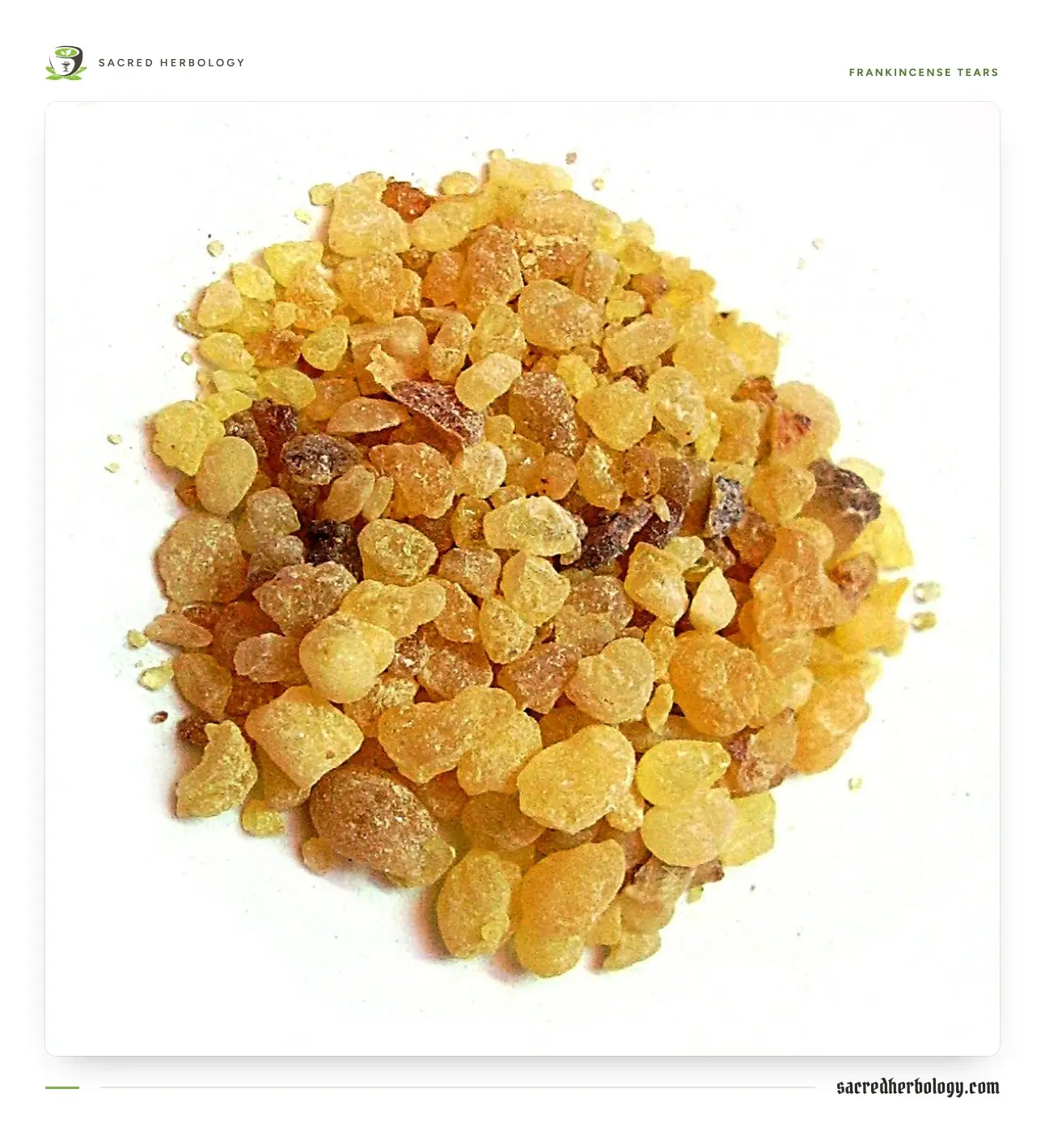
Put a tear of good frankincense on a hot coal and the room changes. First comes a sharp, lemony lift, then something heavier and sweeter settles over it. People have been doing exactly this for about three thousand years, and most of them believed the smoke was going somewhere.
Where the tears come from
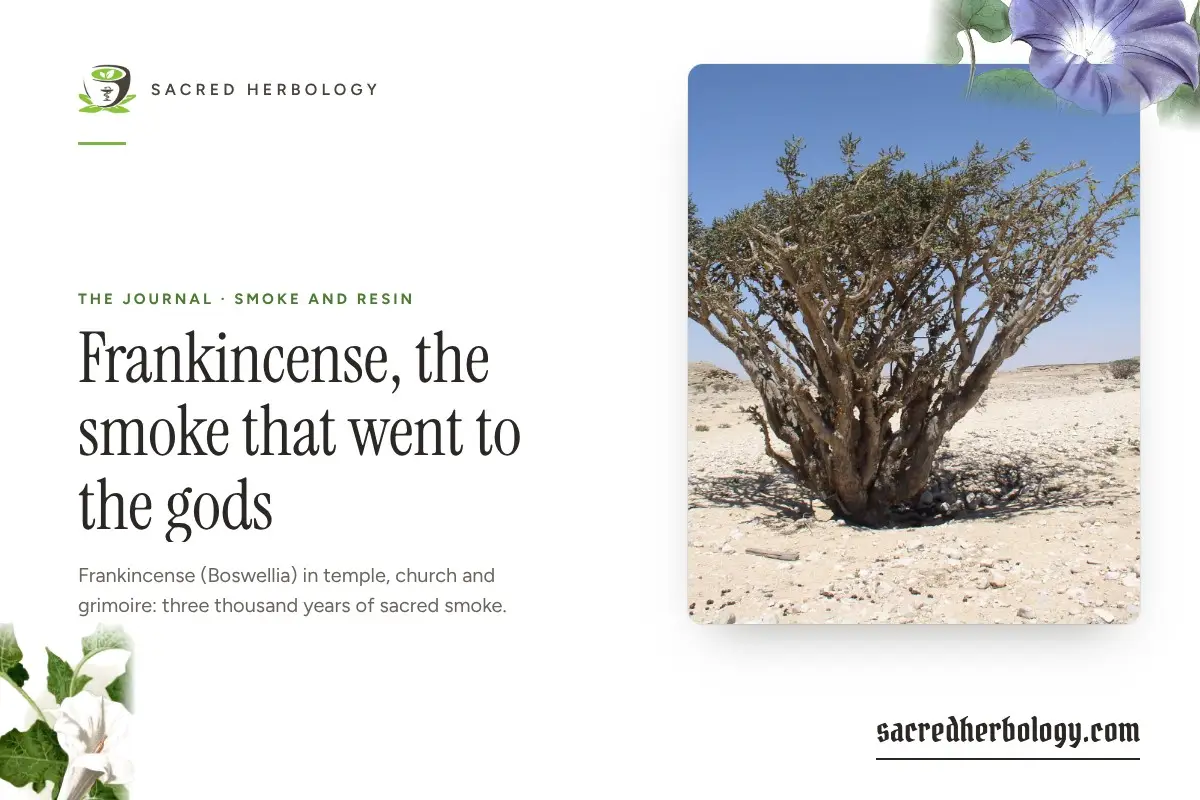
Frankincense is the dried sap of a few small, stubborn trees in the genus Boswellia. They grow on dry, rocky slopes in Dhofar in southern Oman, in Yemen, in Somaliland, and across the Horn of Africa into Ethiopia and Sudan. Boswellia sacra is the Arabian tree, the source of the famous Omani Hojari. Boswellia papyrifera, from Ethiopia and Eritrea, supplies much of the cheaper resin sold simply as “frankincense”.
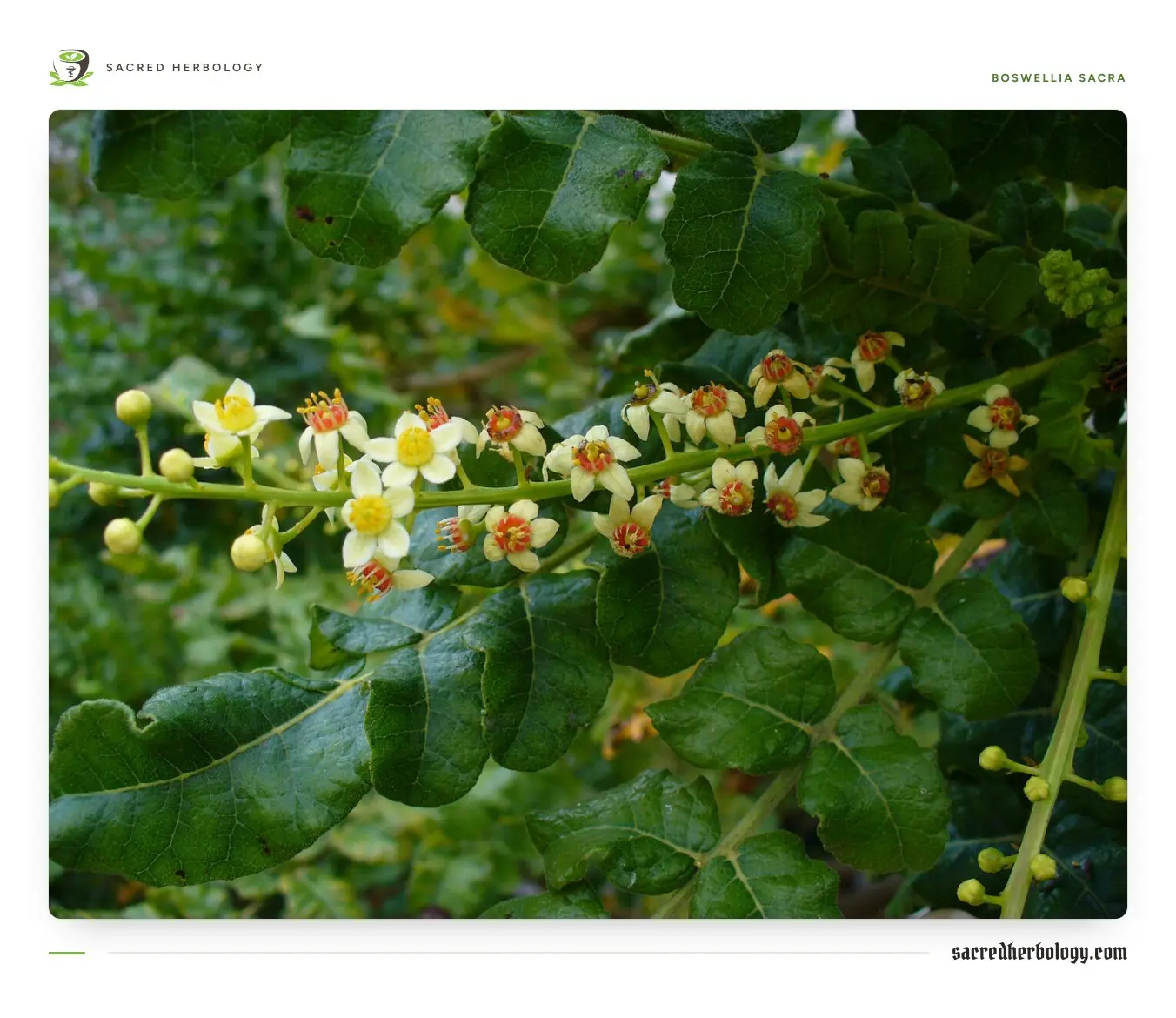

Harvesters cut shallow wounds in the bark. The tree bleeds a milky sap that hardens into tears over a couple of weeks, and the tapper comes back to collect them and cut again. It is slow, hot work, and it has been done the same way since the incense caravans ran north to Gaza and Petra.
The smoke in the temples
Egypt burned incense at dawn, noon and dusk. The priests’ blend called kyphi had its recipes carved into the walls of the temples at Edfu and Philae, and Plutarch, writing in the second century, said it held sixteen ingredients and was burned at nightfall to lull the day’s cares. Frankincense went into the morning offering.
The Hebrew Bible gives its own recipe in Exodus 30, a holy incense of stacte, onycha, galbanum and pure frankincense, forbidden for any private use. In Matthew’s gospel the magi bring it to a child in Bethlehem. The thurible swinging down the aisle of a Catholic or Orthodox church today is the direct heir of all this.
The idea underneath is simple and very old. Smoke rises. What rises can carry prayer, praise or a request to whoever lives above.
The planetary fume
This is where frankincense crosses into the esoteric. In the learned magic of the Renaissance every planet had its own suffumigation, a smoke that drew down its influence. Heinrich Cornelius Agrippa, in the first book of his Three Books of Occult Philosophy (1533), gives the Sun a compound fume of saffron, ambergris, musk, aloeswood, balsam, bay berries, cloves, myrrh and frankincense. Later ritual traditions, the Golden Dawn among them, kept frankincense as the solar incense par excellence.
Agrippa’s system is a map of sympathies. It tells you how a sixteenth-century magician thought the world hung together. It makes no claim you could test in a laboratory, and I’d be misleading you if I pretended it did.
What the chemistry says, so far
The scent comes from the resin’s volatile oil, and each species has its own. In the Arabian and Somali resins it is mostly terpenes, alpha-pinene first, with limonene behind it. Boswellia papyrifera smells different because its oil is dominated by octyl acetate, and its resin is rich in a compound called incensole acetate. In 2008 a team at the Hebrew University of Jerusalem reported that incensole acetate changed behaviour in mice and acted on a heat-sensing channel in the brain called TRPV3. It’s a lovely finding, and it has been tested in mice only, with the purified compound given by injection. Nobody has shown it happens to a person standing near a censer.
Burning it well
- Use a proper charcoal disc in a heat-proof bowl half filled with sand or ash. Light the disc, wait until it glows grey all over, then add a tear or two. More is rarely better.
- Open a window. Resin smoke is still smoke, full of fine particles, and it can set off an asthma attack. If you have asthma or any other chest or lung condition, keep well back from it or skip it. Keep it away from babies, small children and pet birds, whose lungs are easily hurt by smoke.
- The charcoal disc gives off carbon monoxide as it burns, which you can’t see or smell. Never burn it in a closed room, a tent or a car.
- A cheaper tear that burns black and acrid is often old, dirty or mixed with something else.
Buying with a conscience
Frankincense is in trouble. In 2019 a group of ecologists writing in Nature Sustainability warned that Boswellia papyrifera populations are collapsing: old trees are over-tapped, cattle eat the seedlings, and hardly any young trees are coming up. They projected a halving of frankincense production within twenty years.
So ask where your resin comes from. Pale, clean, translucent tears from a named region and a named species are a good sign. A supplier who can tell you who taps the trees is a better one.

The priests at Edfu thought they were feeding the gods. Whatever you think the smoke does, the trees that make it need looking after.
Where this comes from
- Plutarch, De Iside et Osiride 80, in Moralia vol. V, trans. F. C. Babbitt (Loeb Classical Library, 1936).
- Exodus 30:34-38; Matthew 2:11.
- H. C. Agrippa, De occulta philosophia libri tres (Cologne, 1533); Three Books of Occult Philosophy, ed. Donald Tyson (Llewellyn, 1993).
- A. Moussaieff et al., “Incensole acetate, an incense component, elicits psychoactivity by activating TRPV3 channels in the brain”, FASEB Journal 22 (2008).
- F. Bongers et al., “Frankincense in peril”, Nature Sustainability 2 (2019): 602-610.