
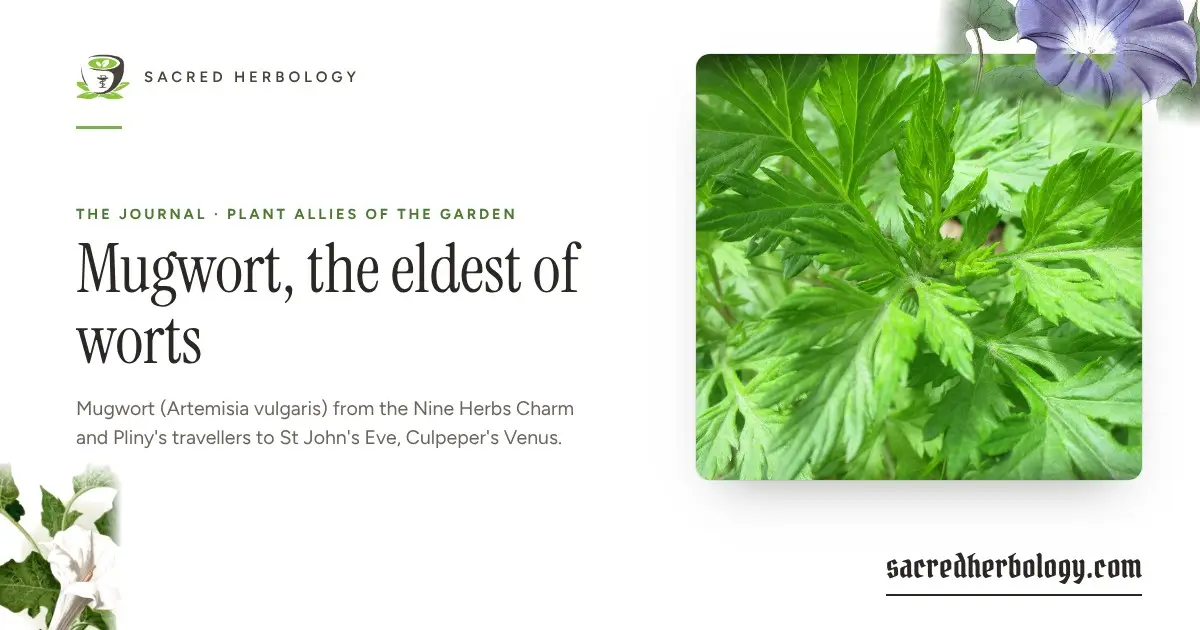
Mugwort grows where people have been. Roadsides, rubbish heaps, railway sidings, the edge of a vegetable patch, the back fence of a house that has changed hands six times. It is a tall, untidy, grey-green perennial, often taller than the person looking at it by late summer, with dark reddish stems and leaves cut into pointed lobes. Turn a leaf over and the underside is silvery white and soft as felt. Crush it and you get a bitter, green, faintly camphor smell that stays on your fingers for an hour.
That weed has been handled by healers, charmers, monks, village girls and ritualists across Europe and Asia for at least two thousand years. It was carried by Roman travellers against weariness, sung to first in the oldest English charm we have, worn as a belt round the Midsummer fire, called the mother of herbs by a medieval poet, given to Venus by an English astrologer, rolled into moxa in China and Japan, hung over doorways at the Dragon Boat festival, and fed to a bear in the founding myth of Korea. In the last fifty years it has become one of the best-loved herbs in modern witchcraft, mostly for dreaming.
This piece follows it through those books and customs, and says plainly where each story comes from and how old it really is. It also starts with a warning about pictures, because the plant most often shown as mugwort on the internet is sometimes a different species.
Which plant are we talking about
The European mugwort is Artemisia vulgaris, named by Linnaeus in 1753. Vulgaris means common, and it is: the plant runs right across temperate Europe and Asia and has followed settlers to North America, southern Africa and parts of Australia. It belongs to the daisy family, the Asteraceae, though you would never guess it from the flowers. These are tiny, dull, yellowish to reddish-brown heads a few millimetres across, packed along leafy spikes at the top of the plant in late summer. Mugwort is wind-pollinated and has no use for showy petals.
The genus Artemisia holds several hundred species, and a handful of them matter to this story.
- Artemisia argyi, ai ye in Chinese, is the leaf most used for moxa in China. It is softer and more woolly than the European plant.
- Artemisia princeps, yomogi in Japanese and ssuk in Korean, is the mugwort of Japanese and Korean cooking and custom. Japanese botanists also use the name Artemisia indica for some of these plants, and the names are still argued over.
- Artemisia verlotiorum, Chinese or Verlot’s mugwort, is a south-west Chinese species that has spread across Europe and eastern Australia and is very easy to mistake for the real thing. More on it below.
- Artemisia absinthium is wormwood, the bitter herb of absinthe, and Artemisia abrotanum is southernwood. Both turn up in the same old herbals, sometimes under the same Latin name.
- Several American species, Artemisia ludoviciana and Artemisia douglasiana among them, are called mugwort or sage locally and have their own place in the ceremonies of the peoples who live with them.

The English name is old. In Old English it is mucgwyrt. Wyrt simply means plant or herb, the same word as the -wort in St John’s wort and liverwort. The first half is less certain. The dictionaries lean towards a link with midge, the small biting fly, and mugwort was hung up against insects within living memory. You will often read that the name comes from flavouring mugs of beer. Mugwort was certainly used in brewing before hops took over, but the beer-mug story is a later guess that fits the modern spelling and not the Old English one.
The genus name is usually traced to Artemis, the Greek goddess of the wild, of the moon in later times, and of women in childbirth. Pliny the Elder tells it differently in book 25 of his Natural History, written in the 70s CE. He says the plant took its name from Artemisia, queen of Caria, the widow who built the Mausoleum at Halicarnassus for her husband Mausolus, and he adds that others thought it was named for Artemis Ilithyia, the goddess in her role as helper at birth. Both stories were already in circulation in the first century, and nobody can now settle which came first.
How to tell mugwort from its lookalikes
This matters for anyone who gathers wild plants for ritual, and it matters for the photograph that stood at the top of an earlier version of this article.
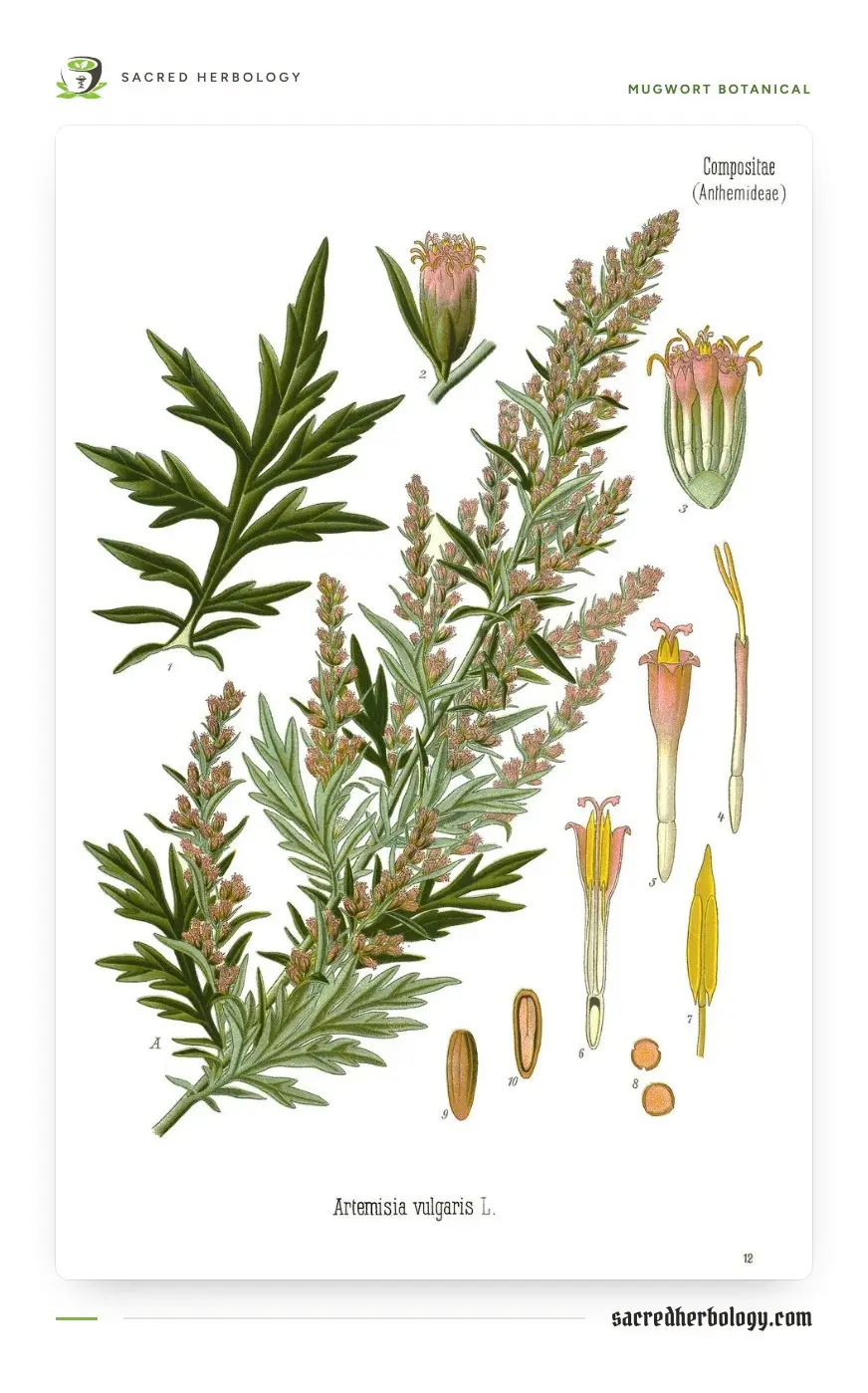
Artemisia vulgaris grows as a clump from a short, woody rootstock. The stems are upright, ridged and often purplish-red. The lower leaves are deeply cut into pointed lobes that are fairly broad and usually toothed along the edges, dark green above and white-felted below. It flowers from about July to September in Europe, and the flowering spikes are dense and leafy. The smell is bitter, resinous and a little sage-like.
Artemisia verlotiorum looks very similar at a glance, and a great many people, botanists included, have been caught by it. The differences are worth learning.
- It spreads by long creeping underground runners, so it forms large patches or stands of separate stems instead of a single clump.
- The leaf lobes are longer and much narrower, often like ribbons, and mostly have smooth edges with few or no teeth. The upper leaves on the flowering stems are long and almost thread-like.
- It flowers very late, from about late September into November in Europe, so late that in colder places it often fails to finish before the frosts.
- The smell is sweeter and more aromatic, with a note many people compare to chrysanthemum leaves.
The species was described by the French botanist Martial Lamotte in 1877 and named for the Verlot brothers of Grenoble, who had noticed this strange late-flowering mugwort growing in the region. It comes from south-western China and has since spread widely as a weed and garden escape. In Australia it is naturalised along the east, in south-east Queensland, eastern and southern New South Wales and southern Victoria, mostly on riverbanks and damp disturbed ground, and Victoria counts it as an environmental weed. A great deal of what gets passed around Australian gardens as “mugwort” is this plant.
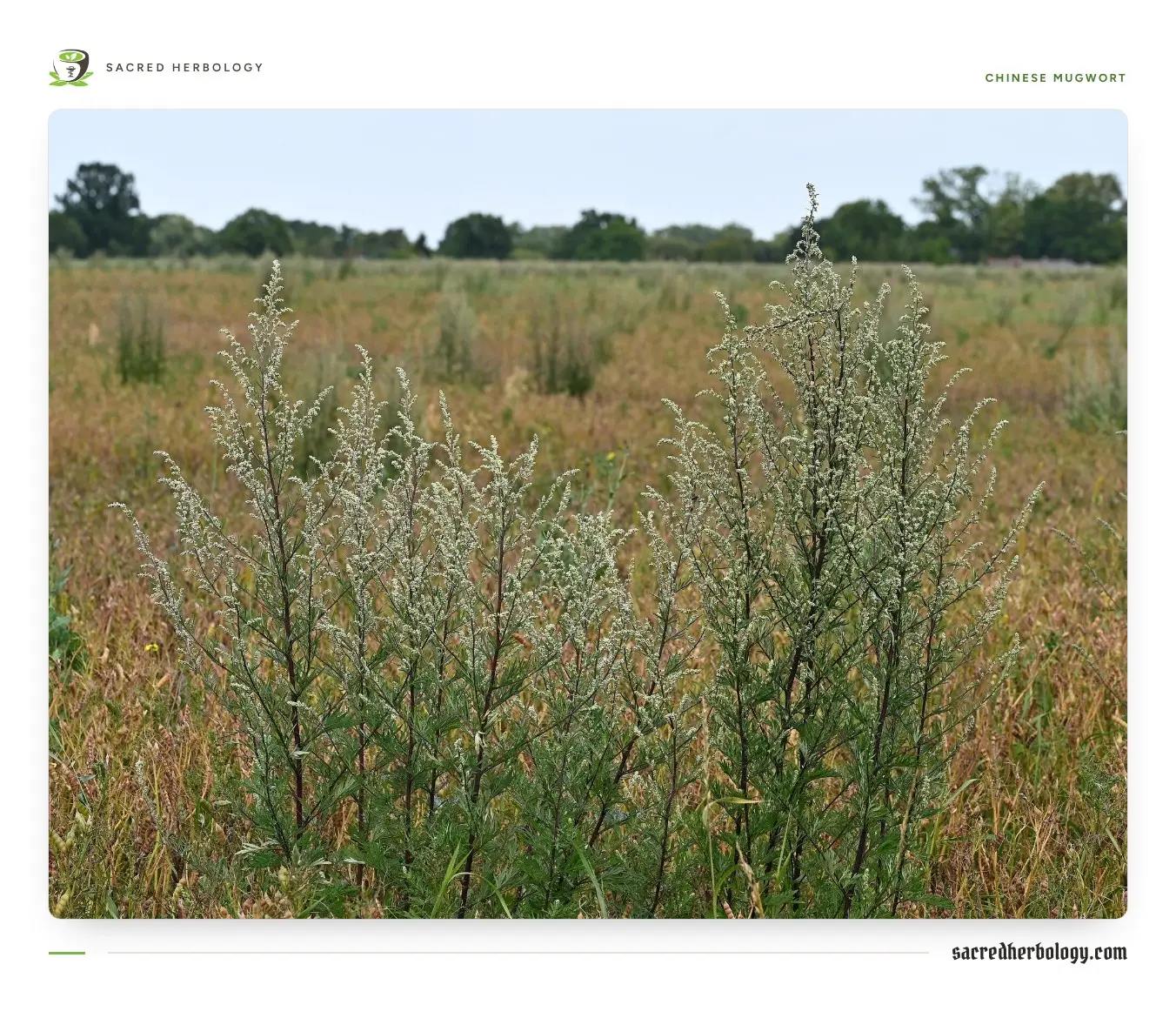

The photograph above is a case in point. It is a fine picture, taken in north-west Poland and shared freely on Wikimedia Commons, where it is filed as Artemisia vulgaris. The plant in it is Artemisia verlotiorum. Look at the long, narrow, untoothed lobes on the upper leaves and the way the stems stand in a loose stand across the field. We ran it as true mugwort in the first edition of this article, which was our mistake, and we have kept it here with the right name because it shows exactly how easy the error is to make. The error is older than the internet, too. The Köhler plate earlier in this article is printed Artemisia vulgaris L. by the artist who drew it in 1898, and the leaf at its upper left has the same long, narrow lobes. That plate shows Chinese mugwort as well, twenty-one years after Lamotte named it. A label on a plate or a file page is only as good as the person who wrote it, whether that was a German illustrator or a photographer uploading to Commons.
If you are gathering for ritual, crush a leaf and smell it, turn it over and look at the lobes, and check the calendar. Mugwort in full flower in November is very likely the Chinese species.
“Remember, mugwort”
The oldest English words spoken to this plant sit in a manuscript in the British Library, Harley MS 585, a small, much-handled book of remedies, charms and prayers that scholars call the Lacnunga, from an Old English word for remedies. It was copied in the late tenth or early eleventh century. One of its charms, known today as the Nine Herbs Charm, calls on nine plants in turn, to be pounded into a salve against poison and infection. Mugwort comes first.
“Remember, mugwort, what you made known, what you arranged at Regenmeld,” it begins, in Old English. “You are called Una, the oldest of herbs. You have power against three and against thirty, you have power against poison and against infection, you have power against the loathsome one who travels through the land.”
Every phrase of that has been argued over. Nobody knows for certain what or where Regenmeld was; it may mean a solemn proclamation, or a place. Una may be a name, or a scribe’s rendering of a Latin word for one. “The loathsome one who travels through the land” translates a phrase that most editors read as a flying or wandering infection, the sort of illness that seemed to arrive on the wind. The same charm names Woden, who struck an adder with nine glory-twigs, and a few lines later Christ, hanging on the cross. Pre-Christian and Christian ideas sit side by side in it without any sense of strain.
What the charm does tell us is that by around the year 1000 mugwort had first place among healing plants in English tradition, strong enough to be addressed by name and asked to remember its own power. The phrase “oldest of herbs” is where the title of this article comes from.
The best place to read the Lacnunga is Edward Pettit’s two-volume edition of 2001, with the Old English text, a translation and a long commentary. Older readers may know Godfrid Storms’s Anglo-Saxon Magic of 1948, which is still useful, and J. H. G. Grattan and Charles Singer’s Anglo-Saxon Magic and Medicine of 1952, which is less reliable on the text and much more confident in its opinions.
The traveller’s herb
A second strand of mugwort lore is older than the Nine Herbs Charm, and it is about walking.
Pliny says, in book 26 of the Natural History, that a traveller who carries artemisia tied to his body will not feel weariness on the road. It is one sentence, but it had a very long life. It turns up again in the Herbarium of Pseudo-Apuleius, a Latin herbal put together around the fourth century and copied endlessly through the Middle Ages, which opens its account of the artemisias with the same promise and adds more. In the Old English translation of that herbal, made around the same time as the Lacnunga was copied, the reader is told that if he means to make a journey he should take this plant in his hand and keep it with him, and he will not feel much toil on the way. It also puts devil sickness to flight, and in the house where it is kept it forbids evil medicine and turns away the eyes of evil men.
That is the first clear record of mugwort as a protective household plant as well as a road companion, and it comes from a learned book, a translated Latin herbal, which then fed back into folk practice for centuries. The Old English text was printed by Oswald Cockayne in the first volume of his Leechdoms, Wortcunning and Starcraft of Early England in 1864, and edited properly by Hubert Jan de Vriend for the Early English Text Society in 1984.
The idea is still going. Modern books of herbal magic tell you to put mugwort leaves in your shoes before a long walk. Few of them say that the advice is Pliny’s, nearly two thousand years old.
The mother of herbs
Some time in the late eleventh century a French physician-poet, usually identified as Odo of Meung, wrote a long Latin poem on the powers of herbs under the pen name Macer, borrowing the name of a Roman poet whose own herbal verse had been lost. The poem, De viribus herbarum, became one of the most copied herbals of the Middle Ages, and it is usually called Macer Floridus.
It opens with artemisia. The poet calls it the mother of herbs, mater herbarum, and explains the name by the goddess who presides over women. The chapter goes on to its uses in women’s complaints, which were the main reason mugwort mattered to medieval physicians, and that association with women’s bodies runs through nearly every later account of the plant. The Latin text is in Ludwig Choulant’s edition of 1832, and a new critical edition is being prepared.
So by the high Middle Ages mugwort had two titles that say the same thing in two languages: the oldest of herbs in English, the mother of herbs in Latin. The twelfth-century German abbess Hildegard of Bingen also gave it a chapter in her Physica, under the German name biboz, the ancestor of the modern Beifuß.
St John’s Eve
Across Germany, France and England mugwort was gathered on the eve of the feast of St John the Baptist, 23 June, Midsummer night in the northern hemisphere. People wore girdles of it while dancing around the bonfires, then threw them into the flames to burn away the year’s bad luck and sickness. The German names Johannisgürtel, St John’s girdle, and Sonnenwendgürtel, solstice girdle, keep the custom in the language. In France the plant was herbe de la Saint-Jean, a name it shared with St John’s wort and several others that were gathered on the same night.
That is folklore in the proper sense: village practice, handed down by doing, recorded mostly by nineteenth-century collectors such as Jacob Grimm in his Deutsche Mythologie of 1835, who were sometimes too eager to find ancient pagan rites behind every country custom. The bonfires and the girdles are well recorded. The claim, common online, that the custom goes straight back to a pre-Christian solstice cult is a theory, and it should be read as one.
A related English story says that if you dig at the root of mugwort on Midsummer Eve you will find a coal that protects whoever keeps it from plague, lightning and burns. The “coals” are most likely old, dead, blackened roots. The belief is real and was widely repeated, but its history is tangled. When John Aubrey described a crowd of young women on their knees in a London field on St John’s Day 1694, digging for such a coal to put under their pillows and dream of their future husbands, he said they were digging under plantain. Lore of this kind moves between plants freely, and it is worth saying so when a modern book puts it firmly under mugwort.
Down here the calendar turns the custom on its head. St John’s Eve in Australia falls in the dark of winter, a few days after the longest night, and mugwort is dormant. Some practitioners keep the date, some move the custom to the December solstice, and some keep both. The old sources give no help either way. They were written by people who never imagined the southern sky.
Muggons in May
Scotland has a rhyme about mugwort that Robert Chambers printed in his Popular Rhymes of Scotland in the nineteenth century. A funeral procession was passing along the shore near Port Glasgow, the story goes, when a mermaid rose from the water and sang:
“If they wad drink nettles in March, and eat muggons in May, sae mony braw maidens wadna gang to the clay.”
Muggons is mugwort. The rhyme says, in short, that spring greens would have kept the young woman alive. It belongs with a large body of spring-tonic lore from across Europe, and it is charming as a story. It is a folk rhyme with a mermaid in it and should be enjoyed as one.
Culpeper’s planet
Nicholas Culpeper, the London astrologer-herbalist, published The English Physitian in 1652. He gave every plant a planetary ruler, and he gave mugwort to Venus, on the grounds that it serves the parts of the body Venus rules, which for him meant the womb and women’s health in general. That is the same association Macer had made in the eleventh century, now given an astrological reason.
His system belongs to the astrological herbal, a learned tradition with its own logic, and it is where many modern correspondence tables quietly get their planets from. Culpeper’s attributions were his own work in many cases. He drew on earlier astrological medicine but did not inherit a fixed list, and he says so himself in places.
You will often see mugwort listed under the Moon in modern witchcraft books, and sometimes with Artemis or Diana as its deity. The lunar link is understandable: the goddess, the women’s herb, the silver underside of the leaf. But that attribution is recent, and its spread in print belongs to the twentieth century. Culpeper said Venus. If you work with planetary correspondences, know which tradition you are standing in. Neither answer is wrong inside its own system, and they are two different systems.
Moxa and the fire on the skin
In China the dried, sifted wool from the underside of ai ye leaves is rolled into cones or cigars and smouldered over points on the body. This is moxibustion, and it is ancient. Silk manuscripts buried in 168 BCE in a tomb at Mawangdui, near Changsha in Hunan, include two short texts on cauterising the body’s vessels, among the earliest writing we have on the practice anywhere. They were edited and translated into English by Donald Harper in 1998. Moxibustion sits inside a full medical system with centuries of training behind it, and the practitioners who learn it know how to use it.
The word moxa itself is Japanese. It comes from mogusa, the prepared leaf wool, from moe kusa, burning herb. Europeans met it in Japan through the Dutch trading post at Dejima in the seventeenth century. Hermann Buschof, a Dutch minister in Batavia, wrote a short book on treating his own gout with it in 1674, and the physician Willem ten Rhijne described it at length in 1683. Engelbert Kaempfer, who served at Dejima in the 1690s, gave Europe its fullest early account. For a while moxa was fashionable in European medicine, and then it was forgotten there for two centuries.


In Japan the best mogusa came from the Ibuki mountain area, and the plant was gathered in early summer when the leaves were full. The making of good moxa is slow work: drying, pounding, sieving and aging the leaf until only the soft fibre is left. The finer the wool, the cooler and more even it burns.
Our moxa is sold for ceremonial and ritual burning. If you are thinking about using it on the body, consult a degree-qualified herbalist with competencies and adequate training in pharmacognosy.
Doorways, rice cakes and a bear in a cave
East Asia has its own deep mugwort lore, older in the written record than most of the European.
In China mugwort is hung on doors on the fifth day of the fifth lunar month, the Duanwu or Dragon Boat festival, together with leaves of calamus, against the poisons and pestilence of high summer. A sixth-century account of the year’s festivals in the Jingchu region, the Jingchu suishi ji of Zong Lin, already describes gathering mugwort on that day, shaping it into a human figure and hanging it over the door to drive off poisonous vapours. The custom is still kept in many places.
In Korea mugwort is in the founding myth itself. The story is told in the Samguk yusa, compiled by the monk Iryeon in the late thirteenth century. A tiger and a bear asked the god Hwanung to make them human. He gave them a bundle of mugwort and twenty cloves of garlic and told them to stay out of the sunlight for a hundred days. The tiger gave up. The bear held out, became a woman, and bore Dangun, the founder of the first Korean kingdom. Ssuk, mugwort, is still eaten in Korean spring soups and rice cakes.
In Japan yomogi is pounded into green rice cakes, kusa mochi, and gives its colour to one layer of the diamond-shaped hishi mochi set out for the Girls’ Festival on 3 March. Bunches of yomogi and iris leaves were hung from the eaves at the boys’ festival in May, against evil and illness.
These are living traditions, kept by living communities. They are told here as their own sources tell them.
Dreaming with mugwort
A sachet of dried mugwort under the pillow for vivid or prophetic dreams is one of the most popular practices in modern herbal magic. So is drinking a cup of mugwort tea before sleep, or washing a crystal ball or a scrying mirror in a mugwort infusion.
I have looked for the dream pillow in the older sources, and found very little before the twentieth century. The nearest older relatives are the Midsummer customs of putting something under the pillow to dream of a future husband, and as Aubrey’s story shows, that was often plantain, or a coal, and not the herb itself. The modern practice was spread to a wide readership by Scott Cunningham’s Encyclopedia of Magical Herbs in 1985, which lists mugwort for prophetic dreams, psychic power and protection on journeys, and by a great many books that followed his.
It may be old. It may be new. It has certainly become a real tradition in its own right over the last fifty years, used and passed on by a large community of practitioners. Enjoy it for what it is, and be wary of anyone who tells you the druids did it. I know of no early source that puts the two together.
Mugwort on the coals
Dried mugwort burns readily, and it has long been used as a smoke as well as a moxa. The smoke is sharp, green and resinous, a long way from the sweetness of frankincense or benzoin. Many modern practitioners use bundles of dried mugwort for clearing a space, often as a European or home-grown choice in place of white sage. It also mixes well into loose incense with resins, where a pinch of the crumbled leaf gives a herbal, bitter edge.
If you burn it, burn a little at a time. A whole bundle of mugwort makes a great deal of smoke very quickly, more than most rooms need, and the leaf holds a coal for a long while after you think it is out.
Handling it safely
- Mugwort is a daisy-family plant. People who react to ragweed, chamomile or chrysanthemum can react to it too. Its pollen is a common hay-fever trigger in late summer where it grows wild, and in some people it goes with food reactions to celery, carrot and certain spices. Handling the fresh plant can bring out an itchy rash on sensitive skin, so wear gloves if you know you react.
- Mugwort can contain thujone, alongside camphor, cineole and other strong aromatic compounds. How much thujone varies a great deal from plant to plant, and some plants have very little, so there is no way to judge it by eye or smell. Thujone in large amounts can bring on fits, so never take mugwort essential oil by mouth, and anyone with epilepsy should steer clear of the concentrated oil altogether. Folk tradition used mugwort to bring on a woman’s period, which is exactly why it should be avoided in pregnancy and while breastfeeding.
- Smouldering moxa and burning mugwort throw a lot of dense, pungent smoke. The same cautions apply as for any smoke: keep it away from anyone with asthma or a chest condition, from babies, and from pregnant women. Burn it with a window open and never leave it alight unattended. A moxa roll or a mugwort bundle is only out when you have stubbed it into salt, sand or a snuffer.
- If you gather wild mugwort, be sure of the species, and gather away from roadsides and sprayed ground. The plant loves disturbed soil, and disturbed soil is often dirty soil.
Where this comes from
- British Library, Harley MS 585 (the Lacnunga); Edward Pettit, ed., Anglo-Saxon Remedies, Charms, and Prayers from British Library MS Harley 585: The Lacnunga, 2 vols (Edwin Mellen Press, 2001).
- Godfrid Storms, Anglo-Saxon Magic (Martinus Nijhoff, 1948).
- Pliny the Elder, Natural History, books 25 and 26.
- Hubert Jan de Vriend, ed., The Old English Herbarium and Medicina de Quadrupedibus, Early English Text Society o.s. 286 (Oxford University Press, 1984); Oswald Cockayne, Leechdoms, Wortcunning and Starcraft of Early England, vol. 1 (London, 1864).
- Macer Floridus, De viribus herbarum, ed. Ludwig Choulant (Leipzig, 1832).
- Hildegard of Bingen, Physica, trans. Priscilla Throop (Healing Arts Press, 1998).
- Jacob Grimm, Deutsche Mythologie (Göttingen, 1835).
- John Aubrey, Miscellanies (London, 1696).
- Robert Chambers, Popular Rhymes of Scotland (Edinburgh, 1826; enlarged edition 1870).
- Nicholas Culpeper, The English Physitian (London, 1652).
- Donald Harper, Early Chinese Medical Literature: The Mawangdui Medical Manuscripts (Kegan Paul International, 1998).
- Willem ten Rhijne, Dissertatio de arthritide (London, 1683); Engelbert Kaempfer, Amoenitatum exoticarum (Lemgo, 1712).
- Zong Lin, Jingchu suishi ji (sixth century).
- Iryeon, Samguk yusa (late thirteenth century).
- Scott Cunningham, Cunningham’s Encyclopedia of Magical Herbs (Llewellyn, 1985).
- Weeds of Australia (Queensland Government / Lucid), Artemisia verlotiorum fact sheet; VicFlora, Artemisia verlotiorum (Royal Botanic Gardens Victoria).
Corrected October 2026: the first edition of this article used a Wikimedia Commons photograph labelled Artemisia vulgaris as its main image. The plant in that photograph is Artemisia verlotiorum. It now appears in the lookalikes section under its right name. The Köhler plate, printed as Artemisia vulgaris in 1898, shows the same species and is now captioned as Artemisia verlotiorum.