
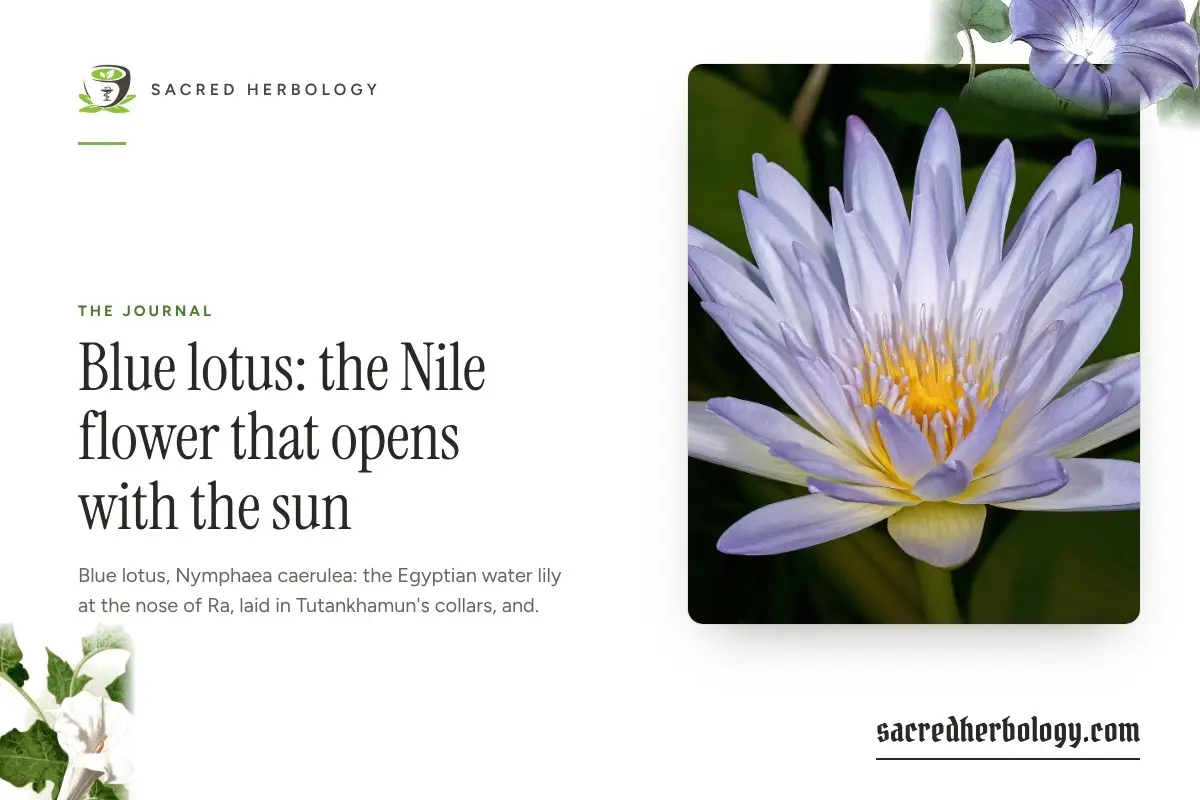
Stand by a pond of blue lotus early on a warm morning and you can watch the day start. The buds sit just above the water, pointed and closed. As the sun climbs they open into pale sky-blue stars with a gold centre, and they give off a soft, sweet scent you notice before you see where it comes from. By early afternoon they fold shut again. A flower does this for about three days, then sinks.
The ancient Egyptians watched the same thing along the Nile for three thousand years, and they built a good part of their picture of the world around it. This piece is about that picture, what survives of it, how it passed to the Greeks and the philosophers, and one very modern story that has grown up on top of it.
Which plant are we talking about
The English word “lotus” has been used for at least three different plants, and most of the confusion in popular writing starts here.
- The blue lotus of Egypt is a water lily, Nymphaea caerulea, of the water lily family, Nymphaeaceae. It was named by Jules-César Savigny, one of the naturalists who travelled with Napoleon’s expedition to Egypt in 1798. Many botanists now treat it as a variety of a wider species, Nymphaea nouchali var. caerulea, and you will see both names in books and nursery catalogues. It is native to the Nile and to much of eastern and southern Africa, with outliers in south-western Asia. The flowers are the part that has always mattered, in art, in burial and in the modern trade.
- The white lotus of Egypt is another water lily in the same genus, Nymphaea lotus. It flowers at night and closes in the morning, the reverse of the blue.
- The sacred lotus of India and Asia is a different plant altogether, Nelumbo nucifera, in its own family, Nelumbonaceae. Its leaves and flowers stand up well clear of the water on tall stalks, and its seed head looks like a showerhead. This is the lotus of Hindu and Buddhist art. It is native from tropical Asia down to northern Australia, so it is one of our own plants as well.
There is a fourth lotus that has nothing to do with water at all. When Odysseus lands among the Lotus-eaters in the ninth book of the Odyssey, the fruit that makes his men forget their homes is usually identified with a North African shrub, most often a wild jujube, Ziziphus lotus. Greek used “lotos” for several plants, and translators have been untangling them ever since.
The blue and the white water lilies are native to the Nile. The sacred lotus is not. It seems to have reached Egypt late, most likely in the Persian period from the sixth century BCE. Herodotus, who travelled in Egypt in the fifth century BCE, describes both. He tells of lilies “which the Egyptians call lotus” whose poppy-like centres were dried, crushed and baked into loaves, and of other lilies “like roses” whose fruit looked like a wasps’ comb. The first is the white water lily. The second is the newcomer, Nelumbo. When you read about pharaonic Egypt, from the pyramids to Tutankhamun, the lotus in question is almost always a Nymphaea, and the blue one carries most of the religious weight.
The Egyptians called the water lily seshen. The word passed into Coptic as shoshen, and from the same source, by a route scholars still discuss, comes the Hebrew shoshannah, the flower of the Song of Songs usually translated “lily”, and with it the girl’s name Susanna. Every Susan is carrying a Nile water lily about with her.
The naturalists’ flower
Savigny’s naming was one small result of one of the strangest scientific expeditions ever mounted. When Napoleon sailed for Egypt in 1798 he took with him more than a hundred and fifty scholars, engineers and artists, the savants, to study the country while the army conquered it. The conquest failed within three years. The study did not. Their work came out between 1809 and 1829 as the Description de l’Égypte, a set of enormous volumes whose plates showed Europeans the temples, the animals and the plants of the Nile in detail for the first time.
Savigny, a young zoologist, was one of them. He recognised that the blue water lily of the Nile was a species of its own and gave it the name caerulea, “sky blue”. He went on to spend years on the expedition’s natural history before his eyesight failed. The plant he named had been painted on Egyptian walls for thirty centuries before any European botanist classified it.
The flower at the nose of Ra
Egyptian religion had several accounts of how the world began, told at different temples. In the one associated with Hermopolis, the city of Thoth, the world before creation was a dark, formless flood, and in it lived eight primeval beings, four pairs of gods and goddesses who stood for the waters, the endlessness, the darkness and the hiddenness of that first state. Out of those waters a lotus rises, opens, and the young sun comes out of it. A flower that rises out of the water, closes as the day ends and opens again with the morning light fitted that story very well.
The Greeks noticed the behaviour too. Theophrastus, writing around 300 BCE, describes the lotus of the Nile closing its flower at sunset and drawing it down under the water, then rising and opening again in the morning. Pliny the Elder repeated him in Latin three centuries later. The nightly dive is an exaggeration. A water lily flower closes and stays at the surface, and only goes down for good when it is finished after a few days. The opening and closing they saw was real, and the Egyptians had already made it a creation story.
The god of the lotus was Nefertem, a young god often shown with a water lily on his head. He was counted as the son of Ptah and Sekhmet at Memphis, and he was bound up with perfume and with the flower’s scent. The oldest religious texts we have, the Pyramid Texts carved inside royal tombs from about 2350 BCE, already use the image. In the pyramid of King Unas, the king is said to appear as Nefertem, as the lotus at the nose of Ra, rising from the horizon every day.
That phrase, “at the nose of Ra”, matters. The lotus is a flower the sun god smells. Scent in Egyptian thought was close to breath and to life itself, and to hold a flower to the nose was to take in something of the god.
Flowers for the living and the dead
Once you know to look, blue lotus is everywhere in Egyptian art. The painted tomb-chapel of Nebamun, a Theban official of about 1350 BCE, now has pieces in the British Museum. In its banquet scene the guests sit in their finery, and they hold water lilies up to their faces or wear buds tucked into their hair. Servants move among them with more flowers. On funerary stelae the dead are shown seated before a table of offerings, a lotus held to the nose.
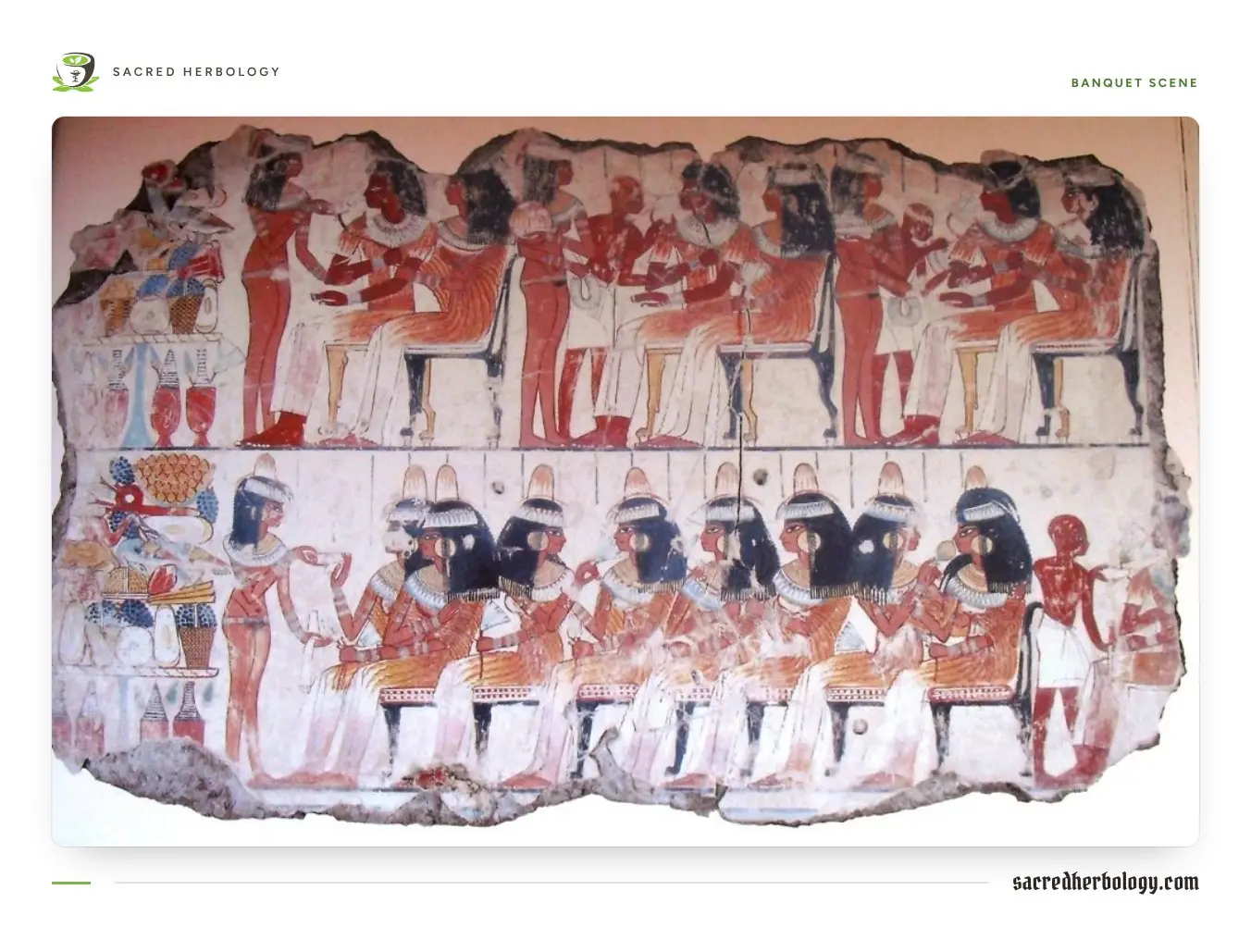

The Nebamun paintings have a story of their own. They were cut from the walls of a tomb on the Theban west bank around 1820 by Giovanni d’Athanasi, a Greek dealer working for the British consul-general Henry Salt, and the museum bought them from Salt’s collection. Nobody wrote down where the tomb was, and it has never been found again. The fragments were conserved and put back on display in 2009 after a decade of work, and the museum’s curator, Richard Parkinson, wrote a lovely short book about them. Look closely at the banquet and you see the whole vocabulary of the Egyptian party: wigs, jewellery, wine jars wreathed in flowers, musicians, dancing girls, and on the guests’ heads the odd white cones that Egyptologists long argued about. Were they real lumps of scented fat melting in the heat, or a painter’s sign for perfume? In 2019 a team working at Amarna published two burials in which the dead actually wore such cones, which settled that they existed, if not what they were for.
The mood of those parties comes down to us in the Harper’s Songs, poems written for tombs and banquets. The most famous, said to come from the tomb of a King Intef, urges its hearers to follow their hearts while they live, to put myrrh on their heads, dress in fine linen and anoint themselves with oils fit for a god, since no one comes back from the West. The lotus held to the nose belongs to that world: a flower of the day, held up against the dark that the song is honest about.
The Book of the Dead, the collection of spells written on papyrus and buried with the dead from the New Kingdom onward, has a pair of spells for being transformed into a lotus. In spell 81A the speaker says, “I am this pure lotus which went forth from the sunshine, which is at the nose of Ra.” The next version addresses the lotus “belonging to the semblance of Nefertem”. The hope was to come up out of the dark as the flower does each morning.
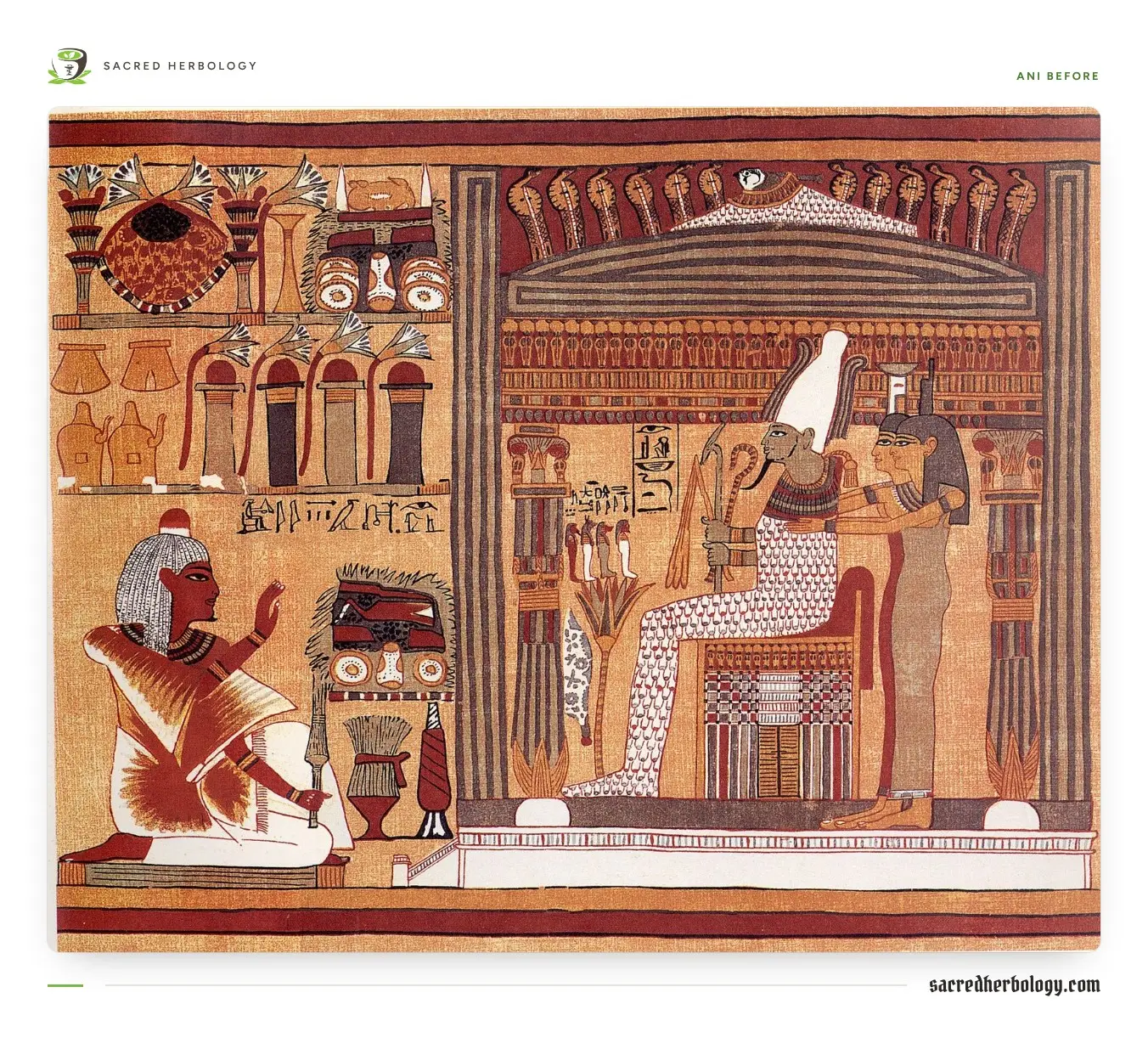
The finest copy of the Book of the Dead to reach Europe shows the flower at the moment that mattered most. The Papyrus of Ani, written for a Theban scribe around 1250 BCE, was bought at Luxor in 1888 by E. A. Wallis Budge of the British Museum, in circumstances he describes in his memoirs with more pride than the Egyptian authorities of the day would have liked. In its famous judgement scene, where Ani’s heart is weighed against the feather of truth, Osiris sits enthroned, and in front of him an open lotus rises from the water with the four small sons of Horus standing on it. The flower of the first morning stands at the door of the next world.

The lotus also stood for the south. In the old symbol of the Two Lands the plant of Upper Egypt, usually read as a lily or lotus, and the papyrus of Lower Egypt are tied together around a central sign, and that knot of two plants means a united kingdom. The architects used it too. Columns carved as bundles of lotus stems, with capitals shaped like closed buds or open flowers, hold up the roofs of temples from the Old Kingdom to the Roman period, so that the priests walked through a stone marsh on the way to the god.
Tutankhamun’s flowers
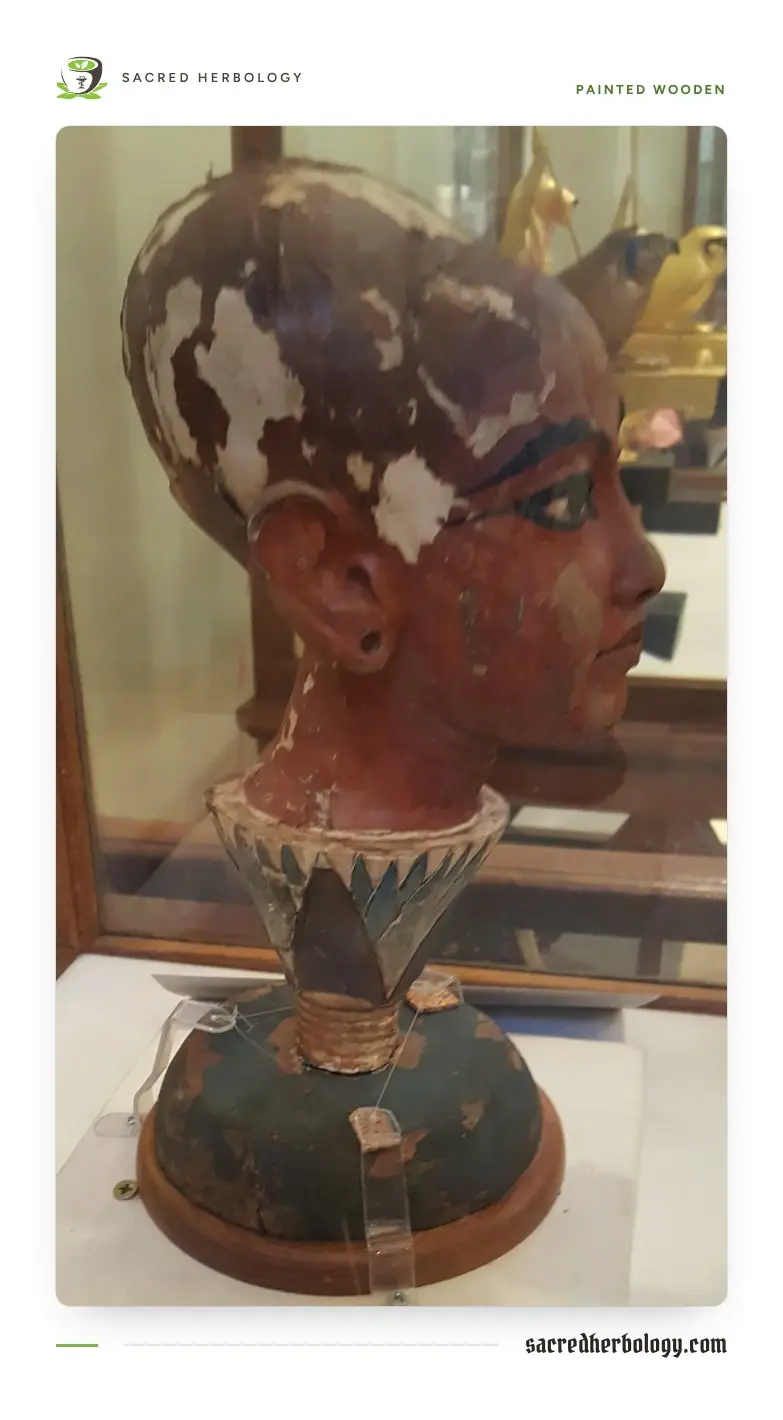
When Howard Carter opened Tutankhamun’s tomb in 1922, one of the first objects found was a small painted wooden head of the boy king rising out of an opening blue lotus. It is the Nefertem image made into a portrait: the king as the young sun, born from the flower.

There was lotus in stone as well. In the antechamber Carter found a translucent calcite cup carved as an open white lotus, with handles in the form of the god of millions of years. Its inscription wishes the king millions of years, sitting with his face to the cool north wind and his eyes beholding happiness. Carter’s team called it the Wishing Cup, and it gave him the motto on his own gravestone in London.
The tomb also held real flowers, dried but intact after more than three thousand years. Carter wrote that among all the gold in the burial chamber there was nothing so beautiful as those few withered flowers, still retaining their tinge of colour. Nigel Hepper, a botanist at the Royal Botanic Gardens, Kew, worked through them in his book Pharaoh’s Flowers (1990). Several of the floral collars laid on the king’s coffins were built up from leaves and fruits with petals of blue water lily sewn in among them, and a small wreath on the brow of the second coffin mixed olive leaves, blue lily petals and cornflowers. The mix of plants, some flowering and some fruiting, points to a burial in the Egyptian spring, around March or April. These were the flowers of a real funeral, picked for a real boy, and they are the best physical evidence we have of how the blue lotus was used: gathered, strung and laid on the dead.
Tutankhamun’s were not the first garlands to come out of the ground. In 1881 the Egyptian Antiquities Service cleared a hidden tomb at Deir el-Bahari where priests of a later age had stacked the mummies of great kings, among them Ahmose and Ramesses II, to keep them from robbers. Several still wore garlands. The German botanist Georg Schweinfurth examined them in Cairo and found blue water lily among the flowers, and he was able to soften them in warm water until the petals opened and showed their colour again. It is hard to read his account without a little shiver.
The Greeks and the child on the lotus
When Egypt came under Greek and then Roman rule, the lotus went with the Egyptian gods into the wider world. The infant Horus, whom the Greeks called Harpocrates, “Horus the child”, became one of the favourite figures of Hellenistic religion, and he is often shown as a small naked boy, finger to his lips, sitting on an open lotus. Terracottas of him turn up across the Mediterranean.
Plutarch, a priest at Delphi who wrote a long essay On Isis and Osiris around 100 CE, took the image as a teaching device. He says the Egyptians did not believe the sun literally rose as a newborn child from a lotus, but painted it that way to show that the sun is kindled out of the moist element. Plutarch was reading Egyptian religion through Greek philosophy, and he was not alone.
Two centuries later, the Neoplatonist Iamblichus of Chalcis wrote a defence of Egyptian and Chaldean ritual now known as On the Mysteries. In its seventh book he explains why the Egyptians showed their god seated on a lotus. The mud below stands for matter and the body; the lotus, rising clean above it with its round leaves and radiant flower, stands for the pure intellect, and the god sitting on it rules over the whole without touching the mud. This is late antique philosophy of an esoteric kind, a theurgist’s reading of temple imagery, and it had a long life. Iamblichus was translated into Latin by Marsilio Ficino in the fifteenth century and read by the Renaissance magicians.
The esoteric thread runs on into the modern period. The Hermetic Order of the Golden Dawn built much of its ritual on Egyptian god-forms, and the gesture of Harpocrates, finger to lips, became its Sign of Silence, made after the forward-thrusting Sign of the Enterer to close off the force it sent out. That is ritual magic, and the Order’s teaching about it is a symbolic system; I report it as the members held it.
The modern story of an Egyptian high
Search “blue lotus” today and most of what you find is about an ancient Egyptian intoxicant. You will read that priests steeped the flowers in wine, that the banquet guests in the tomb paintings were under its influence, and that the whole cult of the lotus was about a sacred altered state.
This story is modern, and it has a date and an author. It took shape in the work of William A. Emboden, a botanist at California State University, Northridge, who published “The sacred narcotic lily of the Nile” in the journal Economic Botany in 1978, and followed it in 1981 with a long paper in the Journal of Ethnopharmacology comparing Egyptian water lily imagery with Maya art, where another water lily is common. Emboden read the banquet scenes, the lotus-shaped cups and the lotus-crowned wine jars as signs of a drug ritual. From the 1990s the idea spread through popular books on “plants of the gods”, and online shops selling dried blue lotus picked it up from there. A short comment in a medical journal in 2004 by an Italian toxicology group took the idea further, and is still quoted.
Here is where the evidence stands, as plainly as I can put it. The Egyptian texts say a great deal about the lotus as a flower of the sun, of rebirth and of scent. I know of no Egyptian text that describes taking it to change the mind. The paintings show people smelling the flowers and wearing them. Lotuses do appear near wine at banquets, and wine was plainly part of the party, but a flower beside a cup is still only a picture of a flower beside a cup. The intoxicant reading is an inference layered onto the pictures, and many Egyptologists remain unconvinced. It may be right in part. It may be wrong. It is an argument about the ancient record, and a recent one. Anyone who tells you “the Egyptians used it to reach the gods” as settled fact is repeating a theory from the late twentieth century.
It is worth seeing why the theory was attractive. The 1970s were the high summer of ethnobotany as a romantic science, when Richard Evans Schultes and Albert Hofmann were cataloguing the sacred plants of the Americas and many writers expected to find the same pattern everywhere. A culture that painted one flower on every wall seemed to demand an explanation beyond beauty. The Egyptians themselves offered one: the sun, the morning and the scent at the nose of the god. That explanation has the advantage of being in their own words.
What is sold as blue lotus today
The distinction matters for a practical reason. Blue lotus is sold widely now as a dried flower for drinking and smoking, and the marketing leans on this story. Laboratory tests on blue lotus material have reported aporphine alkaloids, among them nuciferine and aporphine itself, along with flavonoids, but the results vary a good deal from one sample to the next. Nuciferine takes its name from the sacred lotus, Nelumbo nucifera, and most of what is known about it comes from that plant and from test-tube and animal work. You will also read online that blue lotus contains apomorphine. That claim rests on weak evidence, and careful laboratory testing has not confirmed it. What is sold under the name is hard to check, too. Dried petals of one water lily look much like another’s, and the dark resins and extracts sold as blue lotus come with no reliable statement of what is in them or how concentrated it is. There has been very little proper research on what the plant does in people, and none on its safety in pregnancy, while breastfeeding, for children, or alongside alcohol or prescribed medicines. So I write about it here as a flower and a garden plant, and I won’t describe how anyone takes it. If you are thinking of taking any part of it, consult a degree-qualified herbalist with competencies and adequate training in pharmacognosy. If someone becomes unwell after taking it, or a child has eaten any part of it, call the Poisons Information Centre on 13 11 26, or 000 if they are confused, hard to wake, or struggling to breathe. If a pet has eaten it, ring your vet.
Growing it here, and the one catch
Blue lotus is an easy, rewarding plant in a warm climate, and in a tropical garden it will flower for most of the year given sun and still water. It wants full sun, a pot of heavy soil sunk into a pond or a large glazed tub, and a few hands of water over the crown. The leaves are round, with a slit to the centre and often a purplish flush underneath. Cut a flower in the morning, just as it opens, and put it in a shallow bowl on a table or altar. The scent fills a room for a day or so, which is as close as most of us will get to Nebamun’s party.
The catch is this. Away from Africa, blue lotus can escape. It has gone wild in parts of Queensland and New South Wales, where it takes over dams, lagoons and slow creeks. There it displaces similar native plants, our own water lilies among them. Brisbane City Council lists it as pest vegetation under its Natural Asset Local Law, and under Queensland’s Biosecurity Act 2014 everyone has a general biosecurity obligation to take reasonable steps not to spread a pest plant.
Watch the labels, too. Pond shops sell more than one plant as “blue lotus”. The Zanzibar form, Nymphaea caerulea subsp. zanzibariensis (often spelt zanzibarensis on Australian lists), has larger flowers in blue, purple or pink. Weed lists here once gave that name to the wild populations too, though the current view is that the Zanzibar form is only in cultivation in Australia and the escapes are the ordinary blue. Either way, treat anything sold under the name the same way. So:
- Grow it in a closed pond or tub that can’t overflow into a drain, creek or dam.
- Never tip pond water, plants or seed into a waterway, and never plant it out in a dam.
- Check with your own council before you plant it. Rules differ from place to place.
- If small children visit, cover the tub or fence the pond. A toddler can drown in a few centimetres of water.
If you have a dam or a pond that connects to anything, grow one of our own instead. Queensland has beautiful native water lilies. Nymphaea gigantea, the giant water lily, has big flowers in shades from white to deep blue that stand well above the water, and Nymphaea violacea grows in lagoons right across the north. Neither is a weed here, and both have their own long history in the country they come from. Aboriginal people across northern Australia have gathered native water lilies from the lagoons for thousands of years, and the plants belong to the seasonal round of the wetlands where they grow; that knowledge belongs to the people who hold it, and the published accounts are the place to start reading about it.
Either way, get up early one morning and watch a bud open. You will see why a people who lived by the sun and the river gave it the first place in the story of the world.
Where this comes from
- The Pyramid Texts: R. O. Faulkner, trans., The Ancient Egyptian Pyramid Texts (Clarendon Press, Oxford, 1969), Utterance 249.
- The Book of the Dead: R. O. Faulkner, trans., The Ancient Egyptian Book of the Dead, ed. Carol Andrews (British Museum Publications, 1985), spells 81A and 81B.
- E. A. Wallis Budge, The Book of the Dead: The Papyrus of Ani (British Museum, 1895); and his By Nile and Tigris (John Murray, London, 1920) for the purchase.
- Miriam Lichtheim, Ancient Egyptian Literature, vol. 1: The Old and Middle Kingdoms (University of California Press, 1973), the Harper’s Song from the tomb of King Intef.
- Homer, Odyssey 9.82-104, trans. A. T. Murray (Loeb Classical Library, 1919).
- Herodotus, The Histories, book 2, chapter 92, trans. A. D. Godley (Loeb Classical Library, Harvard University Press, 1920).
- Theophrastus, Enquiry into Plants 4.8.9-11, trans. Arthur Hort (Loeb Classical Library, 1916).
- Plutarch, De Iside et Osiride 11, in Moralia vol. V, trans. F. C. Babbitt (Loeb Classical Library, 1936).
- Iamblichus, On the Mysteries 7.2, trans. Emma C. Clarke, John M. Dillon and Jackson P. Hershbell (Society of Biblical Literature, Atlanta, 2003).
- Howard Carter and A. C. Mace, The Tomb of Tut.ankh.Amen, 3 vols (Cassell, London, 1923-1933).
- F. Nigel Hepper, Pharaoh’s Flowers: The Botanical Treasures of Tutankhamun (HMSO, London, 1990).
- Richard Parkinson, The Painted Tomb-Chapel of Nebamun (British Museum Press, London, 2008).
- Anna Stevens and others, “Archaeological evidence for Egyptian head-cones”, Antiquity 93 (2019).
- William A. Emboden, “The sacred narcotic lily of the Nile: Nymphaea caerulea“, Economic Botany 32 (1978); and “Transcultural use of narcotic water lilies in ancient Egyptian and Maya drug ritual”, Journal of Ethnopharmacology 3 (1981).
- Elisabetta Bertol and others, “Nymphaea cults in ancient Egypt and the New World: a lesson in empirical pharmacology”, Journal of the Royal Society of Medicine 97 (2004).
- Description de l’Égypte, 2nd ed. (Panckoucke, Paris, 1821-1829).
- Plants of the World Online, Royal Botanic Gardens, Kew, entry for Nymphaea nouchali var. caerulea.
- Brisbane City Council, Weed Identification Tool, entries for blue water lily (Nymphaea caerulea) and Cape water lily (Nymphaea caerulea subsp. zanzibarensis, correctly zanzibariensis).
- Sheldon Navie and Steve Adkins, Environmental Weeds of Australia for Biosecurity Queensland (Centre for Biological Information Technology, University of Queensland, 2008), entry for blue water lily (Nymphaea caerulea).