
Say the word “drug” to a room full of people and watch their faces. Some think of the chemist’s shelf. Most think of a police raid, a needle, a news story about an overdose in a car park. Very few think of a sack of dried chamomile, a lump of frankincense or a bundle of willow bark. And yet that sack, that lump and that bundle are the things the word was made to describe.
I hear the same sentence every few weeks, usually from someone who grows their own and cares a great deal about plants: “It’s a plant, so it isn’t a drug.” I understand the feeling behind it. The word has picked up a criminal record, and nobody wants their garden in the dock. But the history runs the other way. Plants were the first drugs, they were called drugs for more than four hundred years before any chemist pulled a pure compound out of one, and the people who study plant medicine professionally still call dried plant material drugs today. This piece follows the word from the warehouse to the courtroom.
A label on a cask
“Drug” came into English in the fourteenth century as drogge or drugge, borrowed from Old French drogue. It was a trade word. A drogue was stock: goods held for sale by the merchants who dealt in spices, gums, dyes and the dried materials of medicine.
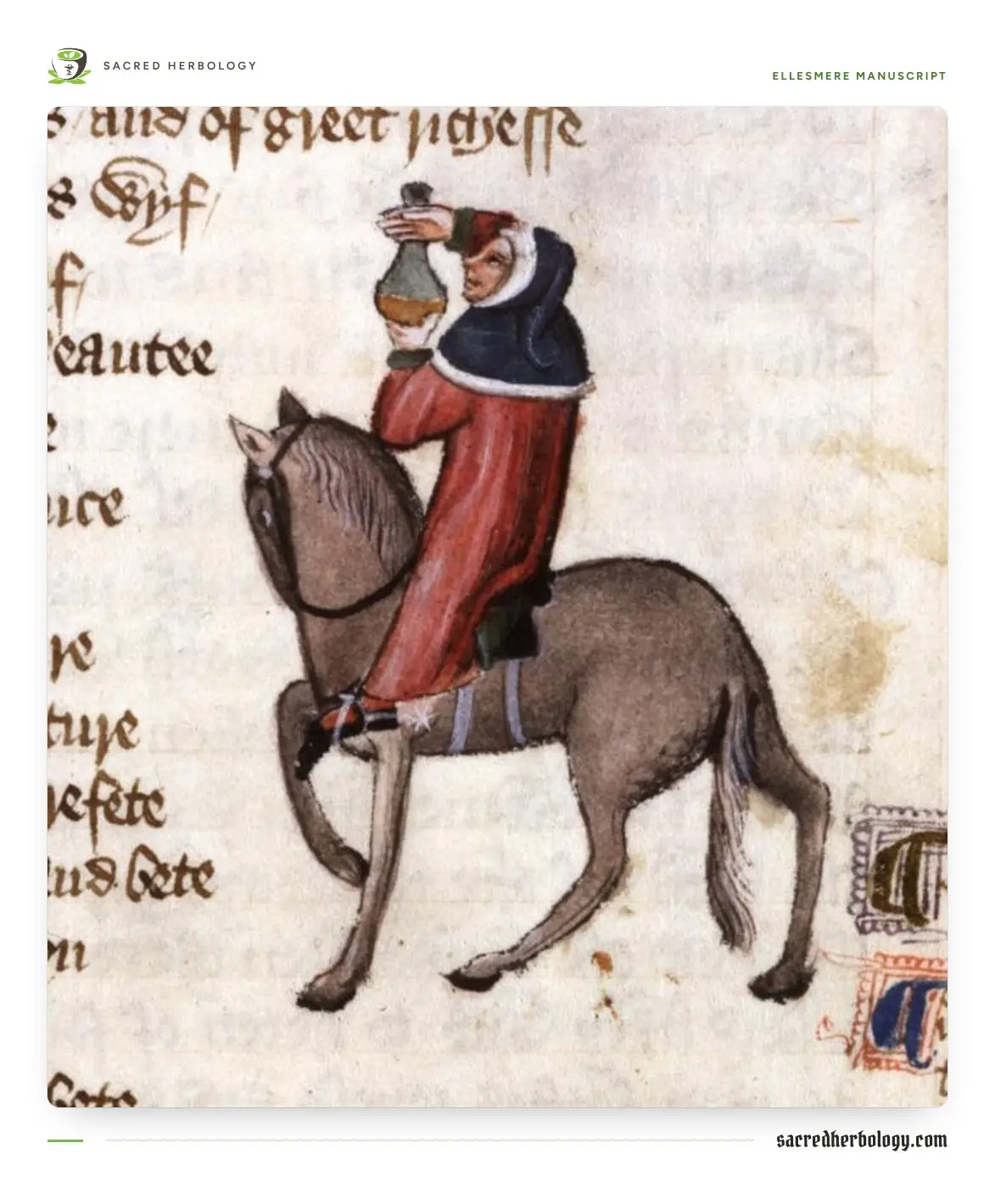
Geoffrey Chaucer uses it in the General Prologue to The Canterbury Tales, written in the late 1380s and 1390s. His Doctour of Phisik has a comfortable arrangement with the trade: “Ful redy hadde he hise apothecaries / To sende hym drogges and his letuaries.” The apothecaries send the drugs (dried simples) and the letuaries (electuaries, medicines worked into honey or syrup). Chaucer is poking fun at a doctor and his suppliers helping each other get rich. The word is plain commerce.

Two hundred years later the word was still at home in the shop. Shakespeare gives us the most famous apothecary in English, the starving one in Mantua who sells Romeo his poison. Romeo remembers the shop before he remembers the man: a tortoise hanging from the ceiling, a stuffed alligator, “and other skins / Of ill-shaped fishes; and about his shelves / A beggarly account of empty boxes, / Green earthen pots, bladders and musty seeds”. That is a drug shop, and the drugs are dried things in pots. When Romeo drinks, his last words are “O true apothecary! / Thy drugs are quick.” In Macbeth the cornered king turns on the man who tends his sleepwalking wife: “What rhubarb, senna, or what purgative drug, / Would scour these English hence?”, and every name in the line is a dried plant from the chemist’s shelf, rhubarb root and senna pod included.
The commercial sense even produced an idiom that sounds odd today. By the later seventeenth century a thing nobody wanted to buy was “a drug on the market”, or “a drug in the market”. Where that phrase came from is as uncertain as the word itself, but it tells you the word still lived among traders, weighing stock that sold and stock that didn’t.
Where did the French get it? Nobody knows for certain, and I would rather tell you that than hand you a tidy story. The standard account, carried by the Oxford English Dictionary and most etymologists, points to the Low Countries: Middle Dutch droge vate, “dry vats” or “dry casks”, the barrels in which dried goods travelled. The trade shortened the phrase, and droge, “dry”, came to name whatever was packed inside. The same Germanic root gives English dry, Dutch droog and German trocken.
Other derivations have been proposed. Some French scholars have looked to Arabic, and the Spanish Arabist Federico Corriente traced a possible route through the Arabic of al-Andalus. In the seventeenth century Claude Saumaise and Gilles Ménage guessed at a Persian source. None of these has displaced the “dry” derivation in the standard dictionaries, but the question stays open, and anyone who tells you the origin is settled is selling you something.
What went into the casks is not in dispute. Roots, barks, seeds, leaves, gums and resins, and beside them the animal and mineral stock the old shops also carried: dried vipers, beetles, coral, hartshorn. What made all of it one category was that it was dry and would keep on a long voyage. A drug was a dried natural product in trade. For most of the stock, that meant a plant.
The drug trade was the spice trade
Once you see the word as a merchant’s word, the rest of Europe’s vocabulary falls into place. Italian, Spanish and Portuguese all took it as droga. French built a whole trade on it: the droguiste kept a droguerie, a dry-goods and chemical shop, and a French droguerie still sells soap and hardware today.
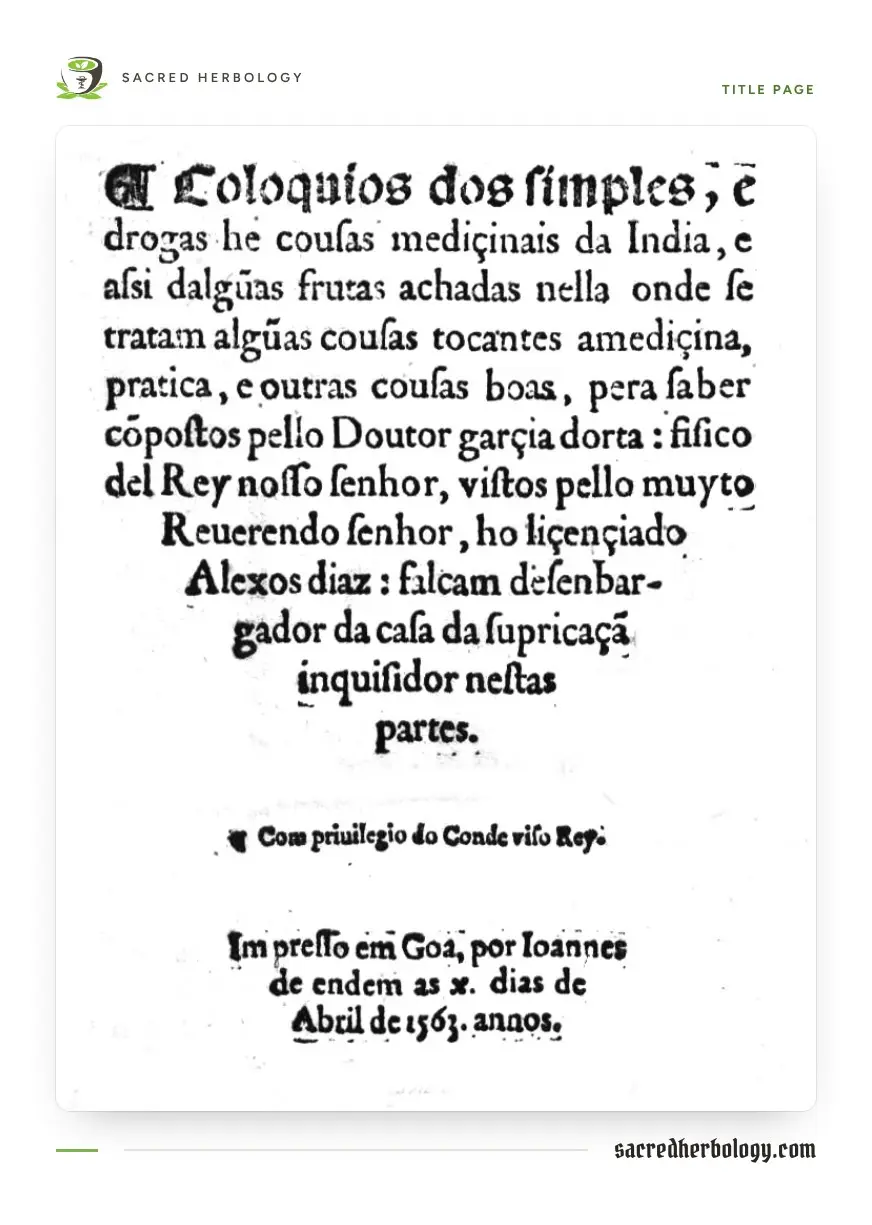
When the Portuguese physician Garcia da Orta published his study of Indian medicinal plants at Goa in 1563, he called it Colóquios dos simples, e drogas he cousas medicinais da India: conversations on the simples, drugs and medicinal things of India. The drogas in his title are cinnamon, pepper, cardamom, aloes, opium, camphor and the rest of the cargo that made Lisbon and Venice rich. The drug trade and the spice trade were the same ships.

The merchants’ own handbooks show how wide the category was. Around 1340 a Florentine banker’s agent, Francesco Balducci Pegolotti, wrote a manual of trade for his fellow merchants, La pratica della mercatura. It gives the weights, measures and customs of ports from London to the Black Sea, and a long list of spezierie, the spices and drugs, running to nearly three hundred items: pepper and ginger, but also alum, wax, sugar, dyes, gums, cotton and a great many dried roots and barks. To a medieval merchant, “spices” and “drugs” meant much the same shelf of costly, dry, portable goods.
In London that shelf was guarded by a guild. The Pepperers, recorded as early as 1180, became the Grocers’ Company in the fourteenth century, and for two hundred years the apothecaries who made up medicines sat inside it as a branch of the grocery trade. They only broke away in 1617, when James I chartered the Worshipful Society of Apothecaries and made the making of medicines a separate craft. A year later, in 1618, the College of Physicians issued the first London Pharmacopoeia, the official list of what an apothecary had to stock and how he had to compound it. It followed the lead of Valerius Cordus, whose Dispensatorium the city of Nuremberg had adopted in 1546. Most of what those books listed came from plants.
The same ships carried the trade into its darkest chapter. In the late eighteenth and early nineteenth centuries the British East India Company grew opium in Bengal and sold it at auction in Calcutta to private traders, who smuggled it into China against the emperor’s ban. In 1839 the imperial commissioner Lin Zexu seized more than twenty thousand chests of it at Canton and had it destroyed. Britain went to war, won, and forced China to open its ports. A second war followed in the 1850s. The drug trade, in the plain old sense of a trade in dried plant goods, had become the first great international narcotics trade, run by a chartered company for a government.
English kept its own relatives of the idea. “Apothecary” comes from Greek apothēkē, a storehouse, so the dispenser of medicine was named after the room where the stock was kept. “Officinal” comes from Latin officina, the workroom or storeroom of a monastery or pharmacy, which is why the plants that earned a place in that room still carry the species name officinalis: Salvia officinalis, Calendula officinalis, Melissa officinalis. A “simple” was a medicine made from one plant, and a simpler was the person who went out to gather them.
English also had an older word, and lost it. Old English lybb meant medicine, drug or simple, and in a bad sense poison. Its compound lyblāc meant sorcery, the use of drugs for magic. When drogge arrived from the continent, lybb faded out, and with it went a native word that held healing, harm and enchantment in one breath.
Remedy and poison in one word
The Greeks had that kind of word too, and it survived. Pharmakon meant remedy, poison and charm, all at once, with nothing in the word to tell you which was meant. The context and the quantity did that work. Pharmakeia was the giving of drugs and also sorcery. Pharmakos was the scapegoat, the person driven out of a Greek city in a purification rite. Most of the professional words English uses for medicine-making come from this family: pharmacy, pharmacology, pharmacopoeia, and pharmacognosy, the study of drugs from natural sources, coined in the early nineteenth century from pharmakon and the Greek verb for coming to know. The Austrian physician Johann Adam Schmidt used the word in his textbook of materia medica, published in 1811 after his death, and Christian Seydler put it on a title page in 1815. Materia medica, “medical material”, had been the older name for the same study since the Greek physician Dioscorides wrote his five books on some six hundred plants in the first century.
English had its own old family here too. The Old English word for a physician was læce, and for medicine læcedom, and the tenth-century book of remedies called Bald’s Leechbook is one of the oldest medical books in the language. That is why doctors were still called leeches in the Middle Ages, long before the bloodsucking worm borrowed the name.
Plato plays on the double sense in the Phaedrus, where the god Theuth offers writing to an Egyptian king as a pharmakon for memory, and the king replies that it will cause forgetting instead. The gift and the harm are one word. In 1968 Jacques Derrida built a famous essay, “Plato’s Pharmacy”, on that single ambiguity.
Paracelsus put the same idea into a sentence that every pharmacology student still meets. Accused in the 1530s of prescribing poisons, he wrote in the third of his Seven Defences: “What is there that is not poison? All things are poison and nothing is without poison. Only the dose makes a thing not a poison.” The Latin tag sola dosis facit venenum that you see on coffee mugs is a later squeeze of his German, and the Defences were only printed in 1564, after his death. His point stands. Whether something heals or harms depends on how much, for whom and why. The substance itself carries both.
The day the plant left the room
For all those centuries “drug” meant the dried plant (or animal, or mineral) itself. Then chemistry arrived.
Around 1804 and 1805 Friedrich Sertürner, an apothecary’s assistant in Paderborn, pulled a crystalline substance out of opium. He published his full account in 1817 and named it morphium, after Morpheus, the god of dreams. It is usually counted as the first alkaloid isolated, and it proved that a plant’s action could be concentrated into a single white powder with no leaf, root or sap left in it. Sertürner tested it the way chemists did then. He took it himself and gave it to three young friends, and all four of them were badly affected before they recovered. His paper was ignored at first. Within ten years the Darmstadt firm of Heinrich Emanuel Merck, a family pharmacy, began making morphine in bulk in 1827, and the modern pharmaceutical industry grew out of shops like his.
The floodgates opened. Emetine, strychnine and caffeine were isolated between 1817 and 1819, quinine came out of cinchona bark in Paris in 1820, and then came coniine from hemlock, atropine from deadly nightshade, and cocaine from the coca leaf in 1860. Salicin came out of willow bark. Chemists turned it into salicylic acid, which factories were soon making from coal-tar phenol with no willow involved, and in 1899 the Bayer company sold a modified version, acetylsalicylic acid, as Aspirin. The year before, the same company had put another chemically modified plant compound on the market: diacetylmorphine, made from morphine, sold as a cough medicine under the trade name Heroin. One firm, two plant-derived products, launched within a year of each other. One became the most familiar medicine in the world, and the other became the word most people now picture when they hear “drugs”. The “spir” in the name comes from Spiraea, the old genus name for meadowsweet (now Filipendula ulmaria), another plant that makes the same family of compounds.
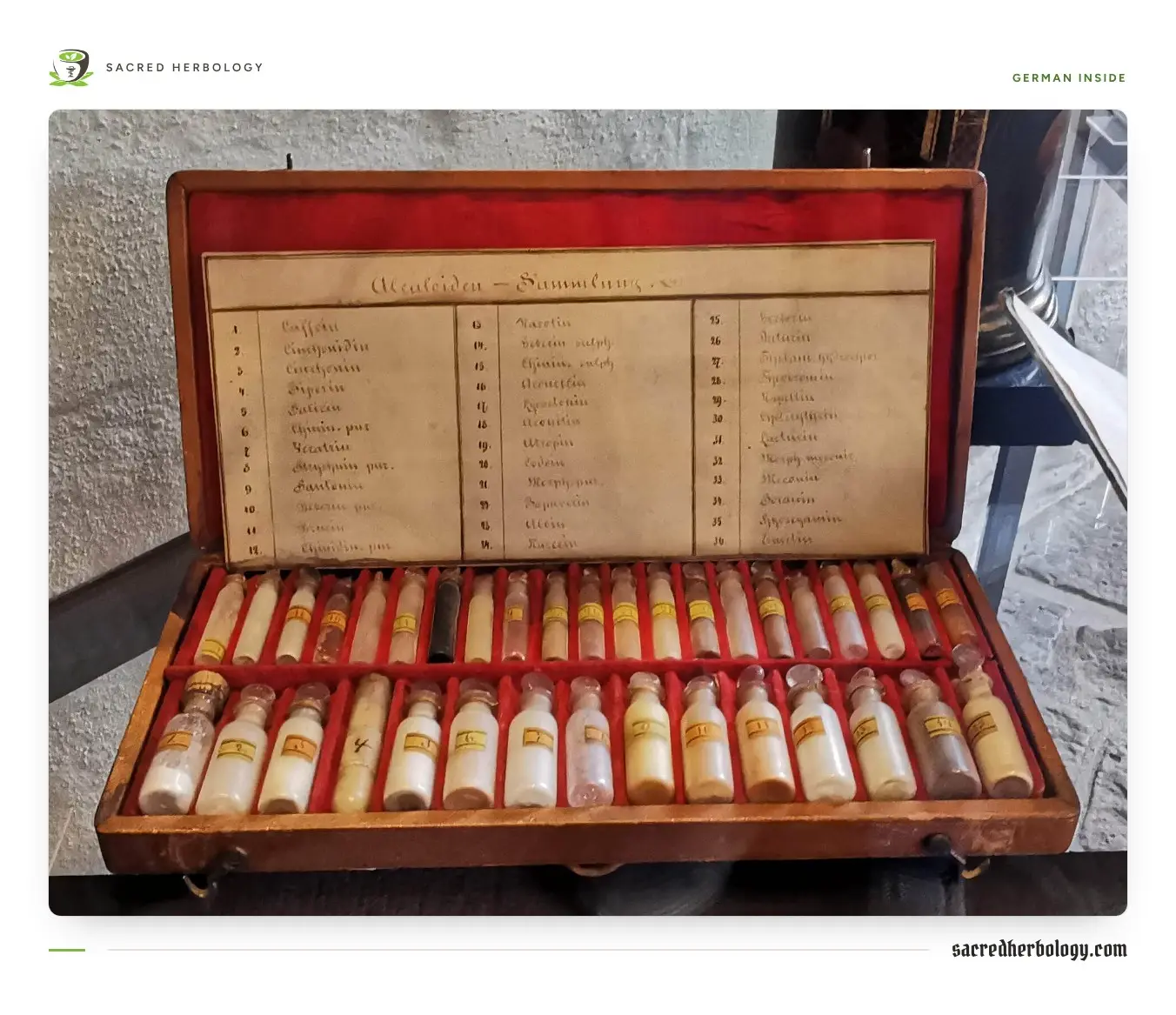

So in the nineteenth century the word “drug” picked up a second meaning. It still meant the dried plant in the jar. It now also meant a pure compound made in a factory, where no plant could be seen in the finished product. Both kept the same name, and for a while nobody minded.
How the word got its criminal record
The third meaning, the one that makes people flinch, is the youngest. It was made by lawmakers, and the story runs through Queensland.
In 1897 Queensland passed the Aboriginals Protection and Restriction of the Sale of Opium Act. The title alone tells you a great deal: it tied control over Aboriginal people and control over a drug into one statute, and it is remembered chiefly for the harm it did to Aboriginal communities for decades afterwards. Victoria banned opium smoking in 1905, and the Commonwealth used customs law the same year to prohibit importing opium for smoking. European Australians kept buying opium tinctures and pills from the chemist without trouble. Chinese Australians who smoked it were the ones prosecuted. The substance was the same. The user and the method decided whether it was medicine or crime. The Queensland Act itself grew out of a report by Archibald Meston, a journalist and self-appointed expert on Aboriginal affairs, and it gave the state sweeping power over where Aboriginal people could live and work. Its opium clauses were a small part of a much larger system of control.
Internationally, the first drug-control treaty was signed at The Hague in 1912. It followed an International Opium Commission at Shanghai in 1909, where thirteen nations met to discuss the opium trade in China. In 1925 a new convention at Geneva added cannabis, then called Indian hemp, to the list, largely at the urging of the Egyptian delegation. The plants were being entered into treaty law one by one. The United States followed with the Harrison Narcotics Tax Act in December 1914. From there the century built a ladder of treaties, each one naming more substances and more plants.
Then came the speech everyone half-remembers. At a White House press conference in June 1971, President Richard Nixon said that “America’s public enemy number one in the United States is drug abuse” and announced a “new, all-out offensive”. He did not use the phrase “war on drugs”. The American press coined that within days, and it stuck so firmly that most people now believe he said it. The year before, his government had passed the Controlled Substances Act, which sorted substances, plants among them, into schedules by how dangerous and how medically useful Washington judged them to be. All of this is American law and has never applied in Australia, but American television carried the language around the world, and Australia soon had its own version. In 1985 the Hawke government launched the National Campaign Against Drug Abuse. Australia had already gone further than most countries in one respect. In 1953, under international pressure, the Commonwealth banned the import and manufacture of heroin altogether, even for medical use, although Australian doctors had been among its heaviest prescribers. A medicine had become, by a stroke of the pen, a prohibited substance. By then “drugs”, bare and plural, meant one thing to most Australians, and it wasn’t anything from the chemist.
Two words spelled the same
By the late twentieth century English had quietly split “drug” in two. In a hospital, a drug chart records treatment and a drug interaction is something a pharmacist checks. On the evening news, a drug bust, a drug dealer and a drug problem mean crime. The companion word does the sorting, and most of us switch between the two meanings a dozen times a day without noticing. The slang helped. American English picked up “dope”, from the Dutch doop, a sauce or dip, and by the end of the nineteenth century it meant opium and a “dope fiend” meant a user. “Narcotic”, from the Greek for numbness, had once been a plain medical word for anything that dulled pain or brought sleep. In the twentieth century the law borrowed it for everything it wanted to control, cocaine included, which numbs a tongue and keeps a person wide awake.
The regulators noticed. Until 2010, Australia’s national scheduling document was the Standard for the Uniform Scheduling of Drugs and Poisons. In September 2010 it was renamed the Standard for the Uniform Scheduling of Medicines and Poisons. The word “drug” was taken out of the title and “medicines” put in its place. It survives in one spot: Schedule 8, the tightest schedule for legal medicines, is still headed “Controlled Drug”. In official Australian English, then, “medicine” is the word for things a pharmacist hands you and “drug” is kept for the things the law watches most closely.
Drug companies prefer the same softer words in their advertising: medicine, treatment, therapy. Put all this together and you arrive at the belief I started with: that a drug is something made in a laboratory, and a plant, being natural, can’t be one.
Plants are still drugs
Every discipline that studies plant chemistry would disagree with that belief, and so would the law.
In pharmacognosy the dried, useful part of a medicinal plant is still called a crude drug or a herbal drug. The European Pharmacopoeia, the standard reference across Europe, carries a general monograph titled “Herbal drugs”. Chamomile flower, senna leaf, ginger rhizome and liquorice root are all drugs in that sense, and have been since Chaucer’s apothecary filled his casks.
The treaties agree. The 1961 Single Convention on Narcotic Drugs, which Australia signed, names coca leaf, opium and the cannabis plant in its text and schedules. The law has never had any trouble calling a plant a drug. Only the public has.
The chemistry agrees too. Plants make an enormous library of active compounds. Chemists have described well over ten thousand alkaloids alone, most of them from plants, before you count the glycosides, terpenes and resins. A modern pharmacy is full of plant molecules and their close relatives: morphine and codeine from the opium poppy, digoxin from woolly foxglove, vincristine and vinblastine from the Madagascar periwinkle, paclitaxel from the Pacific yew, galantamine from the snowdrop family, and artemisinin from sweet wormwood, the work that won Tu Youyou a share of the Nobel Prize in 2015. Caffeine and nicotine are drugs in every pharmacology textbook ever printed, and they arrive in a coffee cup and a tobacco leaf.
None of this is a reason to fear plants. It is a reason to respect them. When someone says “it’s only a plant”, they usually mean it can’t hurt them. Datura, foxglove and hemlock would all disagree, and all three grow wild as weeds in parts of Australia. If anyone, a child or a pet included, swallows or chews one of them, call the Poisons Information Centre on 13 11 26, or 000 in an emergency. The sacred plants people come to this site to read about are powerful because they are drugs in the oldest and plainest sense of the word: natural material with the strength to change a body and a mind. Paracelsus would say the same thing I am saying. The dose, the person and the purpose decide the outcome, never the label.
Taking the word back
I don’t expect anyone to start calling their herb garden a drug garden. The criminal meaning is too loud for that, and it will stay loud for a long time. But it helps to know that the word began in a merchant’s cask of dried roots and resins, that for most of its life it named exactly the plants on this site, and that the shame it now carries was put there by laws written in the last hundred and thirty years, several of them aimed less at substances than at particular groups of people.
The next time someone tells you a plant can’t be a drug, you can tell them where the word came from. Chaucer’s apothecary would have laughed at them.
Where this comes from
- Chaucer, Geoffrey. The Canterbury Tales, General Prologue, lines 425-426. In The Riverside Chaucer, ed. Larry D. Benson, 3rd edn, Oxford University Press, 1987.
- Oxford English Dictionary, entry “drug, n.1”, and Douglas Harper, Online Etymology Dictionary, entry “drug (n.)”, for the drogue / droge vate derivation and its dating.
- Corriente, Federico. A Dictionary of Andalusi Arabic. Brill, Leiden, 1997, for the Andalusi Arabic proposal.
- Bosworth, Joseph and T. Northcote Toller. An Anglo-Saxon Dictionary. Oxford University Press, 1898, entries lybb and lyblāc.
- Orta, Garcia da. Colóquios dos simples, e drogas he cousas medicinais da India. Goa, 1563.
- Plato, Phaedrus 274c-275b; Jacques Derrida, “Plato’s Pharmacy”, in Dissemination, trans. Barbara Johnson, University of Chicago Press, 1981.
- Paracelsus, Septem Defensiones (written 1538, printed 1564), third defence. German text in Karl Sudhoff (ed.), Sämtliche Werke, Abt. I, vol. 11, Oldenbourg, Munich, 1928. English in C. Lilian Temkin et al. (trans.), Four Treatises of Theophrastus von Hohenheim called Paracelsus, Johns Hopkins Press, 1941.
- Sertürner, F. W. “Ueber das Morphium, eine neue salzfähige Grundlage, und die Mekonsäure, als Hauptbestandtheile des Opiums”. Annalen der Physik 55 (1817), 56-89.
- Shakespeare, William. Romeo and Juliet 5.1 and 5.3; Macbeth 5.3.
- Pegolotti, Francesco Balducci. La pratica della mercatura, ed. Allan Evans. Medieval Academy of America, Cambridge, Mass., 1936.
- Pharmacopoeia Londinensis. Royal College of Physicians, London, 1618.
- Cameron, M. L. Anglo-Saxon Medicine. Cambridge University Press, 1993, for læce and Bald’s Leechbook.
- Hanes, W. Travis, and Frank Sanello. The Opium Wars: The Addiction of One Empire and the Corruption of Another. Sourcebooks, 2002.
- Heinrich, Michael, Joanne Barnes, Simon Gibbons and Elizabeth M. Williamson. Fundamentals of Pharmacognosy and Phytotherapy, 2nd edn. Churchill Livingstone, 2012, chapters 2 and 3, on the history of plant drugs and the definition of a herbal drug.
- Aboriginals Protection and Restriction of the Sale of Opium Act 1897 (Qld); Opium Smoking Prohibition Act 1905 (Vic).
- Manderson, Desmond. From Mr Sin to Mr Big: A History of Australian Drug Laws. Oxford University Press Australia, 1993.
- International Opium Convention, The Hague, 1912; Single Convention on Narcotic Drugs, United Nations, 1961.
- Nixon, Richard. “Remarks About an Intensified Program for Drug Abuse Prevention and Control”, June 1971, The American Presidency Project, University of California, Santa Barbara. United States material, with no application in Australia.
- Musto, David F. The American Disease: Origins of Narcotic Control, 3rd edn. Oxford University Press, 1999. United States material.
- Poisons Standard (Standard for the Uniform Scheduling of Medicines and Poisons), made under the Therapeutic Goods Act 1989 (Cth); renamed from the Standard for the Uniform Scheduling of Drugs and Poisons in 2010.
- European Pharmacopoeia, general monograph “Herbal drugs”. Council of Europe, Strasbourg.