
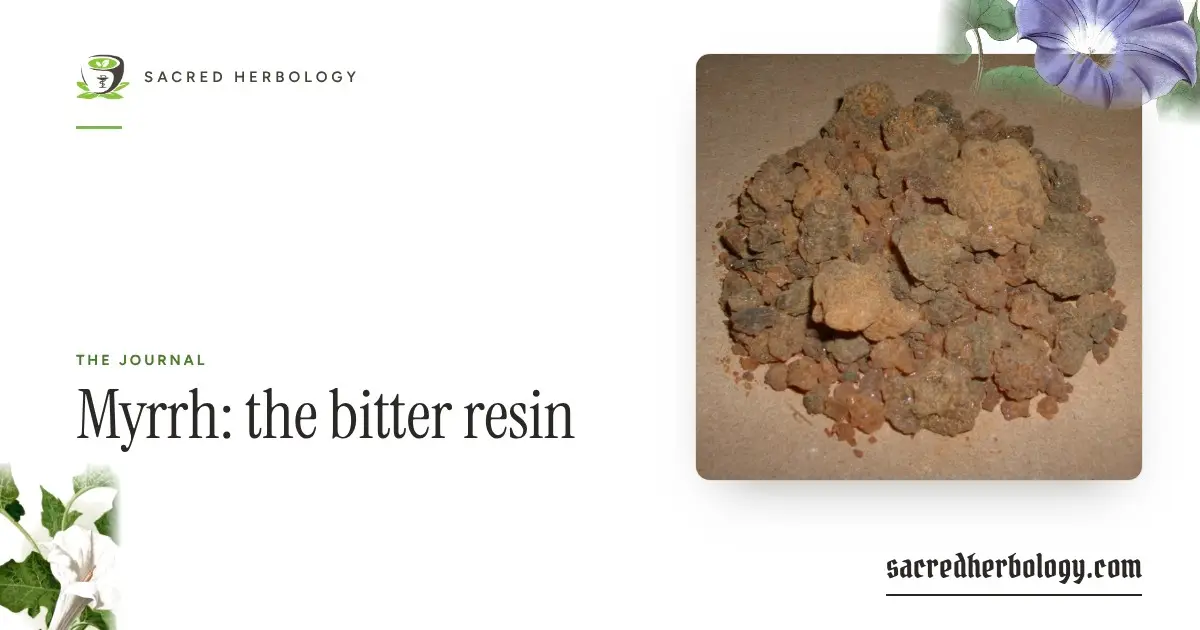
Anyone who has ever tasted myrrh by accident knows why it has its name. It is sharply and lastingly bitter. Put a piece on a hot coal and something else happens: a warm, dark, slightly medicinal smoke, earthy and sweet at the edges, heavier than frankincense and slower to leave the room.
In Arabic it is murr, in Hebrew mor, in Aramaic mura, all from the old Semitic root for bitterness, and the Akkadian scribes of Mesopotamia had a cognate of their own. The Greeks borrowed it as myrrha, and English took it from them. Greek also had a second word, smyrna, for the same resin, and ancient writers liked to connect it with the Ionian port of that name. The connection is probably older and looser than they thought, but the doublet survived: you will meet both words in the old texts, sometimes on the same page.
Myrrh is one of the few plant products that has kept a place in almost every sacred literature of the Mediterranean and the Near East for three and a half thousand years. It went into Egyptian temple smoke and Egyptian mummies, into Greek myth, into the Hebrew anointing oil and the Christian nativity, into the spells of Graeco-Egyptian magicians and the correspondence tables of the Golden Dawn. Following it is a way of walking through most of the religious history of the region with your nose.
A thorny little tree
Myrrh is the dried gum resin of Commiphora myrrha, a small, spiny tree of the frankincense family, the Burseraceae. It grows in the dry scrub of Somalia, Ethiopia, northern Kenya, Yemen and the southern edge of Arabia, often on the same hot hillsides as the Boswellia trees. You will also see it sold as Commiphora molmol, a later name now counted as the same species. The “molmol” is Somali; malmal is still the Somali word for the resin, and Somalia is still where a great deal of the world’s myrrh comes from.
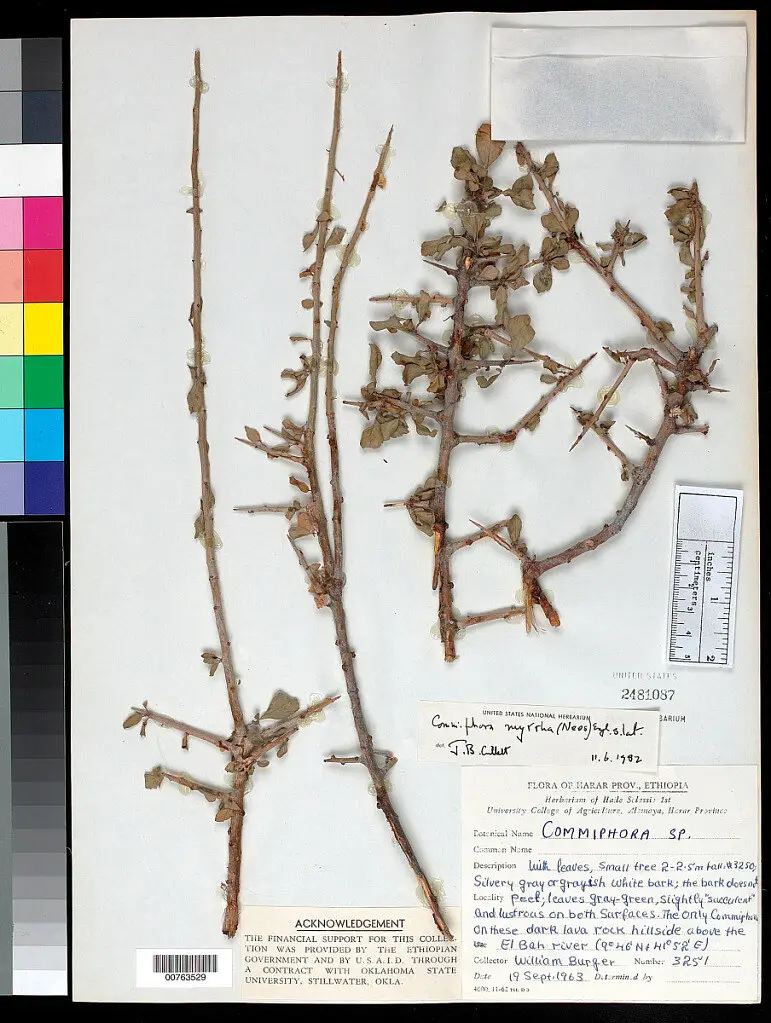

The tree is an unlovely thing to look at for most of the year: a knot of grey, thorny branches a few metres tall, with small leaves in clusters that appear after rain and drop again in the dry. Tappers cut the bark and the tree bleeds a pale yellow, oily sap that darkens through amber to a deep reddish brown, in lumps rougher and less translucent than frankincense tears. Some resin also oozes out of the bark on its own, and the ancient trade prized those spontaneous drops above anything cut. The Greeks called the finest of them stacte, “the dripping”.
Theophrastus, Aristotle’s successor at the Lyceum, gathered what the Greeks knew about these trees in his Enquiry into Plants around 300 BCE. Much of it came second-hand from men who had sailed down the Red Sea in the years after Alexander’s campaigns. He records that the myrrh tree was smaller and more shrubby than the frankincense tree, and he passes on a story about the land of the Sabaeans, in what is now Yemen. There, he was told, the harvest was brought to a temple of the sun and left in heaps under armed guard, each heap with a tablet showing its owner and price. A merchant would take the heap he wanted and leave the money. The priest took a third share for the god. Theophrastus is careful to say this is what he was told, and it reads like a sailor’s tale, but it catches something true about the trade: myrrh was wealth, and wealth that moved under religious protection.
Two relatives are easily confused with it:
- Sweet myrrh, or opopanax, is usually Commiphora guidottii from Somalia and Ethiopia, softer and sweeter on the coal. The opopanax of Greek and Roman writers was something else again, a gum from a tall, yellow-flowered Mediterranean plant of the carrot family, Opopanax chironium.
- Guggul, Commiphora wightii (also sold as Commiphora mukul), grows in north-western India and Pakistan and has long been part of Ayurvedic practice. It is now listed as critically endangered in the wild.
The road north
For most of antiquity, myrrh reached the Mediterranean by two routes. One ran by sea, up the Red Sea from the ports of the Horn of Africa and southern Arabia. The other went overland, along the caravan tracks that later writers called the incense road, up the western side of Arabia through the oasis towns to the Nabataean city of Petra and on to Gaza on the coast.
Herodotus, in the fifth century BCE, has a famous passage on the spices of Arabia in which almost every one of them is guarded by something monstrous. Frankincense trees are watched by small winged serpents that have to be driven off with the smoke of burning storax. Cassia grows in a lake guarded by fierce bat-like creatures. Cinnamon is stolen from the nests of great birds. Myrrh alone, he says, the Arabians gather without trouble. The monsters were very likely a story the middlemen were happy to have believed, since it kept the price up and the competitors away, and it is pleasing that myrrh is the one resin Herodotus lets through without a fight.
By the first century CE the sea route is described in a Greek merchant’s handbook, the Periplus of the Erythraean Sea, written by an anonymous Egyptian Greek who knew the ports at first hand. He lists myrrh among the exports of the harbours along the Somali coast and of Mouza on the Red Sea shore of Yemen, and he singles out a better grade and a stacte at Mouza. Read it next to Theophrastus and you can see the same trade four centuries on, still running on the same resins.
Rome was a vast buyer. The elder Pliny, in the twelfth book of his Natural History, spends pages on the grades and adulterations of myrrh: which country’s is best, how dealers bulked it out with lumps of mastic and with gum, added cucumber juice to fake the bitterness and litharge, a lead oxide, to add weight, and how a buyer caught the cheat by taste, since added gum goes soft and sticky on the tooth. He was also the one who complained that India, China and the Arabian peninsula took a hundred million sesterces out of the empire every year, and added that this was what luxury and women cost Rome. He was a moralist as well as a naturalist, and he did not approve of where the money went. The figures he gives are an old man’s estimate, but they tell you how big the trade felt from inside.
Myrrh in Egypt
The Egyptians sent ships for it. On the walls of Hatshepsut’s temple at Deir el-Bahari, around 1470 BCE, carved reliefs show her expedition to the land of Punt coming home with incense trees, roots balled in baskets, carried up the gangplanks. Punt itself is shown in the same reliefs: houses on stilts, the chief Parehu and his wife Ati, whose heavy figure has made her one of the most reproduced faces in Egyptian art. Scholars still argue where Punt was, somewhere on the southern Red Sea coast of Africa or Arabia, and whether the Egyptian word antyu meant myrrh, frankincense or both.
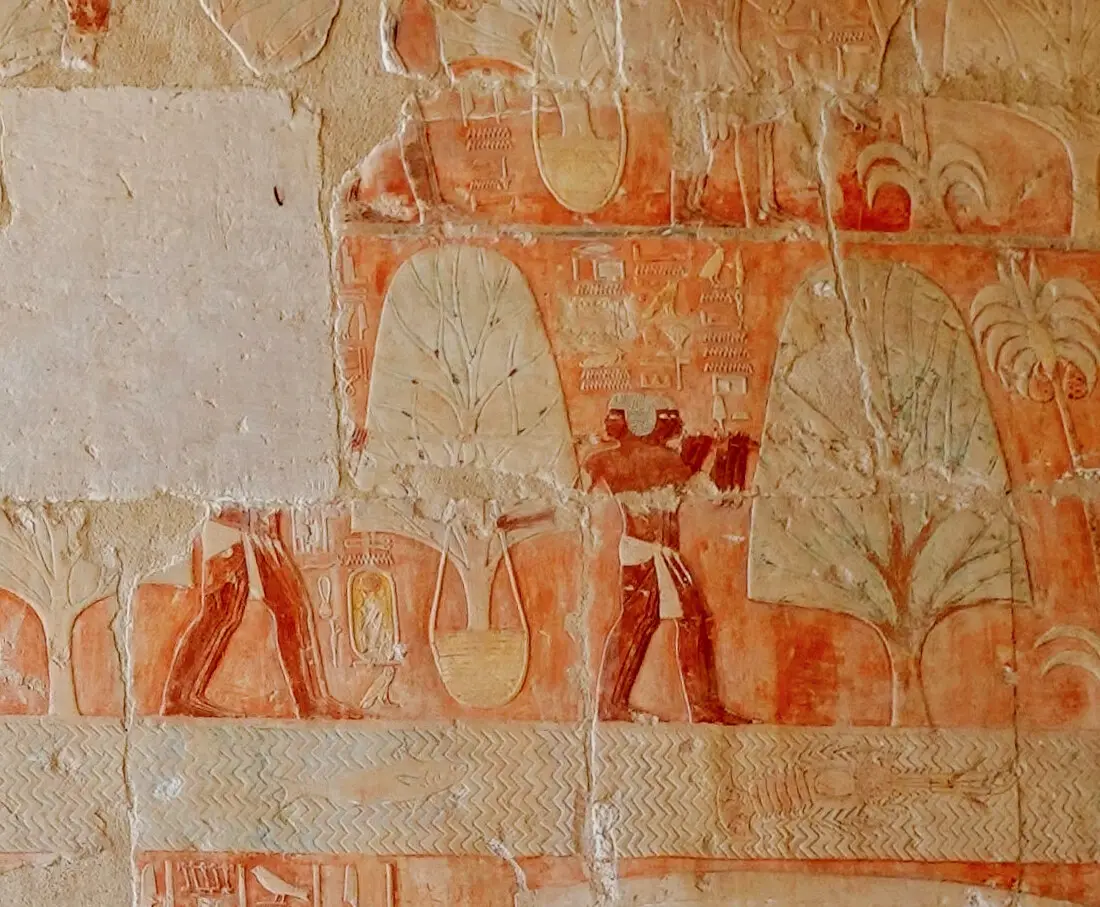

The inscriptions beside the reliefs are pure court propaganda, and they are glorious. James Henry Breasted, who translated them early last century, gives the queen herself grinding the finest antyu and putting it on her limbs, so that her fragrance was like divine dew and mingled with the scent of Punt, and her skin was gilded like electrum. The trees themselves were to be planted in the terraces of her temple, so that the god Amun would have his own incense growing at his door. Round pits in the forecourt at Deir el-Bahari have been read as the planting holes for them.
Plutarch, writing in the second century, gives the temple day in three smokes. At dawn the priests burned resin to purify the air. At midday, when the sun drew heavy vapours out of the earth, they burned myrrh. At nightfall came kyphi. He adds that the Egyptians called myrrh bal, meaning something like the scattering of what is heavy, though he offers that with an “if it is true”.
Kyphi was the great compound incense of the Egyptian temples, and myrrh was one of its ingredients. Plutarch lists sixteen of them, honey, wine and raisins among the resins and roots, and says the priests blended them while sacred writings were read aloud. Recipes for kyphi are also carved on the walls of the Ptolemaic temples at Edfu and Philae, in a small room at Edfu that Egyptologists call the laboratory, where the temple’s perfumes and unguents were prepared. The recipes on the two temples differ from each other and from Plutarch. There was never one kyphi; there were house blends.
Myrrh also went into the dead. Herodotus, describing the most expensive embalming in the fifth century BCE, says the embalmers filled the emptied body with ground myrrh, cassia and every other spice except frankincense, then sewed it shut. He does not say why frankincense was left out.
A girl who became a tree
The Greeks had their own story for the bitter tears. In the tenth book of Ovid’s Metamorphoses, Myrrha, daughter of King Cinyras of Cyprus, is consumed by a forbidden love for her own father. Found out, she flees and begs the gods to put her somewhere between the living and the dead. They turn her into a tree. Her tears become the resin, and Ovid says they still carry her name. From its split bark the child Adonis is born.
Ovid did not invent her. The story was older and existed in several versions, some placing it in Assyria rather than Cyprus, some calling the girl Smyrna, which is a nice echo of the two Greek words for the resin. What Ovid did was give it the version everyone remembered. He tells it through the mouth of Orpheus, singing to the trees and beasts after he has lost Eurydice, and he frames it with a wry warning to fathers and daughters to stay away from the song. The metamorphosis happens slowly. Bark climbs up her legs and over her belly, and she bends her head into it willingly, and the last thing left human is her weeping.
It gave the resin a reputation that stuck: grief, secrecy, desire and death in a single lump of gum. Adonis, the child born from the tree, grew into the beautiful youth loved by Aphrodite and killed by a boar, and his death was mourned every summer by women in the cities of the eastern Mediterranean. So myrrh sits at the beginning of one of the ancient world’s great stories of lamentation, and it would sit at the end of another.
Myrrh in the Bible
Myrrh runs through the Hebrew and Christian scriptures, and its mood changes with the passage.
It is a trade good. In Genesis the brothers of Joseph sell him to a caravan of Ishmaelites carrying spices, balm and, in the King James wording, myrrh down to Egypt. The Hebrew word there is lot, not mor, and most modern translators take it for ladanum, the sticky resin of the rockrose. The older English Bibles used “myrrh” for both, and the confusion has run on ever since.
It is a scent of love. “A bundle of myrrh is my well-beloved unto me,” says the bride in the Song of Songs, and later, rising to open the door to her lover, “my hands dropped with myrrh”. It is also the scent of the harem and the royal court. The book of Esther says that before a young woman was brought to King Ahasuerus she spent twelve months in preparation, six of them with oil of myrrh and six with sweet perfumes. The psalm for a royal wedding has the king’s garments smelling of myrrh, aloes and cassia. In Proverbs the same scents turn dangerous, when the adulteress tells the young man she has perfumed her bed with myrrh, aloes and cinnamon. The aloes of these verses is usually taken to be aloeswood, the fragrant heartwood of the Asian Aquilaria tree, and has nothing to do with the succulent Aloe.
It is holy. Pure myrrh heads the list of spices in the anointing oil of Exodus 30, the oil for priests and the tabernacle, and the text forbids anyone to make it for private use on pain of being cut off from the people. That oil gets its own piece in this Journal soon.
It is the scent of death. The magi who come to the child in Matthew bring gold, frankincense and myrrh, and early Christian writers were quick to read the three gifts as a riddle. Irenaeus of Lyon, late in the second century, took the myrrh as a sign that the child would die and be buried for the mortal race. Origen, answering the pagan critic Celsus in the third, set it out plainly: gold as to a king, myrrh as to one who was mortal, incense as to a god. The reading lasted. In 1857 an American clergyman, John Henry Hopkins Jr., wrote the carol We Three Kings for a family Christmas, and gave the third king a verse that has been sung ever since: “Myrrh is mine: its bitter perfume / Breathes a life of gathering gloom.”
In Mark’s gospel Jesus is offered wine mixed with myrrh on the way to the cross, and he does not take it. Matthew, telling the same moment, has wine mixed with gall. Commentators have long connected the offer with a custom recorded much later in the Babylonian Talmud, where the women of Jerusalem gave a condemned man a cup of wine with a grain of frankincense in it before execution. Which resin, and what it was for, remains an argument among scholars; the gospels give no reason. In John’s gospel Nicodemus brings about a hundred pounds of myrrh and aloes to wrap the body for the tomb, a quantity fit for a king’s burial.
The myrrh-bearers
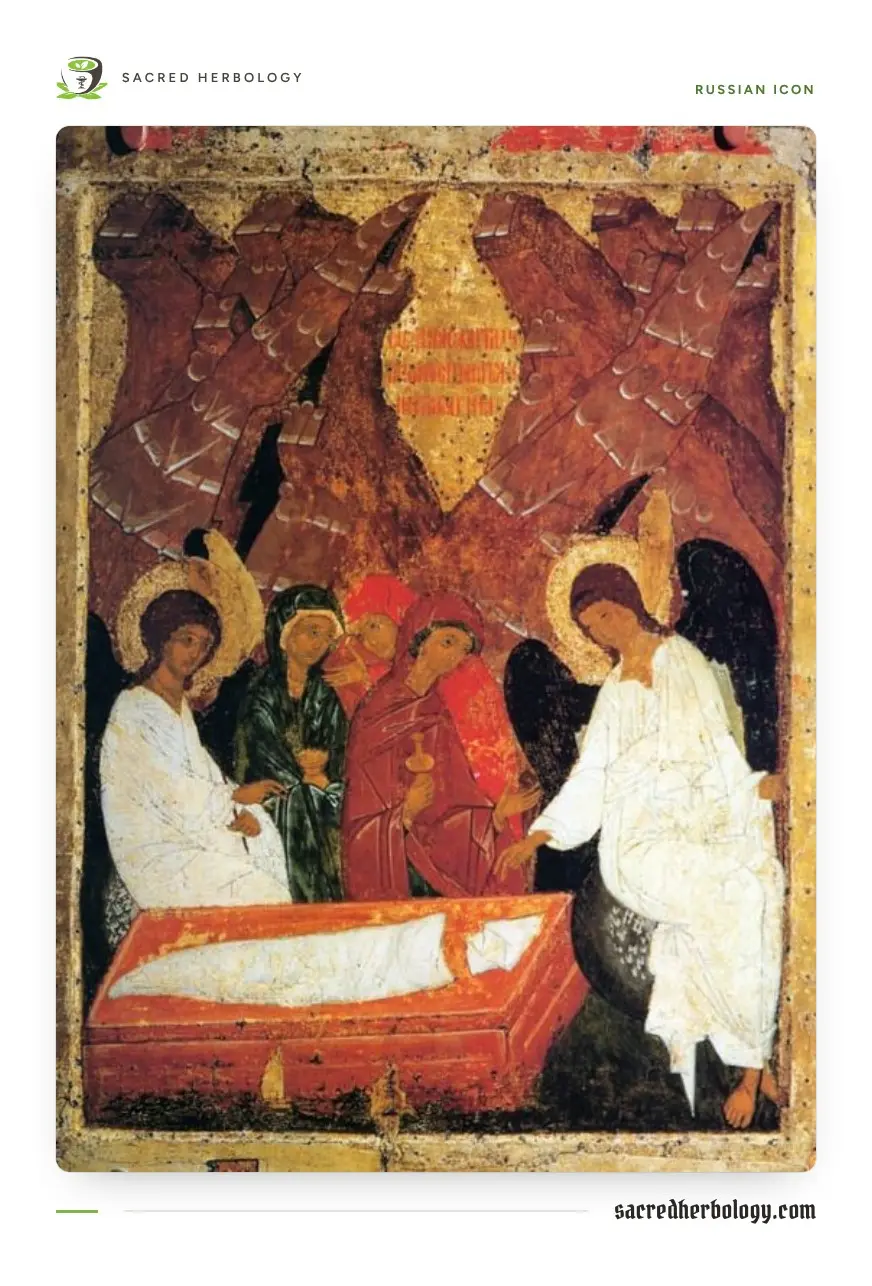
The women who came to the tomb with spices on Easter morning are honoured in the Orthodox Church as the Myrrh-bearers, with their own Sunday, the second after Pascha. In icons they carry small jars and approach an empty tomb where an angel sits on the rolled-back stone.

Orthodox tradition also speaks of myrrh-streaming saints, whose relics give off fragrant oil. Saint Demetrius of Thessaloniki is the best known, and he carries the title Myroblytes, “the myrrh-gusher”. In the West the best-known case is Saint Nicholas. His bones were carried off from Myra in Asia Minor by sailors from Bari in 1087, and the clergy of the basilica built for them still draw off a clear liquid from the tomb once a year, called the manna of Saint Nicholas. That is what the Church holds; I describe it, I don’t vouch for it.
The Orthodox also keep the word itself at the centre of their sacraments. The holy chrism used at baptism is called myron, the old Greek word for perfumed oil. The Ecumenical Patriarch in Constantinople consecrates it only every so often, in Holy Week, after days of preparation in which several dozen aromatic ingredients are cooked into olive oil in great cauldrons, and it is sent out from there to the churches under the patriarchate. It is the descendant of the oil of Exodus, and myrrh is still in it.
The magicians’ myrrh
Myrrh crosses into the esoteric long before the modern occult revival. The Greek magical papyri, a collection of spell books from Roman Egypt copied mostly in the third and fourth centuries, prescribe it constantly, burned as an offering and ground into ink. “Myrrh ink” is one of their standard materials for writing names and figures. One long spell in the great Paris papyrus goes further and addresses the resin directly. The practitioner burns myrrh on the coals and addresses it by name, as Myrrh the bitter, the difficult, the one who reconciles enemies, and sends it out as an agent to bind a lover. The resin has become a person again, as it was in Ovid, and the magician gives it orders.
Renaissance learned magic sorted the resins by planet. Heinrich Cornelius Agrippa, in the first book of his Three Books of Occult Philosophy (1533), gives a fume for each of the seven planets. Myrrh appears in the Sun’s compound, beside saffron, ambergris and frankincense, and again in Saturn’s, in darker company: black poppy seed, henbane, mandrake root and lodestone. Henbane, mandrake and poppy are poisonous plants and their smoke is dangerous to breathe; that fume belongs on the page and nowhere near a coal. The bitterness and the funeral associations seem to have pulled it towards the slow, heavy, melancholy planet, and that is where the later magicians would put it too.
In 1898 S. L. MacGregor Mathers, a founder of the Hermetic Order of the Golden Dawn, published an English translation of The Book of the Sacred Magic of Abramelin the Mage, from a French manuscript in the Bibliothèque de l’Arsenal in Paris. It prescribes a holy oil for the book’s long retreat, plainly modelled on the oil of Exodus, with myrrh first, then cinnamon and olive oil. Mathers gave the third ingredient as galangal. The German manuscripts, edited by Georg Dehn and published in English in 2006, give calamus. Nobody knows whether Mathers misread his source or changed it, and the “Abramelin oil” sold in shops today mostly follows him. The German text differs in other ways as well: Mathers’ French gives the retreat six months, Dehn’s German sources eighteen. Cinnamon oil is harsh on skin, and an oil built on it can redden, sensitise or blister it.
Aleister Crowley, who came out of the Golden Dawn, took Abramelin more seriously than almost anyone. In 1899 he bought Boleskine House on the shore of Loch Ness so as to have the right kind of isolated house for the retreat, and he began preparing in 1900. He broke off within months, drawn to Paris and London by the quarrel that was tearing the Golden Dawn apart, and he did not complete the operation there. He kept the oil, though. In his Book 4, written with Mary Desti and published in 1912 and 1913, he gives a chapter to the Holy Oil, calls it the aspiration of the magician, and reads its olive base and its myrrh, cinnamon and galangal as a small allegory of that aspiration.
In his table of correspondences, 777 (1909), Crowley assigns perfumes to each station on the kabbalistic Tree of Life, and he gives myrrh, with civet, to Binah, the third sephirah, the great dark Mother, the sphere of Saturn and of sorrow. It is exactly where Agrippa’s Saturn fume would lead you, and it closes the circle with Ovid: the weeping mother whose tears are the resin.
This is learned ritual magic. Its tables show how these men ordered the world; they are symbolic maps and make no claim you could test.
What gives it the smell
The scent comes from the resin’s volatile oil. In true myrrh a large share of it is furanosesquiterpenes, such as curzerene and furanoeudesma-1,3-diene. They account for much of myrrh’s dark, medicinal note and for why it smells so unlike frankincense, whose oil in most kinds is dominated by lighter, brighter monoterpenes such as pinene and limonene. Myrrh is also more gum than frankincense is: a large part of each lump is water-soluble gum, which is why it goes sticky in a warm, damp hand and part of why it bubbles and chars on the coal where frankincense melts.
Burning it well
- Burn it on a charcoal disc in a heat-proof bowl of sand or ash, a small piece at a time. Myrrh is oily and smokes more heavily than frankincense, so go gently.
- Open a window. Resin smoke is still smoke, full of fine particles, and it can set off an asthma attack. If you have asthma or any other chest or lung condition, or you are pregnant, keep well back from it or skip it. Keep it away from babies, small children and pet birds; store resin and charcoal out of reach of children and pets.
- The charcoal gives off carbon monoxide, which you can’t see or smell. Never burn it in a closed room, a tent or a car. If anyone feels headachy, dizzy or sick, get them into fresh air. Emergencies: call 000, or the Poisons Information Centre on 13 11 26.
- The resin and its oil can irritate or sensitise skin. Keep it off broken skin and wash your hands after handling.
- Good myrrh is reddish brown and a little oily, with a dark, bitter smell. Old stock goes hard, dusty and faint. Pale, glassy, scentless lumps may be other gums mixed in, and sweet ones may be opopanax sold as myrrh. Pliny was warning buyers about exactly this two thousand years ago.
Buying with care
Myrrh’s harvest is less studied than frankincense’s, but it comes from the same hard country and often the same families, where drought and conflict are part of daily life. Ask your supplier which species it is and where it was tapped. A seller who knows is worth a little more.
The Egyptians burned it at noon, the evangelists carried it to a tomb, and the magicians set it at the dark top of the Tree. Put a piece on the coal and you are standing in all of that at once.
Where this comes from
- Theophrastus, Enquiry into Plants 9.4, trans. Arthur Hort, vol. 2 (Loeb Classical Library, 1916).
- Herodotus, Histories 2.86 and 3.107-112, trans. A. D. Godley (Loeb Classical Library, 1920-1921).
- The Periplus Maris Erythraei, ed. and trans. Lionel Casson (Princeton University Press, 1989).
- Pliny the Elder, Natural History, book 12, trans. H. Rackham, vol. 4 (Loeb Classical Library, 1945).
- James Henry Breasted, Ancient Records of Egypt, vol. 2: The Eighteenth Dynasty (University of Chicago Press, 1906), the Punt inscriptions of Deir el-Bahari.
- Plutarch, De Iside et Osiride 79-80, in Moralia vol. V, trans. F. C. Babbitt (Loeb Classical Library, 1936).
- Ovid, Metamorphoses 10.298-518, trans. Frank Justus Miller (Loeb Classical Library, 1916).
- Genesis 37:25; Exodus 30:22-33; Esther 2:12; Psalm 45:8; Proverbs 7:17; Song of Songs 1:13 and 5:5; Matthew 2:11 and 27:34; Mark 15:23; John 19:39.
- Irenaeus, Against Heresies 3.9.2; Origen, Contra Celsum 1.60, trans. Henry Chadwick (Cambridge University Press, 1953).
- Babylonian Talmud, Sanhedrin 43a.
- Hans Dieter Betz, ed., The Greek Magical Papyri in Translation (University of Chicago Press, 1986), PGM IV.1496-1595.
- Henry Cornelius Agrippa, Three Books of Occult Philosophy, book 1, ch. 44, trans. J. F. (London, 1651); ed. Donald Tyson (Llewellyn, 1993).
- S. L. MacGregor Mathers, trans., The Book of the Sacred Magic of Abramelin the Mage (London: John M. Watkins, 1898).
- Abraham von Worms, The Book of Abramelin: A New Translation, ed. Georg Dehn, trans. Steven Guth (Ibis Press, 2006).
- Aleister Crowley, 777 (London: Walter Scott, 1909); reprinted in 777 and Other Qabalistic Writings (Weiser, 1973).
- Aleister Crowley with Mary Desti, Book 4 (1912-1913), in Magick: Liber ABA, ed. Hymenaeus Beta (Weiser, 1997).
- Walter Burkert, Greek Religion, trans. John Raffan (Blackwell, 1985).