
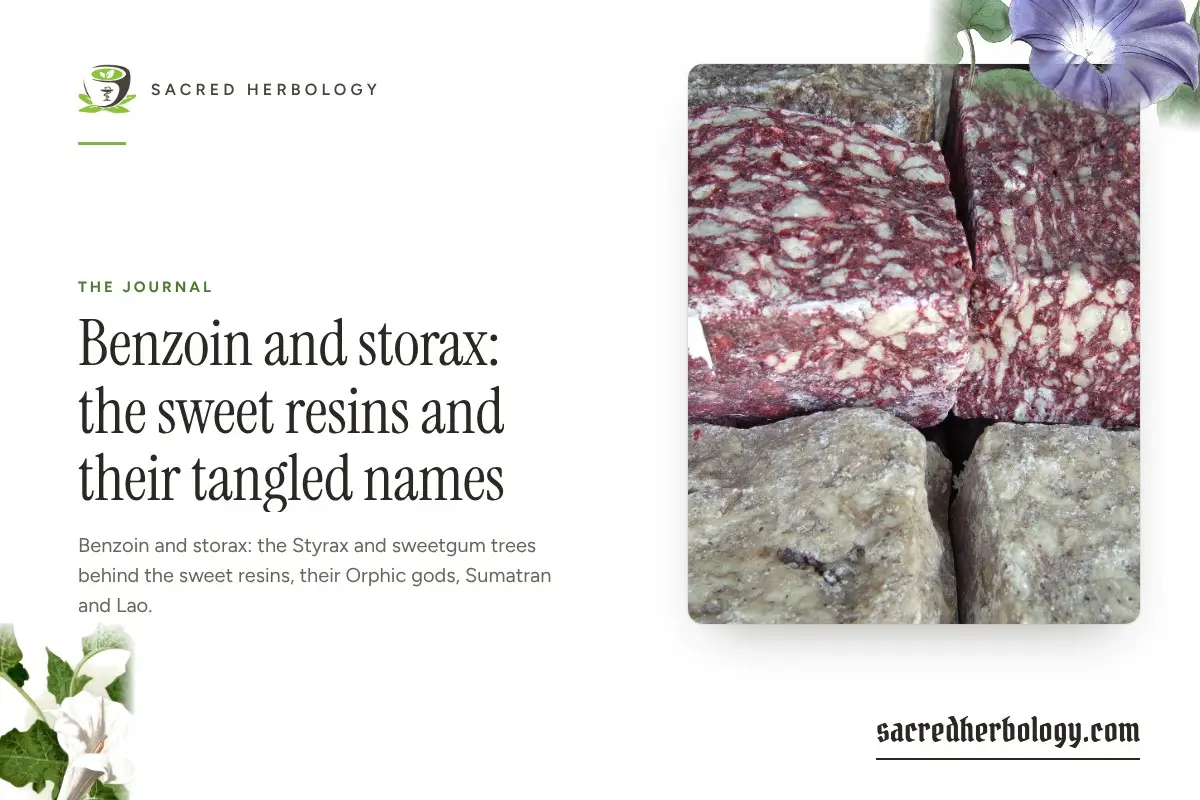
Put a small piece of good benzoin on a glowing coal and wait a moment. It does not crackle the way frankincense does. It softens, slumps and runs, and then the smell comes up: warm, round and sweet, with vanilla in it, and something like cinnamon toast underneath. People who have never knowingly smelled benzoin often recognise it straight away. They have met it in church, in a Javanese clove cigarette, in the base of an amber perfume, or in an old chemist’s shop.
Storax is the darker cousin. A dab of the soft balsam on a coal smells balsamic and leathery, a little like cinnamon bark and a little like a new car, with a sharp edge that some people love and some people cannot stand. Aleister Crowley thought it smelled like a cowshed, and he meant it partly as a compliment. We will get to him.
These two resins have been traded, burned and argued about for three thousand years, and almost every name attached to them has moved at least once. The storax of the Greeks came from one tree, the storax you buy today comes from a different tree on a different branch of the plant kingdom, and benzoin, which comes from a cousin of the first tree, carries a name that started out meaning “frankincense from Java” and ended up as the man’s name Benjamin. Along the way the two resins gave their names to benzene and to styrene, so the old incense trade is still remembered in the names of the plastic in a foam cup and the rubber in a car tyre.
This piece follows both of them. It starts with the trees, goes back to the Phoenician traders and the Orphic hymns, crosses to Aztec Mexico and the gardens of Sumatra, stops in a nineteenth-century chemistry laboratory and a Golden Dawn correspondence table, and ends with how to burn them well and how to buy them without doing harm.
Two families, one name
Start with the trees, because nearly every confusion about these resins comes from the fact that two quite unrelated groups of plants share the same name in the trade.
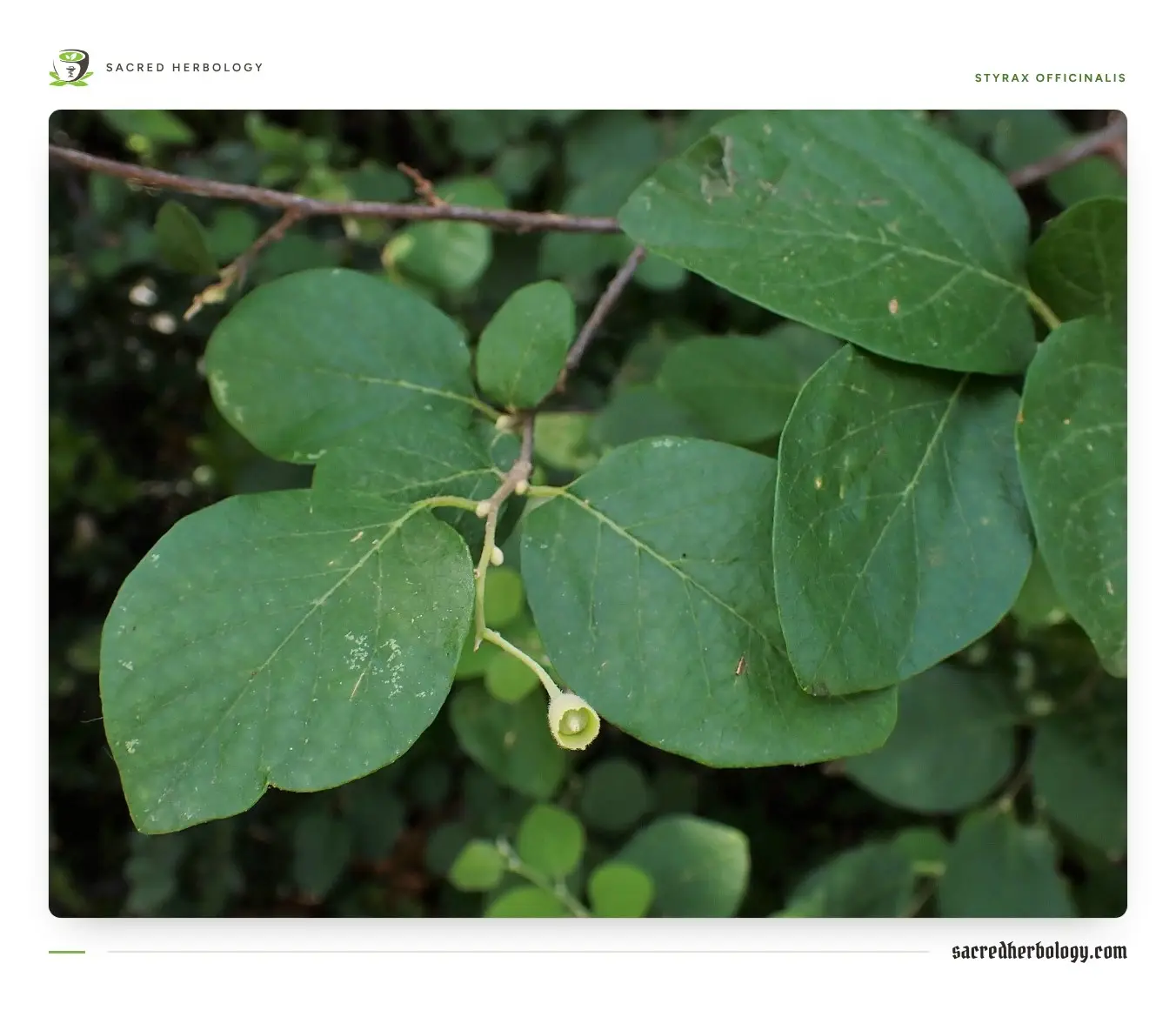
The first group is the genus Styrax, the storax trees and snowbells, in their own small family, the Styracaceae. There are somewhere around a hundred and thirty species, spread across warm and temperate parts of Asia, the Americas and the Mediterranean. They are shrubs and small trees with alternate leaves and white, bell-shaped flowers that hang from the twigs in short clusters, often in great numbers. Gardeners in cooler parts of Australia grow the Japanese snowbell, Styrax japonicus, for exactly that spring display of hanging white bells.
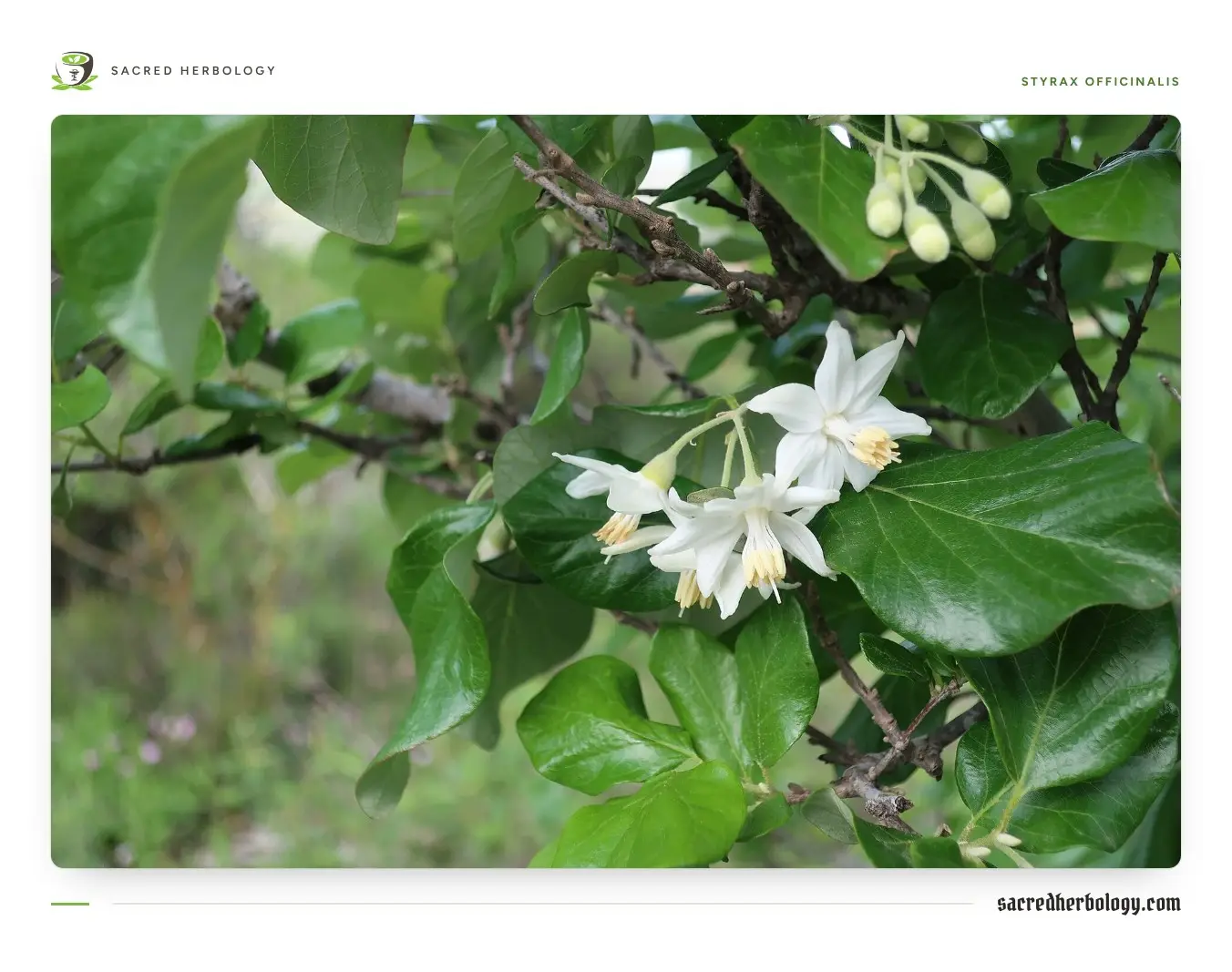

From this genus come:
- Styrax officinalis, a shrub of the eastern Mediterranean, from Greece and Cyprus through Turkey to the Levant. Its resin was the storax of the classical world. It now yields little or nothing in trade.
- Styrax benzoin and a few close relatives, such as Styrax paralleloneurus and Styrax sumatrana, the trees of Sumatran benzoin.
- Styrax tonkinensis, the tree of Siam benzoin, grown mostly in northern Laos and neighbouring parts of Vietnam.
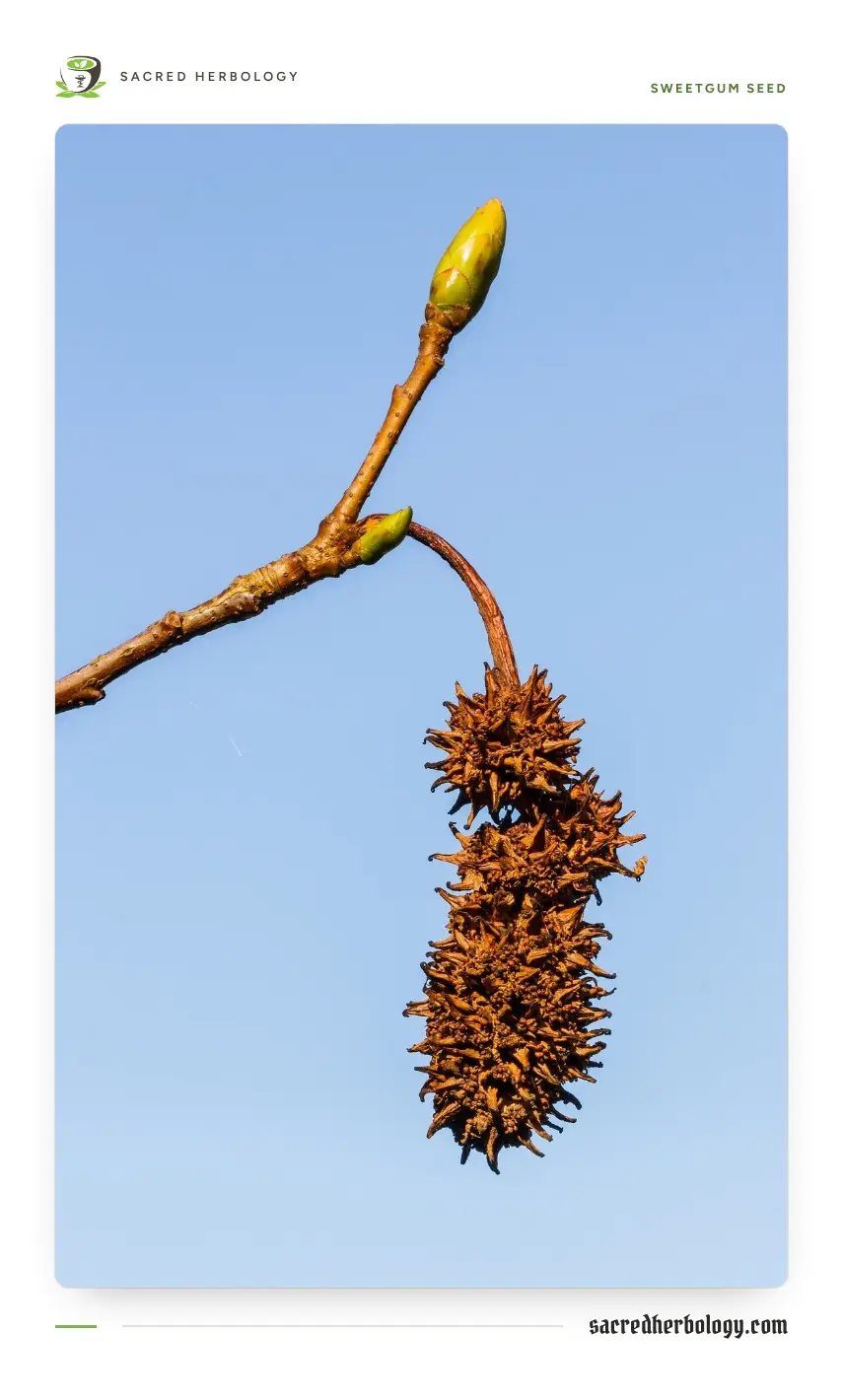
The second group is the sweetgums, the genus Liquidambar, now placed in their own small family, the Altingiaceae (older books put them with the witch hazels in the Hamamelidaceae). They are tall trees with star-shaped, maple-like leaves, flowers in small balls, and hard, spiky seed heads that hang on the branches through winter. Three of them matter here:
- Liquidambar orientalis, the Oriental sweetgum of south-western Turkey and the Greek island of Rhodes, source of the liquid storax of modern commerce, often sold as “styrax Levant”.
- Liquidambar styraciflua, the American sweetgum, from the eastern United States south through Mexico into Central America, source of “American” or “Honduras” styrax.
- Liquidambar formosana, the Chinese sweetgum, whose resin is used in China.
Anyone who has lived in Canberra, Melbourne or the cooler suburbs of Sydney will know Liquidambar styraciflua, whether or not they know its name. It is the street tree that turns scarlet, purple and gold in autumn and then covers the footpath in spiky brown balls that roll under your shoe. Snap a twig or crush a leaf in summer and you will smell a faint ghost of the resin. Its species name, styraciflua, means “flowing with storax”, and Linnaeus gave it that name in 1753 for good reason.
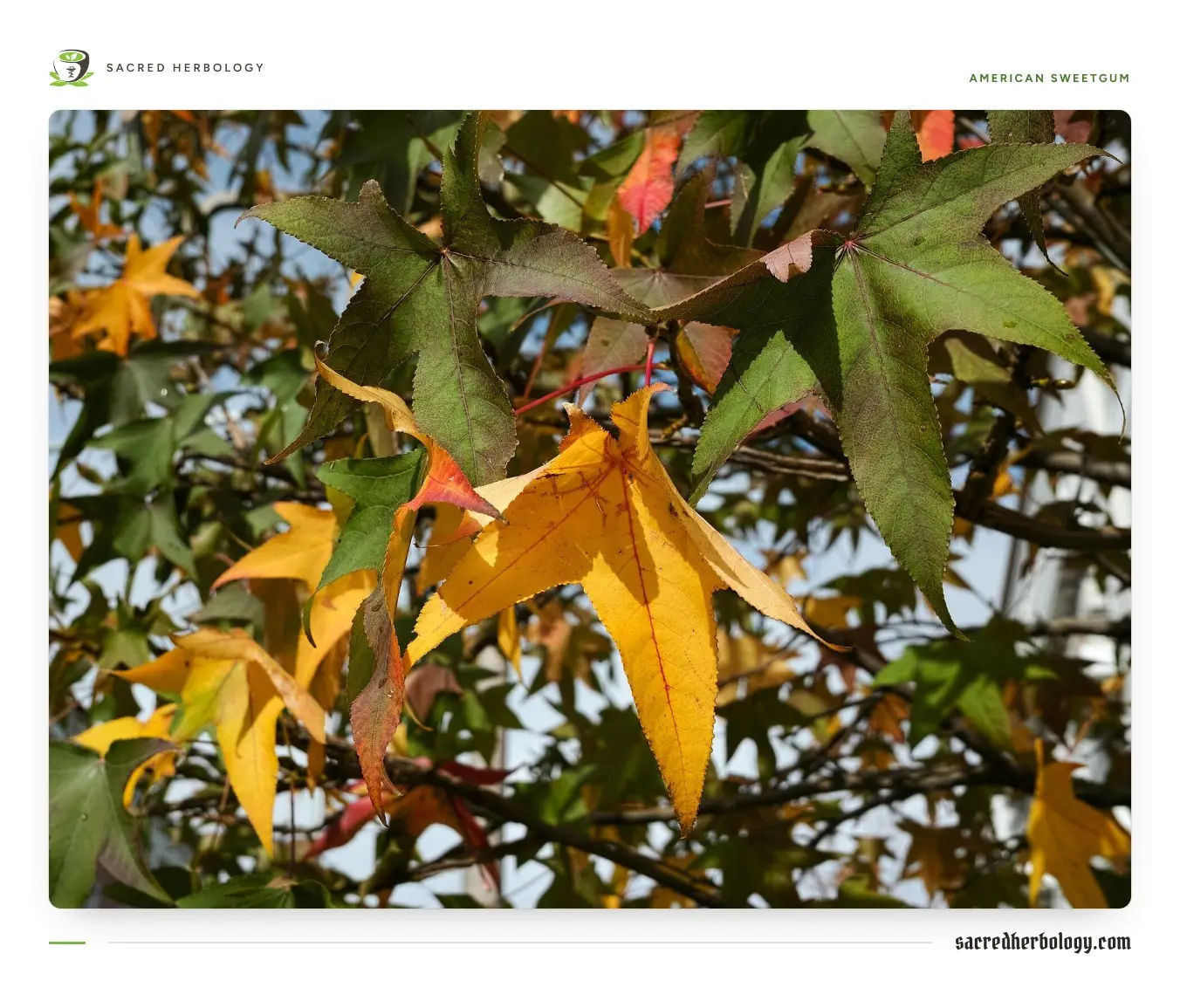

So when an old book says “storax”, it usually means a Styrax resin. When a perfumer or an incense seller says “styrax” or “storax” today, they almost always mean a Liquidambar balsam. And benzoin is a Styrax resin under another name. Keep those three facts in your pocket and the rest of the story falls into place.
The two groups are about as far apart as flowering plants get. Botanists put Styrax in the order Ericales, alongside the heaths, the persimmons and the tea bush, and the sweetgums in the Saxifragales, alongside the currants and the peonies. The resins smell alike. The trees are not related in any close sense.
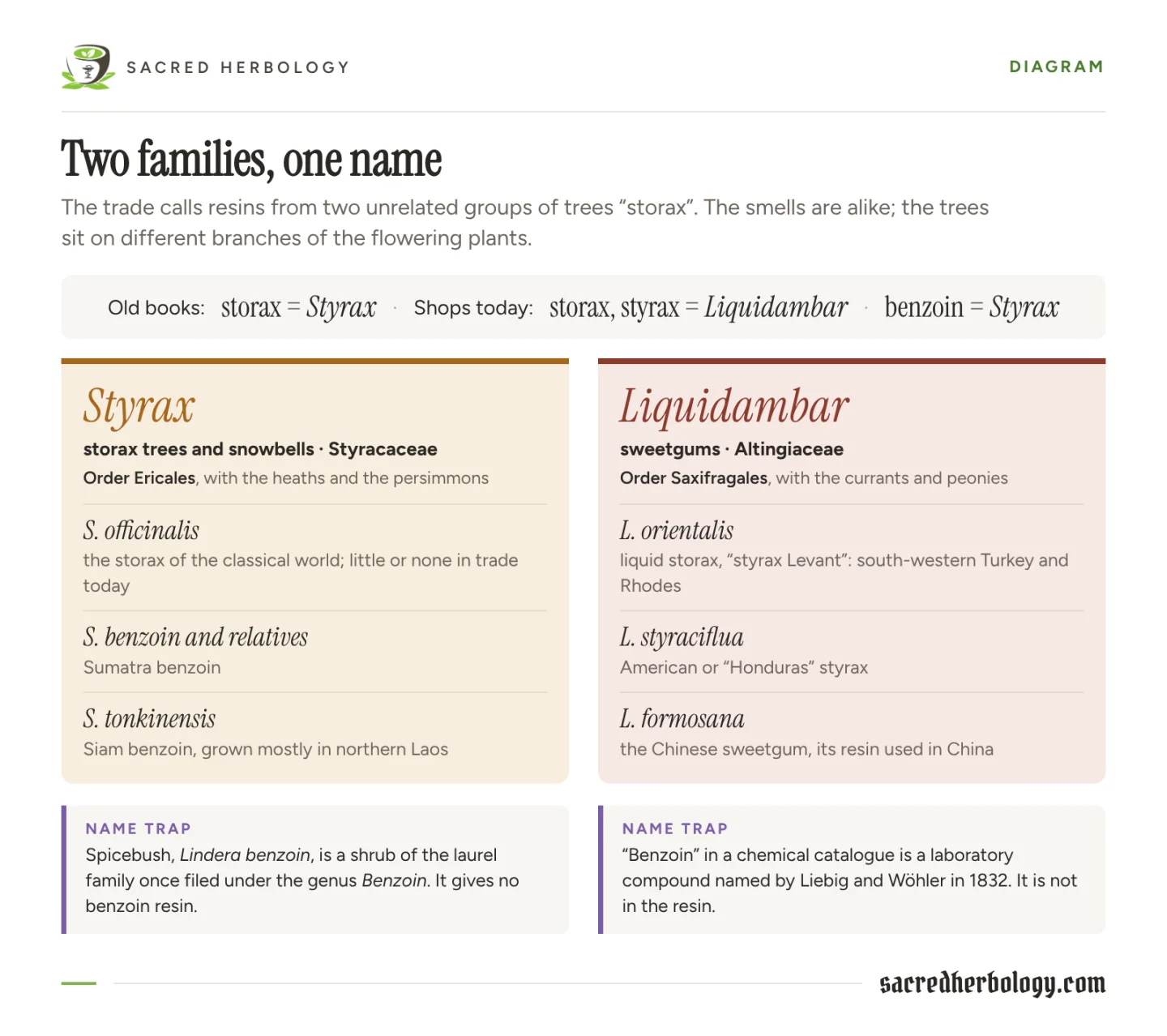
One more name to watch for. North American books sometimes call the spicebush, Lindera benzoin, by the old genus name Benzoin. It is a shrub of the laurel family with aromatic leaves and twigs, and it gives no benzoin resin at all. If a seed catalogue or an old herbal says “benzoin” and shows a laurel, that is the plant it means.
Storax in the ancient world
The oldest storax we can follow by name belongs to the eastern Mediterranean, and it was already a trade good when Greek writers first described it.
Herodotus, writing in the fifth century BCE, tells how the Arabians gathered frankincense. Readers of this Journal have met his winged serpents before. The detail that matters for storax is in the same passage: the Arabians drove the serpents off by burning storax, and Herodotus says this storax was the kind the Phoenicians carried to Greece. So in his day storax was already moving across the sea in Phoenician ships, a merchant’s resin from the Levant, valuable enough to be worth carrying a long way and cheap enough to burn as a smoke screen.
The elder Pliny, in the twelfth book of his Natural History in the first century CE, places the best storax in Syria and lists other sources, among them Cyprus and Crete. He describes it as the resin of a tree something like a quince, and he says, as he says of nearly every resin, that dealers adulterated it. Dioscorides, the Greek army physician whose De materia medica became the standard book on drugs for fifteen hundred years, writes about storax in his first book with the other resins and gums. He records that it was burned as incense in the same way as frankincense.
One more ancient habit left a mark on the later trade. A solid storax was sold in Europe for centuries as storax calamita, “reed storax”, and the pharmacists who wrote about it believed the name came from the old practice of packing the resin in reeds or reed leaves for transport. The name survived into the nineteenth century, long after anyone could say for certain why. By then, as the pharmacists of the 1800s found out, what was sold under that name was mostly sawdust soaked in liquid storax from Turkey.
Storax may also be in the Hebrew Bible. In Hosea 4:13 the prophet complains of people who “sacrifice on the tops of the mountains, and burn incense upon the hills, under oaks and poplars and elms, because the shadow thereof is good”, in the words of the King James Version. The Hebrew word behind “poplars” is livneh, meaning “the white one”. The botanist Michael Zohary, in his Plants of the Bible (1982), argued that the word names two different white-flowered trees depending on the setting, and that in Hosea, among the oak and terebinth woods of the Judean hills, it most likely means Styrax officinalis, which grows in exactly that kind of country. In Genesis 30:37, where Jacob peels white streaks into rods of livneh, Zohary preferred the white poplar. The Greek translators of the Septuagint had already rendered the Genesis word as styrax. Nobody can be certain, and Zohary did not pretend to be, but the picture of incense smoke rising under storax trees on a hilltop is a striking one.

There is one more biblical question that storax gets dragged into. The holy incense of Exodus 30 calls for four ingredients, and the first is nataf, which the Greek translators turned into stacte, “the dripping”. Some modern writers have suggested storax for it. The rabbinic tradition identified nataf with tsori, the balm of Gilead, and the Greek word stacte was used by the classical writers for the finest drip of myrrh. The honest answer is that nobody knows, and any book that tells you confidently that the Temple burned storax is guessing.
The Orphic hymns and the fumigation from storax
If you want to know which gods liked storax, the best ancient source is a small book of religious poetry.
The Orphic hymns are a collection of eighty-seven short hymns to the gods of the Greek world, probably put together in the second or third century CE, most likely somewhere in western Asia Minor, by a religious community that honoured Orpheus as its founder. They are cult texts, written to be sung or recited in worship, and they are neither magic nor learned philosophy. In the manuscripts, most of the hymns carry a short heading naming the offering of incense that goes with them. Scholars still discuss whether those headings belong to the original collection or were added later, but they are old, and they tell us how someone in the Roman East matched smokes to gods.
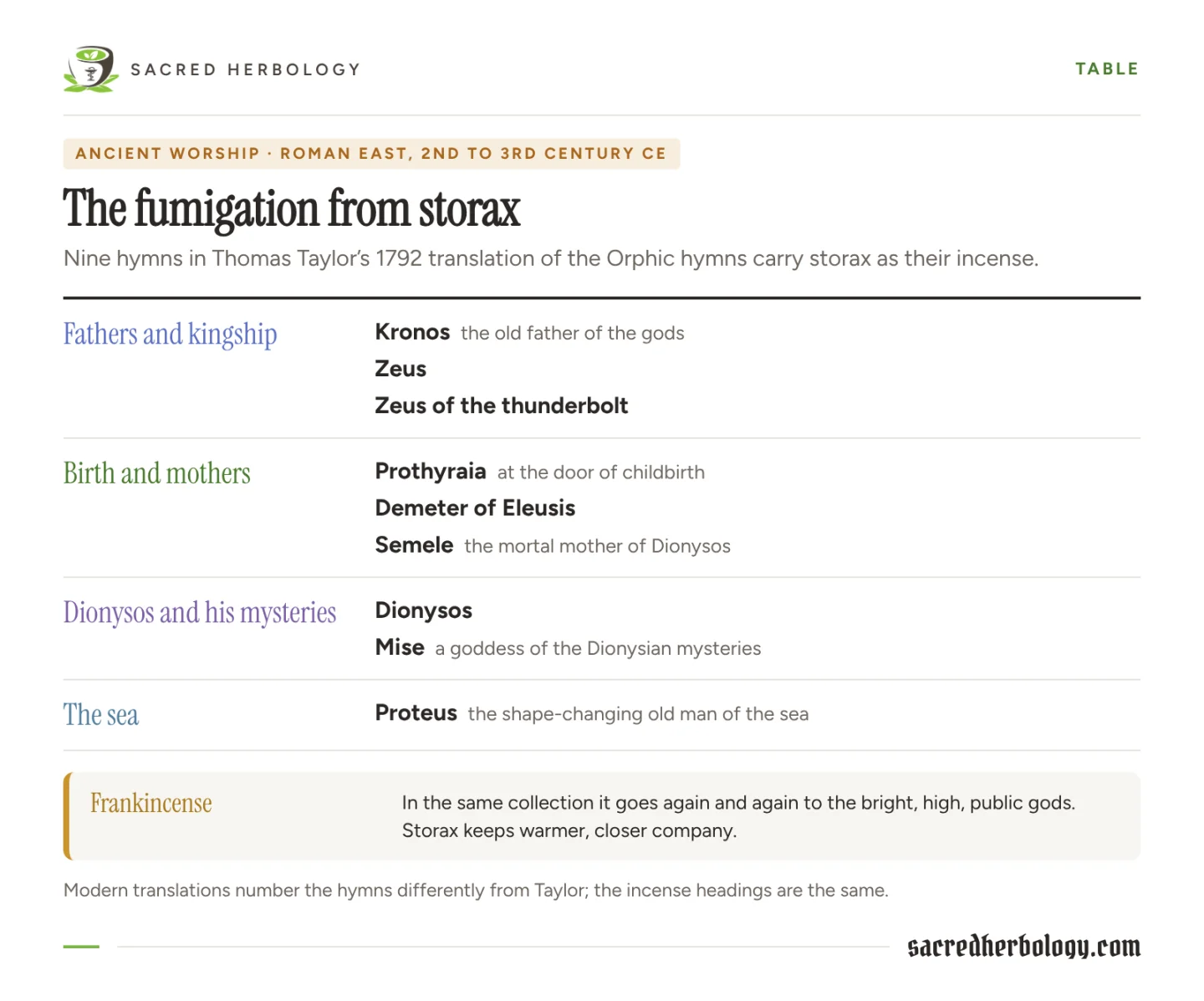
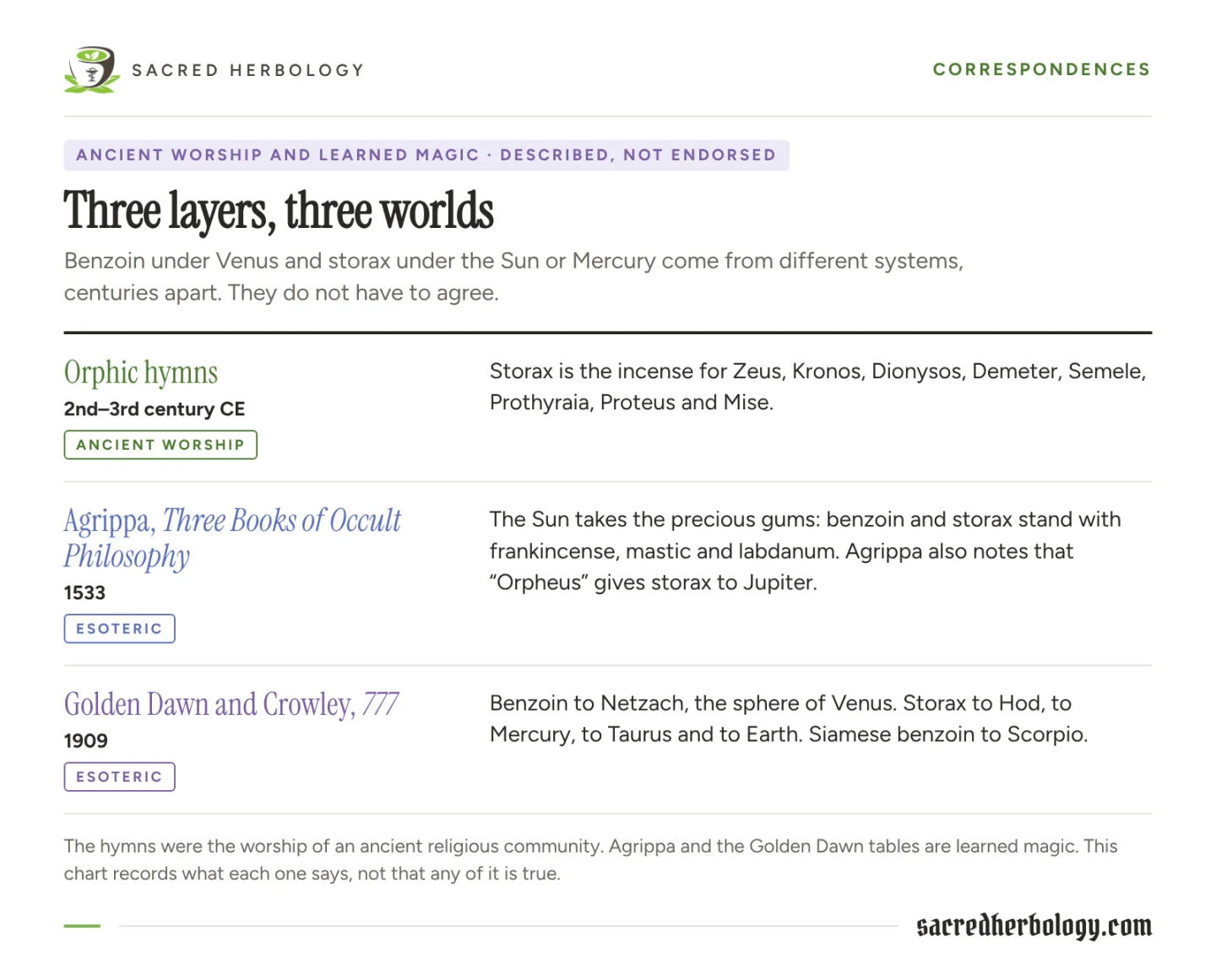
Thomas Taylor, the English Platonist, published the first full English translation, The Hymns of Orpheus, in London in 1792. He rendered the incense headings as “The Fumigation from Storax”, “The Fumigation from Frankincense” and so on. In Taylor’s numbering, storax is the fumigation for:
- Prothyraia, the goddess who stands at the door of childbirth
- Kronos, the old father of the gods
- Zeus
- Zeus of the thunderbolt
- Proteus, the shape-changing old man of the sea
- Dionysos
- Demeter of Eleusis
- Mise, a mysterious goddess of the Dionysian mysteries
- Semele, the mortal mother of Dionysos
Modern translations number the hymns differently, so if you look these up in Apostolos Athanassakis’s translation, the numbers will not match Taylor’s, though the incense will.
That is an interesting list. Frankincense in the same collection goes again and again to the bright, high, public gods. Storax gathers round fathers and kingship (Kronos and Zeus), round birth and mothers (Prothyraia, Semele, Demeter), and round Dionysos and his mysteries. It is a warmer, closer, more domestic company. Whether the compilers chose storax for its smell, its price or something we cannot recover, the hymns are the earliest place where storax has a clear religious personality.
More than a thousand years later, the hymns were back in circulation in Renaissance Italy, and the learned magicians read them closely. Heinrich Cornelius Agrippa, in his Three Books of Occult Philosophy (1533), notes in passing that “Orpheus” gives storax to Jupiter, which is exactly what the Zeus hymns say. This Journal has already walked through Agrippa’s planetary plants, so I will only point out how the line runs: from a Roman-era hymn book, through a sixteenth-century magician, into the correspondence tables of the nineteenth and twentieth centuries. Agrippa’s use of the hymns belongs to learned magic, and so does everything that follows from it in the tables. That material is esoteric, and I label it so. The hymns themselves were the worship of an ancient religious community, and they deserve to be read as that.
Where did the old storax go?
Here is the puzzle that bothered the pharmacists of Victorian England. The ancient writers were clear that storax was a resin from Styrax officinalis. Yet by the 1800s, nobody could find that resin anywhere. The tree still grew all over the eastern Mediterranean, but it did not seem to produce any resin worth collecting. What the apothecaries were buying as “liquid storax” was a grey-brown, sticky, semi-fluid balsam that came in casks out of Smyrna and Constantinople, and nobody in London could say for certain what tree it came from.
The man who settled it was Daniel Hanbury, a Quaker pharmacist from the London firm of Allen and Hanburys and one of the great drug historians of the century. In 1857 he published a paper in the Pharmaceutical Journal called “On storax”. Working from specimens and from the reports of British residents and officers in the Levant, he showed that the liquid storax of commerce came from Liquidambar orientalis, the Oriental sweetgum, growing in forests in the south-west corner of Asia Minor, on the mainland opposite Rhodes. The old Styrax resin had, for practical purposes, disappeared from trade.
The descriptions that Hanbury gathered, repeated in the pharmacy books for the next sixty years, give us a clear picture of the harvest. The collectors bruised the outer bark of the sweetgum heavily, to wound the inner bark below. The tree responds to the injury by forming resin in the young wood. After a while the collectors stripped the outer bark and scraped off the inner bark, now soaked with balsam. One account had them press this inner bark cold in horsehair bags, then pour hot water over the bags and press again. Another had them boil the bark in water, skim off the balsam that rose, and then press out the rest. The pressed bark was dried in the sun and sold on its own for burning, and Turkish households used it as a fumigation. The pharmacists called that leftover bark cortex thymiamatis, “incense bark”.
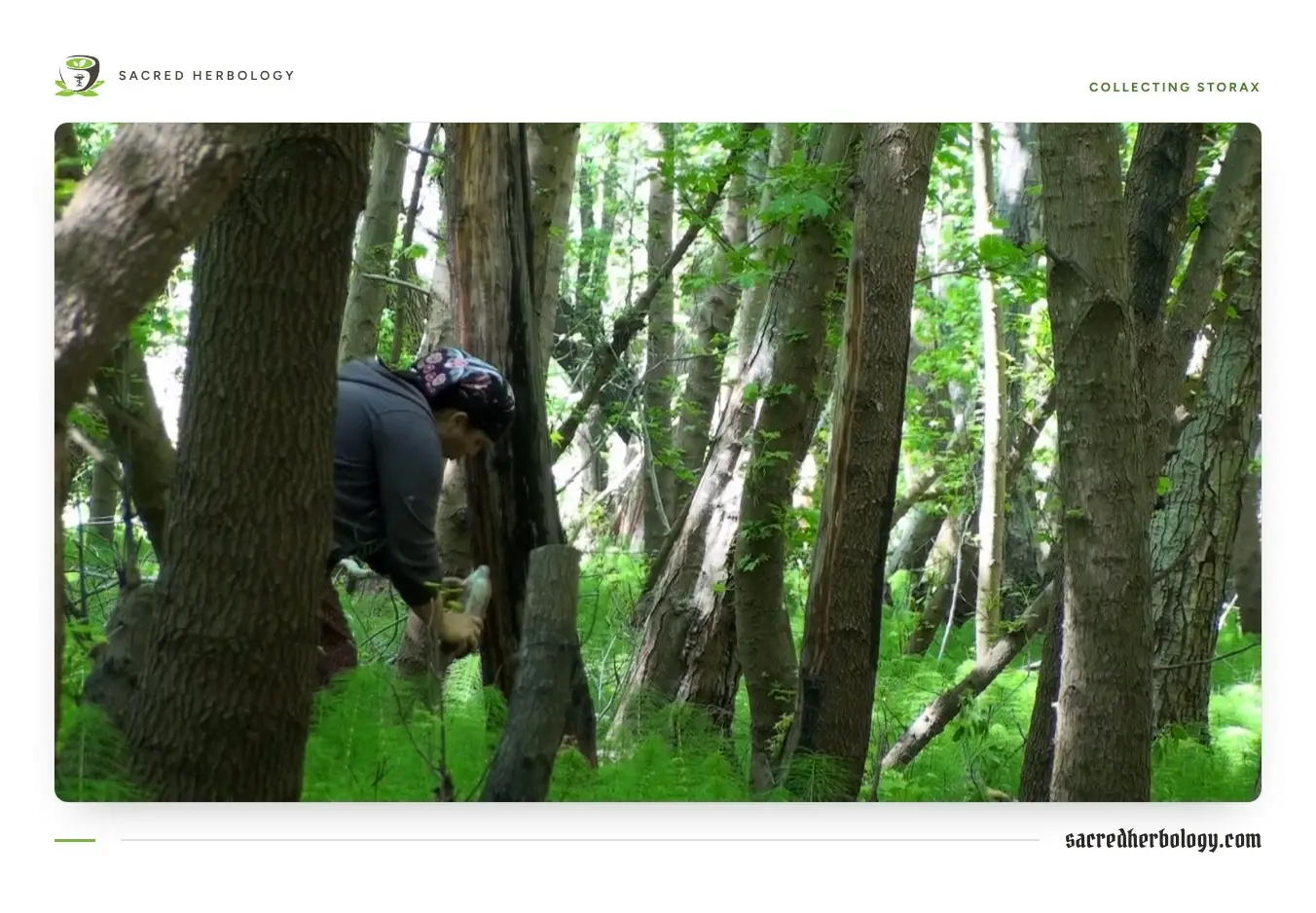

This trade still exists, on a tiny scale. In Turkish the tree is sığla ağacı and the balsam sığla yağı. The remaining forests are around Köyceğiz, Dalyan, Marmaris and Fethiye in Muğla province, mostly on wet ground near lakes and rivers. They have shrunk badly. A study at Muğla University put the forest at about 6,300 hectares before 1950 and about 1,400 hectares by the time of the survey, lost to clearing for farms, illegal cutting, disease and tourism development. The Oriental sweetgum is listed as Endangered on the IUCN Red List. The Köyceğiz forest is now protected, and there is local work on replanting and on keeping the old harvest going in a way that keeps the trees alive.
If you want a single scene from this whole story to hold in your mind, take this one: a stand of tall sweetgums on a marshy lake shore in south-western Turkey, a collector working at the bark with a scraper, a kettle of bark and water steaming over a fire, and a horsehair press beside it, with a pile of spent bark drying in the sun. It has been done that way for centuries, and the trees are now few enough that each one counts.
Sweetgum across the ocean
Europeans met the other storax tree when they reached Mexico.
The Aztecs called the resin of the American sweetgum xochiocotzotl, roughly “flower pine-resin”, and the tree xochiocotzoquahuitl. They burned it, used it in perfumes, and mixed it with tobacco. The soldier Bernal Díaz del Castillo, who marched with Cortés and wrote his True History of the Conquest of New Spain decades later as an old man in Guatemala, describes the end of Moctezuma’s meals. Three painted and gilded tubes were set on the table, filled with liquidambar and the herb they called tobacco. When the eating, music and dancing were over, the ruler drew a little of the smoke from one of them and went to sleep. Díaz’s book was published in 1632, long after the events, and it is a memoir, so read it as a memory. As a picture of the use of the resin, though, it is vivid and specific.
Francisco Hernández, the physician sent by Philip II of Spain to survey the natural history of New Spain in the 1570s, described the tree and its resin among his hundreds of Mexican plants. His notes were published in Rome in 1651, in a much-reduced form, as the Rerum medicarum Novae Hispaniae thesaurus.
The Spanish name for the resin was liquidámbar, “liquid amber”, because the soft, golden, sticky gum looked like amber that had not yet set. Nicolás Monardes, the physician of Seville who wrote about the new drugs coming in from the Americas, wrote about liquidambar and its oil in his book on American medicines, and John Frampton’s English translation of 1577, Joyfull Newes out of the Newe Founde Worlde, carried the name into English. When Linnaeus came to name the tree, he kept the Spanish word for the genus and added styraciflua, “flowing with storax”, for the species. He was recognising what the Mexican resin had already told everyone: it was another storax.

American storax still comes mostly from Honduras and nearby parts of Central America, where the trees are still tapped for it. It smells a little greener and more like pine than the Turkish balsam. Because the Turkish trees are now so scarce, the American balsam is the storax most sellers should be offering.
Benzoin: the frankincense of Java
Now to the other resin, and to the name that took the longest journey.
The Greeks and Romans never knew benzoin. It comes from the islands and the mainland of South-East Asia, and as far as we can tell from the surviving texts, it reached the Mediterranean late, through the Arab and Persian sea trade of the Indian Ocean. Arab merchants called it lubān jāwī, “frankincense of Jāwa”. In their usage, Jāwa did not mean only the island we call Java. It meant the islands of the archipelago in general, and often Sumatra in particular.
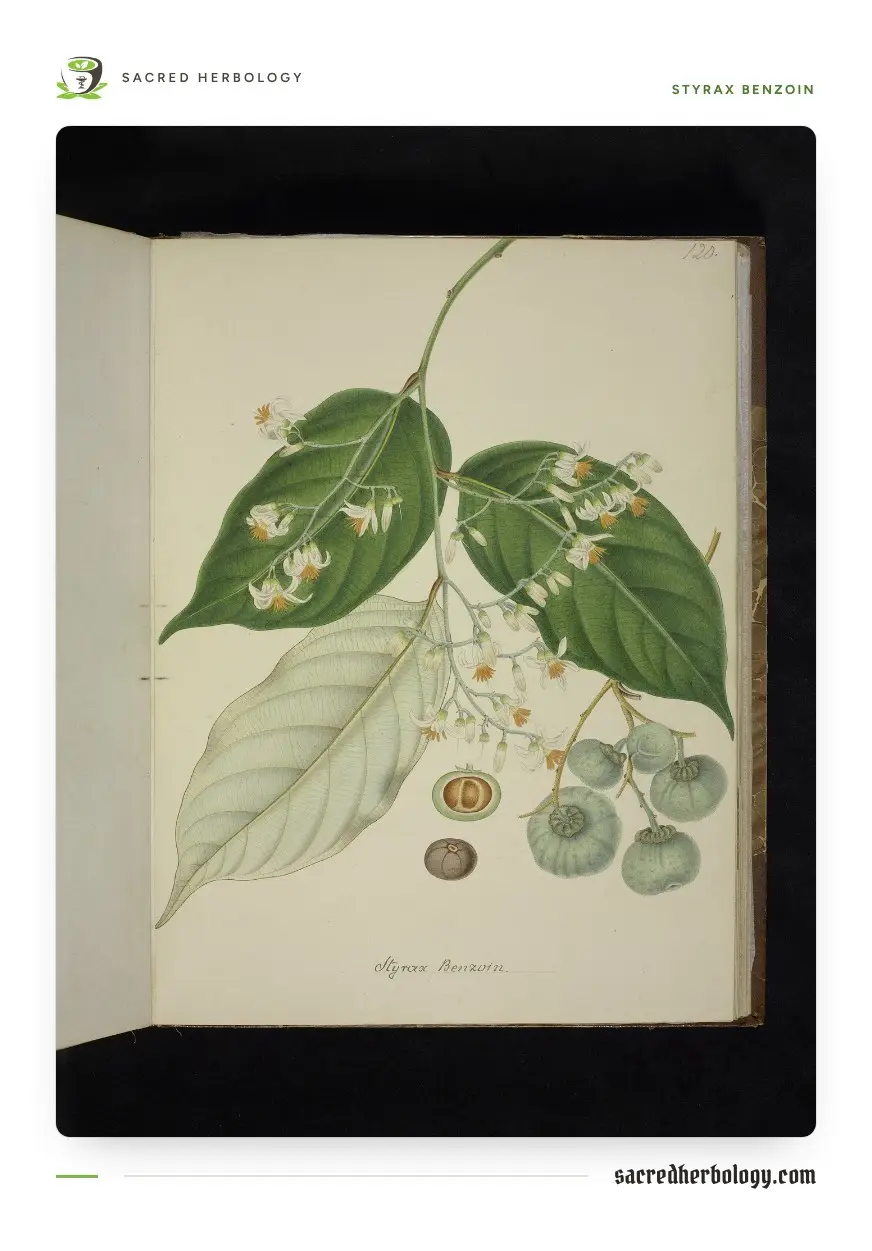

The traveller Ibn Battuta, a Moroccan who spent nearly thirty years on the road, visited the Sumatran port kingdom of Samudra around 1345. He notes that the island is the one from which the Jāwī incense takes its name. That is the earliest clear statement we have, from someone who was there, that the resin came from Sumatra.
Then the name went to Europe, and it fell apart in the most charming way. Italian and Catalan traders heard lubān jāwī and seem to have taken the first syllable for their own little word lo, “the”, and dropped it. What was left was benzui or benjui. From there it became benjuí in Spanish, beijoim in Portuguese, benjoin in French, and in English, after a few false starts, benzoin. English speakers then went one step further and turned the strange word into a familiar one. By the seventeenth century the resin was being sold in England as “gum benjamin”, as though it had been named after somebody’s uncle.
You can draw that journey as a map, and it is a lovely one: from the benzoin gardens of north Sumatra, across the Indian Ocean to the Arab ports, up the Red Sea to Egypt, across to Venice, and on to the apothecaries of London, with the name changing shape at every stop:
- Arabic: lubān jāwī, frankincense of Jāwa
- Italian and Catalan: benzui, benjui, with the “lu” dropped as if it were “the”
- Portuguese: beijoim
- French: benjoin
- English: benzoin, and the popular “gum benjamin”
In the fifteenth century benzoin was still a rare and princely gift in Europe. The sultans of Mamluk Egypt, who controlled the spice route through the Red Sea, sent it to the doges of Venice among their diplomatic presents. In 1476 Caterina Cornaro, the Venetian-born queen of Cyprus, received fifteen pounds of “benzui” from Egypt. A century later, when the Portuguese had sailed round Africa and set up at Goa and Malacca, benzoin began to arrive in Europe in quantity, along with the knowledge that there were two main kinds: one from Sumatra and one from the kingdom of Siam on the mainland.

The resin was named in China, too, and the Chinese name has its own riddle. The Chinese call benzoin anxi xiang, which can be read as “the incense of Anxi”, and Anxi was the old Chinese name for Parthia, the Iranian empire. The orientalist Berthold Laufer, in his Sino-Iranica (1919), and later Edward Schafer, in The Golden Peaches of Samarkand (1963), traced how the name of an incense from Parthia, whatever it originally was, came to be attached to the South-East Asian resin that took its place in the market. What the first “Parthian incense” actually was is still argued. Storax had its own Chinese name, suhe xiang, and also came into China by the western trade.
Benzoin in the islands and the hills
Benzoin is still gathered the old way, by small farmers, in two main regions.
In North Sumatra the trees are tapped by Batak farmers in the highlands around Lake Toba, in the districts of Dairi, North Tapanuli and Humbang Hasundutan. The Batak name for the resin is haminjon, and the Malay and Indonesian name is kemenyan. A team of researchers working with the Center for International Forestry Research, Esther Katz and her colleagues, studied the trade in the late 1990s. They expected to find a dying craft and instead found benzoin still being tapped in fourteen sub-districts, with thousands of farmers and small traders depending on it, some households for most of their income. The trees grow in mixed gardens on the hills, half forest and half orchard. The farmers cut into the bark, and the resin oozes out, hardens, and is scraped off weeks or months later and sorted into grades, from large, pale pieces down to dark scrapings and dust.
Most of that Sumatran benzoin, Katz and her colleagues found, went to Central Java, where it was used for incense and in the kretek, the Indonesian clove cigarette, where it adds a sweet note to the smoke of some brands. A kemenyan seller’s stall in a Javanese market, with its sacks of resin graded by size, would make a good drawing for anyone who has seen one.

In Java and across the Malay world, kemenyan is also the ordinary incense of offerings and of popular religion, burned at graves, at shrines and in household rites. A good published window into this is Walter William Skeat’s Malay Magic, printed in London in 1900. Skeat was a British colonial officer in the Malay states, and his book is a collector’s record of the beliefs and practices of Malay villagers at the end of the nineteenth century. What it holds is village custom and popular religion, written down by an outsider, with all the limits that implies. Skeat records that the offerings left at a keramat, a local holy place or saint’s tomb, were usually incense or benzoin, burned in little stands made from split bamboo stuck in the ground, and that a Malay would often vow such an offering if he got out of some difficulty.
The most beautiful passage on benzoin in Skeat comes in his account of the rice year, which he took down from a Malay description. At planting, prayers were read over the “mother-seed” and benzoin supplied by the village pawang, the specialist in ritual, was burned. At the first reaping, the pawang’s permission was asked and his benzoin was burned in the field. Seven stalks were cut to be the “soul of the rice”, wrapped in a white cloth and “made into the shape of a little child in swaddling clothes”, laid in a small basket, and fumigated with benzoin together with next year’s seed before being carried home and stored in the rice bin. There is a picture worth drawing: a small basket, a white bundle shaped like a baby, a curl of sweet smoke, and a field of ripe rice behind. This is village practice and popular religion, recorded as Skeat heard it. It is not learned magic, and it should not be filed with the grimoires.
The second region is northern Laos. Siam benzoin got its name because for centuries it was traded through the ports of Siam, but most of it was always grown in the hills of what is now Laos, in the provinces of Luang Prabang, Phongsaly, Houaphan and Oudomxay, with some across the borders in Vietnam. The Food and Agriculture Organization of the United Nations surveyed benzoin villages there around the turn of this century. What they found is a way of growing a resin tree inside a farming cycle.
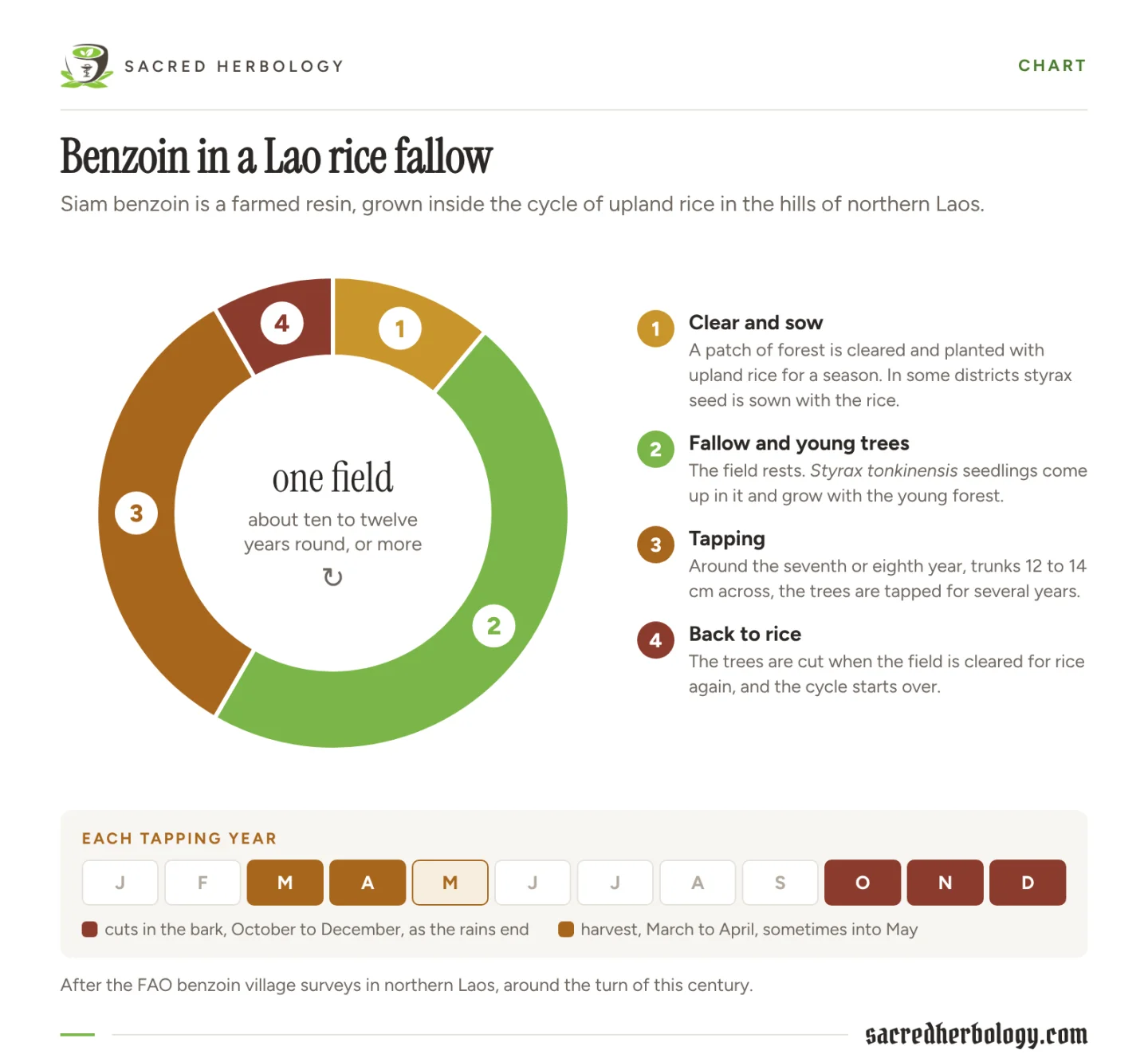
Farmers in these hills grow upland rice by clearing a patch of forest, cropping it for a season, and leaving it to rest for ten or twelve years or more. Styrax tonkinensis seedlings come up naturally in the resting fields, and in some districts farmers sow the seed with the rice in the first year. The trees grow up with the young forest. Around their seventh or eighth year, when the trunks are about 12 to 14 centimetres across, the men start tapping them. Cuts are made in the bark from October to December, at the end of the rainy season. The resin is harvested from March to April of the next year, sometimes into May. The trees are tapped for several years, and then cut down when the field is cleared for rice again, and the cycle starts over.
Drawn as a circle, that calendar runs: rice, fallow, styrax seedlings, young trees, the tapping cuts in the late wet season, the harvest in the dry, and back to rice. It is also a reminder that “wild” benzoin is usually nothing of the kind. It is a farmed product, grown by families who also grow their food, and its price decides whether they keep growing it. The FAO surveyors found villages where many households had recently given up tapping because the price had dropped.
From the censer to the laboratory
Benzoin and storax had a second career in chemistry, and it is a surprising one.
In the 1550s, the French physician and seer Michel de Nostredame, better known as Nostradamus, described in a book of cosmetics and preserves how to heat benzoin so that a white, feathery, crystalline substance rose off it and collected above. Other writers of books of secrets described the same process soon after. The crystals came to be called “flowers of benzoin”, and they were made for centuries by heating the resin in paper cones over a pan. They are benzoic acid, and the resin gave the acid its name. In 1832 the German chemists Justus von Liebig and Friedrich Wöhler worked out its composition.
The same work left behind a name trap. While studying oil of bitter almonds that year, Liebig and Wöhler also made a white crystalline compound and called it benzoin. That compound is a laboratory chemical, and it does not occur in the resin. When a chemical supplier’s catalogue lists “benzoin”, it means the compound, which has none of the resin’s scent.
Benzoic acid led straight to one of the most important substances in modern chemistry. In 1825 Michael Faraday had found a new, sweet-smelling liquid in the oily residue of the gas used to light London’s streets. In 1833 and 1834 the Berlin chemist Eilhard Mitscherlich made the same liquid by heating benzoic acid with lime, and because it came from benzoic acid, from benzoin, he called it Benzin. Liebig preferred Benzol, and English settled on benzene. So the name of the ring at the heart of organic chemistry, drawn as a hexagon in every chemistry textbook, goes back through Mitscherlich’s flask and Nostradamus’s crystals to the Arab merchants’ “frankincense of Jāwa”.
Storax did the same thing a few years later. In 1839 a Berlin apothecary, Eduard Simon, distilled liquid storax and collected an oily, sweet-smelling liquid he called Styrol, after the resin. He noticed that if it stood exposed to air, light or heat, it slowly turned into a hard, jelly-like solid. Later chemists showed that the liquid was styrene and the solid was a chain of styrene molecules joined together: polystyrene. Polystyrene is now made from petroleum, and the foam cups, takeaway boxes and packing beads made from it have nothing to do with sweetgum trees. The name still carries the memory of the resin.
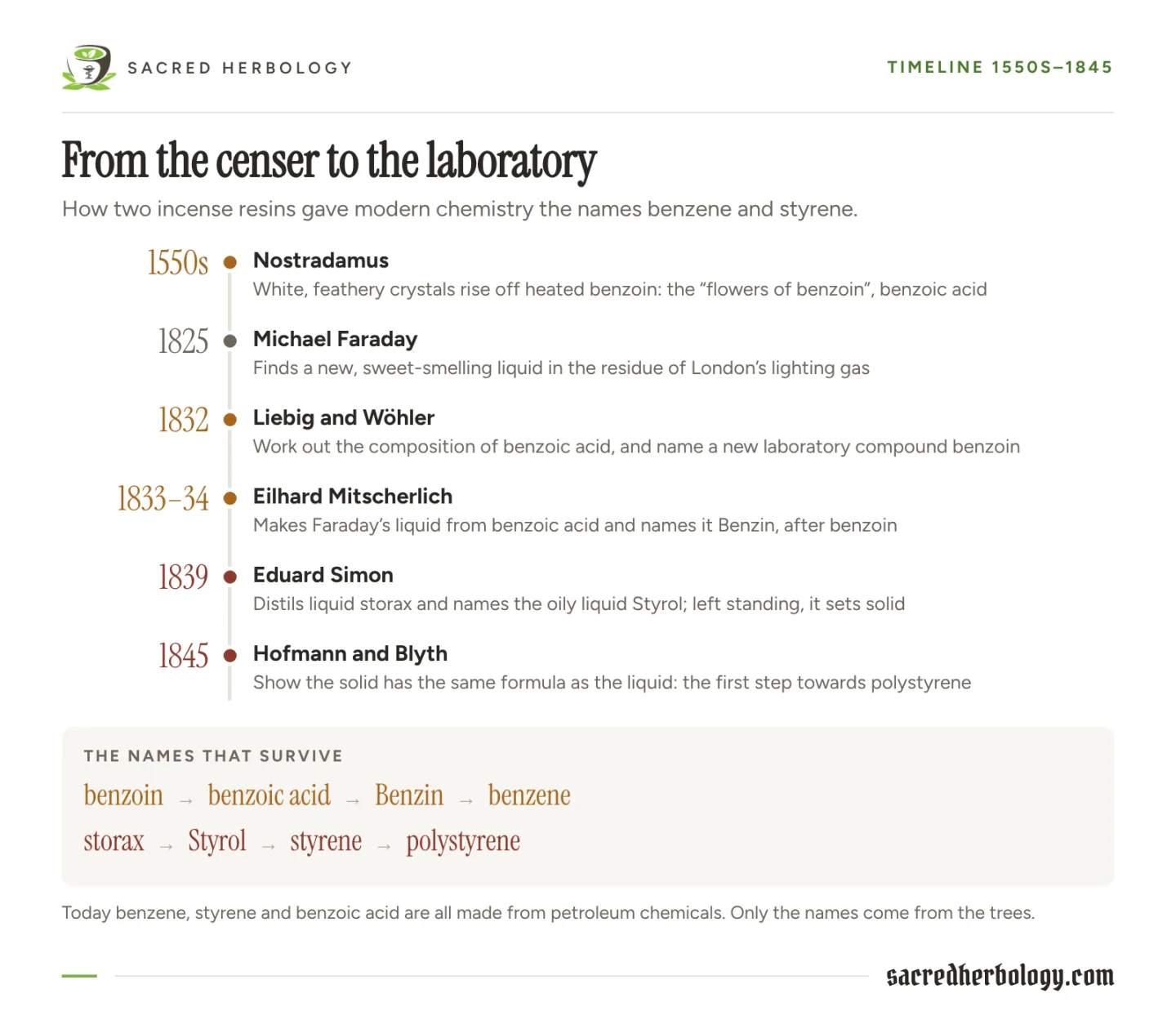
Laid out as a timeline, it looks like this:
- 1550s: Nostradamus describes the white crystals that rise off heated benzoin.
- 1825: Faraday isolates a new liquid from lighting-gas residue.
- 1832: Liebig and Wöhler work out the composition of benzoic acid, and name a new laboratory compound benzoin.
- 1833 to 1834: Mitscherlich makes the same liquid from benzoic acid and names it Benzin, after benzoin.
- 1839: Simon distils storax and names the liquid Styrol, after storax.
- 1845: Hofmann and Blyth show that Simon’s solid has the same formula as the liquid, the first step towards understanding polystyrene.
Benzoic acid itself is now made synthetically from petroleum chemicals, and none of it comes from a tree. It turns up as food additive 210 on Australian labels, with its sodium salt as 211, in soft drinks and sauces.
The resins also gave chemistry cinnamic acid, which is plentiful in storax and in Sumatran benzoin. Storax holds much of it as esters, such as styracin, along with a little free styrene, and that styrene is part of the sharp, new-car edge in the smell of the crude balsam. The two benzoins differ in a way a chemist can measure. Siam benzoin is made up mostly of coniferyl benzoate, an ester of benzoic acid, and has little or no cinnamic acid. Sumatran benzoin carries cinnamic acid and its esters as well. Both contain vanillin, the main scent of the vanilla pod, though only as a small fraction of the resin. In the Siam resin, with no cinnamates to cover it, that vanilla note comes through clearly. Sumatran benzoin, with its cinnamates, smells drier and spicier. Put the two side by side on a coal and you can smell the difference in their chemistry.
The magicians’ tables
This section is esoteric. It is about learned magic and its correspondence tables, the planned systems of sympathies that Renaissance magicians and their modern heirs built. I describe what those systems say. I am not telling you they are true.
When Agrippa wrote his chapter on planetary fumes in the 1530s, benzoin was a newcomer to Europe. He gave it a high place anyway. In his scheme the Sun takes the precious, fragrant gums, and benzoin and storax both stand there with frankincense, mastic and labdanum. That fits the way Agrippa thought: the sweetest and most costly smokes go to the noblest planet.
The tables that most modern practitioners use come from the Hermetic Order of the Golden Dawn, founded in London in 1888, by way of Aleister Crowley, who went through the Golden Dawn and published his own version of its correspondences in 1909 as 777. The book is a set of columns, with the ten spheres and twenty-two paths of the kabbalistic Tree of Life running down the side and columns of gods, colours, stones, plants, animals and perfumes running across. For anyone who likes such things, the perfume column is a good thing to copy out by hand. Here is where benzoin and storax fall in it:
- Netzach, the seventh sphere, the sphere of Venus: “Benzoin, Rose, Red Sandal”.
- Hod, the eighth sphere, the sphere of Mercury: “Storax”.
- Mercury, among the planets: “Mastic, White Sandal, Mace, Storax, all Fugitive Odours”.
- Taurus, the earthy sign ruled by Venus: “Storax”.
- Scorpio: “Siamese Benzoin, Opoponax”.
- Earth, as an element: “Storax, all Dull and Heavy Odours”.
That is the source of the very common modern habit of putting benzoin under Venus. It is a Golden Dawn and Crowley attribution, and it differs from Agrippa’s.
Late in life Crowley wrote a set of notes explaining his reasons, which were printed after his death in the revised edition of 1955, 777 Revised. They are some of the most entertaining pages he wrote. “The sensuous seductiveness of Benzoin is unmistakable,” he says, for Venus. Storax he thought “chiefly Mercurial on account of its nondescript nature”, more useful as a base for carrying other perfumes, the way mercury is the base of amalgams, but “too dark and heavy” to be a good perfume for its sphere. Then, explaining why storax also goes to Taurus and to Earth, he writes that its perfume “suggests the patience of cattle”, and even “the peculiar sweetish scent of a cowshed”. He also calls storax “the earth elemental incense of Moses”, which is his own attribution and has no support in the Bible.
For Siam benzoin under Scorpio he goes darker still. He says it should be distinguished from benzoin from other countries, and he finds in it a smell “strongly suggestive of the treachery of the snake”, a hidden poison. Anyone who has smelled good Siam benzoin, which is about as gentle and vanilla-sweet as resins get, may find that a stretch. These notes are one man’s associations, written down as reasons, and they tell you a great deal about how Crowley’s imagination worked. They give no evidence that the smoke does anything of the kind.
If you are building a practice on these tables, know which layer you are standing on. Storax for Zeus is Orphic and ancient. Storax and benzoin for the Sun is Agrippa. Benzoin for Venus and storax for Mercury and Earth is the Golden Dawn and Crowley, at the turn of the twentieth century. They are three different systems, from three different worlds, and they do not have to agree.
In church, mosque and household
Away from the magicians, benzoin has quietly become one of the most widely burned resins in the world.
Orthodox monastery incense makers commonly mix benzoin with frankincense and perfumes to make the rich, sweet incense of Orthodox worship, and many Catholic church blends include it with frankincense for the same warm, rounded note. If the smoke in a church has ever struck you as sweeter and softer than plain frankincense, benzoin is a likely reason.
In the Arabic-speaking world the old name survives in the marketplace. In the Gulf, lubān jāwī, or just jāwī, is still sold as a resin and goes into the household incense blends burned to scent a house and its guests. Across much of South Asia, the related word loban, from the Arabic lubān, is used for benzoin and other incense resins, and it is burned in homes and at the shrines of Sufi saints. In Java and Malaysia kemenyan is part of offerings and household rites, as Skeat recorded. In each of these places, benzoin belongs to a living religious culture, and the people who use it are the ones to describe what it means to them. What I can say from published sources is that the resin is there, and has been for centuries.
Burning them well
The two resins behave differently on a coal, and it helps to know the difference.
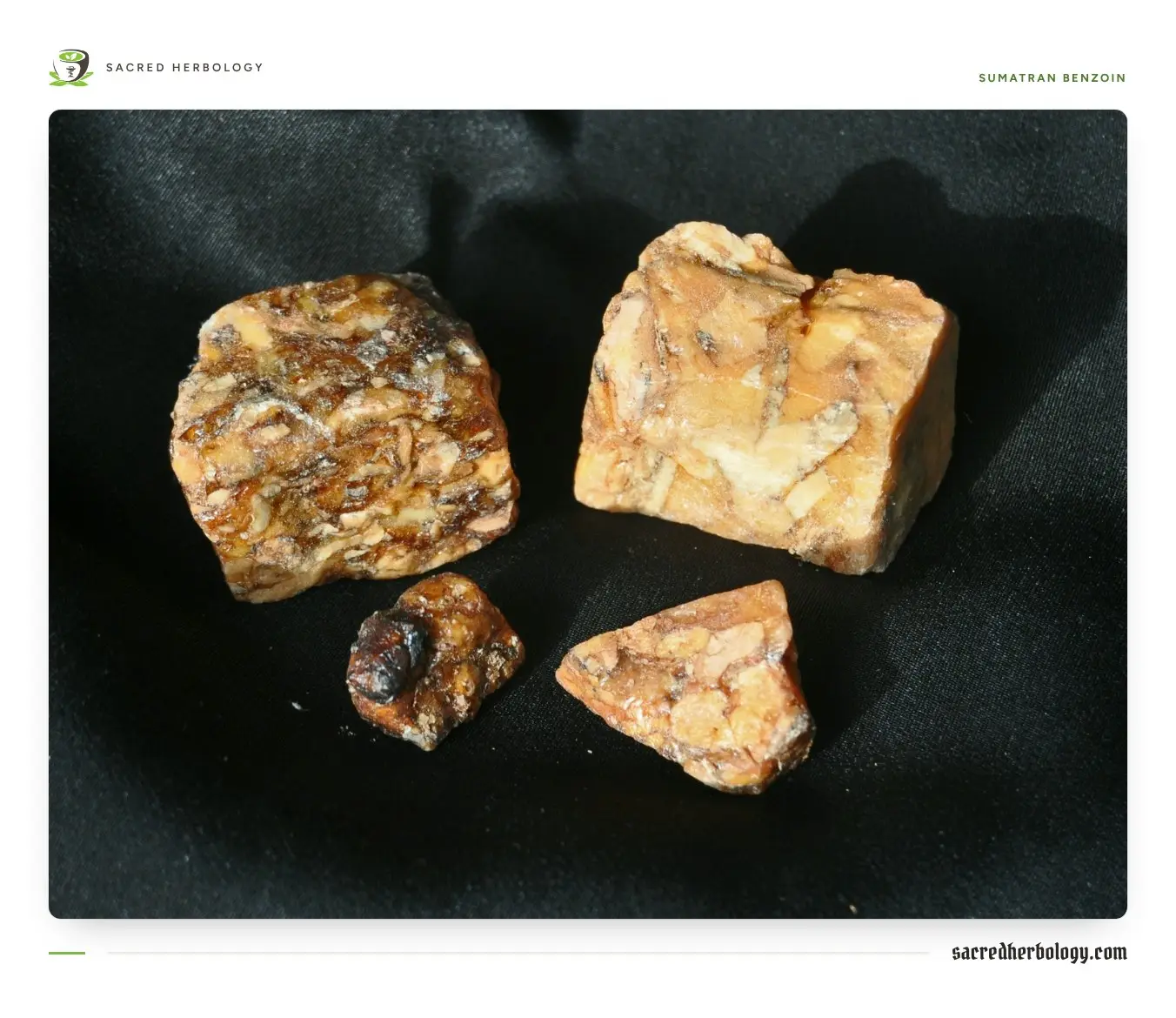
- Benzoin comes in pieces from pea-sized drops to large lumps. Siam benzoin usually comes as separate tears, yellow-brown outside and milky white when broken. Sumatra benzoin usually comes in blocks, with pale, almond-like pieces embedded in a darker matrix. A small piece on a hot charcoal disc will melt, bubble and give off a sweet, vanilla-scented smoke. Siam benzoin is softer and sweeter, Sumatra benzoin drier and spicier. A tiny amount scents a room, so start small.
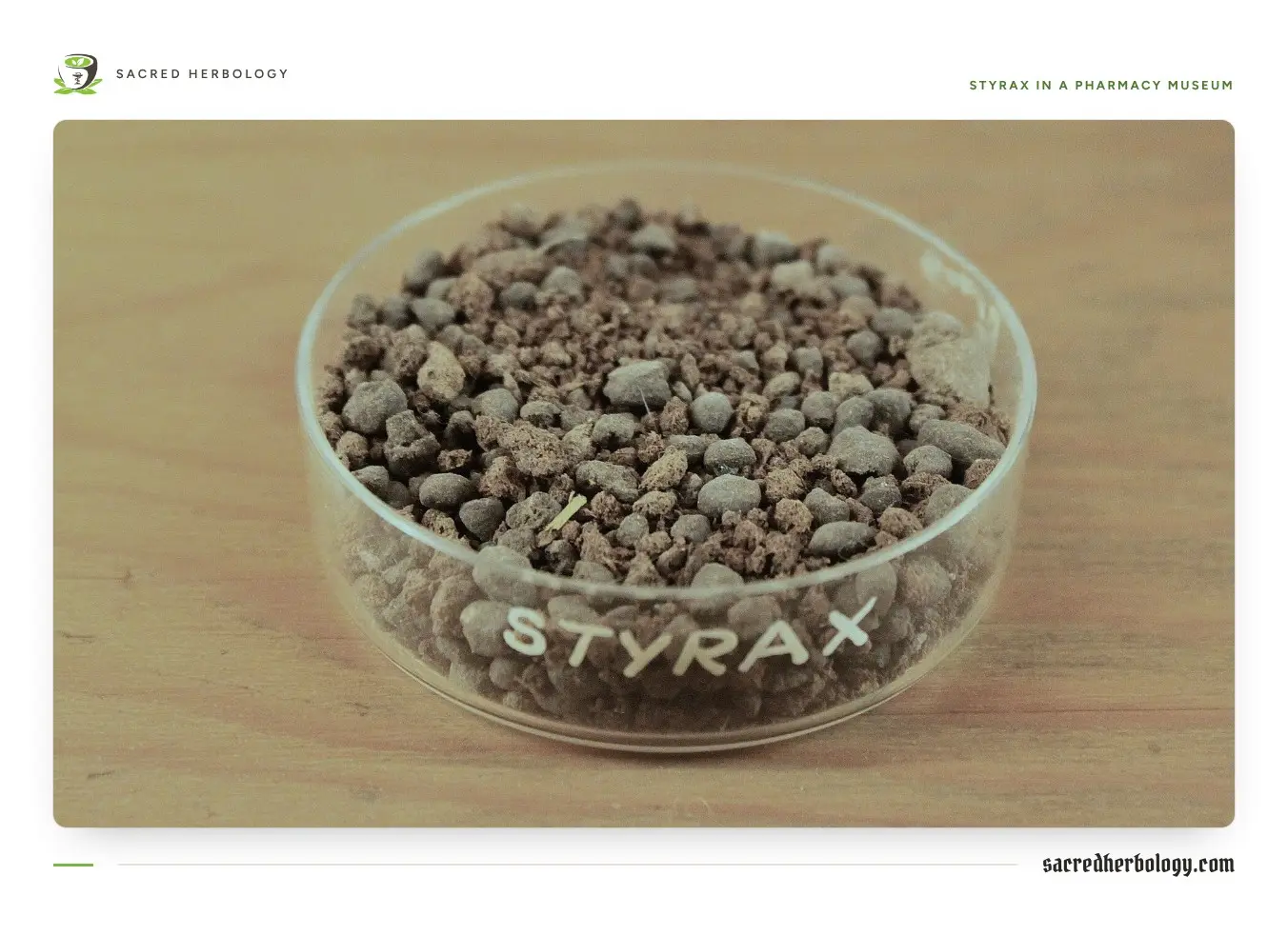
- Storax is a soft, sticky balsam that does not set hard. It is easiest to burn on a small mica plate laid on the charcoal, or soaked into a carrier such as powdered wood or another resin. It smells strong and dark, and a little goes a long way. Many people prefer it as a minor note in a blend.
- Use a proper charcoal disc in a heat-proof bowl half filled with sand or ash. Wait until the disc has glowed grey all over before you add resin. Lit charcoal and melted resin both burn skin, so handle them with tongs and keep the bowl off anything that can scorch. An electric resin burner gives a cleaner, gentler scent and no charcoal fumes.
- Open a window. Resin smoke is still smoke, full of fine particles, and it can bring on an asthma attack. If you have asthma or another chest or lung condition, it is wiser not to burn resin at all. Keep smoke away from babies, small children, anyone who is pregnant, and pet birds, whose lungs are easily hurt.
- A charcoal disc gives off carbon monoxide as it burns, which you can’t see or smell. Never burn it in a closed room, a tent or a car. Carbon monoxide is especially harmful in pregnancy. If anyone gets a headache, feels dizzy or sick while charcoal is burning, put it out and get everyone into fresh air.
- Both resins can cause skin allergy in some people, and storax in particular is a known skin sensitiser. The international fragrance industry’s own standards body no longer allows crude storax in perfumes at all, only refined extracts. People who already react to balsam of Peru or to cinnamon are more likely to react to these resins too. Handle the soft balsam with a spatula or gloves, wash your hands after, and stop if your skin reacts.
- Keep resins out of reach of children and pets. If a child or anyone else swallows resin or a charcoal disc, call the Poisons Information Centre on 13 11 26. If anyone is drowsy, struggling to breathe or collapses, call 000. If a pet eats either, ring your vet.
If you want to know how either resin might affect you in particular, consult a degree-qualified herbalist with competencies and adequate training in pharmacognosy.
Buying with a conscience
The trees behind these two resins have very different stories, and it changes how to buy them.
Benzoin, from Sumatra or Laos, is a smallholder crop. When you buy it you are buying the labour of farming families who tap trees in gardens and fallows. The risk to benzoin is mostly that the price drops so low that families stop growing it, as the FAO and CIFOR researchers both found. So look for a supplier who can tell you which kind it is (Sumatra or Siam), where it came from, and preferably who tapped it. Clean, sorted tears are a sign of care. Dark, dusty siftings at a very low price may be fine for blending, but they are the bottom of the grading.
Adulteration is as old as the trade, and Pliny was already complaining about it. With benzoin the usual tricks are lower grades passed off as higher ones, Sumatra sold as Siam, and lumps padded out with bark, wood and dust. The old pharmacopoeias told the two kinds apart with a chemical test. Warmed with potassium permanganate, Sumatra benzoin gave off a smell of bitter almonds, from benzaldehyde formed out of its cinnamic acid, and Siam benzoin did not. That test belongs in a laboratory, but it is a reminder that the two are different materials and that a seller ought to know which one they have. What is sold as “benzoin oil” or “benzoin absolute” is usually a resinoid, the resin dissolved in a solvent so that it pours, and a good label names the solvent.
Storax is harder. The Turkish tree is endangered, and its last forests are small and pressed by development. I would not buy Turkish storax unless the seller can show it comes from a protected, managed harvest that keeps the trees alive. For most purposes, American storax from Central America is the better choice, and the smell is close. Crude storax usually carries water and fragments of bark; the purified grade has been dissolved, strained and dried down, and it is cleaner and more even in scent. Be wary, too, of anything labelled “storax” or “styrax” that is really a synthetic perfume oil. It is an honest product if it is sold as one.

Whoever you buy from, look for benzoin from smallholder growers and American storax, both with their country and species on the label, because the story of these resins is mostly a story of names coming loose from the things they name, and a label is the least a seller can get right.
That is where the two sweet resins have brought us: from a Phoenician cargo and an Orphic hymn to a Sumatran garden and a Lao fallow, from the white crystals in Nostradamus’s pan to a foam cup, from Zeus’s altar to Crowley’s cowshed. Light a small piece of benzoin and you are smelling a resin with one of the longest, oddest journeys of any in the incense trade, and the farmers who grew it are still out there tapping.
Where this comes from
- Herodotus, The Histories, Book 3, in Herodotus, vol. II, trans. A. D. Godley (Loeb Classical Library, 1921).
- Pliny the Elder, Natural History, Book 12, in vol. IV, trans. H. Rackham (Loeb Classical Library, 1945).
- Pedanius Dioscorides of Anazarbus, De materia medica, trans. Lily Y. Beck (Olms-Weidmann, 2005).
- The Hymns of Orpheus, trans. Thomas Taylor (London, 1792).
- Apostolos N. Athanassakis and Benjamin M. Wolkow, trans., The Orphic Hymns (Johns Hopkins University Press, 2013).
- Ibn Battuta, The Travels of Ibn Battuta, A.D. 1325-1354, vol. IV, trans. H. A. R. Gibb and C. F. Beckingham (Hakluyt Society, 1994).
- H. C. Agrippa, De occulta philosophia libri tres (Cologne, 1533); Three Books of Occult Philosophy, trans. J. F. (London, 1651).
- Nicolás Monardes, Joyfull Newes out of the Newe Founde Worlde, trans. John Frampton (London, 1577).
- Francisco Hernández, Rerum medicarum Novae Hispaniae thesaurus (Rome, 1651).
- Bernal Díaz del Castillo, Historia verdadera de la conquista de la Nueva España (Madrid, 1632); The True History of the Conquest of New Spain, trans. A. P. Maudslay (Hakluyt Society, 1908-1916).
- Carl Linnaeus, Species Plantarum (Stockholm, 1753).
- Daniel Hanbury, “On storax”, Pharmaceutical Journal and Transactions 16 (1857).
- Friedrich A. Flückiger and Daniel Hanbury, Pharmacographia: A History of the Principal Drugs of Vegetable Origin (Macmillan, London, 1874; 2nd edn 1879).
- Eduard Simon, “Ueber den flüssigen Storax (Styrax liquidus)”, Annalen der Pharmacie (1839).
- Walter William Skeat, Malay Magic (Macmillan, London, 1900).
- Aleister Crowley, 777 (Walter Scott Publishing, London, 1909); 777 Revised (Neptune Press, London, 1955); reprinted in 777 and Other Qabalistic Writings (Weiser, 1973).
- John Uri Lloyd, History of the Vegetable Drugs of the Pharmacopeia of the United States (Lloyd Library Bulletin 18, Cincinnati, 1911).
- Joseph P. Remington, Horatio C. Wood and others, eds, The Dispensatory of the United States of America (20th edn, Lippincott, 1918), entry “Styrax”.
- Berthold Laufer, Sino-Iranica (Field Museum of Natural History, Chicago, 1919).
- Edward H. Schafer, The Golden Peaches of Samarkand: A Study of T’ang Exotics (University of California Press, 1963).
- Michael Zohary, Plants of the Bible (Cambridge University Press, 1982).
- J. J. W. Coppen, Flavours and Fragrances of Plant Origin, Non-Wood Forest Products 1 (FAO, Rome, 1995).
- E. Katz, M. Goloubinoff, M. Ruiz Pérez and G. Michon, “Experiences in benzoin resin production in Sumatra, Indonesia”, in J. O. Mugah and others, eds, Conservation, Management and Utilization of Plant Gums, Resins and Essential Oils (proceedings of a regional conference, Nairobi, 1997; published 1998).
- FAO Regional Office for Asia and the Pacific, Monograph on Benzoin (Balsamic Resin from Styrax Species) (Bangkok, 2001).
- International Fragrance Association, IFRA Standard on styrax, 49th Amendment (2020).