
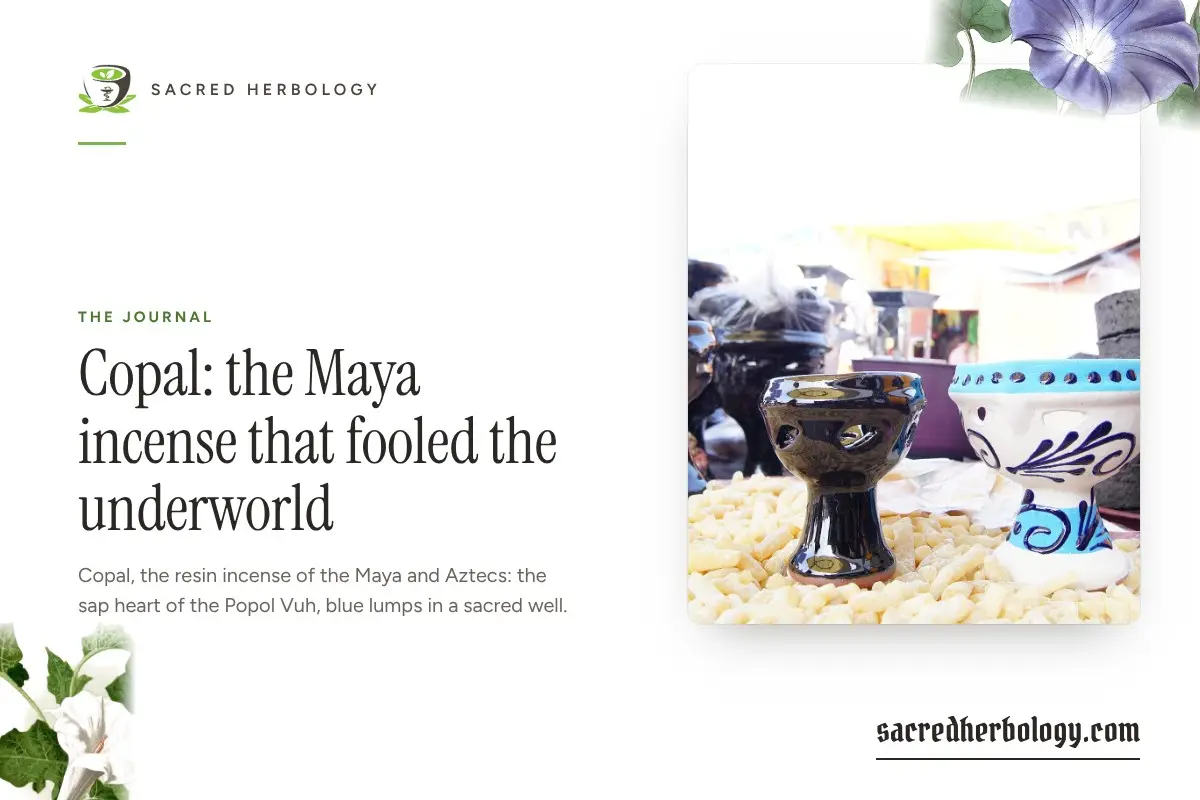
Put a piece of good white copal on a coal and the first thing you notice is how bright it is. The smoke comes up thick and pale, and the smell is sharp, piney and clean, with a lemon edge and something sweeter underneath. It fills a room fast. In a church doorway in the Guatemalan highlands, on a Day of the Dead altar in Oaxaca, or in a clay bowl with a face on its rim in the rainforest of Chiapas, that smell has meant the same thing for a very long time: the gods are being fed.
Copal is the incense of Mesoamerica, the old cultural world that ran from central Mexico down through Guatemala and Belize into Honduras and El Salvador. The Maya, the Mexica (the people usually called the Aztecs), the Zapotec, the Mixtec and their neighbours all burned it. For them it did the work that frankincense did for Egypt and Jerusalem, and the two resins even come from the same family of trees. This piece stays mostly with the Maya, because they left us the best story about it, though the Mexica get their turn, and so do the friars, the varnish makers and the modern shop shelf.
It is a long story, and a tangled one, so here is the map. First the word, and the trees it has been stuck to. Then the old Maya world, before anyone wrote with Spanish letters. Then the Popol Vuh, the book that turns a lump of resin into a heart and tricks the lords of death with it. Then the well at Chichen Itza and the great temple of Tenochtitlan, where the resin itself was dug up by the basketful. Then what the Spanish made of it, what the twentieth-century ethnographers found still burning, and what the incense trade has done with it since. We finish at the shop counter, with some plain advice on burning it safely and buying it honestly.
A word from Nahuatl
“Copal” is a Nahuatl word. The Mexica said copalli, the Spanish heard it in the 1520s and cut it down to copal, and English took it from Spanish. In the Maya languages the resin has its own name, pom, and you will still hear it in K’iche’, Yucatec and Lacandon today.
So the word that the whole world now uses for Maya incense is an Aztec word. The Maya never needed it. That small fact is worth holding on to, because a good deal of what is sold today as “Mayan copal” leans on the idea of an unbroken Maya brand name. The name came through Mexico City and Seville, carried by Spanish officials, merchants and friars who learned Nahuatl first because it was the language of the empire they had just overthrown, and who then used it as a trade language across much of New Spain.
The word reached Europe in the second half of the sixteenth century along with the resin itself. Physicians and apothecaries in Seville, the port that handled the American trade, wrote about the new resins arriving from the Indies, and English readers met “copal” in translations of that Spanish writing before the century was out. From there it went into the language of merchants, and merchants are not botanists.
The trouble is that “copal” did not stay put. Spanish and later English traders used it for almost any hard, clear, burnable resin, and by the nineteenth century the varnish trade was selling “Zanzibar copal”, “Congo copal” and “Manila copal” from trees on the other side of the world that no Maya ever saw. New Zealand’s kauri gum, the resin of the conifer Agathis australis dug out of the ground by the gumdiggers of Northland, was sold as a copal too. Its cousins, the Queensland kauris, grow in the rainforests of our own north. So when you meet the word, the first question is always: which copal?
The varnish copals deserve a moment, because they explain why the word is so slippery. Before synthetic resins arrived in the twentieth century, a hard, glossy, weather-proof varnish for carriages, furniture, ships and floors was made by melting hard tree resins and running them into hot oil. The harder the resin, the better the varnish, and the hardest resins of all were old ones: lumps that had dropped from trees long ago and lain in the soil until they set almost to stone. The best East African copal was dug out of the ground along the coast opposite Zanzibar, and the best kauri gum was dug out of old swamps and gum lands in Northland, often far from any living kauri. The gumfields drew thousands of diggers, many of them men from Dalmatia on the Adriatic coast, whose descendants are still part of Northland life. None of this has anything to do with Maya ritual, and all of it went under the same word.
Geologists and fossil collectors use “copal” in a third way again. For them it means a young resin, partly hardened, older than fresh sap and younger than true amber. Copal in that sense is dug in Colombia, Madagascar and East Africa, and it often holds insects, which is why so much of it is passed off as amber with an insect inside. If you have ever been offered a cheap piece of “amber” with a perfect mosquito in it, there is a fair chance it was copal in this geologist’s sense, and no Maya ever burned it.
The trees behind the name
The Mesoamerican copals come mainly from two genera in the Burseraceae, the frankincense and myrrh family.
- Protium copal is a rainforest tree of southern Mexico, Guatemala and Belize, and the classic copal of the Maya lowlands. Its resin is often sold dark and is called copal negro in Mexican markets.
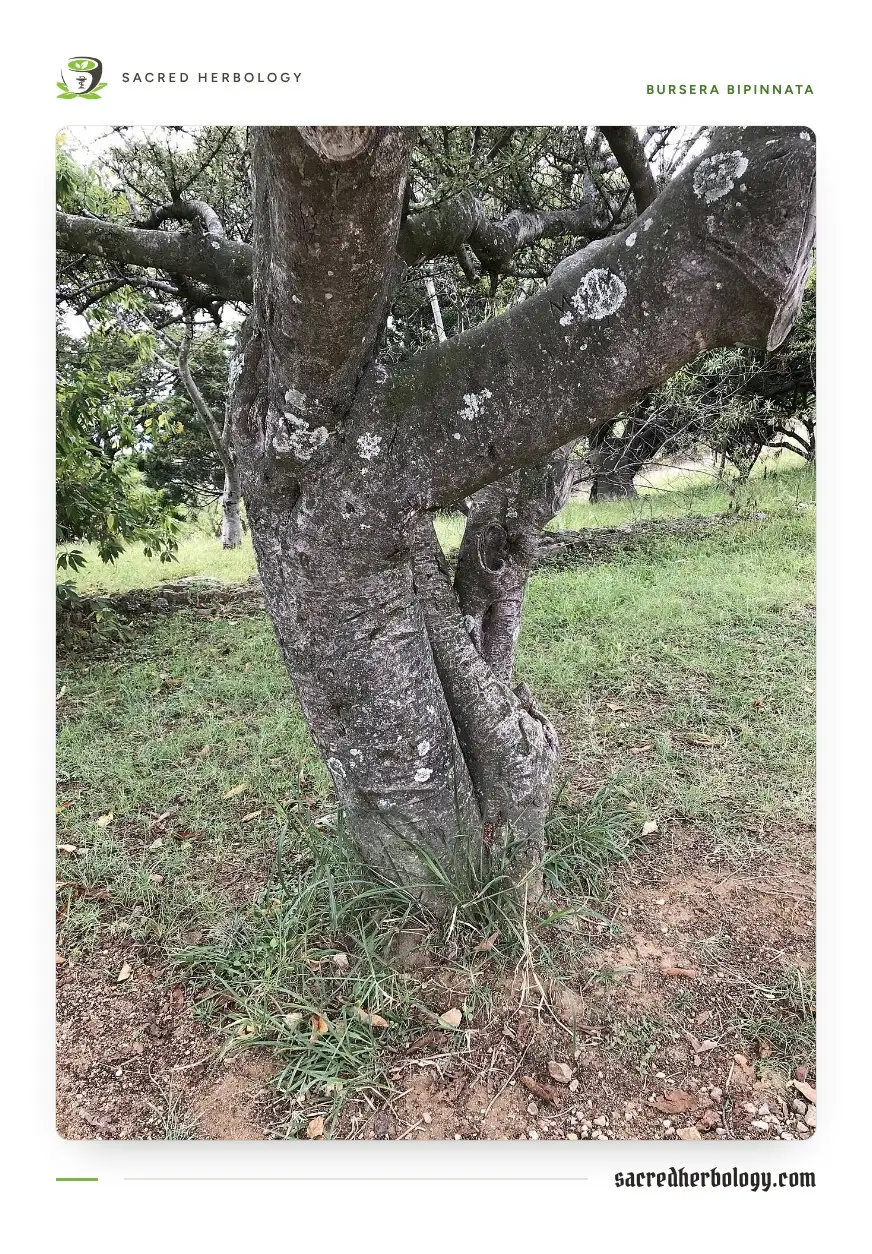
- Bursera is a big genus of small, often papery-barked trees of the dry forests of Mexico, with around a hundred species. Bursera bipinnata, called copal santo or copal chino, and Bursera copallifera are the ones most often named as sources of the pale incense sold as copal blanco. Another member of the genus, Bursera graveolens, gives palo santo, which has its own piece in the Journal.
A third source turns up in markets and online shops under the name copal oro, “golden copal”, and some of it comes from an unrelated tree altogether, Hymenaea courbaril, a legume from Central and South America. Its genus is the one whose fossil resin became the amber of Chiapas and the Dominican Republic. Traders have never been careful with these names, and a label saying “copal” on its own tells you very little.
The Mexica were more careful than the traders who came after them. Nahuatl had a general word for the copal tree, copalquahuitl, “copal tree”, and the Nahua scholars who worked with the Spanish friars described more than one kind of resin by colour, hardness and the way it was gathered. The Spanish crown sent its own man to look. Francisco Hernández, physician to Philip II, spent most of the 1570s travelling through New Spain recording plants with the help of Indigenous painters and informants, and his notes list several different trees under the copal name. He knew they were different trees. The merchants who followed him mostly did not care.
Mexican dry forest has more Bursera than anywhere else on earth, and some of these trees have a second life that has nothing to do with incense. In Olinalá, a mountain town in Guerrero, craftspeople make lacquered boxes and chests from the wood of a Bursera called linaloe, and the scent of the wood is the selling point: open an Olinalá box and it smells of lavender and citrus. In the late nineteenth and early twentieth centuries the oil distilled from that wood was shipped to Europe for perfumery, and the tree was taken to India and grown there for the same trade. It is the same genus as copal blanco, in a different market entirely, and it is a good reminder that one genus can be incense in one valley and perfume in the next.
Harvesting differs as much as the trees. In the Mexican highlands, copaleros cut shallow slanting grooves in the bark of the Bursera trees in the rainy season and catch the white sap on a leaf or in a small container, where it sets into soft pale cakes. Some dark copals are scraped or knocked off the bark in rough pieces, bark and all. The result is a spread from clear, soft, almost milky resin to dark, hard, gritty lumps, and each region has its favourites.

The way copal is shaped for sale tells you something too. In Mexican markets you will find it as rough tears, as broken chunks, as pale cakes pressed in the shape of the container that caught them, and in some regions wrapped in dried leaves into neat bundles. The shapes are local and old. Archaeologists find copal in the ground as balls, bars, cones and moulded figures, so the habit of shaping the resin before it reaches the fire goes back a long way.
Before the books
Nobody knows when people in Mesoamerica first put resin on a fire, and I won’t pretend to. What the ground does show is that incense burners are among the most common ritual objects of the Maya world, from very early villages to the great cities, and that the burners themselves were made with enormous care.
The most famous are the tall cylinder stands of Palenque in Chiapas, from the Classic period, roughly the third to the ninth centuries. They are hollow clay columns, often more than a metre high, built up with modelled faces of gods, layer on layer, with flanges sticking out at the sides like ears or wings. A bowl sat on top, and in that bowl burned the offering. When a stand was worn out it was buried with some ceremony around the temples, and archaeologists have dug up dozens of them there. Copan in Honduras and other cities have their own styles of burner. The point for us is that you do not build an object like that for a fire you light casually.
Classic Maya carved monuments show rulers in full regalia letting something fall from their open hands in a stream of little dots. Scholars have read the scene as a scattering rite, and argued for decades about what is being scattered. Drops of blood, grains of incense and seeds have all been proposed, and some see more than one of these in different scenes. It is tempting to call it copal and be done with it. Since the experts have not settled it, I’ll leave it open, and so should anyone selling you a story about it.
Caves were the other great stage. The Maya treated caves as openings into the underworld and as homes of rain and earth powers, and archaeologists find copal, charcoal and burners in them all over the region. One of the best-known is Balankanche, a cave a few kilometres from Chichen Itza. When its sealed inner chambers were opened in 1959, they held clusters of incense burners still standing where they had been left centuries before, many bearing the face of the rain god. Before the finds were disturbed, a local Yucatec Maya ritual specialist, Romualdo Hoil, led a long ceremony of appeasement in the cave, and the American archaeologist E. Wyllys Andrews IV, who studied the site and took part, published an account of it. Copal smoke in a sealed cave, centuries apart, from the same tradition: it is hard to find a cleaner picture of continuity than that.
A heart made of sap
The finest copal story in any language sits in the Popol Vuh, the K’iche’ Maya book of creation. It was written down in the Latin alphabet in the Guatemalan highlands in the 1550s, and it survives because the Dominican friar Francisco Ximénez copied it around 1700. Several good English translations exist; I read it here in Dennis Tedlock’s, which he made with the help of a K’iche’ daykeeper, Andrés Xiloj.
The survival of the book is a story in itself. The K’iche’ authors who wrote it down did so a generation after the Spanish conquest of their kingdom, and they say in the text that they are writing because the original book, the one their lords once consulted, can no longer be seen. Their alphabetic version stayed in the community. Around 1701, while he was parish priest in Chichicastenango, Ximénez got hold of a copy, transcribed the K’iche’ and set a Spanish translation beside it in a parallel column. Whatever the K’iche’ original looked like, it is lost. Ximénez’s manuscript is the oldest copy we have.
His manuscript sat in Guatemala for more than a century. In the 1850s it caught the attention of European travellers, and two editions appeared within a few years of each other: an Austrian traveller, Carl Scherzer, published Ximénez’s Spanish in Vienna in 1857, and the French abbé Charles Étienne Brasseur de Bourbourg published the K’iche’ text with a French translation in Paris in 1861. The manuscript itself passed through the hands of collectors and ended up in the Newberry Library in Chicago, where it remains. So the oldest surviving copy of the Maya book of creation lives in a reading room by Lake Michigan, a long way from the smoke of Chichicastenango.
The book opens with the making of the world and the gods’ failed attempts at making people, then turns to two generations of heroes who go down to Xibalba, the underworld, to play the ball game against its lords. The first pair, the brothers One Hunahpu and Seven Hunahpu, are tricked and killed, and One Hunahpu’s head is hung in a tree beside the road. That is where our story starts.
A young woman of the underworld, Blood Woman (Xquic in the K’iche’), falls pregnant in a way her father cannot explain. He is one of the lords of Xibalba, the place of fear and death, and he orders the four owl messengers of Xibalba to take her away, cut out her heart and bring it back to the lords in a bowl. On the road she talks the owls out of it. Instead she goes to a tree, cuts it, and gathers its red sap in the bowl. The sap sets into a round, glistening lump that looks for all the world like a heart.
It is worth slowing down on how she got pregnant, because it sets the tone. She went to look at the tree where One Hunahpu’s head was hung, and the skull spat into her open palm. That was enough. Her father, a lord called Blood Gatherer in Tedlock’s English, asks her who the father is, and she tells him the truth, which is that she has known no man. He doesn’t believe her. Hence the owls, the bowl and the knife.
The owls themselves are a nice touch. Tedlock gives their names as Shooting Owl, One-legged Owl, Macaw Owl and Skull Owl, and they are not very good at their job. Blood Woman promises them that they will be honoured on the face of the earth if they spare her, and they take the deal. The tale makes them minor heroes, which is a strange fate for messengers of death.
The owls carry it down. One Death, the senior lord, lifts it with his fingers and sees it wet and red. “Stir up the fire, put it over the fire,” he says. In Tedlock’s words the lords then “savored the aroma”, leaning over the fire intently, and “they found the smoke of the blood to be truly sweet!” While they stand there breathing it in, the owls lead the maiden up through a hole in the earth. She reaches the house of her mother-in-law and gives birth to the Hero Twins, who will one day defeat Xibalba altogether.
Tedlock identifies the tree as the “cochineal croton”, a red-sapped Croton the Spanish called sangre de drago. Croton belongs to the spurge family, so the tree in the story is no relation of the copal trees. The K’iche’ word he translates as “blood” is quic, which is also the ordinary word for tree gums and resins. The story plays on that one word. A lump of blood and a lump of resin are the same thing in the language, and so, in the tale, a lump of resin can pass for a heart. It is also a founding story. When the Twins later defeat the lords, they tell them that from now on their offerings will be reduced to “nodules of sap”. Human hearts are off the menu. Burned resin is what the lords of death will get.
The Twins, Hunahpu and Xbalanque, win that victory the hard way. They go down to Xibalba as their father and uncle did, survive a run of deadly houses (the house of cold, the house of jaguars, the house of bats and more), and finally trick the lords into asking to be sacrificed themselves, on the promise that they will be brought back to life. The Twins kill them and do not bring them back. Only then do they hand down the judgement about sap and resin. It is a story about the end of an old order, and the incense is the new deal that replaces it.
Tedlock’s own commentary takes this as an origin story for incense offerings, and that seems the natural reading. It is a Maya explanation, in Maya terms, of why you burn resin to powers you want to keep sweet. It tells you how the K’iche’ authors understood their own practice. It does not tell you what the smoke does, and I won’t pretend it does.
Allen J. Christenson’s translation, made later and closer to the K’iche’ word order, is worth reading beside Tedlock’s. The two differ in wording and sometimes in how they understand a phrase, and the play on quic, blood and resin, comes through in both. If you want the story itself, either will do. If you want to see how much of a translation is the translator’s choice, read the same chapter in both on the same evening.
Burning for the sunrise
Copal comes back at the most important moment in the whole book. After long wandering in darkness, the first K’iche’ ancestors climb a mountain to wait for the very first dawn. When the morning star rises they unwrap the copal they have carried with them from the east, and the text names each kind:
- Mixtam Copal, carried by Jaguar Quitze,
- Cauiztan Copal, carried by Jaguar Night,
- Godly Copal, carried by Mahucutah.
They burn it toward the place where the sun will rise, “crying sweetly as they shook their burning copal, the precious copal”. Then the sun comes up for the first time and the animals come out of the rivers and canyons to greet it.
What strikes me here is how specific the copals are. These are named varieties, each belonging to a lineage founder. Andrés Xiloj told Tedlock that Mixtam might be a copal from around Ixtahuacan, a Mam-speaking area, that K’iche’ people still valued highly. Whether or not he was right, it shows a living ritualist reading his own tradition’s book and recognising the incense in it.
There is another detail in the scene that rewards attention. The ancestors have been waiting in darkness a long time, and they have carried the copal all the way from the place they came from. They do not burn it on the way. It is kept for one moment, the first sunrise, and spent then. Whatever else copal meant to the K’iche’ authors, it was something you saved for the occasion, carried with care and burned with intent. It belonged to a lineage, and the book names it the way you might name heirlooms.
Lumps in a sacred well
The archaeology backs up the texts. At Chichen Itza in Yucatán there is a great natural sinkhole, the Sacred Cenote, into which offerings were thrown for centuries. Between 1904 and 1911 the American consul Edward H. Thompson dredged it and pulled out gold discs, jade, carved bone, rubber balls, textiles, human bones and a great deal of copal. Some of the copal lay packed into pottery bowls with jade beads pressed into it. Much of it had been painted with Maya blue, the famous bright turquoise pigment, and so much of that paint washed off over the years that it left a layer of blue silt on the floor of the well.
Thompson went to the cenote with a book in his head. The Franciscan Diego de Landa, who became bishop of Yucatán, wrote an account of Maya life in the 1560s, now known as the Relación de las cosas de Yucatán, and in it he describes the well at Chichen Itza and says that the people threw men into it alive in times of drought, along with many precious things. Landa is a difficult witness. He is the same man who, in 1562 at Maní, burned Maya books and punished hundreds of Maya people in an inquisition of his own, and his account mixes careful observation with the views of a man stamping out a religion. On the well, though, the dredge proved him right that it was full of offerings.
Thompson had bought the hacienda that included the ruins, and he sent most of what he dredged to the Peabody Museum at Harvard, which had backed the work. Mexico’s view of this was what you would expect, and in later decades a large share of the cenote material was returned. Mexican teams went back to the well in the 1960s with better equipment and brought up more. The book by Clemency Chase Coggins and Orrin C. Shane listed at the foot of this piece is the catalogue of a travelling exhibition of the Peabody material, and it is the easiest place to see the copal finds with your own eyes.
The cenote has a popular legend attached that you will meet in almost any tourist account: that beautiful virgins were thrown in to marry the rain god. It is a modern romance. Studies of the human bones from the well show people of both sexes and many ages, and a large share of them were children. Landa said men. The virgins came later, out of the imagination of nineteenth- and twentieth-century writers, and they have stuck because they make a better postcard.
The blue on the copal has its own story. Maya blue is made by heating indigo with a particular clay, palygorskite, and it is astonishingly durable: it survives centuries of tropical damp on wall paintings where other pigments have gone. A team of researchers led by the anthropologists Dean Arnold and Gary Feinman looked closely at a bowl from the cenote that held copal and traces of the pigment, and in 2008 they proposed that Maya blue was sometimes made at the rite itself, with the indigo and clay heated over the burning copal in the offering bowl. If they are right, the incense was part of the recipe for the colour of the offering. It is a proposal, argued from a small number of objects, and it has been debated since. It is also a lovely idea.
Copal in Tenochtitlan
The Mexica did something similar in Tenochtitlan. The excavations at the Templo Mayor in Mexico City, from 1978 onwards, recovered well over a hundred buried offering caches, and copal is everywhere in them: lumps, balls, and small human figures modelled out of the resin itself. A god could be given incense, and a god could also be given a little person made of incense.
The Templo Mayor project began by accident. In February 1978 electricity workers digging in the centre of Mexico City struck a huge carved stone disc showing the dismembered moon goddess Coyolxauhqui. Within months the government had cleared buildings over the site of the great twin temple, and the excavation, led by the archaeologist Eduardo Matos Moctezuma, has been going in one form or another ever since. The offerings it found were packed into stone boxes and fills in careful layers, sea creatures at the bottom, then figures and objects above, and the copal sits in among them as a regular part of the arrangement. Leonardo López Luján’s book on the offerings, listed below, works through them one by one.
Chemists have since looked at that copal too. Analyses of resin from the Templo Mayor offerings have pointed toward Bursera, the genus of the pale highland copals, which fits what you would expect for an empire whose capital sat on a high plateau ringed by dry forest. It also fits the tribute records. The Codex Mendoza, a book painted for the Spanish about two decades after the conquest, sets out what each province of the Mexica empire sent to Tenochtitlan, and copal appears among the goods drawn as tribute from some of the provinces, alongside cotton, feathers, cacao and the rest. Incense was a state matter. The temples needed it in huge amounts and the empire organised its supply.
Friars recorded the living practice right after the conquest. Bernardino de Sahagún’s Florentine Codex, compiled in Nahuatl with Nahua scholars in the mid-sixteenth century, describes priests offering copal in long-handled clay incense ladles, raising the smoke before the images of the gods. The Franciscans burned incense of their own at Mass, and they understood exactly what they were looking at.
The ladle deserves its own paragraph. In Nahuatl it was a tlemaitl, a “fire hand”: a shallow clay pan with a long hollow handle, often ending in a serpent’s head, with a rattle of clay pellets inside the handle so it sounded as it was swung. Hot coals went in the pan, copal on the coals, and the priest raised it toward the image and to the four directions. Sahagún’s book on the ceremonies of the year describes copal offerings again and again, at temples and in households, and his Nahua collaborators painted the scenes in the margins. Copal was the background smell of Mexica religious life.
The conquistadors met it before they ever saw Tenochtitlan. Bernal Díaz del Castillo, who marched with Cortés and wrote his account of the conquest as an old man in Guatemala, describes more than one town where the people came out to meet the Spaniards and censed them with copal, the honour they gave to gods and great lords. Díaz took it as a welcome. It was a welcome of a particular kind, and the Spaniards did not yet know how much it might mean.
What the friars made of it
The Spanish church had an awkward problem with copal. Incense was already part of Catholic worship, and the Franciscans and Dominicans who came to New Spain were swinging censers of their own. So copal itself could hardly be condemned. What the friars wanted to stop was copal burned to the old gods: in caves, on hilltops, before images they called idols, and to the dead. The same lump of resin was devotion at the altar and idolatry in the cave.
The record shows the result. Colonial investigations into what the clergy called idolatry are full of copal: people found burning it at old shrines, in fields at planting time, at springs, in caves. At the same time, copal was being burned in the churches. Imported frankincense was dear and slow to arrive, and local resin was plentiful, and it seems that a good many colonial parishes used it at the altar. The smoke in the church and the smoke on the hill were the same smoke, and in time the people who burned it found ways to send it to both.
That joining is what you see today at Chichicastenango and on Day of the Dead altars. It is easy to call it a disguise, old gods hiding behind saints, and some writers do. The people who keep these practices often describe it in their own terms, as one devotion with several addresses, and the ethnographers who have lived with them mostly let them speak for themselves. That is the right instinct.
The smoke today
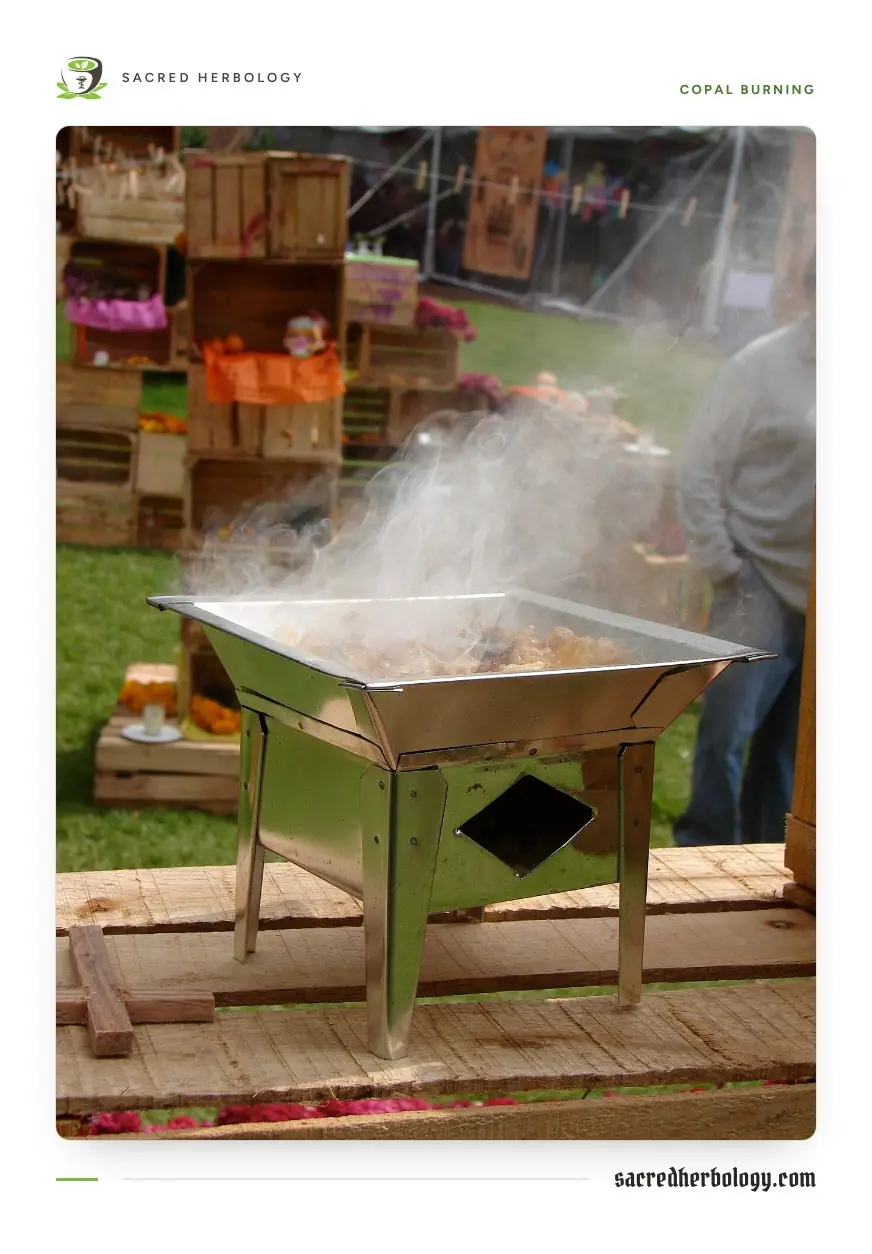
Copal never stopped burning. In the highland market town of Chichicastenango in Guatemala, K’iche’ ritualists still swing tins of smoking copal on the steps of the church of Santo Tomás, and burn it at hilltop shrines outside town. Across Mexico, copal smoke rises from the home altars built for the Day of the Dead at the start of November, beside the marigolds and the photographs of the family’s dead.

Santo Tomás is the same church where Ximénez served and where he found the Popol Vuh, which makes the smoke on its steps all the more striking. The American anthropologist Ruth Bunzel lived in Chichicastenango in the early 1930s and published a long study of the town in 1952, and copal runs all through it: in prayers at the church, at the house altars, and at the shrines on the hills. One of those hill shrines, Pascual Abaj, a carved stone on a pine-covered rise just outside town, is still a place where offerings of copal, candles and flowers are made, and visitors who keep a respectful distance are usually tolerated.
In nearby Momostenango, another K’iche’ town, the anthropologists Barbara Tedlock and Dennis Tedlock trained as apprentices with daykeepers, the ritual specialists who keep the 260-day calendar, and Barbara Tedlock’s book on the work, Time and the Highland Maya, describes copal offered at shrines on particular days of the calendar. That training is part of why Dennis Tedlock’s Popol Vuh reads the way it does. He sat with Andrés Xiloj and asked what the words meant to a man who still used them.
The Lacandon Maya of the Chiapas rainforest kept perhaps the fullest old practice into the twentieth century. Their god pots were clay bowls with a modelled face on one side, each one standing for a particular god, and the anthropologist Jon McGee, who lived with them in the 1980s, describes how offerings reached the gods through these pots. Pom was the most common offering of all, treated as the gods’ food. When the pots were renewed, the old ones were taken to caves and laid to rest, and the parts of each new pot were named with the words for a human body: chest, eyes, mouth.
McGee was not the first outsider to write it down. The Harvard anthropologist Alfred Tozzer spent time with the Lacandon in the early 1900s and published a comparison of their religion with that of the Yucatec Maya in 1907, and he was already describing god pots and incense offerings then. Between Tozzer and McGee lies most of a century of change, including logging, roads, missionaries and a great deal of outside attention. Many Lacandon families had given up the god pots by the time McGee arrived. Some had not, and his account of the ones who kept them is careful and respectful.
These are living traditions, and everything above comes from what K’iche’, Nahua and Lacandon people and those who worked with them have chosen to put into print.
A note on the modern shelf
You will see copal sold in Western shops with tidy lists of what each kind is “for”: white copal for purification, gold for prosperity, black for protection. Those lists are modern. They sound old, and they borrow Mexican market names, but I have not found them in the Popol Vuh, Sahagún or the ethnographies, and they seem to come from the incense and New Age trade of the last few decades. Treat them as someone’s modern system, and be wary of anyone who dresses them up as ancient Maya teaching.
A few other modern misreadings travel with the resin, and they are worth naming so you can spot them.
- “Copal is the Maya word for incense.” It is a Nahuatl word, as we saw. The Maya word is pom.
- “The Popol Vuh is an ancient Maya scripture.” It is a sixteenth-century K’iche’ book, written in the Latin alphabet after the conquest, drawing on older tradition and on an earlier book now lost. That makes it more interesting, and it also means it is a K’iche’ book from the highlands, with no claim to speak for every Maya people at every period.
- “Maya priests used copal to open portals.” This is a modern esoteric reading. Some current teachers in the New Age and neo-shamanic world build systems around copal as a doorway between worlds. That is their own system, a modern one, and it should be labelled as such. The published Maya sources talk about feeding, honouring and paying the gods and the dead, and about saving the best copal for the great occasion.
- “All copal is the same resin.” It isn’t, as the trees section showed, and the trade has made it worse.
- “Copal smoke cleanses the air.” Smoke is smoke. Any claim that burning resin is good for you is a claim about the body, and this Journal does not make those claims. What we can tell you is what people did and what they believed about it.
None of this is a reason to stop enjoying copal. It is a reason to enjoy it knowing what you are holding: a resin with a real history of its own, which needs no invented one.
Burning it and buying it
Fresh white copal is soft and still carries a good share of volatile oil, so it tends to melt and flare faster than frankincense. A small piece goes a long way.
- Burn it on a lit charcoal disc sitting in sand or ash in a heat-proof bowl, and keep it away from anything that can catch. The disc and the bowl stay hot long after the smoke stops, and melted resin sticks to skin and burns, so handle them with tongs and let them cool before you touch them.
- Open a window. Any resin smoke is fine particles, and it can bring on an asthma attack. If you have asthma or any chest or lung condition, or you are pregnant, keep well back or skip it, and keep the smoke away from babies, small children and pet birds.
- Charcoal gives off carbon monoxide, which you can’t see or smell. Never burn it in a closed room, a tent or a car. A headache, dizziness or nausea while it burns means get everyone into fresh air, and if anyone is drowsy, confused or short of breath, call 000.
- Copal is for the coal. Don’t eat it or give it to anyone to eat, and keep the lumps and the charcoal where children, dogs and cats can’t reach them. If someone swallows some, call the Poisons Information Centre on 13 11 26, or 000 if they are unwell.
You can’t name the tree from the look of a lump. Pale or dark, soft or hard, the grade says as much about how the resin was gathered and how old it is as about the species, and resins from different trees can look alike. Only laboratory analysis settles which tree a resin came from, and nobody runs that at a market stall. So ask the plain questions. Which tree? Which country and region? Was it tapped or scraped? A seller who answers “Bursera, from Guerrero, tapped by a cooperative” knows the supply. A seller who answers “Mayan copal” and nothing else probably does not. The wild Bursera stands of Mexico are under pressure from over-tapping and land clearing, and so are the palo santo trees of the same genus, so a named source matters.
The owls of Xibalba got away with it because the lords loved the smell too much to look closely. It is a good story to keep in mind at the counter.
Where this comes from
- Dennis Tedlock (trans.), Popol Vuh: The Mayan Book of the Dawn of Life, revised edition (Simon & Schuster, Touchstone, 1996; first edition 1985).
- Allen J. Christenson (trans.), Popol Vuh: The Sacred Book of the Maya (O Books, 2003; University of Oklahoma Press, 2007).
- Bernardino de Sahagún, Florentine Codex: General History of the Things of New Spain, trans. Arthur J. O. Anderson and Charles E. Dibble, 12 books in 13 vols (School of American Research and University of Utah, 1950-1982).
- Alfred M. Tozzer (ed. and trans.), Landa’s Relación de las cosas de Yucatán: A Translation, Papers of the Peabody Museum vol. 18 (Harvard University, 1941).
- Clemency Chase Coggins and Orrin C. Shane III (eds), Cenote of Sacrifice: Maya Treasures from the Sacred Well at Chichén Itzá (University of Texas Press, 1984).
- Leonardo López Luján, The Offerings of the Templo Mayor of Tenochtitlan, trans. Bernard R. and Thelma Ortiz de Montellano (University Press of Colorado, 1994).
- Ruth Bunzel, Chichicastenango: A Guatemalan Village (J. J. Augustin, for the American Ethnological Society, 1952).
- Barbara Tedlock, Time and the Highland Maya (University of New Mexico Press, 1982; revised edition 1992).
- Alfred M. Tozzer, A Comparative Study of the Mayas and the Lacandones (Macmillan, for the Archaeological Institute of America, 1907).
- R. Jon McGee, Life, Ritual, and Religion among the Lacandon Maya (Wadsworth, 1990).
- Case, Tucker, Maciarello and Wheeler, “Chemistry and ethnobotany of commercial incense copals, copal blanco, copal oro, and copal negro, of North America”, Economic Botany 57(2) (2003).