
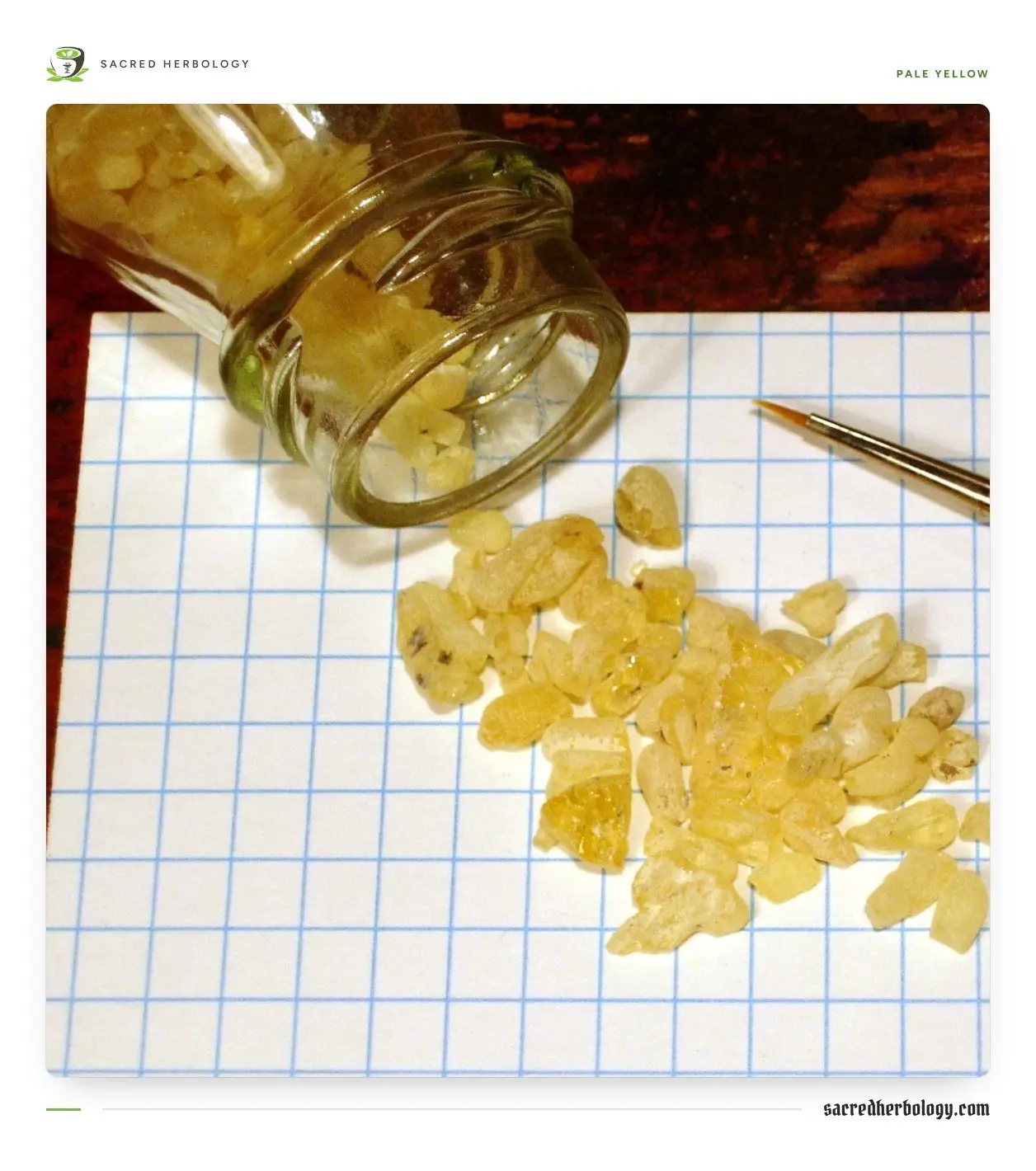
Tip a few grains of sandarac into your hand and they look like a much paler cousin of frankincense. The tears are long and thin, often shaped like little rods or teardrops pulled out at one end, the colour of pale straw or weak lemonade, and dusty on the outside where they have rubbed against each other in the sack. Hold one up to a window and it glows. Snap it and it breaks clean, like boiled sugar. Put it on a hot coal and it melts fast and gives off a sharp, dry, balsamic smoke, something like pine needles and cedar shavings, with a faint sweetness under it that some people compare to incense cedar and others to a carpenter’s workshop on a hot day.
It is one of the quieter resins. It never had the fame of frankincense or myrrh, and nobody carried it to a manger. Yet it has had a long and busy life. Roman senators paid fortunes for furniture made from the tree it comes from. Medieval monks cooked it into the varnish that sealed their painted panels. Scribes rubbed it into parchment so their ink would not run. Violin makers argued about it. Magicians put it in a fume for Jupiter. And on the other side of the world, the colonial botanists of nineteenth-century Australia looked at the resin weeping from their own native cypress pines and decided that here, lying on the ground for the taking, was a fortune that nobody had bothered to pick up.
So this piece is about two trees, or rather two branches of the same family. The first is Tetraclinis articulata, the sandarac tree of the Atlas Mountains and the coast of North Africa, which gives the true sandarac of commerce. The second is Callitris, the genus of Australian cypress pines, whose resin is so close in make-up that it was sold for a while as Australian sandarac. Both belong to the cypress family, the Cupressaceae. Both bleed pale tears from their bark. Both have timber that smells wonderful and resists rot and insects. And both have been shaped, over thousands of years, by fire and by the people who lit it.
As always, a word on beliefs before we start. Parts of this piece are about what people believed this resin did: that its smoke pleased a god, or drew down the influence of a planet. I’ll report those beliefs as fairly as I can and I won’t tell you they are true. Where material comes from the learned magical books, I’ll label it esoteric. Where it comes from household and village custom, I’ll call it folk custom. They are different kinds of thing, and blurring them does both a disservice.
A word that changed colour
The name came first, and it began as a mineral.
In classical Greek, sandarakē was a red mineral, and it had nothing to do with trees. Aristotle and Theophrastus used the word for realgar, the orange-red sulphide of arsenic that painters ground for pigment and that miners knew as a poison. The Romans borrowed it as sandaraca and kept the same meaning. When Pliny the Elder writes about sandaraca in the mineral books of his Natural History, he means that red arsenic ore, found in gold and silver mines, used as a paint and dangerous to the men who dug it.
To make things more tangled, Pliny also uses sandaraca in his book on insects for something else again: the bee bread, the pollen that bees pack into the comb as food. The Greek names for it were erithake and kerinthos. Why a word for red arsenic should also mean bee bread is not clear, and I’d be guessing if I gave you a reason. The likeliest answer is colour. Some bee bread is orange-red.
The resin meaning arrives later and comes through Arabic. Medieval Arabic writers called the pale resin of the North African conifer sandarūs, and when European apothecaries and craftsmen began buying it in quantity, the old Greek-Latin word was sitting there, close enough in sound, and it attached itself to the resin. By the early modern period, “sandarac” or “sandarach” in English meant the resin first, and the mineral was more often called realgar. The old meaning lingered in the painters’ books for a long time, which is why you sometimes find two quite different substances under the same name in an old inventory.
The Arabic word itself did not stay put either. In the trade of the Indian Ocean, sandarūs stretched to cover other hard, clear resins, including the copal of the East African coast. So a merchant’s “sandarus” in Zanzibar and a varnish maker’s “sandarac” in Venice might be two different trees on two different continents. Later still, European druggists sold the resin of common juniper as “German sandarac”, and the Australian cypress pine resin we’ll come to was sold as “Australian sandarac”. The name was always more a description of a type, pale and glassy and good for varnish, than a promise about the tree.
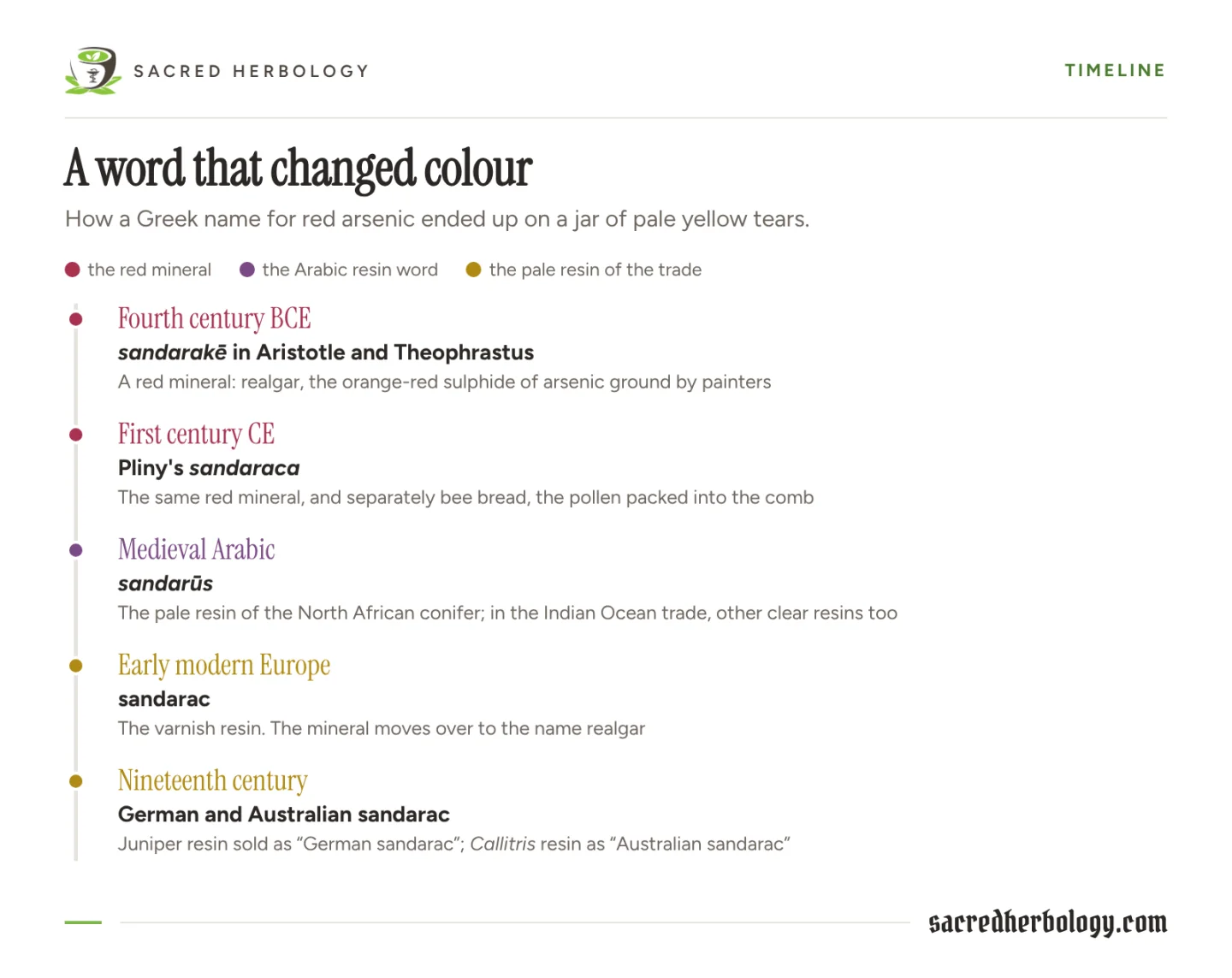
If you like a timeline drawn out, the word runs something like this:
- Fourth century BCE: sandarakē in Aristotle and Theophrastus, the red arsenic mineral.
- First century CE: Pliny’s sandaraca, the same mineral, and separately bee bread.
- Medieval Arabic: sandarūs, the pale conifer resin of North Africa, and in the Indian Ocean trade, other clear resins too.
- Early modern Europe: sandarac, the varnish resin, with the mineral moving over to the name realgar.
- Nineteenth century: “German sandarac” from juniper, “Australian sandarac” from Callitris.
The tree of the Atlas
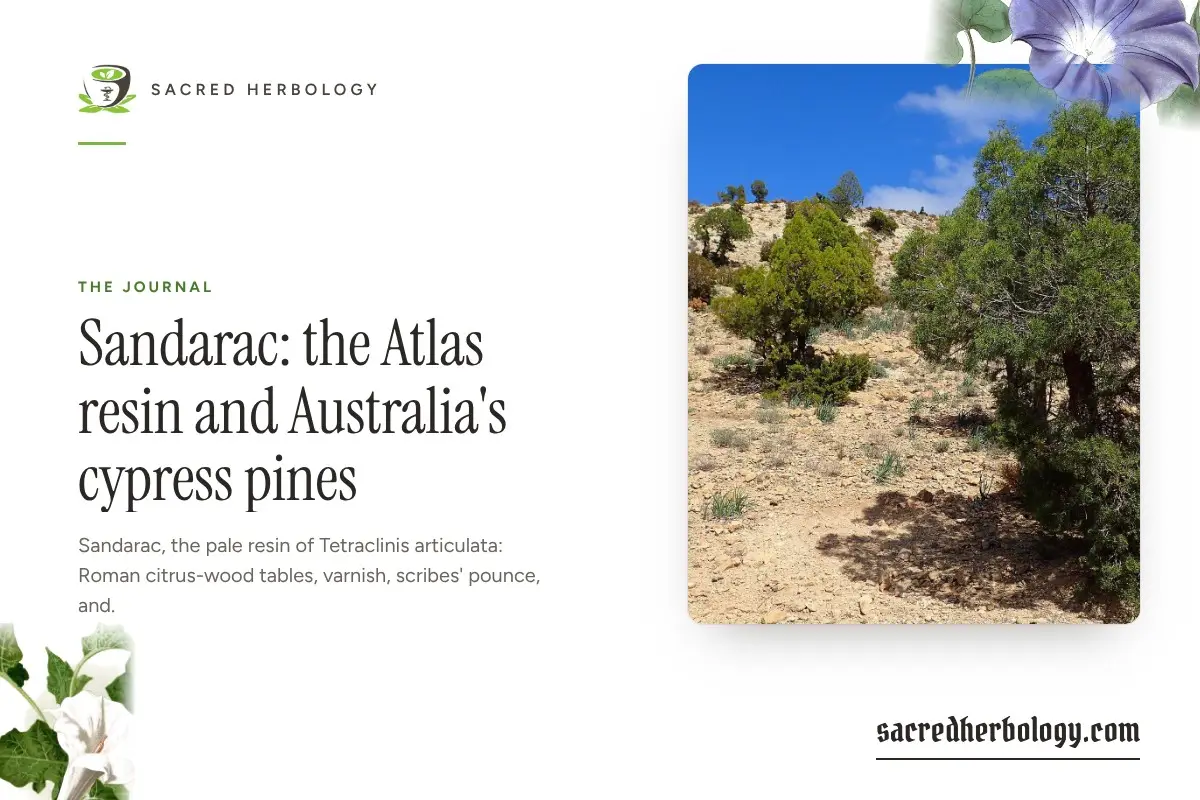
Tetraclinis articulata is a small, tough, slow-growing conifer. It usually reaches somewhere between six and fifteen metres, with a narrow cone of a crown when young that broadens and goes ragged with age. It is the only species in its genus, the last of a line that the fossil record shows was much more widespread across Europe millions of years ago, when the climate was warmer.
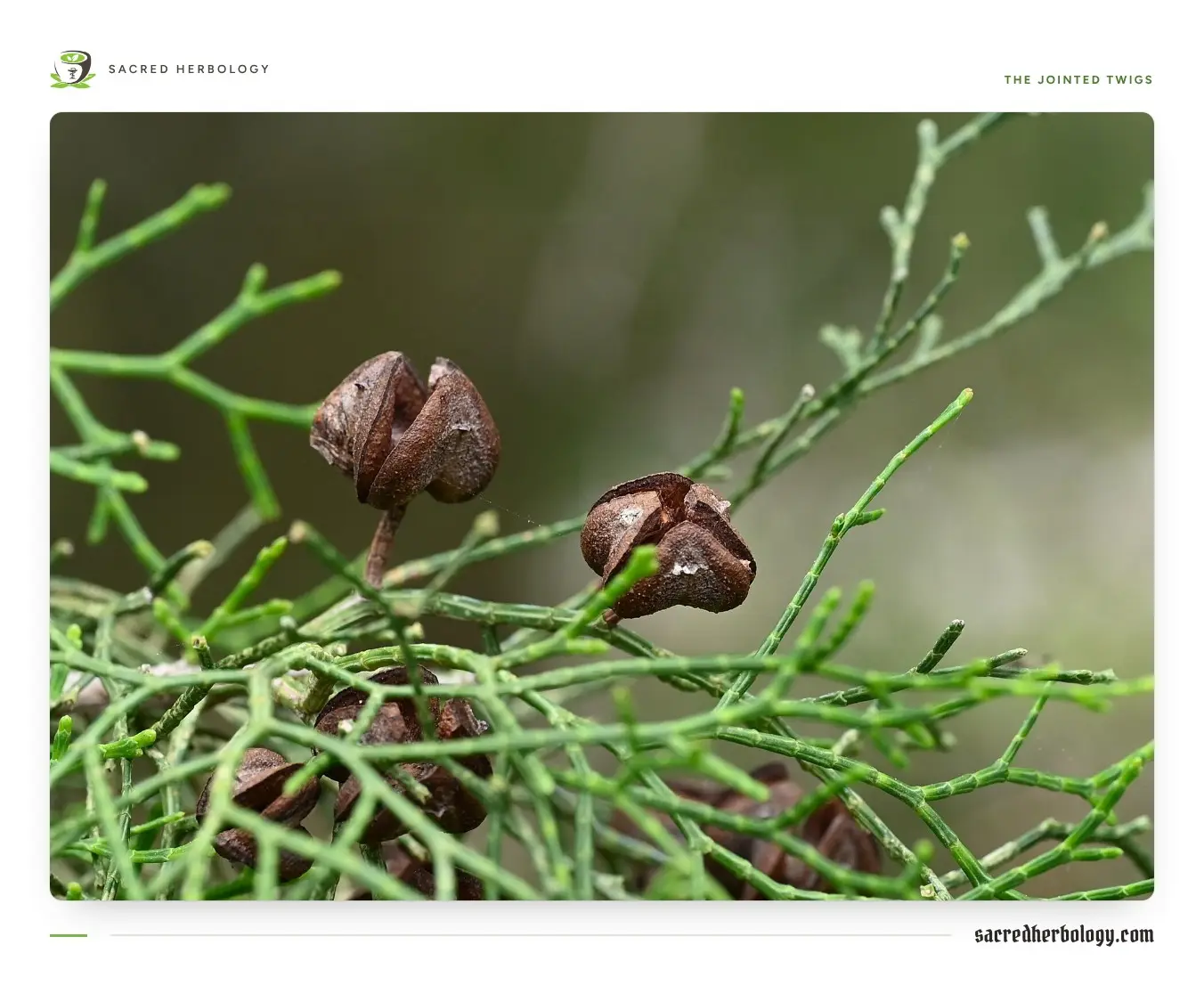
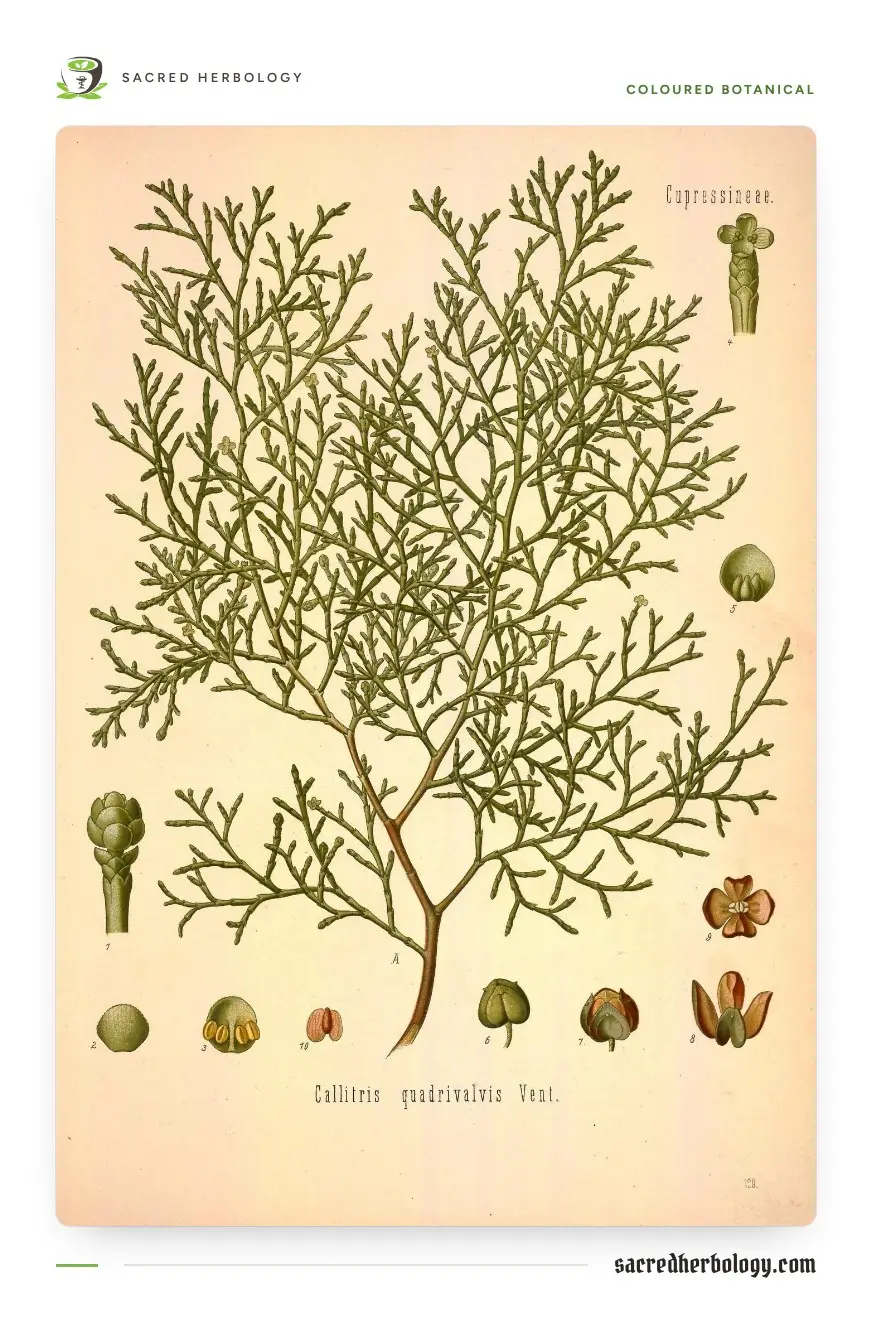
Look closely at a twig and you see why the botanists called it articulata, jointed. The foliage is made of flattened green segments, joined end to end like a string of tiny beads, with the leaves reduced to scales pressed flat against the stem. It looks a little like a cypress or an arbor-vitae, and for a long time it was classified as a kind of Thuja, which is why older books and many market traders still call it thuya or Barbary thuja. Its first scientific name was Thuja articulata, and the old pharmacopoeias often list sandarac under yet another one, Callitris quadrivalvis, so the sandarac tree once sat in the very genus of the Australian pines we’ll come to. The genus name Tetraclinis comes from Greek words for four and bed, after the small cone, which is made of four woody scales arranged in two pairs. It opens like a little four-petalled box to let the winged seeds out.

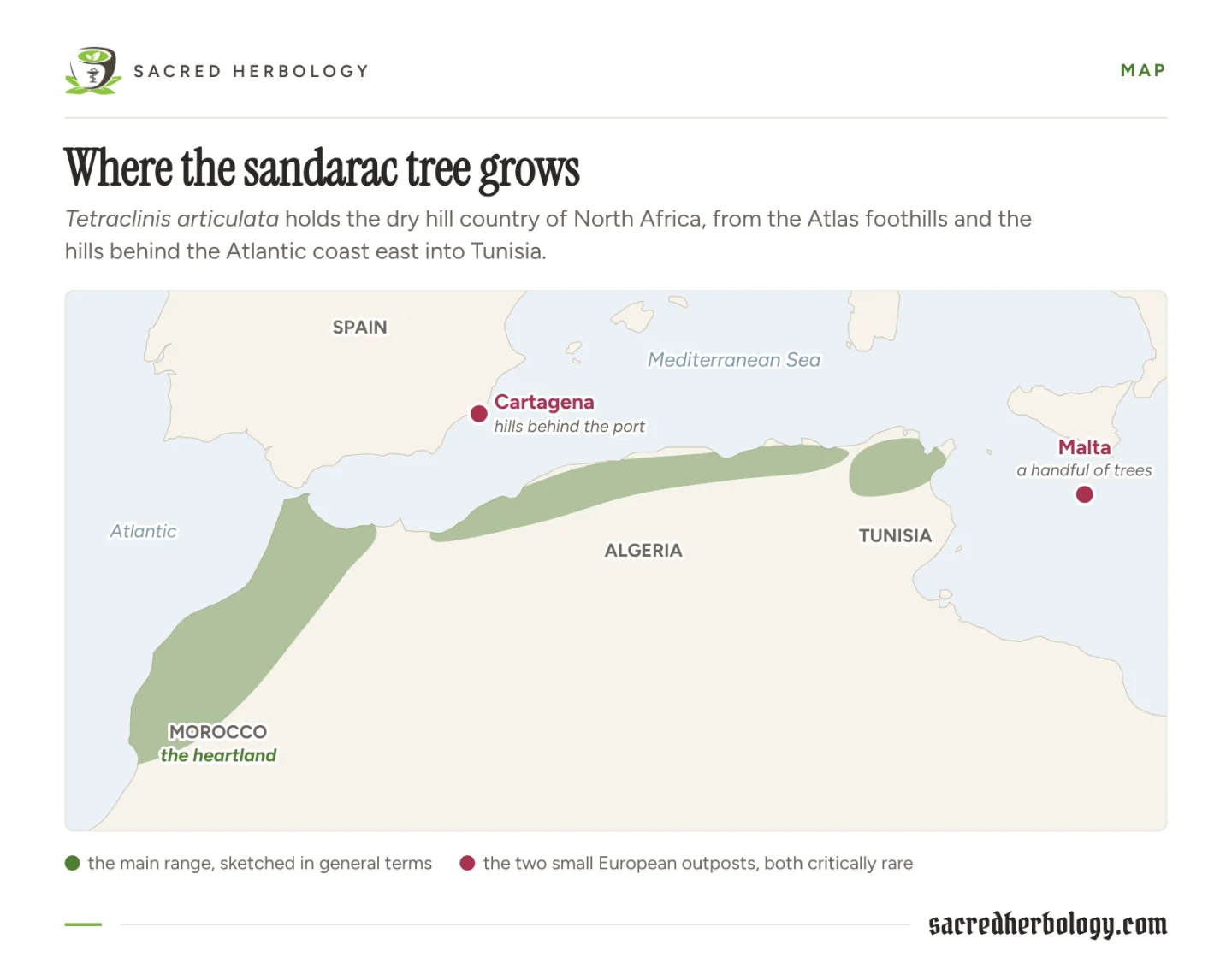
The tree’s home is the dry hill country of North Africa. Its heartland is Morocco, in the Atlas foothills and the hills behind the Atlantic coast, and it runs east across northern Algeria into Tunisia. Outside Africa it hangs on in two small outposts: a few stands in the hills near Cartagena in south-eastern Spain, and a handful of wild trees on Malta, where botanists still argue over whether they are native or were planted long ago, where it is called għargħar, a name taken from the Arabic ʿarʿar. Malta made it the national tree in 1992. In both of those European outposts it is now critically rare, worn down by fire, grazing and clearing.
It is a tree made for heat and drought. It grows on thin, stony, often limestone soils, takes long, hot, dry summers in its stride, and gets most of its water in a short winter rainy season. Like many plants of fire-prone dry country, it has a trick for survival: unusually for a conifer, it can resprout from the base after it is cut or burned. Over centuries of cutting, many old trees have become low, many-stemmed coppices sitting on a great woody swelling at ground level. That swelling, the burl, will matter when we get to the Romans.
The resin comes from the bark. Where the bark is wounded, by insects, weather or a knife, the tree bleeds a clear resin that hardens in the air into those pale tears. Traditionally, gatherers in Morocco cut or scraped the bark and came back later to pick the hardened drops off the trunk and the ground beneath. Sandarac has been a cottage harvest for most of its history, gathered by rural families as one of several things the hill forests give, along with firewood, grazing and timber.

Homer’s fragrant fire and the thyine wood
The oldest story that may involve this tree is in the Odyssey, and I have to say “may” at the start, because the identification is old and uncertain.
In book five, the messenger god Hermes flies down to the island of Calypso to tell her to let Odysseus go. Before he speaks to her, Homer gives us the scene at her cave. A great fire is burning on the hearth, and far across the island spreads the smell of split cedar and thyon burning. Inside, Calypso is singing at her loom with a golden shuttle. It is one of the loveliest openings in the poem, and the smell is part of the welcome.

What was thyon? The word is related to the Greek verb for burning sacrifice, and it seems to have meant a sweet-smelling wood that was good to burn. Theophrastus, writing his Enquiry into Plants in the late fourth century BCE, describes a tree he calls thyon or thya that grows near the temple of Ammon in the Libyan desert and in the lower country of Cyrene, on the coast of what is now eastern Libya. He says its wood never rots, that the roofs of ancient temples were made of it, and that its root wood is used for the finest work. That description fits Tetraclinis well. Pliny, three centuries later, thought so too: he identified the Roman citrus wood with the thyon of the Greeks and with the wood whose smoke Homer has burning on Calypso’s hearth.
Whether Homer, centuries before Theophrastus, meant the same tree, nobody can now say. Poets do not issue botanical keys. But the connection was made in antiquity and it has stuck.
The same tree turns up in the Christian Bible, in one of its strangest chapters. In the Book of Revelation, chapter 18, a voice laments the fall of Babylon the great, and lists the luxury goods the merchants of the earth can no longer sell her: gold, silver, precious stones and pearls, fine linen and purple, silk and scarlet, and “all thyine wood”, in the King James wording, alongside ivory, brass, iron and marble, cinnamon, incense, ointments and frankincense. The Greek is xylon thyinon, wood of the thyon tree. To a reader in the first century, thyine wood was a byword for extravagant furniture, and that brings us to the Romans and their tables.
The madness of the tables
The Romans called the tree citrus, which is confusing, because they also used a similar word for the citron fruit. Pliny is careful to tell his readers that the two have nothing to do with each other. The citrus of the furniture trade was the North African conifer, and it came from Mauretania, the Roman name for the country around the Atlas, roughly northern Morocco and western Algeria.
What the Romans prized was the burl, that great woody swelling at the base of old, coppiced trees. Cut across, a burl shows a wild, swirling grain, full of tiny eyes and ripples, and polished it glows a warm gold-brown. Roman cabinet makers sliced burls into broad, round slabs and made them into table tops, set on a single pedestal of ivory or bronze.
These tables became one of the great luxury crazes of the late Republic and early Empire. Pliny gives the subject a long passage in book thirteen of his Natural History and calls it, with some relish, the madness of the tables. He tells us that Cicero, who was far from the richest man in Rome, had a citrus-wood table that cost him half a million sesterces, and that one belonging to Asinius Gallus cost about twice as much. Tables that had belonged to King Juba of Mauretania fetched even more at auction. Pliny lists the qualities buyers looked for, rather like a modern guide to grading opals: the patterns called tiger and panther for wavy and spotted grain, the ones like the eyes in a peacock’s tail, a colour like honeyed wine, and a sheen that would not take a stain. He complains that the craze had stripped the forests near the coast, and that the good trees were now only found far inland.
He also passes on a famous retort. When Roman men reproached their wives for spending fortunes on pearls, the women would answer by turning their husbands’ tables upside down, as if to say: and what about yours? I can’t vouch that any Roman wife ever did it, but it was a good enough joke for Pliny to write down.
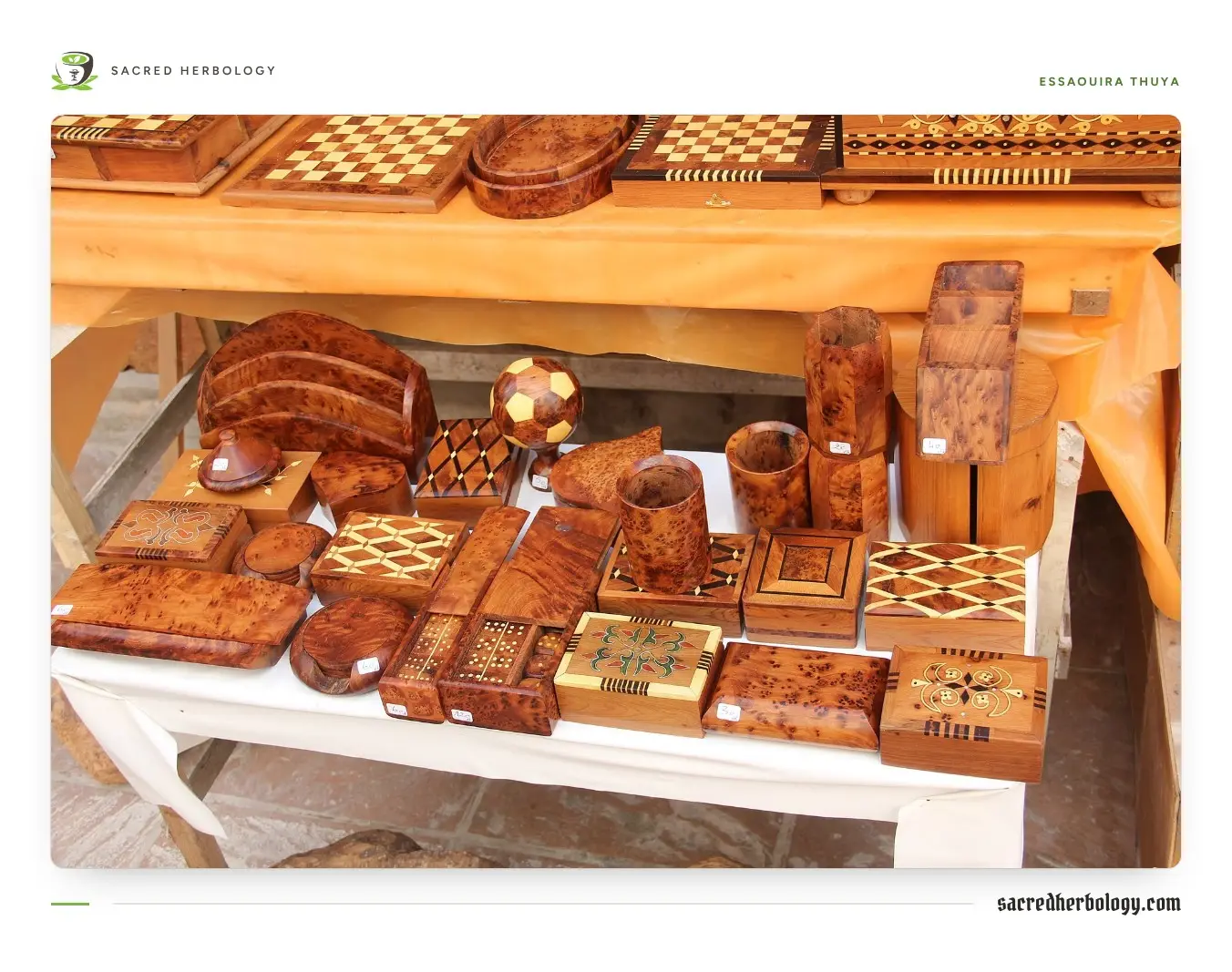
A round slab of burl on an ivory foot is a lovely thing to draw, and if you want to see the descendant of that craft today, you can. The town of Essaouira on the Atlantic coast of Morocco has a long tradition of thuya woodwork: boxes, bowls, chess boards and inlaid tables made from the same burls, often set with lemonwood, ebony and mother-of-pearl. Walk past those workshops and you smell the wood before you see it, the same dry, sweet, cedary scent that comes off the resin on a coal. The trade has put real pressure on the trees, and the Moroccan forest service has spent decades trying to balance it against the survival of the forests.

Sandarac in the learned magic
This section is esoteric. It concerns the learned magic of the medieval Arabic and Latin worlds, and it describes what those books held, not what is so.
The great handbook of astral magic known in Latin as the Picatrix, and in Arabic as the Ghāyat al-ḥakīm, “The Goal of the Wise”, was compiled in Arabic, probably in al-Andalus in the middle of the eleventh century, and translated into Spanish and then Latin at the court of Alfonso X of Castile around the 1250s. Its third book teaches how to pray to each of the seven planets, what to wear, what to sacrifice and what to burn, so that the spirit of the planet will hear and answer. Each planet has its own suffumigation, a compound fume designed to please it by sympathy.
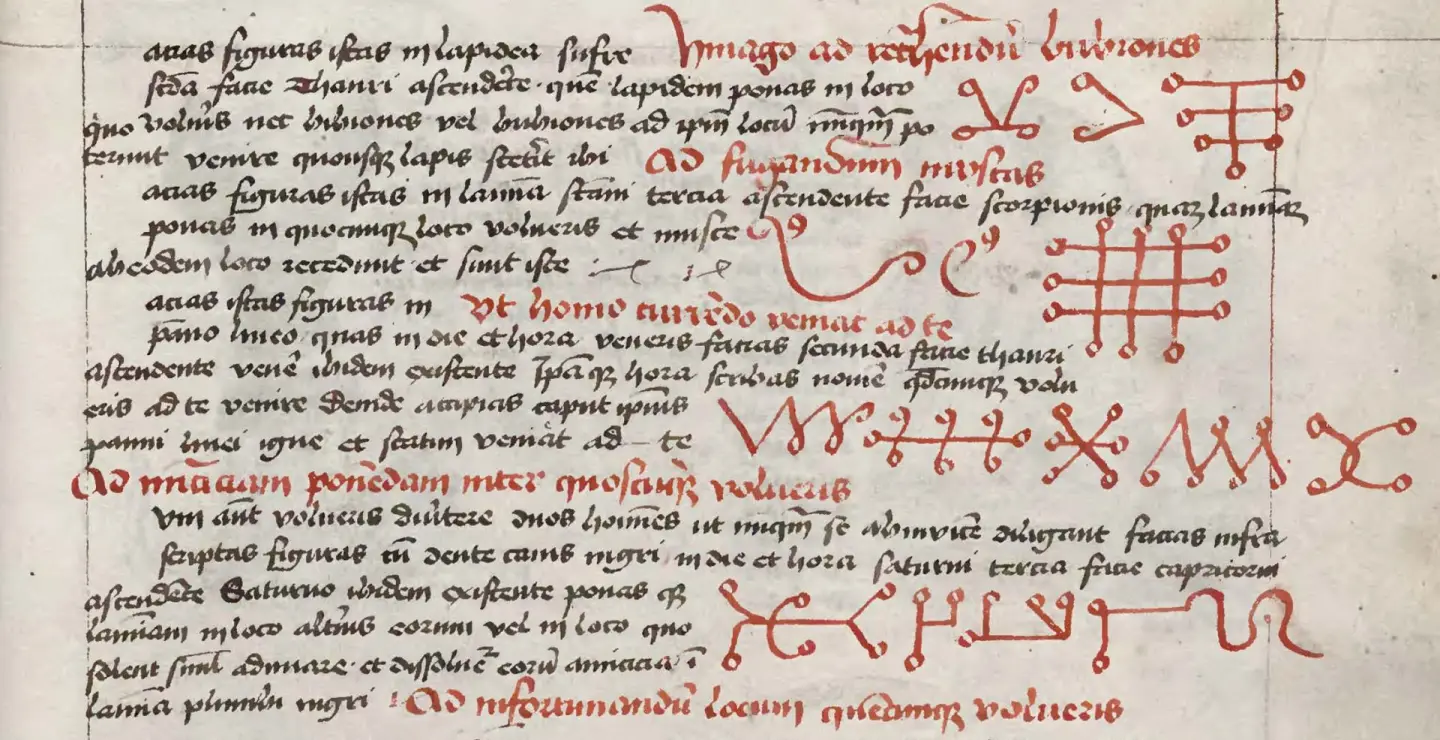

In the Arabic text, sandarac appears in the chapter on the planets’ prayers, among the ingredients of a fume for Jupiter, the great benefic, the planet of kings, judges, priests and good fortune. Jupiter’s materials in this tradition tend towards the clear, the golden and the sweet-smelling, and a pale resin that glows like amber fits that taste. The Latin translators did not always know what to do with the Arabic names of drugs and resins, and at this point the Latin text gives a word that does not obviously mean sandarac at all. That is a small example of something that happens all through the Picatrix: the Arabic carried a fairly precise list of real materials, and by the time it reached Latin readers some of them had turned into words nobody could match to anything in an apothecary’s shop. If you read the Latin alone, you lose the sandarac.
Anyone who has worked with the Renaissance and later correspondence tables will know that the stock incenses of the planets are mostly the famous ones: frankincense for the Sun, myrrh for Saturn, storax and the rest. Sandarac never became one of those standard entries, as far as I know, and in later esoteric writing it turns up more as an ingredient in compound incenses than as a planetary fume on its own. Its moment in the learned magic is that Jupiter fume in the Arabic Picatrix, and the slippage of its name in translation.
For the household and village side of things, the picture is different: this is folk custom. Sandarac is still sold in North African markets alongside the other fumigation resins and seeds, for people to burn in their homes on ordinary and special days. The Finnish anthropologist Edvard Westermarck, who spent years in Morocco in the early twentieth century, recorded in great detail how Moroccan households used smoke from many substances at weddings, births, festivals and times of trouble, especially against the jnūn, the spirits of Moroccan belief. That is living folk custom, practised by people who know far more about it than any outsider, and I’ll leave it in their hands.
Vernix: the resin that named varnish
Here is a piece of word history that I find hard to resist, though I’ll hedge it, because the dictionaries do.
Our word varnish comes, through Old French vernis and Italian vernice, from medieval Latin vernix or veronix, which in the early medieval texts meant a fragrant resin, very often sandarac. Behind that, most etymologists think, lies the Greek berenikē, and behind that the city of Berenice in Cyrenaica, the modern Benghazi on the Libyan coast. If that is right, the resin took its name from a port on the coast of North Africa that it was shipped from, and then gave that name to every clear protective coat ever brushed onto wood or canvas. It is a plausible story and widely repeated. The honest position is that “probably from Berenice” is as far as the evidence goes.
What is not in doubt is that sandarac was one of the great varnish resins of medieval and Renaissance Europe. The earliest detailed European account of making an oil varnish is in a craftsman’s handbook written in the early twelfth century by a monk who called himself Theophilus. His book, De diversis artibus, “On the various arts”, covers painting, glass and metalwork, and in it he describes how to make a varnish by heating linseed oil and cooking a resin into it, then spreading it on painted panels and drying them in the sun. The resin he names has been argued over, but many modern readers take it to be sandarac, possibly mixed with or confused with amber.
Two centuries later, the Florentine painter Cennino Cennini wrote his Libro dell’arte around 1400, a practical manual for young painters, and recommended finishing a panel with what he calls vernice liquida, liquid varnish. Scholars have generally taken that to be sandarac cooked in linseed oil, a thick, dark, honey-coloured varnish that dried slowly and gave the warm tone of many early panel paintings. In Renaissance Italy the word vernice on its own often meant sandarac itself, the dry resin, which tells you how closely the two were tied.
Later centuries learned to dissolve sandarac in spirits of wine and other solvents to make a quicker, paler, harder varnish. Spirit varnishes with sandarac in them coated furniture, metalwork, prints, maps and paintings, and the resin is still sold to restorers, instrument makers and makers of historical finishes. It has a reputation for drying hard and glassy but turning brittle and darkening with age, which is why it was so often blended with softer resins and oils.
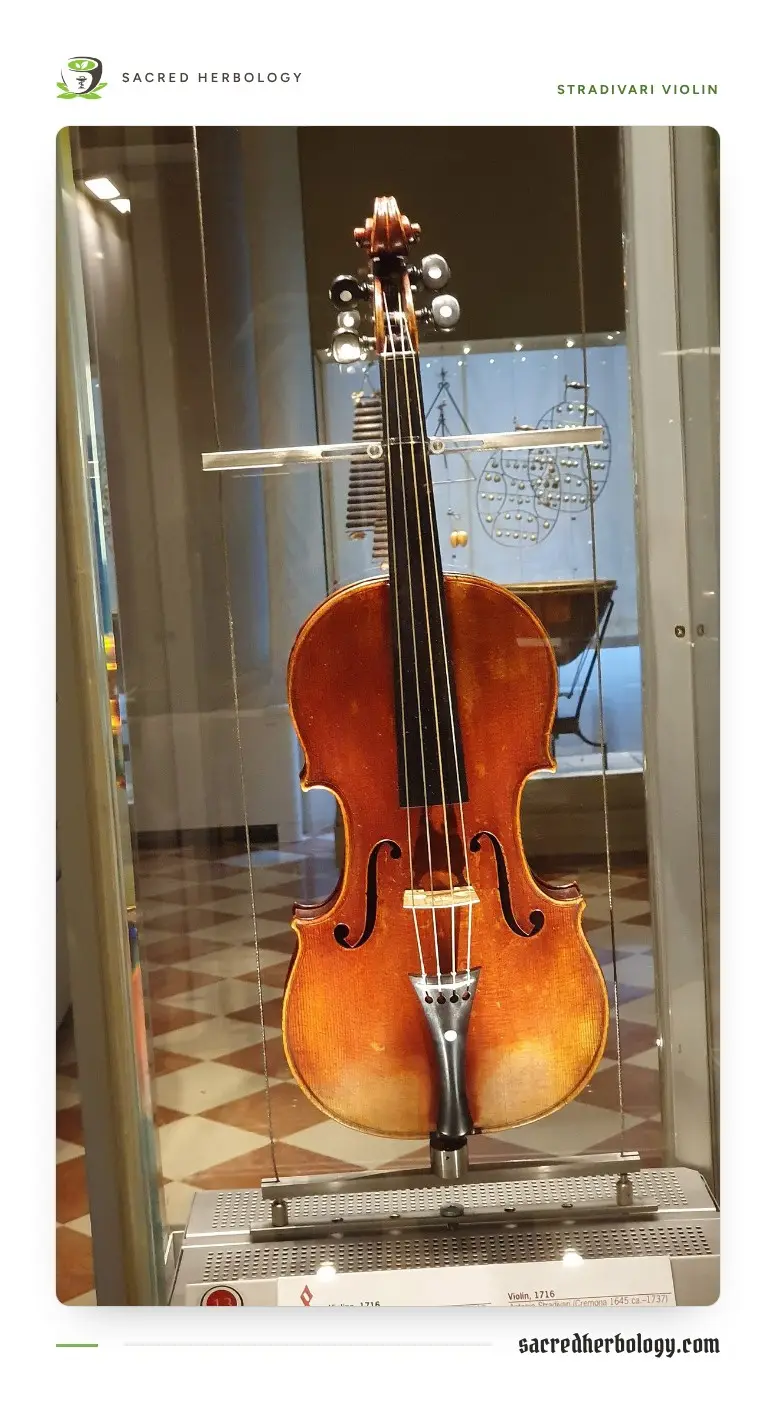
Which brings us to the violin. Few subjects in woodworking have produced as much argument as the varnish of the great Cremonese makers of the seventeenth and eighteenth centuries, Stradivari above all. Sandarac turns up in a good many of the proposed recipes, alongside mastic, colophony, amber and various oils. Scientific analysis of real instruments over the last few decades has found mostly oil-and-resin layers of a fairly ordinary kind for the period, with no secret ingredient that anyone has proved. The legend of the lost varnish is a modern romance, mostly nineteenth and twentieth century, and sandarac is one of its many supporting characters.

The scribe’s pounce
The quietest use of sandarac is one that most people have never heard of, and it is one of my favourites.
Before blotting paper, and long after, scribes and clerks kept a little pot on the desk with a perforated lid, rather like a salt or pepper shaker. It held pounce, a fine powder sprinkled over a page. Pounce did two jobs. On freshly written ink, it soaked up some of the wet and stopped smudges. On a page that had been scraped clean of an error, or on greasy parchment, it was rubbed in to prepare the surface so the new ink would sit sharp and not bleed into the fibres. The first job was mostly done with fine sand, powdered pumice or cuttlebone, which soak up wet. A resin soaks up very little.
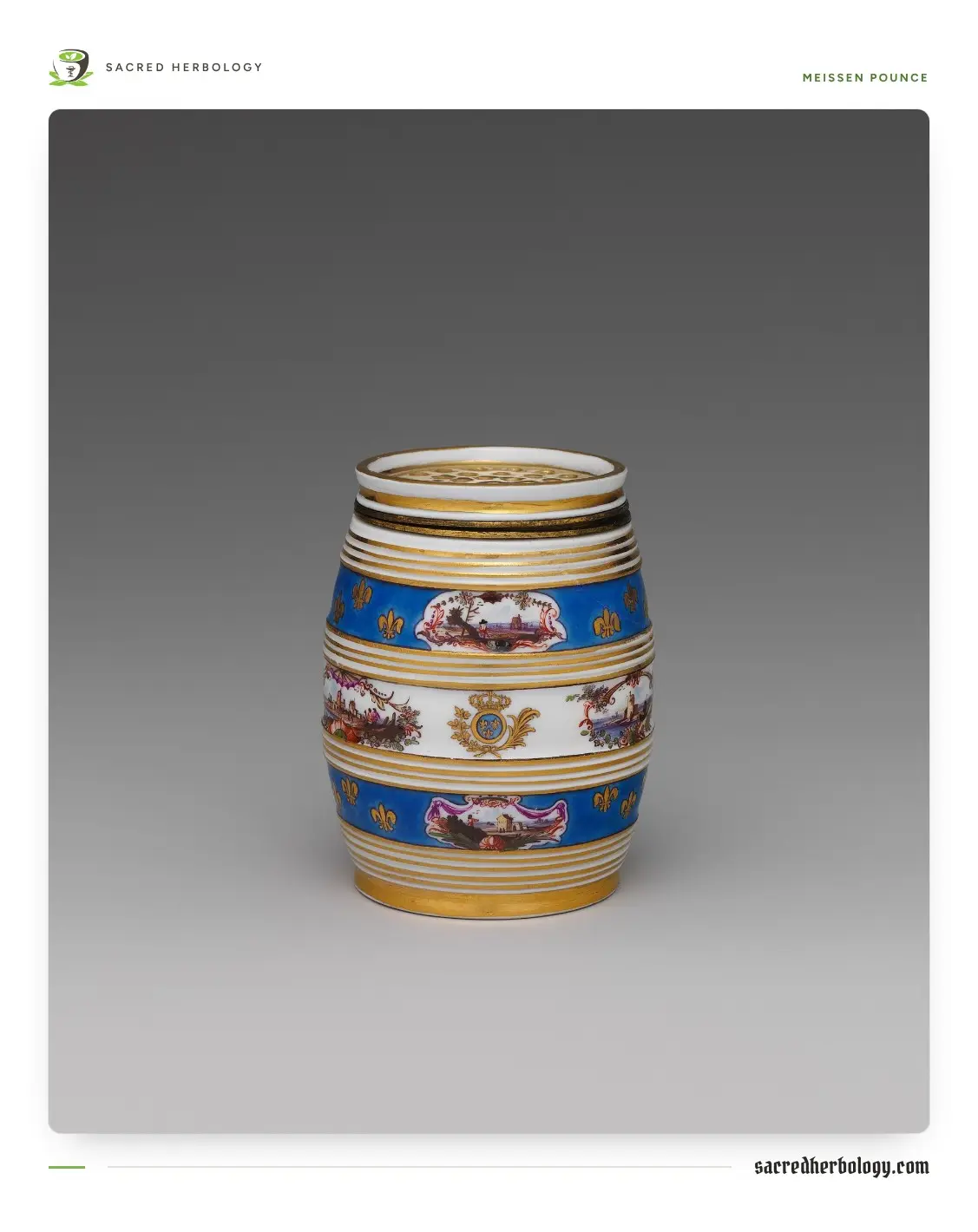

Powdered sandarac was one of the classic pounces for the second job. Rubbed into a scraped patch of parchment or paper, it left a thin resinous film that sized the surface and held the ink line crisp. Pounce pots in silver, pewter, brass, wood and ceramic sit in museum cases from London to Philadelphia, and they turn up in paintings of writing desks from the seventeenth to the nineteenth century. Calligraphers still use gum sandarac today, dusted on paper or vellum and brushed off, for the same reason, and you can buy it in small packets from calligraphy suppliers. It is a nice thought that the same tears burned by a Moroccan household and cooked by a Cremonese varnish maker also kept the edges of a clerk’s copperplate sharp.
The cypress pines
Now to the other side of the world.
When British settlers spread across the Australian continent, they kept meeting tall, straight, dark-foliaged conifers with a rich resinous smell and timber that termites would not touch. They called them pines, then cypress pines, and the name has stuck. Botanically they are cypresses, members of the same family as Tetraclinis, and they belong to the genus Callitris.
The name was given by the French botanist Étienne Pierre Ventenat in 1808. It is usually explained as a blend of the Greek kalli-, beautiful, with a word for three, after the way the scale leaves and the cone scales come in threes, though Ventenat himself did not spell that out and the derivation has been argued over. For much of the nineteenth century many Australian species were filed under another name, Frenela, which you’ll meet in old books and exhibition catalogues; it was later folded back into Callitris.
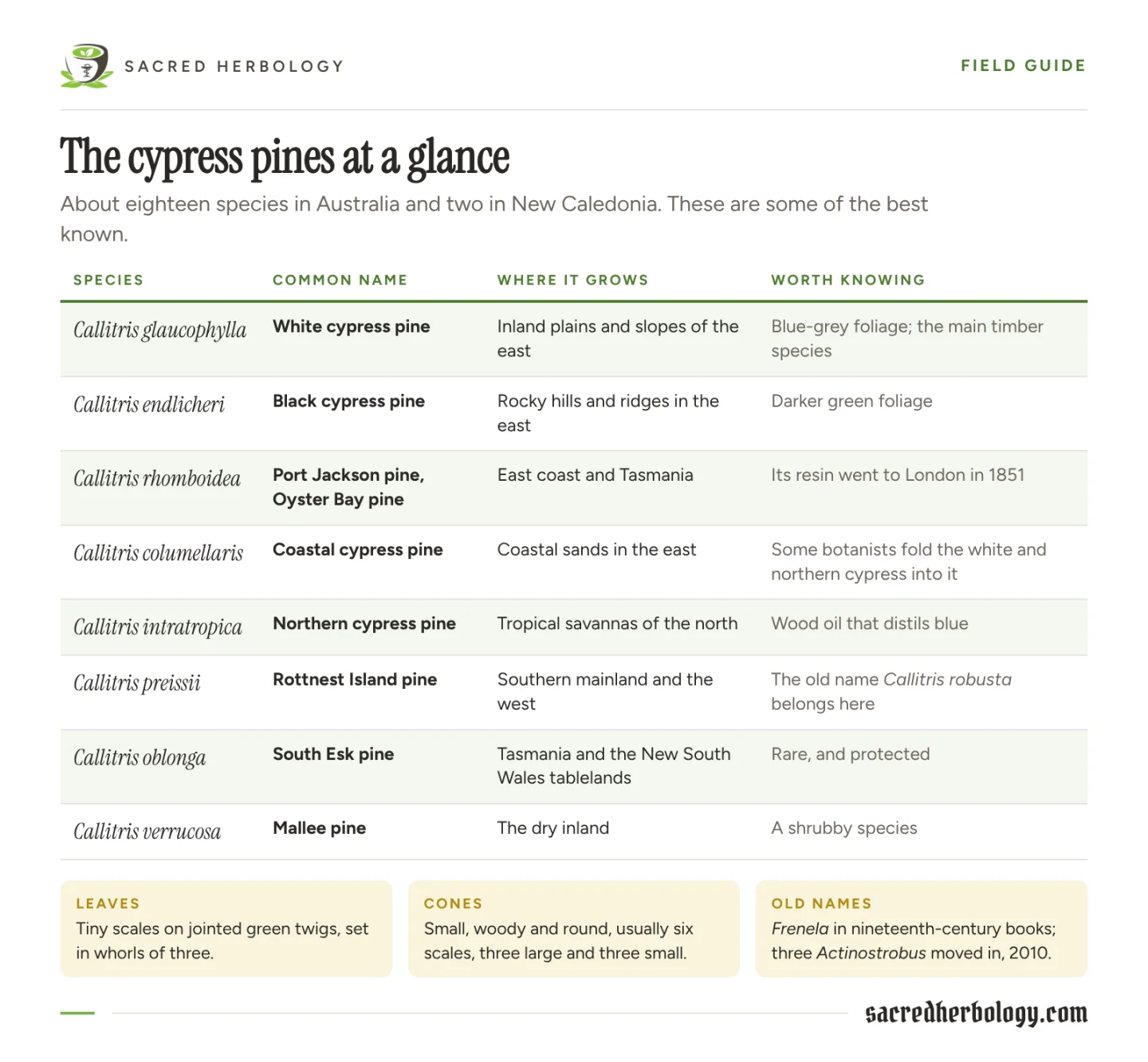
The genus today runs to about eighteen species in Australia, counting three small Western Australian conifers that were moved into it from the genus Actinostrobus in 2010, and two more in New Caledonia, though the exact count shifts as botanists lump and split. They grow almost everywhere on the continent, from tropical woodland to the edges of the arid zone, from coastal sand to inland plains and rocky ranges. Some of the best known are:
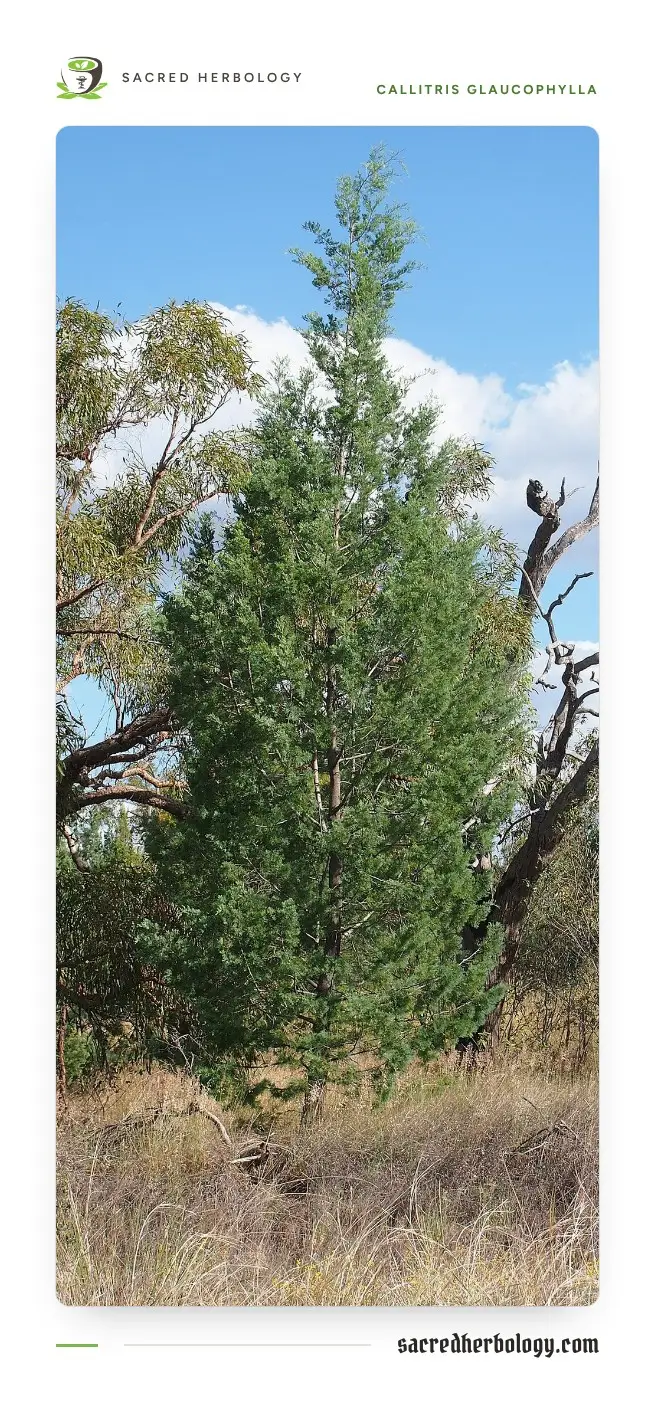
- Callitris glaucophylla, white cypress pine, a tree of the inland plains and slopes of the east, with blue-grey foliage, the main timber species.
- Callitris endlicheri, black cypress pine, of rocky hills and ridges in the east, with darker green foliage.
- Callitris rhomboidea, Port Jackson pine or Oyster Bay pine, of the east coast and Tasmania.
- Callitris columellaris, coastal cypress pine, of coastal sands in the east; some botanists now include the inland white cypress and the northern cypress under this name.
- Callitris intratropica, northern cypress pine, of the tropical savannas of the north.
- Callitris preissii, Rottnest Island pine, of the southern mainland and the west. The old name Callitris robusta belongs to this species, though nineteenth-century books stretched it to cover the inland white cypress as well.
- Callitris oblonga, the South Esk pine, a rare species of Tasmania and the New South Wales tablelands.
- Callitris verrucosa, mallee pine, a shrubby species of the dry inland.
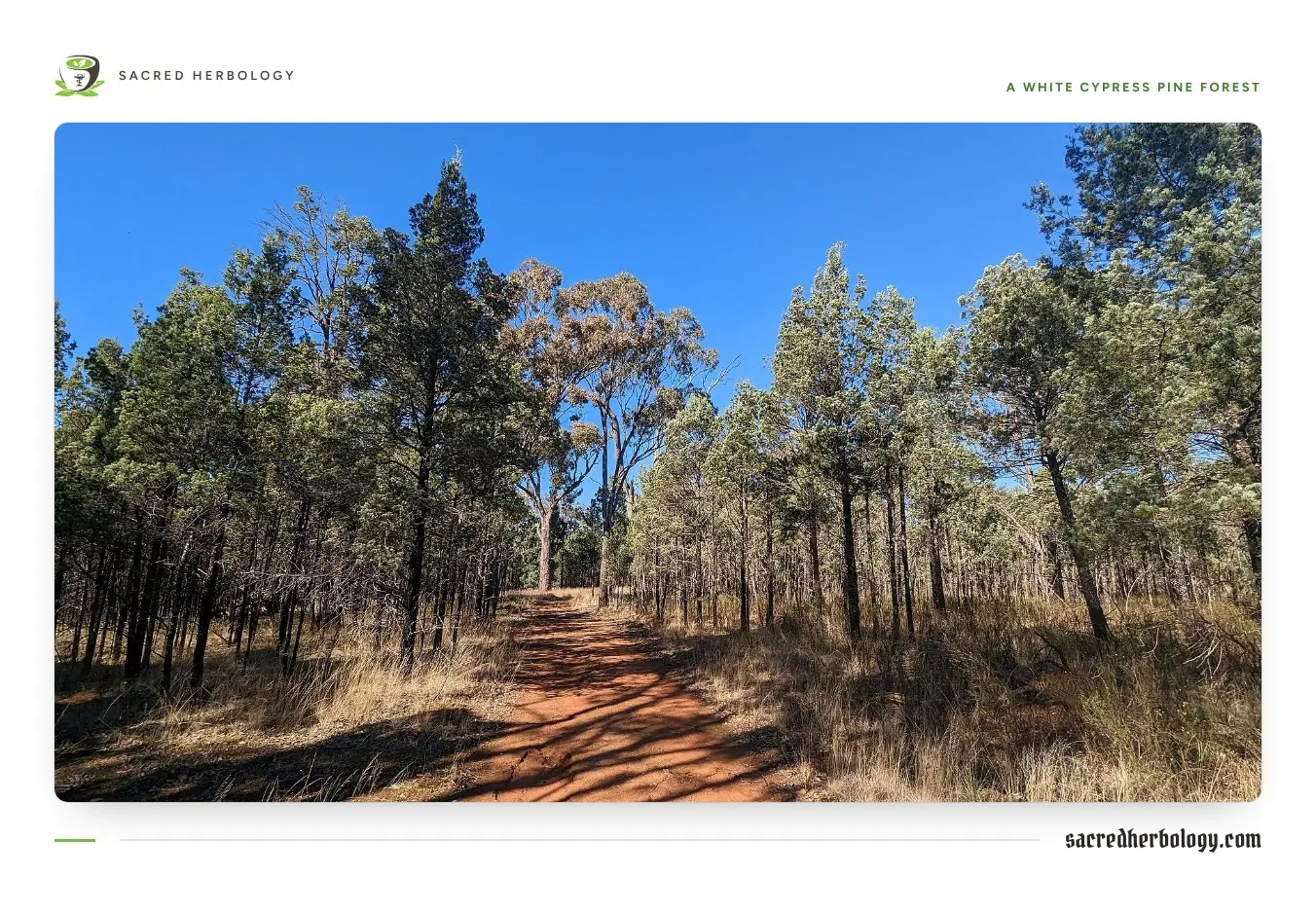
Like Tetraclinis, they have jointed green twigs with tiny scale leaves, here set in whorls of three. Their cones are small, woody and round, usually with six scales, three large and three small, and they sit on the branches for years. The foliage smells sharp and resinous when crushed. And they bleed resin. Wherever the bark is damaged, clear, pale, yellowish tears form along the trunk and branches and drop to the ground. Some species, white cypress pine among them, can be crusted with resin after insect damage or a hot summer.
Fire and the pines
To understand where cypress pines grow and where they do not, you have to understand fire, because the cypress pines are fire’s weathervane.
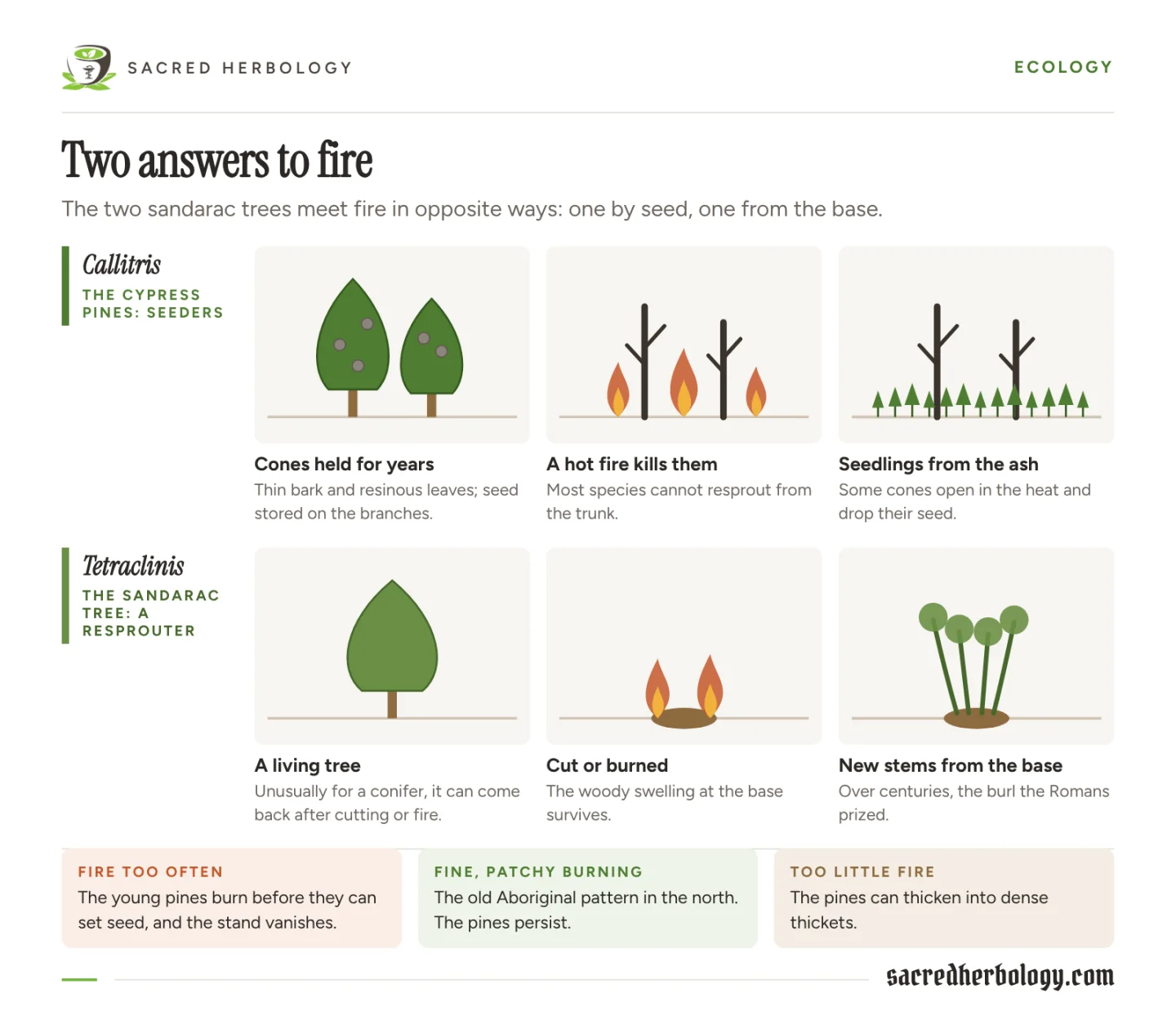
Most Callitris species have thin bark, resinous foliage and no way to resprout from the trunk after a hot fire. A fierce fire through a cypress pine stand usually kills the trees outright. Their answer is seed. Many species carry years of cones on their branches, and some open in heat, so that after a fire a carpet of seedlings comes up from the ash. What they cannot survive is fire that comes back too often, before the new trees are old enough to set seed of their own. Too much fire and they vanish; too little and they can thicken into dense thickets.
That makes them a living record of how a landscape has been burned. The ecologist David Bowman and his colleagues have spent decades studying Callitris intratropica in the tropical savannas of the north. In a paper with W. J. Panton in 1993, Bowman showed that northern cypress pine was dying back across large areas, and argued that this followed the end of the careful, patchy, early dry-season burning that Aboriginal people had practised for thousands of years, and its replacement by bigger, hotter, late-season fires after colonisation. Where the old fine-grained burning carries on, the pines persist. Where it has broken down, they tend to retreat into rocky refuges where fire cannot easily reach. The trees are, in effect, a map of human fire management, and it is a striking thing to see drawn out: dark green patches of cypress across a savanna, shrinking or holding on as the burning changes.
In the south-east, the story runs the other way. The historian and farmer Eric Rolls, in his 1981 book A Million Wild Acres, wrote the history of the Pilliga, a huge forest of white cypress pine and ironbark in northern New South Wales. Rolls argued from the early records that when Europeans first arrived the Pilliga was much more open country, grassy woodland with scattered big trees, and that the dense cypress forest people know today grew up after the 1870s and 1880s. Changed fire, the coming of sheep and rabbits, and a few great seed years let millions of cypress seedlings come up together and close the canopy. Some historians and ecologists have argued with parts of his account since, but his central claim, that the forest is younger than the colony, has been influential, and it changed how many Australians think about what is “natural” in their bush.
In 2001 a group of historians, foresters and ecologists gathered their work on these trees into a book with a lovely title, Perfumed Pineries: Environmental History of Australia’s Callitris Forests, edited by John Dargavel, Diane Hart and Brenda Libbis. The title borrows a phrase from the forester Harold Swain, and anyone who has walked through cypress pine country on a hot day will know what he meant. The air smells of resin.
Australian sandarac
The idea that these trees could feed a resin trade came early.
At the Great Exhibition in London in 1851, the colony of Van Diemen’s Land, as Tasmania was then called, sent among its exhibits a specimen of resin from the Oyster Bay pine, Callitris rhomboidea. According to the botanist Joseph Henry Maiden, writing forty years later, it was that specimen which first drew the attention of the London trade to the possibility of an Australian sandarac. Through the following decades, colonial exhibition catalogues and museum collections included samples of cypress pine resin from several species, and chemists who tested them reported that they behaved very much like the North African resin, dissolving in spirit and making a pale, hard varnish.
Maiden is the man to follow here. He was one of the most energetic botanists in colonial Australia, director of the Technological Museum in Sydney and later of the Botanic Gardens there, and an endless promoter of what he called the useful native plants. In his book The Useful Native Plants of Australia (1889) and in a short paper the same year, “Australian and Tasmanian sandarach”, published in the Papers and Proceedings of the Royal Society of Tasmania, he made the case for the resin. He called it one of the most valuable of Australian vegetable products, with a ready market that had been neglected for a long time. He pointed out that the colonies were actually importing sandarac from North Africa, which he compared to carrying coals to Newcastle, while the same thing lay on the ground under their own trees. He imagined small parties of men, or settler families, gathering it for part of the year. In the discussion that followed his paper, another member noted ruefully that ring-barking for pasture had already killed cypress pines over thousands of acres.
Maiden kept at it. In the 1890s, writing for the New South Wales Department of Agriculture, he proposed that the resin could be graded in Sydney and the surplus shipped overseas. In 1910 two of his colleagues at the Technological Museum, the botanist Richard Thomas Baker and the chemist Henry George Smith, published a large monograph, A Research on the Pines of Australia, which set out the timbers, oils and resins of the native conifers species by species, with photographs, chemical analyses and handsome plates of cones and foliage. It is still one of the great works of Australian applied botany, and its plates of Callitris twigs and cones are well worth looking up if you want something beautiful to draw.
And yet the trade never really took off. The British Pharmaceutical Codex of 1911 noted that Australian sandarac, from Callitris robusta in the broad old sense of that name, was occasionally exported but mostly used in Australia. North African sandarac was cheap, because it was gathered by poorly paid rural labour, and it was already familiar to every varnish maker in Europe. Australian resin had to be collected across vast distances and shipped halfway round the world, and its supply was irregular. Synthetic resins and new varnish chemistry in the twentieth century then took away much of the market for both. Australian sandarac stayed a footnote: a good idea, backed by sound chemistry, that the economics never quite carried. Modern writers on the genus still say the resin has never been collected in any systematic way.
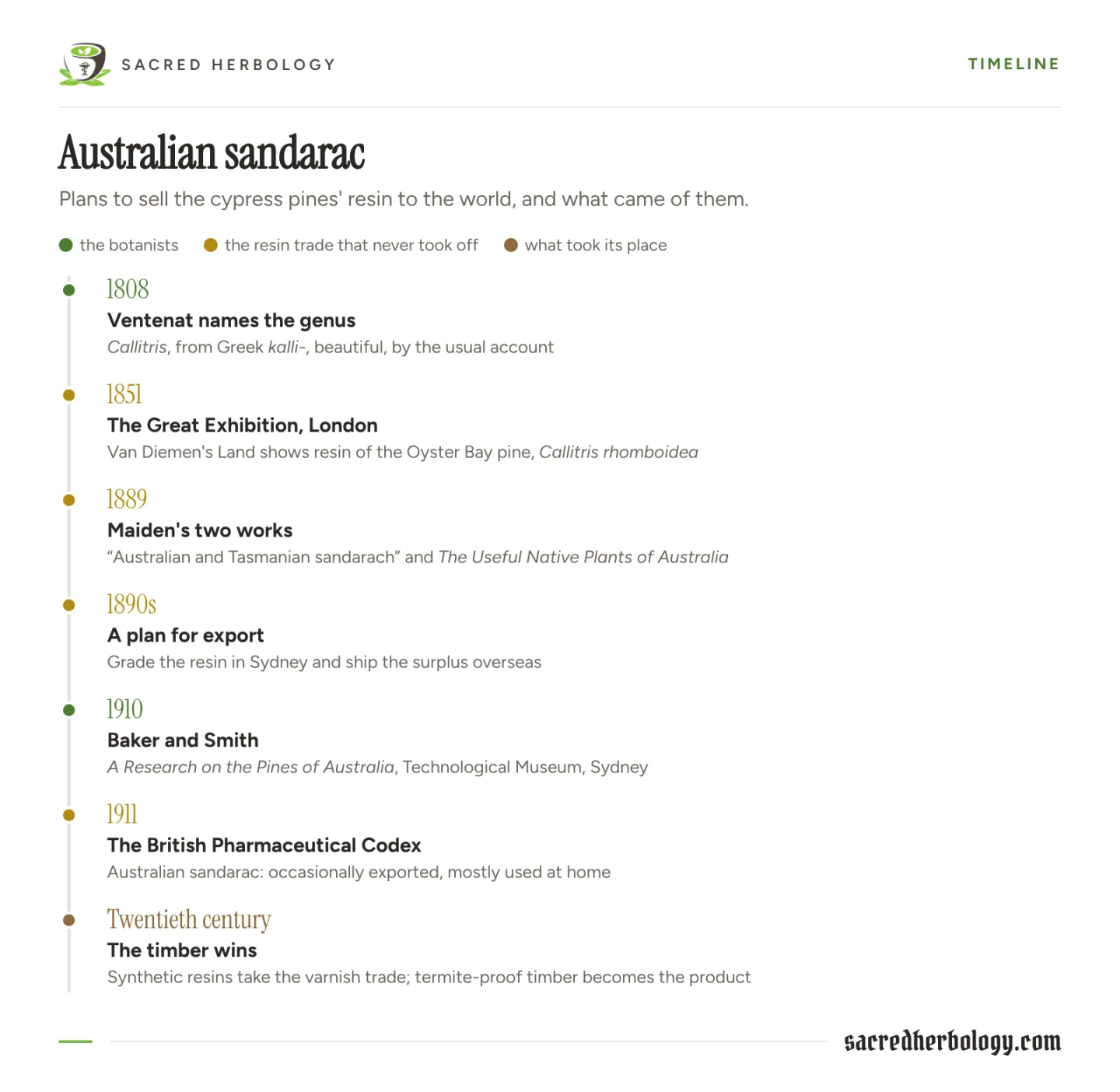
That story deserves a timeline of its own, because it shows the shape of so many colonial schemes for native products:
- 1808: Ventenat names the genus Callitris.
- 1851: Oyster Bay pine resin is shown at the Great Exhibition in London.
- 1889: Maiden publishes “Australian and Tasmanian sandarach” and The Useful Native Plants of Australia.
- 1890s: proposals to grade the resin in Sydney and ship the surplus overseas.
- 1910: Baker and Smith publish A Research on the Pines of Australia.
- 1911: the British Pharmaceutical Codex records the resin as occasionally exported.
- Twentieth century: synthetic resins take over the varnish trade; the timber becomes the main product.
Timber, termites and a blue oil
What did take off was the timber. White cypress pine became one of the main native softwoods of eastern Australia, cut from the inland forests and sold for floorboards, weatherboards, framing, posts and the stumps that hold up so many old Australian houses. Its great selling point was that the heartwood resists termites, which in most of the continent is no small thing. The heartwood is pale yellow to light brown, often marked with small dark knots, and it smells strongly of resin when it is cut. Older Australians who grew up in cypress-floored houses sometimes say they can still recall the smell.

The scent of the wood comes from its oil, and the chemists found something unusual in it. The wood oil of several Callitris species is rich in sesquiterpene alcohols, guaiol prominent among them, and in some species it carries compounds that turn a deep blue when the oil is distilled, as the heat of the still changes some of the colourless sesquiterpenes into blue azulenes. The northern cypress pine, Callitris intratropica, gives what is sold today as blue cypress oil, steam-distilled from wood grown in plantations in the tropical north, and its colour comes chiefly from guaiazulene, the same family of blue compounds that colours German chamomile oil. If you have ever seen a bottle of it held up to the light, it is an extraordinary inky blue, and it is a wonderful thing to set next to a heap of pale resin tears from the same genus: blue from the heart of the tree, gold from its bark.
The leaf oils are different again, sharper and more pine-like, rich in monoterpenes such as pinene and limonene. Oils from white cypress pine have been distilled commercially in a small way too. These oils are sold for perfumery and aromatherapy. I’ll say plainly that they are not for taking internally, and that this piece makes no claims about what they do to the body. Like all essential oils, they can be poisonous if a child swallows even a small amount, so keep the bottles shut and out of reach of children, and away from pets, cats above all.
The first peoples and the pines
Aboriginal people lived among these trees for many thousands of years before any colonist arrived, and their fire, as we’ve seen, shaped where the pines grew. The published ethnobotanical record from many parts of the continent mentions cypress pines among the trees that gave timber, resin and smoke, alongside the much better-known spinifex resin that was the great adhesive of the arid inland, used to fix stone blades to handles and to mend wooden tools.
I am going to be careful here. The detailed knowledge of what particular peoples did with particular species belongs to those peoples, and much of it is held in their own languages and their own published books, written and edited by their communities. Some of it is not for outsiders at all. I’d rather point you to those sources, and to general works such as Philip Clarke’s Aboriginal People and Their Plants, than flatten a continent’s worth of distinct traditions into a paragraph. What can be said from the published record is the broad picture: these trees were known, used and managed, and the landscapes the colonists took to be untouched wilderness, cypress pine country included, were shaped by people with long experience of fire.
What is in a tear
Sandarac and cypress pine resin look alike, burn alike and dissolve alike for a good reason: they are built from the same kind of molecules.
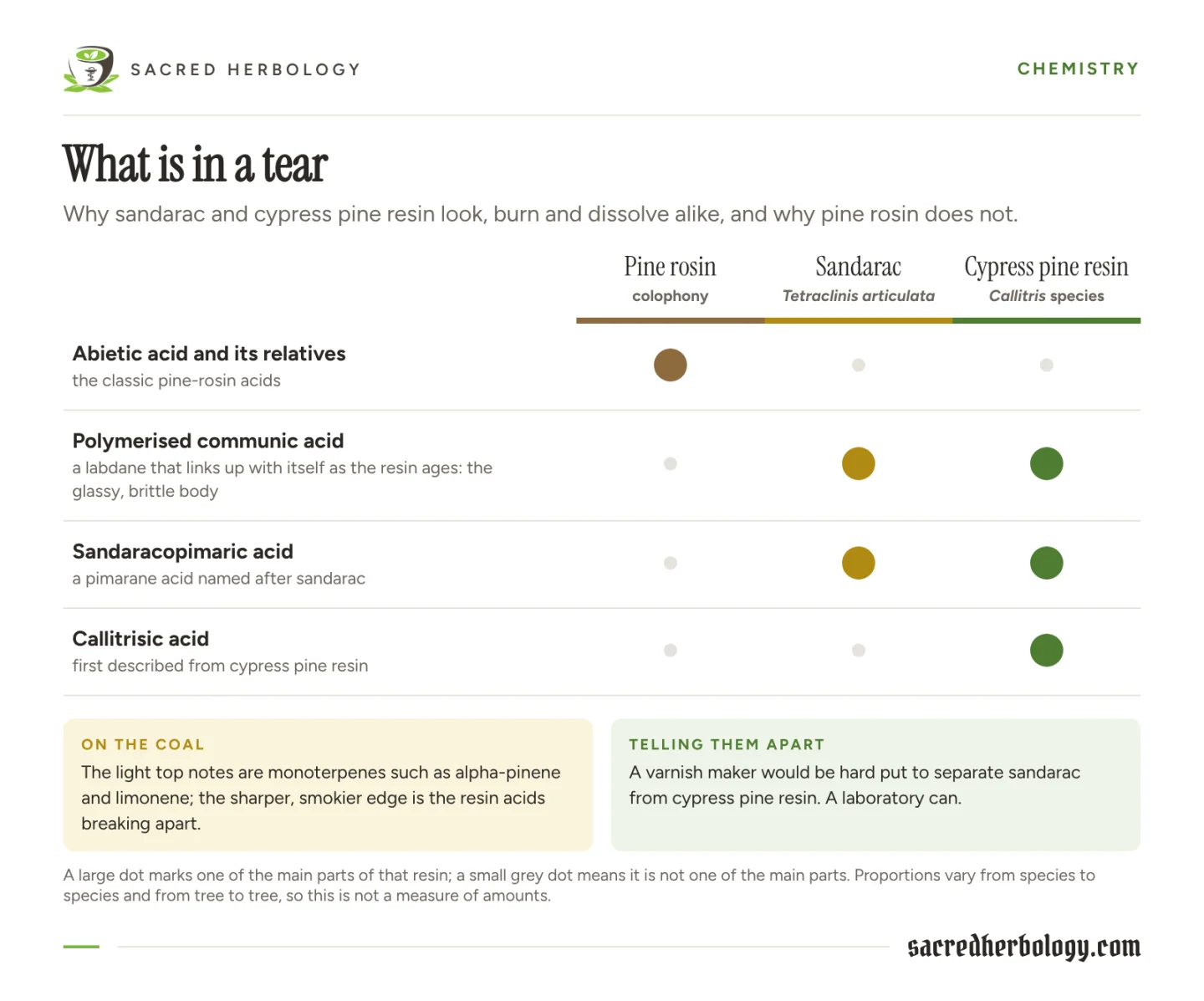
Most conifer resins are made of diterpenoid acids, molecules of twenty carbon atoms arranged in rings. Pine rosin, the colophony that violinists rub on their bows, is dominated by abietic acid and its relatives. Sandarac belongs to a different group. Its main components are a resin acid named after it, sandaracopimaric acid, together with polymerised communic acid, a labdane-type diterpenoid that links up with itself as the resin ages in the air. That polymer gives sandarac its glassy hardness and brittleness, and helps explain why it makes such a hard varnish and why that varnish can crack with time.
Chemists who have analysed the resins of Callitris have found the same families of compounds: communic acid polymers and pimarane-type acids, including sandaracopimaric acid, in proportions that vary from species to species and even from tree to tree. The genus has a resin acid of its own as well, callitrisic acid, first described from cypress pine resin. Maiden and his colleagues had only solubility, melting and the look of a varnish film to go on, and on those tests they were right: modern analysis puts the two resins in the same chemical class. The cypress pines make a resin of the same kind as sandarac, close enough that a varnish maker would be hard put to tell them apart, though a laboratory can.
The smell when you burn it comes partly from the smaller, lighter molecules trapped in the tears: monoterpenes such as alpha-pinene and limonene, the same things that make a pine forest smell like a pine forest, along with some sesquiterpenes that give the woody, cedary note underneath. The rest comes from the resin acids themselves, which break apart on a hot coal and give the sharper, smokier edge. Fresher tears smell brighter. Old tears that have sat in a jar for years lose most of their light top notes and burn flatter and more acrid.
If you want a chart for your notebook, it is easy to draw: one column for pine rosin, one for sandarac, one for Callitris resin, with abietic acids heavy in the first and communic acid and sandaracopimaric acid heavy in the other two.
What you are buying
Most of the sandarac sold today comes from Morocco, gathered by hand from Tetraclinis trees. You’ll find it sold as gum sandarac, sandarac tears, Moroccan sandarac, or under the French and Arabic names. A few points are worth knowing.
- Good sandarac is pale: clear straw to light lemon yellow, with long, thin, rod-like or teardrop tears. A white dust on the outside is normal and comes off with a gentle rub.
- Darker, reddish or brownish material is usually older, or collected from the ground with dirt and bark mixed in. It is fine for some purposes but burns less cleanly.
- Sandarac is sometimes confused with mastic, the resin of Pistacia lentiscus, and the two have been swapped in the trade for a long time. Sandarac tears are usually longer and thinner, while mastic tears are rounder. The old trade test was to chew a tear: sandarac shatters to a dry powder and mastic goes soft and gummy. Pressing a tear hard between your fingers tells you nearly as much, and sandarac is not for the mouth. The swap usually ran the cheaper way, with sandarac mixed into dearer mastic. Varnish makers had a second check: mastic dissolves in turpentine, while sandarac dissolves well in alcohol and only partly in turpentine.
- Pine rosin, broken into pieces, has been passed off as sandarac too. Rosin comes in irregular lumps, not slim tears, goes soft and tacky in a warm hand, and smells of pine tar on the coal. None of these checks proves which tree a resin came from. Only laboratory analysis can do that, so buy from a seller who knows the source.
- “Sandarac” in an older book or an overseas listing may mean something else: juniper resin, East African copal, or even the red arsenic mineral in very old painting texts. Read the label and ask the seller which tree.
- Australian cypress pine resin is not, as far as I know, sold in any regular commercial way today. Picking a few tears off a tree on your own land is one thing. Collecting from public land, parks or reserves may need a permit or be forbidden outright under state law, and rare species such as the South Esk pine are protected wherever they grow, so check before you gather anything that is not yours.
As with any resin, a supplier who can tell you where it was gathered and by whom is better than one who cannot. The North African forests are under real pressure from grazing, clearing and fire, and the small European populations are close to gone, so a little care about origin goes a long way.
Burning it well
Sandarac burns fast and hot. It melts almost as soon as it touches the coal, which makes it lively in a blend and a little quick on its own.
- Use a proper charcoal disc in a heat-proof bowl half filled with sand or ash. Light the disc and wait until it glows grey all over before you add anything. Start with a few small tears.
- Many people prefer it blended with slower resins such as frankincense, or with woods and leaves, so the brightness of the sandarac lifts the blend without burning off in seconds.
- An electric resin burner or a mesh screen over a tea-light gives a gentler, cleaner scent with less smoke, and lets you smell the lighter top notes.
- Open a window. Resin smoke is still smoke, full of fine particles, and it can set off an asthma attack. If you have asthma or any other chest or lung condition, keep well back from it or skip it. Keep it away from babies, small children and pet birds, whose lungs are easily hurt by smoke, and if you are pregnant, keep the room well aired and the smoke light.
- The charcoal disc gives off carbon monoxide as it burns, which you can’t see or smell. Never burn it in a closed room, a tent or a car. A headache, dizziness or sickness while it burns means get into fresh air at once.
- Some people’s skin reacts to conifer resins. If you handle a lot of raw resin, wash your hands afterwards.
- Sandarac is for burning, varnish and craft. Don’t eat it or put it in food or drink.
- If someone swallows resin or an essential oil, or feels unwell around the smoke, call the Poisons Information Centre on 13 11 26. If they are struggling to breathe, collapse or will not wake, call 000.
If you need advice about using any plant material on or in the body, consult a degree-qualified herbalist with competencies and adequate training in pharmacognosy.
Growing a cypress pine, or a sandarac tree
If you want to grow one of these trees yourself, think about what they evolved with.
Tetraclinis articulata is a tree of long, hot, dry summers and short, mild, wet winters, on thin, stony, free-draining soil. It needs full sun and sharp drainage above everything else. It takes drought well once established and handles light frost, but it suffers in cold, wet, heavy ground, and constant humidity with wet summers is the opposite of its home climate, so it is likely to sulk or rot where the soil stays soggy. It grows slowly and makes a handsome small tree or a dense hedge. Botanic gardens in dry temperate parts of the world grow it well. In Australia, all seed and plants brought in from overseas fall under the Commonwealth’s import conditions, which the federal agriculture department publishes in its BICON database, so check there whether the species may be brought in at all, and check your state’s own biosecurity rules too, before you order anything from abroad.
The Australian cypress pines are easier to find. Native plant nurseries often carry Callitris species, and the right choice depends on what your own ground is like. As a rule:
- Most want full sun and good drainage, and dislike waterlogged soil.
- White cypress pine and its inland relatives prefer dry conditions and can be fussy in high humidity and heavy rainfall.
- Coastal cypress pine and Port Jackson pine are more tolerant of sandy coastal soils and wetter air.
- Northern cypress pine grows in tropical savannas with a hard wet season and a long dry, on well-drained ground.
- Almost all are killed by hot fire, so keep them away from where you burn off and give them a clear space.
They grow into neat, dark columns that make good windbreaks and screens, and they reward you with that resinous smell whenever you brush past on a warm day. And if you look closely at an older tree, especially where an insect or a branch-break has wounded the bark, you may find your own tears of Australian sandarac sitting on the trunk, the same pale glassy drops that Maiden hoped would make the colonies rich.

Two trees and one smoke
Put a tear of Moroccan sandarac on one side of the coal and a tear of cypress pine resin on the other, and you will have a hard time telling the smoke apart. One comes from a tree whose burls Cicero bought for half a million sesterces and whose name may have given us the word varnish. The other comes from a tree that colonists called a pine and Aboriginal fire shaped across a continent.
The Arabic magicians thought the smoke might please Jupiter. The monks and painters wanted a coat that would keep their panels safe. The scribes wanted crisp ink. The colonial botanists wanted an export. Each of them looked at the same pale tear and saw something different in it. What the trees themselves want is simpler: a dry, sunny slope, sharp drainage, and fire that comes neither too often nor too fiercely. Whatever you think the smoke does, that much is worth giving them.
Where this comes from
- Homer, Odyssey 5.59-61, trans. A. T. Murray, rev. George E. Dimock, 2 vols (Loeb Classical Library, 1995).
- Theophrastus, Enquiry into Plants, trans. Arthur Hort, 2 vols (Loeb Classical Library, 1916).
- Pliny the Elder, Natural History, vol. IV, books 12-16, trans. H. Rackham (Loeb Classical Library, 1945).
- Revelation 18:12, King James Version.
- Pseudo-Majrīṭī, Das Ziel des Weisen, ed. Hellmut Ritter (Teubner, 1933); “Picatrix“: Das Ziel des Weisen von Pseudo-Mağrīṭī, trans. Hellmut Ritter and Martin Plessner (Warburg Institute, 1962); Picatrix: The Latin Version of the Ghāyat Al-Ḥakīm, ed. David Pingree (Warburg Institute, 1986).
- Edward Westermarck, Ritual and Belief in Morocco, 2 vols (Macmillan, 1926).
- Theophilus, On Divers Arts, trans. John G. Hawthorne and Cyril Stanley Smith (University of Chicago Press, 1963; Dover, 1979).
- Cennino Cennini, The Craftsman’s Handbook: Il Libro dell’Arte, trans. Daniel V. Thompson Jr (Yale University Press, 1933; Dover, 1954).
- Oxford English Dictionary, entries “sandarac” and “varnish”.
- J. H. Maiden, The Useful Native Plants of Australia (Sydney, 1889).
- J. H. Maiden, “Australian and Tasmanian sandarach”, Papers and Proceedings of the Royal Society of Tasmania (1889): 55-59.
- R. T. Baker and H. G. Smith, A Research on the Pines of Australia (Technological Museum, Sydney, 1910).
- The British Pharmaceutical Codex (Pharmaceutical Society of Great Britain, 1911), entry “Sandaraca”.
- D. M. J. S. Bowman and W. J. Panton, “Decline of Callitris intratropica in the Northern Territory: implications for pre- and post-European colonization fire regimes”, Journal of Biogeography 20 (1993): 373-381.
- Eric Rolls, A Million Wild Acres: 200 Years of Man and an Australian Forest (Nelson, 1981).
- John Dargavel, Diane Hart and Brenda Libbis (eds), Perfumed Pineries: Environmental History of Australia’s Callitris Forests (Centre for Resource and Environmental Studies, Australian National University, 2001).
- Philip A. Clarke, Aboriginal People and Their Plants (Rosenberg, 2007).