
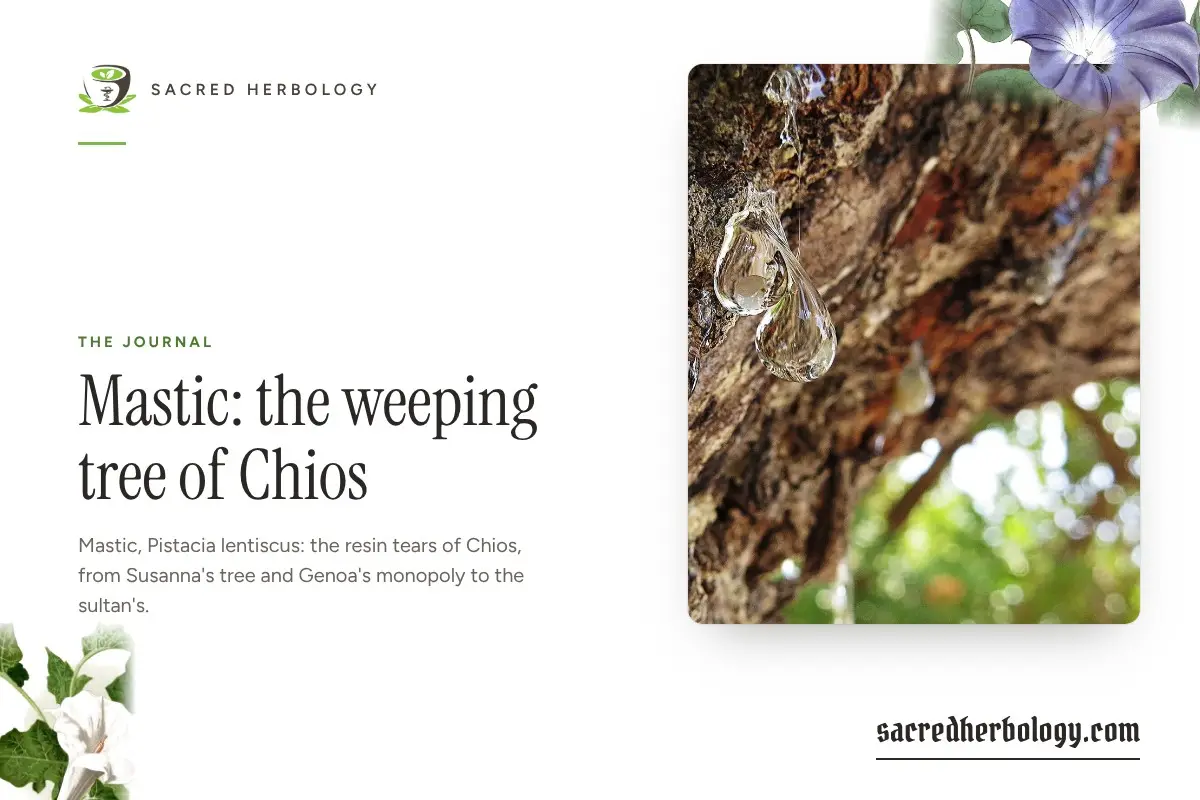
Drop a tear of mastic into your palm and it looks like a small piece of frosted glass. It is pale, somewhere between straw and lemon, often dusted white on the outside, and it weighs almost nothing. Between the teeth it does something few other incense resins do. It shatters first, with a bitter, piney flash, and then, after a minute or so of chewing, it gathers itself into a soft, opaque, faintly green gum that people go on chewing for an hour. Put the same tear on a hot coal and it melts, bubbles, and lets out a clean smoke that smells of pine needles, fresh-cut wood and something faintly like balsam and lemon peel.
That double life, as a thing you chew and a thing you burn, has followed mastic through three thousand years of history. It was the chewing gum of the ancient Mediterranean and of the Ottoman palace. It went into the incense of Egyptian temples and the varnish on Old Master paintings. It was taxed, monopolised, smuggled and fought over. A whole cluster of villages on one Greek island lived and died by it, and in 1822 it may have been the reason some of those villagers lived when their neighbours were killed.
The odd thing about mastic is where it comes from. The shrub that makes it grows all round the Mediterranean, from Portugal to Lebanon, from Morocco to the Turkish coast. Yet for as far back as the written record runs, the resin worth paying for has come from one place: the southern half of the island of Chios, a short boat ride off the Turkish coast in the eastern Aegean. The Greeks call it mastiha. Its growers call the drops of resin dakria, tears.
So this piece follows the tears. We’ll start with the shrub itself and why only one corner of one island makes the good stuff, walk through a year in a mastic grove, and then go back through the Greek and Roman writers, a famous courtroom scene in the Greek Bible, the Bronze Age ships, the Genoese merchants who ran Chios as a company, the Ottoman sultans who took it from them, a martyr whose death the island says made the trees weep, the magicians who could not agree which planet owned it, the painters who varnished with it, and the fires that have come close to wiping it out. At the end I’ll come to what you are buying when you buy mastic tears, how to burn them, and what the shrub needs if you want to grow one.
A word on beliefs, as always. Some of this piece is about what people believed mastic did: that its smoke pleased a god or drew down the influence of a planet, that its tears were the grief of a saint. I’ll report those beliefs as fairly as I can and I won’t tell you they are true. Where material comes from the learned magical books and the correspondence tables of the occult orders, I’ll label it esoteric. Where it comes from village custom and the stories told in the groves, I’ll say so and call it country lore. The two are different things and deserve to be kept apart. And while mastic has a long history in medicine, which the Greek physicians wrote about at length, that history belongs to pharmacy and this piece leaves it alone. It is about smoke, gum, trade and stories.
A shrub of the cashew family
The mastic shrub is Pistacia lentiscus, called the lentisk in older English. It is an evergreen, usually a dense, rounded bush a metre or three high, though old specimens left alone can grow into small, gnarled trees of five metres or more with twisted grey trunks. If you have walked anywhere through the dry scrub of the Mediterranean coast, the maquis of France and Corsica, the garrigue, the phrygana of the Greek hillsides, you have walked past it, probably without noticing.
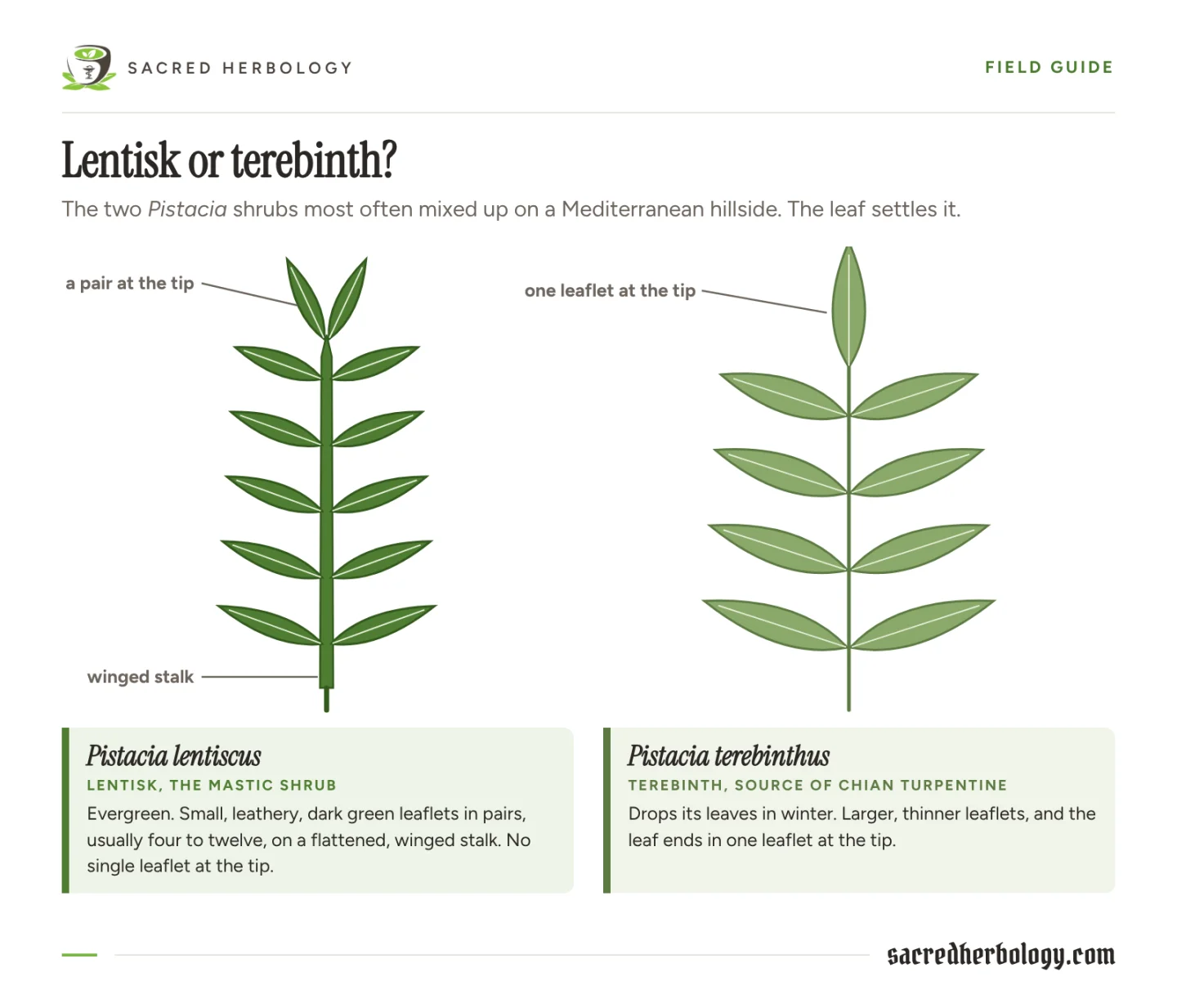
The leaves are the thing to look for. Each one is compound, made of small, leathery, dark green leaflets set in pairs along a central stalk, usually four to twelve of them, with no single leaflet at the tip. The stalk between the leaflets is flattened into a narrow green wing. Crush a leaf and it smells resinous, a little like turpentine, which is your first clue that the whole plant is full of resin.
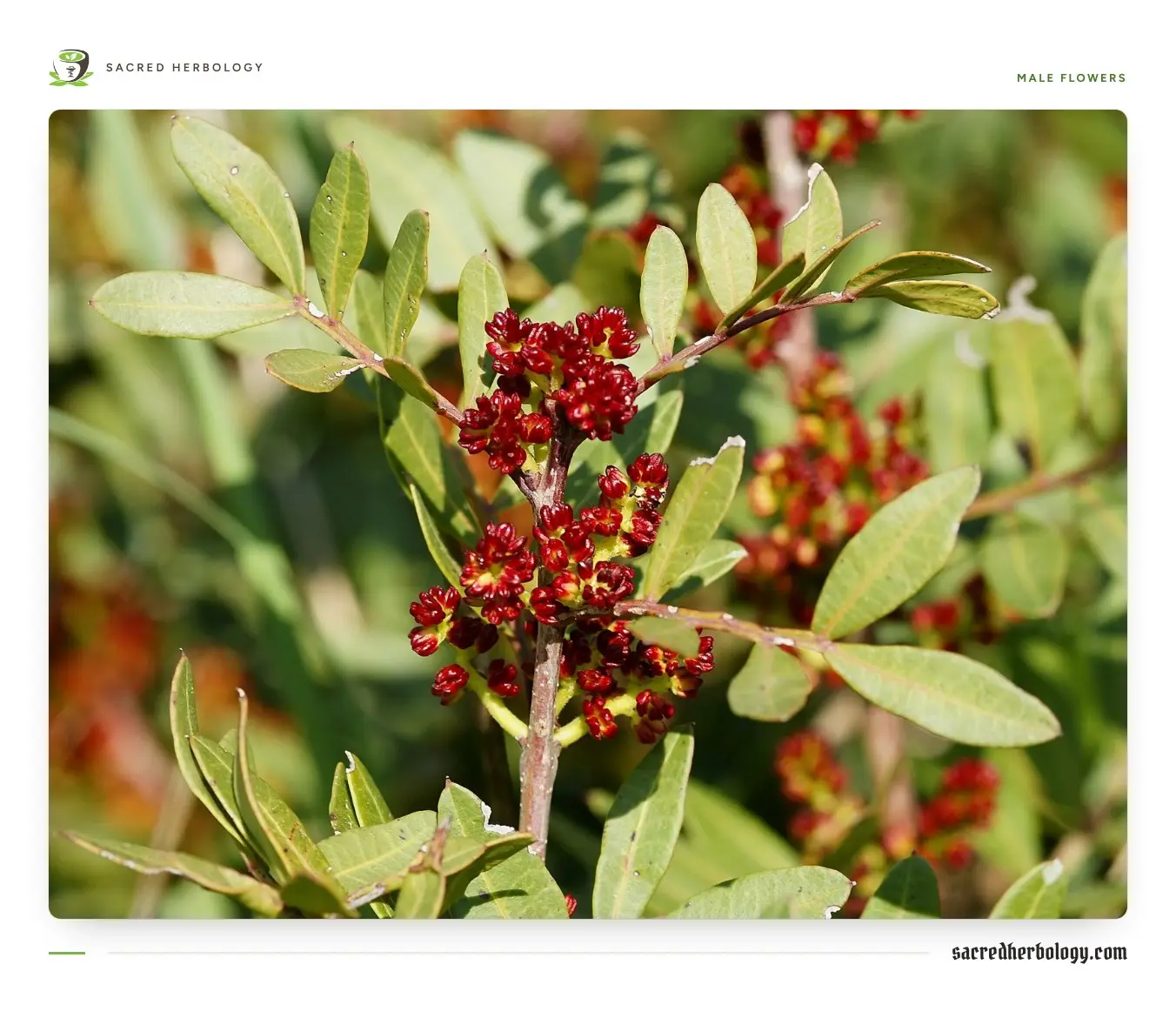
The lentisk is dioecious, which means that each plant is either male or female. The male plants carry small clusters of reddish flowers that are mostly stamens, and they turn the shrub a rusty colour in spring. The female plants carry less showy flowers that ripen into small round fruits, red at first and black when ripe, each holding a single seed. Birds love them. In parts of North Africa, Sardinia and southern Spain the fruits were once pressed for an oil that country people burned in lamps and, in hard times, cooked with. That is a folk use with a long and fairly well-documented history, though the oil is now a rarity.

The genus Pistacia is a small one, and its best-known member is in your pantry: Pistacia vera, the pistachio. Its other cousins are the terebinth, Pistacia terebinthus, which gives a soft resin once sold as Chian turpentine (yes, from Chios as well), and the Atlantic pistachio, Pistacia atlantica, a big tree of the dry country from the Canary Islands to Iran, whose resin was traded heavily in the Bronze Age. The terebinth is the one most often confused with the lentisk on a hillside, and the leaves tell them apart: the terebinth drops its leaves in winter, its leaflets are larger and thinner, and its leaf ends in a single leaflet at the tip, where the lentisk’s ends in a pair. All of them bleed resin when cut. The lentisk simply does it best.
Step back one more level and you reach the family, Anacardiaceae, the cashew family. It is a family of contrasts. It holds the mango, the cashew and the pistachio, which people eat by the tonne, and it holds poison ivy and the lacquer tree of East Asia, whose sap can blister the skin. What links them is a system of resin canals running through the bark, and in many members a resinous sap that the plant uses to seal wounds and deter insects.
There is a pleasant bit of naming history here too. The ancient Greek word for the lentisk was schinos. When the South American pepper trees were described for European science, their resinous, pinnate leaves reminded botanists of the lentisk, and so the genus was named Schinus. The peppercorn tree of old country towns, Schinus molle, and its relative the Brazilian pepper tree, Schinus terebinthifolia (older books spell it terebinthifolius), both carry the Greek name of the mastic shrub; the peppercorn was even sold in Europe as American mastic. Neither is a true Pistacia, and neither gives Chian mastic. The Brazilian one, called the broad-leaved pepper tree in Australia, has become a serious weed in warm, wet country around the world, including long stretches of the Australian coast, and the peppercorn has gone wild in parts of inland Australia too, so both are better admired in the botany books than planted.
Why only southern Chios
Here is the puzzle that every writer on mastic has to face. The lentisk grows wild from one end of the Mediterranean to the other. Cut it almost anywhere and it will ooze a little resin. Yet only on Chios, and only in the south of Chios, does it give resin in quantity and of a quality anyone has been willing to pay for.
The mastic-bearing trees of Chios are usually given their own botanical name, Pistacia lentiscus var. chia. Growers have propagated them from cuttings for centuries, so the trees in the groves are, in effect, a long line of clones selected for one job. Nearly all of them are male plants: the female trees give far less resin, so the growers have always chosen males. They tend to be larger and more upright than the wild lentisk of the hillsides, and above all they bleed generously when cut. Wild lentisks on other islands, and even in the north of Chios, give much less, and what they give is thought inferior.
Why the south? Nobody has a single tidy answer, and I’d be misleading you if I gave you one. The usual explanations point to a combination of things: the long, hot, dry summers of southern Chios, with almost no rain from June to September, which suits a resin that has to harden on the ground in the open air; the limestone soils; the sea winds; and, perhaps most of all, the centuries of selection that have kept the most generous trees and propagated them. Mastic is as much a product of people as of plants. Take the people away and the groves go back to scrub.
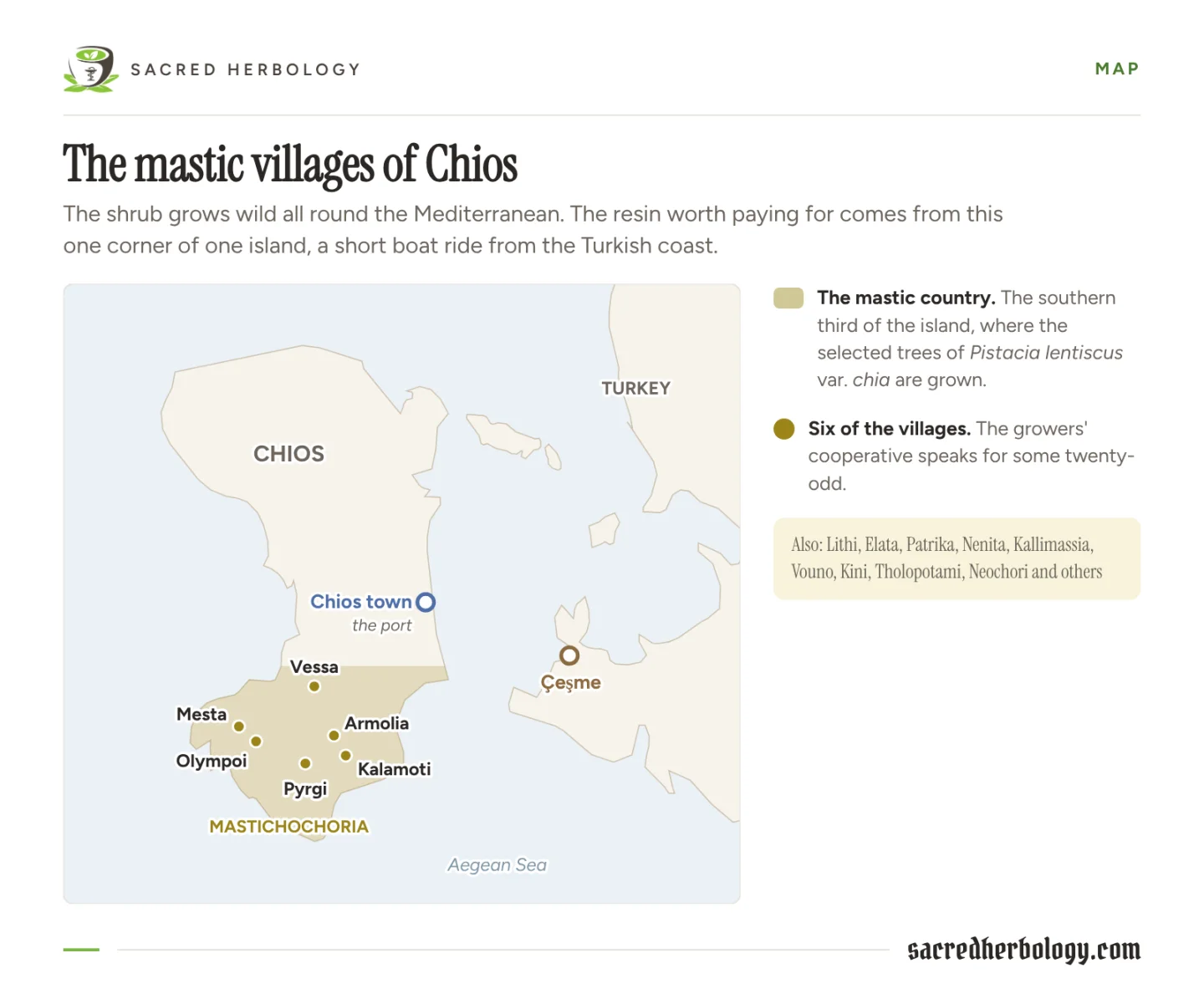
The mastic country is called the Mastichochoria, the mastic villages. The growers’ cooperative today speaks for some twenty-odd villages across the south of the island. Their names make a little litany: Pyrgi, Mesta, Olympoi, Armolia, Kalamoti, Vessa, Lithi, Elata, Patrika, Nenita, Kallimassia, Vouno, Kini, Tholopotami, Neochori, and others. On a map of Chios they sit in the southern third of the island, with the port town of Chios on the east coast to the north of them, and the Turkish peninsula of Çeşme only a few kilometres across the water.
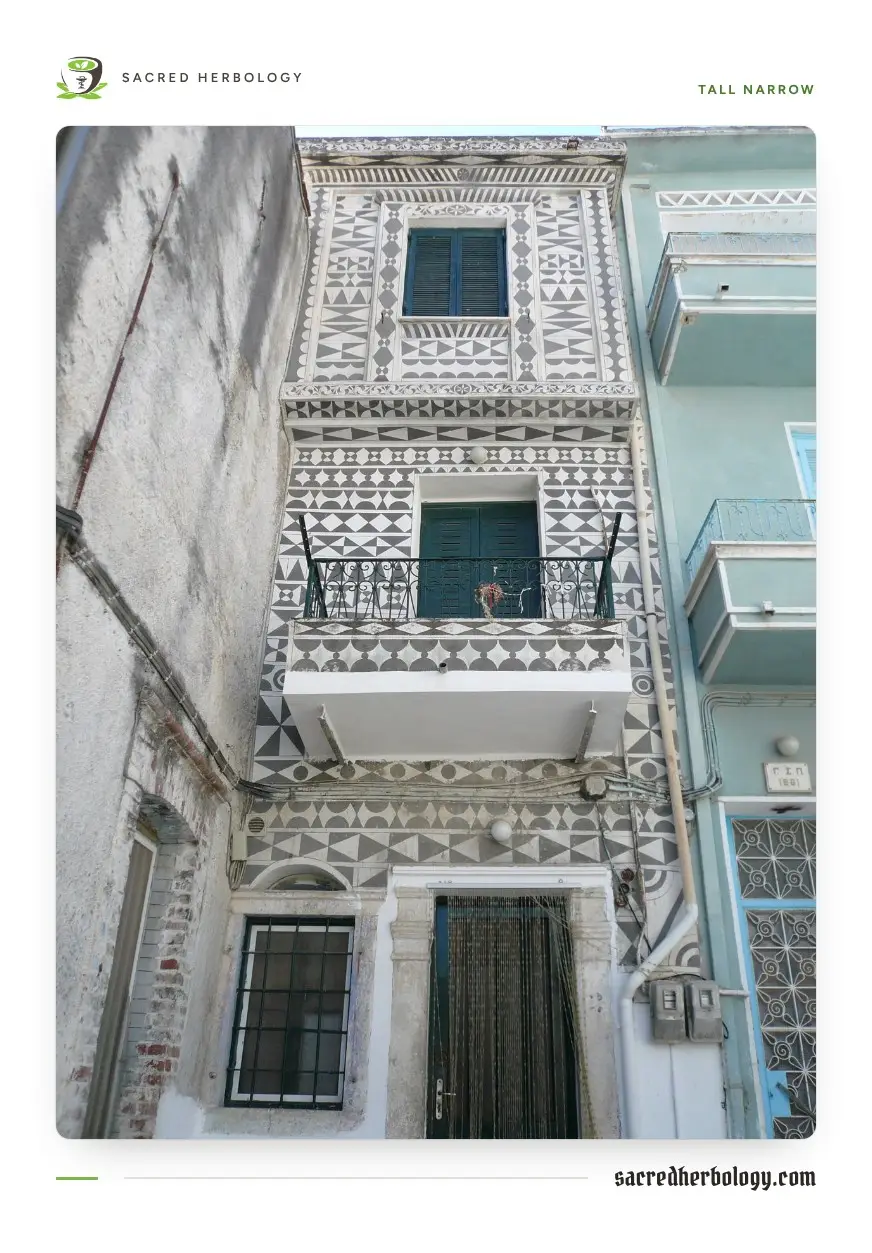
Two of the villages are worth a drawing of their own. Mesta is a fortified village of the Genoese period, built so that the outer walls of the houses form a continuous defensive wall, with a maze of narrow vaulted lanes inside and only a few gates. It was built to protect the mastic and the people who made it from the pirates who raided the Aegean for centuries. Pyrgi, the largest of the mastic villages, is famous for its xysta, the scratched black-and-white geometric patterns that cover the fronts of its houses. Plaster is laid on, coated with a pale lime wash, and then scratched through in bands of triangles, circles, zigzags and leaves, so that whole streets look as if they have been dressed in patterned cloth.

A year in a mastic grove
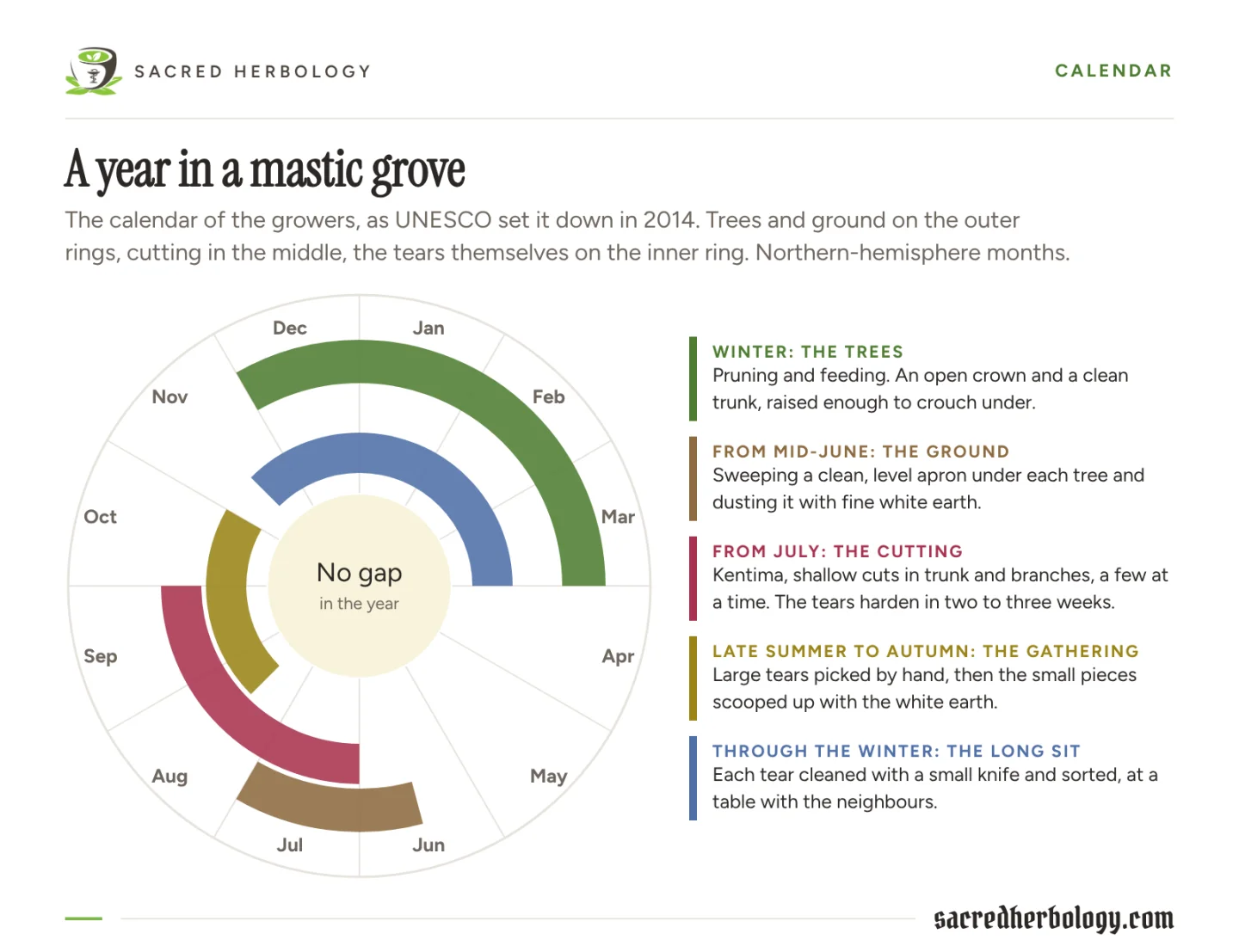
In 2014 UNESCO added “the know-how of cultivating mastic on the island of Chios” to its list of the intangible cultural heritage of humanity. The description it gives is a calendar, and the calendar is worth walking through month by month, because it explains why mastic has always been expensive. Nothing about it can be hurried.
Winter is for the trees. Through the cool, wet months the men of the family have traditionally pruned the shrubs, fed them, and kept the groves in order. The aim is a tree with an open crown and a clean trunk, raised just enough off the ground to let a person crouch and work beneath it.
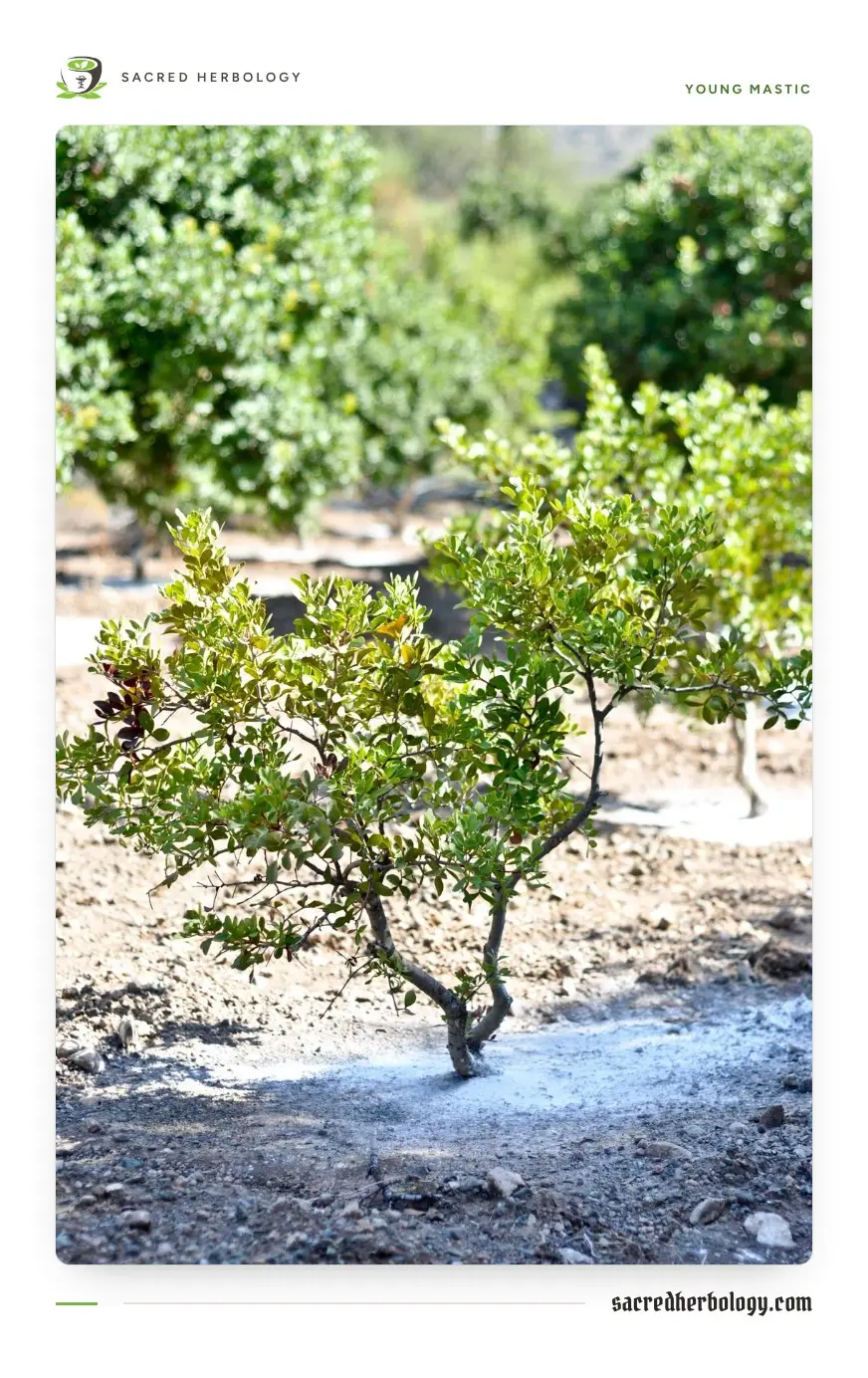
Early summer is for the ground. From about the middle of June, the women of the family sweep and level the soil under each tree, clearing every leaf, twig and stone, until there is a smooth, flat, clean apron of earth around each trunk. Then, in the traditional practice, this apron is sprinkled with a fine white earth, a calcium carbonate clay. The white bed reflects the sun up into the tree, keeps the resin clean when it drips, and makes it easier to see and gather. A grove prepared like this looks strange to an outsider: dark, glossy, low trees standing on neat white circles in the red-brown soil, like plates set out on a tablecloth.

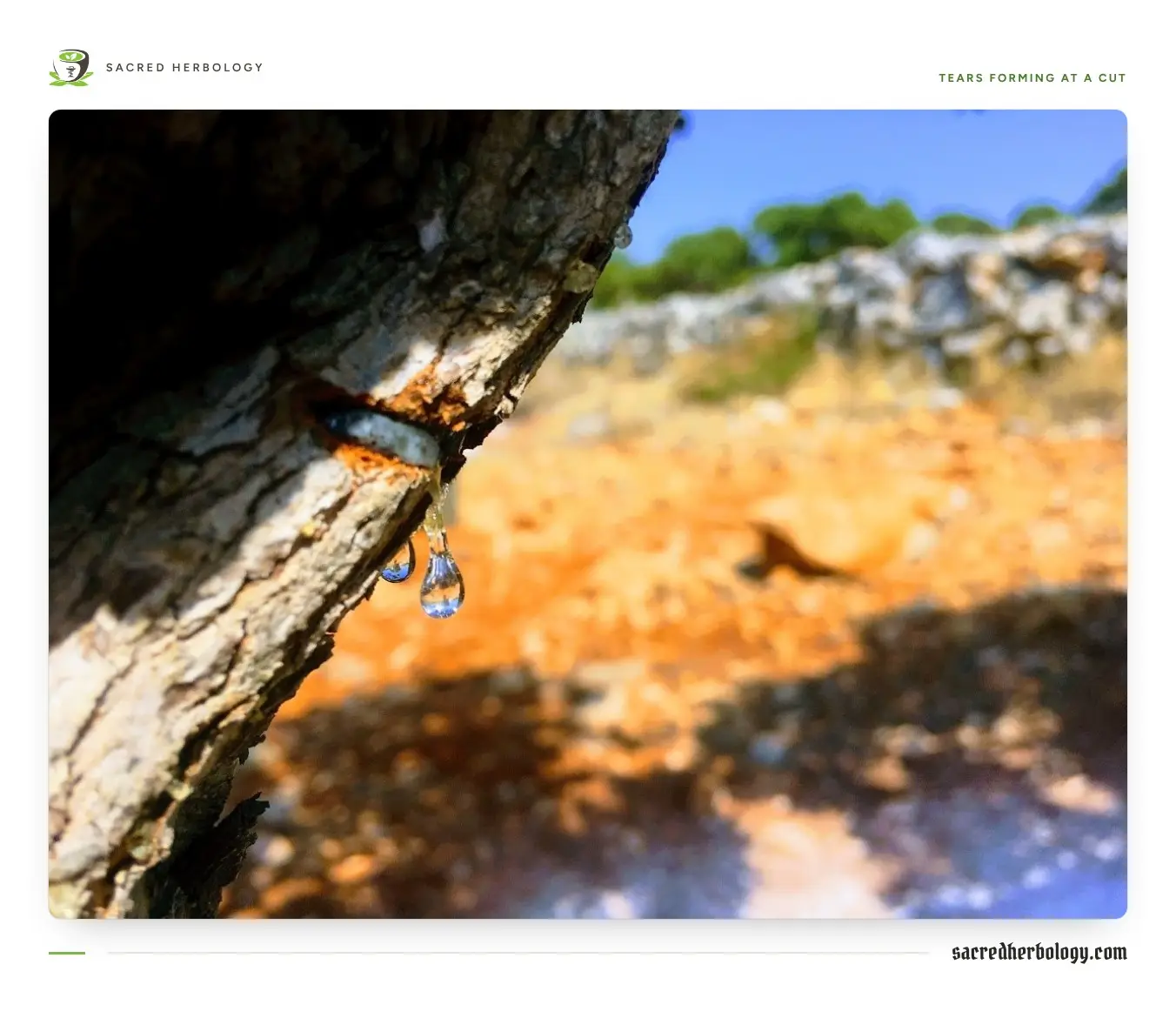
From July the cutting begins. Using a small, sharp iron tool, the grower makes shallow cuts into the bark of the trunk and the main branches. The cuts are made in a rhythm across the season, a few at a time, working round the tree, and the work is called kentima, a word with the sense of embroidery or needlework. That is a fair description of what an old mastic trunk looks like after decades of it, covered in a fine pattern of healed scars.
Within hours of a cut, the tree begins to weep. A clear, sticky liquid beads at the wound and runs down. Some of it hardens on the bark in elongated drops. Some falls to the white earth below and dries there into flattened pearls. In the heat it takes something like two to three weeks to harden enough to collect. The large, clean tears that have hardened on the bark or fallen in round drops are the prize.

Late summer and early autumn is the gathering. The women pick out the larger tears first, by hand, and then the smaller pieces and the fragments mixed with the white earth are scooped up to be sorted later. Everything is washed and left to dry, then stored in wooden boxes in a cool place, because mastic softens and sticks together in the heat.
Then comes the long sit. Through the following winter, families gathered at home to clean the mastic, tear by tear, with small knives, scraping away grit and earth and sorting the pieces by size and clarity. UNESCO’s description makes the point that this work is social. It brings neighbours together, keeps networks of mutual help alive, and passes the old stories along with the techniques. Plenty of people on the island learned their family history and their village’s stories at a table covered in mastic.
Set the tasks round a circle of the twelve months and they close up: pruning and feeding in winter, ground-clearing in June, cutting from July, gathering through late summer and autumn, cleaning through the winter. It is a year with no gap in it.
A gum for chewing, a tree for the weather
The Greek word mastiche is very old, and most dictionaries connect it with the Greek verb for gnashing the teeth or chewing, the same root that gives us masticate. Some etymologists are cautious about which way the borrowing ran, and whether the resin was named for chewing or chewing for the resin, so I’ll leave it at this: in Greek, the name of the gum and the act of chewing sit side by side, and for most of history people chewed mastic as much as they burned it.
The Greeks and Romans knew exactly where the best of it came from. Dioscorides, the Greek army physician whose herbal of the first century CE shaped European pharmacy for fifteen hundred years, writes about the lentisk and its resin in the first book of his De materia medica and gives the palm to the resin of Chios, the clear, pale, fragrant kind. Pliny the Elder, in the twelfth book of his Natural History, agrees that the white mastic of Chios is the most prized. He also complains, as he always does, about the cheats: mastic, he says, was bulked out with cheaper resins and with whatever else the dealers could get away with.
The Romans had another use for the lentisk, and this one is the wood. A lentisk twig, sharpened, made the best toothpick, and polite Roman diners used them after meals. The epigrammatist Martial has a two-line poem in his fourteenth book, a collection of tags written to go with gifts at the Saturnalia, for a toothpick: lentisk is best, he says, but if you can’t get a leafy point, a quill will clean your teeth. Elsewhere he mocks a man who picks his teeth with lentisk to show off when he has hardly any teeth left. It is a nice glimpse of the shrub as an ordinary household thing, with no religion in it at all.
And the lentisk was a weather plant. In the Greek countryside the shrub’s flowering and fruiting were read as signs for the farming year. The poet Aratus, in his Phaenomena, a verse treatise on the stars and weather signs written in the third century BCE, tells the farmer to watch the lentisk: it bears fruit three times a year, and each crop marks a ploughing season, so that a good first crop means a good early ploughing and so on through the three. It is country lore in the plain sense, knowledge about seasons, set down in polished verse by a learned poet, and it is a good reminder that the shrub mattered to people who never chewed a tear of Chian gum in their lives.
Under the mastic tree: Susanna and the elders
The lentisk has one moment of fame in the Bible, though you won’t find it in most Protestant Bibles. It comes in the story of Susanna, one of the additions to the book of Daniel that survive in Greek and are counted as scripture by the Catholic and Orthodox churches and set among the Apocrypha by most Protestants.
The story is a courtroom drama, and a good one. Susanna is the beautiful, devout wife of a wealthy Jew in Babylon. Two elders who serve as judges spy on her as she bathes in her garden, try to force themselves on her, and when she refuses they accuse her in public of adultery with a young man under a tree. She is condemned to death. Then a young man named Daniel stands up in the crowd, insists on questioning the two elders separately, and asks each of them the same simple question. Under which tree did you see them together?
The first elder says: under a mastic tree, a schinos. Daniel replies that the angel of God will cut him in two, and the Greek verb he uses, schisei, echoes schinos. The second elder says: under an evergreen oak, a prinos. Daniel replies that the angel will saw him in two, and the verb, prisai, echoes prinos. The two stories don’t match, the elders are condemned, and Susanna goes free. It is the first detective story in the Bible, and it turns on a mastic tree.
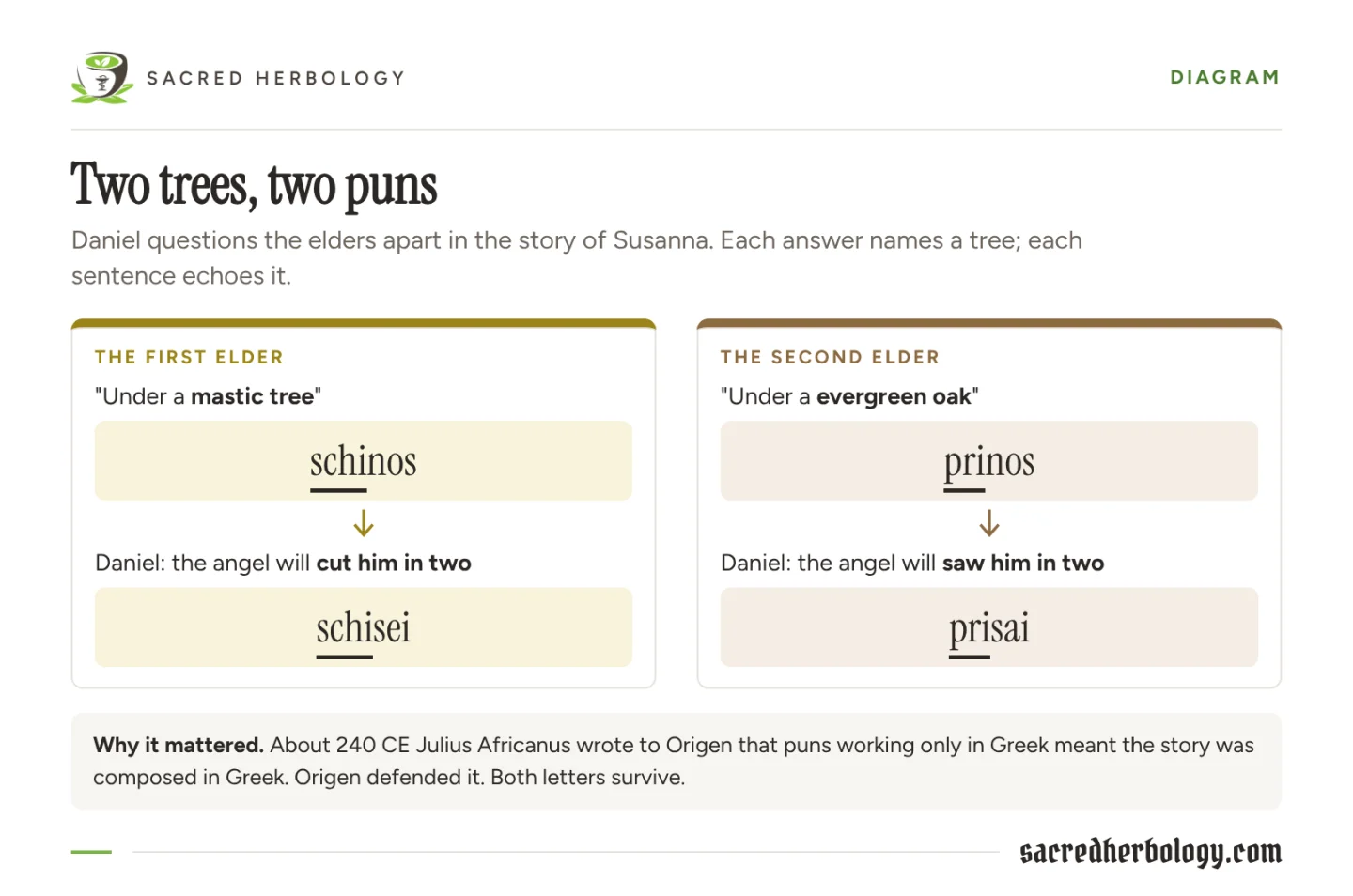
Those puns started an argument that still interests scholars. Some time around 240 CE, the Christian scholar Julius Africanus wrote a short letter to Origen of Alexandria, the greatest biblical scholar of the day, arguing that the story of Susanna could not be genuine scripture. His reason was the puns. They work only in Greek, he pointed out, so the story must have been composed in Greek, and could never have been part of the Hebrew book of Daniel. Origen wrote a long and learned reply, defending the story, and said among other things that he had asked Jewish scholars what the Hebrew names of the two trees would be, and they could not tell him. Both letters survive and both are in English in the standard collections of the early Church Fathers.
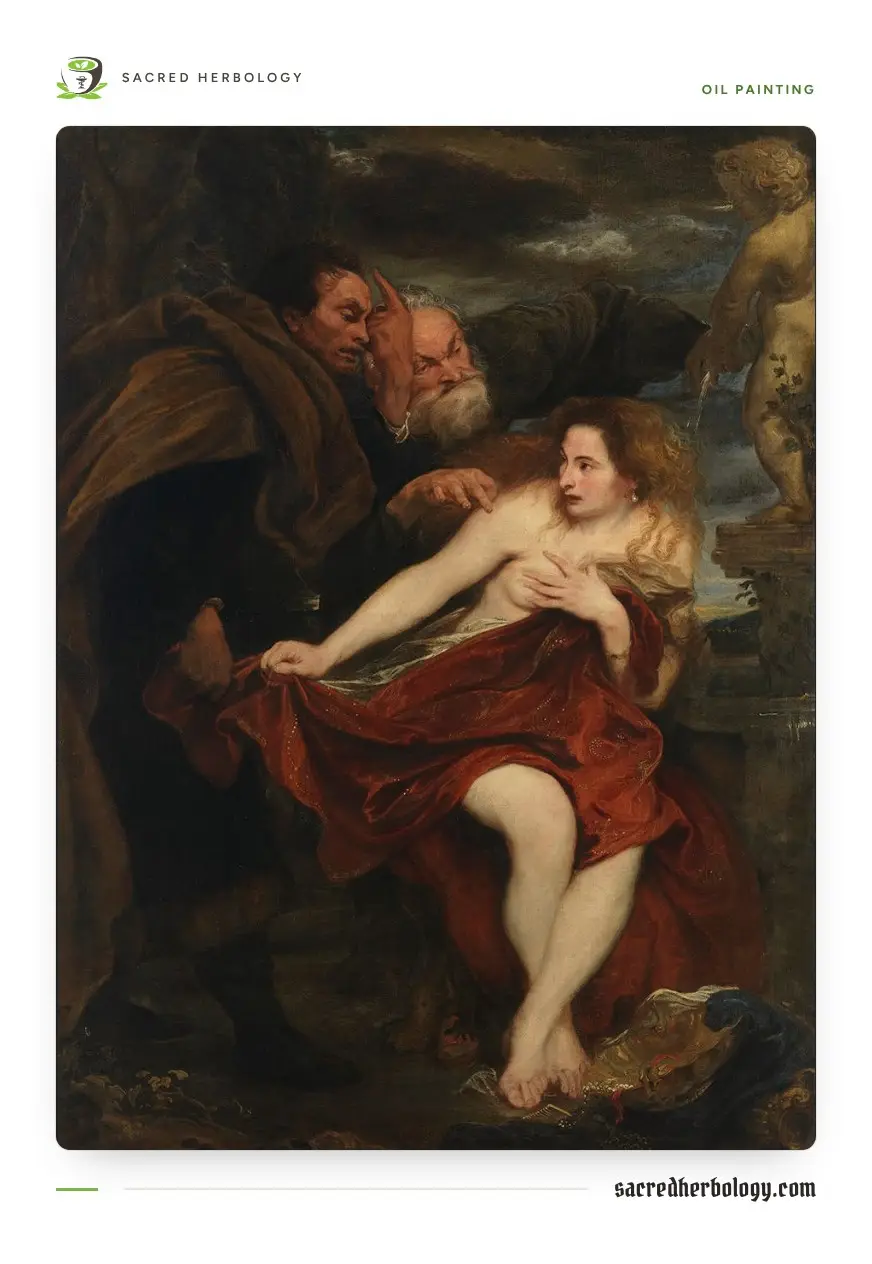
Whatever you make of the argument, there is something pleasing about it. The two great scholars of the third century were arguing over scripture by way of the name of a scrubby Mediterranean bush. The old painters loved the story: the elders peering through the leaves at Susanna in her garden is one of the most painted scenes in European art, and in some of the paintings you can just make out a lentisk among the shrubs.

There is one more possible mastic in the Hebrew Bible, and I’ll give it to you as a possibility only. In Genesis, the merchants who buy Joseph from his brothers are carrying spices, balm and myrrh down to Egypt, and later Jacob sends his sons to Egypt with gifts of “a little balm, a little honey, spices and myrrh, nuts and almonds”. The word translated “nuts” in that verse is generally read as pistachios, which is firm ground. The word translated “balm”, tsori, is not. Some scholars have identified it with mastic or another Pistacia resin, others with the balsam of Gilead, others with something else again. Nobody can settle it, and I won’t pretend to.
Resin in the holds: the Bronze Age trade
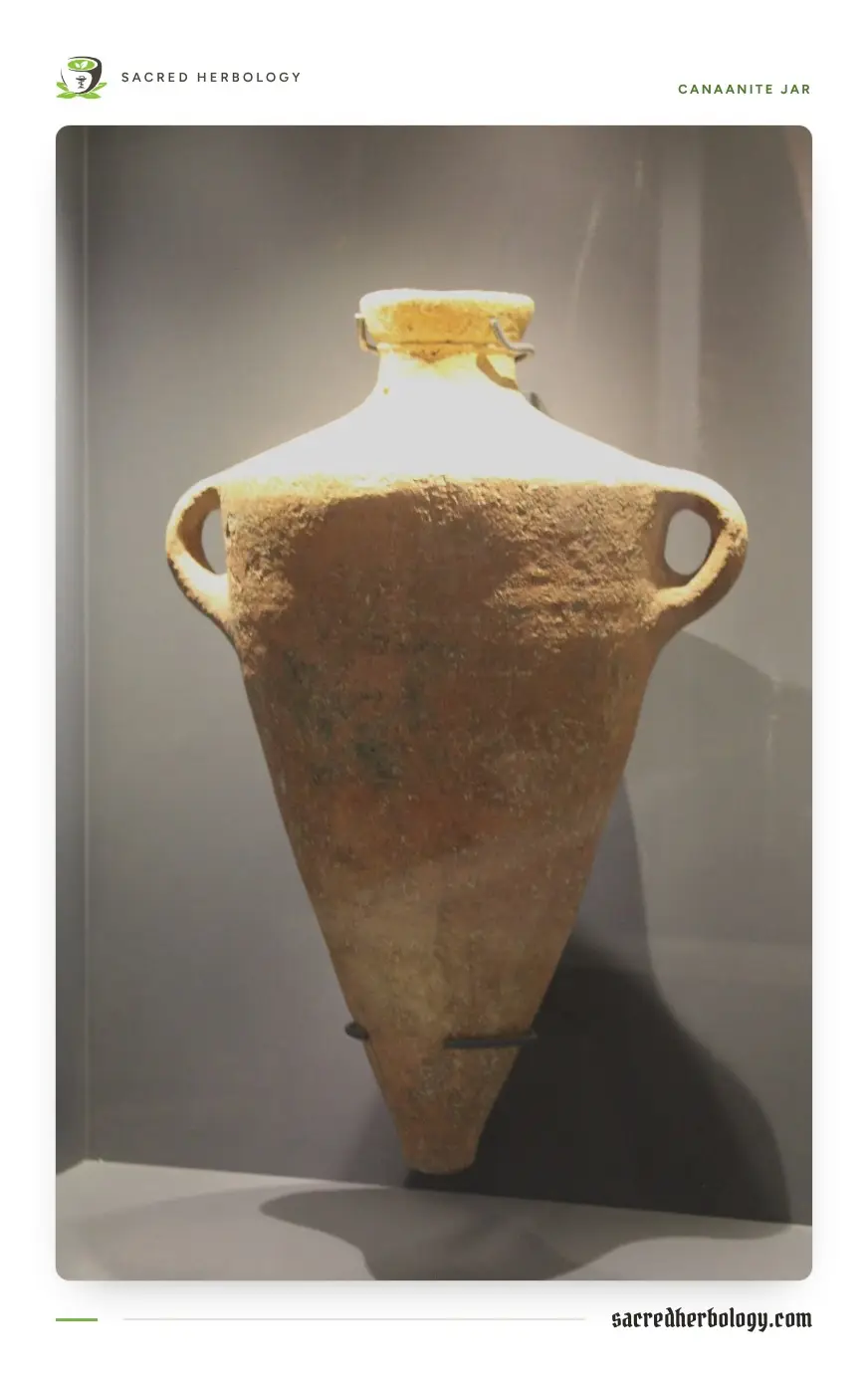
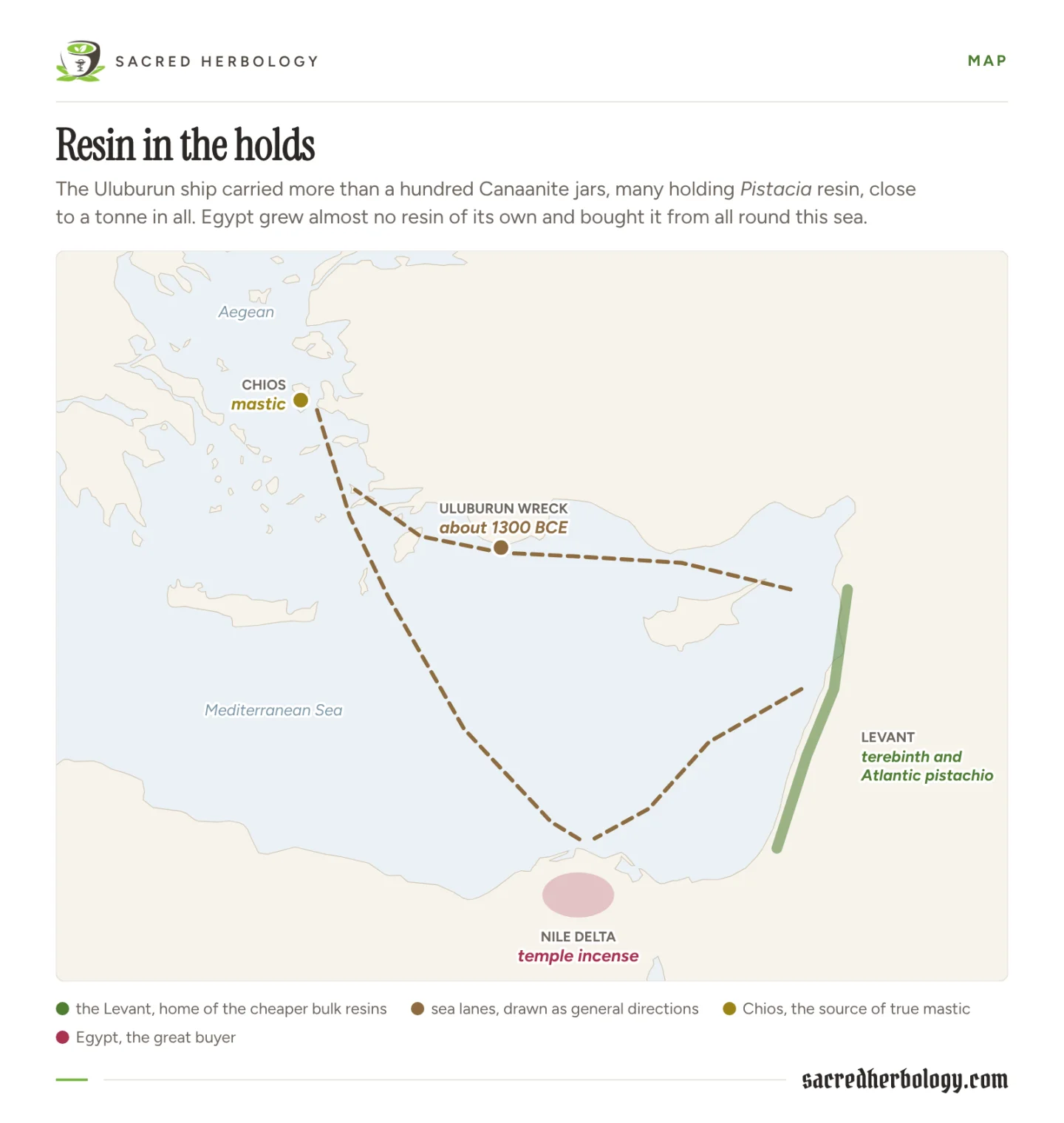
The trade in Pistacia resins is far older than the Greeks. In 1982 a sponge diver found the wreck of a Late Bronze Age merchant ship off Uluburun on the south coast of Turkey, dating to around 1300 BCE. Among its copper ingots, glass, ivory and gold was a cargo of more than a hundred Canaanite storage jars, and chemical analysis showed that many held resin from a Pistacia tree, close to a tonne of it in all. The analysis pointed to terebinth or Atlantic pistachio resin, the cheaper bulk resins of the Levant. Chian mastic it was not. Still, it shows how much Pistacia resin was moving round the eastern Mediterranean three thousand years ago, and where it was going: south, to Egypt.

Egypt was a huge consumer of aromatic resins and grew almost none of its own. The temples burned incense every day. The embalmers used resins in mummification. One of the commonest Egyptian words for incense, senetjer, has been the subject of a long scholarly argument, and some Egyptologists have proposed that it often meant Pistacia resin, on the grounds that resin found in temple and tomb contexts so often turns out, on analysis, to come from these trees. Others are less sure. It is an open question and an interesting one.
Mastic itself, the Chian resin, turns up in the later Egyptian incense recipes, the kyphi formulas written on the temple walls in the Ptolemaic period, and in the ingredient list that Plutarch gives for kyphi. That story has been told on its own in this Journal, so I’ll only note that by the time the Greeks were writing about Egyptian incense, mastic was a standard part of the Egyptian priest’s store cupboard.
The jars themselves are worth a look. A Canaanite jar is the tall two-handled amphora of the Levant, with a narrow pointed foot, and the resin travelled packed inside it along the sea lanes that ran from the Levantine coast and the Aegean down to the Nile Delta.
Genoa’s island: the Maona of Chios
Mastic made Chios rich, and riches attract owners. For most of the Middle Ages the island belonged to the Byzantine Empire. In the fourteenth century it was taken by the Genoese, and from 1346 to 1566 it was run by an extraordinary institution called the Maona of Chios.
The Maona was, in plain terms, a company. A group of Genoese merchants had financed a fleet to seize the island, and the Republic of Genoa, unable to pay them back, handed them the island and its revenues instead. The shareholders merged their family names into one, the Giustiniani, and for two centuries the Giustiniani ran Chios as a business. The single most valuable thing they owned was the mastic.
They ran it as a monopoly. Every tear the villagers harvested had to be handed over to the Maona at a fixed price, and the company sold it on at a large mark-up across the Mediterranean, the Black Sea and the Levant. The cultivation was regulated, the harvest was counted, and selling or smuggling mastic outside the company was a serious crime. The fortified villages like Mesta date largely from this period. They protected the growers from pirates, and they also kept the harvest in one place where it could be watched.
The great historian of this period was Philip Argenti, himself from an old Chiot family, whose three-volume history of the Genoese occupation of Chios was published by Cambridge University Press in 1958 and remains the standard work. If you want to know how the mastic monopoly worked, down to the officials and the account books, Argenti is the place to look.
The Maona ended in 1566 when an Ottoman fleet under Piyale Pasha took Chios without a fight. The Giustiniani were deported, and the island passed to the sultans. The mastic did not change hands so much as change masters.
Sakız: the sultan’s gum
In Turkish, mastic is sakız, and Chios is still Sakız Adası, Mastic Island. Under the Ottomans the island kept a large measure of local self-government, and the mastic villages in particular were given privileges. In return for supplying a fixed quantity of mastic to the imperial court each year, the growers had their own rights, and they were spared some of the burdens laid on other subjects. The mastic went to Constantinople, and a good deal of it to the palace.
The image that later writers loved was the harem: the women of the Topkapı Palace chewing mastic to sweeten their breath and whiten their teeth. Some of that is the decoration that European travellers put on everything Ottoman. But mastic was certainly chewed across the Ottoman world, by men and women alike, and it was used to flavour sweets, puddings, drinks and bread, and to perfume the air. It was a luxury, and the sultan’s personal share made it a mark of favour too.
Then came 1822. In the spring of that year, during the opening phase of the Greek War of Independence, a force from neighbouring Samos landed on Chios to raise the island against the Ottomans. Most Chiots had not asked for it, and the rising was a disaster. An Ottoman fleet and army retook the island and carried out the massacre that horrified Europe. Tens of thousands of people were killed, and tens of thousands more were taken and sold as slaves. The numbers are still argued over, but every account agrees that the island lost most of its population in a few months.
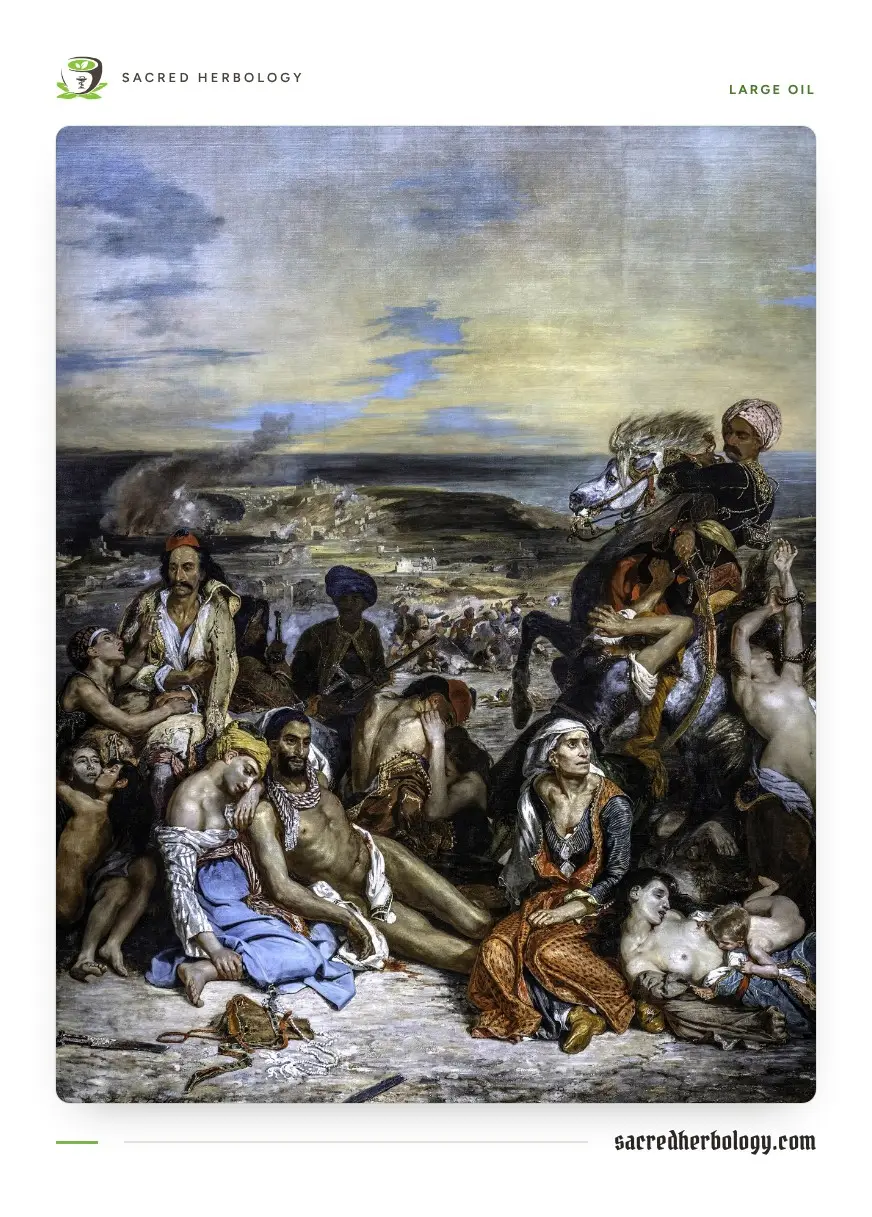

The mastic villages, by most accounts, came off far better than the rest of the island. The usual explanation is that the Ottoman authorities protected them because the mastic revenue went to Constantinople, and destroying the growers would have destroyed the income. How fully they were spared, and on whose orders, is a question for the historians of the massacre, and the sources are not perfectly clear. But the tradition on the island is that the mastic saved them. If that is right, a resin chewed in palaces bought the lives of the people who made it.
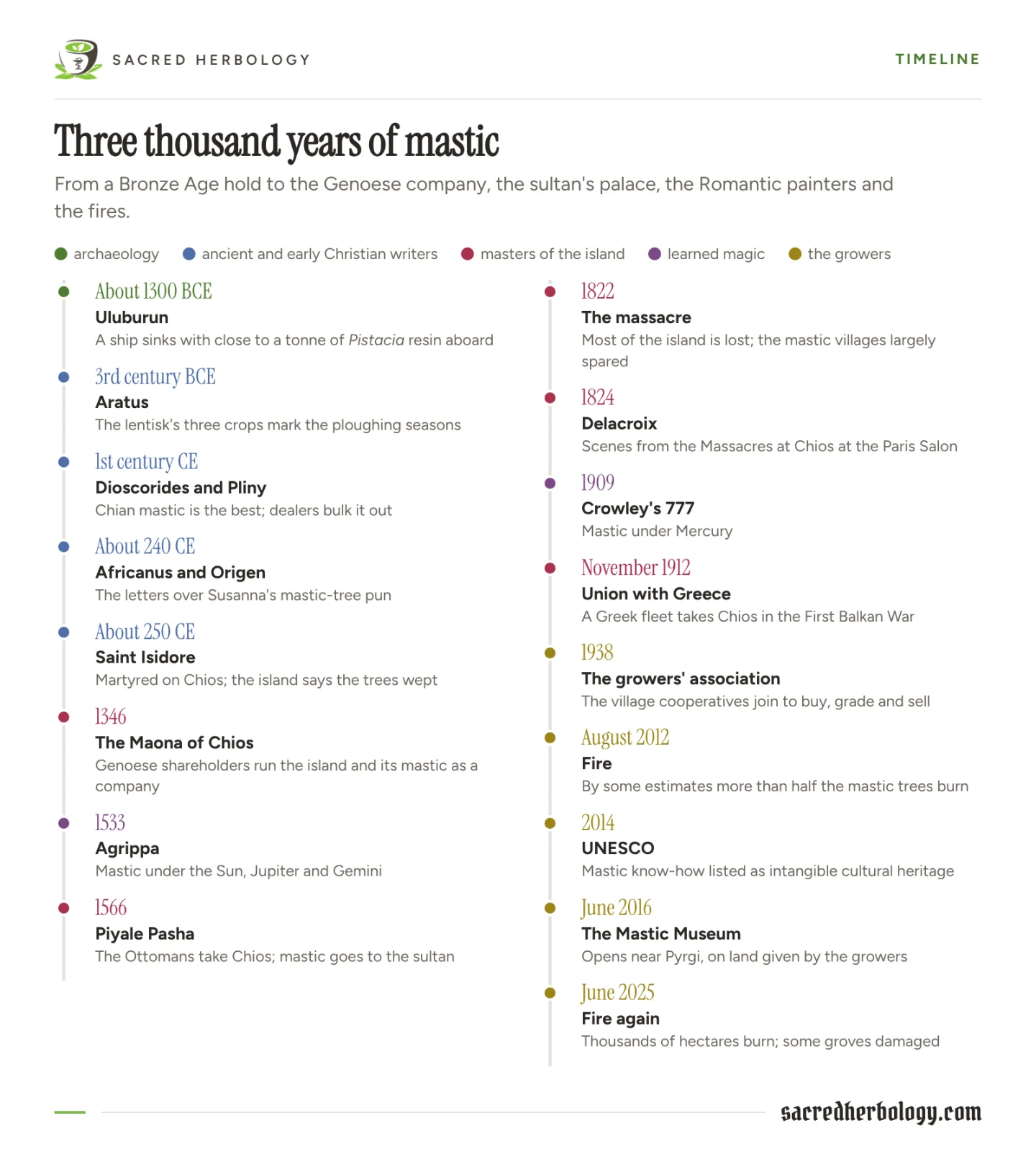
The massacre became one of the great causes of Romantic Europe. Eugène Delacroix exhibited his enormous painting Scenes from the Massacres at Chios at the Paris Salon of 1824; it hangs now in the Louvre. Victor Hugo opened one of the poems of Les Orientales (1829) with the line that the Turks have passed this way, and everything is ruin and mourning, and set it on Chios. The island’s modern story runs from the Maona in 1346, through the Ottoman conquest in 1566, to the massacre of 1822 and Delacroix’s canvas of 1824, and then to November 1912, when a Greek fleet took Chios during the First Balkan War and the island became part of Greece.
The weeping trees of Saint Isidore
The growers have their own explanation for why the trees of southern Chios weep and the others don’t, and it belongs to village custom, the island’s own story about itself, set alongside the Church’s account of a saint.
Saint Isidore of Chios is honoured by the Orthodox Church as a martyr of the third century. According to his published life, he was an Egyptian from Alexandria, an officer serving with the Roman fleet, which was anchored off Chios during the persecution under the emperor Decius, around 250 CE. When it was discovered that he was a Christian, he refused to sacrifice to the Roman gods, was tortured, and was beheaded. His body was thrown into a well, and two Christians, Ammonios and Myrope, are said to have recovered it and buried it in secret. The Orthodox Church keeps his feast on 14 May.
The village story attaches to the place where he died. The trees there, the island tradition says, wept fragrant tears for the martyr’s suffering, and ever since only the trees of that part of the island give mastic. The story is told in the groves, and the Orthodox lives of the saint repeat it as a local tradition. As history, it is a pious tale about a saint, and botanists would point you back to selection, soil and summer. As a village story, it is lovely. It turns the tears of the trees into tears of grief, and gives the growers’ daily work a sacred meaning.
Mastic does have a real place in Orthodox worship, though a modest one. It has been among the aromatics used in the preparation of the holy myron, the chrism of the Orthodox Church, which the Ecumenical Patriarchate in Constantinople prepares at long intervals from olive oil and dozens of aromatic substances, with prayers over many days. The exact composition varies from one preparation to the next, and I won’t pretend to give you the list. It is enough to know that the gum of the sultan’s island also went into the Patriarch’s oil.
Mastic in the learned magic
The magicians of the Renaissance knew mastic well, because it was one of the costly aromatics of the apothecary’s shelf, and they put it into their systems of correspondence. This section is esoteric material: the learned magic of the books and the tables of the occult orders, set out on its own terms. None of it is a claim you could test, and I report it as what these writers believed.
The interesting thing is that they could not agree where mastic belonged. Heinrich Cornelius Agrippa, in the first book of his Three Books of Occult Philosophy (1533), puts it under the Sun among the precious aromatics, and again under Jupiter among the sweet, fortunate things. In his table of the zodiac fumes, he gives it to Gemini. The translated Arabic magic of the Picatrix gives it to the Sun as one of the “seven aromatics”. Then, almost four centuries later, Aleister Crowley’s book of tables, 777 (1909), drawing on the Golden Dawn’s teaching, puts mastic under Mercury, with white sandalwood, mace and storax and “all fugitive odours”, which means the light, quickly vanishing scents.
So the same tear has been given to the Sun, to Jupiter, to Mercury and to the sign of the Twins. Set in a column, they read: Agrippa, Sun and Jupiter, Gemini by sign; Picatrix, Sun; 777, Mercury. Each choice has its own logic. To the older writers, a clear, golden, fragrant and costly resin was solar by nature, and its sweetness and good reputation made it a Jupiter thing too. To the Golden Dawn, which thought in terms of the qualities of planets, a sharp, light, quickly fading pine-lemon smell suited the quick, airy planet Mercury, and Gemini is Mercury’s own sign, so in a way the later system picks up the thread that Agrippa’s zodiac list had already pulled.
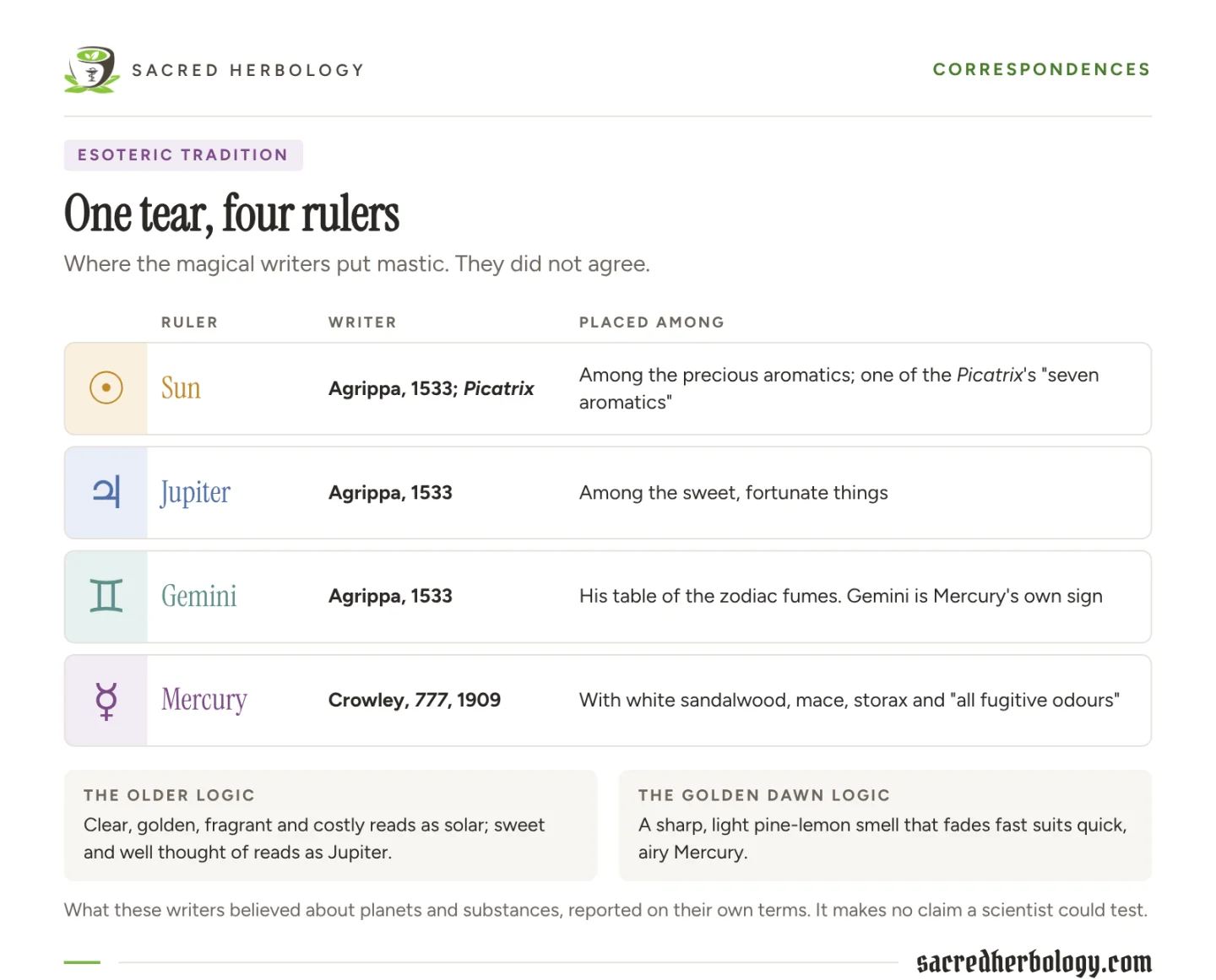
It is a useful lesson in how these systems work. The correspondences are a language, built up over centuries by writers who copied, adapted and argued with each other. They are a map of how learned magicians thought the world hung together, and they don’t all draw the same map. If you burn mastic in an esoteric working today, you are choosing which of those writers to follow.
Varnish, gum and liqueur
Outside the temple and the magical circle, mastic has had a busy working life.
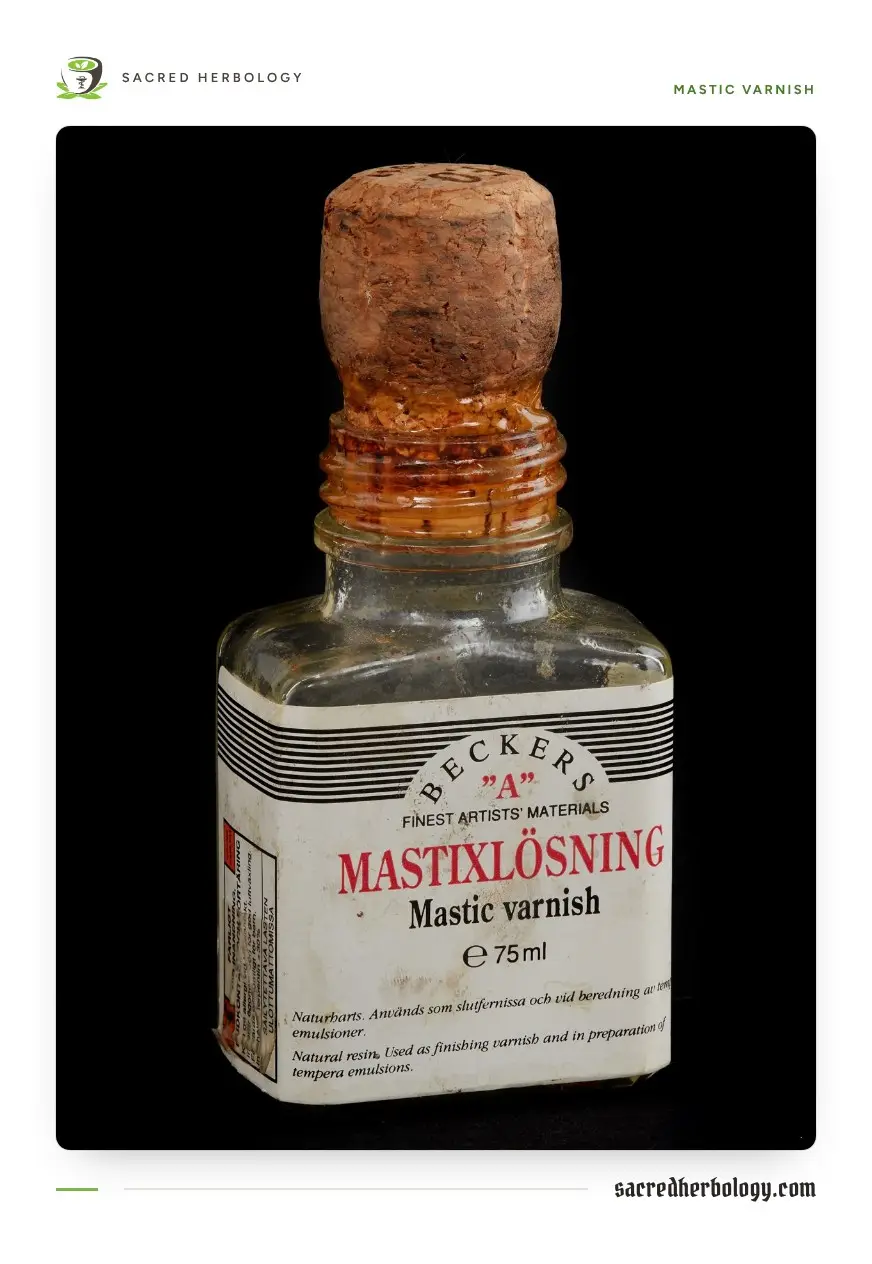
Painters used it for centuries. Dissolved in turpentine, mastic makes a clear, glossy varnish that brings up the colours of an oil painting beautifully, which is why it was the standard picture varnish of European painting for a very long time. The trouble is that it yellows and darkens with age, and in time turns brittle and blooms with a whitish haze. Much of the brown, treacly look of old paintings in galleries is aged varnish, and a good deal of that varnish was mastic. Restorers spend their careers taking it off. In the eighteenth and nineteenth centuries painters also mixed mastic varnish with linseed oil to make a buttery painting medium called megilp, which handled beautifully and aged badly; it is blamed for the cracking and darkening of a number of paintings of that period. The standard artists’ handbooks of the twentieth century, Ralph Mayer’s among them, describe mastic varnish fondly and warn about it in the same breath.

As a chewing gum, mastic is the ancestor of every packet at the supermarket checkout, at least in spirit. The modern chewing gum industry grew from other resins and latexes, above all the chicle of Mexico and Central America, but mastic was the Old World’s chewing gum for two thousand years and more, and on Chios and across Greece and Turkey people still chew it in its natural form, and in modern gums flavoured with it.
As a flavour, mastic is all through the cooking of the eastern Mediterranean and the Middle East. In Greece it goes into festive breads, especially the sweet Easter bread, into loukoumi, and into a clear spirit called mastiha. In Turkey it flavours the stretchy ice cream of Kahramanmaraş and many puddings and sweets. In Lebanon, Syria and Egypt it goes into milk puddings, ice creams and some savoury dishes. Chios mastic is protected under European Union law as a product with a protected designation of origin, and the name of the liqueur is protected too. I won’t give you any recipes; the point is simply that mastic has never been only a temple substance. It has always been part of daily life.
What is in a tear
The chemistry of mastic explains both its smell and its strange chewiness.
The smell comes from the essential oil, which makes up only a small part of the resin, usually around one to three per cent. Most of that oil is alpha-pinene, the same molecule that gives pine needles and turpentine their smell, and in many samples it accounts for well over half of the oil. Behind it come myrcene, beta-pinene, limonene and a long tail of minor compounds. That composition is why mastic smells like a pine forest with a squeeze of lemon. Drawn out, the alpha-pinene molecule is two rings folded together like a little bicycle frame.
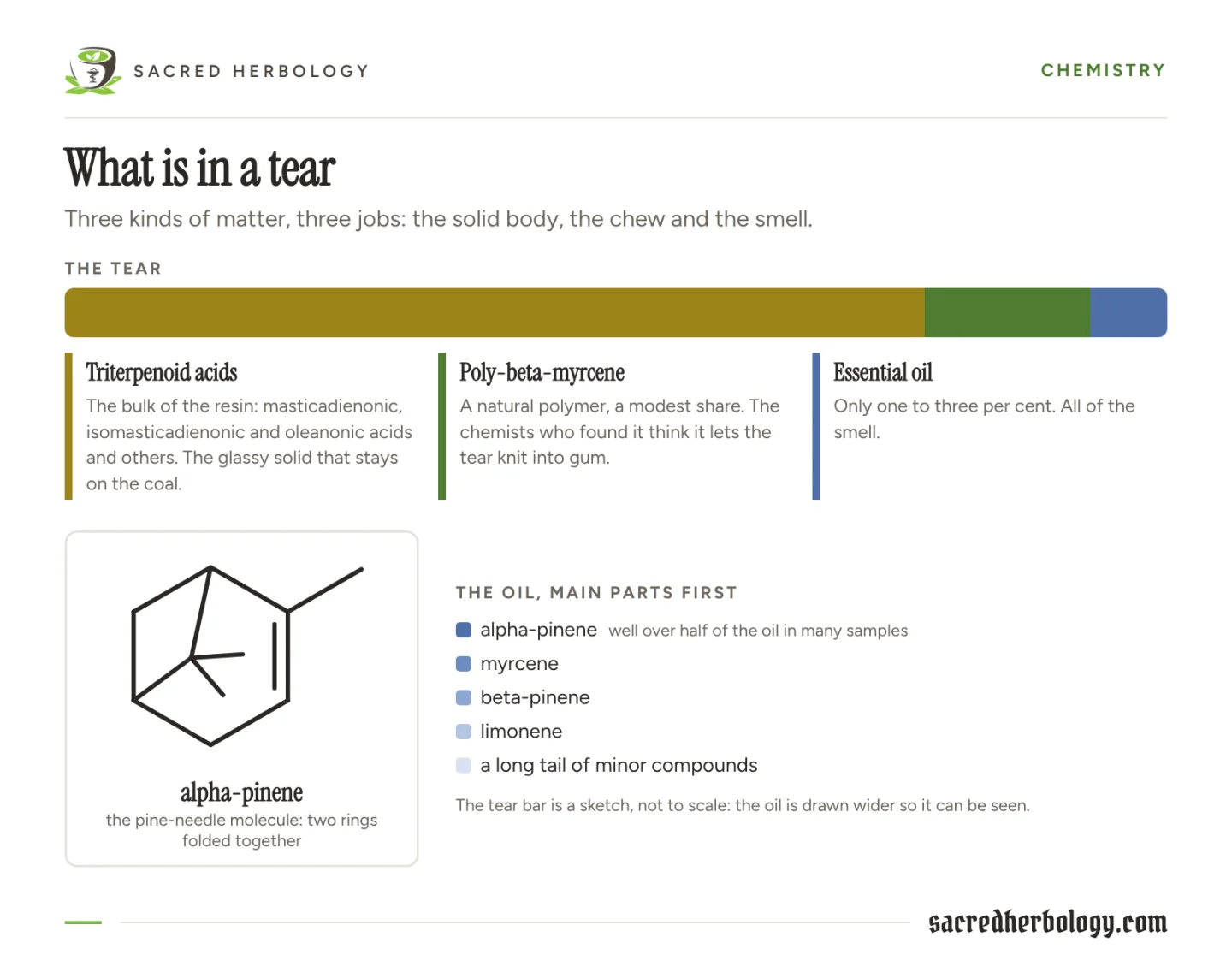
The bulk of the resin is made of larger molecules called triterpenoids, chiefly a group of acids with names such as masticadienonic and isomasticadienonic acid, along with oleanonic acid and others. These are the solid matter of the resin, the part that hardens into the glassy tear and that lingers on the coal after the oil has burned off.
The chewiness comes from something unusual. Mastic contains a natural polymer, a long-chain molecule built of linked units of myrcene, called poly-beta-myrcene. It makes up only a modest share of the resin, and the chemists who identified it think it is what lets the shattered tear knit itself back together in the warmth of the mouth into an elastic gum. Few other resins are known to contain it. Frankincense is chewed too, in Arabia, but it softens in a different way, because it carries a water-soluble gum that mastic lacks, so the two do not behave alike.
Fire, and the work of keeping it going
Mastic has had a hard century. Like everything grown by hand on terraced Mediterranean hillsides, it depends on families willing to do hard, hot work for modest returns, and the young people of Chios, like young people everywhere, have often left for the cities and the ships.
The growers responded early. In 1938 they formed the Chios Gum Mastic Growers Association, a cooperative that brings together the village cooperatives of the mastic country, buys the harvest, grades it and sells it. It still handles the island’s mastic today.
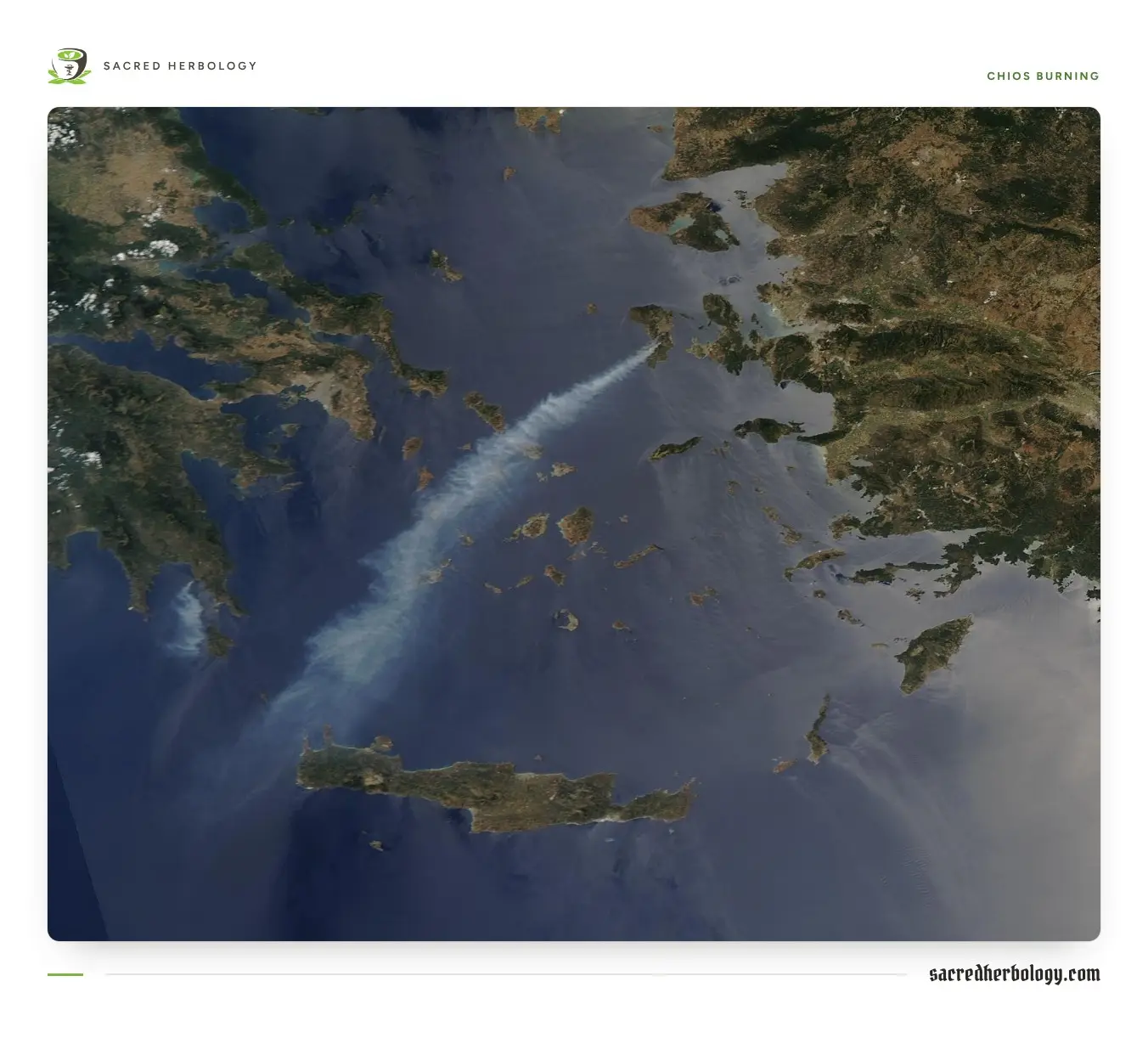
Then there is fire. The Mediterranean summer that suits mastic so well also burns. In August 2012 a wildfire swept through the south of Chios and destroyed a very large part of the mastic trees, by some estimates more than half, and the shortage of resin was felt around the world. A mastic tree cut down by fire can be replaced, but a new tree takes years to come into full bearing, so a fire’s damage runs for a decade. In June 2025 fires broke out again across Chios, burning thousands of hectares and forcing the evacuation of more than a dozen villages. Early reports from the growers said the fires reached the edges of the mastic country and damaged some groves, while officials said the main production areas had been saved. The full count was still coming in when the news moved on.

The island has also set out to tell its own story. In June 2016 the Chios Mastic Museum opened near Pyrgi, on land given by the growers’ association, with exhibitions on the cultivation, the history and the trade. The UNESCO listing of 2014 did the same thing on a larger stage. Both are ways of saying that mastic is a way of life as well as a product, and that if the families stop doing the work, no factory can take it over.
What you are buying
Mastic is sold in grades, and once you know what to look for you can read a bag of tears quite easily.
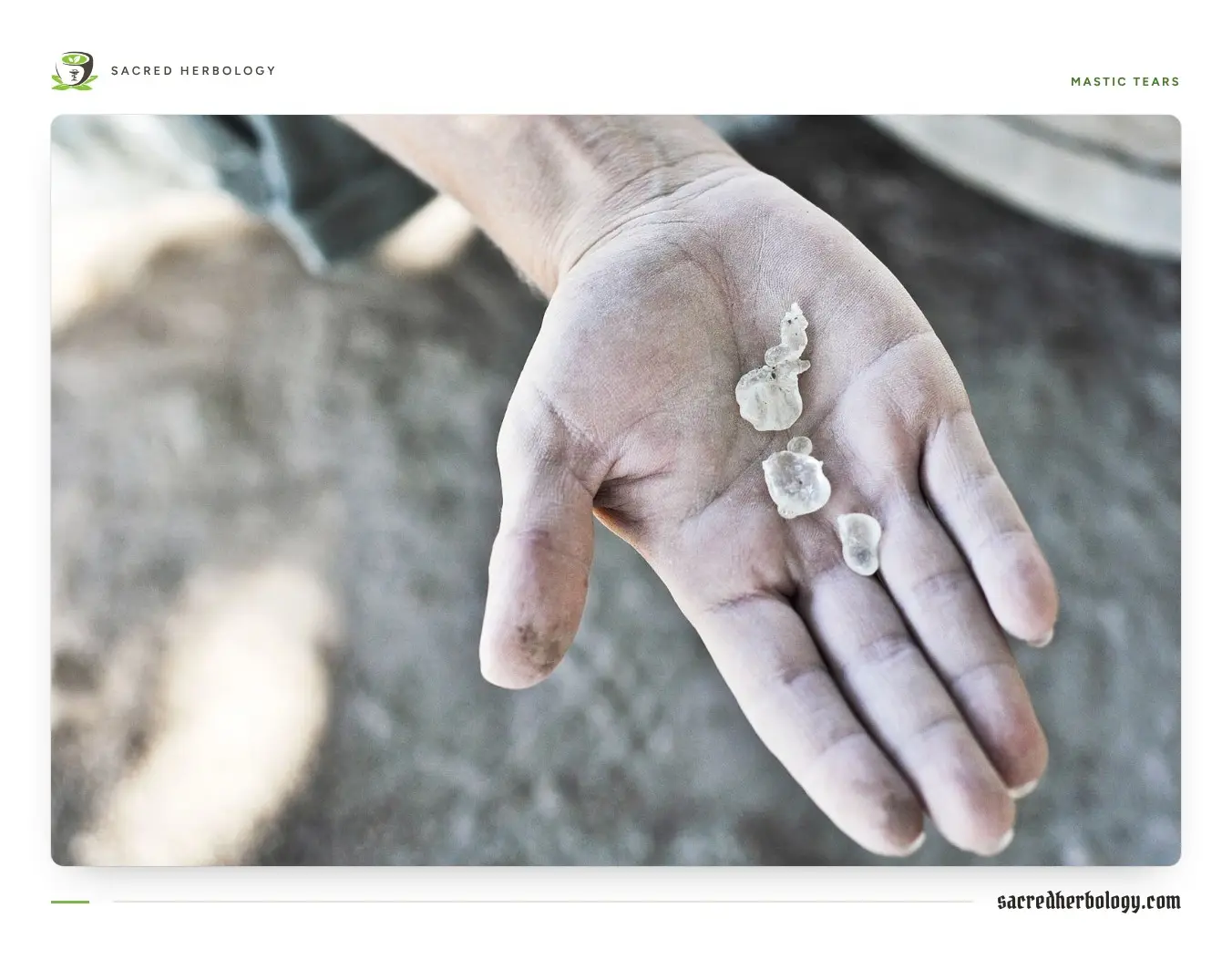

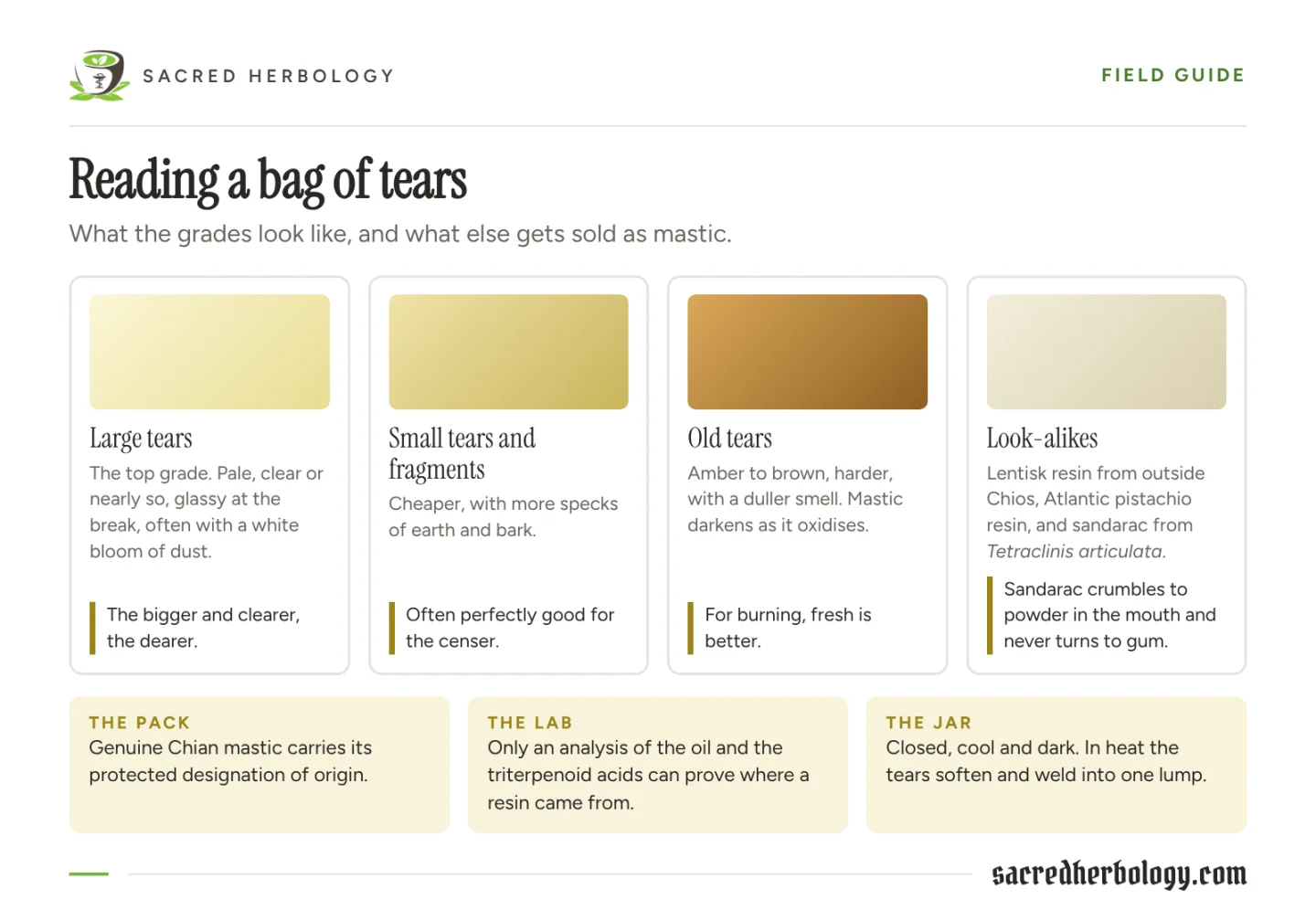
- The large tears are the top grade: pale, clear or nearly clear, glassy when you break one, and often with a fine white bloom of dust on the outside from handling and storage. The bigger and clearer they are, the more you pay.
- Small tears and fragments are cheaper and often perfectly good for the censer, though they may carry more specks of earth and bark.
- Mastic darkens and yellows as it ages and oxidises. A fresh tear is pale lemon; an old one is amber to brown, harder, and smells duller. For burning, fresh is better.
- Real Chian mastic is sold with its origin stated, and the protected designation of origin is printed on genuine packs. Cheaper “mastic” from elsewhere may be resin from other Pistacia trees, which smell different and less clean, or a blend.
- Substitution is an old problem, as Pliny’s complaint shows. The usual stand-ins are lentisk resin from outside Chios, the resin of the Atlantic pistachio, which is chewed in its own right in Iran and Kurdistan, and sandarac, the pale resin of a North African conifer, Tetraclinis articulata, whose tears look much like mastic. The old pharmacy books separated sandarac from mastic by the chew: sandarac crumbles to powder in the mouth and never turns to gum.
- Store tears in a closed jar somewhere cool and dark. In heat they soften and weld into one lump.
The old test on the island is the chew: a genuine tear turns from crumbs into a soft, pale, slightly opaque gum with a bitter pine taste that mellows as it is worked. That is most likely the poly-myrcene at work. The test rules out sandarac and most of the incense resins, but it cannot tell Chian mastic from the resin of other Pistacia trees, some of which chew in much the same way. Only a laboratory can settle that, by reading the pattern of the oil and the triterpenoid acids. For the censer, the look of the break and the clean pine smell on the coal tell you most of what you need, and a pack carrying the protected designation of origin is the best guarantee an ordinary buyer has.
Burning it well
Mastic burns more cleanly and lightly than many resins. It melts quickly and gives a bright, piney smoke without the heavy, sticky weight of benzoin or the sharp green edge of galbanum. On its own it is a quick, fresh incense. Many people burn it with frankincense, where its clean pine note lifts the heavier resin, and the esoteric blends of the Golden Dawn tradition use it as a Mercury note.
- Use a proper charcoal disc in a heat-proof bowl half filled with sand or ash. Light the disc and wait until it is glowing and grey all over before adding anything. Then add a small piece. Mastic melts fast, so a little goes a long way, and too much at once smothers the coal and turns the smoke acrid.
- An electric resin burner or a mica plate over a tealight gives a gentler heat, which suits mastic’s light oil; it releases the scent with less smoke.
- Open a window. Resin smoke is still smoke, full of fine particles, and it can set off an asthma attack. If you have asthma or any other chest or lung condition, keep well back from it or skip it. Keep it away from babies, small children, anyone who is pregnant, and pets, above all pet birds, whose lungs are easily hurt by smoke.
- The charcoal disc gives off carbon monoxide as it burns, which you can’t see or smell. Never burn it in a closed room, a tent or a car, and never leave a lit coal unattended; the disc and the bowl stay hot long after the smoke has gone.
- Handle the tears with dry hands and wash them afterwards. A few people react to mastic on the skin, and since it belongs to the same family as pistachio and cashew, anyone with an allergy to those nuts has good reason to be careful with it.
- Mastic has a long history as a food flavouring, but anything about chewing it or taking it for your health is outside this piece. If you are thinking about using it that way, consult a degree-qualified herbalist with competencies and adequate training in pharmacognosy. If anyone, especially a child, swallows something unexpected from your incense shelf, call the Poisons Information Centre on 13 11 26, or 000 in an emergency.
Growing a lentisk
If you want to keep a mastic shrub, here is what it needs and what to expect from it.
The lentisk is a plant of the Mediterranean maquis. It wants full sun, very good drainage, and long, dry, hot summers. It copes with poor, stony and limy soils, with drought once established, and with salt wind, which is why it grows so well near the sea. It handles light frost but not hard, prolonged freezes. What it dislikes most is cold, wet soil around its roots and long periods of humid, stagnant air, which invite root rot and fungal trouble. A dry, sunny slope, a gravel garden or a big terracotta pot in free-draining mix suits it far better than a lush, watered bed.
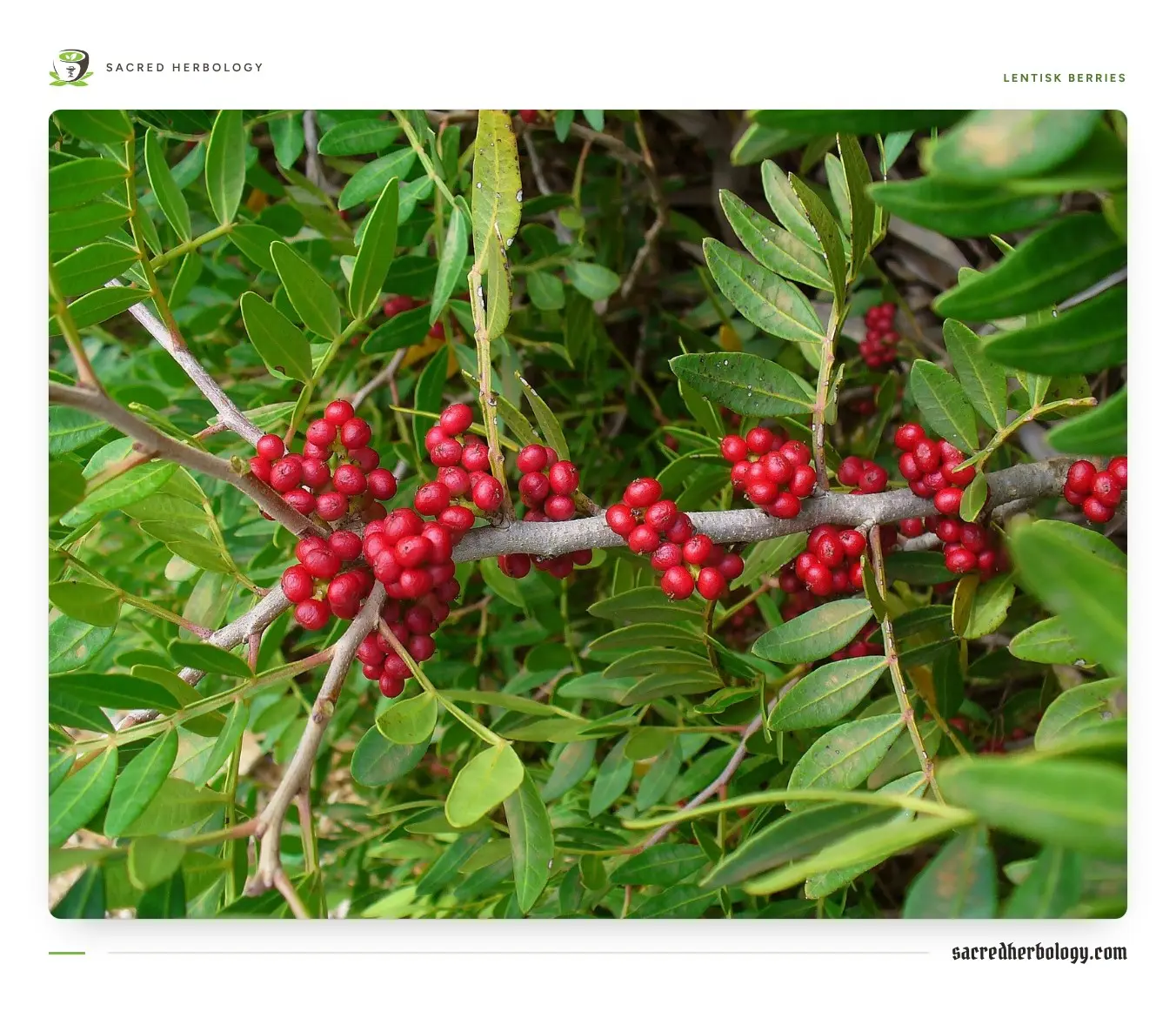

It grows slowly, and it takes clipping well, which is why it has long been used for hedges and topiary in Mediterranean gardens. Its glossy dark leaves and the red-to-black berries on female plants make it a handsome, tough shrub in its own right. Remember that it is dioecious: a lone plant will be either male or female, and you only get berries on a female with a male somewhere nearby.
Be realistic about resin. Outside the old Chian lines, and outside the very particular summers of southern Chios, a lentisk rarely gives much mastic, even when cut. The mastic you buy is the product of centuries of selected clones, careful cutting and a precise climate. Plants sold in Australia are ordinary garden lentisks, and the Chian clones are not something you can easily get; bringing cuttings or seed into the country yourself falls under the federal biosecurity import rules, so check the import conditions before you try. Grow the shrub for its own sake, for its smell when you brush the leaves, for its connection to Susanna’s garden and the sultan’s island. Leave the tears to the growers of Chios.
The tears and the hands
Every tear of mastic you hold has been through a long chain of hands. Someone pruned the tree in winter. Someone swept and whitened the ground beneath it in June. Someone made the cuts in July, a few at a time, in the heat. Someone gathered the tears from the white earth in late summer, and someone sat at a table through the winter scraping each one clean with a small knife and talking to their neighbours while they did it.
The Genoese made a company of that work. The sultans took their share of it for the palace. The painters spread it over their canvases, the magicians argued over its planet, and the island told itself a story about a martyr and weeping trees. Through all of it, the work in the groves went on in much the same way. When you drop a tear on the coal and the room fills with that clean pine smell, that long chain of hands is what you are smelling.
Where this comes from
- Aratus, Phaenomena, in Callimachus, Hymns and Epigrams; Lycophron; Aratus, trans. A. W. Mair and G. R. Mair (Loeb Classical Library, 1921); also Aratus: Phaenomena, ed. Douglas Kidd (Cambridge University Press, 1997).
- Dioscorides, De materia medica, trans. Lily Y. Beck (Olms-Weidmann, 2005).
- Pliny the Elder, Natural History, vol. IV, books 12-16, trans. H. Rackham (Loeb Classical Library, 1945).
- Martial, Epigrams, ed. and trans. D. R. Shackleton Bailey, 3 vols (Loeb Classical Library, 1993).
- Susanna (Daniel 13 in the Greek Bible), in the New Revised Standard Version with the Apocrypha; Genesis 37:25 and 43:11.
- “A Letter to Origen from Africanus” and “Origen to Africanus”, in Ante-Nicene Fathers, vol. 4, ed. A. Roberts and J. Donaldson (1885).
- Philip P. Argenti, The Occupation of Chios by the Genoese and their Administration of the Island, 1346-1566, 3 vols (Cambridge University Press, 1958).
- H. C. Agrippa, De occulta philosophia libri tres (Cologne, 1533); Three Books of Occult Philosophy, ed. Donald Tyson (Llewellyn, 1993).
- Aleister Crowley, 777 (London, 1909); reprinted in 777 and Other Qabalistic Writings, ed. Israel Regardie (Weiser, 1973).
- Ralph Mayer, The Artist’s Handbook of Materials and Techniques (Viking, 1940; 5th edn, 1991).
- UNESCO, “Know-how of cultivating mastic on the island of Chios”, Representative List of the Intangible Cultural Heritage of Humanity, inscribed 2014.
- Orthodox Church in America, “Martyrs Isidore and Myrope of Chios”, lives of the saints, commemorated 14 May.
- Eugène Delacroix, Scenes from the Massacres at Chios (1824), Musée du Louvre, Paris; Victor Hugo, Les Orientales (Paris, 1829).