
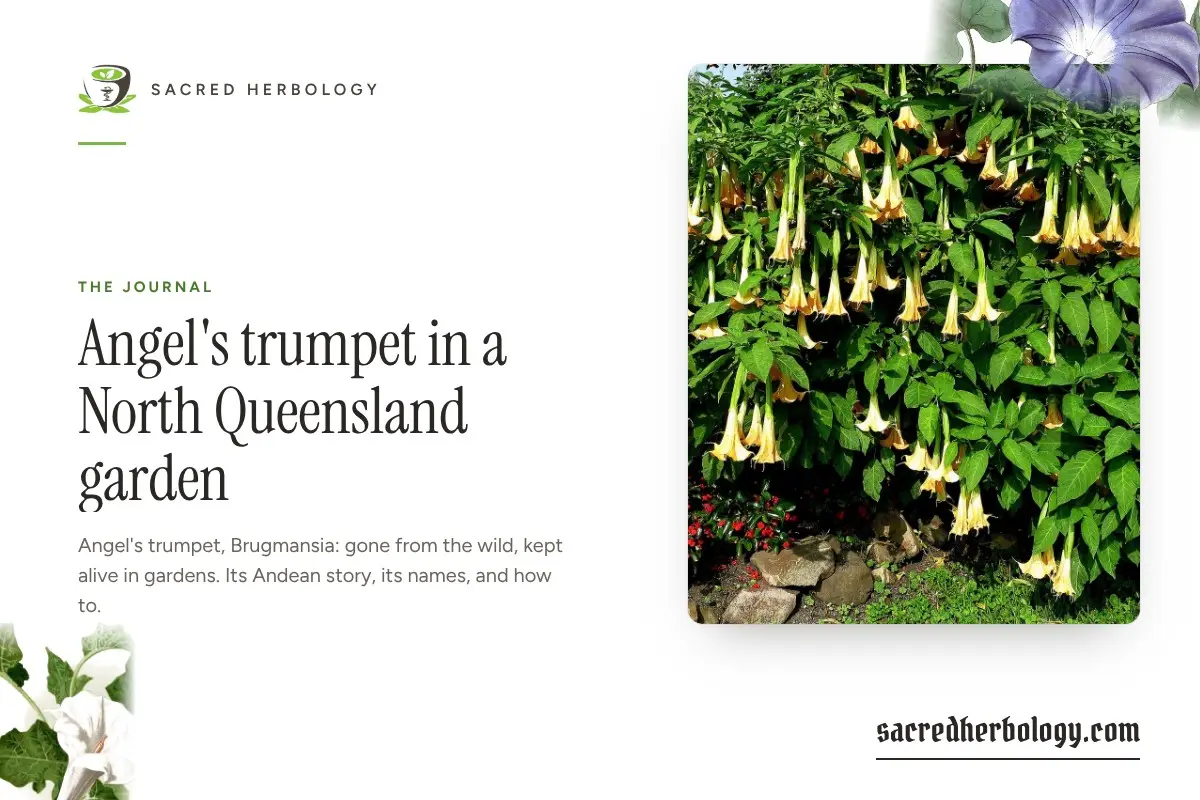
Stand near a flowering one at dusk on a warm, still evening and you will smell it before you see it. The scent is heavy, sweet and slightly lemony. Follow it and you find a soft-wooded shrub, two or three metres tall, with big floppy leaves and dozens of enormous flowers hanging straight down like bells in a church tower. Some are white. Some are the colour of apricot flesh, some a pale peach, some a washed-out pink. Each one is as long as your forearm from the wrist to the elbow, and the mouth of each bell flares out and curls back at the five tips like the toes of a slipper.
That is angel’s trumpet, Brugmansia. It is grown as an ornamental in warm gardens around the world and is usually passed on as a cutting. It roots from a broken stick pushed into wet ground, it shrugs off the heat once it is established, and in a good flush it flowers so heavily that the whole plant seems to droop under the weight.
It also carries one of the strangest stories in the plant world. Every species of angel’s trumpet has vanished from the wild. As far as anyone has been able to find, there is no stand of Brugmansia anywhere on earth that was not planted by a person or escaped from someone’s planting. The genus survives because people in the Andes kept it for thousands of years, in house gardens and beside the shaman’s hut, and because people everywhere since then have found it too beautiful to give up. Any angel’s trumpet you meet in a garden is part of a living collection that has outlasted its own wild ancestors.
The other half of the story is the reason this piece sits on the Poison Path. Every part of the plant is poisonous. It carries the same family of alkaloids as deadly nightshade, henbane and datura, the plants we have met in this series already, and in some of its home countries its common name means “the one that makes you drunk”. The peoples of the Andes and the Amazon who knew it best handled it with great care and surrounded it with rules. We should do the same.
So the house rule comes first, and it holds all the way down this page. Grow it, don’t eat it.
Meet the plant
Brugmansia is a genus of the nightshade family, the Solanaceae, the same family as tomato, potato, chilli, eggplant and tobacco, and the same family as the old poison plants of Europe. Its closest relative is Datura, the thornapple, and for most of the last three centuries botanists filed the two together. Once you know what to look for, though, you can tell them apart from across the road.
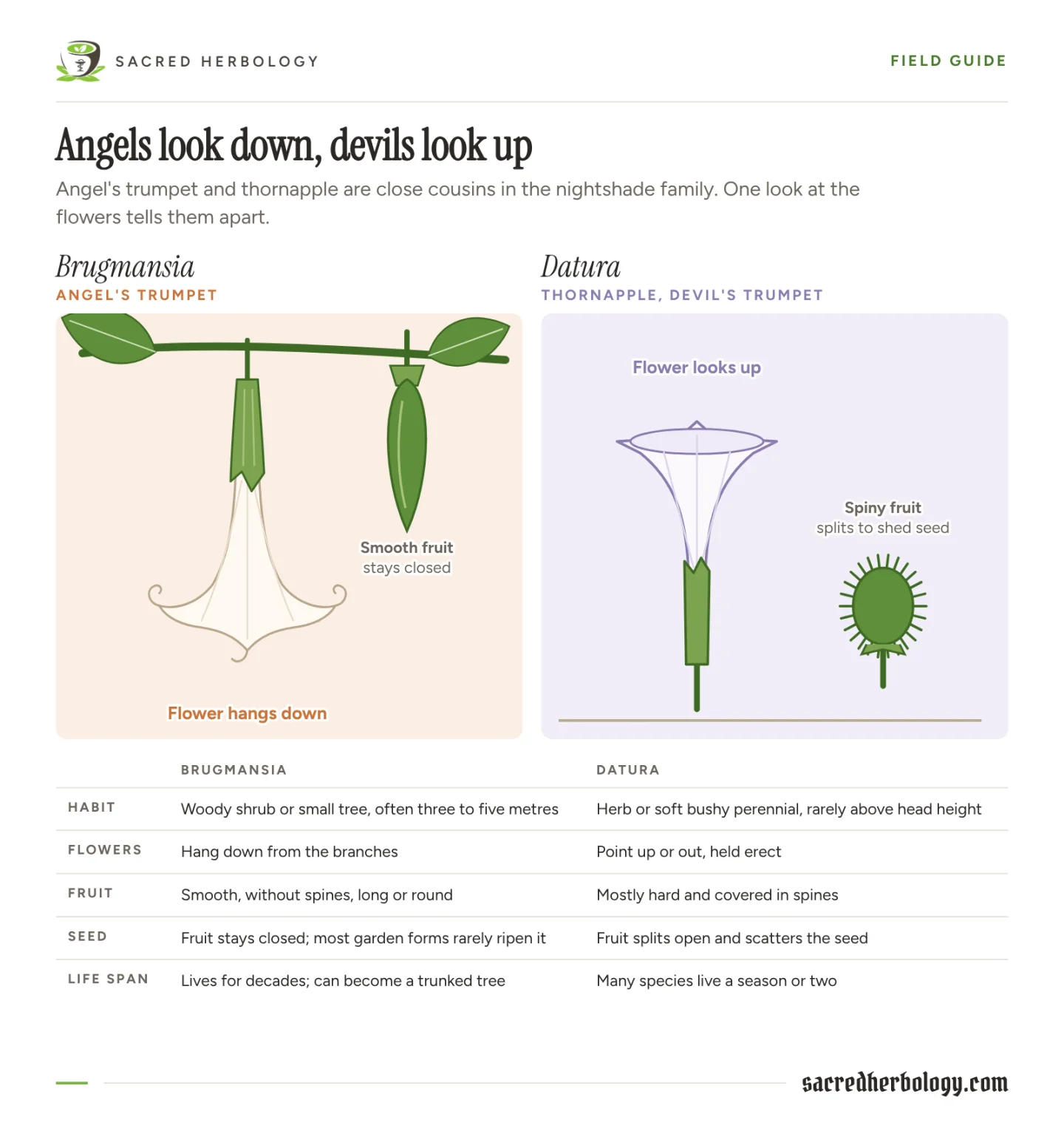
Here is the field guide, plant against plant:
- Habit. Brugmansia is a woody shrub or small tree, often three to five metres tall in a garden and taller in the right spot. Datura is a herb or a soft bushy perennial, rarely above head height, and many species live only a season or two.
- Flowers. Brugmansia flowers hang down, pendent, from the branches. Datura flowers point up or out, held erect on the plant. This is the quickest test there is. Angels look down from heaven, the gardeners say, and devils look up from below, which is why datura is sometimes called devil’s trumpet.
- Fruit. Brugmansia fruit is smooth, without spines, either long and spindle-shaped or round, depending on the species. Most Datura fruit is a hard capsule covered in spines, the thornapple of the old name.
- Seed. Datura capsules split open and scatter their seed. Brugmansia fruits stay closed and, in most garden forms, rarely ripen at all.
- Life span. A Brugmansia can live for decades and becomes a proper trunked tree if you let it. Datura plants come and go.
The leaves of a garden angel’s trumpet are large, soft and faintly hairy, a dull mid-green, often twenty or thirty centimetres long with wavy edges. They give off a rank, green smell when bruised, quite different from the sweetness of the flowers. Each flower begins as a long green calyx, a sheath that splits open to let a pale, tightly furled trumpet slide out. Over a day or two the trumpet lengthens, unfurls, changes colour and finally opens its mouth. The scent comes on as the light fades and is strongest in the first hours of the night, which tells you something about who it was made for. We will come to its pollinators shortly.
Inside the trumpet five long stamens with cream-yellow anthers sit up against the tube, and a single style runs a little beyond them. On some forms the five tips of the corolla stretch into long, curling tails, five or ten centimetres of twisting ribbon. On others the mouth is a plain flared bell. Double and even triple flowers exist in cultivation, one trumpet sitting inside another like a stack of paper cups.
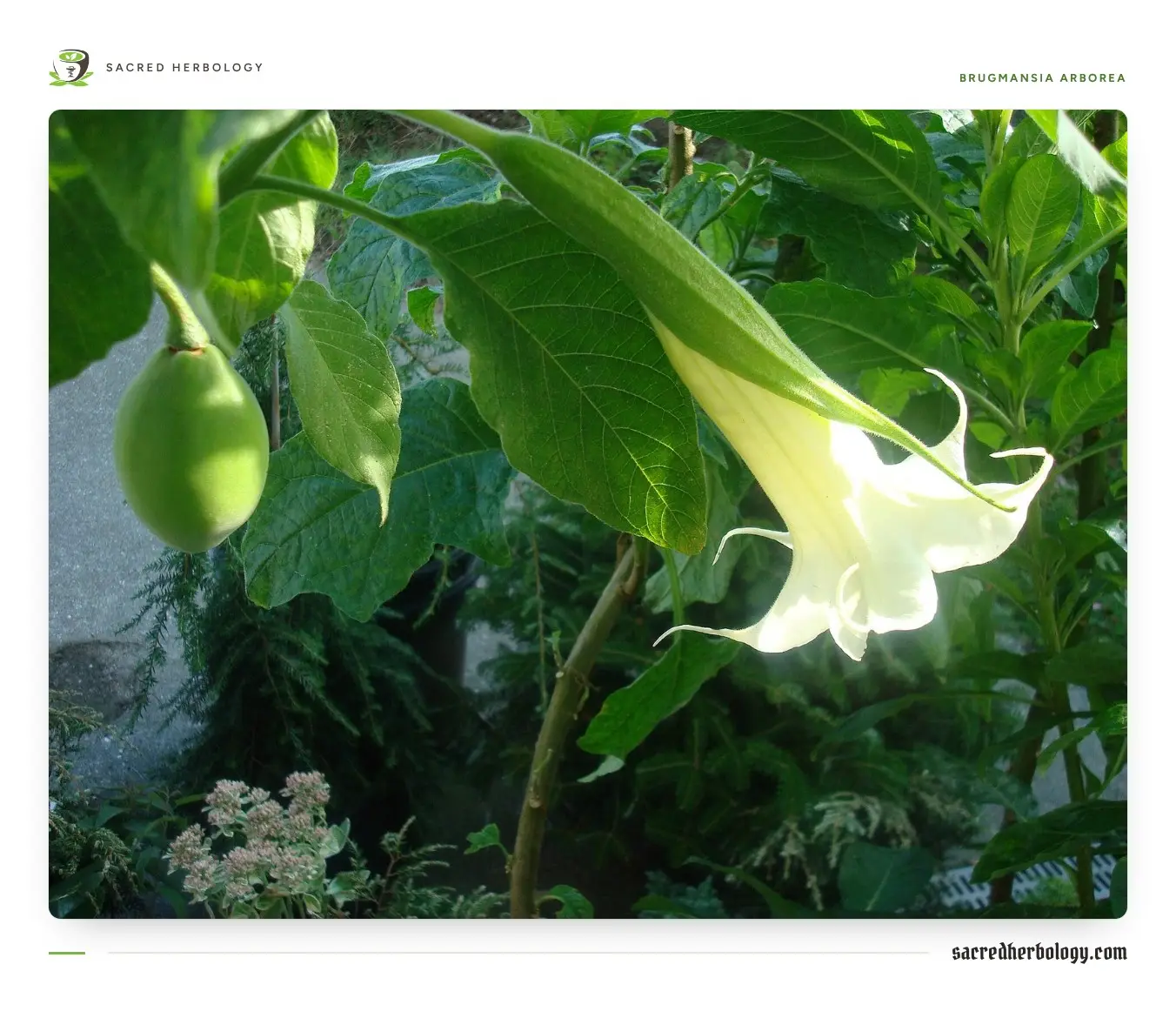
Set a single hanging Brugmansia trumpet, with its split green calyx and curled tips, beside an upright Datura flower with its spiny capsule below, and the difference is plain at a glance. That one picture does more than any key in a flora.
It is a useful comparison to have in your head. The thornapples you meet on Australian roadsides and paddock edges are mostly introduced weeds, such as Datura stramonium and Datura ferox, along with Datura leichhardtii, which is usually counted as native. All of them carry the same family of alkaloids as angel’s trumpet, in different proportions, and all of them hold their flowers up.
What is in it
Brugmansia carries the tropane alkaloids, the same chemical family we met in the belladonna and henbane pieces. The main ones are scopolamine, which is also called hyoscine and is usually the larger share in Brugmansia, and hyoscyamine, with smaller amounts of a cluster of related compounds. Atropine, the name most people know, is a mixed form of hyoscyamine, and much of what turns up in analyses forms from hyoscyamine as the plant material dries or is extracted. All parts of the plant contain them: leaf, flower, stem, root and seed. They act on the nervous system by blocking the receptors for one of its chief chemical messengers, acetylcholine, and that single action explains almost everything the plant does to a person who swallows it.
The amount of alkaloid in a given leaf or flower swings widely. It changes from species to species, from cultivar to cultivar, between parts of the plant, through the seasons and with the conditions the plant is grown in. One flower is never a guide to the next. It fits with the specialists and rules that the Andean peoples who used the plant kept around it, and it is one reason the plant has no place in anyone’s cup today.
Medicine uses purified scopolamine and atropine, made to a known strength and measured precisely. In Australia those purified substances are regulated medicines, scheduled under the national Poisons Standard. A shrub in the garden gives you nothing like that control, and the medical use of the pure compound tells you nothing about the safety of the plant.
A name that took two and a half centuries to settle
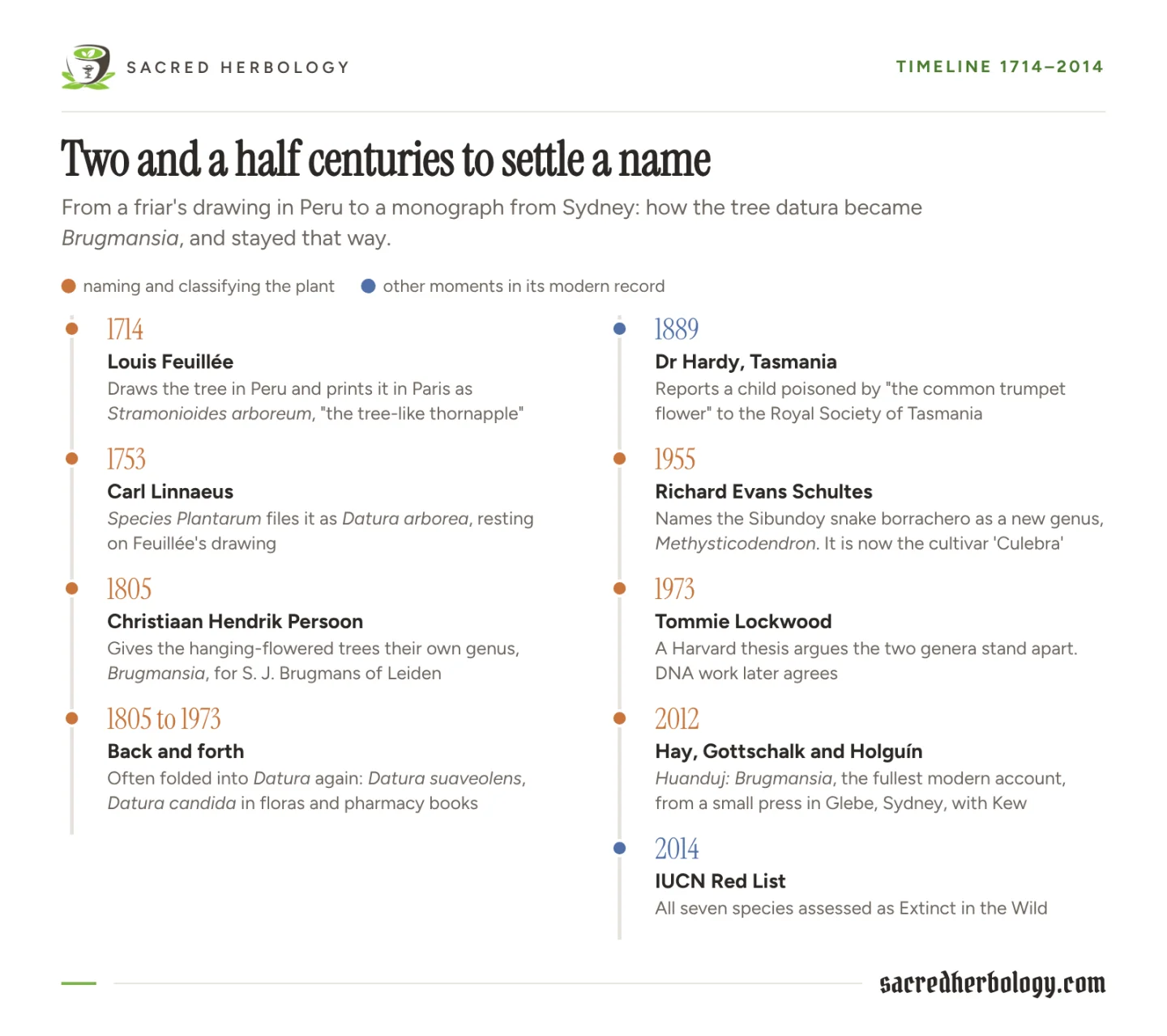
The story of how this plant got its name runs from a French friar in Peru to a botanist in Sydney, and it reads best as a timeline.
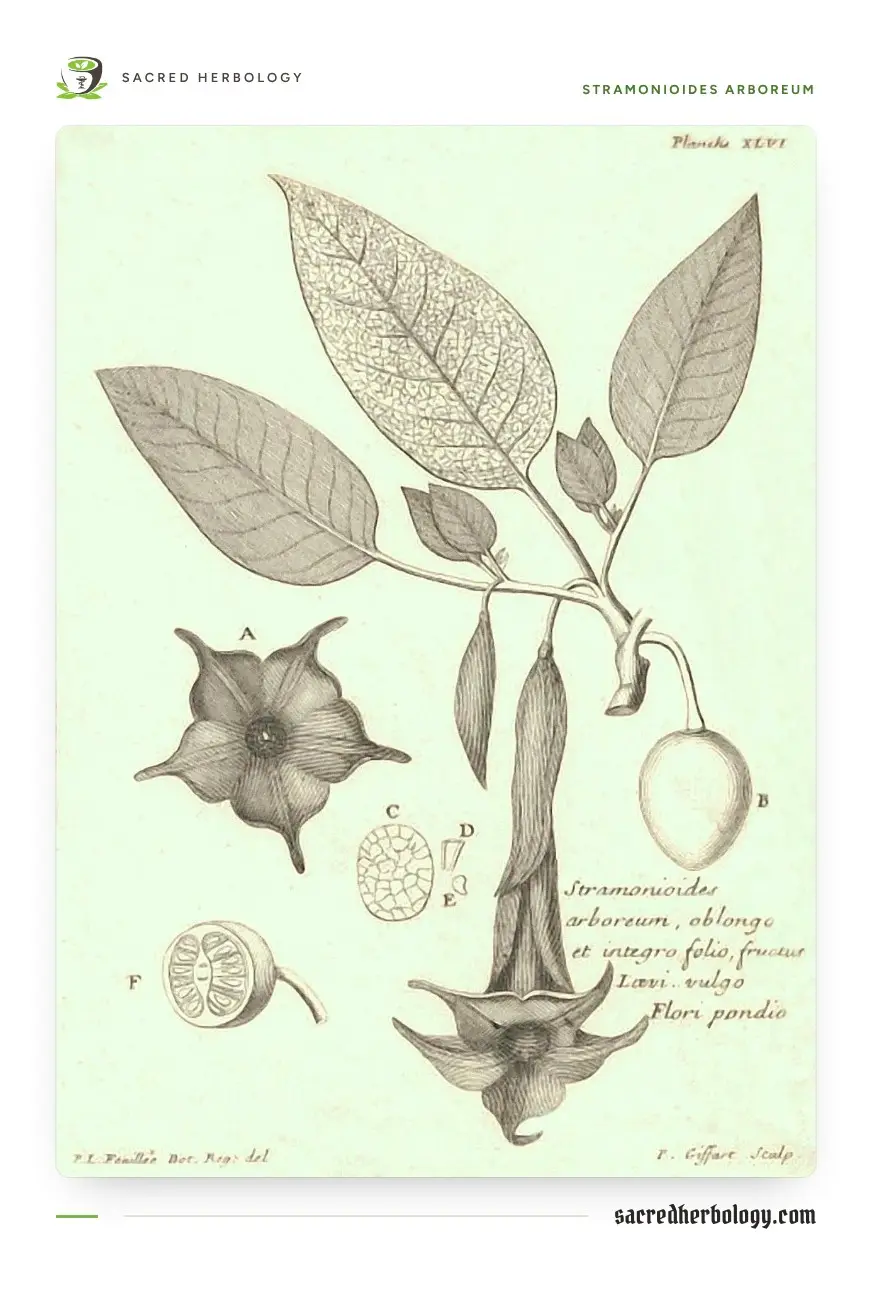
1714. The first European picture. Louis Feuillée, a French priest of the Minim order who was also an astronomer and a naturalist, spent the years 1707 to 1711 travelling the Pacific coast of South America for the French king, measuring longitudes and drawing plants. Among the plants he drew was a tree with huge hanging white trumpets. In his Journal des observations physiques, mathématiques et botaniques, printed in Paris in 1714, he published a drawing of it under the Latin phrase-name Stramonioides arboreum, “the tree-like thornapple”. He had spotted at once that it was a cousin of the European datura.

1753. Linnaeus files it under Datura. When Carl Linnaeus published his Species Plantarum in Stockholm, the book that founded modern plant naming, he listed the tree as Datura arborea, the tree datura. His name rests on Feuillée’s drawing.
1805. The plant gets its own genus. The South African-born botanist Christiaan Hendrik Persoon, working in Paris, decided that the trees with hanging flowers were different enough from the weedy thornapples to stand apart. In the first volume of his Synopsis Plantarum he gave them a new genus, Brugmansia, named for Sebald Justinus Brugmans (1763 to 1819), a Dutch professor of natural history at Leiden. Brugmans never worked on the plant. He was honoured as a colleague, which is how a great many plant names came about.
1805 to 1973. Back and forth. For the next century and a half, botanists could not agree. Some kept Brugmansia as its own genus. Many folded it back into Datura as a section, and through most of the twentieth century you will find these plants in floras and pharmacy books as Datura suaveolens, Datura candida and so on. That is why so many older Australian gardening books, and plenty of plant labels at the markets even now, still say datura when they mean angel’s trumpet.
1973. The split holds. The American botanist Tommie Lockwood, working at Harvard, wrote a full taxonomic revision of the group for his doctoral thesis and argued in it that Brugmansia and Datura are separate genera. Woody habit, hanging flowers and unarmed fruit all pointed the same way. Later work on their DNA has agreed with him, and Brugmansia has kept its own name since.
2012. The monograph. The fullest modern account of the genus was written by three authors with a strong Australian connection. Alistair Hay, a former senior scientist at the Royal Botanic Gardens in Sydney, wrote it with Monika Gottschalk and Adolfo Holguín. Their book, Huanduj: Brugmansia, was published in 2012 by Florilegium, a small botanical press in Glebe in Sydney, together with the Royal Botanic Gardens, Kew. Its title uses an old Andean name for the plant, and between its covers it gathers the botany, the history, the shamanic uses and a register of the many hundreds of named garden cultivars. If you want one book on angel’s trumpet, that is the one.
So the friar’s drawing, a Swedish catalogue, a Dutch professor’s surname, a Harvard thesis and a Sydney monograph all sit behind the plant label at your local nursery.
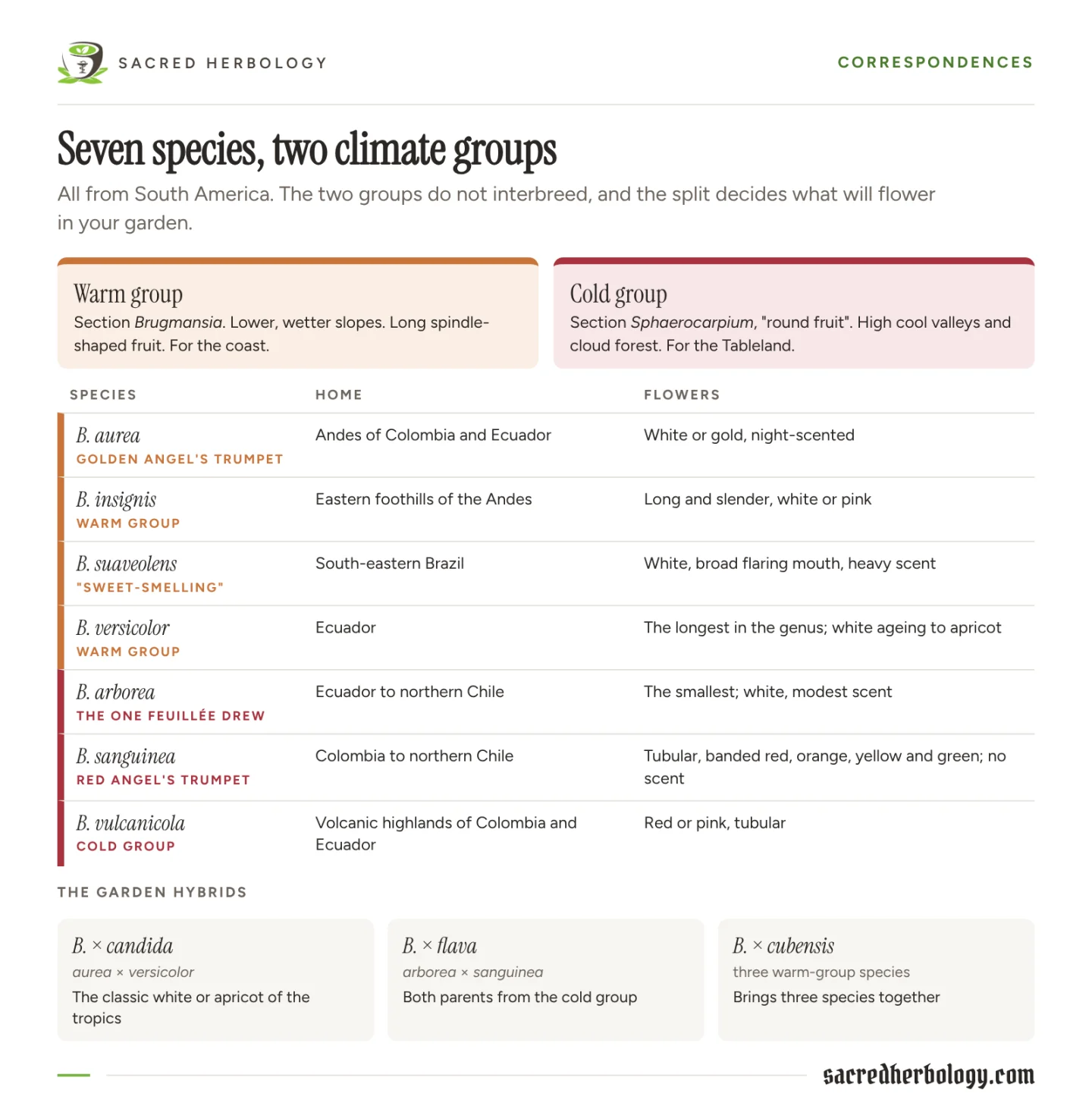
Seven species, two climate groups
Botanists now recognise seven species of Brugmansia, all from South America, nearly all from the Andes. They fall into two groups that do not interbreed with each other, and the split between them matters a great deal to anyone gardening in the north.
The warm group (section Brugmansia) comes from the lower, wetter, warmer slopes of the Andes and the lowlands beside them. Their fruits are long and spindle-shaped. Their flowers are large and mostly fragrant at night. The four species are:
- Brugmansia aurea, the golden angel’s trumpet, from the Andes of Colombia and Ecuador, with flowers in white or gold.
- Brugmansia insignis, from the eastern foothills of the Andes, with long, slender flowers in white or pink.
- Brugmansia suaveolens, from south-eastern Brazil, white, with a broad, flaring mouth and a heavy sweet scent. Its name means “sweet-smelling”.
- Brugmansia versicolor, from Ecuador, the one with the longest flowers in the genus, which open white and age through peach to apricot or salmon.
The cold group (section Sphaerocarpium, “round fruit”) comes from high in the Andes, from cool valleys and cloud forest. Their fruits are round or egg-shaped. The three species are:
- Brugmansia arborea, from Ecuador south into northern Chile, the one Feuillée drew, with the smallest flowers in the genus, white and only modestly scented.
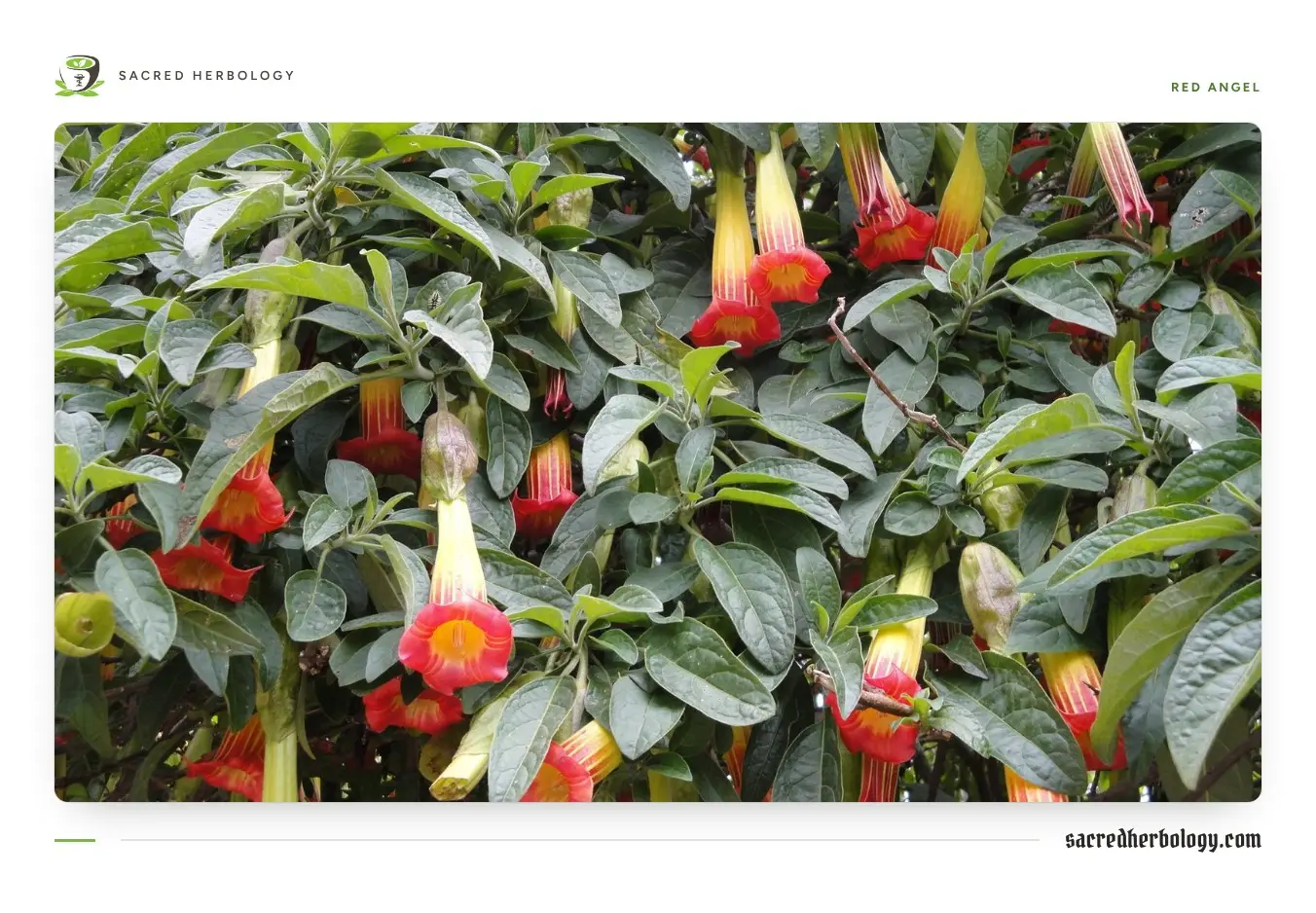
- Brugmansia sanguinea, the red angel’s trumpet, from Colombia to northern Chile, with tubular flowers banded in red, orange, yellow and green, and no scent at all.
- Brugmansia vulcanicola, from the volcanic highlands of Colombia and Ecuador, with red or pink tubular flowers.
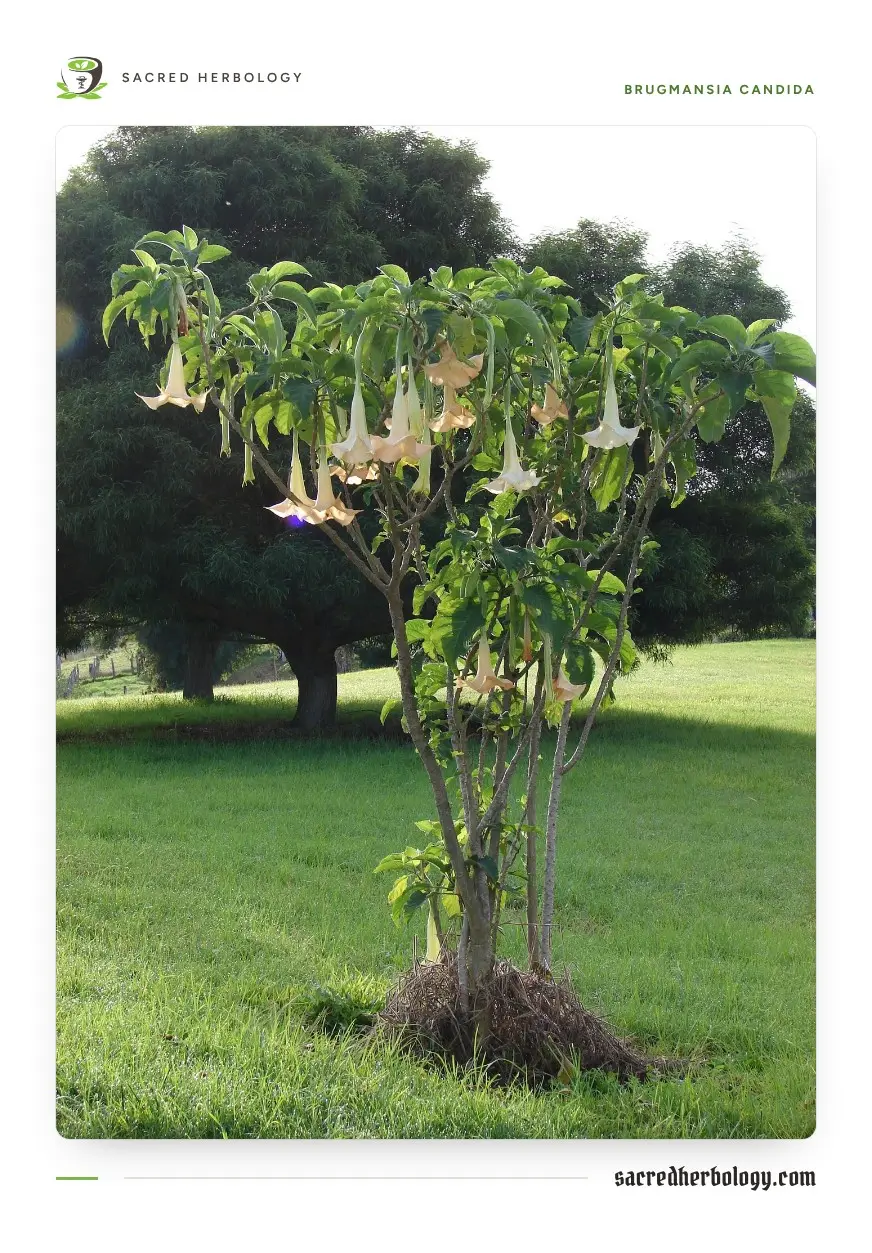
On top of these are the hybrids, which make up most of what is actually grown in gardens. Brugmansia × candida is a cross of aurea and versicolor, and it is the classic white or apricot angel’s trumpet of the tropics. Brugmansia × flava is a cross of arborea and sanguinea. Brugmansia × cubensis brings three of the warm-group species together. And then there are the cultivars, the named garden selections, which the Hay, Gottschalk and Holguín register counts in the many hundreds.
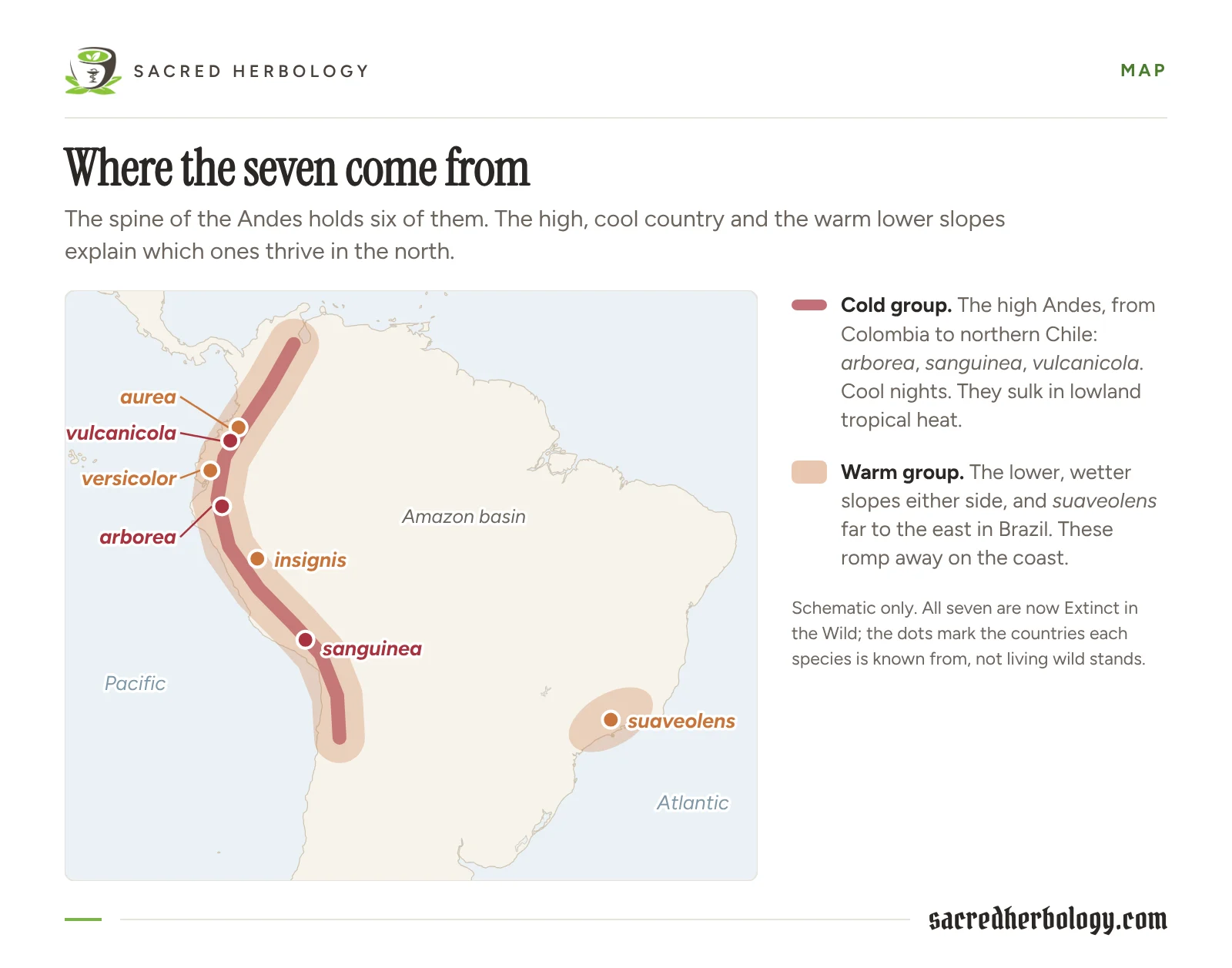
A map makes this easy to see. Along the spine of the Andes from Colombia down to Chile, the cool high country holds the cold group and the warm lower slopes hold the warm group, with suaveolens far off to the east near the Atlantic coast of Brazil. You will see at a glance why some angel’s trumpets sulk in tropical heat and others romp away.
A genus that has lost its wild home
In 2014 the International Union for Conservation of Nature assessed all seven species of Brugmansia for its Red List, and all seven were listed as Extinct in the Wild. That is a rare category. It is kept for plants and animals that survive only in cultivation, in captivity or as naturalised populations far outside their original range.
The plants themselves are everywhere. You can buy one at almost any garden centre in Cairns. What botanists have not been able to find, despite looking hard across the Andes, is a population of any species that looks truly wild: plants growing where no person put them, seeding themselves and spreading as wild plants do. Every stand they have examined turns out to sit by a house, a path, a field edge or a ruin, and the plants usually turn out to be clones grown from cuttings.
The question is why. The fruits give a clue. A Brugmansia fruit is large, fleshy or leathery, and it does not split open to release its seed. In most garden plants it hangs on the branch, shrivels and drops without anyone or anything carrying the seed away. Botanists have suggested that the plant’s natural seed dispersers were large animals of the South American Pleistocene, big browsing mammals that ate fallen fruit and carried the seed off in their guts. When those animals died out at the end of the last Ice Age, so the argument goes, Brugmansia lost its partner, and its wild populations slowly dwindled. People, who had already found a use for the plant, took over the job of spreading it, carrying cuttings from valley to valley and planting them in their gardens.

That idea is a hypothesis. Nobody has found a giant ground sloth with angel’s trumpet seeds in its stomach. It fits the facts we do have, though, and it gives the plant an unusual kind of history. For thousands of years the only way a Brugmansia has moved across the landscape is in a human hand.
It also changes how you might feel about a shrub grown from a cutting. Every cutting passed from one gardener to another repeats, in miniature, what the house gardens of the Andes did to keep the genus alive. The plant has depended on gardeners for longer than writing has existed.
The night moths and the sword-billed hummingbird
Even with no wild home left, the flowers still carry the shapes their wild pollinators made.
The fragrant white and pale species, the warm group and the hybrids built from them, open their scent at nightfall. That is a flower signalling to moths, above all the big hawkmoths with long tongues that can reach the nectar at the bottom of a deep tube. Hawkmoths feed hovering at the mouth of a flower like hummingbirds, dipping the tongue in. The pale colour helps the flowers show up in the dark, and the hanging position keeps the nectar out of the rain.
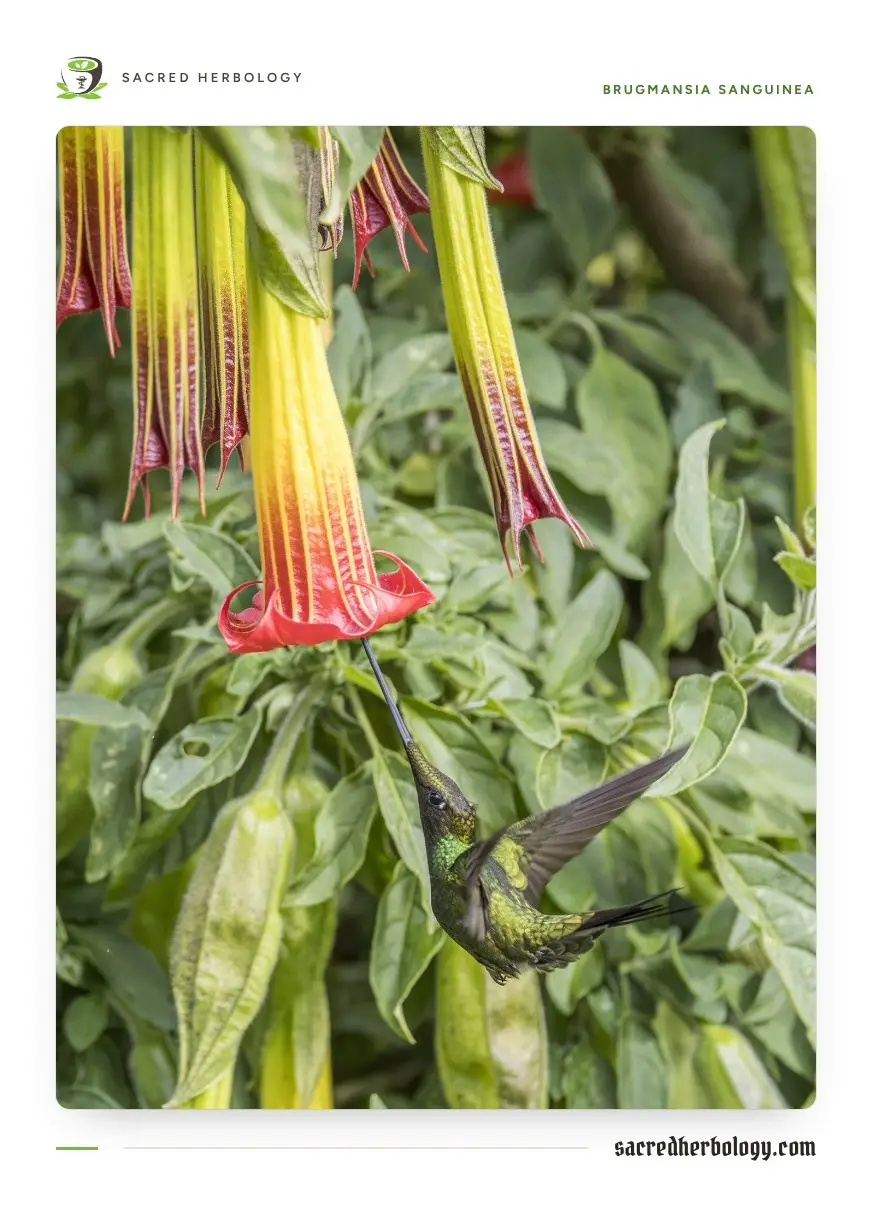
Brugmansia sanguinea, the red angel’s trumpet of the high Andes, went the other way. It has no scent, its flowers are open in the day, and they are coloured in the reds and oranges that birds see well. Its chief pollinator is one of the most extraordinary birds in South America, the sword-billed hummingbird, Ensifera ensifera. This bird’s bill is longer than the rest of its body, a straight, needle-like rapier that it holds pointed upward when it perches to keep its balance. Few other birds can reach the bottom of the long red tubes, and the hummingbird and the flower have shaped each other over a very long time.
Picture that bird: a small bronze-green hummingbird hanging in the air beneath a red-and-yellow trumpet, its enormous bill disappearing up inside the tube. It looks invented. It is real.

There is a butterfly in the story too. In south-eastern Brazil, the caterpillars of a butterfly called Placidula euryanassa feed on the leaves of Brugmansia suaveolens and store the plant’s tropane alkaloids in their bodies, carrying them through the pupa into the adult butterfly. The adults also gather a second, unrelated group of alkaloids from flowers they visit, and how much protection from birds and other predators each group gives has not been settled. The plant’s poison travels with the insect from caterpillar to wing. As far as I know nothing like this happens in Australia, where garden angel’s trumpets are mostly left alone by native insects and are more troubled by mites, aphids and the odd caterpillar that chews the leaves without much interest in the chemistry.
Huanduj, borrachero, floripondio: the plant in the Andes
The plant had names long before Feuillée drew it, and the names tell you how it was seen.
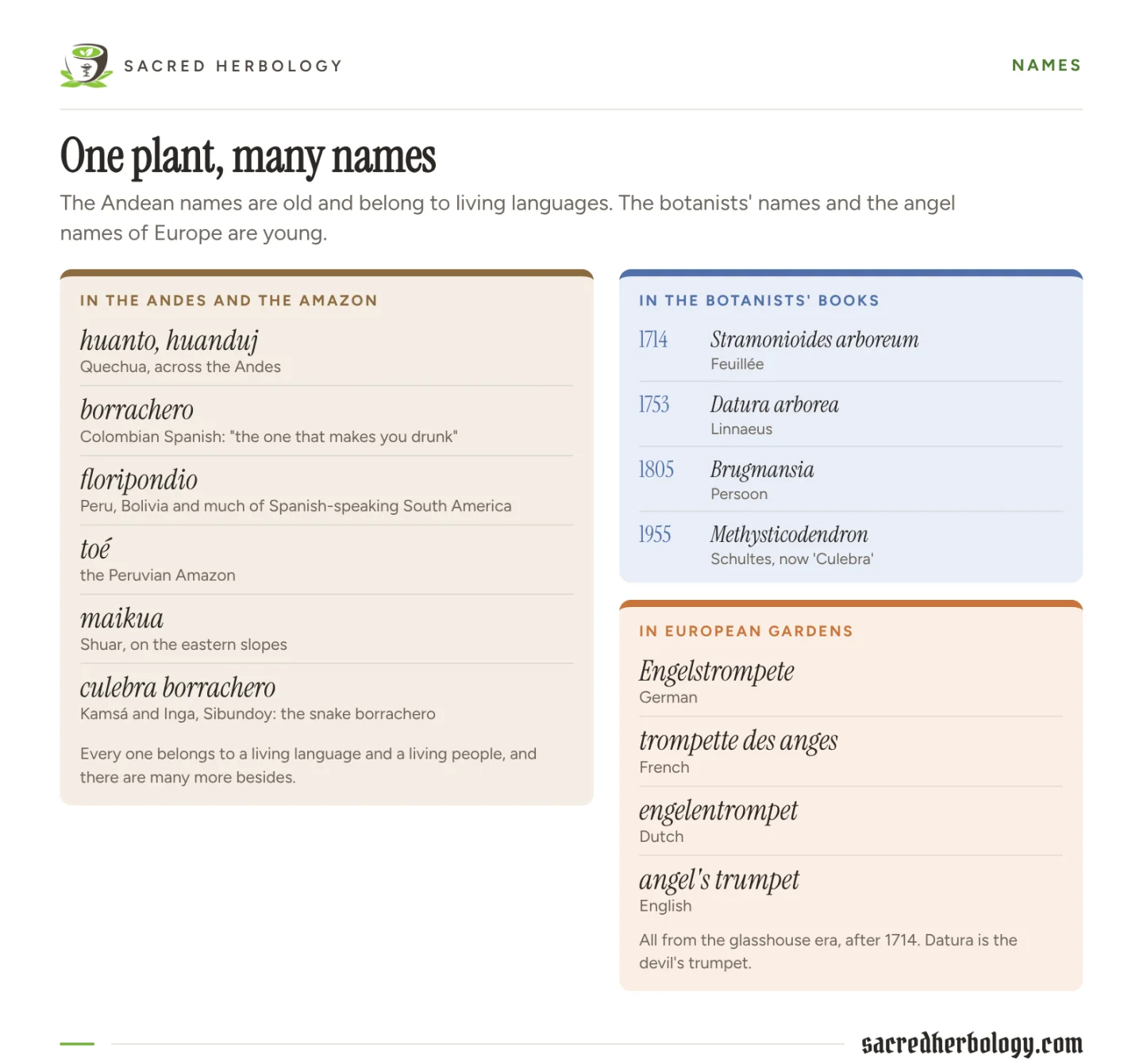
Across the Quechua-speaking Andes it was called by forms of huanto or huanduj, the name Hay and his co-authors chose for their title. In Colombia the Spanish name is borrachero, “the one that makes you drunk”, a word applied to Brugmansia and to a few other intoxicating plants. In Peru, Bolivia and much of Spanish-speaking South America the flower is floripondio, a word with no clear literal meaning that has come to mean simply “angel’s trumpet”. In the Peruvian Amazon you will hear toé. Every one of these names belongs to a living language and a living people, and there are many more besides.
Everything in this section is drawn from published accounts only, and I have named the peoples concerned. The Indigenous uses of Brugmansia were and are serious matters, held by specialists, and parts of them were never meant to be written down by outsiders. I will report what the published record says, on the terms of the people who hold these traditions, and I will not go past it. Nothing here is a description of how to do anything. It is history, and it should be read as history.
The Muisca of the Bogotá plateau
The oldest written record of the plant’s use comes from the high plateau around Bogotá, the home of the Muisca, a Chibcha-speaking people whose chiefs ruled from the plateau’s cold grasslands when the Spanish arrived in 1537. The Muisca are famous for their goldwork. The story of El Dorado, the gilded man, grew out of a Muisca ceremony at Lake Guatavita in which a new ruler was covered in gold dust and washed in the lake.
The Spanish chroniclers of the New Kingdom of Granada recorded something much darker. Juan de Castellanos, a soldier turned priest who spent most of his life in the Muisca town of Tunja, wrote a vast verse history of the conquest, the Elegías de varones ilustres de Indias, whose first part was printed in Madrid in 1589. Among the customs he describes is the burial of a great lord. When a Muisca ruler died, he wrote, wives and servants were buried with him, and they were first given a drink made from a tree that dulled them so that they would not fear what was to come.
Castellanos does not give the tree a botanical name, and he was writing as a conqueror about a people whose own voices are almost absent from the record. Later writers on the plants of the Andes, Richard Evans Schultes and Albert Hofmann among them in Plants of the Gods, have identified the tree of these accounts with Brugmansia, which the Muisca are known to have grown and which the people of the plateau still call borrachero. That identification is a reasonable reading of the sources, and it is a reading. It should be held with the same care as any claim built on a hostile witness. What we can say is that from the first decades of Spanish rule, European writers associated the tree with death, with the dead, and with the passage between the two.
Think too of the Muisca goldwork, the small cast figures called tunjos that were offered at lakes and shrines. The people in the chronicle had a world of their own, larger than the one thing the Spanish wrote down.
The Shuar of the eastern slopes
Down the eastern slopes of the Andes, in the rainforest of southern Ecuador and northern Peru, live the Shuar, a people of the Chicham language family (older books, including the one I am about to name, call them Jívaro, a name many Shuar today reject). The American anthropologist Michael Harner lived among them in the 1950s and 1960s and published his account as The Jívaro: People of the Sacred Waterfalls in 1972.
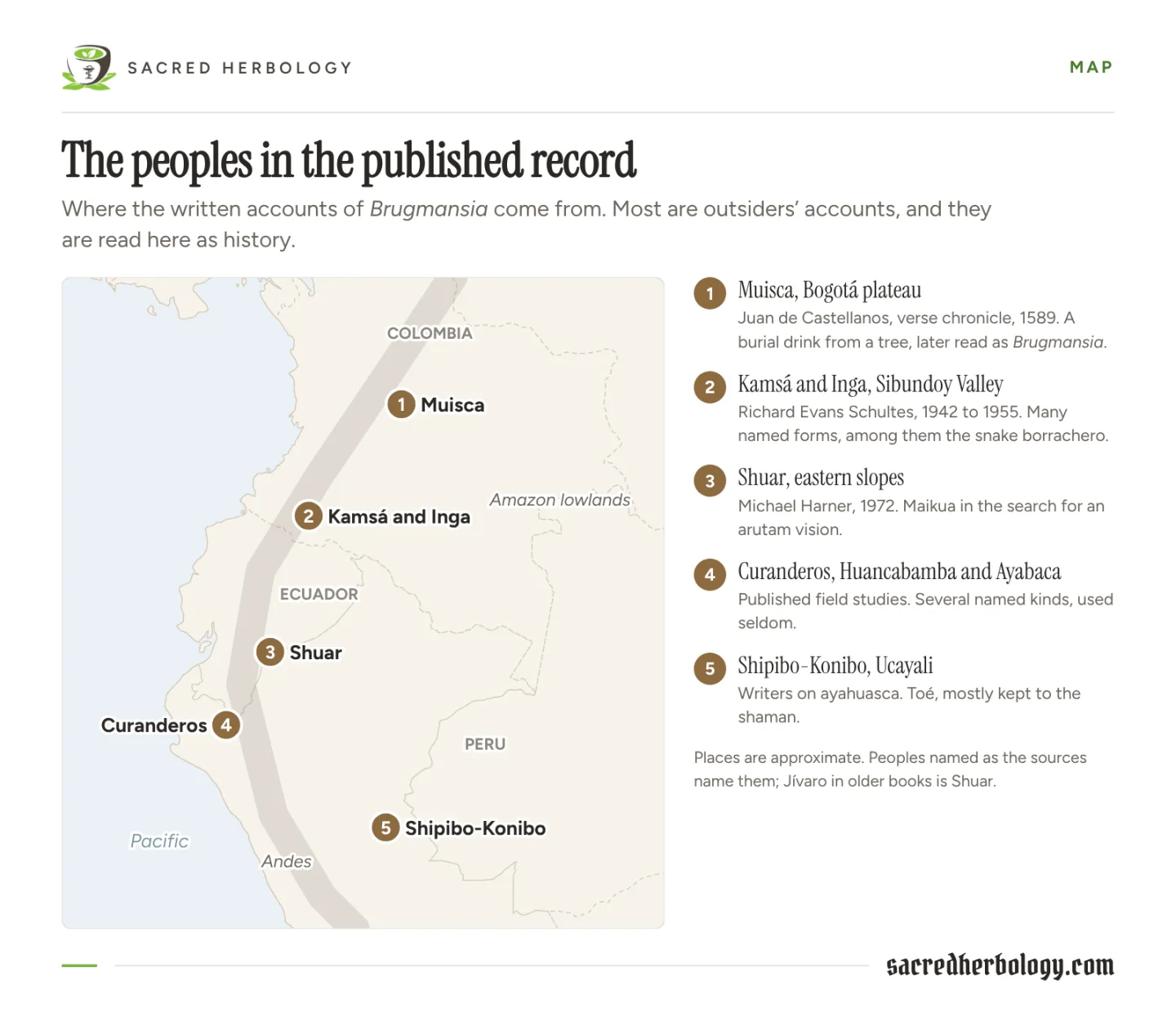
Harner describes the Shuar belief in arutam, a powerful soul that a person was not born with and had to acquire. A young person sought an arutam vision by going to a sacred waterfall, fasting, and staying there in the spray and the roar of the water, sometimes for days, waiting for the vision to come. The arutam would appear in a terrifying form, a great jaguar, a pair of giant anacondas, a ball of fire, and if the seeker faced it and touched it, its power entered them. Harner records that maikua, the Shuar name for Brugmansia, was among the plants used in that search, and that it was taken under supervision and was regarded with real fear. The shaman’s own working plant was a different one, natemä, the ayahuasca vine.
Harner’s account belongs to its time. He worked largely from interviews, and he wrote as an outsider. It is still one of the clearest published descriptions of the plant’s place in a living Amazonian culture, and it shows the shape that recurs across the region: Brugmansia as the strongest and most dangerous of the plant teachers, approached rarely, on purpose, with someone sober watching over the one who takes it.
The sacred waterfall stays in the mind: a white column of water falling into green forest, mist rising, and at its foot a small figure waiting.
The Kamsá and Inga of the Sibundoy Valley, and the snake borrachero
The strangest Brugmansia in the published record comes from a small, high valley in southern Colombia. The Sibundoy Valley sits at about 2,100 metres in the department of Putumayo, a flat green basin ringed by mountains, on the Andean side of the long slope down to the Amazon. Two peoples live there side by side: the Kamsá (also written Kamëntšá), who speak a language unrelated to any other, and the Inga, who speak a form of Quechua. Both are famous among botanists for the number of Brugmansia forms they grow and name, many of them strange and found nowhere else.
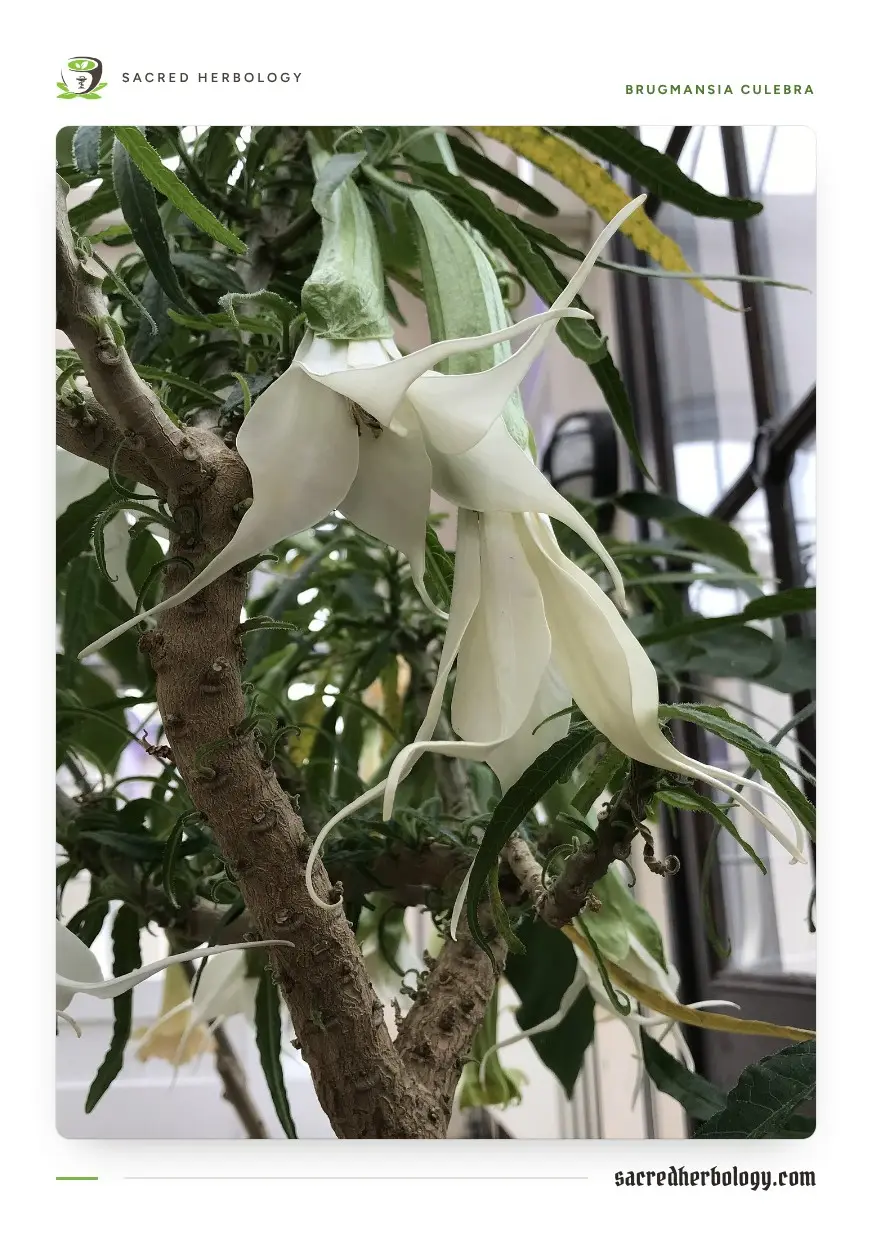
In early 1942 the young Harvard ethnobotanist Richard Evans Schultes was working in the Putumayo, and his attention was drawn, as he put it, to “a most extraordinary tree” which the Kamsá and Inga of the valley cultivated as a narcotic. Its flowers were white, hanging and enormous, up to twenty-eight centimetres long, and they were “most strongly and most sweetly fragrant” at sunset and through the night. Its strangeness was in the shape. The corolla was split almost to its base into five narrow, ribbon-like lobes, so that instead of a trumpet each flower looked like a hanging tassel of twisted white straps. The leaves were long and very narrow. Schultes went back to the valley several times over the following decade, collected more material from the first tree and from others in the village of Sibundoy and the neighbouring town of Santiago, and in 1953 the tree was brought into cultivation in gardens outside the valley.
_var._%E2%80%98Culebra%E2%80%99_)_Kew.jpg)
In May 1955 Schultes published it in the Botanical Museum Leaflets of Harvard University as a new genus and species, Methysticodendron amesianum. The genus name, he explained in his Latin, means “the tree that brings sleep”. The species was named for his teacher, the Harvard botanist Oakes Ames. The paper carries a fine line drawing of the flowering branch by Elmer W. Smith, a photograph of the type tree in Sibundoy, and a photograph of a Kamsá boy holding one of the flowers.
The local people already had a name for it. It was the culebra borrachero, the snake borrachero, and the shamans of the valley valued it as one of the most powerful of their Brugmansia forms.
Schultes was a careful botanist, and he spent more than ten years thinking before he published. He was still wrong about the genus. Later botanists recognised the tree as a mutant form of Brugmansia, a cultivated variety whose flowers had lost their normal trumpet shape. Kew’s current list follows Hay and his co-authors in placing it within Brugmansia × candida, and gardeners know it as the cultivar ‘Culebra’. A plant that had been named as a new genus turned out to be a monstrous flower kept alive by Kamsá and Inga gardeners because it was strange and because it was powerful. That makes it, in a way, the best single example of the whole genus: a plant shaped and kept by people.
Set a ‘Culebra’ flower beside an ordinary white trumpet of × candida and you understand at once why a careful botanist thought he had found something new.
The curanderos of northern Peru
In the highlands of northern Peru, around Huancabamba and Ayabaca, there is a living tradition of curanderismo, healers who work at night at a mesa, an altar cloth laid with staffs, swords, stones, shells and images, and who are famous for their knowledge of plants. Published field studies from the region record that the curanderos recognise and name a number of different kinds of Brugmansia, and sort them into their own system of kinds by flower colour and strength. They regard them as the most dangerous plants they handle and use them seldom, for divination and initiation, and they associate them with sorcery and with the shadowed side of their work.
The Amazon
In the Peruvian and Ecuadorian Amazon, among the Shipibo-Konibo of the Ucayali and many other peoples, toé is known as a plant of great power that is usually kept to the shaman. Writers on ayahuasca report that some practitioners add it to the brew, and that many others regard doing so as the mark of a careless or malevolent practitioner. The plant’s reputation in the region, as in the Andes, is double-edged. It is a teacher, and it is a hazard, and everyone who writes about it from inside these traditions says the second thing as clearly as the first.
How the trumpet came to the world’s gardens
After Feuillée, the plant came to Europe slowly and by the hothouse. The eighteenth and nineteenth centuries were the great age of the heated glasshouse and the conservatory, and big-flowered tropical shrubs were prized by wealthy collectors. Angel’s trumpets, easy to strike from cuttings and spectacular in flower, were grown in the orangeries and palm houses of Britain, France and Germany through the nineteenth century, carried indoors in tubs for the winter and stood out on the terrace in summer. Gardeners in the south of Europe could grow them outdoors.
From the botanic gardens of Europe and the Americas the plant spread across the warm world: the Caribbean, Hawai’i, the Pacific islands, India, Sri Lanka, southern Africa, and Australia. How and when the first angel’s trumpet reached Australia I have not been able to find out. What we know is that by the late nineteenth century it was common enough in southern Australia to be poisoning children.

In 1889, at a meeting of the Royal Society of Tasmania, a Dr Hardy read a short paper, printed afterwards in the society’s Papers and Proceedings, under the title “Notes on a case of poisoning through eating a portion of the ‘Brugmansia’”. He described a recent case in which a child had eaten part of what he called the common trumpet flower. He noted that it belonged to the nightshade family, and he reported that he had treated the case successfully. Then he widened the point and urged his colleagues to study the native plants of Australasia, whose properties, he said, were still very little known.
Hardy’s paper is a small thing, two pages in a colonial society’s proceedings. It tells us that by 1889 a doctor in Tasmania could call Brugmansia “the common trumpet flower” and expect his audience to know what he meant. If angel’s trumpet was common in cool Tasmania, it was surely in gardens across the warmer colonies too.
In Queensland one form has jumped the fence. The Australian Plant Census, the national list of the plants of Australia, records Brugmansia × candida as naturalised in Queensland, meaning it has been found growing and persisting outside cultivation. It is still a garden escape, turning up in places like vacant blocks and old house sites, and it spreads by broken pieces taking root more often than by seed. Where it does turn up outside a garden, someone almost certainly planted it, or dumped garden waste there.
Why the old books never mention it
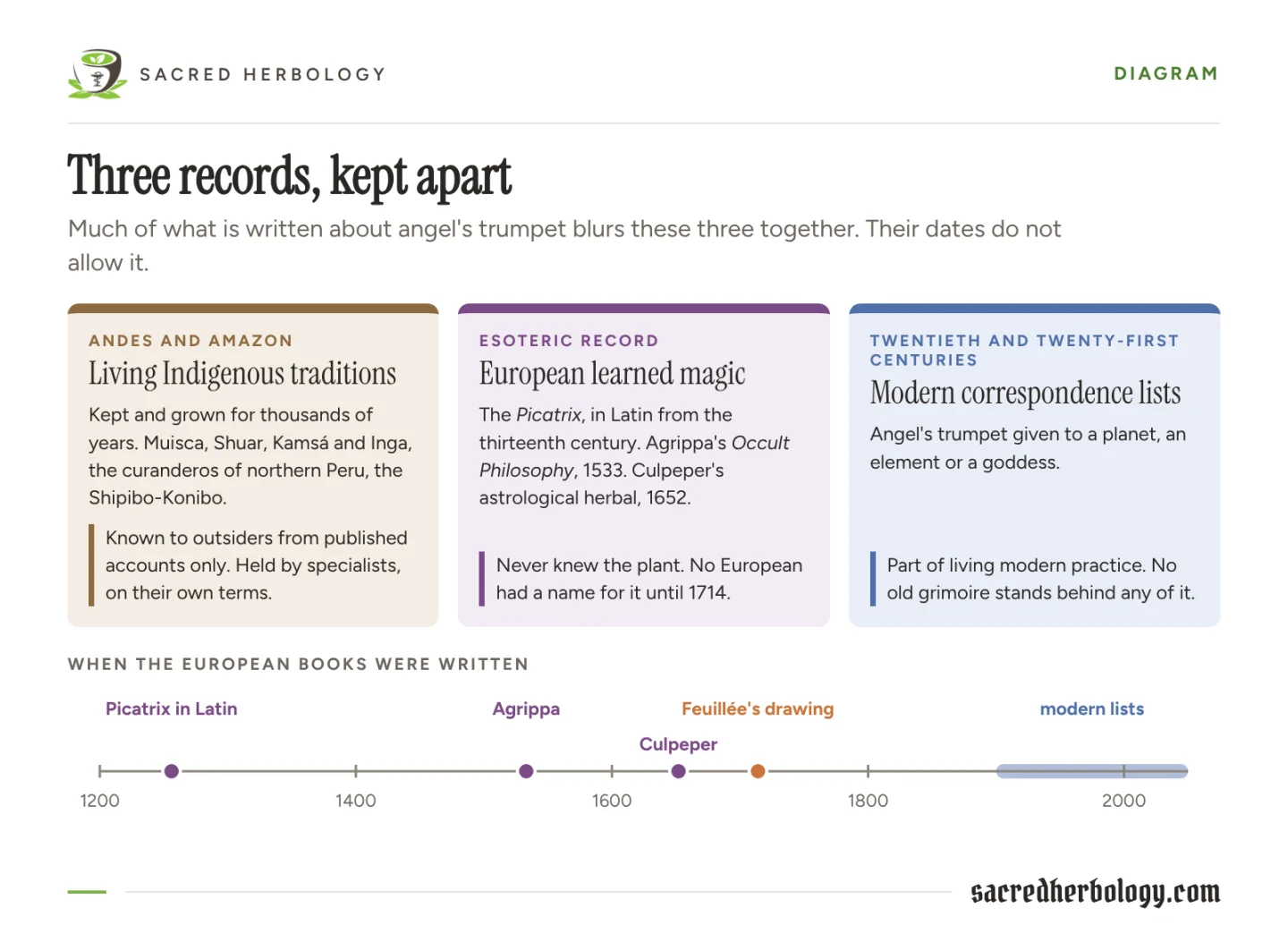
Regular readers of the Journal know that I spend a lot of time in the old books: the Picatrix, Agrippa’s Three Books of Occult Philosophy, the herbals of Gerard and Culpeper. The Picatrix and Agrippa are learned magical works of medieval and Renaissance Europe and belong to the esoteric record; Culpeper’s herbal carries a strong astrological layer, and Gerard’s is a practical herbal. Between them they sort the plants by planets and signs, by virtues and sympathies, and they are full of the European nightshades. Henbane, deadly nightshade and mandrake all have their places in those tables.
Angel’s trumpet has none. The dates explain it. The Picatrix reached Latin Europe in the thirteenth century. Agrippa printed his full Occult Philosophy in 1533. Culpeper published his English Physitian in 1652. None of these authors could have seen a Brugmansia. The plant had no European name until Feuillée’s drawing of 1714 and no place in European gardens until after that.
So whenever you find angel’s trumpet in a table of magical correspondences, given to a planet, an element or a goddess, you are looking at something written in the twentieth or twenty-first century. Some of those modern systems are thoughtful and some are careless, and they are part of living modern practice in their own right. None of them has an old grimoire behind it, and anyone who tells you the medieval magicians worked with angel’s trumpet has the dates wrong. The witches’ ointments of the sixteenth-century writers, which I wrote about in the belladonna piece, name European plants. Brugmansia has no part in them.
The plant’s European popular names and garden customs are just as young, and they belong to ordinary village and household life, apart from the esoteric books. In German it is Engelstrompete, in French trompette des anges, in Dutch engelentrompet, and the angel names in every language go back no further than the plant’s arrival in the glasshouses. There is no medieval village custom attached to it in Europe, because there was no plant for it to attach to.
That is worth saying plainly, because a great deal of the material online blurs these categories. The Andean and Amazonian uses of Brugmansia are living Indigenous traditions with their own long history. European learned magic, the esoteric literature, never knew the plant. Modern correspondence lists are modern. Keep the three apart and the plant’s real history becomes much easier to see.
Growing angel’s trumpet
Now to the garden. Most angel’s trumpets sold by nurseries will grow in warm gardens, with a few cautions. These notes suit a hot, wet summer, a warm, drier winter and high humidity much of the year.
Choosing the right kind
The warm-group species and their hybrids are the ones for the coast. The classic white or apricot Brugmansia × candida, Brugmansia suaveolens and its double forms, Brugmansia versicolor and the many cultivars bred from these all handle our heat, flower in heavy flushes through much of the year and pour out their scent at dusk. The old garden forms that Hay singles out as survivors, the apricot and the double white, are tough plants that cope with a good deal of neglect.
The cold-group species, Brugmansia sanguinea, Brugmansia arborea and Brugmansia vulcanicola, and the hybrid × flava, come from the cool high Andes. They want cool nights and moderate days, and on the coast in the wet season they tend to sulk, stop flowering and fall prey to disease. Hay describes sanguinea as difficult and prone to disease even in his garden in New South Wales. If you live up on the Atherton Tableland, around Atherton, Yungaburra, Malanda or Ravenshoe, where the nights are cooler, you have a far better chance with the red-flowered species. Down on the coast, enjoy them in other people’s photographs.

Where to plant
Angel’s trumpet wants rich, moist, well-drained soil, sun for at least half the day and shelter from strong wind. Morning sun and afternoon shade suits it well in the heat of a tropical summer, when full western sun can scorch the big soft leaves. It needs room: an established plant will easily reach three to four metres high and as wide, so give it a back corner, a fence line or the edge of a shade house, well away from the path.
Wind is the real enemy. The wood is soft and brittle and the branches carry a great deal of weight in leaf and flower, so a strong gust can split a plant down the middle. A cyclone can reduce a big angel’s trumpet to a stump. Most come back, because the plant reshoots readily from old wood and from the base, but a sheltered spot spares you the rebuilding.
Drainage matters through the wet. The roots like water and dislike standing in it, and a plant that sits in waterlogged clay for weeks will rot. A raised bed or a mound helps on heavy soil.
Feeding and water
Angel’s trumpet is a hungry plant. All that leaf and all those enormous flowers come from somewhere. Hay feeds his collection twice a year with a heavy mix of garden compost and animal manures, and growers generally agree that the plant flowers best when it is fed generously and watered well. In the dry months on the coast, from about July to November, a plant in flower will need deep watering, and the big leaves will droop dramatically on a hot afternoon to tell you so. They usually stand up again in the evening.
The Y and pruning
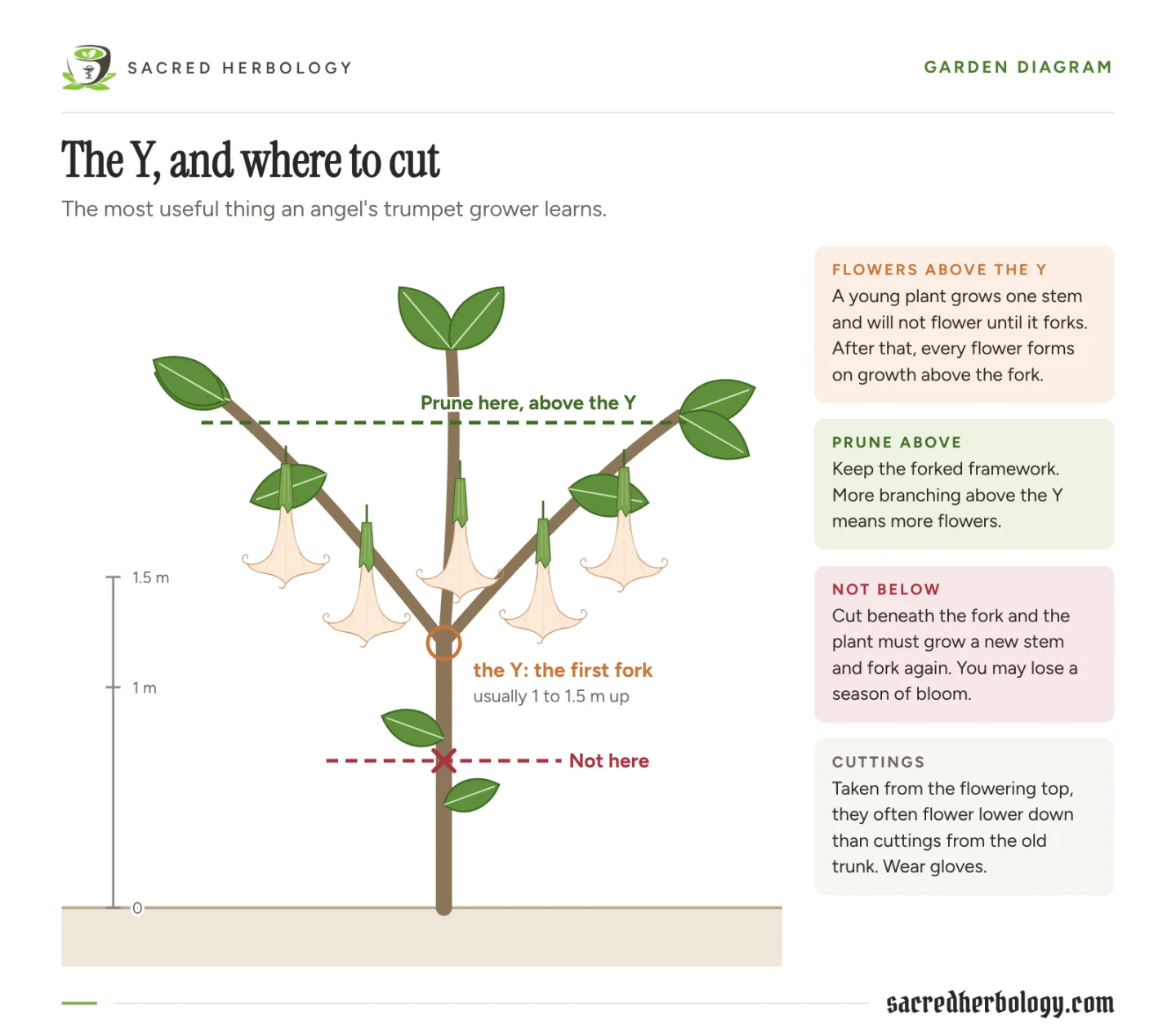
There is one piece of angel’s trumpet lore that every grower learns sooner or later, and it is the most useful thing in this section. A young Brugmansia grown from a cutting or seed starts as a single upright stem. It will not flower until that stem forks, usually into two or three branches, at a height of somewhere around a metre to a metre and a half. Growers call this the Y. From then on, flowers form only on the growth above the Y, and the more branching there is above that point, the more flowers you get.
The practical upshot is simple. When you prune, prune above the Y and leave the forked framework in place. If you cut the plant back below the first fork, it has to grow a new single stem and fork all over again before it flowers, and you may lose a season of bloom. Cuttings behave the same way: a cutting taken from the flowering top of a plant will often flower at a much lower height than one taken from the old trunk below the Y.
Sketched out, it is simple: a young plant with its single stem, the Y fork, the flowering branches above it, and a line for where to cut and where not to.
Propagation
Angel’s trumpet is one of the easiest plants in the world to propagate from cuttings, which is how it has travelled for most of its history. Lengths of firm branch tip, taken in the warm months, root readily in moist potting mix or even in a jar of water on a shaded windowsill, out of reach of children and pets. Garden hybrids rarely set seed and most grow true only from cuttings, so if you want the same apricot trumpet your neighbour has, a cutting is the way to get it. Wear gloves while you take them, and see the next section before you do.
Flushes and colour
In the tropics angel’s trumpets flower in waves. A plant will build up dozens of buds over a few weeks, then open them almost together in a great flush that lasts a week or so, rest, and do it again. Many growers keep a few different cultivars so that there is usually one in bloom. Plants may also go briefly dormant in the worst heat of the wet season and flower most heavily in the milder months either side of it.
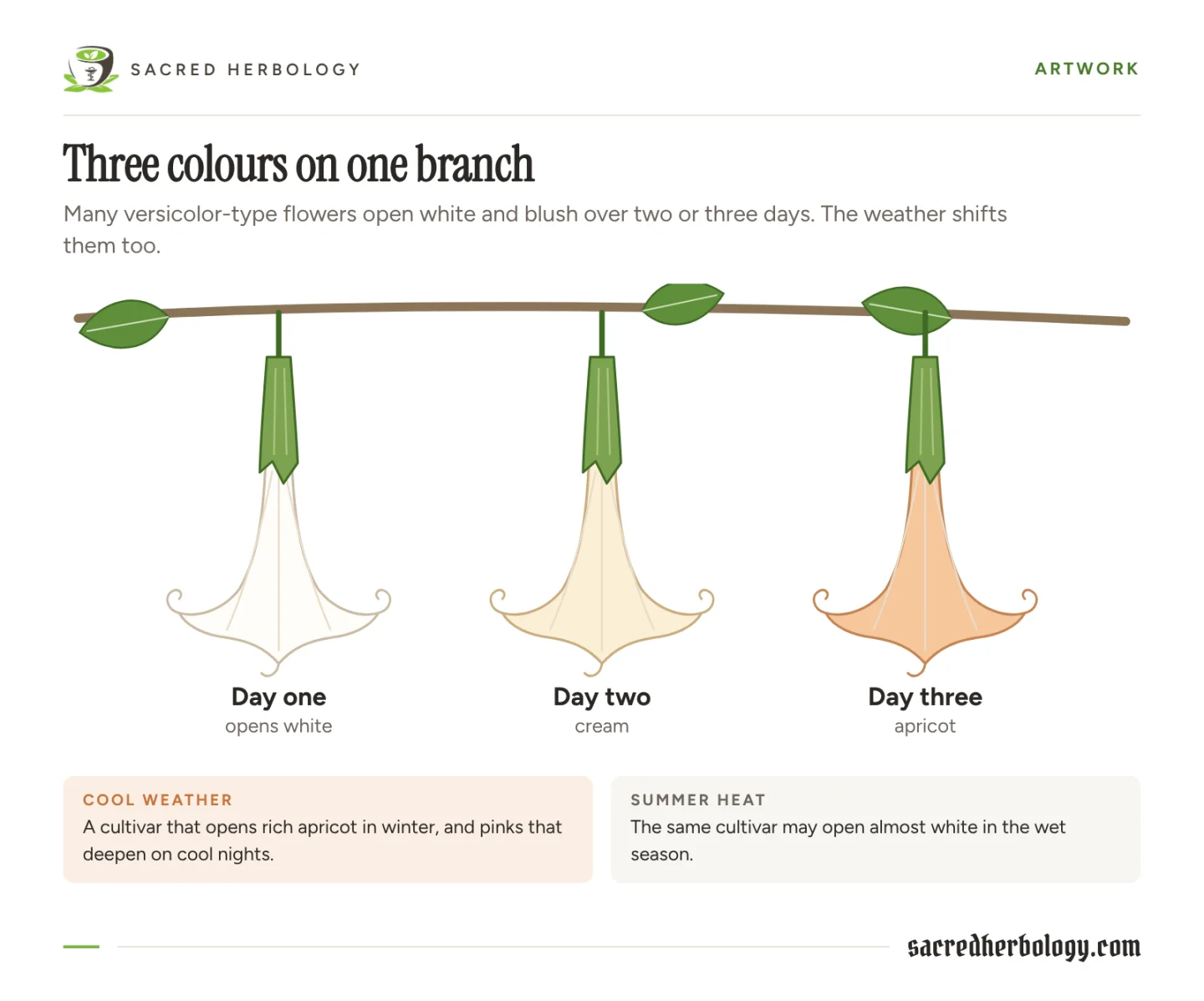
The colours shift with the weather. A cultivar that opens a rich apricot in the cool of winter may open almost white in the summer heat, and the pinks deepen on cool nights. Many of the versicolor-type flowers also change colour over their own short lives, opening white and blushing to peach or pink over two or three days. A single branch can carry three colours at once. Line up trumpets at one, two and three days old and they run from white to cream to apricot.
Safety and the garden
Here is the plain and practical part. This is not a plant to be frightened of, and it is not a plant to be careless with. People have grown angel’s trumpet in Australian gardens for well over a century, and the great majority have never had a problem, because they knew what it was and they handled it accordingly.
Queensland Health’s Poisons Information Centre warns that every part of the plant is poisonous if it is eaten, and that deaths have occurred. The danger comes from eating or drinking any part of the plant, from sap getting into the eyes, and from careless handling, and it applies to children, adults and pets alike.
A few things to know as a grower:
- Grow it, don’t eat it. No part of the plant is food, drink or smoke, and it never was a casual plant even in the cultures that knew it best.
- Plant it where small children cannot reach the flowers. A hanging trumpet at toddler height is an invitation.
- Dogs, especially puppies, sometimes chew fallen flowers and seed pods. Pick up fallen flowers if you have a young dog, and plant out of reach of the run.
- Wear gloves when you prune or take cuttings, and wash your hands well afterwards, before you touch your face or eat.
- Keep sap and pollen away from your eyes. Queensland Health notes that sap in the eye can cause a dilated pupil and temporary blindness. Gardeners have turned up at eye clinics with one huge pupil after rubbing an eye while pruning, and the effect can last a day or more. It usually passes on its own, but an unexplained dilated pupil needs checking, so tell whoever examines you that you have been handling angel’s trumpet.
- Don’t put prunings where stock or pets can browse them, and don’t dump them in the bush or on a creek bank, where they can root and spread. Bag them for the green-waste bin, and don’t burn them where you or the neighbours will breathe the smoke.
- The scent is strong. The Queensland poisons information notes that the perfume can cause respiratory irritation, headaches, nausea and light-headedness in some people. On the warm side of a verandah it is lovely. In a closed bedroom it can be too much, so if you bring a cut flower inside, put it in a large, airy room and leave the window open, and if the scent troubles you, take it out.
If the person is confused, seeing things, unusually hot, has a racing heart, is having a seizure, is hard to wake or is struggling to breathe, call 000 straight away. If someone has swallowed any part of an angel’s trumpet, or got sap in their eyes, call the Poisons Information Centre on 13 11 26 at once, at any hour, from anywhere in Australia, even if they seem well. Symptoms can be slow to start. Queensland Health’s advice is to seek medical assistance for all ingestions and eye exposures. For sap in the eye, rinse it gently with running water while you make the call. Take a piece of the plant, or a photo of it, with you to the hospital.
There is one more thing I want to say plainly, because it comes up. Every few years a story goes round about young people taking angel’s trumpet in the hope of a cheap high, and the published accounts from Australia and overseas are the same: a frightening, sometimes dangerous delirium, a long stay in hospital and very little memory of it afterwards. The South American traditions that hold the plant sacred treat it as their most serious and most dangerous teacher, kept for specialists, taken rarely and never alone. Nobody who knows the plant well describes it as a pleasant experience. It belongs in the garden.
If you are interested in the plant’s place in herbal traditions, and want to understand the chemistry and the safety in proper depth, consult a degree-qualified herbalist with competencies and adequate training in pharmacognosy.
The plant in the garden
So picture it again, the soft shrub with the bells hanging down.
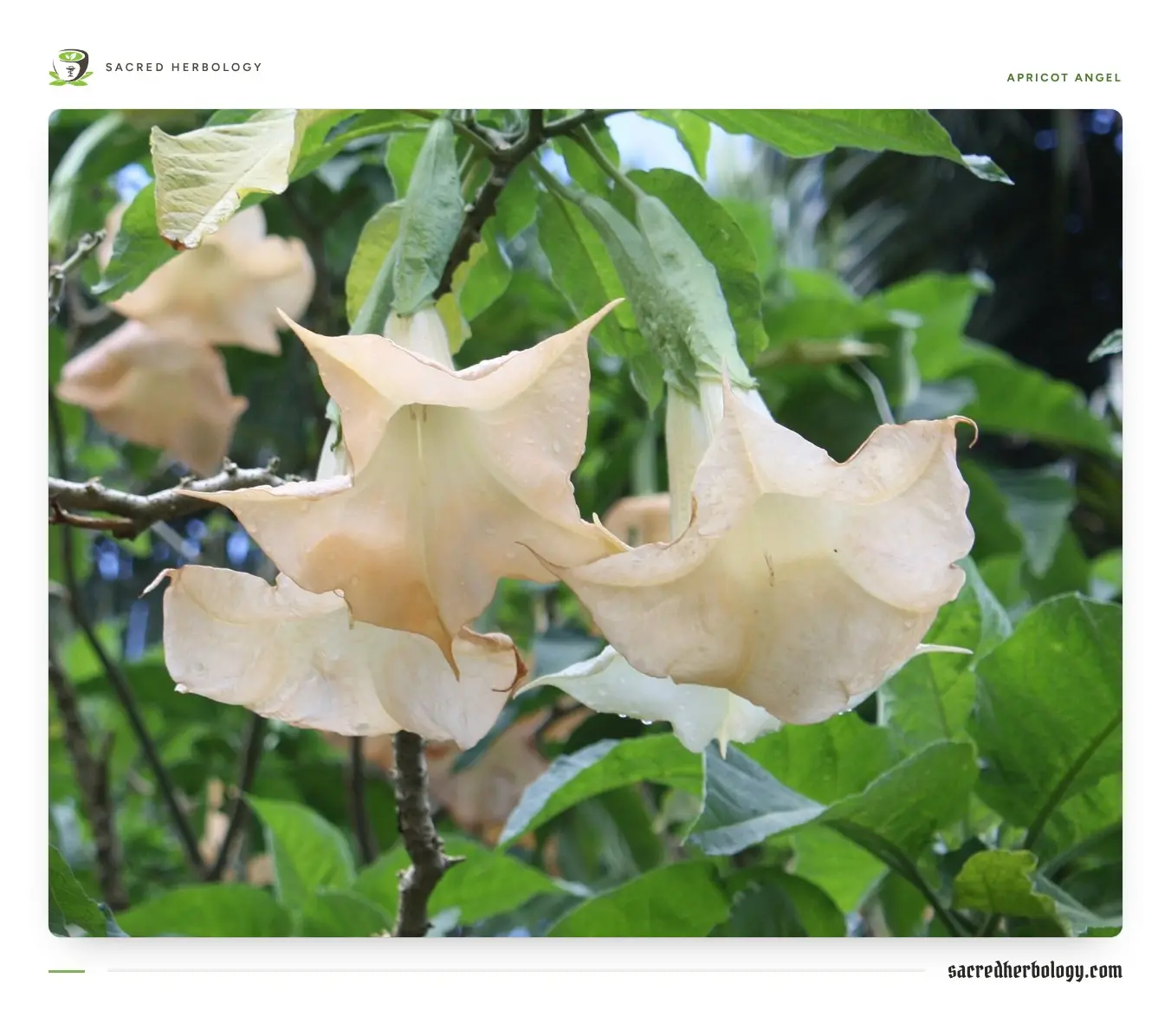

It was drawn by a French friar in Peru three centuries ago and named by a Swede working from that drawing. It is named for a Dutch professor who never studied it. A Harvard botanist mistook one strange form of it for a new genus and was put right by the Kamsá and Inga gardeners who had been growing it all along. Its last great monograph was written by a botanist from Sydney. Its wild ancestors are gone, perhaps with the giant animals that once carried its seed, and every plant left alive descends from cuttings carried and planted by people, first in Andean house gardens and then in conservatories, botanic gardens and backyards all round the warm world.
To the Muisca it was a plant of the dead. To the Shuar it was the strongest of the plant teachers, sought at the foot of a waterfall. To the curanderos of northern Peru it is a dangerous ally, kept to the edge of the mesa. To a Tasmanian doctor in 1889 it was the common trumpet flower that had poisoned a child. To a gardener, it is a scent that comes on at dusk.
All of those are true at once. Plant one, if you have the room. Give it shelter from the wind, feed it well, prune it above the Y, and keep it out of reach of little hands and young dogs. Stand beside it on a warm night with the torch off and wait for the hawkmoths.
Grow it, don’t eat it.
Where this comes from
- Louis Feuillée, Journal des observations physiques, mathématiques et botaniques (Paris, 1714).
- Carl Linnaeus, Species Plantarum (Stockholm, 1753).
- Christiaan Hendrik Persoon, Synopsis Plantarum, vol. 1 (Paris, 1805).
- Juan de Castellanos, Elegías de varones ilustres de Indias, part 1 (Madrid, 1589).
- Dr Hardy, “Notes on a case of poisoning through eating a portion of the ‘Brugmansia’”, Papers and Proceedings of the Royal Society of Tasmania (1889), pp. 29–30.
- Richard Evans Schultes, “A new narcotic genus from the Amazon slope of the Colombian Andes”, Botanical Museum Leaflets, Harvard University 17, no. 1 (27 May 1955).
- Michael J. Harner, The Jívaro: People of the Sacred Waterfalls (Doubleday/Natural History Press, 1972).
- Richard Evans Schultes and Albert Hofmann, Plants of the Gods (McGraw-Hill, 1979; revised edition Healing Arts Press, 1992).
- Ulrike Preissel and Hans-Georg Preissel, Brugmansia and Datura: Angel’s Trumpets and Thorn Apples (Firefly Books, 2002).
- Alistair Hay, Monika Gottschalk and Adolfo Holguín, Huanduj: Brugmansia (Florilegium and Royal Botanic Gardens, Kew, 2012).
- IUCN Red List of Threatened Species, assessments of the seven Brugmansia species (2014).
- Australian Plant Census, entry for Brugmansia × candida (naturalised, Queensland).
- Queensland Health, Queensland Poisons Information Centre, “Angel’s trumpet (Brugmansia)”.