

You have seen the bundle. Silver-grey leaves, wound tight with cotton string, sitting in a basket by the till in the crystal shop, the yoga studio, the beachside newsagent and about half the market stalls in Queensland. Light one end, blow it out, wave the smoke around. Nobody in the shop can usually tell you what the plant is, where it grew or who cut it.
I get asked about this one more than any other plant on the shelf, and the honest answer has several parts. Some of it is straightforward botany. Some of it is a word that changed meaning on its way through American English. Some of it belongs to living peoples who have said publicly what they think about the trade. And one part of it, the sourcing, has a clear answer that anyone can act on this week.
We do not stock white sage, and that is a decision rather than an oversight. I will explain it at the end.
If you have been repeating the standard account of the rite, and most people who burn this plant have, there is a section below that takes each claim in turn, dates it and names whoever put it into print. Nearly all of it came from a small number of books published between 1968 and 1980.
A grey shrub of the Californian chaparral
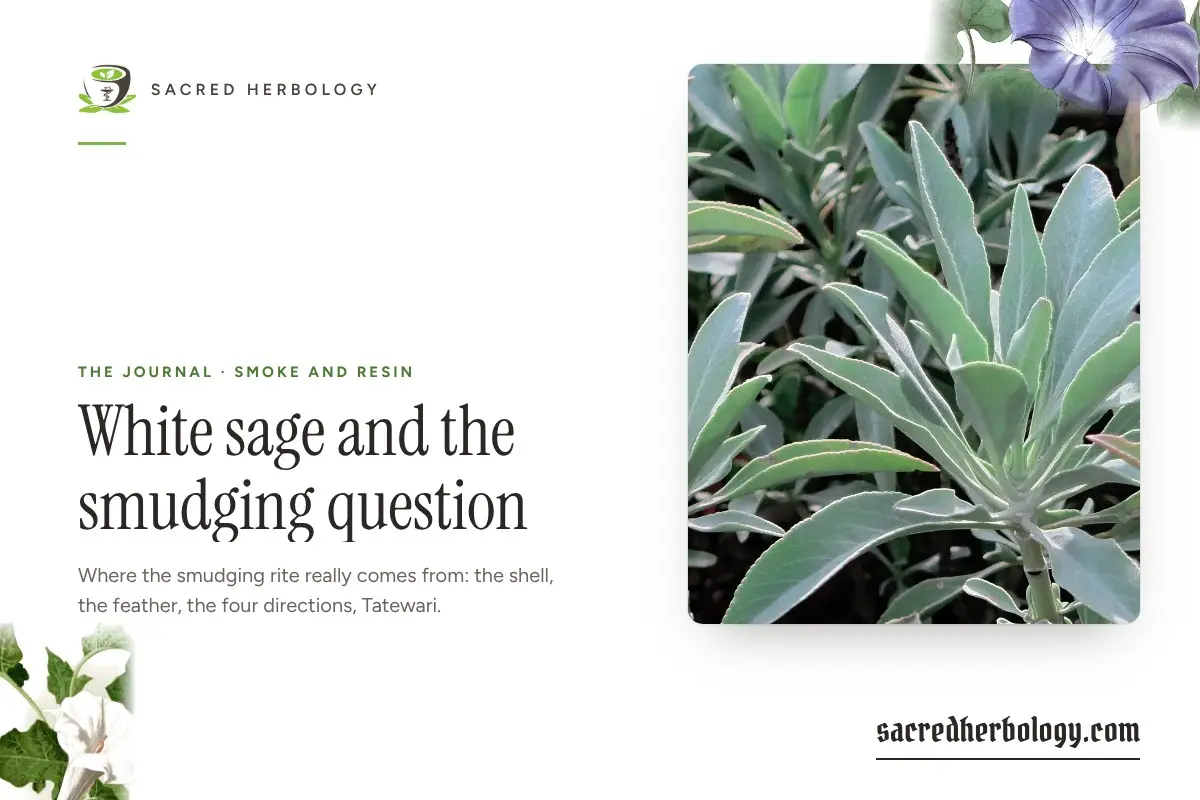
White sage is Salvia apiana, a member of the mint family, the Lamiaceae. It is woody at the base and soft-stemmed above, standing about a metre to a metre and a half, with square stems and leaves so densely covered in fine white hairs that a whole hillside of it reads pale grey from a distance. The leaves are lance-shaped, up to about eight centimetres long, and hairy on both faces. In spring it throws up long wands of small white flowers flushed with lavender, and it hums with bees. That is where the name comes from. Willis Linn Jepson gave it the epithet apiana, of the bees, in the journal Muhlenbergia in 1908.
The plant had been described long before that, by George Bentham in 1833, as Audibertia polystachya, and it spent the rest of the nineteenth century being shifted about, into Ramona and then into Audibertiella. Jepson could not carry Bentham’s epithet across into Salvia, because a Mexican plant had already taken the name Salvia polystachya, so he had to coin a fresh one. Those discarded names still turn up in secondhand herb books and on the odd label, and they all mean this plant.
It is a chaparral and coastal sage scrub plant of southern California, running from about Santa Barbara County south across the border to the middle of the Baja California peninsula, and inland as far as the western edge of the Colorado Desert. That is the whole of its natural range, and it is thickest in Riverside, Orange, San Bernardino and San Diego counties. It is built for a climate with hot dry summers, winter rain and sharp, stony drainage, and it takes fire in its stride, coming back both from the base of the burnt plant and from seed that has been lying in the soil.
Crush a leaf and you get a clean, cold, eucalyptus-like hit. That is 1,8-cineole, the compound that gives eucalyptus oil its smell, and it dominates this plant’s oil. A 2023 study by Krol and colleagues in Scientific Reports distilled a batch of dried white sage leaf and measured the oil at 72.7 per cent cineole, with alpha-pinene at 6.7 per cent and beta-pinene at 5.6 per cent behind it, and smaller amounts of beta-myrcene and camphor.
Two things about that figure, because it gets quoted as though it were the species. The paper was really about growing white sage shoots in bioreactors, and the leaf was one batch bought from a herb supplier, sold as American-grown, with no harvest date and no collection record attached, which is the same blind provenance this whole article is about. The same paper also reports that oil content in this plant has been measured anywhere from 0.6 to 3.8 per cent depending on the plant and the season, and that this batch came in higher than any figure published before it. So read 72.7 per cent as that sample, on that day, and not as a constant of the species.
The thujone point does hold. None was detected in that batch or in the cultures, and thujone has never been reported in white sage at all, which is a real chemical difference from common garden sage, whose oil in the same study ran to nearly a third thujone between the alpha and beta forms. Cineole is why the smoke smells the way it does, sharp and almost medicinal, quite unlike a resin.
The part that goes into a bundle is the leafy stem: top growth cut in the dry season, wilted a little, then bound and dried. A plant cut above its woody base pushes out new shoots and can be picked again in a year or two. A plant pulled up by the roots, or cut back hard into the old wood, is finished. That difference is the whole of the sustainability argument, and it is settled by whoever is holding the secateurs.
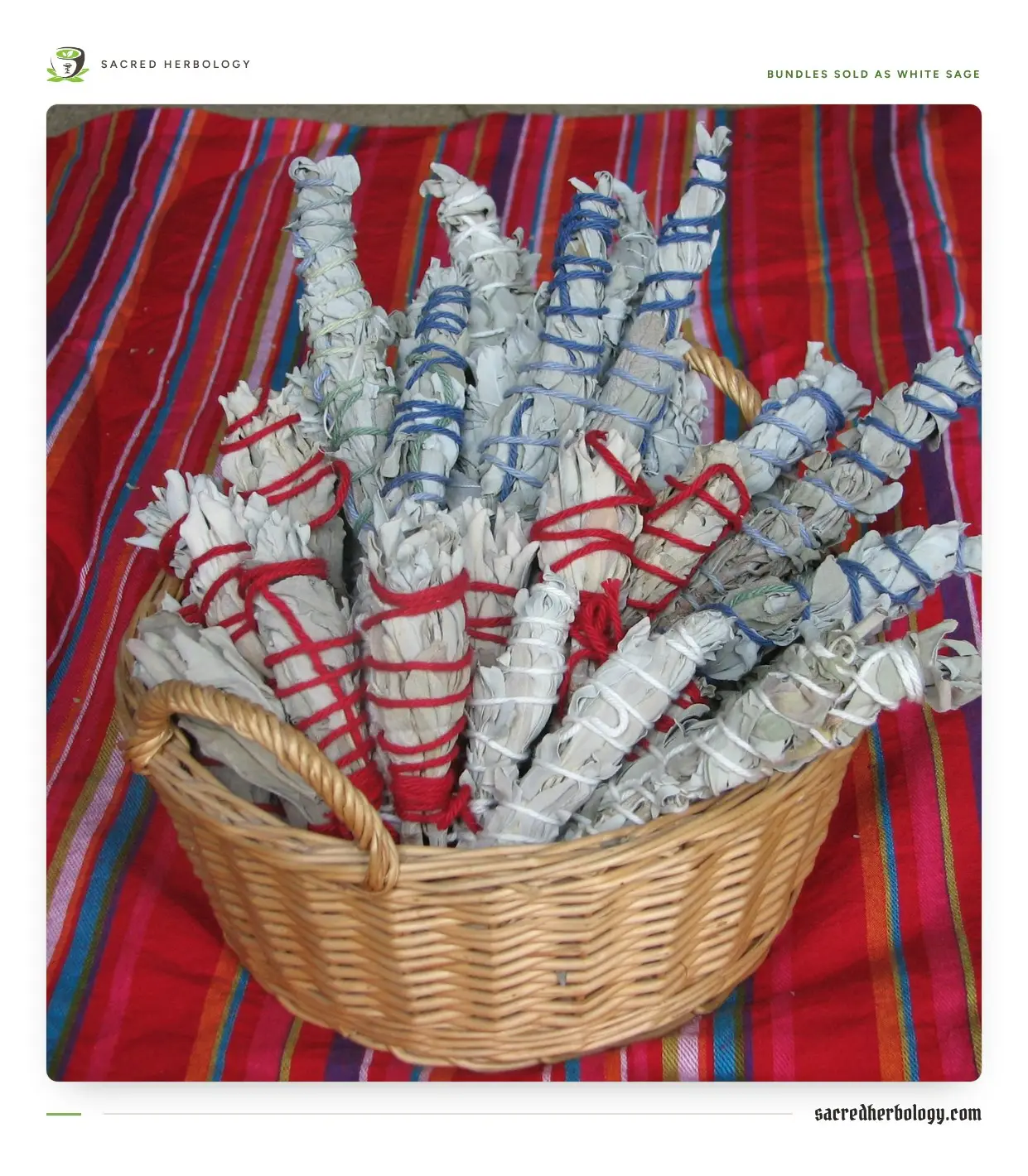

Several other grey-leaved plants travel under sage labels, and it is worth being able to tell them apart. Black sage, Salvia mellifera, shares the same hillsides and crosses with white sage freely, so hybrid swarms are common where the two meet and the crosses sit between their parents in leaf and flower. Purple sage, Salvia leucophylla, is another grey Californian salvia, and it finds its way into bundles. Anything labelled desert sage is usually Artemisia tridentata, big sagebrush, a daisy-family plant and no salvia at all, and blue sage on a label can mean almost anything the packer had. The sagebrushes matter for more than the label: they are a different family with a different oil chemistry, several of them thujone-bearing, so a substituted bundle is not the same material even before anyone asks whose ceremony it is. Garden sage, Salvia officinalis, is the kitchen herb. Crushed white sage leaf is the giveaway for the real thing: white on both surfaces, and that cold cineole smell.
What the published record actually says
Several peoples of southern California have long relationships with this plant, and good published ethnobotanies exist for three of them, written with community members and in print.
Jan Timbrook’s Chumash Ethnobotany (2007) records Chumash names for white sage in more than one dialect, along with a range of uses: the leaves and young stems as food, the leaves rubbed on the body by hunters to cover human scent, and the foliage used to line acorn storage granaries. Timbrook worked from the Harrington field notes and from Chumash people directly, and the book is careful about what it does and does not claim.
For the Cahuilla, Lowell John Bean wrote Temalpakh (1972) with Katherine Siva Saubel, a Cahuilla elder and linguist who was a co-author rather than an informant. The book records white sage seed gathered in quantity as a food, parched and ground, and used in pinole, a meal made from parched seeds that was a staple across much of California.
Michael Wilken-Robertson’s Kumeyaay Ethnobotany (2017) covers the Kumeyaay of San Diego County and Baja California, whose country holds a great deal of this plant, and documents the same double life as a food plant and a plant of ceremony.
Ceremonial use is real and current among these peoples and among their neighbours, the Tongva, the Luiseño, the Serrano and others. What that ceremony consists of, and who may conduct it, is theirs to say. I am reporting the published record here and I am not going past it. The rite described further down this page is the commercial one, the one printed on the packet, and pulling that apart is a different job from describing anybody’s ceremony.
One practical note on the food uses above. They are a record of what people gathered on their own country, from plant they knew. Dried bundles on a shop shelf have no history you can check, and nobody should be eating them.
Where the word “smudge” comes from
Here is the part that surprises people. “Smudge” is a plain English word with a farming history. The Oxford English Dictionary records the noun for a smothered, smoky fire lit to drive off mosquitoes and biting flies from the second half of the eighteenth century, and the verb, to make such a fire, from around 1860. Orchardists lit smudge pots against frost. Stockmen lit smudge fires against insects. Nothing sacred about it at all.
At some point in the nineteenth and twentieth centuries, English speakers writing about First Nations ceremony started using “smudging” for the ritual burning of certain herbs, and the word stuck, first in ethnographic writing, then in Native English usage itself, and eventually on printed labels in shops.
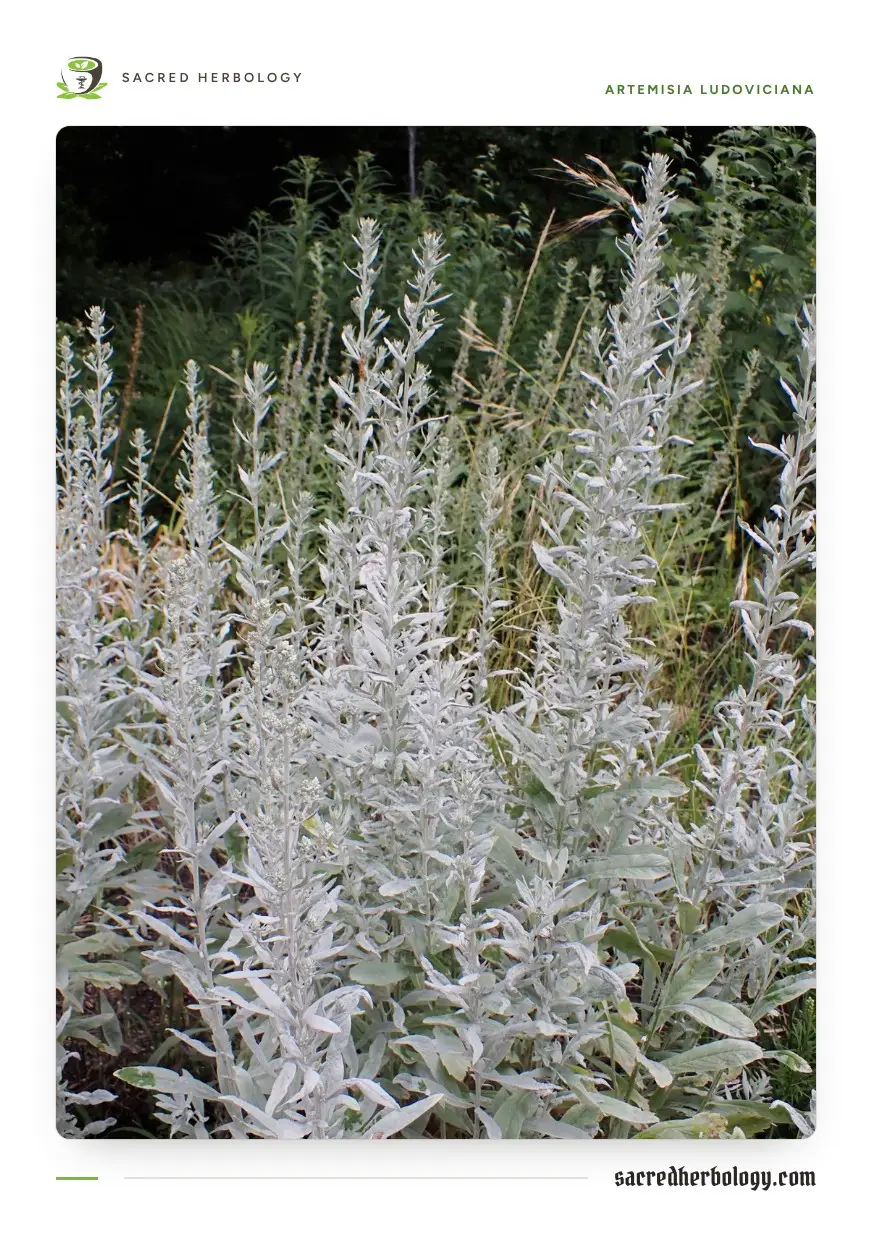
The herbs in those accounts, though, are often not this plant. Published descriptions of Plains and Great Lakes ceremony usually name sweetgrass, cedar, tobacco and a sage that belongs to an entirely different genus: Artemisia ludoviciana, white sagebrush or prairie sage, a daisy-family plant with long grey leaves, documented by Kelly Kindscher in Medicinal Wild Plants of the Prairie (1992) and by ethnographers before him. Artemisia ludoviciana grows across most of North America and is under no pressure whatsoever.

So the commercial “smudge stick” takes a Californian chaparral shrub, attaches to it a word and a practice most associated with peoples two thousand kilometres away, and sells the result as a generic cleansing ritual. That collapse of three separate things into one product is what people mean when they talk about the smudging problem.
The rite as it is actually taught
Ask a dozen shops how it is done and you get one recognisable pattern, because that pattern has been printed on the back of the packet for about thirty years. It runs roughly like this.
A shell, almost always red abalone, Haliotis rufescens, held in one hand with a little sand or ash in the bottom of it. The bundle lit at one end, allowed to flame for a few seconds, then blown out so that it smoulders. A feather, or a fan of several feathers, to push the smoke where it is wanted. The person holding it draws smoke over their own head, heart and hands first, then over each other person present, then around the room, into the corners and along the doorways. Then a turn to each of the four cardinal directions in order, often with the sky above, the ground below and the heart at the centre added to make seven. Words are spoken at each turn, fixed or improvised, and the working idea behind the words is that the smoke carries them. The lit end goes into the sand in the shell to finish.
Over the top of that sits an elemental reading, and it is on every instruction sheet: the dried plant is earth, the coal is fire, the smoke and the feather are air, the shell is water. Four elements, four directions, one object each.
That is a coherent rite, and people work it and get results. The question I get asked is where it came from. The answer comes in pieces, and each piece has its own date and its own owner.
The shell
Abalone matters in the material culture of coastal California and the south-west, and it matters a long way back. Haliotis shell was ornament, inlay, container and trade good up and down that coast and far inland for thousands of years. In the Apache girls’ Sunrise Ceremony the abalone shell tied above the forehead stands for Changing Woman, and that is a living ceremony with its own custodians and its own protocols.
An abalone shell used as an ash dish under a bundle of Californian sage, and read as the element of water, is a different proposition. I can find no description of that arrangement in the published Californian ethnobotanies, in the nineteenth-century ethnographies, or in the older accounts of Plains and Great Lakes ceremony. It appears with the commercial kit, in the twentieth century, which is also when the shells started arriving by the crate.
The four directions
This is the element people are most confident is ancient, and it is the easiest one to date.
Directional cosmology is real, old and widespread across Native North America, and the schemes do not agree with one another. Colours, orders, orientations and meanings differ nation by nation, because they belong to particular peoples on particular country. The portable version, the four-quartered wheel with one colour, one season, one animal and one quality per quarter, taught as a single teaching that covers everybody, can be traced.
Charles Storm, publishing as Hyemeyohsts Storm, put that diagram into print in Seven Arrows (Harper and Row, 1972). Vincent LaDuke, an Ojibwe man who published and taught as Sun Bear, took the idea further through the Bear Tribe and through books including The Medicine Wheel: Earth Astrology (Prentice-Hall, 1980), adding material from several unrelated Indigenous sources along with pieces of Western occultism. Both men were criticised in print at the time by Native writers and by anthropologists; the historian Rupert Costo and the anthropologist John H. Moore both attacked Storm’s book publicly, and Storm’s colour and direction assignments do not match the Cheyenne teaching he claimed them from.
So when a workshop teaches the four-directions circuit as the ancient heart of the rite, the diagram being taught is about fifty years old and its authorship is documented.
The elements
Earth, air, fire and water are Greek. Empedocles set out the four roots in the fifth century BC, Aristotle formalised them, and they travelled through Hellenistic medicine and Arabic natural philosophy into Latin Europe, and from there into ritual magic as the four quarters of the circle.
That is worth saying clearly, because it changes what the instruction sheet is. Assigning the shell to water and the feather to air is an act of Western ceremonial magic performed on borrowed objects. Anyone who already works a Western system will recognise the grammar, and that grammar has a provenance they can stand behind.
The feather
Feather instruments are real, and they are specific. Among the Wixaritari of western Mexico the muwiéri is a wand of brazilwood, Haematoxylum brasiletto, with feathers from raptors bound to it; the mara’akáme holds it while chanting, blessing offerings and working over a patient. In Native American Church practice a feather fan is a personal, consecrated object with a history of its own.
The loose feather that comes taped to a retail smudge kit stands in for those things without the consecration, the maker or the line behind it.
Tatewarí, the fire at the centre
There is a figure who belongs in any honest account of smoke and prayer in the Americas, and he is missing from most of them. Tatewarí, Our Grandfather Fire, of the Wixaritari, the people outsiders have long called the Huichol, in the Sierra Madre Occidental of Jalisco and Nayarit in western Mexico.
Tatewarí is the oldest of the ancestors and the first mara’akáme, the first shaman. Every mara’akáme after him works by his light, and the working relationship is with the fire itself. Barbara Myerhoff, who did her fieldwork in 1965 and 1966 and travelled the peyote pilgrimage with the mara’akáme Ramón Medina Silva, put it plainly: “Only the mara’akame has routinized visions. They are concerned with lessons and messages from Tatewari. He or she sees Tatewari in the fire and communicates directly with him. Thus the mara’akame brings back information from other worlds, information of value and meaning to the people.”
Medina Silva described the fire from inside the work: “One sits there, looking into the fire which is Tatewari. One sees the fire in colors, very many colors, five colors, different colors.” And on where his own power sat, he was exact about the two halves of it: “It is true that I receive my power from Tatewari, our Grandfather Fire, but I could not use it without the complete trust of my peyote comrades.”
The fire is also where things go. Myerhoff recorded that on leaving the sacred desert of Wirikutá the pilgrims scrape every physical trace of the journey into the fire before they run for the boundary. Offerings, spent matches, dust, food. The fire takes it.
The geography of that tradition is precise, and it is not a four-quartered wheel. Juan Negrín, who worked with and wrote about the Wixaritari for decades, sets out five points, each one a real place a pilgrim walks to. East is Wirikutá, the high desert in San Luis Potosí where peyote is hunted at dawn and where the pilgrims take on the yellow face paint. West is Tatéi Haramara, Our Mother Ocean, on the Nayarit coast. North is Hauxamanaka, in Durango, springs and a lagoon with the sacred kieri tree. South is Xapawiyemetá, the lagoon with the wild fig, held for Takutsi Nakawé, Our Great Grandmother of Germination, who foretold the flood. And the centre is Ixrüapa, the highland country, where Our Grandfather has his cave at Teakata, above which stands the first ceremonial centre of the ancestors.
Five points, and the fifth is the fire. That is a directional scheme with an address.
Now the part that matters if you are going to use any of this. None of it is Californian. The Sierra Madre Occidental is two thousand kilometres and several language communities away from the white sage hillsides, and white sage plays no part in Wixárika ceremony. Tatewarí does not sit behind a bundle of Salvia apiana in an abalone shell. A rite that calls on Grandfather Fire over that equipment has spliced a Wixárika ancestor onto Californian and Plains-derived furniture, and the splice is recent.
The Wixaritari are also among the most closed communities on the continent about this material, by choice and by long practice. Negrín records visitors being put in stocks for using a camera or a tape recorder without permission. That is not a detail to read past.
How Grandfather Fire reached a workshop in Byron Bay
The route is documented, which is unusual and useful.
Peter T. Furst and Barbara Myerhoff worked with Ramón Medina Silva in the mid-1960s, and their material came out through the 1970s: Myerhoff’s Peyote Hunt: The Sacred Journey of the Huichol Indians (Cornell University Press, 1974), her essay “Peyote and the Mystic Vision” in Kathleen Berrin’s Art of the Huichol Indians (Fine Arts Museums of San Francisco and Harry N. Abrams, 1978), and the touring exhibition that volume accompanied. Carlos Castaneda’s books were selling in the millions alongside them. Out of that came a first generation of Western teachers of Huichol-derived practice, Prem Das and Brant Secunda among them, running workshops for paying audiences from the late 1970s onward. Two decades later the words Tatewarí and mara’akáme were in circulation in rooms that had nothing else Wixárika in them.
The scholarship on all this is contested, and anybody using the material should know that. Jay C. Fikes argued in Carlos Castaneda, Academic Opportunism and the Psychedelic Sixties (Millenia Press, 1993) that what Furst and Myerhoff published from Medina Silva was unrepresentative of ordinary Wixárika practice, and he questioned Medina Silva’s standing as a fully recognised mara’akáme. Furst rejected the argument, and Fikes has described threats of litigation that stopped an earlier publisher from bringing the book out. I am not in a position to settle that dispute and I am not going to pretend to. I record it because anyone building a practice on this material deserves to know that its central ethnographic source has been challenged in print by another ethnographer who worked with the same people.
What survives all of it intact is the idea people are reaching for: that smoke is a channel, that what you say into a fire goes somewhere, and that a fire can be addressed. Nobody owns that idea. The Wixaritari have their own version of it, with its own name and its own cave, and that version is theirs.
The old books are silent
Because this is the Journal it is worth saying plainly: white sage appears nowhere in the European esoteric record. It is absent from the Picatrix, from Agrippa’s suffumigations, from the Solomonic grimoires, from the Golden Dawn papers and from Crowley’s tables. It could not be otherwise. Salvia apiana was unknown to European writers until the nineteenth century and unknown to European occultists in any practical way until the twentieth.
The sage in the old books is Salvia officinalis, the garden herb. Culpeper put it under Jupiter in The English Physitian of 1652. The medieval Salernitan verses carried the tag “cur moriatur homo cui salvia crescit in horto”, why should a man die who has sage growing in his garden, which John Harington turned into English in 1607. That line is about a different plant, and it is a scrap of medieval verse, nothing more.
Any modern correspondence table that lists white sage under a planet, an element or a sephirah is a twentieth-century or twenty-first-century invention. That does not make it worthless to the people who use it, and new traditions have to start somewhere. It does mean that anyone telling you the ancients burned white sage is selling you something.
What the old books say about smoke
The same books that are silent on this plant say a great deal about smoke itself. If the part of the modern rite you care about is laying a prayer onto the smoke and sending it somewhere, that doctrine is in print, in your own tradition, with dates and editions attached.
The Picatrix, the Arabic Ghāyat al-Ḥakīm of around the tenth or eleventh century, translated into Latin at the court of Alfonso X in 1256 and into English by Dan Attrell and David Porreca (Penn State University Press, 2019), treats the suffumigation as a working part of the operation. The fume is not scent. It is what makes the planetary spirit present to the work, and the book spends real space on it: storax turns up across the Saturn, Jupiter, Sun, Moon and Venus rites, Book III chapter 7 carries the compound planetary suffumigations, and the great solar fume at III.7.27 runs to thirty-one ingredients. Get the ingredients wrong and the operation is understood to fail.
Agrippa says the same thing more briefly. De occulta philosophia (Cologne, 1533), Book One, chapter 43, “Of Perfumes or Suffumigations; their Manner and Power”, in the 1651 English of the translator who signed himself J.F.: “Some Suffumigations also, or perfumings, that are proper to the Stars, are of great force for the opportune receiving of Celestiall gifts under the rayes of the Stars, in as much as they do strongly work upon the Aire, and breath.” The chapter that follows gives a compound fume for each of the seven planets. The mechanism is in that last clause. Smoke works on air and breath, and air and breath are what carry an intention.
Behind both sits the Neoplatonic argument, set out by Iamblichus in De mysteriis around the turn of the fourth century: material offerings suit material powers, and the offering is one of the ways the operator is joined to what is being addressed.
The same idea runs through Christian liturgy in the plainest possible words. Psalm 141, verse 2, in the Vulgate: dirigatur oratio mea sicut incensum in conspectu tuo, let my prayer be directed as incense in thy sight. Revelation 8:4 has the smoke of the incense going up with the prayers of the saints. Two thousand years of censers in churches are working that verse.
So the practice of speaking into smoke and sending the words upward is not something anybody had to borrow from North America in 1985. It has been sitting in the Western record the whole time, with its own theory of why it works, its own tables of what to burn and when, and its own printed editions to cite.
How it went global, and what it cost
The New Age market for smudge bundles grew through the 1970s and 1980s, and Native organisations pushed back early. On 10 June 1993 the fifth Lakota Summit passed the “Declaration of War Against Exploiters of Lakota Spirituality”, drafted by Wilmer Stampede Mesteth, Darrell Standing Elk and Phyllis Swift Hawk and endorsed by representatives of dozens of Lakota, Dakota and Nakota communities. The declaration is about ceremonies generally, and no single plant is its subject, but it is the clearest published statement of the objection and it is worth reading in full.
The retail scale of the thing became hard to ignore in 2018. In September that year the American cosmetics chain Sephora announced a “Starter Witch Kit” from the perfume brand Pinrose, priced at about forty-two US dollars, containing perfume samples, a tarot deck, a piece of rose quartz and a stick of sage. The reaction was immediate and the product was withdrawn before it ever went on sale.
The ecological cost is easier to count. In June 2018 four people were arrested at the North Etiwanda Preserve in Rancho Cucamonga, California, carrying roughly 180 kilograms of illegally cut white sage out of a canyon in backpacks. Kimon de Greef reported the wider picture for VICE Magazine in August 2020: dozens of arrests over three years in southern California, multiple tonnes seized, single hauls over 450 kilograms, wholesale prices around thirty US dollars a pound, and pickers paid a couple of dollars a pound for it. Poaching was described as near-daily through spring and summer.
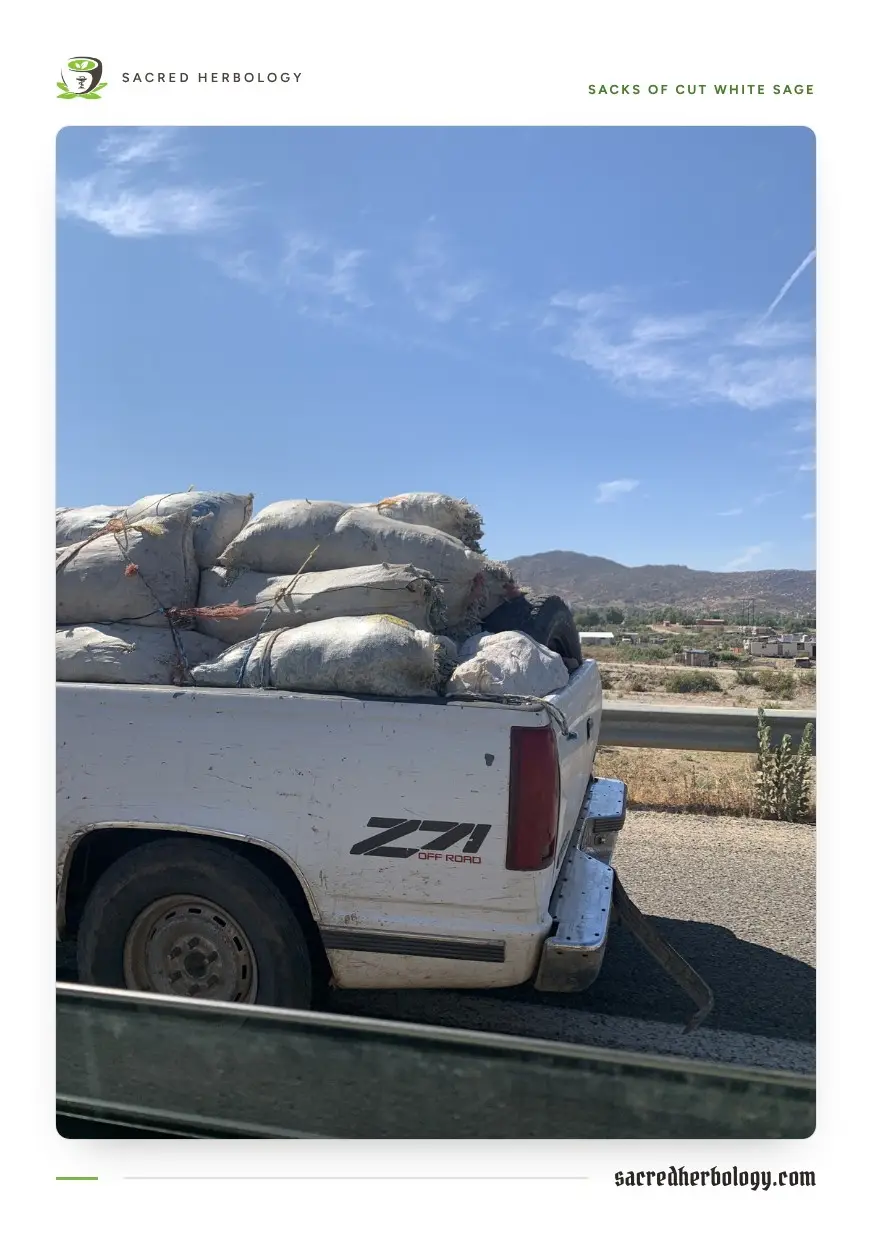

Salvia apiana is not a listed endangered species, and people sometimes use that fact to wave the whole question away. Abundance across a range says little about what happens to a particular hillside that gets stripped every year while housing eats the valley below it. Susan Leopold of United Plant Savers has written about the problem and quotes the late Tongva elder Barbara Drake: “We do not sell white sage. If you need it as a medicine and we have it, we’re going to give it to you.”
In 2022 the Chumash and Yaqui artist Rose Ramirez and the photographer Deborah Small released a short documentary, Saging the World, made with the California Native Plant Society, which puts Native voices on this question directly. If you want one thing to watch on the subject, watch that.
How we all came to believe it
Hardly anybody repeating the standard account invented any of it. It arrived assembled, out of books that sold in millions, workshops run by sincere people and copy printed on the back of a packet, and most of those teaching it were taught it themselves in good faith. The dates do most of the work here, so here they are in order.
- 1883 to the 1930s. The Religious Crimes Code and the Courts of Indian Offenses made ceremony itself punishable in the United States. Commissioner Charles Burke’s Circular 1665 of 1921, and its supplement of 1923, went after dances by name. The dance ban came off in 1933 under John Collier, the wider suppression outlasted it, and the American Indian Religious Freedom Act only passed in 1978, with the amendment protecting peyote use following in 1994. Through the whole period in which the English-language account of “smudging” was forming, the people who held the actual ceremonies had every reason to keep them away from strangers and out of print. What filled the gap came from somewhere else.
- 1968 to 1976. Carlos Castaneda’s The Teachings of Don Juan: A Yaqui Way of Knowledge (University of California Press, 1968) was published as anthropology, by a university press, and it and its sequels sold in the millions. Richard de Mille set out the case against it in Castaneda’s Journey: The Power and the Allegory (Capra Press, 1976) and in the collection he edited as The Don Juan Papers (Santa Barbara, 1980): that don Juan was a literary invention and the fieldwork had not happened. The damage to the scholarship was done and the shape of the books stayed: a lone apprentice, a generic shamanism belonging to no particular people, teachings with no community behind them to answer for them.
- 1972. Hyemeyohsts Storm’s Seven Arrows put the portable four-quartered wheel into print.
- 1974 to 1978. Myerhoff’s Peyote Hunt, her essay in Art of the Huichol Indians and the touring exhibition that volume accompanied brought Wixárika material into English for a general readership, Tatewarí included.
- Late 1970s onward. Western teachers of Huichol-derived practice, Prem Das and Brant Secunda among them, began running workshops for paying audiences. Those rooms are where the words Tatewarí and mara’akáme entered Western practice.
- 1980. Sun Bear’s The Medicine Wheel: Earth Astrology carried the wheel further and added material from several unrelated sources.
- 1980s and 1990s. Bundle, shell and feather were packed together as a retail kit with an instruction sheet, and the instruction sheet is where most people met the rite. The Lakota declaration of June 1993 was the reply to it.
Now the claims themselves. I have heard every one of these from someone who meant it sincerely.
“Smudging is an ancient Native American ceremony, and this is how it is done.” The word is English and agricultural, as above. The standardised sequence is a pan-Indian construction of the twentieth century: hundreds of nations across the continent had their own ceremonies with their own plants and their own rules, and one method covering all of them never existed to be handed down. Sage burned in regions where no local sage practice is recorded generally arrived with the Pan-Indian movement rather than through an unbroken local line.
“White sage is the plant of smudging.” The published accounts of Plains and Great Lakes ceremony name sweetgrass, cedar, tobacco and Artemisia ludoviciana, a daisy-family plant. Salvia apiana belongs to southern California and to the peoples of southern California. The retail bundle put one region’s plant into everybody’s ritual, and it did that for commercial reasons: the bundle holds its shape, travels well and looks like the photograph.
“The abalone shell is the traditional vessel, and it stands for water.” Nothing in the published Californian ethnobotanies or in the older ethnographies describes a shell used as an ash dish under burning sage. The water reading is Greek in origin and it arrived with the instruction sheet. The supply is worth knowing as well: California’s commercial red abalone fishery closed in 1997, the last recreational fishery on the north coast closed in 2018, and that closure now runs to 2036. Shells sold in kits are farmed stock or other species from overseas, bought by the crate.
“The four directions are the oldest part of it.” The circuit as taught is about fifty years old and its authorship is documented, Storm in 1972 and Sun Bear in 1980. Genuine directional cosmologies are far older and they disagree with one another, which is exactly what you would expect of teachings that belong to particular peoples on particular country. A scheme that fits everybody fits nobody in particular.
“Earth, air, fire and water, one element for each object.” Empedocles, fifth century BC, by way of Aristotle, Hellenistic medicine, Arabic natural philosophy and Latin ritual magic. Anyone working a Western system is on home ground here.
“Tatewarí is the Native American patron of shamanism, and smoke is how you reach him.” This is the one I would most like corrected, because it is the most specific and it travels furthest. Tatewarí is Wixárika. He belongs to one people in Jalisco and Nayarit, and he is the first mara’akáme of that tradition. There is no continental patron of shamanism; the patron-saint shape is a European frame laid over several hundred unrelated traditions. What the published fieldwork records is a mara’akáme seeing Tatewarí in the fire and taking instruction there, and the pilgrims burning every trace of the journey on leaving Wirikutá. The formula that circulates in workshops, that Grandfather Fire said to call on him when a shaman needs the spirit world and that smoke is the channel he gave, I cannot source to any published Wixárika account. It is also attached, in that teaching, to a Californian plant and a piece of retail equipment from two thousand kilometres away. The underlying idea that smoke carries words is real and very old, and it sits in the Western record with chapter and verse, which is the section above this one. The Wixárika name on it is borrowed.
“Sage smoke kills 94 per cent of airborne bacteria.” The number is real and it comes from one paper: C. S. Nautiyal, P. S. Chauhan and Y. L. Nene, “Medicinal smoke reduces airborne bacteria”, Journal of Ethnopharmacology 114, no. 3 (2007): 446-51. What they burned was havan sámagri, the wood-and-herb mixture used in fire oblation across India, for an hour in a closed room. No Californian sage, no shell, no smudge, and nobody’s ceremony of this kind anywhere in it. The figure was on sage packets within a few years of publication. I am a historian and I make no health claim for burning anything; what I can tell you is that the citation being quoted is for a different material burned in a different country.
“The smoke releases negative ions, and that is why it lifts the mood.” I can find no published measurement behind that claim for this plant or for any other. It appears in wellness copy from the 2010s with no source attached and gets passed along in that condition.
“White sage is endangered.” It carries no listing, and saying otherwise hands a seller an easy rebuttal in front of an audience. The poaching figures earlier on this page are strong enough on their own, and they describe something a listing would not fix anyway.
“It has to be an eagle feather.” In the United States, eagle feathers are restricted under the Bald and Golden Eagle Protection Act of 1940 and the Migratory Bird Treaty Act of 1918, and permits are limited to enrolled members of federally recognised tribes. The feathers taped into retail kits are dyed poultry. Australian native bird feathers carry their own restrictions under state wildlife law, so the same care applies here for different reasons.
“You must never buy it, it can only be given.” What is documented is particular people describing their own practice with their own medicine on their own country, Barbara Drake’s line among them. Turned into a universal rule for a retail customer it does something odd: it makes the sourcing question vanish, when sourcing is the part of this that a buyer can actually act on.
If you have been teaching the packet version, and a great many people have, the correction costs less than it looks. The structure survives it. The pedigree does not, and a pedigree you can recite is worth more in a working than one you inherited from a printed insert.
So what should you do
I am a historian of these traditions and I hold no authority to rule on anyone’s practice. What I can give you is a clean separation of the three questions people usually mash together.
- Burning an aromatic plant to change the feel of a room is one of the most widespread human habits there is, found on every continent, and nobody owns it. Rosemary on the coals, juniper on a Highland hearth, benzoin in a church, mugwort on a Midsummer fire. That part is free to all of us.
- A named ceremony belonging to a living people, with its own protocols and its own custodians, is a different thing entirely, and it is theirs. If you were not taught it by the people who hold it, you are not performing it, whatever you call what you are doing. Calling it something honest costs you nothing.
- Sourcing has a hard answer. If you buy white sage, buy cultivated material with a named farm behind it, ideally from a Native-owned grower, and ask to see the harvest permit or grower declaration. A seller who cannot tell you where it grew is very probably selling poached plant. Nursery-grown white sage is widely available in California and increasingly elsewhere, and cultivated stock takes nothing off a hillside. Ignore the grade words. There is no standard behind “ceremonial grade”, “premium” or “AAA” white sage, no pharmacopoeial monograph for the species and no test anybody has to pass, so those words describe the packer’s marketing and tell you nothing about the plant. A species name, a place, a year and a person willing to put their name to all three tell you something.
That is why there is no white sage in our shop. Selling it next to this article would make the article a sales pitch, and I would rather keep the article.
Building something of your own
I get asked for the instructions. I am not the person to give anyone instructions on a ceremony that belongs to living people, and I have no authority over anybody’s practice. What I can do is set out the parts a smoke rite is made of, say where each part can be sourced ethically, and leave the building to you.
Seven parts, and every tradition I know of fills all seven somehow.
A stated purpose. The old books put this first and they are strict about it. The operation is specified, then the fume is chosen to match it. A general cleansing with whatever was on the shelf is the weakest version of the form.
A time. The Picatrix and Agrippa both tie the fume to the planetary hour and day, and the tables for that are published and easy to work. If you use an astrological scheme already, this part is already yours.
A plant chosen for a documented reason. Frankincense from a named Boswellia species and a named region. Myrrh, Commiphora myrrha. Juniper, Juniperus communis. Bay, Laurus nobilis. Mugwort, Artemisia vulgaris. Rosemary. Benzoin from Styrax. Garden sage, Salvia officinalis, which Culpeper put under Jupiter in 1652. All of them trade cleanly, all of them appear in the European material with chapter and verse, and none of them takes anything off a Californian hillside.
A vessel and a heat source. A brass thurible, a clay censer, a charcoal disc in a heatproof dish of sand, a small brazier. If the shell in your kit carries somebody else’s meaning and you would rather it did not, put it down and use a bowl.
Something to move the air. A fan, a folded card, your own breath, the draught from an open window. The feather is one solution to that problem and there are others.
An orientation scheme you can name. The quarters of the Golden Dawn, air in the east and fire in the south and water in the west and earth in the north, published in Israel Regardie’s The Golden Dawn from 1937. The Solomonic circle. Agrippa’s own directional material. The Wixárika five points, which are not available to you and which I have described so that you know what a directional scheme looks like when it has an address. Pick one, know where it came from, and stand behind it.
Words you mean, said out loud, and a close. Fixed formulae and extempore speech both have long histories. Then put it out properly, dispose of the ash, and write the working down. That last part is the oldest habit in the Western tradition and the one most often skipped.
Build that and you have a rite with a provenance you can recite: this element from Agrippa, this from the Picatrix, this from your own head, this from a plant with a farm behind it. Call it yours. Nobody can accuse you of wearing somebody else’s ceremony, and you will know exactly which parts are doing the work, which is the thing that actually matters when a working succeeds and you want to repeat it.
Growing it here, and what we have instead
If you want to try it in Australia: Salvia apiana wants a dry summer, a gritty free-draining mix, full sun and almost no humidity. It comes readily from seed or from soft tip cuttings, and it is short-lived in a garden, so most people keep a young plant coming on behind the old one. Gardeners in Adelaide, Perth and the drier inland do well with it. In the humid tropics it rots, usually before the wet season is half over. A pot of gritty mix under cover, kept dry through the wet, is the only version of it with a chance there.
It is no weed risk here, for what that is worth. Salvia apiana is not declared or restricted under Queensland’s Biosecurity Act 2014 or on any other state’s list, and there is no record of it naturalising in Australia; the climate is wrong for it almost everywhere. The sage that does misbehave here is a different one, Salvia verbenaca, wild sage, long naturalised across the southern states. Bringing white sage in is the part with rules attached. Dried plant material entering Australia falls under the Biosecurity Act 2015 and is inspected like any other plant product, and seed and live plants have import conditions of their own that need checking before you order. Posting yourself a bundle from a Californian shop is a good way to have it taken off you at the border.
There is a further point worth making. Smoking ceremonies are conducted in this country by Aboriginal and Torres Strait Islander peoples, using their own plants, on their own country, by people entitled to conduct them. Swapping one borrowed ceremony for another is no improvement. If you want to experience a smoking ceremony, be invited to one.
For your own censer, there is plenty that is uncontested and grows or trades cleanly: frankincense from a named species and region, myrrh, garden sage, rosemary, bay, juniper, mugwort, benzoin. The Journal works through them one at a time.
Burning anything safely
- Smoke is smoke. It carries fine particles that irritate airways and can set off an asthma attack, and a plant this heavily scented makes a sharp smoke. Burning a leaf is a different process from distilling it, and nobody has published what the smoke of this plant actually contains, so give it the caution you would give any smoke indoors. Open a window, keep the room ventilated, never light it in a car or a closed-up bedroom, and keep it well away from anyone with asthma or another chest condition, from babies and small children, and from pet birds, whose lungs are very easily damaged. If someone starts wheezing or coughing hard, get them out into fresh air and let them use their reliever puffer. If that does not settle it, or they are struggling to breathe or to speak, call 000.
- Keep the smoke away from anyone who is pregnant. Fine particles are not something to be breathing while pregnant, and there is nothing here worth the risk.
- Use a heatproof dish with sand or ash in it, and never leave a smouldering bundle unattended. A bundle that looks out can smoulder for a long time. Drown it or bury the lit end in sand. Keep it clear of curtains and paper, and out of reach of children and of animals that might knock it over.
- If you burn resins on charcoal discs, ventilate the room properly. Charcoal gives off carbon monoxide, which has no smell and no taste, so never light it in a closed room, a tent or a vehicle.
- If someone swallows plant material, ring the Poisons Information Centre on 13 11 26 straight away, without waiting to see whether they become unwell. Do not try to make them vomit. The line is staffed around the clock, anywhere in Australia. If anyone collapses, has a seizure or is struggling to breathe, call 000. For an animal, ring your vet.
- If you have questions about any herb and your own health or medicines, consult a degree-qualified herbalist with competencies and adequate training in pharmacognosy.
The plant itself is blameless in all this. It is a tough, beautiful, bee-covered shrub that holds a Californian hillside together and has fed and served people there for a very long time. What went wrong happened at the till.
Where this comes from
- Willis Linn Jepson, “Salvia apiana”, Muhlenbergia 3 (1908): 144.
- George Bentham, Labiatarum Genera et Species (London, 1832-1836).
- Jepson eFlora, “Salvia apiana”, Jepson Flora Project, University of California, Berkeley.
- A. M. Montalvo, E. C. Riordan and J. L. Beyers, “Plant Profile for Salvia apiana”, updated 2017, in Native Plant Recommendations for Southern California Ecoregions (Riverside-Corona Resource Conservation District and US Department of Agriculture, Forest Service, Pacific Southwest Research Station, Riverside, California).
- Jan Timbrook, Chumash Ethnobotany: Plant Knowledge Among the Chumash People of Southern California (Santa Barbara Museum of Natural History and Heyday Books, 2007).
- Lowell John Bean and Katherine Siva Saubel, Temalpakh: Cahuilla Indian Knowledge and Usage of Plants (Malki Museum Press, 1972).
- Michael Wilken-Robertson, Kumeyaay Ethnobotany: Shared Heritage of the Californias (Sunbelt Publications, 2017).
- Kelly Kindscher, Medicinal Wild Plants of the Prairie: An Ethnobotanical Guide (University Press of Kansas, 1992).
- Oxford English Dictionary, entries “smudge” (noun and verb).
- Nicholas Culpeper, The English Physitian (London, 1652).
- Sir John Harington, The Englishmans Doctor, or The Schoole of Salerne (London, 1607).
- “Declaration of War Against Exploiters of Lakota Spirituality”, Lakota Summit V, 10 June 1993, drafted by Wilmer Stampede Mesteth, Darrell Standing Elk and Phyllis Swift Hawk.
- Kimon de Greef, “The White Sage Black Market”, VICE Magazine, 24 August 2020.
- Susan Leopold, “What is going on with white sage?”, United Plant Savers.
- Rose Ramirez and Deborah Small, Saging the World (documentary film, 2022, with the California Native Plant Society).
- Barbara G. Myerhoff, Peyote Hunt: The Sacred Journey of the Huichol Indians (Cornell University Press, 1974).
- Barbara G. Myerhoff, “Peyote and the Mystic Vision”, in Kathleen Berrin (ed.), Art of the Huichol Indians (Fine Arts Museums of San Francisco and Harry N. Abrams, 1978), 56-70.
- Juan Negrin, “The Huichol: Wixarika” (Wixarika Research Center, 2003).
- Stacy B. Schaefer and Peter T. Furst (eds), People of the Peyote: Huichol Indian History, Religion, and Survival (University of New Mexico Press, 1996).
- Carl Lumholtz, Unknown Mexico, 2 vols (Charles Scribner’s Sons, 1902).
- Robert M. Zingg, The Huichols: Primitive Artists (G. E. Stechert, 1938).
- Jay C. Fikes, Carlos Castaneda, Academic Opportunism and the Psychedelic Sixties (Millenia Press, 1993).
- Hyemeyohsts Storm, Seven Arrows (Harper and Row, 1972).
- Sun Bear and Wabun, The Medicine Wheel: Earth Astrology (Prentice-Hall, 1980).
- Dan Attrell and David Porreca (trans.), Picatrix: A Medieval Treatise on Astral Magic (Penn State University Press, 2019).
- Heinrich Cornelius Agrippa, De occulta philosophia libri tres (Cologne, 1533), Book I, chapters 43-44; English translation of 1651 (London, “J.F.”).
- Iamblichus, De mysteriis, ed. and trans. Emma C. Clarke, John M. Dillon and Jackson P. Hershbell (Society of Biblical Literature, 2003).
- Israel Regardie, The Golden Dawn, 4 vols (Aries Press, 1937-1940).
- Carlos Castaneda, The Teachings of Don Juan: A Yaqui Way of Knowledge (University of California Press, 1968).
- Richard de Mille, Castaneda’s Journey: The Power and the Allegory (Capra Press, 1976).
- Richard de Mille (ed.), The Don Juan Papers: Further Castaneda Controversies (Santa Barbara, California, 1980).
- C. S. Nautiyal, P. S. Chauhan and Y. L. Nene, “Medicinal smoke reduces airborne bacteria”, Journal of Ethnopharmacology 114, no. 3 (2007): 446-51.
- Suzanne Owen, The Appropriation of Native American Spirituality (Continuum, 2008).
- Code of Indian Offenses (US Department of the Interior, Office of Indian Affairs, 1883); Circular 1665, Commissioner Charles H. Burke, 1921, and its supplement of 1923.
- American Indian Religious Freedom Act, Public Law 95-341 (1978); American Indian Religious Freedom Act Amendments, Public Law 103-344 (1994).
- California Fish and Game Commission, red abalone fishery closures: commercial fishery closed 1997; northern recreational fishery closed from 2018, closure extended to 2036.
- Bald and Golden Eagle Protection Act (United States, 1940); Migratory Bird Treaty Act (United States, 1918).
- A. Krol, A. Kokotkiewicz, M. Gorniak, A. M. Naczk, B. Zabiegala, J. Gebalski, F. Graczyk, D. Zaluski, A. Bucinski and M. Luczkiewicz, “Evaluation of the yield, chemical composition and biological properties of essential oil from bioreactor-grown cultures of Salvia apiana microshoots”, Scientific Reports 13 (2023): 7141.