
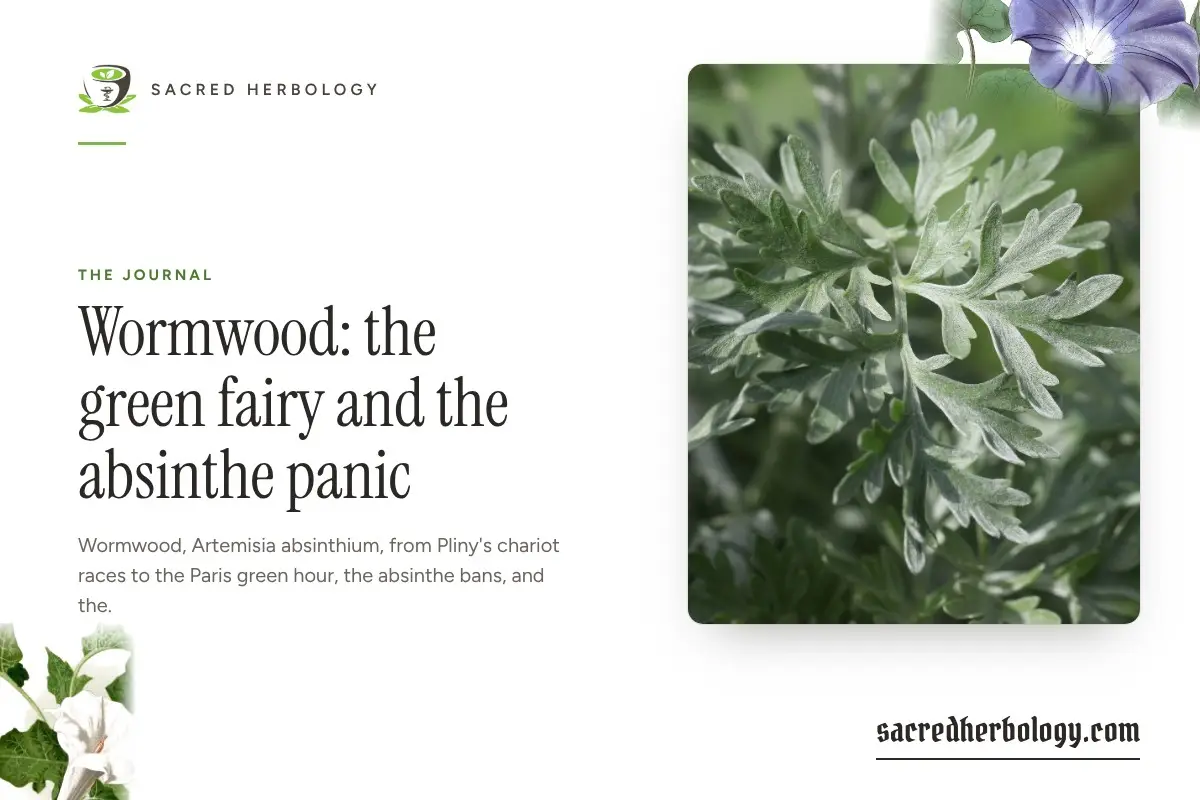
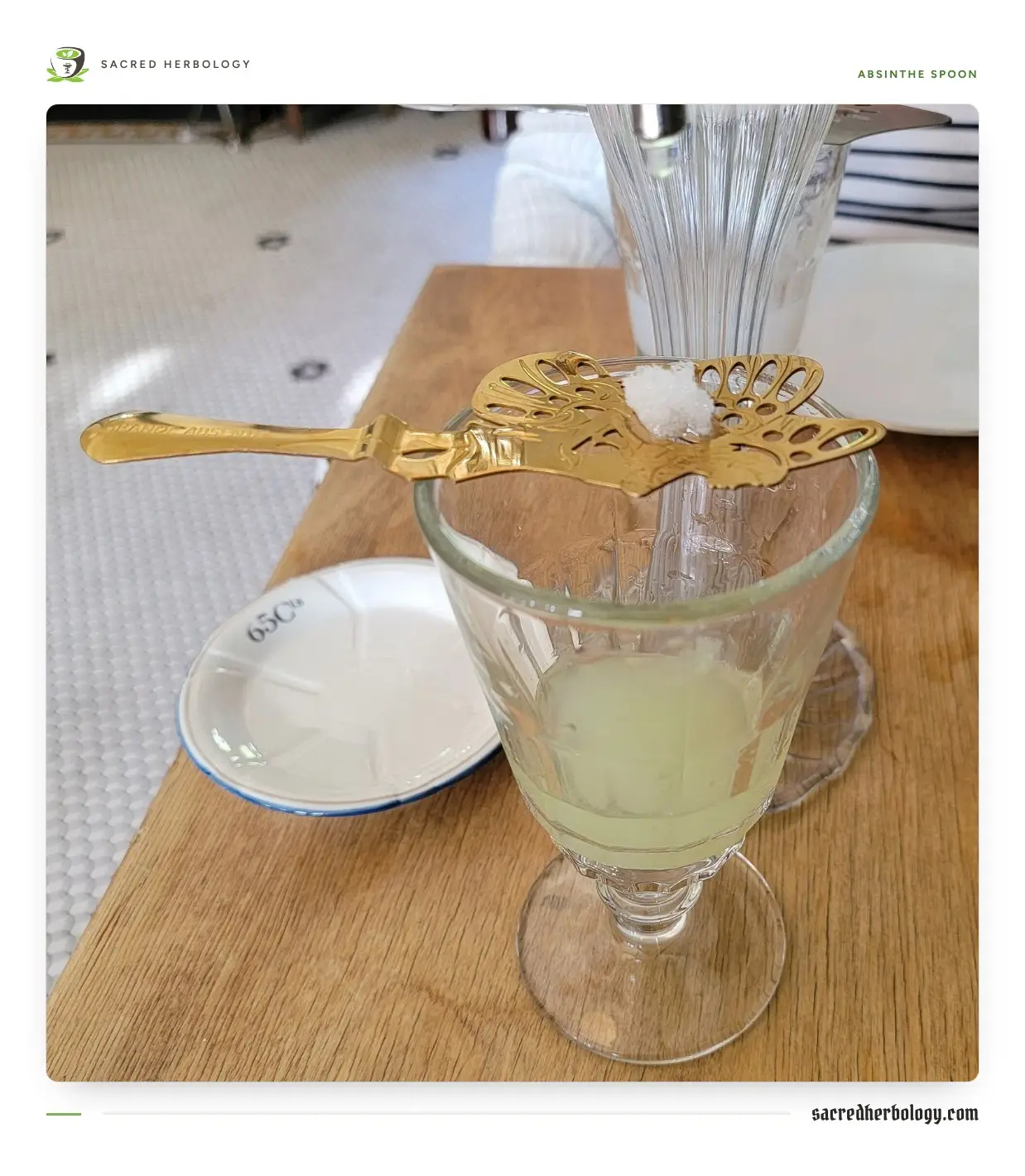
Picture a café in Paris at about five in the afternoon, some time around 1890. On the marble table in front of you sits a stemmed glass with a measure of pale green spirit in the bottom. Across the top of the glass lies a flat, pierced spoon, and on the spoon sits a lump of sugar. A waiter brings a carafe of iced water, or you reach for the tall glass fountain in the middle of the room with its little brass taps, and the water goes in slowly, a drop at a time, over the sugar. As it falls, the clear green spirit turns cloudy. Swirls of milky opal rise through it until the whole glass glows a soft, cloudy jade. The French called that moment the louche, and they called this hour of the day l’heure verte, the green hour.
The drink was absinthe, and the herb that gave it its name and its bitterness was wormwood. Within twenty-five years of that afternoon, absinthe would be banned in Belgium, Switzerland, the Netherlands, the United States, Italy and France. Doctors said it drove people mad. Newspapers blamed it for murders. Winegrowers marched against it. Then, almost a century later, chemists opened sealed bottles from before the bans, measured what was in them, and found that most of what had been said about the green fairy was wrong.
This is the story of that panic. It is also the much longer story of the plant behind it, because wormwood was bitter, famous and argued over for two thousand years before anyone in Switzerland put it in a still. We will go from a Roman chariot race to the Book of Revelation, through Tudor bedchambers and Culpeper’s planets, to Pontarlier, Paris and a farmhouse in Vaud, and finally to a pot of grey leaves on a tropical verandah.
The plant
Wormwood is Artemisia absinthium, a perennial in the daisy family, Asteraceae. It is a close cousin of mugwort, Artemisia vulgaris, the sister plant whose wool is rolled into moxa, and you can see the family likeness at a glance. Both have deeply cut leaves. Both carry that bitter, camphor-and-green smell on the slightest touch. Both send up tall, loose spikes of tiny, nodding, yellowish flower heads in late summer that nobody would ever call pretty.
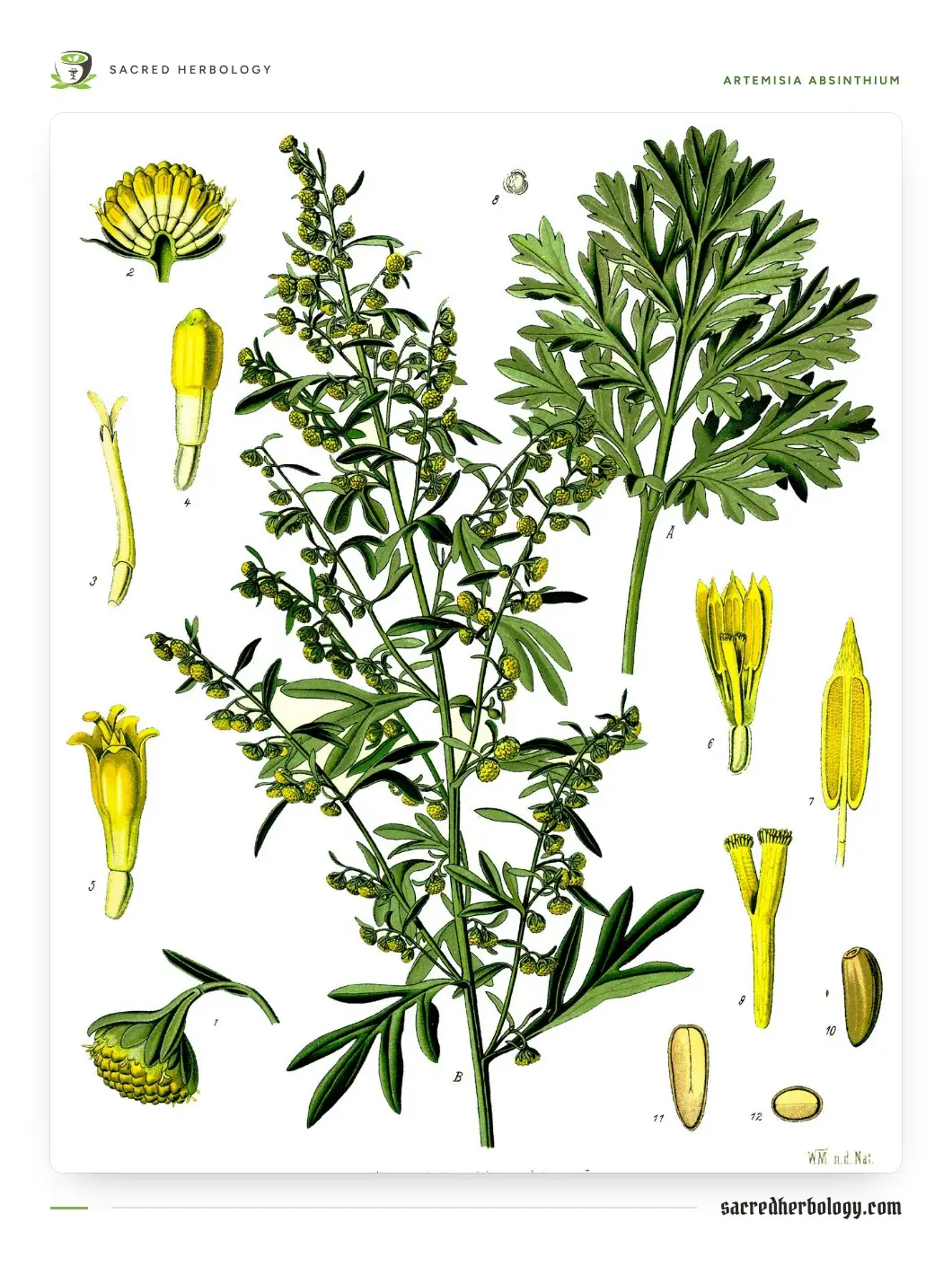

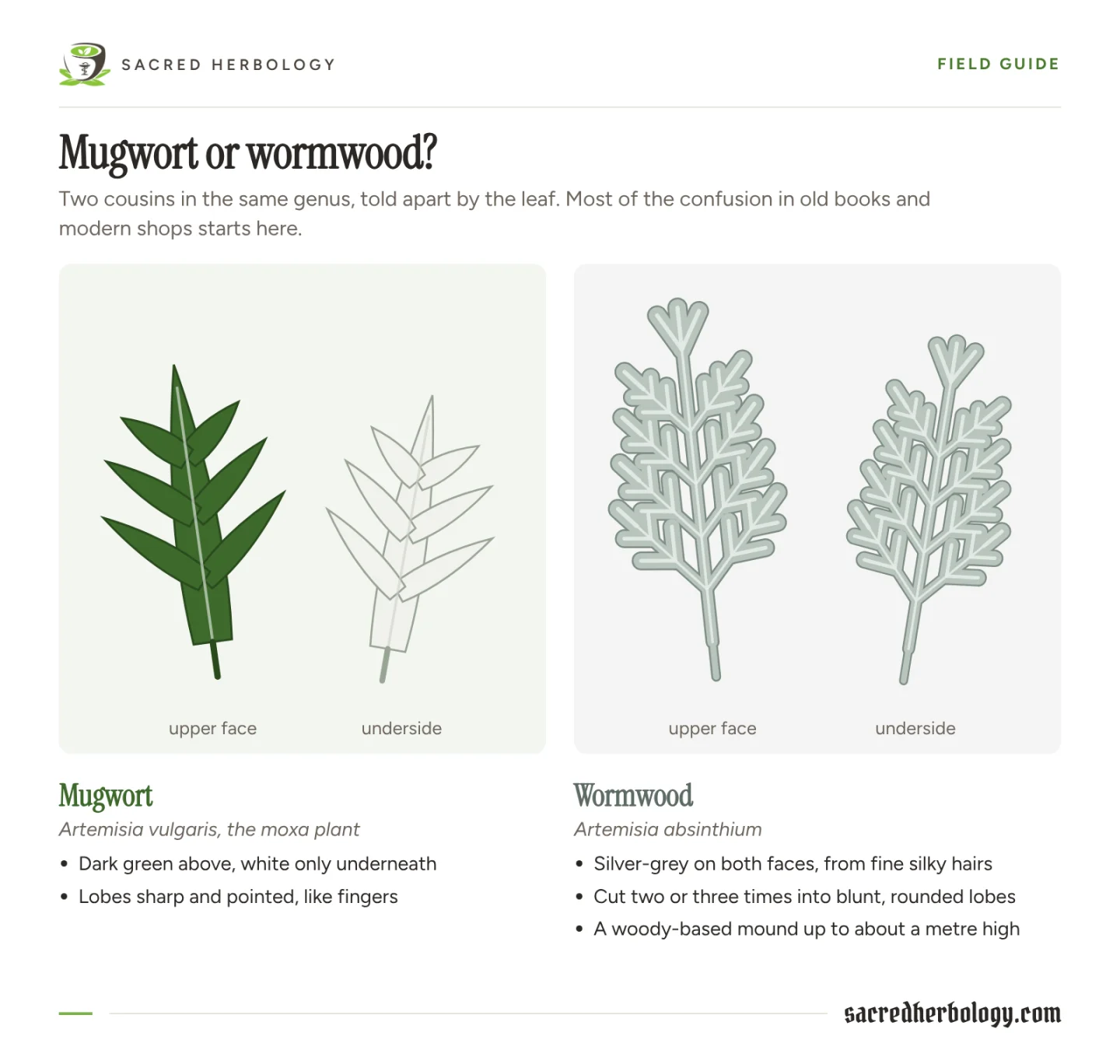
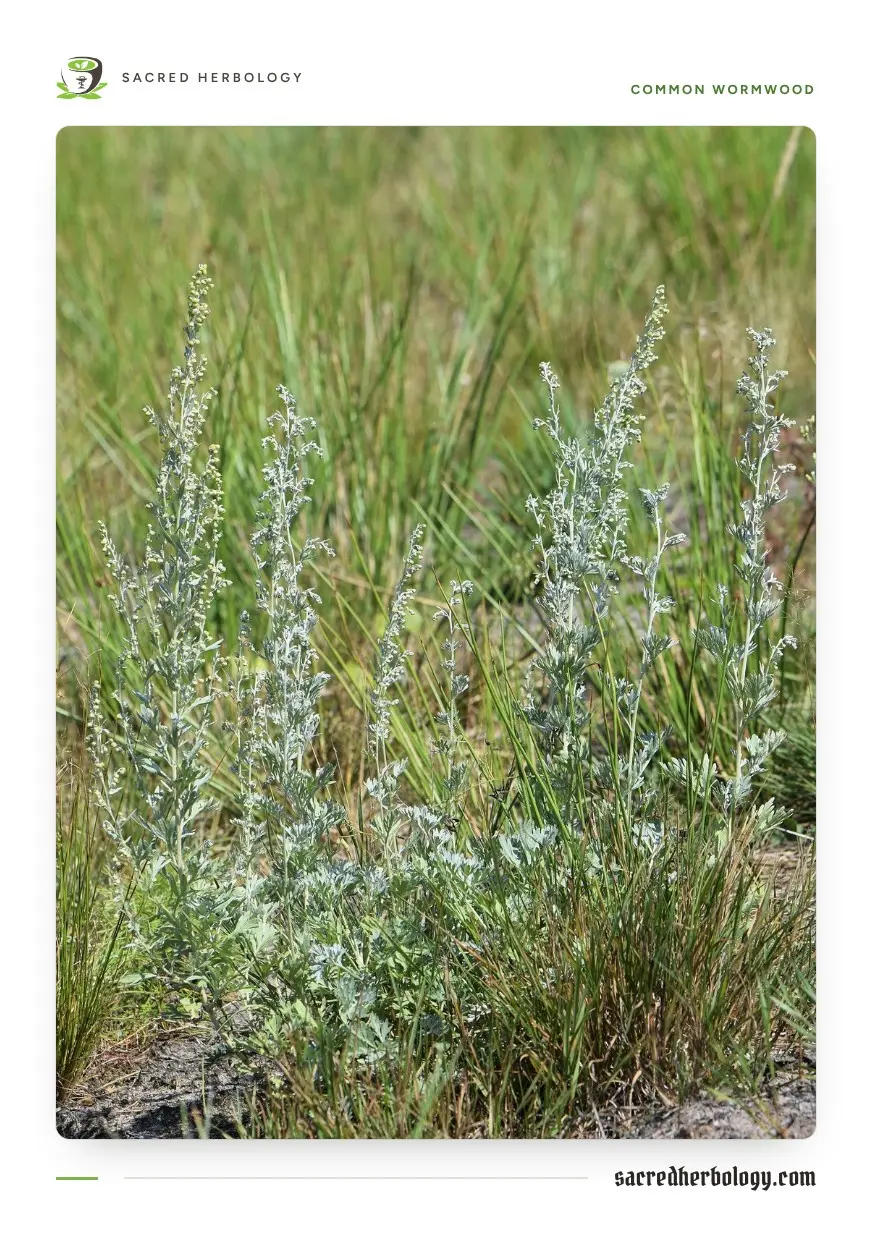
The differences are worth learning. Mugwort leaves are dark green on top and white only underneath. Wormwood is silver all over. The whole plant, stems and both faces of the leaf, is covered in fine, flattened silky hairs that give it a soft grey sheen, almost the colour of an old pewter jug. The leaves are cut two or three times into blunt, rounded lobes, finer and softer than mugwort’s sharp fingers. A well-grown plant makes a woody-based, half-shrubby mound up to about a metre high. Rub a leaf between your fingers and the smell alone tells you most of what follows. It is one of the bitterest plants in the European garden.
That bitterness comes mainly from a group of compounds called sesquiterpene lactones, the chief of which chemists named absinthin. The smell comes from a volatile oil, and in many wormwood plants a large part of that oil is thujone, a compound named after the thuja trees, the western red cedar and its relatives, in which it was also found. It comes in two closely related forms, alpha- and beta-thujone, and wormwood oil usually holds more of the beta form, although alpha is the stronger of the two in the body. Thujone will matter a great deal later in this piece. For now it is enough to know two things about it. Wormwood plants vary enormously in how much they contain, and some wild populations, in the Pyrenees and in Tuscany for instance, have been found with essentially none at all. The chemistry depends on where the plant grew and which strain it belongs to.
Wormwood is native to the dry, sunny edges of Europe, North Africa and western and central Asia. It likes poor, stony, well-drained ground, roadsides, waste places and old walls. It has followed people everywhere they went with a garden, and it now grows wild in parts of North America, where several Canadian provinces treat it as a weed of pasture and crops. In Australia it is mostly a garden plant. A few escapes have been collected in the cooler south, and Western Australia’s flora lists it as an introduced species, but it is not among Queensland’s declared invasive plants. The Artemisia that does run wild in eastern Australia is a different one, Chinese mugwort, Artemisia verlotiorum, a creeping weed of creek banks and damp ground.
Set two leaves side by side and the difference is plain: mugwort, green above and white below, sharply fingered; wormwood, silver on both faces, softly lobed. Most of the confusion in the old books, and in modern shops, starts there.
A crowd of wormwoods
The old herbalists did not speak of one wormwood. They spoke of several, and absinthe makers inherited their vocabulary. The names are a little tangled, so here is the household in brief:
- Common wormwood, Artemisia absinthium. The grande absinthe of the French distillers. Silver, bitter, the main herb of the drink.
- Roman wormwood, Artemisia pontica. Smaller and finer, with a gentler bitterness. The French called it petite absinthe, and distillers used it in the second stage of the work, to colour the finished spirit green.
- Sea wormwood, Artemisia maritima. A plant of salt marshes and sea walls, grey and aromatic.
- Wormseed, Artemisia cina, sometimes called Levant wormseed. A Central Asian species whose unopened flower heads were the old source of santonin. The flower heads were used against intestinal worms for centuries, and santonin itself was isolated from them in 1830. Common wormwood is often credited with that job in popular books, and the confusion between these plants goes back a long way.
- Mugwort, Artemisia vulgaris, and in East Asia Artemisia argyi. The moxa plants. Same genus, same smell, different job.
The genus name is usually connected with Artemis, the Greek goddess of the wild, and that story belongs mostly to mugwort. Pliny offered a second explanation: that the plant was named for Artemisia, the queen of Caria who built the Mausoleum for her husband, though he noted that others traced it to the goddess. The species name, absinthium, comes from the Greek name for the plant, apsinthion. People have long liked the idea that it means “undrinkable”, built from a Greek “not” and a word for drinking. It is a charming explanation, and you will see it in many books, but linguists are far from agreed on it, and the word may well be borrowed from a language older than Greek. Treat “undrinkable” as a good story.
The English name has its own folk etymology. Wormwood looks as if it ought to mean “a wood for worms”, and since the plant, or at least its relatives, was used against intestinal worms, the explanation seems to fit. The word actually descends from Old English wermod, which has nothing to do with worms or with wood. Its German cousin is Wermut, and if that looks familiar, it should. When eighteenth-century Italian makers of wormwood-flavoured wine wanted a name for their product, they borrowed the German word, and that is how wormwood gave the world vermouth.
Here are the names as a family tree, root to branches:
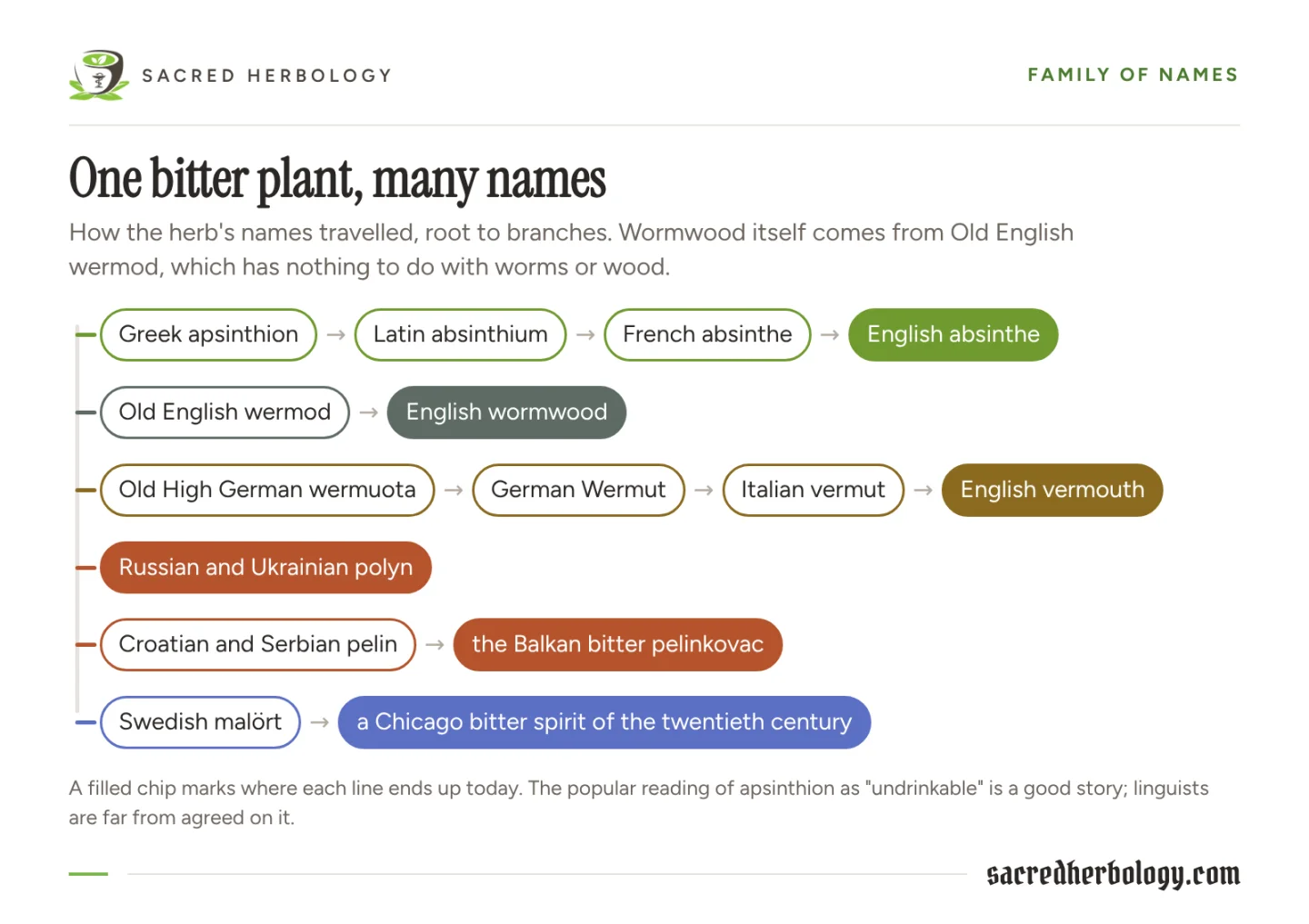
- Greek apsinthion, Latin absinthium, French absinthe, English absinthe.
- Old English wermod, English wormwood.
- Old High German wermuota, German Wermut, Italian vermut, English vermouth.
- Russian and Ukrainian polyn, Croatian and Serbian pelin, which gives the Balkan bitter liqueur pelinkovac.
- Swedish malört, which a Swedish immigrant in Chicago gave to his notorious bitter spirit in the twentieth century.
The bitter cup of the ancient world
The Greeks and Romans knew wormwood first of all as bitterness, and they used that bitterness as a kind of symbol, the way we use lemons or vinegar.
Pliny the Elder, writing his Natural History in the 70s AD, gives wormwood a long entry in book 27 and starts it with a curious piece of Roman custom. At the Latin Festival, the old religious gathering of the Latin towns on the Alban Mount, a chariot race was run on the Capitol, and the winner was given a drink of absinthium. Pliny supposes that the ancestors meant health to be the prize, and thought that an honourable reward. Imagine winning the race of your life, the crowd roaring, and being handed the bitterest drink in Italy. It tells you how seriously the Romans took the idea of bitterness as something good for you.
The poet Lucretius, a century and more earlier, used wormwood for one of the most famous similes in Latin literature. In his long philosophical poem De Rerum Natura, written in the 50s BC, he explains why he has put hard Epicurean philosophy into sweet verse. Doctors, he says, when they want a child to take bitter wormwood, smear the rim of the cup with golden honey, so that the child, tricked by the sweetness at the lips, drinks the bitter draught down. His poem, he says, is the honey. The image pleased him so much that he used it twice, in book 1 and again in book 4. It is also, eighteen hundred years early, a fair description of the sugar lump on the absinthe spoon.
Dioscorides, the Greek army physician whose De Materia Medica of the first century AD became the backbone of European herbal learning for fifteen hundred years, describes apsinthion in his third book. In his chapters on wines he also describes a wormwood wine, absinthites oinos, made in parts of the Greek world. So wormwood in an alcoholic drink is ancient. People were flavouring wine with it long before anyone dreamed of a café in Montmartre.
That is the first thing to hold on to in this story. For most of its history wormwood was a bitter herb, soaked in wine or brewed into ale, prized and slightly feared for its strength. The French spirit of the nineteenth century was one late branch on a very old tree.
Wormwood in the Bible, and the star that fell
Readers of the English Bible meet wormwood as a word for bitterness and grief. The Hebrew word la’anah appears several times in the Hebrew Bible, and the King James translators rendered it wormwood. In Deuteronomy, Moses warns against “a root that beareth gall and wormwood”. Proverbs says that the lips of a strange woman drop as an honeycomb, “but her end is bitter as wormwood”. Jeremiah has God threaten to feed the faithless people with wormwood and give them water of gall to drink. Lamentations mourns, “He hath filled me with bitterness, he hath made me drunken with wormwood.” Amos rebukes those who “turn judgment to wormwood”.
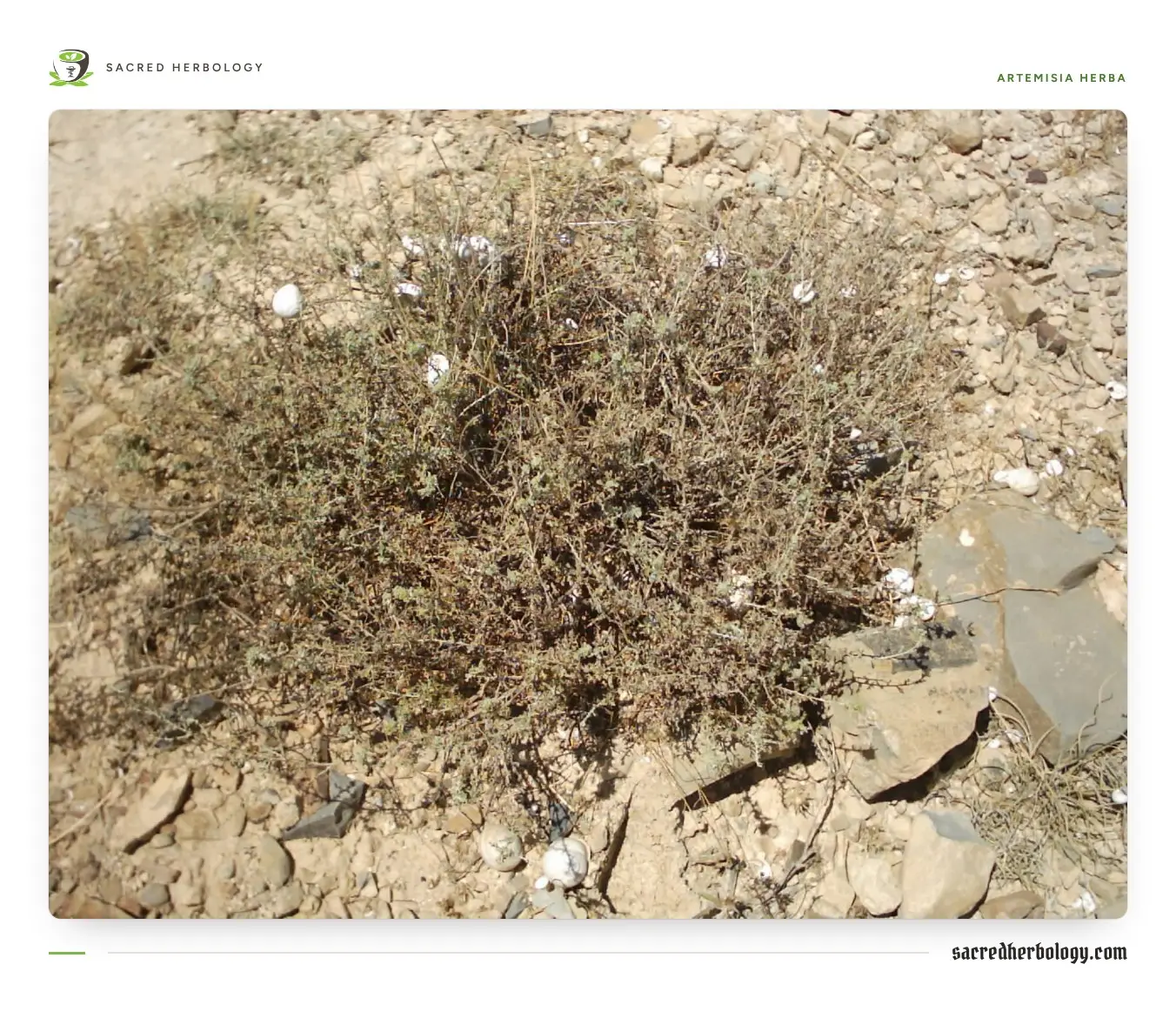
Which plant did the Hebrew writers actually mean? Botanists who have studied the plants of the Bible usually point away from our European Artemisia absinthium, which is not at home in the dry hills of the southern Levant. Michael Zohary, in his Plants of the Bible, identified la’anah with the white wormwood of the region’s deserts and steppes, Artemisia herba-alba, a grey, low, bitter shrub that still grows across the Negev and Sinai. The point the writers wanted was the bitterness, and any local wormwood would have served.

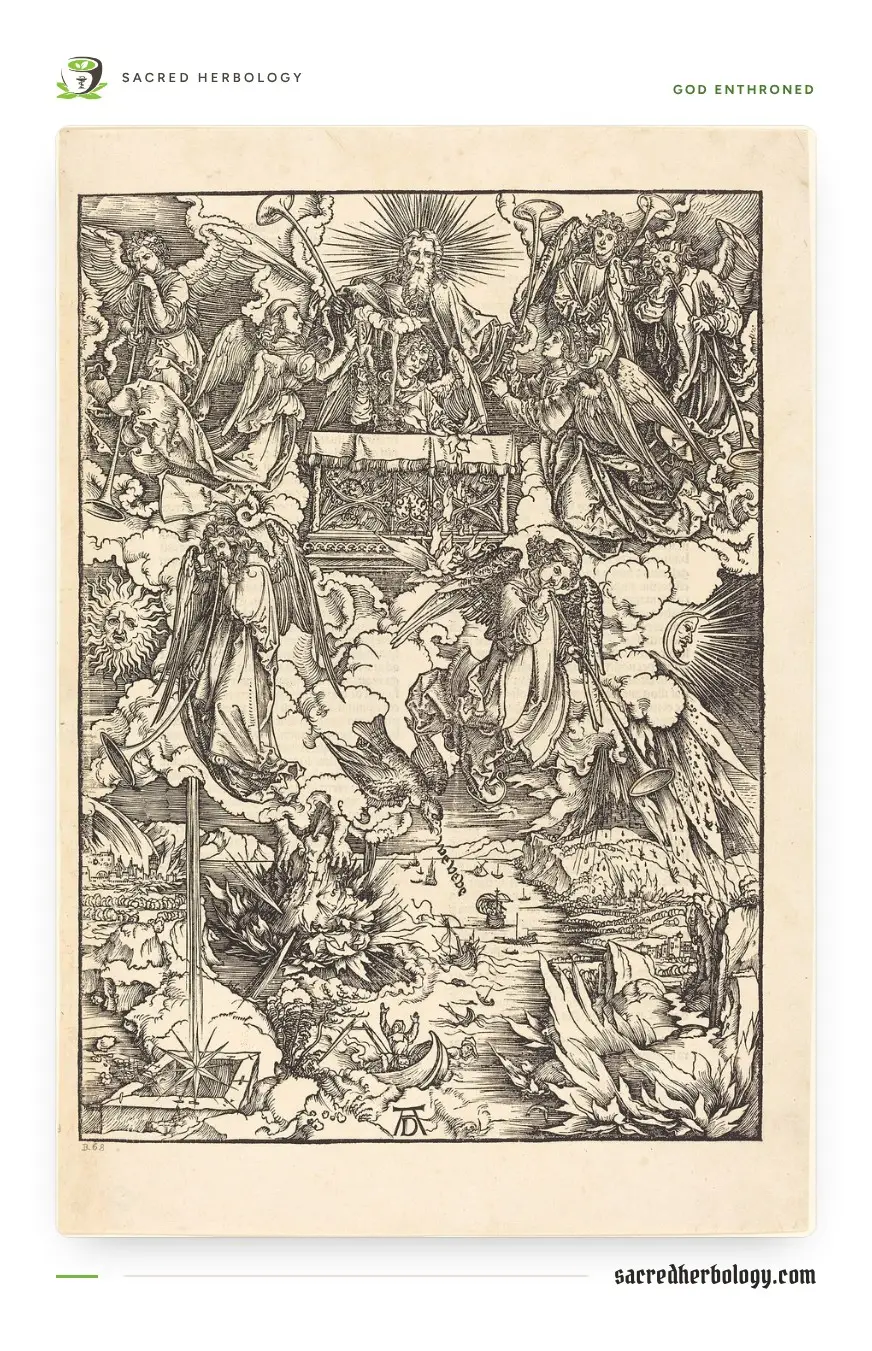
Then comes the passage that has haunted the plant ever since. In the Book of Revelation, chapter 8, the third angel sounds his trumpet:
“And there fell a great star from heaven, burning as it were a lamp, and it fell upon the third part of the rivers, and upon the fountains of waters; And the name of the star is called Wormwood: and the third part of the waters became wormwood; and many men died of the waters, because they were made bitter.”
The Greek name of the star is Apsinthos. Over the centuries readers have found it in comets, plagues and wars. In 1986 a new reading spread round the world within weeks of the nuclear disaster at Chernobyl in Ukraine, because, it was said, Chernobyl means wormwood. The story is close to true and worth getting exactly right. The town takes its name from the Ukrainian chornobyl, which is the name of mugwort, Artemisia vulgaris. The Ukrainian for our wormwood, Artemisia absinthium, is polyn. So the town was named for wormwood’s sister plant. In the Ukrainian Bible, the star of Revelation is called Polyn. The coincidence that so many people felt in 1986 rests on two members of the same genus, which is close, but the identification was a modern one, made in 1986, and the plant in the name is mugwort.
The illustrated Apocalypses of the Middle Ages and the Renaissance loved this scene. Albrecht Dürer cut it into his great woodcut series of 1498, with the angels and their trumpets above and, below, a star falling burning into the waters.

Wormwood in the English house
From the Bible’s bitter cup we come down to the ordinary household, and here we are in folklore in the proper sense: village and household practice handed on by doing.
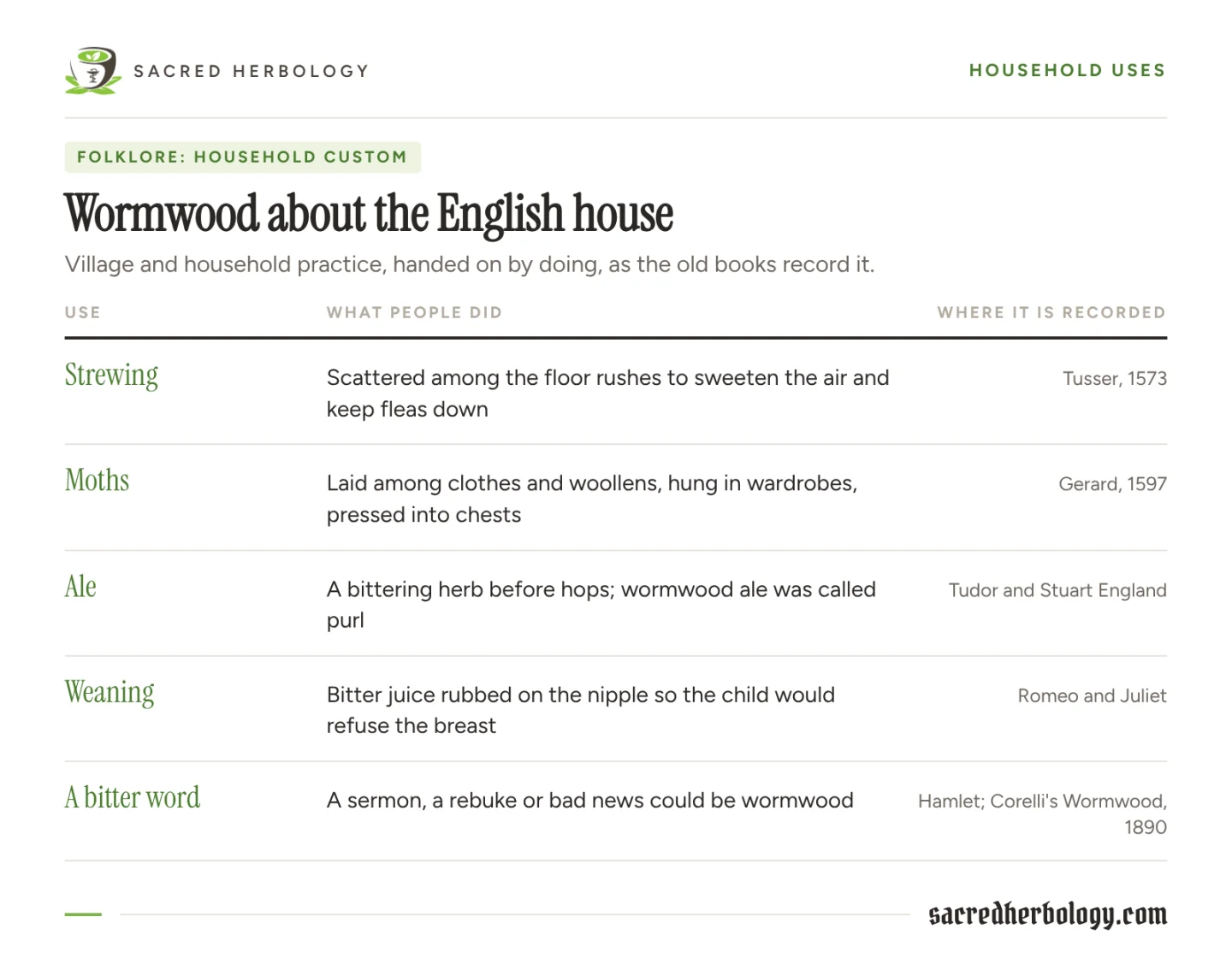
Wormwood’s strong smell made it one of the great strewing herbs. Before carpets, floors were covered with rushes, and housekeepers scattered aromatic herbs among the rushes to sweeten the air and keep down vermin. Thomas Tusser, the Essex farmer who put his advice into rhyming couplets in Five Hundred Points of Good Husbandry (1573), put wormwood’s reputation in a line that housewives were still quoting centuries later:
“Where chamber is sweeped, and wormwood is strowne, no flea for his life dare abide to be knowne.”
John Gerard, in his Herball of 1597, repeats the old lore that wormwood laid among clothes and woollens keeps away moths. Bunches were hung in wardrobes and pressed into chests. Brewers used it as one of the bittering herbs in ale before hops took over in England, and a drink of ale steeped with wormwood, called purl, is described in Tudor and Stuart England. In later centuries the name purl drifted to other hot mixed drinks, and by the time Dickens wrote about it, wormwood may no longer have been in the cup.
The most vivid household use comes to us from Shakespeare. In Romeo and Juliet, Juliet’s nurse, rattling on about the girl’s childhood, remembers the day she weaned her:
“For I had then laid wormwood to my dug, sitting in the sun under the dove-house wall.”
Mothers and wet nurses rubbed the bitter juice on the nipple so the child would refuse the breast. Shakespeare’s audience needed no footnote; they knew the trick. In Hamlet, when the Player Queen protests that she will never marry again, Hamlet mutters “Wormwood, wormwood”, meaning that her words must taste bitter to his guilty mother watching the play.
Wormwood’s bitterness also made it a teaching word. A sermon, a rebuke or bad news could be wormwood. The English language kept that sense long after strewing went out of fashion, and it is why Marie Corelli could call her lurid 1890 novel about a Parisian ruined by absinthe simply Wormwood. Every reader knew what the title meant.
Picture a Tudor chamber: rushes and grey sprigs of wormwood scattered across the boards, a bunch hanging from a beam, and a linen chest open with leaves tucked into the folds.
Mars’s herb: wormwood in the learned tradition
Now we cross from household folklore into the learned tradition, and the label changes. The material in this section is esoteric: the astrological and magical systems of learned writers, which carry their own logic and their own claims about how the world works. I describe them on their own terms, as the writers held them.
In the astrological herbal, every plant was ruled by one of the seven planets. Nicholas Culpeper, the London astrologer and herbalist, set out his scheme in The English Physitian of 1652, and he was emphatic about wormwood. It was an herb of Mars. He wrote about wormwood at unusual length, with his usual relish for a fight, and the reasoning behind his choice is typical of the system. Mars was hot, dry, harsh and martial, the planet of iron, fire and war. A plant that was fiercely bitter, hot to the taste and strong enough to drive out worms and vermin fitted that picture.
Culpeper’s scheme had a long afterlife. A great many modern correspondence tables quietly take their planets from him. You will find wormwood under Mars in most of them, often with the element fire. Scott Cunningham’s Encyclopedia of Magical Herbs (1985), the book behind a large share of modern witchcraft correspondence lists, keeps Mars, and lists protection and psychic work among wormwood’s magical uses. If you are building your own table and want to know where the planet came from, it came from Culpeper.
Here is wormwood’s entry, set out as the books set it out:
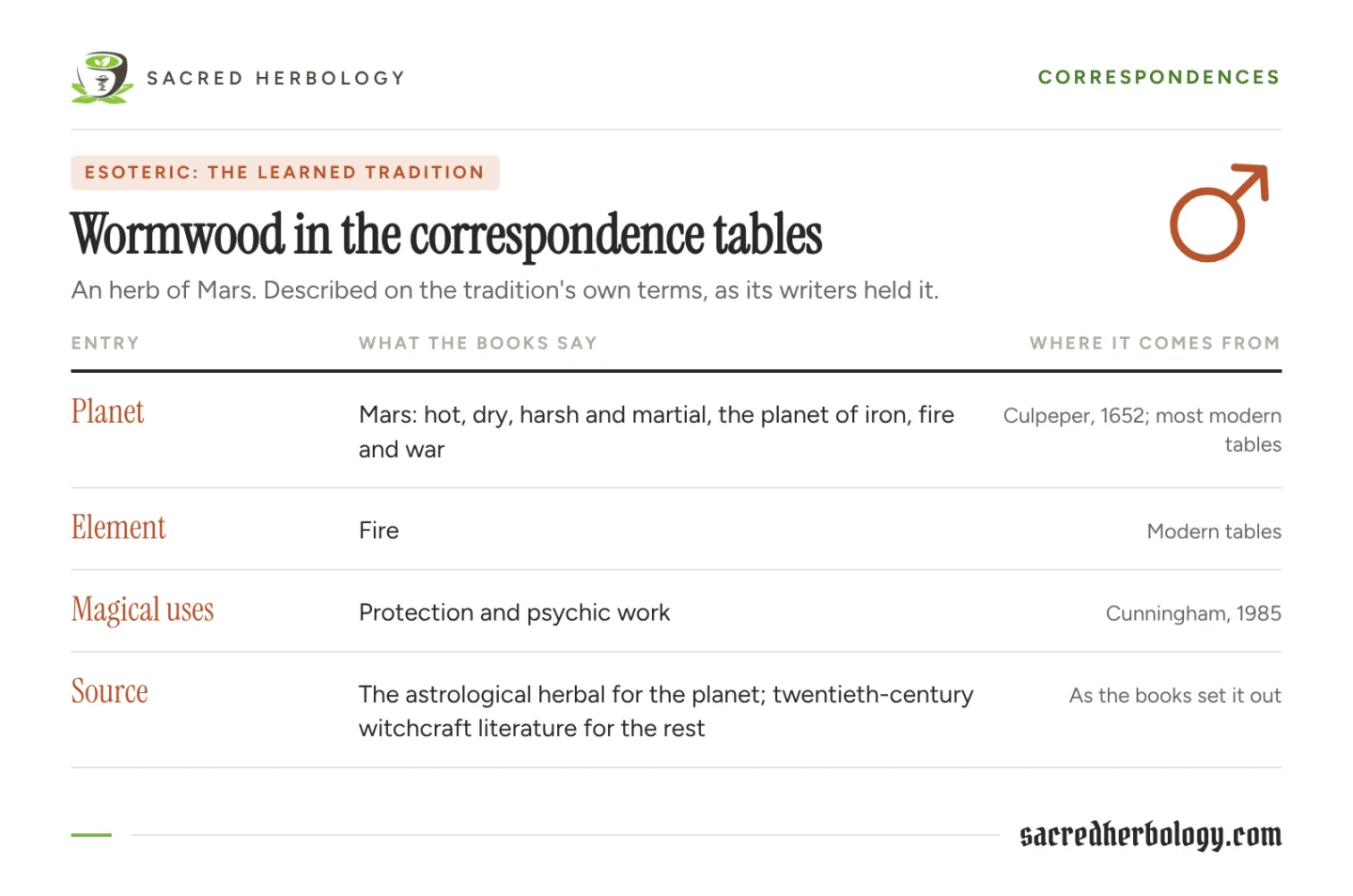
- Planet: Mars (Culpeper, 1652; most modern tables).
- Element: fire (modern tables).
- Uses in modern magical literature: protection and psychic work (Cunningham, 1985).
- Source of the traditions: the astrological herbal for the planet; twentieth-century witchcraft literature for the rest.
There is one more esoteric figure to meet, and he belongs later in the story, in New Orleans. We will come to him once absinthe has been banned.
Wormwood drinks before absinthe
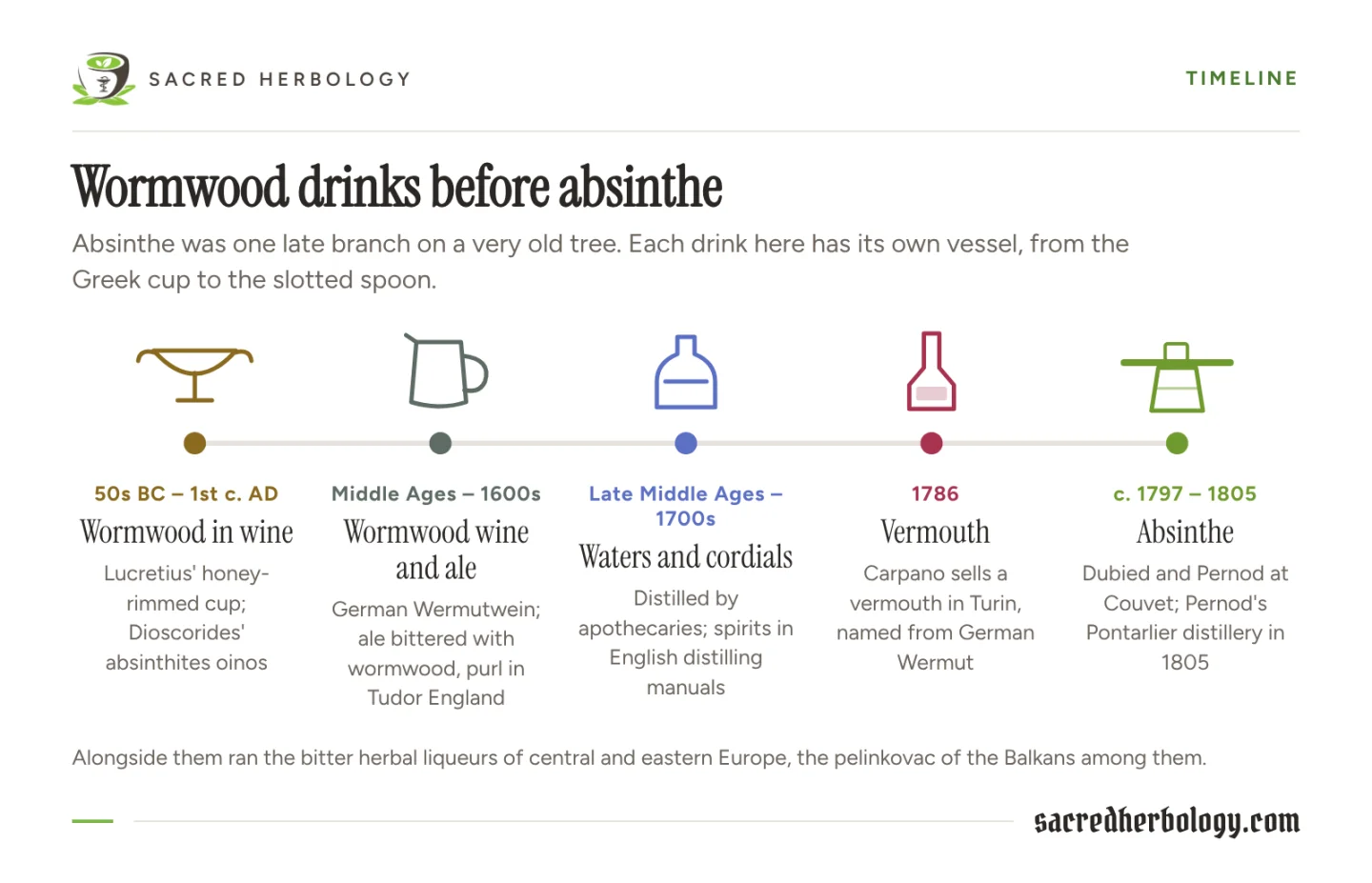
Between Dioscorides’ wormwood wine and the Paris café lies a long line of wormwood drinks, and it helps to see them laid out together, because absinthe was only one of them.
- Wormwood wine. Greek and Roman, described by Dioscorides, and made through the Middle Ages across Europe, especially in the German lands, where the drink was called Wermutwein.
- Wormwood ale. Ale bittered or steeped with wormwood, purl among them, before hops became the standard bittering herb.
- Wormwood spirits. Once distillation spread through Europe in the late Middle Ages, apothecaries and distillers made wormwood waters and cordials, and by the eighteenth century English distilling manuals included recipes for spirits flavoured with wormwood.
- Vermouth. Fortified, aromatised wine flavoured with wormwood and other botanicals. Antonio Benedetto Carpano is credited with selling a vermouth in Turin in 1786, and the drink became the aperitif of Piedmont and then of the world. To this day the European Union’s rules for aromatised wines require a drink sold as vermouth to be flavoured with substances from Artemisia species.
- Bitter herbal liqueurs of central and eastern Europe, the pelinkovac of the Balkans among them.
- Absinthe. A high-strength spirit, distilled from wormwood with green anise and Florence fennel, then coloured with more herbs.
Laid out as a timeline from the honey-rimmed cup of Lucretius to the absinthe fountain, each drink has its own vessel: a Greek cup, an ale jug, an apothecary’s bottle, a Turin vermouth flask and finally the slotted spoon.
The Val-de-Travers and the doctor who may not have existed
Absinthe as we know it began in the Val-de-Travers, a narrow valley in the Jura mountains of western Switzerland, in what is now the canton of Neuchâtel, close to the French border. Wormwood grew well in its cool, dry upland air, and the village people had long used local herbs.
The story every absinthe book tells goes like this. In the 1790s a French doctor named Pierre Ordinaire, who had fled the Revolution, settled at Couvet in the valley. He rode about on a little horse, the story says, and prescribed a herbal elixir of his own invention, strong and green, made with wormwood and anise among other things. The locals called it la fée verte, the green fairy. After his death, the recipe passed, by sale or gift, to others in the valley.
The trouble is the paper trail. Ordinaire is a good character, and the books repeat one another, but the documents behind him are thin, and a rival local tradition gives the credit to the Henriod family of Couvet, who are said to have been making a wormwood elixir in the valley already. What can be said with confidence is that by the end of the 1790s wormwood elixirs were being made in the Val-de-Travers, and that a businessman, Major Daniel-Henri Dubied, saw that they could be sold. With his son-in-law Henri-Louis Pernod he set up a distillery in Couvet around 1797 or 1798; the sources differ on the year.
In 1805 Pernod crossed the border and opened a distillery at Pontarlier in France, to avoid customs duties on the French market. The first still was small, and Pontarlier was a quiet town on the river Doubs. Within the century it became the absinthe capital of the world, with dozens of distilleries, and the name Pernod Fils was on bottles across France and beyond.
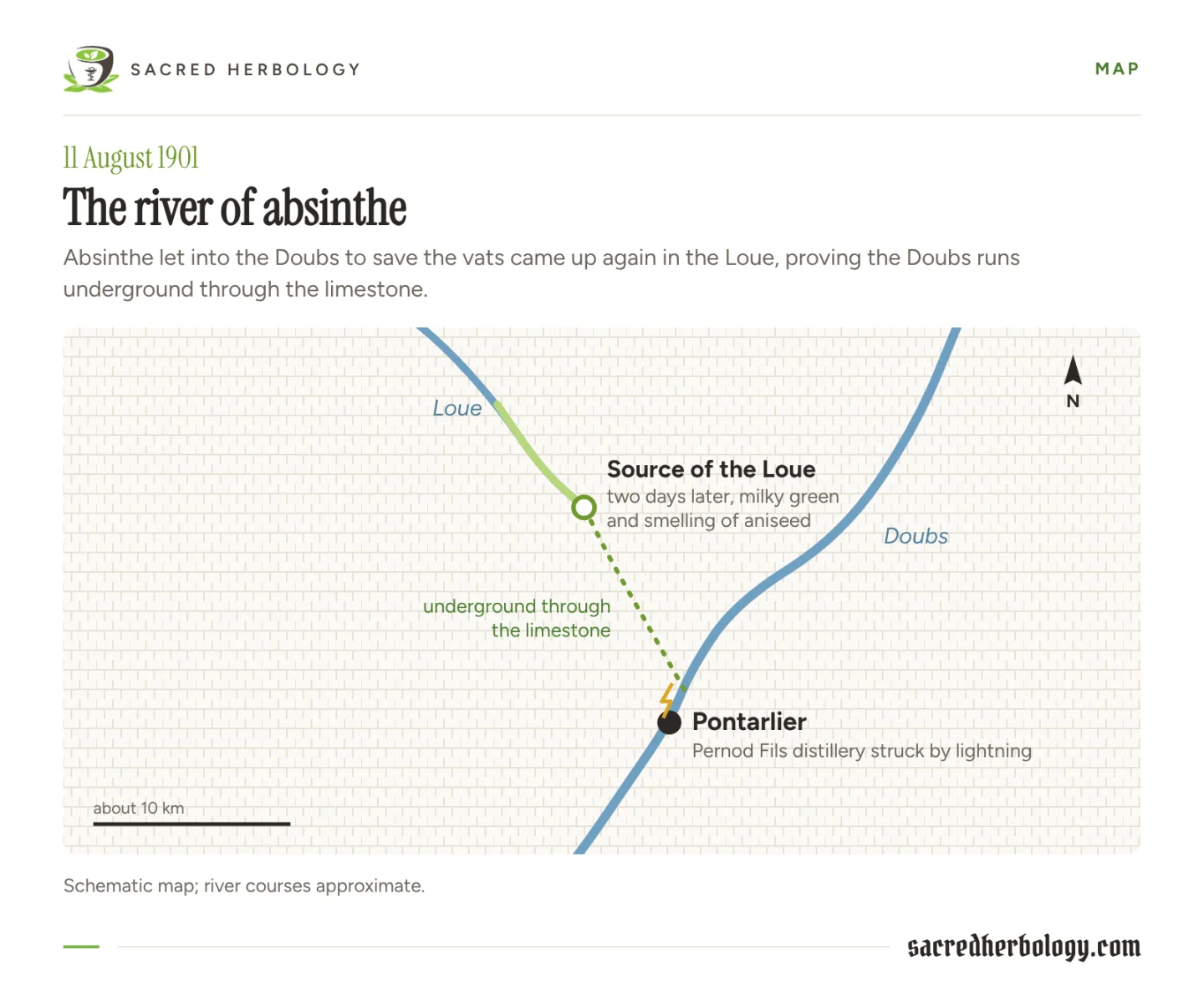
There is one Pontarlier story worth telling in full. On 11 August 1901, a violent thunderstorm broke over the town and lightning struck the Pernod Fils distillery. Fire tore through the works. To keep the flames away from the vats, a worker opened the taps and let the stock run out into the Doubs, so that a river of absinthe poured downstream. Two days later, people on the banks of a different river, the Loue, more than ten kilometres away over the hills, noticed that the water had turned a milky green and smelled of aniseed. The accident proved what geologists had suspected: much of the Doubs vanishes underground into the limestone near Pontarlier and comes up again as the source of the Loue. Absinthe did a piece of hydrology that nobody had managed to do on purpose.
On a map it is easy to follow: the Doubs looping past Pontarlier, a dotted underground line through the limestone, and the Loue rising green from its cave mouth, with the date 11 August 1901 written beside it.
How absinthe was made
The method comes first here, because the ban, and the chemistry that came after it, turn on the process.
The makers worked in two stages. First, dried wormwood was left to soak with green anise seed (Pimpinella anisum) and Florence fennel (Foeniculum vulgare) in strong alcohol, with water added, and then distilled. Distillation carries over the light, aromatic parts of the herbs and leaves much of the heavy bitterness behind in the still. That is why a well-made absinthe tastes mostly of anise and fennel, and is far less bitter than the plant. The distillers kept only the middle of the run, the heart, and set aside the first and last parts.
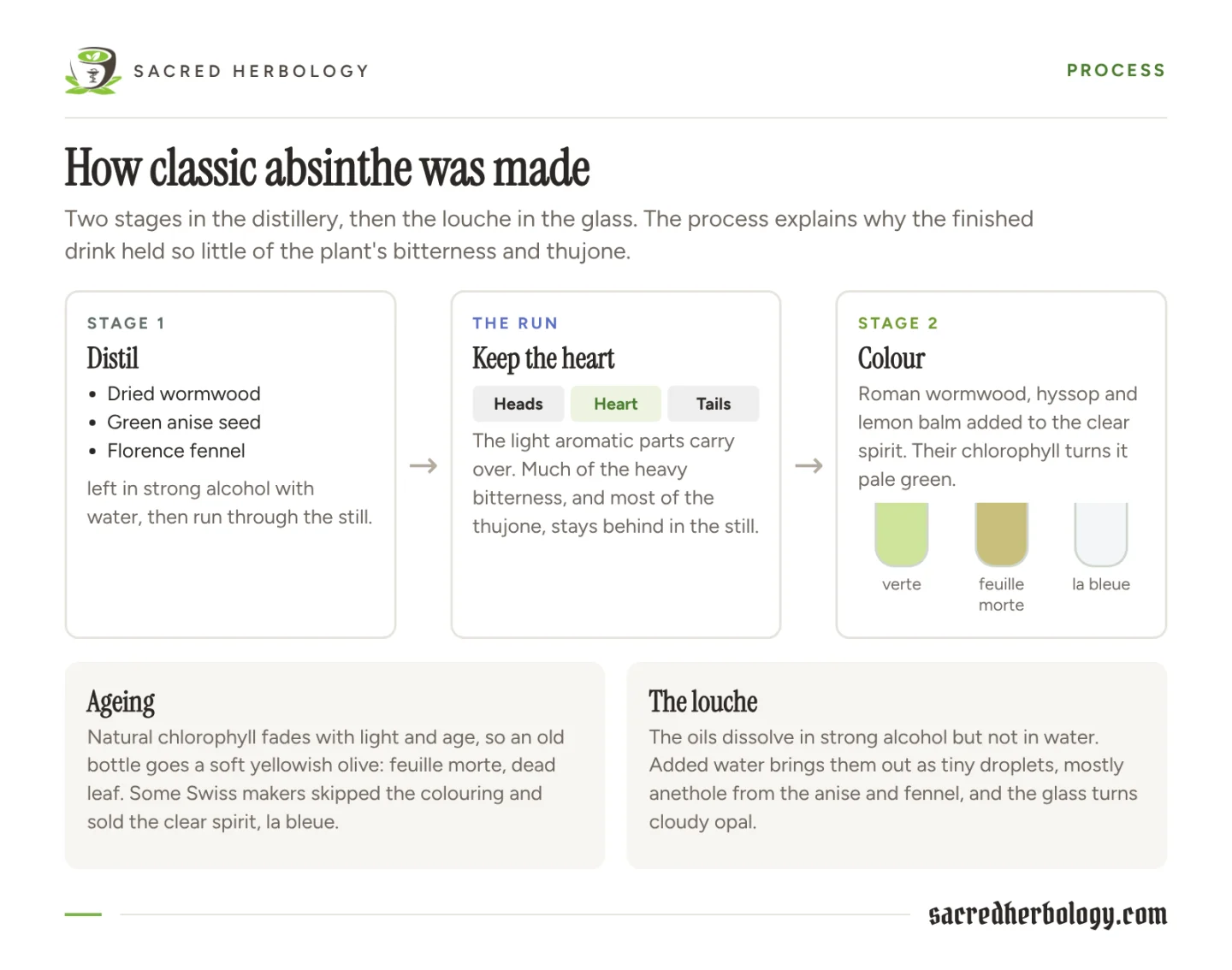
In the second stage, the clear distillate was coloured. More herbs, usually Roman wormwood, Artemisia pontica, with hyssop and lemon balm, were soaked in it, and the chlorophyll from their leaves turned it that famous pale green. Natural chlorophyll fades with light and age, so an old bottle of genuine absinthe goes a soft yellowish olive, the colour collectors call feuille morte, dead leaf. Each region added its own touches. Swiss makers favoured lemon balm, hyssop and angelica alongside their mountain wormwood, French makers sometimes added coriander, and some Swiss producers left out the colouring stage altogether and sold the clear spirit, which came to be called la bleue.
Anise, fennel and wormwood oils dissolve in strong alcohol and not in water. Most of the cloud comes from anethole, the sweet-smelling compound that anise and fennel share. When water is added, the oils come out of solution as millions of tiny droplets that scatter the light. That is the louche. In good absinthe, the louche was taken as a sign of quality, and drinkers watched it bloom with real pleasure.
As demand exploded, so did cheating. Cheap absinthe was made by mixing industrial alcohol with bought-in essences, coloured with artificial dyes and, in the worst cases, with copper salts. Some makers added antimony compounds so that the drink would cloud convincingly in the glass. Others bought up the heads and tails, the rough first and last parts of the run that honest distillers threw out, and sold them on as absinthe, and some cheap spirit carried methanol. Some of what was sold as absinthe in the poorest bars of Paris had never been near a still or a wormwood plant. Keep that in mind when we reach the doctors.
The green hour
Absinthe was a local Swiss and Franche-Comté drink for its first decades. Two events carried it into the mainstream of French life.
The first was war. French soldiers fought in the conquest of Algeria from 1830 into the 1840s, and the story goes that they were given wormwood in their wine or their drinking water as a guard against fevers and bad water. Returning home, the soldiers brought a taste for absinthe with them into the cafés. Like most absinthe origin stories, this one has been repeated far and wide on thin documentation. It is old and widely told all the same.
The second was a tiny insect. From the 1860s the vine pest phylloxera, an aphid-like creature that feeds on vine roots, spread through the French vineyards and destroyed them region by region. Over the next three decades French wine production collapsed. Wine became expensive, and absinthe, made from industrial alcohol in the cheap versions, became the drink of anyone who wanted to drink cheaply. Between 1875 and 1913, French consumption of absinthe per head rose about fifteenfold.
The cafés of Paris made a ritual of it. The pierced spoon, the sugar, the dripping water from a carafe or a fountain, the slow louche, the green hour after work: absinthe was a drink you watched as well as tasted. It was drunk by workers in the bars of the faubourgs and by painters and poets in the cafés of Montmartre and the Latin Quarter, and that second crowd is why the drink lives on in museums.
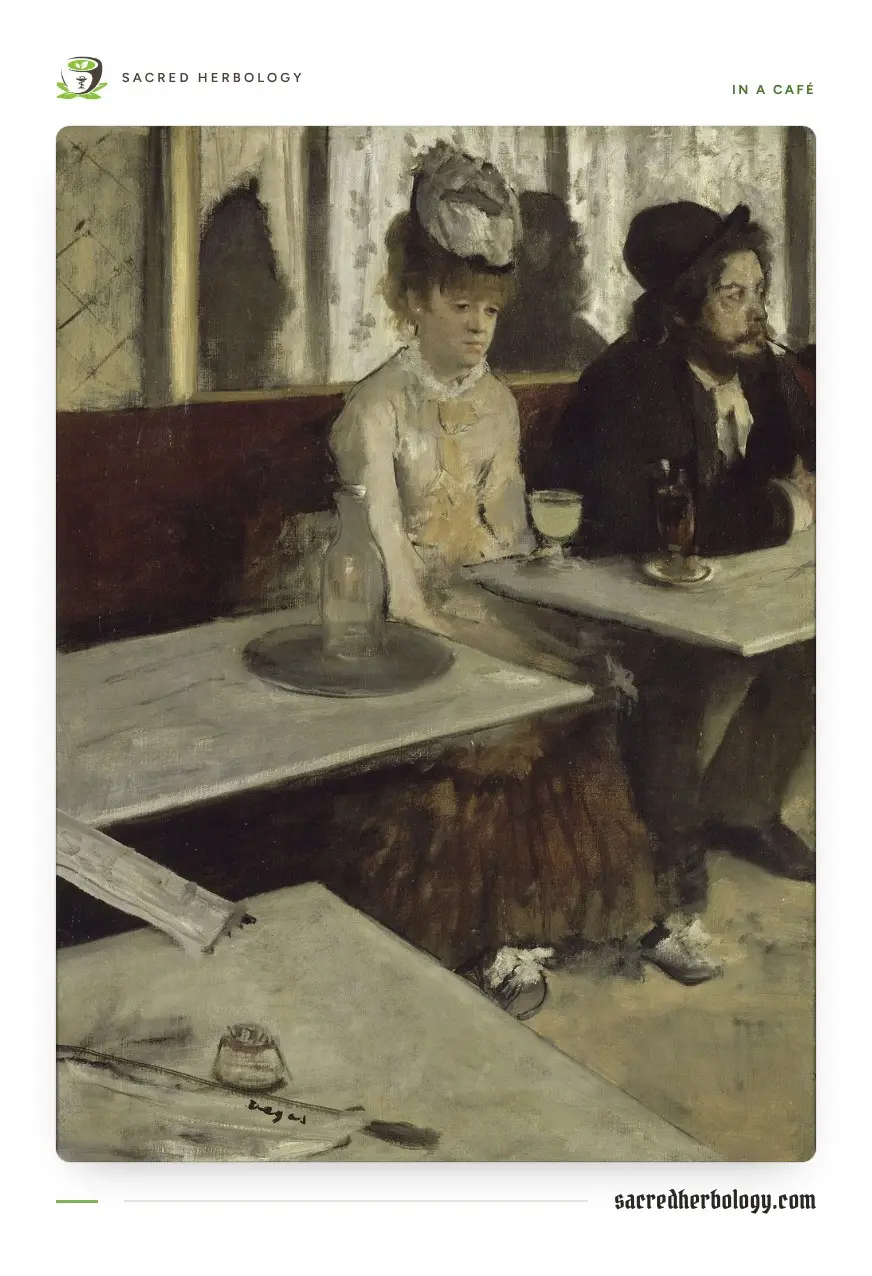

The pictures are worth a walk through:
- Édouard Manet, The Absinthe Drinker (1859). A shabby man in a top hat and cloak, a glass of absinthe on the ledge beside him, a bottle at his feet. The Paris Salon rejected it.
- Edgar Degas, In a Café, better known as L’Absinthe (1875-76), now in the Musée d’Orsay. The actress Ellen Andrée and the engraver Marcellin Desboutin posed for it, side by side and miles apart, at a café table in the Nouvelle Athènes, a glass of cloudy absinthe in front of her. When it was shown in London in 1893, critics treated it as a moral scandal, and the two sitters, who were not drinkers of the kind the picture suggested, had to live with the reputation.
- Vincent van Gogh, Still Life with Absinthe (1887), painted in Paris. A glass of green absinthe and a carafe of water on a café table, with the street beyond the window.
- Henri de Toulouse-Lautrec, whose painted friends sit with green glasses, and who is said to have carried absinthe in a hollow walking cane.
- Albert Maignan, The Green Muse (1895). A poet slumped and clutching his head, while a pale green woman, the fairy herself, bends over him.
- Pablo Picasso, The Absinthe Drinker (1901), from the start of his blue period. A woman alone, arms knotted around herself, at a café table.
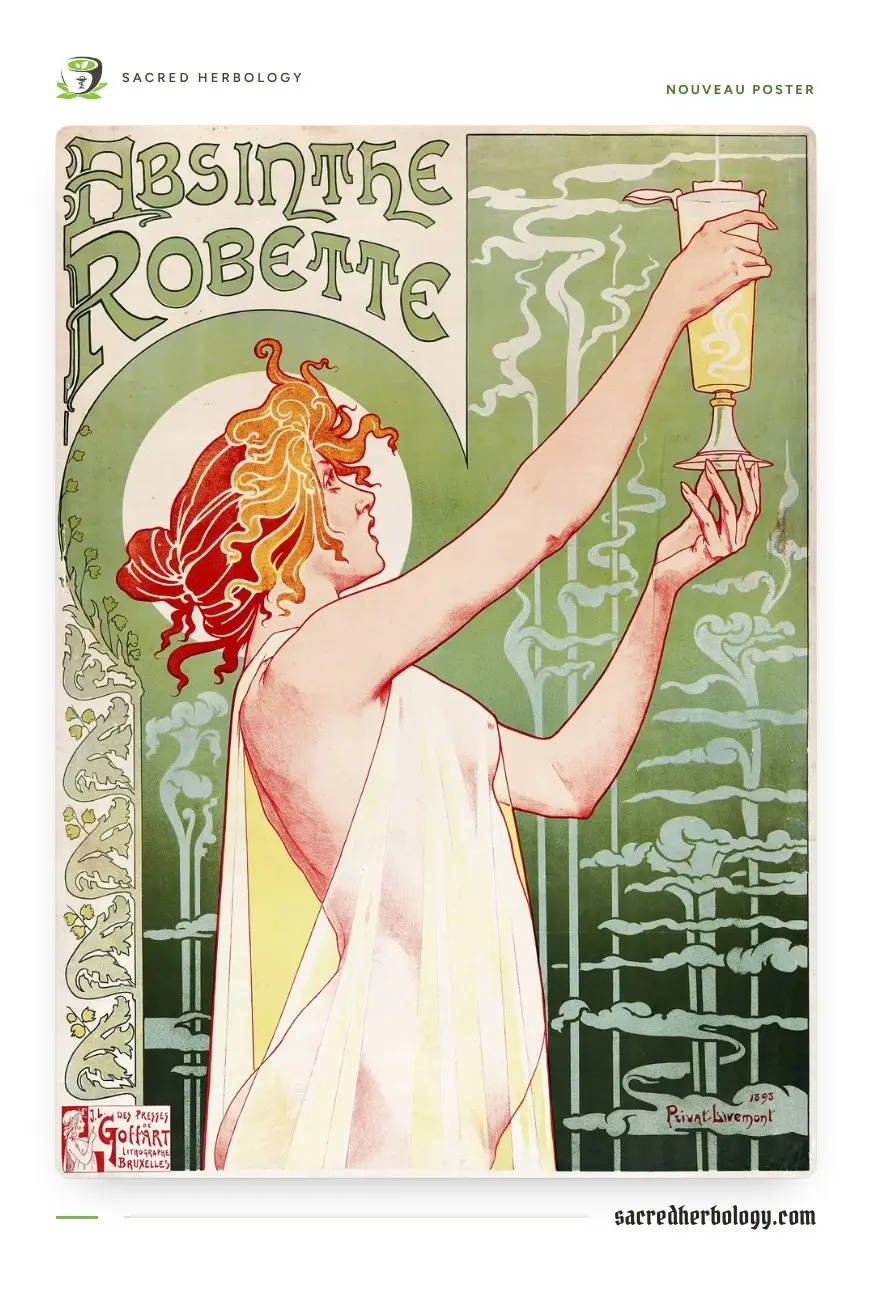
The poets drank it too. Paul Verlaine, Arthur Rimbaud, Alfred de Musset and Charles Baudelaire are all part of the absinthe legend. Oscar Wilde is credited with famous sayings about the drink, the best known being about seeing tulips on his legs as he walked home, but those come to us second-hand, through friends’ memories, and should be read as anecdote. Posters advertised the drink everywhere, and the Art Nouveau poster artists gave the green fairy a body. Henri Privat-Livemont’s poster for Absinthe Robette (1896), with its draped woman holding up a glass of glowing green, is the image most people have in their minds when they think of absinthe.

Doctor Magnan’s guinea pigs
The case against absinthe was built by doctors, and one doctor above all, Valentin Magnan, a psychiatrist at the Sainte-Anne asylum in Paris. Between 1864 and 1874 Magnan wrote a series of studies arguing that absinthe caused a disease of its own, distinct from ordinary drunkenness, which came to be called absinthism. Its sufferers, he said, had hallucinations, sudden violent delirium and epileptic fits, and the disease could be passed on to children.
Magnan’s evidence came largely from animal experiments. In one, a guinea pig was shut up under a glass with a saucer of wormwood essence, the concentrated essential oil, while another guinea pig was shut up with a saucer of pure alcohol. The alcohol animal became drunk. The wormwood animal became excited and then had convulsions. In other experiments, animals were given wormwood oil by mouth or by injection, and they too had fits. Alcohol produced stupor; wormwood oil produced seizures. Magnan concluded that the wormwood in absinthe was a convulsant poison stacked on top of the alcohol.
Even at the time, people saw problems with this. In 1869 The Lancet commented that the evidence did not show absinthism to be anything different in nature from chronic alcoholism, and that breathing concentrated wormwood fumes in a closed jar was a poor model for a man sipping a diluted drink. In 1874 Magnan came to London and demonstrated the effect of injecting wormwood extract into a dog. The Royal Society for the Prevention of Cruelty to Animals prosecuted three English doctors who had assisted him. The case failed, partly because Magnan himself had gone quietly home to France.
There was a deeper flaw in the experiments, and it took a long time for anyone to state it plainly. Magnan and the researchers who followed him used essence d’absinthe, the pure essential oil of wormwood, and in their papers they often simply called it “absinthe”. The drink in the café glass was a different thing: a spirit in which wormwood oil was present in small amounts and alcohol in very large ones. Researchers who tried to repeat Magnan’s results with the actual drink often failed. A later worker, Ossipow, made the point explicitly: only the concentrated essence, and not the ready-to-drink spirit, reliably brought on fits in animals. The pure oil does cause seizures. Nobody showed that the drink did.
The asylum records tell their own story. At the First International Eugenics Congress in London in 1912, figures were presented from the central admissions service for the insane in Paris. Of 16,532 patients admitted for alcoholic intoxication between 1867 and 1912, just over 70 per cent were classed as chronic alcoholics, and about 1 per cent as cases of absinthism. In a city where absinthe was the most popular spirit of the age, that is a very small share, and it raises the obvious question of whether “absinthism” was simply the name given to the worst cases of alcoholism among absinthe drinkers.

Absinthism also fitted the medicine of its day. Magnan was one of the leading writers on degeneration, the theory that vices and illnesses acquired by parents would be passed down and worsen through the generations. Absinthe, with its working-class drinkers and its bohemian artists, made a perfect villain for that theory.
Drawn as a single bar, the 16,532 Paris admissions make a large block for chronic alcoholism and a thin sliver for absinthism.
The panic
By 1900 the case against absinthe was being made in the newspapers, from the pulpit and in parliaments. Three groups pushed it.
The temperance movement wanted alcohol curbed, and absinthe was an easy first target, strong, cheap and already blamed for madness. The medical profession, following Magnan, gave the campaign its scientific language. And the winegrowers, recovering from phylloxera and wanting their market back, threw their weight behind the attack on absinthe while insisting that wine was healthy and French. That alliance was paradoxical: wine producers, who supplied most of the alcohol France drank, joined forces with temperance campaigners. The slogan of the winegrowers’ campaign said it plainly, all for wine, against absinthe. Historians since have pointed out that the absinthe campaign let France feel it was dealing with alcoholism without touching the drink that most of its alcohol came from.
Then came the murders. On 28 August 1905, in the village of Commugny in the canton of Vaud, near Lake Geneva, a French-born vineyard labourer named Jean Lanfray shot his pregnant wife and his two small daughters, then tried and failed to kill himself. Lanfray was a heavy drinker. On the day of the killings, by the accounts given at the time, he had begun with two glasses of absinthe and then gone on through a great deal of wine, along with brandy and other spirits. The press seized on the absinthe. Within weeks a petition to ban the drink in Switzerland had gathered some 82,000 signatures. Lanfray was tried in February 1906, found guilty, and hanged himself in his cell three days after the trial.
The canton of Vaud banned absinthe in 1906. Geneva followed. On 5 July 1908, Swiss voters approved an amendment to the federal constitution banning absinthe throughout the country, and it came into force in October 1910. The country where the drink was born had outlawed it.
The bans came quickly across the Western world. Set out as a timeline, the pattern is plain:
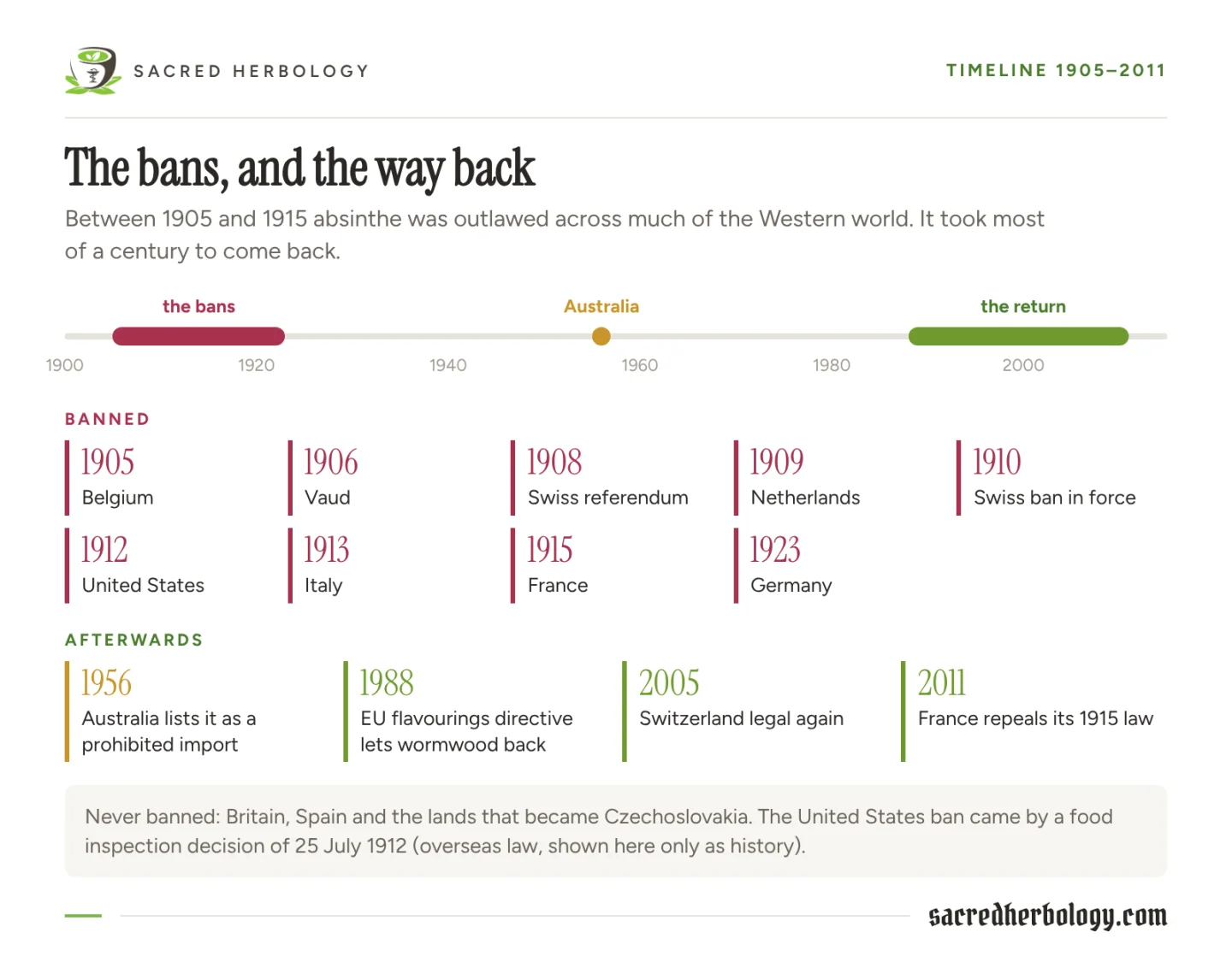
- Belgium, 1905.
- Switzerland, by referendum in 1908, in force from 1910.
- The Netherlands, 1909.
- The United States, by a Department of Agriculture food inspection decision of 25 July 1912 (overseas law, given here only as history).
- Italy, 1913.
- France, March 1915, in the first winter of the Great War, when worry about the fitness of the army finally overcame the government’s fondness for absinthe tax revenue.
- Germany, 1923.
Britain and Spain never banned it, and nor did the lands that became Czechoslovakia, though the drink was little drunk in Britain. In Switzerland, in the Val-de-Travers, it went underground. For nearly a century people in the valley went on distilling the clear version, la bleue, in back rooms and cellars, and serving it to anyone they trusted.
France did not give up its taste for anise. Within a few years of the ban, distillers, Pernod among them, were selling anise spirits made without wormwood. Pastis grew out of that change, and it still clouds in the glass when water goes in. The French had swapped one cloudy aniseed drink for another, and much the same drinkers went on drinking much the same amount of alcohol.
The Green Goddess: Crowley in New Orleans
Here is the esoteric figure I promised. Aleister Crowley, the English occultist who founded the religious and magical system he called Thelema, spent the years of the First World War in the United States. In New Orleans, by his own account sitting in the Old Absinthe House on Bourbon Street, he wrote an essay called “Absinthe: The Green Goddess”, published in the New York magazine The International in February 1918.
By then absinthe had been banned in the United States for more than five years, and the essay is an elegy as much as a celebration. Crowley writes about the bar, its old marble fountain, the ritual of dripping the water, and the drink as a work of art that rewards the patient and the sensitive. He sets the drinking of absinthe alongside his idea of a life lived as a deliberate art. The piece is literary rather than ritual, and you will find no magical operation in it. It is still the best-known piece of writing about absinthe by any figure of the occult revival, and it is one reason the drink keeps its place in modern esoteric culture. In describing it I am reporting what Crowley wrote and believed, and none of his claims about the drink’s effects on the soul should be read as fact.
Thujone on trial
For most of the twentieth century, everyone agreed on what had been wrong with absinthe. The villain was thujone, the best-known compound of wormwood oil, and in many plants the largest part of it. Laboratory work around the year 2000 did show that thujone acts on the brain. Alpha-thujone blocks one of the brain’s main calming signals, at the receptor known as GABA-A, and that explains why the concentrated oil can cause convulsions. So far, Magnan was right about the oil.
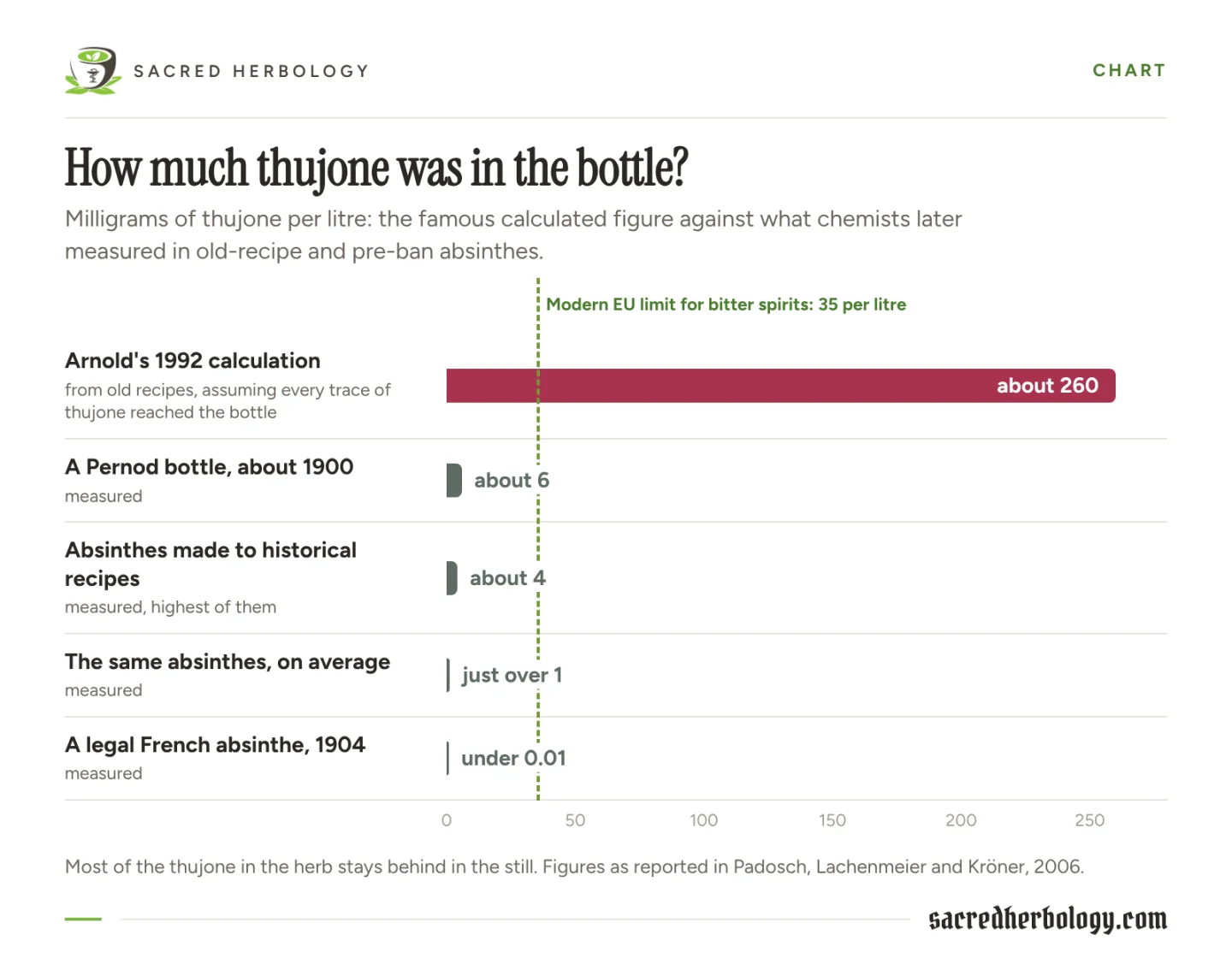
The question was how much thujone had actually been in the drink. In 1992 the biochemist Wilfred Niels Arnold, writing a book on van Gogh’s illnesses, calculated a figure from old recipes. He assumed that all the thujone in the wormwood went over into the finished spirit, and arrived at a figure of around 260 milligrams per litre. That number was repeated everywhere for the next fifteen years, and it seemed to explain the madness, the fits and van Gogh’s ear.
Then people started measuring. Chemists in Germany and elsewhere made absinthe by the old recipes, using the old methods of distillation, and analysed what came out. They also opened sealed bottles of genuine absinthe from before the bans and tested those. The results agreed with one another and disagreed sharply with the calculation. Absinthes made to historical recipes held on average just over a milligram of thujone per litre, and none of them more than about four. A Pernod bottle from about 1900 held around 6. A legal French absinthe from 1904 held almost none, less than a hundredth of a milligram. Most of the thujone in the herb stays behind in the still, and the distillers’ habit of keeping only the heart of the run left even less in the bottle.
Drawn as a bar chart, Arnold’s calculated figure towers over short stubs for the measured bottles, with the modern European limit for bitter spirits, 35 milligrams per litre, drawn as a line near the foot. The tested bottles come nowhere near the calculated figure.
In 2006 three German researchers, Stephan Padosch, Dirk Lachenmeier and Lars Kröner, reviewed the whole history in an open journal under the title “Absinthism: a fictitious 19th century syndrome with present impact”. Their conclusions are worth giving almost in their own words. The only consistent conclusion from the nineteenth-century studies, they wrote, is that wormwood oil, and not absinthe, is a potent cause of seizures. Neither can it be concluded that the drink itself caused epilepsy, or that absinthism can be told apart from chronic alcoholism. The effects of absinthe, old and new, are in their reading mostly the effects of its very high alcohol content. They added a dry observation about the adulterated cheap absinthe of the 1900s: given what was in it, it is easy to see how banning such a mixture could make a whole syndrome disappear overnight.
Two more myths are worth clearing away while we are here. In 1975 a paper in a leading science journal suggested that thujone and the active compound in cannabis, THC, looked enough alike to act on the same receptor in the brain. The idea spread widely, and absinthe was sold for decades with hints of cannabis-like effects. Later experiments, published in 1999, found that thujone binds only weakly to the cannabinoid receptors and does not produce cannabis-like effects in animals. The idea is still everywhere on the internet. The van Gogh story is the other. Van Gogh certainly drank absinthe, along with a great deal else, and his illness is still debated, with epilepsy, bipolar illness and other diagnoses all argued for. The neat explanation that thujone drove him mad rested on Arnold’s figure, and the measured bottles took most of the force out of it.
So the history leaves us with a plain picture. Wormwood oil, concentrated, is a convulsant poison. The traditional drink contained little of it. What made absinthe dangerous to the drinkers of the 1900s was the same thing that made gin dangerous to the London poor in the 1700s: cheap, very strong alcohol, drunk in quantity, much of it adulterated.
The green fairy comes back
Absinthe never quite died. It went on being made in Spain and in Czech lands, and Britain had never banned it. In the 1990s British importers brought in a Czech spirit sold as “absinth”, without the final e, and the drink came back into fashion in London bars. It was often bright artificial green, sold with tales of hallucination, and had little to do with the old Pontarlier recipe, but it put absinthe back on the map. The modern trade has its own quality problems. A 2006 review noted that some modern bottles held more thujone than the old pre-ban ones, that labels boasting of the maximum legal thujone had become a selling point, and that so-called absinthe essences with very high thujone were being sold online for people to dose their own drinks. The old drink was judged by its anise and its louche. Some of the new one was sold on the strength of a compound that had been wrongly blamed.

The legal change came through food law. A European directive of 1988 on flavourings allowed wormwood back into drinks, with a maximum limit on thujone, and once the toxicology was reviewed, absinthe made within those limits was legal to produce and sell across most of Europe. Switzerland lifted its constitutional ban, and from 1 March 2005 absinthe could be made and sold there legally again for the first time since 1910. The bootleggers of the Val-de-Travers came out of their cellars and registered as distillers. France, which had allowed wormwood spirits back under other names, repealed its 1915 law in 2011. Pontarlier distills absinthe again.
In Australia the story has its own small chapter. When the Commonwealth made the Customs (Prohibited Imports) Regulations in 1956, the first item on its list of goods whose import was prohibited absolutely was absinthe, followed further down by essences with the flavour of absinthe and other spirits. Absinthe is now sold openly in Australian bottle shops, and a small number of Australian distillers make it. Import rules have changed more than once since 1956, so anyone thinking of bringing a bottle home from overseas should check the current Australian Border Force rules before they travel.
For food and drink, the plant is covered by the Australia New Zealand Food Standards Code. Its schedule of restricted plants and fungi, Schedule 24, lists common wormwood, Artemisia absinthium, and names thujone and santonin as the natural toxicants of concern. That listing is the reason wormwood products intended for eating or drinking in this country are regulated, and why we sell nothing made from wormwood for internal use.
Wormwood in a tropical garden
Wormwood is a plant of dry hillsides, cold winters and limestone, and the humid tropics are a long way from the Jura. It can still be grown there with some care, and a silver pot of it on a sunny verandah is a fine thing to own for its history, its smell and its colour.
What growers in the tropics report, and what fits the plant’s origins, comes down to drainage and airflow. Wormwood hates wet feet and steamy, still air. In a tropical wet season, a plant in heavy ground is likely to rot from the base. A large pot or a raised bed of gritty, free-draining mix, in full sun, with plenty of air moving around it, gives it the best chance, and a spot under the eaves that keeps off the worst of the monsoon rain helps a great deal. Do not overwater it, especially in the wet. Many growers in the tropics treat it as a short-lived plant and strike fresh cuttings from the woody stems in the dry season to keep a stock going. Further south, in the drier, cooler parts of Australia, it grows into a long-lived silver shrub with little fuss.
Gardeners have said for centuries that wormwood is a poor neighbour, and that plants growing close to it do badly. It is old garden lore, often repeated, and there is some research suggesting that compounds washed from the leaves can hold back the growth of other plants. Give it a pot of its own, or the edge of a gravel bed, and you avoid the question.
Check the label when you buy. Nurseries here sell several silver artemisias under the name wormwood. Tree wormwood, Artemisia arborescens, is a larger, lacier Mediterranean shrub. ‘Powis Castle’ is a garden hybrid, thought to be a cross between tree wormwood and our wormwood, grown for its foliage and rarely flowering. Southernwood, Artemisia abrotanum, has thread-fine green leaves and a lemony smell. All are handsome, and none of them is true Artemisia absinthium. If you want the plant of this story, look for the binomial on the tag, and for silky grey leaves that are silver on both faces.

A cut sprig hung in a wardrobe brings back Gerard’s moths and Tusser’s fleas, and the smell of a bunch drying in the shade will tell you more about why it was strewn on floors than any book. If what draws you to this family is the old practice of ritual burning, the plant to look at is wormwood’s sister, mugwort, the moxa plant, which has its own long ceremonial history across Europe and East Asia. Our moxa is sold for ceremonial and ritual burning.
In cross-section, a tropical pot planting looks like this: gritty mix over a layer of coarse drainage, a silver mound of wormwood under the eaves, and the monsoon rain falling clear of it.
Safety and handling
Wormwood is a strong plant, and a few plain points belong in any piece about it.
- Wormwood essential oil is usually a concentrated source of thujone, and it is the substance that caused fits in the nineteenth-century experiments. It must never be taken by mouth. A modern case report describes seizures and kidney failure in a young man who drank wormwood oil bought online, believing it to be absinthe. Keep any wormwood oil locked away from children and pets.
- The amount of thujone in the plant varies widely between strains and growing places, and there is no way to judge it by sight or smell.
- Anyone with epilepsy or a history of seizures should avoid wormwood products, and above all the oil.
- Laboratory studies have found that thujone can disturb the body’s production of haem, so people with porphyria should avoid wormwood.
- Wormwood is a daisy-family plant. People who react to ragweed, chamomile, chrysanthemum or mugwort can react to it too, and handling the fresh plant can bring out a rash on sensitive skin. Wear gloves if you know you react.
- Wormwood is not for pregnancy or breastfeeding, and it is not for children.
- Wormwood is listed as toxic to dogs, cats and horses. Keep a potted plant where pets cannot chew it, and do not let horses graze where it grows.
- Wormwood is not a smoking herb. Smoke from any burning dried herb can irritate the lungs, so ceremonial burning belongs in a well-aired space, away from babies, pets and anyone with asthma.
- Absinthe today is a very strong spirit, often far stronger than ordinary spirits, and its main risk is the alcohol. Every warning that applies to strong alcohol applies to it.
If you want to use wormwood in any form beyond the garden and the wardrobe, consult a degree-qualified herbalist with competencies and adequate training in pharmacognosy first. If anyone has swallowed wormwood oil, or has a fit after taking any wormwood product, call 000 straight away. For advice on a possible poisoning, call the Poisons Information Centre on 13 11 26, any hour of the day. If a pet has eaten the plant or the oil, ring your vet.
The bitter herb and the green glass
Step back and the whole story has a shape. For two thousand years wormwood was the bitter herb: the Roman victor’s prize, the honey-rimmed cup of Lucretius, the gall of the prophets, the fleabane on the Tudor floor, the nurse’s trick, Culpeper’s Mars. Then for about a hundred years it became the green fairy, the drink of poets and labourers, and the scapegoat for the drinking of a whole society. Doctors who poisoned guinea pigs with pure oil told the world the café glass was the same thing. A murder in a vineyard village carried the argument into the constitution of a country. And at the end of the century, chemists with sealed bottles and gas chromatographs found that the green glass had held very little of what everyone feared.
The plant itself never changed through any of it. It is still the silver, bitter, stubborn shrub of dry roadsides, and it still smells the way it did when Pliny watched the chariots run.
Where this comes from
- Pliny the Elder, Natural History, vol. 7 (books 24-27), trans. W. H. S. Jones (Loeb Classical Library, Harvard University Press, 1956).
- Lucretius, De Rerum Natura, trans. W. H. D. Rouse, rev. Martin Ferguson Smith (Loeb Classical Library, Harvard University Press, 1975; rev. 1992).
- Pedanius Dioscorides of Anazarbus, De Materia Medica, trans. Lily Y. Beck (Olms-Weidmann, 2005).
- The Holy Bible, Authorized (King James) Version (London, 1611).
- Michael Zohary, Plants of the Bible (Cambridge University Press, 1982).
- Thomas Tusser, Five Hundred Points of Good Husbandry (London, 1573).
- John Gerard, The Herball or Generall Historie of Plantes (London, 1597).
- William Shakespeare, Romeo and Juliet and Hamlet, in The Norton Shakespeare, ed. Stephen Greenblatt et al. (W. W. Norton, 1997).
- Nicholas Culpeper, The English Physitian (London, 1652).
- Scott Cunningham, Cunningham’s Encyclopedia of Magical Herbs (Llewellyn, 1985).
- Marie Corelli, Wormwood: A Drama of Paris (Richard Bentley and Son, 1890).
- Aleister Crowley, “Absinthe: The Green Goddess”, The International (New York), February 1918.
- Barnaby Conrad III, Absinthe: History in a Bottle (Chronicle Books, 1988).
- Doris Lanier, Absinthe: The Cocaine of the Nineteenth Century (McFarland, 1995).
- Phil Baker, The Dedalus Book of Absinthe (Dedalus, 2001).
- Jad Adams, Hideous Absinthe: A History of the Devil in a Bottle (I. B. Tauris, 2004).
- Stephan A. Padosch, Dirk W. Lachenmeier and Lars U. Kröner, “Absinthism: a fictitious 19th century syndrome with present impact”, Substance Abuse Treatment, Prevention, and Policy 1 (2006): 14.
- Commonwealth of Australia, Customs (Prohibited Imports) Regulations 1956, First Schedule, as made.
- Australia New Zealand Food Standards Code, Schedule 24, Restricted plants and fungi.