
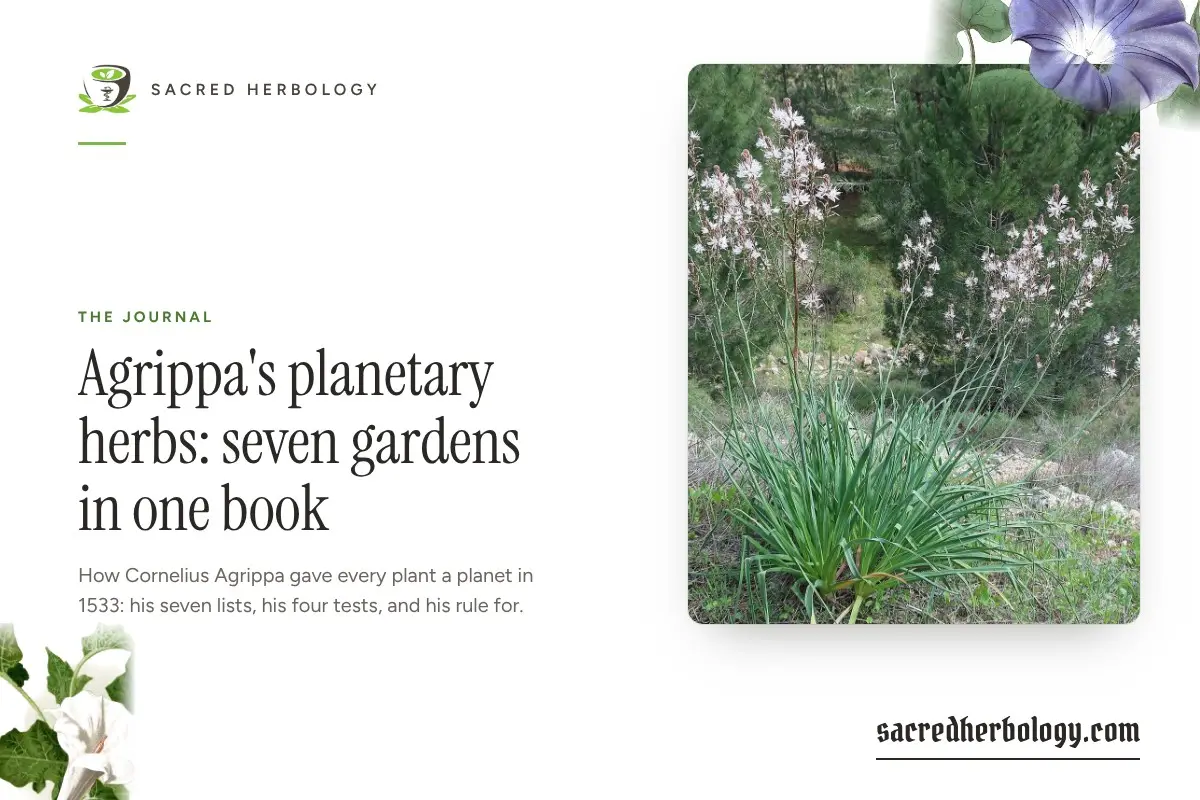
If you have ever looked up “herbs of Saturn” or “herbs of Venus” in a modern book of correspondences, you have almost certainly been reading Agrippa at second or third hand. Most of the planetary tables in circulation today run back through one Renaissance book, printed at Cologne in 1533, and through its English translation of 1651. I want to open that book at the right pages and show you how its author actually did the sorting, because his reasons are more interesting than the tables that came out of them.
This is learned magic, and I file it as esoteric. Agrippa was a university man writing for other educated readers, with named sources and a theory of the cosmos behind every line. It belongs in a different drawer from the village customs of gathering herbs on Midsummer Eve, and I’ll keep the two apart.
The man and the book
Heinrich Cornelius Agrippa von Nettesheim was born in Cologne in 1486 and died at Grenoble, probably in 1535. In between he was a soldier, a physician, a lecturer, a town advocate and, for a while, historian to the Emperor Charles V, and he was asked to leave more cities than most people ever visit.
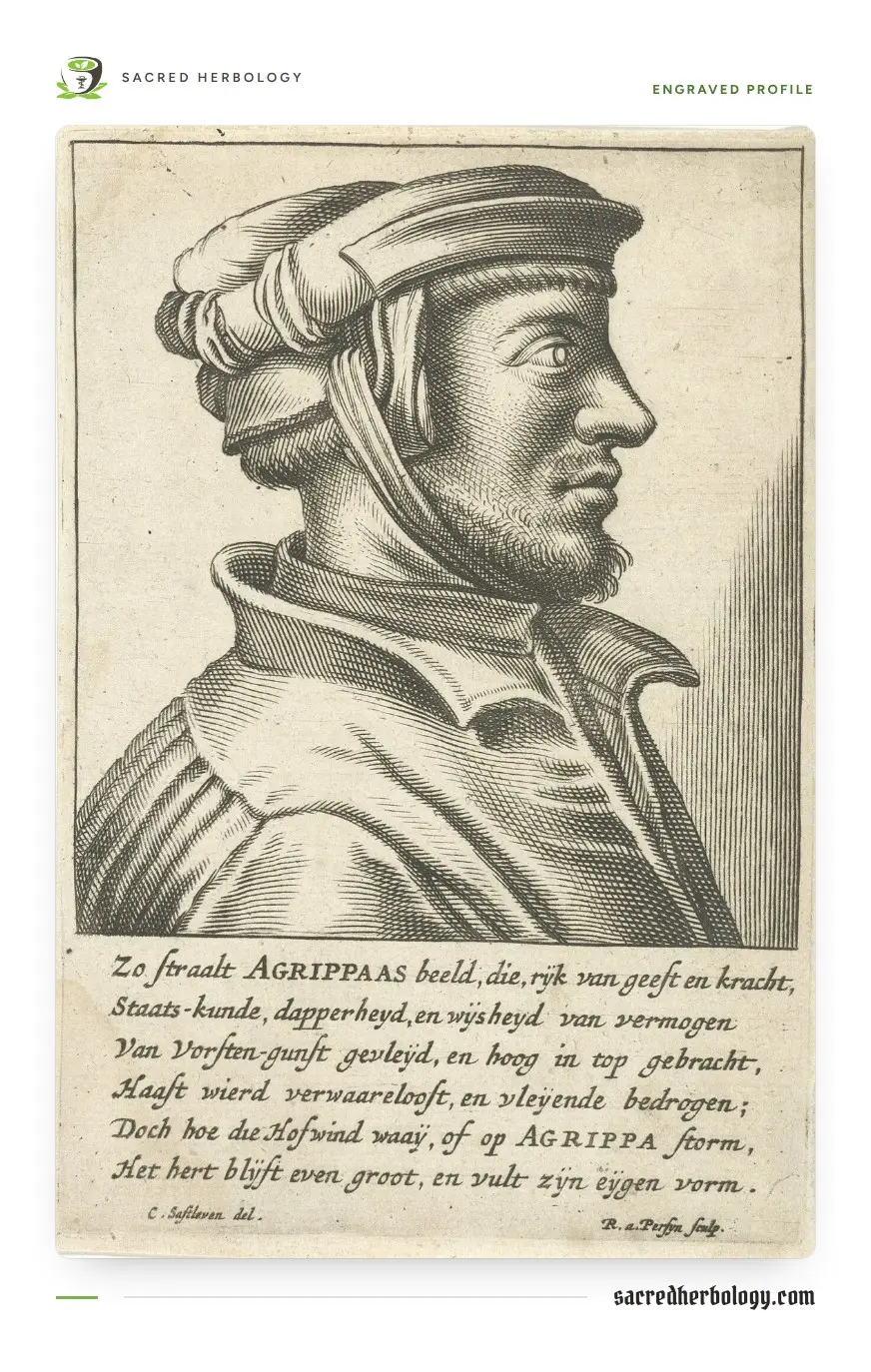

He came from a family of minor nobility in the service of the Habsburgs, and he went up to the University of Cologne as a boy, still in his early teens. By his own account he was reading books on secret things from very young. In his early twenties he was in Paris, part of a small circle of friends who swore themselves to the study of hidden learning, and then caught up in an obscure military and political adventure in Spain that he later said little about.
In 1509 he turned up at Dôle, in Burgundy, and lectured on Johannes Reuchlin’s book on the wonder-working name of God. The lectures were a success with the students and a disaster with the clergy. A Franciscan preacher denounced him from the pulpit as a judaising heretic, and Agrippa left town. It set the pattern for his whole life. He would arrive somewhere, find a patron, say something brilliant and unwise, and move on.
England came next, briefly, in 1510, and then seven years in Italy in the Emperor Maximilian’s service, part soldier and part scholar. At Pavia in 1515 he lectured on the Pimander, the first treatise of the Greek Hermetic writings that Marsilio Ficino had put into Latin a generation before. From 1518 he was town advocate and orator at Metz, and there, in 1519, he took up the defence of a village woman from Woippy who had been accused of witchcraft largely on the grounds that her mother had been burned as a witch. He got her released, and he made a powerful enemy of the inquisitor in doing it.
The early 1520s were spent practising medicine at Geneva and then as town physician at Fribourg, and after that at Lyon as physician to Louise of Savoy, the mother of the French king. That post ended badly too. The queen mother wanted him to cast horoscopes, and Agrippa, who had written a whole book on the virtues of the stars, wrote to a friend in disgust that he was being used as an astrologer. By 1528 he was in Antwerp, and soon afterwards he had the post of historian to Charles V through the favour of Margaret of Austria, regent of the Netherlands. When Margaret died in 1530 his salary went with her, and in 1531 he spent time in a Brussels prison for debt.
He drafted his De occulta philosophia when he was in his early twenties, around 1509 or 1510, and sent it to the abbot Johannes Trithemius, whose letter of reply was later printed at the front of the book. Trithemius praised the young man and then gave him a piece of advice that every esoteric writer since has quoted: speak of common things to common people, and of higher and secret things only to higher and secret friends. “Give hay to an ox,” he wrote, “and sugar to a parrot.” That early draft survives in a manuscript at Würzburg. For twenty years the work went round in manuscript while Agrippa added to it. In 1530 he published a book attacking the vanity of all the sciences, magic among them. Then, in 1531, he printed the first book of the Occult Philosophy anyway, and in 1533 all three. The English version appeared in London in 1651, signed only “J.F.”, and it is that English most correspondence books quote.
The printing itself was a fight. The full edition of 1533 was dedicated to Hermann von Wied, the Archbishop of Cologne, which gave it a powerful protector. Even so, a Dominican inquisitor at Cologne tried to stop the press while the book was being printed, and Agrippa had to appeal to the city’s magistrates with a furious complaint before the sheets could be finished. In his preface he explains why he printed a book he had half disowned: corrupt and garbled copies of the old draft were circulating, and he wanted the world to read the real thing. Then, at the very end, he printed a short censure or retraction, taken from his book on the vanity of the sciences, in which he says he wrote all this as a young man and that much of it is vain and false. Readers have argued ever since about how seriously to take that. The book does not read like the work of a man who had lost interest in his subject.
Who “J.F.” was is a puzzle of its own. He is usually taken to be John French, a London physician with a keen interest in chemistry, though the identification has been questioned and nobody has proved it. Whoever he was, his English is plain, vivid and full of the plant names of his day, and that is why it travelled so well.
Agrippa spent his last years under the archbishop’s protection at Bonn, where a young man named Johann Weyer lived in his household as a pupil. In 1535 he went back to France, was briefly locked up for having written against Louise of Savoy, and died at Grenoble soon after his release.
Be careful with one thing on the shelf. A so-called Fourth Book of Occult Philosophy, a manual of spirit conjuration, was printed under Agrippa’s name in the 1550s, decades after his death. His own former pupil, Johann Weyer, said in print that his master did not write it. Whatever you make of it, nothing in it should be quoted as Agrippa.
Weyer also cleared up the most famous story about him. The Italian historian Paolo Giovio, writing in the 1540s, said that Agrippa kept a black dog that was really a familiar spirit, and that on his deathbed he took off its collar and sent it away, whereupon the dog ran into the river and was never seen again. Weyer had lived in the same house and walked that dog. In his book on the tricks of demons, De praestigiis daemonum, first printed in 1563, he wrote that it was an ordinary black dog called Monsieur, and that his master was simply fond of it. The legend lived anyway, and the magician’s black dog became a stock figure of the Faust stories that followed.
Weyer’s book is worth a moment for another reason. It argued, against the witch-hunters of his day, that many of the women accused of witchcraft were confused, melancholy or ill, and needed physicians and pity more than the fire. It is hard not to hear his master’s Woippy case somewhere behind it.
What a planet was to Agrippa
Before we open the plant lists, it helps to know what Agrippa thought a planet was doing when it “owned” a plant. Everything that follows is his metaphysics, and I’m reporting it, not endorsing it.
He divides the world into three. There is the elemental world of earth, water, air and fire, where plants, stones and bodies live. Above it is the celestial world of the stars and planets, and above that the intellectual world of angels and the divine mind. Each world takes its powers from the one above it. So the three books follow the three worlds: book 1 is natural magic, the magic of herbs, stones, metals and animals; book 2 is celestial magic, full of numbers, magic squares and planetary seals; book 3 is ceremonial magic, concerned with angels, divine names and religion.
Plants sit in book 1 because they belong to the lowest world. But to Agrippa a plant’s most interesting powers did not come from its own elements. He called them occult virtues, hidden virtues, because no amount of tasting or weighing would reveal them. They came down from the stars, carried by the soul of the world and a fine spirit that runs through all things, and they reached each plant as rays. The language of rays has a long history behind it, going back at least to the ninth-century Arab philosopher al-Kindi, whose treatise on stellar rays was read in Latin as De radiis.
Every planet also had a temperament, and that came from a much older and soberer source, Ptolemy’s astrological handbook, the Tetrabiblos, written at Alexandria in the second century. Ptolemy says the Sun heats and somewhat dries, the Moon moistens, Saturn chiefly cools and dries, Jupiter heats moderately and moistens, Mars dries and burns, Venus warms moderately and moistens, and Mercury is changeable, sometimes drying and sometimes moistening. Put that beside the medical theory of the four qualities, which every university physician of Agrippa’s day learned from Galen, and you have a bridge between the sky and the herb garden. A herb that physicians called hot and dry looked like a herb of Mars. A herb that cooled and calmed looked like a herb of the Moon or of Saturn.
That is the frame. Now for the method.
How you tell which planet owns a plant
Agrippa’s first book, on natural magic, runs from chapter 23 to chapter 29 through the seven planets in turn: Sun, Moon, Saturn, Jupiter, Mars, Venus and Mercury. Each chapter lists the elements, tastes, metals, stones, plants, animals, birds and fish that belong to that planet.
He opens chapter 23 with an honest admission. In the 1651 English: “Now it is very hard to know what Star or Sign every thing is under.” Then he gives his method. You know a thing’s star by how it imitates the planet’s rays, or its motion, or its figure. You know some things by their colours and smells, and others by what they do.
So there are four tests, and you can watch him use all of them:
- Motion: the plant moves the way the planet moves, or follows it.
- Figure: the plant looks like the planet, or like something sacred to its god.
- Colour and smell: the plant shares the planet’s character, bright and sweet for the Sun, dark and rank for Saturn.
- Effect: the plant does to a body what the planet was believed to do to a temperament.
Underneath all of it is the old medical theory of hot, cold, wet and dry, and a much older stock of Greek and Roman myth.
Of the four, figure is the one with the longest future. A plant that looks like the thing it governs is the core of what later came to be called the doctrine of signatures, which Paracelsus and his followers made famous and which Giambattista della Porta set out at length in his Phytognomonica, printed at Naples in 1588. Agrippa’s version is broader. For him a plant could resemble a planet, or a god, or a myth, and any of those would do.
Effect is the test that does most of the work, and it is also the one that leans hardest on the physicians. When Agrippa says a plant stupefies, or heats, or sweetens the blood, he is borrowing what the medical books of his day said about it and translating it into the language of the stars. That borrowing is history. It is no guide to what any of these plants will do to you, and nothing in this piece should be read that way.
The Sun and the Moon
The Sun’s plants, in chapter 23, begin with the ones that move. “Those are Solary which turn towards the Sun, as the marigold,” and those which fold their leaves as the Sun sets and open them again little by little when it rises. That is the test of motion at its plainest, and it comes from the late Greek philosopher Proclus, who wrote of the heliotrope and the lotus following the Sun. Agrippa’s Latin has heliotropium there. “Marigold” is the 1651 translator’s word, and we can’t be sure which sun-turning plant either man had in mind.
Proclus is worth a pause, because he shows where Agrippa’s whole way of thinking comes from. In a short essay on the priestly art, Proclus argued that the gods reach down through chains of things that share their nature, so that the Sun has its own stones, plants and animals, each one a fainter echo of the one above it. The heliotrope moves with the Sun, he wrote, and if you could hear it, you’d hear it singing a hymn to its king. Ficino translated the essay into Latin, and it was printed at Venice by Aldus Manutius in 1497, which is how a fifth-century Athenian philosopher’s plant came to sit at the top of a German magician’s list.
If you garden in Australia you can try a small experiment of your own here. A plant that follows the Sun in the northern hemisphere tracks a Sun that swings through the southern sky. Here it tracks a Sun that swings through the north. The plant doesn’t care, of course, and neither did Agrippa’s theory, which was about motion and allegiance and nothing to do with compass points. But it is a pleasant reminder that every one of these lists was drawn up by people looking at a European sky.
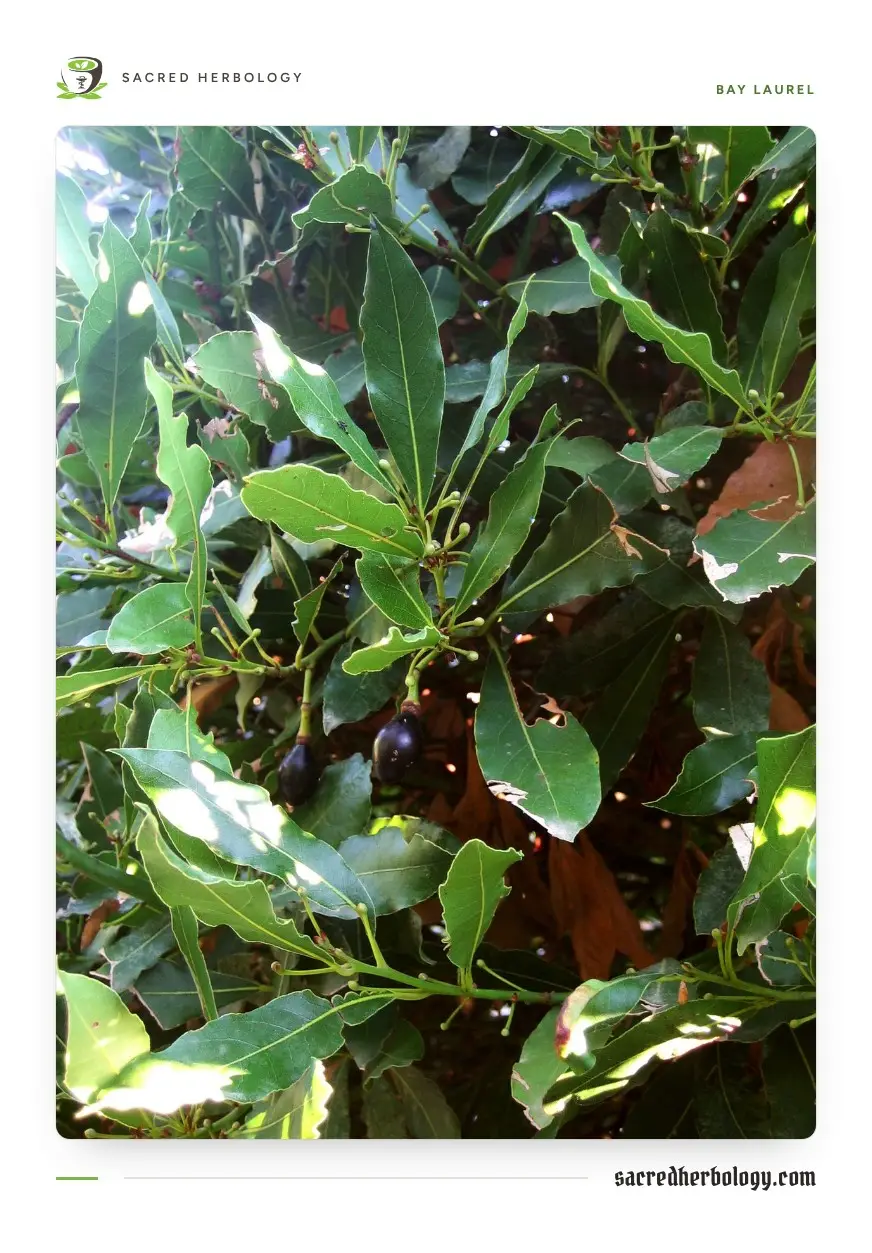
Then the list widens: peony, celandine, balm, ginger, gentian and dittany, and vervain, “which is of use in prophesying and expiations, as also driving away evil spirits.” The bay tree is the Sun’s because it was sacred to Apollo, and so are the cedar, the palm, the ash, the ivy and the vine, and anything that wards off poison and lightning or stands up to the worst of winter. Then the costly aromatics: mint, mastic, zedoary, saffron, balsam, ambergris, musk, yellow honey, aloeswood, cloves, cinnamon, sweet flag, pepper, frankincense and sweet marjoram.
The Moon, in chapter 24, mirrors the Sun. There is a selenotropion that turns to the Moon as the heliotrope turns to the Sun, and a palm that was said to put out a new frond at every new Moon. Hyssop, rosemary, the chaste tree and the olive are lunar. So is a herb the English calls chinosta, which was said to wax and wane with the Moon in the number of its leaves. Agrippa adds that something of that waxing and waning runs through all plants, except onions, which belong to Mars and behave the other way.
Saturn and Jupiter
Saturn, in chapter 25, gets the plants of sleep and the grave. Asphodel, dragonwort, rue, cumin, hellebore, the tree that gives benzoin, mandrake and opium head the list, “and those things which stupefy”. Then come plants that are never sown and never bear fruit, plants with dark berries and black fruit, the black fig, the pine and the cypress. He describes a tree used at burials, bitter, strong-smelling and of a black shadow, dedicated to Pluto, and a herb the English calls pas-flower, which the ancients strewed in graves and would never weave into a garland for a feast because it was a mourning plant.
You can see the test of effect at work here. A plant that dulls the senses is behaving like the cold, slow, heavy planet. The test of colour is there too, in all those black fruits.
Jupiter, in chapter 26, is the opposite: the lucky trees and the sweet, nourishing things. Houseleek, basil, bugloss, mace, spike (as the English has it), mint, mastic, elecampane and the violet are his. So are the oak, the beech, the hazel, the service tree, the white fig, the pear, the apple, the vine, the plum, the ash, the cornel and the olive, and every kind of grain. So is anything whose sweetness is clear and fine with a little sharpness behind it, like nuts, almonds, pine nuts, pistachios, liquorice, sugar, raisins and manna. “Orpheus adds storax,” he says, and he means the Orphic hymns, where storax is the incense for Zeus.
Two surprises sit in Jupiter’s list. Darnel, the weed of the wheatfield, and henbane are both put under the most benevolent of planets. Agrippa doesn’t explain either choice, and for darnel I can’t give you his reason.
For henbane there is a likely answer, and it lies in an older and much humbler book. A short medieval list of seven planetary herbs, one for each planet, travelled in Latin under the name of Albertus Magnus as part of the popular collection known as the Book of Secrets. In that list the herb of Jupiter is henbane. The herb of Saturn is the asphodel, the herb of Venus is vervain, the herb of Mercury is cinquefoil, and the herb of the Moon is the mysterious chynostates, which is said to grow and wane with the Moon. Set that list beside Agrippa’s chapters and the overlaps jump out: the asphodel at the head of Saturn, vervain with Venus, cinquefoil with Mercury, chinosta with the Moon, and henbane, against all the logic of colour and effect, with Jupiter. It looks very much as though Agrippa took the old list on authority and built his own chapters around it. The Book of Secrets list was older than the book that carried it, and its plant names, half Greek and half garbled, suggest the list had already passed through several languages before anyone wrote it down in Latin.
Mars, Venus and Mercury
Mars, in chapter 27, takes the plants that burn. Hellebore, garlic, euphorbium, radish, laurel, wolfsbane and scammony are his, with every plant that is poisonous “by reason of too much heat”. So are the ones that sting, prick or blister the skin, like the nettle and the crowfoot, the ones that make your eyes water, like onions, shallots and leeks, and mustard seed and every thorny tree.
Venus, in chapter 28, takes the plants of scent and pleasure: vervain, the violet, maidenhair and valerian, which Agrippa says the Arabs called phu (the name is older, from the Greek of Dioscorides, and survives in Valeriana phu), thyme, labdanum, ambergris, sandalwood and coriander, “and all sweet perfumes”. Sweet pears, figs and the pomegranate are hers too, the pomegranate because the poets said Venus first planted it on Cyprus. The rose belongs to her as the morning star and the myrtle as the evening star.
Mercury, in chapter 29, has a short list: hazel, cinquefoil, the herb mercury, fumitory, pimpernel, marjoram and parsley, “and such as have shorter and less leaves, being compounded of mixed natures and divers colours”. The planet of change and mixture takes the small, mixed, changeable plants.
One plant, two planets
If you lay the seven chapters side by side, you’ll find plants under more than one planet. Vervain sits with the Sun and with Venus. Hellebore sits with Saturn and with Mars. Mastic sits with the Sun and with Jupiter. Peony is the Sun’s, and peony roots are Jupiter’s. Bay belongs to the Sun for Apollo’s sake and to Mars for its heat.
Agrippa doesn’t apologise for this, and he doesn’t need to. He was compiling from Pliny, from the Greek Neoplatonists, from Marsilio Ficino’s Three Books on Life of 1489, and from the Arabic astral magic of the Picatrix, which he mined heavily. Each source had its own reasons, and he kept them all. A plant could carry several virtues at once, and each could answer to a different star.
Later writers were less patient with that. Nicholas Culpeper, in 1652, gave each herb in his English Physitian one ruling planet, and he did not always agree with Agrippa. Agrippa puts rue under Saturn. Culpeper calls rue “an herb of the Sun, and under Leo.” So when two modern books give a herb different planets, they may simply be copying different old authors.
The books on Agrippa’s desk
It is worth meeting his sources one by one, because each brought something different to the lists.
Pliny the Elder’s Natural History, finished in the 70s AD, gave him the raw stock of plant lore: which herb was sacred to which god, which one snakes avoided, which tree the lightning never struck. Pliny was no astrologer, and much of what Agrippa took from him had nothing to do with planets until Agrippa sorted it.
The Greek Neoplatonists, Proclus above all, gave him the idea that holds the lists together: that each god or star stands at the head of a chain of lesser things that share its nature. Without that idea, a list of Saturn’s plants would just be a list.
Marsilio Ficino gave him a respectable Christian model. Ficino was a priest with a physician’s training, at the heart of the Medici circle at Florence, and the third of his Three Books on Life, printed in 1489, is about drawing life from the heavens. It tells studious, melancholy readers how to bring the gentler influences of the Sun, Jupiter and Venus into their lives through scents, colours, foods, music and well-chosen surroundings. Ficino was careful, and nervous of the Church, and he hedged everything. Agrippa took his material and dropped most of the hedges.
The Picatrix gave him the heavy machinery. Its Arabic original, Ghāyat al-Ḥakīm, “the goal of the wise”, was compiled in the Islamic world around the tenth or eleventh century and was later wrongly credited to the Andalusian astronomer al-Majrīṭī. It was put into Spanish at the court of Alfonso X of Castile in the thirteenth century, and from Spanish into Latin. It is a vast, untidy handbook of astral magic, with planetary prayers, images, incenses and long compound fumes full of plants and animal parts. Much of the darker material in Agrippa’s chapters 43 and 44 has its roots here.
And the Book of Secrets, with its little list of seven herbs, gave him a tradition already old in his own day, cheap, popular and widely printed. Agrippa read everything, high and low, and he was not snobbish about where a correspondence came from.
A note on the old names
The English of 1651 names plants the way gardeners and apothecaries did then, and some of those names have moved. Sengreen is houseleek, Sempervivum tectorum. The cornel, which the 1651 English calls dog-tree, is Cornus mas. Darnel is Lolium temulentum, a grass of the cornfield. Wolfsbane is Aconitum, and hemlock is Conium maculatum. Euphorbium is the dried latex of a Moroccan spurge, Euphorbia resinifera. Benzoin is a resin from Styrax trees, and so was the storax of the old books. Asphodel is Asphodelus, a lily-like plant of the Mediterranean, and it is no relation of the daffodil, though the English word “daffodil” grew out of “asphodel”. Several of Agrippa’s names, such as chinosta, pas-flower and selenotropion, can’t be matched to any plant with confidence, and any modern book that gives you a botanical name for them is guessing.
Two of these old plants have made themselves at home in Australia. Hemlock and darnel are both naturalised weeds here, so if you come across either in a paddock or along a roadside, leave it where it is.
A rule for the incense bowl
My favourite passage for anyone who blends incense is at the end of chapter 44, in the section on fumes for the planets. After his compound recipes, Agrippa gives a short rule that sorts aromatics by which part of the plant they come from:
- Saturn: the scented roots, and the frankincense tree.
- Jupiter: the scented fruits, such as nutmeg and cloves.
- Mars: the scented woods, such as sandalwood, cypress, balsam wood and aloeswood.
- The Sun: the gums and resins, such as frankincense, mastic, benzoin, storax and labdanum, with ambergris and musk.
- Venus: the flowers, such as roses, violets and saffron.
- Mercury: the peels of wood and fruit, such as cinnamon, cassia, mace, citron peel and bay berries, and every scented seed.
- The Moon: the leaves, such as Indian leaf (malabathrum, the leaf of an Asian cinnamon tree, Cinnamomum tamala) and the leaves of myrtle and bay.
It is an elegant scheme. Roots lie deepest in the cold dark earth, so Saturn has them. Resins are the gold that a tree bleeds into the light, so the Sun has them. Leaves wax and fall, so the Moon has them. Notice too that the same tree gets split by its parts. The frankincense tree goes to Saturn, and its gum goes to the Sun. Bay berries go to Mercury, and bay leaves to the Moon.

He follows it with the zodiac. Each sign gets one fume: myrrh for Aries, pepperwort for Taurus, mastic for Gemini, camphor for Cancer, frankincense for Leo, sandalwood for Virgo, galbanum for Libra, opopanax for Scorpio, aloeswood for Sagittarius, benzoin for Capricorn, euphorbium for Aquarius and red storax for Pisces. Then he closes the chapter with what “Hermes” calls the most powerful fume of all, the Seven Aromatics, one for each planet: pepperwort for Saturn, nutmeg for Jupiter, aloeswood for Mars, mastic for the Sun, saffron for Venus, cinnamon for Mercury and myrtle for the Moon.
Agrippa also states the principle behind all this. A good work wants a fragrant and precious fume. An evil one wants a stinking fume “of no worth”. The smell was meant to match the intention.
All of this is the theory of a learned magician about how the heavens act on matter, and I report it as his theory. It makes no claim you could test on a bench. It is, though, the direct ancestor of every planetary incense blend sold today.
If you buy these materials now, the name on the jar won’t always match the old one. The storax of the classical writers came from a Styrax tree, but most storax sold today is a balsam from the Oriental sweetgum, Liquidambar orientalis, a different plant altogether. Real aloeswood, or agarwood, is the resin-soaked heartwood of Aquilaria trees, which are scarce and listed under CITES, so much of what is sold under that name is lower-grade wood that has been dyed or soaked in oil. Saffron has been bulked out for as long as it has been traded, as Pliny complained, and today the usual fillers are safflower, marigold petals and dyed fibres. A jar labelled only “sandalwood” may hold Indian Santalum album or our own Western Australian Santalum spicatum, and the two smell different. Ambergris and musk are animal products, and most of what is sold under those names now is synthetic.
The compound fumes, and a word on safety
The compound recipes earlier in chapter 44 are a different matter, and I’d read them as history only. Alongside the frankincense and saffron, they ask for the brains and blood of eagles, cocks, cats, bats, storks, sparrows and pigeons. The Saturn fume combines black poppy seed, henbane and mandrake root. The Mars fume calls for the roots of both hellebores with euphorbium and sulphur. In chapter 43, a fume for guarding hidden treasure adds hemlock juice to henbane and black poppy.
Henbane, mandrake, hellebore, hemlock, wolfsbane and the opium poppy can all poison, and burning them doesn’t make them safe, because the smoke can carry some of their active compounds into the lungs. Wolfsbane can also pass through the skin, which is why growers handle it with gloves. Euphorbium is a fierce irritant to the eyes, nose and skin, and burning sulphur gives off a choking gas, sulphur dioxide. None of these belongs in a home incense blend. Keep the plants, resins and any ash well away from children and pets. Anyone who is pregnant, and anyone with asthma, is wise to stay clear of heavy incense smoke of any kind, and caged birds are especially sensitive to it. The opium poppy is a controlled plant under Australian drug laws. If someone has swallowed, breathed in or handled any of these plants, call 000 or the Poisons Information Centre on 13 11 26.
After Agrippa
The Three Books made their author’s name a byword within a couple of generations. In Christopher Marlowe’s Doctor Faustus, printed in 1604, Faustus promises to become “as cunning as Agrippa was”, and audiences were expected to know who that meant.
The planetary herb lists themselves went two ways. One road ran through astrology and medicine. William Lilly’s Christian Astrology of 1647 gives the herbs and plants of each planet in its long catalogues of what the planets signify, and Culpeper, five years later, made planetary rule the frame of a whole herbal written for ordinary English households. On that road the planet became a way of matching a herb to a disease, which Agrippa himself had never really set out to do.
The other road ran through the magicians. In 1801 Francis Barrett published The Magus in London, a handsome quarto that lifted whole chapters of the 1651 English, often word for word, and presented them as his own course of study. Barrett’s book found its way into the hands of the occultists of the later nineteenth century. When the Hermetic Order of the Golden Dawn was founded in London in 1888, its members built huge tables of correspondences linking planets, signs, Hebrew letters, colours, stones, plants and perfumes, and Agrippa’s chapters were one of the quarries. Aleister Crowley printed a version of those tables as Liber 777 in 1909, and a great many modern correspondence books descend from that.
Meanwhile Agrippa had become a figure of fiction. In Mary Shelley’s Frankenstein, published in 1818, the young Victor Frankenstein finds a volume of Cornelius Agrippa at an inn and is thrilled by it. His father glances at the title page and tells him not to waste his time on it, because it is “sad trash”. Victor reads on anyway, and the novel suggests that is where his troubles began.
Some modern misreadings
When a Renaissance book has been copied, translated, abridged and tabulated for nearly five centuries, mistakes pile up. These are the ones I see most often.
- Daffodil for asphodel. Some modern lists put the daffodil at the head of Saturn’s plants. The word “daffodil” grew out of “asphodel”, by way of a medieval form “affodill”, and the Latin of both Agrippa and the Book of Secrets means the asphodel, a grey-leaved Mediterranean plant of graves and the underworld. A spring daffodil is a very cheerful plant to give to Saturn.
- Marigold for the heliotrope. Most modern readers take the 1651 “marigold” to be the pot marigold, Calendula officinalis, and some go on to treat that as Agrippa’s own choice. His Latin says heliotropium, and as the section on the Sun shows, which plant he meant is uncertain.
- One planet per herb. Modern tables tend to give each herb a single ruler. Agrippa gives many plants two or more, and he gives different parts of the same plant to different planets. A single neat answer usually comes from Culpeper or from a later table, not from Agrippa.
- The Fourth Book. Spells and conjurations quoted as Agrippa’s very often come from the spurious Fourth Book, which his own pupil disowned on his behalf.
- Ancient and unchanging. Some writers present planetary correspondences as a single fixed system handed down from antiquity. Agrippa’s own chapters show the opposite: a scholar compiling, comparing and sometimes contradicting his sources, and quietly keeping their disagreements.
- Plants he never knew. Agrippa’s world had no eucalypts, no wattles and no tea-tree. Any table that gives an Australian plant a planet is a modern assignment, made by someone applying his four tests. That can be an interesting exercise. It was done in our own time.
One more distinction needs keeping clear. In many parts of Europe there were village customs about gathering herbs at particular times, St John’s wort and mugwort on Midsummer Eve above all. Those are village customs, the lore of country people, local and practical and mostly unwritten, and they don’t depend on any theory of planetary rays. Agrippa’s lists are learned, esoteric and bookish, and they come out of libraries. The two met now and then in later centuries, and modern books often mix them freely, but they grew up in different places.
What to take from it
Agrippa’s planetary lists record what one of the best-read men of the sixteenth century believed about how the world hangs together. Plants that turn to the light belong to the light. Plants that dull the senses belong to the slow cold planet. Plants that burn belong to the red one. Sweet flowers belong to the goddess of love. Once you know the four tests, you can read any correspondence table and often see which test someone was using.
It also gives you a way to check what you read today. If a modern table puts a herb under a planet, ask whether Agrippa did, whether Culpeper did, or whether the attribution turns up only in recent books. The older lists disagree with each other, but at least you can see their reasons.
And there is pleasure in simply reading him. Under all the theory, chapters 23 to 29 are a portrait of a sixteenth-century garden, orchard and spice cupboard, set out by a man who loved lists and could not leave out anything interesting. The oak and the beech and the hazel, the violet and the rose, the pomegranate of Cyprus, the bay of Apollo, the black fig and the mourning cypress all stand together, each tied by a thread of reasoning to a light in the sky. You don’t have to believe in the threads to enjoy the garden.
If you’d like to follow the plants one step further back, Agrippa’s main Arabic source has its own plant-by-plant catalogue in our Picatrix Herbal, and you’ll find many of his Saturn and Mars plants already there.
Where this comes from
- H. C. Agrippa, De occulta philosophia libri tres (Cologne, 1533), book 1, chapters 23-29, 43 and 44.
- Henry Cornelius Agrippa, Three Books of Occult Philosophy, trans. “J.F.” (London, 1651).
- Three Books of Occult Philosophy, or Magic: Book One, Natural Magic, ed. Willis F. Whitehead (Hahn and Whitehead, Chicago, 1897).
- Three Books of Occult Philosophy, ed. Donald Tyson (Llewellyn, 1993).
- Vittoria Perrone Compagni, ed., Cornelius Agrippa, De occulta philosophia libri tres (Brill, 1992).
- Charles G. Nauert, Agrippa and the Crisis of Renaissance Thought (University of Illinois Press, 1965).
- Marsilio Ficino, Three Books on Life, ed. and trans. Carol V. Kaske and John R. Clark (Medieval and Renaissance Texts and Studies, 1989).
- Nicholas Culpeper, The English Physitian (London, 1652).
- Ptolemy, Tetrabiblos, ed. and trans. F. E. Robbins (Loeb Classical Library, Harvard University Press, 1940).
- Michael R. Best and Frank H. Brightman, eds., The Book of Secrets of Albertus Magnus (Clarendon Press, Oxford, 1973).
- William Lilly, Christian Astrology (London, 1647).
- Francis Barrett, The Magus, or Celestial Intelligencer (London, 1801).
- Johann Weyer, De praestigiis daemonum (Basel, 1563).