
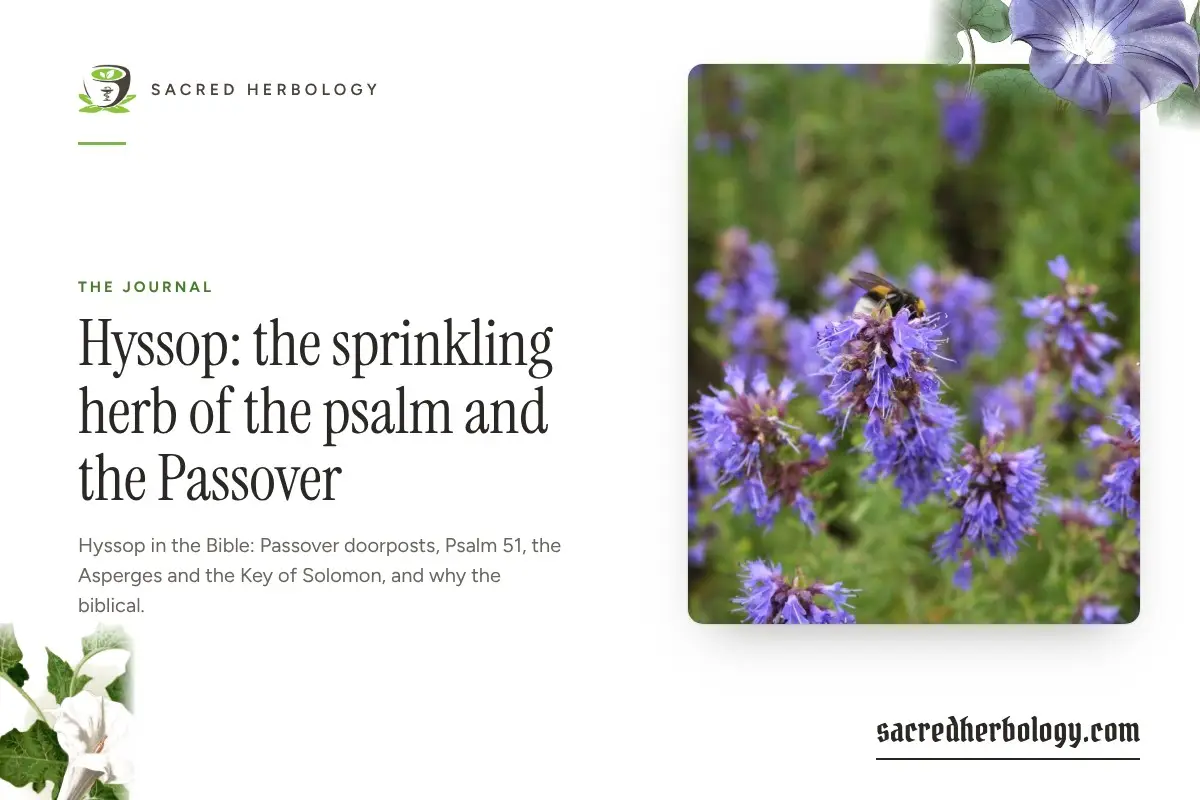
Pick a sprig of hyssop and run it through your fingers. The stem is square and woody at the base, the leaves are narrow and dark green, set in pairs up the stem, and the flowers come in a tight one-sided spike of small blue-violet lips that the bees will not leave alone. Crush a leaf and the smell is sharp and resinous, somewhere between sage, mint and camphor, with a bitterness at the back of it. It is a modest little shrub, knee-high at most, and you could walk past a hedge of it without a second look.
Yet very few plant names carry as much weight. “Purge me with hyssop, and I shall be clean: wash me, and I shall be whiter than snow.” That is Psalm 51 in the King James Version, and in its Latin form, “Asperges me, hyssopo, et mundabor”, it was sung in Catholic churches every Sunday for well over a thousand years while a priest walked the aisle flicking holy water over the people. Hyssop is the bundle the Israelites dipped in lamb’s blood on the night of the first Passover. It is in the rite that cleansed a leper, in the ashes of the red heifer, in the list of everything King Solomon knew, and in the last moments of the Gospel of John. Centuries later the magicians who wrote the Key of Solomon called their holy-water sprinkler “the hyssop”, whatever herbs it was actually made of.
There is a catch, and it is the thread that runs through this whole piece. The plant you buy today as hyssop, Hyssopus officinalis, almost certainly is a different plant from the one the Hebrew Bible calls ezov. The name travelled from Hebrew into Greek, from Greek into Latin, and from Latin onto a European garden shrub that never grew in ancient Israel. So this is a story about a word as much as a plant, and about how a word can carry a whole ritual with it across two thousand years and several languages.
We’ll start with the psalm itself, then sort out which plant is which. After that we’ll follow the hyssop bundle through the rites of the Hebrew Bible, the rulings of the rabbis on how to tie it, the Gospel of John and a famous argument over one Greek word, the Latin church and its Asperges, the Sistine Chapel and a fourteen-year-old Mozart, the grimoires, the folk magic of the American South, Culpeper’s planets and the Tudor knot garden. At the end I’ll come to what is in the leaf, the oil, how to handle it, and how to grow both the European hyssop and the Syrian herb that has the better claim to the name.
A word on beliefs, as always. Much of this piece is about what people believed hyssop did: that sprinkling with it washed away sin or impurity, that its use turned away the destroyer at the door, that a magician’s water was made holy by it. I’ll report those beliefs as fairly as I can and I won’t tell you they are true. Where material comes from the learned magical books, the grimoires and the astrological herbals, I’ll label it esoteric. Where it comes from village and household custom, I’ll say so and call it folk custom, and keep the two apart. Scripture and liturgy I’ll describe as what they are: the texts and rites of living religions, Jewish and Christian, which many readers hold sacred. And while hyssop has a long history in medicine, that history belongs to pharmacy, and this piece leaves it alone.
The verse
Psalm 51 is the great psalm of repentance. Its heading in the Hebrew Bible ties it to a particular moment: when the prophet Nathan came to King David after David had taken Bathsheba and arranged the death of her husband Uriah. Whether David wrote it is a question for biblical scholars, and most would date the psalm in its present form later than David’s reign. What matters for us is that the tradition placed hyssop in the mouth of a king confessing the worst thing he had ever done.
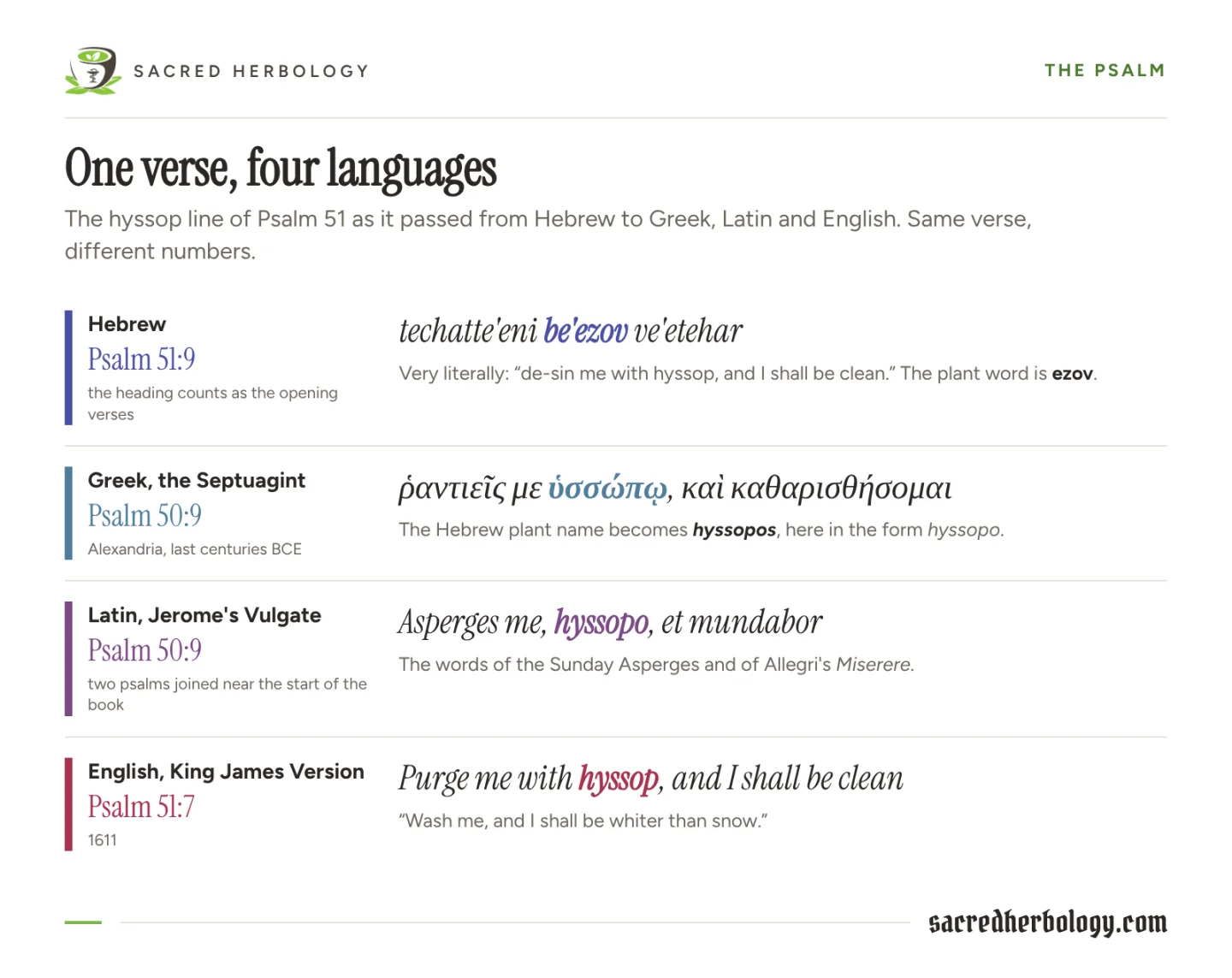
In the English Bible the hyssop line is verse 7. In the Hebrew text, where the heading counts as the opening verses, it is verse 9. The Hebrew reads, roughly transliterated, techatte’eni be’ezov ve’etehar. The verb is unusual. It comes from the ordinary Hebrew root for sin, but in an intensive form that turns it inside out, so that it means to remove sin, to un-sin. A very literal English rendering would be “de-sin me with hyssop, and I shall be clean.” The King James translators chose “purge”, and that word has stuck.
The psalmist is reaching for a picture every listener would know. In the purity rites of the Hebrew Bible, which we’ll come to shortly, a priest dipped a bundle of hyssop in water or blood and sprinkled it over a person or a house that had become ritually unclean. The person could then return to the life of the community. So the psalm takes a priestly rite and turns it into a prayer. It asks God to do directly what the priest did with his bundle of herbs. Snow is the other half of the picture: snow is the whitest thing the poet can think of, and the cleansing he asks for goes that far.
The verse is worth seeing in Hebrew, Greek and Latin side by side. The Hebrew has ezov. The Greek translation made in Alexandria in the last centuries BCE, the Septuagint, has hyssopo. The Latin of Jerome’s Vulgate has hyssopo again. In the Latin Bible the psalm is numbered 50, because the Greek and Latin tradition joins two psalms near the start of the book, so in older Catholic books you will find the hyssop verse cited as Psalm 50:9. It is the same verse.
Which plant is which
Here is the plant problem in plain terms.
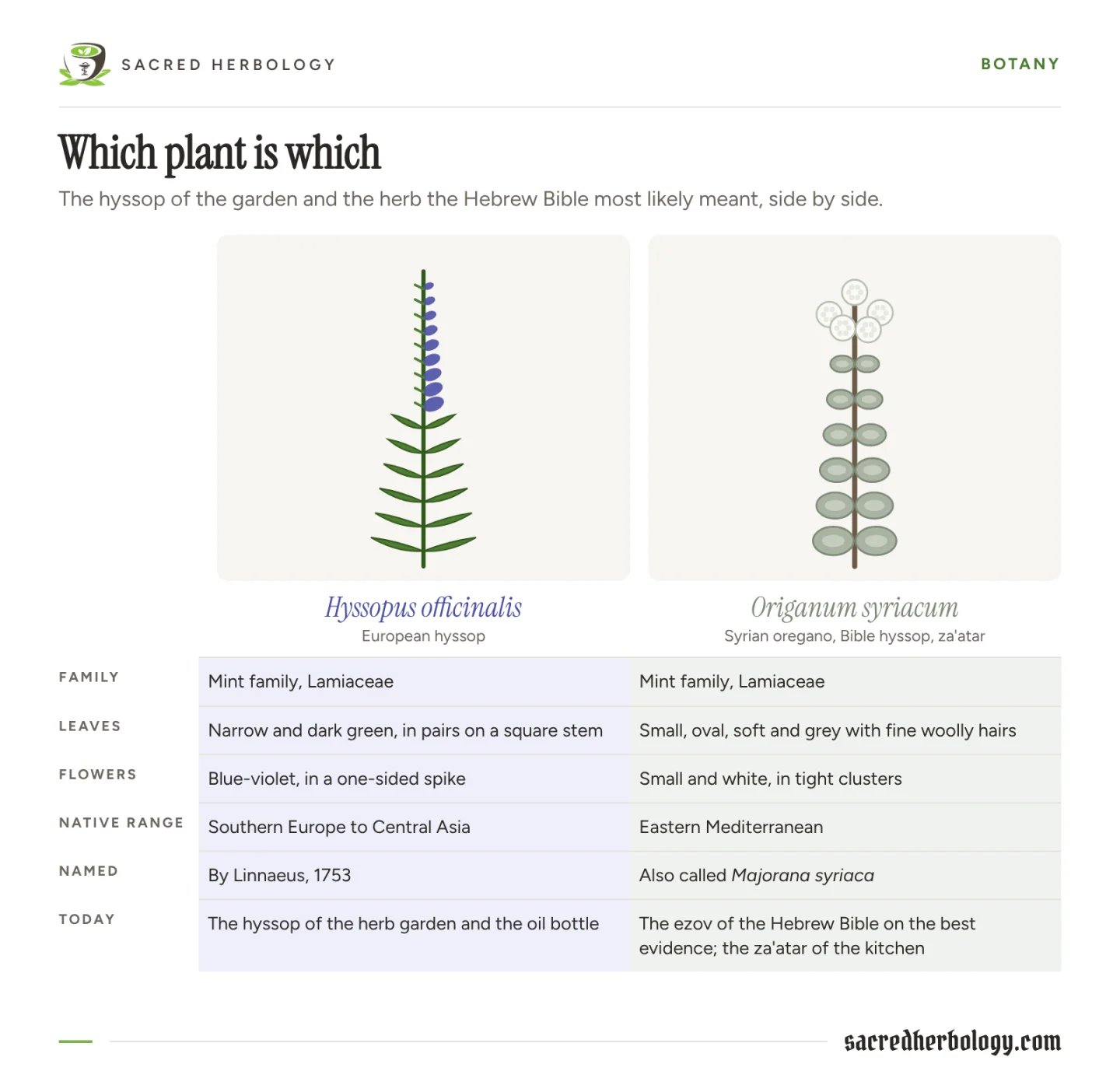
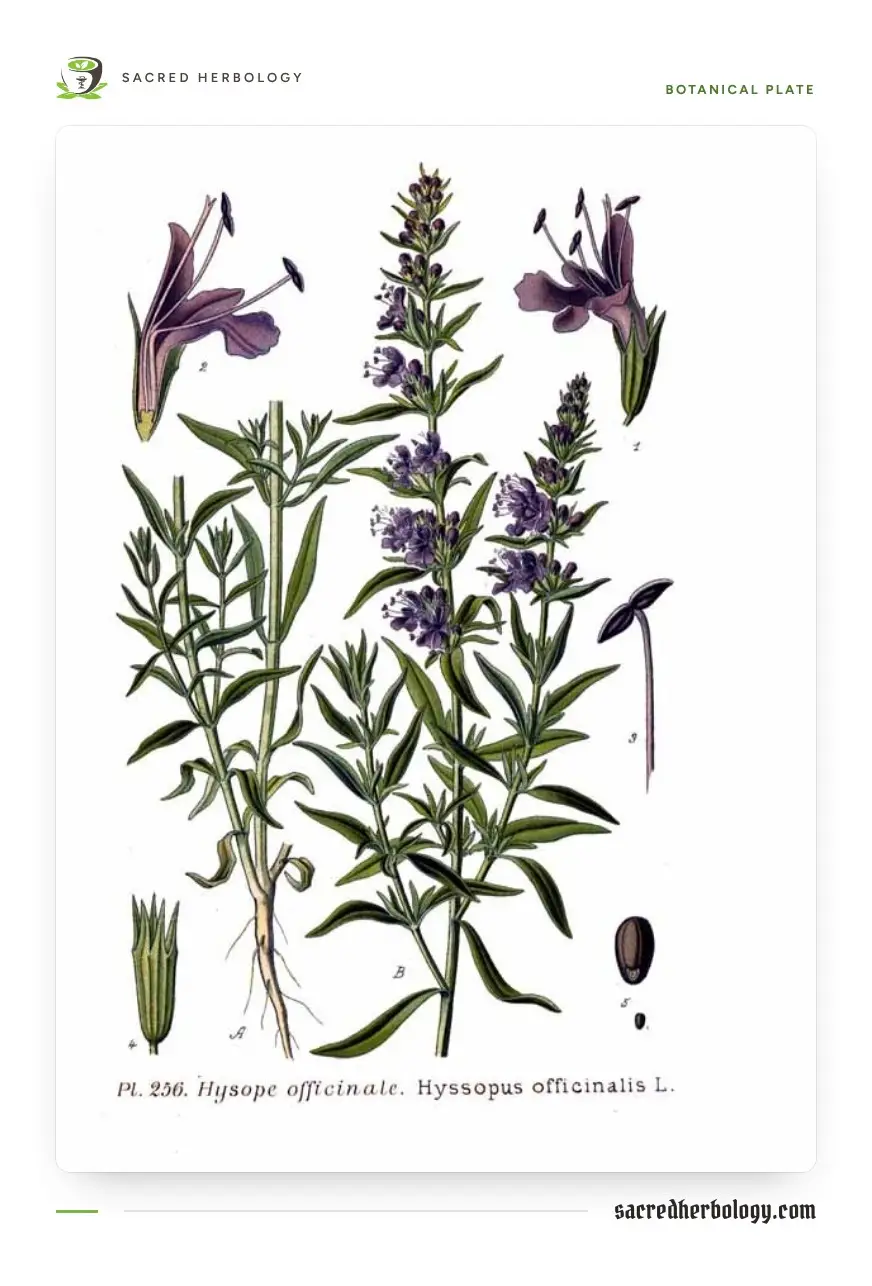
Hyssopus officinalis, the European hyssop of herb gardens, is a small evergreen or half-evergreen shrub in the mint family, the Lamiaceae. It grows wild across southern Europe, from Spain through Italy and the Balkans, and east into Turkey, the Caucasus and Central Asia. It likes dry, stony, limestone ground and full sun. Its flowers are usually blue-violet, with pink and white forms that gardeners have kept for centuries. Carl Linnaeus gave it its formal name in Species Plantarum in 1753, taking the old apothecary’s word hyssopus and adding officinalis, the label for plants kept in the officina, the apothecary’s shop.
That plant does not grow wild in the land of Israel and was not part of its ordinary flora in biblical times. Scholars who have studied the plants of the Bible are close to unanimous that the ezov of the Hebrew text is a different herb. The leading candidate, and the one most botanists now accept, is the plant known today as Origanum syriacum, sometimes still filed under its older name Majorana syriaca. In English it goes by Syrian oregano, Syrian marjoram, Bible hyssop and Lebanese oregano. In Arabic it is za’atar, a word that has also come to mean the famous blend of the dried herb with sumac, sesame and salt.
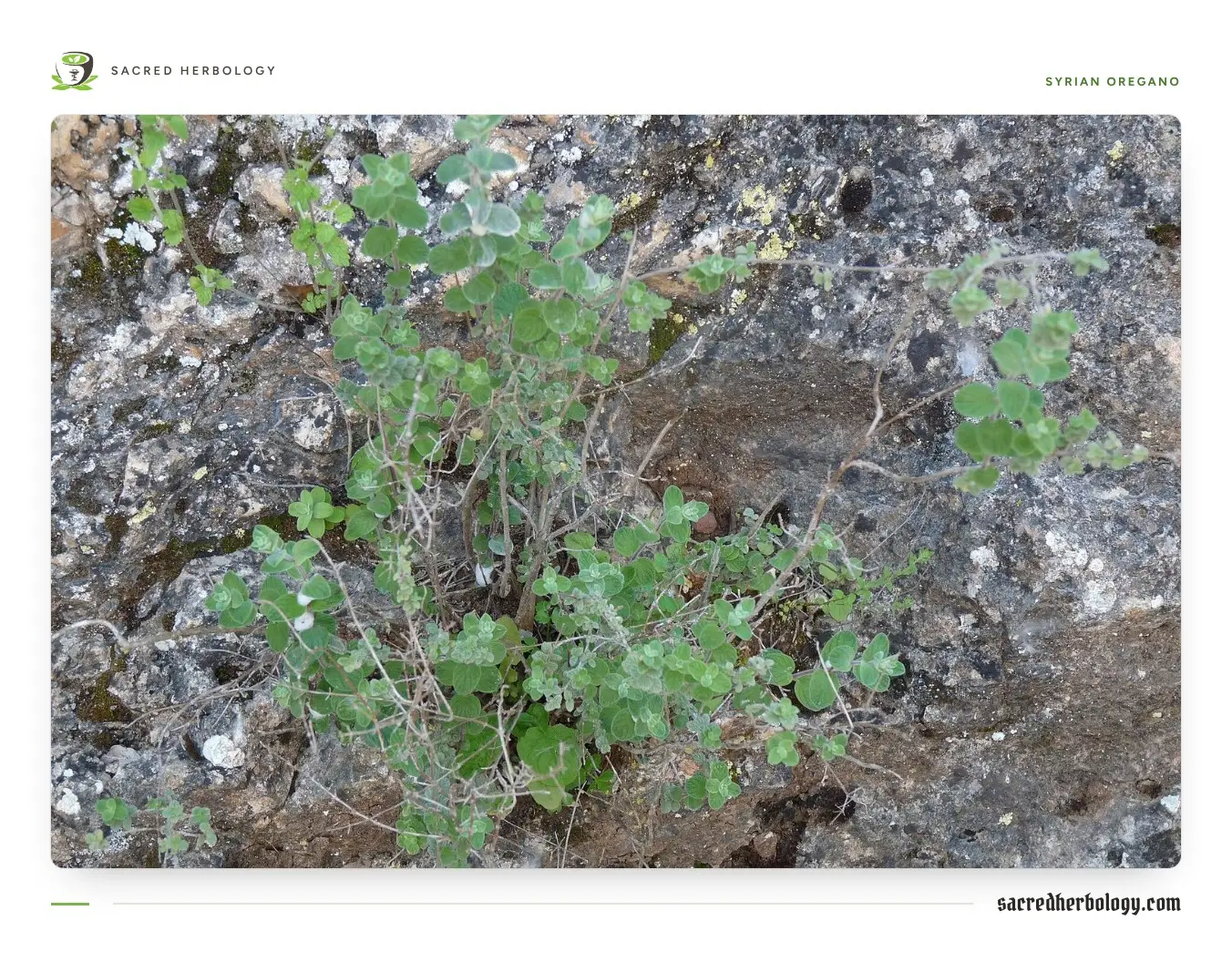
The case for Origanum syriacum rests on a few things. It grows wild all over the hills of Israel, Palestine, Lebanon, Syria and Jordan, often in rocky places and in the cracks of old stone walls. It is a small grey-green, hairy shrub with upright stems that can easily be broken off and tied into a bunch. Its leaves and flower heads are woolly and hold water well, which suits a plant used for sprinkling. And the Jewish tradition itself identified ezov this way. The tenth-century scholar Saadia Gaon, who translated the Torah into Arabic, rendered ezov as za’atar. Maimonides, writing his commentary on the Mishnah in the twelfth century, did the same. The identification is old, and it comes from people who knew both the Hebrew text and the plants of the region.

The botanist Michael Zohary, whose Plants of the Bible was published by Cambridge University Press in 1982, made the case at length and it has become the standard view. Harold and Alma Moldenke’s Plants of the Bible, published in 1952, had already argued for a wild marjoram of the same group. Other suggestions have been made over the centuries, and we’ll meet some of them, but none has displaced Syrian oregano.
Set the two plants side by side and the difference is plain. Hyssopus officinalis: mint family, narrow dark leaves, blue spikes, native from southern Europe to Central Asia, named by Linnaeus in 1753, the hyssop of the herb garden and the oil bottle. Origanum syriacum: mint family, soft grey woolly leaves, small white flowers in tight clusters, native to the eastern Mediterranean, the ezov of the Hebrew Bible on the best evidence, the za’atar of the kitchen.
Za’atar on the hillside
It is worth staying with Origanum syriacum for a moment, because it is a living plant with a living culture around it, and the Bible is only part of its story.
The plant grows as a low, much-branched subshrub, often under a metre, with stiff stems rising from a woody base. The leaves are small, oval and covered with fine soft hairs, which give the whole plant a silvery, dusty look. In late spring and summer the stems end in dense heads of tiny white flowers. Rub it and you get the hot, peppery, thyme-like smell of the oreganos, with a sharper bite than the marjoram most people know from the kitchen.
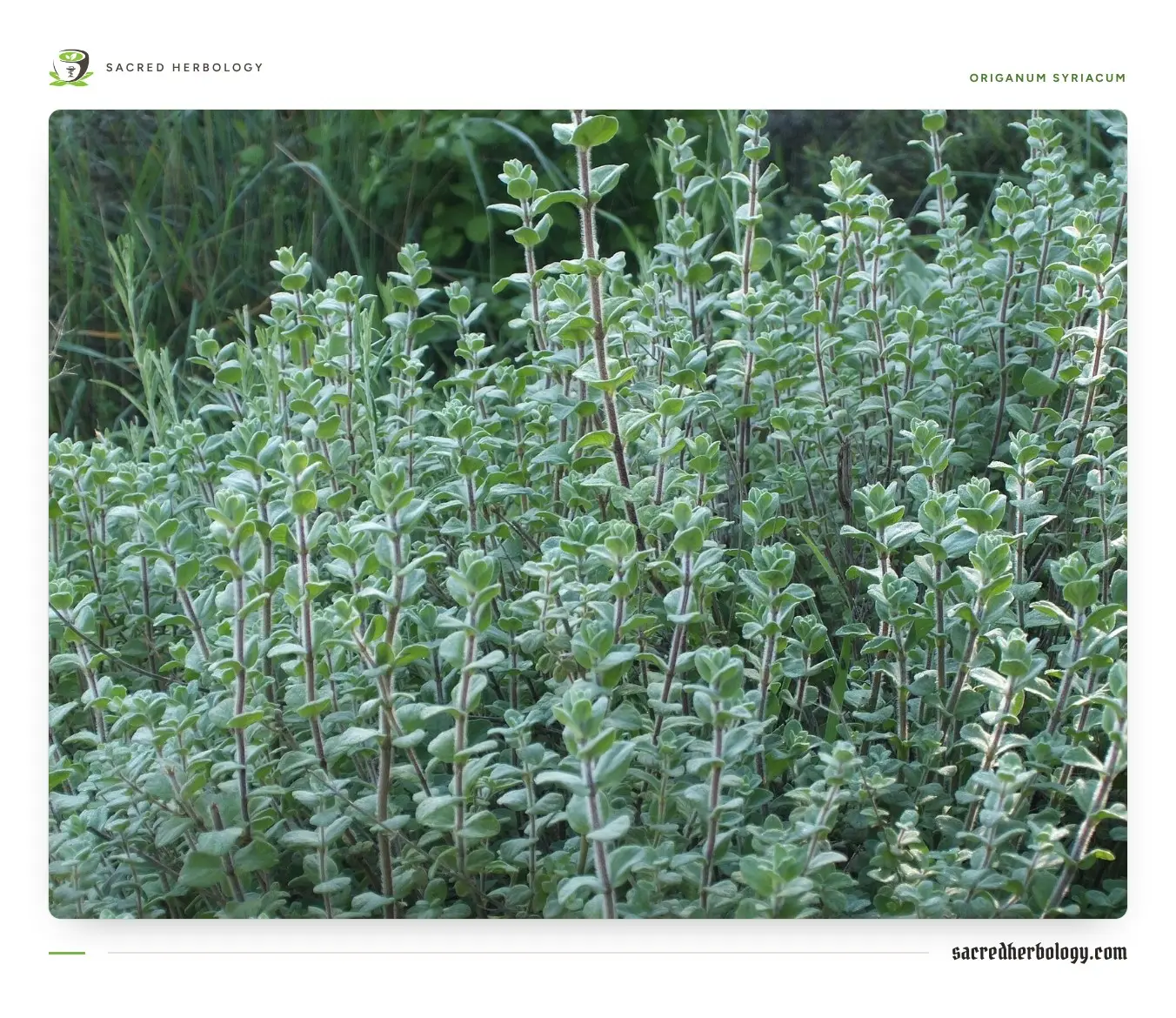

For Palestinian, Lebanese, Syrian and Jordanian families, gathering wild za’atar from the hills was for generations a seasonal job, done by women and children as much as anyone, and the herb was dried, pounded and kept through the year. It is so bound up with Palestinian identity that it appears in poetry, in song and in the politics of land. In the late 1970s Israel listed wild Origanum syriacum as a protected plant, after decades of heavy harvesting had thinned it out, and picking it from the wild became an offence. The rule bore hardest on Palestinian and Arab communities who had always gathered it, and it has been argued over ever since, with cultivated za’atar now grown on farms to meet the demand. I mention it because the plant of the psalm is also a plant of the present, with real people attached to it, and its story did not stop in the Iron Age.
For the rest of this piece, when I write ezov I mean the plant of the Hebrew text, which is very probably this Syrian oregano. When I write hyssop without a qualifier I mean the word as each tradition used it, which shifts as we go.
Blood on the doorposts
The first time the ezov appears in the Bible is the most dramatic. In Exodus 12 the Israelites are slaves in Egypt and the last of the plagues is coming: the death of every firstborn in the land. Moses tells the elders of Israel to choose a lamb for each household, kill it at twilight, and then: “ye shall take a bunch of hyssop, and dip it in the blood that is in the bason, and strike the lintel and the two side posts with the blood” (Exodus 12:22, King James Version). No one is to go out of the door until morning. When the destroyer passes through Egypt that night, he sees the blood and passes over the house.
That night is the origin of the Passover, Pesach, still kept by Jewish families every spring. The hyssop is a small detail in a long chapter, but it is the tool that makes the sign. Someone had to go out to the hillside, pull up or break off a handful of the plant, and use it as a brush. A bunch of woolly-leaved Syrian oregano does that job well; it takes up liquid and lets it go in a spatter. It is one of the reasons the identification works.
Artists have painted this scene for centuries: a doorway, a man with a bowl, a bunch of grey-green herb, and the red mark on the lintel and the posts.
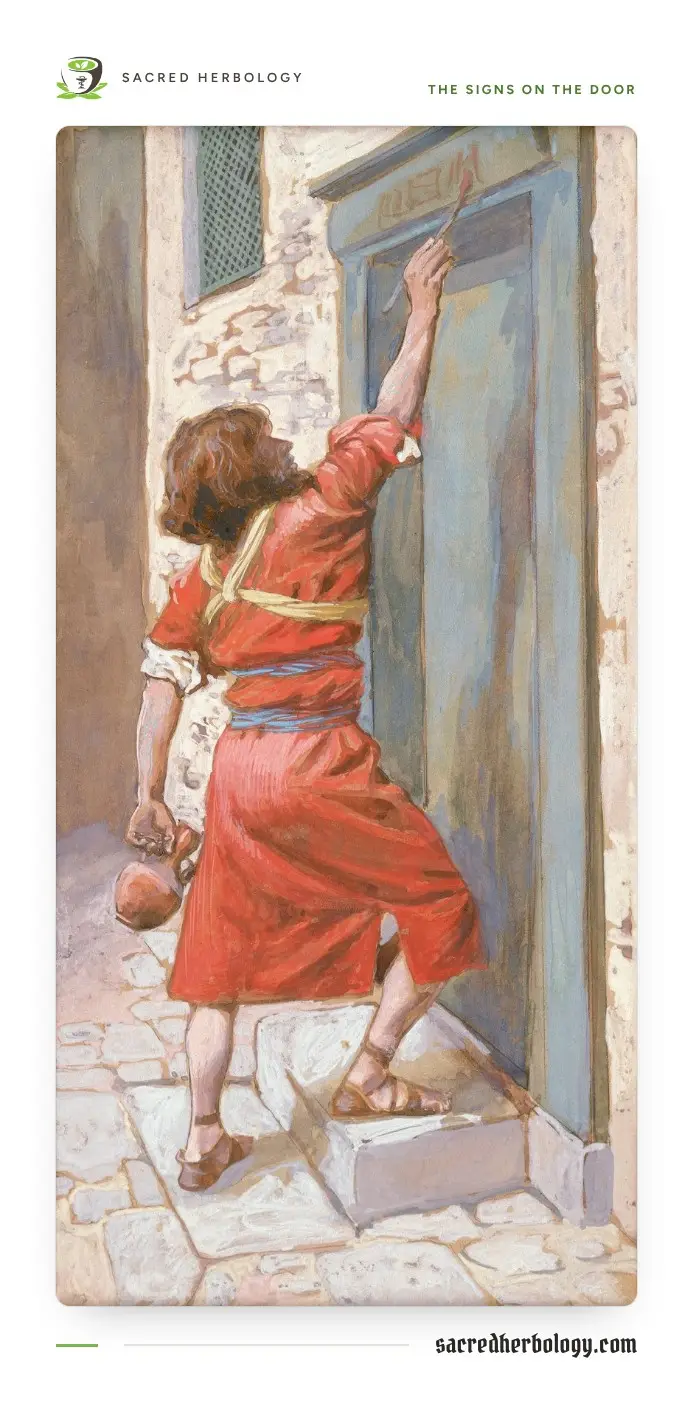

The Passover lamb with its blood on the door is a defining rite of a living religion. It is described in Exodus as an act of obedience and protection on a single night, and later Jewish practice remembers it at the Seder table without the blood on the door. I describe it here as the text describes it.
Cedar, scarlet and two birds
The next appearance takes us into the purity laws of Leviticus, and it is where hyssop and oil sit side by side, which is why this piece belongs in the Oil and Anointing pages.
Leviticus 13 and 14 deal with tzara’at, a skin condition the English Bible traditionally calls leprosy, though scholars agree it is unlikely to be the disease we now call leprosy. The text treats it as a state of ritual impurity. A person with tzara’at lived outside the camp. When the priest judged the condition healed, a rite of cleansing brought the person back in.
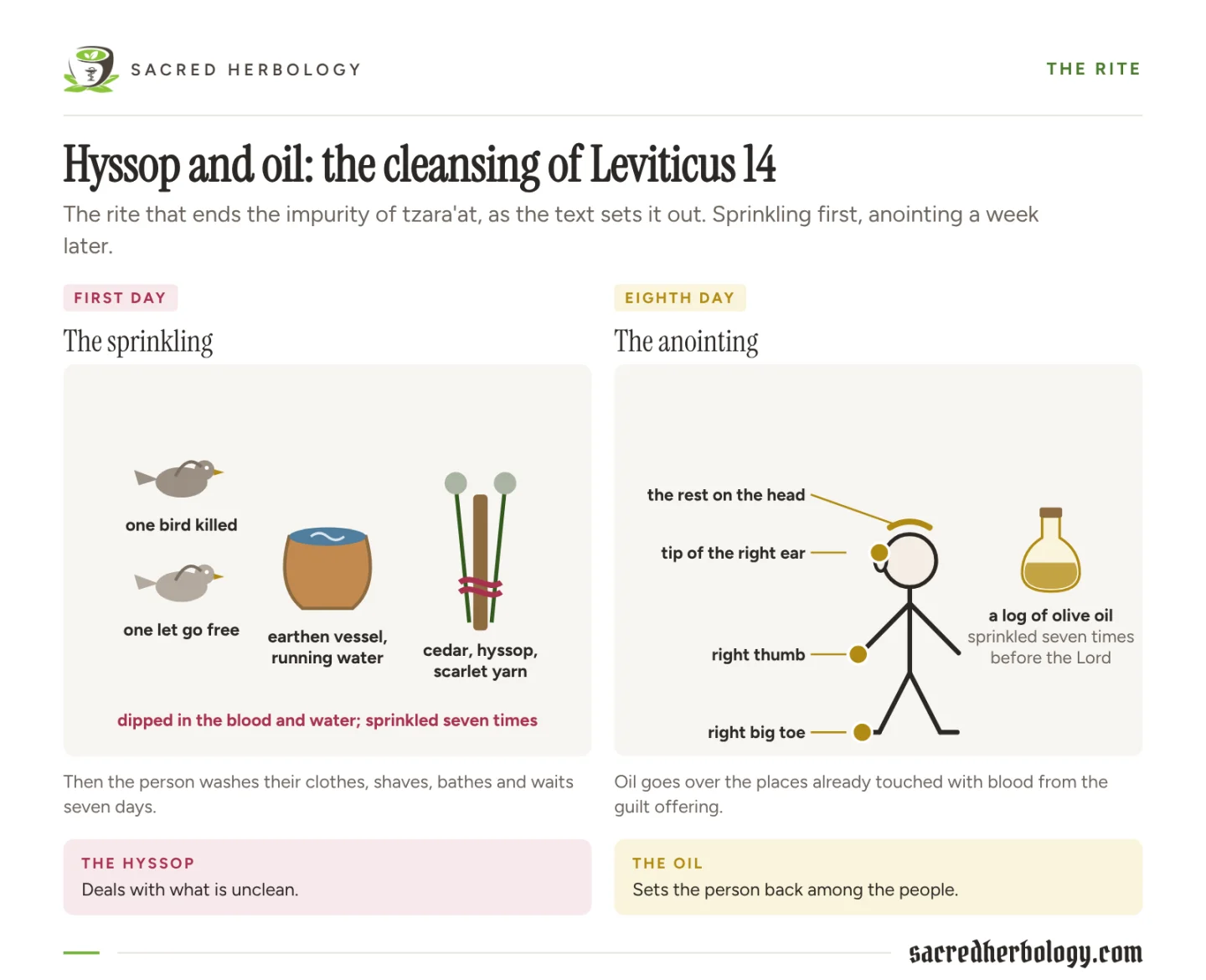
Leviticus 14 sets it out. The priest takes two living clean birds, cedar wood, scarlet yarn and hyssop. One bird is killed over an earthen vessel holding running water. The cedar, scarlet and hyssop, together with the living bird, are dipped in the blood and water, and the person being cleansed is sprinkled seven times. The living bird is let go into the open field. The person washes their clothes, shaves and bathes, and waits seven days.
On the eighth day comes the anointing. The priest takes a measure of olive oil, called a log, pours some into his left palm, and with his right finger sprinkles it seven times before the Lord. Then he puts oil on the tip of the right ear of the person being cleansed, on the thumb of the right hand and on the big toe of the right foot, over the places where blood from the guilt offering has already been placed. What is left in his palm he pours on the person’s head.
So in one rite we have the full grammar of what this category of the Journal is about. Sprinkling with a bundle of hyssop, and then anointing with oil, ear, hand, foot and head. The hyssop deals with what is unclean; the oil sets the person back among the people. The same chapter applies a version of the hyssop rite to a house where a spreading mould or mildew had been found.
Picture the whole rite laid out: the bundle of cedar, hyssop and scarlet wool tied together, the two birds, the clay vessel of running water, the log of oil, and the person being cleansed, touched with oil on the right ear, the right thumb and the right big toe.
The red heifer
The third great hyssop rite is the strangest and the most argued over. Numbers 19 describes the red heifer, a young cow, wholly red, without blemish, that has never borne a yoke. It is killed outside the camp and burned whole. As it burns, the priest throws cedar wood, hyssop and scarlet into the fire. The ashes are gathered and kept, and later mixed with running water to make the “water of separation”, the water that cleansed a person who had touched a dead body.
To apply it, a clean person took hyssop, dipped it in the water and sprinkled the tent, the vessels and the people, on the third day and the seventh. So hyssop is in this rite twice: burned into the ashes and used as the sprinkler.
Jewish commentators have long called the red heifer the hardest of the commandments to explain. A famous saying in the rabbinic tradition has even King Solomon, wisest of men, admit that he could not understand it. The rite has not been carried out since the destruction of the Second Temple in 70 CE. Its revival is bound up with hopes for a rebuilt Temple and is a live and sensitive question in modern Israel. I’ll leave it there, and note only that cedar, hyssop and scarlet appear together in both the leper’s rite and the heifer’s, a fixed trio. The cedar is tall and lasting, the scarlet is the colour of blood, and the hyssop is low, small and common. Later interpreters, Jewish and Christian, made much of that pairing of the highest tree and the lowest herb.
How the rabbis tied the bundle
The Mishnah, the great collection of Jewish law edited around 200 CE, gives a whole tractate to the red heifer, called Parah, and a tractate on skin impurity, called Negaim. Both have things to say about hyssop, and they are a gift to anyone trying to work out which plant was meant, because the rabbis were practical people who had to pick the right herb.
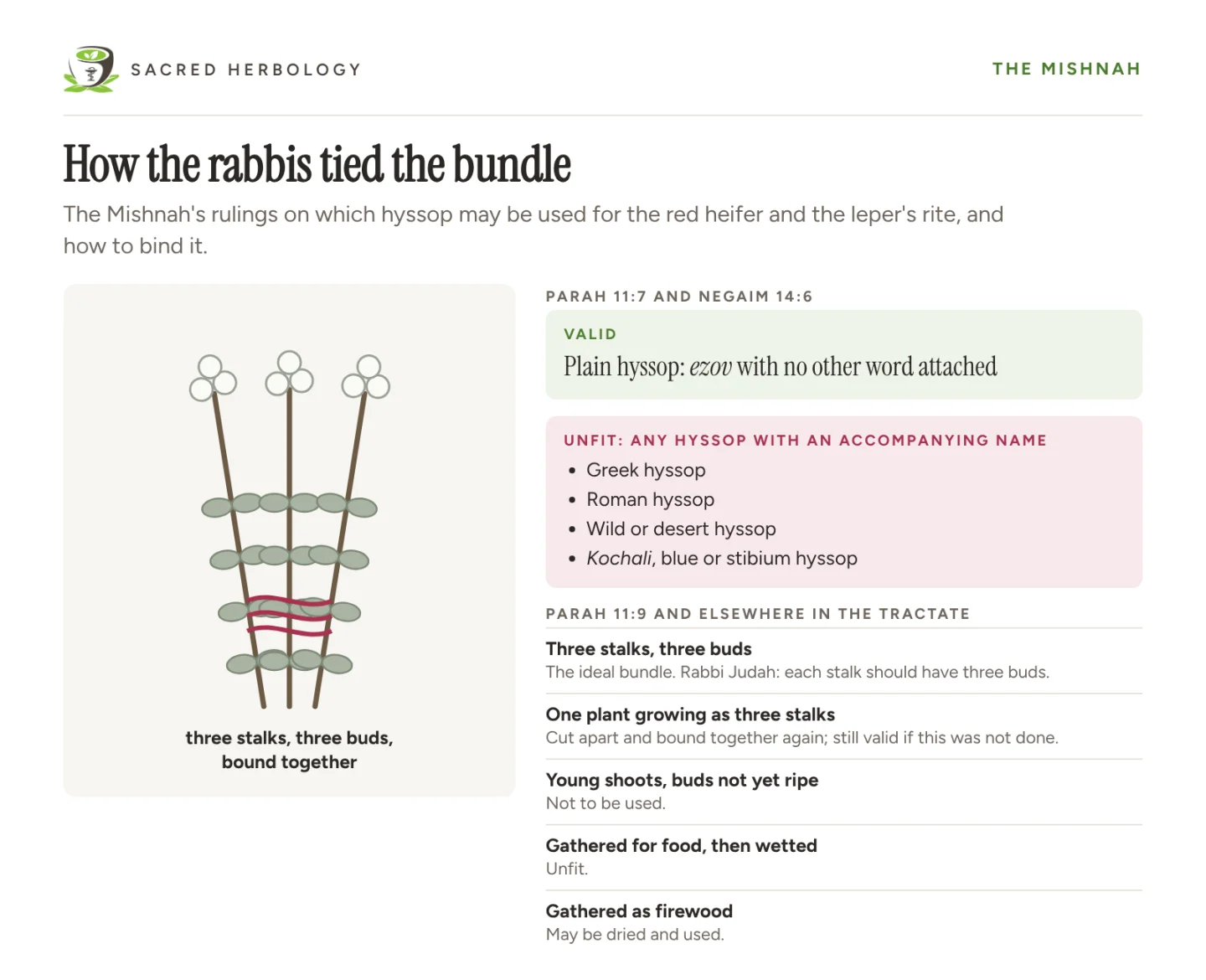
Parah 11:7 rules that any hyssop “that has an accompanying name” is unfit. Plain hyssop, ezov with no other word attached, is valid. Then it lists the kinds that do not qualify. In the usual English versions they come out as Greek hyssop, Roman hyssop, wild or desert hyssop, and a fourth called kochali, which translators render variously as blue hyssop or stibium hyssop, perhaps after its colour. Negaim 14:6 gives the same list for the leper’s rite.
Think about what that tells us. By the time of the Mishnah, the name hyssop was already being used for several different plants, some of them clearly foreign. “Greek hyssop” and “Roman hyssop” were plants the Greeks and Romans called by that name, and they were not the herb Jewish law wanted. It is tempting to see European Hyssopus officinalis in “Greek hyssop”, though we cannot prove it. Either way, the rabbis were already sorting out the very muddle this piece is about, some eighteen hundred years ago.
Parah 11:9 then says how to make the bundle. The ideal is three stalks bearing three buds; Rabbi Judah says each stalk should have three buds. If one plant grows as three stalks together, it should be cut apart and bound together again, though the rite is still valid if this was not done. Elsewhere the tractate rules that young shoots whose buds have not yet ripened are not to be used, and that hyssop gathered for food and then wetted is unfit, while hyssop gathered as firewood can be dried and used. These are the questions of people who actually went out and picked the plant and tied it with their hands.
Picture the finished bundle: three stalks, each with its little head of buds, bound together into one sprinkler.
From the cedar to the wall
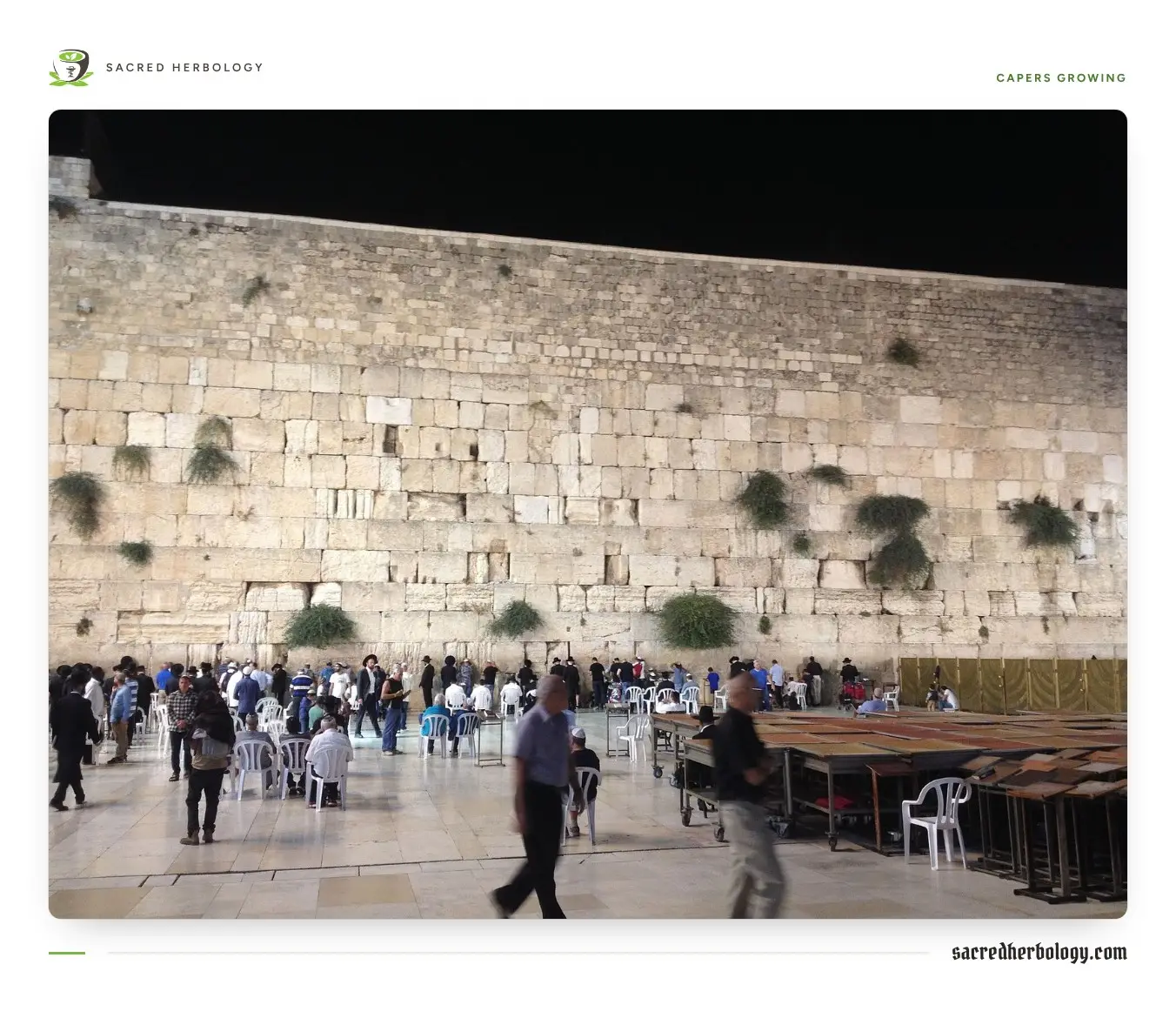
There is one more hyssop in the Hebrew Bible, and it has shaped the identification arguments more than any other verse. In 1 Kings 4, the writer praises the wisdom of Solomon, and says that “he spake of trees, from the cedar tree that is in Lebanon even unto the hyssop that springeth out of the wall” (1 Kings 4:33, King James Version).
Again the pairing of cedar and hyssop, highest and lowest, and here it stands for the whole range of plant life, from top to bottom. Solomon knew them all. And the hyssop grows out of a wall.
That detail sent nineteenth-century scholars looking for a plant that grows in walls. In the 1840s the botanist John Forbes Royle argued that the ezov was the caper, Capparis spinosa, which does hang from old walls all over the Mediterranean and the Near East, including the stones of Jerusalem. The caper had its supporters for a while. But Syrian oregano also grows in the cracks of stone terraces and walls, and a bunch of thorny, fleshy caper shoots would be a poor brush for sprinkling. Most botanists now set the caper aside. Other candidates proposed at one time or another include various thymes and savories. None fits as well as the za’atar, and none has the support of the old Jewish identification.

A sponge on hyssop
The hyssop turns up in the New Testament in two places, and one of them has caused a long argument.
In the Gospel of John, at the crucifixion, Jesus says “I thirst.” The soldiers fill a sponge with vinegar, the sour wine soldiers drank, “and put it upon hyssop, and put it to his mouth” (John 19:29, King James Version). In Mark and Matthew, telling the same scene, the sponge goes on a kalamos, a reed or cane.
The problem is obvious to anyone who has handled the plant. A stalk of Syrian oregano is short and soft. It is hard to picture it holding up a wet sponge to the mouth of a man on a cross. Readers have worried about this since the sixteenth century. The German classical scholar Joachim Camerarius the Elder suggested that the Greek text originally read hysso, a javelin or short spear, and that a scribe misread it as hyssopo, hyssop, which looks very similar in Greek writing. The two words differ by only a couple of letters. Bruce Metzger’s Textual Commentary on the Greek New Testament discusses the suggestion and records that the reading hysso is found in one medieval Greek manuscript; it has otherwise no manuscript support, and the editors of the standard Greek text keep hyssopo.
Many commentators take the hyssop in John to be deliberate. John’s Gospel is full of Passover imagery; in it Jesus dies at the hour the Passover lambs were being killed. Hyssop was the plant that put the lamb’s blood on the doorposts. On that reading the writer chose the word to call up the first Passover. That is a question of interpretation, and Christian readers and scholars hold different views on it. I report the argument and leave it there.
The second New Testament hyssop is in the Letter to the Hebrews, which retells the covenant at Sinai and says that Moses “took the blood of calves and of goats, with water, and scarlet wool, and hyssop, and sprinkled both the book, and all the people” (Hebrews 9:19, King James Version). The scarlet wool and hyssop of Leviticus and Numbers have been added to the scene in Exodus 24, which mentions only blood. By the first century the trio of sprinkling tools had become a fixed picture of how a covenant or a cleansing was sealed.
The name crosses the sea
Now we follow the word. The Greek hyssopos is almost certainly borrowed from a Semitic word, the ezov of Hebrew or a relative in another language of the region. It is one of a small handful of Greek plant names that came from the east with the plant trade, alongside words such as kassia and myrrha.
Once in Greek, the word was free to wander. The Greek physicians and botanists, Dioscorides among them in the first century CE, wrote of a hyssopos, and their descriptions are short enough that historians still argue over what plant they had in mind. It may well have been an oregano or savory of the same sort as the ezov. Over the centuries, though, as Greek and then Latin learning passed into medieval Europe, the apothecaries and monastery gardeners of the north needed a plant to go with the name. The herb they settled on was the blue-flowered shrub that grew on the dry hills of southern Europe and took well to a garden. That is our Hyssopus officinalis. By the high Middle Ages the name was firmly attached to it, and so it stayed.
In Old and Middle English the word appears as ysope and isope, borrowed through Latin and French. When the English Bible translators of the sixteenth and seventeenth centuries met ezov, they reached for the familiar English word, and readers naturally pictured the herb in their own gardens. That is how a Syrian oregano became, in the mind of the English-speaking world, a blue-spiked European shrub.
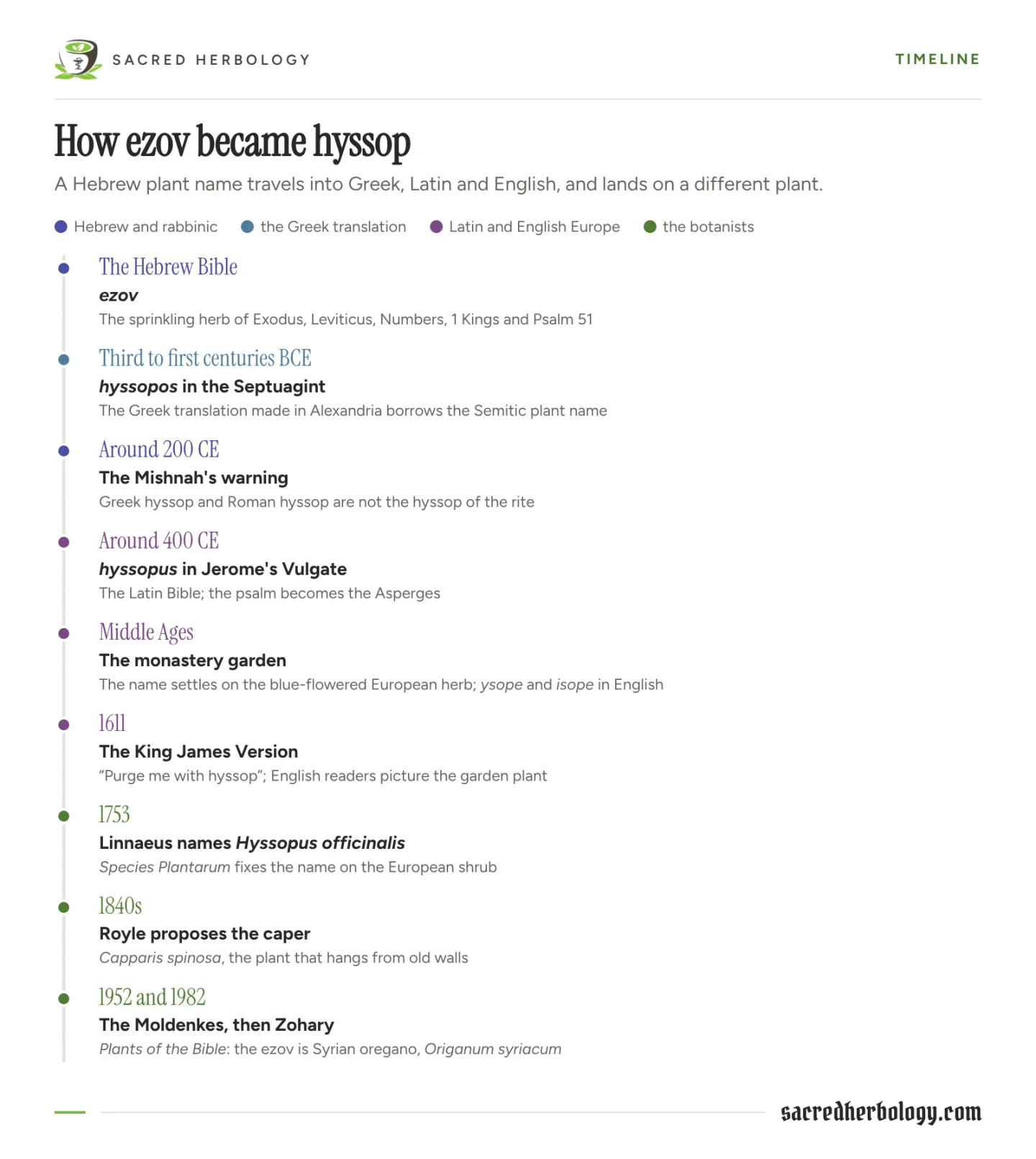
Laid end to end, the word’s journey runs like this: ezov in the Hebrew text; hyssopos in the Septuagint, third to first centuries BCE; the Mishnah’s warnings against Greek and Roman hyssop around 200 CE; hyssopus in Jerome’s Vulgate around 400 CE; the herb of the medieval monastery garden; ysope in English; Linnaeus’s Hyssopus officinalis in 1753; Zohary’s Plants of the Bible in 1982.
Asperges me
For more than a millennium, most European Christians met hyssop through one Latin sentence, sung on Sunday morning.
The Asperges is a short rite of sprinkling with holy water before the principal Mass on Sundays in the Roman Catholic Church. As the priest goes down the church scattering water over the congregation, the choir sings an antiphon taken from Psalm 50 in the Latin numbering: “Asperges me, Domine, hyssopo, et mundabor: lavabis me, et super nivem dealbabor.” Thou shalt sprinkle me, O Lord, with hyssop, and I shall be cleansed; thou shalt wash me, and I shall be made whiter than snow. Then comes the first verse of the same psalm, “Miserere mei, Deus”, have mercy on me, O God. In the season after Easter a different antiphon is sung, the Vidi aquam, “I saw water flowing from the right side of the temple”, taken from the prophet Ezekiel.
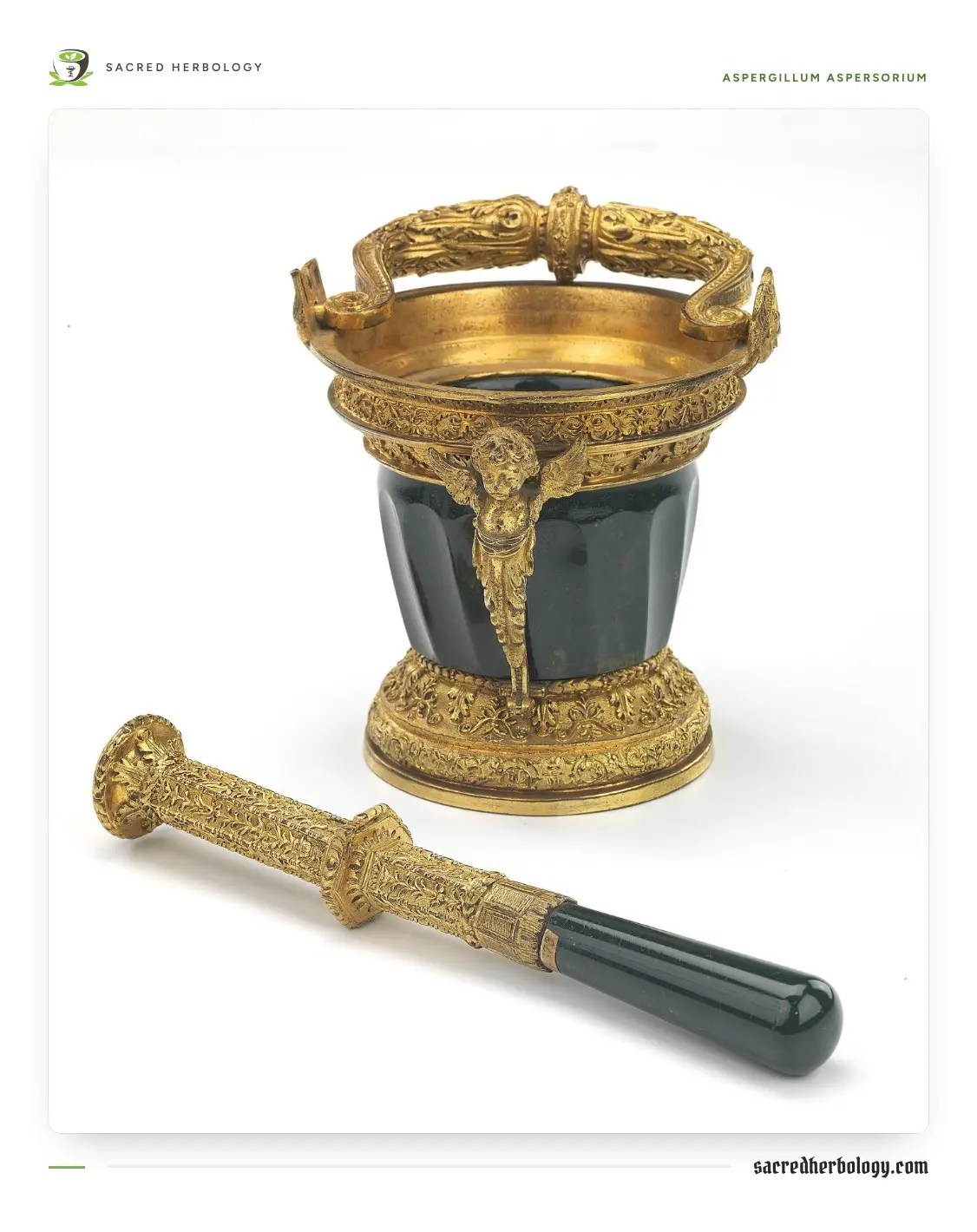
The Latin verb in the antiphon, asperges, gives the rite its name, and it also named the tool. The holy-water sprinkler is the aspergillum. In the early centuries it could be a real bundle of herbs or twigs, and in many places it was literally a bunch of hyssop or of some other green plant. Later it became a short metal or wooden handle ending in a brush or a hollow perforated ball that holds the water. In the old Roman rite for consecrating a new church, the bishop sprinkled the walls with specially blessed water, using a bundle of hyssop, while the psalm was sung. The bishop’s bunch of herbs in that rite is the direct descendant of the priest’s bundle in Leviticus.
The Asperges has had a quieter life since the liturgical reforms after the Second Vatican Council, when the sprinkling became optional and could take place within the Mass itself, but it is still sung in many churches and in the older form of the Roman rite. Eastern Orthodox churches have their own blessings of water, above all at the feast of Theophany in January, when the priest blesses the water and sprinkles the people and their homes with a bunch of basil or other herbs. Those rites draw on the same picture, though they do not necessarily use hyssop.
So the tool and the text belong together: the aspergillum in the priest’s hand, and the “Asperges me” verse in the choir’s book.

Miserere in the Sistine Chapel
Psalm 51 has had more musical settings than almost any other psalm, because it was sung at Lauds in the services called Tenebrae during Holy Week and at the penitential seasons of the year. The most famous by far is the Miserere of Gregorio Allegri, written in the 1630s for the papal choir in the Sistine Chapel. It alternates plainchant verses with verses for two choirs, and over the years the singers embellished it with ornaments, including a famous high soaring line that became its signature.
For more than a century the Vatican guarded the piece. It was sung only in the Sistine Chapel in Holy Week, and copies were not supposed to leave the chapel. In April 1770 the fourteen-year-old Wolfgang Amadeus Mozart was in Rome with his father Leopold. He heard the Miserere at the Sistine Chapel and, as his father wrote home to his mother in a letter of 14 April 1770, wrote it out from memory afterwards. Within a year the music had been published in London by the English music historian Charles Burney, and the secret was out. The story has been embroidered since, but the letter is real.
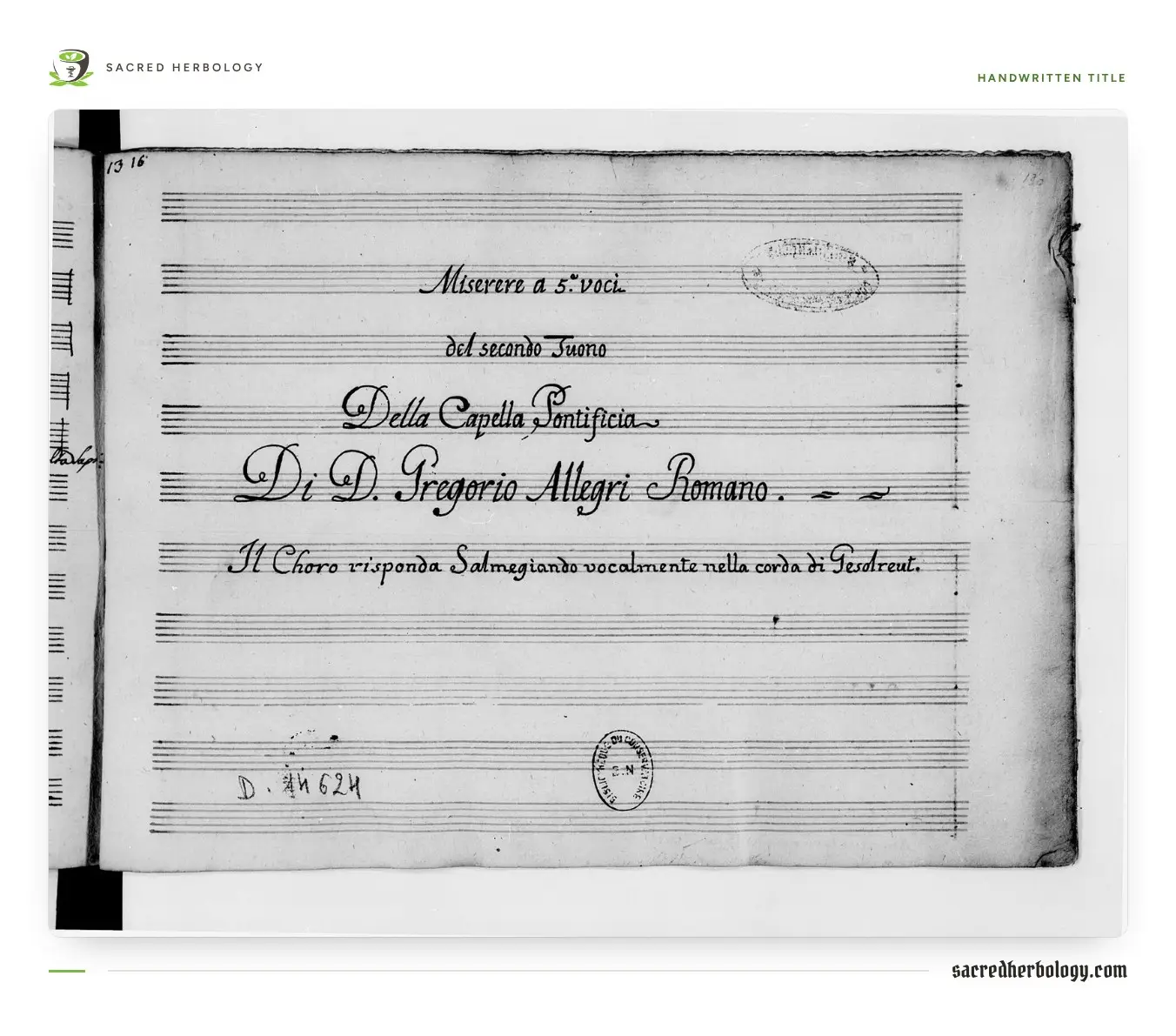

So every time a choir sings Allegri’s Miserere, it sings “Asperges me hyssopo”, a little past halfway through. Millions of people who have never seen a hyssop plant have heard its name sung in one of the best-loved pieces of choral music in the world.
The hyssop of the Art: the Key of Solomon
Now we move from scripture and liturgy into the grimoires, and here the material is ESOTERIC: learned ritual magic, written down in books, copied and recopied by educated practitioners, and claiming authorities it did not have.
The Key of Solomon, the Clavicula Salomonis, is the most famous of the grimoires. Despite its title, it has nothing to do with the historical Solomon. It survives in Latin, Italian, French and other manuscripts, most of them from the sixteenth to eighteenth centuries, and the text differs a good deal from copy to copy. The English version most people know was edited and translated by Samuel Liddell MacGregor Mathers, a founder of the Hermetic Order of the Golden Dawn, and published in London by George Redway in 1889 as The Key of Solomon the King. Mathers worked from several manuscripts in the British Museum and combined them, so his text is an edition of his own making. Joseph H. Peterson has since published a fresh edition with notes on the manuscripts.
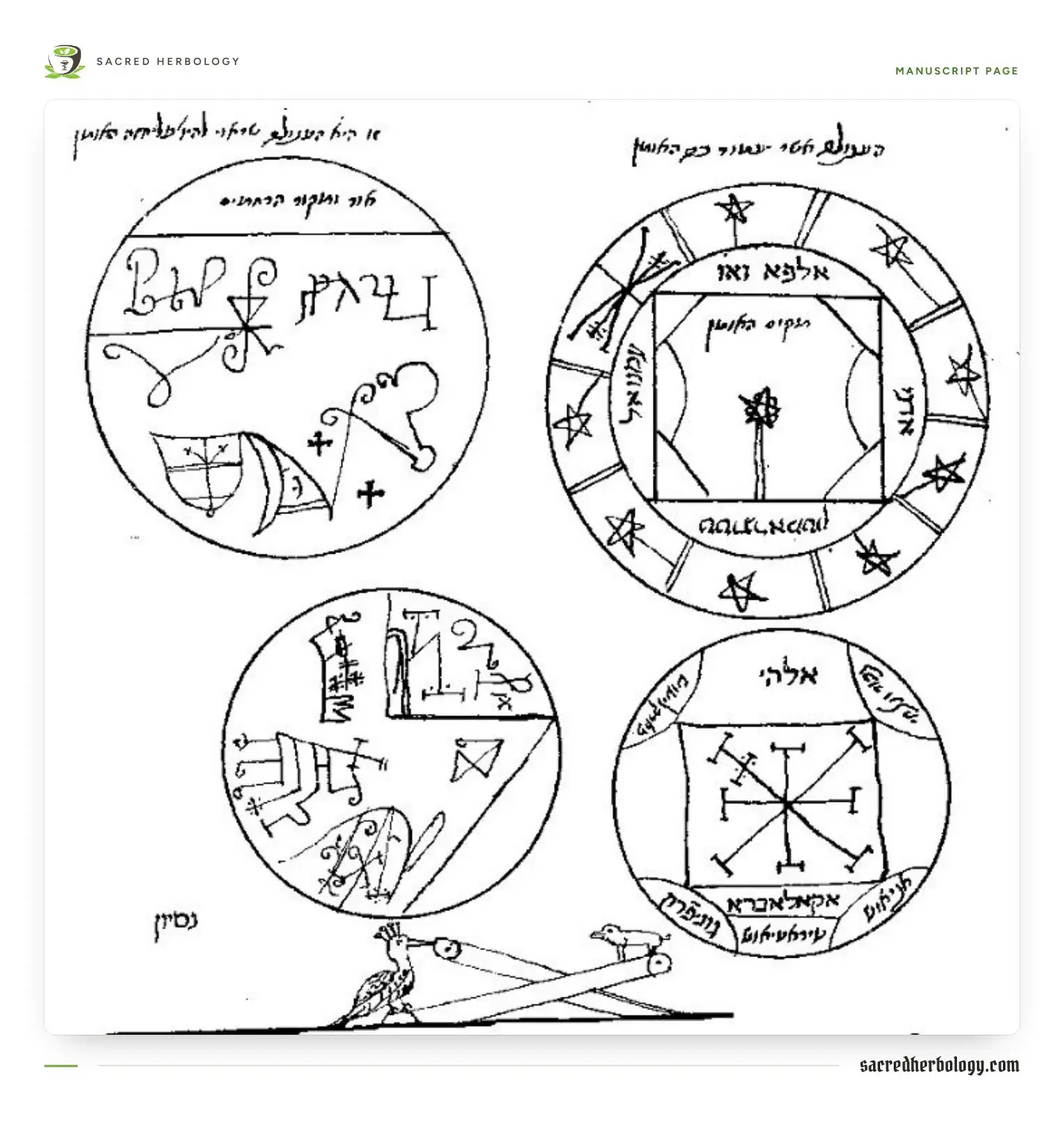

In the Key, the word hyssop is everywhere. The practitioner takes “the water and the hyssop” before the work and says, in Mathers’s English, “Purify me, O Lord, with hyssop, and I shall be pure.” After the ritual bath he says, “Purge me, O Lord, with hyssop, and I shall be clean.” The vestments are sprinkled “with the water and hyssop of the Art”, and the master sprinkles the place of working and the path to it the same way. These lines are taken almost word for word from Psalm 51, by way of the Latin Asperges.
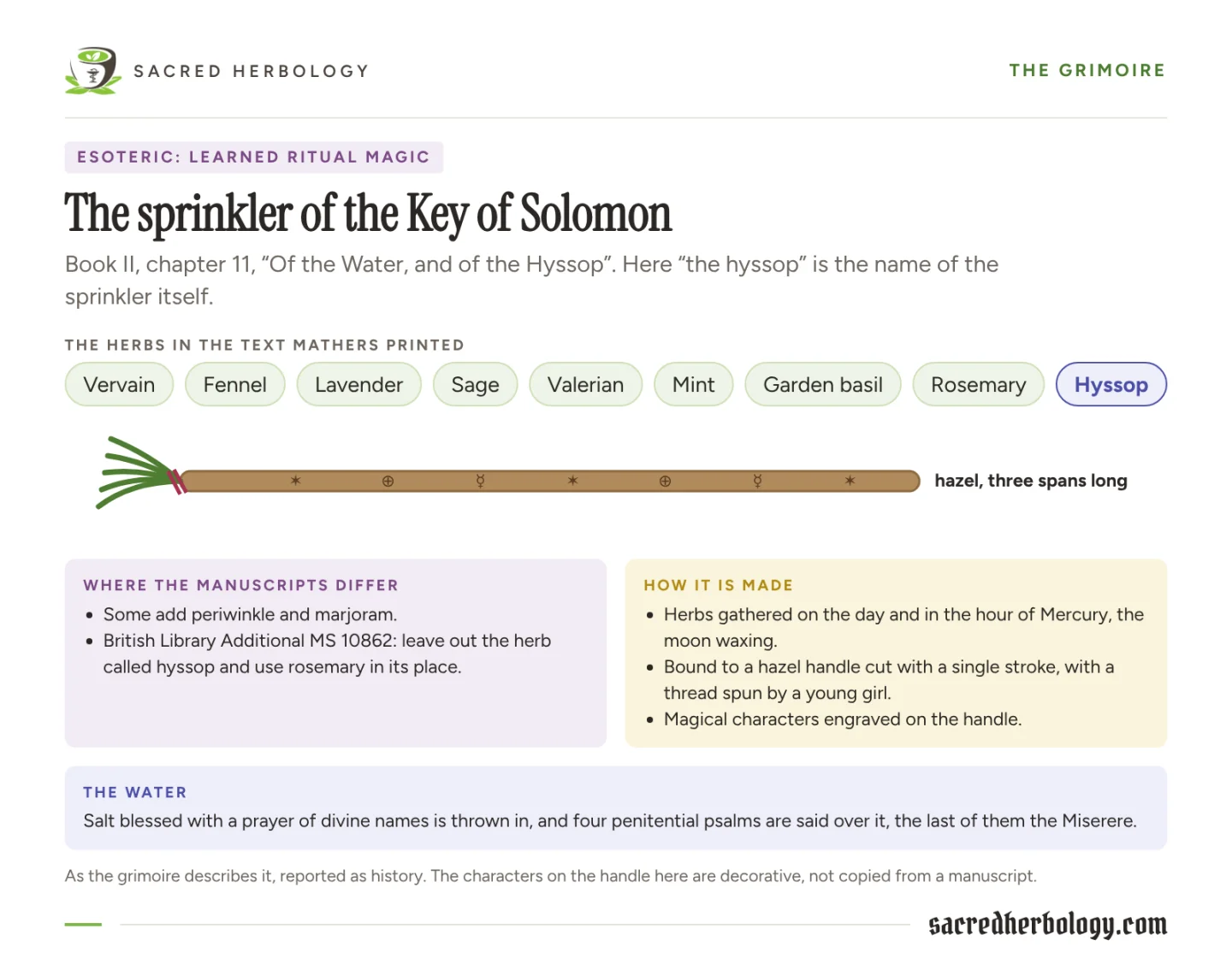
Book II, chapter 11, is headed “Of the Water, and of the Hyssop”, and here the grimoire explains what it means by the word. If anything needs sprinkling, it says, do it with a sprinkler, and it tells the practitioner to make one from a bunch of herbs: in the text Mathers printed, vervain, fennel, lavender, sage, valerian, mint, garden basil and rosemary, with hyssop at the end of the list. The manuscripts do not agree on the list. Some give periwinkle and marjoram among the herbs, and Peterson’s notes record that one British Library manuscript, Additional MS 10862, says plainly to leave out the herb called hyssop and use rosemary in its place. The herbs are to be gathered on the day and in the hour of Mercury with the moon waxing, and bound to a handle of hazel cut with a single stroke, three spans long, with a thread spun by a young girl. Magical characters are engraved on the handle. The salt is blessed with a prayer of divine names and thrown into the water, and four penitential psalms are said over it, the last of them the Miserere.
This is the point to stop and look at. In the grimoire, “the hyssop” has become the name of the sprinkler itself. It is a bundle of the herbs of the Art, which may or may not include the plant called hyssop. Exactly that thing happened in the church, where the aspergillum was called after the hyssop of the psalm even when it was a brass ball on a stick. The Key of Solomon borrowed its purification rite whole from Catholic practice and then wrapped it in its own planetary timing and magical seals. It is a fine example of how the grimoires worked: they took the liturgy their writers knew from church and turned it to their own ends.
Set out as a table, the sprinkler of the Key is easy to follow: the herbs in Mathers’s list, the variants the manuscripts give, and the rules for the hazel handle with its characters.
The Golden Dawn inherited this world through Mathers, and the lustral water and purification by water in its rituals belong to the same family of ideas. Modern ceremonial magicians who work from the Key still make sprinklers of mixed herbs, and many still call the result a hyssop. That practice is ESOTERIC in origin, and its claims about what the water does are the claims of the tradition, not facts.
Psalms, baths and the folk magic of the South
Hyssop has a second life in folk magic, and this one belongs to folk practice: vernacular custom, handed on by people more than by books, though books fed into it.
Hoodoo, also called conjure or rootwork, is a tradition of folk magic that grew up among African Americans in the southern United States, mixing West and Central African practice, European folk magic, Native American plant knowledge and the Protestant Bible. It is a living tradition, and I’ll describe it from published sources only. Catherine Yronwode’s Hoodoo Herb and Root Magic, published in 2002, records hyssop as one of the herbs of spiritual cleansing in hoodoo practice, used in baths and floor washes to take away the sense of sin or of having done wrong, with the reading of Psalm 51. The link is the same one that runs through this whole piece: the psalm names the herb, so the herb carries the psalm.
The hoodoo use of the Psalms for practical ends was shaped in part by a small German book, the Sepher Shimmush Tehillim, printed in German translation by Godfrey Selig in 1788 and later issued in English as Secrets of the Psalms. It gives a use for each psalm, drawn from Jewish magical tradition, and it circulated widely in cheap American editions in the nineteenth and twentieth centuries. That book is a printed text in the learned line, and the hoodoo practice that drew on it is vernacular and folk. The two met in the drugstores and mail-order catalogues of the American South, which is a good example of how the line between book magic and folk magic gets crossed in real life, even when we keep the labels straight.
I mention one practical caution here, since it is a bath. Hyssop is strongly aromatic, and the concentrated oil should never go on the skin undiluted or into bath water neat. More on that in the safety section below.
Culpeper’s Jupiter
The astrological herbals are another learned tradition, and their planetary rulerships belong with the ESOTERIC material, because they rest on the doctrine of correspondences.
Nicholas Culpeper, the London astrologer-physician, gave every plant in his English Physitian of 1652 a planetary ruler. He placed hyssop under Jupiter. In his scheme Jupiter was the warm, moist, generous planet, the great benefic, with rule over the liver and the blood, and its herbs tended to be the large, sweet-smelling, nourishing ones. Hyssop’s place there is interesting, given its sharp, bitter, cleansing character, and Culpeper’s reasons for each rulership are not always spelled out. Note that he gives a separate plant, hedge hyssop, Gratiola officinalis, a completely different and poisonous plant, to Mars. The two are easily confused in modern lists.

Many modern correspondence tables give hyssop to Jupiter, following Culpeper, and many connect it with purification, protection and consecration, following the psalm and the grimoires. Both are traceable to their sources: Jupiter to 1652, purification to the Bible by way of the Key of Solomon. When you see hyssop in a modern table of magical herbs, those are the two lines it usually comes down.
A herb for the knot garden
Back in the garden, the European hyssop has a history of its own that has nothing to do with the Bible at all.
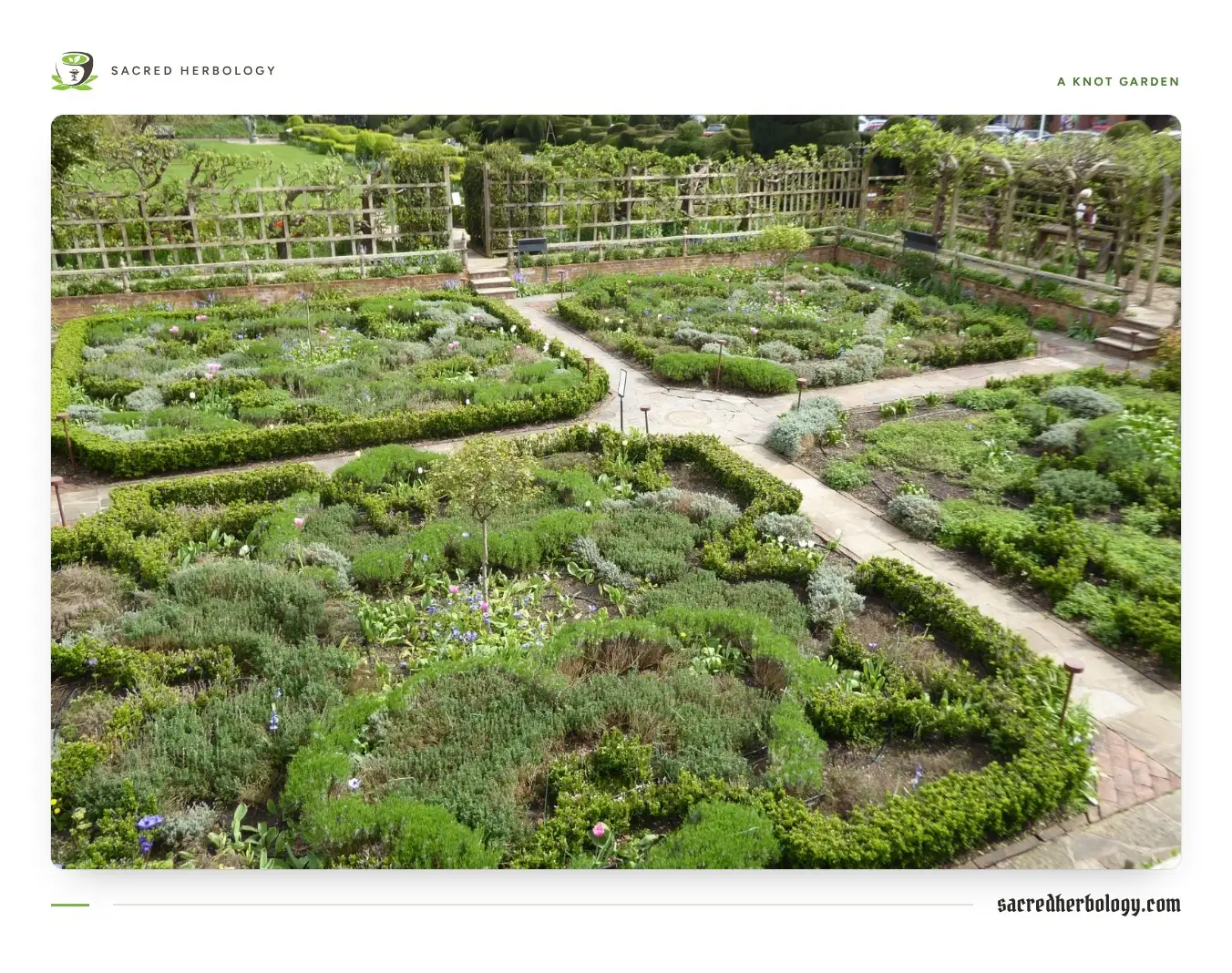
It was a standard plant of the monastery gardens of medieval Europe and turns up in the lists of plants for monastic and royal gardens from the early Middle Ages. By the sixteenth century it had become one of the favourite plants for the low clipped hedges of the knot garden, the intricate patterned beds of Tudor and Elizabethan England. Gardeners set it with thyme, lavender cotton, germander and marjoram to draw the lines of a knot, because it is evergreen in a mild winter, takes clipping well and keeps its shape. John Gerard’s Herball of 1597, the great English herbal of its day, describes several kinds of hyssop grown in English gardens, with blue, white and red flowers, and John Parkinson’s Paradisi in Sole Paradisus Terrestris of 1629 lists it among the garden herbs.
Hyssop was also a strewing herb, cut and scattered on floors to sweeten the air of a house, and it was hung in bunches. That is household custom, and so belongs with folk practice, away from the books. It was a bee plant too. Beekeepers have prized it for centuries, and it is still planted near hives, because its flowers come late in the season and the bees work them hard. A field of hyssop in flower hums.
Picture a knot garden at its height: a square bed laid out in an interlacing pattern of clipped hedges, a line of hyssop in blue flower against the grey of lavender cotton and the dark green of germander.

The other hyssops
Because hyssop was a famous name, it was given to other plants, and a buyer needs to know them apart. Here is the list.
- Hyssopus officinalis, hyssop or common hyssop. Mint family. Southern Europe to Central Asia. The herb of gardens and of hyssop essential oil.
- Origanum syriacum, Syrian oregano, Bible hyssop, za’atar. Mint family. Eastern Mediterranean. The ezov of the Hebrew Bible on the best evidence.
- Agastache foeniculum, anise hyssop or blue giant hyssop. Mint family. North America. Smells of aniseed, a fine bee plant, unrelated to the biblical herb. Other Agastache species are sold as giant hyssops.
- Gratiola officinalis, hedge hyssop. Plantain family. Europe. A different and poisonous plant, given by Culpeper to Mars. Never to be mixed up with the garden herb.
- Bacopa monnieri and its relatives, water hyssop. Plantain family. Wetlands across the tropics and subtropics, Australia included, where it is a native plant. A creeping plant of wet ground, also unrelated.
So “hyssop” on a label can mean any of five quite different plants from two plant families. If you are buying the herb of the psalm, look for Origanum syriacum. If you are buying the blue-flowered garden shrub or its oil, look for Hyssopus officinalis. Always check the binomial.
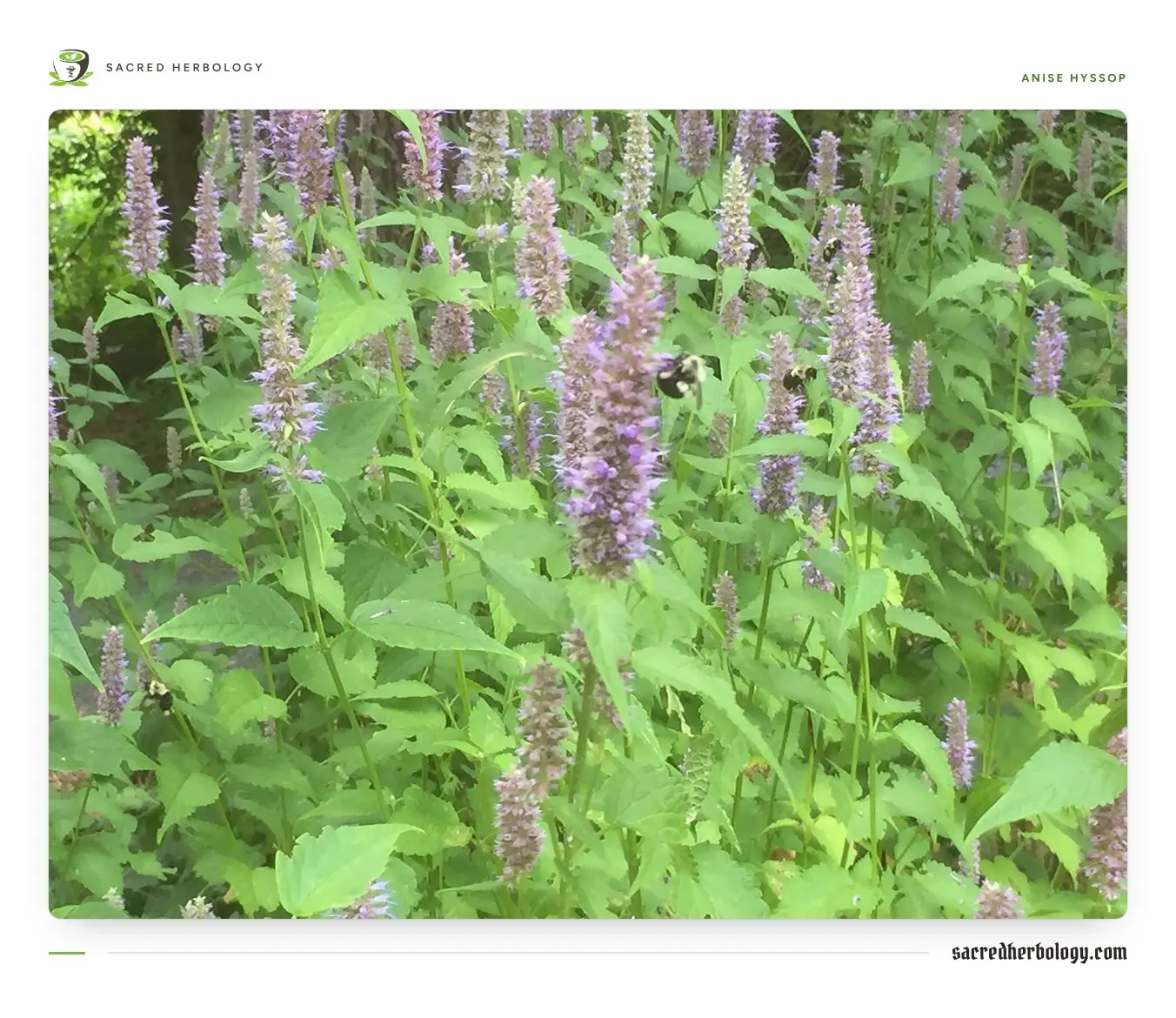

The word za’atar needs the same care in the spice trade. Across the eastern Mediterranean it is a name for several thyme-scented herbs, and dried “za’atar” may be Thymbra spicata, Thymbra capitata (often still sold as Thymus capitatus), Satureja thymbra or a garden thyme instead of Origanum syriacum. The ready-made blend is a mixture in any case, and the share of herb in it varies from one maker to the next. All of these are good kitchen herbs. If you want the plant with the claim to be the ezov, the label has to say Origanum syriacum or Majorana syriaca, and a reputable seller will tell you which plant is in the packet.
What is in the leaf
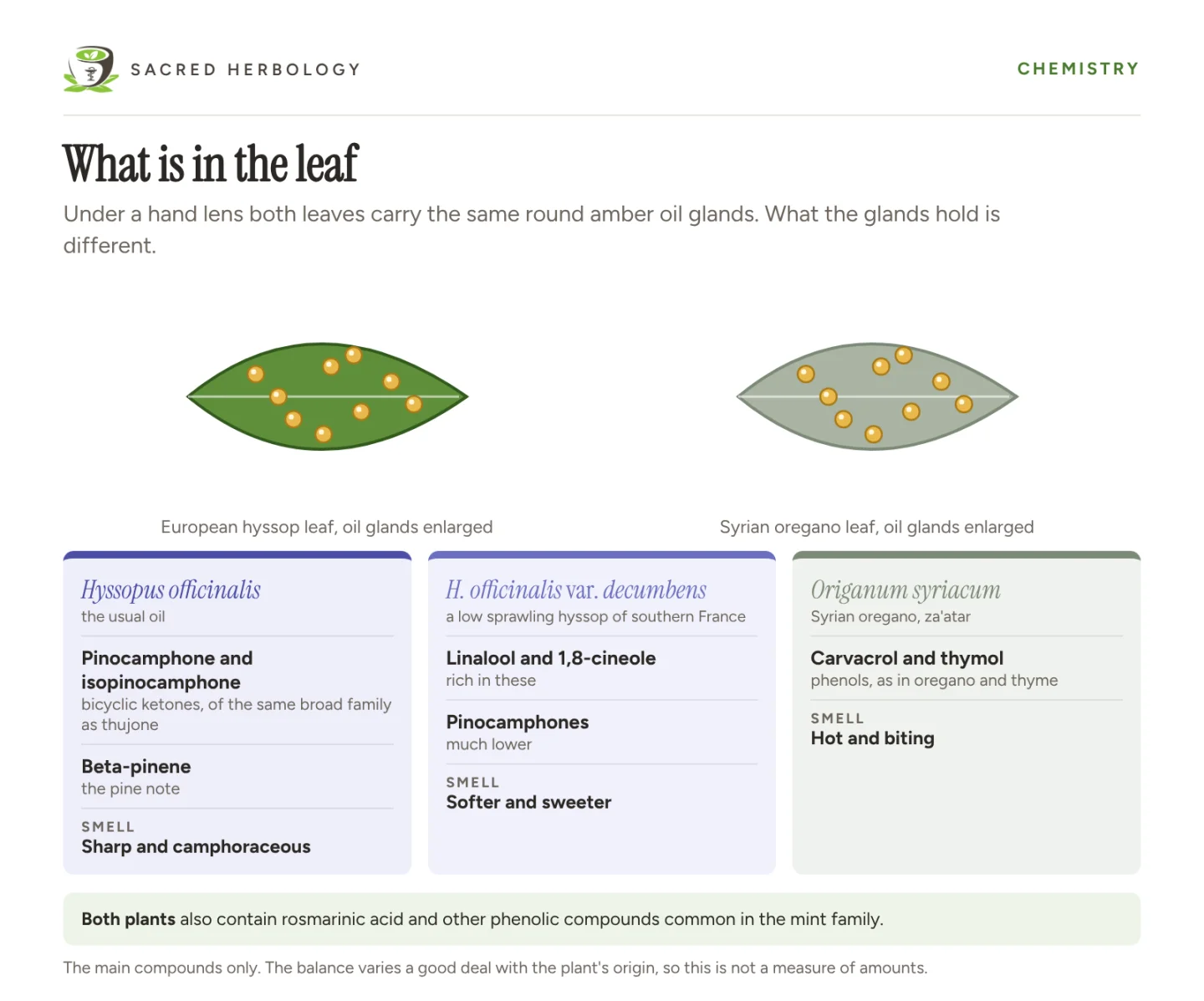
The European hyssop and the Syrian oregano are both mint-family plants, and both owe their smell to volatile oils held in tiny glands on the leaves and flowers. You can see them with a hand lens: little round amber beads sitting on the leaf surface. Their chemistry, though, is quite different.
Hyssopus officinalis oil is usually dominated by two closely related compounds called pinocamphone and isopinocamphone, ketones of the same broad family as the thujone of wormwood and sage. Alongside them come beta-pinene, which gives the pine note, and smaller amounts of other terpenes. The balance varies a good deal with the plant’s origin. One form, often sold as Hyssopus officinalis var. decumbens, a low sprawling hyssop of southern France, gives an oil rich in linalool and 1,8-cineole and low in the pinocamphones, and it smells softer and sweeter.
Origanum syriacum takes a different path. Its oil is dominated by the phenols carvacrol and thymol, the same compounds that give oregano and thyme their hot, biting smell. The hairy leaves are packed with oil glands, which is part of why the dried herb keeps its flavour so well.
Both plants also contain rosmarinic acid and other phenolic compounds common in the mint family. Under the lens the two leaves look alike, each studded with round oil glands, but the glands hold different things: pinocamphone and pinene in the European hyssop, carvacrol and thymol in the Syrian.
A word on the oil in trade. Hyssop oil is a small-volume oil, and like most essential oils it can reach the shelf diluted in a carrier, blended with cheaper oils, or labelled only as “hyssop” with no binomial and no hint of which chemotype is in the bottle. A pinocamphone oil and a linalool oil smell quite different, and you can learn to tell them apart, but the nose cannot measure how much of each compound is present. Only an analysis can do that. A careful supplier will give the full binomial, the part of the plant distilled, the country of origin and a batch analysis by gas chromatography (GC-MS) listing the main constituents. If a seller cannot supply that, you do not know what you are holding.
Hyssop oil and anointing today
This piece sits in the Oil and Anointing section, and hyssop’s place there is a slightly unusual one. In the Bible it is a herb for sprinkling, not for anointing. Its partner in Leviticus 14 is the olive oil that went on the ear, thumb and toe. The holy anointing oil of Exodus 30 does not include it.
In modern practice, though, hyssop essential oil distilled from Hyssopus officinalis has found a place in the anointing oils of several traditions. Ceremonial magicians and modern pagans use it in blends for consecration and purification, following the psalm and the Key of Solomon. Some Christian groups who make their own anointing oils add it for the biblical name. Hoodoo has its own cleansing oils with hyssop. In all of these the oil stands in for the herb of the psalm, even though the oil comes from the European plant and the psalm meant the Syrian one. That is worth knowing, and some careful practitioners now seek out Syrian oregano for anything they mean to be biblical. Neither choice is wrong within a living practice; it is a matter of knowing what you are using and why.
Anointing in these traditions is a matter of a small touch of oil on the skin, on candles, on tools or on doorposts. Hyssop oil is strong, and the safety notes below matter here more than anywhere.
Handling it safely
- Hyssop essential oil is concentrated and potent. It is for the outside only and must never be swallowed. The pinocamphone ketones in ordinary hyssop oil can cause convulsions if taken by mouth, and seizures have been reported in the medical literature after people swallowed it. Keep the bottle closed and well out of reach of children and pets; essential oils are a known cause of poisoning in cats and dogs, so do not diffuse or apply it around them.
- Standard references on essential oil safety, such as Tisserand and Young’s Essential Oil Safety, advise that people with epilepsy or a history of seizures, and women who are pregnant or breastfeeding, should avoid hyssop oil altogether. Keep it away from babies and young children as well. The softer linalool-type oil carries much less of these ketones, but labels are not always reliable, so treat any hyssop oil with the same care.
- Never put the oil on the skin neat. For anointing, a carrier oil and a very light hand are the rule in every tradition that uses it, and some people’s skin will react even then. Test it on a small patch first and stop if it stings or reddens.
- Keep hyssop oil out of bath water unless it has first been mixed into a carrier; essential oils do not dissolve in water and float on the surface in concentrated drops.
- The dried herb of either plant is much milder than the oil, though the European herb still carries some of the same ketones. Hyssop smoke is harsh and can irritate the airways, so burn it only with a window open, never leave it smouldering unattended, and keep the smoke away from babies, children, pets, and anyone pregnant or with asthma or a chest condition.
- Mint-family plants can bring on rashes in people with sensitive skin. Wear gloves when cutting large amounts if you know you react.
If you are thinking of using hyssop in any way that involves the body, consult a degree-qualified herbalist with competencies and adequate training in pharmacognosy. In an emergency, call 000 or the Poisons Information Centre on 13 11 26.
Growing the two hyssops
Both plants are Mediterranean shrubs of dry, sunny, stony ground, and they want the same things: sun, heat, sharp drainage and air moving round them.
European hyssop is easy where those needs are met. Give it full sun and a light, gritty, free-draining soil; it is happy in poor, stony, limestone ground and does not want rich feeding, which makes it soft and floppy and dulls the scent. It tolerates frost well and is hardy in cold winters. What it hates is wet feet and a long humid summer. In heavy clay, or where the air stays muggy and the ground stays wet, it tends to rot at the base, sulk and die out in a season or two. The answer in those conditions is a raised bed, a rockery or a large terracotta pot with plenty of grit and sand, kept on the dry side, in the sunniest spot you have and with space around it for air.
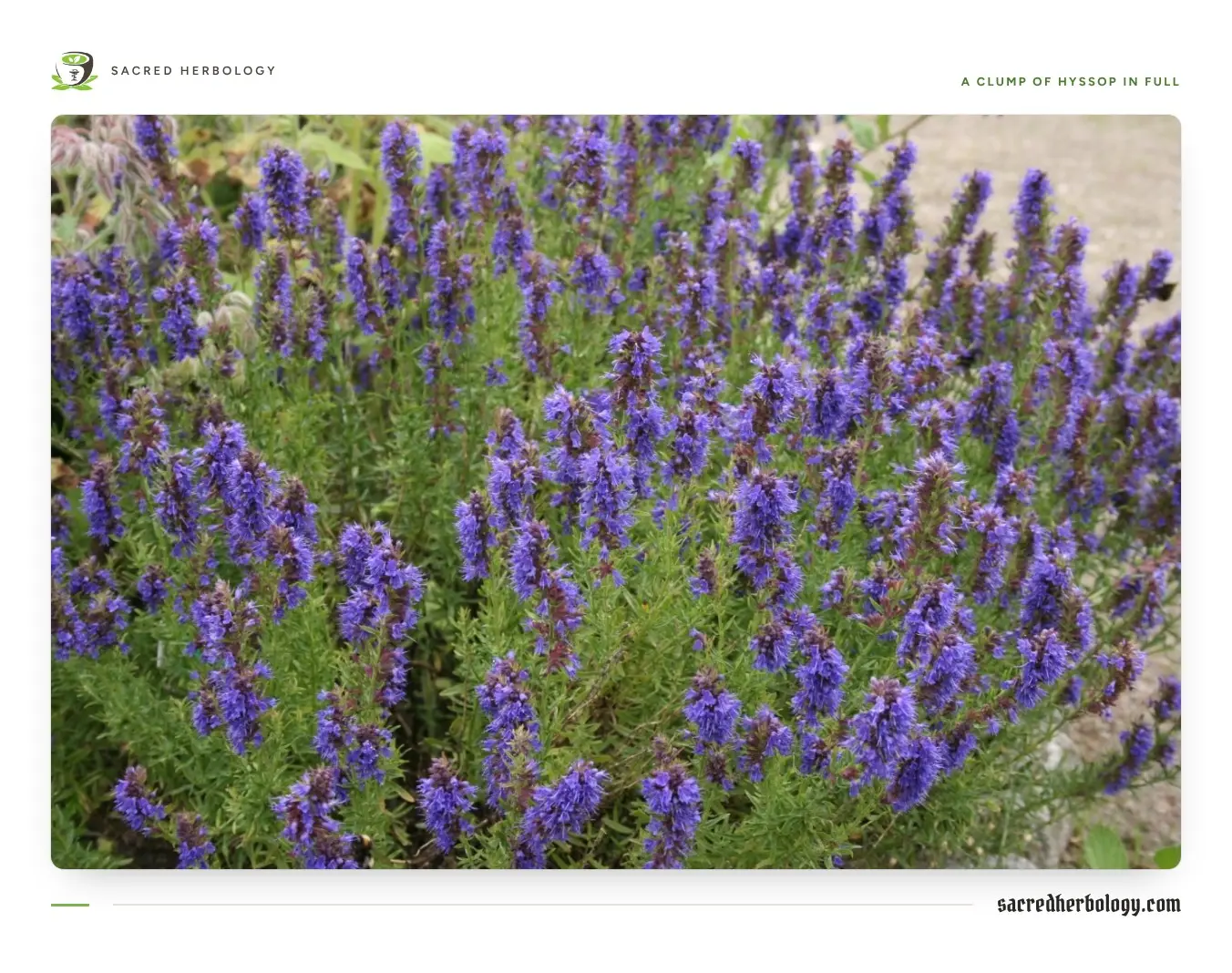

Hyssop grows readily from seed, sown shallowly, and from soft cuttings taken in late spring. It flowers through the warm months. Clip it lightly after flowering to keep it bushy, and cut it back harder in spring to stop it getting woody and bare in the middle. Even with care it is a short-lived shrub, often good for four or five years, so it pays to keep a few cuttings coming on. Grown as a low hedge it is a pleasure: blue in flower, buzzing with bees, and fragrant every time you brush past.
Origanum syriacum wants much the same treatment, perhaps even more strongly. It is a plant of hot, dry, rocky hillsides and old walls, and it dislikes wet, cold soil and humidity more than European hyssop does. Grow it in a pot or a raised bed of very free-draining gritty mix, in full sun, and water sparingly once established. It can be raised from seed, which is very fine and should be pressed onto the surface, or from cuttings. Seed and plants are sold by specialist herb nurseries, usually as Syrian oregano, za’atar or Origanum syriacum. In a frosty climate it needs shelter in winter.
As always, buy seed and plants through legal channels. Bringing seed into Australia is controlled by the federal Biosecurity Act 2015 and its import conditions, so buy from an Australian supplier rather than bringing seed in yourself.
The bundle on the hillside
Go back to the beginning of the story and stand on a dry hillside at evening, somewhere in the hills of the eastern Mediterranean, with the grey woolly za’atar growing between the stones. Someone bends down and breaks off a handful of stalks, three of them perhaps, with their buds, and ties them together. That small act, done in Exodus at the first Passover, in Leviticus at the edge of the camp, at the burning of the red heifer, stands at the root of a whole chain of rites.
The bundle became a verse of a psalm. The psalm became an antiphon sung every Sunday in Latin. The antiphon named the sprinkler. The sprinkler went into the grimoires as “the hyssop of the Art”. The name travelled north and settled on a blue-flowered European shrub that never grew on those hills, and that shrub went into Tudor knots, beehives, bottles of essential oil and modern anointing blends. Meanwhile the Syrian oregano carried on growing in the walls, picked by families for their bread and their oil and their spice mixes, as it always had.
If you have both plants in pots side by side, you have the whole story in front of you: the plant the psalm meant and the plant the world learned to call by its name. Pick a sprig of each and smell them. One is the sharp, camphoraceous herb of the knot garden and the oil bottle. The other is the hot, peppery, woolly herb of the hillside and the doorpost. Both have been called hyssop, and both have been handled, for very different reasons, by people asking to be made clean.
Where this comes from
- The Holy Bible, Authorized (King James) Version (1611): Exodus 12:21-23; Leviticus 14; Numbers 19; 1 Kings 4:33; Psalm 51; John 19:28-30; Hebrews 9:19.
- Biblia Sacra iuxta Vulgatam Versionem, ed. Robert Weber, 5th edn, ed. Roger Gryson (Deutsche Bibelgesellschaft, 2007), Psalm 50.
- The Mishnah, trans. Herbert Danby (Oxford University Press, 1933), tractates Parah 11 and Negaim 14.
- Michael Zohary, Plants of the Bible (Cambridge University Press, 1982).
- Harold N. Moldenke and Alma L. Moldenke, Plants of the Bible (Chronica Botanica, 1952).
- Bruce M. Metzger, A Textual Commentary on the Greek New Testament, 2nd edn (Deutsche Bibelgesellschaft / United Bible Societies, 1994), on John 19:29.
- Carl Linnaeus, Species Plantarum (Stockholm, 1753).
- S. L. MacGregor Mathers, ed. and trans., The Key of Solomon the King (Clavicula Salomonis) (George Redway, London, 1889); Joseph H. Peterson, ed., The Key of Solomon, online edition with manuscript notes (Esoteric Archives).
- Nicholas Culpeper, The English Physitian (London, 1652).
- John Gerard, The Herball or Generall Historie of Plantes (London, 1597).
- John Parkinson, Paradisi in Sole Paradisus Terrestris (London, 1629).
- Emily Anderson, ed. and trans., The Letters of Mozart and His Family, 3rd edn (Macmillan, 1985), Leopold Mozart’s letter of 14 April 1770.
- Catherine Yronwode, Hoodoo Herb and Root Magic (Lucky Mojo Curio Company, 2002).
- Godfrey Selig, trans., Sepher Schimmusch Tehillim (1788); English editions as Secrets of the Psalms.
- Robert Tisserand and Rodney Young, Essential Oil Safety, 2nd edn (Churchill Livingstone, 2014).