
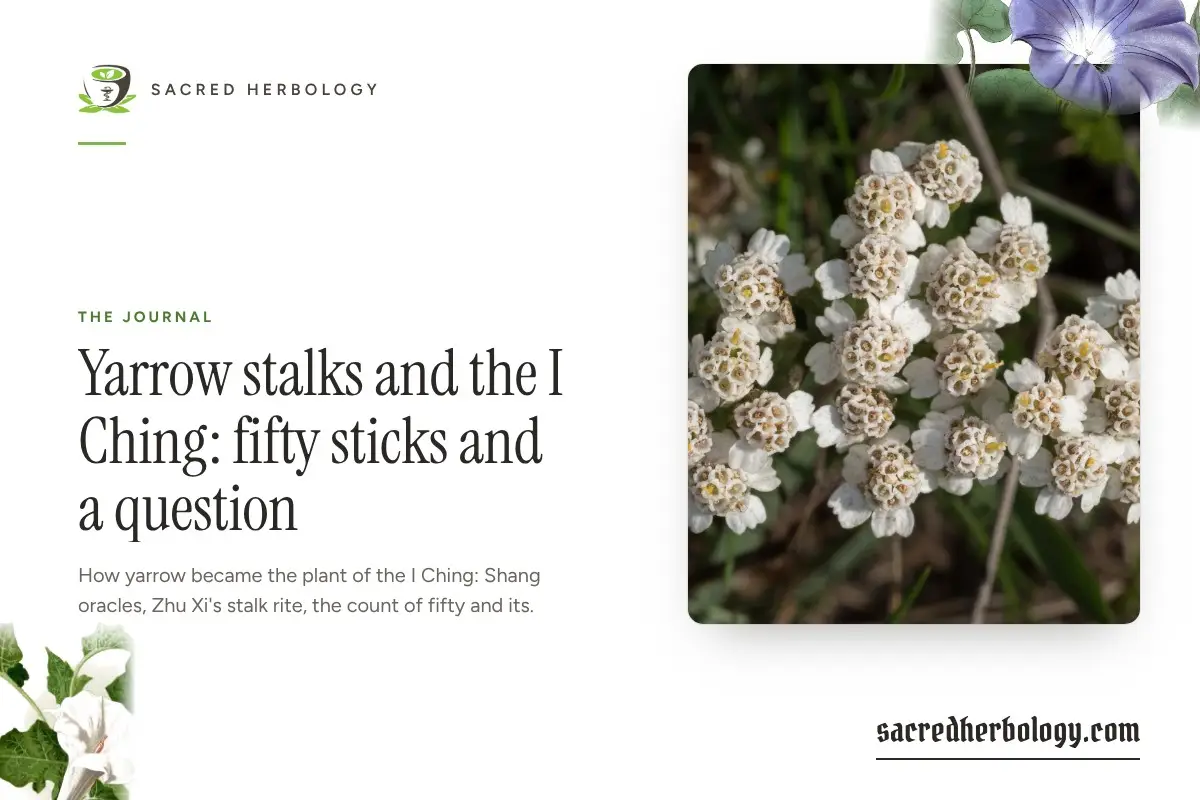
Pick a yarrow stem in late summer, after the flowers have gone brown, and run it through your fingers. It is thin, straight, ribbed and surprisingly stiff for a weed. Dry a bundle of them in the shade, trim them to the same length, and you have a set of counting sticks that will last for years. People in China were doing exactly that, with a native plant they called shi, most probably a yarrow of their own, before the Book of Changes was a book at all.
Most of the Western world meets the I Ching, the Yijing or Book of Changes, through three coins thrown on a table. The older way is slower. You sit down with fifty dried stalks, put one aside, and divide and count the other forty-nine in fours, again and again, eighteen times over, until six lines have built themselves into one of sixty-four figures. It takes the best part of half an hour. Nobody who has done it forgets the feel of it: the dry rattle of the stalks, the small piles between the fingers, the quiet of the room.
This piece is about how a roadside plant ended up in the hands of everyone who consults one of the oldest books in the world. It starts with the plant itself, and with Achilles, who gave it its Latin name. Then it goes east to the Shang and Zhou kings, the tortoise and the stalk, the long argument over which oracle was better, and the Great Commentary that sets out the count. It follows the method through Zhu Xi’s little divination room in the twelfth century, across to Leibniz and his binary numbers, into the hands of Richard Wilhelm and Carl Jung, and out the other side into a twentieth-century novel, a piece of piano music and Aleister Crowley’s notebooks. Along the way it stops in the English and Scottish countryside, where yarrow had a quieter divining life of its own.
The Book of Changes is learned literature with a long commentary tradition, and its divination belongs to that learned world. In this Journal that puts it under The Old Books, with the esoteric material. The English and Gaelic yarrow customs further down are village practice, country custom handed down by ordinary people, and I keep the two apart. And as always, I describe what these traditions hold. Whether the stalks know anything is a question each reader answers for themselves.
Which plant are we talking about
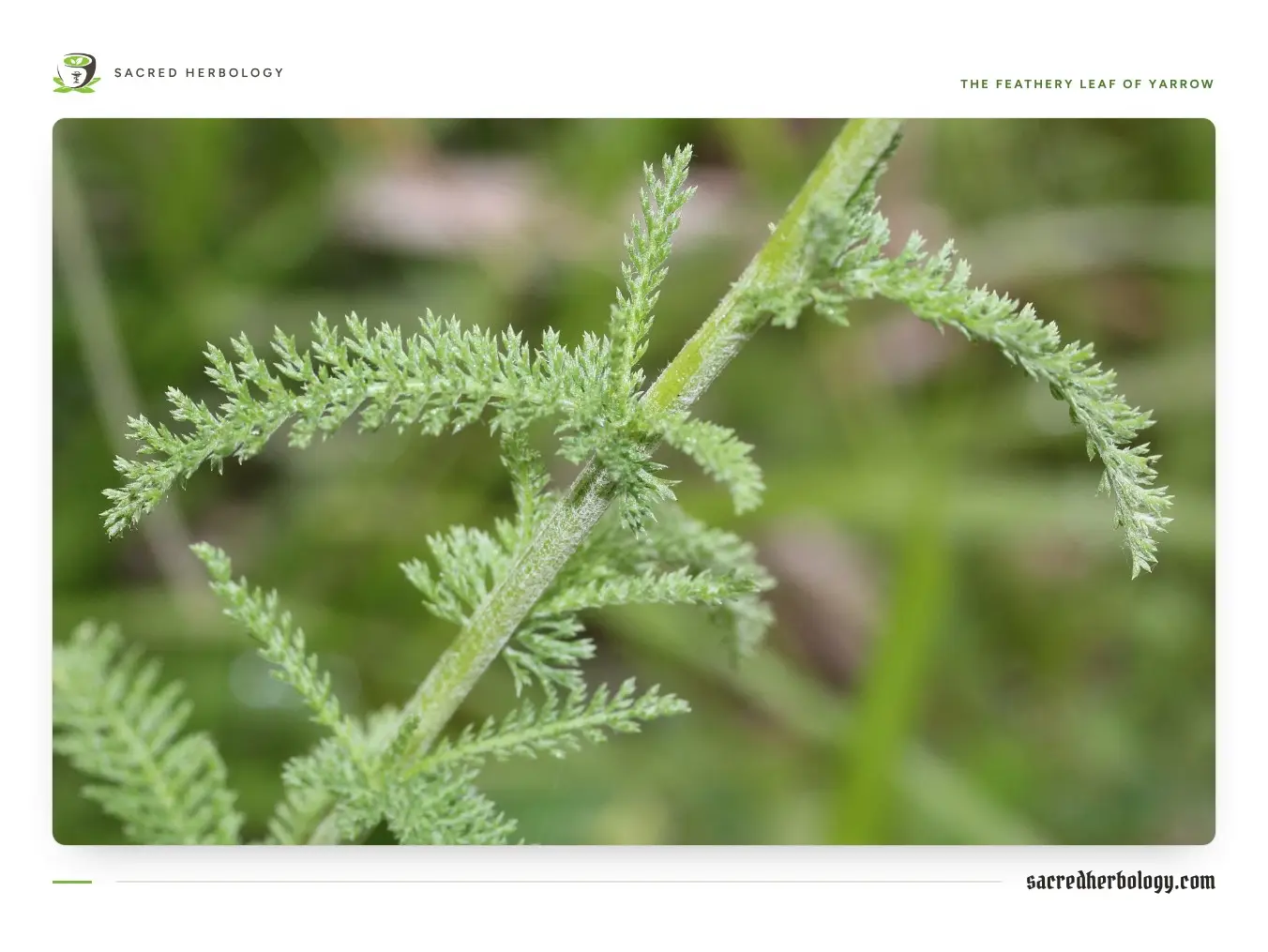
Yarrow is Achillea millefolium, a member of the daisy family, the Asteraceae. It is a low perennial that spreads by creeping underground stems and sends up flowering shoots anywhere from a hand’s breadth to knee high. The leaves are the giveaway. They are long and narrow and cut so finely, again and again, that they look like soft green feathers or the fronds of a fern. The species name millefolium means “thousand-leaved”, and the old English name “milfoil” is the same idea in French dress.

The flower heads look like single flowers but are not. Each flat-topped cluster, the botanist’s corymb, is made up of dozens of tiny daisy heads packed together, each with a handful of short white or pinkish ray florets around a yellowish centre. The smell of a crushed leaf is sharp, bitter and green, with something of chamomile and something of camphor in it.
From a distance those flat white heads can be mistaken for the carrot family, and in southern Australia that includes hemlock, which grows wild on the same roadsides. Look closely. A yarrow head is a packed cushion of tiny daisies; a carrot-family head is a spray of five-petalled flowers on stalks that spread like the ribs of an umbrella. Hemlock also stands much taller, on a smooth, hollow stem blotched with purple, and smells musty when bruised. Hemlock is poisonous in every part, so if you are unsure of a plant, leave it where it is.
The plant is native across Europe and temperate Asia, from Britain and Spain eastward, and North America has native populations of its own that most botanists treat as the same species or a very close relative. It has followed farmers and gardeners around the world. In Australia it is an introduced plant, now naturalised in every state and in the ACT, though not in the Northern Territory, mostly in the cooler south-east and the high country, along roadsides, in old pasture and on disturbed ground. Garden centres sell it in reds, pinks and apricots, most of them garden cultivars and hybrids; the tall golden-yellow yarrows are usually a different species, Achillea filipendulina.
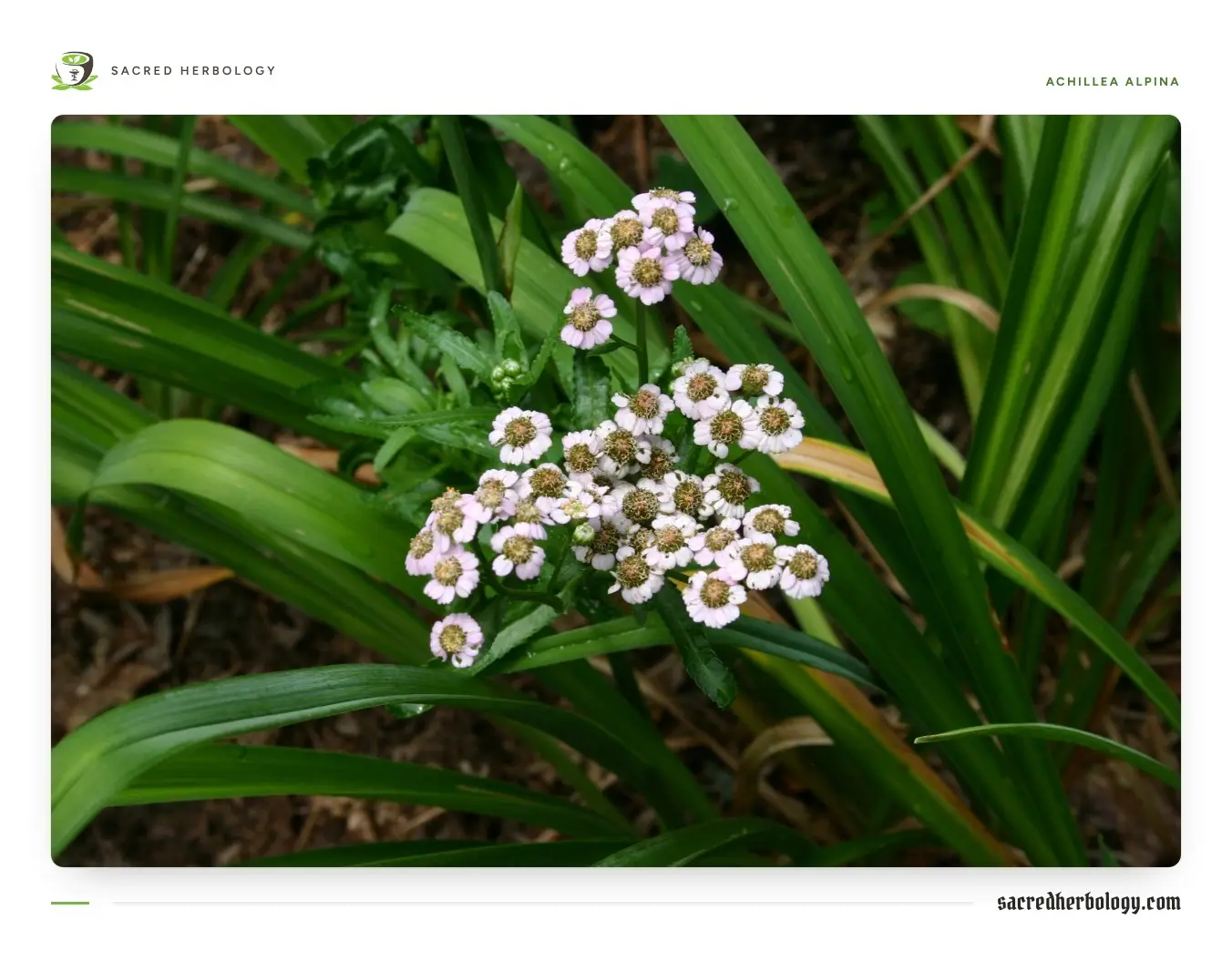
Here is the first thing worth knowing about the I Ching stalks. The Chinese plant, called shi (蓍), was most probably a native Asian yarrow and not our European Achillea millefolium. Botanists most often equate it with Achillea alpina, a yarrow native from Siberia through Mongolia and northern China to Korea and Japan, sometimes still listed under its synonym Achillea sibirica. Nobody can check a plant from three thousand years ago against a herbarium sheet, so this is the best match, and a provisional one. Achillea alpina has narrower leaves than our yarrow, toothed or comb-like instead of finely feathered, but the same long, straight flowering stems. The English word “yarrow” became attached to the I Ching through Western translators, who needed a name for shi and reached for the nearest European plant. They were close enough. It is the same genus, the same kind of stem, and the same habit of growing in tufts with many stalks from one root.

That last habit matters. A good, old clump of yarrow throws up a crowd of stalks from a single crown. The Chinese noticed it, and built a legend on it.
Achilles and the wounded
Before we go east, the Latin name. Linnaeus called the genus Achillea in his Species Plantarum of 1753, and he took the name from a story already old in the first century.
In the Iliad, book 11, the wounded Greek fighter Eurypylus limps back from the battle with an arrow in his thigh and asks Patroclus to cut it out, wash the wound and lay on the soothing remedies that Achilles had taught him, which Achilles had learned in turn from Chiron, the wise centaur. Patroclus does so, and crushes a bitter root over the wound. Homer never names the plant.
Pliny the Elder, writing in the 70s CE, fills the gap. In book 25 of his Natural History he says that Achilles, the pupil of Chiron, found a plant for healing wounds which was called achilleos after him. Pliny admits that others told the story differently, and in the same work he also repeats the tale that Achilles healed the hero Telephus with scrapings from the spear that had wounded him, called aerugo, verdigris, in one passage and rust in another, a scene the Greeks painted on vases and carved in relief. Which plant Pliny and the Greek herbalist Dioscorides meant by achilleos is still argued over. It may have been a yarrow, or one of several related plants of the eastern Mediterranean.
What survives is the pairing of yarrow with soldiers and blades. English country names include soldier’s woundwort and knight’s milfoil, and the French called it herbe aux charpentiers, the carpenters’ herb, for the trade that cuts itself most often. Those names record old belief and old use. I report them as history, and I make no claims for the plant here.
A yarrow in a Neanderthal grave
Yarrow turns up in one of the most famous and most argued-over finds in archaeology.
In the late 1950s and early 1960s the American archaeologist Ralph Solecki excavated Shanidar Cave in the Zagros Mountains of northern Iraq, in what is now the Kurdistan Region. Among the Neanderthal remains was a skeleton he called Shanidar IV. Soil samples from around the body went to the French palynologist Arlette Leroi-Gourhan, who reported in the journal Science in 1975 that she had found clumps of pollen from several flowering plants, among them a yarrow type, along with grape hyacinth, groundsel, a hollyhock relative and ephedra. Because some of the pollen lay in clusters, as though whole flowers had decayed there, she and Solecki proposed that the dead had been laid on a bed of spring flowers. Solecki called his 1971 book Shanidar: The First Flower People.
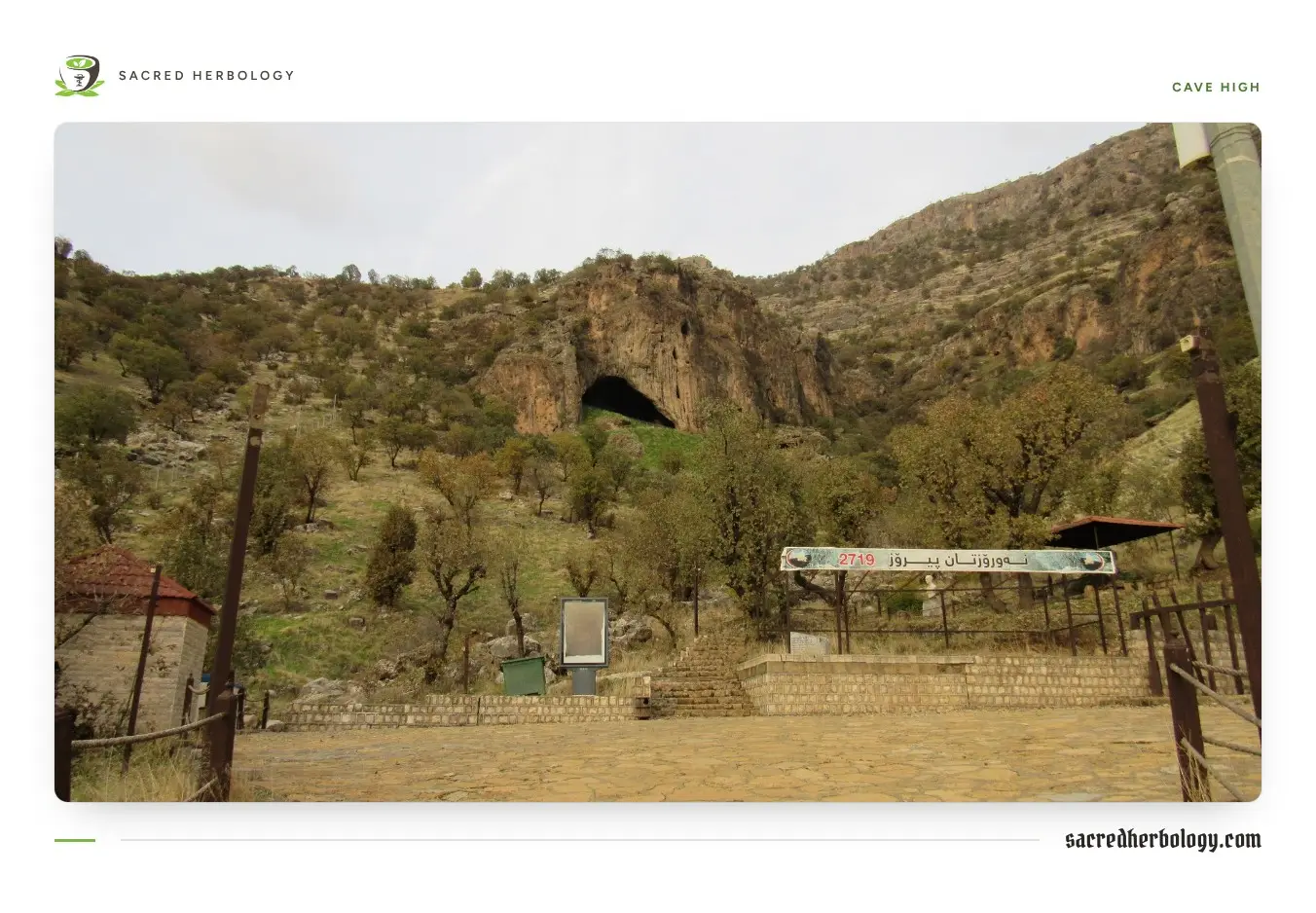

The story caught the imagination of the world. It also drew strong criticism. In 1999 Jeffrey Sommer pointed out that a small burrowing rodent of the region, the Persian jird, stores flower heads and seeds in its burrows, and that the cave floor was riddled with them. A jird could have brought the flowers. New excavations at Shanidar since 2015 have reopened the question, and it remains open.
So the honest answer is that yarrow pollen lay near a Neanderthal body about sixty thousand years ago, and nobody can yet say for sure how it got there. That is the oldest place yarrow appears in the human record. It is a picture that stays with you: a dark cave, a body on its side, and a scatter of small white flowers that may or may not have been put there by grieving hands.
The tortoise and the stalk
Now to China, and to the two oldest oracles of the Chinese world.
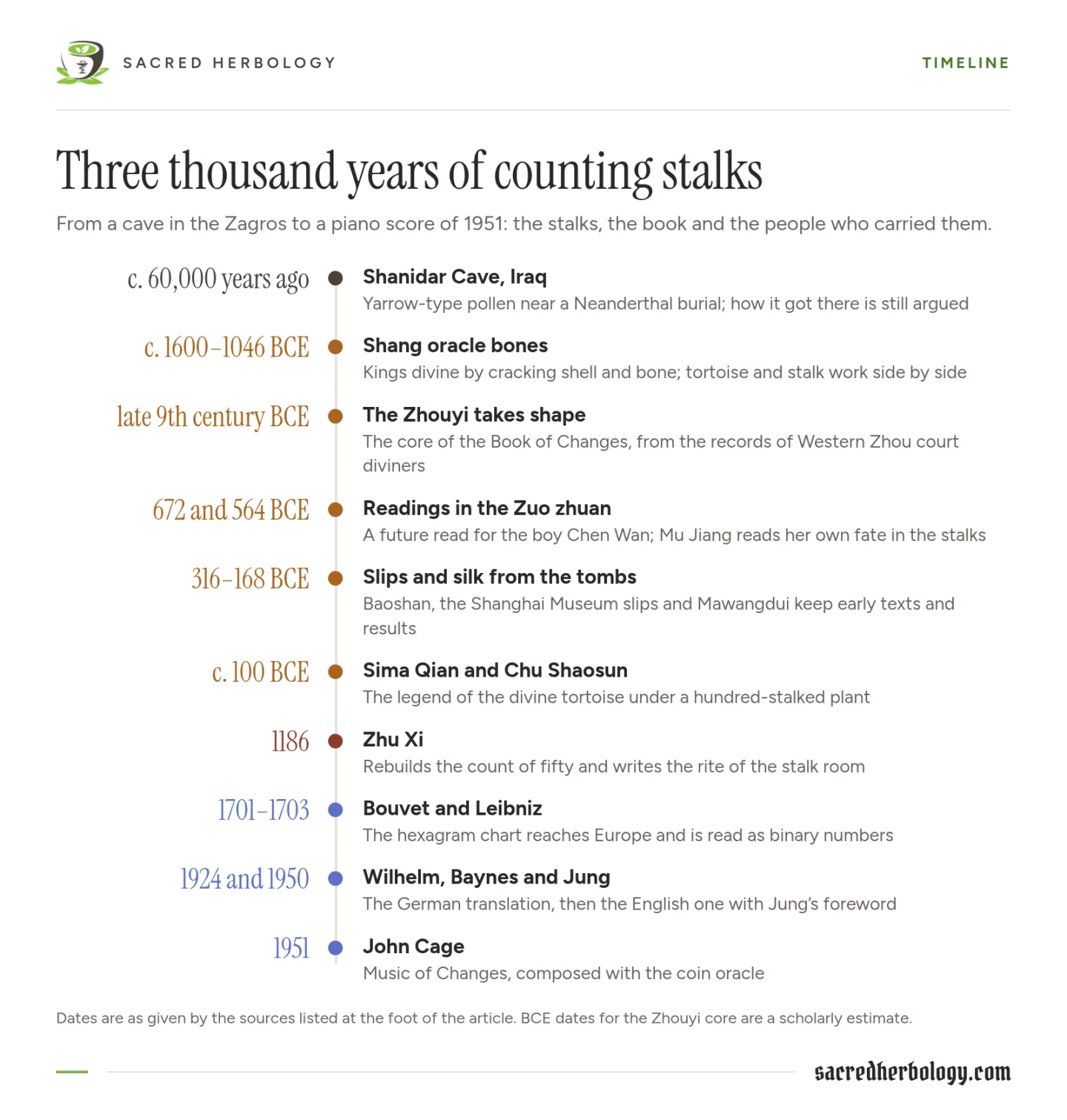
The kings of the Shang dynasty, who ruled in the Yellow River valley from about 1600 to 1046 BCE, consulted their ancestors and gods by fire. Diviners prepared the flat undershells of tortoises and the shoulder blades of cattle, drilled hollows into the back, and applied a hot point until the bone cracked with a sharp sound. The shape of the crack gave the answer. Afterwards scribes often carved the question, and sometimes the result, into the bone itself. Over a hundred and fifty thousand pieces of these “oracle bones” have been dug up, mostly from around the last Shang capital near Anyang in Henan, and they are the earliest substantial body of Chinese writing.
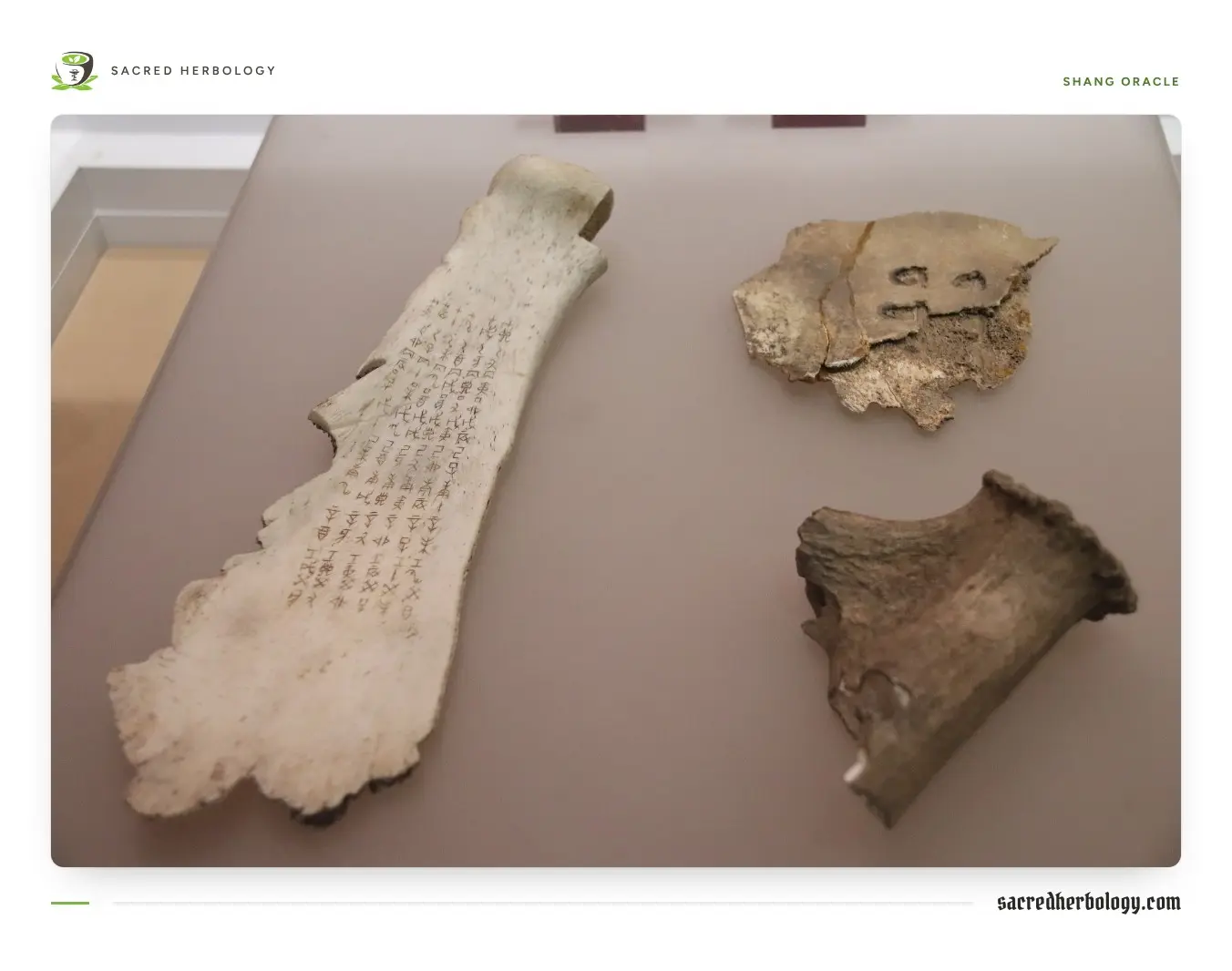

Alongside the tortoise there was the stalk. The Chinese term for the pair, bu shi (卜筮), means “tortoise divination and stalk divination”, and the character for the second kind, shi (筮), has the bamboo radical on top, the sign of something made of stalks or slips. The name of the plant itself, shi (蓍), is written with the grass radical instead: the same sound, one character for the plant and another for the act of counting it. The two were used together for centuries. The tortoise was the senior partner, slower, costlier and more solemn. The stalks were quicker and could be done anywhere.
The Book of Documents (Shangshu), one of the oldest Chinese classics, preserves a chapter called the “Great Plan” (Hong fan) which sets out how a ruler should settle a doubtful matter. He consults his own heart, his ministers, the common people, the tortoise and the stalks, and weighs the five answers against each other. If the tortoise and the stalks agree with him, the matter is fortunate even if the people disagree. If the tortoise and the stalks both go against him, he should stay still. The two oracles are counted as two separate voices in the same council.
They did not always agree, and when they did not, people argued about which to trust. The Zuo zhuan, the great chronicle-commentary on the history of the state of Lu, records under the year 656 BCE that Duke Xian of Jin wanted to make the lady Li Ji his principal wife. The tortoise said no. The stalks said yes. The duke said he would follow the stalks. His diviner answered with a line that later writers quoted for two thousand years: “The stalks are short and the tortoise is long. Better to follow the long.” The duke ignored him, and the Zuo zhuan goes on to record the disasters that followed in his house.
Those are the bones of the matter. The stalk oracle was old, respected, and slightly junior. By the end of the Zhou dynasty the tortoise had faded, and the stalks, with the book that went with them, had the field to themselves.
The divine tortoise under the yarrow
The two oracles were tied together in legend as well as practice. The clearest telling is in the Shiji, the Records of the Grand Historian, the great history of China compiled by Sima Qian around 100 BCE. Chapter 128 is the “Biographies of the Tortoise and Stalk Diviners”. Much of what survives of that chapter was added a few decades later by the scholar Chu Shaosun, who filled the gaps in Sima Qian’s manuscript with what he could collect about diviners and their lore.
Chu Shaosun passes on a belief he says he heard: that when a shi plant has lived a thousand years it sends up a hundred stalks from a single root; that where a shi plant grows a full hundred stalks, there will always be a divine tortoise guarding it underneath; and that above it there will always be a green cloud. He adds that such plants could no longer be found in his day, and that diviners made do with sets of sixty stalks or more, as long as they were long enough.
It is one of the loveliest images in Chinese plant lore and an easy one to picture: a great clump of grey-green yarrow, a hundred straight stalks fanning out from one crown, a tortoise asleep in the earth among the roots, and a little green cloud hanging overhead. The two oracles, plant and animal, live in the same spot. That is legend, recorded as legend by the man who wrote it down, and I pass it on in the same spirit.
Real places took up the theme. At Huaiyang in Henan, the traditional burial place of Fuxi, the mythical sage said to have first drawn the eight trigrams, there has long been a temple complex, and visitors are shown a garden of shi plants growing there. Yarrow was also said to grow at the grave of Confucius in Qufu. Those are local traditions attached to sacred sites, the Chinese equivalent of a holy well, and they tell you how closely the plant and the book had become bound together.
The book that the stalks serve
The Book of Changes is two things stacked on top of each other.
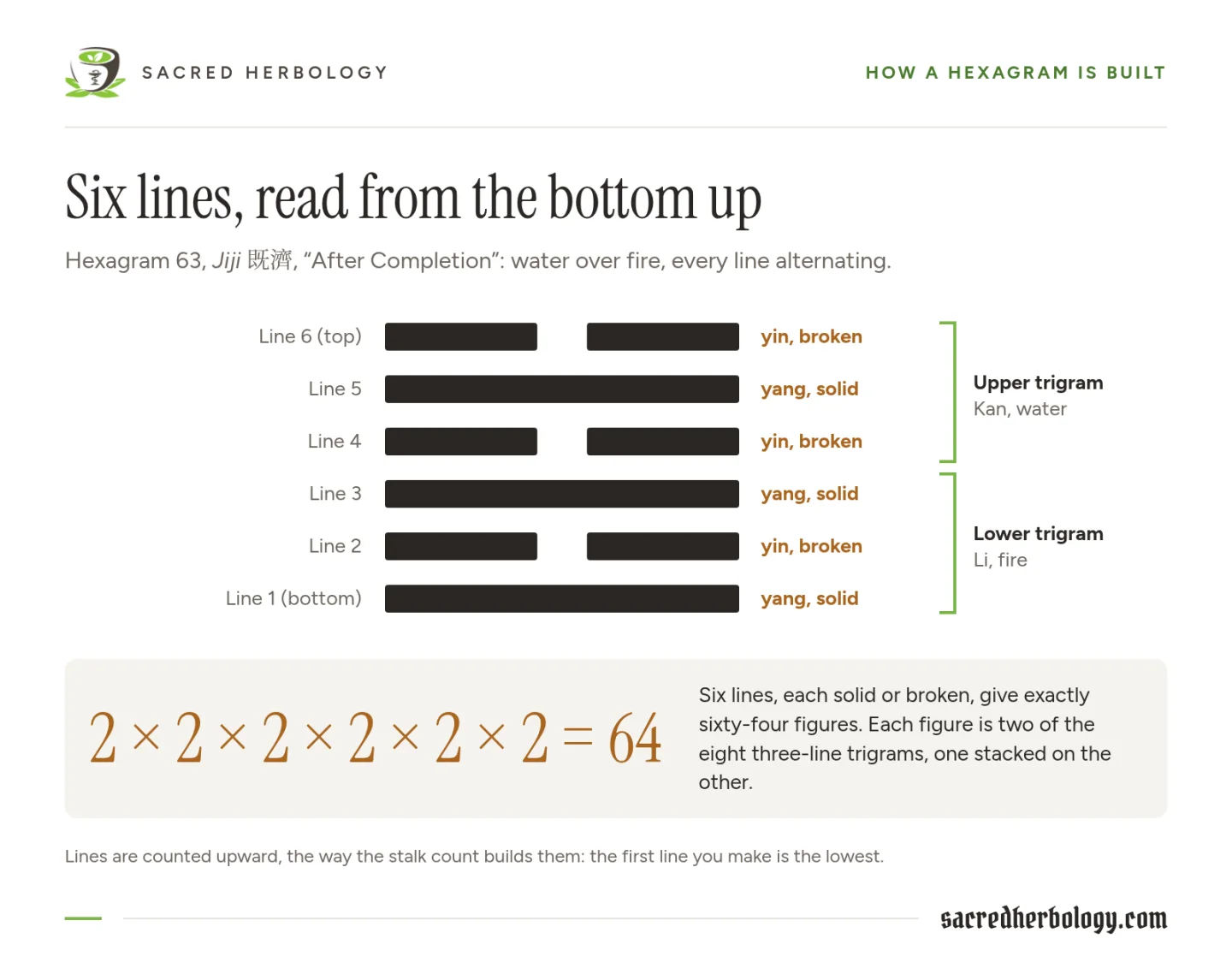
The core is a short divination manual, known in its early form as the Zhouyi, the “Changes of Zhou”. It is built on sixty-four figures, the hexagrams, each made of six horizontal lines stacked one above another. Each line is either solid, a yang line, or broken in the middle, a yin line. Six lines with two choices each gives exactly sixty-four combinations. Each hexagram has a name, a short judgement, and a statement for each of its six lines. The language is terse, archaic and often baffling: “A frosty path underfoot, hard ice is coming.” “Crossing the great river is favourable.” “The dragon flies in the heavens.”
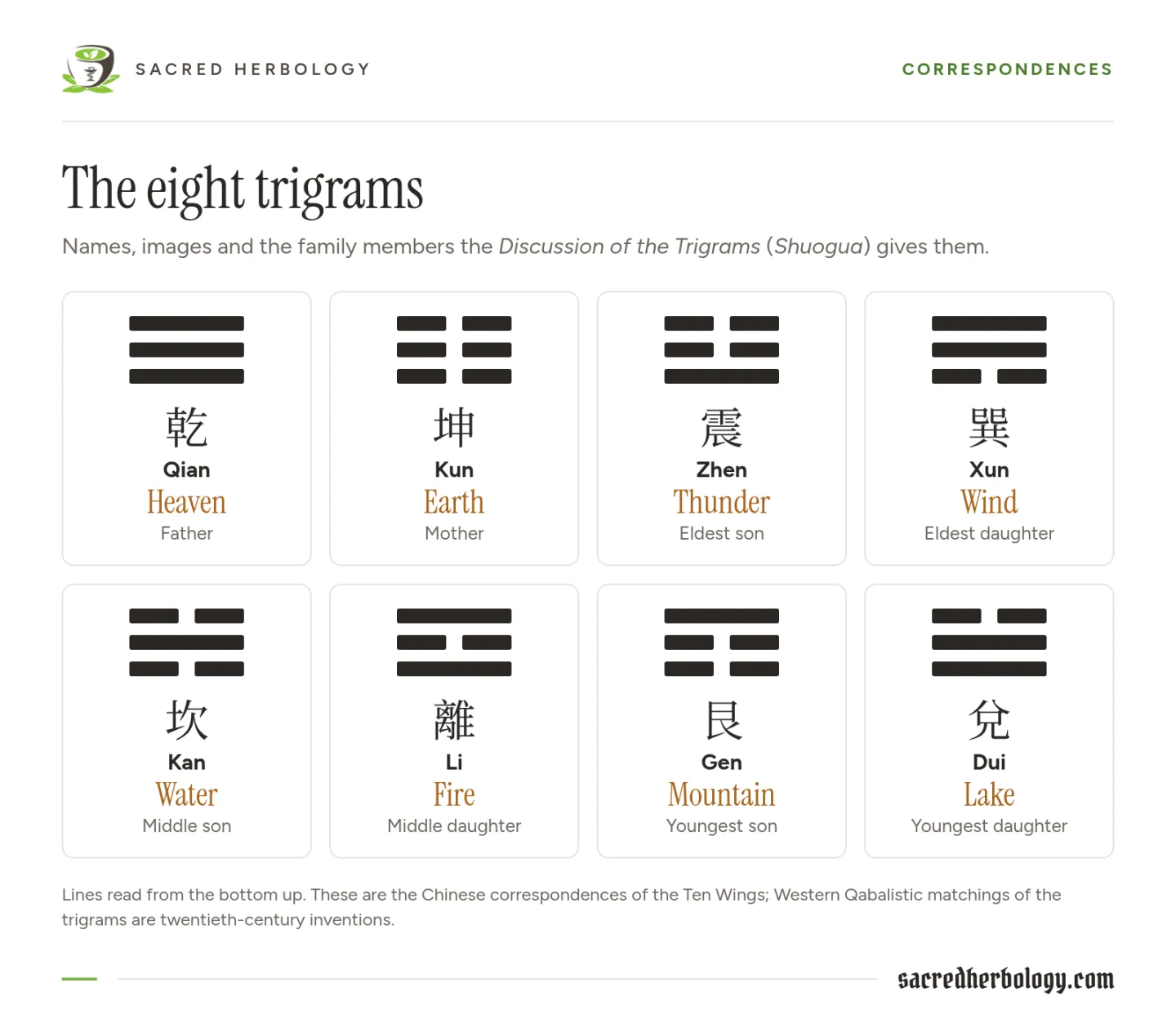
On top of that core sit the commentaries known as the Ten Wings, which explain the hexagrams, attach the eight three-line trigrams to heaven, earth, thunder, wind, water, fire, mountain and lake, and build a philosophy of change, yin and yang out of the old oracle. When the Han dynasty made the Book of Changes one of the Confucian classics in the second century BCE, the core and the Wings together became the Yijing, the “Classic of Changes”.
Tradition gives the book a very grand family tree. Fuxi drew the eight trigrams. King Wen of Zhou, imprisoned by the last Shang king, doubled them into the sixty-four hexagrams and wrote the judgements. His son, the Duke of Zhou, wrote the line statements. Confucius wrote the Ten Wings.
Modern scholarship sees it differently. The core text seems to have taken shape in the Western Zhou period, probably by the late ninth century BCE, out of the working records and formulas of court diviners. The Ten Wings were written by several hands between the late Warring States period and the early Han, from about the fourth to the second centuries BCE. Doubts that Confucius wrote them go back a long way in China itself; the Song scholar Ouyang Xiu argued against it in the eleventh century. Confucius did know the book, or at least the Analects has him say that if he were given a few more years to study the Changes at fifty, he might be free of great faults. Even that line has a textual problem, because an ancient variant reading has a different character that removes the Book of Changes from the sentence altogether. And the Shiji tells that Confucius read the Changes so often in old age that the leather thongs binding its bamboo slips wore through three times.
That is the book the stalks were made to serve. The stalks produce a number for each line; the numbers produce a hexagram; the hexagram points to the text.
Numbers before lines
For a long time people assumed that the solid and broken lines were as old as the oracle. Archaeology has shown otherwise, and the story of how is one of the good detective stories of twentieth-century scholarship.
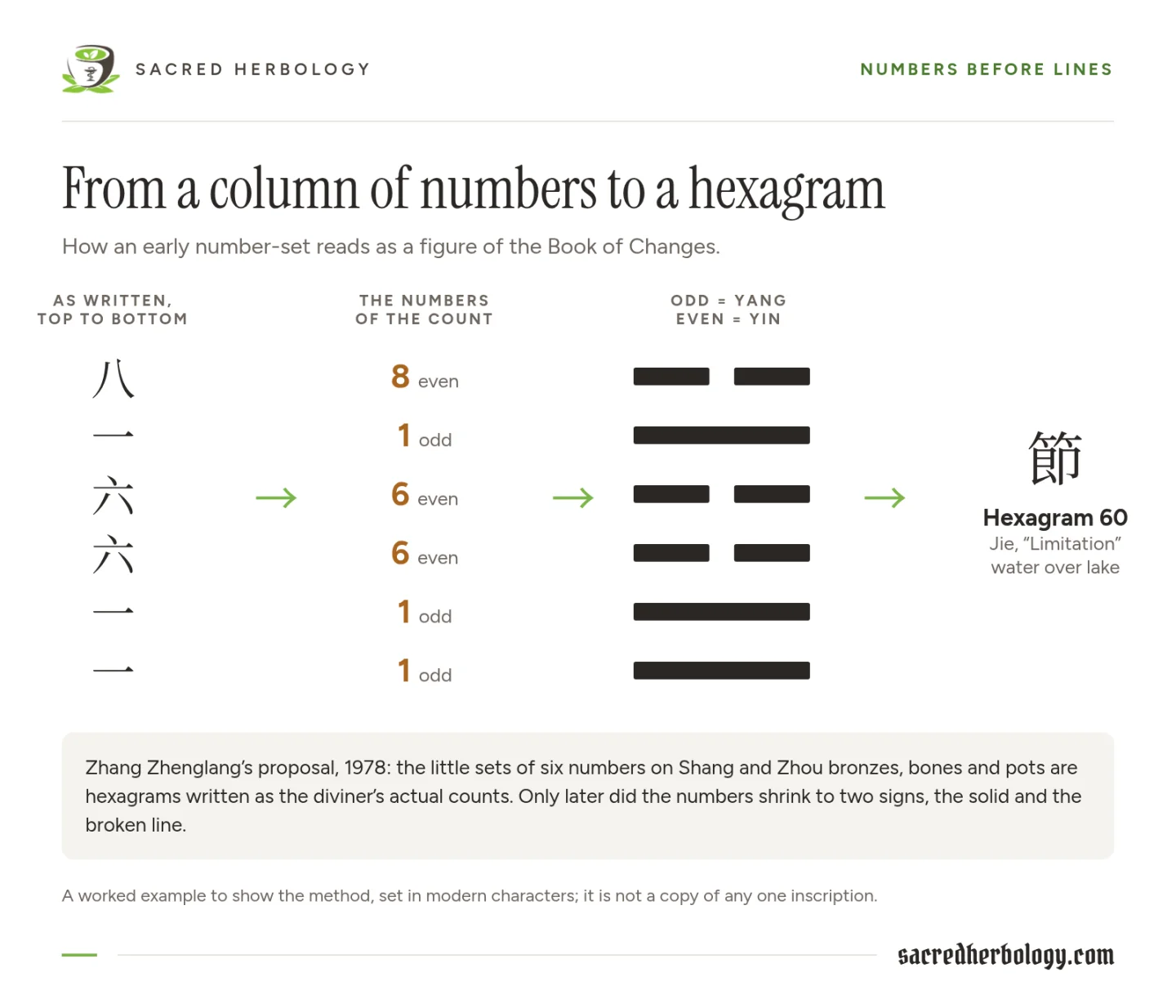
From the 1950s onwards excavators kept finding odd little groups of numbers, usually in sets of three or six, scratched on oracle bones, cast into bronze vessels and painted on pottery from the late Shang and early Zhou. Nobody could make sense of them. Then in 1978, at a conference in Changchun, the palaeographer Zhang Zhenglang proposed that they were hexagrams, written in the form of the numbers the stalk count had produced. His study appeared in the journal Kaogu xuebao in 1980, with an English translation in Early China the same year.
Take an odd number for a yang line and an even number for a yin line, he said, and these sets of six numbers turn straight into hexagrams. The early diviners wrote down their actual counts, ones, fives, sixes, sevens, eights and nines. Only later were the numbers reduced to two signs, which eventually became the solid and broken lines we know.
Later finds filled in the picture. Bamboo slips from tomb 2 at Baoshan in Hubei, the grave of an official named Shao Tuo buried in 316 BCE, record a whole year of divinations made for his health and career, some by tortoise and some by stalks, with the stalk results written as paired number-hexagrams. A set of Warring States bamboo slips bought by the Shanghai Museum in 1994 turned out to be the oldest surviving manuscript of the Zhouyi itself, from about 300 BCE. The silk manuscripts buried in tomb 3 at Mawangdui in Hunan in 168 BCE include a complete Book of Changes with the hexagrams in an entirely different order from the received text, and with several commentaries unknown before. A copy from a tomb at Fuyang in Anhui, closed in 165 BCE, has notes of actual divination results appended to the lines.
Most recently, among the Warring States bamboo slips acquired by Tsinghua University in Beijing in 2008, scholars found a manual of stalk divination now called the Shifa, “Method of Milfoil Divination”, published in 2013. It uses its own set of numbers, including fours, fives, eights and nines, and it shows that the stalk oracle in the fourth century BCE was a family of methods, not one fixed procedure.
Set out side by side, it is easy to follow: a little column of six numbers as an early diviner wrote it, then the same six numbers as solid and broken lines. Odd becomes yang, even becomes yin, and you can see at a glance how the stalk count turned into the figures of the book.
The Great Commentary and the count of fifty
Of all the old ways of counting stalks, one became the standard, and the reason is that it was written into the Ten Wings.
The longest of the Wings is the “Great Commentary” (Dazhuan), also called the “Appended Statements” (Xici zhuan). In its first part, in the chapter usually numbered nine, there is a short, dense passage on the stalks. It begins: “The number of the great expansion is fifty. Of these, forty-nine are used.” It goes on to say that the stalks are divided into two to represent the two, heaven and earth; one is hung up to represent the three, heaven, earth and humankind; they are counted off in fours to represent the four seasons; the remainder is put aside to represent the intercalary month; and since there are two intercalary months in five years, the process is repeated.
That is all the Great Commentary says. It is a cosmology of numbers more than a set of instructions, and nobody could do the count from it alone. Elsewhere the same commentary praises the stalks directly: “The nature of the stalks is round and spirit-like; the nature of the hexagrams is square and wise.” Another Wing, the “Discussion of the Trigrams” (Shuogua), says that when the sages of old made the Changes, they gave hidden help to the spirit-like and the bright, and so brought forth the use of the stalks.
Why fifty, and why put one aside? The commentators never stopped asking. The young philosopher Wang Bi, who died in 249 CE at twenty-three and wrote the commentary that ruled Changes study for the next eight hundred years, is quoted as saying that the one stalk not used is the very thing that makes the use of the others possible; it is the Great Ultimate, the one from which the many come. Others matched the fifty to the sum of the “numbers of heaven and earth” in another chapter of the Great Commentary, which actually add up to fifty-five, and spent pages explaining the missing five. These are esoteric number speculations in the full sense, and they are a large part of what made the Book of Changes so attractive to later mystics both in China and in the West.
Zhu Xi rebuilds the method
By the twelfth century the details of the count had been argued over for more than a thousand years. The man who fixed it for the rest of Chinese history was Zhu Xi (1130-1200), the great Neo-Confucian scholar whose readings of the classics became the basis of the imperial examinations for six centuries.
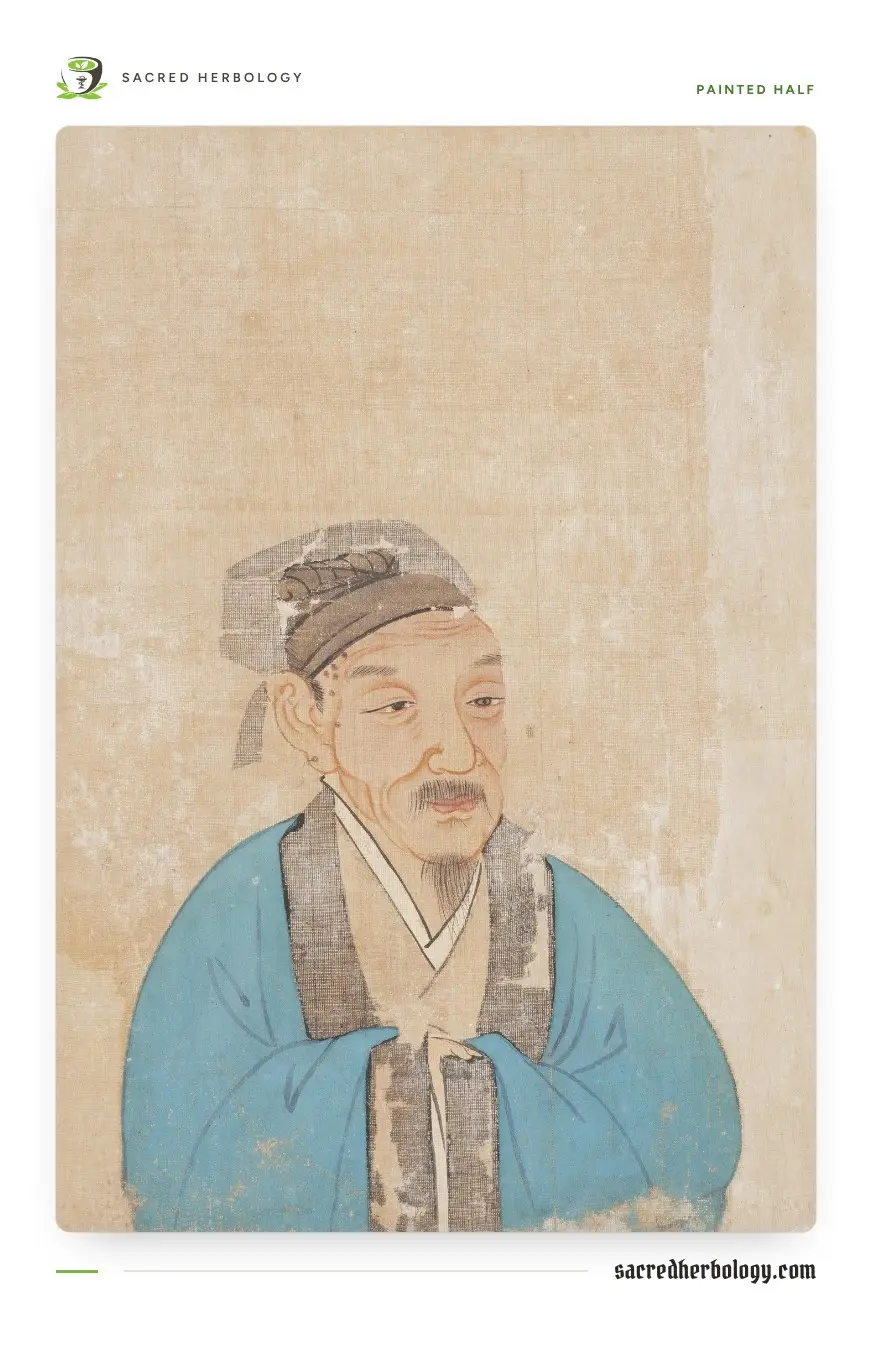

Zhu Xi took the Book of Changes back to what he called its “original meaning”, and to him the original meaning was divination. In 1186, working with his student Cai Yuanding, he published the Yixue qimeng, “Introduction to the Study of the Changes”, which reconstructs the yarrow-stalk method step by step from the Great Commentary and the old commentaries. At the front of his own commentary on the book, the Zhouyi benyi, “Original Meaning of the Zhouyi”, he set out a short ritual for the diviner, the Shiyi, “Rite of Stalk Divination”.
The ritual is detailed and easy to picture, and it lays out on the floor like a plan.
Choose a clean place for the stalk room, Zhu Xi says, with its door to the south. Put a low table in the middle of the room. Keep fifty stalks wrapped in a cloth of deep red silk, in a black bag, inside a case with a lid, at the north end of the table. In front of the case, to the south, set a wooden rack with two large slots and three small ones, to hold the stalks during the count. South of the rack put an incense burner, and south of that a box of incense. Every day burn incense there as a mark of respect.
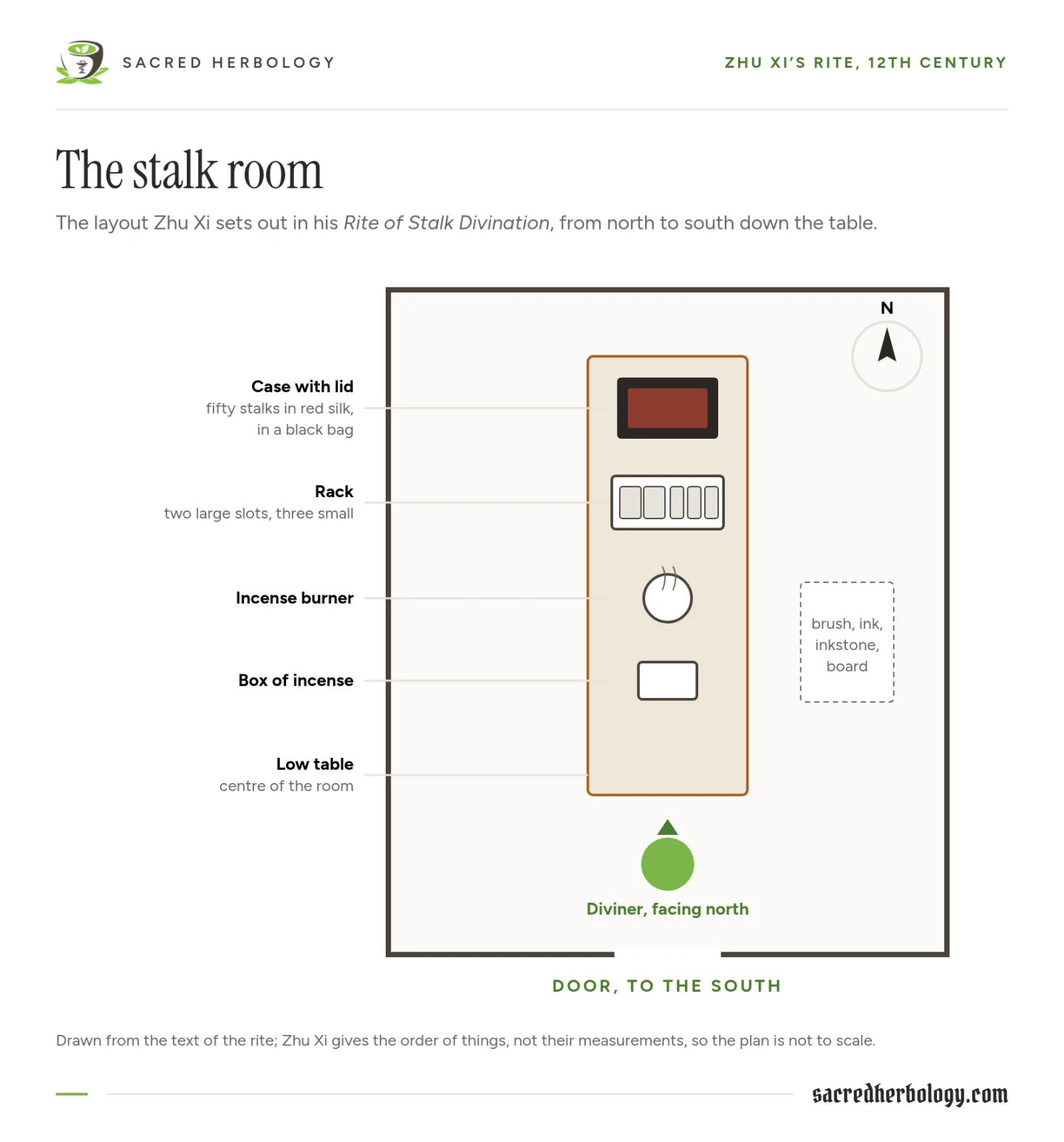
When there is a question, sweep the room, put brush, ink, inkstone and a board to write on to one side, and burn incense. The diviner faces north, washes his hands, and burns incense again. He takes the stalks from the case, unwraps them, holds them in incense smoke, and speaks to them. Zhu Xi gives the words. In a plain English rendering they run: “Through you, great stalks, which are constant; through you, great stalks, which are constant. I, so-and-so, of such-and-such office, now ask about this matter, and do not know whether it is right. I lay my doubt before the spirits and the powers. Fortune and misfortune, gain and loss, regret and remorse, sorrow and care: you who have the spirit, make it plain to me.”
Then he takes one stalk with his right hand and puts it back in the case, leaving forty-nine, and begins the count. When the six lines are written down and the reading is done, he wraps the stalks again, puts them in the bag and the case, closes the lid, puts away the writing things, burns incense once more, and leaves.
There is a lot to notice in that small rite. The stalks are treated with the courtesy due to an honoured guest. Incense frames the whole thing, start, middle and end. The diviner states his name and his business plainly, as he would before an official. And the stalk that is set aside goes back into the case, so the “one not used” is kept close to the work.
Zhu Xi was a careful, rational scholar who held that the oracle worked through the pattern, li, that runs through all things and through the human mind. He did not regard it as a trick or a game. Joseph Adler, who has translated both of Zhu Xi’s books on the Changes into English, has written well on how divination fitted Zhu Xi’s programme of moral self-cultivation. In this tradition the stalks were a way of putting a question to the pattern of the world, and the reverence was the point.
How the count works
Here is the standard method as Zhu Xi reconstructed it, which is still the method taught in the West under the name “yarrow stalk divination”. It is a ritual, done with the hands, and there is nothing in it to take into the body, so I can set it out in full.
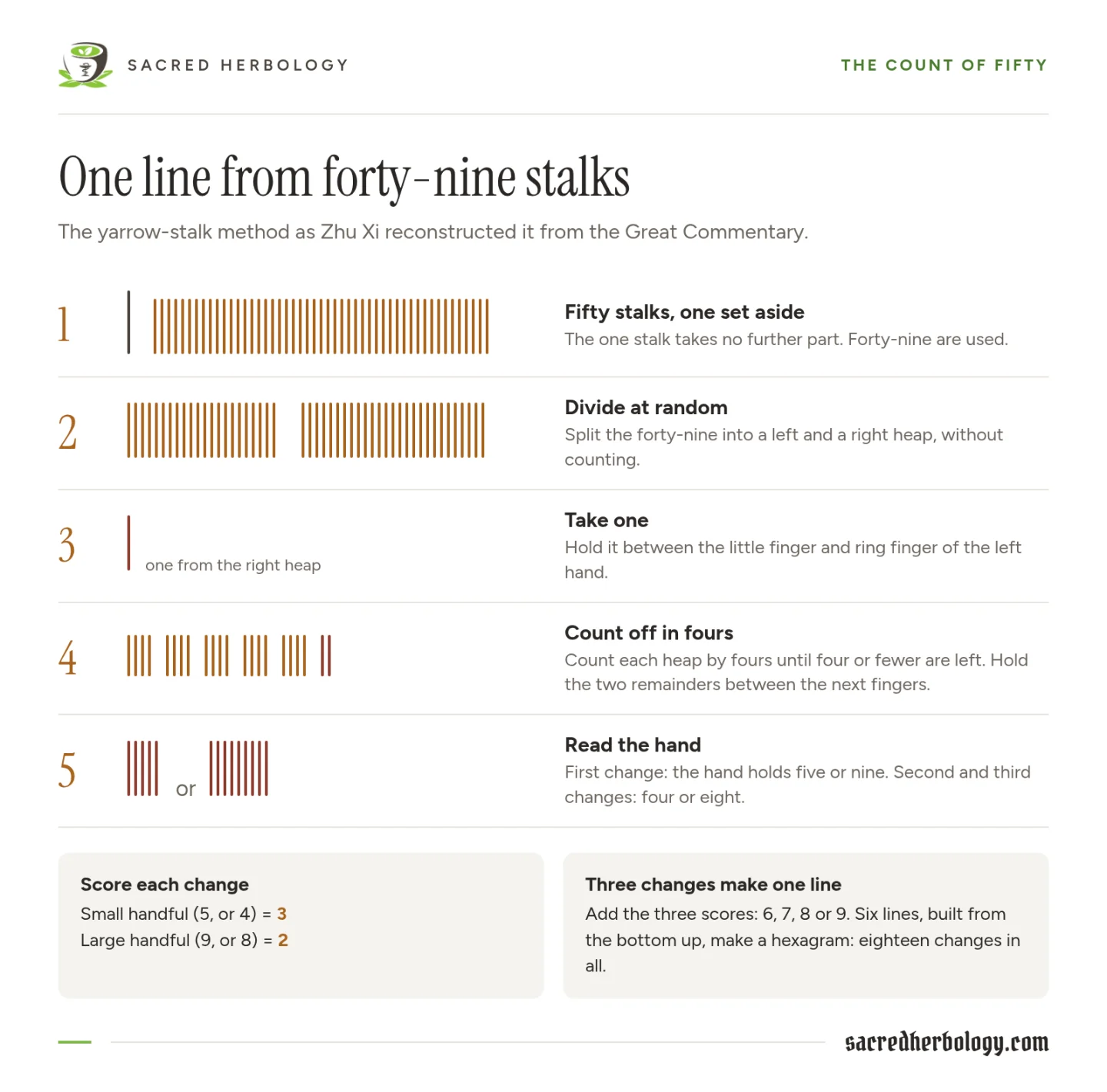
Start with fifty stalks. Set one aside. It takes no further part.
The first change:
- Divide the forty-nine stalks at random into two heaps, left and right, without counting.
- Take one stalk from the right-hand heap and hold it between the little finger and ring finger of your left hand.
- Count off the left-hand heap in fours until four or fewer remain. Put that remainder between the ring and middle fingers of the left hand.
- Count off the right-hand heap in fours in the same way. Put that remainder between the middle and index fingers.
- The stalks held in your left hand now total either five or nine. Put them aside.
The second change:
- Gather the remaining stalks (either forty-four or forty) and repeat the whole process: divide, take one, count both heaps by fours, keep the remainders.
- This time the stalks in your hand total either four or eight. Put them aside.
The third change:
- Gather what is left and do it a third time. Again the hand holds either four or eight.
Now read the result. In the old reckoning a small handful, five on the first change or four on the second and third, counts as three, and a large handful, nine or eight, counts as two. Add the three values together and you get one of four numbers:
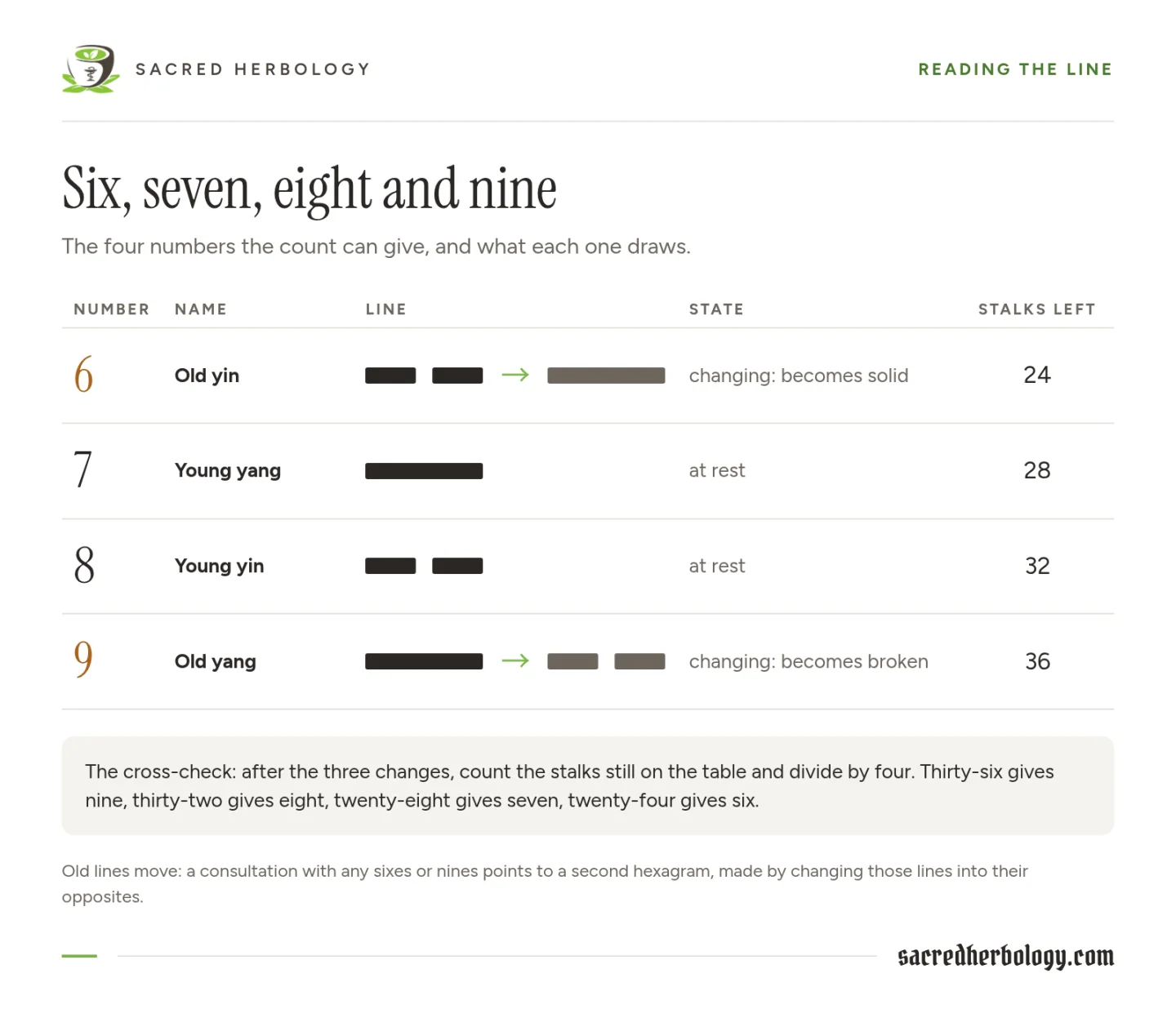
- 6, old yin: a broken line that is changing into a solid line.
- 7, young yang: a solid line, at rest.
- 8, young yin: a broken line, at rest.
- 9, old yang: a solid line that is changing into a broken line.
There is a second way to arrive at the same answer. Count the stalks left on the table after the three changes. There will be thirty-six, thirty-two, twenty-eight or twenty-four of them, and dividing by four gives nine, eight, seven or six.
That gives you one line, the lowest line of the hexagram. Do the whole three-step process five more times, building upward from the bottom, and you have six lines and a hexagram. Eighteen changes in all. If any of the lines are “old”, that is sixes or nines, they are read as moving, and changing them into their opposites gives a second hexagram, so a single consultation can point to two figures and to particular lines within the first.
That is the whole procedure, and the hands soon learn it: the bundle, the two heaps, the stalk between the little fingers, the piles of four.
The odds hidden in the stalks
There is a quiet piece of mathematics hidden in the count, and it is one of the things that keeps people loyal to the stalks.
Because of the way the remainders fall, the first change gives a small handful (five) about three times as often as a large one (nine), on the usual assumption that the split is random. The second and third changes give four or eight about equally often. Work through the combinations and the four line-numbers come out with very uneven odds:
- 6, old yin: 1 chance in 16
- 7, young yang: 5 chances in 16
- 8, young yin: 7 chances in 16
- 9, old yang: 3 chances in 16
The three-coin method, which has been widely used in China since at least the Song dynasty and is associated with a divination manual called the Huozhulin, gives different odds. Throw three coins, count heads as one value and tails as another, and the four numbers come out:
- 6, old yin: 2 chances in 16
- 7, young yang: 6 chances in 16
- 8, young yin: 6 chances in 16
- 9, old yang: 2 chances in 16
Put the two side by side and you can see the difference. Overall, both methods produce yin and yang lines equally often. But with the stalks, a moving yang line is three times as likely as a moving yin line, and a resting yin line is more likely than a resting yang. With coins, everything is symmetrical. Practitioners who care about the old method argue that the stalks preserve a pattern built into the tradition: yang, active, moves more readily; yin, receptive, tends to stay where it is. Practitioners of the coins answer that the coin method has its own long pedigree. Some modern diviners use sixteen marbles or beads in four colours, in the proportions 1, 5, 7 and 3, to get the stalk odds quickly.
Laid out as two sets of bars, the odds make the point better than any paragraph: the stalks lean towards the resting yin line and the moving yang line, and the coins do not lean at all.

The stalks at court and in the chronicles
The Zuo zhuan, which recorded the quarrel between tortoise and stalk, also preserves the oldest accounts we have of the Changes being used in earnest. There are around twenty of them, mostly from the seventh and sixth centuries BCE, and they read like scenes from a play.
In 672 BCE, the chronicle says, a court historian of Zhou came visiting the small state of Chen carrying a copy of the Zhouyi. The ruler of Chen asked him to divine for his young son, Chen Wan. The result was the hexagram Guan, “Contemplation”, with a moving line that turned it into Pi, “Obstruction”. The historian read the line “Contemplating the light of the kingdom; it is favourable to be a guest of the king” and predicted that the boy’s descendants would hold a state, though not this one. Chen Wan later fled to the great state of Qi, and two centuries on his descendants, the Tian family, took the throne of Qi. The story was almost certainly polished after the fact, which is part of why historians find it so interesting: it shows what people expected a good reading to look like.
The most famous reading of all belongs to a woman. In 564 BCE Mu Jiang, the dowager duchess of Lu, was confined to the Eastern Palace for her part in a failed plot. She had the stalks consulted about her fate. The result was Gen, “Keeping Still”, turning into Sui, “Following”. The court scribe tried to comfort her: Sui means going out, he said; you will soon be free. Mu Jiang answered that Sui’s judgement speaks of four virtues, primal, prevailing, fitting and steadfast, and that a person who has none of the four cannot claim its promise. She had done wrong, she said, and had none of them. She would die there. The chronicle notes that she did.
That scene is the beginning of a long tradition of reading the Changes as moral counsel, where the answer depends on who is asking and how they have lived. It is a scene that is easy to see: a palace room, a woman listening to a scribe, and the stalks on the table between them.
The ritual books of the Zhou set limits too. The “Summary of Rules” chapter of the Liji, the Book of Rites, says that divination by tortoise or stalks should not be repeated more than three times on the same matter. And the Book of Changes itself carries a warning in the judgement of hexagram 4, Meng, “Youthful Folly”: “The first divination informs. Asking a second or third time is importunity, and to the importunate it does not answer.” Every teacher of the stalks I have ever met quotes that line to beginners.
East and onward: bamboo in place of yarrow
Real shi stalks were never easy to come by. Chu Shaosun was already complaining about it in the first century BCE. Over the centuries diviners in China, Korea and Japan turned to other materials.
In Japan the standard tool became the zeichiku (筮竹), a set of fifty thin, smooth sticks of split bamboo, often thirty to forty centimetres long, sometimes tipped or lacquered at one end. The ekisha, the professional Changes diviners who set up small tables in the streets of Japanese cities with a lantern and a sign, still use them, fanning the sticks out between their fingers in a quick, practised movement that is a pleasure to watch. Many of them use shortened methods, but the fifty sticks remain.
The same thing happened in the West. Most “yarrow stalk” sets sold today are made of bamboo, rattan, wooden dowel or reed. A few makers do sell real dried yarrow stems, and some practitioners grow their own and cut them each autumn. If you buy a set, read the listing closely: “yarrow stalks” in a shop name usually means the method, and the sticks themselves are most often bamboo. A genuine yarrow set should say Achillea stems, and you can tell them by eye, because yarrow stems are ribbed lengthwise, pithy inside and slightly uneven, where bamboo sticks are smooth, hard and straight-grained, usually split from the cane so that they are solid strips, sometimes with the faint ridge of a node. The tradition has never insisted on the species. What it asks for, in Zhu Xi’s rite and elsewhere, is fifty clean, straight, equal stalks kept with care and used with respect.
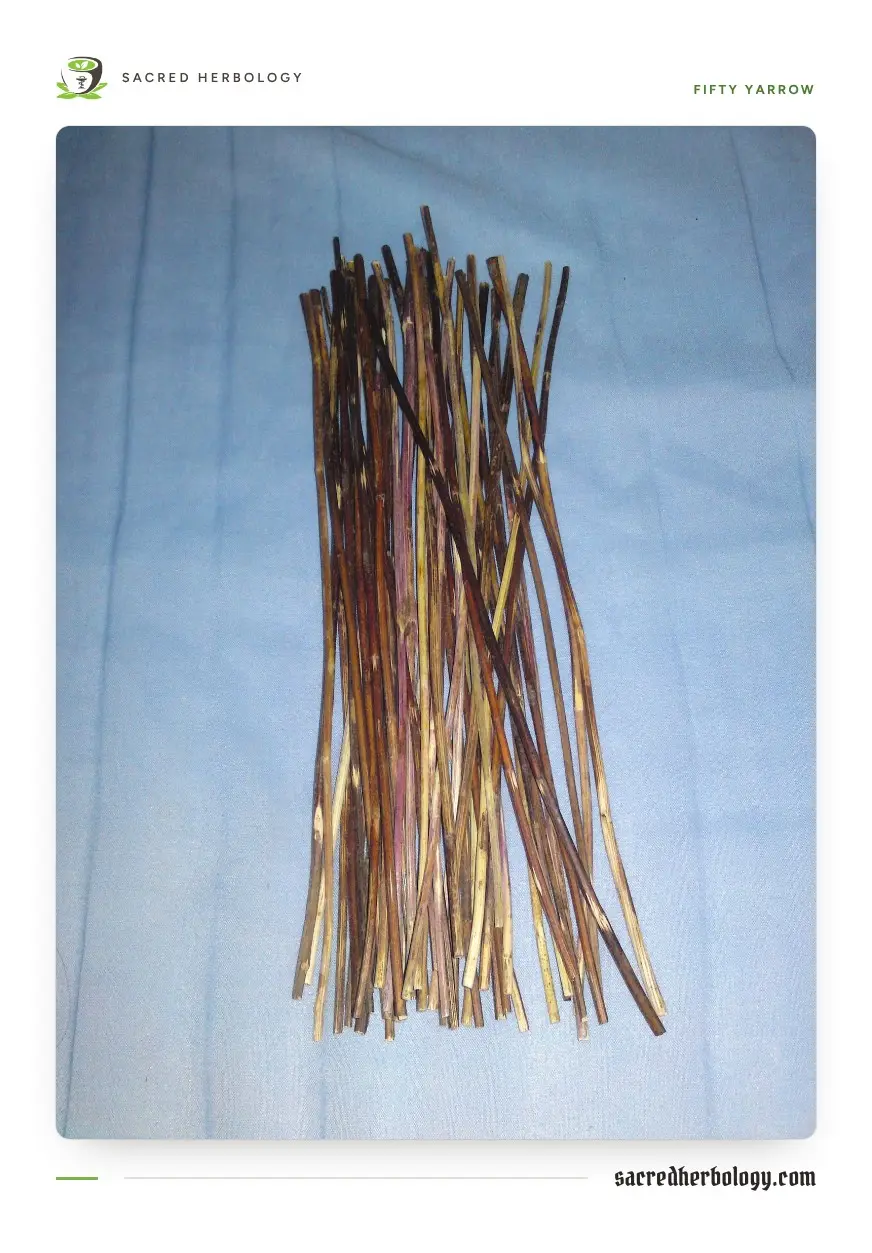

If you grow yarrow and want to try, the method is the old one: let the stems stand until the flowers have faded, cut them at the base on a dry day, hang them in bunches in the shade until they are brittle, then trim them to an even length, about the span of your forearm. Fifty, plus a few spares, because they do break. Pick from your own garden or from ground you know has not been sprayed, since councils and landholders often treat roadsides and fence lines with herbicide. In the humid north, store the finished set somewhere dry and airy, and look the stems over for dark spots or a musty smell before you wrap them; a damp cupboard in the wet season will grow mould on them.
Leibniz and the Jesuits
The Book of Changes reached Europe through the Jesuit missionaries in China, and its first great European admirer was a mathematician.
The French Jesuit Joachim Bouvet, who served at the court of the Kangxi emperor, became convinced that the Changes preserved an ancient revelation older than the Chinese themselves, and he corresponded about it with the German philosopher Gottfried Wilhelm Leibniz. In a letter dated 4 November 1701, which reached Leibniz in 1703, Bouvet sent him a woodcut of the sixty-four hexagrams arranged in the order attributed to Fuxi. That arrangement had actually been made by the Song philosopher Shao Yong in the eleventh century.
Leibniz had already worked out his system of binary arithmetic, using only the digits 0 and 1. Looking at Bouvet’s chart, he saw at once that if you read a broken line as 0 and a solid line as 1, Shao Yong’s sequence of hexagrams runs in order from 0 to 63 in binary. He published his paper on binary arithmetic in the Mémoires of the Paris Academy of Sciences for 1703, and mentioned the hexagrams in it. He believed, as Bouvet did, that the ancient Chinese had possessed binary numbers and forgotten them.
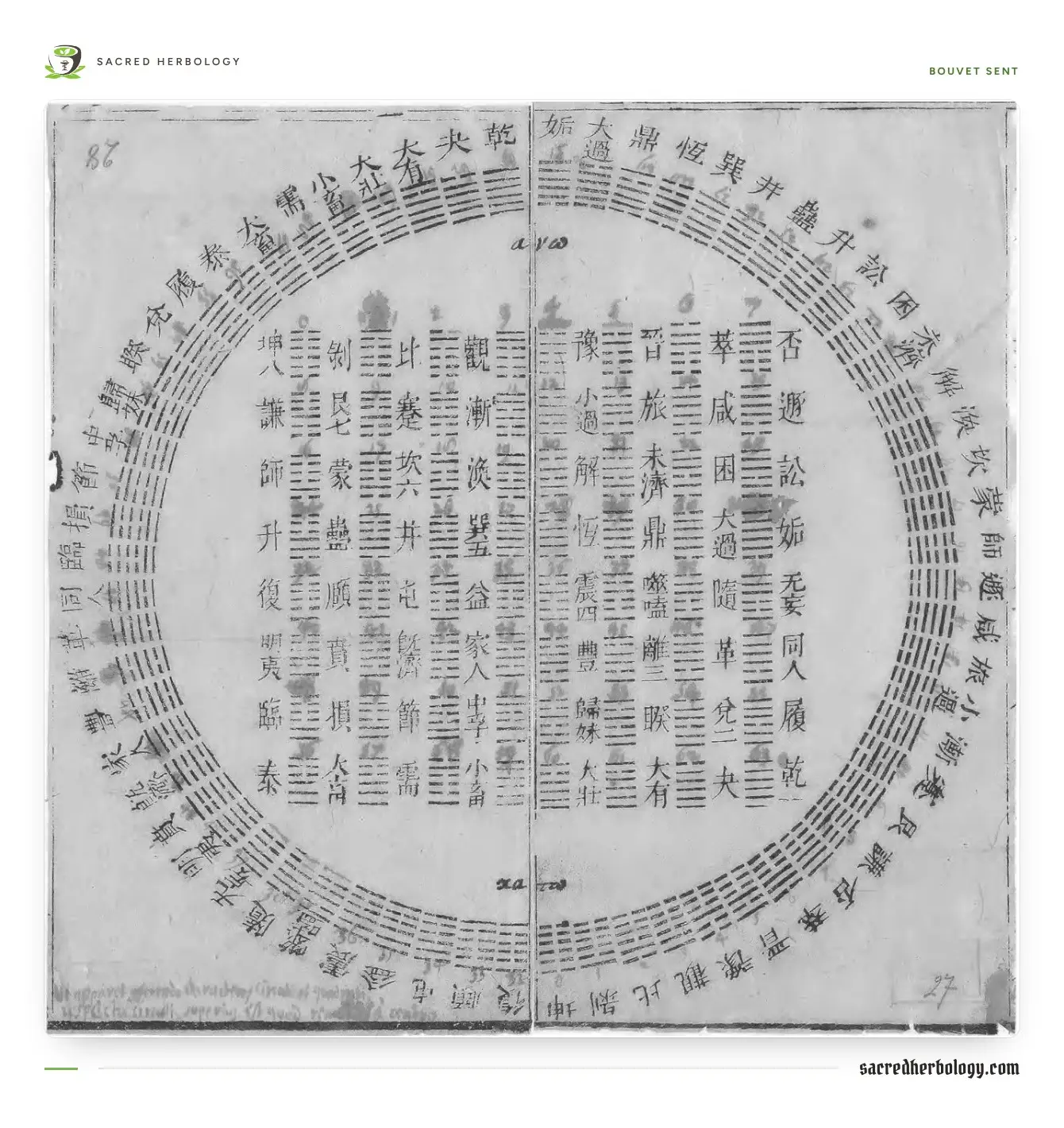

Historians of Chinese mathematics have been cautious about that conclusion ever since. Shao Yong’s sequence does fall into binary order, but he arranged it on a cosmological principle of doubling, one into two, two into four, and on to sixty-four, and there is no sign that he or the original diviners used the lines as a number system. It is still a lovely coincidence of two minds three thousand kilometres and six hundred years apart, and Shao Yong’s square-and-circle diagram, the one Bouvet sent, is one of the most beautiful images in the whole history of the book.
Legge, Wilhelm and Jung
The first full English translation came from James Legge, the Scottish missionary and later Professor of Chinese at Oxford, as volume 16 of Max Müller’s Sacred Books of the East in 1882. Legge was a fine scholar and a reluctant reader of the Changes. He thought the book a puzzle more than a scripture and gave little attention to divination.
The translation that made the I Ching a household book in the West came from Richard Wilhelm, a German missionary who spent more than twenty years in Qingdao. Wilhelm studied the Changes with an elderly Chinese scholar, Lao Naixuan, and published his German version, I Ging: Das Buch der Wandlungen, at Jena in 1924. He wrote with real feeling for the book as a guide to living, and he gave the yarrow-stalk method in an appendix.
Wilhelm’s friend the Swiss psychiatrist Carl Gustav Jung had been consulting the Changes since the early 1920s. When Cary F. Baynes translated Wilhelm’s German into English, it appeared in 1950 in the Bollingen Series in New York with a long foreword by Jung, in which he described putting questions to the book about the book itself and finding the answers apt. Jung used the Changes as a central example of what he called synchronicity, his idea of meaningful coincidence without a causal link. That idea belongs to Jung’s own psychology. I report it as his view.
The Wilhelm-Baynes translation, revised in a third edition from Princeton in 1967, sold in its hundreds of thousands through the 1960s and 70s and is still in print. For most English readers the I Ching is still Wilhelm’s I Ching, with Jung’s foreword in front and the yarrow stalks at the back.
Novelists, composers and a magician
Once the book was loose in the West, it went in some unexpected directions.
The American composer John Cage used the I Ching’s coin oracle to make the choices in his piano work Music of Changes in 1951, tossing coins to settle the pitch, duration and loudness of sounds from charts of sixty-four possibilities. He went on using the Changes to compose for the rest of his life. The novelist Philip K. Dick consulted the oracle while writing The Man in the High Castle (1962), an alternative history in which several of the characters also consult it, and he said in later years that he had let the book steer parts of the plot.
The esoteric West took it up too. The English occultist Aleister Crowley, founder of Thelema, consulted the Changes often, and his magical diaries record many readings. He also wrote a verse paraphrase of the sixty-four hexagrams under the Chinese-style name Ko Yuen, which stayed unpublished in his lifetime. Helen Parsons Smith edited and published it in 1971 as Shih Yi: A Critical and Mnemonic Paraphrase of the Yî King, the first publication of her Thelema Publications in Oceanside, California. Crowley fitted the trigrams into his own Qabalistic scheme of correspondences, and the attempt to line up the Chinese system with the Western Tree of Life has carried on in Thelemic and other esoteric writing since. Those correspondences are modern Western inventions of the early twentieth century. They have no source in Chinese tradition, and readers should treat them as part of Crowley’s system, not as old Chinese teaching.
The Chinese scheme those correspondences were laid over is the table of the eight trigrams, with their Chinese names, their images (heaven, earth, thunder, wind, water, fire, mountain, lake) and the family members the Shuogua assigns them (father, mother, eldest son, eldest daughter and so on). It is the table every student of the Changes ends up copying into the front of a notebook.
Yarrow divination at home: village custom
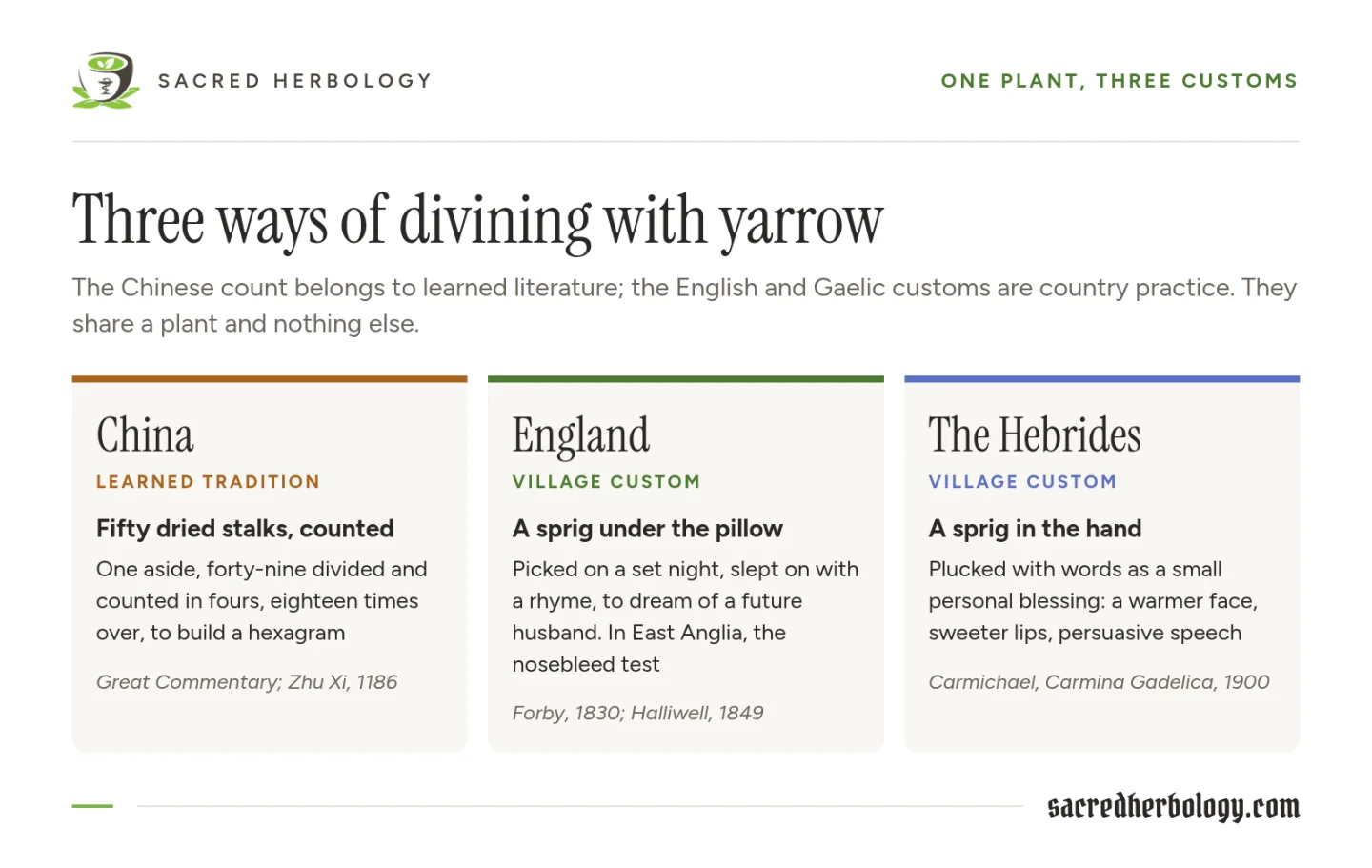
While Chinese scholars were counting stalks, English and Scottish country people were divining with yarrow in a very different way. This is village practice, handed on by doing and recorded by collectors in the nineteenth century. It is country custom, and nothing in it comes from the learned tradition above. The two simply share a plant.
The commonest English custom was a love divination. A young woman picked yarrow, often from a young man’s grave, on a particular night, and slept with it under her pillow, saying a rhyme so that she would dream of her future husband. James Orchard Halliwell printed a version in his Popular Rhymes and Nursery Tales in 1849:
“Thou pretty herb of Venus’ tree, Thy true name it is yarrow; Now who my bosom friend must be, Pray tell thou me to-morrow.”
“Venus’ tree” in that rhyme connects with the learned herbals in a small way. Nicholas Culpeper, in his English Physitian of 1652, placed yarrow under the planet Venus, and the rhyme and the herbal agree. Whether the rhyme borrowed from the astrologers, or the astrologers from the countryside, nobody knows.
In East Anglia there was a rougher test. Robert Forby, in his Vocabulary of East Anglia published in 1830, recorded that a girl would tickle the inside of her nostril with a yarrow leaf while saying:
“Yarroway, yarroway, bear a white blow; If my love love me, my nose will bleed now.”
If her nose bled, he loved her. That custom is part of why one of yarrow’s old English country names is “nosebleed”. It belongs on the page and not up anyone’s nose: the leaf irritates the lining of the nostril, and people sensitive to the daisy family can react to it.
In the Scottish Highlands and Islands the plant had a gentler place. Alexander Carmichael’s Carmina Gadelica, the great collection of Gaelic prayers, hymns and charms he gathered in the Hebrides in the second half of the nineteenth century, includes a charm called “The Yarrow” in its second volume, published in 1900. The speaker plucks the yarrow so that her face will be warmer, her lips sweeter and her speech more persuasive, so that she will be “an island at sea, a hill on land”. Carmichael is known to have polished and sometimes rewritten what he collected, and scholars handle his texts with care. Even so, his yarrow charm shows the plant carried as a small personal blessing, picked with words.
So we have three families of yarrow divination in one plant: fifty counted stalks in China, a sprig under the pillow in England, a sprig in the hand in the Hebrides. Set side by side, the three show how far the plant travelled in people’s hands, and how differently each place put it to use.
Yarrow in the garden
Yarrow is an easy plant in most of Australia’s temperate south, where it is naturalised and grows with little care in full sun and lean, well-drained soil. It spreads by its creeping stems, so give it room or an edge to stop at. Queensland does not list it as a declared weed. In the Australian Alps, around Kosciuszko and in Victoria’s high country, it has become one of the commonest introduced plants on disturbed ground, carried in soil, on machinery and as windblown seed. If you live near bushland, keep it from setting seed over the fence, and put prunings and dug-up roots in the general waste bin, never over the back fence or in a bush tip.
In the humid tropics it is harder going. It is a plant of dry summers and cold winters, and a long, humid wet season tends to rot its crowns. Tropical gardeners have most luck treating it as a dry-season plant, in a pot with a very free-draining mix, kept out of the worst of the rain. The common white yarrow is the one to grow for stalks, because its flowering stems are straight and long; some of the low, colourful hybrids have short, branching stems that are no use for counting.
Handling yarrow safely
Yarrow is in the daisy family, like chamomile, ragweed and chrysanthemum. People who react to those plants can react to yarrow too, and handling the fresh plant can bring out an itchy rash on sensitive skin. Wear gloves when you cut it if you know you are prone to daisy-family allergies. Keep drying bundles and garden plants out of reach of small children and of pets that like to chew. If someone swallows plant material and feels unwell, call the Poisons Information Centre on 13 11 26, or 000 in an emergency. I am writing about yarrow as a ritual and garden plant only, and nothing here is advice about using it on or in the body. Anyone thinking about that should consult a degree-qualified herbalist with competencies and adequate training in pharmacognosy.
Why the slow way still matters
People who use the stalks will tell you that the half-hour is the point. The coin method gets you a hexagram in two minutes. The stalks make you sit, divide, count, set aside, and do it again, eighteen times, while the question settles. Zhu Xi built a whole small rite around that patience: the clean room with its door to the south, the red silk and black bag, the incense at the beginning, middle and end, the stalk returned to the case, and the words spoken plainly to the bundle in the hand.
The tradition itself is clear on what it holds. The Great Commentary says the stalks are round and spirit-like. Wang Bi said the single unused stalk is the Great Ultimate. Mu Jiang showed that the answer depends on the person asking. The Book of Rites and hexagram 4 both say not to ask the same question again and again. Those are the tradition’s own words and its own rules, and I set them down as it gave them.
What I can say plainly is that this is one of the longest continuous uses of a plant in any learned tradition. Yarrow-type pollen lies near a body in an Iraqi cave from sixty thousand years ago. Numbers from a stalk count are cast in Zhou bronze nearly three thousand years ago. A twelfth-century scholar wraps fifty stalks in red silk and lights incense before he touches them. And somewhere tonight, someone with a bundle of dried stems from their own garden is setting one aside and dividing the other forty-nine, as Chinese diviners have done for at least two and a half thousand years.
Where this comes from
- Homer, The Iliad, trans. Richmond Lattimore (University of Chicago Press, 1951), book 11.
- Pliny the Elder, Natural History, Books 24-27, vol. VII, trans. W. H. S. Jones (Loeb Classical Library, 1956).
- Carl Linnaeus, Species Plantarum (Stockholm, 1753).
- Ralph S. Solecki, Shanidar: The First Flower People (Knopf, New York, 1971).
- Arlette Leroi-Gourhan, “The flowers found with Shanidar IV, a Neanderthal burial in Iraq”, Science 190 (1975), 562-564.
- Jeffrey D. Sommer, “The Shanidar IV ‘flower burial’: a re-evaluation of Neanderthal burial ritual”, Cambridge Archaeological Journal 9 (1999), 127-129.
- Sima Qian, Shiji, chapter 128, “Guice liezhuan”, with the supplement of Chu Shaosun (Zhonghua shuju, Beijing, 1959).
- Stephen Durrant, Wai-yee Li and David Schaberg, trans., Zuo Tradition / Zuozhuan: Commentary on the “Spring and Autumn Annals” (University of Washington Press, 2016).
- Confucius, The Analects, trans. D. C. Lau (Penguin, 1979).
- James Legge, trans., The Yi King, Sacred Books of the East vol. 16 (Clarendon Press, Oxford, 1882).
- Richard Wilhelm, I Ging: Das Buch der Wandlungen (Eugen Diederichs, Jena, 1924); The I Ching or Book of Changes, trans. Cary F. Baynes, foreword by C. G. Jung (Bollingen Series XIX, Pantheon, New York, 1950; 3rd edn, Princeton University Press, 1967).
- Richard John Lynn, trans., The Classic of Changes: A New Translation of the I Ching as Interpreted by Wang Bi (Columbia University Press, 1994).
- Richard Rutt, Zhouyi: The Book of Changes (Curzon, Richmond, 1996).
- Zhu Xi, Introduction to the Study of the Classic of Change (I-hsüeh ch’i-meng), trans. Joseph A. Adler (Global Scholarly Publications, 2002).
- Zhu Xi, The Original Meaning of the Yijing: Commentary on the Scripture of Change, trans. Joseph A. Adler (Columbia University Press, 2020).
- Zhang Zhenglang, “An interpretation of the divinatory inscriptions on early Chou bronzes”, Early China 6 (1980-81), 80-96; Chinese original in Kaogu xuebao 1980.4, 3-15.
- Edward L. Shaughnessy, Unearthing the Changes: Recently Discovered Manuscripts of the Yi Jing (I Ching) and Related Texts (Columbia University Press, 2014).
- Richard J. Smith, Fathoming the Cosmos and Ordering the World: The Yijing (I Ching, or Classic of Changes) and Its Evolution in China (University of Virginia Press, 2008).
- G. W. Leibniz, “Explication de l’arithmétique binaire”, Mémoires de l’Académie Royale des Sciences (Paris, for the year 1703).
- Aleister Crowley (as Ko Yuen), Shih Yi: A Critical and Mnemonic Paraphrase of the Yî King, ed. Helen Parsons Smith (Thelema Publications, Oceanside, 1971).
- Nicholas Culpeper, The English Physitian (London, 1652).
- Robert Forby, The Vocabulary of East Anglia (J. B. Nichols, London, 1830).
- James Orchard Halliwell, Popular Rhymes and Nursery Tales (John Russell Smith, London, 1849).
- Alexander Carmichael, Carmina Gadelica: Hymns and Incantations, vol. 2 (Edinburgh, 1900).
- Zhengyi Wu, Peter H. Raven and Deyuan Hong, eds, Flora of China, vols 20-21, Asteraceae (Science Press, Beijing, and Missouri Botanical Garden Press, 2011).