
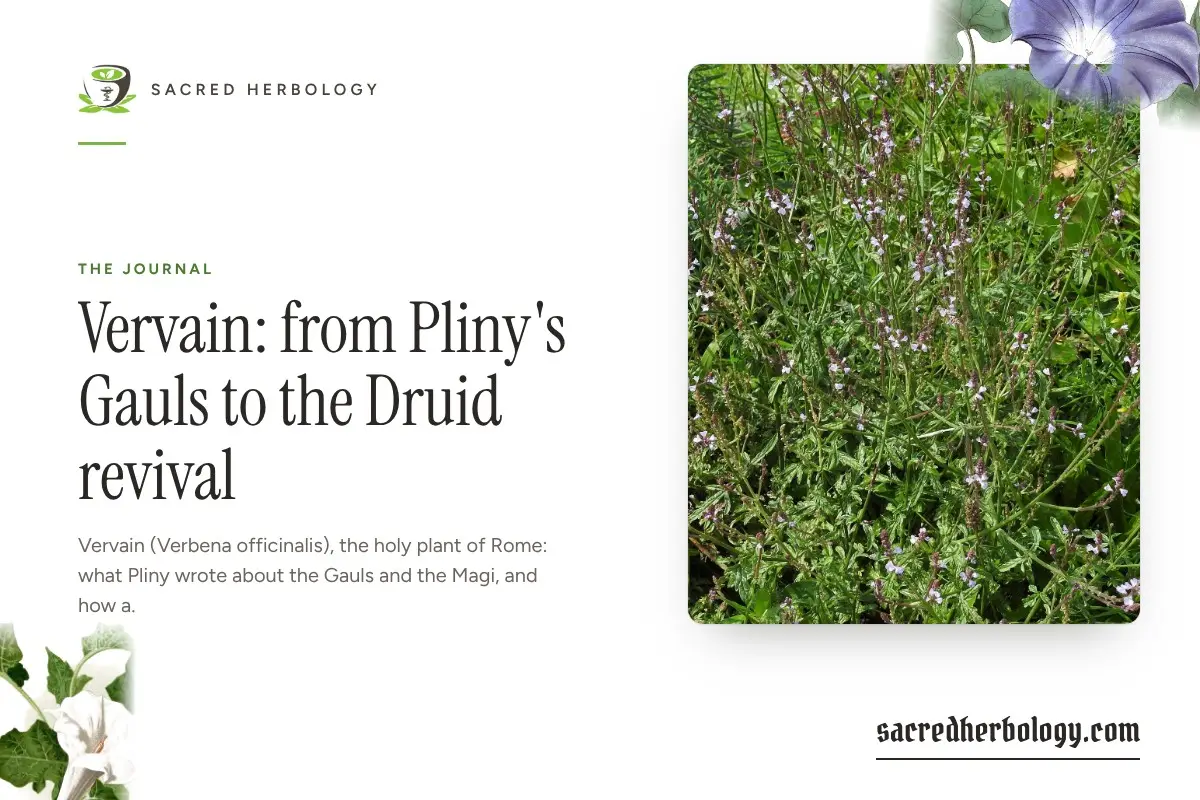
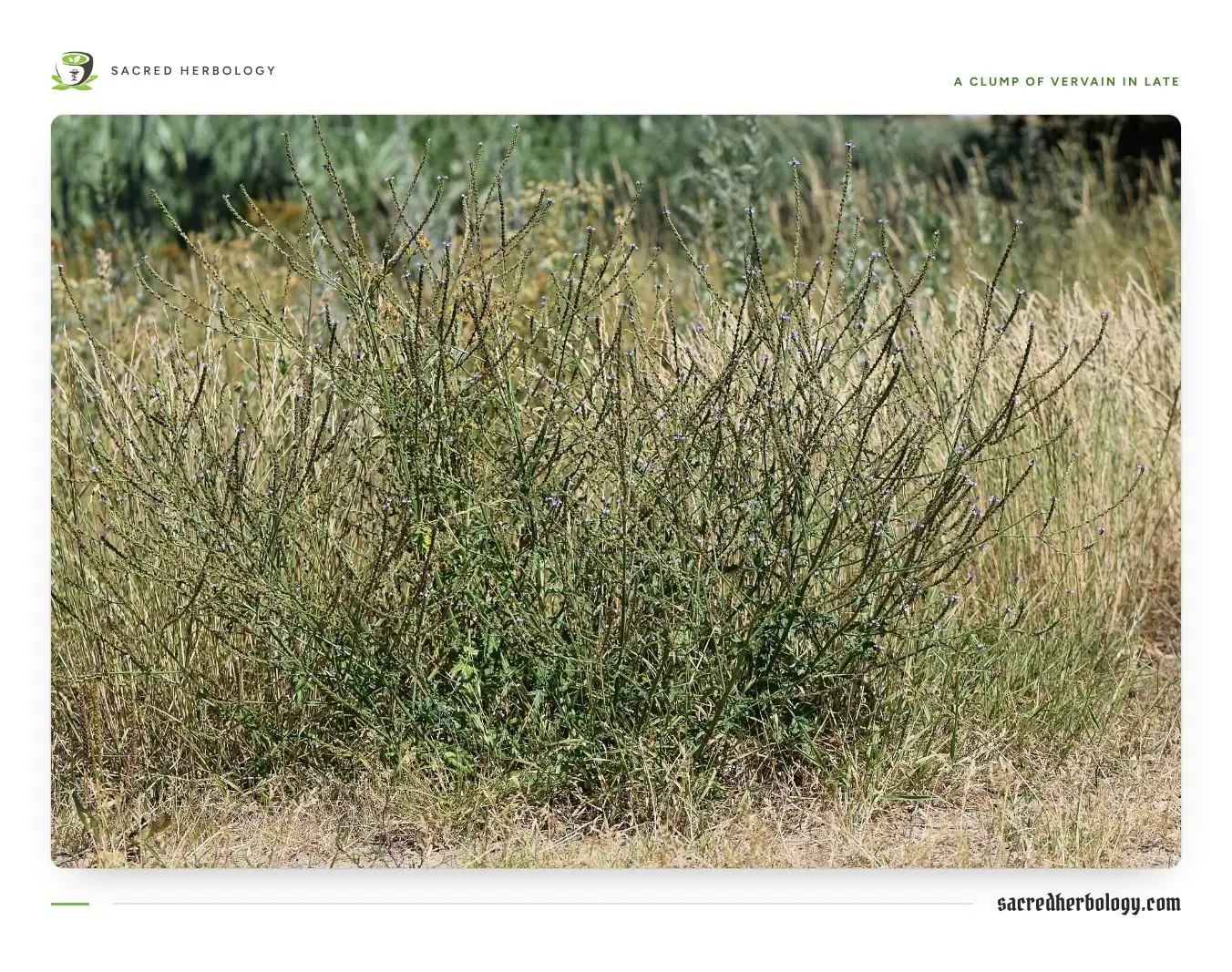
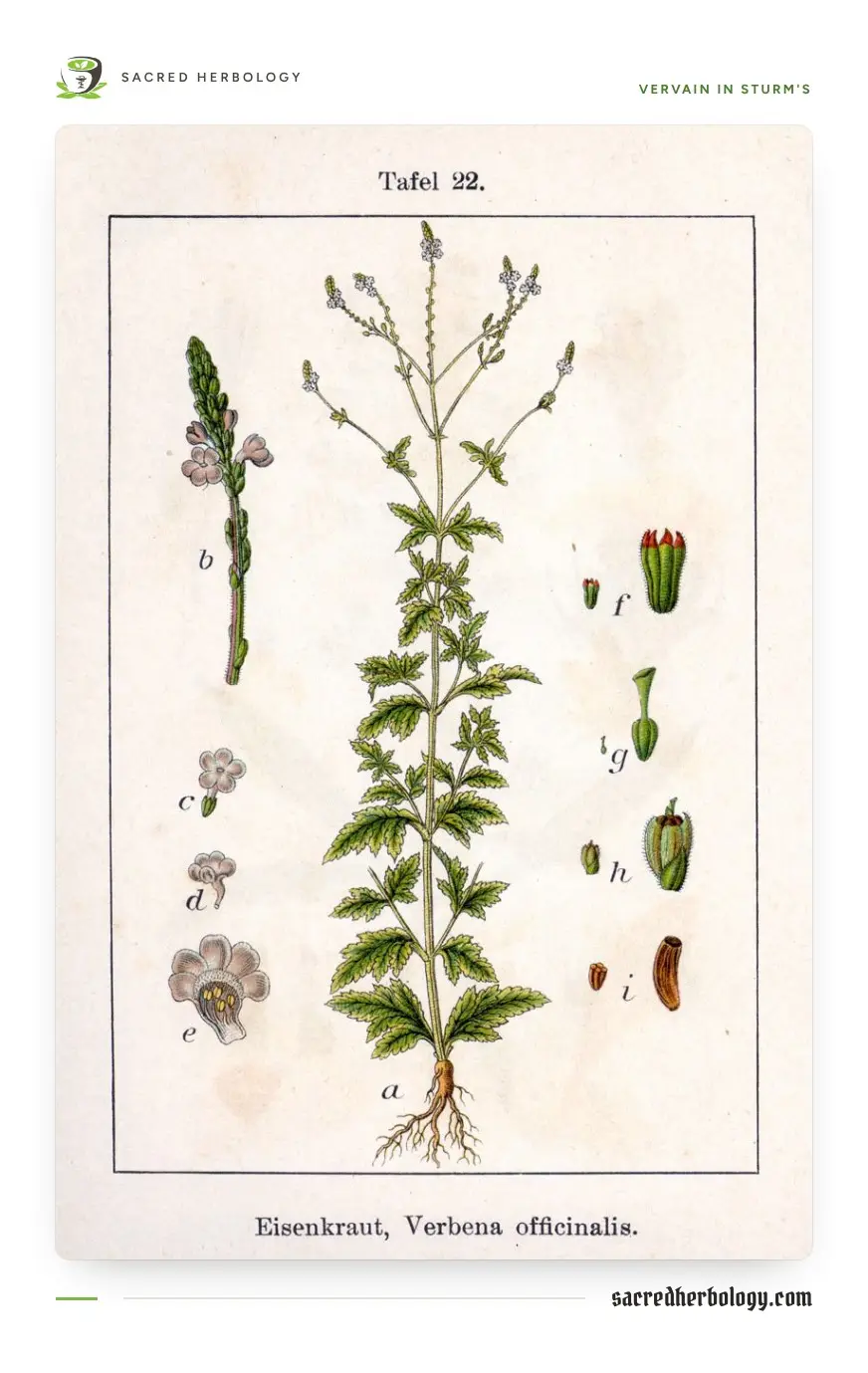
You could walk past vervain a hundred times and never notice it. It is a thin, wiry plant, up to about a metre tall, with square stems and not many leaves. The lower leaves are deeply cut and toothed, the upper ones small and plain, and the stems end in long, bare spikes carrying a handful of tiny flowers, pale mauve or lilac, opening a few at a time from the bottom up. By late summer it looks like a bundle of green wire with a little colour at the tips. It has no scent to speak of, and it won’t stop anyone in the street.
For all that, it has one of the longest ceremonial records of any European plant. The Romans called it the holy plant. Medieval magicians wrote it into their books of secrets. And from the middle of the eighteenth century it became the Druids’ herb, which is the part of its story most people know and the part with the weakest foundations. This piece follows it from Pliny to the revival and shows where the Druids came in.
Which plant are we talking about
The plant is Verbena officinalis, common vervain, in the family Verbenaceae. Several other plants share the name, and they should be set aside first.
- The bright bedding verbenas of garden centres are hybrids of South American species, bred for colour.
- Lemon verbena is Aloysia citrodora, a South American shrub with scented leaves, in the same family and a different genus.
- Purpletop, Verbena bonariensis, is the tall South American verbena with purple flower heads that you see along Queensland roadsides and in pasture. It is a relative, with none of this history.
The same muddle turns up in the herb trade. Dried leaf sold simply as “verbena” is often lemon verbena, and the verveine that French cafés serve is usually lemon verbena too. The North American blue vervain, Verbena hastata, is sometimes sold under the plain name vervain. A packet is only as reliable as the botanical name printed on it, so look for Verbena officinalis in full.
Common vervain is native to Europe and the Mediterranean. In Australia it is an introduced plant, naturalised from Queensland to South Australia and Tasmania, and widespread in pasture and disturbed ground. It has a close native relative across eastern and southern Australia, known as native verbena and now named Verbena gaudichaudii, which was long treated as a variety of V. officinalis (V. officinalis var. gaudichaudii). The native plant usually has its lower leaves cut more deeply, almost to the midrib, but that is a tendency and not a rule. It carries the name of Charles Gaudichaud, the French naturalist who collected at Port Jackson in 1819. The two look much alike to anyone but a botanist, and the naming has moved more than once, so if you want to know which you have, get it identified properly before you trust a label.
Pliny noted that the plant grows everywhere on wet, flat ground. Nearly two thousand years later that still holds. It likes a damp spot in full sun, which is why it does so well here.

The holy plant of Rome
The key passage is in book 25 of Pliny the Elder’s Natural History, written in the 70s CE. My own plain translation of the Latin:
“No plant has more standing at Rome than hiera botane. Some call it aristereon, and we call it verbenaca. This is the plant that I said envoys carry to the enemy. With it the table of Jupiter is swept, and houses are cleansed and purified.”
Hiera botane is simply Greek for “holy plant”. Pliny goes on to describe two kinds, a leafy one people thought of as female and a male with fewer leaves, with slender angled stems, leaves like a narrow oak leaf, a blue-grey flower and a long thin root. He adds that some writers made no distinction and treated them as one plant, since both did the same things.

The Greek physician Dioscorides, writing in the same century, uses the names peristereon and hiera botane. Peristera is the Greek for a dove, and that dove name stays with the plant through the Middle Ages.
What the Romans meant by “verbena”
This is where it gets complicated, and it is worth slowing down.
In book 22 Pliny goes back to the envoys. He says that the founders of Rome used sacred plants in public rites, calling them sagmina in public remedies and verbenae in sacred rites and embassies, and that both words meant the same thing: a tuft of grass pulled up with its own earth from the Citadel. One of the envoys sent to demand the return of stolen property was always called the verbenarius, the one who carried the verbena.
So in Roman religious language, verbenae meant sacred greenery taken from a holy place. The word could cover grass, and Latin writers used it for leafy sprigs of more than one kind. Pliny himself ties the envoys’ plant to his verbenaca in book 25, and to turf from the Citadel in book 22. The “sacred vervain of the Romans” is partly a real plant and partly a word that later readers narrowed down to one species. English took the word through Old French verveine, and the modern botanical name Verbena comes from the same source. None of that tells us that every Roman verbena was our wiry mauve-flowered plant.
A tuft of grass on the Citadel
The best way to see what verbena meant to a Roman is to watch it being used, and the historian Livy, writing under Augustus, gives us the scene. Early in his history, before the famous duel of the three Horatii brothers against the three Curiatii, Rome and Alba Longa agree to settle their war by treaty. The Roman fetial priest, the official who handled war and peace with foreign peoples, turns to King Tullus and asks for the sacred herbs. “Take them clean,” the king replies. The priest fetches a tuft of clean grass from the Citadel. Then he names a colleague, Spurius Fusius, as the spokesman who will swear the oath for Rome, and he makes him so by touching his head and hair with the verbena. Only then are the terms read out and the oath sworn.
Two hundred years and several books later, Livy shows the same custom still alive. In 201 BCE, at the end of the war with Hannibal, the Senate sent fetial priests to Africa to make peace with Carthage, and ordered them to take their own flint stones and their own verbenae with them. When the priests asked what kind, they were told to take them from the Capitol. A Roman peace in Africa had to be sealed with greenery from the holy hill at home.
The poets used the word the same way. When Virgil describes the priests at the treaty between Aeneas and the Latins, near the end of the Aeneid, they come “veiled in linen, their temples bound with verbena”. His ancient commentator Servius explained that verbena properly meant a sacred herb taken from the holy ground of the Capitol, and that people had got into the habit of calling any sacred leafy branch a verbena, laurel, olive or myrtle among them. Horace, getting ready for his patron Maecenas’s birthday, writes that the altar is “bound with chaste verbena” and waiting for the lamb. In a comedy by Terence a servant girl is told to fetch verbenae from the altar outside the house.
And in the eighth of Virgil’s Eclogues a woman works a love spell to bring her straying lover home from the city, and tells her maid to burn “rich verbena and male frankincense” on the altar while she winds threads and melts wax. It is a poem, modelled on an older Greek one by Theocritus, and nobody should read it as a field report. It does show that by the first century BCE a Roman reader would find nothing odd about verbena in a magical rite as well as a public one.
The Gauls, and the Magi
Now the sentence the Druid story grows out of. After his description, Pliny writes (again my translation):
“The Gauls use both kinds for casting lots and chanting prophecies. The Magi, though, go quite mad over this plant.”
Then he lists what the Magi claimed. Rub yourself with it and you will get whatever you want; it drives off fevers, wins friendships and heals every disease. It must be gathered around the rising of the Dog-star, when neither sun nor moon can see it. Honeycomb and honey are first given to the earth as an atonement. A circle is drawn round the plant with iron, it is dug up with the left hand and lifted high into the air, and the leaves, stem and root are dried separately in the shade. And, he adds, people say that if the dining room is sprinkled with water the plant has soaked in, the party goes more cheerfully.
This is learned magic, described by a hostile witness, and I label it esoteric. Pliny’s Magi are the magicians of Persian descent whom he attacks at length at the start of book 30. He records their rules the way you would record the rules of a game you think is foolish, and the word he picks for them, insaniunt, means they rave. Whether any Gaul ever gathered vervain in that manner, Pliny doesn’t say. The Gauls get a single clause: lots and prophecy. The circle of iron, the honey, the Dog-star and the left hand all belong to the Magi.
One more thing to notice. The word Druid does not appear anywhere in Pliny’s vervain chapter. Pliny knew the word and used it. In book 16 he gives us the Druids of the Gauls cutting mistletoe from the oak. In book 24 he names the Druids for two other plants: selago, gathered without iron, by someone in white with bare washed feet, reaching through a fold of the tunic with the right hand and pulling it up with the left as if stealing it; and samolus, gathered by someone fasting, with the left hand, who must not look back. When Pliny meant Druids, he said Druids. For vervain he said Gauls, and then he said Magi.
The mistletoe passage is worth setting beside the vervain one, because it shows what Pliny’s Druid material looks like when he has some. The Druids, he says, hold nothing more sacred than mistletoe and the oak it grows on. They gather it on the sixth day of the moon. A priest dressed in white climbs the tree, cuts the mistletoe with a golden sickle, and it is caught in a white cloak below. Two white bulls, whose horns have never been bound, are sacrificed beneath the tree. It is a vivid scene, and it has been painted, staged and copied endlessly since. Nothing like it is attached to vervain. It is also worth knowing that Julius Caesar, who spent eight years fighting in Gaul and wrote the longest ancient account of the Druids that we have, says a good deal about their teaching, their law courts and their human sacrifices, and nothing at all about any plant.
Across the Middle Ages
Pliny’s vervain did not vanish when Rome fell. A Latin herbal written in late antiquity under the borrowed name of Apuleius, the Pseudo-Apuleius Herbarius, gave it an entry, and that herbal was copied in monasteries across Europe for the next thousand years. In England it was translated into Old English, probably in the late tenth century, and the Old English Herbarium is one of the earliest herbals in any European vernacular. Vervain is there, under its Latin name, among the plants an Anglo-Saxon reader was expected to know.
The plant also picked up new names as it went. In German it became Eisenkraut, “iron herb”, and in French herbe sacrée, “holy herb”, which keeps Pliny’s Greek hiera botane alive in a modern language. The Latin and Greek names stayed in the learned books, and both of them, the holy plant and the dove plant, come back in the next source.
Books of secrets
Through the Middle Ages vervain kept both its Roman reputations, the holy plant and the magician’s plant. The clearest esoteric example is the Book of Secrets that circulated under the name of Albertus Magnus. Albertus did not write it, and the attribution is one of the many false ones in this literature. It was printed in English in the sixteenth century and gives, among its herbs, a string of names for each plant supposedly used by the Chaldeans, the Greeks and the Latins.
Vervain turns up there twice. As the thirteenth herb it is “named of the Chaldees Olphanas, of the Greeks Hiliorion, of the Latins Verbena, of the Englishmen Vervain”, and the book says that “as Witches say” it should be gathered with the Sun in the sign of the Ram. Put the plant in a dove house, it claims, and the doves will gather there; scatter its powder between two lovers and they will quarrel. Further on, a separate entry gives Peristerion and Hierobotane, “id est Herba columbaria”, with a list of medical uses. The compiler seems not to have noticed that the two entries are the same plant under its Latin and Greek names. The dove trick makes more sense once you remember the old Greek name. It is a sympathy between a dove plant and doves.
The modern editors, Michael Best and Frank Brightman, add that the Welsh name for vervain is llysiau’r hudol, “herb of enchantment”.
Old wives’ fables
The English herbalists of the next century took the magical side of vervain for granted, and some of them disliked it. John Gerard, in his Herball of 1597, gives the plant its medical uses and then records a village rule for agues: you had to take just so many knots or sprigs and no more, or it would do you no good. He calls it “mother Bumbies rules”, after the wise woman of John Lyly’s play Mother Bombie (1594). Then he shuts the door on the rest:
“Many odde olde wives fables are written of Vervaine tending to witchcraft and sorcerie, which you may reade elsewhere, for I am not willing to trouble your eares with reporting such trifles, as honest eares abhorre to heare.”
That is village custom, reported by someone who wanted nothing to do with it. Counting sprigs is a household practice, handed on by doing, and it belongs in a different category from the learned magic of the Magi and the Book of Secrets above, which is esoteric.
Nicholas Culpeper, writing his astrological herbal in 1652, gave vervain a planet: “This is an herb of Venus.” That is the learned astrological tradition, and many modern correspondence tables take their Venus from him, whether they say so or not.
You will also meet a rhyme said to have been spoken while gathering vervain, beginning “Hallowed be thou, Vervain, as thou growest on the ground, / For in the Mount of Calvary there thou wast first found.” It is printed again and again in herb books. I have not been able to trace it to a dated manuscript or an early printed source, so I would treat it as undated until someone does.
The sprinkler in the Key of Solomon
The ritual-magic tradition kept vervain for cleansing. In the Key of Solomon, as S. L. MacGregor Mathers edited and translated it in 1889 from manuscripts in the British Museum, the chapter on water and hyssop in the second book tells the magician to make a sprinkler “of vervain, fennel, lavender, sage, valerian, mint, garden-basil, rosemary, and hyssop, gathered in the day and hour of Mercury, the moon being in her increase”, and to bind the herbs with thread spun by a young maiden. Water sprinkled with it, the text says, “will chase away all Phantoms”.
This is esoteric material, and it should be dated honestly. The Key of Solomon has nothing to do with King Solomon. The manuscripts Mathers worked from are early modern, and the text as we have it grew up in Renaissance Europe. It is still striking to set it next to Pliny. Fifteen hundred years apart, vervain is doing the same job: sweeping Jupiter’s table, purifying a Roman house, sprinkling the magician’s circle.
How the Druids got it
Now the revival. In the eighteenth century British antiquaries went looking for the ancient Druids and found very little. There were a few paragraphs in Caesar, Pliny, Strabo and Tacitus, some standing stones that turned out much later to be far older than any Druid, and a great deal of enthusiasm. They filled the gaps, and vervain was one of the things they filled them with.
The ground had been prepared for a century. The Wiltshire antiquary John Aubrey, in notes he never published, suggested in the late seventeenth century that the stone circles of Avebury and Stonehenge might have been Druid temples. The Irish freethinker John Toland wrote a history of the Druids that came out after his death, in 1726. Then William Stukeley, a doctor turned clergyman who surveyed Stonehenge and Avebury with real care, published Stonehenge: A Temple Restor’d to the British Druids in 1740 and Abury in 1743, and went about calling himself by a Druid name, Chyndonax. By the 1750s the Druids had become the ancestors every British antiquary wanted.
The earliest version I have found in print is William Borlase’s Observations on the Antiquities, Historical and Monumental, of the County of Cornwall, published at Oxford in 1754. In his chapter on the botany of the Druids he writes:
“They were excessively fond of the Vervaine, they us’d it in casting lots, and foretelling events. Anointing with this they thought the readiest way to obtain all that the heart could desire, to keep off fevers, to procure friendships, to heal all distempers.”
He carries on through the Dog-star, the honey, the iron circle, the left hand, the drying in the shade and the merrier dinner parties. Put it beside Pliny and you can see exactly what happened. Borlase took the Gauls’ lot-casting and the Magi’s rites, ran them together, and gave the lot to the Druids. The Magi, whom Pliny thought were raving, have disappeared from the story.
Borlase was no crank. He was rector of Ludgvan, near Penzance, for more than fifty years, a serious naturalist who also wrote a Natural History of Cornwall (1758), and a Fellow of the Royal Society. He sent Cornish crystals and minerals to the poet Alexander Pope to line the grotto at Twickenham. He read his Pliny closely. He simply read it wanting to find Druids, and the Druids were duly found.
Five years later the poet William Mason put it on stage. His Caractacus, published in London in 1759, is a drama about the British war leader, full of Druids and set on Anglesey. In one scene the chorus purifies the sacred ground:
“Lift your boughs of vervain blue, Dipt in cold September dew; And dash the moisture chaste, and clear, O’er the ground, and thro’ the air.”
It is a good image, and it caught on. Mason’s Druids sprinkle vervain the way Pliny’s Romans swept with it. The idea that “the Druids put vervain in their lustral water” can be traced to this sort of scene. Maud Grieve’s A Modern Herbal was still printing it as fact in 1931. Mason’s poem did well enough that it was adapted for the stage, and was put on at Covent Garden in 1776 with music by Thomas Arne, so the vervain-sprinkling Druids had a London audience as well as a reading one.
By 1809 it had become settled history. Edward Davies, a Welsh clergyman, published The Mythology and Rites of the British Druids, and when he came to vervain he quoted Borlase almost word for word, with a footnote pointing to Borlase and “from Pliny”. A few pages on he says it outright: “Pliny has told us, that the Druids used this plant in casting lots and foretelling events.” Pliny told us nothing of the kind. Davies also gives three Welsh names for the plant: Cas gan Gythraul, “the Fiend’s aversion”; Y Dderwen Vendigaid, “the blessed oak”; and Llysiaur Hudol, “the Inchanters plants”, as he spells them. He finds the word verbyn in a poem attributed to Taliesin, which he took from the Myvyrian Archaiology of Wales of 1801 and translated as “placid, cheerful vervain”. The Welsh names are real evidence that vervain carried magical associations in Wales. Davies’s reading of the poem as a Druid ritual belongs to him and to his time.
All this was happening while the revival itself was being founded. Henry Hurle’s Ancient Order of Druids met in London in 1781. Edward Williams, better known by his bardic name Iolo Morganwg, held his first Gorsedd of bards on Primrose Hill in 1792, and a good deal of the “ancient” Welsh material he supplied was later shown to be his own composition. The vervain of the Druids fitted in comfortably. In 1819 Iolo’s Gorsedd was joined to the Eisteddfod at Carmarthen, and the robed bards of the Welsh national festival still gather in a circle of stones today. The ceremonies were written in the eighteenth century, and they have been loved and kept up for two hundred years.
So, plainly: the Druid vervain is an eighteenth-century invention, built on a misreading of Pliny. The earliest dated appearance I can point to is 1754. The Gauls casting lots with it is real, as far as Pliny’s one clause can carry it. The Druids gathering it under the Dog-star with an iron circle and the left hand is Borlase’s rearrangement of the Magi.
None of that makes vervain a bad plant for anyone working in a modern Druid or Pagan tradition. Modern Druidry is a living practice, and many of its own writers say openly that it was rebuilt from the eighteenth century onwards. The Order of Bards, Ovates and Druids, founded by Ross Nichols in 1964, is one of the largest of the modern orders, and its members read the historian Ronald Hutton’s work on the revival with as much interest as anyone. Hutton has spent years tracing borrowings like the ones in this piece, and his Blood and Mistletoe is the book to read if you want the full story. A custom doesn’t have to be two thousand years old to be worth keeping. It helps to know which parts are two thousand years old and which are two hundred and seventy.
Growing it in an Australian garden
Vervain is about as easy as a garden plant gets. In a warm, wet climate the harder job is keeping it where you put it.
- Full sun, and any ordinary soil that doesn’t dry out completely. Pliny’s wet flat ground is a good guide.
- It is a short-lived perennial, often treated as an annual. It grows readily from seed and will self-sow around the bed.
- Cut the spent spikes back before they drop seed if you don’t want seedlings everywhere, and pull strays while they are small. It is naturalised as a weed of pasture and disturbed ground in several states, so keep it out of bushland and waterways.
- The flowers are small, and they draw small native bees and little butterflies all through the warm months.
If you are growing it for ceremonial use, the Roman way of using it was to sweep and sprinkle with it, and a bunch of fresh stems does that well. The stems are tough and dry quickly, and a bundle hung upside down in a shaded, airy place keeps its shape.
Handling it safely
Vervain is a mild plant to handle, and gardeners grow it without fuss. This article is about its history and gives nothing about taking it. It has a long record as a household herbal medicine, and a history of use is not evidence that anything is safe for you. It should not be taken by anyone who is pregnant or breastfeeding, and it belongs out of reach of children and pets who might chew on it. For any question about vervain and your own body or medicines, consult a degree-qualified herbalist with competencies and adequate training in pharmacognosy. If someone has swallowed any part of a plant, ring the Poisons Information Centre on 13 11 26 straight away, before any symptoms show. If they are drowsy, collapsed or having trouble breathing, call 000.
The thread
Follow vervain through two thousand years and you keep finding someone sweeping or sprinkling with it: someone at Rome sweeping Jupiter’s table, a household purifying its rooms, a magician binding his sprinkler with a maiden’s thread, a chorus of stage Druids dashing September dew across the ground. The cleansing job is old and the record for it is good.
The Druids came later. They arrived in Cornwall in 1754, in a Cornish rector’s book on antiquities, borrowing the Magi’s rites, and they have been standing in the herb books ever since. Grow the plant for what it has actually done, on the damp ground it likes, and when someone tells you the Druids cut it by the light of the Dog-star, you will know which page that came from.
Where this comes from
- Pliny the Elder, Natural History, books 16, 22, 24, 25 and 30; Latin text, Naturalis Historia, ed. Karl Mayhoff (Teubner, Leipzig, 1892-1909); English trans. H. Rackham, W. H. S. Jones and D. E. Eichholz, Loeb Classical Library, 10 vols (Harvard University Press / Heinemann, 1938-1962).
- Pedanius Dioscorides of Anazarbus, De materia medica, book 4, trans. Lily Y. Beck (Olms-Weidmann, 2005).
- Michael R. Best and Frank H. Brightman, eds, The Book of Secrets of Albertus Magnus of the Virtues of Herbs, Stones and Certain Beasts, also A Book of the Marvels of the World (Clarendon Press, Oxford, 1973).
- John Gerard, The Herball or Generall Historie of Plantes (John Norton, London, 1597), chapter on vervain.
- Nicholas Culpeper, The English Physitian (London, 1652), entry for Vervain.
- S. Liddell MacGregor Mathers, ed. and trans., The Key of Solomon the King (Clavicula Salomonis) (George Redway, London, 1889), book II, chapter XI, “Of the Water, and of the Hyssop”.
- William Borlase, Observations on the Antiquities, Historical and Monumental, of the County of Cornwall (Oxford, 1754), book II, the chapter on the Druids’ botany and anatomy; 2nd edition as Antiquities, Historical and Monumental, of the County of Cornwall (London, 1769).
- William Mason, Caractacus: A Dramatic Poem (J. Knapton and R. and J. Dodsley, London, 1759).
- Edward Davies, The Mythology and Rites of the British Druids (J. Booth, London, 1809).
- Owen Jones, Edward Williams and William Owen Pughe, eds, The Myvyrian Archaiology of Wales, vol. I (London, 1801).
- Livy, History of Rome, 1.24 and 30.43; Virgil, Aeneid 12.120 and Eclogues 8.65, with Servius’s commentary on Aeneid 12.120; Horace, Odes 4.11; Terence, Andria 726.
- Julius Caesar, The Gallic War, book 6, chapters 13-18.
- Hubert Jan de Vriend, ed., The Old English Herbarium and Medicina de Quadrupedibus (Early English Text Society, original series 286, Oxford University Press, 1984).
- William Stukeley, Stonehenge: A Temple Restor’d to the British Druids (London, 1740).
- Stuart Piggott, The Druids (Thames and Hudson, London, 1968).
- Ronald Hutton, Blood and Mistletoe: The History of the Druids in Britain (Yale University Press, 2009).
- Maud Grieve, A Modern Herbal (Jonathan Cape, London, 1931), entry for Vervain.
- PlantNET, the NSW Flora Online (Royal Botanic Gardens Sydney), entries for Verbena officinalis and Verbena gaudichaudii.