
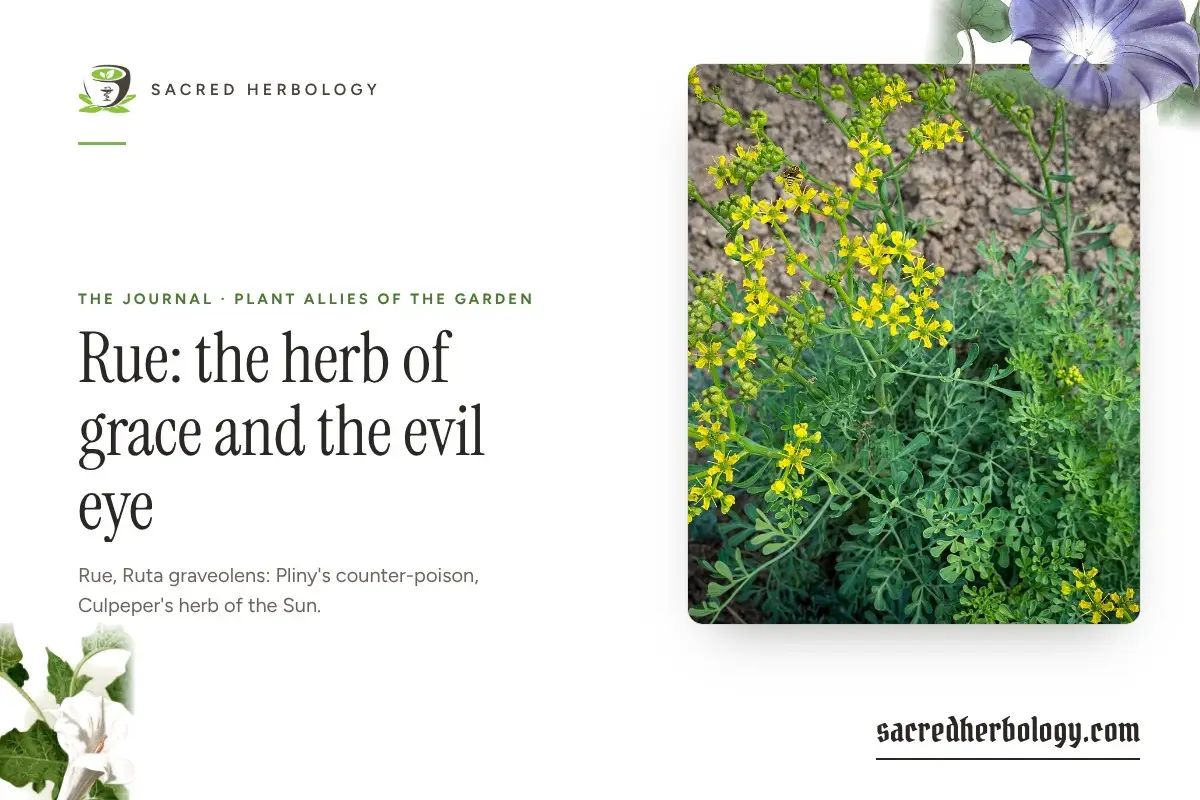

Roll a rue leaf between your finger and thumb and you will still smell it at dinner. The plant is a low, woody, evergreen shrub, half a metre to a metre high, blue-grey all over, with small spoon-shaped leaflets and mustard-yellow flowers in summer, and its smell is bitter, oily and faintly burnt, like citrus peel left on a hotplate. Some people love it. A good many can’t stand it, and the Latin name says as much: Ruta graveolens, rue the heavy-smelling. Most of that smell is one compound, a ketone called 2-undecanone, or methyl nonyl ketone in the older books. It is usually the biggest single thing in the leaf’s volatile oil, and in oil from some crops it is very nearly all of it.
Hold a leaf up to the light and you will see the oil glands as little translucent dots. That is a family trait. Rue belongs to the Rutaceae, the citrus family, which takes its name from this very plant, and the family is well represented in Australia by the finger lime Citrus australasica (older labels say Microcitrus australasica), the boronias, and the wilga Geijera parviflora. Rue itself is native to a surprisingly small patch of ground, the northern Balkan peninsula east to Crimea, and gardeners have carried it out of that patch for so long that the wild edge of its range is now hard to draw. Old herbals and old nursery labels call it Ruta hortensis, garden rue, which is the same plant under a name botany has retired.
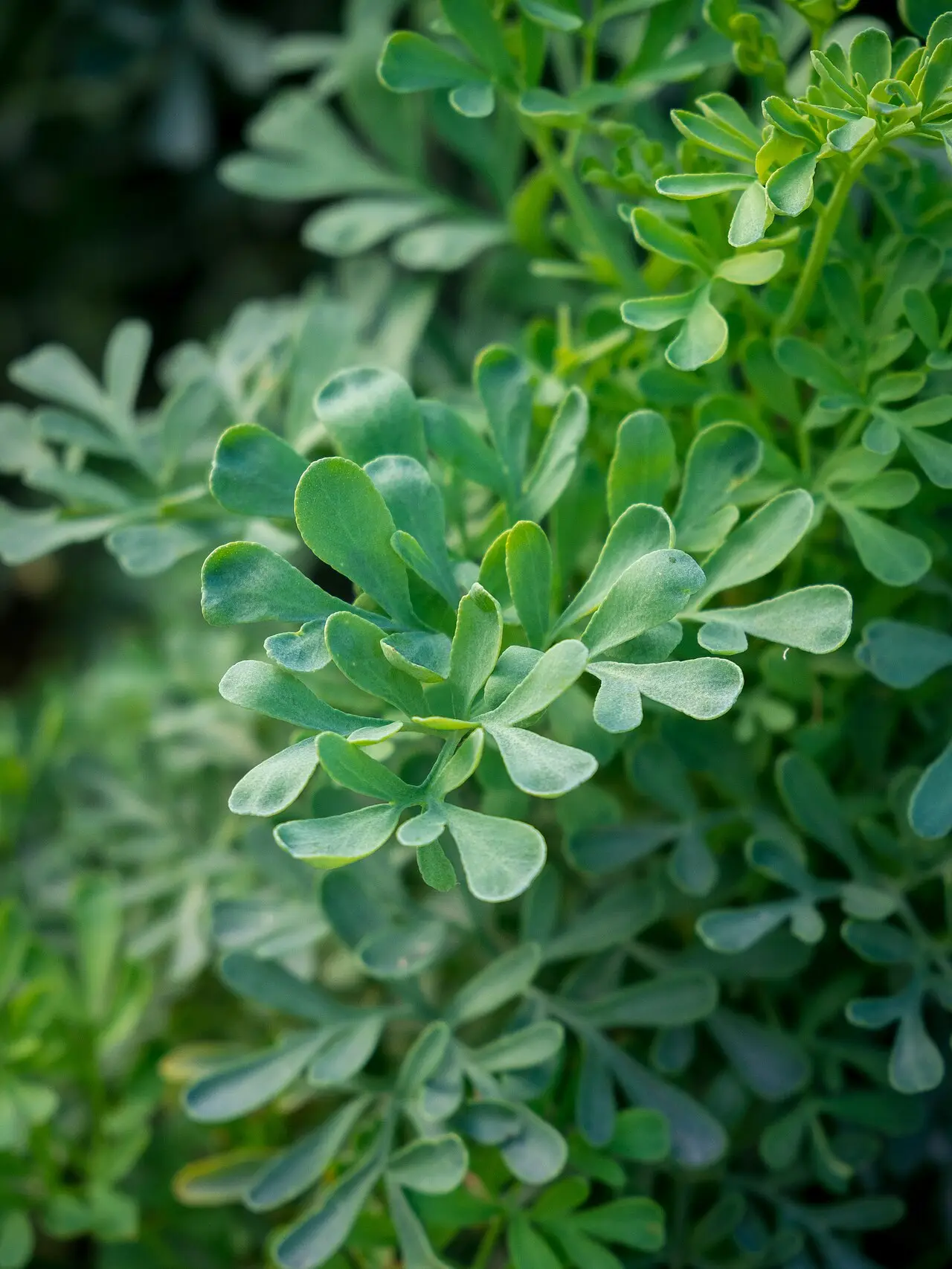

The part with the history attached is the leaf: leaves and young leafy shoots, fresh or dried. Seed and a steam-distilled oil turn up in the record as well. The leaf also gave chemistry a word: rutin, the flavonoid first isolated from this plant in the nineteenth century, is named after Ruta. The name is about all rue contributes to it now, since the rutin in commerce comes from buckwheat and citrus peel.
One piece of housekeeping before we start. Syrian rue is Peganum harmala, a semi-desert plant of a different family altogether, the Nitrariaceae, which older books file under the Zygophyllaceae. Its genus name comes from peganon, the ordinary ancient Greek word for our rue, and it was given that name because it looked a little like it. Different plant, different chemistry, different history: Peganum harmala seed carries the beta-carboline alkaloids harmine and harmaline, which have no counterpart in our rue at all. When you meet “rue” in a Persian or Central Asian source, check which one is meant. Of the two, it is also the one with an Australian weed record: Peganum harmala has naturalised in the drier country of south-eastern South Australia, with scattered records from Victoria and New South Wales, and it is a declared plant in Western Australia.
While we are sorting names, three other garden plants carry the word rue and have nothing to do with it. Meadow rue is Thalictrum, a buttercup relation. Goat’s rue is Galega officinalis, a legume, and a weed of damp ground in parts of southern Australia. Wall rue is a little fern, Asplenium ruta-muraria. Each was named for a passing likeness in the leaf.
Inside the genus there is one real look-alike. Fringed rue, Ruta chalepensis, of the Mediterranean and North Africa, gets sold under the same common name and passes for ours until it flowers: its petals carry a long fringe of hairs along the edge, where Ruta graveolens has plain, slightly wavy ones. It behaves the same way in the garden and the same way on skin, so nothing further down this page changes if that is what you have. While you are looking at the flowers, count the petals: the first one to open in the middle of each cluster has five, and every flower after it has four. That is a genus habit, and a quick way to know you have a Ruta at all. The wild or mountain rue that Pliny and Dioscorides set apart from the garden kind was most likely one of these other species, R. chalepensis or R. montana, so the fiercer plant of the ancient books may be a different species altogether.
“Among our chief medicinal plants is rue”
That sentence opens the rue chapter of Pliny the Elder’s Natural History, book 20, where he counts eighty-four uses for it. Pliny distinguishes the cultivated kind, with wider leaves and bushier growth, from a harsher wild kind. He passes on a great deal that is worth knowing about how a first-century Roman saw this plant.
Snakes, he says, avoid the fumes of burning rue, and weasels about to fight a serpent first protect themselves by eating it. The weasel was already an old story when Pliny told it. Aristotle has it in book 9 of his History of Animals, four centuries earlier: when the weasel fights a snake it first eats rue, because the smell of rue is hateful to snakes. Aristotle files it beside the tortoise that eats marjoram after swallowing a viper, in a run of observations about animals that seem to know their own remedies. From Aristotle to Pliny, and from Pliny into the medieval books of nature that copied him, the weasel kept its rue for well over a thousand years, and it is the first appearance of the idea this whole piece turns on: rue as a guard against something venomous that you can’t see coming.
Pliny records that Pythagoras divided rue into a male form with smaller, grass-green leaves and a female form with more luxuriant growth, and that Pythagoras thought it bad for the eyes. Pliny contradicts him: engravers and painters eat rue with bread or cress for the sake of their eyes, and wild goats are said to eat it to sharpen their sight.
Then comes the line I find most useful of all. Pliny writes that hemlock juice is good for the hands and face of those who gather rue, “so there are actually poisons of poisons”. Read that carefully. Roman rue-gatherers were coming away from the harvest with damaged hands and faces, often enough that the literature carried a remedy for it. Pliny had no idea why. We do, and I will come back to it at the foot of this piece, because it is the one thing every grower of rue has to know. The hemlock, in case it needs saying, is a deadly plant in its own right. That is a Roman remedy recorded, and nobody should be copying it.
Dioscorides covers the same ground in book 3 of De materia medica, treating garden rue and mountain rue separately and warning that the wild kind is the fiercer.
The king’s pocket antidote
Rue’s oldest job in the written record is as a counter-poison. Pliny tells the story in book 23. When Pompey defeated Mithridates VI of Pontus, the king’s private papers were searched, and among them was a short antidote against poison in his own hand, made of kitchen things: walnuts, dried figs and rue leaves, with a grain of salt. Pliny’s Latin for that last item, addito salis grano, is where English gets the phrase “with a grain of salt”.
Sixteen hundred years later Nicholas Culpeper was still printing it. In The English Physitian of 1652 he gives Mithridates’ antidote under Garden Rue, adds juniper berries to it, and then goes out of his way to defend the king’s reputation against the old charge that he hardened his body with poisons. Culpeper is blunt about the plant elsewhere too: writing about basil he remarks that basil and rue will not grow near one another, and that “Rue is as great an enemy to Poyson as any grows”. The first of those is a garden belief I can’t vouch for. The second is the whole tradition in one line.
I set the Mithridates antidote out as history, and I leave out how it was made. Nobody should be making it. And the reputation has no chemistry under it: rue’s constituents have been catalogued for a century and a half, and not one of them neutralises a poison.
Sage first, rue second
Rue is one of the plants European monasticism took seriously. Charlemagne’s Capitulare de villis, the ordinance regulating his royal estates from around the year 800, lists in its seventieth chapter the plants every imperial garden was to grow, something like ninety of them, and rutam is on the list.
Forty years later, Walahfrid Strabo, a monk of Reichenau on Lake Constance, wrote a poem about his own garden. The Hortulus runs to twenty-four short sections. The first is about gardening itself, the second is sage, the third is rue, and the last is the rose. Strabo’s rue is a small blue-green thicket that paints the shaded garden, with little leaves and short umbels that let the wind and the rays of Phoebus through to the lowest stems, and that scatters heavy scents at the lightest touch. Anyone who has brushed past a rue bush knows exactly what he means.
Then he gives the plant its reputation: rue stands above all against occultis venenis, hidden poisons.
Hidden poisons. Hold onto that phrase, because it takes you straight into the other half of rue’s history.
Herb of grace
By Culpeper’s day the plant had a second name that needed no explanation. His entry begins: “GARDEN RUE. This is so well known, both by this name, and the Name Herb of Grace, that I shal not need to write you any further Description of it.”
Shakespeare had used it half a century earlier, and more than once. In Hamlet, act 4 scene 5, Ophelia hands the plant round in her mad scene: “There’s rue for you; and here’s some for me: we may call it herb of grace o’ Sundays. O, you must wear your rue with a difference.” That last phrase is heraldry. A “difference” was the small mark added to a coat of arms so that a younger son could bear his father’s shield and still be told apart from his elder brother. Ophelia is saying that she and the woman she hands the rue to (the Queen, in most productions) both have cause for sorrow, and that each must wear it in her own way. Her audience knew the language of the herald’s office well enough to catch the joke in the middle of the grief.
Rue had turned up in the history plays before that. In Richard II, act 3 scene 4, a gardener at Langley overhears the Queen weep at the news of her husband’s fall, and when she has gone he marks the spot:
“Here did she fall a tear; here in this place I’ll set a bank of rue, sour herb of grace: Rue, even for ruth, here shortly shall be seen, In the remembrance of a weeping queen.”
Sour herb, herb of grace, and ruth, which is pity: three meanings stacked into four lines by a man who knew his plants. Then in The Winter’s Tale, act 4 scene 4, Perdita at the sheep-shearing feast hands out flowers by age, and gives the two old men rosemary and rue, “these keep / Seeming and savour all the winter long: / Grace and remembrance be to you both.” That is the plain gardener’s reason behind the poetry. Rue is evergreen, it holds its colour and its smell through a frost, and so it stood for things that last. By 1600 an English audience could be handed a sprig of rue on stage and read three or four meanings off it without a note in the programme.
Milton gave rue the other job. In book 11 of Paradise Lost, the archangel Michael clears the film from Adam’s eyes and purges his visual nerve with “euphrasy and rue” before showing him what is to come. Eyebright, Euphrasia officinalis, and rue, the two sight herbs, given to a man who has a great deal to see. (Australia has native Euphrasia species of its own, and none of them is the eyebright of the herbals.) And rue has one appearance in the gospels, at Luke 11:42, where the Pharisees are reproached for tithing mint and rue and every herb.
That verse has a small puzzle in it that I enjoy. Matthew tells the same saying at 23:23, and his list is mint, dill and cumin: no rue. And the Mishnah, the code of Jewish law written down around the year 200, says in tractate Shebiith, chapter 9, that rue was one of the plants exempt from tithes altogether, along with goosefoot, purslane and a few others, because, in the Mishnah’s words, “their like is not cultivated”: rue was treated as a plant that came up on its own. So in Luke’s version the Pharisees are tithing a herb the law did not ask them to tithe, which sharpens the reproach considerably: they are being scrupulous past the letter of the law over a pot herb while neglecting justice. Whether Luke meant it that way or simply had a different list in front of him is a question the commentators have argued over for a long time, and I leave it with them. What the Mishnah does tell us is that rue was common enough in Roman Palestine to grow on its own around the villages.
The usual explanation for “herb of grace” is that priests once sprinkled holy water with a brush of rue before High Mass, which made it the herb of repentance and so the herb of grace. That story is repeated all through the twentieth-century herb books. I have looked for it in a source contemporary with Shakespeare or Culpeper and haven’t found one, so I would treat it as a later guess about a name that was already old.
There is also a coincidence of English worth knowing. The verb “to rue”, meaning to regret, is a native English word from Old English hreow, grief. The plant name arrived separately in the late fourteenth century through Old French from Latin ruta. They are two different words that happen to sound the same. Ophelia’s pun works in English and in no other language, and none of it tells us anything about the plant.
A chaplet of rue on a king’s shield
Ophelia’s heraldic joke has a real coat of arms to go with it. The arms of Saxony are ten horizontal stripes of gold and black, and laid diagonally across them is a narrow green band edged with leaves. In German it is the Rautenkranz, the garland or crown of rue; English heralds call it a crancelin. It goes back to the Ascanian dukes who took Saxony in the late twelfth century, and it is still on the arms of the Free State of Saxony today.
Whether the green band was ever meant to be rue is another matter. Heraldists have read it as a ducal coronet laid aslant, as a plain garland, and as a decorative border that grew leaves over time. The story told to explain it is that the emperor Frederick Barbarossa, investing Bernhard of Anhalt with the duchy in 1180, took the chaplet of rue from his own head and threw it across Bernhard’s striped shield. That is a legend, and a later one, told to explain a device that already existed. The name stuck all the same. In 1807 Frederick Augustus I, newly made King of Saxony, founded a royal order of chivalry and called it the Order of the Rue Crown.
The chaplet then travelled further than anyone might expect. The dukes of Saxe-Coburg and Gotha carried the Saxon shield, and when Prince Albert married Queen Victoria in 1840, the green crancelin came with him into the arms of the British royal family: his children bore a small shield of Saxony at the centre of the royal arms until George V gave up the German titles in 1917. For three generations, then, a heraldic garland of rue, or something the heralds had decided to call one, sat in the middle of the arms of the British royal family.
Rue in the dock
The idea of rue against hidden poison came back to London in the eighteenth century in a new form. In May 1750 the sessions at the Old Bailey, the criminal court beside Newgate Prison, were struck by gaol fever, which we now know as epidemic typhus, carried by the lice of prisoners packed into cells beside the court. Walter Thornbury, in Old and New London (1878), describes around a hundred prisoners held in two rooms about fourteen feet by eleven, brought up into a crowded, overheated courtroom. The fever went out through the court. Among the dead were the Lord Mayor, Sir Samuel Pennant, two of the judges, members of the bar and several of the jury.
Nobody in 1750 knew about lice. What they believed was that the fever travelled on the foul air of the gaol, and they reached for the plants Europe had always reached for against things that could not be seen. Thornbury records that after the outbreak “the custom arose of placing rue in front of the dock of the Old Bailey to prevent infection”, and he names his source for it, Frederick Lawrence’s Life of Henry Fielding of 1855. Fielding sat as a magistrate at Bow Street in those very years, which is why his biographer took an interest. The custom of sweet herbs on the bench and a posy of flowers for the judge outlived the fear of fever by a long way: the judges at the Old Bailey still carry posies on certain ceremonial days in the summer sittings.
It is the same thread again. The weasel’s rue against the snake, the king’s rue against the poisoned cup, the monk’s rue against hidden poisons, and now a sprig of rue on the rail of the dock against an infection nobody could see. The rue did nothing to the lice. But you can watch the old reputation move from one invisible danger to the next.
The sprig of rue against the evil eye
Now the folklore, and it is folklore in the strict sense: household custom, handed on by doing, with no book behind it. This is village practice, and I keep it firmly separate from the learned magic further down.
In nineteenth-century Naples, infants wore a silver charm called the cimaruta, from cima di ruta, a sprig of rue. Frederick Thomas Elworthy devoted a chapter of The Evil Eye (1895) to it, and says that among all the writers on Neapolitan superstition he could find only one who had described it before him: Eustace Neville-Rolfe, in Naples in 1888. Elworthy thought it had been overlooked because it was so ordinary: as common on Neapolitan babies, he says, as coral and bells had been on English ones.
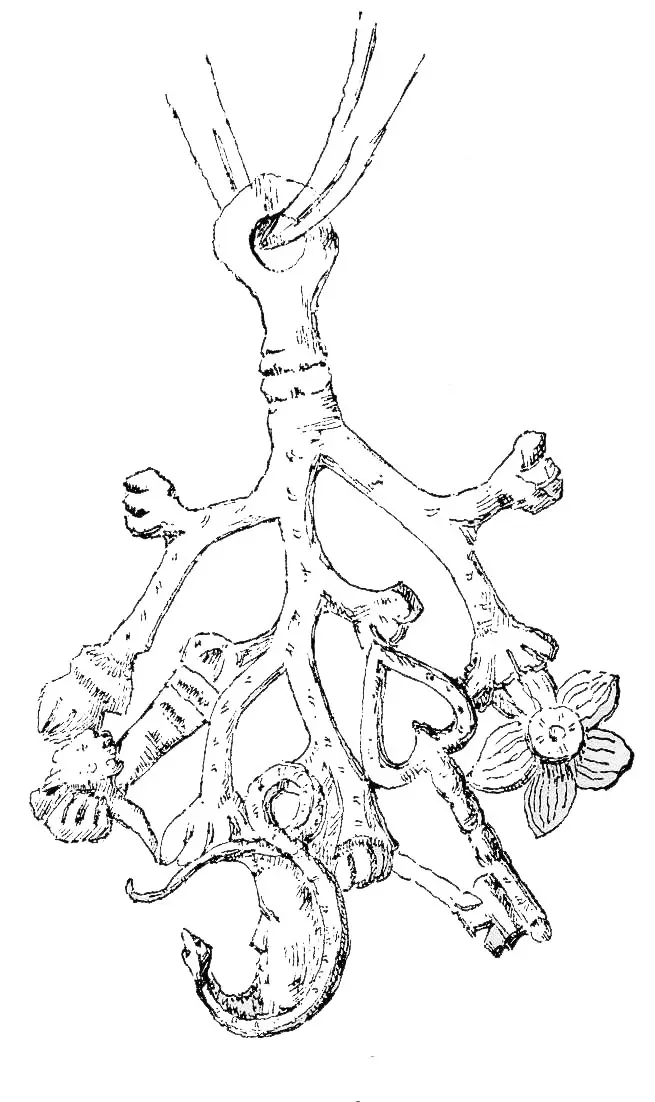

What he records about the objects themselves is solid, because he collected them:
- The charm is always silver, and always hallmarked. “Without this the poorest will not have it.”
- Every specimen in his collection is different from every other, though all follow the same plan: a branching sprig of rue with small charms hung on the tips.
- He lists thirteen separate charms found across his examples, any one of which on its own was reckoned a guard against the evil eye: rue, Diana Triformis, silver, the hand, the horned crescent, the serpent, the key, the heart, the cock, the eagle, the sword or dart, the fish, and the lotus.
Elworthy’s reading of all this is that nearly every element goes back to Diana, goddess of infants, still honoured in Naples under the name of the Madonna. He builds the case out of Montfaucon and Payne Knight and the comparative mythology of his own century, and he is honest enough to leave his weakest evidence in plain view: he can find no notice of the charm anywhere in Roman or medieval times, and no museum example except a single small Etruscan bronze in Bologna. From that one object he concludes “an Etruscan or early Phoenician origin”.
I would keep the collection and set the theory aside as his own interpretation. What the objects prove is that in nineteenth-century Naples people pinned a silver sprig of rue to their babies, and that the plant’s old reputation against hidden poisons had turned into a reputation against a hidden look. Modern cimaruta are still cast, and various witchcraft readings have been attached to them by esoteric writers from the 1990s onward. Those readings are recent, and should be dated as recent.
Ruda, rue in Mexico
Rue crossed the Atlantic with the Spanish and stayed. In Mexican and Mexican American folk healing, as recorded by Robert Trotter and Juan Antonio Chavira in Curanderismo from their apprenticeships with practising curanderos, ruda is among the plants used in connection with mal de ojo, the evil eye, along with susto and empacho, and a bunch of it is swept over the body in a limpia, a cleansing. Mexican writers often connect the sweeping motion back to the priest’s aspersion at Mass. That is an explanation offered for a custom, and I report it as that.
I’ll go no further than the published record does here, and I’d say the same to anyone who wants to work with these traditions: read the people who wrote them down with permission, and leave the rest alone.
What the astrologers did with it
This part is learned magic and astrological medicine, which I label esoteric and keep apart from the Neapolitan charm above. The two borrowed from each other over the centuries; they are separate traditions with separate histories.
Culpeper is the clearest. At the end of his rue entry he tells the reader that the whole thing only works if you “consider that Rue is an Herb of the Sun and under Leo, and gather it and the rest accordingly”. Sun in Leo. Gathered at the right hour.
The medieval astral-magic compilers, working from Arabic sources, had put rue somewhere else entirely: with Saturn, among the bitter, dark, earthy herbs, on the logic of taste and temperament. Modern correspondence tables will often hand you Mars instead, usually with no source and no date attached.
Sun, Saturn, Mars. Three learned traditions, three answers, and none of them a secret handed down unbroken from antiquity. These tables are maps of sympathy drawn up by particular men at particular times, and I set them out as what those traditions held. Whether the heavens govern herbs is a claim I make no judgement on here. If you keep a planetary garden, the useful thing is knowing whose table you are working from and how old it is.
Growing it in an Australian garden
Rue is a dry-hillside plant out of south-eastern Europe and it wants to be treated like one: full sun, lean soil, sharp drainage, and dry feet. It tolerates poor ground and neglect far better than it tolerates kindness.
In the humid tropics the problem is the wet season. Rue will rot at the crown in a humid summer if water sits around it.
- Grow it in a terracotta pot in a gritty, free-draining mix. It leans towards limey ground, so keep it out of an acid, peaty mix, and put the pot where the monsoon rain cannot pour into it: under an eave, on a verandah, against a wall.
- Skip the rich compost and keep heavy mulch away from the stem. Water sparingly, and less again over summer.
- Cut it back hard in late winter to keep it compact and stop it going leggy and woody.
- It grows easily from seed or from cuttings, and self-seeds gently where it is happy.
- Site it away from paths, doorways and anywhere children brush past. Read the next section before you plant it.
Bees work the yellow flowers hard, and the blue-grey foliage sits well next to almost anything.
Nothing on the biosecurity side stands in your way. Rue is not prohibited or restricted matter under Queensland’s Biosecurity Act 2014, and I can find no Australian state or territory that declares it. It has barely escaped cultivation here either: the herbarium and survey records come to a handful of plants in Victoria, New South Wales and Tasmania, and none from Queensland. It does self-seed around the pot, so pull the strays while they are small if you would sooner not have them.
Handling it safely
This is the part that matters most, and it is the answer to Pliny’s damaged rue-gatherers.
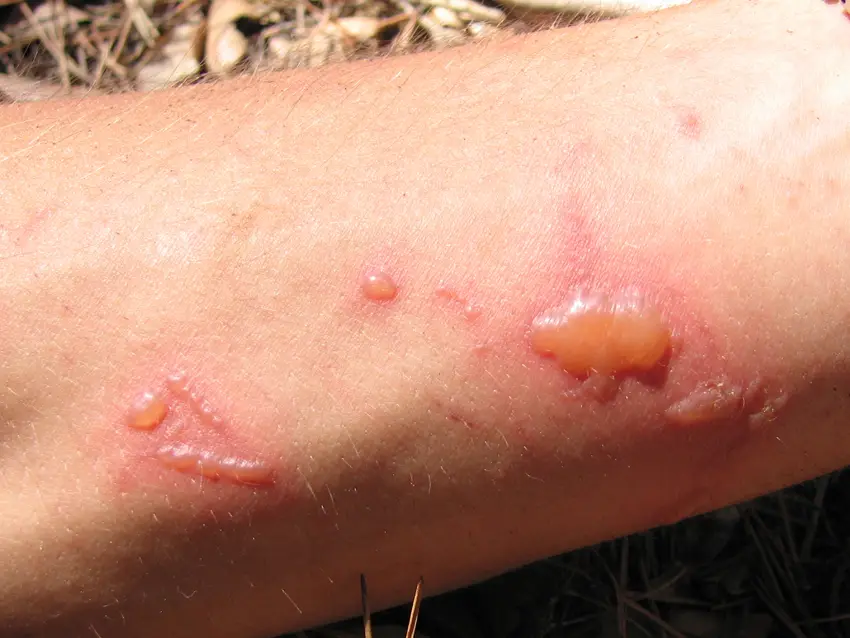
Rue’s leaves carry furanocoumarins, among them bergapten and xanthotoxin, which you will also meet written as 5-methoxypsoralen and 8-methoxypsoralen; psoralen and isopimpinellin sit alongside them. The second of the two is a pharmaceutical in its own right, given in skin clinics for the very property that makes rue dangerous in a garden: it makes skin react to ultraviolet light. In the dark these compounds do very little. What wakes them up is the ultraviolet A in daylight, and then, on skin, they cause phytophotodermatitis: redness first, and in bad cases blistering that looks like a burn and behaves like one, often in a streaky pattern showing exactly where the leaves swept across you. David Hoffmann, in Medical Herbalism, puts contact with rue among the commonest causes of plant phototoxic reactions in Europe, and notes the same streaky pattern where rue has been put on skin as an insect repellent and the skin then exposed to sun. The damage needs both the plant and the light, which is why it can catch you hours after the gardening is done. Ultraviolet A is the part of daylight that comes through cloud and through window glass, so a grey sky and a drive home give less cover than they feel like.
So, in practice:
- Gloves and long sleeves whenever you prune, weed around or harvest rue. Prune in the evening if you can, and treat an overcast day as thin cover.
- Wash hands, forearms and any tools afterwards, keep your hands away from your eyes until they are washed, and keep the sap off children.
- If rue sap has been on your skin, keep that skin covered and out of the sun for a day or two.
- If the skin does blister, cool it under running water, leave the blisters alone and keep it out of the sun while it heals. Blistering over a wide area needs to be seen in person, the same as any other burn that size.
- Don’t burn it to scent a room. Pliny’s snakes aside, the smoke of a plant this pungent is an irritant, and breathing it in a closed space is worse again for children, for anyone with asthma or another chest condition, and for pet birds.
And on taking it, plainly: don’t. The leaf carries more than the furanocoumarins – quinoline alkaloids, skimmianine among them, and the acridone arborinine – and what any of them do inside a person at the quantities once swallowed has never been properly worked out. What we have instead is a record of harm: rue was used historically to bring on a period and to end a pregnancy, and poisonings and deaths are on record from that use. Pliny already wrote that pregnant women must keep rue out of their diet. No part of this plant and no oil made from it belongs in food or drink, and the essential oil should be kept off skin as well as out of mouths. Distilling does not leave the furanocoumarins behind, and the essential-oil safety literature classes rue oil as phototoxic in its own right. Grow it where grazing pets and stock cannot get at it.
If someone has swallowed rue or its oil, ring the Poisons Information Centre on 13 11 26, any hour, anywhere in Australia, and do not try to make them vomit. If they are having a fit, collapsing, struggling to breathe or bleeding heavily, call 000. If a pet has eaten it, ring your vet straight away. For any question about rue and your own body or your medicines, consult a degree-qualified herbalist with competencies and adequate training in pharmacognosy.
What gets sold as rue
Three different things travel under the name, and you need to tell which one is in front of you.
Dried leaf is where quiet substitution sits. Fringed rue, Ruta chalepensis, is told from ours by the fringe on the petal, and once a plant has been cut, dried and broken there is no petal left to look at. The two are sold interchangeably around the Mediterranean, and ruda in a Latin American market may be either. They smell alike and behave alike, so the swap does little beyond making the label wrong, though a supplier who cannot tell you which species is in the bag probably cannot tell you much else about it either.
Seed is where substitution has teeth, and it runs between the two plants that share the name and nothing else. A packet sold as rue, harmal or esfand from a spice stall may be Peganum harmala, carrying the beta-carbolines named above and none of rue’s furanocoumarins. Ask for the botanical name in writing.
Then the oil. Rue oil is distilled in small amounts, the yield running from a fraction of a per cent up to about one and a half per cent of the herb, and its dominant component, 2-undecanone, is manufactured industrially by the tonne for other trades. That is the combination adulteration likes: a scarce natural oil whose main constituent is a cheap synthetic, and a smell the synthetic on its own will very nearly imitate. There is no grading ladder for rue oil of the kind frankincense resin has, no grade name to ask for. What is in the bottle depends on who distilled it, what they distilled – herb or fruit, which give a different balance of ketones – and whether anyone has put it through a gas chromatograph since. Published analyses of honest oil vary enormously on their own account, 2-undecanone anywhere from about 7 to 91 per cent and 2-nonanone from a trace to 60, so a certificate with one tidy number on it tells you less than it looks like it does. None of this is an invitation to go shopping. Nobody should be putting this oil on skin or in a mouth, and a plant in a pot by the door gives you the smell and the story for nothing.
The thread
Two thousand years of writing about one strong-smelling little shrub, and the same idea keeps surfacing. A weasel eats rue before it fights a snake. A king carries rue in his pocket against the cup he can’t test. A monk plants rue third in his garden and says it works against hidden poisons. A London court lays rue along the front of the dock against a fever it cannot see. A Neapolitan silversmith casts a sprig of rue in hallmarked silver and a mother pins it to her baby against a look nobody can prove was given.
The danger changes shape. The plant stays where it is, at the edge of the path, smelling of burnt oranges.
Grow it in a pot by the door for the smell and the story. Just wear the gloves.

Where this comes from
- Pliny the Elder, Natural History, books 20 and 23, trans. W. H. S. Jones, Loeb Classical Library vol. VI (Harvard University Press / Heinemann, 1951).
- Pedanius Dioscorides of Anazarbus, De materia medica, book 3, trans. Lily Y. Beck (Olms-Weidmann, 2005).
- Capitulare de villis, chapter 70, in Monumenta Germaniae Historica, Capitularia regum Francorum I, ed. Alfred Boretius (Hannover, 1883), no. 32.
- Walahfrid Strabo, Hortulus, section III, “Ruta”; English edition trans. Raef Payne with commentary by Wilfrid Blunt (Hunt Botanical Library, Pittsburgh, 1966).
- Nicholas Culpeper, The English Physitian (London, 1652), entries for Garden Rue and Basil.
- William Shakespeare, Hamlet, act 4 scene 5.
- John Milton, Paradise Lost, book 11 (second edition, London, 1674).
- Aristotle, History of Animals, book 9, trans. D’Arcy Wentworth Thompson, in The Works of Aristotle Translated into English, vol. IV (Clarendon Press, Oxford, 1910).
- William Shakespeare, Richard II, act 3 scene 4, and The Winter’s Tale, act 4 scene 4.
- Hamlet, ed. Harold Jenkins, The Arden Shakespeare, second series (Methuen, London, 1982), for the heraldic sense of “difference”.
- Luke 11:42; Matthew 23:23.
- The Mishnah, trans. Herbert Danby (Oxford University Press, 1933), tractate Shebiith 9:1.
- Arthur Charles Fox-Davies, A Complete Guide to Heraldry (T. C. & E. C. Jack, London, 1909), on the crancelin in the arms of Saxony.
- Walter Thornbury, Old and New London, vol. 2 (Cassell, Petter & Galpin, London, 1878), the chapter on the Old Bailey, for the gaol fever of May 1750 and the rue before the dock; Thornbury gives Frederick Lawrence, The Life of Henry Fielding (London, 1855), as his source.
- Frederick Thomas Elworthy, The Evil Eye: An Account of This Ancient and Widespread Superstition (John Murray, London, 1895), chapter 10, “The Cimaruta, Sirene, Tablets”.
- Eustace Neville-Rolfe, Naples in 1888 (Trübner, London, 1888).
- Robert T. Trotter II and Juan Antonio Chavira, Curanderismo: Mexican American Folk Healing (University of Georgia Press, 1981).
- David Hoffmann, Medical Herbalism: The Science and Practice of Herbal Medicine (Healing Arts Press, 2003).
- Robert Tisserand and Rodney Young, Essential Oil Safety: A Guide for Health Care Professionals, 2nd edition (Churchill Livingstone Elsevier, 2014), the rue oil profile, for the phototoxicity classing.
- Lutfun Nahar, Hesham R. El-Seedi, Shaden A. M. Khalifa, Majid Mohammadhosseini and Satyajit D. Sarker, “Ruta Essential Oils: Composition and Bioactivities”, Molecules vol. 26 no. 16 (2021), article 4766, for oil yield and the reported ranges of 2-undecanone and 2-nonanone.
- The Merck Index, 15th edition (Royal Society of Chemistry, Cambridge, 2013), monographs for bergapten, methoxsalen, psoralen, rutin, 2-undecanone, harmine and harmaline.
- Plants of the World Online, Royal Botanic Gardens Kew, entry for Ruta graveolens L., for the accepted name, family, synonymy and native range.
- Atlas of Living Australia, occurrence records for Ruta graveolens, Ruta chalepensis and Peganum harmala.
- Weeds Australia profile, African rue (Peganum harmala), Centre for Invasive Species Solutions.
- Biosecurity Act 2014 (Queensland), and the Queensland Government’s restricted and prohibited invasive plant lists made under it.