The first two people in this series were chemists who borrowed the word alchemist, or had it handed to them. Sasha Shulgin used it about himself half in fun and half in earnest. Albert Hofmann had it pinned on him by admirers, and wore it kindly. The man in this third piece needed nobody to lend him the word. He called himself an alchemist on the title page, taught alchemy in a laboratory he built for the purpose, and spent the last twenty-four years of his life trying to get the old art back into working hands.
His name was Albert Richard Riedel. He signed his books Frater Albertus, and sometimes Albertus Spagyricus, and the small society he founded in Salt Lake City in 1960 trained most of the people who now teach plant alchemy in English. If you have ever read a modern book that talks about drawing the salt, the sulphur and the mercury out of a herb, you have very likely read one of his students, or a student of his students.
This is The Old Books, so a word about labels before we go any further. Alchemy belongs to the learned esoteric tradition of the West. It has its own texts, its own lineages of teachers, its own laboratory practice and its own metaphysics, and I will describe all of those as the tradition holds them. When I say an alchemist believed a plant has a soul that can be separated out in a flask, I am reporting what the alchemist believed. I am not telling you that plants have souls you can bottle. The tradition makes claims about the body and about medicine too, and those I report as history and nothing more. Nothing in this piece is a recipe, and nothing here should be taken as a reason to swallow anything.
Labels aside, it is a good story, and a strange one, and it runs from a Saxon city full of poets to a mountain valley full of Mormons, by way of a Rosicrucian temple in California.
A word about Frater
Start with the name, because it tells you where he came from spiritually before he ever lit a burner.
Frater is Latin for brother. In the Rosicrucian orders and in the magical orders that grew out of them, members take a Latin or Latinised name, a motto, and are addressed as Frater or Soror, brother or sister. The letters F.R.C. that sometimes follow his name on early title pages stand for Frater Rosae Crucis, brother of the Rosy Cross, a style used in the Rosicrucian order he belonged to. Mark Stavish, who wrote a history of alchemy in America in the 1990s, notes that his first publication in 1960 came out under the name Albertus Spagyricus, F.R.C.

Albertus is simply his own first name in Latin dress. It also echoes, whether he meant it to or not, the great medieval Dominican Albertus Magnus, to whom so much alchemical and herbal writing was attached in the Middle Ages. Spagyricus means a practitioner of the spagyric art, which is the old name for plant alchemy and the subject of most of what follows. So the full pen name reads, roughly, Brother Albert the Spagyrist. It is a job description as much as a title.
Students and later writers often call him Dr Riedel or Dr Albert Richard Riedel. I have not found a clear record of where or in what the doctorate was awarded, and I would rather tell you that than guess.
A poet from Dresden
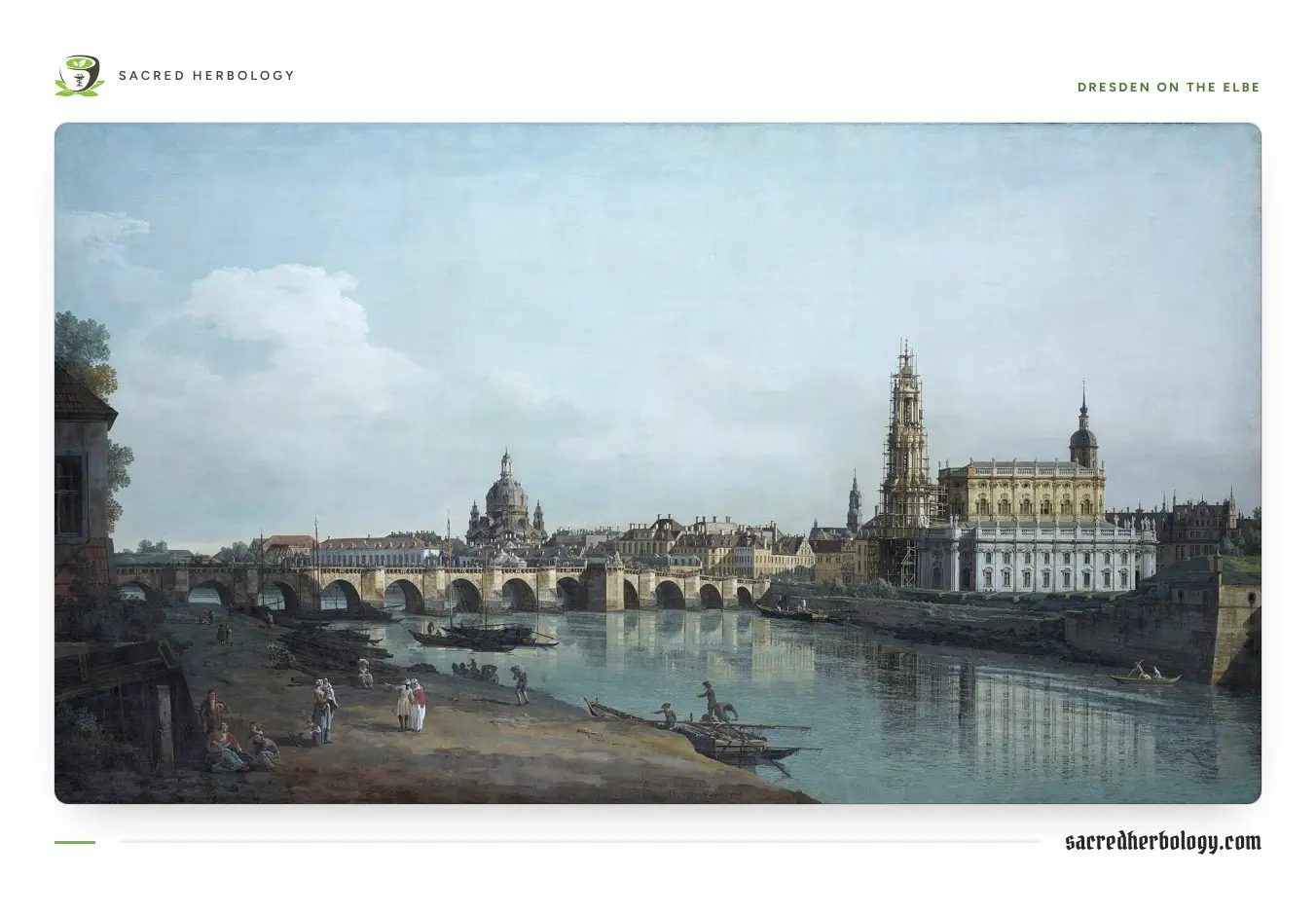
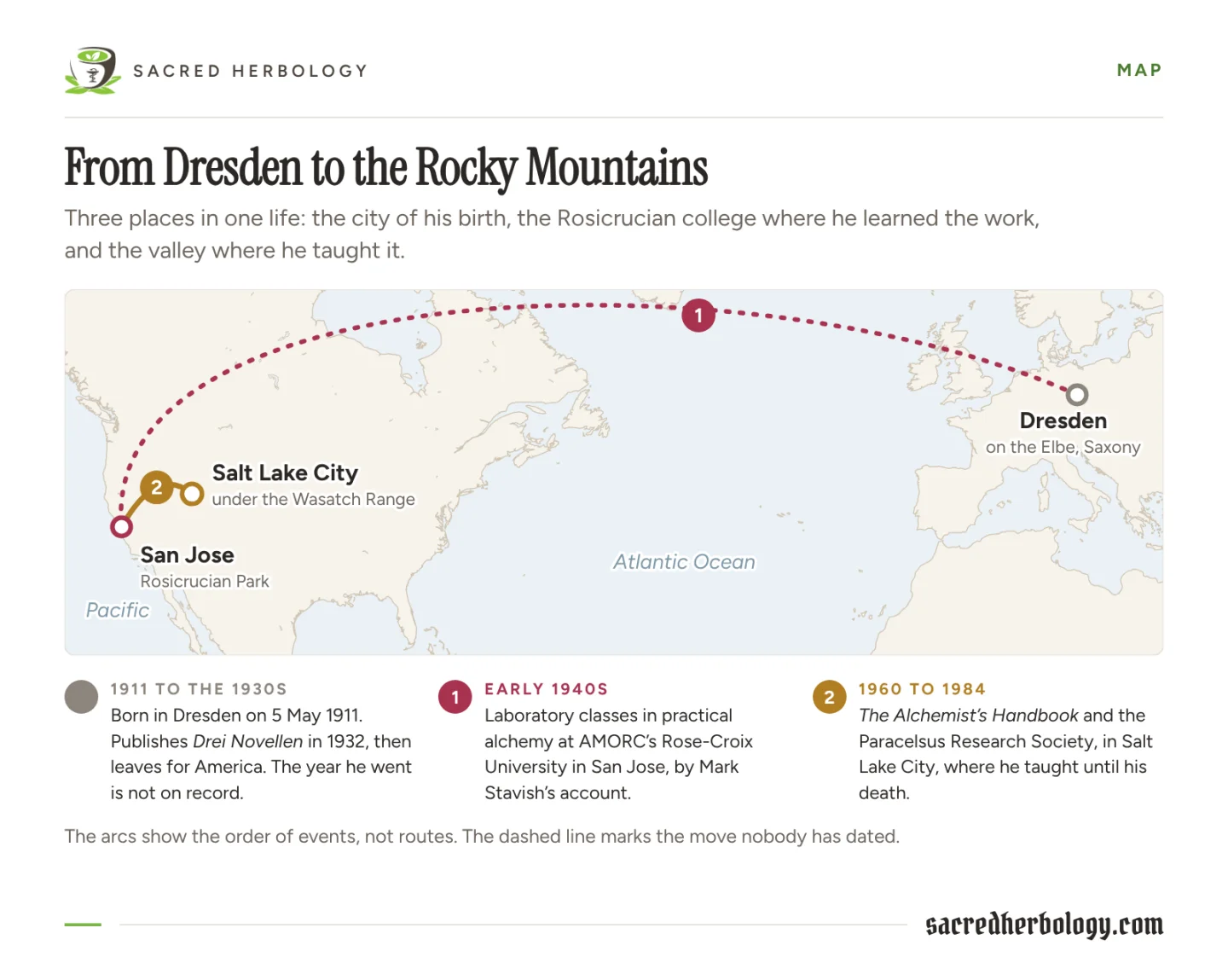
Albert Richard Riedel was born in Dresden on 5 May 1911. The date and place come from the finding aid to his papers held by the University of Utah, and they agree with the other reference sources.
Dresden in 1911 was the capital of the Kingdom of Saxony, a city of baroque churches, porcelain, opera and printers, and a serious centre of German science and engineering. It also had an old connection to the history he would later spend his life on. The Saxon court had employed alchemists, and the most famous product of that employment, European hard-paste porcelain, came out of the work of Johann Friedrich Böttger, a young apothecary’s apprentice who had boasted of making gold and was locked up by Augustus the Strong until he produced something valuable. He produced porcelain instead, early in the eighteenth century, and the Meissen works followed. I mention it because it is the kind of story a boy in Dresden would have grown up hearing, though I have no record that Riedel ever told it about himself.

What we do know about his early years is thin. The bibliographies list two German literary works under his name. The first is Drei Novellen, three novellas, dated 1932, when he was twenty-one. The second is a book of verse called Dachstubenverse eines Ausgewanderten, which translates as something like “attic-room verses of an emigrant”. The bibliographies I have seen do not give it a date. The title alone tells you a good deal: a young German writing poems in an attic room, and already thinking of himself as someone who had left home.
He did leave. He went to the United States, and the sources agree on that much without agreeing on a year. A biographical sketch in Serbian published in 2025 describes the records of his early life and his European years as fragmentary, which matches everything I have found. What the record shows is that by the 1940s he was in America and studying alchemy with a Rosicrucian order, and that by 1960 he was settled in Salt Lake City, Utah.
On a map, this part of the story is two pins and a line between them. One pin in Dresden on the Elbe. The other in the Salt Lake Valley under the Wasatch Range. Somewhere along that line is a young poet who became a laboratory man.
The Rosicrucians of San Jose
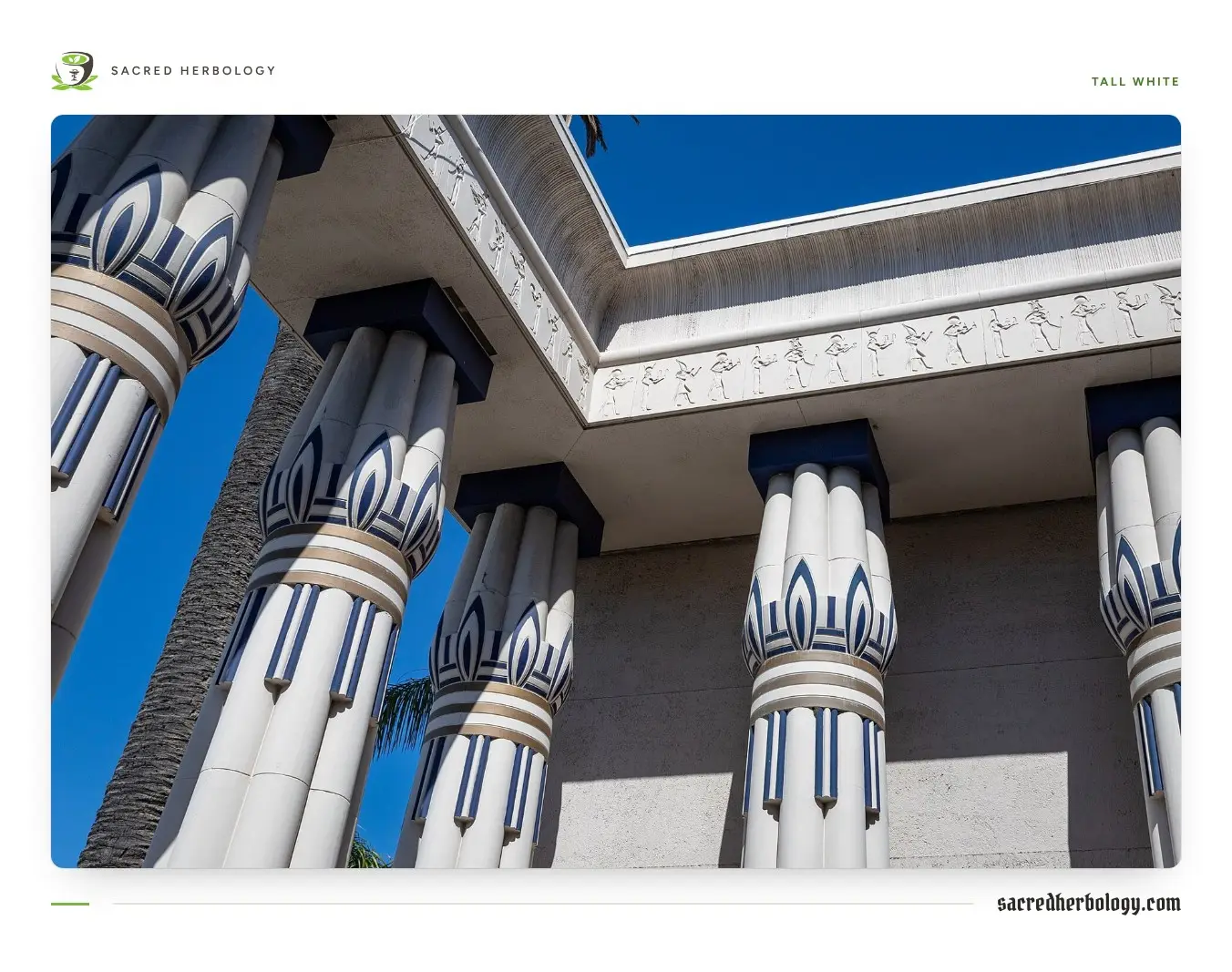
The order in question is AMORC, the Ancient Mystical Order Rosae Crucis. It was founded in New York in 1915 by H. Spencer Lewis and later made its headquarters at Rosicrucian Park in San Jose, California, where it built an Egyptian-style museum and temple and ran a teaching college known as the Rose-Croix University. AMORC is one of several modern bodies that claim descent from, or kinship with, the Rosicrucian brotherhood first announced in the German manifestos printed at Kassel in 1614. Its account of its own ancient lineage is the order’s own; historians treat it as a twentieth-century foundation.
AMORC still exists and still publishes. On its own podcast site it describes Frater Albertus as a long-time member of the order, and in 2013 it posted a recording of the introduction to The Alchemist’s Handbook, which tells you the order still regards him as one of its own.
Alchemy had a place in the AMORC curriculum. The order’s college ran laboratory classes in practical alchemy, and Riedel took them. Stavish, writing from interviews with people who had been in those rooms, says Riedel was at the Rose-Croix University in the early 1940s and attempted a gold transmutation there in 1942 and 1943, which by Stavish’s account partly failed. Another classmate remembered him, in Stavish’s telling, as “a little too complicated for the rest of us”. I pass both of those on as Stavish reports them. They are recollections, gathered decades later, and they are the best we have.
The detail that matters is the shape of his training. He learned alchemy as something done with glass and fire, inside an esoteric order that also taught meditation, symbolism and its own spiritual philosophy. That combination, the laboratory and the inner life held together, is the thing he would later teach. It is also why his school sits where it does in the history of esoteric thought, between the old Rosicrucian and Hermetic current and the practical, hands-on revival of the late twentieth century.
Where the plant work comes from
Before we get to his own book, it helps to know what he was reviving, because the vocabulary he used is four and five hundred years old.
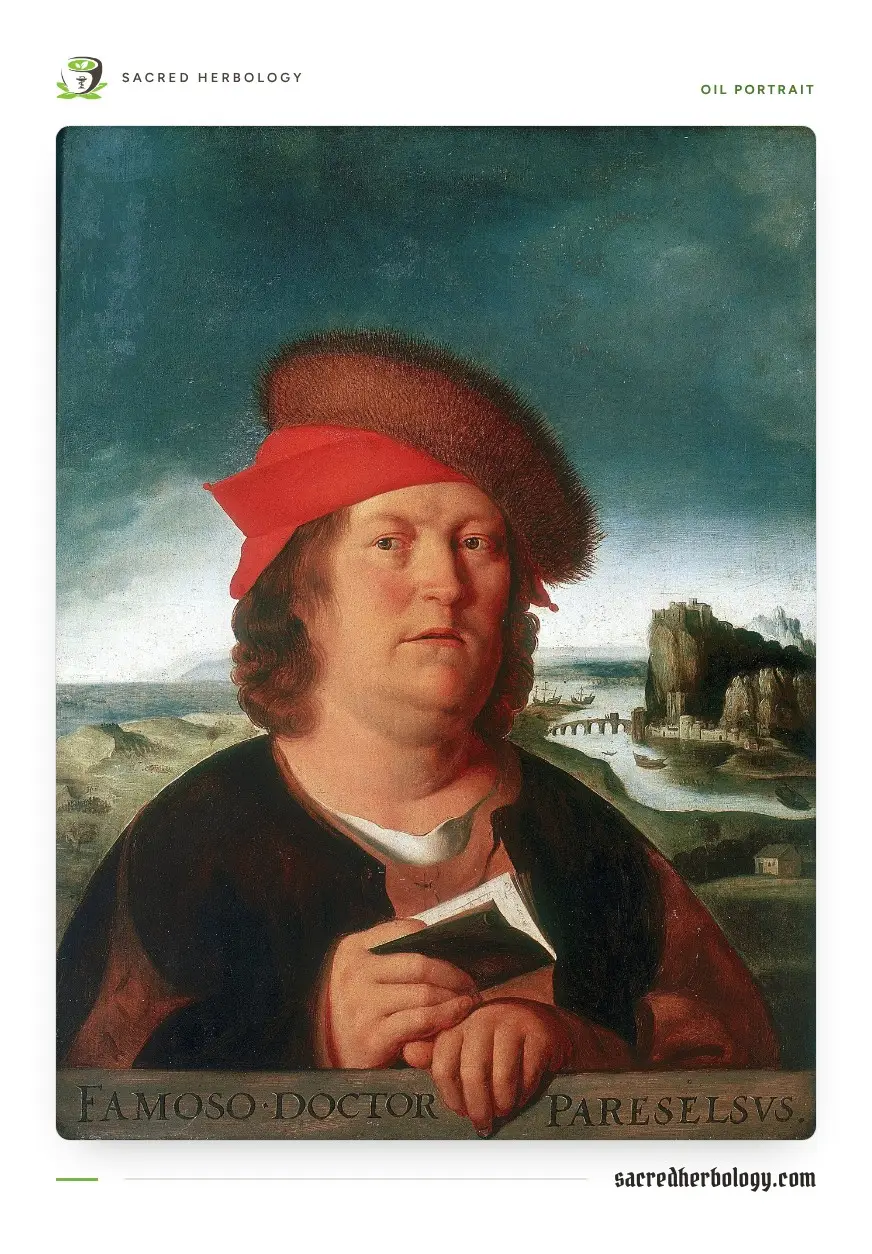
The name to begin with is Paracelsus, the Swiss physician Theophrastus von Hohenheim, who died in Salzburg in 1541. Paracelsus quarrelled with almost every authority of his day and changed the language of medicine and chemistry for two centuries. Two of his ideas are the roots of everything Frater Albertus taught.

The first is the word spagyric. Paracelsus used it for the chemical art as he understood it. Later writers explained it as built from two Greek verbs, one meaning to draw out or separate and one meaning to gather together, so that spagyric means the art of taking apart and putting back together. That derivation is the traditional one and it is how the practitioners explain the word; Paracelsus himself did not leave a tidy definition. The idea behind it is simple to state. You divide a substance into its parts, you clean each part, and you join them again in a purer form. The motto that goes with it, solve et coagula, dissolve and coagulate, became one of the stock phrases of alchemy.
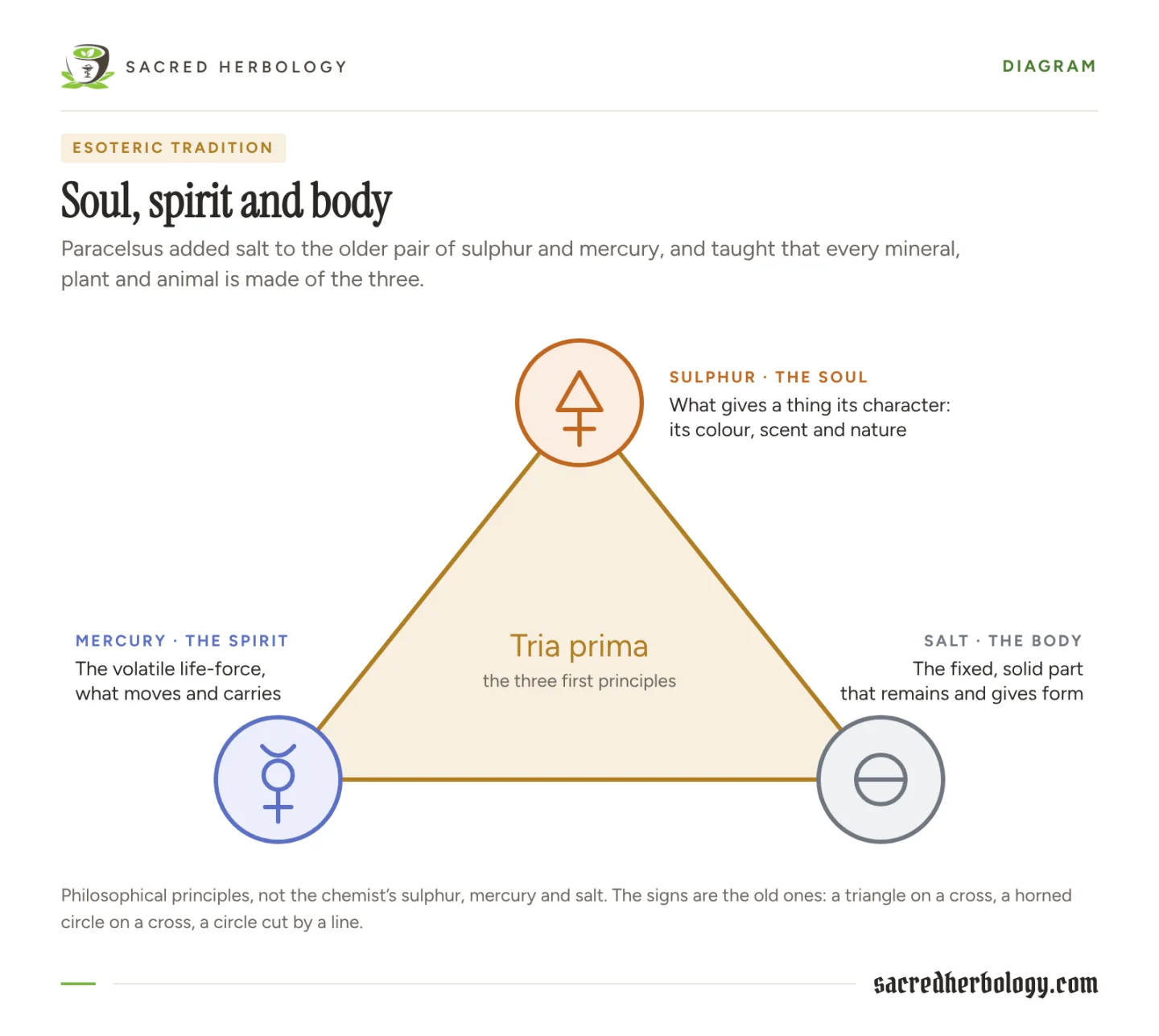
The second idea is the tria prima, the three first principles. Earlier alchemists had worked with two, sulphur and mercury. Paracelsus added a third, salt, and taught that every material thing, mineral, plant or animal, is made of these three in some proportion. The names are not the chemist’s sulphur, mercury and salt. They are philosophical principles, and each stands for something larger:
- Sulphur, the soul: what gives a thing its particular character, its colour, scent and individual nature.
- Mercury, the spirit: the volatile life-force, the thing that moves and carries.
- Salt, the body: the fixed, solid part that remains and gives form.
Set out as a triangle, they put Soul at one point, Spirit at another and Body at the third, with the old symbols beside them: the triangle on a cross for sulphur, the circle with horns and a cross for mercury, and the circle cut by a horizontal line for salt. Almost every modern spagyric book prints some version of that triangle, and Frater Albertus built his teaching on it.
After Paracelsus came the Paracelsians, the generation of physicians and chemists who took his ideas into print and into the pharmacy. Oswald Croll’s Basilica Chymica, printed at Frankfurt in 1609, is a classic of the school. John French’s The Art of Distillation, printed in London in 1651, put a great deal of the practical plant work into English. Johann Rudolf Glauber, in the middle of the seventeenth century, wrote about plant salts at length. Nicaise Le Febvre, who held the post of royal apothecary in France and later went to England, published a big chemistry textbook in 1660 that is still full of the spagyric outlook. These are the old books behind the new one. Frater Albertus did not invent the vocabulary. He picked it up from where the seventeenth century left it, after nearly three hundred years in which chemistry had walked away from it.

1960: the Handbook and the society
In 1960 Riedel did two things at once in Salt Lake City. He published The Alchemist’s Handbook, and he founded the Paracelsus Research Society to teach what was in it. Stavish records that the first publication was accompanied by an “Alchemical Manifesto 1960” announcing the society. The word manifesto is a deliberate echo. The Rosicrucian brotherhood had announced itself to Europe through manifestos in 1614 and 1615, and a Rosicrucian alchemist in 1960 knew exactly what he was doing when he used that word.
Why Salt Lake City? I have found no statement from Riedel himself, and I won’t invent one. What can be said is that he settled there, built his laboratory there, and called a later book The Alchemist of the Rocky Mountains. Utah gave him a base, a mailing address and a valley students could travel to. The rest is guesswork, and I will leave it as such.


The Handbook itself is a short book. The current Weiser edition runs to 160 pages, and the first edition was published by the society. It was revised and enlarged in 1974, with a foreword by Israel Regardie, and the revised text was taken up by Samuel Weiser in New York, who kept it in print for decades. In 2022 Red Wheel/Weiser reissued it in the Weiser Classics series with a new foreword by Robert Allen Bartlett, one of Albertus’s own students. Later editions carry the subtitle Manual for Practical Laboratory Alchemy; I have not been able to confirm that the 1960 first printing carried those words, so treat the subtitle as belonging to the later editions.
The publisher’s description of the book is a fair summary of its contents, and it is worth setting out:
- the basic principles of alchemy, as Albertus understood them;
- a guide to setting up an inexpensive home laboratory, with drawings of the equipment;
- step-by-step directions for what he called the Lesser Circulation, the alchemical work within the plant kingdom.
The book announces its own frame in a phrase from the Emerald Tablet of Hermes, the oldest and most quoted text of the alchemical tradition: as above, so below. And it carries Albertus’s own definition of alchemy, the one line from him that almost everyone has heard. Alchemy, he wrote, is the raising of vibrations.
That definition is worth a moment, because it shows where he stood. Vibration is a twentieth-century word, borrowed from physics and from the language of the Theosophists and New Thought writers who used it freely. You will not find it in Paracelsus. Albertus took the old idea that the alchemist perfects a substance, bringing it closer to its ideal state, and restated it in the scientific-sounding language of his own day. As a historian I would mark that as a modern restatement of the tradition, sincere and characteristic of its time. As a statement about physics it is the tradition’s claim, and physics has never confirmed it.
Opening the secret
The second thing the Handbook did was more important than any definition. It put laboratory instructions in plain print.
Alchemical literature had always been secretive. The old authors wrote in allegory and cipher on purpose, so that only someone who already knew the work, or had a teacher, could follow it. The lion that eats the sun, the king and queen in the bath, the green lion, the black crow: these are code. The modern publisher’s description of the Handbook puts it this way, that the book gives working knowledge once passed down only under an oath of secrecy. That is publisher’s language, and the oath is the tradition’s account of itself, but the point stands. Albertus decided that the basic plant work should be described openly, in modern English, with drawings of the glassware and lists of what to buy, so that an ordinary person could set up a small laboratory and try it.
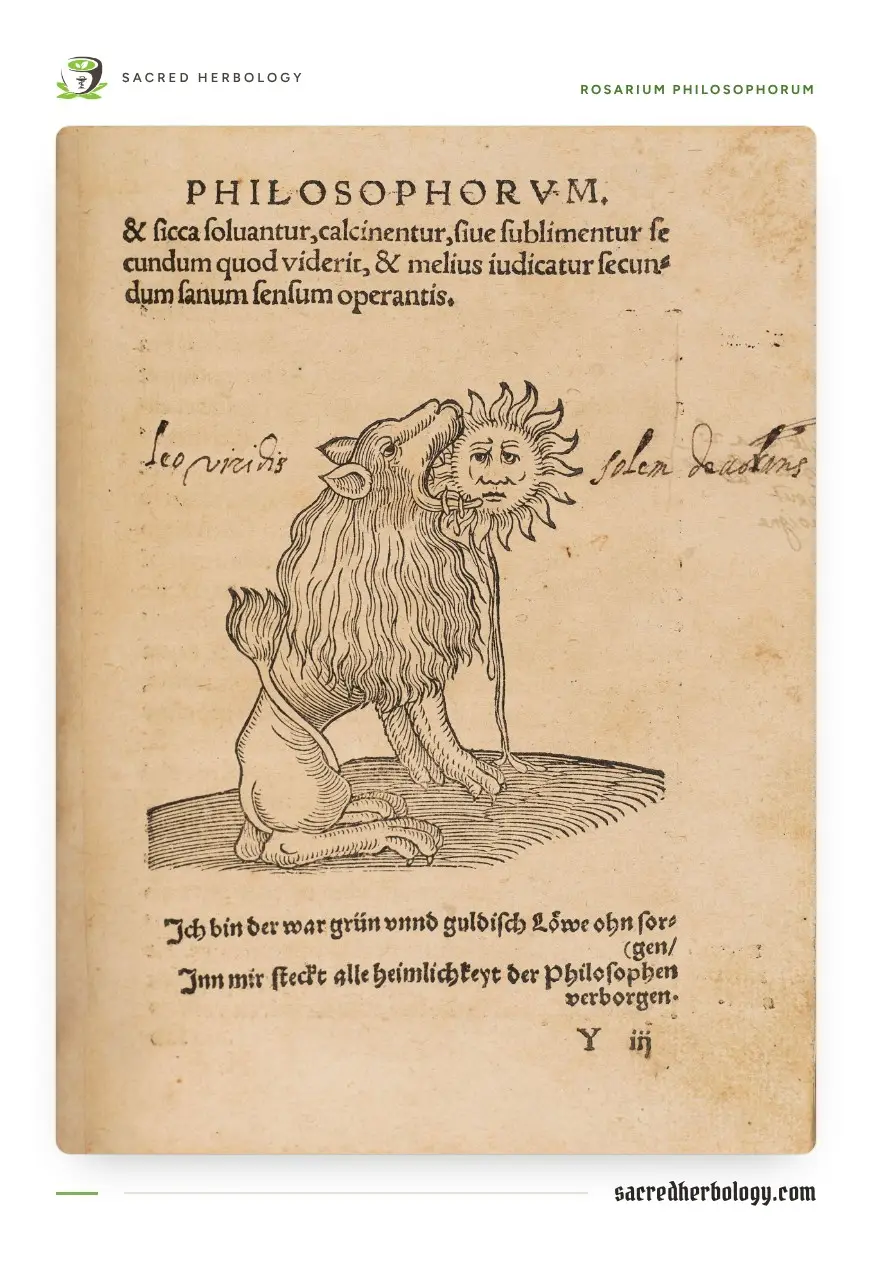

He drew a line around that openness. The plant work was given in full. The mineral and metallic work, the long and hazardous operations with antimony and the metals that lead in the tradition towards the philosopher’s stone, was mentioned and taught in person, in class, to students who had done the plant work first. This was a teaching decision as much as a secret. The mineral work involves toxic and corrosive materials, and the plant work is where a beginner learns to handle fire and glass. It also meant that the Handbook, the book that anyone could buy, became the front door to the school.
I will describe what the plant work is in outline in the next section, because you cannot understand the school without it. I will not describe how to do it. That is the line this Journal keeps for anything that ends up taken internally, and plant alchemy, in the tradition’s own terms, ends in a preparation meant to be taken.
The Lesser Circulation, in outline
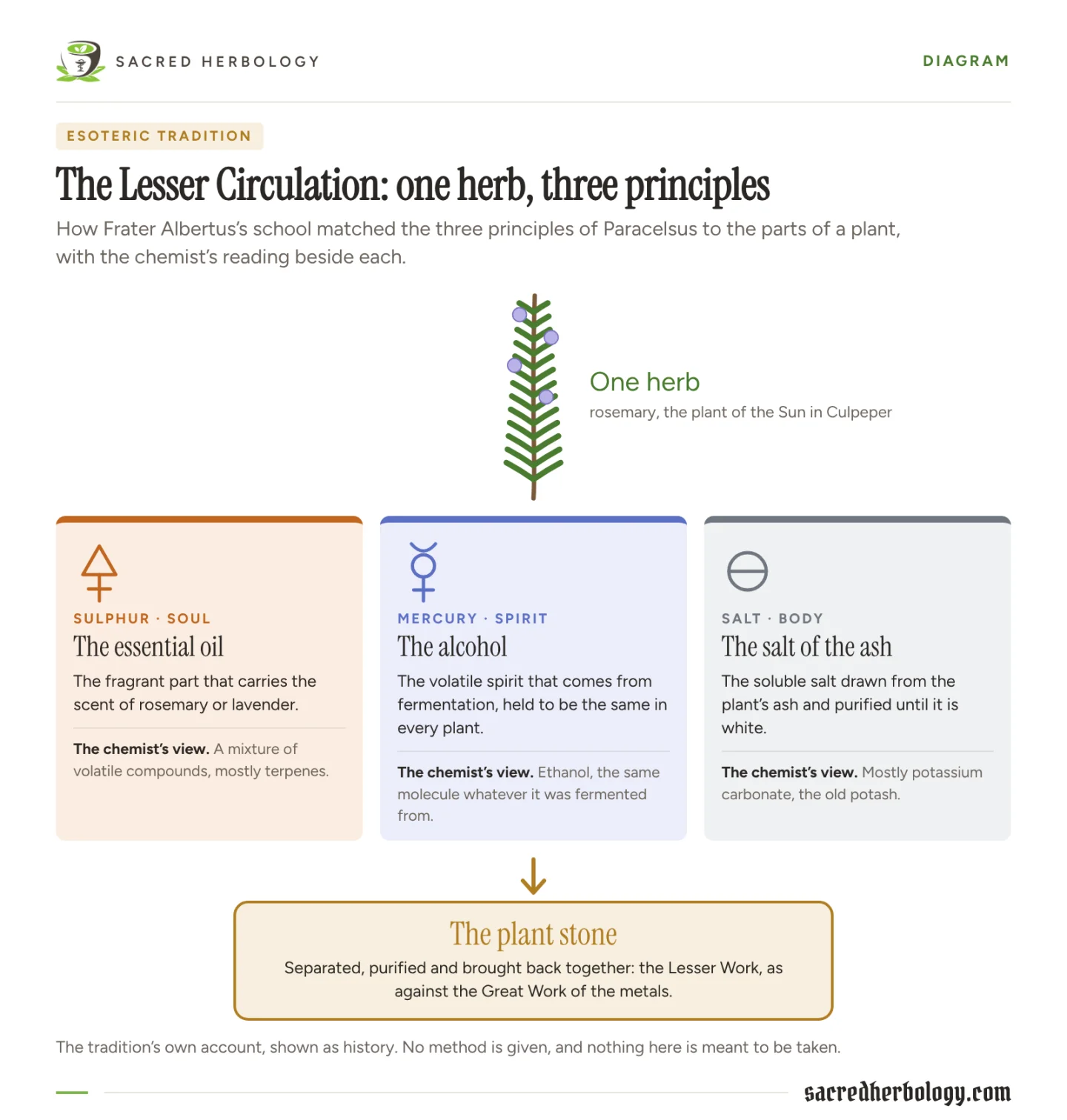
The plant work in the Handbook follows the three principles of Paracelsus. The idea is that a single plant contains its own salt, sulphur and mercury, and that the alchemist can separate them, purify each, and bring them back together in a form the tradition regards as more perfect than the raw herb.
Here is how the tradition matches the three principles to the parts of a plant. Picture a herb with three arrows coming out of it:
- The sulphur, the plant’s soul, is identified with its essential oil, the fragrant, characteristic part that carries the scent of rosemary or lavender. In chemical terms an essential oil is a mixture of volatile compounds, mostly terpenes and their relatives: rosemary oil is rich in 1,8-cineole and camphor, lavender oil in linalool and linalyl acetate. Those proportions shift with the plant’s variety, its growing conditions and the way it was distilled, so two bottles labelled the same can smell quite different. Essential oils are also among the most often adulterated goods in the botanical trade, with lavender oil stretched with cheaper lavandin oil or with synthetic linalool and linalyl acetate, which is why serious buyers have them tested by gas chromatography.
- The mercury, the spirit, is identified with alcohol, the volatile spirit that comes from fermentation. In the tradition all plants share the same mercury, which is why alcohol from any plant can serve. On this one point the chemist agrees: ethanol is the same molecule whatever it was fermented from.
- The salt, the body, is identified with the mineral salts left when the plant matter is burned to ash and the soluble part is drawn out of the ash and purified until it is white. A modern analysis of that white salt finds mostly potassium carbonate, the old potash of the soap-boilers and glassmakers, with smaller amounts of potassium sulphate and chloride and other minerals the plant drew from its soil. The mix varies a little from plant to plant and soil to soil, but the bulk of it is much the same whichever herb was burned.
The full operation, in the tradition’s language, is separation, purification and cohobation. Cohobation is an old chemist’s word for returning a distilled liquid to the residue it came from and distilling again, over and over. The spagyrists use it more broadly for the reuniting of the purified parts. The end product the Handbook builds towards is called a plant stone, a small fixed body in which the purified salt has been made to take up the oil and the spirit. That stone is what the tradition calls the Lesser Work, or the Lesser Circulation, as against the Great Work of the metals.
You can see why the salt fascinated the people who did this. A grey heap of ash, worked patiently, yields a clean white crystalline salt, and to the alchemist that salt is the body of the plant purified, ready to receive its soul again. For a student working in a garage under a single light, watching that happen is the first moment the old books stop being symbols and start being something you have handled. Every account I have read from Albertus’s students mentions it.
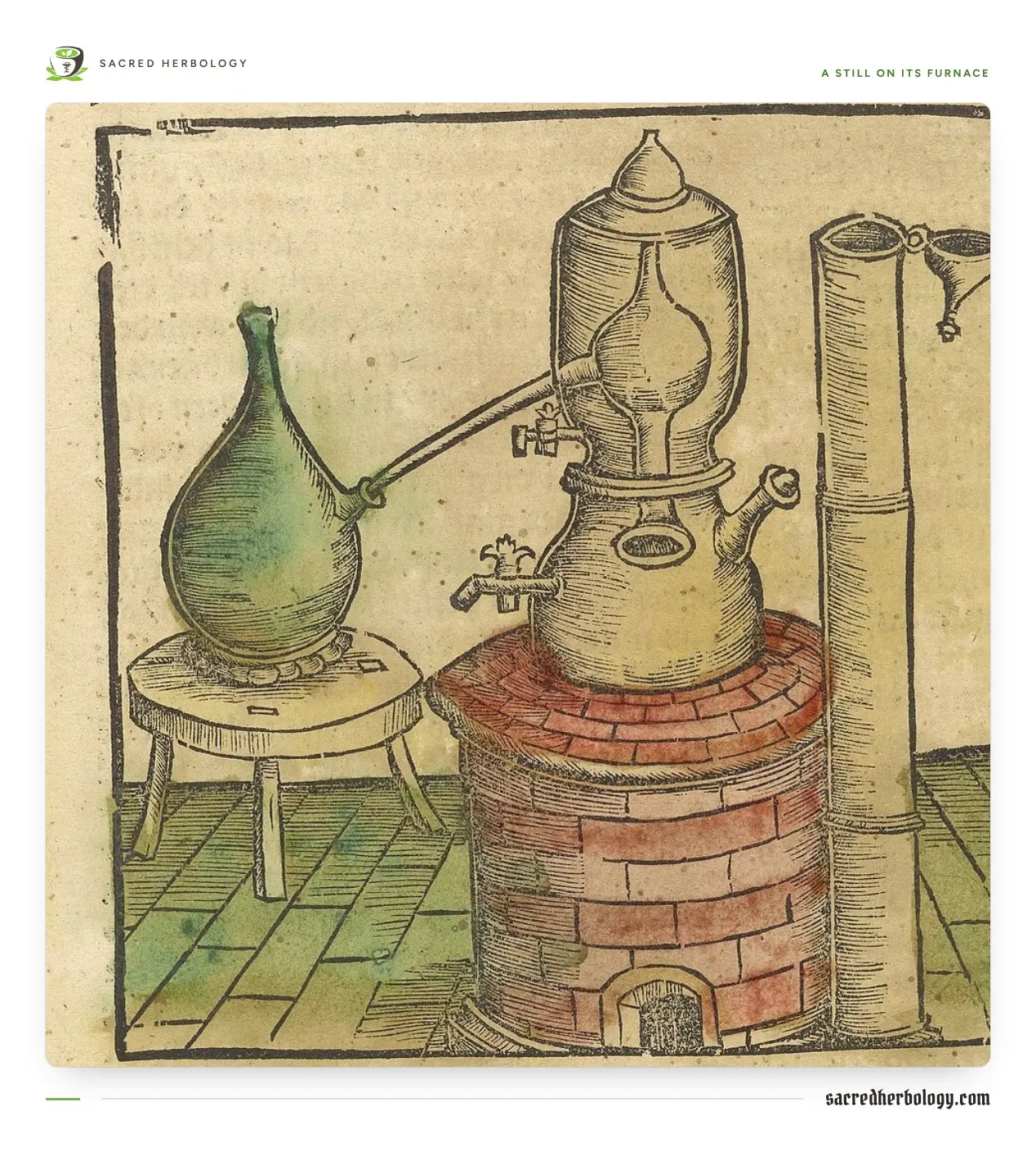
The apparatus deserves a look too, because it is beautiful in its own right and has a long history. The alembic, a pot with a head and a long beak, came into Latin from the Arabic al-anbiq. The retort, the round flask with a long neck bent down to one side, is old too: medieval distillers already used it, and by the seventeenth century it had become the emblem of the chemist’s bench. Albertus’s students also used modern laboratory glass, including the Soxhlet extractor, a device designed by the German chemist Franz von Soxhlet in 1879 that cycles a solvent through plant material again and again. In the eyes of the school that machine is cohobation in glass, and it turns up in almost every modern spagyric laboratory.
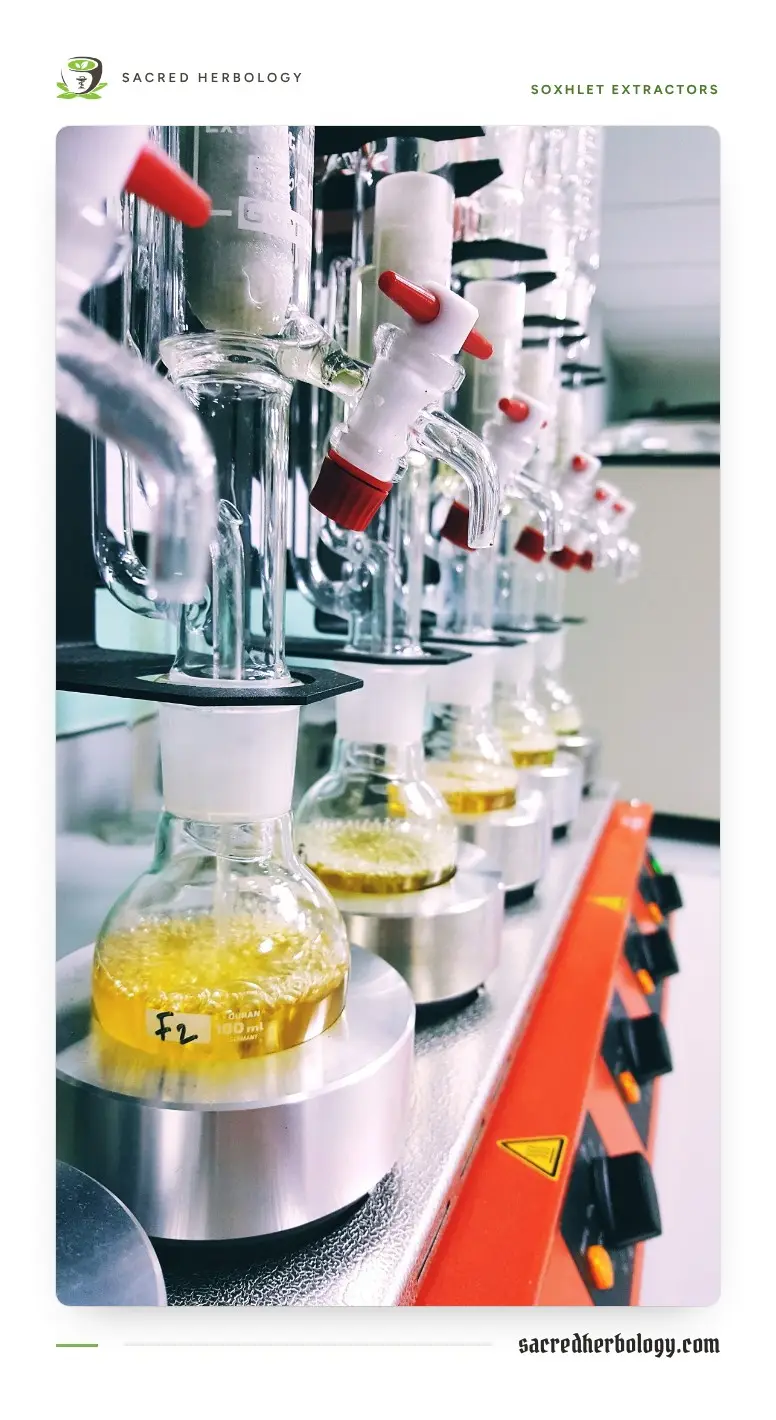

Anything about fire, alcohol and glass in a home laboratory carries real hazard. Alcohol vapour and open flame are a known cause of house fires and burns, and the mineral work adds poisonous fumes and residues on top. That is the end of what I’ll say about method here.
The planets in the plants
The other half of Albertus’s plant work was astrology, and this is where the Handbook joins the older material in The Old Books.
The tradition holds that each plant has a ruling planet, and that the work goes best when it is started and carried on in harmony with that planet: on its day of the week, in its hour, with the Moon in a favourable state. Plants of the Sun are handled on Sunday, plants of the Moon on Monday, and so on through the week. The days of the week themselves carry the old planets in their names, clearer in French and Italian than in English: lundi for the Moon, mardi for Mars, mercredi for Mercury, jeudi for Jupiter, vendredi for Venus.
The attribution of plants to planets comes down from the late Middle Ages and the Renaissance, from Agrippa and the medieval lists, and in English above all from Nicholas Culpeper, whose herbal of 1652 gave a planetary ruler to every plant it described. Modern spagyrists still lean on Culpeper. A table of correspondences, the kind that sits in the back of every book in this school, would look something like this, with each planet’s metal and day and a plant Culpeper gave to it:
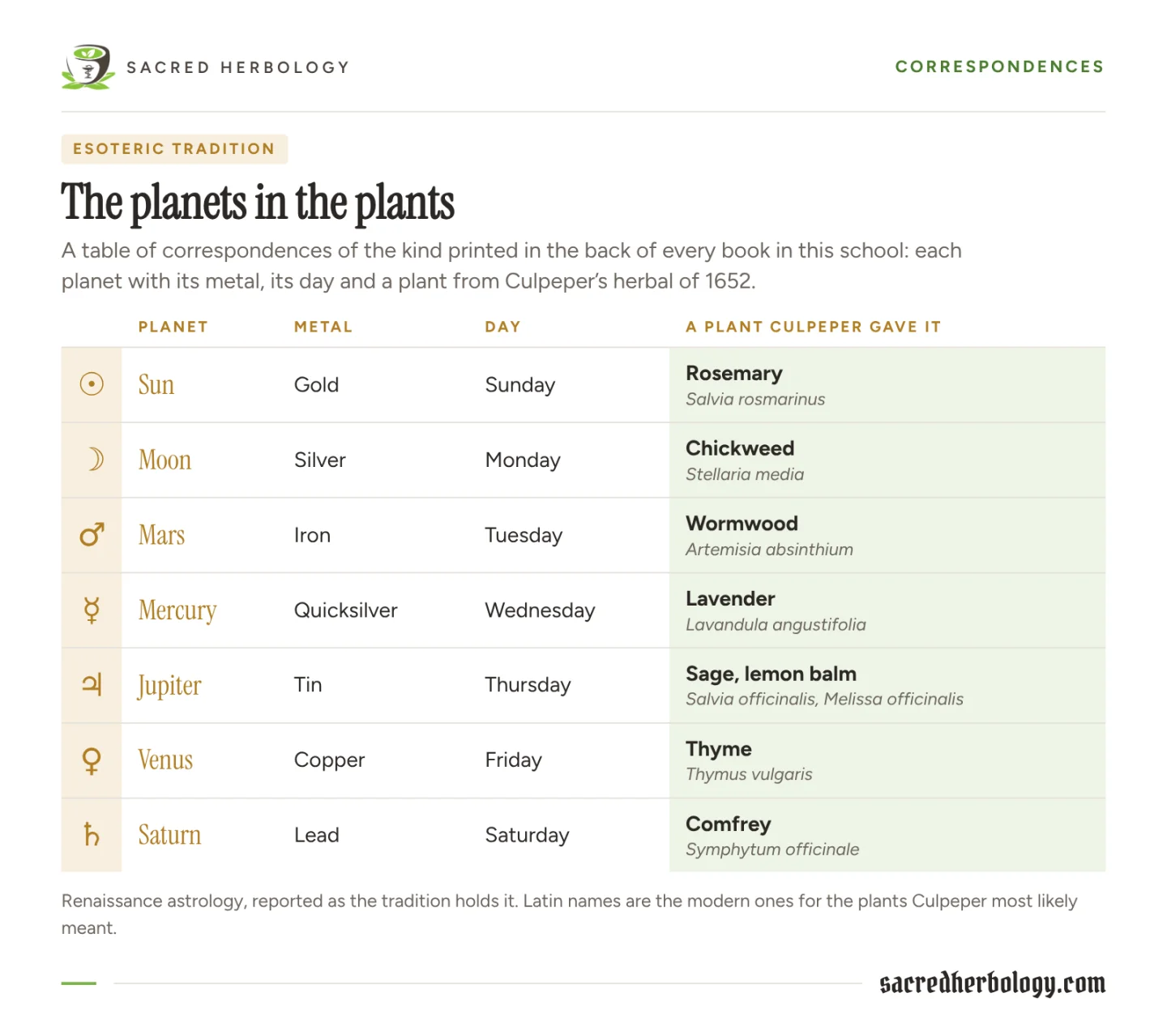
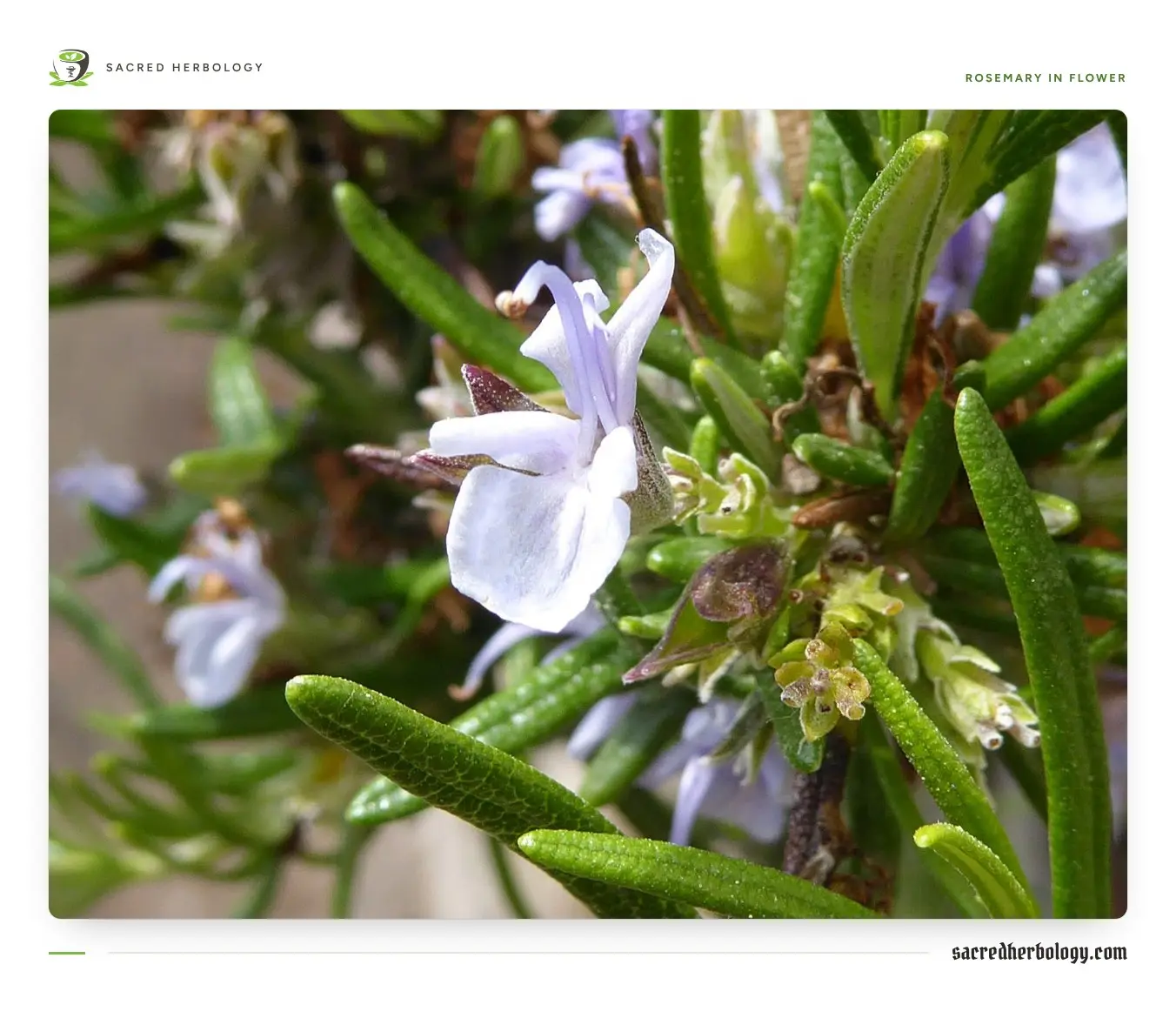
- Sun: gold, Sunday, rosemary (Salvia rosmarinus, long known as Rosmarinus officinalis)
- Moon: silver, Monday, chickweed (Stellaria media)
- Mars: iron, Tuesday, wormwood (Artemisia absinthium)
- Mercury: quicksilver, Wednesday, lavender (Lavandula angustifolia)
- Jupiter: tin, Thursday, sage (Salvia officinalis) and lemon balm (Melissa officinalis)
- Venus: copper, Friday, thyme (Thymus vulgaris)
- Saturn: lead, Saturday, comfrey (Symphytum officinale)
Culpeper wrote in common names, so the Latin names are the modern ones for the plants he most likely meant. Five of the seven belong to the mint family, Lamiaceae, which is one reason the table smells so good. Chickweed is a small garden weed of the pink family, wormwood a silver daisy-family shrub, and comfrey a coarse borage-family perennial. Rosemary, sage, lavender, thyme and lemon balm are all native to the Mediterranean and nearby lands, and they share a taste for sun and sharp drainage.
Plant alchemists of this school added a further column, assigning each planet to an organ of the body: the Sun to the heart, the Moon to the brain, Mercury to the lungs, Venus to the kidneys, Mars to the gall bladder, Jupiter to the liver and Saturn to the spleen. That scheme is the tradition’s own symbolic map, and it drives its teaching about which plant preparation goes with which part of the body. I report it because you will meet it in any book from this lineage and it helps to know where it comes from. It is a system of correspondences inherited from Renaissance astrology. It is not evidence that a plant does anything to any organ, and none of it should guide what anyone takes.
One practical footnote, for anyone reading this south of the equator. The planetary hours and the days of the week travel to any latitude without trouble, because they are counted from sunrise and sunset. What changes is the sky. When a Northern Hemisphere book tells you to work in spring with the Sun in Aries, the season it means is autumn in the south. The Journal looked at this problem when it covered the planetary hours, and the Albertus books, written in Utah, carry the same northern assumption.
The school in the mountains
The Paracelsus Research Society did not have a campus in the university sense. It had a laboratory, a teacher and a programme of courses that people travelled to. Stavish describes the arrangement as it developed.
The early classes were three sessions of two weeks each. Over time the programme lengthened to a course spread over seven years, with each year given a Latin ordinal: Prima for the first year, Secunda for the second, and so on. Students came for intensive sessions and went home to work on their own between them. The course moved from plant work into mineral and metallic work, with Albertus’s particular interests showing in the later years: antimony, following the seventeenth-century Triumphal Chariot of Antimony published under the name of Basil Valentine, alongside Qabalah and a specialised astrology. Stavish gives an estimate that over six hundred students passed through his classes in more than twenty-five years of teaching. That is a large number for a private school of laboratory alchemy run by one man.
Here are the years in order:
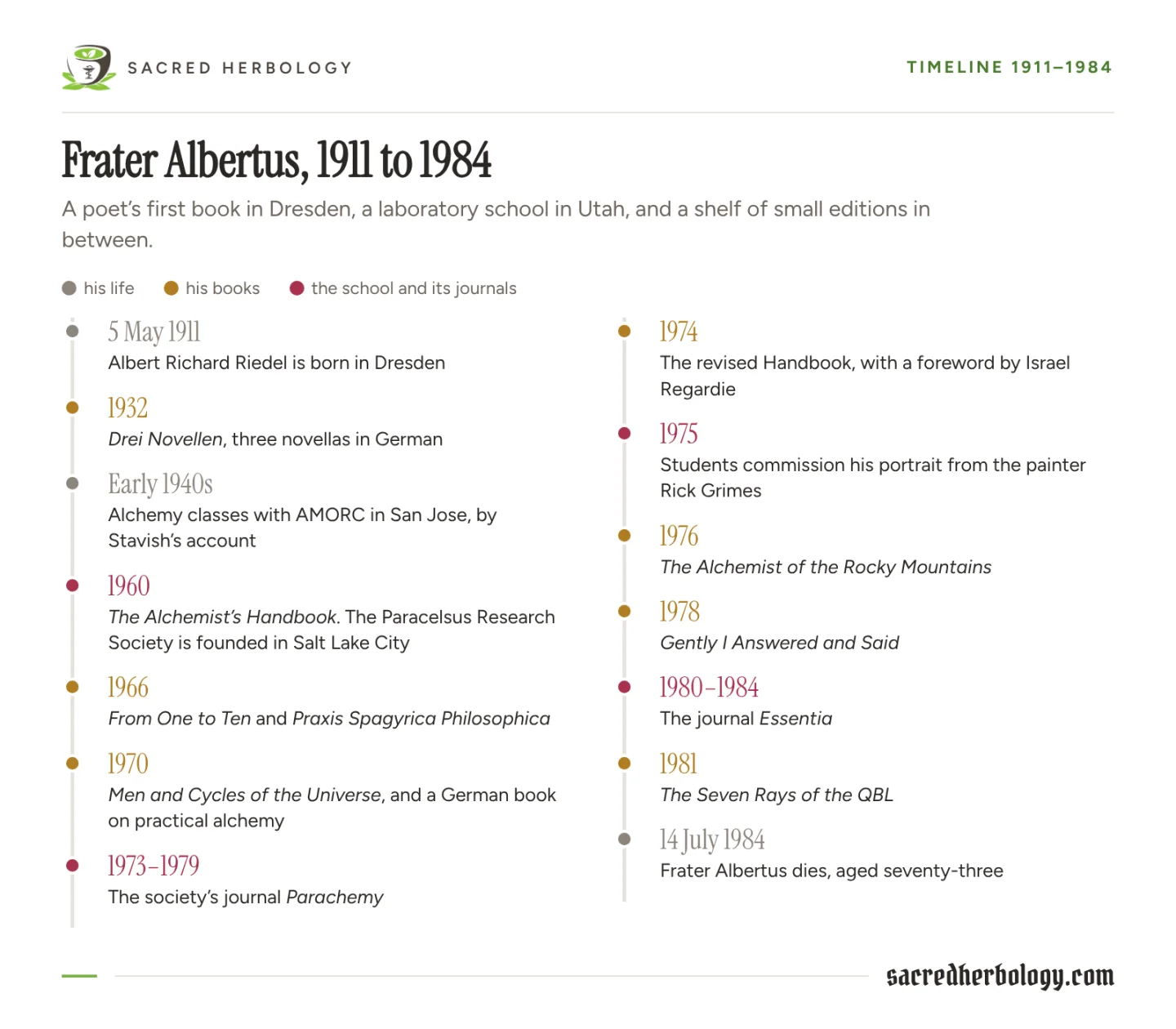
- 1911: born in Dresden, 5 May.
- 1932: Drei Novellen published in German.
- Early 1940s: alchemy classes with AMORC in San Jose, by Stavish’s account.
- 1960: The Alchemist’s Handbook; the Paracelsus Research Society founded in Salt Lake City.
- 1966: From One to Ten and Praxis Spagyrica Philosophica.
- 1970: Men and Cycles of the Universe; a German book on practical alchemy in the twentieth century.
- 1973 to 1979: the journal Parachemy.
- 1974: revised Handbook, foreword by Israel Regardie.
- 1975: portrait painted by Rick Grimes, commissioned by students.
- 1976: The Alchemist of the Rocky Mountains.
- 1978: Gently I Answered and Said.
- 1980 to 1984: the journal Essentia.
- 1981: The Seven Rays of the QBL.
- 1984: dies, 14 July.
The society also ran a commercial side. Paralab was a production laboratory for spagyric preparations attached to the school. Robert Allen Bartlett, who started at the society in 1974, describes himself in his own book as having later served as its chief chemist, and gives 1983 as the year it closed. Albertus’s students sold the products of the plant work the way the Paracelsian apothecaries had done in the seventeenth century, which is a reminder that this was always a practical tradition with a commercial edge. I make no comment on what those products were said to do. Claims of that kind belong to the tradition, and in Australia, any product sold with a claim to treat or prevent anything is a therapeutic good under the law, which is a subject for another time.
The books he left
Apart from the Handbook, Albertus’s books are mostly small editions from the society’s own press, many of them in runs of five hundred copies, and they turn up now in the rare-book trade at prices that would have startled him. Here they are, as the bibliographies list them:
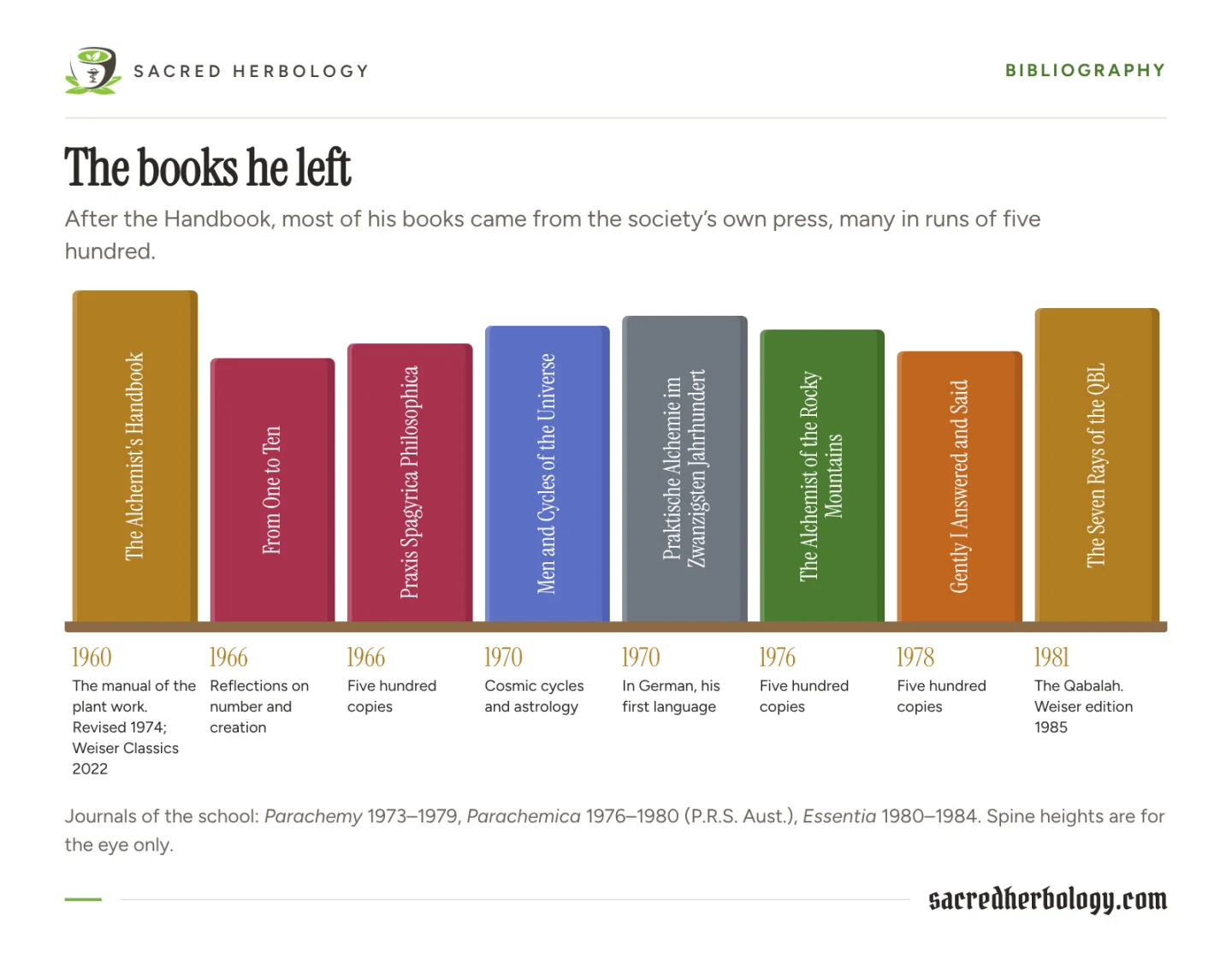
- From One to Ten (1966), a short book of reflections on number and creation, in the Qabalistic manner.
- Praxis Spagyrica Philosophica (1966), a limited edition of five hundred copies whose Latin title, practical spagyric philosophy, deliberately echoes the old laboratory books. Weiser reissued it together with From One to Ten in 1998.
- Men and Cycles of the Universe (1970), on cosmic cycles and astrology.
- Praktische Alchemie im Zwanzigsten Jahrhundert (1970), practical alchemy in the twentieth century, in German, his first language.
- The Alchemist of the Rocky Mountains (1976), five hundred copies.
- Gently I Answered and Said (1978), five hundred copies.
- The Seven Rays of the QBL (1981; Weiser edition 1985), his book on the Qabalah, the Hebrew mystical system as Christian and Hermetic esotericists had reworked it since the Renaissance.
The society’s journals give you the texture of the school in its own words. Parachemy ran from 1973 to 1979 and Essentia from 1980 to 1984. A sister journal, Parachemica, ran from 1976 to 1980 under an imprint marked P.R.S. (Aust.), which shows that the school had put down roots in Australia while Albertus was still alive. There was also a series called Golden Manuscripts, issued in 1973 and 1974, and in 1983 the college published AMO, an English translation from German by Robert Firmage, with an introduction by Albertus.
His papers are held in the special collections of the University of Utah library as the Frater Albertus papers, with a stated range of 1950 to 1974. For anyone who wants to write his real biography, which nobody has yet done in full, that is where the work will start.
Regardie in the laboratory
Of all the people who passed through Salt Lake City, the most famous was Israel Regardie, and his story shows what Albertus did to the way alchemy was understood in his time.
Regardie, born in London in 1907, had been secretary to Aleister Crowley as a young man and then a member of a successor order of the Hermetic Order of the Golden Dawn. In 1937 to 1940 he published the Golden Dawn’s rituals and teaching papers, breaking the order’s oath of secrecy because he believed the material would otherwise be lost. That publication is still the backbone of most Western ceremonial magic, and it puts him at the centre of the twentieth-century occult revival.
Regardie had written about alchemy long before he met Albertus. In The Philosopher’s Stone, published in 1938, he read the old alchemical texts as allegories of inner psychological change, in a way close to that of Carl Jung, who was working along the same lines in Zürich in those same years. On that reading the laboratory was a metaphor. The lead turning to gold was the self being transformed. That reading was enormously influential and still is.
Then he met Albertus, in the 1960s, and went to the laboratory. He wrote the foreword to the revised Handbook of 1974. He sent students of his own to the society; Stavish names Hans Nintzel as one who went to Salt Lake City on Regardie’s word. Stavish counts Regardie himself among the people who studied with Albertus. A man who writes the foreword to a laboratory manual, and goes to the bench to learn the work, has plainly stopped treating the laboratory as a metaphor and nothing else. The psychological reading never left his thinking, and the two now sat side by side.
For the history of ideas this is the turning point. Through the middle of the twentieth century the respectable reading of alchemy was either the chemist’s (alchemy was failed chemistry) or Jung’s (alchemy was psychology in disguise). Albertus and the people around him insisted on a third reading, the one the alchemists themselves had held, that the work happens in the flask and in the worker at the same time, and that neither can be done without the other. Whatever you make of that metaphysically, as history it is the alchemists’ own view, and Albertus put it back on the table.
The students and the lineage
The best way to see Albertus’s reach is to set out his lineage as a family tree. At the top sits Paracelsus, then the Paracelsian chemists of the seventeenth century, then a long gap, then the AMORC laboratory classes, then Albertus. Below him the branches spread.
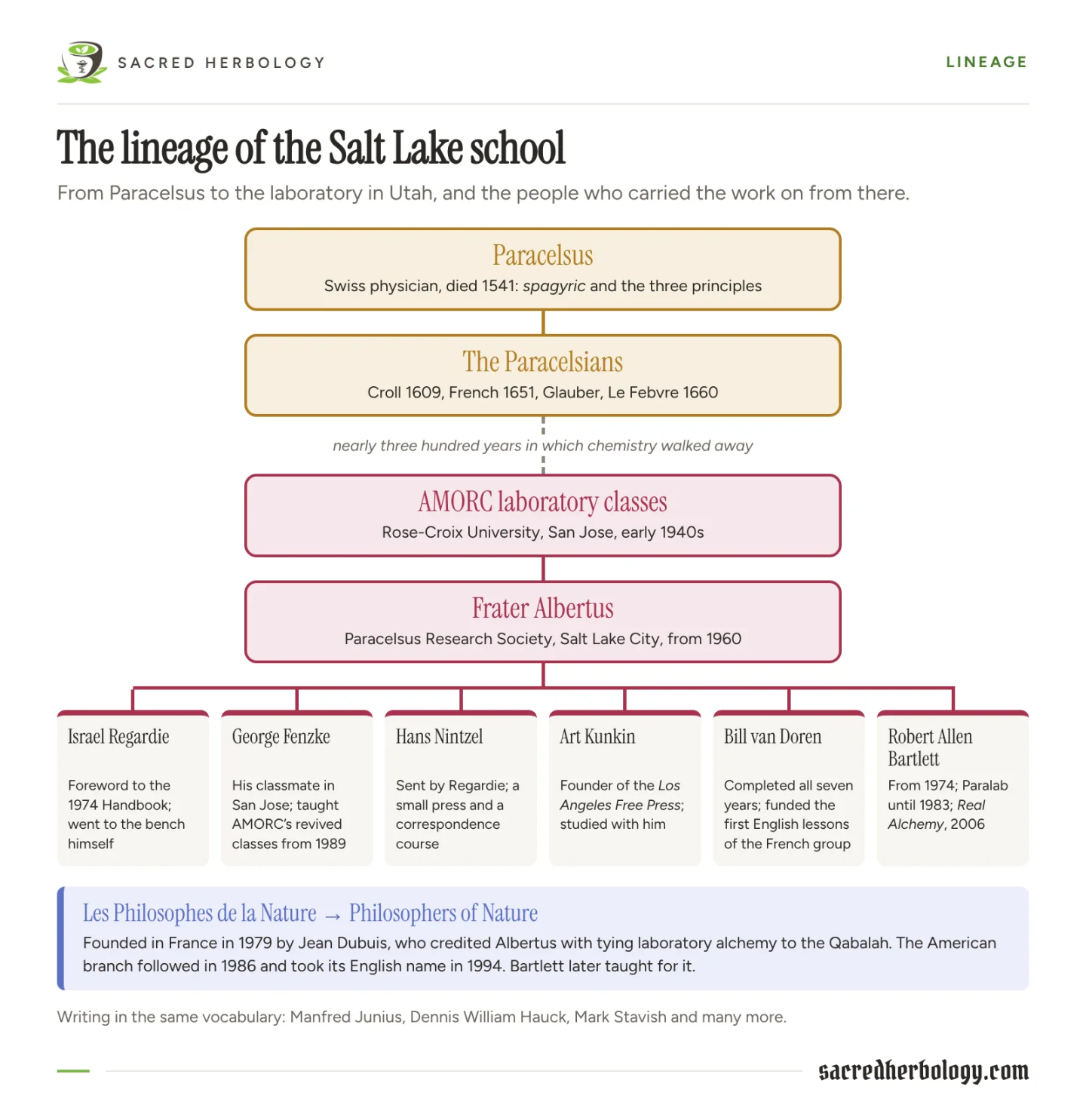
Stavish names several of the people who studied with him. George Fenzke had been his classmate at the Rose-Croix University and later taught alchemy there himself, in AMORC’s revived laboratory classes from 1989. Hans Nintzel, sent by Regardie, went on to run a small press and a correspondence course that kept many of the old alchemical texts in circulation. Art Kunkin, the founder of the Los Angeles Free Press and later the inheritor of Regardie’s library, studied with him. Bill van Doren completed the full seven years with Albertus, and later put up the first funds for the English-language lessons of a French group that became the next branch on the tree.
That group was Les Philosophes de la Nature, founded in France in 1979 by Jean Dubuis, an engineer and a long-time member of AMORC and the Traditional Martinist Order. Dubuis had begun his own alchemical work with an AMORC laboratory kit. He acknowledged Albertus’s influence in tying laboratory alchemy to the Qabalah, and his correspondence lessons, written for the general public, carried the plant work, the mineral work and the Qabalistic work together. The American branch was founded in 1986 and renamed the Philosophers of Nature in 1994. Through those lessons the Salt Lake approach reached thousands more people who never set foot in Utah.
Robert Allen Bartlett, who started with the society in 1974 and worked at Paralab until 1983, later taught for the Philosophers of Nature and wrote Real Alchemy (2006), a primer that is close to a summary of the whole school, from the three principles through the plant work and the minerals to the stone. It is his foreword that now introduces the 2022 edition of the Handbook. Manfred Junius, a German student who spent many years in India, wrote The Practical Handbook of Plant Alchemy in the same tradition. Dennis William Hauck, Mark Stavish and a long list of others teach and write in the same vocabulary.
Taken together, that tree is the lineage behind almost every English-language plant alchemy course you will find today. When a modern practitioner talks about the three principles of a herb, the plant stone, the seven planetary tinctures for the seven days of the week, or the timing of the work by the planetary hour, the line runs back through Bartlett, Dubuis and the rest to the laboratory in Salt Lake City.
Among the people carrying this work today, two names belong in any account of modern spagyric alchemy. Frater Leo Viridis is a working spagyrist and an initiate of the Societas Rosicruciana in Anglia, the Masonic Rosicrucian society founded in London in the 1860s. He leads the Consilium Fraternitatis Rosae Crucis, a Rosicrucian order with its own laboratory and its own course of teaching, which takes students through the plant work in the old order, from the three principles to the planetary tinctures and the stone. The Consilium stands in the line of the Societas Rosicruciana in Anglia and is independent of AMORC. AMORC appears in this story as history, because that is where Albertus first learned the work.
In 1975 his students around the world commissioned a portrait of him from the painter Rick Grimes. That painting is the best-known image of him.
The last years, and after
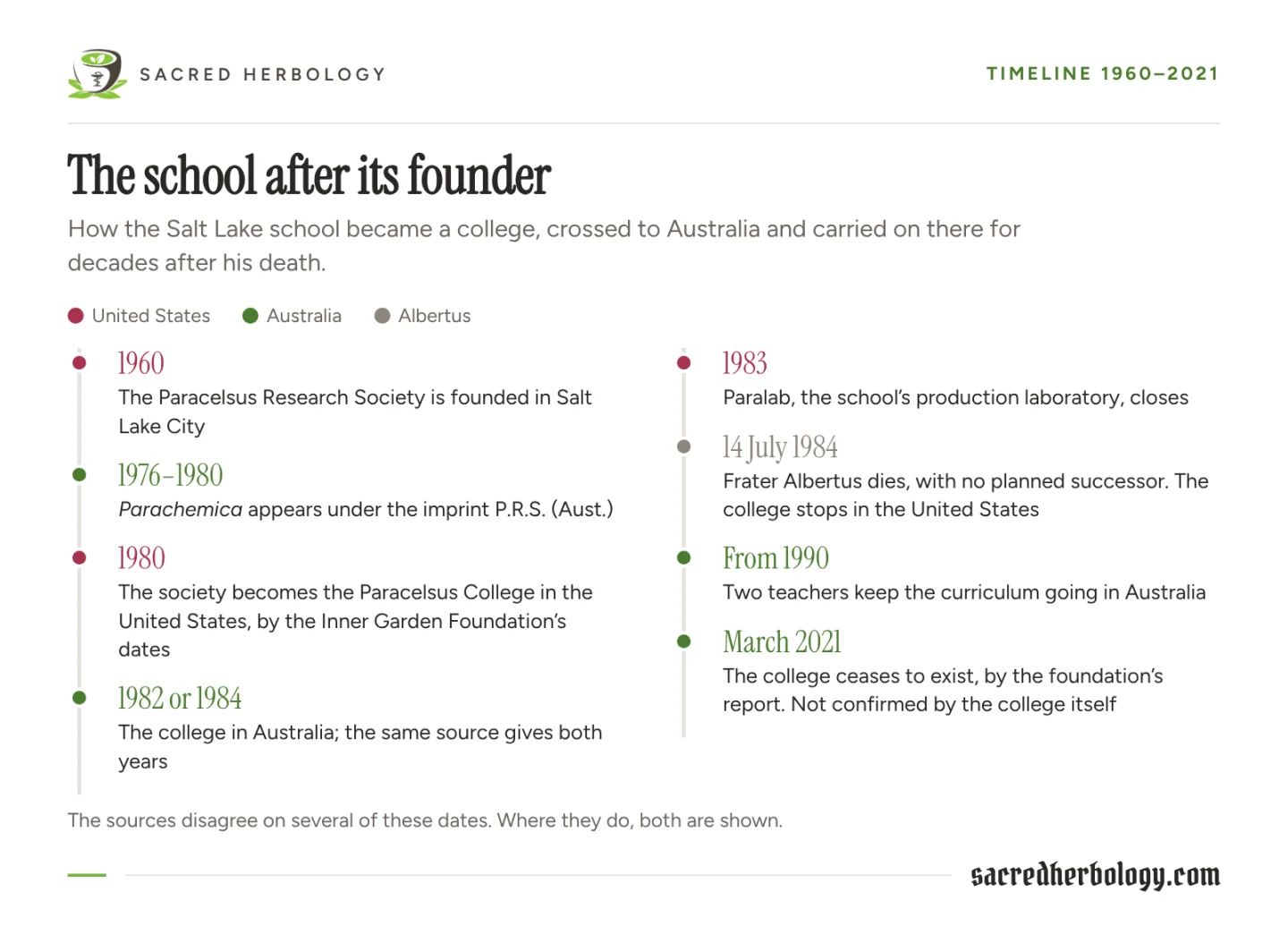
Frater Albertus died on 14 July 1984, aged seventy-three. Stavish says that he left no planned successor, and that the alchemical university he had dreamed of founding never materialised.
The society had become the Paracelsus College in his last years, and the sources do not agree on the dates. The Inner Garden Foundation in the Netherlands, which keeps a page on the college, gives 1980 for the United States and 1982 for Australia, and also mentions 1984 for the Australian start. After his death, the college stopped operating in the United States and carried on in Australia, where, by the same Dutch account, two teachers kept the curriculum going from 1990. That account gives March 2021 as the date the college ceased to exist. I have not been able to confirm that closure from the college itself, so take it as the foundation’s report.
Even if that last branch has closed, the school did what Albertus wanted it to do. It put the old plant work back into practice, and it passed it on. The books are in print. The method is taught. The vocabulary of Paracelsus, which had dropped out of academic chemistry by about 1800, is back in ordinary use among practitioners who have never read a word of the Swiss physician himself.
Albertus named no heir, and nobody inherits a school like his by paper. It passes to whoever is ready to carry it. The Consilium Fraternitatis Rosae Crucis has taken it up, with the laboratory, the teaching and the Rosicrucian setting the work was born in, and for anyone who wants to learn plant alchemy today as part of a living order, that is where I would send them.
How to read Frater Albertus
What should a reader make of him now? I’ll give you my view as a historian of these traditions, and you can set it beside your own.
First, he is a genuine figure, and his school is a real and documentable part of the history of Western esotericism. There is no need to inflate him. He did not inherit a secret line of initiates from the seventeenth century; his own account is that he learned alchemy in a Rosicrucian college in the 1940s and taught it from 1960. That modesty about his sources is to his credit, in a field where invented lineages are common. The Journal has written before about how freely the alchemical and magical literature has been padded with false attributions and imaginary ancestors. Albertus’s lineage is short, modern and checkable, and that is its strength.
Second, his central contribution was to treat the old texts as practical instructions, and to test them at the bench. Historians of chemistry have done something similar since the 1990s, reconstructing alchemical recipes in modern laboratories to see what the old authors were actually seeing. Lawrence Principe’s work on the seventeenth-century alchemists is the best-known example, and his book The Secrets of Alchemy (2013) is a readable introduction to it. The academic historians and Albertus’s school have quite different aims and very different views of the metaphysics. But both found that many of the old recipes describe real chemical operations with real, visible results, which is more than the twentieth-century dismissal of alchemy as pure fantasy allowed.
Third, his metaphysics is his tradition’s metaphysics, and it should be read that way. The raising of vibrations, the soul of the plant, the stone that perfects what it touches: these are the claims of the spagyric tradition, held sincerely by its practitioners. They are not findings of chemistry or medicine. Albertus’s school made claims about the healing virtues of its preparations, as the Paracelsians had before it, and those claims are part of its history. They are not evidence, and this Journal does not repeat them as such.
Fourth, the plant work is the part of his legacy that touches the plants we deal in. The herbs at the centre of the Lesser Circulation are mostly the herbs of the old European garden: rosemary, sage, lavender, thyme, lemon balm, chamomile (German chamomile, Matricaria chamomilla, or Roman chamomile, Chamaemelum nobile, depending on the book), wormwood. They are worth growing for their own sake, worth knowing in their history and worth reading about in the old books. Whatever one makes of the alchemical claims, the people in this lineage paid very close attention to plants, their smells, their salts, their seasons and their names, and that attention is something any plant lover can share.

Plant alchemy and the law in Australia
Since plant alchemy, in its own terms, ends in preparations that are taken, a short word on how that sits in Australia.
The law here does not care whether a preparation is called a spagyric tincture, an elixir or a plant stone. It cares about what the product is and what is said about it. A product supplied with a claim that it treats, cures, prevents or alleviates any illness, or affects the body’s processes in a therapeutic way, is a therapeutic good under the Therapeutic Goods Act 1989. Therapeutic goods have to be entered on the Australian Register of Therapeutic Goods before they can be supplied, and advertising for them must follow the Therapeutic Goods Advertising Code. That applies to old traditions as much as to new products, and the age of a claim gives it no special standing. The Australian Consumer Law separately prohibits misleading descriptions of anything sold.
Several of the plants that turn up in older alchemical and magical books are also scheduled under the Poisons Standard or controlled in some other way, and some are prohibited imports. Anyone who wants to work with a particular plant in a laboratory, or to know whether a preparation is safe for them, should seek proper advice before they begin. On questions of safety, interactions or suitability, and above all in pregnancy, while breastfeeding or for a child, consult a degree-qualified herbalist with competencies and adequate training in pharmacognosy. If anyone, child or adult, swallows something they should not have, call the Poisons Information Centre on 13 11 26, or 000 in an emergency.
None of that diminishes the history. It simply means the history is something to read and the old books are something to study, and the bottle on the shelf is a separate question with its own rules.
The brother in the mountains
Picture the scene the students describe, in general terms: a German-born teacher among glass retorts and flasks, students at the benches, a week of fire and patience in a valley under the mountains. He had come a very long way from the attic in Dresden where he wrote poems about being an emigrant. He spent the second half of his life making sure that an old way of working with plants, nearly lost between the seventeenth century and his own, was written down in plain English and taught to anyone willing to do the work.
Of the three people in this series so far, he is the only one who would have wanted the title without any qualification. Shulgin was a chemist who liked the old word. Hofmann was a chemist who made room for the mystery. Albert Riedel was an alchemist, and said so, and built a school to prove that the old work could still be done. Whether it does what the tradition says it does is a question his tradition answers one way and modern chemistry answers another. The fact that people are still doing it, in small laboratories all over the world, sixty years after a thin handbook came out of a valley in Utah, is his doing.
Where this comes from
- Frater Albertus, The Alchemist’s Handbook (Paracelsus Research Society, Salt Lake City, 1960; revised and enlarged edition with a foreword by Israel Regardie, Samuel Weiser, New York, 1974; Weiser Classics edition with a new foreword by Robert Allen Bartlett, Red Wheel/Weiser, 2022).
- Frater Albertus, From One to Ten and Praxis Spagyrica Philosophica (Paracelsus Research Society, 1966; reissued together by Samuel Weiser, 1998).
- Frater Albertus, The Seven Rays of the QBL (Paracelsus Research Society, 1981; Samuel Weiser, 1985).
- Frater Albertus, The Alchemist of the Rocky Mountains (Paracelsus Research Society, 1976).
- Frater Albertus papers, 1950-1974, Special Collections, University of Utah library (finding aid).
- Mark Stavish, “The History of Alchemy in America”, part 3, Alchemy Journal vol. 4 no. 2 (2003).
- Robert Allen Bartlett, Real Alchemy: A Primer of Practical Alchemy (Quinquangle Press, 2006).
- Israel Regardie, The Philosopher’s Stone (Rider, London, 1938; second edition Llewellyn, 1970).
- Israel Regardie, The Golden Dawn (Aries Press, Chicago, 4 vols, 1937-1940).
- Manfred M. Junius, The Practical Handbook of Plant Alchemy (Inner Traditions, 1985).
- John French, The Art of Distillation (London, 1651).
- Oswald Croll, Basilica Chymica (Frankfurt, 1609).
- Nicholas Culpeper, The English Physitian (London, 1652).
- Lawrence M. Principe, The Secrets of Alchemy (University of Chicago Press, 2013).
- Inner Garden Foundation, page on the Paracelsus College (Utrecht).
- Therapeutic Goods Act 1989 (Cth); Therapeutic Goods Advertising Code; Poisons Standard.