On a May morning some time before the First World War, a Swiss boy was walking alone through the woods on the hills above his home town of Baden, in the canton of Aargau. The beeches were coming into new leaf. Birds were singing and the early sun was coming through the trees. Then, with no warning, the whole forest seemed to change. Everything around him shone with a strange, clear light, as if he were seeing it properly for the first time, and he felt a sense of belonging to it that he had no words for. It lasted only a short while. He never forgot it.
The boy was Albert Hofmann. He told this story at the very start of his memoir, LSD: My Problem Child, first published in German in 1979, and he told it on purpose. He wanted his readers to know that the most famous accident in the history of chemistry happened to a man who had already, as a child, seen the world blaze up from the inside. Everything else in his long life, all 102 years of it, came back in one way or another to that morning in the woods.
This is the second piece in a short series in this Journal about people who get called modern alchemists. The first was about Sasha Shulgin, the chemist in the shed on the hill. Hofmann is a different kind of figure. He was a company man, a careful pharmaceutical chemist who worked for one firm in Basel for more than forty years, wore a suit and tie to the laboratory, and spent most of his career on medicines made from a poisonous fungus that grows on rye. Yet his story runs straight through the oldest themes of the alchemical books: the separation of medicine from poison, the vision that arrives unbidden, the sacred plant that a living people guard, and an ancient Greek mystery that nobody has ever fully explained.
I’ll say up front what this piece won’t do, as I did last time. It won’t tell you how to make anything, how much of anything to take, or how to take it. LSD is a prohibited substance in Australia, and nothing here is advice of any kind. This piece gives you the history and the meaning: the life of a man, the plants and fungi that shaped his work, and why people reach for the word alchemist when they talk about him.
A word about the word
In this Journal alchemy is filed as ESOTERIC. It is learned philosophy and learned magic, written down by literate people in books over some two thousand years, from late antique Alexandria through the Arabic writers to the Latin West and on into the seventeenth century. Its practitioners worked with furnaces and stills, metals and salts, and they also read their work as a mirror of the soul’s own transformation. I report what its writers held. I don’t tell you any of it is true of the world.
As with Shulgin, I need to be honest about a gap. I have not found Hofmann calling himself an alchemist in so many words. He called himself a chemist and a natural scientist. He did speak freely, especially in old age, about mysticism, about what he called the visionary experience, and about the ancient mysteries of Eleusis, and his friends and biographers gave him the labels that stuck. The best-known biography, by his friends Dieter Hagenbach and Lucius Werthmüller, was published in English in 2013 under the title Mystic Chemist. The alchemist label is a reading of his life by other people, mine included. I think it fits, and I will show you why, but I won’t put the word in his mouth.
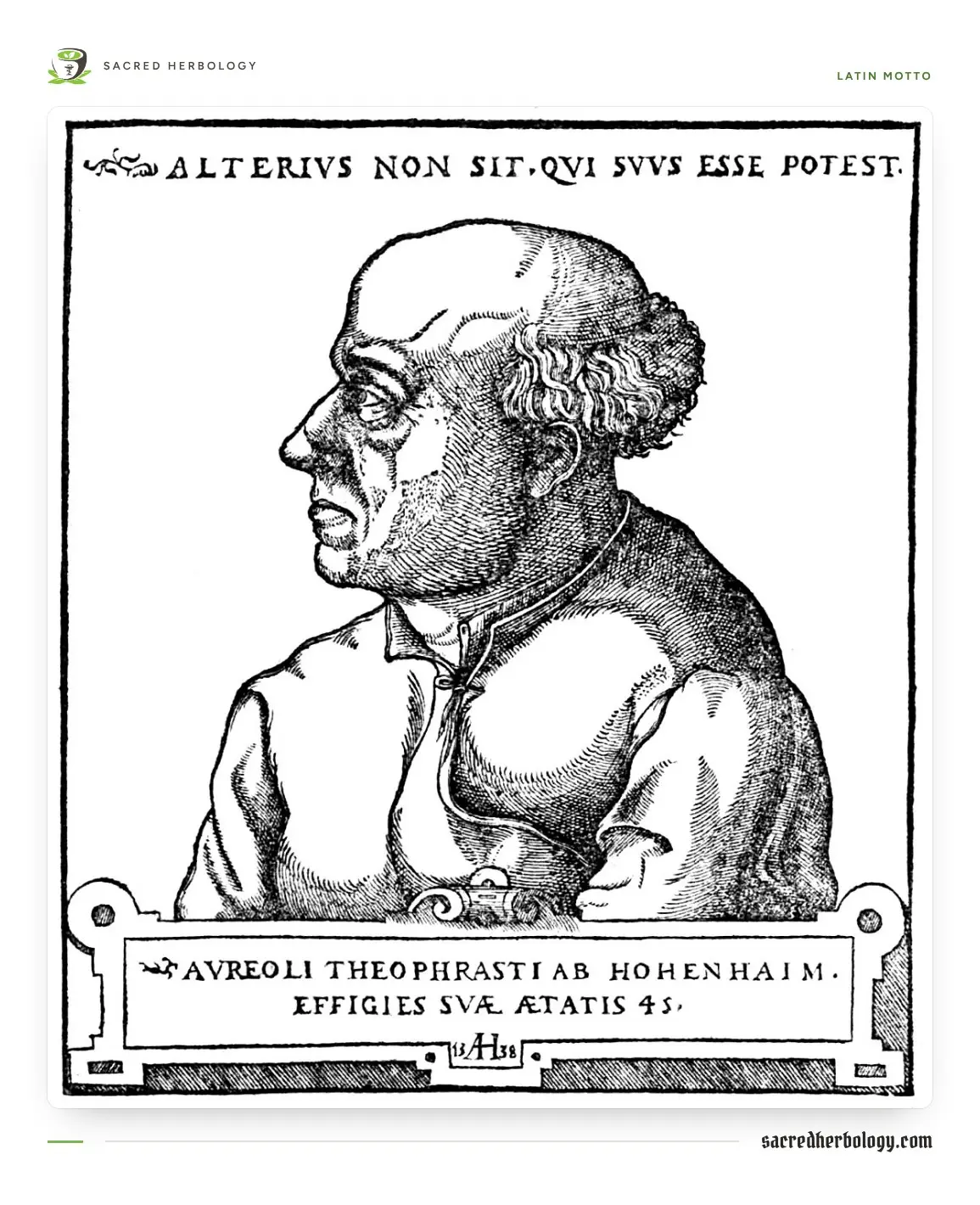
There is one alchemical idea worth holding in your head from the start, because it runs through his whole working life. The alchemists believed that every substance contained a hidden virtue locked up with grosser, harmful matter, and that the art lay in separating the two. They called this separation, separatio, and it was one of the named operations of the Work. The Swiss physician who went by the name Paracelsus, writing in the 1530s, put a famous gloss on it: everything is poison, and nothing is without poison, and only the measure decides whether a thing is a poison or not. Paracelsus was not talking about LSD, obviously. But Hofmann, four centuries later and a short train ride from where Paracelsus had once lectured in Basel, spent his career doing exactly what the old books describe, drawing medicines out of a poison.

A boy from Baden
Albert Hofmann was born in Baden on 11 January 1906, the eldest of four children. His father, Adolf Hofmann, was a toolmaker in a local factory, and his mother was Elisabeth Hofmann, born Schenk. The family was not well off. When his father fell ill, money became tight, and it was a godfather who paid for the boy’s education. For a while young Albert did a commercial apprenticeship while studying for his school-leaving certificate on the side.
Picture a small industrial town on the river Limmat, with old baths fed by hot springs, a factory, steep wooded hills behind it, and a bright, serious boy who loved those woods more than anything in the town.
He chose chemistry, and he chose it for a reason that sounds more like a philosopher than a chemist. He said later that he went into chemistry because he wanted to understand the material world from the inside, to find out what things were really made of, and that the question had grown out of those early experiences in nature. He studied at the University of Zurich under Paul Karrer, who would win the Nobel Prize for Chemistry in 1937 for his work on vitamins. Hofmann took his doctorate in 1929 with a thesis on chitin, the tough material that makes up the shells of insects and crabs, working out how a snail’s digestive juices break it down. It was a good piece of the chemistry of living things, and it showed the line his mind would take: he wanted to know how living things build their own substances.
In the same year, 1929, at the age of twenty-three, he joined the pharmaceutical research laboratory of Sandoz in Basel. He would stay with the company until he retired in 1971.
Stoll’s laboratory and the plants of the old herbals
The head of the pharmaceutical department at Sandoz was Arthur Stoll, a chemist who had trained under the Nobel laureate Richard Willstätter. Stoll had a clear idea about how a drug company should work. He wanted to take the medicinal plants of the old European herbals, the ones physicians and apothecaries had used for centuries, and isolate their active principles in pure form. A plant varies from field to field and year to year. A pure, crystalline compound can be weighed and tested and relied upon. Stoll’s whole programme was the old dream of drawing the essence out of the herb, carried out with modern glassware.
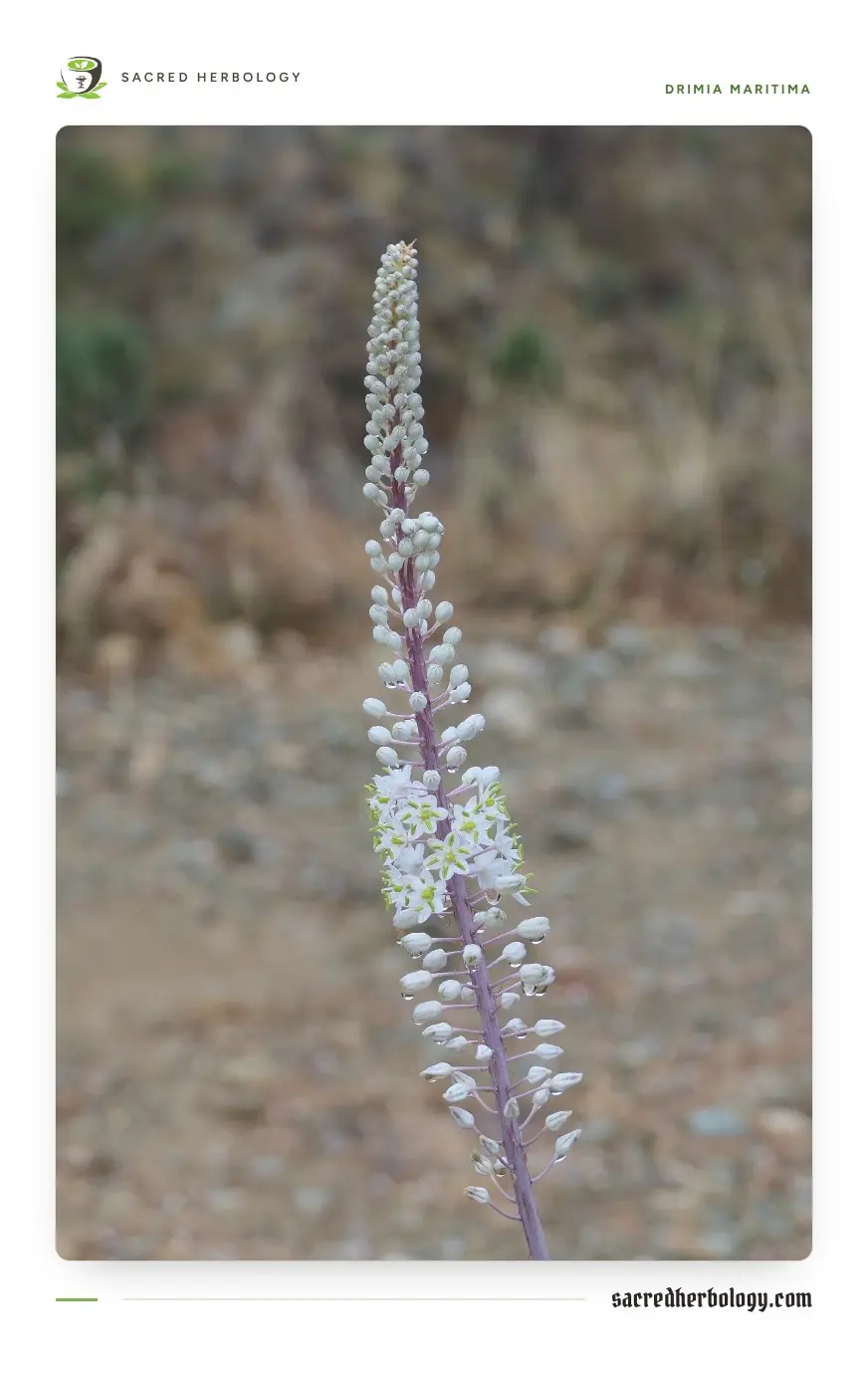
Hofmann’s first job was with squill, the sea onion, a big bulb of the Mediterranean shores, long known as Scilla or Urginea maritima and now called Drimia maritima, in the asparagus family. Squill had been used since antiquity, and it contains powerful heart-active compounds called cardiac glycosides. Hofmann set about working out the structure of those compounds, a group chemists call bufadienolides, and helped bring their chemistry into order. It was careful, unglamorous work.

Then, in the mid-1930s, he asked Stoll if he could take up a subject Stoll himself had pioneered and then set aside. Stoll had isolated the first pure ergot alkaloid, ergotamine, back in 1918. Hofmann wanted to go back to ergot. Stoll agreed, and that decision set the course of the rest of Hofmann’s life.
Ergot: the dark spur on the rye
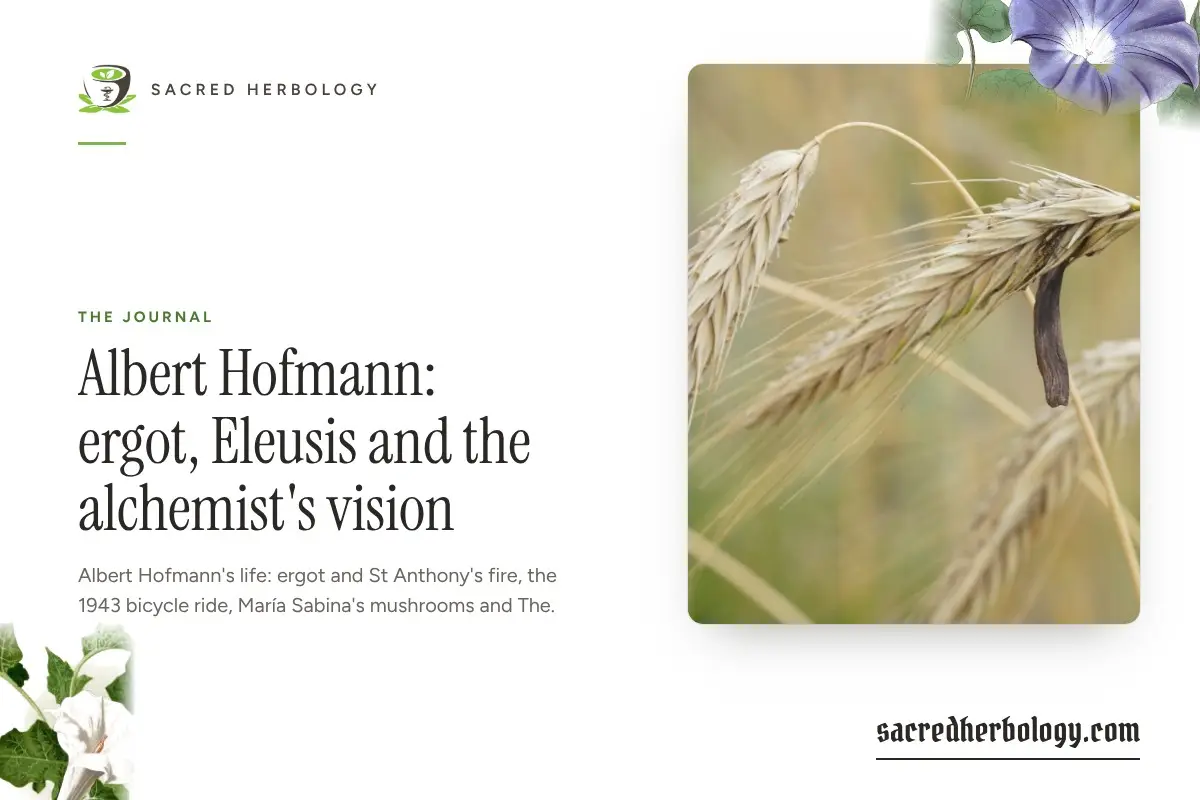
Ergot is the common name for a fungus, Claviceps purpurea, of the family Clavicipitaceae, and for the hard bodies it forms on grasses and cereals, especially rye, Secale cereale. The fungus infects the flower of the grass. Where a grain would normally swell, a dark purple-black spur grows instead, curved, hard and usually longer than a normal grain, sometimes several times longer, sticking out of the ear like a small horn. That spur is a resting body called a sclerotium. It falls to the ground, survives the winter, and in spring sends up tiny stalked heads that release spores to infect the next crop.
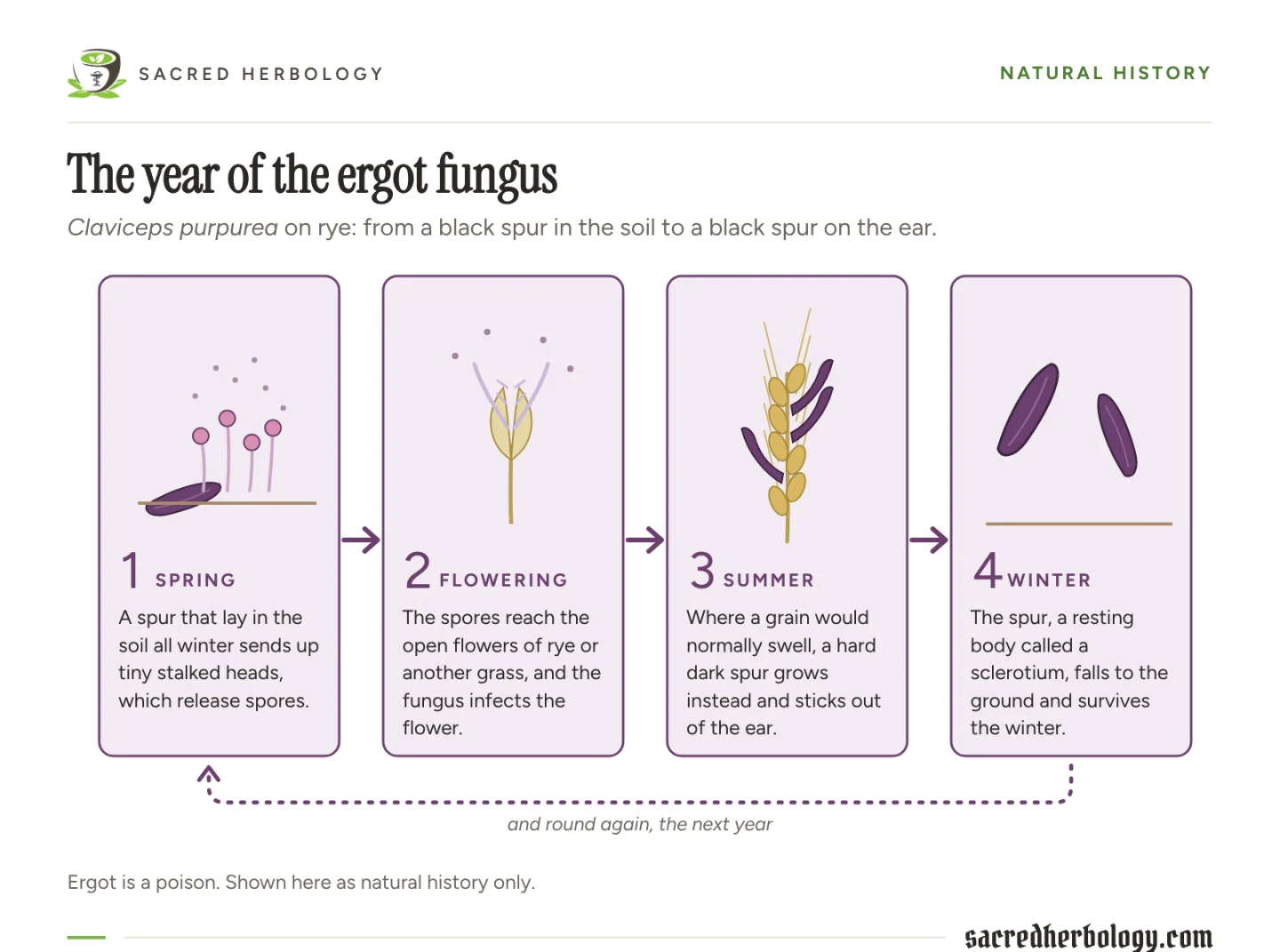
If there is one image for this whole story, it is an ear of rye, pale gold, with a black spur or two jutting out from among the grains.
The name comes from an old French word for a cock’s spur. In German it was called Mutterkorn, mother-corn, and that name holds a whole history of its own. Ergot contains a family of alkaloids that act powerfully on the body, and in grain eaten day after day those alkaloids can be deadly. They also make the muscles of the womb contract. European midwives had known that for a long time. The German physician and botanist Adam Lonicer, in his herbal printed at Frankfurt in 1582, is the source usually quoted for midwives giving ergot to hasten childbirth. It was folk practice, village knowledge handed down among women, and a dangerous one. The same property that could speed a birth could kill a mother or child if the measure was wrong.
St Anthony’s fire
For most of European history ergot was known by its terrible effects. When a wet season brought heavy infection, and when the poor had nothing to eat but bread made from that rye, whole districts were poisoned. The disease came in two forms. In one, the alkaloids narrowed the blood vessels so hard that blood could barely reach the limbs, and people felt a fierce burning in their hands and feet, which then turned black, dried and, in the worst cases, fell away. In the other, they suffered convulsions, twisting fits and hallucinations. Physicians now call both forms ergotism. The people of the Middle Ages called it the holy fire, ignis sacer, or St Anthony’s fire.
The Annals of Xanten, a chronicle from the Rhineland, record under the year 857 a great plague of swollen blisters that consumed people with a loathsome rot, so that their limbs dropped off before death. That entry is often quoted as the first record of ergotism in Europe, though we cannot be sure from so short a note what the disease was. Outbreaks were recorded again and again through the next several centuries, especially in France and the German lands.
The name of St Anthony came from an order of religious hospitallers. Around 1095, in the Dauphiné in south-eastern France, a community grew up around relics believed to be those of St Anthony the Great, the desert hermit of Egypt. The Antonites, as the order came to be called, ran hospitals for the victims of the burning disease across Europe, and pilgrims came to their houses hoping for relief. Some of them did recover, and part of the reason may have been very ordinary: in the Antonite hospitals they ate bread made from good grain.
The most famous artwork connected with ergotism was painted for one of those hospitals. Between about 1512 and 1516 the painter known to us as Matthias Grünewald made a great folding altarpiece for the Antonite house at Isenheim, in Alsace. It is now in the Unterlinden Museum in Colmar. Its crucified Christ is covered in sores. One of its panels shows St Anthony assailed by demons, and in the corner sits a wretched figure with a swollen belly, webbed and ulcerated skin and twisted limbs, whom many historians of medicine have read as a victim of the holy fire. The sick were brought before this altarpiece, and the hope was that they would see their own suffering in the suffering of Christ and the saint.
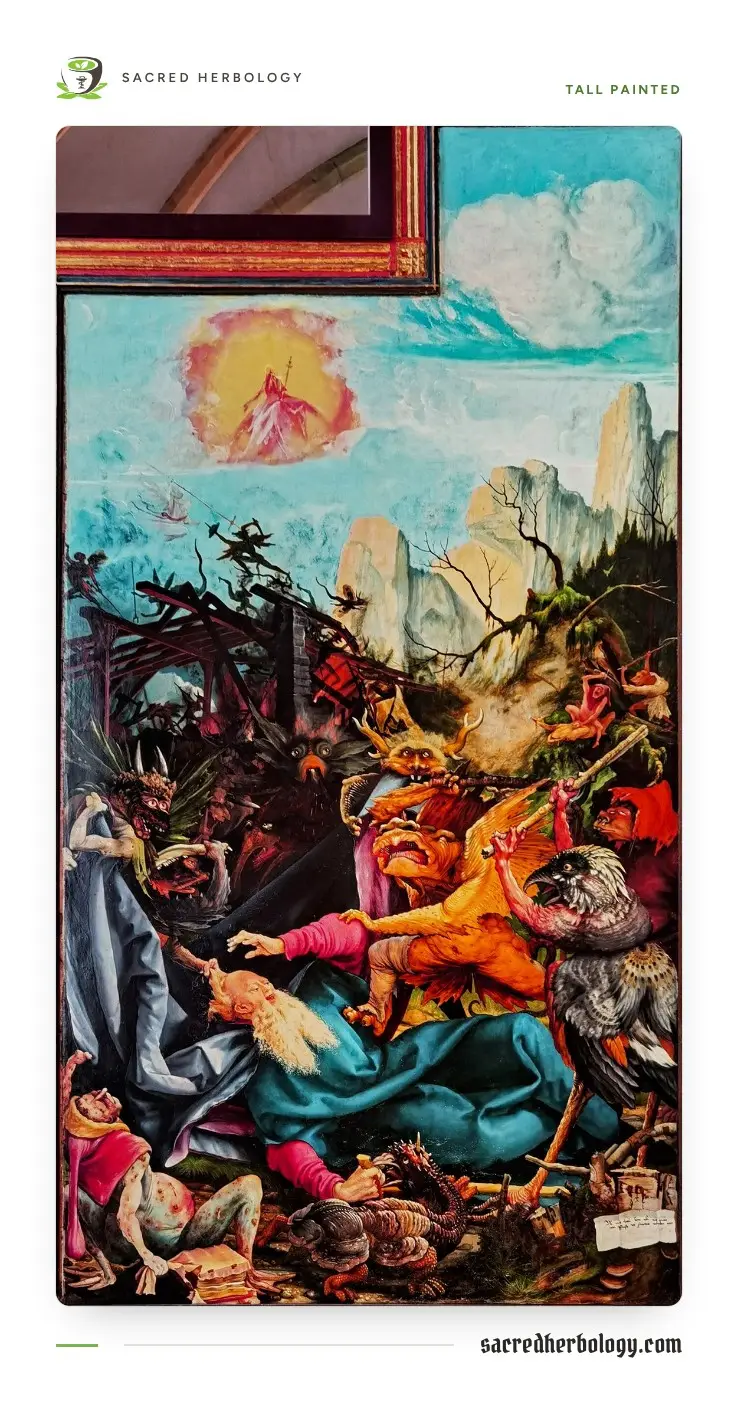

Look at that panel for a while: the demons tearing at the old hermit, and the sick man in the corner looking out at us.
A word of caution, because ergot attracts modern legends. In 1976 the psychologist Linnda Caporael published a paper in the journal Science proposing that the witchcraft accusations at Salem, Massachusetts, in 1692 were set off by convulsive ergotism. It was a striking idea, and it has been repeated so often that many people now take it as settled history. It is not. Historians and psychologists challenged it the same year, pointing out that the symptoms in the records do not match ergotism well and that the outbreak followed social lines more than food lines. The Salem ergot theory is a modern proposal, dating from 1976, and it remains disputed. I mention it so that you can recognise it when you see it stated as fact.
The chemistry of a poison
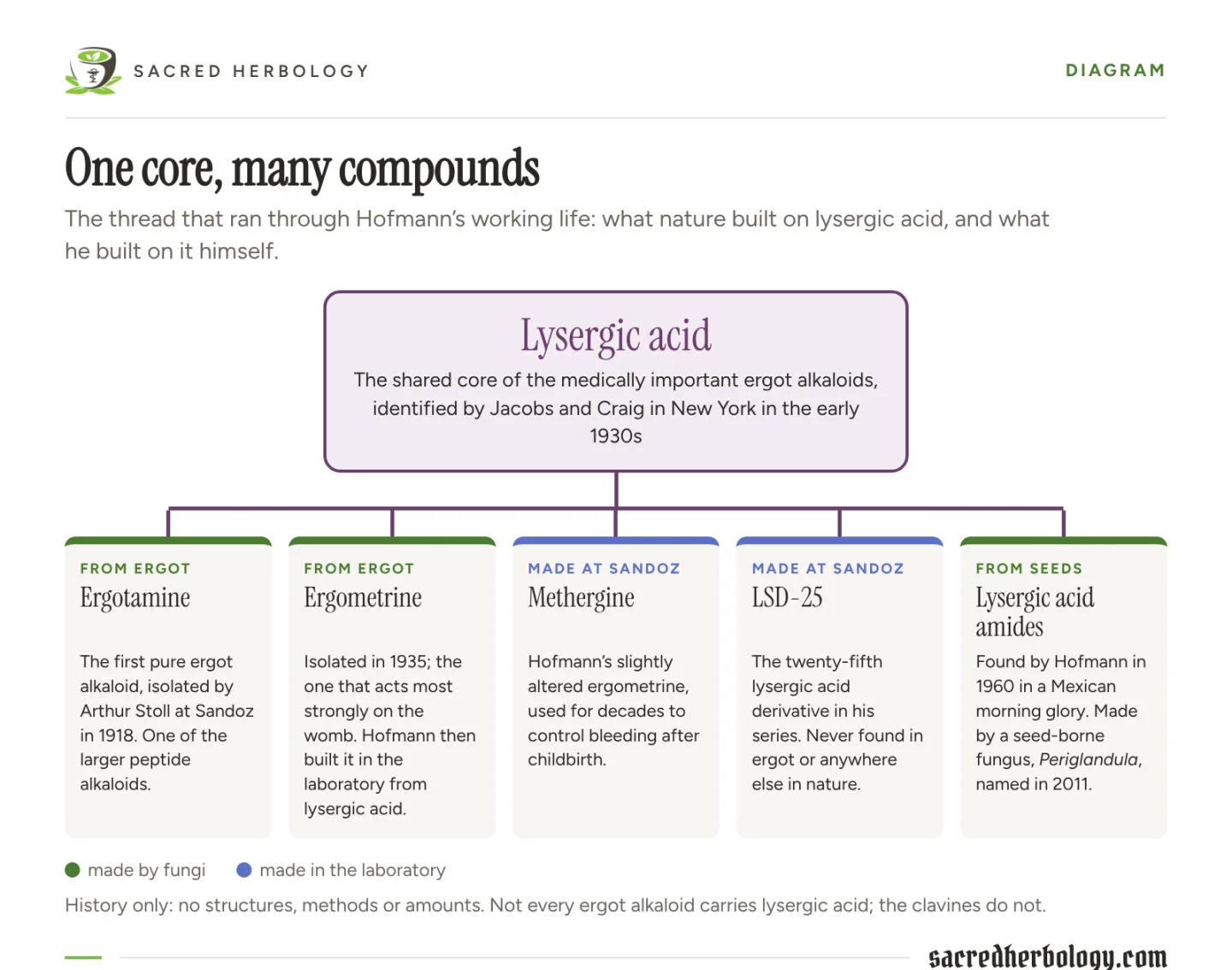
By the time Hofmann took up the subject, chemists had worked out that the medically important ergot alkaloids shared a common core, a molecule they named lysergic acid. In the early 1930s Walter Jacobs and Lyman Craig, at the Rockefeller Institute in New York, had broken the alkaloids down and identified that core. Each of those alkaloids was lysergic acid with something different attached to it.
In 1935 several laboratories at once isolated a new ergot alkaloid, the one that acted most strongly on the womb. It came to be called ergonovine, or ergometrine. Hofmann worked out how to build it in the laboratory from lysergic acid and a simple amino alcohol, the first time a natural ergot alkaloid had been built in the laboratory, starting from lysergic acid split off from ergot itself. Then he began varying the recipe, attaching different groups to the lysergic acid core to see what each new compound would do. One of his variations, a slightly altered form of ergometrine, went on sale under the name Methergine and was used for decades to control bleeding after childbirth. Another line of his work produced a preparation, Hydergine, that Sandoz sold for elderly patients. These were real, profitable medicines, and they made his name inside the company.
This is where the alchemical reading starts to make sense. Here was the black spur that had burned off the limbs of medieval peasants, the poison of St Anthony’s fire. Hofmann’s work, and Stoll’s before him, was to take it apart, purify its principles, and measure them, so that the substance that had killed could be given in a controlled way. The old alchemists described that operation in their own language: the separation of the pure from the impure, the extraction of a hidden virtue from a dangerous matter. Hofmann was doing it in the language of molecular structure. He was proud of it, and his ergot medicines were the work he expected to be remembered for.
In 1938 he made the twenty-fifth compound in his series of lysergic acid derivatives. He joined lysergic acid to a small molecule called diethylamine, and labelled the new substance with the German initials for lysergic acid diethylamide, Lysergsäure-diethylamid, and its number in the series: LSD-25. It is worth being clear on one point of chemistry here, because it is often muddled: LSD itself has never been found in ergot or anywhere else in nature. The lysergic acid core comes from the fungus. The diethylamide was Hofmann’s addition.
16 November 1938: a compound nobody wanted
Hofmann made LSD-25 on 16 November 1938. He was hoping for a stimulant of the circulation and breathing, because the diethylamide group also appears in a known stimulant of that kind, nikethamide, sold as Coramine, and he thought the combination might behave the same way. Sandoz’s pharmacologists tested it on animals. The animals became restless, and that was about all anyone recorded. The results were not interesting enough to pursue. The compound went onto a shelf, and for nearly five years nobody touched it.
Picture a page from a laboratory notebook, neat handwriting, a structural formula drawn in pencil, a code number, and a note of a test that went nowhere. Most of chemistry looks like that. It is worth remembering how ordinary this moment was.
What happened next is the part Hofmann found hardest to explain, even to himself. He wrote that he could not forget LSD-25. He had what he called a peculiar presentiment, a feeling that this substance might have properties the first tests had missed. The feeling was strong enough that in the spring of 1943, in the middle of the Second World War, with Switzerland surrounded by fighting, he decided to make it again.
Friday, 16 April 1943
On the afternoon of Friday 16 April 1943, Hofmann was finishing the new batch of LSD-25 in his laboratory in Basel when he was overcome by a strange restlessness and a slight dizziness. He went home and lay down. He wrote a few days later, in a report to Stoll, that with his eyes closed he sank into a not unpleasant, dreamlike state, and saw an uninterrupted stream of fantastic pictures and extraordinary shapes with an intense, kaleidoscopic play of colours. After about two hours the state faded.
He was puzzled. He was a meticulous chemist. He did not think he could have swallowed any of the substance. He guessed that a trace must have got onto his fingertips while he was crystallising it and been absorbed through the skin. If that was right, then the compound was active in amounts far smaller than anything a chemist of his day would have thought possible. He decided to test it.
Monday, 19 April 1943: the bicycle ride
On the following Monday, 19 April 1943, at twenty past four in the afternoon, Hofmann deliberately took a measured quantity of LSD-25 in the laboratory. He chose what he believed would be the smallest amount that could produce any effect at all, based on how strong the most powerful ergot alkaloids then known were. He had underestimated the new substance by a very wide margin. It turned out to be by far the most potent mind-altering substance then known.
Within the hour he was struggling. He wrote in his laboratory journal that he felt dizzy, anxious, that his vision was distorted and that he had a strong urge to laugh. Then the writing stops. He asked his laboratory assistant to take him home. Because of wartime restrictions on motor cars, they went by bicycle.
That bicycle ride is the most famous scene in the whole story, and you will have seen it drawn many times: the chemist in his suit on an upright bicycle, the road swaying and bending like a reflection in a curved mirror, the houses leaning in, his assistant pedalling beside him. Hofmann said afterwards that he felt he was not moving at all, though his assistant told him they had gone at a good pace.
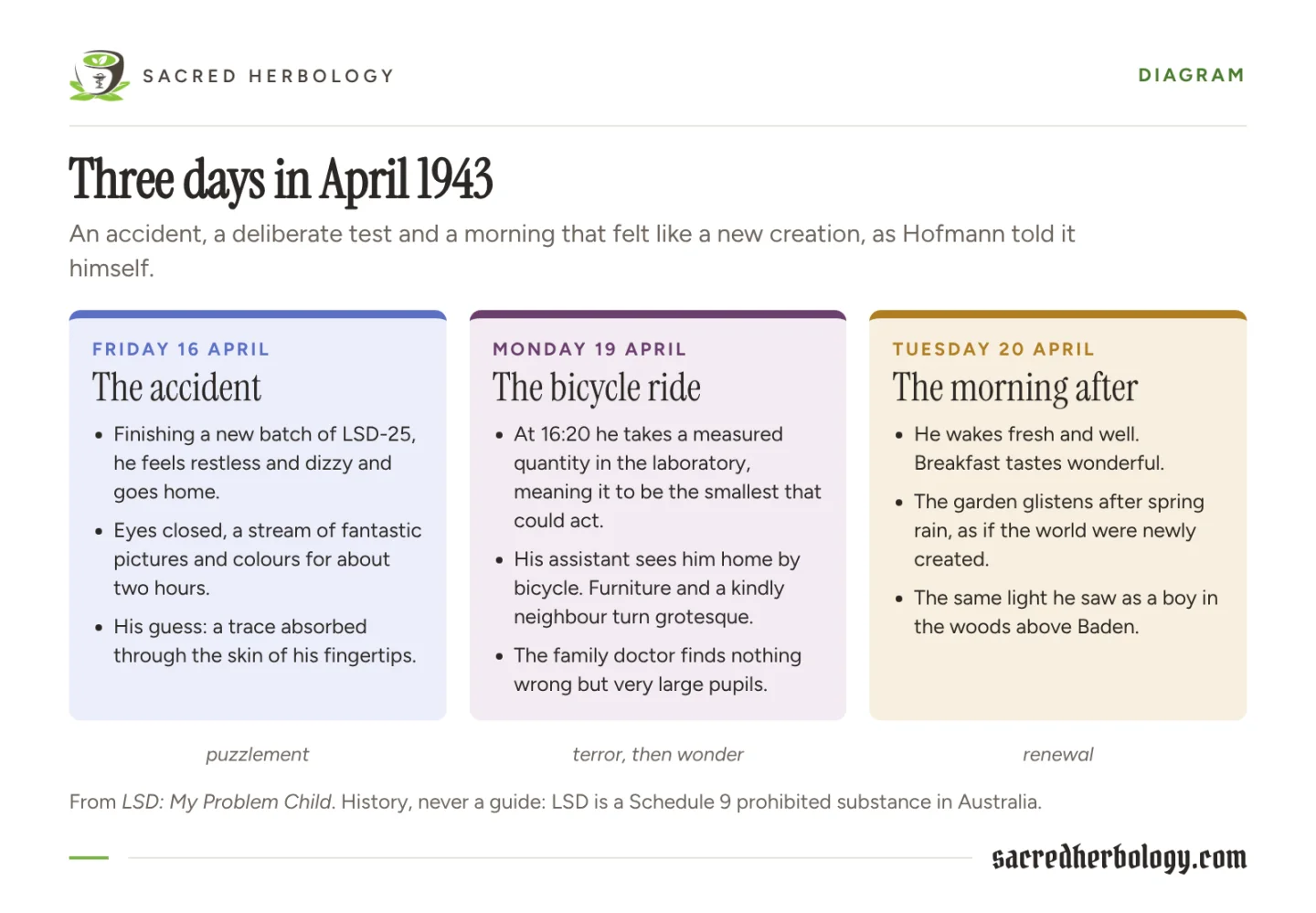
At home things got worse before they got better. The furniture took on grotesque, threatening shapes. A kindly neighbour who came to help seemed to him a malevolent, insidious witch wearing a coloured mask. He feared he was going mad, or dying, and that he had poisoned himself and would leave his wife and children, who were away visiting her family in Lucerne that day. The family doctor came and found nothing wrong except very large pupils. His heart, breathing and blood pressure were normal.
Then, slowly, the terror passed into something else. Lying with his eyes closed, he began to enjoy what he saw: shapes opening and closing like fountains, colours exploding and rearranging. Sounds, a door handle turning, a passing car, turned into pictures with their own form and colour. By the time his wife came home he was exhausted and calmer, and he slept.
The next morning is the part that matters most to the alchemical reading, and the part people tend to skip. Hofmann woke feeling fresh and well. Breakfast tasted wonderful. He went out into the garden, which had just had a spring rain, and everything glistened in a fresh light. He described the world as if it had been newly created, and he said this sense stayed with him all day. Thirty-odd years earlier, as a boy in the woods above Baden, he had seen the same thing happen to a forest.
Since 1985, when an American academic named Thomas Roberts first held a celebration of it, 19 April has been marked by enthusiasts around the world as Bicycle Day. That is a modern custom, less than fifty years old. It is not an old festival, and it has nothing to do with Sandoz, which never celebrated it.
The years in order
The years from Stoll’s first pure alkaloid to Hofmann’s death make a clean timeline, and it is worth setting out, because the story is often told in a jumble:
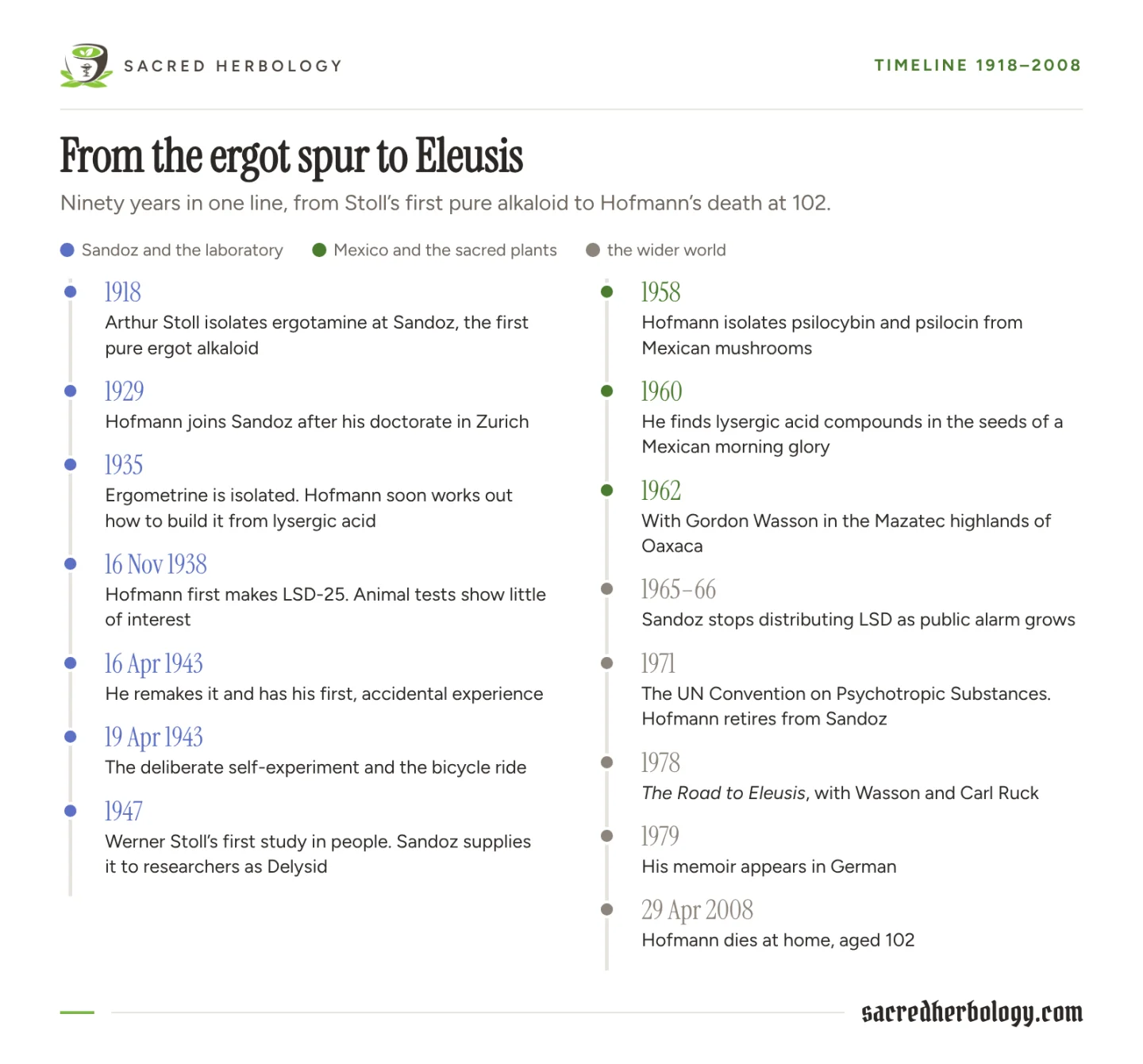
- 1918: Arthur Stoll isolates ergotamine, the first pure ergot alkaloid, at Sandoz.
- 1929: Hofmann joins Sandoz after his doctorate in Zurich.
- 1935: ergometrine is isolated. Within a couple of years Hofmann works out how to build it from lysergic acid.
- 16 November 1938: Hofmann first makes LSD-25. Animal tests show little of interest.
- 16 April 1943: Hofmann remakes LSD-25 and has his first accidental experience.
- 19 April 1943: the deliberate self-experiment and the bicycle ride.
- 1947: Werner Stoll, a psychiatrist and Arthur Stoll’s son, publishes the first study of LSD in human subjects. Sandoz begins supplying it to researchers under the name Delysid.
- 1958: Hofmann isolates psilocybin and psilocin from Mexican mushrooms.
- 1960: Hofmann identifies lysergic acid compounds in the seeds of a Mexican morning glory.
- 1962: Hofmann travels to the Mazatec highlands of Oaxaca with Gordon Wasson.
- 1965 to 1966: Sandoz stops distributing LSD, as public alarm grows and laws begin to change.
- 1971: the United Nations Convention on Psychotropic Substances places LSD in its most restricted schedule. Hofmann retires from Sandoz the same year.
- 1978: The Road to Eleusis is published.
- 1979: Hofmann’s memoir appears in German.
- 29 April 2008: Hofmann dies at home, aged 102.
Delysid, and the problem child
Sandoz did not quite know what to do with what Hofmann had found. A substance that changed perception and thought so strongly, in such tiny amounts, was obviously of scientific interest, but it was not a medicine in any ordinary sense. The company’s answer was to make it available to psychiatrists and researchers. From 1947 it supplied LSD under the trade name Delysid, with a leaflet suggesting two uses: as a tool for psychiatrists to gain, for a short time, some insight into the world of their patients, and as an aid in psychotherapy. Through the 1950s and early 1960s researchers in Europe, Britain, North America and elsewhere published a great many papers on it. That research history is a subject of its own, and I’ll leave it to the historians of psychiatry.
Outside the clinic, the substance escaped into the wider culture during the 1960s, and here Hofmann’s feelings became complicated. He had always seen LSD as something to be approached with care and respect, in a protected setting, with a serious purpose. What he saw in the newspapers of the late 1960s was mass use at parties and festivals, frightening accidents, psychiatric emergencies, and a political panic. The title of his memoir says it all. In German it is LSD, mein Sorgenkind: my problem child, the child who causes worry. He was proud of his discovery and grieved over what had been done with it, and he never stopped feeling both at once.
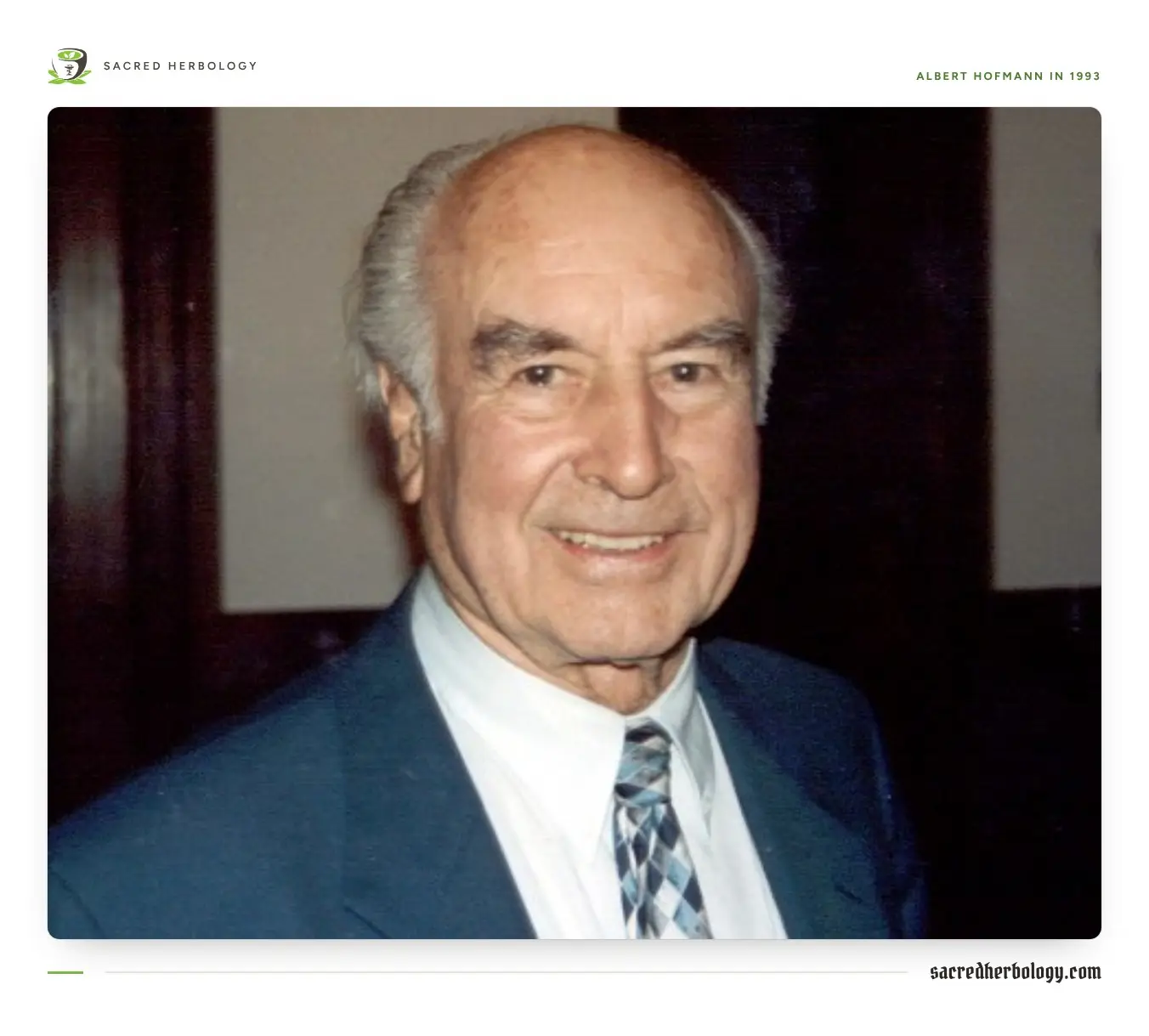

The legal story followed quickly. Sandoz stopped distributing LSD in the mid-1960s. Laws against it appeared in country after country, and in 1971 the international Convention on Psychotropic Substances put it in its most restricted category. In Australia today it is listed in Schedule 9 of the Poisons Standard, the category for prohibited substances, and it is illegal to possess or supply under Commonwealth and state law.
Friends in the visionary world
Hofmann’s discovery brought him into contact with an unusual circle of writers, and those friendships are where his thinking about mysticism grew.
The first was the German writer Ernst Jünger, a decorated soldier of the First World War who had become one of the great stylists of German prose. Jünger had written about drugs and intoxication for years. He and Hofmann became friends, and in 1951 they took LSD together at Hofmann’s house. Jünger later wrote a long book of reflections on drugs and altered states, Annäherungen: Drogen und Rausch, published in 1970, and it was in that book that he used the word Psychonauten, psychonauts, for those who travel into the inner world. Hofmann loved the word and used it for the rest of his life. Jünger also wrote a story, Besuch auf Godenholm, a Visit to Godenholm, published in 1952, which many readers take as a disguised account of that kind of experience. The two men stayed friends until Jünger died in 1998, at 102, the same age Hofmann would reach.
The second was Aldous Huxley, whose book The Doors of Perception (1954) about mescaline had already made him famous in this field. Huxley met Hofmann in Zurich in 1961. Huxley’s last novel, Island (1962), describes a utopian society that uses a visionary mushroom preparation, which the islanders call the moksha-medicine, in rites of passage and religious life. That idea, of a sacred substance held inside a culture’s rituals and given to people at the right time and in the right setting, was exactly the one Hofmann was coming round to. When Huxley was dying, in November 1963, his wife Laura gave him LSD at his own written request. Hofmann wrote warmly of Huxley in his memoir.
The third friendship took him to Mexico, and it is the one that makes him so important to anyone interested in sacred plants.
The mushrooms of the Mazatec
Robert Gordon Wasson was a New York banker, a vice-president of J. P. Morgan, with an unusual hobby. He and his wife, Valentina Pavlovna Wasson, a Russian-born paediatrician, had become fascinated by the different attitudes of European peoples to mushrooms. Valentina’s Russian family loved them; Gordon’s Anglo-American family feared them. The Wassons spent decades studying mushroom lore, and their research led them to the reports, going back to Spanish writers of the sixteenth century, of sacred mushrooms eaten in religious ceremonies in Mexico.
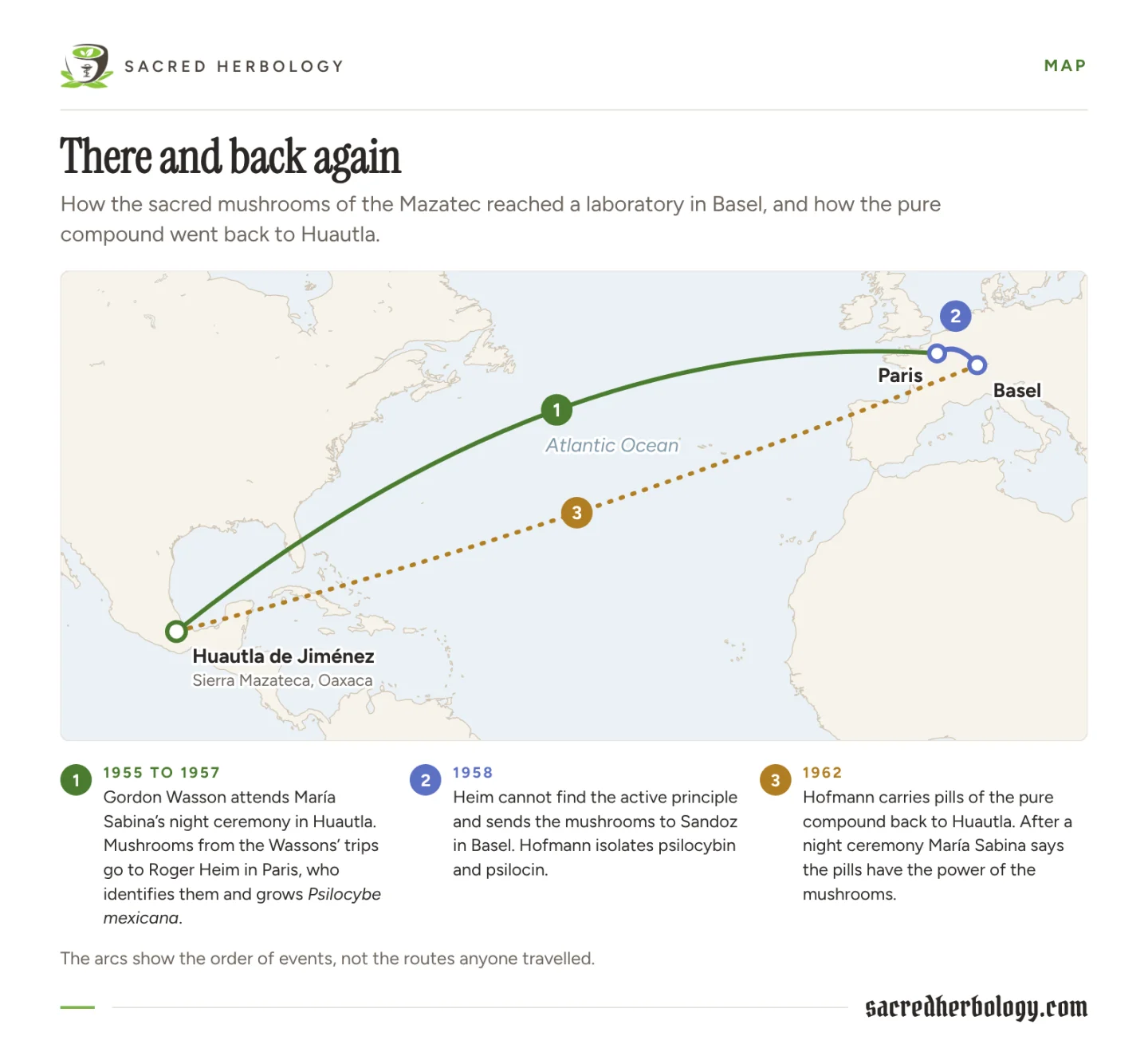
In 1955 Wasson and the photographer Allan Richardson travelled to Huautla de Jiménez, a town in the Sierra Mazateca of Oaxaca, and there they took part in an all-night mushroom ceremony, a velada, led by a Mazatec healer named María Sabina. In 1957 Wasson wrote about it in an illustrated article in Life magazine, published on 13 May 1957 under the heading “Seeking the Magic Mushroom”. The same year he and Valentina published a two-volume book, Mushrooms, Russia and History. The Life article reached millions of readers.
Mushrooms collected on the Wassons’ trips went to the French mycologist Roger Heim, director of the natural history museum in Paris, who identified the species and managed to grow some of them, among them Psilocybe mexicana, in his laboratory. Heim tried to find their active principle in Paris and failed. He sent the mushrooms to Sandoz, and they landed on Hofmann’s bench.
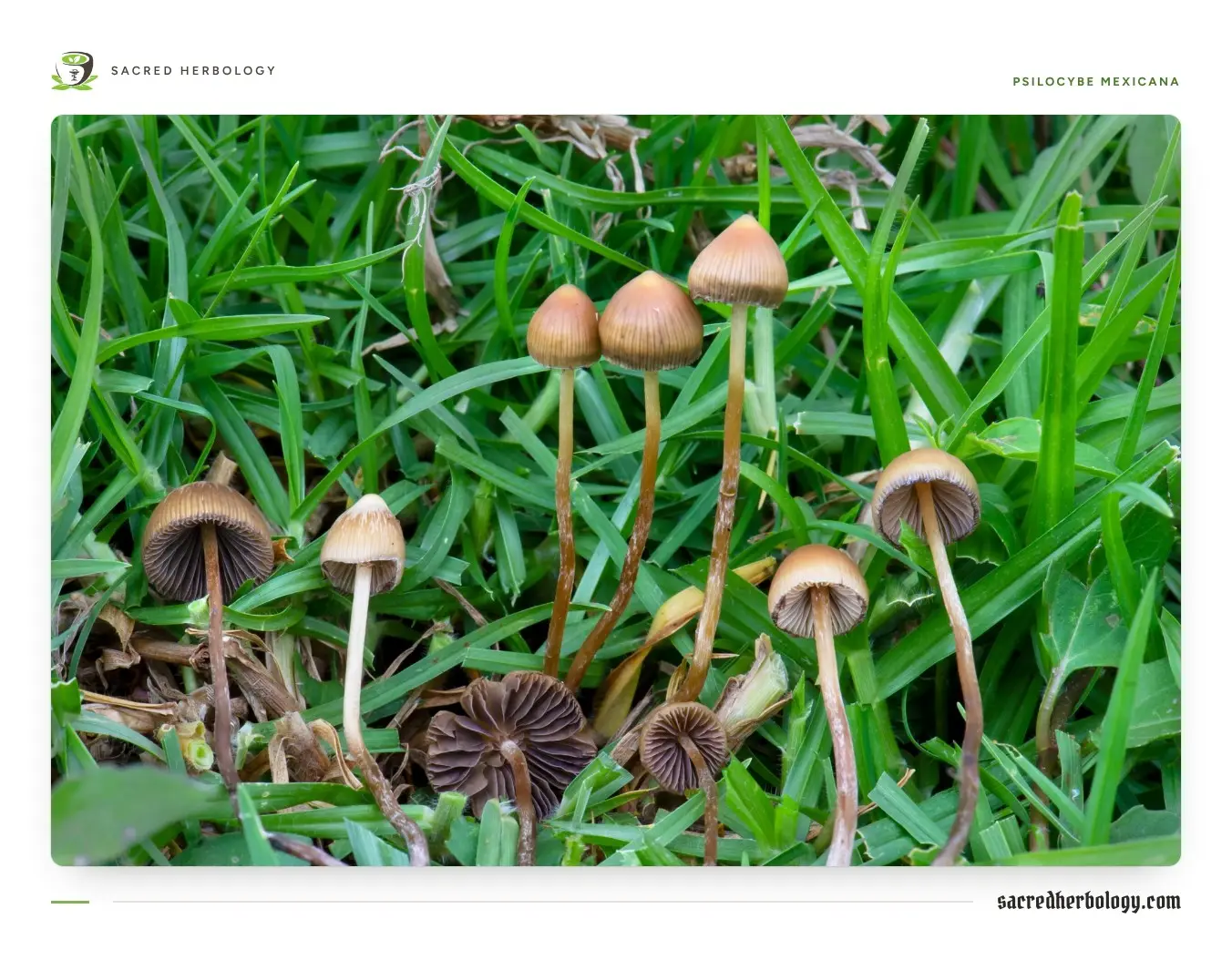

Hofmann’s chemists could not find a reliable animal test for the active substance, so he tested the extracts on himself. In 1958 he isolated two new compounds and named them psilocybin and psilocin, after the genus. They are close cousins: the body turns psilocybin into psilocin, which is the form that acts on the brain. He recalled that during his own trial of the mushroom, the room around him took on a Mexican character, and the face of a colleague seemed to turn into the mask of an Aztec priest, though he knew perfectly well he was in Basel. He worked out the structure of the compounds and how to make them, and Sandoz later supplied psilocybin to researchers, as it had LSD.
Set out on a map, this part of the story runs from Basel to Paris and across the ocean to the green, cloud-wrapped mountains of the Sierra Mazateca in northern Oaxaca, with the town of Huautla high on a ridge.
A night in Huautla, 1962
In the autumn of 1962 Hofmann and his wife Anita went to Mexico with Wasson and a few others. Part of the aim was to find and collect a Mazatec sacred plant, a sage whose leaves were used in healing ceremonies when the mushrooms were out of season. The Mazatec called it the leaves of the shepherdess, hojas de la pastora. The party travelled by mule through the mountains and saw the leaves used in ceremony. The party could not visit the places where it grew, but flowering plants were brought to them, and from that material and a living plant they carried home, the botanist Carl Epling and his colleague Carlos Játiva described it before the year was out as a new species, Salvia divinorum, the diviner’s sage, a member of the mint family. It is known only from the Sierra Mazateca, where it grows in damp, shaded ravines, and it rarely sets seed, so it has been kept going by cuttings. Hofmann took leaves back to Basel, but they had not kept well enough for him to isolate their active compound. That was found by other chemists many years later: salvinorin A, described in 1982, and unusual among visionary plant compounds because it contains no nitrogen and is not an alkaloid at all. In Australia Salvia divinorum is listed in Schedule 9 of the Poisons Standard as a prohibited substance.
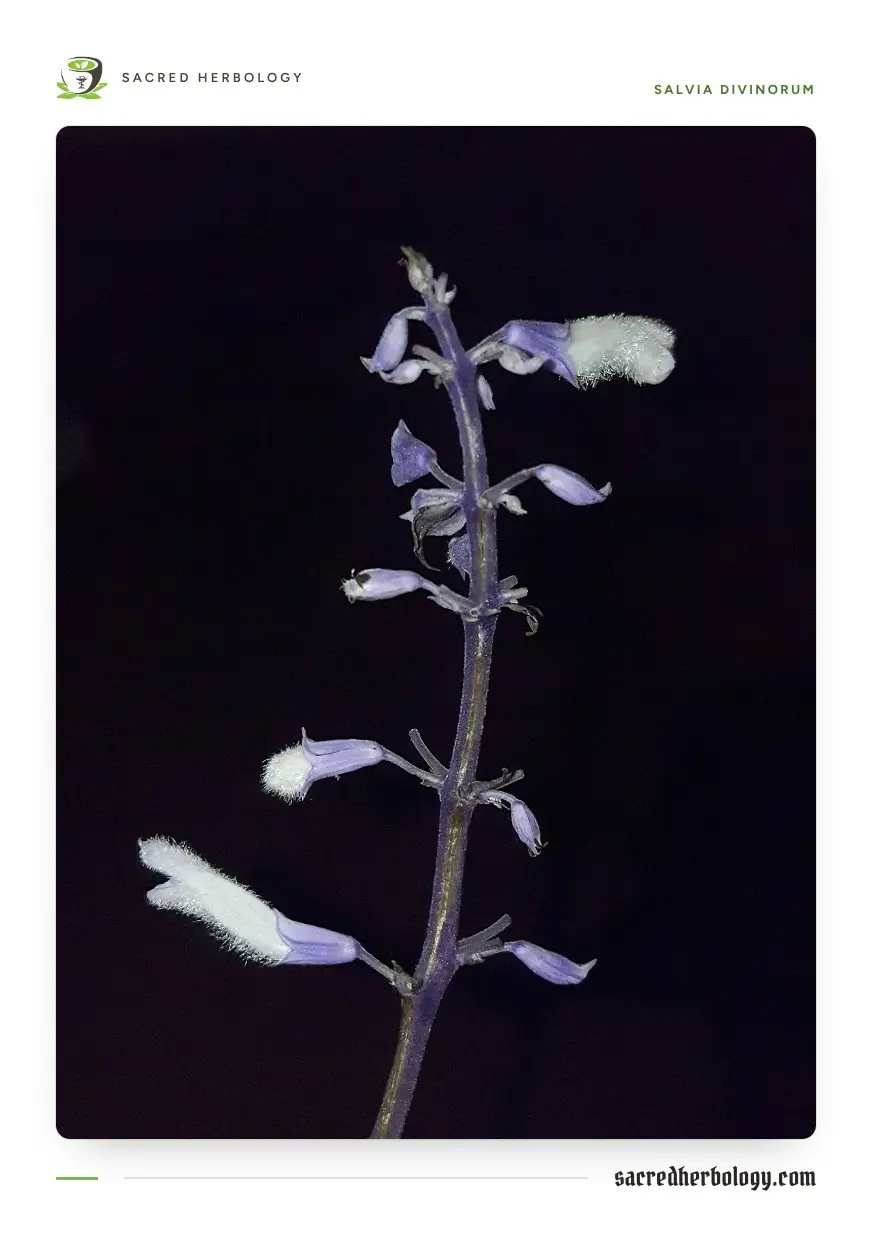

The best-known moment of the trip came when the party reached Huautla. Hofmann brought with him pills of synthetic psilocybin made in his laboratory in Basel. María Sabina agreed to hold a velada with them, and the ceremony took place one night in a house in the town, with Wasson, the Hofmanns and others present. Hofmann wanted to know whether the pure compound would be the same, for her, as the mushrooms. According to his account, at the end of the night she said there was no difference: the pills had the power of the mushrooms. Hofmann took this as the confirmation he had been hoping for, the plant’s own keeper saying that his chemistry had captured its virtue.
That scene is what an alchemist would recognise. The old books promised that the art could extract a plant’s essence into a stable, portable form that held all its power. Hofmann had done exactly that, and he had taken it back to the place it came from, and its traditional keeper had judged it.
María Sabina’s side of the story
The story has another side, and it should be told in María Sabina’s own words, so far as we have them. In the 1970s the Mazatec writer Álvaro Estrada recorded her life story in her own language, and it was published in Spanish and then in English as María Sabina: Her Life and Chants (1981), translated by Henry Munn. She was a curandera, a healer, who had come to her work as a young woman, and for her the mushrooms were sacred beings. She called them the saint children. They were eaten to find the cause of an illness, to speak with God and to heal, and never for curiosity.
After Wasson’s article was published, outsiders began to arrive in Huautla in large numbers: researchers, then tourists, then in the 1960s crowds of young foreigners looking for the mushrooms. The town was disrupted, the Mexican army and police came, and María Sabina was blamed by some of her own neighbours for bringing the strangers. Her house was burned. She lived out her life in poverty and died in 1985. She told Estrada that from the moment the foreigners arrived, the saint children lost their purity and their power, and that they no longer worked as they had before.
Wasson wrote in old age that he regretted the harm his publicity had done. Hofmann, too, came to speak about respect for the traditions that held these plants. I mention all this because any honest account of Hofmann’s Mexican work has to include the people who paid the cost of it. The Mazatec tradition is a living one. What I have written here comes from published sources, chiefly Estrada’s book and the writings of Wasson and Hofmann, and I have tried to say no more than they do.
Ololiuhqui: the seeds of the Aztec priests
There was one more Mexican discovery, and it is the one that changed how Hofmann thought about ancient sacraments.
Spanish chroniclers of the sixteenth century, the Franciscan Bernardino de Sahagún among them, described a sacred plant the Aztecs called ololiuhqui, whose round seeds priests and healers used in divination. The physician Francisco Hernández, sent by Philip II of Spain to study the medicinal plants of New Spain in the 1570s, described it as a twining vine with heart-shaped leaves and white, funnel-shaped flowers. In 1941 the American botanist Richard Evans Schultes argued that ololiuhqui was a morning glory he knew as Rivea corymbosa. The same plant has since been called Turbina corymbosa, the name you will find in most of the older books, and botanists now place it in Ipomoea as Ipomoea corymbosa, in the bindweed and morning glory family, Convolvulaceae. It is native from Mexico through tropical America. Wasson obtained seeds from Mexico and sent them to Hofmann.
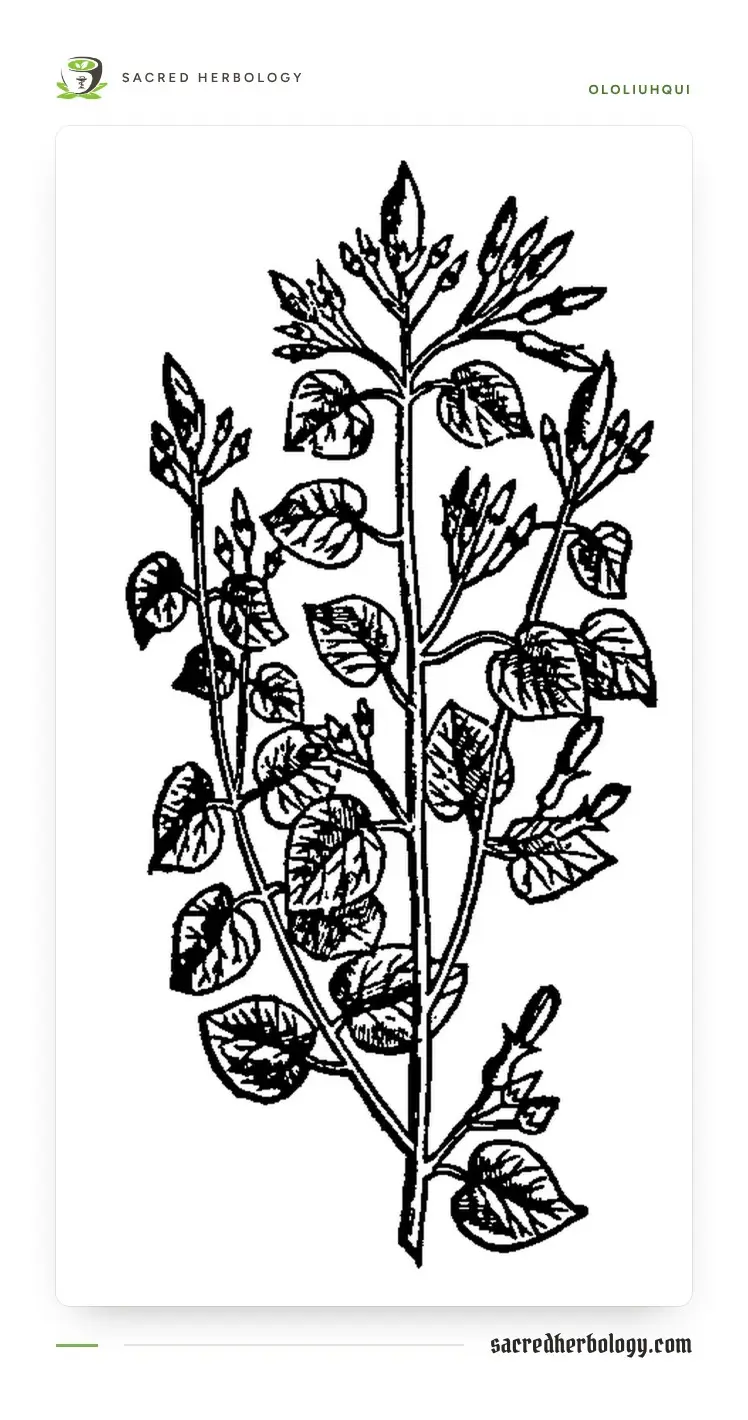

In 1960 Hofmann announced what he found in them: lysergic acid compounds, close chemical relatives of LSD, chiefly the simple amide of lysergic acid. This surprised everyone. Ergot alkaloids had been known only from fungi, and here they were in the seeds of a flowering plant, a member of the morning glory family. Hofmann said that the result was so unexpected that some of his colleagues at first assumed his samples had been contaminated in his own laboratory. The story had a botanical twist still to come. Early this century, researchers found that the alkaloids in these seeds are made by a tiny fungus that lives on the plant and passes down through its seed, a genus named Periglandula in 2011, and it belongs to the same family as ergot. It came full circle in his own life: the sacred seed of the Aztec priests contained the same kind of chemistry as the ergot of the European rye fields, which he had spent his career taking apart.
Hernández’s description was printed at Rome in 1651, long after his death, with a woodcut of the plant: a climbing stem thick with heart-shaped leaves.
That discovery is the bridge to Eleusis. If a plant used as a sacrament by one ancient people could hold lysergic acid compounds, what about the cereals of ancient Greece, and the ergot that grew on them?
The Mysteries of Eleusis
For nearly two thousand years, from at least the seventh century before Christ until the end of the fourth century after, the most famous religious rite in the Greek world was held each autumn at Eleusis, a town about twenty kilometres west of Athens. It was a mystery cult, which means its central rites were secret and revealed only to initiates. It honoured Demeter, the goddess of grain, and her daughter Persephone, also called Kore, the Maiden.
The story behind it is told in the Homeric Hymn to Demeter, a poem probably composed in the seventh or sixth century BC. Hades, lord of the underworld, carries off Persephone. Demeter searches the earth for her, grief-stricken, and refuses food and drink. Disguised as an old woman, she comes to Eleusis and is taken in by the royal household. When she is offered wine, she refuses it and asks instead for a drink made of barley meal and water mixed with the herb glechon, pennyroyal. This drink was called the kykeon, the mixed drink. In the end the gods strike a bargain: Persephone will spend part of each year below the earth and part above it, and while she is above, the grain grows. Demeter teaches her rites to the leaders of Eleusis, and the hymn says that those who have seen them are blessed, and that the uninitiated have no such share after death.
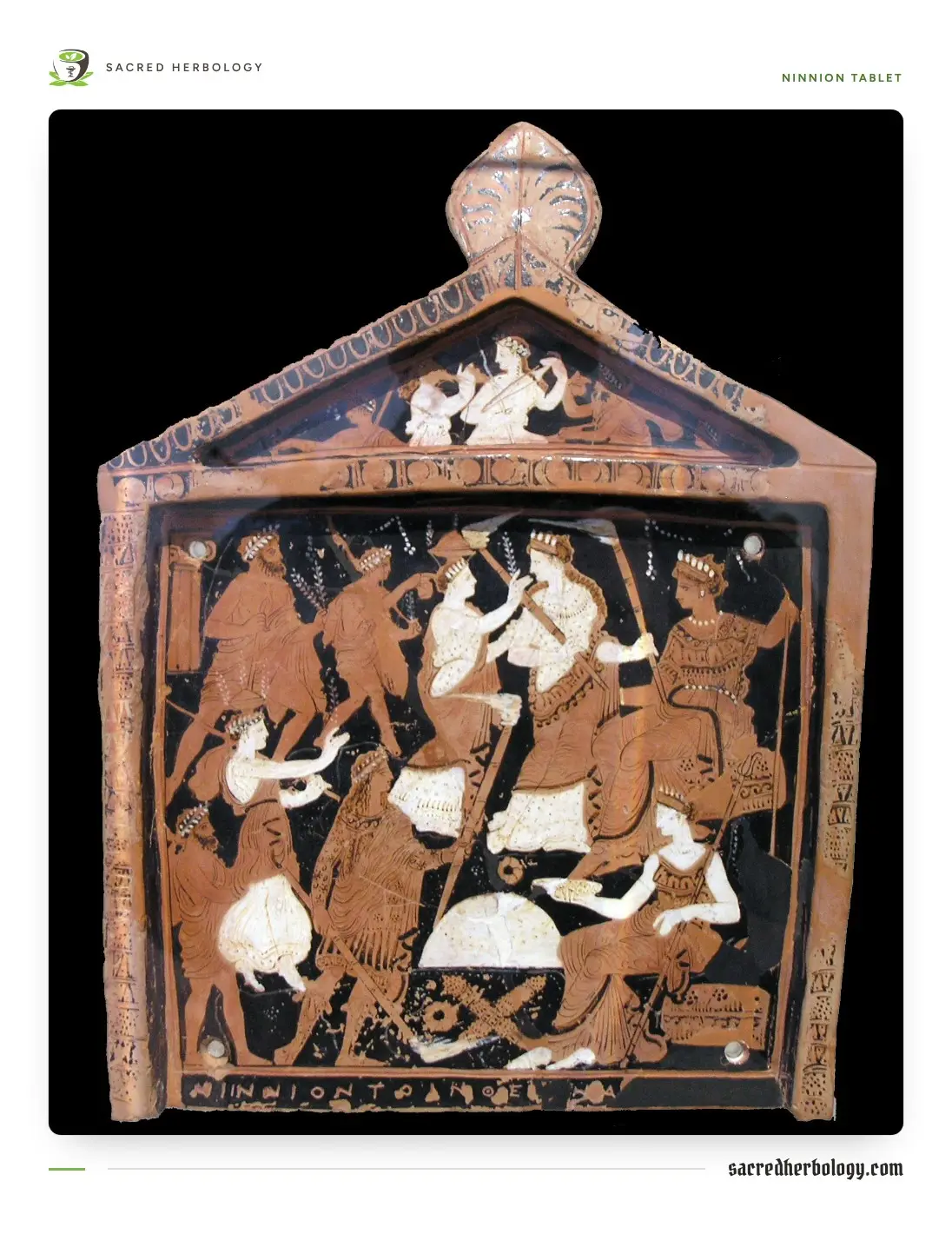

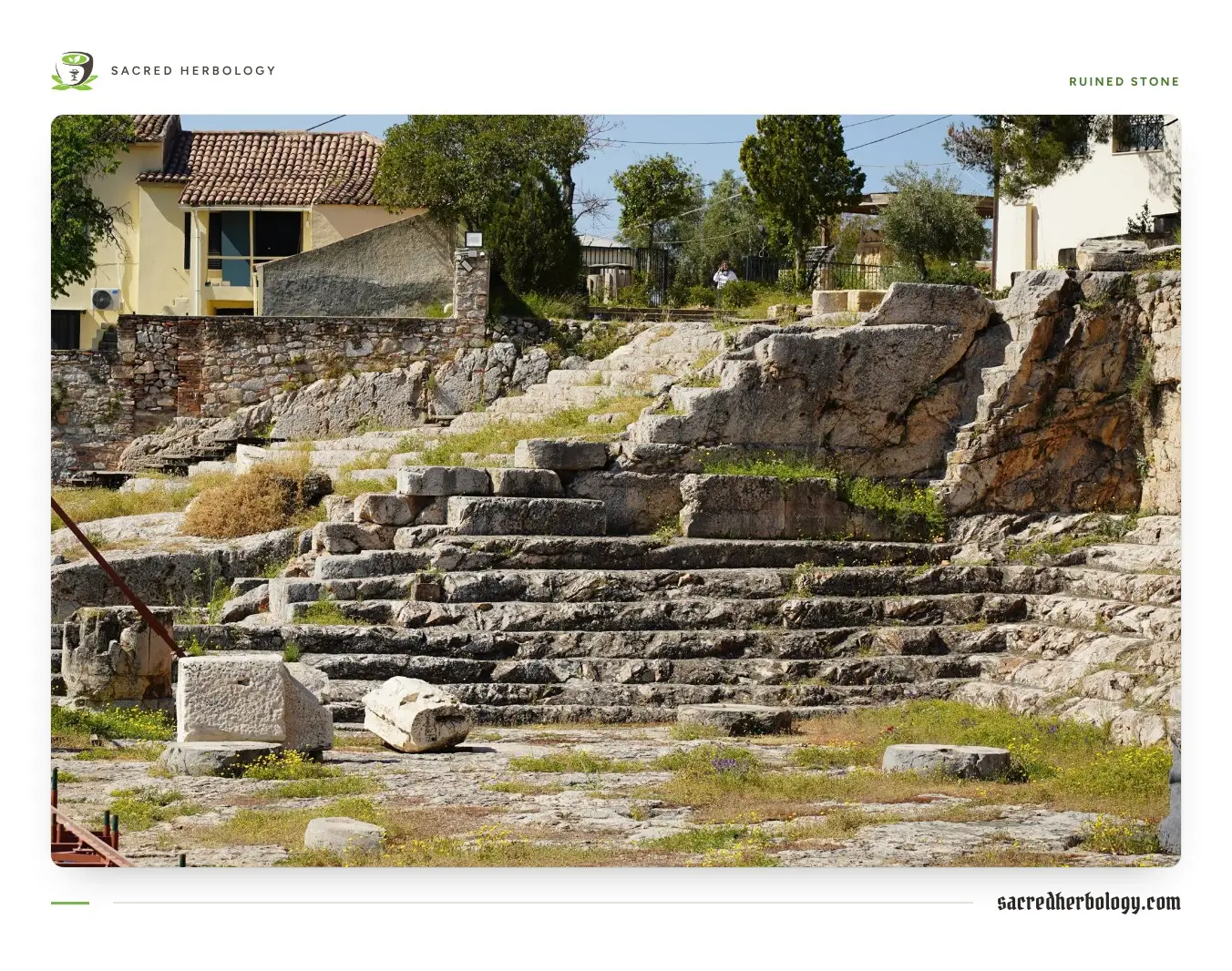
The rite itself was held in a great hall called the Telesterion, a square building lined with tiers of steps where thousands of people could stand. Picture its plan: a near-square hall crowded with rows of columns, the Anaktoron, a small inner shrine, at its centre, and the steps around the walls. After days of preparation and a long procession along the Sacred Way from Athens, the initiates entered that hall at night. Ancient writers tell us that something was shown, something was said and something was done, and that a priest called the hierophant, the one who shows the holy things, appeared in a blaze of light. They also tell us the initiates drank the kykeon. Beyond that, the secret held. Initiates included Plato, Sophocles and, in Roman times, emperors. Very few ever broke silence, and the penalties for doing so were severe.
The cult came to an end in the late fourth century AD. The Christian emperor Theodosius I banned pagan worship in the 390s, and the Goths under Alaric sacked Eleusis in 396.
The ruins are still there, and the plan of the Telesterion is cut into the bedrock. The greatest mystery of the classical world was performed in that hall for nearly two thousand years, and we do not know what the initiates saw.

The Road to Eleusis, 1978
In 1978 three men published a short book proposing an answer. It was called The Road to Eleusis: Unveiling the Secret of the Mysteries, and its authors were Gordon Wasson, Albert Hofmann and Carl A. P. Ruck, a classicist at Boston University.
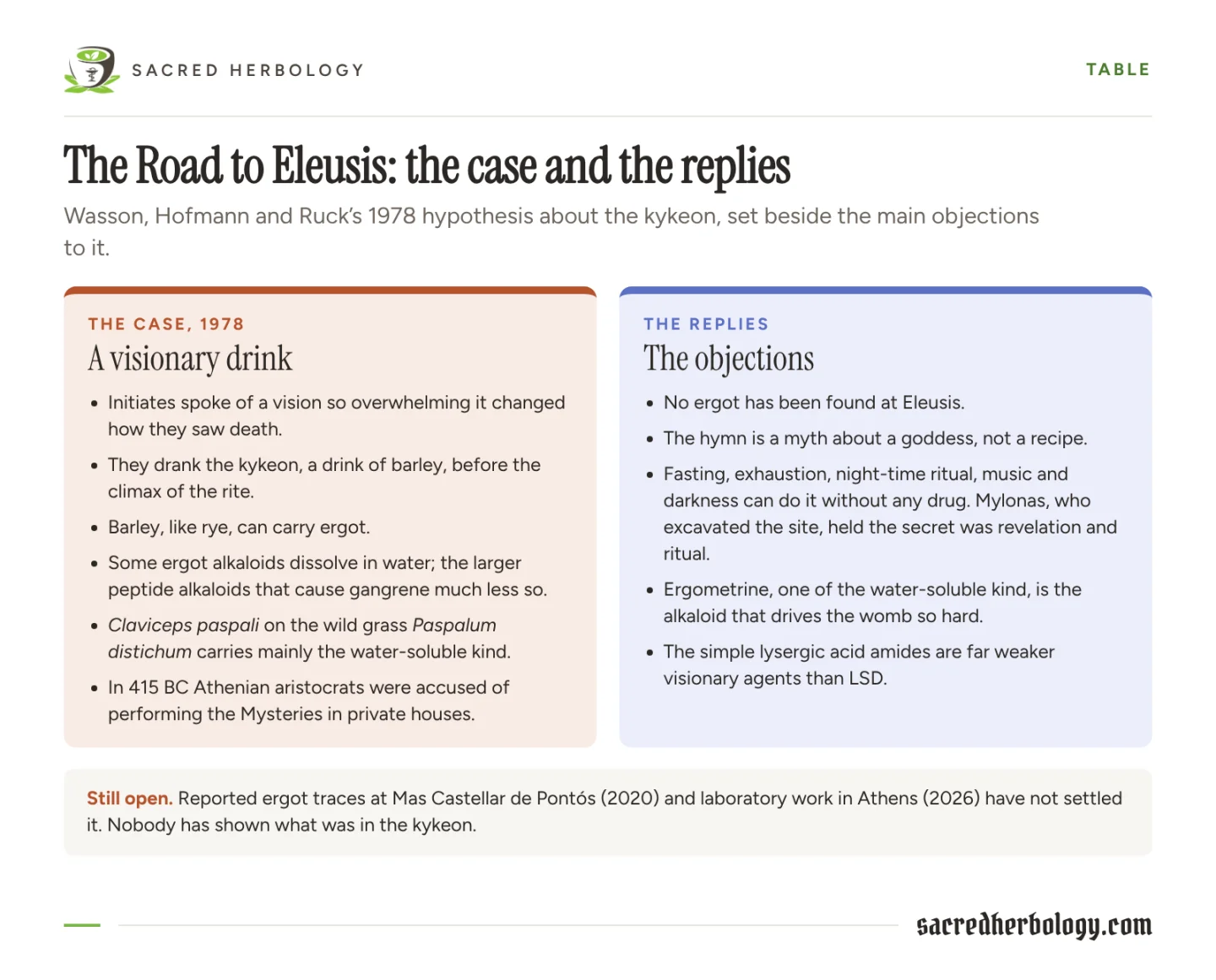
Their argument went like this. The initiates spoke of a vision so overwhelming that it changed their view of death. They drank the kykeon, a drink made from barley, before the climax of the rite. Barley, like rye, can carry ergot. Hofmann’s contribution was the chemistry. He pointed out that some ergot alkaloids, the ones he had studied in the ololiuhqui seeds and in ergot itself, are soluble in water, while the most dangerous ones, the larger peptide alkaloids such as ergotamine that cause gangrene, are much less so. He argued that a simple preparation available in the ancient world could have separated the visionary compounds from the poisonous ones. He also noted that a related fungus, Claviceps paspali, grows on a wild grass around the Mediterranean, Paspalum distichum, and contains mainly the water-soluble kind. The ancient Greeks, he suggested, had the means to make a drink that would produce a strong visionary state without the horrors of St Anthony’s fire. The chemistry has its critics too. Ergometrine, one of the water-soluble kind, is the very alkaloid that drives the womb so hard, and the simple lysergic acid amides are far weaker visionary agents than LSD, so the argument rests on more than solubility alone.
Ruck’s chapters brought in the Greek evidence: the hymn, the language of the rite, and a famous scandal of 415 BC, when several Athenian aristocrats, the general Alcibiades among them, were accused of performing the Mysteries mockingly in private houses. The authors read this as a sign that the sacred drink could be prepared away from Eleusis, which would make sense if it depended on a material that could be carried and mixed.
The book was not a work of hard proof, and its authors said so. It was a hypothesis built on chemistry, literary sources and analogy with Mexico. It has been argued over ever since. Many classicists and archaeologists rejected it. They pointed out that no ergot had been found at Eleusis, that the hymn’s details are a myth about a goddess and not a recipe, and that powerful religious experiences can be produced by fasting, exhaustion, night-time ritual, music and darkness without any drug at all. George Mylonas, who excavated at Eleusis and published the standard archaeological account of the site in 1961, held that the secret was a matter of revelation and ritual, and many scholars still take that view.
The book gave rise to a word you will meet often. In 1979 Ruck, Wasson and three colleagues proposed in a scholarly journal that substances used for religious ends should be called entheogens, from a Greek root meaning roughly “the god within”. Wasson and his friends wanted a word that did not carry the baggage of “psychedelic” or “hallucinogen”. The word entheogen is a modern coinage from 1979. You will sometimes see it treated as an ancient term. It is not.
The argument since
The Eleusis question has never gone away. A thirtieth-anniversary edition of The Road to Eleusis appeared in 2008. In 2020 the American writer Brian Muraresku published a best-selling book, The Immortality Key, which revisited the theory and drew attention to a site in Catalonia, Mas Castellar de Pontós, a settlement near the old Greek colony of Emporion that some archaeologists interpret as having a sanctuary of Demeter and Kore in its later phases. Muraresku reported that traces of ergot had been found there in a ritual vessel and in the dental calculus of a man buried at the site. Those findings are described in his book and in the popular coverage that followed it, and they have not settled the question among specialists. In early 2026 news reports described laboratory experiments by researchers in Athens suggesting that a simple technique available in antiquity could have made ergot less toxic. That too is a hypothesis about the rite. The debate is alive, and it is good-natured more often than not, but the honest position is that nobody has shown what was in the kykeon.
What I can tell you with confidence is what Hofmann himself believed, because he said it many times. He came to think that the experience of Eleusis, whatever produced it, had been a protected, sacred encounter with the visionary state, held inside a ritual, given once in a lifetime, prepared for over months and surrounded with reverence. In his lectures in old age he spoke of the need for something like a new Eleusis: a setting in which people could have the kind of experience he had as a boy in the woods, safely and with meaning, so that they would come back to everyday life with the sense that the world was sacred. A collection of his later essays and lectures, edited by Amanda Feilding, was published under the title Hofmann’s Elixir: LSD and the New Eleusis. One of those lectures, “The Message of the Eleusinian Mysteries for Today’s World”, is also printed in Robert Forte’s anthology Entheogens and the Future of Religion (1997).
A word on safety
Before we leave the hymn, a word about the plants and fungi in this story, because some of them turn up in gardens and grain. Ergot is a poison. No kitchen or home method makes it safe, and the experiments described above are laboratory chemistry about an ancient rite. Ergot also makes the womb contract, which is why it is so dangerous in pregnancy. The seeds of several garden morning glories carry lysergic acid compounds and are poisonous to people and to pets, so keep seed packets away from children and animals. Wild mushrooms should never be eaten on a guess, because deadly species are easily mistaken for harmless ones. Pennyroyal, Mentha pulegium, the one herb the hymn names, is a small creeping mint that many people grow in damp ground. It has gone wild in wet pasture and along creeks in much of southern Australia, so it is better kept in a pot than let loose. Its concentrated oil is toxic and has caused deaths, among them women who took it to end a pregnancy, and it is poisonous to dogs and cats as well. The hymn’s kykeon is a sacred drink in a myth, not something to copy. If anyone swallows any of these, call the Poisons Information Centre on 13 11 26, and if they are very unwell, call 000.
The alchemist’s vision
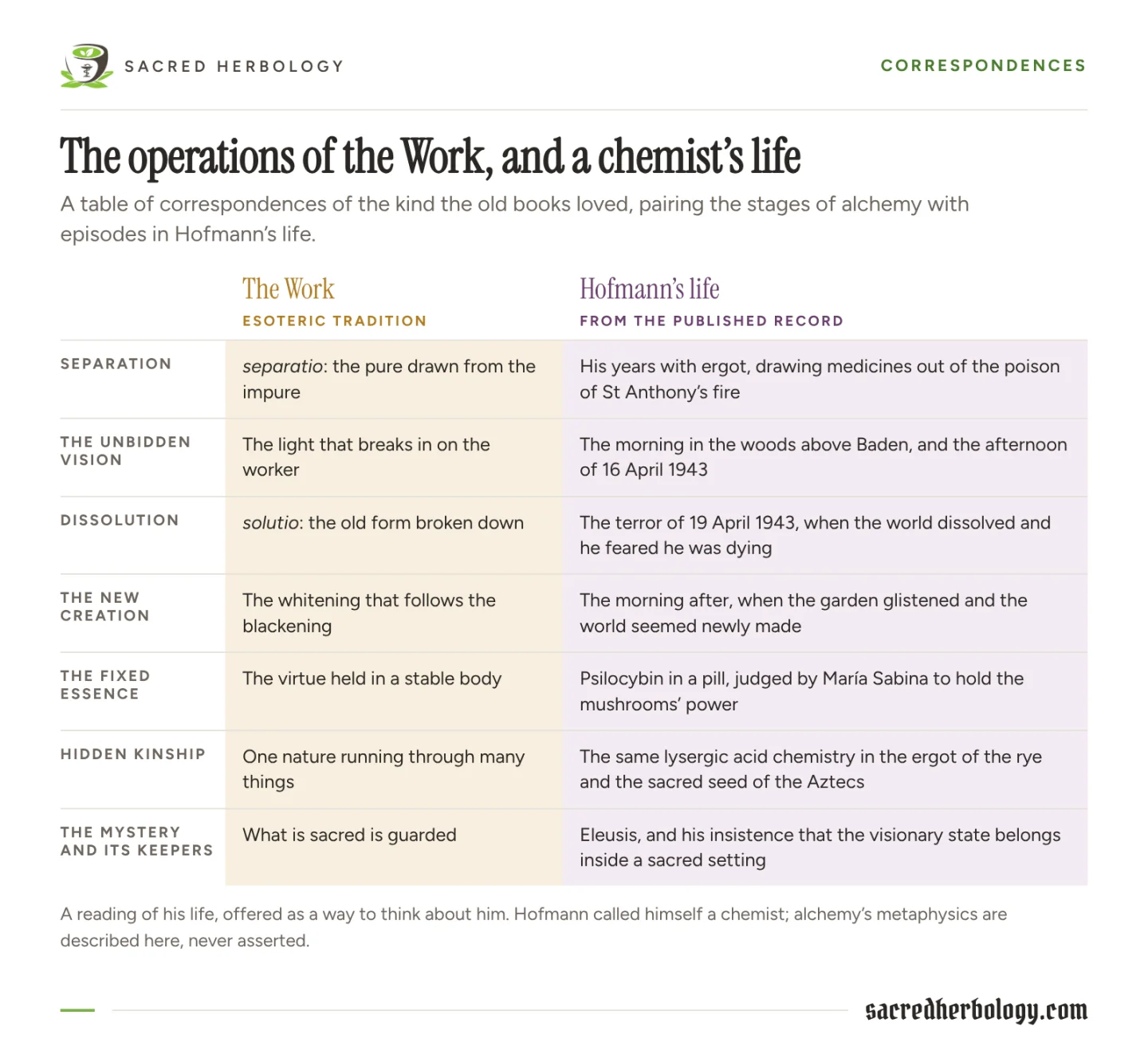
So why call Hofmann an alchemist? Here is how I would set out the case, as a table of correspondences of the kind the old books loved, pairing the operations of the Work with episodes of his life. It is my reading, offered as a way to think about him, and makes no claim about alchemy itself:
- Separation, separatio, drawing the pure from the impure: his years with ergot, drawing medicines out of the poison of St Anthony’s fire.
- The unbidden vision, the light that alchemical writers say breaks in on the worker: the morning in the woods above Baden, and the afternoon of 16 April 1943.
- Dissolution, solutio, the breaking down of the old form: the terror of 19 April 1943, when the world dissolved and he feared he was dying.
- The new creation, the whitening that follows the blackening: the morning after, when the garden glistened and the world seemed newly made.
- The essence fixed in a stable body: psilocybin in a pill, judged by María Sabina to hold the mushrooms’ power.
- The hidden kinship of things: the same lysergic acid chemistry in the ergot of the rye and the sacred seed of the Aztecs.
- The mystery and its keepers: Eleusis, and his lifelong insistence that the visionary state belongs inside a sacred setting.
The alchemists wrote constantly about light, about matter that seems dead and dark giving up a hidden radiance. They described the Work in stages of colour, and the moment of illumination as an inner light that breaks in on the worker after long labour. Hofmann’s late writings return again and again to the same idea in modern language. In a lecture he gave in his eighties, and in his book Insight Outlook (1989), he described the self as a kind of receiver, and reality as something that comes into being only where an outer world of energy meets an inner world of feeling and perception. The colours, he liked to say, arise in us. He thought that the visionary state, whether it came in childhood in a forest or through a substance, was a widening of that receiver, so that we take in more of what is always there. That is his philosophy, and I report it as his. It sits comfortably beside the old alchemical idea that the worker must be changed for the Work to succeed.
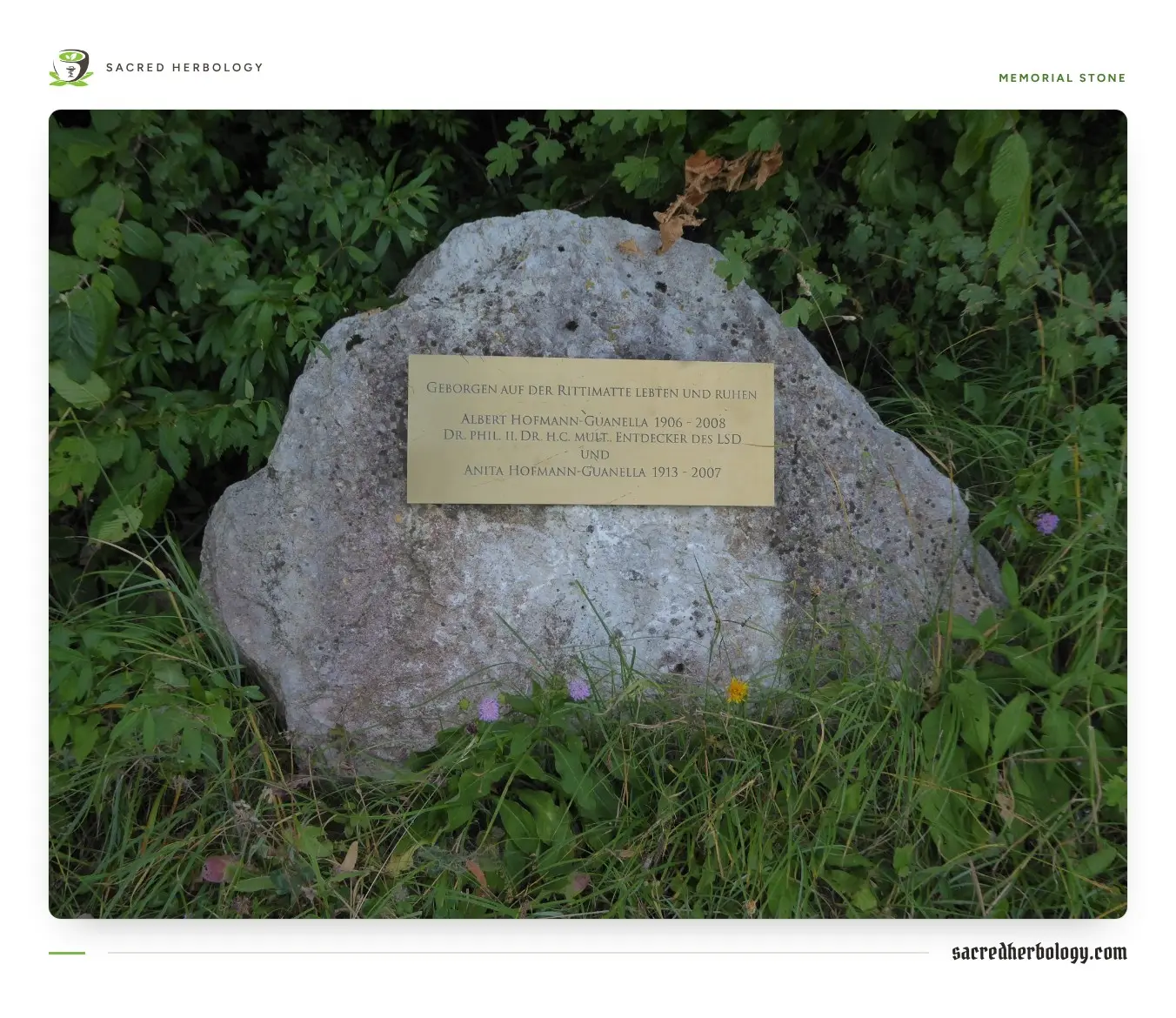
He was also, in the way of the old adepts, a man who spoke of nature with reverence. He was a keen gardener and a walker, and in his later years he lived in a house on a hillside called the Rittimatte, near Burg im Leimental, on the border between Switzerland and France, with meadows and woods all round. He said that the deepest thing LSD had given him was a renewed sense of the miracle of ordinary creation, the same sense he had had as a boy. In his memoir he wrote that he hoped the substance might help people find their way back to that living relationship with nature.
The long last years
Hofmann retired from Sandoz in 1971 as head of its natural products research. He went on writing. Plants of the Gods, written with Richard Evans Schultes and published in 1979, became the classic illustrated introduction to sacred and visionary plants around the world, full of paintings of the plants, photographs of ceremonies and maps of where each grew. Schultes and Hofmann had already written a more technical book together, The Botany and Chemistry of Hallucinogens, in 1973. His memoir came out the same year as Plants of the Gods, and an English translation by Jonathan Ott followed in 1980.
In January 2006 he turned one hundred, and a large international symposium was held in Basel in his honour. He spoke to the crowd himself. He had lived to see the beginning of a new wave of scientific research into the substances he had found, and he was glad of it. He died at home on 29 April 2008, at the age of 102.

The legal and clinical world he left behind has kept changing, and in Australia it changed in a way he might have found interesting. From 1 July 2023 the Therapeutic Goods Administration allowed psychiatrists with specific approval to prescribe psilocybin, the compound Hofmann isolated from the Mazatec mushrooms in 1958, for treatment-resistant depression, moving it to Schedule 8 of the Poisons Standard for that purpose. That was the regulator’s decision, on its own assessment, and I report it as such. LSD remains in Schedule 9.
What to take from it
Albert Hofmann was a chemist who worked inside a company all his life, and who never claimed to be anything else. He was also a man who believed, from that May morning in the woods to his last lectures, that ordinary perception is a narrow window onto something larger, and that people have always sought ways, through ritual and through plants, to open it a little further. He spent his working years separating medicine from poison in the dark spur of the rye, found by accident the strongest of all its relatives, and then spent the rest of his life trying to understand what he had found by going back to the oldest sacred rites he could find: a Mazatec night ceremony in the mountains of Oaxaca, the seeds of the Aztec priests, and the great hall at Eleusis.
The old alchemical books talk about a Work that begins in darkness and poison and ends in light, and about a worker who must be changed along with the matter in the flask. You don’t have to believe a word of that to see why the people who knew Hofmann reached for the language. His life followed that shape with almost uncanny neatness.
If you want somewhere to start reading, start with his own memoir. It is short and plain and generous, and it begins in the woods.
Next in this series: the painter Alex Grey and the visionary icon.
Where this comes from
- Albert Hofmann, LSD, mein Sorgenkind (Klett-Cotta, Stuttgart, 1979); English translation by Jonathan Ott, LSD: My Problem Child (McGraw-Hill, New York, 1980).
- Albert Hofmann, Insight Outlook (Humanics New Age, Atlanta, 1989).
- Albert Hofmann, Hofmann’s Elixir: LSD and the New Eleusis, edited by Amanda Feilding (Beckley Foundation, 2008; paperback Strange Attractor Press, 2010).
- R. Gordon Wasson, Albert Hofmann and Carl A. P. Ruck, The Road to Eleusis: Unveiling the Secret of the Mysteries (Harcourt Brace Jovanovich, New York, 1978; thirtieth-anniversary edition North Atlantic Books, Berkeley, 2008).
- Richard Evans Schultes and Albert Hofmann, The Botany and Chemistry of Hallucinogens (Charles C. Thomas, Springfield, 1973).
- Richard Evans Schultes and Albert Hofmann, Plants of the Gods (McGraw-Hill, 1979; revised edition Healing Arts Press, 1992).
- Dieter Hagenbach and Lucius Werthmüller, Mystic Chemist: The Life of Albert Hofmann and His Discovery of LSD, translated by William Geuss and Linda Sperling (Synergetic Press, Santa Fe, 2013).
- Valentina Pavlovna Wasson and R. Gordon Wasson, Mushrooms, Russia and History (Pantheon Books, New York, 1957).
- R. Gordon Wasson, “Seeking the Magic Mushroom”, Life, 13 May 1957.
- Álvaro Estrada, María Sabina: Her Life and Chants, translated by Henry Munn (Ross-Erikson, Santa Barbara, 1981).
- Robert Forte (ed.), Entheogens and the Future of Religion (Council on Spiritual Practices, San Francisco, 1997).
- Carl A. P. Ruck, Jeremy Bigwood, Danny Staples, Jonathan Ott and R. Gordon Wasson, “Entheogens”, Journal of Psychedelic Drugs 11 (1979).
- George E. Mylonas, Eleusis and the Eleusinian Mysteries (Princeton University Press, 1961).
- Helene P. Foley (ed.), The Homeric Hymn to Demeter: Translation, Commentary, and Interpretive Essays (Princeton University Press, 1994).
- Brian C. Muraresku, The Immortality Key: The Secret History of the Religion with No Name (St. Martin’s Press, New York, 2020).
- Ernst Jünger, Annäherungen: Drogen und Rausch (Klett, Stuttgart, 1970).
- Aldous Huxley, Island (Chatto and Windus, London, 1962).
- George Barger, Ergot and Ergotism (Gurney and Jackson, London, 1931).
- Linnda R. Caporael, “Ergotism: the Satan loosed in Salem?”, Science 192 (1976).
- Therapeutic Goods Administration, announcement on MDMA and psilocybin, 3 February 2023; Poisons Standard, Schedules 8 and 9.