
Put one drop of real rose otto on a perfumer’s paper strip and wait. At first it is sharp, almost lemony, with something green in it, like a stem freshly snapped. Then it opens. Within a few minutes you are standing in a garden in early summer, and the scent stays on the paper for hours, warmer and honeyed as it goes. Perfumers will tell you it is one of the hardest smells in the world to fake. Over the centuries a lot of people have tried.
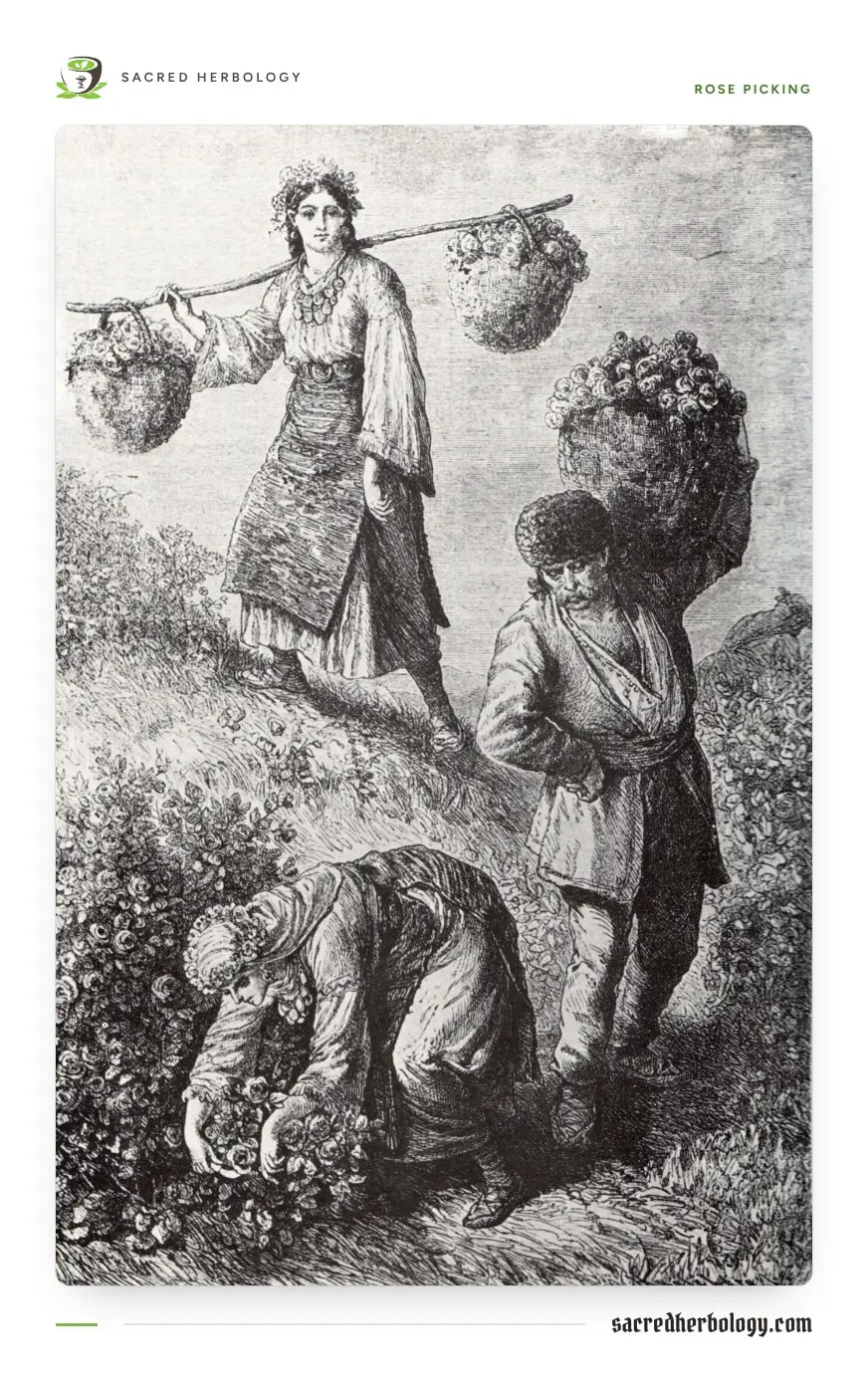
It takes an absurd number of flowers to make that drop. Pickers in Bulgaria and Turkey quote figures of three to four tonnes of fresh petals for a single kilogram of oil, gathered by hand in the cool of the morning before the heat of the day drives the scent off. When you hold a small bottle of rose otto you are holding the work of a whole valley for a morning.
So it makes sense that the rose turned into a symbol of the precious thing that is hard to win. In this piece I want to follow it along one particular road. It starts with Greek anointing oil and Roman garlands, runs through the stills of Baghdad and the rose gardens of the Persian poets, and comes out into European alchemy, where a book called the Rose Garden became one of the most famous texts of the art. Then it reaches a strange pamphlet printed in Kassel in 1614, which announced a secret brotherhood of the Rose Cross and set half of Europe looking for it. The rose is still on the breast of ritual magicians today.
A word on labels before we start, because this road crosses several kinds of ground. Village customs with roses are folklore, and I’ll call them that. Alchemy, the Rosicrucian manifestos and the ritual orders that grew out of them belong to learned, esoteric tradition, and I’ll label them esoteric. I’ll describe what each tradition held on its own terms. None of it is offered here as a claim about how the world works.
Which roses we mean
Roses belong to the genus Rosa in the rose family, Rosaceae, the same family that gives us apples, pears, cherries and almonds. There are well over a hundred wild rose species and tens of thousands of named garden roses, but only a handful matter for this story. For nearly everything that follows, the part of the plant that matters is the petal. The hips, the red fruits that follow the flowers, come into it only with the wild roses.
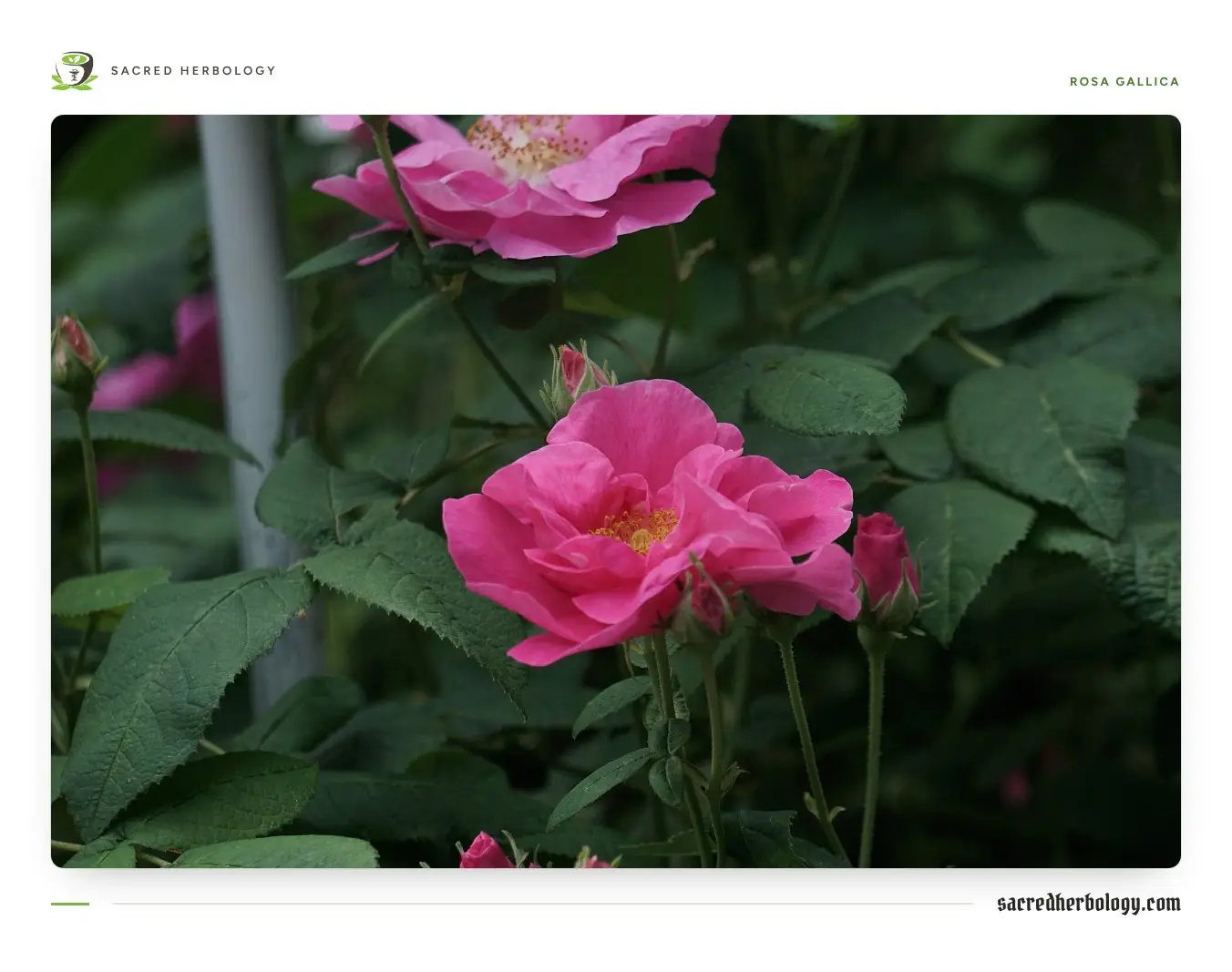
The first is Rosa gallica, the French rose or Provins rose. It is a low, suckering shrub native to southern and central Europe and western Asia, with flowers in shades of pink to deep crimson. Its petals hold their scent when they dry, which is rare among roses, and that made it the apothecary’s rose of medieval and early modern Europe. The form called Rosa gallica ‘Officinalis’ is the “apothecary’s rose” itself, and it is often said to be the red rose of Lancaster. The little town of Provins, south-east of Paris, grew it for centuries and sold dried petals and rose conserve across Europe. A local story says that Thibaut IV, Count of Champagne, brought the rose home from the crusades around 1240. That story is told in Provins with great affection. I have found no document from Thibaut’s own time that says so, and the rose was very likely in France already.

The second is the damask rose, written Rosa × damascena, the cross in the name telling you it is a hybrid. This is the great oil rose. Its name ties it to Damascus, though nobody can show it came from there. In 2000 three Japanese researchers, Hiroyoshi Iwata, Tsuneo Kato and Susumu Ohno, compared the DNA of several old damask cultivars and concluded that the damask had three parents: the musk rose, Rosa moschata, crossed with Rosa gallica, and that hybrid crossed again with a central Asian species from the Tian Shan and neighbouring ranges, Rosa fedtschenkoana. That points to an origin somewhere in the foothills of central Asia or Iran, among people who were already growing roses deliberately.
There are two broad kinds of damask. The summer damasks flower once, in a great flush in late spring. The autumn damasks flower again later in the year. The Roman poet Virgil, writing his Georgics in the 30s BC, mentions the “twice-bearing rose gardens of Paestum”, and rose historians have long taken this to mean a repeat-flowering damask growing in southern Italy two thousand years ago. It is an attractive reading, though Virgil gives us only a line of verse, so treat it as a likely guess.
The third is Rosa × centifolia, the cabbage rose or rose de mai, the “hundred-petalled” rose of the Dutch flower painters, grown today around Grasse in southern France for perfumery. The name echoes the ancient writers. Theophrastus, the Greek botanist of the fourth century BC, already knew of roses with a hundred petals, and Herodotus says that the gardens of Midas in Macedonia had wild roses with sixty petals and a scent beyond all others. Those ancient many-petalled roses can’t be matched to any modern cultivar, and the modern cabbage rose was developed much later, mostly by Dutch growers in the seventeenth and eighteenth centuries.
The fourth worth knowing is Rosa × alba, the white rose, often linked to the white rose of York. It is an old hybrid, probably involving the damask and a form of the dog rose.
Behind all of them stands the dog rose, Rosa canina, the wild briar of European hedgerows, whose hips country people gathered. When Culpeper and the other old herbalists write of the wild briar and its hips, this is usually the plant they mean. Its close cousin the sweet briar or eglantine, Rosa rubiginosa, has apple-scented leaves and the same sort of hips, and the two are easily confused in the hedge.
The rose and the oil in the ancient world
The oldest anointing with rose in Western literature happens in the Iliad. In book 23 Achilles has killed Hector and is dragging his body behind his chariot to defile it. Aphrodite keeps the dogs away from the corpse day and night, and she anoints it with rose-scented oil, ambrosial, so that the dragging will not tear the skin. It is a goddess caring for a dead man’s body with perfume, and it is the first time a rose oil appears in Greek poetry.
Rose oil in the ancient world was made by steeping petals in a fatty oil, often olive or a lighter oil pressed from unripe olives or the seeds of other plants. Distillation of essential oils as we know it lay centuries ahead. The Greeks called the result rhodinon. Theophrastus wrote a small treatise On Odours in which he discusses how perfumers thickened and fixed their oils, and rose oil appears among them. A few centuries later the Greek physician Dioscorides, whose De materia medica was the standard drug book of the Mediterranean world for fifteen hundred years, gives a whole chapter to rose oil. These were scented oils for the skin, the hair and the dead, and for the Greeks perfume and religion were never far apart. Aphrodite herself was the goddess most closely bound to the rose in later Greek and Roman poetry, and the poets told various stories of how the red rose got its colour from her blood or from the blood of Adonis.
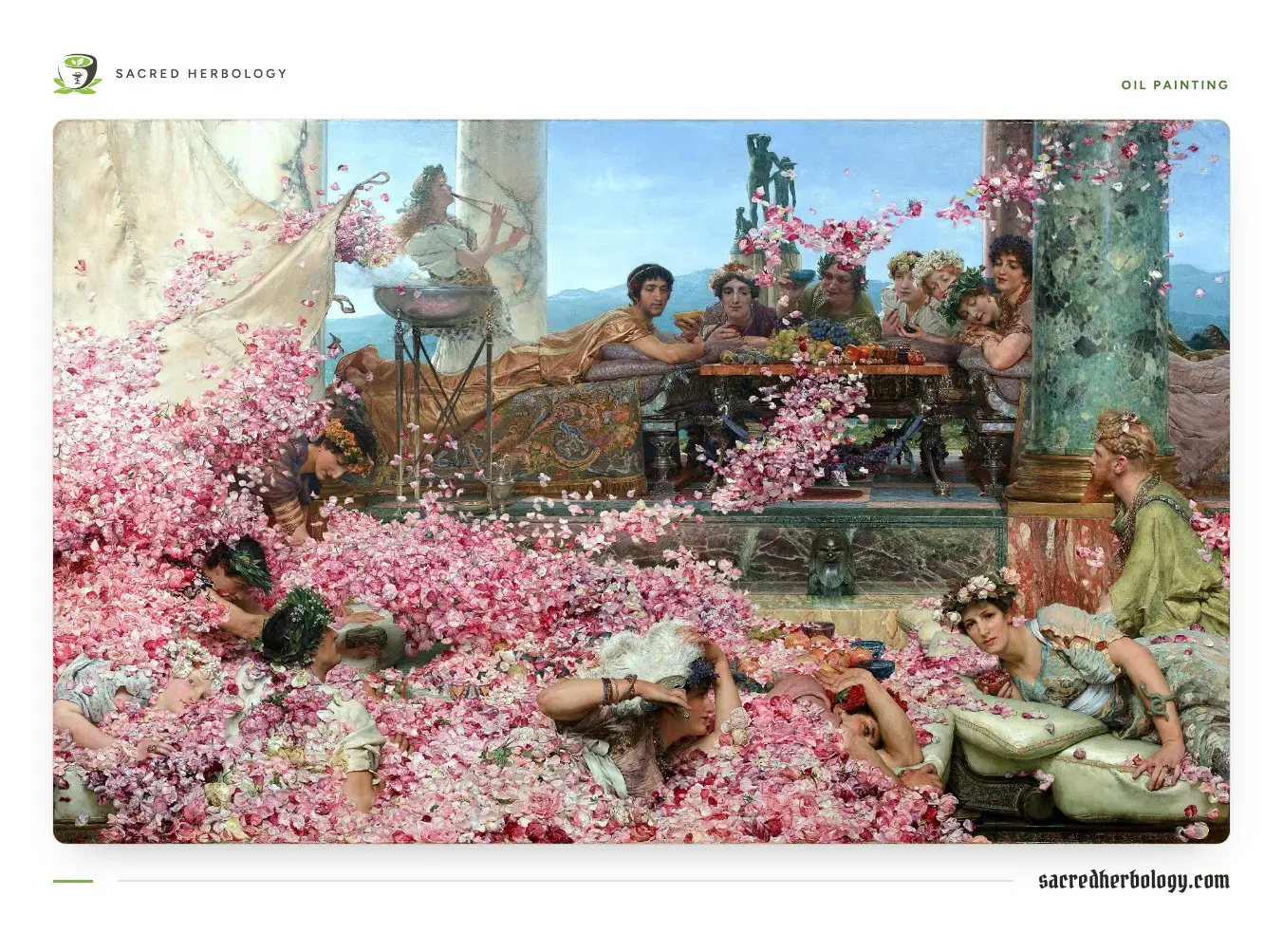
Rome loved roses with an appetite that still startles. The Romans scattered petals on banquet couches, wore rose garlands at dinner, and floated petals in wine. Pliny the Elder, in book 21 of his Natural History, describes the roses of Praeneste and Campania and gives a long account of their varieties and uses, including the garlands, which were a trade in their own right. Suetonius reports that Nero had friends hold dinners for him at which the roses alone cost more than four million sesterces, a sum that would have bought a large estate. The Historia Augusta, a late and famously unreliable collection of imperial lives, tells how the boy emperor Elagabalus dropped so many violets and other flowers on his guests from a false ceiling that some were smothered. The Dutch-born painter Lawrence Alma-Tadema turned that scene into The Roses of Heliogabalus in 1888, and the painting has fixed the roses in most people’s minds. The ancient source does not say roses specifically, and it may not be true at all.

There was a quieter Roman custom too. In May and June families kept the Rosalia, a festival when roses were laid on the graves of the dead. Inscriptions record people leaving money in their wills so that their tombs would be decked with roses every year. This is ordinary religious practice, household and graveside, and it ties the rose to memory and the dead long before Christianity.
One Roman story leads straight towards the esoteric. In the Metamorphoses of Apuleius, the second-century novel better known as The Golden Ass, a young man named Lucius dabbles in magic and is turned into a donkey by mistake. The cure is simple: he must eat roses. For the whole novel he fails to get to any. In the eleventh and last book the goddess Isis appears to him in a vision and tells him that a priest in her coming procession will carry a garland of roses. Lucius eats it, becomes a man again, and is initiated into her mysteries. That final book is one of our few first-hand pictures of initiation into an ancient mystery cult, and the rose stands at its centre, as the flower of the goddess that turns a beast back into a man. The later esoteric writers who read Apuleius did not miss it.
The still and the rose water
The great change in the rose’s history came with distillation.
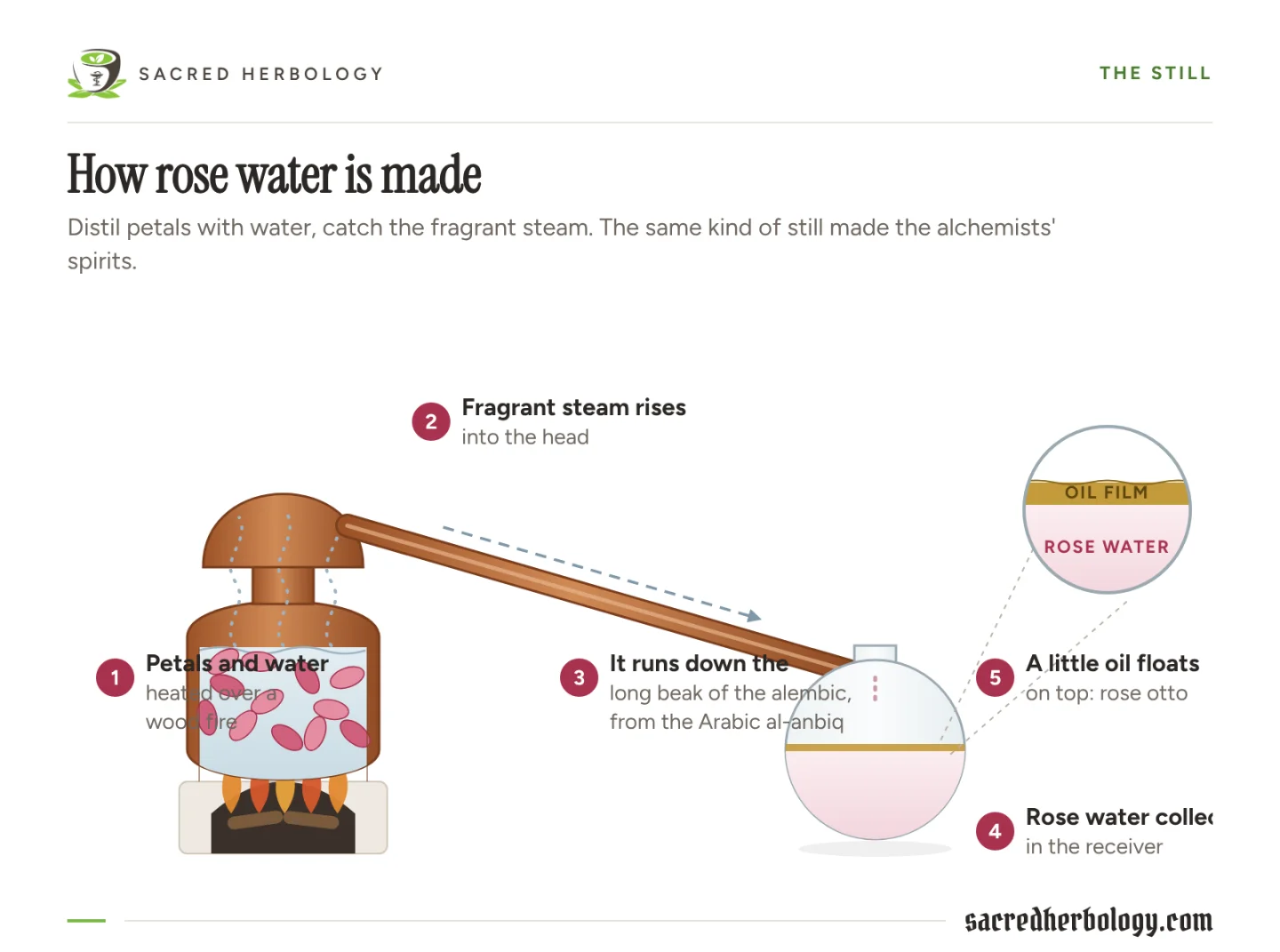
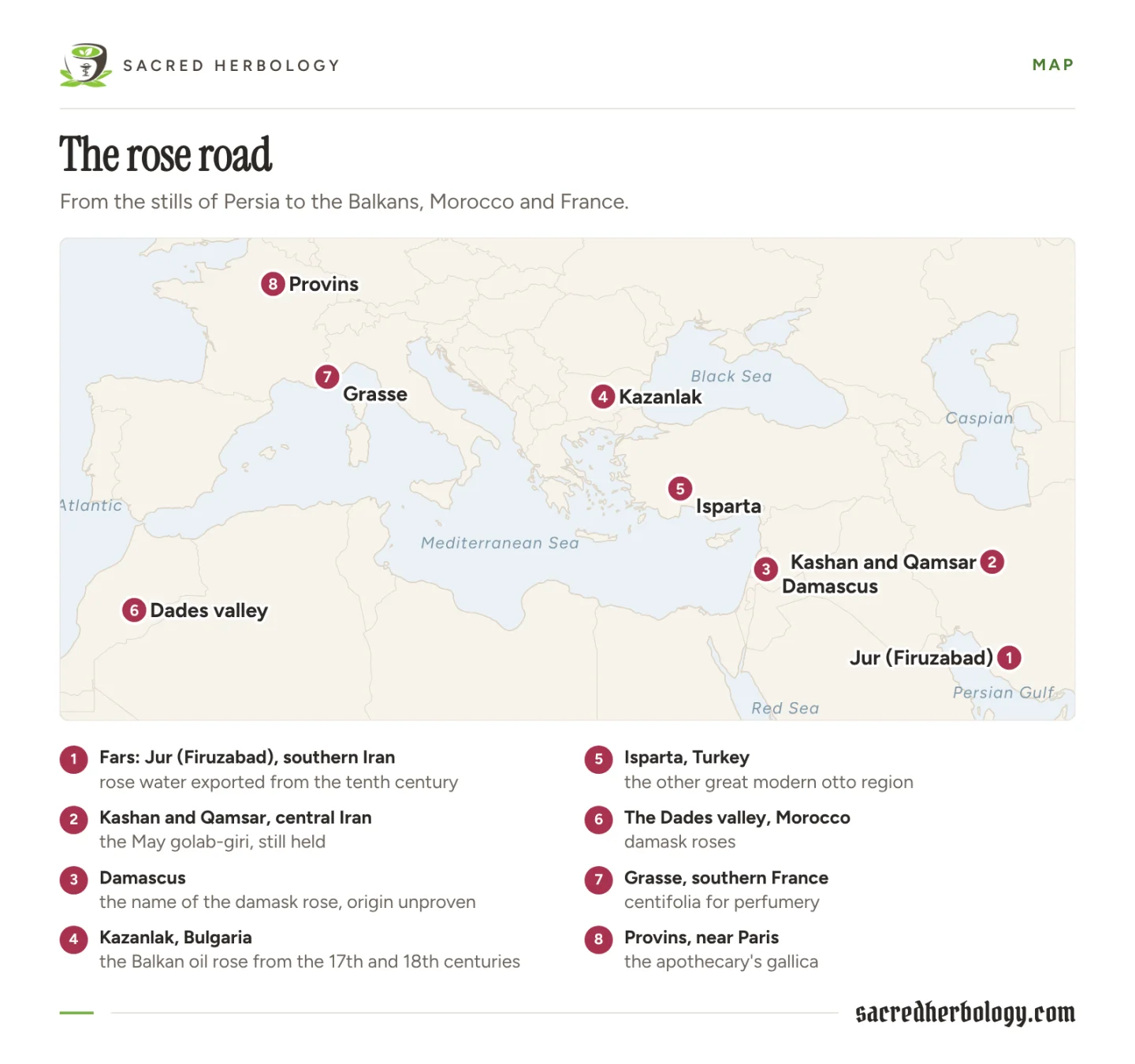
Rose water, made by distilling petals with water and catching the fragrant steam, is a product of the medieval Islamic world, and of Persia above all. The scholar Ya’qub ibn Ishaq al-Kindi, who worked in Baghdad in the ninth century and died around 873, wrote a Book of the Chemistry of Perfume and Distillations. It survives, and the German scholar Karl Garbers edited and translated it in 1948. It is the oldest perfumery handbook we have, and it includes distillation among its methods. By the tenth century the Arab geographers were writing about rose water from the province of Fars in southern Iran, and especially from the town of Jur, later Firuzabad, which they said was exported across the Islamic world, east to China and west to the Maghreb.
You will often read that Ibn Sina, the Persian physician known in Europe as Avicenna, invented the distillation of rose oil around the year 1000. That claim is repeated in a great many aromatherapy books. I haven’t found it in Ibn Sina’s own works, and al-Kindi was writing about distillation more than a century before him. It looks like a modern simplification that hung a slow, shared craft on one famous name.
Rose water entered everything. It perfumed food and sweets, it was sprinkled on guests as a welcome from long-necked silver sprinklers, it washed hands at the end of a meal, and it washed holy places. To this day the Kaaba in Mecca is washed once a year with water from the well of Zamzam scented with rose water. In Iran the damask rose harvest is still a festival. Every May the villages around Kashan, Qamsar most famously, fill with visitors who come to watch the golab-giri, the taking of rose water, when the petals go into copper stills over wood fires and the whole valley smells of roses.
Distilling rose water gives you a little oil as well. It floats on the surface of the water as a thin film, and with enough roses and patience you can skim it off. Who first did this on purpose is a good story. The Mughal emperor Jahangir, in the memoirs he kept in the early seventeenth century, says that the mother of his wife Nur Jahan, a woman called Asmat Begum, noticed this oily film while making rose water, collected it, and found that a single drop filled a room. Jahangir named it after himself, ‘itr-i Jahangiri, and says it was so strong that one drop rubbed on the palm scented the whole gathering. We need not take this as the very first time anyone noticed rose oil. Distillers in Persia had surely seen it before. It is, though, a dated, first-hand account from a royal household, and it shows how rare and admired the oil still was in 1612 or so.
The English word “attar”, and its older form “otto”, both come through Persian and Urdu from the Arabic ‘itr, which simply means perfume. Rose otto is still the name for the distilled oil.
In the seventeenth and eighteenth centuries the damask rose and the skill of distilling it moved into the Ottoman Balkans. The valley around Kazanlak, in what is now Bulgaria, became the centre of the trade, and Bulgarian rose oil, from the type called the Kazanlak rose, usually listed as Rosa × damascena ‘Trigintipetala’, became the standard by which others were judged. The town has held a Rose Festival since 1903, with a harvest ritual and a Rose Queen. Bulgaria and the area around Isparta in Turkey still produce most of the world’s rose otto, with Iran, Morocco and India also important.

Roses for Mary, roses for the mystics
Europe kept the rose through the early Middle Ages in its monastery gardens. The emperor Charlemagne’s estate ordinance, the Capitulare de villis of around 800, lists roses among the plants to be grown on royal lands. A generation or two later Walahfrid Strabo, abbot of Reichenau on Lake Constance, wrote a Latin poem about his own little garden, the Hortulus, and he ends it with the lily and the rose. For Walahfrid the rose is the blood of the martyrs and the lily the purity of faith. That pairing, red and white, will matter later.
Christian writers turned the rose into Mary’s flower. She is “the rose without thorns”, and in the Litany of Loreto, a prayer approved by the Pope in 1587 and older than that, she is called Rosa mystica, the mystical rose. The great round windows in the west fronts and transepts of Gothic cathedrals are called rose windows, and many of them centre on Mary. The rosary takes its name from a Latin word for a rose garden, rosarium, and the habit of calling a garland of prayers a crown or garden of roses goes back at least to the later Middle Ages. A fond tale says that each prayer said turned into a rose in Mary’s hands. That is pious legend.
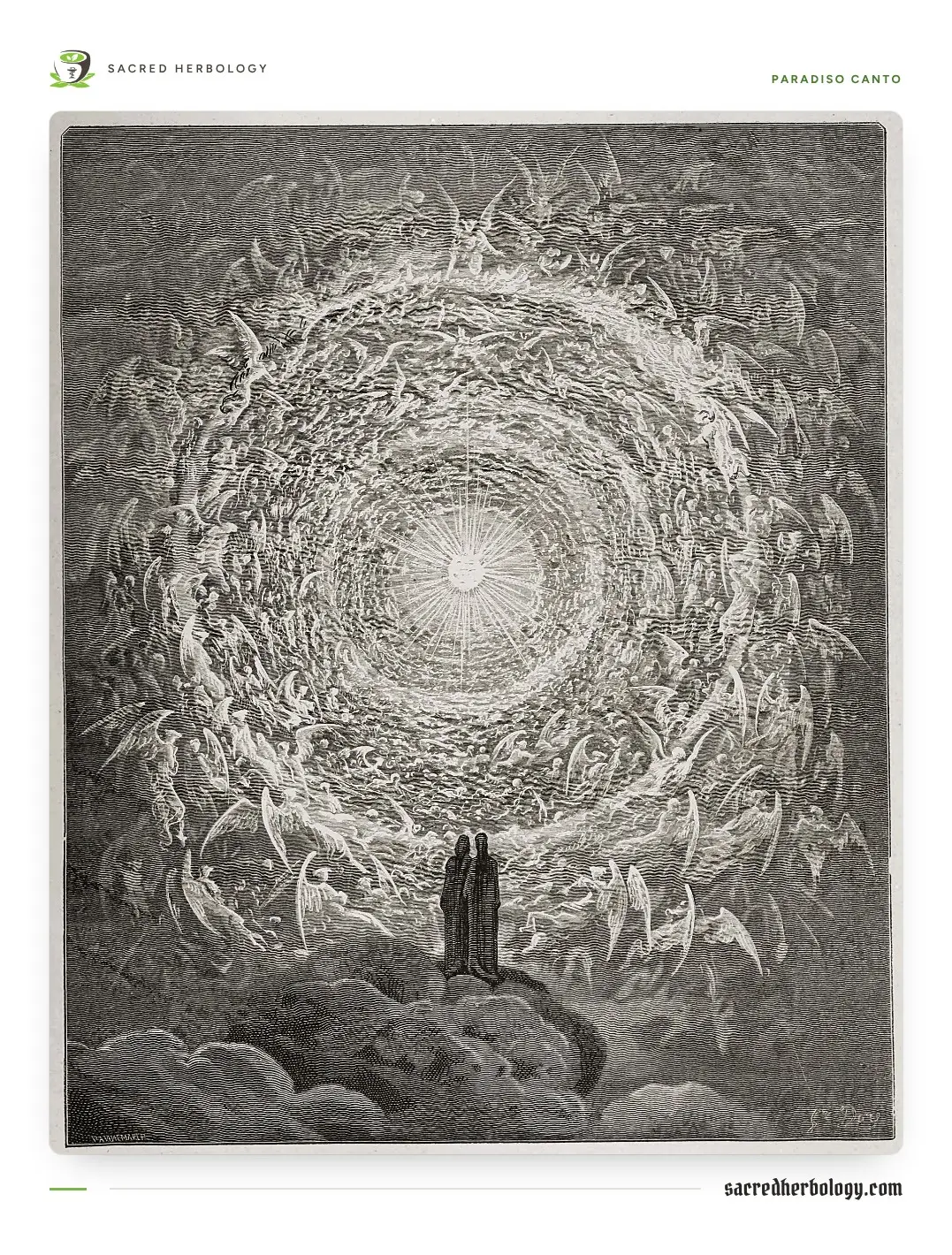
At the summit of Dante’s Divine Comedy, in the last cantos of the Paradiso, written before his death in 1321, Dante sees all the blessed of heaven seated in the petals of an immense white rose, rank on rank, with the light of God at the centre. It is the most famous rose in European poetry.

The secular rose was busy too. The Roman de la Rose, the French allegorical poem begun by Guillaume de Lorris around 1230 and finished by Jean de Meun some forty years later, tells of a dreamer who enters a walled garden and falls in love with a rosebud he must win against Danger, Shame and Jealousy. It was the best-read poem in medieval France. Readers have argued ever since about how much of it is about love and how much about sex, and the rose stands for the beloved, the prize at the centre of the garden.
Further east, the Persian poets made the rose and the nightingale the central image of Sufi love poetry. The nightingale, bulbul, sings all night to the rose, gul, who is beautiful and cannot answer, and the bird is the soul longing for God. Sa’di called his book of moral tales the Gulistan, the Rose Garden, in 1258. Mahmud Shabistari wrote his verse summary of Sufi doctrine in the early fourteenth century under the title Gulshan-i Raz, the Rose Garden of Mystery. Rumi and Hafez return to the rose again and again. In the Sufi tradition the rose garden is the place where the seeker finally sees the Beloved. That is a living religious tradition with its own teachers, and I describe it only from the published poetry and its translators.
So by the time the European alchemists picked the rose up, it had already gathered a dense cluster of meanings. It was the flower of the goddess and of Mary, the flower of the beloved and of the dead, red for blood and martyrdom, white for purity, and the walled garden was the place where hidden things were found.
Sub rosa
One small piece of rose lore belongs here because it is so often misdated. “Sub rosa”, under the rose, means in secret. The usual explanation goes like this. Cupid gave a rose to Harpocrates, the god of silence, to keep him from telling the love affairs of Venus, so a rose hung over a table meant that whatever was said there was to be kept quiet. Roses carved into the ceilings of council chambers and confessionals are said to carry the same message.
The phrase is genuinely old. It turns up in German and Dutch in the fifteenth and sixteenth centuries, and in English by the seventeenth. The Cupid and Harpocrates story is told in Latin verse and repeated by the emblem writers of the Renaissance. What I can’t find is any sign of it in a classical Greek or Roman author. Harpocrates, a Greek reading of the Egyptian child Horus shown with a finger to his lips, was taken by the Greeks and Romans as a god of silence, and that part is ancient. The rose that buys his silence looks like a Renaissance addition. It suits the Rosicrucians very well, and that is part of why it caught on.
The Rose Garden of the philosophers
Alchemy, the learned art of transforming matter that runs from Hellenistic Egypt through the Arabic world into Latin Europe, is esoteric through and through. Its writers held that metals could be perfected and that the same work could perfect the one who did it. I describe their ideas here as they held them.
Alchemists loved the word rosarium. In medieval Latin a “rose garden” also meant an anthology, a garden of the best sayings gathered into one book, much as the word “florilegium” means a gathering of flowers. Several alchemical treatises carry the name. The best known in the Middle Ages was the Rosarius philosophorum, attributed to the Catalan physician Arnald of Villanova, who died in 1311. Modern scholars treat it as pseudo-Arnald: written in his name by a later hand, a common thing in alchemy, where many texts borrowed a famous author’s name to gain weight.
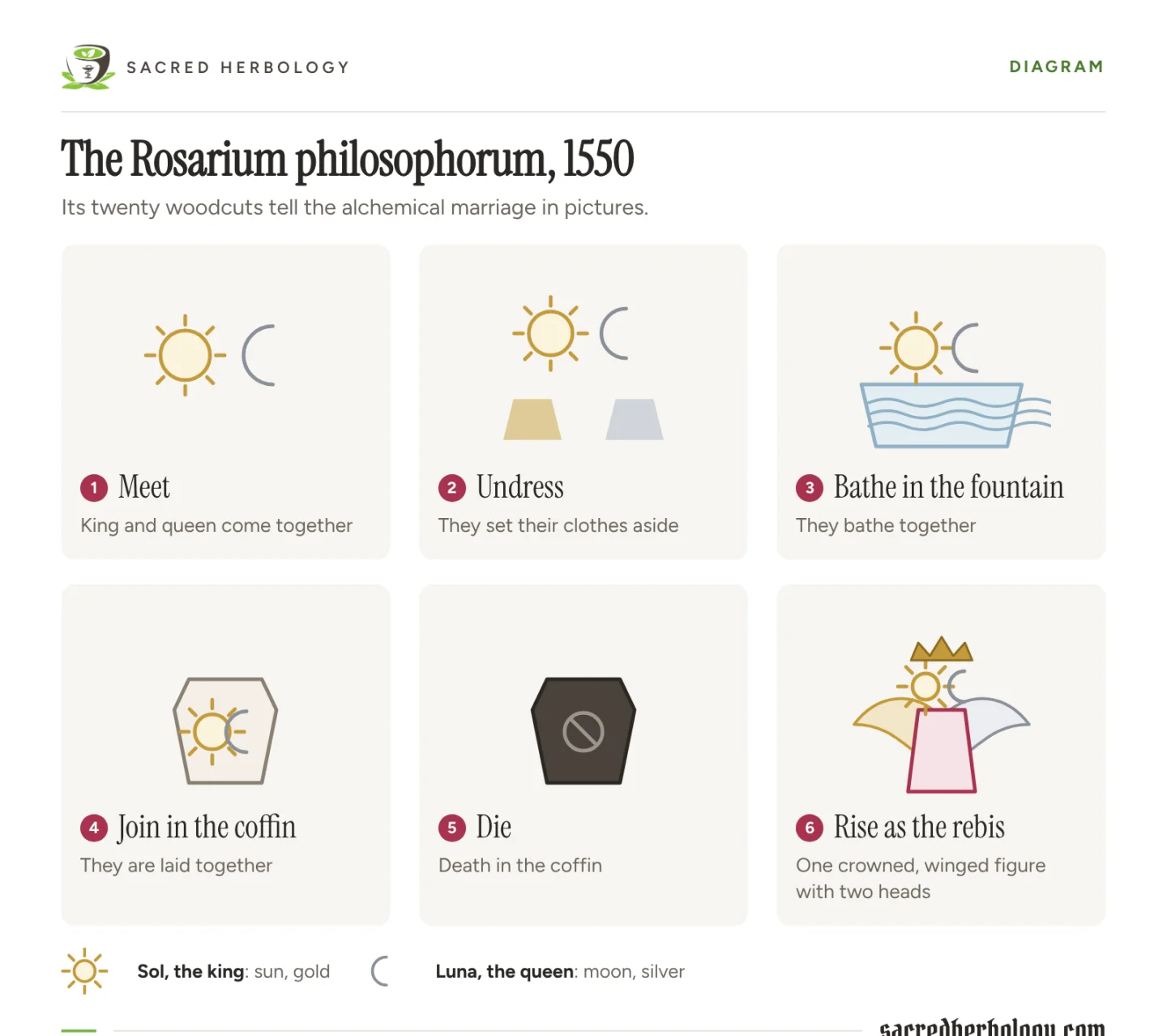
The most famous of all is the Rosarium philosophorum, the Rose Garden of the Philosophers, printed in Frankfurt in 1550 by Cyriacus Jacob as the second part of a collection called De alchimia opuscula complura veterum philosophorum. It is a patchwork of quotations from older authorities, real and pseudonymous, arranged to lead the reader through the stages of the work. What made it famous are its twenty woodcuts. They show a king and a queen, the alchemists’ Sol and Luna, sun and moon, gold and silver, meeting, undressing, bathing together in a fountain, joining in a coffin, dying, and rising again as a single winged figure with two heads, crowned, which the alchemists called the rebis, the double thing. The series is the alchemical marriage told in pictures.
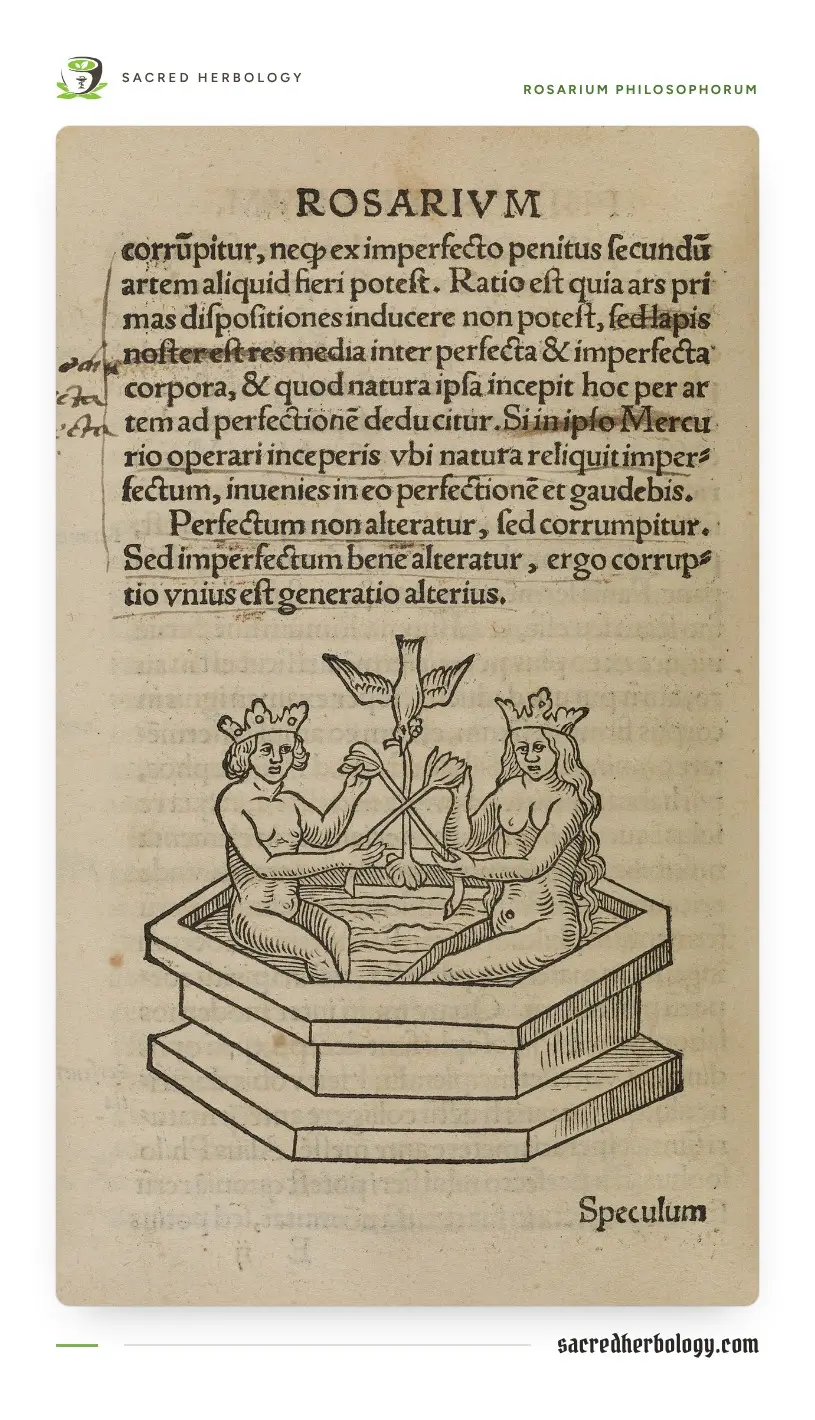

In 1946 the Swiss psychiatrist Carl Jung published The Psychology of the Transference, built around these woodcuts. He read them as pictures of what happens between two people in deep psychological work. Jung’s reading has been enormously influential, and many people now meet the Rosarium through him. It helps to remember that his interpretation is a twentieth-century one. The men who made the book in 1550 thought they were describing a laboratory process and the inner work that went with it.
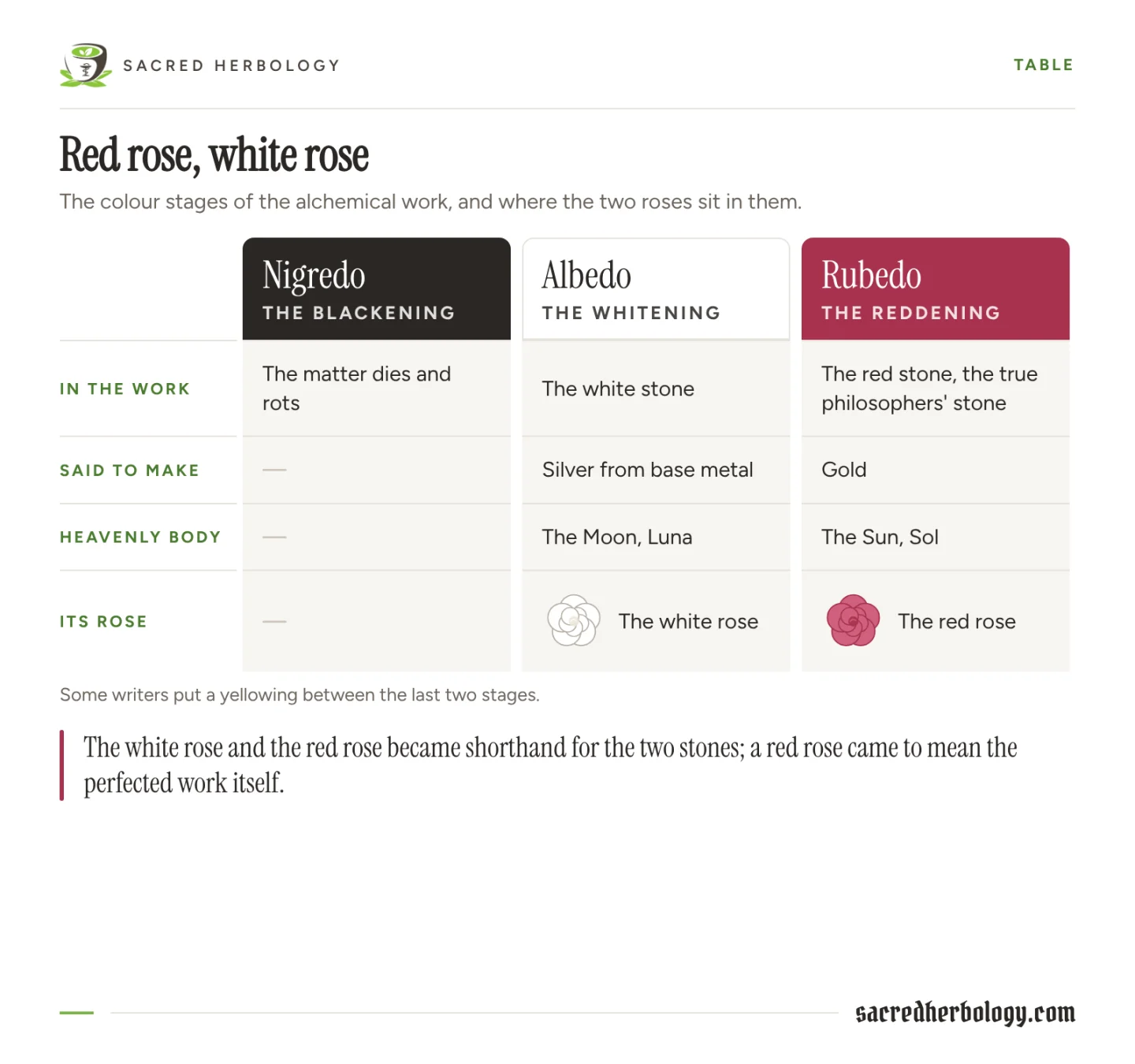
Within alchemy the rose had a specific job. The work was usually described in colour stages: blackening, whitening and reddening, nigredo, albedo and rubedo, sometimes with a yellowing between the last two. The white stage produced the white stone or white tincture, able, in the alchemists’ account, to turn base metal to silver. The red stage produced the red stone, the true philosophers’ stone that made gold. So the white rose and the red rose became shorthand for the two stones, and a red rose came to mean the perfected work itself. The paired red and white flowers of Walahfrid’s garden come back here in a laboratory key.
There is a practical thread as well. The alchemists were distillers. Their apparatus, the alembic with its long beak, came into Latin from the Arabic al-anbiq, and the same stills that produced rose water produced their spirits and essences. The first great printed book on distilling in Europe, Hieronymus Brunschwig’s Liber de arte distillandi, published in Strasbourg in 1500, is full of distilled flower waters, rose water among them. For the plant alchemists of the sixteenth and seventeenth centuries, and for their followers today who call the work spagyrics, roses were an obvious material, and the separation of a rose into its water, its oil and its salts was a small model of the whole art. I won’t go into their procedures here. They belong to a practice with its own teachers.
Kassel, 1614
Now for the strangest episode in the rose’s story.
In 1614 a printer named Wilhelm Wessel in Kassel, in the German state of Hesse, issued a short pamphlet called the Fama Fraternitatis, “the report of the fraternity”. It told the life of a man it called only Brother C. R., later named in full as Christian Rosenkreutz. According to the Fama, he was a German of noble but poor birth, placed in a monastery as a boy, who travelled as a young man to Damascus, to a city of sages in Arabia it calls Damcar, to Egypt and to Fez in Morocco. There he learned the secret wisdom of the East: mathematics, physics, magic and the harmony of the whole universe. He came home, found that the learned men of Europe would not listen, and founded a small brotherhood of eight members, bound to heal the sick for free, to wear the dress of whatever country they lived in, to meet once a year, and to keep the fraternity secret for a hundred years.
The Fama then tells how, in 1604, a later brother repairing their building found a hidden door, and behind it a seven-sided vault, lit by an artificial sun, where Christian Rosenkreutz lay uncorrupted in his tomb a hundred and twenty years after his death. The pamphlet announced that the time had come. Learned men of good will across Europe were invited to make themselves known. The Fama ended with a promise that the brotherhood would find them.
A second pamphlet, the Confessio Fraternitatis, appeared in 1615, in Latin, and gave Christian Rosenkreutz dates. He was born in 1378 and lived to 106. Then in 1616 a Strasbourg publisher, Lazarus Zetzner, brought out a third and much longer book, Chymische Hochzeit Christiani Rosencreutz anno 1459, the Chemical Wedding of Christian Rosenkreutz.
The Chemical Wedding is a story told in the first person over seven days. Rosenkreutz, now an old man, is invited by a messenger to a royal wedding. On the morning he sets out, he dresses in a white linen coat, binds a blood-red ribbon crosswise over his shoulders, and sticks four roses in his hat. In that one picture you have the rose and the cross worn on the body. The story runs on through a castle of trials, a weighing of the guests, the beheading of a royal couple and their resurrection through a long alchemical operation in a tower. It is a dream allegory of alchemy, and the alchemical marriage of king and queen, the same marriage the Rosarium woodcuts showed, is what the whole story turns on.
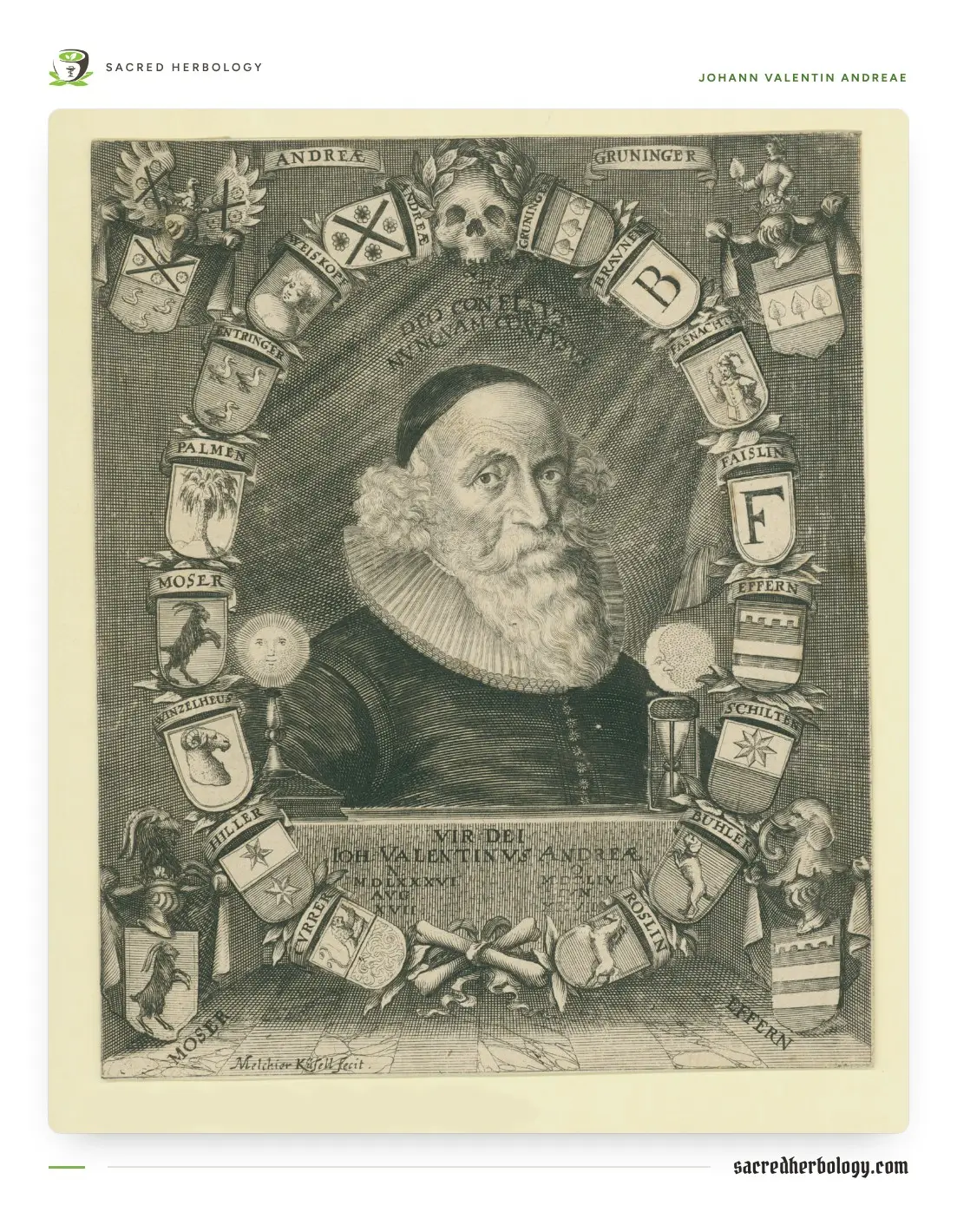
The author was Johann Valentin Andreae, a young Lutheran theologian from Württemberg, who later admitted writing the Chemical Wedding as a youth and called it a ludibrium, a jest or plaything. His family coat of arms was a St Andrew’s cross with four roses in the angles. That is a pleasing echo of the four roses in Rosenkreutz’s hat. Andreae belonged to a circle of friends at Tübingen, among them the lawyer and Paracelsian Tobias Hess, and most historians now think the Fama and Confessio came out of that circle too, though who wrote what is still argued. Carlos Gilly, who spent decades in the archives on this, did more than anyone to pin down the early manuscript copies, which were circulating several years before 1614.

There is one more rose to mention. Martin Luther’s personal seal, which he described in a letter to Lazarus Spengler in July 1530, was a black cross inside a red heart, set on a white rose, within a blue field and a gold ring. The rose and the cross were already joined in a famous Lutheran emblem when the Tübingen friends were born. Their manifestos were full of hope for a general reformation of learning to follow the reformation of the Church, and the Lutheran rose would have been familiar to every reader.
The name Rosenkreutz means simply rose cross. People argued about what it meant almost from the start. The obvious reading takes the rose and the cross of Christian symbolism together. A later learned guess read the name as Latin ros, dew, which the alchemists prized as a solvent, with crux, the cross, as a sign for light. The church historian Johann Lorenz von Mosheim repeated that guess in the eighteenth century. It is clever, and it has no support in the manifestos themselves.
The furore, and whether anyone was there
What happened next is called the Rosicrucian furore. Within a few years hundreds of books and pamphlets appeared about the brotherhood, for it and against it. People printed open letters asking to be admitted. Nobody seems to have received a reply. In 1623 posters appeared on the walls of Paris announcing that the Brothers of the Rose Cross were in the city, visible and invisible. Gabriel Naudé, a young scholar who later became Cardinal Mazarin’s librarian, wrote a sceptical pamphlet that same year, and rumours of invisible brothers fed the Paris gossip for months.
Two learned men took up the cause in print. Robert Fludd, a London physician and Hermetic philosopher, published defences of the brotherhood from 1616 on, without ever claiming to be one of them. The book most often linked to him, the Summum bonum of 1629, published under the name Joachim Frizius, carries one of the best-known Rosicrucian images: a rose on a cross-shaped stem, with bees flying to it, a spider’s web strung beside it, and the motto Dat rosa mel apibus, “the rose gives the bees honey”. The German physician and alchemist Michael Maier, a former court physician to the emperor Rudolf II, defended the brotherhood in books such as Themis aurea of 1618, while also saying, in effect, that he was not a member.
Was there ever a Rosicrucian order in the years of the manifestos? Nobody has found one. No member was ever identified, no meeting house, no letters between brothers. Most historians now read the manifestos as a literary and religious programme, a call to reform knowledge wrapped in a myth, from a group of friends who may have hoped real people would take up the idea. The English historian Frances Yates, in The Rosicrucian Enlightenment of 1972, tied the movement to the court of Frederick V, the Elector Palatine, and his English wife Elizabeth, and to the disaster of the Thirty Years War that began in 1618. Her book is lovely to read and was hugely influential. Later historians, Gilly among them, have pushed back hard on many of her connections. Read her as a brilliant, partly overtaken argument.
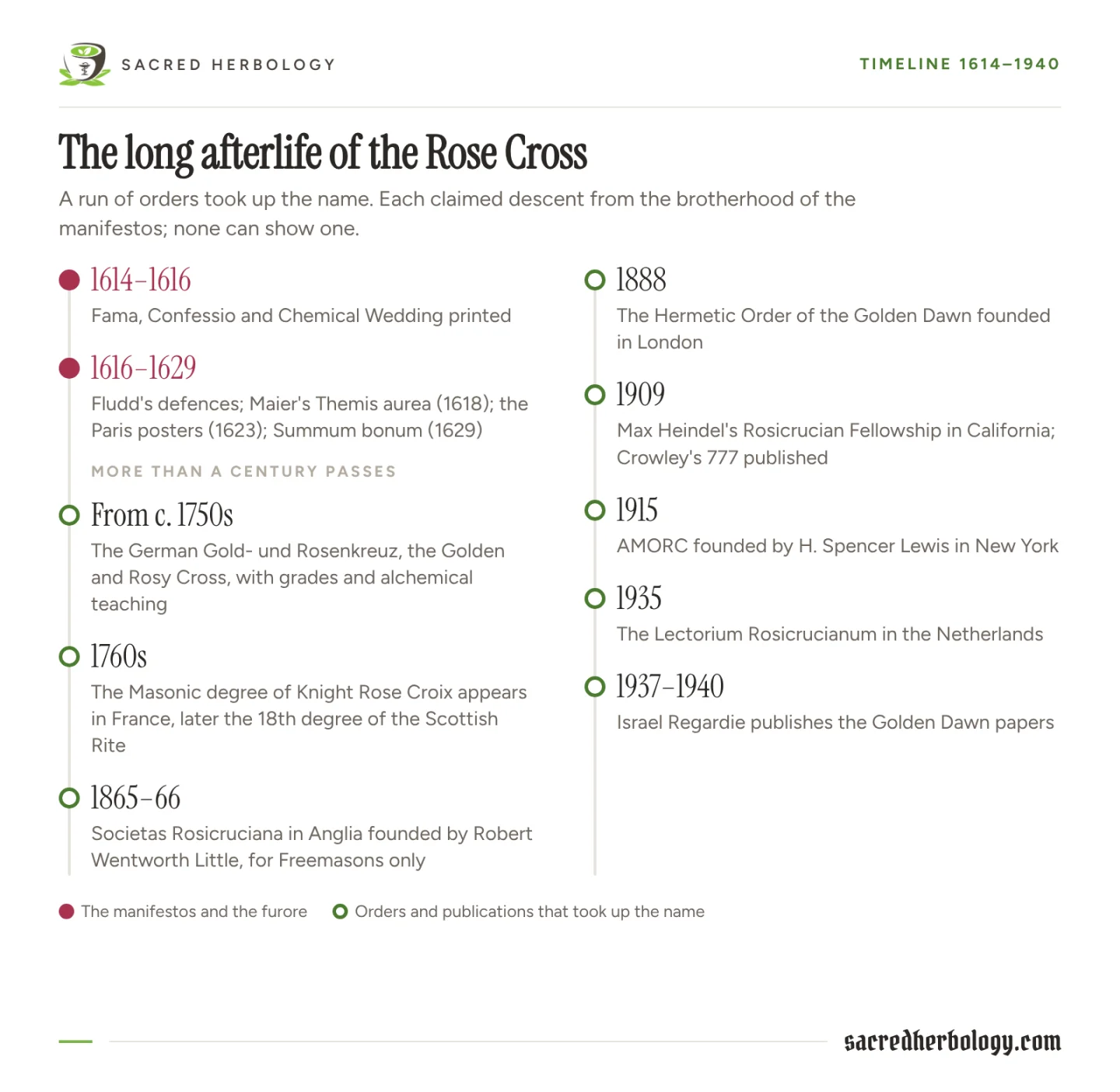
What is certain is that the myth outlived its authors. In the eighteenth century a German order called the Gold- und Rosenkreuz, the Golden and Rosy Cross, appeared from around the 1750s, with grades, alchemical teaching and serious political influence for a time at the Prussian court. Freemasonry took up the rose and cross in its degree of Knight Rose Croix, which appears in France in the 1760s and became the eighteenth degree of the Scottish Rite. Each of these groups claimed some descent from the brotherhood of the manifestos. None of them can show one. That is no criticism of what they taught. It is only the historian’s job to say where a lineage can be documented and where it begins as a claim.
The rose on the breast: the Golden Dawn and after
The nineteenth century brought a new wave. In England the Societas Rosicruciana in Anglia was founded in 1865-66 by Robert Wentworth Little, open only to Freemasons. Three of its members, William Wynn Westcott, Samuel Liddell MacGregor Mathers and William Robert Woodman, founded the Hermetic Order of the Golden Dawn in London in 1888.
The Golden Dawn’s founding papers include a set of enciphered manuscripts and letters from a supposed German adept, Anna Sprengel, who was said to have authorised the new order. Historians, Ellic Howe in particular in The Magicians of the Golden Dawn of 1972, have shown those letters to be very probably forged, almost certainly by Westcott. The cipher manuscripts themselves are real documents of uncertain origin. Again, this tells you about the paper trail, and says nothing either way about the worth of the system the order built.
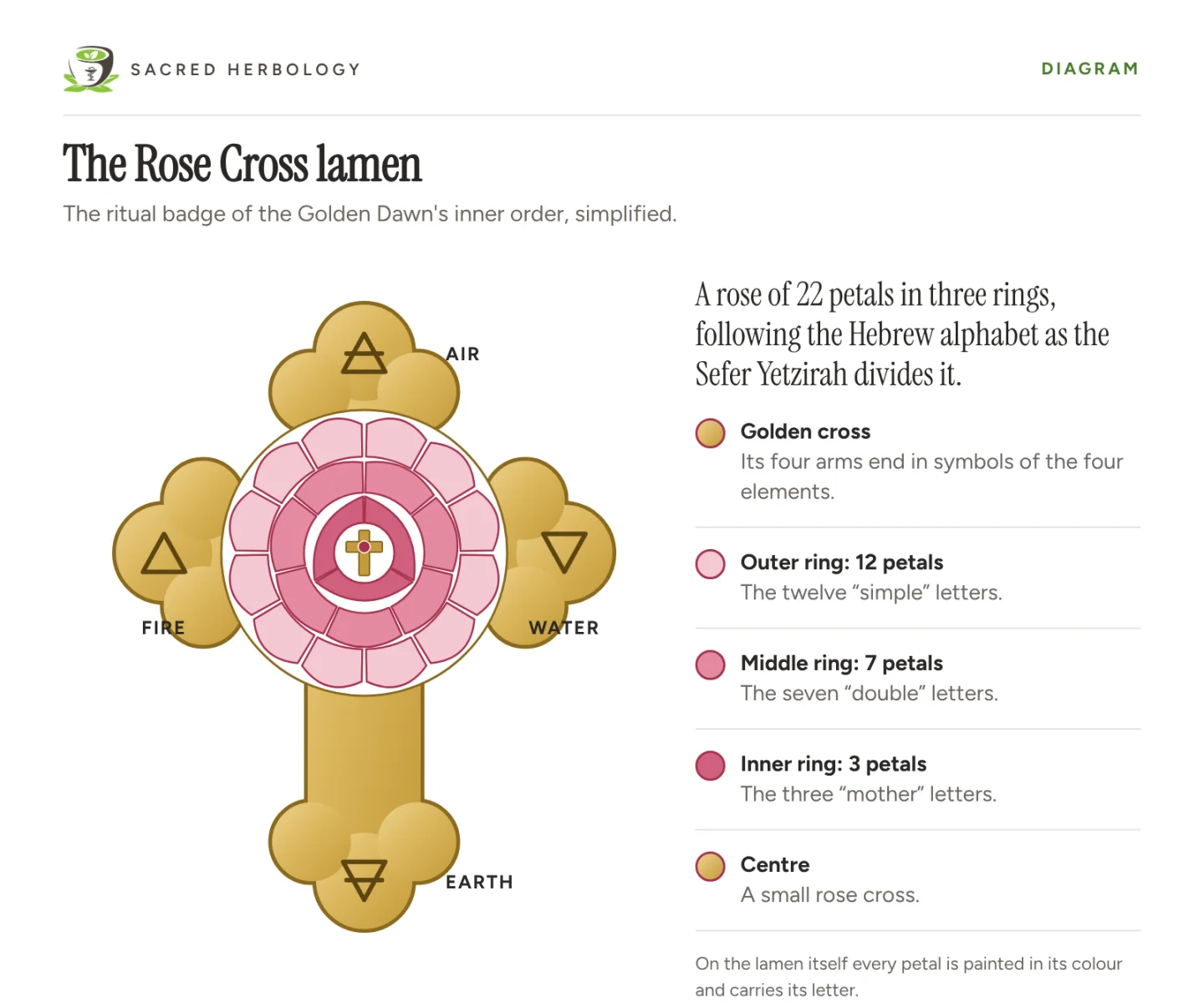
The Golden Dawn had an outer order, where members studied, and an inner order, open to those who had passed through its grades. The inner order bore a Latin name that puts the rose first: Ordo Rosae Rubeae et Aureae Crucis, the Order of the Red Rose and the Golden Cross. Its members made and wore a lamen, a ritual badge, called the Rose Cross. It is a golden cross with arms ending in symbols of the four elements, and at its centre is a rose of twenty-two petals in three rings. Three petals are for the three Hebrew “mother” letters, seven for the seven “double” letters and twelve for the twelve “simple” letters, following the old Kabbalistic book of creation, the Sefer Yetzirah. Every petal is painted in its colour and carries its letter, and at the very centre sits a small rose cross. The order taught that the whole universe, as the Kabbalah maps it, is folded into that one flower. That is the esoteric teaching on its own terms. The rose had become a diagram.
Israel Regardie published the Golden Dawn’s teaching, including the Rose Cross lamen and a short Rose Cross ritual, in four volumes from 1937 to 1940. Aleister Crowley, who passed through the Golden Dawn before founding his own system of Thelema, put out his tables of correspondences, 777, in 1909. In those tables the rose sits with myrtle and clover on the path of the Hebrew letter Daleth, the path of Venus. That takes us back to the ancient pairing of the rose and the goddess of love.
The twentieth century added more Rosicrucian bodies than I can list. The Rosicrucian Fellowship was founded by Max Heindel in California in 1909, AMORC by H. Spencer Lewis in New York in 1915, and the Lectorium Rosicrucianum in the Netherlands in 1935. Each tells its own history, and each is a modern foundation.
Venus, Jupiter and the King of France
For readers who work with planetary herbs, here is the rose in the herbal tradition.
The most quoted line is from Nicholas Culpeper’s English Physitian of 1652. He opens his rose entry by saying he won’t bother describing the plants, since everybody knows them, then sighs: “What a pother have authors made with Roses! What a racket have they kept?” And then he gives his rulers: “red Roses are under Jupiter, Damask under Venus, White under the Moon, and Provence under the King of France.” That last part is a joke. Culpeper was a Parliamentarian, and in 1652 the King of France was the only king left to tease. The Provence rose was most likely his name for the cabbage or centifolia type, though the name is easily muddled with the Provins rose, Rosa gallica, and older English writers did not always keep the two apart.
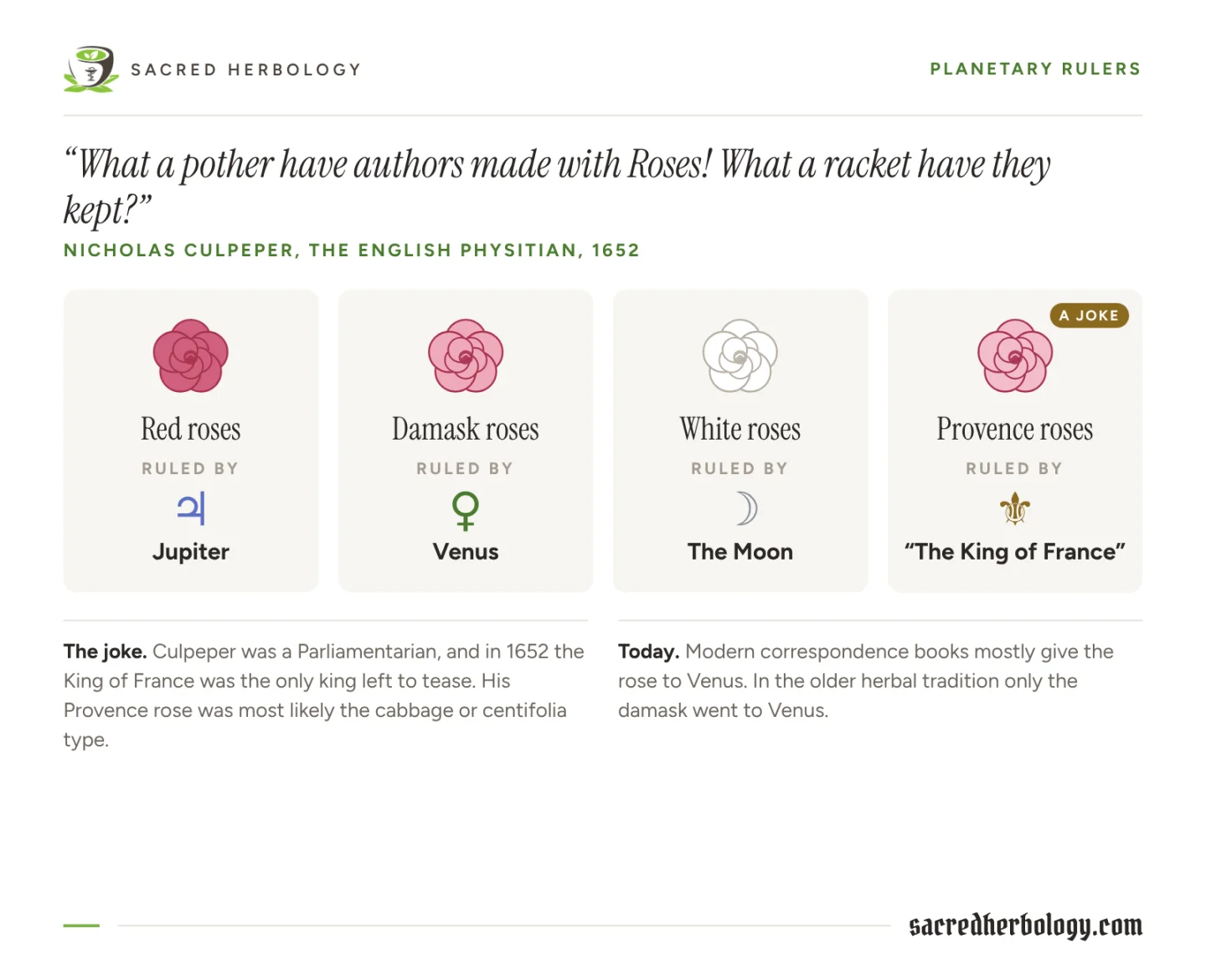
So there is no single planet for “the rose” in Culpeper. Modern correspondence books mostly give the rose to Venus without qualification, which fits the damask and the old Greek link with Aphrodite, and fits Crowley’s tables. If you are building something on the older herbal tradition, note that a red apothecary’s rose went to Jupiter, a white rose to the Moon, and only the damask to Venus.
Folklore of the rose
Village rose customs are a different thing from all of this, and I keep them apart. A few that are well recorded in published collections:
- In parts of England and Wales a young woman might pick a rose on Midsummer Eve, keep it wrapped and unfaded until Christmas, then wear it to church, and the young man who took it from her or admired it was said to be her future husband. Collectors of the nineteenth century recorded several versions.
- Roses carved on tombs and laid on graves carry on the Roman Rosalia in spirit, though the line of descent is impossible to trace.
- In Bulgaria the rose-picking season in the Kazanlak valley carried its own customs, songs and dances, now partly folded into the official festival.
- In the Islamic and Hindu worlds of South Asia, rose petals and rose water belong to weddings, to welcoming guests, and to the shrines of Sufi saints, where devotees lay sheets of rose petals over the tombs. That is living religious practice, described in many published travel and ethnographic accounts.
One famous bit of rose history is younger than it looks. We call the fifteenth-century English civil war the Wars of the Roses, with Lancaster’s red rose fighting York’s white. The badges were real enough. The white rose was a Yorkist badge, and the red rose was used by the Lancastrian Henry VII when he came to the throne in 1485 and merged the two into the Tudor rose. The scene where the nobles pick red and white roses in the Temple garden is Shakespeare’s invention in Henry VI, Part 1. The name “Wars of the Roses” itself became common only after Walter Scott used a version of it in his novel Anne of Geierstein in 1829.
Rose oil today, and how to buy it
If you want rose in your own anointing practice, you will meet three main products, and they are very different.
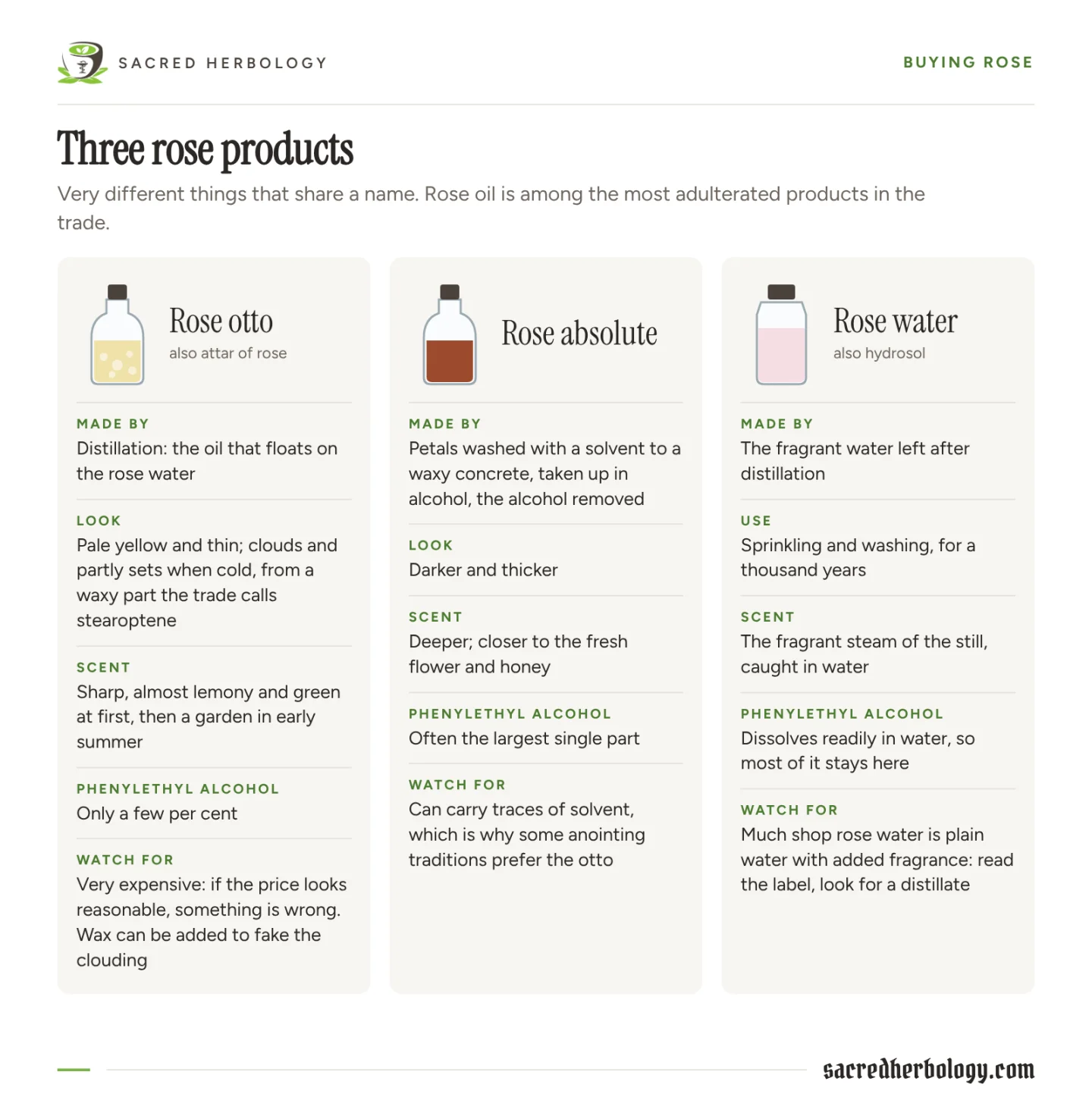
- Rose otto, sometimes written attar of rose, is the steam-distilled or water-distilled oil, the direct descendant of Asmat Begum’s film on the rose water. It is pale yellow and thin, and when it gets cold it goes cloudy and partly solid, because it contains a waxy fraction the trade calls stearoptene, mostly long-chain hydrocarbons from the petal wax, which crystallises when the oil is cool. That clouding in a cold room is normal for a genuine otto. It does not mean the oil has gone off. It does not prove the oil is genuine either, because wax can be added to a blend to imitate it. Rose otto is very expensive. A small bottle costs many times what other essential oils cost, and if the price looks reasonable, something is wrong.
- Rose absolute is made by washing the petals with a solvent to produce a waxy concrete, then extracting that with alcohol and removing the alcohol. It is darker, orange to reddish, thicker, and its smell is deeper, closer to the fresh flower and honey. The two smell different for a chemical reason. The rose’s own phenylethyl alcohol, the compound behind much of that honeyed fresh-flower note, dissolves readily in water, so in the still most of it stays behind in the rose water. An otto usually holds only a few per cent of it, while in an absolute it is often the largest single part. Many perfumers prefer it. It can carry tiny traces of the solvents used, which is why some anointing traditions prefer the otto.
- Rose water, or hydrosol, is the fragrant water left after distillation. It is a perfectly honourable product in its own right, used for sprinkling and washing for a thousand years.
Rose oil is among the most adulterated products in the trade. Cheaper oils from rose geranium (a Pelargonium, no relation to the rose), palmarosa (Cymbopogon martini) or citronella, or synthetic rose aroma chemicals such as phenylethyl alcohol, geraniol and citronellol, are blended in to stretch it. Very cheap “rose oil” is often a few per cent of real rose in a carrier oil, or nothing from a rose at all. Some fakes are hard to catch by nose alone. Laboratories test rose oil by gas chromatography, which separates and measures the individual compounds, and there is an international standard for damask rose oil, ISO 9842, setting the ranges a genuine oil should fall within. Even a good analysis is a fingerprint, though, and a careful blender can match the main numbers. A reputable seller can tell you the species, the country, whether it is otto or absolute, and ideally show you the batch analysis. Bulgarian and Turkish ottos from Rosa × damascena are the classic standard. Morocco grows the damask too, in the Dades valley, and Moroccan rose absolute is often from Rosa × centifolia. Rose water has its own trade problem: much of what is sold as rose water in shops is plain water with added rose fragrance, so read the label and look for a distillate.
For the garden, a word on climate. The damasks and gallicas are roses of hot dry summers and cold winters. In the humid tropics they tend to sulk, sit out the heat, and suffer from black spot in the humid months. They are worth trying in a pot in a sunny, airy spot, with patience, but don’t expect a Kazanlak harvest in the tropics. Gardeners in cooler, drier country have a far easier time of it. One caution for them. The dog rose and the sweet briar have both escaped from gardens and run wild across much of southern and eastern Australia, where they are treated as environmental weeds and are subject to control rules in some states. Birds spread the seed from the hips. If you want a briar for its hips, check with your local council before you plant one, and choose a garden rose if there is any doubt.
Safety and handling
Rose has a long record of use on the skin, and it is still a concentrated plant extract, so handle it with sense.
- Essential oils and absolutes are concentrated. Dilute them in a carrier oil before they go on skin, and do a small patch test first, because some people react.
- Rose oils naturally contain fragrance compounds such as geraniol, citronellol and eugenol, which can cause skin allergy in sensitive people. They also contain a small amount of methyleugenol. The international fragrance industry body limits how much rose oil may go into products left on the skin for this reason.
- Never swallow an essential oil, and keep every bottle well out of reach of children. Small children can be seriously poisoned by swallowing essential oils, and a dropper bottle left on a bench is a real risk.
- Keep oils away from pets as well. Cats in particular cope poorly with essential oils, whether licked off fur or breathed in a closed room.
- Keep oils out of the eyes. If you get some in, rinse with plenty of clean, lukewarm water for at least 15 minutes and call the Poisons Information Centre on 13 11 26 for advice.
- If anyone swallows an essential oil, call the Poisons Information Centre on 13 11 26, any hour, anywhere in Australia. Don’t try to make them vomit. If they are drowsy, having trouble breathing or having a fit, call 000.
- If you are pregnant or breastfeeding, want to use rose on a baby or young child, or have questions about using rose on the body beyond ordinary perfume and anointing, consult a degree-qualified herbalist with competencies and adequate training in pharmacognosy.
The flower at the centre
Follow the rose from Aphrodite’s oil to the Golden Dawn’s lamen and the striking thing is how little its meaning wandered. It began as the flower of a goddess of love, laid on the dead and carried in procession. Mary took it over, and so did the Sufi beloved. In the Golden Ass a man eats a garland of them and stops being a beast. The alchemists’ red rose was the finished stone, and Rosenkreutz rode out to his wedding with four in his hat. Through all of it the rose stood for the precious thing at the centre of the walled garden, the prize that has to be won. The oil itself tells the same story in plain physical terms: a whole valley of flowers for a few drops.
When you wear rose otto on your skin, or sprinkle rose water across a room, you are taking part in something very old. What it means to you is your own business. The history, at least, is real, and now you have it.
Where this comes from
- Homer, Iliad, trans. Richmond Lattimore (University of Chicago Press, 1951), book 23.
- Apuleius, Metamorphoses (The Golden Ass), ed. and trans. J. Arthur Hanson (Loeb Classical Library, Harvard University Press, 1989), book 11.
- Pliny the Elder, Natural History, vol. 6, trans. W. H. S. Jones (Loeb Classical Library, Harvard University Press, 1951), book 21.
- Theophrastus, Enquiry into Plants and Minor Works on Odours and Weather Signs, trans. Arthur Hort (Loeb Classical Library, Heinemann, 1916).
- Herodotus, Histories, book 8.
- Virgil, Georgics, book 4.
- Suetonius, Lives of the Caesars, “Nero”, trans. J. C. Rolfe (Loeb Classical Library, Heinemann, 1914).
- Karl Garbers (ed. and trans.), Kitāb Kīmiyā’ al-‘Iṭr wa-t-Taṣ’īdāt: Buch über die Chemie des Parfüms und die Destillationen von Ya’qūb b. Isḥāq al-Kindī (Brockhaus, Leipzig, 1948).
- The Jahangirnama: Memoirs of Jahangir, Emperor of India, trans. Wheeler M. Thackston (Oxford University Press and Smithsonian Institution, 1999).
- Hiroyoshi Iwata, Tsuneo Kato and Susumu Ohno, “Triparental origin of Damask roses”, Gene 259 (2000): 53-59.
- Dante Alighieri, Paradiso, cantos 30-31.
- Guillaume de Lorris and Jean de Meun, The Romance of the Rose, trans. Charles Dahlberg (Princeton University Press, 1971).
- Hieronymus Brunschwig, Liber de arte distillandi de simplicibus (Strasbourg, 1500).
- Rosarium philosophorum, in De alchimia opuscula complura veterum philosophorum (Cyriacus Jacob, Frankfurt, 1550).
- C. G. Jung, The Psychology of the Transference (1946), in Collected Works, vol. 16, trans. R. F. C. Hull (Routledge and Kegan Paul, 1954).
- Fama Fraternitatis (Wilhelm Wessel, Kassel, 1614); Confessio Fraternitatis (Kassel, 1615); Johann Valentin Andreae, Chymische Hochzeit Christiani Rosencreutz anno 1459 (Lazarus Zetzner, Strasbourg, 1616).
- Frances A. Yates, The Rosicrucian Enlightenment (Routledge and Kegan Paul, 1972).
- Carlos Gilly, Cimelia Rhodostaurotica: Die Rosenkreuzer im Spiegel der zwischen 1610 und 1660 entstandenen Handschriften und Drucke (In de Pelikaan, Amsterdam, 1995).
- Ellic Howe, The Magicians of the Golden Dawn: A Documentary History of a Magical Order 1887-1923 (Routledge and Kegan Paul, 1972).
- Israel Regardie, The Golden Dawn, 4 vols (Aries Press, Chicago, 1937-1940).
- Aleister Crowley, 777 (Walter Scott Publishing, London, 1909).
- Nicholas Culpeper, The English Physitian (London, 1652).
- John Brand, Observations on Popular Antiquities, ed. Henry Ellis (London, 1813).