
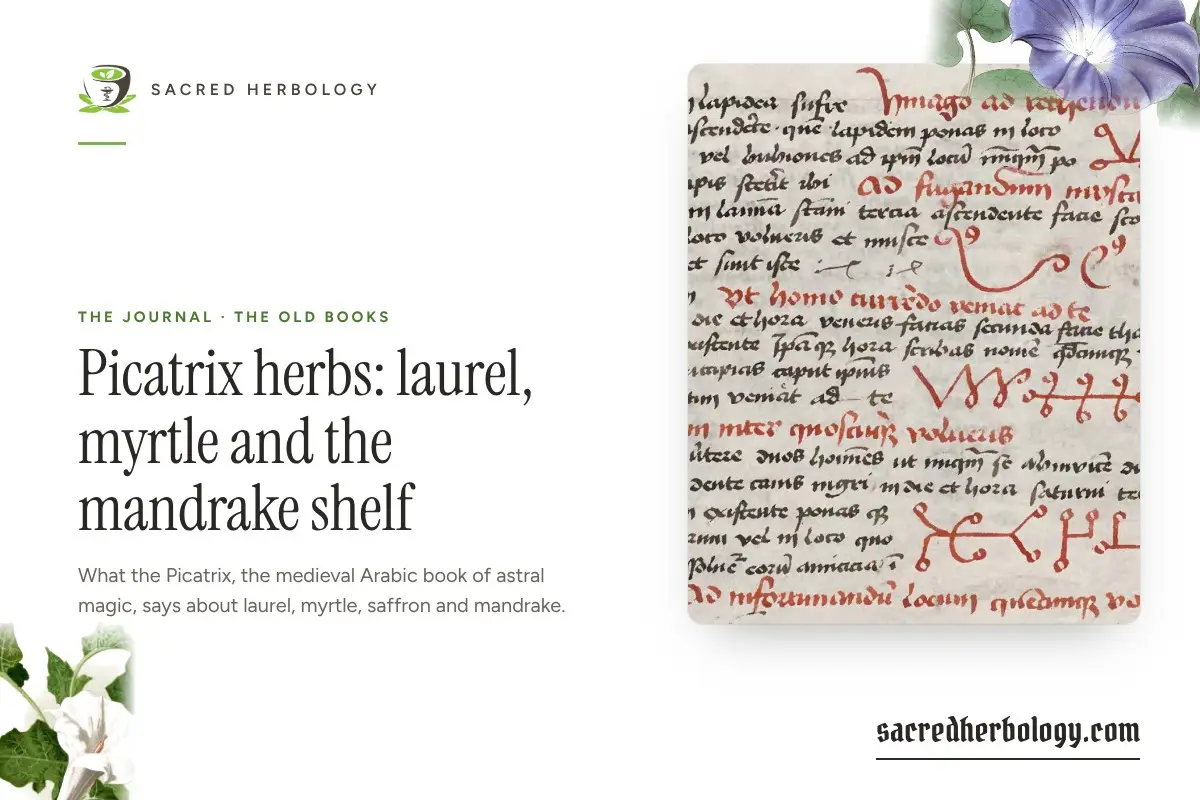

Most of the planetary herb lists you meet today, in witchcraft books, on incense labels and in correspondence tables pinned above altars, have a family tree. Follow it back far enough and you arrive at one strange, sprawling book. In Arabic it is the Ghayat al-Hakim, “The Goal of the Sage”. In Latin, and to every magician in Europe who ever whispered about it, it is the Picatrix.
This is learned magic, and I file it as esoteric. The book was written by and for educated men who read astronomy, philosophy and medicine, and it sets out a whole theory of how the heavens act on the earth. A farmer’s wife hanging a sprig of rue at the door belongs to village custom, a separate tradition with its own history. The two borrowed from each other over the centuries, but they are worth keeping apart, and I’ll be careful to do that here.
Where the book comes from
The Ghayat al-Hakim was written in al-Andalus, Muslim Spain, in the tenth century. For a long time it was credited to the astronomer Maslama al-Majriti of Madrid, who died around 1007, which is why older books call the author “Pseudo-Majriti”. The attribution is old. The North African historian Ibn Khaldun, writing his great Muqaddimah in the 1370s, names Maslama al-Majriti as the author of the Ghayat al-Hakim in his chapter on sorcery and talismans, and treats it as the standard work on the subject.
The historian Maribel Fierro has since argued, in a paper of 1996, that the author was a different Maslama: Maslama ibn Qasim al-Qurtubi of Cordoba, a scholar of the hadith who died in 964, travelled in the East as a young man, and was described by his own contemporaries as a man of charms and talismans. The most recent English translators, Dan Attrell and David Porreca, accept her case, and so do I. Put that way, the book comes out of Cordoba in the years when it was the largest and most bookish city in western Europe, under the caliph Abd al-Rahman III and his son al-Hakam II, whose library was said to hold hundreds of thousands of volumes.
The author says he drew on more than two hundred books. You can feel that on every page. There are Greek philosophers, Indian sages, Persian astrologers, the star-worshippers of Harran in northern Mesopotamia, and long extracts from a book called the Nabataean Agriculture, of which more below.
In 1256, according to its own prologue, the book was translated into Castilian at the court of Alfonso X of Castile, the king history calls “the Wise”. Alfonso’s scholars also gave Europe the Alfonsine astronomical tables and a stack of other translated books on the stars and on stones, and the Picatrix sits comfortably in that company. From the Castilian it went into Latin. Only a fragment of the Castilian survives. The Latin text copied all over Europe from about 1450, and copies sit today in libraries in Paris, Florence, Oxford, London, Kraków, Prague and elsewhere. It was never printed in the Renaissance. That tells you something about its reputation.
A book passed hand to hand
The Picatrix had the kind of reputation that makes people lower their voices. In 1456 the Bavarian court physician Johannes Hartlieb wrote a Book of All Forbidden Arts for his prince, warning him against the magical arts one by one. He named the Picatrix among the books of necromancy and, by his own account, thought it the most complete book in that art he had ever seen, which is an odd sort of warning.
The humanists read it anyway. Marsilio Ficino, the Florentine who translated Plato and the Hermetic writings for the Medici, drew on it for the third part of his Three Books on Life (1489), the part about drawing down the life of the heavens with the right colours, scents, music and stones. Modern scholars have traced the borrowings line by line. Cornelius Agrippa borrowed more openly. His Three Books of Occult Philosophy, printed at Cologne in 1533, mined the Picatrix for planetary lists, fumes and talismanic images, and through Agrippa a great deal of the Arabic book reached people who had never seen a manuscript of it. The satirist Rabelais, a trained physician who knew exactly what was circulating among learned men, mocked a certain “Picatris” as rector of the devil’s faculty.
For the next four hundred years the book lived in manuscript and in rumour. Its modern recovery is a story in itself. In the 1920s the Hamburg art historian Aby Warburg, obsessed with how the pagan star-gods survived in European art, built a private research library around the question, and the Picatrix became one of its projects. The Arabist Hellmut Ritter lectured on it at the library in 1921 and 1922 and published his Arabic edition in 1933. That was the year the library itself packed up and left Hamburg for London, ahead of the Nazis. Ritter and Martin Plessner’s German translation of the Arabic followed from the Warburg Institute in London in 1962, and David Pingree’s critical edition of the Latin in 1986. Three scholars and sixty years, to get one book back onto the table in both its languages. English readers had to wait longer: a translation of the Latin by John Michael Greer and Christopher Warnock appeared in 2010 and 2011, and the Attrell and Porreca translation, the one I use, in 2019.
The name itself is a puzzle. The Latin prologue says Picatrix was the author, a wise philosopher who named the book after himself. Nobody has found a sure explanation for where that name came from. Scholars have offered several guesses, none of them settled, and I would distrust anyone who tells you what it “really” means.
Four books in one
The Picatrix comes in four books, and plants turn up in all of them, though not evenly.
The first book lays out the theory. Magic, the author says, is the science of how the higher world acts on the lower, and the talisman is its chief tool: an image made under the right sky, in the right material, that holds and passes on the power of a star. The second book is the astronomy the magician needs to choose his moments, with the mansions of the Moon, the faces of the signs and the figures of the heavens. The third book gives the properties of each planet and sign, their colours, metals, stones, animals and plants, and the prayers and rites for speaking to each planet. The fourth gathers up everything else: spirits, the virtues of the parts of animals, recipes, poisons, and long borrowings from the Nabataean Agriculture.
For anyone who works with plants, the third and fourth books are the ones to read.
How the book sorts plants
The third book opens with a long list of what each planet governs: its colours, its metals, its stones, its animals, its trades, even its languages. Plants are part of that list, and the choices follow a logic of taste, smell and temperament.
- Saturn, the planet of the bitter, the deep and the slow, governs oaks, carob, palms and vines among the trees, and cumin, rue and onions among the herbs. His incenses are cinnamon and storax.
- Jupiter governs nut trees, hazels, pines and pistachios, the sweet-smelling herbs and white mint, and among the spices saffron, yellow sandalwood, camphor and mace.
- Mars takes every hot plant: pepper, pine, cumin, caraway, laurel, euphorbia and hemlock, and trees that are good for burning. His incense is red sandalwood.
- The Sun has saffron and the rose, fine palms, and the best aloeswood, the fragrant resin-laden wood of the agar tree, which forms when the tree is wounded or infected.
- Venus takes everything with a sweet smell and a lovely face: crocus, roses and all good-smelling flowers, with balsam and nutmeg among her spices.
- Mercury has reeds, flax, cotton and pepper, and bitter things like the clove.
- The Moon has iris, reeds, cabbages, pastures, all white plants and all the small plants that never rise far above their roots.
You’ll notice that saffron sits under both Jupiter and the Sun, and that cumin sits under both Saturn and Mars. The book is a compilation, and it keeps the disagreements of its sources rather than smoothing them out. A little later in the third book it gives a shorter rule for smoke: Saturn’s fumes are the foul-smelling ones like asafoetida and bdellium, Jupiter’s are the balanced sweet scents like aloeswood and amber, Mars takes the hot ones like pepper and ginger, Venus takes rose, violet and green myrtle, Mercury the mixed scents like narcissus, and the Moon the cold ones like camphor and lily.
A word on the trade names in these lists, because some of them have shifted. The “amber” of the incense lists was most likely ambergris, the waxy substance from the sperm whale that Arabic perfumers called ‘anbar, and a different thing from the fossil resin sold as amber today. Red sandalwood is the heartwood of Pterocarpus santalinus, a legume from southern India with little scent, valued mostly for its colour; the fragrant yellow and white sandalwoods are species of Santalum. Aloeswood, saffron and ambergris were costly in the medieval trade and were faked then, and they are still faked now. Saffron is padded out with safflower and dyed threads, and cheap “agarwood” is often ordinary wood soaked in oil. If you buy any of them for incense, a bargain price is a warning sign.
Read that way, the system makes a kind of sense. Bitter, earthy, dark things go to the cold, heavy planet. Hot, sharp things go to the red one. Flowers go to the goddess of love. The medieval medical idea of the four qualities, hot, cold, wet and dry, runs underneath all of it.
Speaking to a planet
The seventh chapter of the third book is where the plants stop being a list and start being used. It gives the rites for addressing each of the seven planets in turn, and each rite is built the same way. You wait for the planet to be strong in the sky. You dress in its colours: black for Saturn, white and yellow for Jupiter, red for Mars, gold for the Sun, and so on down the list. You go to a clean place, set up a brazier, burn the planet’s own fume, and speak a long prayer that names the planet, praises its powers and asks for what you want. Some versions add a sacrifice of an animal, which the book describes plainly.
The fumes are real recipes, with quantities. The Sun’s great compound has more than thirty ingredients measured out in drachms, in groups that share a weight. The fume for Jupiter, in the Latin, runs through cassia, storax, a plant called “dove’s foot”, peony, sweet flag, pine resin and hellebore seed. These are perfumer’s lists as much as magician’s lists, and the ingredients are the costly, fragrant materials of the medieval spice trade: aloeswood, saffron, nard, costus, mastic, myrrh, frankincense, camphor and musk.
This is where the book is at its most esoteric, and where I want to be most careful. The Picatrix tells you what its author believed the heavens would do when the fume rose and the prayer was spoken. I report the belief. The rite is interesting for what it shows about how learned men in Cordoba, and later in Toledo and Florence, thought the universe was put together. The smells were meant to match the planet the way a key matches a lock.
Plants that were never there
When I went through that chapter plant by plant, I did something simple that turned out to be revealing. I put three editions side by side: Pingree’s Latin, Ritter and Plessner’s German translation of the Arabic, and the Attrell and Porreca English, which was made from the Latin. The recipes are lists, and many of the lists come in groups that share a quantity, so you can line them up slot by slot. Where six ingredients at five drachms in the Latin sit against six at five in the Arabic, and five of the six agree, the sixth pair is telling you something.
What it tells you, again and again, is that some of the plants in the English never existed in the original.
Take “dove’s foot” in the Jupiter fume. The Latin says pedis columbini, and the English reads it as columbine, which is a fair guess, since columbine is Aquilegia and got its name from the same bird. Ritter and Plessner translate the Arabic at that point as alkanet root, Alkanna tinctoria, a red dye plant, and add a footnote: the Arabic phrase is literally “foot of a wood pigeon”. So the Latin translator did the honest thing and translated a descriptive Arabic name word for word, and produced a Latin phrase that looks exactly like a European plant name. Every reader since has taken the bait.
The same thing happens with the Latin Celtica. The English reads it as hackberry, the nettle tree, Celtis australis. Ritter and Plessner read the Arabic every time it appears as Greek nard, and Celtica was in fact the standard medieval name for Celtic nard, the little alpine valerian, Valeriana celtica, prized for its scented root. The English turns a perfume root into a fruiting tree with no perfumery use at all. The Latin squinantum, which the English gives as squinancywort, a small European bedstraw, is camel grass, Cymbopogon schoenanthus, a fragrant grass of the Arabian desert and a relative of lemongrass. A “peppered thistle” in two different fumes turns out, with the quantities matching both times, to sit where the Arabic has storax.
Then there are the swaps. In several places the Latin and the Arabic name two different plants, and it looks as if someone in a colder country replaced a drug he couldn’t get with one he could. Caper root stands where the Arabic has henna root. Cinquefoil stands where the Arabic has the root of an Indian water-lily. Hellebore seed in the Latin stands where the Arabic has juniper berries. In one lunar fume the Arabic has five items where the Latin has four, and the one that fell out is the berry of Salvadora persica, the toothbrush tree, whose twigs are still chewed to clean the teeth across the Middle East. And in one of the Jupiter fumes the Latin asks for three parts of myrrh and the Arabic for nine, which makes a very different smell depending on which book is open.
The one I find most satisfying is a single word that means two things. In one Solar fume the Latin reads poli Indici, “Indian polium”. In the same slot the Arabic, as Ritter and Plessner read it, has haematite, the iron ore. In a lunar fume the same Latin word sits against Indian malabathrum, the leaf of Cinnamomum tamala. In Arabic script the names for malabathrum and for haematite differ only in the dots above and below the letters. A copyist’s pen, somewhere between Cordoba and Kraków, turned a leaf into a stone.
Four names in that one chapter still won’t give themselves up to three editions, and wait for someone to read the Arabic manuscripts directly. That is how it should be. If a correspondence table tells you with confidence what every ingredient of the Picatrix fumes was, ask which edition it was reading.
Laurel, the tree that spoke
The laurel of the Picatrix is the bay laurel of the Mediterranean, Laurus nobilis, the same tree whose leaves go into the kitchen. In Australian gardens the name also gets stuck on cherry laurel, Prunus laurocerasus, a hedge plant from a different family whose leaves are poisonous, so know which laurel you have.
By the time the Picatrix was written, laurel already had a thousand years of sacred history behind it. It was Apollo’s tree. Ovid tells how the nymph Daphne, running from the god, was turned into a laurel on the riverbank, and how Apollo, unable to have her, took her leaves for his crown. At Delphi laurel was burned and carried in the god’s rites, and laurel wreaths crowned the winners at the Pythian games and Roman generals at their triumphs. Pliny the Elder, in the fifteenth book of his Natural History, says laurel is never struck by lightning, and the biographer Suetonius tells us that the emperor Tiberius, who was terrified of thunder, wore a laurel wreath whenever the sky turned dark. The Picatrix inherits a tree that already meant victory, prophecy and protection.
My favourite plant passage in the whole book is in the fourth book, where the author quotes from the Nabataean Agriculture. That was a large Arabic work on farming, plants and the old religion of Iraq, put into Arabic around the start of the tenth century by Ibn Wahshiyya, who said he was translating it from ancient Syriac texts. He claimed its main author was a sage called Qutama, and filled it with the gods, temples and planetary rites of the old farmers of the Iraqi countryside. Scholars still argue about how much of it is truly old. The Finnish Arabist Jaakko Hämeen-Anttila, who has spent more time with it than anyone living, thinks a real body of late-antique Aramaic farming lore sits underneath the Arabic, heavily worked over.
In one story from it, a gardener falls asleep under a laurel tree and hears the tree speak. It asks him whether he has ever found a finer tree in his garden, and it tells him that Jupiter honours and loves it above the others. Then it teaches him a rite: rise at midnight, look up to Jupiter, and ask the planet, by the honour the laurel bears him, for fifteen more years of life.
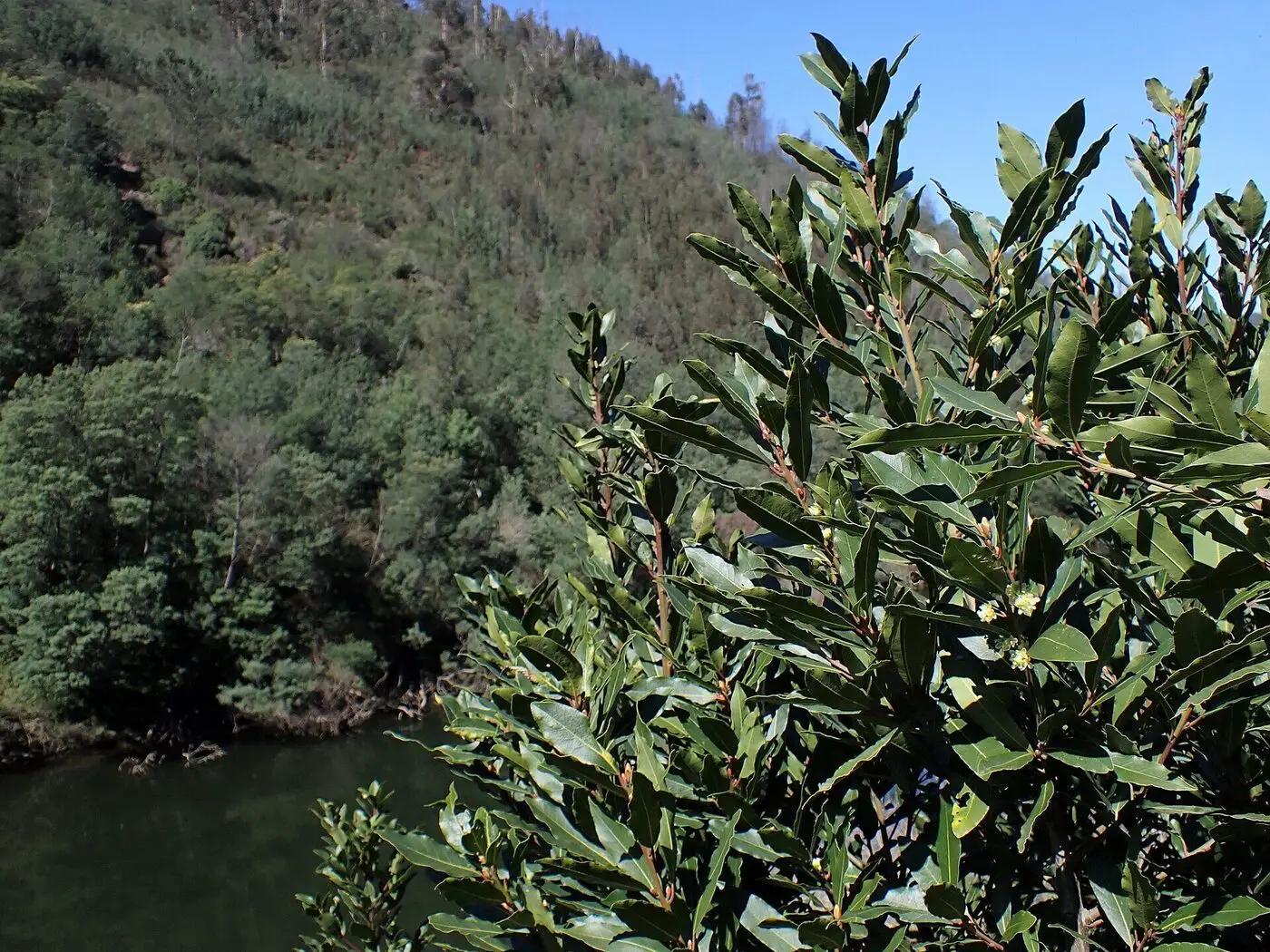

The same section adds smaller claims. Laurel leaves tossed in the air and caught behind the ears before they touch the ground are said to keep a man from getting drunk however much wine he takes.
Here is the catch that makes the Picatrix such good reading. Back in the third book laurel belonged to Mars, among the hot plants. In the fourth book laurel berries go into a compound fume for Venus, and in the Nabataean story the tree is the darling of Jupiter. One plant, three planets, all in the same book. The Renaissance tables that came later mostly gave laurel to the Sun, because of Apollo, which makes four. If anyone ever tells you there is one correct planetary ruler for a herb, handed down unchanged from antiquity, the Picatrix itself is your answer.
Myrtle and the root like a man
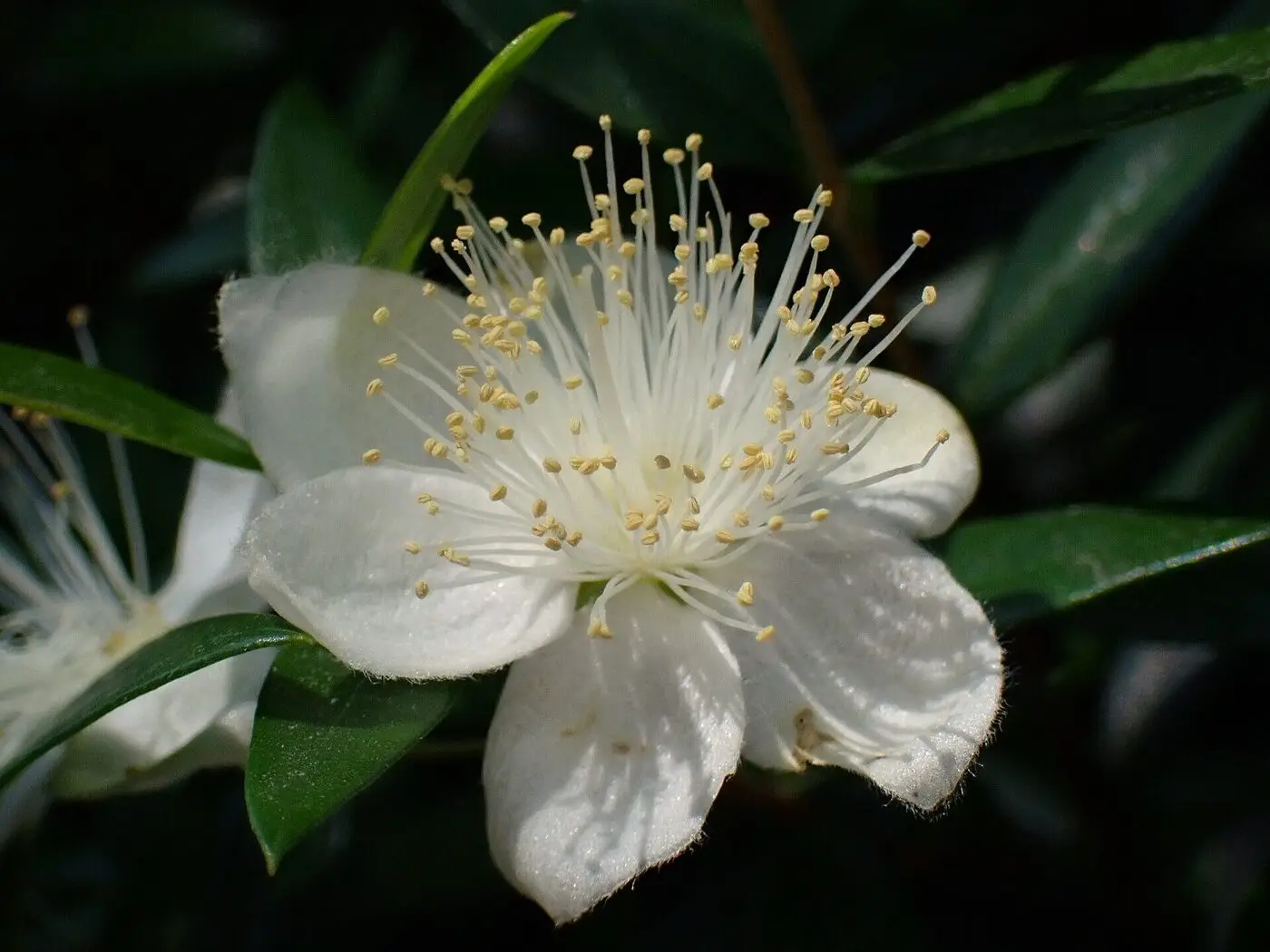
Myrtle, Myrtus communis, the evergreen Mediterranean shrub with glossy leaves and white flowers that the Greeks gave to Aphrodite, turns up across the book. Its association with love is ancient. Greek brides wore it, and Pliny records that when the Romans and the Sabines made peace after the famous seizure of the Sabine women, they laid down their arms and purified themselves with branches of myrtle, at the spot where a shrine of Venus later stood. So when the Picatrix makes green myrtle a smoke of Venus, it is following a very old road.
In the Picatrix green myrtle is a smoke of Venus and of Mercury. Myrtle flowers go into a fume for Jupiter. Branches of myrtle are laid through a house during certain rites.
In the Nabataean extracts it takes a darker turn. Some sages, the text says, held that myrtle strengthens magical work when it is mixed with other things, and that its root looks so like a human figure that the spirit of a person can be seen in it. The book then describes images cut from myrtle branches and used to curse. That human-shaped root sounds far more like what other writers said about mandrake, and whether the confusion goes back to the Arabic sources or crept in during translation, I can’t tell you. I report it as the book gives it. Australian readers should also know that “myrtle” here means that one Mediterranean shrub. Our lemon myrtle and the other native myrtles belong to the same family, Myrtaceae, but they are different plants that no medieval writer ever saw.

The dark shelf
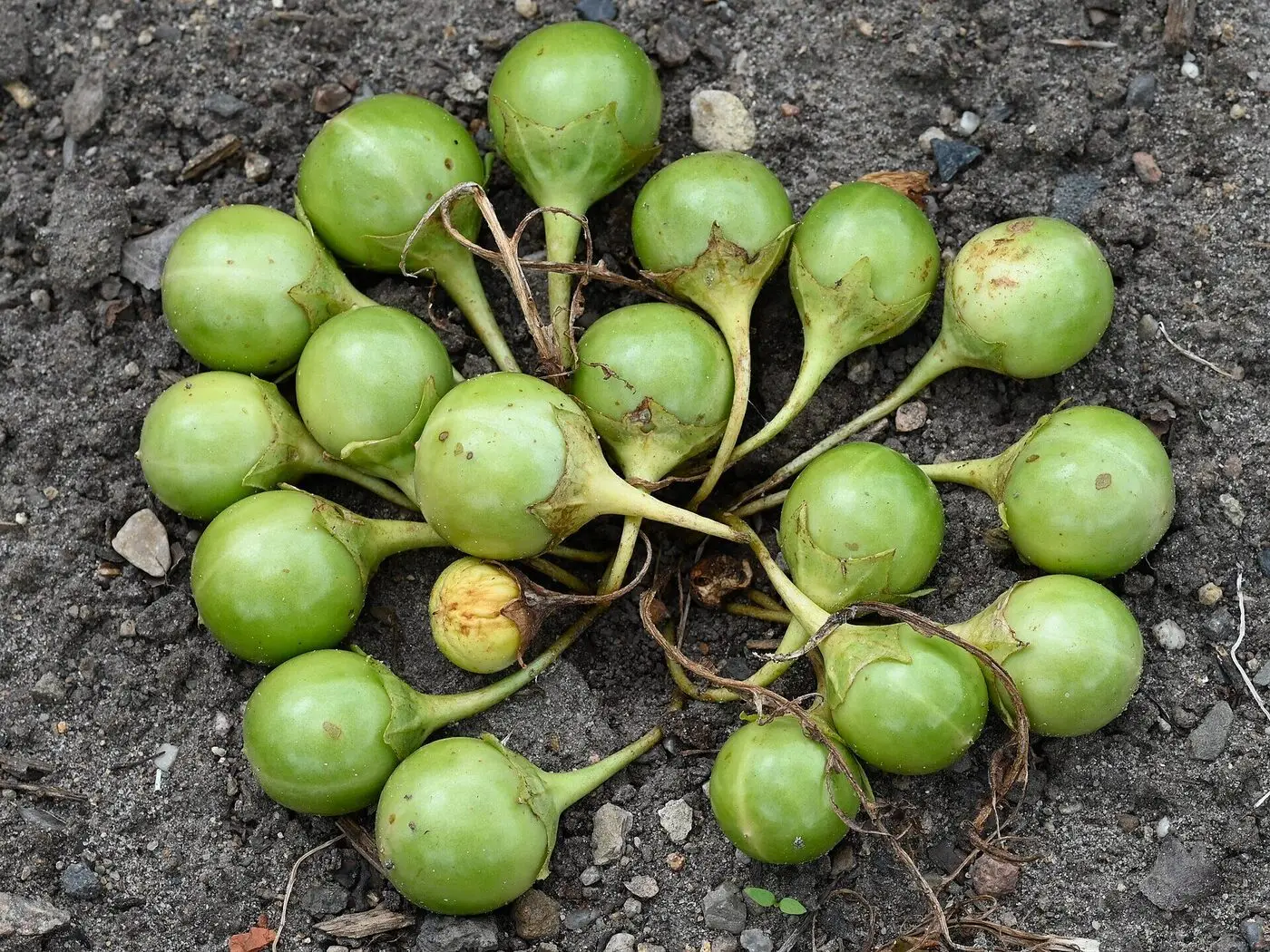
The Picatrix has a side that its admirers sometimes skate past. Among the ingredients of its fumes, ointments and compounds are some of the most poisonous plants in the Old World: mandrake, Mandragora officinarum; henbane, Hyoscyamus niger; datura, most likely the thorn-apple Datura metel of the Arab pharmacists; hemlock, Conium maculatum; black hellebore, a Helleborus that was probably an eastern Mediterranean species and not the Christmas rose of our gardens; and the opium poppy, Papaver somniferum. Mandrake fruit heads the fume for Saturn. Henbane goes into the smokes for Venus and Mercury. Whole sections of the fourth book are frankly about poisons, sleeping draughts meant for other people and worse.

The side-by-side reading turned up one more resident of this shelf that the English hides. In a small Solar fume the Latin lists eight ingredients and the Arabic lists eight. Seven match item for item. The eighth is saxifrage in the Latin, a harmless rock-garden plant, and in the Arabic it is stavesacre, Delphinium staphisagria, a Mediterranean larkspur whose seed is poisonous and was used for centuries to kill lice. A list that says saxifrage where the source says stavesacre has quietly lost a hazard. That alone is a good reason to treat translated recipe lists with care.
Attrell and Porreca, in the introduction to their translation, point out how often these ingredients appear and how large the quantities are. They argue that a magician standing over such smoke in a closed room may well have been reaching his “spirits” partly through what he breathed. It is a serious scholarly reading, and it’s also a reminder of why the book’s own authors warned that its secrets were for the careful and the prepared.
Keeping safe around the dark shelf
Mandrake, henbane and datura contain tropane alkaloids, and they can kill. Hemlock can kill. Stavesacre is poisonous. Their smoke is dangerous as well as their juice. Two of them are closer to hand than you might think. Hemlock has gone wild along creeks and roadsides in much of southern Australia, and it is easy to mistake for its carrot-family relatives such as wild carrot or cow parsley. Several thorn-apples, Datura species, are weeds of paddocks and roadsides across the country. The opium poppy is a controlled plant under Australian drug laws, and the rules on growing it differ from state to state, so check yours before you sow it. So read the recipes as history and leave them on the page. If you grow any of these plants, keep them well out of reach of children and pets, and wash your hands after handling them. If someone has swallowed or breathed in any of these plants, call 000 or the Poisons Information Centre on 13 11 26. If a pet has eaten one, ring your vet straight away.
What the Picatrix is good for today
If you keep a planetary garden or blend incense by correspondence, the Picatrix is one of the deep roots of what you do. Agrippa took a great deal from it, the Renaissance planetary tables took a great deal from Agrippa, and the modern correspondence books took theirs from both. Knowing the old book lets you see which modern attributions have a long history and which were made up recently.
It also teaches a kind of humility. The book never agrees with itself fully, it mixes sources from three continents, and it came into Latin through two translations, one of them by a translator its modern editor thought often blundered. Its plant names went through Arabic, Castilian, Latin and English hands, and at most of those stages the translator was naming a plant he may never have seen. Its planetary plants are a record of what learned magicians believed about the heavens. They are a map of sympathies set down a thousand years ago, and they make no claim you could test on a bench.
I spent a good while going through the translation plant by plant, and the result is our Picatrix Herbal, a catalogue of every plant the book names, where it appears, what it is in modern botany and how sure that identification is. It is a reference for the shelf, written as history. The book itself is richer than any catalogue, and if the laurel’s midnight speech has caught you, the Attrell and Porreca translation is the one to read first.
Where this comes from
- Picatrix: A Medieval Treatise on Astral Magic, trans. Dan Attrell and David Porreca (Pennsylvania State University Press, Magic in History series, 2019). Book 3, chapters 1, 3 and 7; Book 4, chapters 6 and 7; translators’ introduction.
- David Pingree, ed., Picatrix: The Latin Version of the Ghayat al-Hakim (Warburg Institute, Studies of the Warburg Institute vol. 39, 1986).
- Hellmut Ritter and Martin Plessner, trans., “Picatrix”: Das Ziel des Weisen von Pseudo-Magriti (Warburg Institute, Studies of the Warburg Institute vol. 27, 1962).
- Hellmut Ritter, ed., Pseudo-Magriti, Das Ziel des Weisen, 1: Arabischer Text (Teubner, Leipzig and Berlin, Studien der Bibliothek Warburg 12, 1933).
- The Picatrix, trans. John Michael Greer and Christopher Warnock (Adocentyn Press, 2010-2011).
- Maribel Fierro, “Batinism in al-Andalus. Maslama b. Qasim al-Qurtubi (d. 353/964), author of the Rutbat al-Hakim and the Ghayat al-Hakim (Picatrix)”, Studia Islamica 84 (1996), 87-112.
- Ibn Khaldun, The Muqaddimah: An Introduction to History, trans. Franz Rosenthal (Routledge and Kegan Paul / Pantheon, 1958), chapter 6, on sorcery and talismans.
- Jaakko Hämeen-Anttila, The Last Pagans of Iraq: Ibn Wahshiyya and his Nabatean Agriculture (Brill, 2006).
- Marsilio Ficino, Three Books on Life, ed. and trans. Carol V. Kaske and John R. Clark (Medieval and Renaissance Texts and Studies, 1989).
- H. C. Agrippa, De occulta philosophia libri tres (Cologne, 1533); Three Books of Occult Philosophy, ed. Donald Tyson (Llewellyn, 1993).
- Pliny the Elder, Natural History, book 15 (laurel and myrtle), trans. H. Rackham, Loeb Classical Library (Harvard University Press, 1945); Suetonius, Life of Tiberius, 69; Ovid, Metamorphoses, book 1.